
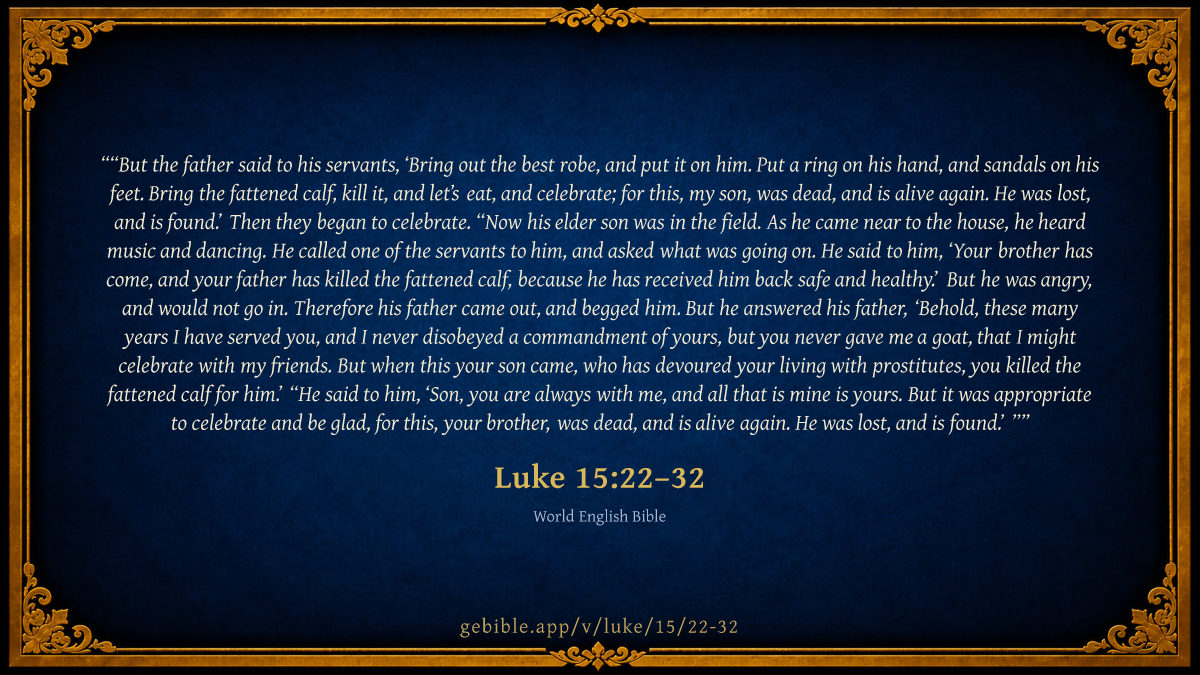
“But the father said to his servants, ‘Bring out the best robe, and put it on him. Put a ring on his hand, and sandals on his feet. Bring the fattened calf, kill it, and let’s eat, and celebrate; for this, my son, was dead, and is alive again. He was lost, and is found.’ Then they began to celebrate.
“Now his elder son was in the field. As he came near to the house, he heard music and dancing. He called one of the servants to him, and asked what was going on. He said to him, ‘Your brother has come, and your father has killed the fattened calf, because he has received him back safe and healthy.’ But he was angry, and would not go in. Therefore his father came out, and begged him. But he answered his father, ‘Behold, these many years I have served you, and I never disobeyed a commandment of yours, but you never gave me a goat, that I might celebrate with my friends. But when this your son came, who has devoured your living with prostitutes, you killed the fattened calf for him.’
“He said to him, ‘Son, you are always with me, and all that is mine is yours. But it was appropriate to celebrate and be glad, for this, your brother, was dead, and is alive again. He was lost, and is found.’ ”
Geneva Bible translators 1599 · Public Domain On v25 Such as truly fear God, desire to have all…
Such as truly fear God, desire to have all men to be their fellows.
Geneva Bible (1599) marginal notes — public domain.
John Trapp 1656 · Public Domain On vv22–32 22 But the father said to his servants, Bring…
22 But the father said to his servants, Bring forth the best robe, and put it on him; and put a ring on his hand, and shoes on his feet:
Ver. 22. The best robe] That white raiment of Christ’s righteousness, Rev 3:18; that rich and royal array, Psa 45:14, the righteousness (δικαιωματα) of the saints, Rev 19:8.
John Trapp, A Commentary or Exposition upon All the Books of the Old and New Testament (1647–1656) — public domain. Text from a community e-Sword module.
Matthew Poole 1685 · Public Domain On vv22, 25 We must remember that we are in a parable…
We must remember that we are in a parable where a sinner is represented to us under the notion of a prodigal son; God, under the notion of an indulgent father; a repenting sinner, under the notion of a prodigal returning to his father, confessing his error, petitioning his father for mercy, acknowledging he deserveth none, but casting himself upon his father’s goodness and mercy. It is observed by an eminent author, that amongst all the parables this is one of the most famous, and wherein is the most full and perfect representation of the thing intended to be represented, and an applicableness of every part of the similitude to that which it is brought to represent. This part of it represents the grace of God to truly repenting sinners. We before heard his readiness and willingness to receive them, this part lets us see the manner how he will treat them. As in case of apostasy, the seeming righteousness and profession of men shall not be remembered, Eze 3:20; 33:13; so in case of a true and hearty repentance, the sins of a soul shall not be remembered, Isa 43:25.
The father taketh no notice of the prodigal’s leaving his house, or wasting his estate riotously, but saith,
Read full note →
Bring forth the best robe, την στολην την πρωτην; and put a ring on his hand, and shoes on his feet: and bring hither the fatted calf, τον μοσχον τον σιτευτον. I find some interpreters who by the fatted calf are willing enough to understand Christ; yet interpreting the best robe, innocency, or inherent righteousness. Nor is it an ill interpretation, if we consider, that God, at the same time when he imputeth the merits of Christ to the soul for justification, doth also put his Spirit of holiness into the soul, by which being renewed in the inward man, this man brings forth the fruits of holiness unto righteousness, Eze 36:26,27. But why we should not understand both the phrases of the application of Christ’s merits, and the imputation of his righteousness to the soul, I cannot tell, considering, that the church of Laodicea is counselled to buy of him white raiment, that she might be clothed, Rev 3:18; and that those clothed with white robes, Rev 7:14, are said to have washed their robes, and made them white in the blood of the Lamb; and that though the habits of grace are sometimes in holy writ compared to clothing, Be ye clothed with humility, ( saith the apostle), yet these are not ς στολς ς πρωτς. I should therefore rather choose to interpret the killing of the fatted calf for the prodigal son, as representing that application of the blood of Christ, which is made to every sinner that truly repenteth, and maketh its application to God for mercy; and the best robe, as the righteousness of Christ, in that moment reckoned unto the soul (thus believing) for righteousness. Further yet, (to consider it only in the parable), the word θυσατε, sacrifice the fatted calf, seems to signify what a great cause of thanksgiving to God, as well as joy amongst men, the conversion of a sinner is. We that are earthly parents, or ministers of the gospel, should not receive the news, or see the visible probability of a soul’s being converted, and returning unto God, without offering a sacrifice of thanksgiving unto God for doing such things for men, and without a true and hearty rejoicing in ourselves. But to return again to the meaning of the parable.
Let us eat, and be merry: consider these words as the words of a heavenly Father, they signify unto us, that the eternal God, from the day that a repenting soul hath the blood of Christ applied to it, and is clothed with his righteousness, is at peace with the soul, hath a communion with it, and that it from that time hath a true right to spiritual mirth and rejoicing; for light is sown for the righteous, and joy for the upright in heart: though possibly the soul at present, through temptations, cannot apprehend it, and be not actually possessed of that joy and peace which followeth believing, yet it hath a right to it, and indeed none but that soul hath any thing to do with peace.
It followeth, For this my son was dead, and is alive again; he was lost, and is found. A sinful soul is a dead soul, as the woman that liveth in pleasure is said to be dead while she liveth, by the apostle. The conversion of a sinner is as a resurrection from the dead. Nor is any soul capable of any true mirth, till it be reconciled to God through the blood of Christ.
Matthew Poole's English Annotations on the Holy Bible (1683–1685) — public domain. Text from a community e-Sword/MySword module.
William Burkitt 1703 · Public Domain On v25 By the murmuring of the elder son at the…
By the murmuring of the elder son at the prodigal’s returning to, and reception with, his father, some think the Jews in general are to be understood, whose peevishness to the Gentiles, and the repining at the offer of salvation made unto them by the gospel, is very evident from many places of scripture: others understand it of the scribes and Pharisees in particular, who presuming on their own righteousness, as if they had never transgressed God’s commandments at any time, murmured at our Saviour for conversing with sinners, though it were in order to the bringing of them to repentance; which instead of being frowardly discontented at, they ought to have rejoiced at.
Learn hence, there is such an envious spirit in men, yea, even in the best of men, as inclined them to repine at such dispensations of divine grace and favor, as others receive, and they want.
Read full note →
Learn, 2. That to indulge such a spirit and temper in ourselves, argues great sin, and great folly: great sin in being dissatisfied with God’s dispensations, and affronting his wisdom and justice; and great folly, in making another’s good our grief; as if we had less, because another has more: The eldest son was angry, and would not go in: it follows, therefore came his father out and intreated him. This shows the meekness of God in dealing with us under, our frowardness; and the high satisfaction he takes in a sinner’s conversion and returning to his duty.
Lastly, this points out unto us our duty to imitate God, and be followers of him as dear children. Does he rejoice at a sinner’s return to this duty? So should we. It is the devil’s temper to regret and envy the good and happiness of others: he gnashes his teeth, when the prey he thought himself sure of, is snatched out of his jaws. But to God, and all his holy angels, nothing is so agreeable as their repentance and conversion of a sinner from the error of his ways, and the saving of a soul from death; this is looked upon as a resurrection from the dead, and a ground of the greatest joy and rejoicing: It was meet that we should make merry and be glad, for this thy brother was dead, and is alive again; he was lost, and is found.
Whence note, that regeneration is the term from which all true pleasure commences. We never live a merry day until we begin to live unto God; when the prodigal son returned to his father, then, and not until then, they began to be merry.
William Burkitt's Expository Notes on the New Testament (1700–1703) — public domain. Text from a community e-Sword module.
John Gill 1763 · Public Domain On vv22–32 But the father said to his servants,.... The word…
But the father said to his servants,.... The word "but", with which those words begin, is expressive of much grace, as it often is; see Co1 6:11 and signifies, that though the son had behaved so badly, and was now so sensible of it himself, as that he desired to be a hired servant, being unworthy to be called a son; but the "father", against whom he had sinned, would hear nothing of it: but
said to his servants; not the angels, but the ministers of the Gospel; who are the servants of the most high God; and whose business it is to set forth, in the ministry of the word, the righteousness of Christ, and the everlasting love of God; and to direct souls to a life and conversation becoming the Gospel of Christ; and to set before them the rich provisions of the Gospel for their nourishment, joy, and comfort. These servants, the father of the son ordered, not to take him away from his presence, as one whose person he could not endure in his sight; nor to terrify and affright him with the curse and condemnation of the law, and fill his mind with wroth and terror; nor even to chastise and correct him for his former course of living, and to upbraid him with it; but to confer upon him all the honour, and high favours, and blessings that could be expressed in the following language:
Read full note →
bring forth the best robe; out of the wardrobe, that it is in. The Vulgate Latin version adds "quickly"; which increases the father's regard to him and shows that he was in haste to have his son appear in a better condition: the Arabic version adds it in the next clause, "and put it on him quickly"; which expresses the same thing: and the Ethiopic version renders it, "hasten ye, bring", &c. By the "best robe" is meant, not water baptism; nor an holy life and conversation; nor any particular grace, as faith, or hope, or charity; or the whole of sanctification; nor Adam's robe of innocence; but the righteousness of Christ which is often compared to a robe, or garment, Isa 61:10 because it is not any thing in believers, but what is unto them, and upon them, and is put there by an act of God's grace in imputation; and is what covers their naked souls, and hides their sins from the avenging eye of divine justice; protects them from all injuries, and saves them from wrath to come; as well as beautifies and adorns them, and renders them acceptable in the sight of God; and keeps them warm and alive; and gives them a right and title to eternal life. This is as in the Greek text "the first robe"; and so it is rendered by the Vulgate Latin, and Arabic versions; because it was first in God's designation and counsel, and in Christ the head of his people, in whom they are blessed with all spiritual blessings before the foundation of the world, and so with this blessing; and it was also provided and secured in the everlasting covenant of grace, long before Adam's robe of innocence and righteousness was made and wore by him: the reference is not to the first that should be come at in the wardrobe; or to that which the son wore before he went into the far country; but to the "Talith", which was the first and uppermost garment wore by the Jews, and answers to the Greek word "the stole", here used: so the Babylonish garment is called, , (d) which the gloss interprets a "Talith", made of pure wool. The Ethiopic version renders the phrase, "fragrant garments"; and such are Christ's garments of salvation, and robe of righteousness; see Psa 45:8 the Persic version renders it, "the splendid robe"; and the Syriac, as ours, the "chief", or "best robe"; and such is Christ's righteousness: it is a better righteousness, not only than that of a self-righteous Pharisee; but better than the outward conversation garment of a real good man, which, at best, is imperfect; or than the inward sanctification of the Spirit of God, which, though pure, is not yet perfect: it is better than the robe of innocence wore by Adam in his sinless state; for that was but a natural righteousness, and the righteousness of a creature, and was loseable, as the event has shown; and had he kept it, would not have given him a title to eternal life: yea, it is better than the righteousness of the angels heaven; for what is said of Adam's, may be said of theirs, that it is natural, the righteousness of a creature; and had it not been for confirming grace, a loseable one: but Christ's righteousness is pure and perfect; the righteousness of God, and an everlasting one: and when the servants of God, the ministers of the Gospel, are ordered to bring it out,
and put it on him: this is done, not by the imputation of it to men, for that is the Father's act; nor by application of it to them, that is the Spirit's work; but by a declaration of it, setting it forth in a ministerial way before them; declaring it to be a justifying one, and encouraging their faith to lay hold upon it as such:
and put a ring on his hand; on one of the fingers of his hand: by which is intended not the grace of faith; that is, rather the hand on which the ring is put; and though this grace is both precious and ornamental, as will be allowed, yet it does not unite to Christ, this must be denied; it being a grace which flows from union, as all grace does; and by which souls have communion with Christ: nor are good works designed; such indeed who are called by grace, are to be set to work from a right principle, to a right end; and true grace does show itself by works; and good works are the seal and token of grace to the world; but then, as before, these are rather meant by the hand; since that is the instrument of action: nor is the seal and earnest of the Spirit meant by the ring. The Spirit of God is certainly the seal of grace, and the earnest of glory; and to have this is a high favour, and a precious benefit indeed, and what will never be taken away; but as faith, so not the Spirit is the bond of union between God and his people, but the fruit of it: by the "ring" is meant the everlasting love of God; and which, as a ring, is round, and has neither beginning nor end; it does not begin with the obedience of his people, nor with their love to him; nor with their conversion; nor with the mission, sufferings, and death of Christ; but was from all eternity; nor will it have any end, nor can there be any separation from it: this is the bond of union, that can never be dissolved; and this being manifested to the soul, is a token of freedom; it sets a man free from the bondage of corruption, and from the slavery of Satan, and introduces into the liberty of the children of God: it is a mark of great honour, a sign of riches, both of grace and glory; it is a declaration of sonship, and heirship; and is a seal and pledge of everlasting happiness: now the putting on of this ring does not design the shedding abroad of this love in the heart by the Spirit of God; but the declaration of it by his servants in a ministerial way; setting it forth in its nature and effects, to the great joy and comfort of souls; when believers receive it by the hand of faith, and which constrains them, and makes them active, and puts them upon doing good works to the glory of God.
And shoes on his feet: by feet are meant the outward walk and conversation; which in persons called by grace should be different from what it was before, and from that of others: it should not be loose and naked, as those that walk barefoot, but should be upright, straight, and regular; not carnal and earthly, but spiritual and heavenly; and should be with prudence, care, and circumspection, and worthy of their calling, and as becomes the Gospel of Christ: and by "the shoes" may be meant, the preparation of the Gospel of peace, Eph 6:15. The Gospel is as shoes to the feet; it beautifies and adorns, Sol 7:1 it keeps the feet tight and straight, the conversation regular and upright; preserves from slipping and failing; strengthens and makes more fit for walking; directs, guides, and influences in walking, and protects from the stones, thorns, and scorpions of the world's reproaches; and the doctrines of it are shoes that will never wear out: and to walk according to the Gospel of Christ, is what Gospel ministers direct and exhort unto, and may be meant by their putting on those shoes; they pressing a good life and conversation from, and by the doctrines of grace. A person with all these things on him was reckoned, among the Jews, as one thoroughly dressed: a canon of theirs, relating to the defilement of leprosy, runs thus (e);
"a man of Israel that goes into a house infected with the plague of leprosy, , "clothed with garments, and his sandals on his feet, and his rings on his hands", lo, that man is immediately defiled.''
(d) T. Bab. Sanhedrin, fol. 44. 1. Vid. Targum in Jos. vii. 21. (e) Maimon Hilch. Tumaot Tzaraath, c. 16. sect. 6. T. Bab. Cholin, fol 71. 2.
John Gill's Exposition of the Whole Bible (1746–1763) — public domain (CC PDM 1.0). Text via the HelloAO Bible API.
John Wesley 1765 · Public Domain On vv22, 23, 25, 27, 28, 29, 31, 32 But the father said - Interrupting him before he…
But the father said - Interrupting him before he had finished what he intended to say. So does God frequently cut an earnest confession short by a display of his pardoning love.
John Wesley, Explanatory Notes Upon the Whole Bible (1754–1765) — public domain. Text via the GEBible commentary corpus.
Adam Clarke 1810 · Public Domain On vv22, 23, 24, 25, 28, 29, 30, 31, 32 Verse 22. Bring forth the best robe] Bring out…
Verse 22. Bring forth the best robe] Bring out that chief garment, την στολην την πρωτην, the garment which was laid by, to be used only on birth-days or festival times. Such as that which Rebecca had laid by for Esau, and which she put on Jacob when she made him personate his brother. See Clarke on Ge 27:15.
Put a ring on his hand] Giving a ring was in ancient times a mark of honour and dignity. See Ge 41:42; 1Kg 21:8; Es 8:2; Da 6:17; Jas 2:2.
Read full note →
Shoes on his feet] Formerly those who were captivated had their shoes taken off, Isa 20:1; and when they were restored to liberty their shoes were restored. See 2Ch 28:15. In Bengal, shoes of a superior quality make one of the distinguishing parts of a person's dress. Some of them cost as much as a hundred rupees a pair; £10 or £12. Reference is perhaps made here to some such costly shoes. It is the same among the Chinese: some very costly shoes and boots of that people are now before me.
Adam Clarke's Commentary on the Bible (1810–1826) — public domain. Text from a community e-Sword/MySword module.
Joseph Benson 1811 · Public Domain On vv24, 25, 29, 32 Luk 15:24. For this my son was dead —…
Luk 15:24. For this my son was dead — Was considered by me as dead; and is alive again — “It is by a very common and beautiful emblem, that vicious persons are represented as dead, both by sacred and profane authors; and the natural death of their children would be less grievous to pious parents than to see them abandoned to such a course as this young sinner took.” — Doddridge. He was lost and is found — We looked upon him as utterly lost, but lo! he is come back again, beyond all expectation, in safety. Two things here are worthy of observation: 1st, That the conversion of a soul from sin to God is the raising of that soul from death to life, and the finding of that which seemed to be lost. It is a great, wonderful, and happy change: it is like that which passes upon the face of the earth when the spring returns. 2d, The conversion of sinners is very pleasing to the God of heaven, and all that belong to his family ought to rejoice in it. Those in heaven do, and those on earth should, rejoice. And they began to be merry — They sat down to the feast, rejoicing exceedingly at the happy occasion of it.
Joseph Benson's Commentary on the Old and New Testaments (1811–1818) — public domain. Text from a community e-Sword module.
Albert Barnes 1834 · Public Domain On vv22, 23, 24, 25, 26, 29, 30, 31 The best robe - The son was probably in…
The best robe - The son was probably in rags. The joy of the father is expressed by clothing him in the best raiment, that he might appear well. The “robe” here mentioned is probably the outer garment; and the father told them to put on him the best one that was in the house - one reserved for festival occasions. See Gen 27:15.
A ring on his hand - To wear a ring on the hand was one mark of wealth and dignity. The rich and those in office commonly wore them. Compare Jam 2:2. To “give” a ring was a mark of favor, or of affection, or of conferring office. Compare Gen 41:42; Est 8:2. Here it was expressive of the “favor” and affection of the father.
Read full note →
Shoes on his feet - Servants, probably, did not usually wear shoes. The son returned, doubtless, without shoes a condition very unlike that in which he was when he left home. When, therefore, the father commanded them to put shoes on him, it expressed his wish that he should not be treated “as a servant,” but “as a son.” The word “shoes” here, however, means no more than “sandals,” such as were commonly worn. And the meaning of all these images is the same - “that God will treat those who return to him with kindness and affection.” These images should not be attempted to be “spiritualized.” They are beautifully thrown in to fill up the narrative, and to express with more force the “general” truth that “God” will treat returning penitents with mercy and with love. To dress up the son in this manner was a proof of the father’s affection. So God will bestow on sinners the marks of his confidence and regard.
Albert Barnes' Notes on the Bible (1834–1885) — public domain. Text from a community e-Sword/MySword module.
Haydock's Catholic Bible Commentary 1859 · Public Domain On vv22, 24, 25, 29 The first; i.e. the best robe: by it, is…
The first; i.e. the best robe: by it, is meant the habit of grace. (Witham)
George Leo Haydock (1774–1849), Haydock's Catholic Family Bible and Commentary, 1859 edition — public domain. Excludes Psalms (Douay-Rheims chapter numbering differs from Protestant) and Deuterocanonical books (Catholic canon only).
Robert Jamieson, A. R. Fausset & David Brown 1871 · Public Domain On vv22, 23, 24, 25, 28, 29, 31, 32 But the Father said, &c.--The son has not said…
But the Father said, &c.--The son has not said all he purposed, not so much, because the father's demonstrations had rekindled the filial, and swallowed up all servile feeling [TRENCH] (on the word "Father," see on Luk 15:18), but because the father's heart is made to appear too full to listen, at that moment, to more in this strain.
the best robe--Compare Zac 3:4-5, "Take away the filthy garments from him; behold I have clothed thee with change of raiment; and they clothed him with garments" (Isa 61:10; Rev 3:18).
Read full note →
a ring--(Compare Gen 41:42; Jam 2:2).
shoes--Slaves went barefoot. Thus, we have here a threefold symbol of freedom and honor, restored, as the fruit of perfect reconciliation.
Jamieson, Fausset & Brown — Commentary Critical and Explanatory on the Whole Bible (1871) — public domain (CC PDM 1.0). Text via the HelloAO Bible API.
Daniel D. Whedon 1874 · Public Domain On vv22, 23, 24, 25, 28, 29, 31 22. The best robe—Literally, the first robe; that is,…
22. The best robe—Literally, the first robe; that is, the first in quality of the whole.
Robe… ring… shoes—These investments betoken the bestowing of the endowments and prerogatives of the child of God.
Daniel D. Whedon (gen. ed.), Commentary on the Old and New Testaments (1874–1909) — public domain. Text from a community e-Sword module.
The Cambridge Bible for Schools and Colleges 1878 · Public Domain On vv22, 24, 25, 28, 29, 30, 31, 32 22. But the father said to his servants] It…
22. But the father said to his servants] It is as though he had purposely cut short the humble self-reproaching words of shame which would have entreated him to make his lost son like one of his hired servants. “While they are yet speaking, I will hear,” Isa_65:24.
Bring forth] The true reading is probably ‘Bring forth quickly’ א, B, L, &c.
Read full note →
the best robe] The talar or stole poderes, Luk_20:46; Joh_19:23; Isa_61:10; Rev_3:18. Compare the remarkable scene of taking away the filthy rags from the High Priest Joshua, and clothing him with change of raiment, in Zec_3:1-10. It is literally ‘the first robe’ and some have explained it of the robe he used to wear at home—the former robe.
shoes on his feet] Another sign that he is to be regarded as a son, and not as a mere sandalled or unsandalled slave (see on Luk_10:4). Some have given special and separate significance to the best robe, as corresponding to the ‘wedding garment,’ the robe of Christ’s righteousness (Php_3:9); and have identified the seal-ring with Baptism (Eph_1:13-14); and the shoes with the preparation of the Gospel of peace (Eph_6:15; Zec_10:12); and in the next verse have seen in the ‘fatted calf’ an allusion to the Sacrifice of Christ, or the Eucharist. Such applications are pious and instructive afterthoughts, though the latter is as old as Irenaeus; but it is doubtful whether the elaboration of them does not weaken the impressive grandeur and unity of the parable, as revealing the love of God even to His erring children. We must not confuse Parable with Allegory. The one dominant meaning of the parable is that God loved us even while we were dead in sins, Eph_2:1; Eph_2:5.
kill it] Rather, sacrifice it (comp. Herod. i. 118 where there is a sacrifice and supper for a son’s safety). Hence perhaps one reason for assigning to St Luke the Cherubic symbol of the calf (Introd. p. 13).
The Cambridge Bible for Schools and Colleges (gen. ed. J. J. S. Perowne; Cambridge University Press, 1878–1918) — public domain. Text from a community e-Sword module.
Ellicott's Commentary for English Readers 1878 · Public Domain On vv22, 23, 24, 25, 27, 28, 29, 30, 31, 32 (22) Bring forth the best robe.—It is hardly necessary,…
(22) Bring forth the best robe.—It is hardly necessary, perhaps, in such a parable, to press the symbolic interpretation of each minute detail; but in this instance the symbolism lies so near the surface that it is at least well to ask ourselves what meaning either earlier or later associations would lead the disciples to attach to them. The “best robe” cannot well be other than the “garment of praise” (Isa_61:3), the vesture of righteousness, the new life and immortality with which it is the desire of the penitent to be clothed upon; the ring, as the signet upon the right hand (Jer_22:24), must be the token of the special favour of the Giver, the seal of his “calling and election;” the shoes must answer to that “preparation” or “readiness” which comes from the gospel of peace (Eph_6:15), and which makes him eager to do his work as a messenger who proclaims that gospel to others, and which he need not lay aside (comp. Exo_3:5) even when he treads on the “holy ground” where man holds communion with God, the forgiven and restored son with the Eternal Father.
A Bible Commentary for English Readers, edited by Charles John Ellicott (1878–1897) — public domain. Text from a community e-Sword module.
The Pulpit Commentary 1880 · Public Domain On vv22, 23, 25, 28, 29, 31 But the father said to his servants, Bring forth…
But the father said to his servants, Bring forth the best robe, and put it on him; and put a ring on his hand, and shoes on his feet. The older authorities add "quickly" after the words "bring forth." Everything is done by the father to assure the wanderer of full and entire forgiveness. Not only is a welcome given to the tired, ragged son, but he is invested at once, with all speed, with the insignia of his old rank as one of the house. But it is observable not a word is spoken of reply to the confession; in grave and solemn silence the story of the guilty past is received. Nothing can excuse it. He forgives, but forgives in silence.
The Pulpit Commentary (1880–1919), ed. H.D.M. Spence-Jones & Joseph S. Exell — public domain. Text from a community e-Sword module.
Alexander MacLaren 1905 · Public Domain On vv22, 24
Luke
THE PRODIGAL AND HIS FATHER
Read full note →
GIFTS TO THE PRODIGAL
Luk 15:22 - Luk 15:23.
God’s giving always follows His forgiving. It is not so with us. We think ourselves very magnanimous when we pardon; and we seldom go on to lavish favours where we have overlooked faults. Perhaps it is right that men who have offended against men should earn restoration by acts, and should have to ride quarantine, as it were, for a time. But I question whether forgiveness is ever true which is not, like God’s, attended by large-hearted gifts. If pardon is only the non-infliction of penalty, then it is natural enough that it should be considered sufficient by itself, and that the evildoer should not be rewarded for having been bad. But if pardon is the outflow of the love of the offended to the offender, then it can scarcely be content with simply giving the debtor his discharge, and turning him into the world penniless.
However that may be with regard to men, God’s forgiveness is essentially the communication of God’s love to us sinners, as if we had never sinned at all. And, that being so, that love cannot stay its working until it has given all that it can bestow or we can receive. God does not do things by halves; and He always gives when He forgives.
Now that is the great truth of the last part of this immortal parable. And it is one of the points in which it differs from, and towers high above, the two preceding ones. The lost sheep was carried back to the pastures, turned loose there, needed no further special care, and began to nibble as if nothing had happened. The lost drachma was simply put back in the woman’s purse. But the lost son was pardoned, and, being pardoned, was capable of receiving, and received, greater gifts than he had before. These gifts are very remarkably detailed in the words of our text.
Now, of course, it is always risky to seek for a spiritual interpretation of every point in a parable, many of which points are mere drapery. But, on the other hand, we may very easily fall into the error of treating as insignificant details which really are meant to be full of instruction. And I cannot help thinking-although many would differ from me,-that this detailed enumeration of the gifts to the prodigal is meant to be translated into the terms of spiritual experience. So I desire to look at them as suggesting for us the gifts of God which accompany forgiveness. I take the catalogue as it stands-the Robe, the Ring, the Shoes, the Feast.
I. First, the Robe.
‘Bring forth the best robe, and put it on him.’ That was the command. This detail, of course, like all the others, refers back to, and casts light upon, the supposed condition of the spendthrift when he came back. There he stood, ragged, with the stain of travel and the stench of the pig-sty upon his garments, some of them, no doubt, remains of the tawdry finery that he had worn in the world; wine-spots, and stains, and filth of all sorts on the rags. The father says, ‘Take them all off him, and put the best robe upon him.’ What does that mean?
Well, we all know the very familiar metaphor by which qualities of mind, traits of character, and the like are described as being the dress of the spirit. We talk about being ‘arrayed in purity,’ ‘clad in zeal,’ ‘clothed with humility,’ ‘vested with power,’ and so on. If we turn to Scripture, we find running through it a whole series of instances of this metaphor, which guide us at once to its true meaning. Zechariah saw in vision the high priest standing at the heavenly tribunal, clad in filthy garments. A voice said, ‘Take away the filthy garments from him,’ and the interpretation is added: ‘Behold! I have caused thine iniquity to pass from thee, and I will clothe thee with a change of raiment.’ You remember our Lord’s parable of the man with a wedding garment. You remember the Apostle Paul’s frequent use of the metaphor of ‘putting off the old man, putting on the new.’ You remember, finally, the visions of the last days, in which the Seer in Patmos saw the armies in heaven that followed their victorious Commander, ‘clothed in fine linen, white and pure, which is the righteousness of the saints.’ If we put all these together, surely I am not forcing a meaning on a non-significant detail, when I say that here we have shadowed for us the great thought, that the result of the divine forgiveness coming upon a man is that he is clothed with a character which fits him to sit down at his Father’s table. They tell us that forgiveness is impossible, because things done must have their consequences, and that character is the slow formation of actions, precipitated, as it were, from our deeds. That is all true. But it does not conflict with this other truth that there may and does come into men’s hearts, when they set their faith on Jesus Christ, a new power which transforms the nature and causes old things to pass away.
God’s forgiveness revolutionises a life. Similar effects follow even human pardons for small offences. Brute natures are held in by penalties, and to them pardon means impunity, and impunity means licence, and licence means lust. But wherever there is a heart with love to the offended in it, there is nothing that will so fill it with loathing of its past self as the assurance that the offended, though loved, One loves, and is not offended, and that free forgiveness has come. Whether is it the rod or the mother’s kiss that makes a child hate its sin most? And if we lift our thoughts to Him, and think how He, up there in the heavens,
‘Who mightest vengeance best have took,’
bends over us in frank, free forgiveness, then surely that, more than all punishments or threatenings or terrors, will cause us to turn away from our evil, and to loathe the sins which are thus forgiven. The prophet went very deep when he said, ‘Thou shalt be ashamed and confounded, and never open thy mouth any more because of thine iniquity, when I am pacified towards thee for all that thou hast done, saith the Lord.’
But not only so, there is given along with forgiveness, and wrapped up in it, a new power, which makes all things new, and changes a man. It would be a poor Gospel for me to stand up and preach if I had only to proclaim to men the divine forgiveness; and if that only meant that hell’s door was barred and some outward heaven was flung open. But the true Gospel offers forgiveness as preliminary to the bestowal of the highest gifts of God. The pardoned man is stripped of his rags and clothed with a new nature which God Himself bestows.
That is what we all need. We have not all been in the pig-sty; we have not all fallen into gross sin. We have all turned our backs on our Father; we have all wanted to be independent; we have all preferred the far-off land to being near home. And, dear brethren, the character that you have made for yourselves clings to you like the poisoned Nessus’ shirt to Hercules. You cannot strip it off. You may get part of it away, but you cannot entirely cast it from your limbs, nor free yourselves from the entanglements of its tatters. Go to God, and He will smile away your sin, and His forgiving love will melt the stains and the evil, as the sun this morning drank up the mists; and they who come knowing themselves to be foul, and needing forgiveness, will surely receive from Him ‘the fine linen white and pure, the righteousness of saints.’
II. The Ring.
This prodigal lad only wanted to be placed in the position of a slave, but his father said, ‘Put a ring on his finger.’ The ring is an emblem of wealth, position, honour; that is one signification of this gift to the penitent. Still further, it is an ornament to the hand on which it glistens; that is another. It is a sign of delegated authority and of representative character; as when Joseph was exalted to be the second man in Egypt, and Pharaoh’s signet ring was plucked off and placed upon his finger. All these thoughts are, as it seems to me, clustered in, and fairly deducible from, this one detail.
Freedom, exaltation, dignity of position are expressed. And that opens up a thought which needs to be set forth with many reservations, and much guarding, but still is true-viz., that, by the mercy and miraculous loving-kindness and quickening power of God in the Gospel, it is possible that the lower a man falls the higher he may rise. I know, of course, that it is better to be innocent than to be cleansed. I know, and every man that looks into his own heart knows, that forgiven sins may leave scars; that the memory may be loaded with many a foul and many a painful remembrance; that the fetters may be stricken off the limbs, but the marks of them, and the way of walking that they compelled, may persist long after deliverance. But I know, too, that redeemed men are higher in final position than angels that never fell; and that, though it is too much to say that the greater the sinner the greater the saint, it still remains true that sin repented and forgiven may be, as it were, an elevation upon which a man may stand to reach higher than, apparently, he otherwise would in the divine life.
And so, though I do not say to any man, Make the experiment; for, indeed, the poorest of us has sins enough to get all the benefit out of repentance and forgiveness which is included in them, yet, if there is any man here-and I hope there is-saying to himself, ‘I have got too low down ever to master this, that, or the other evil; I have stained myself so foully that I cannot hope to have the black marks erased,’ I say to such; ‘Remember that the man who ended with a ring on his finger, honoured and dignified, was the man that had herded with pigs, and stank, and all but rotted, with his fleshly crimes.’ And so nobody need doubt but that for him, however low he has gone, and however far he has gone, there is restoration possible to a higher dignity than the pure spirits that never transgressed at any time God’s commandment will ever attain; for he who has within himself the experience of repentance, of pardon, and who has come into living contact with Jesus Christ as Redeemer, can teach angels how blessed it is to be a child of God.
Nor less distinctly are the other two things which I have referred to brought out in this metaphor. Not only is the ring the sign of dignity, but it is also the sign of delegated authority and representative character. God sets poor penitents to be His witnesses in His world, and to do His work here. And a ring is an ornament to the hand that wears it; which being translated is this: where God gives pardon, He gives a strange beauty of character, to which, if a man is true to himself, and to his Redeemer, he will assuredly attain. There should be no lives so lovely, none that flash with so many jewelled colours, as the lives of the men and women who have learned what it is to be miserable, what it is to repent, what it is to be forgiven. So, though our ‘hands have been full of blood,’ as the prophet says, though they have dabbled in all manner of pollution, though they have been the ready instruments of many evil things, we may all hope that, cleansed and whitened, even our hands will not want the lustre of that adornment which the loving father clasped upon the fingers of his penitent boy.
III. Further, ‘Shoes on his feet.’
No doubt he had come back barefooted and filthy and bleeding, and it was needful for the ‘keeping’ of the narrative that this detail should appear. But I think it is something more than drapery.
Does it not speak to us of equipment for the walk of life? God does prepare men for future service, and for every step that they have to take, by giving to them His forgiveness for all that is past. The sense of the divine pardon will in itself fit a man, as nothing else will, for running with patience the race that is set before him. God does communicate, along with His forgiveness, to every one who seeks it, actual power to ‘travel on life’s common way in cheerful godliness’; and his feet are ‘shod with the preparedness of the gospel of peace.’
Ah, brethren, life is a rough road for us all, and for those whose faces are set towards duty, and God, and self-denial, it is especially so, though there are many compensating circumstances. There are places where sharp flints stick up in the path and cut the feet. There are places where rocks jut out for us to stumble over. There are all the trials and sorrows that necessarily attend upon our daily lives, and which sometimes make us feel as if our path were across heated ploughshares, and every step was a separate agony. God will give us, if we go to Him for pardon, that which will defend us against the pains and the sorrows of life. The bare foot is cut by that which the shod foot tramples upon unconscious.
There are foul places on all our paths, over which, when we pass, if we have not something else than our own naked selves, we shall certainly contract defilement. God will give to the penitent man, if he will have it, that which will keep his feet from soil, even when they walk amidst filth. And if, at any time, notwithstanding the defence, some mud should stain the foot, and he that is washed needs again to wash his feet, the Master, with the towel and the basin, will not be far away.
There are enemies and dangers in life. A very important part of the equipment of the soldier in antiquity was the heavy boot, which enabled him to stand fast, and resist the rush of the enemy. God will give to the penitent man, if he will have it, that which will set his foot upon a rock, ‘and establish his goings,’ and which ‘will make him able to withstand in the evil day, and having done all, to stand.’
Brethren, defence, stability, shielding from pains, and protection against evil are all included in this great promise, which each of us may realise, if we will, for ourselves.
IV. Lastly, the Feast.
Now that comes into view in the parable, mainly as teaching us the great truth that Heaven keeps holiday, when some poor waif comes shrinking back to his Father. But I do not touch upon that truth now, though it is the main significance of this last part of the story.
The prodigal was half starving, and the fatted calf was killed ‘for him,’ as his ill-conditioned brother grumbled. Remember what it was that drove him back-not his heart, nor his conscience, but his stomach. He did not bethink himself to go back, because dormant filial affection woke up, or because a sense that he had been wrong stirred in him, but because he was hungry; and well he might be, when ‘the husks that the swine did eat’ were luxuries beyond his reach. Thank God for the teaching that even so low a motive as that is accepted by God; and that, if a man goes back, even for no better reason-as long as he does go back, he will be welcomed by the Father. This poor boy was quite content to sink his sonship for the sake of a loaf; and all that he wanted was to stay his hunger. So he had to learn that he could not get bread on the terms that he desired, and that what he wished most was not what he needed first. He had to be forgiven and bathed in the outflow of his father’s love before he could be fed. And, being thus received, he could not fail to be fed. So the message for us is, first, forgiveness, and then every hunger of the heart satisfied; all desires met; every needful nourishment communicated, and the true bread ours for ever, if we choose to eat. ‘The meek shall eat and be satisfied.’
I need not draw the picture-that picture of which there are many originals sitting in these pews before me-of the men that go for ever roaming with a hungry heart, through all the regions of life separate from God; and whether they seek their nourishment in the garbage of the sty, or whether fastidiously they look for it in the higher nutriment of mind and intellect and heart, still are condemned to be unfilled.
Brethren, ‘Why do you spend your money for that . . . which satisfies not?’ Here is the true way for all desires to be appeased. Go to God in Jesus Christ for forgiveness, and then everything that you need shall be yours. ‘I counsel thee to buy of Me . . . white raiment that thou mayest be clothed.’ ‘He that eateth of this bread shall live for ever.’
Alexander MacLaren, Expositions of Holy Scripture (1904–1910) — public domain. Text from a community e-Sword module.
Paul E. Kretzmann 1924 · Public Domain On v25 The older son:
The older son:
v. 25. Now his elder son was in the field; and as lie came and drew nigh to the house, he heard music and dancing.
Read full note →
v. 26. And he called one of the servants, and asked what these things meant.
v. 27. And he said unto him, Thy brother is come, and thy father hath killed the fatted calf because he hath received him safe and sound.
v. 28. And he was angry, and would not go in; therefore came his father out and intreated him.
v. 29. And he, answering, said to his father, Lo, these many years do I serve thee, neither transgressed I at any time thy commandment; and yet thou never gavest me a kid that I might make merry with my friends;
v. 30. but as soon as this thy son was come, which hath, devoured thy living with harlots, thou hast killed for him the fatted calf.
v. 31. And he said unto him, Son, thou art ever with me, and all that I have is thine.
v. 32. It was meet that we should make merry and be glad; for this thy brother was dead and is alive again; and was lost and is found.
A picture of the prim and proper, sanctimonious and self-righteous person. The older son, whom no temptation had apparently ever assailed, was busy in the field during all this time, and may not have returned till toward evening. But when he did return, the unusual bustle and commotion on the place, which had recently been as quiet as a cemetery, caused him to wonder. The sound of the musical instruments which accompanied the choirs of singers could be heard for some distance. He was filled with astonishment and displeasure that a festival should have been arranged without his knowledge, and, calling one of the servants to him, he inquired what all that meant. The servant answered, as well as he could, probably according to the part that he had been obliged to take in the feast. The fatted calf had been slaughtered because the brother was home again and well. This news filled the older brother, not only with disgust, but with anger. A sense of wrong and general unfair treatment took hold upon him. So far as he was concerned, he had washed his hands of the good-for-nothing youngster; and the latter might have been lost and could have perished for all he cared. While the father, against whom the sin had been committed, was full of joy over the repentant son, the older son, in his peevish mood, does not even want to be seen in the company of the wastrel. Thereupon the father went out to him and pleaded with him, thus showing as much love and patience with this boy as with the other. The anger and the entire behavior of the older son was altogether unreasonable. It was spiteful talk to accuse his father of never having given him so much as a kid to provide a feast for himself and his friends. And his self-praise of his willing service and of his keeping the commands of the father was a veiled attack on his brother. The gentle rebuke of the father was very properly administered. What the father had acquired since the division of the goods was his to dispose of as he pleased. But he had been generous to the older boy beyond his duty, for lie had shared all with him, had given him the full and unrestricted use of his property. Therefore he admonishes him finally to be joyful with the rest, since the dead one had returned to life, since the lost one had been found. The older son is a type of the self-righteous Pharisees of all times, that are always boasting of their good works and merits and begrudge the poor sinners the unmerited grace of God. That they themselves and all that they can perform owe this to the goodness of God, that fact seems never to strike their minds. That the fact of their never having been tempted to such an extent as many a fallen person is in itself an unmerited grace, that has never occurred to them. But God is merciful above all comprehension of man. According to His gracious will, He wants all men to be saved. He is not only happy over the repentance of publicans and sinners, but He tries to soften the hearts of proud Pharisees as well.
The entire parable has reference to the lost and prodigal sons and daughters of all times, showing to all sinners the way of redemption. But also the believers, the true children of God, that are enjoying the fullness of God’s grace, should learn the lesson of this parable, to understand ever more fully what sin and grace includes. The ’entire life of every Christian is a continual repentance. True Christians, by daily contrition and repentance, turn away from the world and its allurements, turn to God the Father, pray daily in true faith for forgiveness of all trespasses, and are glad of the experience of God’s love toward sinners. Such Christians will rejoice from their hearts whenever a prodigal son or daughter returns and asks for admission; they will give them a reception which is in accordance with the merciful will of God, never forgetting that every one that is saved receives this mercy in the same way as the thief on the cross, by grace alone.
Summary.Jesus teaches the Pharisees the meaning of God’s love for the lost by telling the parables of the lost sheep, the lost piece of silver, and the prodigal son.
Paul E. Kretzmann, Popular Commentary of the Bible (1921–1924) — public domain. Text from a community e-Sword module.
unfoldingWord translationNotes 2017 · CC BY-SA 4.0 On vv22, 25, 28, 31 best robe
best robe
"the best robe in the house." AT: "the best coat" or "the best garment"
Read full note →
put a ring on his hand
A ring was a sign of authority that men wore on one of their fingers.
sandals
Wealthy people of that time wore sandals. However, in many cultures the modern equivalent would be "shoes."
fattened calf
A calf is a young cow. People would give one of their calves special food so that it would grow well, and then when they wanted to have a special feast, they would eat that calf. AT: "the best calf" or "the young animal we have been making fat" (See: Assumed Knowledge and Implicit Information)
kill it
The implied information that they were to cook the meat can be made explicit. AT: "kill it and cook it" (See: Assumed Knowledge and Implicit Information)
my son was dead, and now he is alive
This metaphor speaks of the son being gone as if he were dead. AT: "it is as if my son were dead and became alive again" or "I felt like my son had died, but he is now alive" (See: Metaphor)
He was lost, and now he is found
This metaphor speaks of the son being gone as if he were lost. AT: "It is as if my son were lost and now I found him" or "My son was lost and has returned home" (See: Metaphor)
translationWords
servant
robe
sandal
cow
feast
die
life
unfoldingWord translationNotes — © Distant Shores Media and the Door43 World Missions Community, licensed CC BY-SA 4.0. Source: git.door43.org/Door43/en_tn.
Tyndale Open Study Notes 2022 · CC BY-SA 4.0 On vv22, 23, 28, 30, 31 15:22 The finest robe belonged to the father; it…
15:22 The finest robe belonged to the father; it affirmed the son’s role as an heir and a cherished member of the household. • Get a ring for his finger: A ring was a symbol of authority. Like the robe, it indicated his status as son and heir.
Tyndale Open Study Notes — © Tyndale Open Resources, licensed CC BY-SA 4.0. Text via the HelloAO Bible API.