
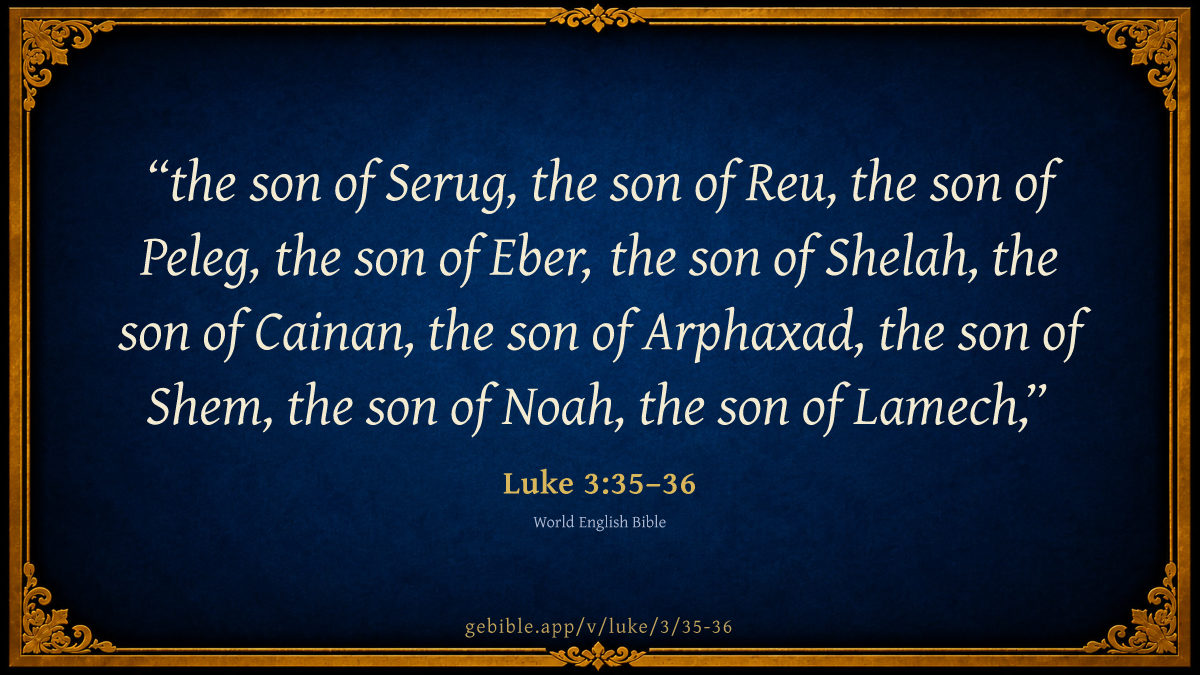
the son of Serug, the son of Reu, the son of Peleg, the son of Eber, the son of Shelah, the son of Cainan, the son of Arphaxad, the son of Shem, the son of Noah, the son of Lamech,
Show the surrounding paragraph
Luke 3:35-36 sits inside this longer paragraph.
Jesus himself, when he began to teach, was about thirty years old, being the son (as was supposed) of Joseph, the son of Heli, the son of Matthat, the son of Levi, the son of Melchi, the son of Jannai, the son of Joseph, the son of Mattathias, the son of Amos, the son of Nahum, the son of Esli, the son of Naggai, the son of Maath, the son of Mattathias, the son of Semein, the son of Joseph, the son of Judah, the son of Joanan, the son of Rhesa, the son of Zerubbabel, the son of Shealtiel, the son of Neri, the son of Melchi, the son of Addi, the son of Cosam, the son of Elmodam, the son of Er, the son of Jose, the son of Eliezer, the son of Jorim, the son of Matthat, the son of Levi, the son of Simeon, the son of Judah, the son of Joseph, the son of Jonan, the son of Eliakim, the son of Melea, the son of Menan, the son of Mattatha, the son of Nathan, the son of David, the son of Jesse, the son of Obed, the son of Boaz, the son of Salmon, the son of Nahshon, the son of Amminadab, the son of Aram, the son of Hezron, the son of Perez, the son of Judah, the son of Jacob, the son of Isaac, the son of Abraham, the son of Terah, the son of Nahor, the son of Serug, the son of Reu, the son of Peleg, the son of Eber, the son of Shelah, the son of Cainan, the son of Arphaxad, the son of Shem, the son of Noah, the son of Lamech, the son of Methuselah, the son of Enoch, the son of Jared, the son of Mahalaleel, the son of Cainan, the son of Enos, the son of Seth, the son of Adam, the son of God.
Parallel Translations
-
the son of Serug, the son of Reu, the son of Peleg, the son of Eber, the son of Shelah,
the son of Cainan, the son of Arphaxad, the son of Shem, the son of Noah, the son of Lamech,
-
which was the sonne of Saruch: which was the sonne of Ragau: which was the sonne of Phalec: which was the sonne of Heber: which was the sonne of Sala:
which was the sonne of Cainan: which was the sonne of Arphaxat: which was the sonne of Sem: which was the sonne of Noe: which was the sonne of Lameth:
Show all 3 translations
-
The sonne of Saruch, the sonne of Ragau, the sonne of Phalec, the sonne of Eber, the sonne of Sala,
The sonne of Cainan, the sonne of Arphaxad, the sonne of Sem, the sonne of Noe, the sonne of Lamech,
Examined in Scripture Analysis
Contradictions (1)
Questions where the Bible appears to say two different things, with the passages on each side set together.
Cross-references (19)
- Genesis 5:28-32 (v36) Lamech lived one hundred eighty-two years, then became the father of a son. He named him Noah, saying, “This one will comfort us in our…
- Genesis 10:21-22 (v36) Children were also born to Shem (the elder brother of Japheth), the father of all the children of Eber. The sons of Shem were: Elam,…
- Genesis 9:1 (v36) God blessed Noah and his sons, and said to them, “Be fruitful, multiply, and replenish the earth.
- Genesis 6:8-10 (v36) But Noah found favor in Yahweh’s eyes. This is the history of the generations of Noah: Noah was a righteous man, blameless among the people…
- Genesis 6:22–7:1 (v36) Thus Noah did. He did all that God commanded him. Yahweh said to Noah, “Come with all of your household into the ship, for I have seen your…
Show all 19 cross-references
- Genesis 7:13 (v36) In the same day Noah, and Shem, Ham, and Japheth—the sons of Noah—and Noah’s wife and the three wives of his sons with them, entered into…
- Genesis 7:23 (v36) Every living thing was destroyed that was on the surface of the ground, including man, livestock, creeping things, and birds of the sky.…
- Genesis 8:1 (v36) God remembered Noah, all the animals, and all the livestock that were with him in the ship; and God made a wind to pass over the earth. The…
- Genesis 9:26-27 (v36) He said, “Blessed be Yahweh, the God of Shem. Let Canaan be his servant. May God enlarge Japheth. Let him dwell in the tents of Shem. Let…
- Genesis 10:24-25 (v35) Arpachshad became the father of Shelah. Shelah became the father of Eber. To Eber were born two sons. The name of the one was Peleg, for in…
- Genesis 11:10-26 (v36) This is the history of the generations of Shem: Shem was one hundred years old when he became the father of Arpachshad two years after the…
- Genesis 11:12-21 (v35) Arpachshad lived thirty-five years and became the father of Shelah. Arpachshad lived four hundred three years after he became the father of…
- 1 Chronicles 1:17 (v36) The sons of Shem: Elam, Asshur, Arpachshad, Lud, Aram, Uz, Hul, Gether, and Meshech.
- Ezekiel 14:14 (v36) though these three men, Noah, Daniel, and Job, were in it, they would deliver only their own souls by their righteousness,” says the Lord…
- Luke 17:27 (v36) They ate, they drank, they married, and they were given in marriage until the day that Noah entered into the ship, and the flood came and…
- Hebrews 11:7 (v36) By faith, Noah, being warned about things not yet seen, moved with godly fear, prepared a ship for the saving of his house, through which…
- 1 Peter 3:20 (v36) who before were disobedient, when God waited patiently in the days of Noah, while the ship was being built. In it, few, that is, eight…
- 2 Peter 2:5 (v36) and didn’t spare the ancient world, but preserved Noah with seven others, a preacher of righteousness, when he brought a flood on the world…
- Genesis 9:18 (v36) The sons of Noah who went out from the ship were Shem, Ham, and Japheth. Ham is the father of Canaan.
Cross-references from openbible.info (CC BY 4.0)
Explain this passage (8 sources)
Historical commentary, presented as a primary source — not an endorsement.
Private notes
Saved on this device only — never synced or sent anywhere.
John Trapp 1656 · Public Domain On vv35–36 35 Which was the son of Saruch, which was…
35 Which was the son of Saruch, which was the son of Ragau, which was the son of Phalec, which was the son of Heber, which was the son of Sala,
Ver. 35. Which was the son of Thara] So there are reckoned ten generations from Abraham to Noah. And again, ten from Noah to Adam.
John Trapp, A Commentary or Exposition upon All the Books of the Old and New Testament (1647–1656) — public domain. Text from a community e-Sword module.
John Gill 1763 · Public Domain On vv35–36 Which was the son of Cainan,.... This Cainan is…
Which was the son of Cainan,.... This Cainan is not mentioned by Moses in Gen 11:12 nor has he ever appeared in any Hebrew copy of the Old Testament, nor in the Samaritan version, nor in the Targum; nor is he mentioned by Josephus, nor in Ch1 1:24 where the genealogy is repeated; nor is it in Beza's most ancient Greek copy of Luke: it indeed stands in the present copies of the Septuagint, but was not originally there; and therefore could not be taken by Luke from thence, but seems to be owing to some early negligent transcriber of Luke's Gospel, and since put into the Septuagint to give it authority: I say "early", because it is in many Greek copies, and in the Vulgate Latin, and all the Oriental versions, even in the Syriac, the oldest of them; but ought not to stand neither in the text, nor in any version: for certain it is, there never was such a Cainan, the son of Arphaxad, for Salah was his son; and with him the next words should be connected,
which was the son of Arphaxad; Gen 11:12
Read full note →
which was the son of Sem, or Shem, Gen 11:10
which was the son of Noe, or Noah, Gen 5:32
which was the son of Lamech,
John Gill's Exposition of the Whole Bible (1746–1763) — public domain (CC PDM 1.0). Text via the HelloAO Bible API.
Adam Clarke 1810 · Public Domain On v36 Verse 36. Of Cainan] This Cainan, the son of…
Verse 36. Of Cainan] This Cainan, the son of Arphaxad, and father of Sala, is not found in any other Scripture genealogy. See Ge 10:24; Ge 11:12; 1Ch 1:18; 1Ch 1:24, where Arphaxad is made the father of Sala, and no mention at all made of Cainan. Some suppose that Cainan was a surname of Sala, and that the names should be read together thus, The son of Heber, the son of Salacainan, the son of Arphaxad, c. If this does not untie the knot, it certainly cuts it and the reader may pass on without any great scruple or embarrassment. There are many sensible observations on this genealogy in the notes at the end of Bishop Newcome's Harmony.
Adam Clarke's Commentary on the Bible (1810–1826) — public domain. Text from a community e-Sword/MySword module.
Joseph Benson 1811 · Public Domain On v36 Luk 3:36-37. Which was the son of Cainan —…
Luk 3:36-37. Which was the son of Cainan — “There is no mention made of this Cainan in either of the genealogies which Moses gives, Gen 10:24; Gen 11:12; but Salah is there said to be the son of Arphaxad. Cainan must therefore have been introduced here from the translation of the Seventy interpreters, who have inserted him in both these places in the same order as we find him here; and as this translation was then commonly used, and was more generally understood than the Hebrew, it is probable that some transcriber of this gospel added Cainan from that version. Unless we suppose that Luke himself might choose, in writing this genealogy, to follow the LXX., as he appears to do in several other passages that he has quoted from the Old Testament.” The evangelist’s design was only to present us with the genealogy of Christ in its ascent to Adam, and this is equally clear, whether we reckon Salah as the immediate descendant of Arphaxad, or whether we consider him as his grandson by Cainan.
Joseph Benson's Commentary on the Old and New Testaments (1811–1818) — public domain. Text from a community e-Sword module.
Haydock's Catholic Bible Commentary 1859 · Public Domain On v36 Who was of Cainan. Notwithstanding the veneration due to…
Who was of Cainan. Notwithstanding the veneration due to the Latin Vulgate, which is to be esteemed authentic, Corn. a Lapide calls it a chronological problem, whether the word Cainan be the true reading, or whether it hath slipt into the text. It is true Cainan is found in the Septuagint Genesis x. 24., Genesis xi. 44., and 1 Paralipomenon i. 18; though, in this last place, a Lapide says, it is wanting in one edition of the Septuagint by Sixtus V.; at least it is not read in all those places, neither in the Hebrew, nor Latin Vulgate. Some say that here in St. Luke’s text, is found Cainan, because his citations are conformable to the Septuagint. Others conjecture that Cainan and Sale were only different names of one and the same person, so that the sense may be, who was of Sale, who is also Cainan. Qui fuit Sale, qui & Cainan. (Witham)
George Leo Haydock (1774–1849), Haydock's Catholic Family Bible and Commentary, 1859 edition — public domain. Excludes Psalms (Douay-Rheims chapter numbering differs from Protestant) and Deuterocanonical books (Catholic canon only).
Daniel D. Whedon 1874 · Public Domain On v36 36. Which was the son of Cainan—The name of…
36. Which was the son of Cainan—The name of this Cainan does not appear in the Old Testament catalogues. It has been inserted, both in the Septuagint and in this place, by means unknown. There seems to be some reason to suppose that it was first inserted in the Septuagint for the purpose of lengthening the chronology. It may thence have been inserted by early transcribers into Luke’s genealogy in order to make it agree with the Septuagint.
Daniel D. Whedon (gen. ed.), Commentary on the Old and New Testaments (1874–1909) — public domain. Text from a community e-Sword module.
C. I. Scofield 1917 · Public Domain On v36 Arphaxad. Gen 10:22.
Arphaxad
Arphaxad. Gen 10:22.
The Scofield Reference Bible (1917 edition), notes by C. I. Scofield — public domain. Text from a community e-Sword module.
unfoldingWord translationNotes 2017 · CC BY-SA 4.0 On v36 the son of Cainan, the son of Arphaxad ...…
the son of Cainan, the son of Arphaxad ... Adam
This is a continuation of the list of Jesus' ancestors. Use the same format as you used in the previous verses. (See: How to Translate Names)
Read full note →
Adam, the son of God
"Adam, created by God" or "Adam, who was from God" or "Adam, the son, we could say, of God"
translationWords
Shem
Noah
Lamech
Enoch
Seth
Adam
God
unfoldingWord translationNotes — © Distant Shores Media and the Door43 World Missions Community, licensed CC BY-SA 4.0. Source: git.door43.org/Door43/en_tn.