
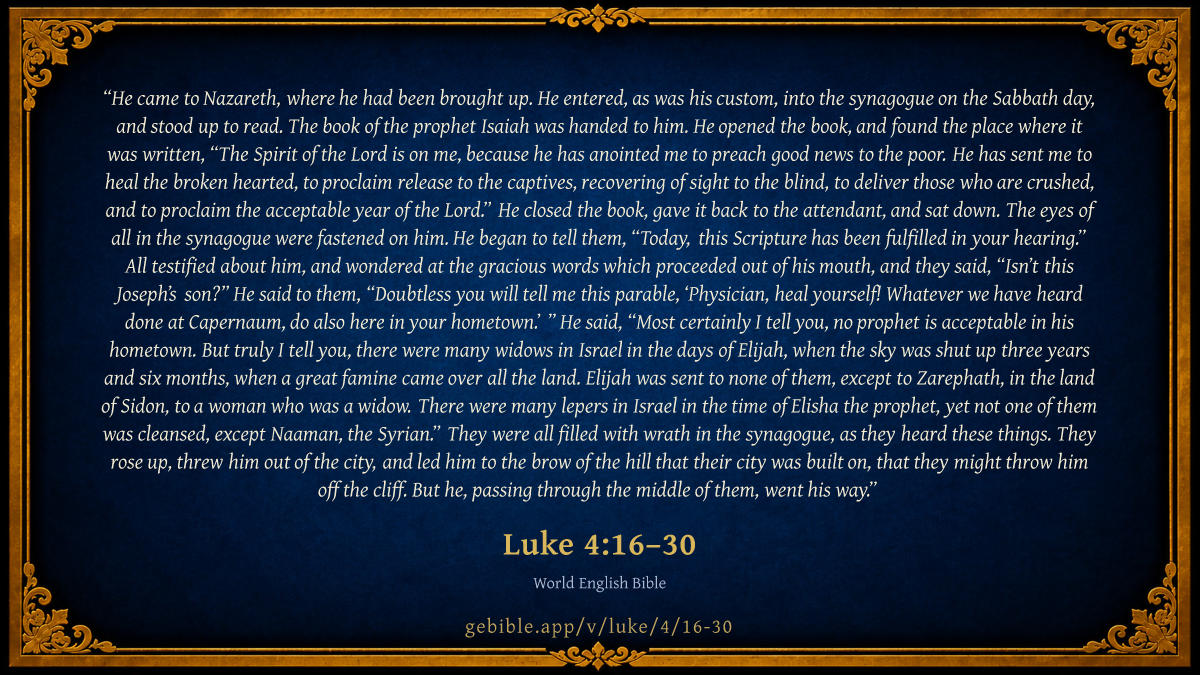
He came to Nazareth, where he had been brought up. He entered, as was his custom, into the synagogue on the Sabbath day, and stood up to read.
The book of the prophet Isaiah was handed to him. He opened the book, and found the place where it was written,
“The Spirit of the Lord is on me, because he has anointed me to preach good news to the poor. He has sent me to heal the broken hearted, to proclaim release to the captives, recovering of sight to the blind, to deliver those who are crushed,
and to proclaim the acceptable year of the Lord.”
He closed the book, gave it back to the attendant, and sat down. The eyes of all in the synagogue were fastened on him. He began to tell them, “Today, this Scripture has been fulfilled in your hearing.”
All testified about him, and wondered at the gracious words which proceeded out of his mouth, and they said, “Isn’t this Joseph’s son?”
He said to them, “Doubtless you will tell me this parable, ‘Physician, heal yourself! Whatever we have heard done at Capernaum, do also here in your hometown.’ ” He said, “Most certainly I tell you, no prophet is acceptable in his hometown. But truly I tell you, there were many widows in Israel in the days of Elijah, when the sky was shut up three years and six months, when a great famine came over all the land. Elijah was sent to none of them, except to Zarephath, in the land of Sidon, to a woman who was a widow. There were many lepers in Israel in the time of Elisha the prophet, yet not one of them was cleansed, except Naaman, the Syrian.”
They were all filled with wrath in the synagogue, as they heard these things. They rose up, threw him out of the city, and led him to the brow of the hill that their city was built on, that they might throw him off the cliff. But he, passing through the middle of them, went his way.
Geneva Bible translators 1599 · Public Domain On vv16, 17, 22, 25, 28 Who Christ is, and wherefore he came, he showeth…
Who Christ is, and wherefore he came, he showeth out of the prophet Isaiah.
Geneva Bible (1599) marginal notes — public domain.
John Trapp 1656 · Public Domain On vv16–30 16 And he came to Nazareth, where he had…
16 And he came to Nazareth, where he had been brought up: and, as his custom was, he went into the synagogue on the sabbath day, and stood up for to read.
Ver. 16. Where he had been brought up] The Jews were to be kind to the Egyptians, and to pray for the prosperity of Babylon, where they had been bred and fed. "Be ye thankful," Col 3:15, viz. to your friends and benefactors.
Read full note →
And stood up for to read] In honour of the word that he read. So Neh 8:5, a commendable custom.
John Trapp, A Commentary or Exposition upon All the Books of the Old and New Testament (1647–1656) — public domain. Text from a community e-Sword module.
Matthew Poole 1685 · Public Domain On vv16, 17, 20, 22, 23, 25, 28 We heard before, Luk 2:39,51, that Christ was brought…
We heard before, Luk 2:39,51, that Christ was brought up at Nazareth; we read of him at Nazareth, Mat 13:54. But I must confess I doubt whether Matthew there, and Luke here, speak of the same time. Of the nature of the Jewish synagogues, and their order of worship there, and the reading of the Scriptures in them, we have spoken before in our notes on Mat 4:23. See Poole on "Mat 4:23".
Matthew Poole's English Annotations on the Holy Bible (1683–1685) — public domain. Text from a community e-Sword/MySword module.
William Burkitt 1703 · Public Domain On vv22, 25, 28 Observe here, 1. The effect of our Saviour’s ministry…
Observe here, 1. The effect of our Saviour’s ministry at Nazareth: it created wonder, but did not produce faith; they marvelled, but not believed; they admired the wisdom of his discourse, but will not own him to be the promised Messiah, because of the poverty and meanness of Christ’s condition: Is not this Joseph’s son? They expected the son of a prince, not the son of a carpenter to be their Messiah.
Thence note, that the poverty and meanness of Christ’s condition was that which multitudes stumbled at, and which kept many, yea, most, from believing on him. None but a spiritual eye can discern beauty in an humbled and abased Saviour.
Read full note →
Observe 2. Our Saviour wonders not that so few of his countrymen, among whom he had been bred and brought up, and with whom he had lived most part of his time, did despise his person, and reject his doctrine; he tells them, No prophet has honor in his own country: that is, very seldom has.
Teaching us that usually the ministers of God are most despised where they are most familiarly known; sometimes the remembrance of their mean original and extraction, sometimes the poverty of their parents, sometimes the indecencies of their childhood, sometimes the follies of their youth, sometimes the faults of their families and relations, are ript up, and made occasion of contempt; and therefore that prophet that comes from afar, and has not been much known, gains the greatest reputation amongst a people, who, being ignorant of his extraction, look upon his breeding, as well as his calling to be divine.
This good use ought to be made of our Saviour’s observation, that his ministers be very wise and discreet in conversation with their people, not making themselves cheap and common in every company, nor light and vain in any company; for such familiarity will breed contempt, both of their persons and their doctrine.
But our duty is by strictness and gravity of deportment to keep up an awe and esteem in the consciences of our people; always tempering our gravity with courtesy and a condescending affability. That minister which prostitutes his authority, frustrates the end of his ministry, and is the occasion of his own contempt.
William Burkitt's Expository Notes on the New Testament (1700–1703) — public domain. Text from a community e-Sword module.
John Gill 1763 · Public Domain On vv16–30 And he came to Nazareth,.... After some length of…
And he came to Nazareth,.... After some length of time, when he had gone through all Galilee, and had acquired great credit and reputation by his ministry and miracles; he came to the place,
where he had been brought up: where he was conceived, though not born; and where he had his education, and wrought at a trade, and was well known to the inhabitants; and therefore it was proper that he should first exercise his ministry, and obtain a character in other places, which would prepare him a reception among his townsmen, who otherwise, in all likelihood, would have treated him at once with neglect and contempt:
Read full note →
and as his custom was, he went into the synagogue on the sabbath day. This was either his custom from his youth, when he dwelt at Nazareth, while a private person, and before he was engaged in public service, whither he had used to repair as an inhabitant of the city, and a member of the congregation, to attend synagogue worship, as he now did; or it refers to his custom, since he became a public preacher, who at Capernaum, or any other city of Galilee, where there was a synagogue, used to frequent it, whether on sabbath days, or any other, and so he did here:
and stood up for to read: by rising and standing up, and perhaps by some other gesture he signified his inclination to read a portion of Scripture, if liberty was given, and a book delivered him, for, as yet, he had no book to read in; nor might any read in public, unless he had an order from the congregation, or the chief of it; for so runs the Jewish canon (k):
"a reader may not read until the chief of the congregation bids him read; yea, even a minister of the congregation, or a ruler of the synagogue, may not read of himself, until the congregation, or the chief among them, bids him read.''
This custom of reading the Scriptures publicly, was an appointment of Moses, according to the account of the Jews; who say (l).
"Moses our master, ordered the Israelites to read in the law publicly, on the sabbath, and on the second and fifth days of the week, in the morning; so that they might not be three days without hearing the law and Ezra ordered, that they should read so at the evening sacrifice, every sabbath, on account of those that sit in the corners of streets; and also he ordered, that three men should read on the second and fifth days of the week, and that they should not read less than twenty verses.''
It was also the custom to stand at reading the law and the prophets: with regard to the book of Esther, the rule is (m) this;
"he that reads the "Megilia", or book of "Esther", stands or sits.''
That is, as their commentators (n) explain it, if he will he may stand, and if he will he may sit, he may do as he pleases; but so he might not in reading the law: hence it is asked (o),
"why is it not so in the law? R. Abhu replies, because the Scripture says, Deu 5:3 "Stand thou here by me."''
Wherefore they say (p), the law must be read standing, and it is even forbidden to lean on any thing. Christ conformed to these rules; he went into the synagogue to read on the sabbath day, and stood up when he read, and waited for order, and a book to be given him to read: it may be asked, how he came to be admitted to read publicly in the synagogue, when he was not of the tribe of Levi, nor was he brought up in the schools and academies of the Jews, and was known to be a mechanic? It may be observed, that common Israelites, as well as priests and Levites, were allowed to read the Scriptures publicly; every sabbath day, seven persons read, a priest, a Levite, and five Israelites: the order was this; the priest read first, and after him the Levite, and after him an Israelite: and it is said to be a known custom to this day, that even an unlearned priest read before the greatest wise man in Israel; and he that was greater than his companion in wisdom, read first (q). Now Christ, on account of the great fame he was in for his wisdom and mighty works, was admitted to this public service, though he was no Levite, and known by the inhabitants of this place, to have been brought up to a trade.
(k) Maimon. Hilchot Tephilla, c. 12. sect. 7. (l) Maimon. Hilchot Tephilla, c. 12. sect. 1. (m) Misn. Megilia, c. 4. 1. (n) Jarchi & Bartenora in ib. (o) T. Bab. Megilia, fol. 21. 1. (p) Robbenu Asher in T. Megill. c. 3. sect. 1. & Piske Harosh in ib. (q) Maimon. Hilch. Tephillah, c. 12. sect. 16, 18.
John Gill's Exposition of the Whole Bible (1746–1763) — public domain (CC PDM 1.0). Text via the HelloAO Bible API.
John Wesley 1765 · Public Domain On vv16, 17, 18, 19, 21, 22, 23, 24, 25, 27, 28, 30 He stood up - Showing thereby that he had…
He stood up - Showing thereby that he had a desire to read the Scripture to the congregation: on which the book was given to him. It was the Jewish custom to read standing, but to preach sitting. Matt. xiii, 54; Mark vi, 1.
John Wesley, Explanatory Notes Upon the Whole Bible (1754–1765) — public domain. Text via the GEBible commentary corpus.
Adam Clarke 1810 · Public Domain On vv16, 17, 18, 20, 22, 23, 24, 25, 26, 27, 28, 29, 30 Verse 16. To Nazareth, where he had been brought…
Verse 16. To Nazareth, where he had been brought up] It is likely that our Lord lived principally in this city till the 30th year of his age; but, after he entered on his public ministry, his usual place of residence was at the house of Peter, in Capernaum.
As his custom was] Our Lord regularly attended the public worship of God in the synagogues; for there the Scriptures were read: other parts of the worship were very corrupt; but it was the best at that time to be found in the land. To worship God publicly is the duty of every man, and no man can be guiltless who neglects it. If a person cannot get such public worship as he likes, let him frequent such as he can get. Better to attend the most indifferent than to stay at home, especially on the Lord's day. The place and the time are set apart for the worship of the true God: if others do not conduct themselves well in it, that is not your fault, and need not be any hinderance to you. You come to worship GOD - do not forget your errand-and God will supply the lack in the service by the teachings of his Spirit. Hear the saying of old Mr. Herbert: - "The worst speak something good: should all want sense,
Read full note →
God takes the text, and preacheth p-a-t-i-e-n-c-e."
A man may always profit where the word of God is read.
Stood up for to read.] The Jews, in general, sat while they taught or commented on the Sacred Writings, or the traditions of the elders; but when they read either the law or the prophets they invariably stood up: it was not lawful for them even to lean against any thing while employed in reading.
Adam Clarke's Commentary on the Bible (1810–1826) — public domain. Text from a community e-Sword/MySword module.
Joseph Benson 1811 · Public Domain On vv17, 20, 22, 23, 25, 28 Luk 4:17-19. There was delivered to him the book…
Luk 4:17-19. There was delivered to him the book of Esaias — A paragraph of the law having, according to custom, been read before. See on Act 13:15. When he had opened the book — Αναπτυξας, having unrolled the volume of the book. The books of the ancients, as is well known, consisted of one long sheet of paper or parchment, which they rolled up neatly on a round piece of wood. When a book of this kind was to be read, they unrolled it gradually as they read it, and put what was read round another piece of wood of the same sort with the former. He found the place — The expression, ευρε τον τοπον, seems to imply, that upon unrolling the book, the passage here mentioned immediately met his eye, by the particular providence of God. Many commentators, however, think, that as the Scriptures were read in order, the passage mentioned was that which fell of course to be read in the synagogue that day. And according to the custom of all the synagogues, this passage was to be read with the fiftieth section of the law, appointed for the last sabbath of the sixth, or the first of the seventh month, answering to our August and September. So that if our Lord read this passage as the ordinary lesson for the day, the chronology of this part of the history is thereby determined. The Spirit of the Lord is upon me — This was said of the prophets, when they were under an immediate afflatus of the Holy Spirit; but it was here, doubtless, primarily meant of the Messiah: because he hath anointed me — That is, hath commissioned me with authority, qualified me with gifts, and set me apart for the important offices here mentioned. The expression is used in allusion to the Jewish prophets, priests, and kings, who were consecrated to their offices by anointing them with oil. The unction of the Messiah was the Holy Spirit, which he had without measure. To preach the gospel to the poor — The reason why I, the Messiah, enjoy so great a degree of inspiration, and am endowed with the power of working such astonishing miracles is, because God hath commissioned me to preach the glad tidings of salvation to the poor, and by so doing, to heal the broken-hearted — That is, to relieve and comfort all those, without distinction, whose hearts are broken by sharp convictions of sin, and fears of future punishment. The passage of Isaiah here quoted, in our translation stands thus: To preach good tidings to the meek — But the word ענוים, signifies more properly persons in a low and afflicted condition. It is certainly an unspeakable recommendation of the gospel dispensation, that it offers the pardon of sin, and salvation, to all on the same terms. The rich, here, have no pre- eminence over the poor; as they seem to have had under the law, which prescribed such costly sacrifices for the atonement of sin as were very burdensome to the poor. The Prophet Isaiah, therefore, in describing the happiness of gospel times, very fitly introduces the Messiah mentioning this as one of the many blessings which would accrue to the world from his coming, that the glad tidings of salvation were to be preached by him and his ministers to the poor, and consequently were to be offered to them without money and without price. To preach deliverance to the captives — To proclaim to the captives of sin and Satan liberty from the power of their tyrannical masters, on the terms of repentance toward God, and faith in the Messiah, now manifested: and to confer that liberty on such as complied with these terms. And recovering of sight to the blind — Not merely to confer bodily sight on a few blind individuals, but to open the eyes of the understanding of millions, and cure their spiritual blindness, by imparting to them the spirit of wisdom and revelation. Thus, Isa 42:6-7, the Messiah is said to be given for a covenant of the people, for a light of the Gentiles, to open the blind eyes. And the commission given to Paul, as recorded, Act 26:18, was, I send thee to open their eyes, and to turn them from darkness to light: in both which passages spiritual illumination is undoubtedly solely intended. To set at liberty them that are bruised — With the heavy load of their fetters and chains; with the guilt and power of their iniquities, and the condemnation and wrath due to them on that account. Here is a beautiful gradation, in comparing the spiritual state of man to the miserable state of those captives who were not only cast into prison, but, like Zedekiah, had their eyes put out, and were laden and bruised with chains of iron. To preach the acceptable year of the Lord — To proclaim that happy period of the divine dispensations toward mankind, in which a full and free remission of all their offences was to be offered to them, and which might be fitly represented in prophecy by the Jewish jubilee, wherein debts were forgiven, slaves released, and inheritances restored to their original owners. For a further explanation of this passage, see the notes on Isa 61:1-3; and Isa 42:6-7.
Joseph Benson's Commentary on the Old and New Testaments (1811–1818) — public domain. Text from a community e-Sword module.
Albert Barnes 1834 · Public Domain On vv16–30 And, as his custom was, he went ... -…
And, as his custom was, he went ... - From this it appears that the Saviour regularly attended the service of the synagogue. In that service the Scriptures of the Old Testament were read, prayers were offered, and the Word of God was explained. See the notes at Mat 4:23. There was great corruption in doctrine and practice at that time, but Christ did not on that account keep away from the place of public worship. From this we may learn:
That it is our duty “regularly” to attend public worship. That it is better to attend a place of worship which is not entirely pure, or where just such doctrines are not delivered as we would wish, than not attend at all.
Read full note →
It is of vast importance that the public worship of God should be maintained; and it is “our” duty to assist in maintaining it, to show by our example that we love it, and to win others also to love it. See Heb 10:25. At the same time, this remark should not be construed as enjoining it as our duty to attend where the “true” God is not worshipped, or where he is worshipped by pagan rites and pagan prayers. If, therefore, the Unitarian does not worship the true God, and if the Roman Catholic worships God in a manner forbidden and offers homage to the creatures of God, thus being guilty of idolatry, it cannot be a duty to attend on such a place of worship.
The synagogue - See Mat 4:23.
Stood up for to read - The books of Moses were so divided that they could be read through in the synagogues once in a year. To these were added portions out of the prophets, so that no small part of them was read also once a year. It is not known whether our Saviour read the lesson which was the regular one for that day, though it might seem “probable” that he would not depart from the usual custom. Yet, as the eyes of all were fixed on him; as he deliberately looked out a place; and as the people were evidently surprised at what he did, it seems to be intimated that he selected a lesson which was “not” the regular one for that day. The same ceremonies in regard to conducting public worship which are here described are observed at Jerusalem by the Jews at the present time. Professor Hackett (“Illustrations of Scripture,” p. 232) says: “I attended the Jewish worship at Jerusalem, and was struck with the accordance of the ceremonies with those mentioned in the New Testament. The sacred roll was brought from the chest or closet where it was kept; it was handed by an attendant to the reader; a portion of it was rehearsed; the congregation rose and stood while it was read, whereas the speaker, as well as the others present, sat during the delivery of the address which formed a part of the service.”
Albert Barnes' Notes on the Bible (1834–1885) — public domain. Text from a community e-Sword/MySword module.
Haydock's Catholic Bible Commentary 1859 · Public Domain On vv17, 18, 19, 20, 21, 23, 30 As he unfolded the book: and again, (ver. 20)…
As he unfolded the book: and again, (ver. 20) when he had folded the book. Books at that time where not like our now-a-days, but were skins or parchments, rolled or folded up. (Witham) --- Some are of opinion that the Jews of Nazareth, having heard of the miracles and fame of Jesus, and that he was accustomed to teach in the synagogues, though he had never been instructed in any learning, when he rose to speak, purposely gave him the book of Isaias, which was esteemed the most difficult to be explained, in order to try his learning; though it is probable that it was done by the all-directing interposition of Divine Providence. (Maldonatus)
George Leo Haydock (1774–1849), Haydock's Catholic Family Bible and Commentary, 1859 edition — public domain. Excludes Psalms (Douay-Rheims chapter numbering differs from Protestant) and Deuterocanonical books (Catholic canon only).
Robert Jamieson, A. R. Fausset & David Brown 1871 · Public Domain On vv18, 19, 20, 21, 22, 23, 24, 25, 26, 28, 29, 30 To have fixed on any passage announcing His sufferings…
To have fixed on any passage announcing His sufferings (as Isa 53:1-12), would have been unsuitable at that early stage of His ministry. But He selects a passage announcing the sublime object of His whole mission, its divine character, and His special endowments for it; expressed in the first person, and so singularly adapted to the first opening of the mouth in His prophetic capacity, that it seems as if made expressly for this occasion. It is from the well-known section of Isaiah's prophecies whose burden is that mysterious "SERVANT OF THE LORD," despised of man, abhorred of the nation, but before whom kings on seeing Him are to arise, and princes to worship; in visage more marred than any man and His form than the sons of men, yet sprinkling many nations; laboring seemingly in vain, and spending His strength for naught and in vain, yet Jehovah's Servant to raise up the tribes of Jacob and be His Salvation to the ends of the earth (Isa. 49:1-26, &c.). The quotation is chiefly from the Septuagint version, used in the synagogues.
Jamieson, Fausset & Brown — Commentary Critical and Explanatory on the Whole Bible (1871) — public domain (CC PDM 1.0). Text via the HelloAO Bible API.
Daniel D. Whedon 1874 · Public Domain On vv16, 17, 18, 19, 20, 21, 22, 23, 24, 25, 27, 28, 29, 30 FIRST VISIT TO NAZARETH—RESIDENCE AT CAPERNAUM, Luk_4:16-31.
FIRST VISIT TO NAZARETH—RESIDENCE AT CAPERNAUM, Luk_4:16-31.
Luke sees a true propriety in selecting the first manifestation of the Lord at Nazareth, as the opening of his history of the great ministry. It was initial, ominous, typical. Here, pre-eminently, “he came to his own, and his own received him not.”
Read full note →
It is strenuously maintained by some commentators that there was but one visit and rejection at Nazareth. This is argued from the fact that in both accounts the same proverb is adduced, and the same reference to Jesus’s relatives is made. But that a repetition of the unwelcome visit should awaken similar trains of thought and language is perfectly natural. On the contrary, it seems scarcely probable that in Matthew and Mark the most exciting part of the affair, the attempt to hurl Jesus from the precipice, should be omitted.
16. Nazareth—See Stanley’s beautiful description of this place in our note on Mat_1:23. The rude character ascribed by Nathaniel to this town in his query, “Can any good thing come out of Nazareth?” (although some doubt, very groundlessly, its imputing any popular odium to that town,) was well illustrated by the coarse and murderous violence of its mob on the present occasion.
As his custom—His custom of attending the synagogue on the sabbath, to read and teach. Luke’s summary of Christ’s Galilean ministry thus far, (Luk_4:15,) indicates that he had preached long enough to have established a custom.
Nazareth was not so bad but that she had a synagogue and a service. The service of the synagogue commenced with praise and prayer; then a portion of the law was read aloud, and after this a portion of the prophets. The reader and congregation, out of respect to God’s word, stood while it was read; they sat while the subsequent discourse was delivered.
Stood up to read—It would seem that Jesus rose to indicate that it was his wish to read and explain; which was probably expected and readily accorded by the chazan and congregation. He sat down to discourse, (Luk_4:20,) instead of returning to his own place in the congregation. In regard to Jewish synagogues, see our note on Mat_4:23.
Daniel D. Whedon (gen. ed.), Commentary on the Old and New Testaments (1874–1909) — public domain. Text from a community e-Sword module.
The Cambridge Bible for Schools and Colleges 1878 · Public Domain On vv16–30 16. And he came to Nazareth] This is probably…
16. And he came to Nazareth] This is probably the visit related in unchronological order in Mat_13:53-58; Mar_6:1-6, since after so violent and decisive a rejection as St Luke narrates, it is unlikely that He should have preached at Nazareth again. If so, we learn from these (1) that His disciples were with Him; (2) that He healed a few of the sick, being prevented from further activity by their unbelief.
as his custom was] This seems to refer to what had been the habit of the life of Jesus while he had lived at Nazareth. Hitherto however He had been, in all probability, a silent worshipper.
Read full note →
into the synagogue] The article shews that the little village only possessed a single synagogue. Synagogues had sprung up throughout Judaea since the return from the exile. They were rooms of which the end pointed towards Jerusalem (the Kibleh, or consecrated direction, of Jewish worship (Dan_6:10), as Mecca is of Mohammedan). The men sat on one side; the veiled women behind a lattice on the other. The chief furniture was the Ark (tebhah) of painted wood, generally shrouded by a curtain, and containing the Thorah (Pentateuch), and rolls (megilloth) of the Prophets. On one side was a bema for the reader and preacher, and there were “chief seats” (Mar_12:39) for the Ruler of the Synagogue, and the elders (zekanim). The servants of the synagogue were the clerk (chazzan), verger (sheliach) and deacons (parnasim, ‘shepherds’).
on the sabbath day] Observe the divine sanction thus given to the ordinance of weekly public worship.
stood up for to read] The custom was to read the Scripture standing. There was no recognised or ordained ministry for the synagogues. The functions of Priest and Levites were confined to the Temple, and the various officers of the synagogue were more like our churchwardens. Hence it was the custom of the Ruler or Elders to invite any one to read or preach who was known to them as a distinguished or competent person (Act_13:15).
The Cambridge Bible for Schools and Colleges (gen. ed. J. J. S. Perowne; Cambridge University Press, 1878–1918) — public domain. Text from a community e-Sword module.
Ellicott's Commentary for English Readers 1878 · Public Domain On vv16, 17, 18, 19, 20, 21, 22, 23, 24, 26, 27, 28, 29, 30 (16) And he came to Nazareth.—The narrative that follows,…
(16) And he came to Nazareth.—The narrative that follows, signally interesting in itself, has also the special interest of being peculiar to St. Luke. We may naturally think of it as having come to him from the same group of informants as those from whom he derived his narrative of the Infancy. (See Introduction.) He may have journeyed from Cæarea to Nazareth during St. Paul’s imprisonment in the former city, and obtained his information on the spot. It is clear that our Lord did not begin His ministry at Nazareth. He came there when His fame was, in some measure, at least, already established.
As his custom was.—This, then, had been His wont before He entered on His work. Children were admitted to the synagogue at the age of five. At thirteen attendance was obligatory. It was open to any man of reputed knowledge and piety, with the sanction of the ruler of the synagogue, to read the lessons (one from the Law and one from the Prophets), and our Lord’s previous life had doubtless gained the respect of that officer. Up to this time, it would seem, He had confined Himself to reading. Now He came to preach, after an absence possibly of some months, with the new power that had already made Him famous. The work of preaching also was open to any person of adequate culture, who had a “word of exhortation” to address to the worshippers. (Comp. Act_13:15.) The constitution of the synagogue in thus admitting the teaching functions of qualified laymen, was distinctly opposed to the root-idea of sacerdotalism.
A Bible Commentary for English Readers, edited by Charles John Ellicott (1878–1897) — public domain. Text from a community e-Sword module.
The Pulpit Commentary 1880 · Public Domain On vv16, 17, 18, 20, 22, 23, 24, 25, 28, 29, 30 And he came to Nazareth, where he had been…
And he came to Nazareth, where he had been brought up: and, as his custom was, he went into the synagogue on the sabbath day. This had been for years his practice in the little synagogue of the village where was his carpenter"s shop. Children at the age of five years were admitted into the synagogue, and at thirteen attendance there was part of the legal life of the Jew. These synagogues were the regular places for religious gatherings every sabbath day, and also usually on Mondays and Tuesdays, besides on other special occasions. We hear of them after the return from the Captivity, and probably they existed long before. Some think that in Psa_74:8 there is a reference to them. And stood up for to read. The holy books were always read standing. The ruler or elder presided over and directed the synagogue service. The priest and Levite had no recognized position in the synagogue. Their functions were confined to the temple and to the duties prescribed in the Law. It was not unusual for the synagogue officials, if any stranger was present who was known to be competent, to ask him to read and to expound a passage in the Law or Prophets. Our Lord was well known in Nazareth, and of late had evidently gained a great reputation as a preacher. It was, therefore, most natural that he should be asked to take a prominent part in the sabbath services.
The Pulpit Commentary (1880–1919), ed. H.D.M. Spence-Jones & Joseph S. Exell — public domain. Text from a community e-Sword module.
The Biblical Illustrator 1887 · Public Domain On vv16, 18, 22, 26, 28 And He came to Nazareth, where He had been…
Luk_4:16
And He came to Nazareth, where He had been brought up: and, as His custom was, He went into the synagogue on the Sabbath day
Read full note →
The tides of the Spirit
The moment was overcharged with a certain sad intensity.
Since last He stood upon that spot, a change had passed upon Him; a light, long struggling with the clouds, and often drowned in a golden haze of mystery, had cleared itself within Him; He was no longer at His own disposal, nor free to rest upon the trodden paths; but the sacred dove was ever on the wing before Him; and now alighted on the synagogue of Nazareth, and there, where He naturally fell into the attitude of docility, left Him to speak the word of supernatural power. Never is it so hard to follow and trust a higher inspiration, as amid the crowd of customary things. If ever Jesus could yield to misgivings of what was committed to Him it would be in that place. There, in the presence of those at whose feet He used to sit--there, where He first heard and pondered Israels hope, and watched a holy light on other faces, not knowing that it was reflected from His own--how could He stand up and draw the great words of Isaiah upon Himself, and say aloud, This is the hour. Lo! it is I. But He had emerged from the desert that lay between the old life and the new. The very Spirit of God had driven Him thither to hear what could be said against itself. And now, He was no longer His own. No flitting of the Spirit, off and on. It rested with Him now. And so He could bear those native scenes again, for they lay in another light; the hills of Nazareth were transfigured before Him; from all things round the chill and weary aspect had fled, that makes them press with the weight of usage; and He stood amid the well-known groups, as some immortal friend might return and look in among us here, with unabated love, but with saintly insight into meanings hid from us. Lifted then into the full power of the Spirit, whither, as least congenial, does He take His heavenly point of view? To the village synagogue, on the stated day of rest; nothing newer, nothing higher; but just the place and time which had been sacred to the fathers. The first thing which He did, under freshest inspiration, was to resume the dear old ways, to fall in with the well-known season, to unroll the same venerable page; only to find a new meaning in words that had long carried their rhythm to His heart. We are sustained then by the sympathy of the highest inspiration, when we make it our custom, too, to illuminate in our calendar some holy day, and to raise near every cluster of our dwellings a house where prayer is wont to be made. Against the Christian habit of seasonal and local worship the truth is often urged that God is a Spirit, eternal and omniscient, abiding neither in this mountain nor in that Jerusalem, and bearing equal relation into every mind and moment. In the occasionalism of piety I see, however, not its shame but its distinctive glory. For of all Gods agencies and manifestations, it is the lowest that are least mutable, and most remain the same from first to last; whilst the highest have ever a tidal ebb and flow--moving in waves of time, and surprising hidden inlets of space with their flood. Be assured then that in your ancient usages of seasonal and local worship, in seeking here to meet at intervals the high tides of Gods Spirit, you are in harmony with His sublimest providence--with a law of variation transcending any physical uniformity over which it sweeps. Reverence the holy custom, shelter from heedless slight the living impulse that week by week calls you hither to remember, to aspire, to pray. Bring only the pure, lowly, childlike hearts, tender to everything except the sins you must confess--full of hope for the world and trust in God; spread out an eager and a gentle spirit for the dropping of fruitful seeds from Holy Writ and saintly hymn; freshen the fading vow of self-sacrificing love; and your worship here will not only resemble His who, in fulness of the Spirit, went as His custom was, &c., but prepare for a higher communion where your life is hid with Him in God. (J. Martineau, LL. D.)
Synagogue worship
The Jewish synagogues were open every day for three services, but as those of the afternoon and evening were always joined, there were, in reality, only two. It was the duty of every godly Jew to go to each service, for so sacred was daily attendance that the Rabbis taught that he who practised it saved Israel from the heathen. The two market days, Monday and Thursday, when the country people came into town, and when the courts were held, and the Sabbaths, were the special times of public worship. Feast days and fasts were also marked by similar sacredness. (Dr. Geikie.)
A good example in attending public worship
Of good Archbishop Leighton it is said, that the Sabbath was his delight, and no slight hindrance could detain him from the house of prayer. Upon one occasion, when he was indisposed, the day being stormy, his friends urged him, on account of his health, not to venture to church. Were the weather fair, was the reply, I would stay at home but since it is otherwise, I must go, lest I be thought to countenance by my example, the irreligious practice of allowing trivial hindrances to keep me back from public worship. (Life of Leighton.)
Evil of neglecting public worship
Of the late venerable Dr. Waugh, his biographer records that, in his ministerial visitations, his nationality was often strongly displayed, and this with most beneficial effect, both in sentiment and language. When, without any adequate cause, any of his hearers had failed to attend public ordinances so regularly as he could have wished, and would plead their distance from the chapel as an excuse, he would exclaim in the emphatic northern dialect, which he used on familiar occasions to employ, What, you from Scotland! from Melrose! from Gala Water! from Selkirk! and its a hard matter to walk a mile or two to serve your Maker one day in the week! How many miles did you walk at Selkirk? Five. Five! And can ye no walk twa here? Man!your father walked ten or twal (twelve) out, and as many hame, every Sunday i the year; and your mither too, aften. Ive seen a hunder folk and muir, that aye walked six or seven--men, women, and bairns too: and at the sacraments folk walked fifteen, and some twenty miles. How far will you walk the morn to mak half-a-crown? Fie! fie I But yell be out wi a your household next Sabbath, I ken. O my man, mind the bairns I If you love their souls, dinna let them get into the habit of biding awa In the kirk. All the evils among young folk in London arise from their not attending Gods house. Such remonstrances, it may easily be imagined, were not often urged in vain. (Baxendales Anecdotes.)
The synagogue service
The order of service was certainly fixed and invariable in the time of Christ. The supreme moment of the service was that of the reading of the law, for the great end of meeting was to hear and study the law. Prayer preceded this exercise, and the reading of a passage chosen from the prophets, followed by the benediction, closed the service. In the opening prayer there were several distinct portions. It began with the recitation of the Shema (three passages of the law, viz., Deu_6:4-9; Deu_11:13-21; Num_15:37-41). Then came the eighteen blessings. During this solemn recitation, the people remained standing with their faces turned towards Jerusalem and the Holy Place. The reciter stood before the chest containing the manuscripts. Any member of the assembly could be called on by the president to perform this important duty. Minors alone were excepted, and Christ may have very likely taken His turn in these introductory prayers, both at Nazareth and at Capernaum. The people responded with a loud Amen at the close of each prayer. The reading of the law followed. The Chazzan took the sacred scroll out of the chest, removed its case, and placed it before the first reader. The seven members who had been chosen, rose, and read in turn at least three verses each. The first reader before beginning used a short formula of benediction, which he repeated also at the end. The Torah was divided into one hundred and fifty-three sections. In three years the whole was read through. Subsequently these sections were made three times as long, and the whole law was read through in one year. The Chazzan remained all the time close to the reader, and watched that he made no mistake, and read nothing unsuitable for a general audience. To the reading and its translation was always added a commentary, a sort of homily, to which great importance came to be attached in the Christian Churches, and which subsequently developed into the sermon. The reading of the law being over, the one who had recited the opening prayer read a portion from one of the prophets. This was called the closing lesson, because it completed the service. The reader was chosen by the head of the synagogue. He read three verses in succession, and then translated them (into Aramaic). Christ one day read one of these closing lessons in the synagogue at Nazareth. It is possible, however, that He may have chosen the passage Himself. We notice that it consists of only two verses. This was allowable, because He proposed to make some comment on it. The final benediction was then pronounced, and the assembly broke up. (E. Stapfer, D. D.)
Jesus of Nazareth admired but rejected
If we were to single out one place as illustrating more perhaps than any other place St. Johns remark, He came to His own and His own received Him not, that place would surely be Nazareth.
I. Observe THE VALUE WHICH THE LORD PUTS UPON THE PUBLIC MEANS OF GRACE--As His custom was. Although there was very little life or spirituality in the synagogue services, yet Jesus was a habitual worshipper there. What a lesson for those who excuse themselves on such grounds as that--
1. They can pray as well at home. Do they?
2. The service is not quite to their mind (Heb_10:25).
II. THE ACCOUNT WHICH CHRIST GAVE AT NAZARETH OF HIS OWN OFFICE AND MINISTRY.
III. THE EFFECT PRODUCED BY OUR OURS DISCOURSE AT NAZARETH,
1. Admiration and astonishment.
2. But, mingled with this, contempt.
3. And so Christ and His salvation are rejected. (G. T.Harding, M. A.)
An inaugural discourse
The first sermon of Jesus at Nazareth, a standard for the minister of the gospel at the beginning of His work. The narrative imparts to the minister of the gospel pregnant suggestions.
I. In reference to the POINT OF VIEW from which he is to consider his work.
1. Origin.
2. Matter.
3. Object of preaching.
II. In relation to the MANNER in which he must perform his work. His preaching must be, as here--
1. Grounded on Scripture.
2. Accommodated to the necessity of the hearers.
3. Presented in an attractive manner.
III. In relation to the FRUIT upon which he can reckon in this labour. Nazareth shows us--
1. That blossoms are as yet no certain signs of fruit.
2. That this fruit may be blasted by the most unhappy causes.
3. That the harvest may turn out yet better than at the beginning it appears (there in the synagogue were Mary, and also the Lords brethren, who afterwards believed; and if the Saviour did not work many miracles at Nazareth, He yet wrought some) (Mat_13:58).
IV. In relation to the TEMPER in which he is to begin a new work.
1. With thankful recollections of the past.
2. With holy spiritual might for the present.
3. With joyful hope for the future.
Happy the teacher who is permitted to begin his preaching under more favourable presages than Jesus began His in the city where He was brought up. (J. J. Van Oosterzee, D. D.)
View of Nazareth
Sheets of smooth rock; fields of hinge boulders, between which, at times, there was scarcely room to pass; acres of loose stones of all sizes, no path or track visible--parts so steep that to hold on to the horses mane was a help--everything unspeakably rough and difficult--such was the way up the face of the rocks to get to the tableland on which Nazareth stands. After a time spots of green appeared on the wide, unearthly desolation, and some lean cattle were to be seen picking up poor mouthfuls among the stones. Further on was a larger, but still very small, spot of green. Goats and sheep alone could find sustenance in such a weird place. After an hours ride, during which we passed both camels and donkeys toiling up the face of the hill with heavy loads, we came to a spring at the wayside, now running, but dry in summer. At last, all at once, a small valley opened below, set round with hills, and a pleasant little town appeared to the west. Its straggling houses, of white, soft limestone, and mostly new, rose row over row up the steep slope. A fine large building, with slender cypresses growing around it, stood nearest to us; a minaret looked down a little to the rear. Fig-trees, single and in clumps, were growing here and there in the valley, which was covered with crops of grain, lentils, and beans. Above the town the hills were steep and high, with thin pasture, sheets of rock, fig-trees, and now and then an enclosed spot. The small domed tomb-shrine of a Mahommedan saint crowned the upper end of the western slope. Such was Nazareth, the home of our Lord Numerous hills, not grassy like those of England, but bare, white, and rocky, though here and there faintly green, shut in Nazareth from the outer world; the last heights of Galilee, as they melt away into the plain of Esdraelon. Their long, rounded tops have no wild beauty, and there are no ravines or shady woods to make them romantic or picturesque; indeed, so far as the eye reaches, they are treeless, or very nearly so … The water of Nazareth is mainly derived from rain-cisterns, for there is only one spring, and in autumn its supply is precarious. A momentous interest, however, gathers around this single fountain, for it has been in use for immemorial ages, and, no doubt, often saw the Virgin and her Divine Child among those who frequented it morning and evening, as the mothers of the town, many with children at their side, do now. The water comes through spouts in a stone wall, under an arched recess built for shelter, and falls into a trough at which a dozen persons can stand side by side. Thence it runs into a square stone tank at the side, against which gossips at all hours delight to lean. The water that flows over the top of the trough below the spouts makes a small pool immediately beneath them, and there women wash their linen, and even their children; standing in the water, ankle-deep, their baggy trousers--striped pink or green--tucked between their knees, while those coming for water are continually passing and repassing with their jars, empty or full, on their heads. The spring lies under the town, and as the Nazareth of ancient times, as shown by old cisterns and tombs, was rather higher up the hill than at present, the fountain must in those days have been still farther away from the houses. (C. Geikie, D. D.)
The synagogue
A synagogue generally stood on the highest piece of ground in a city, or near it; it was oblong, and the end opposite to the entrance pointed towards Jerusalem. There were the seats of the elders, and in the midst, at this end, was the ark with a lamp always burning before it, in which was preserved the roll of the Law. Before it also was an eight-branched candlestick, lighted on the highest festivals. A little way down was a raised platform, on which several persons could stand at once, and in the middle rose a pulpit, in which the reader stood to read those lessons which were not from the books of Moses. The roll of the Law was taken with great solemnity out of the ark, and unrolled by the Rabbi, so that the congregation might not look on the writing. The lessons from Moses were so arranged that the books of the Law were read through once in three years. Much less ceremony was shown about the second lesson, which was taken from the prophets and historical books. On week-days, not less than twenty-one verses were read; on the Sabbath, not more than three, five, or seven. After this lesson followed the exposition, or interpretation. The Scriptures were read in Hebrew, but the Hebrew was unintelligible to the Jews after their return from the Babylonish captivity, consequently the interpreter translated or expounded what he had read in the Aramaic or Syro-Chaldee tongue. The reader stood when reading the prophets, but was allowed to sit or stand for the historical books. Originally the prophets and historical books had not been read in the synagogue service, but when Antiochus Epiphanes forbade the reading of the Law, in the services of the Sabbath, the prophets and other books had been substituted for those of Moses, and when this restriction was withdrawn the Jews continued reading the prophets, but read the Law as well, as of old, in the place of honour. (S. Baring. Gould, M. A.)
Christs mission
I. THE GREAT DISTINCTION IN WHICH OUR LORD EXALTED--The Spirit of the Lord is upon Me. As this was what distinguished the Lord, so it ought to distinguish His Church.
II. THE GREAT MESSAGE OUR LORD HAD TO DELIVER--TO preach the gospel to the poor, &c.
III. THE GREAT WORK OUR LORD HAD TO ACCOMPLISH--To heal the broken-hearted, &c. (J. P. Chown.)
The Christ as a preacher
Christ read the appointed lesson for the day (which happened to be the day of Atonement), but not the whole of it. He had not come to proclaim the day of the vengeance of our God. The gospel is primarily a deliverance shadowed by the year of Jubilee; it embraces the physical and social ills of men, and their spiritual ills. The inextricableness with which they are united in the words of Christ suggests the profound mystery of body and spirit, mind and matter, environment and spiritual history. In these words we find a theology and a life, a doctrine and a practice, and that the two are inseparable. Pass now to this preaching of Christ.
I. ITS SUBSTANCE. Without doubt we have here the key-note to His entire teaching. It is the peculiarity of Christs preaching that He pierces at once to the centre of His great delivering system, and plants His ministry upon it. The peculiar feature of this quotation from Isaiah, which Christ makes His own, is its doubleness: poor, captives, blind, bruised physically and morally, but chiefly morally. Let no man think that there is any gospel of deliverance or helpfulness for him, except as it is grounded in a cure of whatever evil there may be in him--evil habits, or selfish aims, or a worldly spirit.
II. ITS PHILOSOPHY. Suppose some questioner had arisen in that synagogue of Nazareth and asked Jesus, not as to the substance of His preaching, for that was plain enough, but what was the ground of it, on what ultimate fact or reason it rested. I think the answer would have been of this sort: I am making in this gospel a revelation of God, showing you His very heart. This is what God feels for you; this is how He loves and pities you; this is what God proposes to do for you, to cheer you with good news, and open your blind eyes, and free your bruised souls and bodies from the captivity of evil.
III. ITS POWER. In one sense its power lay in its substance; m another, in the philosophy or ground of it; but there was more than come from these; there was the power that resided in Him who spoke these truths. In what lay the commanding power which made them wonder at His words? Not in any impressiveness of manner, or felicity of presentation. These are elements of power, but they do not constitute power. The main element of power in one who speaks is, an entire, or the largest possible comprehension of the subject. Here we have the key to the power with which Christ preached. He saw the meaning of the Jewish system. He knew what the acceptable year of the Lord meant. He pierced the whole symbolism to its centre, and drew out its significance. He saw that God was a deliverer from first to last, and measured the significance of the fact. The whole heart and mind of God were open to Him. This was the power of Christs preaching; He saw God; He understood God; He knew what God had done, and would do; the whole purpose and plan of deliverance and redemption lay before Him as an open page. We cannot measure this knowledge of the Christ, we can but faintly conceive it. But the measure of our conception of it is the measure of our spiritual power over others. ( T. T. Munger.)
Jesus at Nazareth
Observe
I. THE PLACE SPECIFIED IN THE TEXT.
1. The obscurity of Christs private life.
2. We see in it Gods estimation of the worlds pomp and glory.
3. We see honest industry honoured by the Saviour.
II. WHAT JESUS DID ON HIS VISIT TO NAZARETH.
1. The place to which He resorted. The synagogue.
2. This place was identified with former associations. As His custom was.
3. The time when Christ went into the synagogue was the Sabbath.
4. What Jesus did in the synagogue.
5. The portion of the Sacred Scriptures which HE read.
Application:
1. Give especial heed, &c., to the Holy Scriptures.
2. Let Scripture be the test of all your views and doctrines, &c.
3. The rule of your life, &c. (J. Burns, D. D.)
Christs first sermon
I. THE ACCOUNT WHICH JESUS GAVE OF HIS MISSION.
1. He refers to His Divine qualification.
(1) The Spirit was upon Him in unbroken plenitude.
(2) He had the Spirit always with Him.
2. He refers to the fulfilment of a striking prophecy. Every word of God is pure, true, unalterable.
3. He declares the character of His work.
(1) To preach the gospel to the poor.
(2) To heal the broken-hearted.
(3) Deliverance to the captives.
(4) Recovering of sight to the blind.
(5) He sets at liberty those that are bruised.
(6) He proclaimed the year of jubilee to the people.
The very reverse of their former state, made known the joyful sound of peace and plenty, of rest and festivity. The gospel era is emphatically the acceptable year of the Lord.
II. THE EFFECT IT PRODUCED UPON HIS AUDITORY.
1. They listened with marked attention. This was proper, necessary, pleasing. Some have their eyes closed in sleep, some gaze about, some look into their Bibles and hymn books; but they fixed their eyes upon the speaker.
2. They were filled with astonishment and wonder. No doubt at His wisdom, but equally so at the tenderness, condescension, and love with which He spake.
3. They were spell-bound, however, by prejudice.
4. They attempted to murder the Son of God. Truth flashed upon their minds, but they hated it; it exasperated them, and they tried to cast the messenger of mercy headlong down the hill, &c.
Application:
1. To you Jesus has come with the message of life.
2. You stand in need of the blessings He bestows.
3. Do not allow prejudice to make Christ a stone of stumbling and rock of offence.
4. Embrace the message, and live.
5. Put on Christ, and profess Him to the world. (J. Burns, D. D.)
Jesus at Nazareth
Let us notice the chief points of interest connected with Christs first appearance as the Messiah, proclaiming the gospel in the home of His childhood.
I. THE PLACE. He was ready to preach where He had been known all His life. Many resolve to become disciples of Christ as soon as they get away among strangers. They say they have not courage to follow Him amongst their own friends. Every one knows their past sins. Their friends would laugh at them. Their changed lives would attract general attention. But, the greater the change, the more reason for showing it at home. Jesus had no past sins laid to His charge when He went back to His own home to preach glad tidings. If your past character has been upright, the remembrance of it will give weight to your testimony as a disciple of Christ. If your past life has been evil, no one will be so moved by the genuineness of the change in you as those who knew you before your conversion.
II. THE ASSOCIATIONS. He preached in the synagogue. It was His custom to attend there. He always worked through the regularly organized channels for religious labour, and among those who professed to be religious. There are those who profess to be followers of Christ, who stand apart from the Churches because of the imperfections of Christians. They cannot work with or enter into fellowship with Christians. But they find no warrant for this in the example of Jesus. The Jewish Church was corrupt; yet He worked in and with and through it, till they cast Him out.
III. THE TIME. He preached on the Sabbath. He used holy time for holy work. His work was always holy, always appropriate to time and place. But He honoured the Sabbath in its true meaning as the day of worship.
IV. THE SUBJECT. It was a text from the Bible. No one ever expounded the Scriptures as He did. He was Himself the Word. God had spoken through the prophets. His Word of old had been the revelation of Himself. Now the Word was made flesh, and dwelt among us. The living speech and living speaker revealed the mind of God. His words were spirit and life. But they never thrust into the background what had been already spoken. Those who would follow Christ will love the Bible, and will grow holy by receiving and obeying it, and will persuade others through it to believe on Jesus Christ. Without it we are defenceless against the attacks of the adversary.
V. THE SOURCE OF THE PREACHERS POWER. The Spirit of the Lord was upon Him. It empowered Him to make known the gracious message of salvation, and Himself the Saviour. Before leaving the world He bestowed this Divine gift on His disciples, and it is promised to every one who believes on Christ and seeks it. He is ready to anoint every believer for service. Whoever empties himself of pride, self-seeking, all sin, and asks for that gift simply that he may glorify God, will receive it.
VI. THE SERMON. He was Himself the explanation of His text. His presence spoke and made His words luminous.
VII. THE RECEPTION OF THE SERMON. His hearers lacked the sense of the Divine presence. They were filled with worldliness and pride, and could not appreciate the heavenly gifts which Christ brought. With no consciousness of inner want, they sought only outward things. They judged Him first by His personal appearance and manner, and the graciousness of His words; they were pleased. Then they remembered His humble position in society, and their impression began to change. Then they recalled the fame of His miracles, and they began to desire to be entertained by wonders. Then they saw that He was exposing their prevailing sins, and they were enraged. But the truth which He presented they could not discern, and they saw the frame not the picture; the vessel, not the contents. They sought entertainment, flattery, agreement with themselves, not truth. They thrust for ever salvation and their Saviour, with murder in their hearts.
VIII. THE ESCAPE. The only wonder which they would be likely to remember was that by which He separated Himself from them for ever. A mob is always unreasoning. Some sudden feeling or event may change its purpose as quickly as it was started. Many times the courage and firmness of a single man has dispersed enraged multitudes. When Marius, once the honoured consul of Rome, was being dragged to execution by a yelling, cursing crowd, he fixed his eye on the man who came forward to kill him, with the words, Slave I dost thou dare to kill Marius? The soldier dropped his sword and fled, and with him the panic-stricken mob. When Napoleon came back to France from exile, and met the troops sent to oppose him, they, at the sight of him, changed their purpose, and welcomed him as their commander. Jesus, with the majesty of grace and truth, so awed His enemies, that their rage was restrained, and He passed through them unharmed. But oh i had they welcomed the Prince of Peace, even at that last moment, how different their destiny would have been. (A. E. Dunning.)
The new teacher
Jesus emerged from the desert to enter on His great career. The season was the spring. And within as without all was springtime. He returned in the power of the Spirit into Galilee, and Galilee felt and owned the Spirit and the power. In the homes of its peasantry and the hamlets of its fishermen, on the shores of its beautiful sea, in the towns and villages that stood on its banks, and were mirrored in its waves, He preached His gospel. Only His own Nazareth refused to hear Him. Thither, indeed, He had gone, had entered the synagogue on the Sabbath, as His custom was, and had stood up to read. To Him the place was full of sacred associations. He had there, as boy and youth and man, listened for hours and days to the voice of God. But others had their associations as well as He, and theirs were not always as sacred as His. The synagogue was often the scene of strife. The conflict of opinion was not unknown there. The men of Nazareth had their personal rivalries and spites, and when One whom they knew, so far as the senses can know, rose and read, and applied to Himself the prophetic words, they received His gracious speech with incredulous wonder. But when He proceeded to speak with authority, to rebuke their unbelief, to quote against them their own proverbs, then they were filled with wrath, &c. And He went His way, and found elsewhere men who heard gladly His words of power. The strange thing about the new Teacher was not His having been untaught and a carpenter. The great creative spirits of Israel had never been the sons of a school. The Rabbi was qualified rather than disqualified for his office by a handicraft. But the strange thing was the new Teacher Himself. He stood distinguished from all the Rabbis who had been, or then were, in Israel. Of the points that made Him pre-eminent and unique, three may be here specified.
1. The relation between His person and His word. The Teacher made the truth He taught. His teaching was His articulated person, His person His incorporated teaching.
2. The consciousness He had of Himself and His truth; its authority and creative energy.
3. His knowledge of His truth and mission, throughout perfect and self-consistent. His first word revealed His purpose, expressed His aim. Had Christ at first a plan? is a question often discussed. Plan is a word too mechanical and pragmatic. Christ had at the beginning the idea He meant to realize. The evidence lives in the phrase most frequent on His lips, the kingdom of heaven. (A. M. Fairbairn, D. D.)
The gospel for the Gentiles
If I read this narrative for the first time I should pause at the words, glorified of all, knowing that there would be a thunderstorm before long. Here is Christ, with more wisdom in Him than all the world besides; and yet, as His custom was, He went into the synagogue, &c. What did He go there for? They could teach Him nothing. Men and women now, on the plea that they learn nothing, that there is nothing fresh to hear or know or learn at church, very seldom come. And many of you who come to hear me, come not to worship God. So I turn and read this history of how Christ, who was the fountain of life, the wisest of the wise, went, as His custom was, &c. He stood up for to read. Here stands a teacher from whose teaching men shall date for all time, and He is about to choose a text. What it was you know. Who could wonder that the eyes of all were fastened upon Him. They had never heard the words read as He read them. They wondered at the gracious words, &c. They found them gracious, and they said, some of them honestly, some of them meanly, Is not this Josephs son? Now watch for the storm. He tells them a terrible truth which they dont like. As long as they thought He was going to preach all these things to the Jewish nation it was all right, but the moment they hear that these things are to be done to the Gentiles, oh! then the storm comes. You know what they had heard--that Gods love was big enough to reach Sarepta. These people had sound right views. Think of that! And what did Christ do to anger them? He told them that Gods love reached even to Sidon; that His heart was deep enough to take in the leprous Naaman. What shocking things to tell the people, werent they? And what effect did they have? They were proud of Him ten minutes ago; but now they are going to throw Him headlong over the brow of the hill. Has there ever been any picture like that?--the sunny morning; the welcome Christ; the teacher kissed; the teacher thrown down the precipice. And what brought it about? He discussed of the largeness of Gods love. I often see these things. It does not belong to this history only. (George Dawson, M. A.)
Habit and holiness
Here, in our text, is one case of Jesus conforming to a good common custom--perhaps not only following the custom, but getting help from it to promote His own spiritual life. From this one well-authenticated custom of Jesus in regard to Sabbath observance, I purpose, in connection with the text, to set before you the value and use of habit, as an aid to holy life and character, placed by Gods providence within our reach, and which we are bound, as wise men, to turn to account. The capacity of forming habits is a very valuable part of human nature, as originally framed by God. By doing a thing often, we come to do it easily, and even to contract a liking and craving to do it. Sometimes this facility and inclination grow up before we are aware of it, in matters where we did not intend it. Moreover, it is a power as ready for bad uses as for good, so that it requires observation and guidance. It is by habit and use that workroom in the various arts and trades learn to manipulate skilfully the various tools and materials which they employ. Similarly, by gradual training, both animal and vegetable natures may be wonderfully modified-by more or less light, water, warmth, food, or motion. It is the alteration of these conditions that determines life and death, beauty and deformity, success and failure. Many of the evils that give us the greatest annoyance in society are largely the result of neglected or misdirected habits or customs. It is no new thing to employ the force of habit in connection with piety; it has already been done very systematically in past ages. In fact, it is only in comparatively recent times, and in connection with Protestant Churches especially, that the power of habit has been neglected. Under the Romish system there was both great use and abuse of habit and custom. At present we are in the midst of a reaction and protest against former abuses. All the details of rule and discipline, as laid down for monks and nuns, had for their aim the utilizing of habit on the side of virtue and holiness. But, in many cases, this was carried to excess, and rules became ridiculous when emphasized as important in themselves, whereas they were only means to an end. Such rules applied to dress, to hours of devotion, to repeating certain formulae, to the period of sleep, to regulation of diet. When this was pushed beyond reasonable bounds, the system was open to ridicule, as an attempt to make virtue by machinery. But these ancient extravagances of certain branches of the Christian Church are no reason why habit should not be studied and utilized for the same purposes within proper limits. Habit, in excess, is formalism or routine, and is near of kin to hypocrisy. This was the besetting sin of the old Pharisees. In the same way, habit or custom, in excess, becomes a system of ceremony, or ritualism, which is just old Pharisaism renewing its youth, but in adaptation to the Christian System. Warned by these errors--but mindful that there is also in habit a mighty power for good--let us consider a few of those matters in which habit is desirable.
1. The instance in the text applicable to Jesus--the custom of being present at public worship every Sabbath. How great an aid is this to everything that is good I It puts us in the way of the chief means of grace; it puts us in the way of the best human companionship.
2. A habit of prayer. The prayer to which I refer specially at present is family and personal prayer. Public or common prayer is implied in Sunday observance and churchgoing. If there is no habit of family prayer, the prayer is not likely to be made at all. All the details of family worship imply arrangement--a certain hour--a fixed place--books at hand--a person responsible for conducting the service. Family worship thus becomes one of the most beautiful features of domestic order in every house where it is duly attended to. Its omission becomes at once a mark and cause of disorder. Personal prayer no less depends on habit and custom for its maintenance.
3. Labour may be the subject of another of those good habits, in a religious point of view. At first sight it might seem as if a habit of labour, while good and useful in itself, had little to do with religion. These idle, aimless existences are the most unhappy condition possible for reasonable beings. Far better is it for a man to hold on steadily in his work to the end, and nobly wear out, than rust wearily and unprofitably. It is a calamity when a man cannot work by reason of old age or sickness. The man who has acquired the habit of labour has got possession of that honest power which will advance him alike in a worldly and moral point of view, and which will keep him out of many temptations.
4. A habit of learning may well form the sequel to a habit of labour. It is in always aiming to learn something new that we secure for ourselves real improvement and progress, carrying the purposes of youth and early manhood into advanced years. There are various ways in which this habit of learning may develop itself. The simplest, perhaps, is obser-ration for ones self; and the next in simplicity, conversation with ones neighbours, so as to add their observation or information to ones own. But far more valuable are books and professed teachers, who have made a specialty of some subject. A habit of spending leisure time in careful, definite reading on matters useful in ordinary life, is one of the most noble exercises in which a man can train himself.
5. The last matter that I shall at present name as a fit subject for a good habit is charity. A custom of this noble sort could not be formed or maintained save by very deliberate effort and self-sacrifice. Thus have we considered the place and utility of habit from a Christian point of view. (J. Rankin, D. D.)
Our Lords visit to Nazareth
I. HIS ARRIVAL AT NAZARETH. He came to Nazareth, where He had been brought up. A man of reflection and feeling piety will always be affected when he comes to the place where he was brought up.
1. What was Nazareth? It was a small town of the Zebu-lonites, in Galilee, seventy-two miles north of Jerusalem, and west of Mount Tamar. Can any good thing come out of Nazareth?
2. How came He to be brought up here?
3. How was He brought up there?
4. How came He to Nazareth, since He was there brought up? Because He had been absent from the place: He had been to the baptism of John. For a considerable time He visited other places, where He performed His first miracles; and having thus gained a well-deserved renown, this would serve to favour His introduction to His townsmen and His relations: and thus He came to Nazareth where He had been brought up.
II. HIS PRIVATE ENGAGEMENTS THERE BEFORE HE PREACHED--And, as His custom was, He went into the synagogue on the sabbath day, and stood up for to read.
1. The time was the Sabbath.
2. The place was the synagogue. Synagogues were scattered all over Judea, and were in every country where the Jews lived. They were places sacred to devotion and instruction. They were not expressly of Divine appointment, like the Temple, but they arose from the moral exigencies of the people; and were peculiarly serviceable in maintaining and perpetuating the knowledge of Moses and the prophets. They are supposed to have originated in the days of Ezra.
3. The action--He stood up for to read. Bless God that you have the Scriptures in your own hand, and in your own language; and that you are allowed to read them, and that you are commanded to read them.
III. This brings us to HIS PREACHING. And there was delivered unto Him the book of the prophet Esaias; and when He had opened the book, He found the place where it was written, The Spirit of the Lord is upon Me, because He hath anointed Me to preach the gospel to the poor, He hath sent me to heal the broken-hearted, to preach deliverance to the captives, and recovering of sight to the blind, to set at liberty them that are bruised, to preach the acceptable year of the Lord.
1. This was the text.
2. But observe the attention of the audience-- And He closed the book, and gave it again to the minister, and sat down: and the eyes of all them that were in the synagogue were fastened on Him. It is very desirable to see an audience attentive, as the mind follows the eye, and the eye affecteth the heart.
3. Then observe the sermon itself--And He began to say, This day is this Scripture fulfilled in your ears.
(1) First, He asserts His qualification for His mission-- The Spirit of the Lord God is upon Me.
(2) Then He asserts the design of His office-- He hath anointed Me to preach the gospel to the poor.
IV. WHAT WAS THE EFFECT OF THE SERMON? They were struck with admiration; but admiration seems to have been all that they felt--And they wondered at the gracious words that proceeded out of His mouth; and they said, Is not this Josephs son? What reception does Jesus Christ meet with from us? (W. Jay.)
The Biblical Illustrator, edited by Joseph S. Exell (c. 1880s–1900s) — public domain. Text from a community e-Sword module.
B. W. Johnson 1891 · Public Domain On vv16, 17, 20, 21, 22, 23, 25, 28 16. Entered … into the synagogue. The meetings were…
16. Entered … into the synagogue. The meetings were held every Sabbath in the synagogues, and Jesus was accustomed to attend, as were all religious Jews. Compare with Matt. 13:53–58 and Mark 6:1–5. Critics differ whether this is an account of the same visit as that of Matt. 13, or a different one. It seems probable that there were two visits. Stood up for to read. To indicate his readiness to read. It was allowed that any member of the synagogue might read the lesson, and this was the one in which he had been reared.
B. W. Johnson's The People's New Testament with Notes (1889–1891) — public domain. Electronic text from the Christian Classics Ethereal Library (CCEL) ThML edition.
William B. Godbey 1900 · Public Domain On v16 Luk 4:16-31; Mat 4:13-16. “He came into Nazareth, where…
JESUS REJECTED AT NAZARETH, MIGRATES TO CAPERNAUM
Luk 4:16-31; Mat 4:13-16. “He came into Nazareth, where he was brought up, and according to the custom to Him on the Sabbath-day, He came into the synagogue, and stood up to read. And the Book of Isaiah the prophet was given unto Him, and opening the book, He found the place where it was written [Isa 61:1], The Spirit of the Lord is upon Me, because He hath anointed Me to preach the gospel unto the poor; sent Me to heal the broken-hearted; to preach deliverance to the captives, and sight to the blind; to send away with liberty those who are bruised; to preach the acceptable year of the Lord. And closing the book, giving it to the officer, He sat down; and the eyes of all in the synagogue were concentrated on Him. And He began to speak to them, This day is this Scripture fulfilled in your ears.” Isaiah has been denominated the Messianic prophet, because his writings so copiously, brilliantly, and triumphantly set forth the Christ, the Shiloh of prophecy, the Redeemer of Israel, and the Savior of the world. Jesus now preaches to them these Scriptures, assuring them that they are fulfilled. This is to them, not only astounding, but paradoxical. He had spent His life there. They looked upon Him as one of them, and the idea that these grand prophecies are fulfilled in Him is more than they can receive.
Read full note →
“And all continued to witness to Him and to be astonished at the words of grace which proceeded out of His mouth, and said, Is not this the son of Joseph?” When I was in Nazareth, I visited Joseph’s workshop, and saw, in beautiful and impressive statuary, Joseph and Jesus working at the carpenter’s trade, and Mary sitting by looking at them. The scene was wonderfully sweet and charming, especially the statue of the loving boy Jesus, working with His hands. They had known Him thirty years as the son of the carpenter Joseph. There were no common schools in that country; no educational opportunities except the rabbinical colleges at Jerusalem, the prophetical schools of Elijah and Elisha being institutions of the past. They knew He had never gone away to college. Hence they are astonished, and all eyes centered on Him, and all minds wrapped in bewilderment. The birth of Jesus in Bethlehem symbolizes the regeneration of the human heart by the Holy Spirit, while His induement with the Holy Ghost, immediately after His consecration to the official Messiahship by the baptism of John, responds to our sanctification; as you must bear in mind that the negative work of sin’s removal had no place in His experience as in ours. Hence, He only had the positive side born in Bethlehem, and filled with the Holy Ghost at the Jordan. During the thirty years of His minority at Nazareth, His life was perfectly irreproachable, and He was a paragon saint in His disposition, attending the synagogue worship regularly as a faithful Church member. But now they see a wonderful change in Him. Such is His magnetism that all eyes are centered on Him. While they all know Him, having been acquainted with Him all His life, they can scarcely believe their own eyes and ears when they see such a change in the flash of His eye, the tone of His voice, the character and manner of His speech. What is the solution? Why, He has been filled with the Holy Ghost since they saw Him, so that now His words are like flaming fire, burning their way into the deep interior of all hearts, arousing the carnal mind with rattlesnake venom and retaliation.
Doubtless, during the years of His young manhood, He had taken an active part in the synagogue worship; but never before had they realized those fiery thunderbolts, going down into the deep interior of their spirits, producing heart-ache intolerable, and arousing Adam the First to fight for his life.
“And He said to them, Truly do you speak to Me this parable, Physician, heal thyself; so many things as we have heard having been done in Capernaum, do even so here in Thy own country.” As they had heard of His working mighty miracles in Capernaum (of which we have no record except this terse allusion), now they demand of Him to do the same in Nazareth; and as He is a citizen of Nazareth, the old medical problem, “Physician, heal thyself,” is here applied. “As You are a Nazarene, and in healing the Nazarenes, You would heal Yourself.” “And He said, Truly, I say unto you, A prophet is not acceptable in his own country.” He also said He could not do many mighty works there on account of their unbelief. This illustrates the importance of leaving home, pursuant to the Commission, “Go and preach.” We must not forget, that “Go” is a part of the Commission as well as preach. Even our Savior found it necessary to go away from Nazareth to do His mighty works, as their unbelief laid an incorrigible paralysis even on the ministry of Jesus. Multitudes of good preachers blight their own usefulness by staying where they were brought up, and so frequently by remaining too long at any one place.
“But in truth I say unto you, There were many widows in the days of Elijah in Israel, when heaven was shut up, as there was a great drought on all the land; and Elijah was sent to no one of them except to a widow woman in Sareptah of Sidon. And there were many lepers in Israel in the days of Elisha the prophet; and no one of them was healed except Naaman the Syrian.” Our Lord here sets forth the sovereign, discriminating mercy of God, as illustrated in the case of Elijah and Elisha, the greatest prophets — the one only sent to relieve one widow, and she not an Israelite, but a Gentile; and the other only healing one leper, and he was not an Israelite, but a Syrian. So we really deserve none of God’s mercies. Whatever He does is a sheer gratuity; and if He does not relieve us, we have no right to complain if He simply lets us alone in the sin and misery which we have brought on ourselves.
“And they were all in the synagogue, hearing these things, filled with rage.” They regard His talk as an impudent insinuation against them, as if they were not as good as the people in other cities where He had done these mighty works of philanthropy and benefaction. He had attended service in that synagogue thirty years; they felt that He was one of them; and they had a right to the wonderful benefit of His prophetical services. Now they conclude that He has gotten above them, treated them with contempt, as if they were not as good as other people. Therefore, instead of receiving the truth and getting convicted, they become violently angry.
“And rising up, they were preparing to cast Him out of their city, and were leading Him to the brow of the mountain, on which their city was built, in order to precipitate Him down; and He, going through the midst of them, departed. And He came down to Capernaum, a city of Galilee.” When I was in Nazareth, I visited this synagogue, as they claim, yet standing, a venerable stone edifice, where Jesus worshipped during the thirty years of His minority, and where they finally rejected the burning truth which He preached with the Holy Ghost sent down from heaven, and, rising up, led Him away, to cast Him down from a precipice, and kill Him. The young men went from this synagogue directly to the Mount of Precipitation. They point out two precipices, both claiming to be the height from which they aimed to cast Him. The one more distant from the city is quite a conspicuous mountain, which we had in full view two days in our peregrinations. We see that Jesus changed his residence to Capernaum, where many of the people believed on Him, and He received much appreciation. The people of Nazareth had gotten along with Him, so far as we know, without any trouble all His life till He got sanctified; i.e., filled with the Holy Ghost. Then His words were like forked lightnings, burning them through and through, and utterly intolerable to the carnal mind. Though you have always gotten along pleasantly in your Church till you go away to a holiness camp and get sanctified, — but do not be surprised or discouraged, when you go home, if they reject your testimony, and even get so mad at you that they “cast you out” — i.e., turn you out of the Church — and feel like killing you. This was precisely the history of Jesus. His example is before you. When they rejected His testimony at Nazareth, He went away from His native home, and never lived there any more. At Capernaum, whither He went and fixed His abode, He received much encouragement. Peter, Andrew, James, John, and Philip, noble apostles, and many disciples, He received at Capernaum.
Matthew: “Leaving Nazareth, having come, He dwelt in Capernaum, by the seaside, in the coast of Zebulun and Naphtali; in order that the word spoken by Isaiah the prophet may be fulfilled, Thou land of Zebulun and land of Naphtali, the way of the sea, beyond the Jordan, Galilee of the Gentiles, the people sitting in darkness saw a great light; and to those sitting in the valley and shadow of death, light sprang up.” Capernaum is on the northern coast of the Sea of Galilee, in the tribe of Zebulun, but near the border of Naphtali, and a short distance west of the Jordan, which was the boundary of the Jews and Gentiles at that place, the country lying east of the Jordan and the Sea of Galilee being occupied by the Gadarenes and the Decapolis. Hence the fulfillment of this prophecy, as our Savior made Capernaum his headquarters. The wonderful influence of His ministry brought a sunburst on all that country, bringing untold blessings to both Jews and Gentiles.
William B. Godbey, Commentary on the New Testament (1896–1900) — public domain. Text from a community e-Sword module.
Alexander MacLaren 1905 · Public Domain On v21
Luke
PREACHING AT NAZARETH
Read full note →
Luk 4:21.
This first appearance of our Lord, in His public work at Nazareth, the home of His childhood, was preceded, as we learn from John’s Gospel, by a somewhat extended ministry in Jerusalem. In the course of it, He cast the money-changers out of the Temple, did many miracles, had His conversation with Nicodemus, and on His return towards Galilee met the woman of Samaria at the well. The report of these things, no doubt, had preceded Him, and kindled the Nazarenes’ curiosity to see their old companion who had suddenly shot up into a person of importance, and had even made a sensation in the metropolis. A great man’s neighbours are keen critics of, and slow believers in, his greatness. So it was natural and very prudent that Jesus should not begin His ministry in Nazareth.
We can easily imagine the scene that morning in the little village, nestling among the hills. How many memories would occupy Christ as He entered the synagogue, where He had so often sat a silent worshipper! How Mary’s eyes would fill with tears if she was there, and how the companions of His boyhood, who used to play with Him, would watch Him; all curious, some sympathetic, some jealous, some contemptuous!
The synagogue service began with prayer and praise. Then followed two readings, one from the Law, one from the Prophets. When the latter point was reached, in accordance with usage, Jesus rose, thereby signifying His desire to be reader of the Prophetic portion. We can understand how there would be a movement of quickened attention as the roll was handed to Him and He turned its sheets. He ‘found the place’; that looks as if He sought for it; that is to say, that it was not the appointed lesson for the day-if there was such-but that it was a passage selected by Himself.
I need not enter upon the divergences between Luke’s quotation as given in our English version and the Hebrew. They are partly due to the fact that he is quoting from memory the Greek version of the LXX. He inserts, for instance, one clause which is not found in that place in Isaiah, but in another part of the same prophet. Having read standing, as was the usage, in token of reverence for the Scripture, Jesus resumed His seat, not as having finished, but, as was the usage, taking the attitude of the teacher, which signified authority. And then, His very first sentence was the most unlimited assertion that the great words which He had been reading had reached their full accomplishment in Himself. They are very familiar to our ears. If we would understand their startling audacity we must listen to them with the ears of the Nazarenes, who had known Him ever since He was a child. ‘This day is this Scripture fulfilled in your ears.’ Now, it seems to me that this first sermon of our Lord’s to His old fellow-townsmen brings into striking prominence some characteristics of His whole teaching, to which I desire briefly to direct attention.
I. I note Christ’s self-assertion.
To begin in Nazareth with such words as these in my text was startling enough, but it is in full accord with the whole tone of our Lord’s teaching. If you will carefully search for the most essential characteristics and outstanding differentia of the words of Jesus Christ, even if you make all allowance that some make for the non-historical character of the Gospels, you have this left as the residuum, that the impression which He made upon the men that were nearest to Him, and that caught up most fully the spirit of His teaching, was that the great thing that differentiated it from all other was His unhesitating persistence in pushing into the very forefront, His testimony about Himself. I do not think that there is anything parallel to that anywhere else amongst the men whom the world recognises as being great religious geniuses or great moral teachers. What characterises as perfectly unique our Lord’s teaching is not only the blessed things that He said about God or the deep truths that He said about men and their duty, or the sad things that He said about men and their destiny, or the radiant hopes that He unveiled as to men and their possibility, but what He said about Himself. His message was not so much ‘Believe in God and do right,’ as it was ‘Believe in Me and follow Me.’
I need only point you to the Sermon on the Mount, which is popularly supposed to contain very little of Christ’s reference to Himself, and to remind you how there, in that authoritative proclamation of the laws of the new kingdom, He calmly puts His own utterances as co-ordinate with-nay! as superior to-the utterances of the ancient law, and sweeps aside Moses-though recognising Moses’ divine mission-with an ‘I say unto you.’ I need only remind you, further, how, at the end of that ‘compendium of reasonable morality,’ He lays down this principle-that these sayings of ‘Mine’ are a rock-foundation, on which whoever builds shall never be put to confusion. This is but a specimen of the golden thread, if I may call it so, of self-assertion which runs through the whole of our Lord’s teaching.
Now, I venture to say that this undeniable characteristic is only warranted on the supposition that He is the Son of God, and His work the salvation of the world. If He is so, if ‘He that hath seen Me hath seen the Father,’ if the revelation of Himself which He makes is the Revelation of God, if His death is for the life of the world; and if, when we honour Him, we honour God; when we trust Him, we trust God; when we obey Him we obey God; then I can understand His persistent self-assertion. But otherwise does He not deliberately intercept emotions which are only rightly directed to God? Does He not claim prerogatives, such as forgiveness of sins, bestowal of life, answering of prayer, which are only possessed by the Divine Being?
I know that many who will not go with me in my intellectual formularising of the truth about Christ’s nature do bow to Him with unfeigned reverence. But it seems to me, I humbly confess, that there is no logical basis for such reverence except the full-toned recognition that the mystery of His self-assertion is explained by the mystery of His nature, God manifest in the flesh. I, for my part, do not see how the moral perfectness of Jesus Christ is to be saved, in view of that unmistakable strand in His teaching, unless by such admission. Rather, I feel that the recognition of it brings us face to face with the tremendous alternative, and that the people who were moved to indignation by His self-assertion because they recognised not His divine origin, and said ‘This man blasphemeth’; ‘This deceiver said,’ have more to say in defence of their conclusion than those who bow before Him with reverence, and declare Him to be the pattern of all human perfectness, and yet falter when they are asked to join in the great confession, ‘Thou are the Christ, the Son of the living God.’
II. Secondly, note here our Lord’s sad conception of humanity.
There are, as it were, two strands running through the prophetic passage which He quotes, one in reference to Himself, one in reference to those whom He came to help. To the latter I now turn, to get our Lord’s point of view when He looked upon the facts of human life.
No man will ever do much for the world whose ears have not been opened to hear its sad music. An inadequate conception of its miseries is sure to lead to inadequate prescriptions for their remedy. We must bear upon our own hearts the burdens that we seek to lift off our brothers’ shoulders. There is nothing about the Master’s words concerning mankind more pathetic and more plain than the sad, stern, and yet pitying view which He always took concerning them and their condition.
In the passage on which Jesus based His claims, as given by Luke, one of the clauses is probably not in this place genuine, for ‘the healing of the brokenhearted’ should be struck out of the true text. There are then four symbols employed: the poor, the captives, the blind, the bruised. And these four are representations of the result of one fell cause, and that is-sin.
Sin impoverishes. Our true wealth is God. No man that possesses Him, by love, and trust, and conformity of will and effort to His discerned will, is poor, whatever else he has, whatever else he lacks. And no man who has lost this one durable treasure, the loving communion with, and possession of, God, in mind and heart and will and effort, but is a pauper whatever else he possesses. Wherever a man has sold himself to his own will, and has made himself and his own inclinations and misread good his centre and his aim, which is the definition of sin, there bankruptcy and poverty have come. Thieves sometimes beset travellers from the gold mines, as they are bringing down their dust or their nuggets to market, and empty the pockets of the gold, and fill them up with sand. That is what sin does for us; it takes away our true treasure, and befools us by giving us what seems to be solid till we come to open the bag; and then there is no power in it to buy anything for us. ‘Why will ye spend your labour for that which satisfieth not?’ The one poverty is the impoverishment that lays hold of every soul that wrenches itself, in self-will, apart from God. Sin makes poor.
Sin not only impoverishes, but imprisons ‘the captives.’ Ah! you have only to think of your own experience to find out what that means. Is there nothing in the set of your affections, in the mastery that your passion has over you, in the habits of your lives, which you know as well as God knows it, to be wrong and ruinous, and of which you have tried to get rid? I know the answer, and every one of us, if we will look into our own hearts, knows it: we are ‘tied and bound by the chains of our sin.’ You do not need to go to inebriate homes, where there are people that would cut their right hands off if they could get rid of the craving, and cannot, to find instances of this bondage. We have only to be honest with ourselves, and to try to pull the boat against the stream instead of letting it drift with it, to know the force with which the current runs. A tiny thread like a spider’s draws after it a bit of cotton a little thicker, and knotted to that there is a piece of pack-thread, and after that a two-stranded cord, and then a cable that might hold an ironclad at anchor. That is a parable of how we draw to ourselves, by imperceptible degrees, an ever-thickening set of manacles that bind our wills and make us the servants of sin. ‘His slaves ye are whom ye obey.’ Sin imprisons. That is, your sin-do not let us befool ourselves with abstractions-your sin imprisons you.
Sin blinds. Wherever there comes over a soul the mist of self-will and self-regard, sight fails; and all the greatest things are blurred and blotted. The man that is immersed in his own evil is like one plunged in the ocean. The cold, salt waters are about him, and above him; and to him the glories of the sky, and the brightness of the sun, the tenderness of the colouring, are all blotted out. He who goes through life as some of us do, never seeing God, never seeing the loftiest beauty of goodness, never beholding with any clearness of vision the radiant possibilities of the future and its awful threatenings, may indeed see the things an inch from the point of his nose; but he is blind and cannot see afar off, and can only behold, and that darkly, the insignificances that are around him. Sin blinds.
And sin bruises. It takes all the health out of us, and makes us, from the sole of the foot to the crown of the head, masses of ‘wounds and bruises and putrifying sores.’
The enchantress having worked all this havoc, then gives us a cup of illusion which, when we drink, we know not that there is anything the matter with us. We are like a lunatic in a cell, who thinks himself a prince in a palace, and though living on porridge and milk, fancies that he is partaking of all the dainties of a luxurious table. The deceitfulness of sin is not the least of its tragical consequences.
III. Lastly, we have here our Lord’s conception of Himself and of His own work.
Your time will not allow of my dwelling upon this as I would fain have done, but let me point out one or two of the salient features of this initial programme of His. He claims to be the theme and the fulfilment of prophecy. Now, whatever influences modern notions about the genesis of the Old Testament, and the characteristics of its prophetic utterances may have done, they have not touched, and they never will touch, this one central characteristic of all that old system, that embedded in it there was an onward-looking gaze, anticipatory of a higher fulfilment and a further development of all that it taught. To those of us to whom Christ’s words are the end of all strife I need only point out that, here, He endorses the belief that prophetic utterances, however they may have had, and did have, a lower and immediate meaning, were only realised in the whole sweep and significance in Himself. So He presents Himself before His acquaintances in the little synagogue at Nazareth, and before the whole world to all time, as the centre-point and pivot on which the history of the world, so to speak, revolves; all that was before converging to Him, all that was after flowing down from Him. ‘They that went before, and they that followed after, cried, Hosanna! blessed be He that cometh in the name of the Lord.’
He claims to possess the whole fullness of the divine Spirit: ‘The Spirit of the Lord is upon Me.’ That is a reminiscence, no doubt, of the experience by the fords of the Jordan, at the Baptism. But it also opens up a wondrous consciousness, on His part, of a complete and uninterrupted possession of the divine life in all its fullness, which involves an entire separation from the miseries and needs of men. He claims to be the Messiah of the Old Covenant, with all the fullness of meaning, and loftiness of dignity which clustered round that word and that thought. He claims not only to proclaim, but to bestow, the blessings of which He speaks. For He not only comes to ‘preach good tidings to the poor,’ but ‘to heal the broken-hearted,’ and ‘to set at liberty all them that are bound.’ He is the Gospel which He utters. He not merely proclaims the favour of heaven, but He brings ‘the acceptable year of the Lord.’
This, in barest outline-which is all that your time will admit-is the summary of what Jesus Christ, in that first sermon in the synagogue at Nazareth, asserted Himself to be.
He does not detail the means by which He is about to bring the golden year, the year of Jubilee, ‘the acceptable year of the Lord.’ But I venture to say that it is hard to find, in the life of Jesus Christ, that which fulfils Christ’s own programme, as thus announced, unless you bring in His death on the Cross for the abolition of sin, His Resurrection for the abolition of death; His reign in glory for the bestowment on all sinful and bruised souls of the Spirit of healing and of righteousness.
These Nazarenes listened. Their hearts and consciences attested the magnetic power of His personality, and the truth of His word. So do the hearts and consciences of most of us. They wondered at the ‘words of grace’-whose matter was grace, whose manner was gracious-that proceeded from His mouth. So do most of us. But they let the incipient movement of their hearts be arrested by the cold, carping question, ‘Is not this Joseph’s son?’ and all the enthusiasm chilled into indifference; ‘indignation’ followed, and some of those who had almost been drawn to Him, in an hour’s time had their hands on His robe, to cast Him from the brow of the hill on which their village was built. Every man who comes to the point of feeling some emotions towards Christ as his Redeemer, as his King, is at a fork of the road. He may either take to the right, which will lead him to full communion and acceptance; or he may go to the left, which will carry him away out into the desert. The critical hour in the alchemist’s laboratory was when the lead in his crucible began to melt. If a cold current got at it, it resumed its dead solidity, and no gold could be made.
Brother! do not let the world’s cold currents get at your heart and freeze it again, if you feel that in any measure it is beginning to melt into penitence, and to flow with faith. The same voice that in the synagogue of Nazareth said, ‘He hath anointed Me to preach the Gospel to the poor’ speaks to us to-day from heaven, saying, ‘I counsel thee to buy of Me gold tried in the fire, that thou mayest be rich . . . and anoint thine eyes with eyesalve that thou mayest see.’
Alexander MacLaren, Expositions of Holy Scripture (1904–1910) — public domain. Text from a community e-Sword module.
J. W. McGarvey 1914 · Public Domain On v16 J. W. McGarvey's The Fourfold Gospel [LX. Jesus Visits…
J. W. McGarvey's The Fourfold Gospel [LX. Jesus Visits Nazareth].
LX. JESUS VISITS NAZARETH AND IS REJECTED. aMATT. XIII. 54-58; bMARK VI. 1-6; cLUKE IV. 16-31.
Read full note →
b1 And he went out from thence [from Capernaum]; and he cometh { aAnd coming binto his own country; and his disciples follow him. c16 And he came to Nazareth, where he had been brought up [As to this city, see Mar_1:39, Mar_3:1, Mar_3:2). For comment on this usage of the synagogue see Isa_61:1, Isa_61:2; but the quotation embraces other lines from Isaiah.] where it was written, 18 The Spirit of the Lord is upon me, Because he anointed me to preach good tidings to the poor [Anointing was the method by which prophets, priests, and kings were consecrated or set apart to their several offices. This prophecy says that the Holy Spirit came upon Jesus because he was appointed to do [358] a work of divine helpfulness]: He hath sent me to preach release to the captives, And recovering of sight to the blind, To set at liberty them that are bruised, 19 To proclaim the acceptable year of the Lord. [The prophecy set forth in physical terms what Jesus should perform in both the physical and spiritual realms. The prophecy closes with a reference to the jubilee year, which, being a time of liberation, forgiveness, and fresh starts, was a type of Christ's ministry and kingdom.] 20 And he closed the book, and gave it back to the attendant [This officer corresponded to our sexton. Part of this duty was to take charge of the synagogue rolls], and sat down [Reader and congregation both stood during the reading; then, usually, both sat down to hear the passage explained. They stood out of reverence for God's word]: and the eyes of all in the synagogue were fastened on him. [They had heard of his miracles, and were curious to see what he would say and do.] 21 And he began to say unto them, To-day hath this scripture been fulfilled in your ears. 22 And all bare him witness, and wondered at the words of grace which proceeded out of his mouth [The word grace refers rather to the manner than to the matter. The speech of Jesus flowed easily, and gracefully]: a54 And he taught bbegan to teach athem in their bthe synagogue: ainsomuch that bmany hearing him were astonished, aand said, bsaying, Whence hath this man these things? athis wisdom, and these might works? band, What is the wisdom that is given unto this man, and what mean such mighty works wrought by his hands? [They admitted his marvelous teaching and miraculous works, but were at a loss to account for them because their extreme familiarity with his humanity made it hard for them to believe in his divinity, by which alone his actions would be rightly explained. Twice in the early part of his ministry Jesus had been at Cana, within a few miles of Nazareth, and turning away from it had gone down to Capernaum. He did not call upon his townsmen to believe in him or his divine mission until [359] the evidences were so full that they could not deny them.] 3 Is not this the carpenter, cJoseph's son? athe carpenter's son? bthe son of Mary, and brother of James, and Joses, and Judas, and Simon? ais not his mother called Mary? and his brethren, James, and Joseph, and Simon, and Judas? 56 And his sisters, are they not all bhere with us? [They brought forth every item of trade and relationship by which they could confirm themselves in their conviction that he was simply a human being like themselves. The question as to his identity, however, suggests that he may have been absent from Nazareth some little time. As to Jesus' kindred, see 1Ki_17:8-16, and the second at 2Ki_5:1-14. Palestine was filled with poor people even in times of plenty, so there must have been large numbers of hungry people during the long-continued period of famine. There has always been a large number of lepers in the land, and surely if any disease ought to prompt a man to lay aside his prejudices that he might obtain healing it was leprosy; but as Nazareth was now rejecting Jesus, so their ancestors had despised the two mighty prophets. Not one of all the hungry would have received bread from Elijah by an act of faith, nor did one of all the lepers ask healing from Elisha.] 28 And they were all filled with wrath in the synagogue, as they heard these things [The Nazarenes were jealous enough of the claims of Jesus when put in their most modest dress; but when Jesus placed himself alongside Elijah and Elisha, and likened his hearers to widows for want, and lepers for uncleanness, they were ready to dash him to pieces]; 29 and they rose up, and cast him forth out of the city, and led him [they evidently had hold of him] unto the brow of the hill whereon their city was built, that they might throw him down headlong. [Near the eastern end of Nazareth there is a cavern in the rock which forms a precipice down which, if a man were hurled, he would be killed. At the western end there is a perpendicular cliff about forty feet high, with a naked floor of rock at the bottom. To which place they led Jesus we can not decide.] 30 But he passing through the midst of them [361] went his way. [A simple statement of a marvelous fact. Miracles are not explained in the Bible.] b5 And he could there do no mighty work, a58 And he did not many mighty works there because of their unbelief. bsave that he laid his hands upon a few sick folk, and healed them. 6 And he marvelled because of their unbelief. [As to this statement that Jesus felt surprised, see page 273. "It should also be borne in mind," says Canon Cook, "that surprise at the obtuseness and unreasonableness of sin is constantly attributed to God by the prophets." The statement, therefore, is perfectly consonant with the divinity of Jesus.] c31 And he came down to Capernaum, a city of Galilee. [We have followed the chronology of Mark, according to which Jesus had already been living in Capernaum for some time. Luke tells of the rejection early in his narrative, and adds this line to show that from the earlier days of his ministry Jesus made Capernaum his headquarters.]
[FFG 358-362]
J. W. McGarvey (with Philip Y. Pendleton), Commentaries on the New Testament (The Fourfold Gospel, 1914; Acts; and the epistles) — public domain. Text from a community e-Sword/MySword module.
C. I. Scofield 1917 · Public Domain On vv16, 18, 19 came to Nazareth
came to Nazareth
Our Lord visited Nazareth twice after beginning His public ministry. See Mat 13:54-58; Mar 6:1-6.
The Scofield Reference Bible (1917 edition), notes by C. I. Scofield — public domain. Text from a community e-Sword module.
Paul E. Kretzmann 1924 · Public Domain On vv16, 20, 23, 28 The visit to Nazareth:
The visit to Nazareth:
v. 16. And He came to Nazareth, where He had been brought up; and, as His custom was, He went into the synagogue on the Sabbath-day, and stood up for to read.
Read full note →
v. 17. And there was delivered unto Him the book of the prophet Esaias. And when He had opened the book, He found the place where it was written,
v. 18. The Spirit of the Lord is upon Me because He hath anointed Me to preach the Gospel to the poor; He hath sent Me to heal the brokenhearted, to preach deliverance to the captives, and recovering of sight to the blind, to set at liberty them that are bruised,
v. 19. to preach the acceptable year of the Lord.
In the course of the Galilean travels Jesus came to Nazareth. This little town in the hills of Galilee, situated on the brow of a hill, had been His home for almost thirty years. There He had been brought up; there He had received His education, at least in large part; there He had worked at His trade of carpenter, together with His foster-father Joseph. Now He came in a new capacity, as a teacher or rabbi. When the Sabbath came, He followed His usual custom of going to the synagogue. Note: If Jesus felt the need of regular attendance at church services, it is much more necessary for us to make it a habit to be at church every Sunday and whenever His Word is taught. On the Sabbath of which our text speaks the Lord was present as usual. According to the order of services, the reading of the Law had been done. Next in order came the reading from the prophets. Now the Lord arose to read. It was a courtesy which was willingly granted any visiting rabbis that they could read one of the lessons and append to that reading a few remarks in explanation. This was the meamar, or talk, which served instead of the sermon. When Jesus arose, the servant of the synagogue took out of the ark, or case, in which the sacred writings were kept the roll of parchment on which the prophecies of Isaiah were written. It was a long, narrow strip, fastened at either end to an ornamental rod. As the reading was continued, the parchment was rolled up at the one end and unrolled at the other, only a small space of the written text being visible between the two end rolls, from which space the reader slowly read the Hebrew, which was at once translated into the Aramaic. As Jesus now rolled the parchment apart after the manner just described, He came, either by deliberate choice, or according to the due course of the reading of the lesson of the day, to the text Isa 61:1-2. It was a text which was eminently fitting for an introductory sermon, for it described so exactly the work of the Messiah. The Spirit of the Lord rests upon Jesus, because He has been anointed with the Holy Ghost without measure. He is Jesus the Christ, the Messiah, the Anointed One, Act 10:38. The preaching of the Gospel is His characteristic work, Isa 48:16. To the poor He preaches the Gospel, to those that feel the depth and hopelessness of their spiritual poverty; with Christ they will find the true riches that last throughout eternity. Jesus has been sent to heal those whose hearts were broken, that felt the wounds of sin with painful vividness, with the balm of Gilead, the Gospel of healing. To preach to the captives deliverance, to those that were held bound by the power of sin and the fear of the devil; He cuts the cords and breaks the fetters with which the enemies have held the souls in their power. He gives sight to the blind, that their eyes may no longer beheld in the darkness of unbelief; He grants the liberty of the children of God to those that were violently abused, that were slaves of their own lusts as they were led. And all of this together meant for all men the acceptable year of the Lord. As when the harvesters rejoice when the last sheaves are safely stored away, so the Lord of mercy is delighted when His harvest is bountiful. It is a year of rejoicing for His Church, Lev 25:10, the year in which all debts of sins and trespasses are remitted, in which all the goods of God’s heritage, which were lost through sin, are recovered, Isa 49:8. "That is His kingdom, that is His office, that we might not be conquered by death, by sin, by the Law, but that He helps us against them that they may also be overcome in us, not by our strength, but through the power of Christ, who triumphs in us through His Word."
Paul E. Kretzmann, Popular Commentary of the Bible (1921–1924) — public domain. Text from a community e-Sword module.
unfoldingWord translationNotes 2017 · CC BY-SA 4.0 On vv16, 18, 20, 23, 25, 28 where he had been raised
where he had been raised
"where his parents had raised him" or "where he lived when he was a child" or "where he grew up"
Read full note →
as was his custom
"as he did each Sabbath." It was his usual practice to go to the synagogue on the Sabbath day.
The scroll of the prophet Isaiah was handed to him
This can be stated in active form. AT: "Someone gave him the scroll of the prophet Isaiah" (See: Active or Passive)
scroll of the prophet Isaiah
This refers to the book of Isaiah written on a scroll. Isaiah had written the words many years before, and someone else had copied them onto a scroll.
the place where it was written
"the place in the scroll with these words." This sentence continues on into the next verse.
translationWords
Nazareth
synagogue
Sabbath
word of God
scroll
prophet
Isaiah
unfoldingWord translationNotes — © Distant Shores Media and the Door43 World Missions Community, licensed CC BY-SA 4.0. Source: git.door43.org/Door43/en_tn.
Tyndale Open Study Notes 2022 · CC BY-SA 4.0 On vv16, 18, 21, 23, 25, 27, 28, 30 4:16-30 Jesus’ sermon in Nazareth previewed his whole public…
4:16-30 Jesus’ sermon in Nazareth previewed his whole public ministry. Jesus returned to his hometown synagogue to announce the good news that God’s salvation had now arrived. The people were pleased until Jesus reminded them that God reaches out to Gentiles as well as to Jews. The infuriated crowd then attempted to kill him.
Tyndale Open Study Notes — © Tyndale Open Resources, licensed CC BY-SA 4.0. Text via the HelloAO Bible API.