
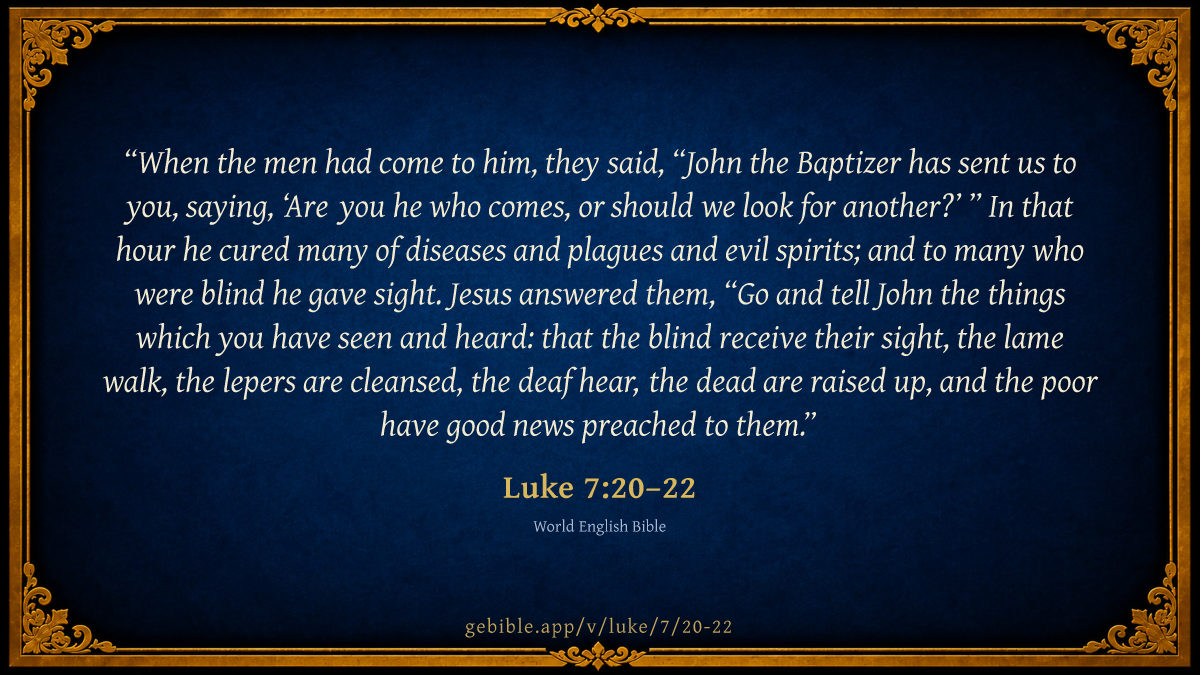
When the men had come to him, they said, “John the Baptizer has sent us to you, saying, ‘Are you he who comes, or should we look for another?’ ”
In that hour he cured many of diseases and plagues and evil spirits; and to many who were blind he gave sight. Jesus answered them, “Go and tell John the things which you have seen and heard: that the blind receive their sight, the lame walk, the lepers are cleansed, the deaf hear, the dead are raised up, and the poor have good news preached to them.
Geneva Bible translators 1599 · Public Domain On v21 When John’s disciples came to Christ.
When John’s disciples came to Christ.
Geneva Bible (1599) marginal notes — public domain.
John Trapp 1656 · Public Domain On vv20–22 20 When the men were come unto him, they…
20 When the men were come unto him, they said, John Baptist hath sent us unto thee, saying, Art thou he that should come? or look we for another?
Ver. 20. {See Trapp on "Mat 11:3"}
John Trapp, A Commentary or Exposition upon All the Books of the Old and New Testament (1647–1656) — public domain. Text from a community e-Sword module.
William Burkitt 1703 · Public Domain On v22 The poor hear and receive the gospel. Mat 11:5
The poor hear and receive the gospel. Mat 11:5
Note, that all along, in our Saviour’s time and since, the poor of the world have been more disposed to hear and embrace the gospel than other men; and the reasons of it are these:
Read full note →
1. Because the poor have no worldly interest to engage them to reject Christ and his gospel. The high-priest, the scribes and Pharisees, had a plain worldly interest to engage them to oppose Christ and his doctrine; but the poor were free from these incumbrances and temptations. They had nothing to lose; therefore our Saviour’s doctrine went down more easily with them, because it did not contradict their interest, as it did the interest of those who had great possessions.
Those that are poor, and enjoy little of the good things of this life, are willing to entertain the glad tidings of happiness in another life. Such as are in a state of misery here, are glad to understand that it shall be well with them hereafter, and are willing to listen to the good news of a future happiness; wheras the rich, who have had their consolation here, are not much concerned what will become of them afterwards.
William Burkitt's Expository Notes on the New Testament (1700–1703) — public domain. Text from a community e-Sword module.
John Gill 1763 · Public Domain On vv20–22 And in that same hour,.... Or at that same…
And in that same hour,.... Or at that same time, for a precise hour is not intended: one exemplar reads, "in that day", in which these men came to Christ,
he, Jesus, as the Persic version expresses it,
Read full note →
cured many of their infirmities; bodily weaknesses and disorders: and plagues; which were inflicted on them as scourges and corrections for sin, very severe diseases, as epilepsies, leprosies, palsies, &c. and of evil spirits; or devils, which he dispossessed and commanded out of the bodies of men; though sometimes evil spirits, with the Jews, signify some kinds of bodily diseases: as when it is said (i).
"whoever puts out a lamp because he is afraid of Gentiles, or of thieves, or of , "an evil spirit", or because of a sick man that is asleep, he is free.''
Upon which Maimonides observes,
"an evil spirit they call all kinds of diseases, which, in the Arabic language, go by the name of "melancholy"; for it is one kind of the diseases mentioned, which makes a sick man to fly, and separate himself from mankind, as if he was afraid of the light, or of coming into the company of men:''
and unto many that were blind he gave sight; freely, as an act of grace and kindness, as the word signifies, without any merit, or motive, in them.
(i) Misn. Sabbat, c. 2. sect. 5. Vid Maimon. Hilchot Gerushin, c. 2. sect. 14.
John Gill's Exposition of the Whole Bible (1746–1763) — public domain (CC PDM 1.0). Text via the HelloAO Bible API.
John Wesley 1765 · Public Domain On v22 To the poor the Gospel is preached - Which…
To the poor the Gospel is preached - Which is the greatest mercy, and the greatest miracle of all.
John Wesley, Explanatory Notes Upon the Whole Bible (1754–1765) — public domain. Text via the GEBible commentary corpus.
Adam Clarke 1810 · Public Domain On vv21–22 Verse 21. Infirmities and plagues] The following judicious note…
Verse 21. Infirmities and plagues] The following judicious note from Bp. PEARCE is worthy of deep attention: "Luke mentions here νοσοι, μαϚιγες, leprosias, and πνευματα πονηρα, i.e. diseases or ill habits of body, sores or lamenesses, and evil spirits: from whence we may conclude that evil spirits are reckoned by him (who speaks of distempers with more accuracy than the other evangelists) as things different from any disorders of the body, included in the two former words."
Unto many that were blind he gave light.] Rather, he kindly gave sight - εχαρισατο το βλεπειν; or, he graciously gave sight. This is the proper meaning of the original words. In all his miracles, Jesus showed the tenderest mercy and kindness: not only the cure, but the manner in which he performed it, endeared him to those who were objects of his compassionate regards.
Adam Clarke's Commentary on the Bible (1810–1826) — public domain. Text from a community e-Sword/MySword module.
Haydock's Catholic Bible Commentary 1859 · Public Domain On vv20, 22 The men; (Greek: oi andres) viz. the two disciples…
The men; (Greek: oi andres) viz. the two disciples sent by John the Baptist, who delivered their master’s message; but, before Jesus Christ undertook to reply to their question, he performed on the spot various kinds of miracles.
George Leo Haydock (1774–1849), Haydock's Catholic Family Bible and Commentary, 1859 edition — public domain. Excludes Psalms (Douay-Rheims chapter numbering differs from Protestant) and Deuterocanonical books (Catholic canon only).
The Cambridge Bible for Schools and Colleges 1878 · Public Domain On vv20–22 29. John Baptist] Rather, The Baptist.
29. John Baptist] Rather, The Baptist.
The Cambridge Bible for Schools and Colleges (gen. ed. J. J. S. Perowne; Cambridge University Press, 1878–1918) — public domain. Text from a community e-Sword module.
Ellicott's Commentary for English Readers 1878 · Public Domain On vv20–22 (20) He that should come.—Literally, as in St. Matthew,…
(20) He that should come.—Literally, as in St. Matthew, He that cometh, or, the coming One.
A Bible Commentary for English Readers, edited by Charles John Ellicott (1878–1897) — public domain. Text from a community e-Sword module.
The Pulpit Commentary 1880 · Public Domain On vv21–22 And in that same hour he cured many of…
And in that same hour he cured many of their infirmities and plagues, and of evil spirits; and unto many that were blind he gave sight. "He knew as God what John"s design was in sending to him, and he put it into his heart to send at that very time when he himself was working many miracles which were the true answer to the question" (Cyril, quoted by Wordsworth).
The Pulpit Commentary (1880–1919), ed. H.D.M. Spence-Jones & Joseph S. Exell — public domain. Text from a community e-Sword module.
Paul E. Kretzmann 1924 · Public Domain On v21 Christ’s reference to the prophecy:
Christ’s reference to the prophecy:
v. 21. And in that same hour He cured many of their infirmities and plagues and of evil spirits, and unto many that were blind He gave sight.
Read full note →
v. 22. Then Jesus, answering, said unto them, Go your way, and tell John what things ye have seen and heard; how that the blind see, the lame walk, the lepers are cleansed, the deaf hear, the dead are raised, to the poor the Gospel is preached.
v. 23. And blessed is he whosoever shall not be offended in Me.
The time of their coming to Jesus could not have been arranged more auspiciously. For just then Jesus was busily engaged with performing miracles of all kinds: He cured many of sicknesses, of plagues which were scourges upon their backs; He healed some of evil spirits; to many that were blind He granted the priceless favor or boon of sight. With reference to these and other miracles Jesus reminded the messengers of the Baptist of a prophecy which had been spoken concerning the Messiah, Isa 35:5-6; Isa 61:1-2. There miracles of all kinds, also in the field of physical healing, had been foretold as taking place through the power of. the Messiah. See Mat 11:4-6. Any one that pays the slightest attention to the Old Testament prophecy, and compares it with the present visible fulfillment, cannot doubt that Jesus is the Christ. And Jesus adds a word of warning for the special benefit of the two disciples: Blessed is he that shall not be offended in Me. That was the danger for all those disciples of John that were not satisfied with the manner in which the disciples of Jesus were conducting themselves, without regard to the rules of the elders about fasting and washing of hands, etc. , chapter 5:30. If a person is so carried away with a false asceticism that he wants to curtail the liberty of the New Testament, and for that reason is offended at Jesus the Christ, he has only himself to blame for the evil consequences.
Paul E. Kretzmann, Popular Commentary of the Bible (1921–1924) — public domain. Text from a community e-Sword module.
unfoldingWord translationNotes 2017 · CC BY-SA 4.0 On v21 In that hour
In that hour
"At that time"
Read full note →
from evil spirits
It may be helpful to restate the healing. AT: "he healed them from evil spirits" or "he set people free from evil spirits" (See: Ellipsis)
said to them
"said to John's messengers" or "said to the messengers that John sent"
report to John
"tell John"
people who have died are being raised back to life
"dead people are being caused to live again"
needy people
"poor people"
The person who does not stop believing in me because of my actions is blessed
This can be stated in active form. AT: "God will bless the person who does not stop believing in me because of my actions" (See: Active or Passive)
The person who does not ... is blessed
"People who do not ... are blessed" or "Anyone who does not ... is blessed" or "Whoever does not ... is blessed." This is not a specific person.
not stop believing in me because of
This double negative means "continues to believe in me despite" (See: Double Negatives)
believing in me
"trusting me completely"
translationWords
hour, hours
cure
afflicted
demon
John (the Baptist)
leper
clean
good news
believe
bless
unfoldingWord translationNotes — © Distant Shores Media and the Door43 World Missions Community, licensed CC BY-SA 4.0. Source: git.door43.org/Door43/en_tn.
Tyndale Open Study Notes 2022 · CC BY-SA 4.0 On v22 7:22 the blind see, the lame walk: A series…
7:22 the blind see, the lame walk: A series of allusions to Isaiah (Isa 26:19; 29:18-19; 35:5-6; 61:1-2) defines God’s salvation as the restoration of fallen creation. Jesus did not come to overthrow Roman rule over Judea (so he omits “captives . . . will be freed” from his quotation of Isa 61:2); he came for the greater purpose of reversing the effects of sin and death.
Tyndale Open Study Notes — © Tyndale Open Resources, licensed CC BY-SA 4.0. Text via the HelloAO Bible API.