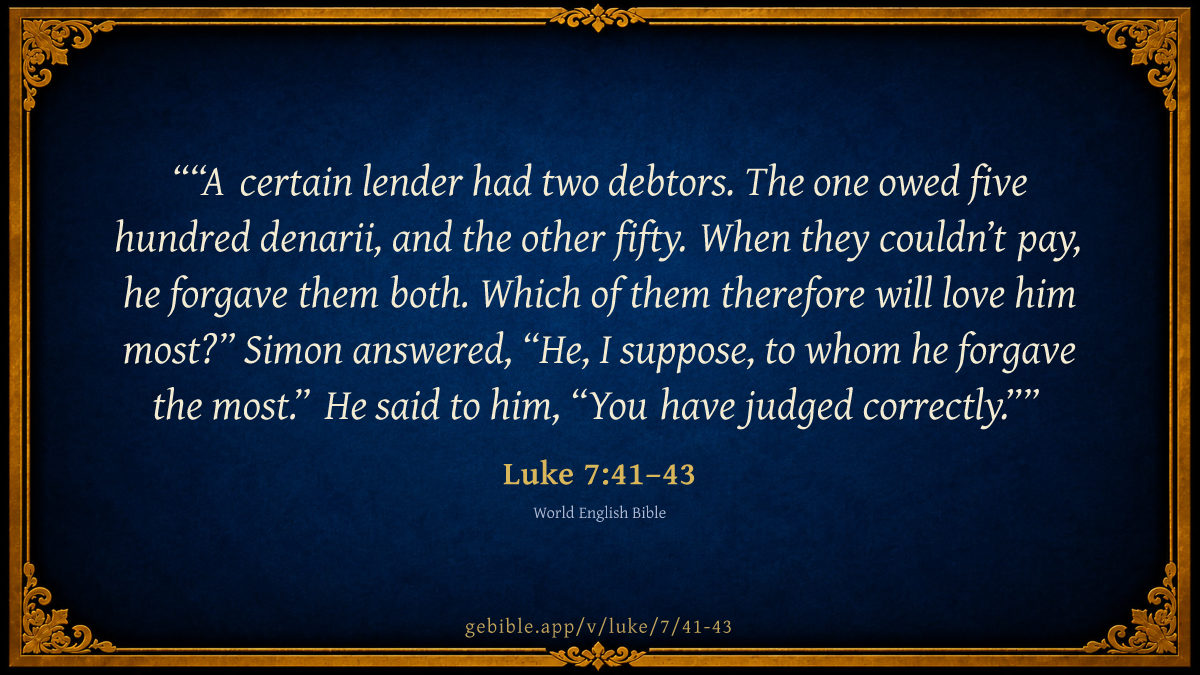
41“A certain lender had two debtors. The one owed five hundred denarii, and the other fifty.42When they couldn’t pay, he forgave them both. Which of them therefore will love him most?”
43Simon answered, “He, I suppose, to whom he forgave the most.” He said to him, “You have judged correctly.”
Luke 7:47(vv41, 43)Therefore I tell you, her sins, which are many, are forgiven, for she loved much. But one to whom little is forgiven, loves little.”
Matthew 6:12(vv41–42)Forgive us our debts, as we also forgive our debtors.
Matthew 18:28(v41)“But that servant went out, and found one of his fellow servants, who owed him one hundred denarii, and he grabbed him, and took him by the…
Romans 5:20(v41)The law came in that the trespass might abound; but where sin abounded, grace abounded more exceedingly;
Psalms 116:16-18(v43)Yahweh, truly I am your servant. I am your servant, the son of your servant girl. You have freed me from my chains. I will offer to you the…
Show all 40 cross-references
Luke 11:4(v41)Forgive us our sins, for we ourselves also forgive everyone who is indebted to us. Bring us not into temptation, but deliver us from the…
Romans 3:23(v41)for all have sinned, and fall short of the glory of God;
1 John 1:8-10(v41)If we say that we have no sin, we deceive ourselves, and the truth is not in us. If we confess our sins, he is faithful and righteous to…
Numbers 27:3(v41)“Our father died in the wilderness. He was not among the company of those who gathered themselves together against Yahweh in the company of…
Psalms 32:1-5(v42)Blessed is he whose disobedience is forgiven, whose sin is covered. Blessed is the man to whom Yahweh doesn’t impute iniquity, in whose…
Psalms 49:7-8(v42)none of them can by any means redeem his brother, nor give God a ransom for him. For the redemption of their life is costly, no payment is…
Psalms 51:1-3(v42)Have mercy on me, God, according to your loving kindness. According to the multitude of your tender mercies, blot out my transgressions.…
Psalms 103:3(v42)who forgives all your sins, who heals all your diseases,
Isaiah 43:25(v42)I, even I, am he who blots out your transgressions for my own sake; and I will not remember your sins.
Isaiah 44:22(v42)I have blotted out, as a thick cloud, your transgressions, and, as a cloud, your sins. Return to me, for I have redeemed you.
Isaiah 50:1(v41)Yahweh says, “Where is the bill of your mother’s divorce, with which I have put her away? Or to which of my creditors have I sold you?…
Jeremiah 3:11(v41)Yahweh said to me, “Backsliding Israel has shown herself more righteous than treacherous Judah.
Jeremiah 31:33-34(v42)“But this is the covenant that I will make with the house of Israel after those days,” says Yahweh: “I will put my law in their inward…
Daniel 9:18-19(v42)My God, turn your ear, and hear. Open your eyes, and see our desolations, and the city which is called by your name; for we do not present…
Micah 7:18-20(v42)Who is a God like you, who pardons iniquity, and passes over the disobedience of the remnant of his heritage? He doesn’t retain his anger…
Matthew 18:23-25(v41)Therefore the Kingdom of Heaven is like a certain king, who wanted to reconcile accounts with his servants. When he had begun to reconcile,…
Matthew 18:25-26(v42)But because he couldn’t pay, his lord commanded him to be sold, with his wife, his children, and all that he had, and payment to be made.…
Matthew 18:34(v42)His lord was angry, and delivered him to the tormentors, until he should pay all that was due to him.
Mark 12:34(v43)When Jesus saw that he answered wisely, he said to him, “You are not far from God’s Kingdom.” No one dared ask him any question after that.
Luke 10:38(v43)As they went on their way, he entered into a certain village, and a certain woman named Martha received him into her house.
Luke 12:48(v41)but he who didn’t know, and did things worthy of stripes, will be beaten with few stripes. To whomever much is given, of him will much be…
Luke 13:4(v41)Or those eighteen, on whom the tower in Siloam fell and killed them; do you think that they were worse offenders than all the men who dwell…
John 15:22-24(v41)If I had not come and spoken to them, they would not have had sin; but now they have no excuse for their sin. He who hates me, hates my…
Acts 13:38-39(v42)Be it known to you therefore, brothers, that through this man is proclaimed to you remission of sins, and by him everyone who believes is…
Romans 3:24(v42)being justified freely by his grace through the redemption that is in Christ Jesus;
Romans 4:5-8(v42)But to him who doesn’t work, but believes in him who justifies the ungodly, his faith is accounted for righteousness. Even as David also…
Romans 5:6(v42)For while we were yet weak, at the right time Christ died for the ungodly.
1 Corinthians 15:9-10(v43)For I am the least of the apostles, who is not worthy to be called an apostle, because I persecuted the assembly of God. But by the grace…
2 Corinthians 5:14-15(v43)For the love of Christ constrains us; because we judge thus, that one died for all, therefore all died. He died for all, that those who…
Galatians 3:10(v42)For as many as are of the works of the law are under a curse. For it is written, “Cursed is everyone who doesn’t continue in all things…
Ephesians 1:7(v42)in whom we have our redemption through his blood, the forgiveness of our trespasses, according to the riches of his grace,
Ephesians 4:32(v42)And be kind to one another, tender hearted, forgiving each other, just as God also in Christ forgave you.
Colossians 3:13(v42)bearing with one another, and forgiving each other, if any man has a complaint against any; even as Christ forgave you, so you also do.
1 Timothy 1:13-16(v43)although I used to be a blasphemer, a persecutor, and insolent. However, I obtained mercy, because I did it ignorantly in unbelief. The…
1 Timothy 1:15-16(v41)The saying is faithful and worthy of all acceptance, that Christ Jesus came into the world to save sinners, of whom I am chief. However,…
40 distinct cross-references across this passage (42 total citations).
Cross-references from openbible.info (CC BY 4.0)
Explain this passage (15 sources)
Historical commentary, presented as a primary source — not an endorsement.
John Trapp1656 · Public DomainOn vv41–4341 There was a certain creditor which had two…
41 There was a certain creditor which had two debtors: the one owed five hundred pence, and the other fifty.
Ver. 41. There was a certain creditor] Christ tells the supercilious and self-conceited Pharisee by this parable, that himself was a sinner also as well as the woman, and as a debtor to God’s judgment, had as much need of his grace in Christ for remission of sin and removal of wrath.
John Trapp, A Commentary or Exposition upon All the Books of the Old and New Testament (1647–1656) — public domain. Text from a community e-Sword module.
John Gill1763 · Public DomainOn vv41–43Thou gavest me no kiss,.... A token of civility…
Thou gavest me no kiss,.... A token of civility among friends, when they met together on any occasion. The Jews have a saying (b), that
"all kisses are foolish, excepting three; the kiss of grandeur or dignity, as in Sa1 10:1 and the kiss at parting, as in Rut 1:14 and the kiss at meeting, as in Exo 4:27 (of which sort this kiss may be thought to be), to which some add the kiss of consanguinity (or that used by relations to one another), as in Gen 29:11'
Read full note →
but this woman, since the time I came in. The Vulgate Latin and Syriac versions read, "since she came in"; and so two of Stephens's copies; which seems to be the more agreeable reading, seeing Christ was in Simon's house before this woman came; for she knowing that he was there, came thither after him:
hath not ceased to kiss my feet; which shows, that this action was repeated by her times without number, even ever since she came into the house.
(b) Shemot Rabba, sect. 6. fol. 91. 3, 4.
John Gill's Exposition of the Whole Bible (1746–1763) — public domain (CC PDM 1.0). Text via the HelloAO Bible API.
John Wesley1765 · Public DomainOn v43Which of them will love him most? - Neither…
Which of them will love him most? - Neither of them will love him at all, before he has forgiven them. An insolvent debtor, till he is forgiven, does not love, but fly his creditor.
John Wesley, Explanatory Notes Upon the Whole Bible (1754–1765) — public domain. Text via the GEBible commentary corpus.
Adam Clarke1810 · Public DomainOn vv41–43Verse 41. A certain creditor, c.] It is plain…
Verse 41. A certain creditor, c.] It is plain that in this parable our Lord means, by the creditor, GOD, and, by the two debtors, Simon and the woman who was present. Simon, who had the light of the law, and who, in consequence of his profession as a Pharisee, was obliged to abstain from outward iniquity, might be considered as the debtor who owed only fifty pence, or denarii. The woman, whom I have supposed to be a heathen, not having these advantages, having no rule to regulate her actions, and no curb on her evil propensities, may be considered as the debtor who owed five hundred pence, or denarii. And when both were compared, Simon's debt to God might be considered, in reference to hers, as fifty to five hundred. However, we find, notwithstanding this great disparity, both were insolvent. Simon, the religious Pharisee, could no more pay his fifty to God than this poor heathen her five hundred and, if both be not freely forgiven by the Divine mercy, both must finally perish. Having NOTHING to PAY, he kindly FORGAVE them both. Some think that this very Simon was no inconsiderable debtor to our Lord, as having been mercifully cleansed from a leprosy; for he is supposed to be the same as Simon the leper. See Clarke on Mt 26:6.
Adam Clarke's Commentary on the Bible (1810–1826) — public domain. Text from a community e-Sword/MySword module.
Albert Barnes1834 · Public DomainOn vv41–43A certain creditor - A man who had lent…
A certain creditor - A man who had lent money or sold property, the payment for which was yet due.
Five hundred pence - About 69 dollars 26 cents, or 14 British pounds, 11 shilling, 8d. See the notes at Mat 18:28.
Read full note →
Fifty - About 7 dollars, or 1 British pound, 9 shillings, and 2d.
Albert Barnes' Notes on the Bible (1834–1885) — public domain. Text from a community e-Sword/MySword module.
Haydock's Catholic Bible Commentary1859 · Public DomainOn vv42–43Which will live him most? as we read in…
Which will live him most? as we read in the Protestant version, and in the Greek, agapesei. But Christ, seeming to require love as a previous disposition to the remission of sins, as appears from ver. 47 below, the Catholic Church has adopted the version of St. Augustine, hom. xxiii. in the present tense: quis ergo plus eum diligit? (Jansenius, Comment. in Evang.)
George Leo Haydock (1774–1849), Haydock's Catholic Family Bible and Commentary, 1859 edition — public domain. Excludes Psalms (Douay-Rheims chapter numbering differs from Protestant) and Deuterocanonical books (Catholic canon only).
Daniel D. Whedon1874 · Public DomainOn vv41–4341. A certain creditor—The creditor is God; the two…
41. A certain creditor—The creditor is God; the two debtors stand for the woman and Simon. The two sums due represent the different moral characters of the two as they stand before the conscience of the world, and as they stand in view of their own moral judgment. One is, in the estimation probably of both, ten times better than the other.
Daniel D. Whedon (gen. ed.), Commentary on the Old and New Testaments (1874–1909) — public domain. Text from a community e-Sword module.
The Cambridge Bible for Schools and Colleges1878 · Public DomainOn vv41–4341. a certain creditor] Rather, money-lender.
41. a certain creditor] Rather, money-lender.
five hundred pence] A denarius was the day’s wages of a labourer and is usually reckoned at 7½d., but really represents much more. Hence 500 denarii would certainly represent as much as £50 in these days. The frequency of our Lord’s illustrations from debtors and creditors shews the disturbed and unprosperous condition of the country under Roman and Herodian oppression.
The Cambridge Bible for Schools and Colleges (gen. ed. J. J. S. Perowne; Cambridge University Press, 1878–1918) — public domain. Text from a community e-Sword module.
Ellicott's Commentary for English Readers1878 · Public DomainOn vv41, 43(41, 42) There was a certain creditor . .…
(41, 42) There was a certain creditor . . .—The parable has some points of resemblance to that of the Two Debtors in Mat_18:23. Here, however, the debts, though different, are not separated by so wide an interval as are the ten thousand talents and the hundred pence. The debts are both within the range of common human experience. The “pence “are, of course, the Roman denarii, worth about sevenpence-halfpenny each. The application of the parable treats the woman as a greater debtor than the Pharisee. She had committed greater sins. Each was equally powerless to pay the debt—i.e., to make atonement for his or her sins. Whatever hope either had lay in the fact that pardon was offered to both as a matter of free gift and bounty.
Frankly.—Better, freely-i.e., gratuitously, as an act of bounty. So Shakespeare—
Read full note →
“I do beseech your grace. . . .
. . . . now to forgive me frankly.”
Henry VIII., Act ii., Scene 1.
A Bible Commentary for English Readers, edited by Charles John Ellicott (1878–1897) — public domain. Text from a community e-Sword module.
The Pulpit Commentary1880 · Public DomainOn vv41, 43Vers. 41, 42. There was a certain creditor which…
Vers. 41, 42. There was a certain creditor which had two debtors: the one owed five hundred pence, and the other fifty. And when they had nothing to pay, he frankly forgave them both. The illustration was from the everyday life of the people. This lending and borrowing was ever a prominent feature in the common life of the Jews. Pointed warnings against greed and covetousness, and the habit of usury, and the love of perpetual trafficking, we find in all the Old Testament books, notably in Deuteronomy, and then centuries later in the Proverbs, besides repeated instances in the prophetic writings and historical books. The character of the Jews in this respect has never changed from the days of their nomad life from the times of their slavery under the Pharaohs to our own day. In this particular instance the two debtors were of the common folk, the sums in question being comparatively small; but in both cases the debtors could never hope to pay their creditors. They were alike hopelessly insolvent, both helplessly bankrupt. The larger sum, considering" the relative value of money, has been computed only to have represented about of our currency. And the two received from their creditor a free, generous acquaintance of the debt which would have hopelessly ruined them. In the mind of Jesus the larger debt pictured the terrible catalogue of sins which the penitent woman acknowledged she had committed; the smaller, the few transgressions which even the Pharisee confessed to having been guilty of. They were both sinners before God, both equally insolvent in his eyes; whether the debt was much or little was to the almighty Creditor a matter of comparative, indifference he frankly forgave them both (better, "freely," the Greek word acarisato signifies "forgave of his generous bounty"). The Revisers simply translate "he forgave," but something more is needed to reproduce the beautiful word in the original. "Frankly," in the sense of "freely," is used by Shakespeare"I do beseech your grace... ... now to forgive me frankly. ("Henry VIII," Ac 2. sc. 1.)
The Pulpit Commentary (1880–1919), ed. H.D.M. Spence-Jones & Joseph S. Exell — public domain. Text from a community e-Sword module.
The Biblical Illustrator1887 · Public DomainOn vv41–42There was a certain creditor which had two debtors
Luk_7:41
There was a certain creditor which had two debtors
Read full note →
God is our Creditor
God is this Creditor; He trusts us with His goods; what we have we have from Him to use.
1. How many daily spend of Gods stock and store. Neither man nor beast (for the use of man), but daily receive from His hand, and seek to be further trusted (Psa_104:27). It would undo the richest man that ever was to have so many in his debt at once.
2. Think how prodigal and expensive men are in spending on Gods stock; how prodigal of His mercy, patience, goodness, &c. (Rom_2:4-5). How lavish are men of the time lent, of health, wealth, &c. (Luk_15:1-32.). Look but on the life of some one sinner, and judge of the rest (Ho Jer_20:7).
3. Consider we with ourselves how long God hath forborne and been out of purse.
4. Add to all Gods bounty and liberality--which is renewed to us daily--He is as willing still to lend us, as if we had paid Him in all, and owedHim not a groat.
5. In all our wants and needs, from hence we have direction to whom to go a-borrowing.
(1) He is a bountiful Creditor, and no needy one; better provided than any other. He hath for our need, and always is at home.
(2) He stands not upon any great security; He is willing to take our words, our promises, for the payment (Gen_28:20; 1Sa_1:11; Mat_18:26-27). Only He expects that we should be just of our words, that we may be again trusted (Ecc_5:4),
(3) Though we borrow of him to-day, yet if we stand in need of Him tomorrow, as questionless we shall, and desire to be further trusted, He will be willing to pleasure us, especially when He sees we employ those talents well wherewith He hath betrusted us. (N. Rogers.)
Other debts
1. A day is set for the payment of other debts. Till the day be come we fear no arrest, they cannot be exacted. But the sinner goes in danger every hour; God may arrest him whensoever it pleaseth Him, as He often doth and hath done, when men think themselves most safe (1Sa_15:32; Dan_5:4-30; Job_21:13).
2. Other debts make us liable but to a bodily arrest only. The conscience may be free; but the debt of sin doth endanger both body and soul too.
3. Other debts may be forgotten, and so not required; but the debt of sin cannot be forgotten of the Lord (Amo_8:7). He keepeth a debt-book, wherein all is written, with the day and place, &c. (Isa_65:6). Cainsdebt is as fresh in Gods mind as if it were but yesterday.
4. From ether debtors there may be some protection, either place or person may keep us from arrest; but there is no protection against the Lords attachments. Angels nor men cannot save us (Job_10:7). The horns of the altar cannot protect us (1Ki_2:28-31). Nor can mountains and rocks conceal us (Rev_6:16).
5. There may be a flying away from other debtors, and a hiding ourselves from mans attachments; but flying here will not save us (Psa_139:7).
6. In mans prison some favour may be showed, good usage obtained; but in the prison wherein sin doth cast us, there is no ease.
7. If thou art not freed out of the hands of other creditors, by friends or other means, yet death will free thee. But it is not so here, the debt which sin cast thee into is most called for, and most terrible after death. (N. Rogers.)
Condition of these two debtors
All are not alike indebted to the Lord. Some are more indebted to Him than others. This appeals by that parable Luk_16:5); and by other express scripture (Mat_11:21; Mat_12:31; Mat_23:14-15; Mat_23:24).
1. All have not received from the Lord a like number of pounds nor talents. He hath not given to all a like stock to trade with (Luk_19:14; Mat_25:14).
2. Again, all are not alike deep in respect of actual transgressions. For albeit original sin be equally and alike extended unto all, it hath no degree nor parts in any child of Adam more than other: yet actual sins committed by us are of a thousand kinds, and every vice hath its latitude and degree. Some are bound up in folio, other some in quarto, others in octavo, and the sins of some other in a decimo sexto.
3. We have learned better, and accordingly we should examine of what kind our sins are, and how much our debt is; and as we find, let us put down in our account. To help us a little in this our search, take this for a general rule, the more directly any sin is done against God, the greater the sin is to be accounted of, and the more the debt. Thus the sin against the Holy Ghost is the greatest sin, because he who committeth that sin, sinneth of malice, purposely to despite the Spirit of grace. Hence it follows--
(1) The sins of the highest degree against the first table are greater than the sins of the highest degree against the second table.
(2) Those sins that are committed against the means which should keep us from sin are greater than other (Mat_11:24). So sins against knowledge are greater than those that are committed out of simple ignorance (Luk_12:47; Jam_4:17). And as it is thus in the sins ofomission, so also in the sins of commission (Act_3:17; 1Ti_1:13). Paul found mercy, because he did it ignorantly. So sins against the gospel are greater than those against the law, for that they are committed against more light. This is the condemnation, saith Christ, that light is come into the world (Joh_3:19). To commit sin in the clear light of the gospel is a reproach not much unlike that of Absolom. He committed wickedness in the sight of the sun
(3) Sins often committed are greater than those but once committed by us, for that here is an abusing of God s patience and forbearance (Rom_2:4-5; Jer_5:6; 2Pe_2:22). In arithmetic a figure, in the first place, stands for itself; in the second place, it stands for ten; and, in the third place, for a hundred, and so higher. (N. Rogers.)
No peace to the debtor
Augustus hearing that the goods of a merchant who died much in debt were set forth to sale, he sent to buy his pillow, saying that he thought it had some rare virtue in it to get one asleep, seeing he that owed so much could sleep on it so quietly. As for these who are so deep in arrearages with God, and in such danger by reason of their debt, and yet sleep securely, God keep me from their bed and pillow. That sleep of theirs is but Porkepose playing before a tempest. (N. Rogers.)
Small debts
1. That the nature of sin stands not in the material part, but in the form, which is the transgression of the law.
2. Small sins, with their multitude and number, hurt the soul as much as great sins do with their weight.
3. Small sins serve to make way for greater. Huntsmen first ply the deer with their little beagles, till it be heated and blown, and then they put on their great buckhounds. Such use the devil makes of little sins. A long thread of iniquity he hath let in with a small needle, as we find in Davids case, and in Peters, &c. A great fire hath been kindled by a little spark; and a great blot made with a little hair hanging in the pen.
4. Small sins are cured with more difficulty than greater. A wound made with a stiletto is more dangerous than a wound made with Goliaths sword; here the wound presently closeth up, and so bleeds inwardly in greater abundance.
5. Forget not what Christ suffered for small sins, even His precious blood Heb_9:7). Our great sins were as the spear in His side, and as the nails in His blessed hands and feet; and our small sins were as the thorns upon His head, they, though small, yet put Him to pain and grief. How dare we crown the Son of God (again) with thorns, and put Him by our small sins to an after suffering? (N. Rogers.)
Free forgiveness
I. IT IS AN UNSPEAKABLE MERCY TO HAVE OUR SINS FORGIVEN. This is the first desire and prayer of an awakened sinner, and a principal blessing in the covenant of grace.
II. IT IS THE SOLE PREROGATIVE OF GOD TO FORGIVE SIN. None can pass by an offence but the party offended, and none can discharge a debt but the person with whom it was contracted.
III. THOSE TO WHOM GOD FORGIVES SIN HAVE NOTHING TO PAY. The whole creation is become insolvent.
IV. THOSE WHOSE SINS ARE PARDONED ARE FIRST BROUGHT TO SEE THAT THEY HAVE NOTHING TO PAY.
V. THE FORGIVENESS OF SINS IS ALL OF GRACE.
VI. THE FORGIVENESS OF SIN TENDS TO GLORIFY GOD. Hence we may learn--
1. How much those wrong God who entertain hard thoughts of Him.
2. What gratitude and love is due to Him from those whose sins are pardoned! (B. Beddome, M. A.)
From the whole, we may observe these six things.
1. That sinners are in debt to God, as having violated His law, and so laid themselves open to the punishment threatened: The wages of sin is death.
2. Some have contracted greater guilt, and so are more in debt to God than others, as having laid themselves open to greater punishment; from the greater advantages they have enjoyed and abused, they have more to answer for and more to fear.
3. It is the common condition of sinners indebted to God that they have nothing to pay, nothing to satisfy Divine justice, or redeem themselves from deserved wrath.
4. God is able and ready to forgive the greatest debt and debtors, as well as the least; those that owe five hundred pence, as well as those that owe fifty.
5. Whom God forgives, He forgives freely; not excluding the satisfaction of Christ, but upon the account of it, which is so far from lessening the freeness of that grace that forgives us, that it greatly exalts it.
I. SOME WHO HAVE RUN FAR IN DEBT TO GOD HAVE BEEN FORGIVEN. Manasseh in the Old Testament, and Paul and Mary Magdalene.
1. Thus He magnifies His patience, and proves it Divine, the patience of God, and not of a creature, much less of a man. (1Ti_1:16.)
2. Some whose iniquities have abounded have been forgiven, for the greater exaltation of grace. Grace is thus exalted and glorified--
(1) In its fulness; that so where sin hath abounded grace may much more abound.
(2) Herein grace shines in its freeness: which, that it may be regarded, it is Gods method, before He makes the offer of pardon, to sum up what sinners have been and done (Isa_43:22-24).
II. WHAT THERE IS IN FORGIVING GRACE TO BE AN ARGUMENT FOR LOVE IN THOSE THAT RECEIVE IT. If blessedness be an argument for love, forgiveness has this belonging to it, and connected with it (Psa_32:1-2). This is a comprehensive blessing, and the foundation of many others. They who have their sins forgiven, are freed from the greatest evil, the wrath of God, and eternal condemnation. Pardon of sin is a covenant-mercy, always connected with the favour of God, and a special relation to to Him. The pardon of sin will sweeten every other mercy, and render any outward burden or affliction tolerable. Sin imbitters, and adds a weight to any affliction; but pardon doth lighten and sweeten it. In a word, the sinner, pardoned in this world, shall have eternal life in the future.
III. How GODS GRACE, AS FREELY FORGIVING GREATER DEBTS, SHOULD LEAD THE FORGIVEN SOUL TO LOVE HIM THE MORE.
And here Gods rich grace, freely forgiving greater debts--
1. Tends to this, as it frees the soul from greater torment, to which its multiplied sins laid it open, especially those committed against light and grace.
2. Gods mercy, as forgiving greater debts, may free the soul from the more tormentful apprehensions it is under, even here, of the wrath to come, and so engage Him to love the more.
3. The greater and more astonishing grace abounding towards great sinners, and singling them out for mercy when others are left, is another ground of greater love.
Application:
1. Have such as have run deeply in debt to God been freely forgiven by Him? What reason have we, then, to believe Him when He declares Himself thus, As I live, I have no pleasure in the death of the wicked, but that the wicked turn from his way and live!
2. How unreasonable are the hard and horrid thoughts whereby sinners, awakened to a sense of their vileness and guilt, are kept off from a forgiving God?
3. How disingenuous would it be for any to go on with the greater security and boldness in sin, because God is ready so freely to forgive the greatest debt?
4. For the greatest sinners to say, There is no hope in their case, is to say what they have no warrant for, from God or His Word.
5. Let such as have any good hope that their debts, how large soever, are forgiven, love much, yea, love the more, the larger their debts have been. If we are pardoned at all, it is a very great debt from which we are discharged. O let us labour after suitable affection, and show it.
(1) By reflecting upon sin with the greater shame and sorrow, hatred and abhorrence, as committed against so good a God.
(2) Having much forgiven, love God the more, and give Him the glory due unto His name. Who is a God like unto Thee, who pardoneth iniquity, and passeth by transgression, &c.
(3) Having much forgiven, let your love show itself greater by your growing esteem of Jesus Christ, whose blood was the price of your pardon, and though it is given you freely, cost Him His life. (D. Wilcox.)
The Biblical Illustrator, edited by Joseph S. Exell (c. 1880s–1900s) — public domain. Text from a community e-Sword module.
Alexander MacLaren1905 · Public DomainOn v41Luk 7:41 - Luk 7:43.
Luke
THE TWO DEBTORS
Read full note →
Luk 7:41 - Luk 7:43.
We all know the lovely story in which this parable is embedded. A woman of notoriously bad character had somehow come in contact with Jesus Christ, and had by Him been aroused from her sensuality and degradation, and calmed by the assurance of forgiveness. So, when she heard that He was in her own town, what could she do but hasten to the Pharisee’s house, and brave the cruel, scornful eyes of the eminently respectable people that would meet her there? She carries with her part of the spoils and instruments of her sinful adornment, to devote it to His service; but before she can open the cruse, her heart opens, and the hot tears flow on His feet, inflicting an indignity where she had meant an honour. She has nothing at hand to repair the fault, she will not venture to take her poor garment, which might have done it, but with a touch, she loosens her long hair, and with the ingenuity and self-abasement of love, uses that for a towel. Then, gathering confidence from her reception, and carried further than she had meant, she ventures to lay her sinful lips on His feet, as if asking pardon for the tears that would come-the only lips, except those of the traitor, that are recorded as having touched the Master. And only then does she dare to pour upon Him her only wealth.
What says the Pharisee? Has he a heart at all? He is scandalised at such a scene at his respectable table; and no wonder, for he could not have known that a change had passed upon the woman, and her evil repute was obviously notorious. He does not wonder at her having found her way into his house, for the meal was half public. But he began to doubt whether a Man who tolerates such familiarities from such a person could be a prophet; or if He were, whether He could be a good man. ‘He would have known her if He had been a prophet,’ thinks he. The thought is only a questionably true one. ‘If He had known her, He would have thrust her back with His foot,’ he thinks; and that thought is obviously false. But Simon’s righteousness was of the sort that gathers up its own robes about it, and shoves back the poor sinner into the filth. ‘She is a sinner,’ says he. No, Simon! she was a sinner, but she is a penitent, and is on the road to be a saint, and having been washed, she is a great deal cleaner than thou art, who art only white-washed.
Our Lord’s parable is the answer to the Pharisee’s thought, and in it Jesus shows Simon that He knows him and the woman a great deal better than he did. There are three things to which briefly I ask your attention-the common debt, in varying amounts; the common insolvency; and the love, like the debt, varying in amount. Now, note these things in order.
I. There is, first of all, the common debt.
I do not propose to dwell at all upon that familiar metaphor, familiar to us all from its use in the Lord’s Prayer, by which sin and the guilt of sin are shadowed forth for us in an imperfect fashion by the conception of debt. For duty neglected is a debt to God, which can only be discharged by a penalty. And all sin, and its consequent guilt and exposure to punishment, may be regarded under the image of indebtedness.
But the point that I want you to notice is that these two in our parable, though they are meant to be portraits of Simon and the woman, are also representatives of the two classes to one or other of which we all belong. They are both debtors, though one owes but a tenth of what the other does. That is to say, our Lord here draws a broad distinction between people who are outwardly respectable, decent, cleanly living, and people who have fallen into the habit, and are living a life, of gross and open transgression. There has been a great deal of very pernicious loose representation of the attitude of Christianity in reference to this matter, common in evangelical pulpits. And I want you to observe that our Lord draws a broad line and says, ‘Yes! you, Simon, are a great deal better than that woman was. She was coarse, unclean, her innocence gone, her purity stained. She had been wallowing in filth, and you, with your respectability, your rigid morality, your punctilious observance of the ordinary human duties, you were far better than she was, and had far less to answer for than she had.’ Fifty is only a tenth of five hundred, and there is a broad distinction, which nothing ought to be allowed to obliterate, between people who, without religion, are trying to do right, to keep themselves in the paths of morality and righteousness, to discharge their duty to their fellows, controlling their passions and their flesh, and others who put the reins upon the necks of the horses and let them carry them where they will, and live in an eminent manner for the world and the flesh and the devil. And there is nothing in evangelical Christianity which in the smallest degree obliterates that distinction, but rather it emphasises it, and gives a man full credit for any difference that there is in his life and conduct and character between himself and the man of gross transgression.
But then it says, on the other side, the difference which does exist, and is not to be minimised, is, after all, a difference of degree. They are both debtors. They stand in the same relation to the creditor, though the amount of the indebtedness is extremely different. We are all sinful men, and we stand in the same relation to God, though one of us may be much darker and blacker than the other.
And then, remember, that when you begin to talk about the guilt of actions in God’s sight, you have to go far below the mere surface. If we could see the infinite complexity of motives-aggravations on the one side and palliations on the other-which go to the doing of a single deed, we should not be so quick to pronounce that the publican and the harlot are worse than the Pharisee. It is quite possible that an action which passes muster in regard to the morality of the world may, if regard be had {which God only can exercise} to the motive for which it is done, be as bad as, if not worse than, the lust and the animalism, drunkenness and debauchery, crime and murder, which the vulgar scales of the world consider to be the heavier. If you once begin to try to measure guilt, you will have to pass under the surface appearance, and will find that many a white and dazzling act has a very rotten inside, and that many a very corrupt and foul one does not come from so corrupt a source as at first sight might seem to be its origin. Let us be very modest in our estimate of the varying guilt of actions, and remember that, deep down below all diversities, there lies a fundamental identity, in which there is no difference, that all of us respectable people that never broke a law of the nation, and scarcely ever a law of propriety, in our lives, and the outcasts, if there are any here now, the drunkards, the sensualists, all of us stand in this respect in the same class. We are all debtors, for we have ‘all sinned and come short of the glory of God,’ A viper an inch long and the thickness of whipcord has a sting and poison in it, and is a viper. And if the question is whether a man has got small-pox or not, one pustule is as good evidence as if he was spotted all over. So, remember, he who owes five hundred and he who owes the tenth part of it, which is fifty, are both debtors.
II. Now notice the common insolvency.
‘They had nothing to pay.’ Well, if there is no money, ‘no effects’ in the bank, no cash in the till, nothing to distrain upon, it does not matter very much what the amount of the debt is, seeing that there is nothing to meet it, and whether it is fifty or five hundred the man is equally unable to pay. And that is precisely our position.
I admit, of course, that men without any recognition of God’s pardoning mercy, or any of the joyful impulse that comes from the sense of Christ’s redemption, or any of the help that is given by the indwelling of the Spirit who sanctifies may do a great deal in the way of mending their characters and making themselves purer and nobler. But that is not the point which my text contemplates, because it deals with a past. And the fact that lies under the metaphor of my text is this, that none of us can in any degree diminish our sin, considered as a debt to God. What can you and I do to lighten our souls of the burden of guilt? What we have written we have written. Tears will not wash it out, and amendment will not alter the past, which stands frowning and irrevocable. If there be a God at all, then our consciences, which speak to us of demerit, proclaim guilt in its two elements-the sense of having done wrong, and the foreboding of punishment therefor. Guilt cannot be dealt with by the guilty one: it must be Some One else who deals with it. He, and only He against whom we have sinned, can touch the great burden that we have piled upon us.
Brother! we have nothing to pay. We may mend our ways; but that does not touch the past. We may hate the evil; that will help to keep us from doing it in the future, but it does not affect our responsibility for what is done. We cannot touch it; there it stands irrevocable, with this solemn sentence written over the black pile, ‘Every transgression and disobedience shall receive its just recompense of reward.’ We have nothing to pay.
But my text suggests, further, that a condition precedent to forgiveness is the recognition by us of our penniless insolvency. Though it is not distinctly stated, it is clearly and necessarily implied in the narrative, that the two debtors are to be supposed as having come and held out a couple of pairs of empty hands, and sued in formâ pauperis. You must recognise your insolvency if you expect to be forgiven. God does not accept dividends, so much in the pound, and let you off the rest on consideration thereof. If you are going to pay, you have to pay all; if He is going to forgive, you have to let Him forgive all. It must be one thing or the other, and you and I have to elect which of the two we shall stand by, and which of the two shall be applied to us.
Oh, dear friends! may we all come and say,
‘Nothing in my hand I bring,
Simply to Thy Cross I cling.
III. And so, lastly, notice the love, which varies with the forgiveness.
‘Tell Me which of them will love him most.’ Simon does not penetrate Christ’s design, and there is a dash of supercilious contempt for the story and the question, as it seems to me, in the languid, half-courteous answer:-’I suppose, if it were worth my while to think about such a thing, that he to whom he forgave the most.’ He did not know what a battery was going to be unmasked. Jesus says, ‘Thou hast rightly judged.’
The man that is most forgiven is the man that will love most. Well, that answer is true if all other things about the two debtors are equal. If they are the same sort of men, with the same openness to sentiments of gratitude and generosity, the man who is let off the smaller debt will generally be less obliged than the man who is let off the larger. But it is, alas! not always the case that we can measure benefits conferred by gratitude shown. Another element comes in-namely, the consciousness of the benefit received-which measures the gratitude far more accurately than the actual benefit bestowed. And so we must take both these things, the actual amount of forgiveness, so to speak, which is conferred, and the depth of the sense of the forgiveness received, in order to get the measure of the love which answers it. So that this principle breaks up into two thoughts, of which I have only just a word or two to say.
First, it is very often true that the greatest sinners make the greatest saints. There have been plenty of instances all down the history of the world, and there are plenty of instances, thank God, cropping up every day still in which some poor, wretched outcast, away out in the darkness, living on the husks that the swine do eat, and liking to be in the pigstye, is brought back into the Father’s house, and turns out a far more loving son and a far better servant than the man that had never wandered away from it. ‘The publicans and the harlots’ do often yet ‘go into the Kingdom of God before’ the respectable people.
And there are plenty of people in Manchester that you would not touch with a pair of tongs who, if they could be got hold of, would make far more earnest and devoted Christians than you are. The very strength of passion and feeling which has swept them wrong, rightly directed, would make grand saints of them, just as the very same conditions of climate which, at tropics, bring tornadoes and cyclones and dreadful thunder-storms, do also bring abundant fertility. The river which devastates a nation, dammed up within banks, may fertilise half a continent. And if a man is brought out of the darkness, and looks back upon the years that are wasted, that may help him to a more intense consecration. And if he remembers the filth out of which Jesus Christ picked him, it will bind him to that Lord with a bond deep and sacred.
So let no outcast man or woman listening to me now despair. You can come back from the furthest darkness, and whatever ugly things you have in your memories and your consciences, you may make them stepping-stones on which to climb to the very throne of God. Let no respectable people despise the outcasts; there may be the making in them of far better Christians than we are.
But, on the other hand, let no man think lightly of sin. Though it can be forgiven and swept away, and the gross sinner may become the great saint, there will be scars and bitter memories and habits surging up again after we thought they were dead; and the old ague and fever that we caught in the pestilential land will hang by us when we have migrated into a more wholesome climate. It is never good for a man to have sinned, even though, through his sin, God may have taken occasion to bring him near to Himself.
But the second form of this principle is always true-namely, that those who are most conscious of forgiveness will be most fruitful of love. The depth and fervour of our individual Christianity depends more largely on the clearness of our consciousness of our own personal guilt and the firmness of our grasp of forgiveness than upon anything else.
Why is it that such multitudes of you professing Christians are such icebergs in your Christianity? Mainly for this reason-that you have never found out, in anything like an adequate measure, how great a sinner you are, and how sure and sweet and sufficient Christ’s pardoning mercy is. And so you are like Simon-you will ask Jesus to dinner, but you will not give Him any water for His feet or ointment for His head. You will do the conventional and necessary pieces of politeness, but not one act of impulse from the heart ever comes from you. You discharge ‘the duties of religion.’ What a phrase! You discharge the duties of religion. Ah! My brother, if you had been down into the horrible pit and the miry clay, and had seen a hand and a face looking down, and an arm outstretched to lift you; and if you had ever known what the rapture was after that subterraneous experience of having your feet set upon a rock and your goings established, you would come to Him and you would say, ‘Take me all, O Lord! for I am all redeemed by Thee.’ ‘To whom little is forgiven the same loveth little.’ Does not that explain the imperfect Christianity of thousands of us?
Fifty pence and five hundred pence are both small sums. Our Lord had nothing to do here with the absolute amount of debt, but only with the comparative amount of the two debts. But when He wanted to tell the people what the absolute amount of the debt was, he did it in that other story of the Unfaithful Servant. He owed his lord, not fifty pence {fifty eightpences or thereabouts}, not five hundred pence, but ‘ten thousand talents,’ which comes to near two and a half millions of English money. And that is the picture of our indebtedness to God. ‘We have nothing to pay.’ Here is the payment-that Cross, that dying Christ. Turn your faith there, my brother, and then you will get ample forgiveness, and that will kindle love, and that will overflow in service. For the aperture in the heart at which forgiveness enters in is precisely of the same width as the one at which love goes out. Christ has loved us all, and perfectly. Let us love Him back again, who has died that we might live, and borne our sins in His own body.
Alexander MacLaren, Expositions of Holy Scripture (1904–1910) — public domain. Text from a community e-Sword module.
Paul E. Kretzmann1924 · Public DomainOn v41The parable and its application:
The parable and its application:
v. 41. There was a certain creditor which had two debtors; the one owed five hundred pence and the other fifty.
Read full note →
v. 42. And when they had nothing to pay, he frankly forgave them both. Tell Me therefore, which of them will love him most?
v. 43. Simon answered and said, I suppose that he to whom he forgave most. And He said unto him, Thou hast rightly judged.
v. 44. And He turned to the woman and said unto Simon, Seest thou this woman? I entered into thine house; thou gavest Me no water for My feet, but she hath washed My feet with tears, and wiped them with the hairs of her head.
v. 45. Thou gavest Me no kiss; but this woman, since the time I came in, hath not ceased to kiss My feet.
v. 46. My head with oil thou didst not anoint; but this woman hath anointed My feet with ointment.
Two debtors were to one creditor; a fine bit of emphasis for the sake of the application of the parable: Simon and the woman, both debtors to the Lord. In the one case the debt was very large, five hundred denarii, almost eighty-five dollars; in the other very small, only one-tenth of that sum. Both were unable to pay, both were excused from paying the debt. Now the question was: Which of the two debtors was under the greater obligation to the Lord, and whose love would therefore be the greater? The answer was obvious, although the Pharisee answered somewhat cautiously that such was his opinion. Jesus accepted the answer gravely. But now came the application. For the first time Jesus turned to the woman directly and also asks Simon to look at her whom he had despised so absolutely. For the proud Pharisee could learn a lesson from the outcast of society. Jesus draws a parallel between the behavior of Simon and of this woman. Note the sharp contrast throughout the description: water—tears; kiss of welcome—repeated kisses; common oil—precious ointment. Simon had not even observed the common courtesies invariably extended to a visitor or guest. When a guest came to the house of a Jew, he was greeted with a salutation and with a kiss, out under the entrance portico. Then the servants brought the water for rinsing off the feet, since people wore only sandals, and their feet became very dusty. And then followed the anointing with oil, of which a few drops were poured on the head of the guest. The words of Christ were a fine, effective reproof. "That, then, is the office of Christ the Lord which He carries on in the world, namely, that He rebukes sin and forgives sin. He rebukes the sin of those that do not acknowledge their sin, and especially of those that do not want to be sinners and consider themselves holy, as this Pharisee did. He forgives sin to those that feel it and desire forgiveness; as this woman was a sinner. With His rebuke He earns little thanks; with the forgiveness of sins He succeeds in having His doctrine branded as heresy and blasphemy. But neither should be omitted. The preaching unto repentance and the rebuking we must have, in order that people come to the knowledge of their sins and become meek. The preaching of grace and of forgiveness of sins we must have, in order that the people do not fall into despair. Therefore the preacher’s office should preserve the mean between presumption and despair, that preaching is done thus that people neither become presumptuous nor despair."
Paul E. Kretzmann, Popular Commentary of the Bible (1921–1924) — public domain. Text from a community e-Sword module.
unfoldingWord translationNotes2017 · CC BY-SA 4.0On v41General Information:
General Information:
To emphasize what he is going to tell Simon the Pharisee, Jesus tells him a story. (See: Parables)
Read full note →
A certain moneylender had two debtors
"Two men owed money to a certain moneylender"
five hundred denarii
"500 days' wages." "Denarii" is the plural of "denarius." A "denarius" was a silver coin. (See: Biblical Money and Numbers)
the other fifty
"the other debtor owed fifty denarii" or "50 days' wages"
he forgave them both
"he forgave their debts" or "he canceled their debts"
I suppose
Simon was cautious about his answer. AT: "Probably"
Tyndale Open Study Notes2022 · CC BY-SA 4.0On vv41, 437:41 500 pieces of silver (denarii) was almost two…
7:41 500 pieces of silver (denarii) was almost two years’ wages for a day laborer. The poor were often heavily indebted to the wealthy in first-century Galilee.

John Trapp 1656 · Public Domain On vv41–43 41 There was a certain creditor which had two…
41 There was a certain creditor which had two debtors: the one owed five hundred pence, and the other fifty.
Ver. 41. There was a certain creditor] Christ tells the supercilious and self-conceited Pharisee by this parable, that himself was a sinner also as well as the woman, and as a debtor to God’s judgment, had as much need of his grace in Christ for remission of sin and removal of wrath.
John Trapp, A Commentary or Exposition upon All the Books of the Old and New Testament (1647–1656) — public domain. Text from a community e-Sword module.
John Gill 1763 · Public Domain On vv41–43 Thou gavest me no kiss,.... A token of civility…
Thou gavest me no kiss,.... A token of civility among friends, when they met together on any occasion. The Jews have a saying (b), that
"all kisses are foolish, excepting three; the kiss of grandeur or dignity, as in Sa1 10:1 and the kiss at parting, as in Rut 1:14 and the kiss at meeting, as in Exo 4:27 (of which sort this kiss may be thought to be), to which some add the kiss of consanguinity (or that used by relations to one another), as in Gen 29:11'
Read full note →
but this woman, since the time I came in. The Vulgate Latin and Syriac versions read, "since she came in"; and so two of Stephens's copies; which seems to be the more agreeable reading, seeing Christ was in Simon's house before this woman came; for she knowing that he was there, came thither after him:
hath not ceased to kiss my feet; which shows, that this action was repeated by her times without number, even ever since she came into the house.
(b) Shemot Rabba, sect. 6. fol. 91. 3, 4.
John Gill's Exposition of the Whole Bible (1746–1763) — public domain (CC PDM 1.0). Text via the HelloAO Bible API.
John Wesley 1765 · Public Domain On v43 Which of them will love him most? - Neither…
Which of them will love him most? - Neither of them will love him at all, before he has forgiven them. An insolvent debtor, till he is forgiven, does not love, but fly his creditor.
John Wesley, Explanatory Notes Upon the Whole Bible (1754–1765) — public domain. Text via the GEBible commentary corpus.
Adam Clarke 1810 · Public Domain On vv41–43 Verse 41. A certain creditor, c.] It is plain…
Verse 41. A certain creditor, c.] It is plain that in this parable our Lord means, by the creditor, GOD, and, by the two debtors, Simon and the woman who was present. Simon, who had the light of the law, and who, in consequence of his profession as a Pharisee, was obliged to abstain from outward iniquity, might be considered as the debtor who owed only fifty pence, or denarii. The woman, whom I have supposed to be a heathen, not having these advantages, having no rule to regulate her actions, and no curb on her evil propensities, may be considered as the debtor who owed five hundred pence, or denarii. And when both were compared, Simon's debt to God might be considered, in reference to hers, as fifty to five hundred. However, we find, notwithstanding this great disparity, both were insolvent. Simon, the religious Pharisee, could no more pay his fifty to God than this poor heathen her five hundred and, if both be not freely forgiven by the Divine mercy, both must finally perish. Having NOTHING to PAY, he kindly FORGAVE them both. Some think that this very Simon was no inconsiderable debtor to our Lord, as having been mercifully cleansed from a leprosy; for he is supposed to be the same as Simon the leper. See Clarke on Mt 26:6.
Adam Clarke's Commentary on the Bible (1810–1826) — public domain. Text from a community e-Sword/MySword module.
Albert Barnes 1834 · Public Domain On vv41–43 A certain creditor - A man who had lent…
A certain creditor - A man who had lent money or sold property, the payment for which was yet due.
Five hundred pence - About 69 dollars 26 cents, or 14 British pounds, 11 shilling, 8d. See the notes at Mat 18:28.
Read full note →
Fifty - About 7 dollars, or 1 British pound, 9 shillings, and 2d.
Albert Barnes' Notes on the Bible (1834–1885) — public domain. Text from a community e-Sword/MySword module.
Haydock's Catholic Bible Commentary 1859 · Public Domain On vv42–43 Which will live him most? as we read in…
Which will live him most? as we read in the Protestant version, and in the Greek, agapesei. But Christ, seeming to require love as a previous disposition to the remission of sins, as appears from ver. 47 below, the Catholic Church has adopted the version of St. Augustine, hom. xxiii. in the present tense: quis ergo plus eum diligit? (Jansenius, Comment. in Evang.)
George Leo Haydock (1774–1849), Haydock's Catholic Family Bible and Commentary, 1859 edition — public domain. Excludes Psalms (Douay-Rheims chapter numbering differs from Protestant) and Deuterocanonical books (Catholic canon only).
Daniel D. Whedon 1874 · Public Domain On vv41–43 41. A certain creditor—The creditor is God; the two…
41. A certain creditor—The creditor is God; the two debtors stand for the woman and Simon. The two sums due represent the different moral characters of the two as they stand before the conscience of the world, and as they stand in view of their own moral judgment. One is, in the estimation probably of both, ten times better than the other.
Daniel D. Whedon (gen. ed.), Commentary on the Old and New Testaments (1874–1909) — public domain. Text from a community e-Sword module.
The Cambridge Bible for Schools and Colleges 1878 · Public Domain On vv41–43 41. a certain creditor] Rather, money-lender.
41. a certain creditor] Rather, money-lender.
five hundred pence] A denarius was the day’s wages of a labourer and is usually reckoned at 7½d., but really represents much more. Hence 500 denarii would certainly represent as much as £50 in these days. The frequency of our Lord’s illustrations from debtors and creditors shews the disturbed and unprosperous condition of the country under Roman and Herodian oppression.
The Cambridge Bible for Schools and Colleges (gen. ed. J. J. S. Perowne; Cambridge University Press, 1878–1918) — public domain. Text from a community e-Sword module.
Ellicott's Commentary for English Readers 1878 · Public Domain On vv41, 43 (41, 42) There was a certain creditor . .…
(41, 42) There was a certain creditor . . .—The parable has some points of resemblance to that of the Two Debtors in Mat_18:23. Here, however, the debts, though different, are not separated by so wide an interval as are the ten thousand talents and the hundred pence. The debts are both within the range of common human experience. The “pence “are, of course, the Roman denarii, worth about sevenpence-halfpenny each. The application of the parable treats the woman as a greater debtor than the Pharisee. She had committed greater sins. Each was equally powerless to pay the debt—i.e., to make atonement for his or her sins. Whatever hope either had lay in the fact that pardon was offered to both as a matter of free gift and bounty.
Frankly.—Better, freely-i.e., gratuitously, as an act of bounty. So Shakespeare—
Read full note →
“I do beseech your grace. . . .
. . . . now to forgive me frankly.”
Henry VIII., Act ii., Scene 1.
A Bible Commentary for English Readers, edited by Charles John Ellicott (1878–1897) — public domain. Text from a community e-Sword module.
The Pulpit Commentary 1880 · Public Domain On vv41, 43 Vers. 41, 42. There was a certain creditor which…
Vers. 41, 42. There was a certain creditor which had two debtors: the one owed five hundred pence, and the other fifty. And when they had nothing to pay, he frankly forgave them both. The illustration was from the everyday life of the people. This lending and borrowing was ever a prominent feature in the common life of the Jews. Pointed warnings against greed and covetousness, and the habit of usury, and the love of perpetual trafficking, we find in all the Old Testament books, notably in Deuteronomy, and then centuries later in the Proverbs, besides repeated instances in the prophetic writings and historical books. The character of the Jews in this respect has never changed from the days of their nomad life from the times of their slavery under the Pharaohs to our own day. In this particular instance the two debtors were of the common folk, the sums in question being comparatively small; but in both cases the debtors could never hope to pay their creditors. They were alike hopelessly insolvent, both helplessly bankrupt. The larger sum, considering" the relative value of money, has been computed only to have represented about of our currency. And the two received from their creditor a free, generous acquaintance of the debt which would have hopelessly ruined them. In the mind of Jesus the larger debt pictured the terrible catalogue of sins which the penitent woman acknowledged she had committed; the smaller, the few transgressions which even the Pharisee confessed to having been guilty of. They were both sinners before God, both equally insolvent in his eyes; whether the debt was much or little was to the almighty Creditor a matter of comparative, indifference he frankly forgave them both (better, "freely," the Greek word acarisato signifies "forgave of his generous bounty"). The Revisers simply translate "he forgave," but something more is needed to reproduce the beautiful word in the original. "Frankly," in the sense of "freely," is used by Shakespeare"I do beseech your grace... ... now to forgive me frankly. ("Henry VIII," Ac 2. sc. 1.)
The Pulpit Commentary (1880–1919), ed. H.D.M. Spence-Jones & Joseph S. Exell — public domain. Text from a community e-Sword module.
The Biblical Illustrator 1887 · Public Domain On vv41–42 There was a certain creditor which had two debtors
Luk_7:41
There was a certain creditor which had two debtors
Read full note →
God is our Creditor
God is this Creditor; He trusts us with His goods; what we have we have from Him to use.
1. How many daily spend of Gods stock and store. Neither man nor beast (for the use of man), but daily receive from His hand, and seek to be further trusted (Psa_104:27). It would undo the richest man that ever was to have so many in his debt at once.
2. Think how prodigal and expensive men are in spending on Gods stock; how prodigal of His mercy, patience, goodness, &c. (Rom_2:4-5). How lavish are men of the time lent, of health, wealth, &c. (Luk_15:1-32.). Look but on the life of some one sinner, and judge of the rest (Ho Jer_20:7).
3. Consider we with ourselves how long God hath forborne and been out of purse.
4. Add to all Gods bounty and liberality--which is renewed to us daily--He is as willing still to lend us, as if we had paid Him in all, and owedHim not a groat.
5. In all our wants and needs, from hence we have direction to whom to go a-borrowing.
(1) He is a bountiful Creditor, and no needy one; better provided than any other. He hath for our need, and always is at home.
(2) He stands not upon any great security; He is willing to take our words, our promises, for the payment (Gen_28:20; 1Sa_1:11; Mat_18:26-27). Only He expects that we should be just of our words, that we may be again trusted (Ecc_5:4),
(3) Though we borrow of him to-day, yet if we stand in need of Him tomorrow, as questionless we shall, and desire to be further trusted, He will be willing to pleasure us, especially when He sees we employ those talents well wherewith He hath betrusted us. (N. Rogers.)
Other debts
1. A day is set for the payment of other debts. Till the day be come we fear no arrest, they cannot be exacted. But the sinner goes in danger every hour; God may arrest him whensoever it pleaseth Him, as He often doth and hath done, when men think themselves most safe (1Sa_15:32; Dan_5:4-30; Job_21:13).
2. Other debts make us liable but to a bodily arrest only. The conscience may be free; but the debt of sin doth endanger both body and soul too.
3. Other debts may be forgotten, and so not required; but the debt of sin cannot be forgotten of the Lord (Amo_8:7). He keepeth a debt-book, wherein all is written, with the day and place, &c. (Isa_65:6). Cainsdebt is as fresh in Gods mind as if it were but yesterday.
4. From ether debtors there may be some protection, either place or person may keep us from arrest; but there is no protection against the Lords attachments. Angels nor men cannot save us (Job_10:7). The horns of the altar cannot protect us (1Ki_2:28-31). Nor can mountains and rocks conceal us (Rev_6:16).
5. There may be a flying away from other debtors, and a hiding ourselves from mans attachments; but flying here will not save us (Psa_139:7).
6. In mans prison some favour may be showed, good usage obtained; but in the prison wherein sin doth cast us, there is no ease.
7. If thou art not freed out of the hands of other creditors, by friends or other means, yet death will free thee. But it is not so here, the debt which sin cast thee into is most called for, and most terrible after death. (N. Rogers.)
Condition of these two debtors
All are not alike indebted to the Lord. Some are more indebted to Him than others. This appeals by that parable Luk_16:5); and by other express scripture (Mat_11:21; Mat_12:31; Mat_23:14-15; Mat_23:24).
1. All have not received from the Lord a like number of pounds nor talents. He hath not given to all a like stock to trade with (Luk_19:14; Mat_25:14).
2. Again, all are not alike deep in respect of actual transgressions. For albeit original sin be equally and alike extended unto all, it hath no degree nor parts in any child of Adam more than other: yet actual sins committed by us are of a thousand kinds, and every vice hath its latitude and degree. Some are bound up in folio, other some in quarto, others in octavo, and the sins of some other in a decimo sexto.
3. We have learned better, and accordingly we should examine of what kind our sins are, and how much our debt is; and as we find, let us put down in our account. To help us a little in this our search, take this for a general rule, the more directly any sin is done against God, the greater the sin is to be accounted of, and the more the debt. Thus the sin against the Holy Ghost is the greatest sin, because he who committeth that sin, sinneth of malice, purposely to despite the Spirit of grace. Hence it follows--
(1) The sins of the highest degree against the first table are greater than the sins of the highest degree against the second table.
(2) Those sins that are committed against the means which should keep us from sin are greater than other (Mat_11:24). So sins against knowledge are greater than those that are committed out of simple ignorance (Luk_12:47; Jam_4:17). And as it is thus in the sins ofomission, so also in the sins of commission (Act_3:17; 1Ti_1:13). Paul found mercy, because he did it ignorantly. So sins against the gospel are greater than those against the law, for that they are committed against more light. This is the condemnation, saith Christ, that light is come into the world (Joh_3:19). To commit sin in the clear light of the gospel is a reproach not much unlike that of Absolom. He committed wickedness in the sight of the sun
(3) Sins often committed are greater than those but once committed by us, for that here is an abusing of God s patience and forbearance (Rom_2:4-5; Jer_5:6; 2Pe_2:22). In arithmetic a figure, in the first place, stands for itself; in the second place, it stands for ten; and, in the third place, for a hundred, and so higher. (N. Rogers.)
No peace to the debtor
Augustus hearing that the goods of a merchant who died much in debt were set forth to sale, he sent to buy his pillow, saying that he thought it had some rare virtue in it to get one asleep, seeing he that owed so much could sleep on it so quietly. As for these who are so deep in arrearages with God, and in such danger by reason of their debt, and yet sleep securely, God keep me from their bed and pillow. That sleep of theirs is but Porkepose playing before a tempest. (N. Rogers.)
Small debts
1. That the nature of sin stands not in the material part, but in the form, which is the transgression of the law.
2. Small sins, with their multitude and number, hurt the soul as much as great sins do with their weight.
3. Small sins serve to make way for greater. Huntsmen first ply the deer with their little beagles, till it be heated and blown, and then they put on their great buckhounds. Such use the devil makes of little sins. A long thread of iniquity he hath let in with a small needle, as we find in Davids case, and in Peters, &c. A great fire hath been kindled by a little spark; and a great blot made with a little hair hanging in the pen.
4. Small sins are cured with more difficulty than greater. A wound made with a stiletto is more dangerous than a wound made with Goliaths sword; here the wound presently closeth up, and so bleeds inwardly in greater abundance.
5. Forget not what Christ suffered for small sins, even His precious blood Heb_9:7). Our great sins were as the spear in His side, and as the nails in His blessed hands and feet; and our small sins were as the thorns upon His head, they, though small, yet put Him to pain and grief. How dare we crown the Son of God (again) with thorns, and put Him by our small sins to an after suffering? (N. Rogers.)
Free forgiveness
I. IT IS AN UNSPEAKABLE MERCY TO HAVE OUR SINS FORGIVEN. This is the first desire and prayer of an awakened sinner, and a principal blessing in the covenant of grace.
II. IT IS THE SOLE PREROGATIVE OF GOD TO FORGIVE SIN. None can pass by an offence but the party offended, and none can discharge a debt but the person with whom it was contracted.
III. THOSE TO WHOM GOD FORGIVES SIN HAVE NOTHING TO PAY. The whole creation is become insolvent.
IV. THOSE WHOSE SINS ARE PARDONED ARE FIRST BROUGHT TO SEE THAT THEY HAVE NOTHING TO PAY.
V. THE FORGIVENESS OF SINS IS ALL OF GRACE.
VI. THE FORGIVENESS OF SIN TENDS TO GLORIFY GOD. Hence we may learn--
1. How much those wrong God who entertain hard thoughts of Him.
2. What gratitude and love is due to Him from those whose sins are pardoned! (B. Beddome, M. A.)
From the whole, we may observe these six things.
1. That sinners are in debt to God, as having violated His law, and so laid themselves open to the punishment threatened: The wages of sin is death.
2. Some have contracted greater guilt, and so are more in debt to God than others, as having laid themselves open to greater punishment; from the greater advantages they have enjoyed and abused, they have more to answer for and more to fear.
3. It is the common condition of sinners indebted to God that they have nothing to pay, nothing to satisfy Divine justice, or redeem themselves from deserved wrath.
4. God is able and ready to forgive the greatest debt and debtors, as well as the least; those that owe five hundred pence, as well as those that owe fifty.
5. Whom God forgives, He forgives freely; not excluding the satisfaction of Christ, but upon the account of it, which is so far from lessening the freeness of that grace that forgives us, that it greatly exalts it.
I. SOME WHO HAVE RUN FAR IN DEBT TO GOD HAVE BEEN FORGIVEN. Manasseh in the Old Testament, and Paul and Mary Magdalene.
1. Thus He magnifies His patience, and proves it Divine, the patience of God, and not of a creature, much less of a man. (1Ti_1:16.)
2. Some whose iniquities have abounded have been forgiven, for the greater exaltation of grace. Grace is thus exalted and glorified--
(1) In its fulness; that so where sin hath abounded grace may much more abound.
(2) Herein grace shines in its freeness: which, that it may be regarded, it is Gods method, before He makes the offer of pardon, to sum up what sinners have been and done (Isa_43:22-24).
II. WHAT THERE IS IN FORGIVING GRACE TO BE AN ARGUMENT FOR LOVE IN THOSE THAT RECEIVE IT. If blessedness be an argument for love, forgiveness has this belonging to it, and connected with it (Psa_32:1-2). This is a comprehensive blessing, and the foundation of many others. They who have their sins forgiven, are freed from the greatest evil, the wrath of God, and eternal condemnation. Pardon of sin is a covenant-mercy, always connected with the favour of God, and a special relation to to Him. The pardon of sin will sweeten every other mercy, and render any outward burden or affliction tolerable. Sin imbitters, and adds a weight to any affliction; but pardon doth lighten and sweeten it. In a word, the sinner, pardoned in this world, shall have eternal life in the future.
III. How GODS GRACE, AS FREELY FORGIVING GREATER DEBTS, SHOULD LEAD THE FORGIVEN SOUL TO LOVE HIM THE MORE.
And here Gods rich grace, freely forgiving greater debts--
1. Tends to this, as it frees the soul from greater torment, to which its multiplied sins laid it open, especially those committed against light and grace.
2. Gods mercy, as forgiving greater debts, may free the soul from the more tormentful apprehensions it is under, even here, of the wrath to come, and so engage Him to love the more.
3. The greater and more astonishing grace abounding towards great sinners, and singling them out for mercy when others are left, is another ground of greater love.
Application:
1. Have such as have run deeply in debt to God been freely forgiven by Him? What reason have we, then, to believe Him when He declares Himself thus, As I live, I have no pleasure in the death of the wicked, but that the wicked turn from his way and live!
2. How unreasonable are the hard and horrid thoughts whereby sinners, awakened to a sense of their vileness and guilt, are kept off from a forgiving God?
3. How disingenuous would it be for any to go on with the greater security and boldness in sin, because God is ready so freely to forgive the greatest debt?
4. For the greatest sinners to say, There is no hope in their case, is to say what they have no warrant for, from God or His Word.
5. Let such as have any good hope that their debts, how large soever, are forgiven, love much, yea, love the more, the larger their debts have been. If we are pardoned at all, it is a very great debt from which we are discharged. O let us labour after suitable affection, and show it.
(1) By reflecting upon sin with the greater shame and sorrow, hatred and abhorrence, as committed against so good a God.
(2) Having much forgiven, love God the more, and give Him the glory due unto His name. Who is a God like unto Thee, who pardoneth iniquity, and passeth by transgression, &c.
(3) Having much forgiven, let your love show itself greater by your growing esteem of Jesus Christ, whose blood was the price of your pardon, and though it is given you freely, cost Him His life. (D. Wilcox.)
The Biblical Illustrator, edited by Joseph S. Exell (c. 1880s–1900s) — public domain. Text from a community e-Sword module.
Alexander MacLaren 1905 · Public Domain On v41 Luk 7:41 - Luk 7:43.
Luke
THE TWO DEBTORS
Read full note →
Luk 7:41 - Luk 7:43.
We all know the lovely story in which this parable is embedded. A woman of notoriously bad character had somehow come in contact with Jesus Christ, and had by Him been aroused from her sensuality and degradation, and calmed by the assurance of forgiveness. So, when she heard that He was in her own town, what could she do but hasten to the Pharisee’s house, and brave the cruel, scornful eyes of the eminently respectable people that would meet her there? She carries with her part of the spoils and instruments of her sinful adornment, to devote it to His service; but before she can open the cruse, her heart opens, and the hot tears flow on His feet, inflicting an indignity where she had meant an honour. She has nothing at hand to repair the fault, she will not venture to take her poor garment, which might have done it, but with a touch, she loosens her long hair, and with the ingenuity and self-abasement of love, uses that for a towel. Then, gathering confidence from her reception, and carried further than she had meant, she ventures to lay her sinful lips on His feet, as if asking pardon for the tears that would come-the only lips, except those of the traitor, that are recorded as having touched the Master. And only then does she dare to pour upon Him her only wealth.
What says the Pharisee? Has he a heart at all? He is scandalised at such a scene at his respectable table; and no wonder, for he could not have known that a change had passed upon the woman, and her evil repute was obviously notorious. He does not wonder at her having found her way into his house, for the meal was half public. But he began to doubt whether a Man who tolerates such familiarities from such a person could be a prophet; or if He were, whether He could be a good man. ‘He would have known her if He had been a prophet,’ thinks he. The thought is only a questionably true one. ‘If He had known her, He would have thrust her back with His foot,’ he thinks; and that thought is obviously false. But Simon’s righteousness was of the sort that gathers up its own robes about it, and shoves back the poor sinner into the filth. ‘She is a sinner,’ says he. No, Simon! she was a sinner, but she is a penitent, and is on the road to be a saint, and having been washed, she is a great deal cleaner than thou art, who art only white-washed.
Our Lord’s parable is the answer to the Pharisee’s thought, and in it Jesus shows Simon that He knows him and the woman a great deal better than he did. There are three things to which briefly I ask your attention-the common debt, in varying amounts; the common insolvency; and the love, like the debt, varying in amount. Now, note these things in order.
I. There is, first of all, the common debt.
I do not propose to dwell at all upon that familiar metaphor, familiar to us all from its use in the Lord’s Prayer, by which sin and the guilt of sin are shadowed forth for us in an imperfect fashion by the conception of debt. For duty neglected is a debt to God, which can only be discharged by a penalty. And all sin, and its consequent guilt and exposure to punishment, may be regarded under the image of indebtedness.
But the point that I want you to notice is that these two in our parable, though they are meant to be portraits of Simon and the woman, are also representatives of the two classes to one or other of which we all belong. They are both debtors, though one owes but a tenth of what the other does. That is to say, our Lord here draws a broad distinction between people who are outwardly respectable, decent, cleanly living, and people who have fallen into the habit, and are living a life, of gross and open transgression. There has been a great deal of very pernicious loose representation of the attitude of Christianity in reference to this matter, common in evangelical pulpits. And I want you to observe that our Lord draws a broad line and says, ‘Yes! you, Simon, are a great deal better than that woman was. She was coarse, unclean, her innocence gone, her purity stained. She had been wallowing in filth, and you, with your respectability, your rigid morality, your punctilious observance of the ordinary human duties, you were far better than she was, and had far less to answer for than she had.’ Fifty is only a tenth of five hundred, and there is a broad distinction, which nothing ought to be allowed to obliterate, between people who, without religion, are trying to do right, to keep themselves in the paths of morality and righteousness, to discharge their duty to their fellows, controlling their passions and their flesh, and others who put the reins upon the necks of the horses and let them carry them where they will, and live in an eminent manner for the world and the flesh and the devil. And there is nothing in evangelical Christianity which in the smallest degree obliterates that distinction, but rather it emphasises it, and gives a man full credit for any difference that there is in his life and conduct and character between himself and the man of gross transgression.
But then it says, on the other side, the difference which does exist, and is not to be minimised, is, after all, a difference of degree. They are both debtors. They stand in the same relation to the creditor, though the amount of the indebtedness is extremely different. We are all sinful men, and we stand in the same relation to God, though one of us may be much darker and blacker than the other.
And then, remember, that when you begin to talk about the guilt of actions in God’s sight, you have to go far below the mere surface. If we could see the infinite complexity of motives-aggravations on the one side and palliations on the other-which go to the doing of a single deed, we should not be so quick to pronounce that the publican and the harlot are worse than the Pharisee. It is quite possible that an action which passes muster in regard to the morality of the world may, if regard be had {which God only can exercise} to the motive for which it is done, be as bad as, if not worse than, the lust and the animalism, drunkenness and debauchery, crime and murder, which the vulgar scales of the world consider to be the heavier. If you once begin to try to measure guilt, you will have to pass under the surface appearance, and will find that many a white and dazzling act has a very rotten inside, and that many a very corrupt and foul one does not come from so corrupt a source as at first sight might seem to be its origin. Let us be very modest in our estimate of the varying guilt of actions, and remember that, deep down below all diversities, there lies a fundamental identity, in which there is no difference, that all of us respectable people that never broke a law of the nation, and scarcely ever a law of propriety, in our lives, and the outcasts, if there are any here now, the drunkards, the sensualists, all of us stand in this respect in the same class. We are all debtors, for we have ‘all sinned and come short of the glory of God,’ A viper an inch long and the thickness of whipcord has a sting and poison in it, and is a viper. And if the question is whether a man has got small-pox or not, one pustule is as good evidence as if he was spotted all over. So, remember, he who owes five hundred and he who owes the tenth part of it, which is fifty, are both debtors.
II. Now notice the common insolvency.
‘They had nothing to pay.’ Well, if there is no money, ‘no effects’ in the bank, no cash in the till, nothing to distrain upon, it does not matter very much what the amount of the debt is, seeing that there is nothing to meet it, and whether it is fifty or five hundred the man is equally unable to pay. And that is precisely our position.
I admit, of course, that men without any recognition of God’s pardoning mercy, or any of the joyful impulse that comes from the sense of Christ’s redemption, or any of the help that is given by the indwelling of the Spirit who sanctifies may do a great deal in the way of mending their characters and making themselves purer and nobler. But that is not the point which my text contemplates, because it deals with a past. And the fact that lies under the metaphor of my text is this, that none of us can in any degree diminish our sin, considered as a debt to God. What can you and I do to lighten our souls of the burden of guilt? What we have written we have written. Tears will not wash it out, and amendment will not alter the past, which stands frowning and irrevocable. If there be a God at all, then our consciences, which speak to us of demerit, proclaim guilt in its two elements-the sense of having done wrong, and the foreboding of punishment therefor. Guilt cannot be dealt with by the guilty one: it must be Some One else who deals with it. He, and only He against whom we have sinned, can touch the great burden that we have piled upon us.
Brother! we have nothing to pay. We may mend our ways; but that does not touch the past. We may hate the evil; that will help to keep us from doing it in the future, but it does not affect our responsibility for what is done. We cannot touch it; there it stands irrevocable, with this solemn sentence written over the black pile, ‘Every transgression and disobedience shall receive its just recompense of reward.’ We have nothing to pay.
But my text suggests, further, that a condition precedent to forgiveness is the recognition by us of our penniless insolvency. Though it is not distinctly stated, it is clearly and necessarily implied in the narrative, that the two debtors are to be supposed as having come and held out a couple of pairs of empty hands, and sued in formâ pauperis. You must recognise your insolvency if you expect to be forgiven. God does not accept dividends, so much in the pound, and let you off the rest on consideration thereof. If you are going to pay, you have to pay all; if He is going to forgive, you have to let Him forgive all. It must be one thing or the other, and you and I have to elect which of the two we shall stand by, and which of the two shall be applied to us.
Oh, dear friends! may we all come and say,
‘Nothing in my hand I bring,
Simply to Thy Cross I cling.
III. And so, lastly, notice the love, which varies with the forgiveness.
‘Tell Me which of them will love him most.’ Simon does not penetrate Christ’s design, and there is a dash of supercilious contempt for the story and the question, as it seems to me, in the languid, half-courteous answer:-’I suppose, if it were worth my while to think about such a thing, that he to whom he forgave the most.’ He did not know what a battery was going to be unmasked. Jesus says, ‘Thou hast rightly judged.’
The man that is most forgiven is the man that will love most. Well, that answer is true if all other things about the two debtors are equal. If they are the same sort of men, with the same openness to sentiments of gratitude and generosity, the man who is let off the smaller debt will generally be less obliged than the man who is let off the larger. But it is, alas! not always the case that we can measure benefits conferred by gratitude shown. Another element comes in-namely, the consciousness of the benefit received-which measures the gratitude far more accurately than the actual benefit bestowed. And so we must take both these things, the actual amount of forgiveness, so to speak, which is conferred, and the depth of the sense of the forgiveness received, in order to get the measure of the love which answers it. So that this principle breaks up into two thoughts, of which I have only just a word or two to say.
First, it is very often true that the greatest sinners make the greatest saints. There have been plenty of instances all down the history of the world, and there are plenty of instances, thank God, cropping up every day still in which some poor, wretched outcast, away out in the darkness, living on the husks that the swine do eat, and liking to be in the pigstye, is brought back into the Father’s house, and turns out a far more loving son and a far better servant than the man that had never wandered away from it. ‘The publicans and the harlots’ do often yet ‘go into the Kingdom of God before’ the respectable people.
And there are plenty of people in Manchester that you would not touch with a pair of tongs who, if they could be got hold of, would make far more earnest and devoted Christians than you are. The very strength of passion and feeling which has swept them wrong, rightly directed, would make grand saints of them, just as the very same conditions of climate which, at tropics, bring tornadoes and cyclones and dreadful thunder-storms, do also bring abundant fertility. The river which devastates a nation, dammed up within banks, may fertilise half a continent. And if a man is brought out of the darkness, and looks back upon the years that are wasted, that may help him to a more intense consecration. And if he remembers the filth out of which Jesus Christ picked him, it will bind him to that Lord with a bond deep and sacred.
So let no outcast man or woman listening to me now despair. You can come back from the furthest darkness, and whatever ugly things you have in your memories and your consciences, you may make them stepping-stones on which to climb to the very throne of God. Let no respectable people despise the outcasts; there may be the making in them of far better Christians than we are.
But, on the other hand, let no man think lightly of sin. Though it can be forgiven and swept away, and the gross sinner may become the great saint, there will be scars and bitter memories and habits surging up again after we thought they were dead; and the old ague and fever that we caught in the pestilential land will hang by us when we have migrated into a more wholesome climate. It is never good for a man to have sinned, even though, through his sin, God may have taken occasion to bring him near to Himself.
But the second form of this principle is always true-namely, that those who are most conscious of forgiveness will be most fruitful of love. The depth and fervour of our individual Christianity depends more largely on the clearness of our consciousness of our own personal guilt and the firmness of our grasp of forgiveness than upon anything else.
Why is it that such multitudes of you professing Christians are such icebergs in your Christianity? Mainly for this reason-that you have never found out, in anything like an adequate measure, how great a sinner you are, and how sure and sweet and sufficient Christ’s pardoning mercy is. And so you are like Simon-you will ask Jesus to dinner, but you will not give Him any water for His feet or ointment for His head. You will do the conventional and necessary pieces of politeness, but not one act of impulse from the heart ever comes from you. You discharge ‘the duties of religion.’ What a phrase! You discharge the duties of religion. Ah! My brother, if you had been down into the horrible pit and the miry clay, and had seen a hand and a face looking down, and an arm outstretched to lift you; and if you had ever known what the rapture was after that subterraneous experience of having your feet set upon a rock and your goings established, you would come to Him and you would say, ‘Take me all, O Lord! for I am all redeemed by Thee.’ ‘To whom little is forgiven the same loveth little.’ Does not that explain the imperfect Christianity of thousands of us?
Fifty pence and five hundred pence are both small sums. Our Lord had nothing to do here with the absolute amount of debt, but only with the comparative amount of the two debts. But when He wanted to tell the people what the absolute amount of the debt was, he did it in that other story of the Unfaithful Servant. He owed his lord, not fifty pence {fifty eightpences or thereabouts}, not five hundred pence, but ‘ten thousand talents,’ which comes to near two and a half millions of English money. And that is the picture of our indebtedness to God. ‘We have nothing to pay.’ Here is the payment-that Cross, that dying Christ. Turn your faith there, my brother, and then you will get ample forgiveness, and that will kindle love, and that will overflow in service. For the aperture in the heart at which forgiveness enters in is precisely of the same width as the one at which love goes out. Christ has loved us all, and perfectly. Let us love Him back again, who has died that we might live, and borne our sins in His own body.
Alexander MacLaren, Expositions of Holy Scripture (1904–1910) — public domain. Text from a community e-Sword module.
Paul E. Kretzmann 1924 · Public Domain On v41 The parable and its application:
The parable and its application:
v. 41. There was a certain creditor which had two debtors; the one owed five hundred pence and the other fifty.
Read full note →
v. 42. And when they had nothing to pay, he frankly forgave them both. Tell Me therefore, which of them will love him most?
v. 43. Simon answered and said, I suppose that he to whom he forgave most. And He said unto him, Thou hast rightly judged.
v. 44. And He turned to the woman and said unto Simon, Seest thou this woman? I entered into thine house; thou gavest Me no water for My feet, but she hath washed My feet with tears, and wiped them with the hairs of her head.
v. 45. Thou gavest Me no kiss; but this woman, since the time I came in, hath not ceased to kiss My feet.
v. 46. My head with oil thou didst not anoint; but this woman hath anointed My feet with ointment.
Two debtors were to one creditor; a fine bit of emphasis for the sake of the application of the parable: Simon and the woman, both debtors to the Lord. In the one case the debt was very large, five hundred denarii, almost eighty-five dollars; in the other very small, only one-tenth of that sum. Both were unable to pay, both were excused from paying the debt. Now the question was: Which of the two debtors was under the greater obligation to the Lord, and whose love would therefore be the greater? The answer was obvious, although the Pharisee answered somewhat cautiously that such was his opinion. Jesus accepted the answer gravely. But now came the application. For the first time Jesus turned to the woman directly and also asks Simon to look at her whom he had despised so absolutely. For the proud Pharisee could learn a lesson from the outcast of society. Jesus draws a parallel between the behavior of Simon and of this woman. Note the sharp contrast throughout the description: water—tears; kiss of welcome—repeated kisses; common oil—precious ointment. Simon had not even observed the common courtesies invariably extended to a visitor or guest. When a guest came to the house of a Jew, he was greeted with a salutation and with a kiss, out under the entrance portico. Then the servants brought the water for rinsing off the feet, since people wore only sandals, and their feet became very dusty. And then followed the anointing with oil, of which a few drops were poured on the head of the guest. The words of Christ were a fine, effective reproof. "That, then, is the office of Christ the Lord which He carries on in the world, namely, that He rebukes sin and forgives sin. He rebukes the sin of those that do not acknowledge their sin, and especially of those that do not want to be sinners and consider themselves holy, as this Pharisee did. He forgives sin to those that feel it and desire forgiveness; as this woman was a sinner. With His rebuke He earns little thanks; with the forgiveness of sins He succeeds in having His doctrine branded as heresy and blasphemy. But neither should be omitted. The preaching unto repentance and the rebuking we must have, in order that people come to the knowledge of their sins and become meek. The preaching of grace and of forgiveness of sins we must have, in order that the people do not fall into despair. Therefore the preacher’s office should preserve the mean between presumption and despair, that preaching is done thus that people neither become presumptuous nor despair."
Paul E. Kretzmann, Popular Commentary of the Bible (1921–1924) — public domain. Text from a community e-Sword module.
unfoldingWord translationNotes 2017 · CC BY-SA 4.0 On v41 General Information:
General Information:
To emphasize what he is going to tell Simon the Pharisee, Jesus tells him a story. (See: Parables)
Read full note →
A certain moneylender had two debtors
"Two men owed money to a certain moneylender"
five hundred denarii
"500 days' wages." "Denarii" is the plural of "denarius." A "denarius" was a silver coin. (See: Biblical Money and Numbers)
the other fifty
"the other debtor owed fifty denarii" or "50 days' wages"
he forgave them both
"he forgave their debts" or "he canceled their debts"
I suppose
Simon was cautious about his answer. AT: "Probably"
You have judged correctly
"You are right"
translationWords
forgive
love
judge
unfoldingWord translationNotes — © Distant Shores Media and the Door43 World Missions Community, licensed CC BY-SA 4.0. Source: git.door43.org/Door43/en_tn.
Tyndale Open Study Notes 2022 · CC BY-SA 4.0 On vv41, 43 7:41 500 pieces of silver (denarii) was almost two…
7:41 500 pieces of silver (denarii) was almost two years’ wages for a day laborer. The poor were often heavily indebted to the wealthy in first-century Galilee.
Tyndale Open Study Notes — © Tyndale Open Resources, licensed CC BY-SA 4.0. Text via the HelloAO Bible API.