Questions where the Bible appears to say two different things, with the passages on each side set together.
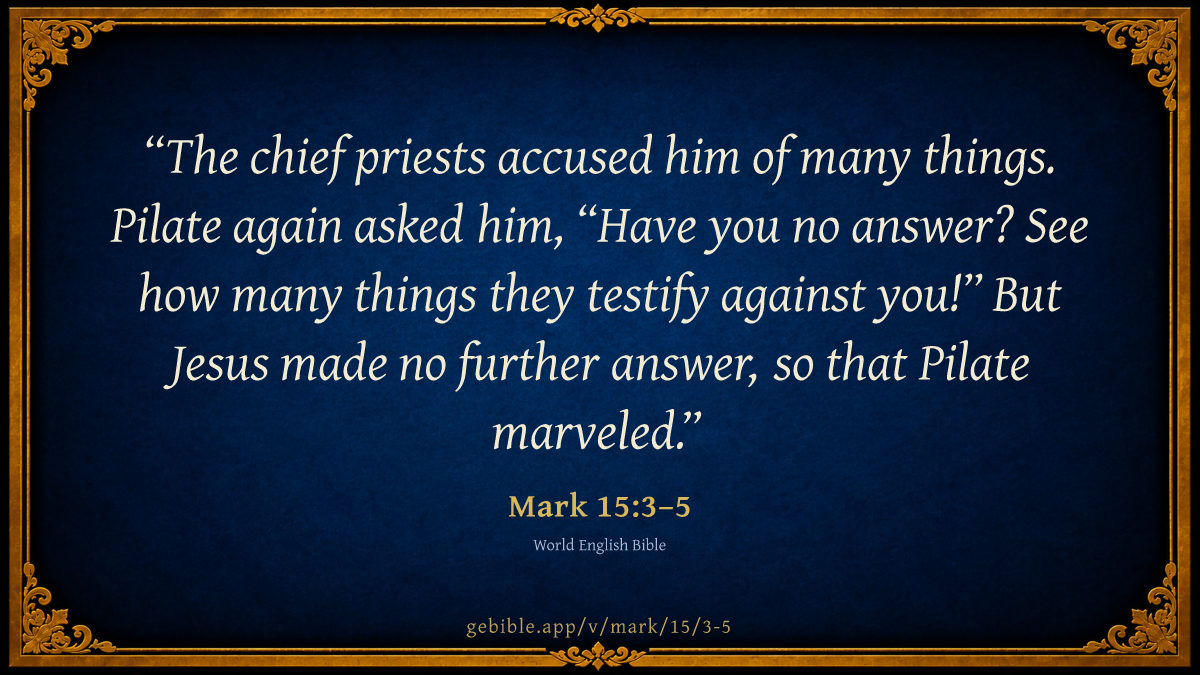
Was Jesus silent during his trial before Pilate?Matthew 27:12-14 and Mark 15:3-5 have Jesus go silent in front of Pilate — refusing to answer the chief priests, refusing to answer a word, until Pilate himsel…
Isaiah 53:7(vv3, 5)He was oppressed, yet when he was afflicted he didn’t open his mouth. As a lamb that is led to the slaughter, and as a sheep that before…
Zechariah 3:8(v5)Hear now, Joshua the high priest, you and your fellows who sit before you; for they are men who are a sign: for, behold, I will bring out…
Psalms 71:7(v5)I am a marvel to many, but you are my strong refuge.
Matthew 27:14(v5)He gave him no answer, not even one word, so that the governor marveled greatly.
John 19:10(v4)Pilate therefore said to him, “Aren’t you speaking to me? Don’t you know that I have power to release you and have power to crucify you?”
Show all 17 cross-references
1 Corinthians 4:9(v5)For, I think that God has displayed us, the apostles, last of all, like men sentenced to death. For we are made a spectacle to the world,…
Isaiah 8:18(v5)Behold, I and the children whom Yahweh has given me are for signs and for wonders in Israel from Yahweh of Armies, who dwells in Mount Zion.
Matthew 26:62(v4)The high priest stood up, and said to him, “Have you no answer? What is this that these testify against you?”
Matthew 27:12(v3)When he was accused by the chief priests and elders, he answered nothing.
Matthew 27:13(v4)Then Pilate said to him, “Don’t you hear how many things they testify against you?”
Mark 14:60-61(v3)The high priest stood up in the middle, and asked Jesus, “Have you no answer? What is it which these testify against you?” But he stayed…
Mark 15:5(v3)But Jesus made no further answer, so that Pilate marveled.
Luke 23:2-5(v3)They began to accuse him, saying, “We found this man perverting the nation, forbidding paying taxes to Caesar, and saying that he himself…
John 18:29-31(v3)Pilate therefore went out to them, and said, “What accusation do you bring against this man?” They answered him, “If this man weren’t an…
John 19:6-7(v3)When therefore the chief priests and the officers saw him, they shouted, saying, “Crucify! Crucify!” Pilate said to them, “Take him…
John 19:9(v5)He entered into the Praetorium again, and said to Jesus, “Where are you from?” But Jesus gave him no answer.
John 19:12(v3)At this, Pilate was seeking to release him, but the Jews cried out, saying, “If you release this man, you aren’t Caesar’s friend! Everyone…
17 distinct cross-references across this passage (18 total citations).
Cross-references from openbible.info (CC BY 4.0)
Explain this passage (8 sources)
Historical commentary, presented as a primary source — not an endorsement.
John Gill1763 · Public DomainOn vv3–5And the chief priests accused him of many things,....…
And the chief priests accused him of many things,.... As that he was a magician, and a blasphemer, and gave out that he was the Son of God; and that he made himself a king, and even forbad the people to give tribute to Caesar, and moved discord, sedition, and rebellion throughout the land;
but he answered nothing. This clause is wanting in the Vulgate Latin, Syriac, Arabic, and Persic versions; but is in the Greek text of the Complutensian edition, and in the Ethiopic version, and agrees with Mat 27:12; see Gill on Mat 27:12.
John Gill's Exposition of the Whole Bible (1746–1763) — public domain (CC PDM 1.0). Text via the HelloAO Bible API.
John Wesley1765 · Public DomainOn v3Matt. xxvii, 12.
Matt. xxvii, 12.
John Wesley, Explanatory Notes Upon the Whole Bible (1754–1765) — public domain. Text via the GEBible commentary corpus.
The Cambridge Bible for Schools and Colleges1878 · Public DomainOn vv3–43. And the chief priests accused him] After the…
3. And the chief priests accused him] After the first examination Pilate came forth to the Jewish deputation, standing before the entrance of the palace, and declared his conviction of the innocence of the Accused (Joh_18:38; Luk_23:4). This was the signal for a furious clamour on the part of the chief priests and members of the Sanhedrim, and they accused our Lord of many things, of (1) “stirring up the people,” and (2) “teaching falsely throughout all Judæa, beginning from Galilee even to Jerusalem” (Luk_23:5).
The Cambridge Bible for Schools and Colleges (gen. ed. J. J. S. Perowne; Cambridge University Press, 1878–1918) — public domain. Text from a community e-Sword module.
Ellicott's Commentary for English Readers1878 · Public DomainOn v3(3) But he answered nothing.—Many MSS. omit these words,…
(3) But he answered nothing.—Many MSS. omit these words, but the fact is implied in Pilate’s question, and in “Jesus yet answered nothing,” in Mar_15:5.
A Bible Commentary for English Readers, edited by Charles John Ellicott (1878–1897) — public domain. Text from a community e-Sword module.
The Pulpit Commentary1880 · Public DomainOn vv3–5And the chief priests accused him of many things.…
And the chief priests accused him of many things. The words in the Authorized Version, "but he answered nothing," are not to be found here in any of the best manuscripts or versions. But they are to be found in St. Matthew; (Mat_27:12) and Pilate"s question in the next verse confirms St. Matthew"s statement, and makes the sentence unnecessary here. Our Lord answered nothing, because all that they had to say against him was manifestly false or frivolous, and unworthy of any reply. St. Augustine says on this, "The Savior, who is the Wisdom of God, knew how to overcome by keeping silence."
The Pulpit Commentary (1880–1919), ed. H.D.M. Spence-Jones & Joseph S. Exell — public domain. Text from a community e-Sword module.
The Biblical Illustrator1887 · Public DomainOn v3But He answered nothing.
Mar_15:3
But He answered nothing.
Read full note →
The silence of our Lord
From our Lords sublime silence we may learn-
1. That the manifestation of anger and temper is inconsistent with a Christian spirit. Again, anger is said to rest in the bosom of fools, a mortifying fact, which should be a corrective to this tendency. Socrates, when kicked by a profligate person, said to those who would have him retaliate, Had an ass kicked me, would you have me kick back in return? It requires no intellect to be angry. It is rather a sign of mulishness. You give an advantage to your adversary. Men get the fruit of the cocoanut tree by exasperating the monkeys that live among the branches, so that the animals hurl down the fruit. The assailants keep up the altercation until their end is gained and their baskets are full. But to be patient is to be godlike. Here, then, are two mirrors. In which is your face reflected? Are you easily irritated, or are you able to patiently stand, like your Lord, answering not a word?
2. No one grace more glorifies God than the spirit shown in the silence of Christ. The following incident is related of that eminent minister, Dr. Hopkins: A brother-in-law who was a sceptic, said that his pious kinsman would bear exasperating circumstances no better than anyone else, and, to try him, stated to him some facts peculiarly aggravating. Dr. H. went away very angry, and the remark was made, I told you so. The night, however, was spent in prayer, and with the morning Dr. H. came and confessed his sin of unholy passion, whereupon his brother was deeply affected, and admitted that this was a spirit which he did not possess. The infidel was led to re-examine the grounds on which he stood. He became a humble follower of Christ and a minister of the gospel. But the objector says, I cannot control myself: what is the remedy? In general, we may answer, Watch and pray. God will do His part, we must do ours. More specifically: Keep yourself from temptations. Again, your physical condition is to be cared for. Late hours, bad ventilation, and improper diet affect the temper. If you eat mince pie, fruit cake, and lobster salad at night, you will have dyspepsia, If you have dyspepsia, you will be cross. Think, again, how belittling to you are these spurts of ill-temper, and let it shame you. Think, too, how trivial are these annoyances, and how transitory life is. Look at Christ, whose whole nature was sweet to the depths of His being, and so was not obliged continually to curb the risings of unholy emotion. Commit your cause unto Him who judgeth righteously, and answer not a word. (American Homiletic Review.)
The Biblical Illustrator, edited by Joseph S. Exell (c. 1880s–1900s) — public domain. Text from a community e-Sword module.
unfoldingWord translationNotes2017 · CC BY-SA 4.0On v4Pilate again asked him
Pilate again asked him
"Pilate asked Jesus again"
Read full note →
Do you give no answer
This can be stated in positive form. AT: "Do you have an answer"
See
"Look" or "Listen" or "Pay attention to what I am about to tell you"
that amazed him
It surprised Pilate that Jesus did not reply and defend himself.
 GEBible — Godless Engineer's Bible App
John Gill 1763 · Public Domain On vv3–5 And the chief priests accused him of many things,....…
And the chief priests accused him of many things,.... As that he was a magician, and a blasphemer, and gave out that he was the Son of God; and that he made himself a king, and even forbad the people to give tribute to Caesar, and moved discord, sedition, and rebellion throughout the land;
but he answered nothing. This clause is wanting in the Vulgate Latin, Syriac, Arabic, and Persic versions; but is in the Greek text of the Complutensian edition, and in the Ethiopic version, and agrees with Mat 27:12; see Gill on Mat 27:12.
John Gill's Exposition of the Whole Bible (1746–1763) — public domain (CC PDM 1.0). Text via the HelloAO Bible API.
John Wesley 1765 · Public Domain On v3 Matt. xxvii, 12.
Matt. xxvii, 12.
John Wesley, Explanatory Notes Upon the Whole Bible (1754–1765) — public domain. Text via the GEBible commentary corpus.
The Cambridge Bible for Schools and Colleges 1878 · Public Domain On vv3–4 3. And the chief priests accused him] After the…
3. And the chief priests accused him] After the first examination Pilate came forth to the Jewish deputation, standing before the entrance of the palace, and declared his conviction of the innocence of the Accused (Joh_18:38; Luk_23:4). This was the signal for a furious clamour on the part of the chief priests and members of the Sanhedrim, and they accused our Lord of many things, of (1) “stirring up the people,” and (2) “teaching falsely throughout all Judæa, beginning from Galilee even to Jerusalem” (Luk_23:5).
The Cambridge Bible for Schools and Colleges (gen. ed. J. J. S. Perowne; Cambridge University Press, 1878–1918) — public domain. Text from a community e-Sword module.
Ellicott's Commentary for English Readers 1878 · Public Domain On v3 (3) But he answered nothing.—Many MSS. omit these words,…
(3) But he answered nothing.—Many MSS. omit these words, but the fact is implied in Pilate’s question, and in “Jesus yet answered nothing,” in Mar_15:5.
A Bible Commentary for English Readers, edited by Charles John Ellicott (1878–1897) — public domain. Text from a community e-Sword module.
The Pulpit Commentary 1880 · Public Domain On vv3–5 And the chief priests accused him of many things.…
And the chief priests accused him of many things. The words in the Authorized Version, "but he answered nothing," are not to be found here in any of the best manuscripts or versions. But they are to be found in St. Matthew; (Mat_27:12) and Pilate"s question in the next verse confirms St. Matthew"s statement, and makes the sentence unnecessary here. Our Lord answered nothing, because all that they had to say against him was manifestly false or frivolous, and unworthy of any reply. St. Augustine says on this, "The Savior, who is the Wisdom of God, knew how to overcome by keeping silence."
The Pulpit Commentary (1880–1919), ed. H.D.M. Spence-Jones & Joseph S. Exell — public domain. Text from a community e-Sword module.
The Biblical Illustrator 1887 · Public Domain On v3 But He answered nothing.
Mar_15:3
But He answered nothing.
Read full note →
The silence of our Lord
From our Lords sublime silence we may learn-
1. That the manifestation of anger and temper is inconsistent with a Christian spirit. Again, anger is said to rest in the bosom of fools, a mortifying fact, which should be a corrective to this tendency. Socrates, when kicked by a profligate person, said to those who would have him retaliate, Had an ass kicked me, would you have me kick back in return? It requires no intellect to be angry. It is rather a sign of mulishness. You give an advantage to your adversary. Men get the fruit of the cocoanut tree by exasperating the monkeys that live among the branches, so that the animals hurl down the fruit. The assailants keep up the altercation until their end is gained and their baskets are full. But to be patient is to be godlike. Here, then, are two mirrors. In which is your face reflected? Are you easily irritated, or are you able to patiently stand, like your Lord, answering not a word?
2. No one grace more glorifies God than the spirit shown in the silence of Christ. The following incident is related of that eminent minister, Dr. Hopkins: A brother-in-law who was a sceptic, said that his pious kinsman would bear exasperating circumstances no better than anyone else, and, to try him, stated to him some facts peculiarly aggravating. Dr. H. went away very angry, and the remark was made, I told you so. The night, however, was spent in prayer, and with the morning Dr. H. came and confessed his sin of unholy passion, whereupon his brother was deeply affected, and admitted that this was a spirit which he did not possess. The infidel was led to re-examine the grounds on which he stood. He became a humble follower of Christ and a minister of the gospel. But the objector says, I cannot control myself: what is the remedy? In general, we may answer, Watch and pray. God will do His part, we must do ours. More specifically: Keep yourself from temptations. Again, your physical condition is to be cared for. Late hours, bad ventilation, and improper diet affect the temper. If you eat mince pie, fruit cake, and lobster salad at night, you will have dyspepsia, If you have dyspepsia, you will be cross. Think, again, how belittling to you are these spurts of ill-temper, and let it shame you. Think, too, how trivial are these annoyances, and how transitory life is. Look at Christ, whose whole nature was sweet to the depths of His being, and so was not obliged continually to curb the risings of unholy emotion. Commit your cause unto Him who judgeth righteously, and answer not a word. (American Homiletic Review.)
The Biblical Illustrator, edited by Joseph S. Exell (c. 1880s–1900s) — public domain. Text from a community e-Sword module.
unfoldingWord translationNotes 2017 · CC BY-SA 4.0 On v4 Pilate again asked him
Pilate again asked him
"Pilate asked Jesus again"
Read full note →
Do you give no answer
This can be stated in positive form. AT: "Do you have an answer"
See
"Look" or "Listen" or "Pay attention to what I am about to tell you"
that amazed him
It surprised Pilate that Jesus did not reply and defend himself.
translationWords
Pilate
Jesus
amazed
unfoldingWord translationNotes — © Distant Shores Media and the Door43 World Missions Community, licensed CC BY-SA 4.0. Source: git.door43.org/Door43/en_tn.
Tyndale Open Study Notes 2022 · CC BY-SA 4.0 On v3 15:3-5 Pilate sought a self-defense from Jesus concerning the…
15:3-5 Pilate sought a self-defense from Jesus concerning the charges.
Tyndale Open Study Notes — © Tyndale Open Resources, licensed CC BY-SA 4.0. Text via the HelloAO Bible API.