Mark 6:19-24 sits inside this longer paragraph.
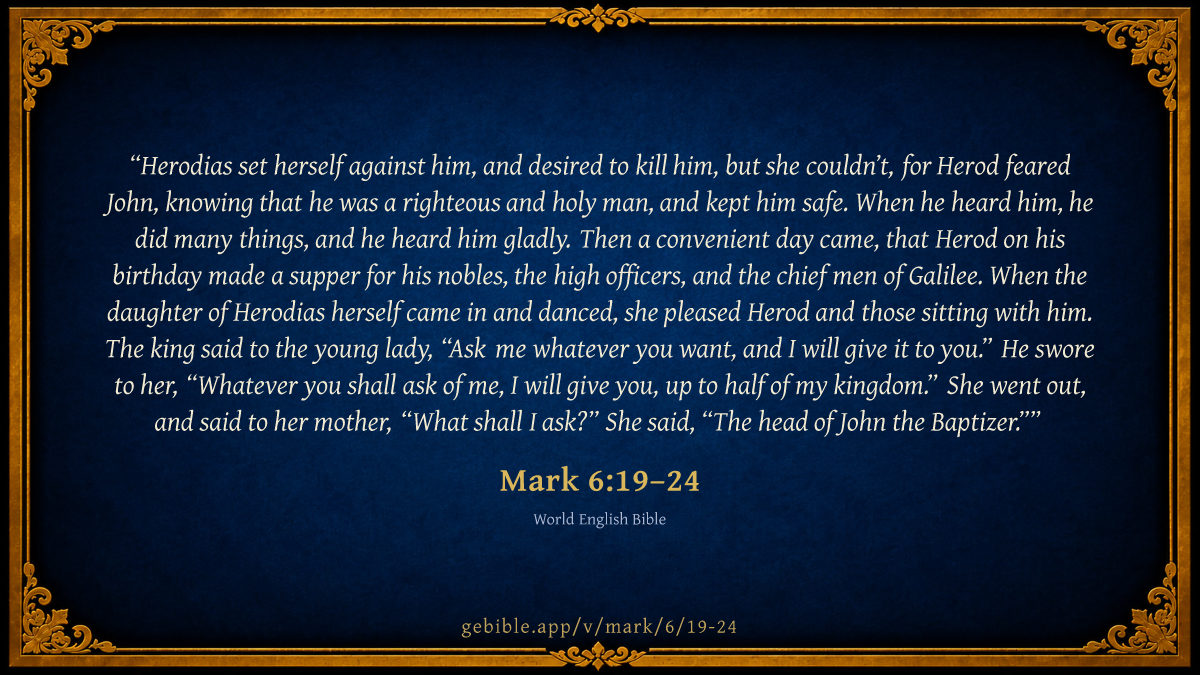
12They went out and preached that people should repent. 13They cast out many demons, and anointed many with oil who were sick, and healed them. 14King Herod heard this, for his name had become known, and he said, “John the Baptizer has risen from the dead, and therefore these powers are at work in him.” 15But others said, “He is Elijah.” Others said, “He is a prophet, or like one of the prophets.” 16But Herod, when he heard this, said, “This is John, whom I beheaded. He has risen from the dead.” 17For Herod himself had sent out and arrested John, and bound him in prison for the sake of Herodias, his brother Philip’s wife, for he had married her. 18For John said to Herod, “It is not lawful for you to have your brother’s wife.” 19Herodias set herself against him, and desired to kill him, but she couldn’t, 20for Herod feared John, knowing that he was a righteous and holy man, and kept him safe. When he heard him, he did many things, and he heard him gladly.
21Then a convenient day came, that Herod on his birthday made a supper for his nobles, the high officers, and the chief men of Galilee. 22When the daughter of Herodias herself came in and danced, she pleased Herod and those sitting with him. The king said to the young lady, “Ask me whatever you want, and I will give it to you.” 23He swore to her, “Whatever you shall ask of me, I will give you, up to half of my kingdom.”
24She went out, and said to her mother, “What shall I ask?” She said, “The head of John the Baptizer.”

Geneva Bible translators 1599 · Public Domain On vv19, 20, 22, 24 Sought all means to do him hurt.
Sought all means to do him hurt.
Geneva Bible (1599) marginal notes — public domain.
John Trapp 1656 · Public Domain On vv19–24 19 Therefore Herodias had a quarrel against him, and…
19 Therefore Herodias had a quarrel against him, and would have killed him; but she could not:
Ver. 19. Herodias had a quarrel against him] Gr. ενειχεν αυτω, hung over him, as highly displeased at him, and waiting an occasion to be even with him. Veritas odium parit, they that follow truth close at heels, may have their teeth struck out, though she be a good mistress. Tange montes et fumigabunt. As wild beasts cannot endure fire, so neither can carnal hearts fervency and plain dealing. Poor Zegedine suffered many years’ captivity in misery and irons by the Turk, for one word in a sermon, which distasted a woman, without the least cause. Melch. Adanl. in Vita.
John Trapp, A Commentary or Exposition upon All the Books of the Old and New Testament (1647–1656) — public domain. Text from a community e-Sword module.
John Gill 1763 · Public Domain On vv19–24 Therefore Herodias had a quarrel against him,.... Was angry…
Therefore Herodias had a quarrel against him,.... Was angry with him, conceived wrath, and laid up hatred against him, and was an adversary to him; which is the sense of the Oriental versions. She bore him an inward grudge, and lay in wait to take the first opportunity of dispatching him:
and would have killed him, but she could not; being hindered by Herod, who as yet would not suffer it; partly through fear of the people, and partly through the respect he had for John.
John Gill's Exposition of the Whole Bible (1746–1763) — public domain (CC PDM 1.0). Text via the HelloAO Bible API.
John Wesley 1765 · Public Domain On vv20, 21, 23 And preserved him - Against all the malice and…
And preserved him - Against all the malice and contrivances of Herodias. And when he heard him - Probably sending for him, at times, during his imprisonment, which continued a year and a half. He heard him gladly - Delusive joy! While Herodias lay in his bosom.
John Wesley, Explanatory Notes Upon the Whole Bible (1754–1765) — public domain. Text via the GEBible commentary corpus.
Adam Clarke 1810 · Public Domain On vv19, 21, 23 Verse 19. Would have killed] εζητει, SOUGHT to kill…
Verse 19. Would have killed] εζητει, SOUGHT to kill him. C and five of the Itala.
See the whole of this account, from Mr 6:17-29, explained on Mt 14:2-12.
Adam Clarke's Commentary on the Bible (1810–1826) — public domain. Text from a community e-Sword/MySword module.
Haydock's Catholic Bible Commentary 1859 · Public Domain On v20 Herod,[2] &c. The sense both of the Latin and…
Herod,[2] &c. The sense both of the Latin and Greek text seems to be, that Herod entertained and shewed a particular respect and value for John the Baptist: yet some expound it, that he had a watchful eye over him, and sought only for an occasion to take him off. (Witham)
===============================
Read full note →
[BIBLIOGRAPHY]
Custodiebat eum, Greek: suneterei auton. The Protestant translation, observed him.
George Leo Haydock (1774–1849), Haydock's Catholic Family Bible and Commentary, 1859 edition — public domain. Excludes Psalms (Douay-Rheims chapter numbering differs from Protestant) and Deuterocanonical books (Catholic canon only).
Daniel D. Whedon 1874 · Public Domain On v21 § 60. — DEATH OF JOHN THE BAPTIST, Mar_6:21-29.
§ 60. — DEATH OF JOHN THE BAPTIST, Mar_6:21-29.
(See notes on Mat_14:6-12.)
Daniel D. Whedon (gen. ed.), Commentary on the Old and New Testaments (1874–1909) — public domain. Text from a community e-Sword module.
The Cambridge Bible for Schools and Colleges 1878 · Public Domain On vv19–24 19. had a quarrel] or as it is rendered…
19. had a quarrel] or as it is rendered in the margin, “had an inward grudge” against him. The word here translated “had a quarrel” occurs in Luk_11:53, where we have rendered it, “and the Pharisees began to urge Him vehemently,” and in Gen_49:23, where the dying Jacob says of Joseph, “The archers sorely grieved him, and shot at him, and hated him.” It denotes literally (1) to “hold” or “keep fast within one;” then (2) to “lay up” or “cherish wrath” against another. Comp. Herod. i. 118, vi. 119. In Tyndale and Cranmer’s Versions it is rendered “laid waite for him,” in the Rhemish, “sought all occasion against him.”
would have killed] The word in the original is much stronger, and denotes that she had a settled wish to kill him. Some Versions read “she sought” or “kept seeking” means to kill him.
The Cambridge Bible for Schools and Colleges (gen. ed. J. J. S. Perowne; Cambridge University Press, 1878–1918) — public domain. Text from a community e-Sword module.
Ellicott's Commentary for English Readers 1878 · Public Domain On vv19, 20, 21, 24 (19) Herodias had a quarrel.—Better, as in the margin,…
(19) Herodias had a quarrel.—Better, as in the margin, had a grudge, or spite, against him.
A Bible Commentary for English Readers, edited by Charles John Ellicott (1878–1897) — public domain. Text from a community e-Sword module.
The Pulpit Commentary 1880 · Public Domain On vv20, 21, 22, 24 The words in the Authorized Version are, When he…
The words in the Authorized Version are, When he heard him, he did many things (polla epoiei), and heard him gladly. But according to the best authorities the reading should be (polla hporei), he was much perplexed. In St. Luke, as stated above, we have (dihporei), "he was much perplexed." Nor is there any inconsistency in the next clause in St. Mark, if we accept this reading. Herod was not utterly depraved. There was to him a charm, not only in the character, but in the discourses of John the Baptist. But he was an inconsistent man, and was continually the victim of a conflict between the good and the evil within him, in which evil, alas! triumphed. Herodias, on the other hand, had always wished to get rid of John, as the stern and uncompromising reprover of her adultery and incest; and so at length she persuaded Herod to give way. "For," says Bede, "she feared lest Herod should at length repent, and yield to the exhortations of John, and dissolve this unreal marriage, and restore Herodias to her lawful husband."
The Pulpit Commentary (1880–1919), ed. H.D.M. Spence-Jones & Joseph S. Exell — public domain. Text from a community e-Sword module.
The Biblical Illustrator 1887 · Public Domain On v20 For Herod feared John.
Mar_6:20
For Herod feared John.
Read full note →
Better to fear God than His minister
Herod feared John, and did many things; had he feared God, he would have laboured to do everything. (Gurnall.)
Fear versus Love
The chains of love are stronger than the chains of fear. Herods love of Herodias was too hard for his fear of John. (Gurnall.)
What moves wicked men thus to affect and reverence Gods faithful ministers
1. The consideration of the excellent gifts which they discern in them, especially natural gifts. These draw them into admiration, and so cause them to esteem and reverence them.
2. Some worldly good or benefit which they reap by the acquaintance or society of such faithful ministers of God.
3. The holy lives of Gods faithful ministers. (G. Petter.)
Character of Herod
I. How mysterious and complex is the character of man! In the same individual what a variety of qualities, apparently the most opposite, are sometimes combined. How important it is that we should know ourselves and the sins which so easily mislead and overcome us; looking meanwhile for guidance to Him who searcheth the reins and trieth the hearts of men.
II. How strong is the impression which real excellence of character makes, even on the minds of wicked men. With all his abandonment of principle and looseness of practice, Herod could not help admiring and respecting John.
III. Yet a man may go far in his admiration of goodness, while he remains practically unaffected by it. The precise extent of Johns moral influence over Herod we do not know; but it is plain that he did follow his guidance in some respects, and, so far, for good; but, in spite of all, there was no real, decided, permanent change in his heart and character. He had mistaken the semblance of religion for its reality-the husk for the kernel. Consequently, when temptation came, it made him tenfold more the child of Satan than before.
IV. Learn from this the danger of yielding to favourite sins. Until met by the home thrust, It is not lawful for thee to have her, all went on smoothly and pleasantly between Herod and John; but the exposure of his darling vice turned his friendship into enmity.
V. The danger of trifling with serious impressions and acting contrary to conscience. Herods association with John ought to have brought him to a humbling sense of sin and a decided change of heart. But he trampled on his convictions; and fatal was the result. Let us be warned by his example. Every funeral that passes, solemn and slow, along the streets; every visit of disease and death to your family circle; every season of holy communion with God; every prick of conscience; these are all so many instruments which God puts in operation for your well-being. Attend to these faithful monitors; cherish them; and they will be productive of lasting benefit to your soul. (R. Burns, D. D.)
Bad men with better moments
This wicked and despotic man, though he appointed for himself no bounds of morality, had moral sensibility lying within him. In the midst of vice and crime he had a conscience. More than that: this man whose very name has come down as a synonym of all that is corrupt and oppressive, had, in the midst of vices and crimes, a kind of yearning for goodness. He had heard John; he had heard him gladly; he wanted to hear him again; and, after the momentary flash of passion and anger was over, he wanted to save him. He was sorry that he was to be executed. There was something in this despotic king which yearned towards justice and goodness. And woe be to every wicked man who, in his wickedness, never finds a single spark of virtue to illuminate his life. I have reason to believe that the men who follow vice have hours in which they look out from themselves longingly, and wish they were better; and that men who are given over to the power of their passions have hours and days in which no outward condemnation is comparable to that which they themselves pass on themselves. Men, because they are wicked, are not necessarily dead. Because they violate rectitude, they do not necessarily destroy their conscience utterly. It sleeps or is drugged; but it has its revenge. Nay, more; it is this dormant or latent sensibility to that which is in contrariety to their whole course of life, that lays the foundation for hope of the recovery or reformation of men. There are hours when many a man, if he had power to regenerate himself, would speedily do it. Oh! that we only knew those hours. Oh! that some friend could approach every such man at these periods when the doors of his prison are thrown open for a time, and lead him by the hand. How many men might be rescued from the abyss which finally overwhelms and destroys them, how many men might be brought up from their degradation and peril, if only we were wise to seize the hours in which they are impressible. The acute and watchful physician knows that a disease runs to a crisis, and that there are points of time when, if the patient is carefully nursed and tended, curative tendencies will set in, and his health may be restored. Now, men are in the same condition spiritually; and if there were rely some oversight of them, they might be saved; but, alas! they themselves cannot perpetuate these hours; they will not; and we stand outside, and know nothing of them. So in every street, and in every community, there are men who are secretly burning out the very vital substance of their life; who are walking in ways, the beginnings of which are pleasant, but the ends of which are death; who are going down through the community, moaning as they go, sighing for something better, and at times holding up hands of prayer and saying, God, help me! Nevertheless, there are men who, with all these experiences, are utterly destroyed. Here was this man Herod-as bad a man as could well be pictured, in many respects; and yet there were in him elements that could have reformed and restored him. (H. W. Beecher.)
Herods partial repentance
It is curious and instructive to observe that Herod is set before us here in the good points of his character-at least, in the best points that he had. It is in the Holy Gospels that one of the vilest wretches in human history is set before us in a somewhat amiable and interesting aspect. He feels a sincere respect for religion. He is not so far gone but that he knows honesty and faith and self-devotion when he sees them in another man. And he does not respect these the less, but a great deal the more, when the just and holy man does not spare his own sins, but denounces them to his face. Not only this, but he takes the preacher under his protection; and declares, doubtless with much hard swearing, when one and another of the courtiers propose to stop the prophets insolence by taking his life, that no man shall hurt a hair of his head. And I have no doubt that he took enormous pride in it, too, as many a swearing, drinking, cheating reprobate nowadays will pride himself on hiring a pew in a most puritan church, where righteousness and temperance and judgment are faithfully preached to him, and will insist, with profuse expletives, that no man shall say a word against his minister. The case is common enough. But we should do Herod injustice if we should suppose this to be all. Herod listened to the preacher of righteousness and repentance with a genuine personal and practical interest. He applies Johns teaching to his own case-to his own sins and his own duties-so far as anything was left to his ingenuity in the matter of application, for Johns teaching was sufficiently direct and pointed in itself. Herod did lay the word of the Lord to heart with reference to his own amendment, and did obviously begin to make such a difference in his course of life as to give Herodias reason to fear that he would not make an end of reforming until he had reformed her and her devils imp of a daughter out of the palace altogether. He did many things in consequence of Johns preaching-many just and upright things such as were strange enough to hear of in the vice-regal court of Palestine; beneficent and public-spirited things, making his reign, for the time, a less unmitigated curse to that afflicted country; merciful things, using his princely wealth and power for the relic of the distressed. What a thing to give thanks for was even this partial repentance of Herod, for the good it did, for the pain and outrage that it saved! Let no one think that the preaching of Gods kingdom is a total waste, even when no man yields to it his unreserved submission. The whole work of Christs gospel in any community is not to be summed up in the net number of converts or communicants. How many a soul is saved from being just such an abandoned wretch as Herod was; how many a decent home from being such a sty of uncleanness as Herods palace was; how many a State from being defiled with blood and turbulent with wrong, just through some mens standing in awe before the holiness of Christ, and hearing Him gladly, and being willing to do many things! (Leonard W. Bacon.)
Insufficiency of Herods right-doing
In all his doing of right things, Herod does nothing right; for in all that he does he is Herod. The things that he does in obedience to Johns preaching are right in the abstract, considered independently of the man that does them. But as a matter of fact, these actions in the abstract never get done in actual life. We can think about them, and reason about them; but we never really see or know of an action that is not done by somebody. The action is the man acting. Strictly speaking, it is not actions that are right or wrong; it is men. And when the question is,-Did the man do right? we have to look at the man as well as the deed. And the honest conscience has no doubt on this point: No man is right in his doing, so long as he is cherishing a fixed, conscious purpose to do wrong, or not to do altogether right. This is a rule that does not work both ways. The hidden thought of the heart is like the morsel hidden in the garment (Hag_2:10-14); it can pollute a good act, it cannot sanctify an evil act. Here is Herod resolutely protecting the sternest of Gods prophets, eagerly listening to him, heeding him, obeying him in many things, but standing out obstinately in his incestuous and adulterous love against that word of the Lord, It is not lawful for thee to have her. How does the case stand with him, just now? It was right, wasnt it? for Herod to do many things at the preaching of John. He was a pretty good man for the time being, wasnt he? Wasnt it quite like heroism-moral heroism-backed up by political caution, when he stubbornly refused to permit the killing of John, and said to Herodias, No! I will not! I will agree to lock him up in prison, but not one step further will I go! Was he not rather the pattern of what we should call a good member of society-a man with a sincere respect for religion, and a great interest in the church, and a strong attachment to his favourite minister;-a man who is willing to subscribe handsomely, and do many things, and deny himself many things, but of course, not everything? Now I do not find that the gospel has any dealings with this kind of goodness. It does not appear that Jesus Christ has any advice or encouragement for those who would like to be rid of a part of their sins. He is not a specialist in spiritual maladies; He is a Great Physician. It is not worth your while to go to Him with a request for partial and local treatment-to hold up before Him your infected, swollen limb, and say, There! give me something for that! Dont touch the rest of me. I am all right. I only want that arm cured. He will not treat the case on any such terms. Your case is constitutional, not local. If you would have the help of Jesus Christ; you must surrender the case to Him; and prepare for thorough treatment, perhaps for sharp surgery. (Leonard W. Bacon.)
Character a power
Your success is very much connected with your personal character. Herod heard John gladly, and did many things, because he knew the preacher to be a just and holy man. Words uttered from the heart find their way to the heart by a holy sympathy. Character is power. (R Cecil.)
Inconstancy
A ship that is not of the right make can not sail trim, and a clock whose spring is faulty will not always go true; so a person of unsound principles cannot be constant and even in his practices. The religion of those that are inwardly rotten, is like a fire in some cold climates, which almost fries a man before, when at the same time he is freezing behind; they are zealous in some things, as holy duties, which are cheap; and cold in other things, especially when they cross their profit or credit; as Mount Hecla is covered with snow on one side, when it burns and casts out cinders on the other: but the holiness of them that are sound at heart is like the natural heat,-though it resorts most to the vitals of sacred performances, yet, as need is, it warms and has an influence upon all the outward parts of civil transactions. It may be said of true sanctity, as of the sun, There is nothing hid from the heat thereof. When all the parts of the body have their due nourishment distributed to them, it is a sign of a healthy temper. As the saint is described sometimes by a clean heart, so also sometimes by clean hands, because he has both; the holiness of his heart is seen at his fingers ends. (G. Swinnock.)
A false respect for religion
A man may be acknowledged to be just and holy, and for that very reason he may be dreaded. You like to see lions and tigers in the Zoological Gardens, but you would not like to see them in your own room; you would very much prefer to see them behind bars and within cages; and so very many have respect for religion, but religious people they cannot bear. (C. H. Spurgeon.)
Wanting to go to heaven, but liking the way to hell
Herod was a foxy man. We sometimes meet with these foxy people. They want to go to heaven, but they like the road to hell. They will sing a hymn to Jesus, but a good roaring song they like also. They will give a guinea to the church, but how many guineas are spent on their own lust. Thus they try to dodge between God and Satan. (C. H. Spurgeon.)
John and Herod
I. The hopeful points in Herods character. He respected justice and holiness. He admired the man in whom he saw justice and righteousness. He listened to John. He obeyed the word to which he listened. He continued to hear the preacher gladly. His conscience was greatly affected.
II. The flaws in the case of Herod. Though he feared John he never looked to Johns Master. He had no respect for goodness in his own heart. He never loved the Word of God as Gods Word. He was under the sway of sin. His was a religion of fear, not of love.
III. What because of Herod. He slew the preacher whom he respected. This Herod Antipas was the man who afterwards mocked the Saviour. He soon lost all the power he possessed. His name is infamous forever. (C. H. Spurgeon.)
Limed by lust
He was like a bird taken with lime twigs: he wanted to fly; but, sad to say, he was willingly held, limed by his lust. (C. H. Spurgeon.)
Preaching! Mans privilege and Gods power
I. The blessedness of hearing the Word. The preaching of the gospel is represented by the sowing of seed-casting the net into the sea-it is the bread of heaven-it is the light of the world.
II. The responsibilities of the hearer of the Word.
III. The needful accompaniments of hearing the Word. (C. H. Spurgeon.)
Transient religious impressions
When you take hold of a piece of india rubber, you may make any impression that you like all over it, but after all it resumes its old shape. There are hosts of hearers of that kind: very impressible, but they quickly return to their old tastes and habits. (C. H. Spurgeon.)
Why Herod feared John
Herod was a king; John was a subject. Herod was in a palace; John was in a prison. Herod wore a crown; John most probably did not even own a turban, Herod wore the purple; John wore camlet, as we should call it. John was the son of an obscure Jewish country priest and his wife: the child of their old age. There is no hint that John had any wealth, or name, or fame, or education, or influence, when he began his life as a man. He comes on the scene as a rough, angular man, with not many words and not many friends. Herod began to reign just about when John began to live, so that there was no preponderant age in the priests son over the kings son: that was all on the other side. Indeed, by all mere surface facts, principles, and analogies, John ought to have feared Herod; he ought to have bated his breath and bent his head before him. Now, I propose to discuss at this time the roots of this power and weakness, to see what made Herod so weak and John so strong, and to ask this question, What can we, who are set as John was, in the advance guard of reformers, do to make a deep, clear mark? And I note for you that John had three great roots of power: First, he was a powerful man by creation-a with a clear head, a steady nerve, and a nature set in a deadly antagonism to sin and meanness of every sort and degree. He was the Jewish John Knox or John Brown.
When he saw a thing was true,
He went to work and put it through.
He could die, but he could not back down, Every time I meet a man who is a man, and not a stick, I ask myself one question: Why are you the man you are? Whence does your power hint itself to me? Whence does it come. And while the ultimate answer has never come out of Phrenology or Physiognomy, or any of the sciences that profess to tell you what a man is by how he looks, yet the indicative answer has always lain in that direction. In the head, and face, and form of a man there is certainly something that impresses you in some such way as the weight, colour, and inscription of a coin reveal to you, with a fair certainty, whether it be gold, or silver, or-brass and it is possible, too, that the line in which a man has descended, the country in which he is born, the climate, the scenery, the history, the poetry, and the society about him, have a great deal to do with the man. The father, in Queen Elizabeths time as I have known in old English families, may be twenty-two carat gold; and the children in Queen Victorias time may be no better than lead. That mysterious antagonism that sows tares among the wheat, sows baseness in the blood; and if there be not forever a careful and most painful dividing and burning, the tares will in time come to nearly all there is on the soil. But still forever the great mint of Providence beats on, silently, certainly, continually, sending its own new golden coins to circulate through our human life, and on each of them stamping the infallible image and superscription that tells us this is gold. Nay, the same great Providence makes not only gold coins, but silver and iron too; and if they are true to their ring, they are all Divine; as in all great houses there be divers vessels, some to more honour and some to less honour, but not one to dishonour if it be true to its purpose; for while the golden vase that holds the wine at the feast of a king is a vessel of honour, so is the iron pot that holds the meat in the furnace; the Parian vase that you fill with flowers is a vessel of honour, and so is the tin dipper with which you fill it at the well. For me, it is a wonderful thing to study merely the pictures of great men. There is a power in the very shadow that makes you feel they were born to be kings and priests unto God. But if you know a great man personally, you find a power in him which the picture can never give you. I suppose this good Jewish country parson, the father of John, flora the little we can glean about him, was just a gentle, timid, pious, retiring man, whose mind had never risen above the routine of his humble post in the temple. But lo! God, in the full time, drops just one golden ingot down into that family treasury, pure, ponderous, solid gold. Yet I need not tall you that there is a theory of human nature that busies itself forever in trying to prove that our human nature in itself is abominably and naturally despicable. Now, this primitive intrinsic nature, I say, was the first element that made John mightier in the prison than Herod was in the palace. The one was a king by creation; the other was only a king by descent. And then, secondly, there comes into the difference another element. Herod made the purple vile by his sin; John made the camels hair radiant by his holiness. And in that personal truth, this rightwiseness, this wholeness, he gained every Divine force in the universe over to his side, and left to Herod only the infernal forces. It was a question of power, reaching back ultimately, as all such questions do, to God and the devil. So the fetter was turned to a sceptre, and the sceptre to a fetter, and the soul of the Sybarite quailed, and went down before the soul of the saint. Then the good man, the true, the upright, downright man of power, goes right on to the mark. Let me tell you a story given me by the late venerable James Mott, of Philadelphia, whose uncle, fifty years ago, discovered the island in the Pacific inhabited by Adams and his companions, as you have read in the story of The Mutiny of the Bounty. I was talking with him one day about it, and he said that, after staying at the island for some time, his uncle turned his vessel homeward and steered directly for Boston,-sailing as he did from your own good city,-eight thousand miles distant. Month after month the brave craft ploughed through storm and shine, keeping her head ever homewards. But as she came near home, she got into a thick fog, and seemed to be sailing by guess. The captain had never sighted land from the time they started; but one night he said to the crew, Now, boys, lay her to! I reckon Boston harbour must be just over there somewhere; but we must wait for the fog to clear up before we try to run in. And so, sure enough, when the morning sun rose it lifted the fog, and right over against them were the spires and homes of the great city of Boston! So can men go right onward over this great sea of life. The chart and compass are with them; and the power is with them to observe the meridian sun and the eternal stars. Storms will drive them, currents will drift them, dangers will beset them; they wilt long for more solid certainties; but by noon and by night they will drive right on, correcting deflections, resisting adverse influences, and then, at the last, when they are near home, they will know it. The darkness may be all about them, but the soul shines in its confidence; and the true mariner will say to his soul, I will wait for the mist to rise with the new morning; I know home is just over there. Then in the morning he is satisfied; he wakes to see the golden light on temple and home. So God brings him to the desired haven. New John was one of those right-on men. Had there been a crevice in Johns armour, Herod would have found it out and laughed at him; but in the presence of that pure life, that deep, conscious antagonism to sin, that masterful power, won as a soldier wins a hard battle, this man on the throne was abased before that man in the prison. Then the third root of power in this great man, by which he mastered a king,-by which he became a king,-lay in the fact that he was a true, clear, unflinching, outspoken preacher of holiness. Some preachers reflect the great verities of religion, as bad boys reflect the sun from bits of broken glass. They stand just on one side, and flash a blaze of fierce light across the eyes of their victim, and leave him more bewildered and irritated than he was before. Such a one is your fitful, changing doctrinaire, whose ideas of right and wrong, or sin and holiness, of God and the devil, today, are not at all as they were last Sunday: who holds not that blessed thing, an ever-changing, because an ever-growing and ripening faith, but a mere sand hill of bewilderment, liable to be blown anywhere by the next great storm. Then there is another sort of preacher, who is like the red light at the head of a railway night train. He is made for warning; he comes to tell of danger. That is the work of his life. When he is not doing that, he has nothing to do. I hear friends at times question whether this man has a Divine mission. Surely, if there be danger to the soul,-and that question is not yet decided in the negative,-then he has to the inner life a mission as Divine as that of the red lamp to the outer life. And I know myself of men who have turned sharp out of the track before his fierce glare, who, but for him, had been run down, and into a disgraceful grave. But the true preacher of holiness, the real forerunner of Christ, is the man who holds up in himself the Divine truth, as a true mirror holds the light, so that whoever comes to him, will see his own character just as it is. Such a man was this who mastered a king. His soul was never distorted by the traditions of the elders, or the habits of good society, as it is called. On the broad clear surface of his soul, as on a pure still lake, you saw things as if in a great deep. He had no broken lights, for he held fast to his own primitive nature, and to his own direct inspiration. (R. Collyer.)
The Biblical Illustrator, edited by Joseph S. Exell (c. 1880s–1900s) — public domain. Text from a community e-Sword module.
B. W. Johnson 1891 · Public Domain On vv19–21 19. Would have killed him. The wicked woman sought…
19. Would have killed him. The wicked woman sought his murder, but could not kill him because Herod refused to consent.
B. W. Johnson's The People's New Testament with Notes (1889–1891) — public domain. Electronic text from the Christian Classics Ethereal Library (CCEL) ThML edition.
C. I. Scofield 1917 · Public Domain On v20 and observed
and observed
kept him safely, and, hearing him, did many things, hearing him gladly.
The Scofield Reference Bible (1917 edition), notes by C. I. Scofield — public domain. Text from a community e-Sword module.
Paul E. Kretzmann 1924 · Public Domain On v21 The birthday festival:
The birthday festival:
v. 21. And when a convenient day was come, that Herod on his birthday made a supper to his lords, high captains, and chief estates of Galilee;
Read full note →
v. 22. and when the daughter of the said Herodias came in and danced, and pleased Herod and them that sat with him, the king said unto the damsel, Ask of me whatsoever thou wilt, and I will give it thee.
v. 23. And he sware unto her, Whatsoever thou shalt ask of me, I will give it thee, unto the half of my kingdom.
v. 24. And she went forth and said unto her mother, What shall I ask? And she said, The head of John the Baptist.
v. 25. And she came in straightway with haste unto the king and asked, saying, I will that thou give me by and by in a charger the head of John the Baptist. Convenient this birthday festival was, coming just at a good, at the right time to agree with the vengeful plans of Herodias, for she still cherished her grudge against John the Baptist.
On his birth. day Herod must needs celebrate in style, in a manner befitting one who expected soon to bear the title of king, by permission of the Emperor and the Roman Senate. The mighty ones and the rulers of thousands and the first families of Galilee were invited, that is, the state, civil, and military officials, and the socially important persons of Galilee: an imposing gathering for such an important event. The joy of the festival banquet was at its height, the guests having undoubtedly freely imbibed and being in the condition of semi-intoxication when reason and sense have alike fled, though articulate speech remains. There had probably also been the usual forms of dancing after the Oriental fashion for the amusement of the guests, when a number not on the program was introduced by the wily Herodias. She had trained her own daughter in the voluptuous dances of the dancing girls, and the girl came into the banquet-hall and danced with reckless abandon and shamelessness. The dance pleased Herod and those that were reclining about the tables. They had just about reached the condition when such exhibitions were inclined to appeal to them with special force. Herod immediately made an extravagant promise to the girl, encouraging her to name the reward that was to be hers for this dance. And when she, either from exhaustion after the strenuous exercise or in natural hesitation over the offer, was still standing undecided, he added an oath, swearing that she should have her desire, though it aspire to half of his kingdom: a true example of maudlin, amatory generosity, as one commentator calls it. It may be that her mother had instructed her even beforehand what she should ask for, as the account of Matthew implies, though not expressly says, and now she needed a further urging. At any rate, she hurries to her mother, who promptly impresses upon her the need to ask for, and insist upon, only one thing. Whether there was another determining factor or not, Salome, the dancer, was now ready to do her mother’s bidding. Without delay and with a quick step, as though the business in hand was the most interesting and joyous in the world, she returns to the banquet-hall. Her words properly indicate the condition of her heart: I want that thou without delay givest me on a platter the head of John the Baptist. Gruesome words from the lips of a young girl, "request proffered with a cool, pert impudence almost outdoing the mother."
Paul E. Kretzmann, Popular Commentary of the Bible (1921–1924) — public domain. Text from a community e-Sword module.
unfoldingWord translationNotes 2017 · CC BY-SA 4.0 On vv21, 23 Connecting Statement:
Connecting Statement:
The author continues to give background information about Herod and the beheading of John the Baptist. (See: Background Information)
Read full note →
he made a dinner for his officials ... of Galilee
Here the word "he" refers to Herod and is a metonym for his servant whom he would have commanded to prepare a meal. AT: "he had a dinner made for his officials ... of Galilee" or "he invited his officials ... of Galilee to eat and celebrate with him"
a dinner
a formal meal or banquet
Herodias herself
The word "herself" is a reflexive pronoun used to emphasize that it was significant that it was Herodias' own daughter who danced at the dinner. (See: Reflexive Pronouns)
came in
"came into the room"
translationWords
Herod Antipas
commander
Galilee
Herodias
king
unfoldingWord translationNotes — © Distant Shores Media and the Door43 World Missions Community, licensed CC BY-SA 4.0. Source: git.door43.org/Door43/en_tn.
Tyndale Open Study Notes 2022 · CC BY-SA 4.0 On vv19, 22 6:19-28 Herodias’s role in the murder of John the…
6:19-28 Herodias’s role in the murder of John the Baptist recalls the story of Jezebel (1 Kgs 19:1-2). Herod succumbed to pressure (Mark 6:26-28), which foreshadows the later story of Pontius Pilate, who put Jesus to death against his better judgment (cp. 6:20, 25-28 with 15:6-15).
Tyndale Open Study Notes — © Tyndale Open Resources, licensed CC BY-SA 4.0. Text via the HelloAO Bible API.