Mark 7:27-30 sits inside this longer paragraph.
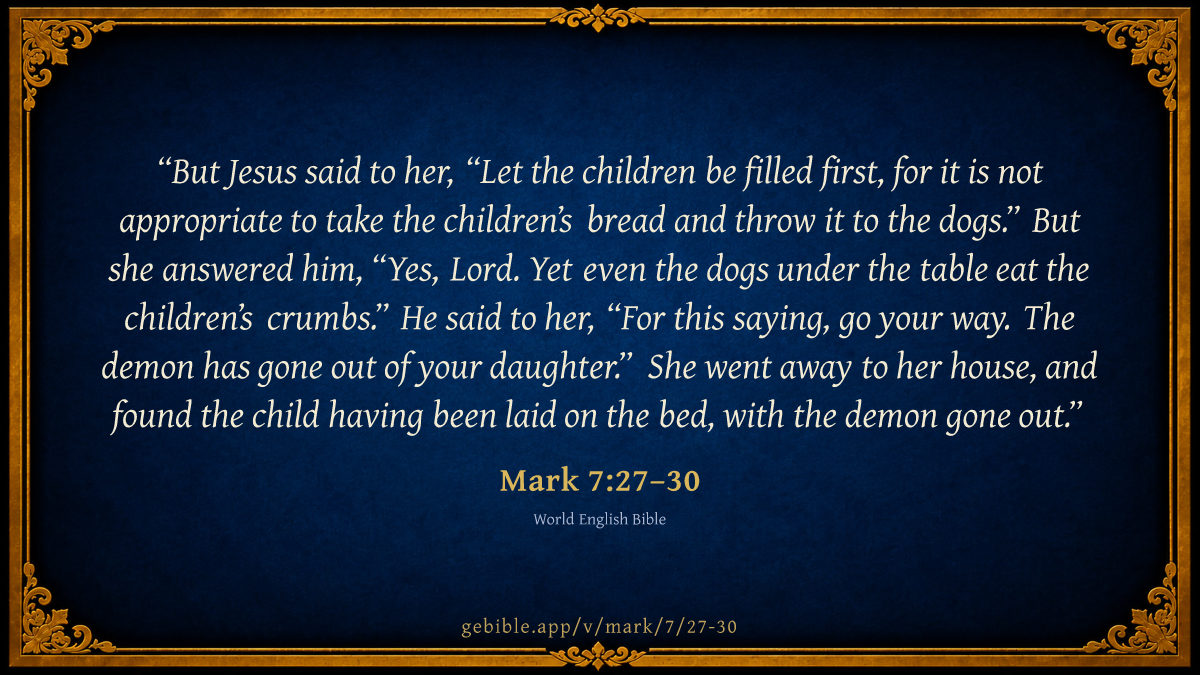
24From there he arose, and went away into the borders of Tyre and Sidon. He entered into a house, and didn’t want anyone to know it, but he couldn’t escape notice. 25For a woman, whose little daughter had an unclean spirit, having heard of him, came and fell down at his feet. 26Now the woman was a Greek, a Syrophoenician by race. She begged him that he would cast the demon out of her daughter. 27But Jesus said to her, “Let the children be filled first, for it is not appropriate to take the children’s bread and throw it to the dogs.”
28But she answered him, “Yes, Lord. Yet even the dogs under the table eat the children’s crumbs.”
29He said to her, “For this saying, go your way. The demon has gone out of your daughter.”
30She went away to her house, and found the child having been laid on the bed, with the demon gone out.

Geneva Bible translators 1599 · Public Domain On vv27–28 He useth this word Whelps rather than the word…
He useth this word Whelps rather than the word Dogs, that he may seem to speak more contumaciously.
Geneva Bible (1599) marginal notes — public domain.
John Trapp 1656 · Public Domain On vv27–28 27 But Jesus said unto her, Let the children…
27 But Jesus said unto her, Let the children first be filled: for it is not meet to take the children’s bread, and to cast it unto the dogs.
Ver. 27. To cast it unto dogs] τοις κυναριοις, unto whelps, for more contempt’ sake, as Beza noteth. The pope made Dandalus, the Venetian ambassador, to come before him, tied in iron chains, and to wallow under his table with dogs, while his Holiness sat at supper. Unde ei canis cognomentum apud suos, saith Revius. He was ever after called the dog ambassador.
John Trapp, A Commentary or Exposition upon All the Books of the Old and New Testament (1647–1656) — public domain. Text from a community e-Sword module.
John Gill 1763 · Public Domain On vv27–30 And she answered and said unto him, yes, Lord,....…
And she answered and said unto him, yes, Lord,.... Agreeing to, and acquiescing in, what he said; which she seemed to have understood, though delivered in a proverbial way; and very appropriately replies,
yet the dogs under the table eat of the children's crumbs; which they leave, or let fall: signifying that she did not envy the blessings of the Jews, or desire any thing might be done injurious to them; only that this favour might be granted her, which she owned she was unworthy of, that her daughter might be healed. She tacitly owns, that the character of dogs belonged to the Gentiles, and to her and hers among the rest; that they were vile and base in themselves, inferior to the Jews, as to privileges, like dogs under the table; that the provisions with which the table of the Gospel ministry was furnished, was not for them; at least, that they were quite undeserving of them: but however, whereas dogs were allowed to eat crumbs, which now and then fell from the table, or out of the children's hands and laps; so such unworthy Gentiles as she, might be allowed a small benefit or favour by the bye, when it did not take from, and was no disadvantage to the Jews; See Gill on Mat 15:27.
John Gill's Exposition of the Whole Bible (1746–1763) — public domain (CC PDM 1.0). Text via the HelloAO Bible API.
Adam Clarke 1810 · Public Domain On v30 Verse 30. Laid upon the bed.] The demon having…
Verse 30. Laid upon the bed.] The demon having tormented her, so that her bodily strength was exhausted, and she was now laid upon the couch to take a little rest. The AEthiopic has a remarkable reading here, which gives a very different, and, I think, a better sense. And she found her daughter CLOTHED, SITTING upon the couch, and the demon gone out.
Adam Clarke's Commentary on the Bible (1810–1826) — public domain. Text from a community e-Sword/MySword module.
The Cambridge Bible for Schools and Colleges 1878 · Public Domain On vv27, 28, 30 27. But Jesus said unto her] St Mark passes…
27. But Jesus said unto her] St Mark passes more briefly over the interview than St Matthew. The latter Evangelist points out three stages of this woman’s trial; (i) Silence; “He answered her not a word” (Mat_15:23); (ii) Refusal; “I am not sent but unto the lost sheep of the house of Israel” (Mat_15:24); (iii) Reproach; “It is not meet to take the children’s bread and cast it to the dogs” (Mat_15:26). But in spite of all she persevered and finally conquered.
the dogs] In the original the diminutive is used = “little dogs.” “Little whelps” Wyclif; “the whelps” Tyndale, Cranmer. The Jews, “the children of the kingdom” (Mat_8:12), were wont to designate the heathen as “dogs,” the noble characteristics of which animal are seldom brought out in Scripture (comp. Deu_23:18; Job_30:1; 2Ki_8:13; Php_3:2; Rev_22:15). Here however the term is somewhat softened. The heathen are compared not to the great wild dogs infesting Eastern towns (1Ki_14:11; 1Ki_16:4; 2Ki_9:10), but to the small dogs attached to households. In the East now the Mahometans apply this name to the Christians.
The Cambridge Bible for Schools and Colleges (gen. ed. J. J. S. Perowne; Cambridge University Press, 1878–1918) — public domain. Text from a community e-Sword module.
Ellicott's Commentary for English Readers 1878 · Public Domain On vv27–30 (27) Let the children first be filled.—The precise form…
(27) Let the children first be filled.—The precise form of the answer thus given is peculiar to St. Mark.
A Bible Commentary for English Readers, edited by Charles John Ellicott (1878–1897) — public domain. Text from a community e-Sword module.
The Pulpit Commentary 1880 · Public Domain On vv28–30 In this verse there is a slight change of…
In this verse there is a slight change of reading, causing a change of rendering; namely, thus: Yea, Lord: even kai instead of kai gar the dogs ta kunaria the little dogs under the table eat of the children"s crumbs. Observe the antithesis: "the children" (the little daughter) sitting at the table; the "little dogs" under the table. It is as though she said, "Give me, most gracious Lord, only a crumb (a small mercy compared with thy greater mercies), the healing of my little daughter, which may fall as it were obiter from thee upon us Canaanites and Gentiles, and be gratefully picked up as one of thy lesser benefits." Cornelius a Lapide enlarges beautifully upon this: "Feed me, then, as a little dog. To me, a poor Gentile, let a crumb of thy grace and mercy be vouchsafed; but let the full board, the plentiful bread of grace and righteousness, be reserved for the Jewish children. I cannot leave the table of my Lord, whose little dog I am. No; if you spurn me away with your foot, or with a blow, I will go away; but I will come back again, like a little dog, through another door. I will not be driven away by blows. I will not let thee go until thou hast given me what I ask of thee." For this Canaanite constrains Christ, arguing her case from his own words, prudently, modestly, forcibly, and with a humble faith which perceives that he is not unwilling to be overcome by petition and by reason. Indeed, she entangles him in the meshes of his own words. So great is the plenteousness of his table, that it shall abundantly suffice for her if she may but partake of the crumbs which fall from the table of his children."
The Pulpit Commentary (1880–1919), ed. H.D.M. Spence-Jones & Joseph S. Exell — public domain. Text from a community e-Sword module.
C. I. Scofield 1917 · Public Domain On v28 And she
And she
She, however, answered, saying, True, Lord! and yet the little dogs under the table eat from the children’s crumbs. Rom 11:24; Eph 2:11-22.
The Scofield Reference Bible (1917 edition), notes by C. I. Scofield — public domain. Text from a community e-Sword module.
Paul E. Kretzmann 1924 · Public Domain On v27 The victory of faith:
The victory of faith:
v. 27. But Jesus said unto her, Let the children first be filled; for it is not meet to take the children’s bread, and to cast it unto the dogs.
Read full note →
v. 28. And she answered and said unto Him, Yes, Lord; yet the dogs under the table eat of the children’s crumbs.
v. 29. And He said unto her, For this saying go thy way; the devil is gone out of thy daughter.
v. 30. And when she was come to her house, she found the devil gone out, and her daughter laid upon the bed.
Mark gives the story in a very brief form, merely indicating the battle which the woman fought in proving herself equal to the test of faith which Jesus laid upon her. Christ was not sent but to the lost sheep of the house of Israel, Mat 15:24; His personal ministry extended no farther, and He frankly told the woman so. Neither could the impatient interference of the disciples induce Him to change His mind, Mat 15:21-28. But the woman’s method of attacking Christ and taking hold of His own words in her interest won the day for her. When He told her: Let the children have their food first; it isn’t a nice thing to take the children’s bread and throw it to the dogs, she acknowledged and admitted the truth of that saying without reservation. She stood the blow in a splendid manner, as Luther says. She was ready to concede to the Jews the right of being children of God, His chosen nation. But she marked well that Jesus used the word that was usually applied to the privileged house-dogs, that had the right to gather up the crumbs under the table. Upon this word she pounces, to that she clings: Yes, Lord. In spite of the fact that He had apparently rejected her and her petition, though there seemed no ray of hope in His manner nor in His words, she found the one place where He had left an opening: And yet the little house-dogs under the table eat of the crumbs of the children; if Thou thinkest the comparison fits, Lord, I do not question it; rather do I count myself lucky that this word includes a promise for me, the promise to receive the crumbs which the Jews, in the richness of the ministry being done among them, will never miss. Thus did this heathen woman give evidence of a conquering faith, in overcoming Christ with His own arguments. And Jesus, ever delighted over any show of true trust and faith in Him, gladly yields to her request, for the sake of that word of humble trust, of sublime assurance which she hath spoken. Let her therefore go home happy, for the demon had already gone forth out of her daughter. And so she found the situation when she came to her house: the daughter, whom the evil spirit had formerly tormented and torn in the most excruciating manner, now lying quietly on the couch, with no more indication of her former suffering. Her faith had won the victory. We, who have much more definite promises of the Lord regarding our earthly and spiritual welfare, usually do not show even a fraction of the faith exhibited by the Syrophoenician woman. It behooves us to be much more instant in prayer and, above all, much more persevering in our appeals to the grace and mercy of God, no matter what gifts we have in mind. We must learn to conquer the Lord with His own words and promises, then true happiness will be ours both here and hereafter.
Paul E. Kretzmann, Popular Commentary of the Bible (1921–1924) — public domain. Text from a community e-Sword module.
unfoldingWord translationNotes 2017 · CC BY-SA 4.0 On vv27, 29 Let the children first be fed. For it is…
Let the children first be fed. For it is not right ... throw it to the dogs
Here Jesus speaks about the Jews as if they are children and the Gentiles as if they are dogs. AT: "Let the children of Israel first be fed. For it is not right to take the children's bread and throw it to the Gentiles, who are like dogs" (See: Metaphor)
Read full note →
Let the children first be fed
This can be stated in active form. AT: "We must first feed the children of Israel" (See: Active or Passive)
bread
This refers to food in general. AT: "food" (See: Synecdoche)
dogs
This refers to small dogs kept as pets.
translationWords
bread
lord
unfoldingWord translationNotes — © Distant Shores Media and the Door43 World Missions Community, licensed CC BY-SA 4.0. Source: git.door43.org/Door43/en_tn.
Tyndale Open Study Notes 2022 · CC BY-SA 4.0 On vv27, 29 7:27-28 Jesus’ reply to the woman seems like a…
7:27-28 Jesus’ reply to the woman seems like a harsh refusal, but their interaction indicates that he wanted to see her faith (cp. Matt 15:28). • Jesus’ use of first did not exclude her as a Gentile from the grace of God but indicated that his mission was first to the Jews (Acts 13:46; Rom 1:16). The woman responded to Jesus’ words with humility and faith. She acknowledged the priority of the Jewish people but argued that there was more than enough food for the dogs as well. (In Jewish literature, Gentiles were frequently referred to as dogs, which were seen as filthy scavengers rather than as adorable pets; see also study note on Rev 22:15.) The woman’s persistence and acknowledgment of Jesus as Lord were rewarded.
Tyndale Open Study Notes — © Tyndale Open Resources, licensed CC BY-SA 4.0. Text via the HelloAO Bible API.