
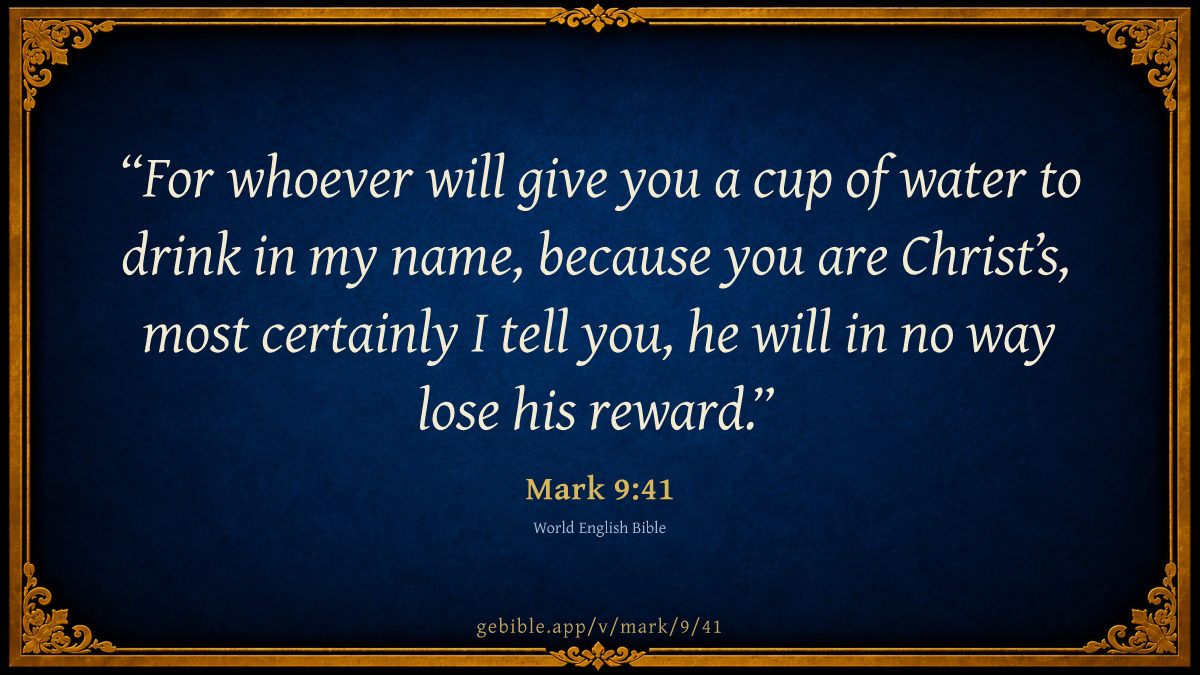
For whoever will give you a cup of water to drink in my name, because you are Christ’s, most certainly I tell you, he will in no way lose his reward.
Parallel Translations
-
For whoever will give you a cup of water to drink in my name, because you are Christ’s, most certainly I tell you, he will in no way lose his reward.
-
And whosoever shall geve you a cuppe of water to drinke for my names sake because ye belonge to Christe verely I saye vnto you he shall not loose his rewarde.
-
And whosoeuer shall giue you a cup of water to drinke for my Names sake, because ye belong to Christ, verely I say vnto you, he shall not lose his rewarde.
Cross-references (2)
Passages linked to Mark 9:41 in the Treasury of Scripture Knowledge, ordered by reader-vote popularity; verse text shown in World English Bible.
- Matthew 10:42 Whoever gives one of these little ones just a cup of cold water to drink in the name of a disciple, most certainly I tell you he will in no way lose his reward.”
- Matthew 25:40 “The King will answer them, ‘Most certainly I tell you, because you did it to one of the least of these my brothers, you did it to me.’
Cross-references from openbible.info (CC BY 4.0)
Explain this verse (14 sources)
Historical commentary, presented as a primary source — not an endorsement.
Private notes
Saved on this device only — never synced or sent anywhere.
John Trapp 1656 · Public Domain 41 For whosoever shall give you a cup of…
41 For whosoever shall give you a cup of water to drink in my name, because ye belong to Christ, verily I say unto you, he shall not lose his reward.
Ver. 41. For whosoever shall give, &c.] Much more he that shall cast out devils in my name, and out of love to me.
John Trapp, A Commentary or Exposition upon All the Books of the Old and New Testament (1647–1656) — public domain. Text from a community e-Sword module.
Matthew Poole 1685 · Public Domain We meet with the same in substance, Mat 10:42;…
We meet with the same in substance, Mat 10:42; there the phrase is, in the name of a disciple; here it is expounded, because ye belong to Christ. In my name; upon my account, believing you have a relation to me.
Matthew Poole's English Annotations on the Holy Bible (1683–1685) — public domain. Text from a community e-Sword/MySword module.
Matthew Henry 1710 · Public Domain Here, I. Christ promiseth a reward to all those…
Here, I. Christ promiseth a reward to all those that are any way kind to his disciples (Mar 9:41); "Whosoever shall give you a cup of water, when you need it, and will be a refreshment to you, because ye belong to Christ, and are of his family, he shall not lose his reward." Note, 1. It is the honour and happiness of Christians, that they belong to Christ, they have joined themselves to him, and are owned by him; they wear his livery and retainers to his family; nay, they are more nearly related, they are members of his body. 2. They who belong to Christ, may sometimes be reduced to such straits as to be glad of a cup of cold water. 3. The relieving of Christ's poor in their distresses, is a good deed, and will turn a good account; he accepts it, and will reward it. 4. What kindness is done to Christ's poor, must be done them for his sake, and because they belong to him; for that is it that sanctifies the kindness, and puts a value upon it in the sight of God. 5. This is a reason why we must not discountenance and discourage those who are serving the interests of Christ's kingdom, though they are not in every thing of our mind and way. It comes in here as a reason why those must not be hindered, that cast out devils in Christ's name, though they did not follow him; for (as Dr. Hammond paraphrases it) "It is not only the great eminent performances which are done by you my constant attendants and disciples, that are accepted by me, but every the least degree of sincere faith and Christian performance, proportionable but to the expressing the least kindness, as giving a cup of water to a disciple of mine for being such, shall be accepted and rewarded." If Christ reckons kindness to us services to him, we ought to reckon services to him kindnesses to us, and to encourage them, though done by those that follow not with us.
II. He threatens those that offend his little ones, that wilfully are the occasion of sin or trouble to them, Mar 9:42. Whosoever shall grieve any true Christians, though they be of the weakest, shall oppose their entrance into the ways of God, or discourage and obstruct their progress in those ways, shall either restrain them from doing good, or draw them in to commit sin, it were better for him that a millstone were hanged about his neck, and he were cast into the sea: his punishment will be very great, and the death and ruin of his soul more terrible than such a death and ruin of his body would be. See Mat 18:6.
Read full note →
III. He warns all his followers to take heed of ruining their own souls. This charity must begin at home; if we must take heed of doing any thing to hinder others from good, and to occasion their sin, much more careful must we be to avoid every thing that will take us off from our duty, or lead us to sin; and that which doth so we must part with, though it be ever so dear to us. This we had twice in Matthew, Mat 5:29, Mat 5:30, and Mat 18:8, Mat 18:9. It is here urged somewhat more largely and pressingly; certainly this requires our serious regard, which is so much insisted upon. Observe,
1. The case supposed, that our own hand, or eye, or foot, offend us; that the impure corruption we indulge is as dear to us as an eye or a hand, or that that which is to us as an eye or a hand, is become an invisible temptation to sin, or occasion of it. Suppose the beloved is become a sin, or the sin a beloved. Suppose we cannot keep that which is dear to us, but it will be a snare and a stumbling-block; suppose we must part with it, or part with Christ and a good conscience.
2. The duty prescribed in that case; Pluck out the eye, cut off the hand and foot, mortify the darling lust, kill it, crucify it, starve it, make no provision for it. Let the idols that have been delectable things, be cast away as detestable things; keep at a distance from that which is a temptation, though ever so pleasing. It is necessary that the part which is gangrened, should be taken off for the preservation of the whole. Immedicabile vulnus ense recidendum est, ne pars sincera trahatur - The part that is incurably wounded must be cut off, lest the parts that are sound be corrupted. We must put ourselves to pain, that we may not bring ourselves to ruin; self must be denied, that it may not be destroyed.
3. The necessity of doing this. The flesh must be mortified, that we may enter into life (Mar 9:43, Mar 9:45), into the kingdom of God, Mar 9:47. Though, by abandoning sin, we may, for the present, feel ourselves as if we were halt and maimed (it may seem to be a force put upon ourselves, and may create us some uneasiness), yet it is for life; and all that men have, they will give for their lives: it is for a kingdom, the kingdom of God, which we cannot otherwise obtain; these halts and maims will be the marks of the Lord Jesus, will be in that kingdom scars of honour.
4. The danger of not doing this. The matter is brought to this issue, that either sin must die, or we must die. If we will lay this Delilah in our bosom, it will betray us; if we be ruled by sin, we shall inevitably be ruined by it; if we must keep our two hands, and two eyes, and two feet, we must with them be cast into hell. Our Saviour often pressed our duty upon us, from the consideration of the torments of hell, which we run ourselves into if we continue in sin. With what an emphasis of terror are those words repeated three times here, Where their worm dieth not, and the fire is not quenched! The words are quoted from Isa 66:24. (1.) The reflections and reproaches of the sinner's own conscience are the worm that dieth not; which will cleave to the damned soul as the worms do to the dead body, and prey upon it, and never leave it till it is quite devoured. Son, remember, will set this worm gnawing; and how terrible will it bite that word (Pro 5:12, Pro 5:23), How have I hated instruction! The soul that is food to this worm, dies not; and the worm is bred in it, and one with it, and therefore neither doth that die. Damned sinners will be to eternity accusing, condemning, and upbraiding, themselves with their own follies, which, how much soever they are now in love with them, will at the last bite like a serpent, and sting like an adder. (2.) The wrath of God fastening upon a guilty and polluted conscience, is the fire that is not quenched; for it is the wrath of the living God, the eternal God, into whose hands it is a fearful thing to fall. There are no operations of the Spirit of grace upon the souls of the damned sinners, and therefore there is nothing to alter the nature of the fuel, which must remain for ever combustible; nor is there any application of the merit of Christ to them, and therefore there is nothing to appease or quench the violence of the fire. Dr. Whitby shows that the eternity of the torments of hell was not only the constant faith of the Christian church, but had been so of the Jewish church. Josephus saith, The Pharisees held that the souls of the wicked were to be punished with perpetual punishment; and that there was appointed for them a perpetual prison. And Philo saith, The punishment of the wicked is to live for ever dying, and to be for ever in pains and griefs that never cease.
The two last verses are somewhat difficult, and interpreters agree not in the sense of them; for every one in general, or rather every one of them that are cast into hell, shall be salted with fire, and every sacrifice shall be salted with salt. Therefore have salt in yourselves. [1.] It was appointed by the law of Moses, that every sacrifice should be salted with salt, not to preserve it (for it was to be immediately consumed), but because it was the food of God's table, and no flesh is eaten without salt; it was therefore particularly required in the meat-offerings, Lev 2:13. [2.] The nature of man, being corrupt, and as such being called flesh (Gen 6:3; Psa 78:39), some way or other must be salted, in order to its being a sacrifice to God. The salting of fish (and I think of other things) they call the curing of it. [3.] Our chief concern is, to present ourselves living sacrifices to the grace of God (Rom 12:1), and, in order to our acceptableness, we must be salted with salt, our corrupt affections must be subdued and mortified, and we must have in our souls a savour of grace. Thus the offering up or sacrificing of the Gentiles is said to be acceptable, being sanctified by the Holy Ghost, as the sacrifices were salted, Rom 15:16. [4.] Those that have the salt of grace, must make it appear that they have it; that they have salt in themselves, a living principle of grace in their hearts, which works out all corrupt dispositions, and every thing in the soul that tends to putrefaction, and would offend our God, or our own consciences, as unsavoury meat doth. Our speech must be always with grace seasoned with this salt, that no corrupt communication may proceed out of our mouth, but we may loathe it as much as we would to put putrid meat into our mouths. [5.] As this gracious salt will keep our own consciences void of offence, so it will keep our conversation with others so, that we may not offend any of Christ's little ones, but may be at peace one with another. [6.] We must not only have this salt of grace, but we must always retain the relish and savour of it; for if this salt lose its saltiness, if a Christian revolt from his Christianity, if he loses the savour of it, and be no longer under the power and influence of it, what can recover him, or wherewith will ye season him? This was said Mat 5:13. [7.] Those that present not themselves living sacrifices to God's grace, shall be made for ever dying sacrifices to his justice, and since they would not give honour to him, he will get him honour upon them; they would not be salted with the salt of divine grace, would not admit that to subdue their corrupt affections, no, they would not submit to the operation, could not bear the corrosives that were necessary to eat out the proud flesh, it was to them like cutting off a hand, or plucking out an eye; and therefore in hell they shall be salted with fire; coals of fire shall be scattered upon them (Eze 10:2), as salt upon the meat, and brimstone (Job 18:15), as fire and brimstone were rained on Sodom; the pleasures they have lived in, shall eat their flesh, as it were with fire, Jam 5:3. The pain of mortifying the flesh now is no more to be compared with the punishment for not mortifying it, than salting with burning. And since he had said, that the fire of hell shall not be quenched, but it might be objected, that the fuel will not last always, he here intimates, that by the power of God it shall be made to last always; for those that are cast into hell, will find the fire to have not only the corroding quality of salt, but its preserving quality; whence it is used to signify that which is lasting: a covenant of salt is a perpetual covenant, and Lot's wife being turned into a pillar of salt, made her a remaining monument of divine vengeance. Now since this will certainly be the doom of those that do not crucify the flesh with its affections and lusts, let us, knowing this terror of the Lord, be persuaded to do it.
Matthew Henry's Commentary on the Whole Bible (1708–1710) — public domain (CC PDM 1.0). Text via the HelloAO Bible API.
John Gill 1763 · Public Domain And whosoever shall offend one of these little ones…
And whosoever shall offend one of these little ones that believe in me,.... Whosoever shall do the, least injury to the meanest person that believes in Christ, who are mean both in their own eyes, and the eyes of others; for Christ is not speaking of little children in age, who are neither capable of believing in Christ, nor are they ready to take offence; but of such as belong to him; his disciples and followers, of whom he is speaking in the preceding verse:
it is better for him that a mill stone were hanged about his neck, and he were cast into the sea; and drowned there: the allusion is to the drowning of malefactors, by tying a stone, or any heavy thing about their necks, and casting them into the sea. Casaubon, and others, have shown out of Heathen writers, that this has been a practice of some nations, particularly the Grecians: Jerom says, Christ speaks according to the custom of the country; this being a punishment of the greatest crimes among the Jews; but I have no where met with it in their writings: Christ's sense is, that such who give offence to any of his ministers or people, how mean soever they may appear, shall undergo the severest punishment; See Gill on Mat 18:6.
John Gill's Exposition of the Whole Bible (1746–1763) — public domain (CC PDM 1.0). Text via the HelloAO Bible API.
John Wesley 1765 · Public Domain For whosoever shall give you a cup - Having…
For whosoever shall give you a cup - Having answered St. John, our Lord here resumes the discourse which was broken off at the 37th verse. Mark ix, 37. Matt. x, 42.
John Wesley, Explanatory Notes Upon the Whole Bible (1754–1765) — public domain. Text via the GEBible commentary corpus.
Adam Clarke 1810 · Public Domain Verse 41. A cup of water to drink] See…
Verse 41. A cup of water to drink] See the notes on Mt 10:42; Mt 18:6-8.
Adam Clarke's Commentary on the Bible (1810–1826) — public domain. Text from a community e-Sword/MySword module.
Joseph Benson 1811 · Public Domain Mar 9:41-42. For whosoever shall give you a cup…
Mar 9:41-42. For whosoever shall give you a cup of water, &c. — Having answered John, our Lord resumes the discourse, which was broken off at Mar 9:37. And to show the apostles further, that they had been in the wrong to discourage this person, who must have entertained a great veneration for their Master, and was in a fair way to become his follower, he told them, that the lowest degree of respect which any one showed him, though it were but the giving a cup of cold water to one of his thirsty disciples, would be acceptable to him, and should not lose its reward: whereas, on the other hand, the least discouragement of his servants in their duty, come from what quarter it might, should be severely punished. For he added, Whosoever shall offend: και ος αν σκανδαλιση, whosoever shall cause to stumble one of these little ones — The very least Christian. It is better for him that a millstone were hanged about his neck — See note on Mat 18:5-6.
Joseph Benson's Commentary on the Old and New Testaments (1811–1818) — public domain. Text from a community e-Sword module.
Albert Barnes 1834 · Public Domain Whosoever shall give you a cup ... - How…
Whosoever shall give you a cup ... - How easy it is to be a Christian! What is easier than to give a cup of cold water to a thirsty disciple of Jesus! But it must be in his name - that is, because he “is” a Christian, and therefore from love “to the Saviour.” This is very different from giving it from a mere motive of common kindness. If done from love to Christ, it will be rewarded; and hence we learn that the humblest acts of Christians - the lowest service that is rendered - will be graciously noticed by Jesus and rewarded. None are so humble in his kingdom as not to be able to do good, and none so poor that he may not show attachment to him. The feeblest service will be accepted, and acts of love that may be forgotten by man, will be remembered by Him, and rewarded in heaven.
Albert Barnes' Notes on the Bible (1834–1885) — public domain. Text from a community e-Sword/MySword module.
Daniel D. Whedon 1874 · Public Domain 41. Give you a cup of water — See…
41. Give you a cup of water — See note on Mat_10:42.
Daniel D. Whedon (gen. ed.), Commentary on the Old and New Testaments (1874–1909) — public domain. Text from a community e-Sword module.
The Cambridge Bible for Schools and Colleges 1878 · Public Domain 41. a cup of water] which all gave readily…
41. a cup of water] which all gave readily in those sultry lands.
The Cambridge Bible for Schools and Colleges (gen. ed. J. J. S. Perowne; Cambridge University Press, 1878–1918) — public domain. Text from a community e-Sword module.
Ellicott's Commentary for English Readers 1878 · Public Domain (41) Whosoever shall give you a cup of water.—See…
(41) Whosoever shall give you a cup of water.—See Note on Mat_10:42. The reproduction of the promise in so different a context is significant as an instance of our Lord’s method of teaching, reiterating words of blessing and of wisdom till they were engraved indelibly on the minds of those who heard them.
A Bible Commentary for English Readers, edited by Charles John Ellicott (1878–1897) — public domain. Text from a community e-Sword module.
The Pulpit Commentary 1880 · Public Domain In my name, because ye belong to Christ. The…
In my name, because ye belong to Christ. The reading adopted in the Revised Version is, en onomati oti cristou este : literally, in name, that ye are Christ"s; or, because ye are Christs. The force of this observation seems to be this: "If he who gives you a cup of water to drink in my Name, and out of regard for me, does well, and shall be rewarded of God, much more shall he be rewarded who casts out devils in my Name." The disciples are thus taught that it is contrary to the whole spirit of Christianity to disparage works of beneficence, or to suggest unworthy motives for them (see "Speaker"s Commentary," in loc.).
Christian beneficence.
Read full note →
Loving consideration for others and generous kindness to them are among the fruits of the Spirit and the signs of true discipleship. Their effects it would not be easy to exaggerate. The law of kindness for Jesus" sake is of all things the most likely to remove prejudices against Christianity, and to bring together those whose interests are separate, so as to ensure the salvation of society. Even on lower grounds, therefore, this law demands our obedience, for there is much in our social condition to cause anxiety to the Church. Questions once carefully ignored are being boldly discussed; classes of men whose ignorance and poverty made them political nonentities are now powers in the State. Capitalists and producers are discussing anew their respective rights; owners of land are being openly asked whether She proportion they have received of its value is not greater than their due. And in all these movements agitators are exaggerating claims, some of which have in them germs of right. Meanwhile it is to be feared that religion, as a factor in the settlement of such disputes, is being disregarded, and debate is rife whether indeed the Christian faith is longer credible. Anything which would suddenly change the relations of various classes, any outburst of the communistic or nihilistic spirit, would bring about far more evil than good. Evils must be abolished now as they were in the early days of the Christian faith. When slaves were held in cruel bondage, and profligacy assumed hideous forms, and accumulated wealth appeared side by side with abject want, Christ and the teachers who followed him aroused no servile war, but by word and life showed a more excellent way. They taught that the highest bliss was not in abundance of possessions, but in abundance of spiritual life; that the loftiest dignity was to be found not in the indulgence, but in the denial, of self; that all a man possessed he held as a responsible steward; and that those removed from others in social position were brothers and sisters to be cared for. All this was exhibited in the life of One who went about doing good, and was seen in its ultimate victory on the cross where Christ died for us, that we henceforth might live no morn to ourselves. One phase of this law of kindness is brought before us in our text, where its manifestation is recognized as a germ of discipleship.
I THE DUTY OF CHRISTIAN BENEFICENCE is asserted throughout Scripture. Under the old dispensation, the blessedness of him who considers the poor was exemplified in the experience of Job, and of the widow of Sarepta, and of multitudes besides. The duty was made still more clear in the New Testament; and this is noteworthy, because the disciples of our Lord were themselves poor, so that no one of them could give out of his superabundance; and even of our Lord himself this was true, though he so often showed that it was more blessed to give than to receive. On this principle the Church acted. Spontaneously Barnabas sold his estates to aid those who were in special difficulties because they were cast out of trade and home, and his example was contagious. There was no law passed that Christians should do this; but though as a compulsory law it would have been an unsound dictum for all times, it was right and good when Christians, moved by pity for their poor persecuted brethren, distributed as every man had need. Spontaneity gives worth to such acts. He who thus gives, though it be but a cup of cold water, shall not lose his reward.
II THE OBJECTS OF CHRISTIAN BENEFICENCE. All less favored than ourselves have a claim, not necessarily on our money, but on our help and sympathy, in some form, when an opportunity comes for service in Christ"s Name.
1. Human relationship has its claims on us, and he who does not "provide for his own," even though he benefits some religious organization, fails in his duty to his Lord.
2. Neighbourhood has claims on us. No follower of Christ can be like the rich man, who would give alms to be seen of man, but would let poor Lazarus die at his gate, fighting for crumbs with the dogs.
3. Fellowship in the same Church has claims on us, though those needing our aid may be least in knowledge, least in capacity, least in attractiveness, or least in desert.
4. But we are to do good unto all men, though especially to such as are of the household of faith. Christ died for all, and in his Name, for his sake, in his spirit, we must seek to aid them, even though it only be by a cup of cold water.
III THE REASONS FOR CHRISTIAN BENEFICENCE are numerous, but we may mention one or two.
1. All we have is from God. His providence has made us to differ. Our birth, our inheritance, our education, our natural capacities, these are in no sense the results of our own creation or choice. He who gave us these, demands that we should use them in part to promote the peace and the comfort of those for whom his Son died. "Freely ye have received, freely give.
2. Our superabundance is for others. When our cup runs over, the droppings are not for ourselves but for others. When our harvest is gathered, room must be made for gleaners as well as for reapers. Waste is against God"s law. The breath we throw off from our lungs is wanted by nature. The rain poured down so lavishly is not lost. The refuse flung on the soil is to reappear in new forms. All nature rebukes the waste and extravagance of which we are often guilty; and Ambrose has well said, "It is no greater sin to take from him that rightly possesseth than being able not to give to him that wanteth. A.R.
The Pulpit Commentary (1880–1919), ed. H.D.M. Spence-Jones & Joseph S. Exell — public domain. Text from a community e-Sword module.
The Biblical Illustrator 1887 · Public Domain A cup of water to drink in My name.
Mar_9:41
A cup of water to drink in My name.
Read full note →
The smallest gift and the largest reward
I. The description which is here given of the disciples of Christ, is exceedingly interesting and instructive. They belong to Christ; they are peculiarly and emphatically His; speaking of them, he calls them My sheep, My people, My disciples; and addressing His heavenly Father respecting them, He says, All Mine are Thine, and Thine are Mine; and I am glorified in them. And the Scriptures, which thus represent Christians as the property of Christ, teach us also the way in which they become so entirely His. It is evident from Christs own language, that His disciples belong to Him primarily by the gift of His Father. Thine they were, says He, and Thou gavest them Me. My Father which gave them to Me, is greater than all. All that the Father hath given to Me shall come to Me. And if they thus belong to Christ by His reception of them from the Father, and by His redemption of them by His blood, they are also His by their own voluntary dedication of themselves to Him, as the result of His electing and redeeming mercy.
II. The gift which Jesus Christ asks on behalf of these His disciples, is a cup of water. When we consider believers as belonging so peculiarly to Christ, we might suppose that He would solicit for them the most costly and munificent donations that the most wealthy could bestow; but it is a remarkable and an interesting fact, that He never either sought great things for Himself, or led His disciples to expect great things from others. An impostor, or a mere enthusiast, would in all probability have acted differently, and have said to his disciples, Whosoever shall give you thousands of gold and silver; whosoever shall exalt you to worldly dignity and honour; and whosoever shall clothe you in purple and fine linen, and cause you to fare sumptuously every day;-but His language was, Whosoever shall give you a cup of water to drink. And let not such a gift, small as it is, be despised. In our circumstances, we are mercifully unable to estimate its worth; but a man may be brought into such a situation that even a cup of water would be the most valuable and acceptable present that he could receive. When Samson had slain, single-handed, a thousand of his Philistine foes, he cried unto the Lord and said, I die for thirst. But when a little water was procured, his spirit came again, and he revived. The smallness of the gift which Christ solicits in our text, may, however, suitably admonish His disciples to be satisfied with little.
III. The motive by which you should be influenced in the bestowment of this gift, seems to include both love to Christ and to His disciples; for, says He, whosoever shall give you a cup of water to drink in My name, and because ye belong to Christ. Such is the deceit fulness and desperate wickedness of the human heart, that an action productive of good to others may be done merely for the purpose of thereby accomplishing some selfish and unhallowed object, merely because they are following with you, and adhering to the sect or party to which you belong. But, to return to the consideration of the motives by which our gifts are to be influenced-the greatest and the purest is love to Christ. To Him we are laid under unspeakable obligations for the love with which He loved us, when He died for our sins, and to secure the complete and eternal salvation of our souls. Love to Christ cannot exist, however, without love to Christians, who belong to Christ, and who bear His image; for everyone that loveth Him that begat, loveth them also that are begotten of Him.
IV. The reward by which the bestower of this gift will be honoured and enriched is secured to him by the Saviours faithful promise, Verily I say unto you, he shall not lose his reward.
1. He shall be rewarded by the pleasurable feelings which the exercise of benevolence and kindness to others never fails to produce.
2. He shall be rewarded with the prayers, and blessings, and sympathy of the disciple on whom he has bestowed the gift.
3. He shall be rewarded with the approbation and blessing of Christ Himself. (J. Alexander.)
A cup of water
There is something very economical about the generosity of kindness; a little goes a long way. (Faber.)
A right motive
It is said that when Andrew Fuller went into his native town to collect for the cause of missions, one of his old acquaintances said, Well, Andrew, Ill give five pounds, seeing its you. No, said Mr. Fuller, I can take nothing for this cause, seeing its me:-and handed the money back. The man felt reproved, but in a moment he said, Andrew, you are right. Here are ten pounds, seeing it is for the Lord Jesus Christ.
An act, a motive, and a reward
Here is an act, a motive, and a reward, calling for thought. As to the act, it is both suggestive and comprehensive. A man may live without food for many days; but he cannot exist without water for the bodys cooling and circulating fluids. So there is a moral life that is kept up by the interchange of little acts; the kind salutation, the smile, the kiss of charity, the word fitly spoken and in season, which cost nothing to the giver, but are invaluable to the receiver. So the little acts of giving, the mites of poor widows, the full carrying out of Pauls universal appointment, let every one of you lay by him in store as the Lord hath prospered him-it is these gathered drops that fill the exhaustless reservoirs of worldwide Christian charities. The motive, too, like that which sees in a child the lineaments of an esteemed parent, that recognizes in the livery the servant of a liege lord, it is this recognition of Christ in His disciple that at once honours the Master, and which permits Him to honour the service. The reward, too, is in keeping with the act and its motive. The little badge a prince bestows is more than a life estate. To find true what Jesus declares shortly after (Mat_25:1-46), that the rewards of the final judgment turn on these little acts and their motive, that Jesus will say of forgotten trifles, Ye did it to Me, the realization of this fact, so as to make it the rule of everyday life-this is to learn the lesson of giving a cup of cold water in the name of Christ. (G. W. Samson, D. D.)
Give in Christs name-humanity not Christianity
That man has given more to the poor than any man in the town; now thats what I call being a noble Christian, is the remark that a friend made a few days ago. This is also a sample of the opinion of quite a large class of people; they hold that because a man is benevolent he must naturally be a Christian; but this does not necessarily follow. A man may love the poor, sympathize with those in distress, and in the fulness of his heart relieve the wants of the pauper, and yet not be a Christian. He gives for humanitys sake, while the Christian gives only for Christs sake. Humanity must not be mistaken for Christianity. Many noted highwaymen have given largely to the poor out of what they robbed from the rich. That they possessed humanity no one will doubt, but there was not a particle of Christianity about them. The virtue in humanitys gift lies in the amount given, but the test in Christianitys gift lies in the amount thats left behind; and while humanity rejoices in having given so much, Christianity will weep because she has no more to give. The gift for humanitys sake is good, but to give for Christs sake is better. The Pharisee who ostentatiously cast in of his abundance pales into insignificance before the poor widow who cast in her all. Says Christ: For the poor always ye have with you; but Me ye have not always. Christ first, the poor afterward. Had Mary given the money to the poor, she would have done well, but in that she gave it to Christ she did better. Had she given for humanitys sake, three hundred souls would each have the temporal satisfaction of a pennyworth of bread; but in that she did it for Christs sake millions have been cheered and encouraged while reading of her devotion and tenderness of Christ. This is all expressed by Paul in a single sentence: Though I bestow all my goods to feed the poor … and have not charity, I am nothing. To feed the poor is humanity, but charity is Christianity. Humanity is transitory and passes away. Christianity is eternal, and, like a river, is continually fed by countless tiny tributaries that, however small and powerless in themselves, all combine to form one golden current that flows into a far more exceeding and eternal sea of glory. (Frank Hope.)
Whose am I
Ye belong to Christ. These thoughts are suggested by this phrase.
I. Proprietorship. There is a sense in which it may be said that all men belong to Christ.
1. This claim to us is based primarily on His Creatorship.
2. All are His by redemption.
3. Baptism is a confirmation of all this.
4. But believers belong to Christ in a more peculiar sense by an act of personal consecration. In the case of many this act of consecration has been repeatedly renewed.
5. Believers are Christs by adoption. The soul surrendered all its powers to Christ, and He graciously accepted the offering, and smiled upon the oblation.
II. To belong to Christ implies privilege.
1. Special care.
2. Identity of interests. If I am Christs my joys are His joys, my sorrows are His sorrows.
(1) Things done against the saints, Christ regards as done against Himself.
(2) Things done for the saints Christ regards as done to Himself. The act of acing good to you will add to the felicity of the doer forever.
3. Dignity.
III. Belonging to Christ involves responsibility.
1. We are to live for Christ.
2. We are to live like Christ.
3. We are to confess Christ. (R. Roberts.)
Belonging to Christ
I. The connection which Christ claims with His people.
1. They belong to Him by separation and surrender.
2. They possess some spiritual worth. There are in Scripture some hints respecting the Divine estimate of men.
3. They are appointed to high and sacred ministries
4. They engage the interest of Christ in their improvement.
5. They enjoy the honour of spiritual association.
II. Practical suggestions from the subject.
1. The difficulty of holding this truth firmly is seen.
2. It should encourage consistency of Christian life.
3. It invites us to consider the personal signs of connection with Christ. (J. S. Bright.)
The Biblical Illustrator, edited by Joseph S. Exell (c. 1880s–1900s) — public domain. Text from a community e-Sword module.
Paul E. Kretzmann 1924 · Public Domain Christ continues His lesson:
Christ continues His lesson:
v. 41. For whosoever shall give a cup of water to drink in My name because ye belong to Christ, verily I say unto you, he shall not lose his reward.
Read full note →
v. 42. And whosoever shall offend one of these little ones that believe in Me, it is better for him that a millstone were hanged about his neck, and he were cast into the sea.
v. 43. And if thy hand offend thee, cut it off; it is better for thee to enter into life maimed than, having two hands, to go into hell, into the fire that never shall be quenched;
v. 44. where their worm dieth not, and the fire is not quenched.
After the interruption, Christ resumes His discourse. It is not always the big and mighty works in the kingdom of Christ, the miracles, that count and are credited. A small, incidental service, a cup of water offered in His name, to show a service for His sake, is thought of so highly by Him that He promises His definite reward. On the other hand, if anyone scandalizes, offends, causes one of these little ones that believe on Christ, especially also little children, to do wrong or to get an impression which will cause such a person to think less highly of Christ and of the Christian Church, this is an offense which the Lord cannot condemn too strongly. Far better, He says, It would be for such a person to be cast into the sea with a millstone about his neck before such an offense is committed. Here a grave responsibility is placed upon all parents, teachers, and all whose duty brings them into contact with children and with such as are small in the kingdom of God, the Christians that are weak in Christian knowledge. To watch over our mouths that they do not speak words, to watch over our members that they do not commit deeds, that will cause harm and offense, that is a solemn obligation, for which account will be demanded on the last day with most severe reckoning. In this respect the hand is very apt to offend, almost unconsciously it is placed into the service of sin. Constant watchfulness is necessary, lest the sin which it commits, the offense which it gives, become a part of the accumulated guilt which will bring upon such a person the punishment of hell-fire.
Paul E. Kretzmann, Popular Commentary of the Bible (1921–1924) — public domain. Text from a community e-Sword module.