Matthew 11:3-5 sits inside this longer paragraph.
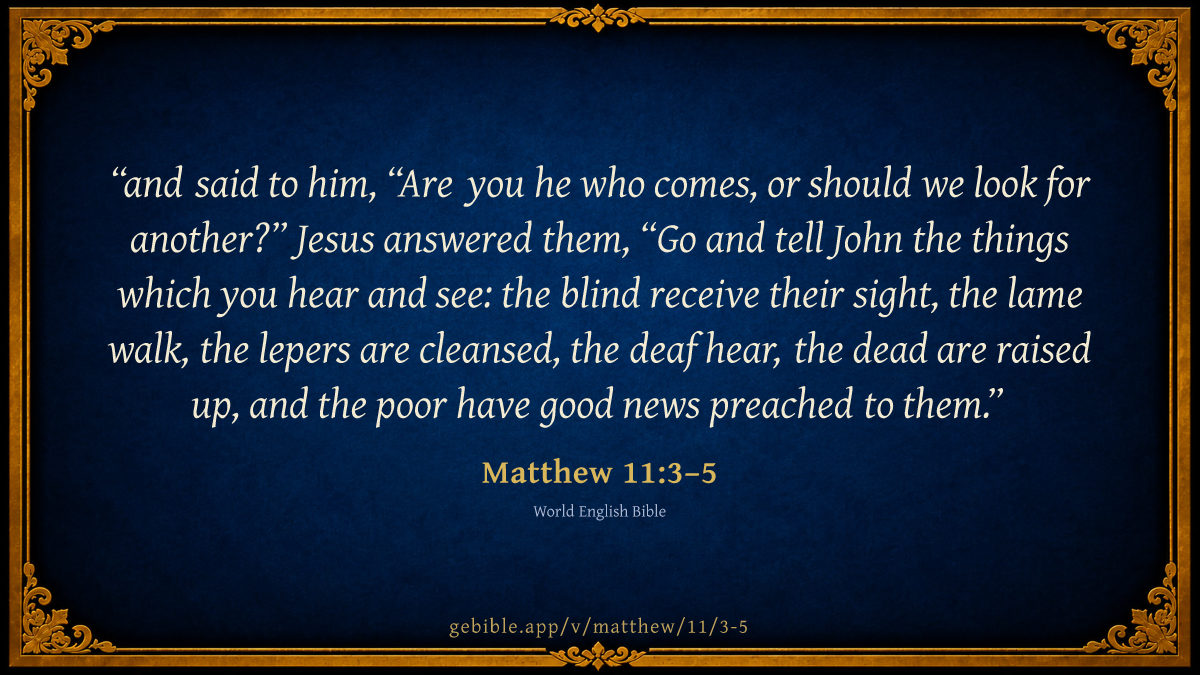
1When Jesus had finished directing his twelve disciples, he departed from there to teach and preach in their cities. 2Now when John heard in the prison the works of Christ, he sent two of his disciples 3and said to him, “Are you he who comes, or should we look for another?”
4Jesus answered them, “Go and tell John the things which you hear and see: 5the blind receive their sight, the lame walk, the lepers are cleansed, the deaf hear, the dead are raised up, and the poor have good news preached to them. 6Blessed is he who finds no occasion for stumbling in me.”

John Trapp 1656 · Public Domain On vv3–5 3 And said unto him, Art thou he that…
3 And said unto him, Art thou he that should come, or do we look for another?
Ver. 3. Art thou he that should come, &c.] This question the Baptist moved not for his own sake (for he was well assured, and had sufficiently testified, Joh 3:27-36), but for his disciples’ better settlement and satisfaction. This, while Tertullian observed not, he hath done the Baptist palpable injury in three different places; as if himself had doubted of the person of Christ. Let not us be troubled to be in like manner mistaken and misjudged.
John Trapp, A Commentary or Exposition upon All the Books of the Old and New Testament (1647–1656) — public domain. Text from a community e-Sword module.
Matthew Poole 1685 · Public Domain On v4 We must imagine these disciples of John to have…
We must imagine these disciples of John to have stayed with Christ some time, and to have seen him work some of these miracles, and to have heard him preach, and seen the great success of his ministry, and then to have left him with this answer. Luke therefore addeth, Luk 7:21, And in the same hour he cured many of their infirmities and plagues, and of evil spirits; and unto many that were blind he gave sight. Then he repeateth the answer which we have here, in which our Saviour refereth unto his works as sufficiently testifying of him, Joh 5:36,37; 10:25,37,38. We read not that these disciples saw any dead person raised while they were with Christ, but it appeareth from Luk 7:18, &c. that the report of such a miracle was the occasion of their coming to Christ.
The question is, how the sight of these things done by our Saviour could be a sufficient argument to confirm to them that he was the Messias, especially considering that his apostles did the same things?
Read full note →
Answer: First, it was prophesied by Isaiah, Isa 35:4-6, that when God should come to save them, the eyes of the blind should be opened, and the ears of the deaf unstopped; then shall the lame man leap as an hart, and the tongue of the dumb sing: and Isa 61:1, that the Messiah should preach good tidings to the meek, that is, the poor, Luk 4:18, which Christ, Luk 4:21, applied to himself. So that the fulfilling of these promises argued that the Messias was come, and no other was to be looked for, whether these things were done by him or by his disciples.
Secondly, the disciples as yet had done no such things, so as his doing of them plainly evidenced his Divine power; the others did them but as his disciples, by his power and authority.
Thirdly, it is more than probable, that when the disciples did them, they used some such form as Peter used, Act 3:6, In the name of Jesus Christ of Nazareth rise up and walk. We find Peter, Act 3:12, very wary that the people should not mistake in thinking they did it by their own power or holiness.
And the poor have the gospel preached unto them. Gr. πτωχοι ευαγγελιζονται, which may be translated, the poor preach the gospel, in an active sense, as the word is used Luk 2:10; or, the poor are gospelized, taking the word in a passive sense, as Heb 4:2; 1Pe 1:25; 4:6. In the passive sense it may be understood either of a more external reception of the gospel upon preaching, or of a more internal reception of the gospel by faith. In all senses it was true of the times of the Messiah,
1. The poor preached the gospel; nor was this a mean evidence that the Messiah was come, to see a few poor fishermen at his call leaving their nets and their friends, and following one calling them to preach a new doctrine to the new world.
2. The poor had the gospel preached to them; nor was this a less evidence of Christ to be the Messiah, considering the prophecy, Isa 61:1, and the contempt of the poor amongst the Jews, Joh 7:49.
But that the poor, who commonly are the more ignorant and rude sort of people, should vouchsafe to hear the gospel, and be turned into the likeness of the gospel upon Christ’s preaching to them, this was yet a higher evidence. Many by poor understand the poor in spirit. The binding up of broken hearts, and bringing glad tidings to souls sadden on spiritual accounts is a great effect of the Divine power. It followeth, And blessed is he, whosoever shall not be offended in me. It is not improbable that our Saviour here reflects on the disciples of John, who out of a great honour for their master took many occasions to be offended at Christ. One while because he and his disciples did not first so often as they and the Pharisees, as Mat 9:14; another while because so many followed him, Joh 3:26. But the words spoken have a further reference than to John’s disciples. The Lord Jesus and his doctrine are to many a stone of stumbling and a rock of offence, according to the prophecy, Isa 8:14; Isa 28:16; Luk 2:34; Rom 9:33; 1Co 1:23; 1Pe 2:6. The Jews stumbled at the meanness of his person and parentage, and the meanness of his followers. The Gentiles, not at these things only, but his ignominious death. At this day many stumble at the sublimeness and strictness of his doctrine, &c. Christ speaks here with reference to all, and pronounces that man a blessed man, who shall so take offence at nothing, whether respecting his person, his life, or his death, his doctrine, or his followers, as to deter or discourage him from embracing him, and believing in him as the Saviour of lost sinners, that shall by faith receive him.
Matthew Poole's English Annotations on the Holy Bible (1683–1685) — public domain. Text from a community e-Sword/MySword module.
William Burkitt 1703 · Public Domain On v4 Observe here, 1. The way and means which our…
Observe here, 1. The way and means which our Saviour takes for the conviction and satisfaction of John’s disciples, that he was the true Messias; he appeals to the miracles wrought by himself, and submits the miracles wrought by him to the judgment of their senses; Go and shew John the miracles which you hear and see.
Observe, 2. The miracles themselves. The blind receive their sight, the lame walk, the deaf hear, &c. Christ was all this in a literal sense, and in a mystical sense also; he was an eye of understanding to the ignorant, a foot of power to the weak: he opened an ear in deaf hearts, to receive the word of life: and the poor are evangelized, that is, turned into the spirit and temper of it; the gospel; the rich hear the gospel, but the poor receives, that is, they feel the powerful impressions of it: as we say, such an one is Italianized, when his carriage is such as if he were a natural Italian. The passive verb enagzelizonrai denotes, non actum predicationis, sed effectum evangelii pradicati; the good effect which the gospel had upon the hearts and lives of the poor, transforming them into the likeness of itself.
Read full note →
Learn, It is a blessed thing, when the preaching of the gospel has such a powerful influence upon the minds of men, that the temper of their minds and the actions of their lives are a willing transcript of the spirit and temper of the holy Jesus.
Note, That as it was prophesied of the Messias, that he should preach the gospel to the poor, Isa 61:1. accordingly they were the poor whom Christ preached unto; for the Pharisees and Rabbies neglected them as the people of the earth, Joh 7:49. And Grotius says, that they had a proverb, That the Spirit of God never rests but upon a rich man. Besides the Pharisees and Rabbies doctrines, which they preached, were vain traditions, allegorical interpretations, and cabalistical deductions, which transcended the capacities of the vulgar, so that they could profit very little by repairing to their schools, and by hearing their interpretations of the law; and therefore our Saviour, in the close of this chapter, calls the people off from them to learn of him, Come unto me, &c. Mat 11:28
William Burkitt's Expository Notes on the New Testament (1700–1703) — public domain. Text from a community e-Sword module.
John Gill 1763 · Public Domain On vv3–5 And said unto him,.... By the disciples he sent;…
And said unto him,.... By the disciples he sent; this was the message they came with, and this the question they were to ask, and did,
art thou he that should come? A "periphrasis" of the Messiah, well known to the Jews; for he had been spoken of frequently in the prophecies of the Old Testament, as the Shiloh, the Redeemer, the Prophet, and King that should come; particularly, by this circumlocution, reference seems to be had to Hab 2:3. "It shall surely come", , which may be rendered, "for he that cometh", or "is to come, shall come". So that the question in plain terms is, whether he was the Messiah? John could not be ignorant of this, who had seen the Spirit of God descending on him at his baptism, heard a voice from heaven, declaring him the Son of God; and had so often pointed him out to others, and had borne frequent testimonies that he was the Lamb of God, and bridegroom of his church: wherefore this question was put, not upon his own account, but his disciples, that they might have from the mouth of Christ a full and satisfactory answer, which would remove all their doubts and scruples, and attach them to Christ, now he was about to die, and leave them, than which nothing was more desirable to him. Though some have thought, that John's faith was somewhat slackened; and through his long imprisonment, he began to doubt whether he was the Messiah or not: and others have been of opinion, as particularly Dr. Lightfoot, that the reason of this message was, neither the ignorance and unbelief of John, or his disciples; but that John, with the rest of the Jews, having a notion of a temporal kingdom, and hearing of the mighty works of Christ, wonders that he himself was not delivered out of prison by him, grows impatient upon it, and asks, if he was the Messiah? And if he was, why did he suffer his forerunner and chief minister to lie in prison?
Read full note →
or do we look for another, to release me, and set up this kingdom?
John Gill's Exposition of the Whole Bible (1746–1763) — public domain (CC PDM 1.0). Text via the HelloAO Bible API.
John Wesley 1765 · Public Domain On vv3–5 He that is to come - The Messiah.
He that is to come - The Messiah.
John Wesley, Explanatory Notes Upon the Whole Bible (1754–1765) — public domain. Text via the GEBible commentary corpus.
Adam Clarke 1810 · Public Domain On vv3–5 Verse 3. Art thou he that should come] ο…
Verse 3. Art thou he that should come] ο ερχομενος, he that cometh, seems to have been a proper name of the Messiah; to save or deliver is necessarily implied. See Clarke on Lu 7:19.
There is some difficulty in what is here spoken of John. Some have thought he was utterly ignorant of our Lord's Divine mission, and that he sent merely for his own information; but this is certainly inconsistent with his own declaration, Lu 3:15, c. Joh 1:15; Joh 1:26; Joh 1:33; Joh 3:28, c. Others suppose he sent the message merely for the instruction of his disciples that, as he saw his end approaching, he wished them to have the fullest conviction that Jesus was the Messiah, that they might attach themselves to him.
Read full note →
A third opinion takes a middle course between the two former, and states that, though John was at first perfectly convinced that Jesus was the Christ, yet, entertaining some hopes that he would erect a secular kingdom in Judea, wished to know whether this was likely to take place speedily. It is very probable that John now began, through the length of his confinement, to entertain doubts, relative to his kingdom, which perplexed and harassed his mind; and he took the most reasonable way to get rid of them at once, viz. by applying to Christ himself.
Two of his disciples] Instead of δυο, two, several excellent MSS., with both the Syriac, Armenian, Gothic, and one copy of the Itala, have δια, by; he sent by his disciples.
Adam Clarke's Commentary on the Bible (1810–1826) — public domain. Text from a community e-Sword/MySword module.
Albert Barnes 1834 · Public Domain On vv3–4 Art thou he that should come? - That is,…
Art thou he that should come? - That is, Art thou the Messiah, or the Christ? The Jews expected a Saviour. His coming had been long foretold, Gen 49:10; Isa 9:1-6; Isa 11:1-5; Isa 35:4-6; Isa 53:1-12; Dan 9:24-27. See also Joh 6:14. Compare Deu 18:18-19. In common language, therefore, he was familiarly described as “he that was to come.” Luke adds here Luk 7:21, that at the time when the messengers came to him, Jesus “cured many of their infirmities, and plagues, and of evil spirits.” An answer was therefore ready to the inquiries of John.
Albert Barnes' Notes on the Bible (1834–1885) — public domain. Text from a community e-Sword/MySword module.
Haydock's Catholic Bible Commentary 1859 · Public Domain On vv3–5 Art thou he that is to come?{1] (Greek, who…
Art thou he that is to come?{1] (Greek, who cometh?) i.e. the Messias. John the Baptist had already, on several occasions, declared that Jesus was the Messias. (John i). He could not then doubt of it himself, but sent his disciples to take away their doubt. (Witham) --- St. John the Baptist sent his disciples not to satisfy his own doubts, but for the sake of his disciples, who, blinded by the love they bore their Master, and by some emulation, would not acknowledge Christ to be the Messias. (St. John Chrysostom in Baradius) --- This expression of St. John is much taken notice of, as conveying with it a very particular question. "Tell me, says St. John, now that I am departing out of this world, whether thou art coming to redeem the patriarchs and holy fathers; or wilt thou send another?" (St. Thomas Aquinas) --- And St. Chrysostom also explains it thus, Art thou he that art to come to limbo? but the Baptist omitting this last word, sufficiently indicated to our Saviour what was the purport of this question. St. Jerome and St. Gregory say, that by his death, he was going to preach to the holy fathers that Christ, the Messias, was come. John does not here propose this question as ignorant of the real case, but in the same manner as Christ asked where Lazarus was laid. So John sends his disciples to Jesus, that seeing the signs and miracles he performed, they might believe in him. As long, therefore, as John remained with his disciples, he constantly exhorted them to follow Jesus; but not that he is going to leave them, he is more earnest for their belief in him. (St. Thomas Aquinas)
===============================
Read full note →
[BIBLIOGRAPHY]
Qui venturus es, Greek: o erchomenos, qui venit, who cometh.
George Leo Haydock (1774–1849), Haydock's Catholic Family Bible and Commentary, 1859 edition — public domain. Excludes Psalms (Douay-Rheims chapter numbering differs from Protestant) and Deuterocanonical books (Catholic canon only).
Daniel D. Whedon 1874 · Public Domain On vv3–5 3. Art thou he that should come — Here…
3. Art thou he that should come — Here is no doubt a reference to Mal_3:1, where it is said: “Jehovah whom ye seek shall suddenly come to his temple.” The slowness of our Lord to develope the glory of his kingdom seemed to John not to agree with the suddenness ascribed to the Messiah. Do we look for another — John here seems to be running into the same train of reasoning as that which induced the later Jews to adopt the theory of two Messiahs, one of whom (called by them the Son of Joseph) should fulfil the humiliations described by the prophets as belonging to the Messiah; and the other (whom they called the Son of David) should fulfil the glorious part of the prophecies. I do not mean that John adopted or was acquainted with this Jewish theory; but that the same idea (namely, the contrast lying between the humble suffering Messiah and the glorious Messiah, Prince of the kingdom of God) which prompted that theory prompted his question.
Daniel D. Whedon (gen. ed.), Commentary on the Old and New Testaments (1874–1909) — public domain. Text from a community e-Sword module.
The Cambridge Bible for Schools and Colleges 1878 · Public Domain On vv3, 5 3. he that should come] Literally, He that cometh.…
3. he that should come] Literally, He that cometh. One of the designations of the Messiah; in every age the prophet said “He cometh.”
It is often disputed whether John sent this message (1) from a sense of hope deferred and despondency in his own soul; he would ask himself: (a) Is this the Christ whom I knew and whom I baptized? (b) Are these works of which I hear, the works of the promised Messiah? or (2) to confirm the faith of his disciples, or (3) to induce Jesus to make a public profession of His Messiahship. (1) The first motive is the most natural and the most instructive. In the weariness and misery of the prison the faith of the strongest fails for a moment. It is not doubt, but faith wavering: “Lord, I believe; help Thou mine unbelief.” (2) The second has been suggested and found support rather from the wish to uphold the consistency of the Baptist’s character than because it is the clearest inference from the text. (3) The third motive would have been hardly less derogatory to John’s faith than the first. And would not our Lord’s rebuke Mat_11:6 have taken a different form, as when He said to Mary, “Mine hour is not yet come”?
The Cambridge Bible for Schools and Colleges (gen. ed. J. J. S. Perowne; Cambridge University Press, 1878–1918) — public domain. Text from a community e-Sword module.
Ellicott's Commentary for English Readers 1878 · Public Domain On vv3–5 (3) Art thou he that should come?—There are no…
(3) Art thou he that should come?—There are no adequate grounds for assuming, as some have done, that the Baptist sent the disciples only to remove heir doubts. The question comes from him; the answer is sent to him. No difficulty in conceiving how the doubt which the question seems to imply could enter into the mind of the Baptist after the testimony which he had borne and that which he had heard, can warrant us in doing violence to what would seem to be the plain meaning of the history. And the meaning of the question is not far to seek. The sickness of deferred hope turns the full assurance of faith into something like despair. So of old Jeremiah had complained, in the bitterness of his spirit, that Jehovah had deceived him (Jer_20:7). So now the Baptist, as week after week passed without the appearance of the kingdom as he expected it to appear, felt as if the King was deserting the forerunner and herald of His kingdom. The very wonders of which he heard made the feeling more grievous, for they seemed to give proof of the power, and to leave him to the conclusion that the will was wanting. And so he sends his disciples with the question, which is one of impatience rather than doubt, “Art Thou the coming One of whom the prophets spoke” (Psa_40:7; Psa_118:26; Mal_3:1)? but if so, why tarry the wheels of Thy chariot? Are we still to look for another and a different Christ?”
A Bible Commentary for English Readers, edited by Charles John Ellicott (1878–1897) — public domain. Text from a community e-Sword module.
The Pulpit Commentary 1880 · Public Domain On vv3–5 And said unto him. The question was brought from…
And said unto him. The question was brought from John; the answer is sent back to him (ver. 4). This points to the cause of the question lying ultimately, not with his disciples, but with himself. Although John might justly fear that they would follow him rather than Jesus, (cf. Mat_9:14, note) yet he seems to have made this inquiry for his own sake. He who stood on the Jewish side of the threshold of the kingdom (ver. 11) did not understand the methods by which the King was acting, and thus his faith was tried (comp. Tertullian, "Adv. Marc.," 4:18). In this he recalls his great prototype, whose plans seemed to have failed and his boldness to have done no good. (1Ki_19:13, 1Ki_19:14) To both the answer implied that success was assured to quiet spiritual work. Art thou (emphatic) he that should come? he that cometh (Revised Version); oo ercomenov . (comp. Mat_3:11, note) The title was probably derived from Psa_118:26, and would become the more known from the LXX of Hab_2:3, (comp. Heb_10:37) and perhaps also from a directly Messianic interpretation of Gen_49:10. Or do we look for. The word (prosdokwmen) contains no thought of looking about for, but only of earnest expectation. Another? Eteron , and so in Luk_7:19; but allon in Luk_7:20 (where, however, Westcott and Heft margin reads eteron). Observe that in both records the evangelist"s own summary of John"s message speaks of a difference in kind, but that in the form given by the messengers (Luk_7:20) it is only a matter of a second person coming. (comp. Gal_1:6, 7 1Co_12:8, etc.; 1Co_15:39, etc.) John"s disciples, that is to say, are represented as failing to catch the point of their master"s question whether he must look, after all, for a Messiah who acts differently from the way in which Jesus acts.
HOMILIES BY W.F. ADENEY Ver. 3. A prophet"s doubt.
Read full note →
What is most remarkable about this question is that it was put by John the Baptist, the forerunner of Christ. Let us look at the doubt in relation to the prophet who felt it.
I THE SUBJECT OF THE DOUBT. This was most fundamental. Was Jesus the Christ or not? No doubt can be more serious than this. There are many questions which cannot be answered, and people are not to be called sceptics because they do not see all truth. It is impossible to think on the great problems of existence without the most perplexing surmises, and yet while all these unsettled ideas may pass through the mind, it is still possible for faith to be fixed on a rock with a deep conviction of God, and a calm trust in Christ. But we must be clear and decided on these two points not theoretically, but practically. We cannot understand the Trinity, and we may be quite unable to comprehend the Incarnation. Still, it is of vital importance to know whether indeed Jesus Christ is the Son of God and the Saviour of the world, whether we can come to God through him and trust him as our eternal Redeemer.
II THE RECEPTION OF THE DOUBT. A doubt as to the end of his work is in the mind of the Baptist. Had he made a mistake in pointing to Christ? Consider this man who entertains such a thought.
1. A prophet. Inspiration does not prevent personal weakness. Advanced knowledge will not secure us against the invasions of doubt. An apostle was a doubter. (Joh_20:25)
2. A good man. John the Baptist was no deceiver of the people. His heart was right with God. Yet he doubted. Doubt is not sinful in itself.
3. A privileged man. John had known Christ, had baptized him. Yet he doubted. It is not enough to know Christ after the flesh.
4. A religious leader. It is possible for a great religious teacher to be in error. Does the pope ever have a doubt? Certainly it is foolish for preachers to assume infallibility. Sympathy with doubters by confession of difficulties would be a tie of union between teacher and learner. Yet the pulpit is not a place in which to air one"s doubts. If the teacher is in serious uncertainty as to his message, is he not a blind leader of the blind?
III THE CAUSES OF THE DOUBT. How dared the black thought venture to roost in the mind of the great prophet?
1. In disappointment. Jesus had not developed into the Messiah John had expected. The promising career of the Nazarene seemed to be passing into a simple ministry of preaching and healing. But John had a mistaken idea of the Messiahship. Sometimes doubts arise from the disappointment of erroneous religious notions.
2. In adversity. John lay in prison he who all his life had lived in the wilderness! We need not be astonished that he was depressed.
3. Without full grounds of assurance. John never had been exactly a Christian. There is much doubt infecting the border-land of Christian faith.
IV THE TREATMENT OF THE DOUBT.
1. Confession. John did not deny it; he did not hide it in shame; on the contrary, he clearly expressed it. We have half conquered our doubts when we have distinctly stated them.
2. Inquiry. John did not rest satisfied with doubt. He sought a solution of his difficulty.
3. Resorting to Christ. John sent to Christ. We can best learn about Christ by going straight to Christ. It is wise to bring our doubts to him. He meets doubt by showing his great works. To-day the answer to doubt is the work of Christ in the world. W.F.A.
The way to deal with our doubts.
Whether the doubts were John"s own, or such as he knew disturbed the minds of his disciples, he certainly took the wisest and most hopeful way in which to secure their removal. If a man is an intelligent man he is sure to have doubts; doubts come in the process of thinking; but everything depends on the way in which a man deals with his doubts. He may foster them; he may indulge them; or he may make earnest effort to secure their removal. He may keep them to himself, and grow proud of them; or he may take them to Jesus, and get them solved and dissipated.
I JOHN DEALING WITH HIS OWN DOUBTS.
1. Thinking them over in his own heart. It is certain that John had occasional glimpses, at least, of the higher and more spiritual aspects of Messiah"s mission; but it is equally certain that he never shook himself quite free from those temporal notions of Messiah which were the characteristic of his age. The teaching and healing, and the very gentle ways, of Jesus, did not at all match the idea of Messiah which he had formed. The Jewish nation was not likely to be delivered from Roman bondage by such a man. Perhaps, after all, the work of Jesus was only preparing work, like his own had been.
2. Talking them over with his disciples. They might well be more puzzled than he, for they had none of those prophetical visions which had been vouchsafed to him. Evidently the talk did not mend matters. It even seemed to increase the uncertainty, and it made John feel that something must at once be done. Neither thinking doubts over, nor talking doubts over, ever helps us very much. Too often they grow big by brooding; and so much de ends on the friends whom we choose for the talk.
II JOHN TAKING HIS DOUBTS TO THE LORD JESUS. He would have actually gone himself, but he could not. So he sent two disciples, that he might see through their eyes and hear through their ears. Our Lord solved the doubts by, in effect, saying, "You find a difficulty in recognizing me because you are hindered by wrong ideas concerning the character of Messiah"s mission." A Messiah who heals, delivers, and saves, exactly fits a forerunner who called to repentance. John"s doubts fled when he learned to say, "He is the Messiah, he must be the Messiah, for I see that his moral and spiritual work is precisely the carrying on, the completion, of that moral work of mine. R.T.
The Pulpit Commentary (1880–1919), ed. H.D.M. Spence-Jones & Joseph S. Exell — public domain. Text from a community e-Sword module.
The Biblical Illustrator 1887 · Public Domain On v5 And the poor have the gospel preached to them.
Mat_11:5
And the poor have the gospel preached to them.
Read full note →
The right of the poor
I. Let us state the sentiment of the text. We understand it to intend the poor in condition, and not the poor in spirit.
1. The gospel is not preached to the poor in order to mix itself with the questions of civil distinctions.
2. It is not that the gospel regards social distinctions as chiefly important.
3. It is not that the gospel takes the same view of these respective classifications which we are accustomed to entertain.
4. It is not that the gospel is merely adapted to the humble spheres and employments of life.
5. It is not that the gospel is unworthy the attention of the most educated minds.
6. This announcement is not only declarative but predictive.
II. Why is the gospel especially preached to the poor?
1. To demonstrate the Divine independence,
2. To explain the apparent inequalities of Providence. If the poor are denied worldly wealth; they can have durable riches.
3. To establish the necessity of a Divine revelation. The poor show the perplexity of other systems; Christianity commenced where they failed.
4. To exhibit the true importance of man.
6. To relieve the heaviest severity of present trouble. The gospel is the tender mercy of our God.
6. To unfold the true genius of the Christian faith.
7. To intimate the spirituality of Christian blessings and rewards.
8. To place before us the value of predispositions in the reception of Christianity.
9. To bind the institutions of the gospel with the perpetuity of an inevitable human condition-The poor ye have always with you.
III. The demonstration of the truth of christianity, arising out of this fact, remains to be established.
1. It was the accomplishment of prophecy.
2. It distinguished it from all other systems of philosophy and religion.
3. It took a survey of human nature profound as it was new.
4. It reflects most amiably on the character of the Christian Founder.
5. Its Divine efficacy is proved to be complete.
6. The truth of Christianity borrows new evidence from its operations on the poor, when we remember the nature of the principles which it has inculcated.
7. In this progress of the gospel we must seek an adequate cause. (R. W. Hamilton, D. D.)
The gospel of the poor
We shall more clearly see how it is that Christs gospel is for the poor, if we contrast it with some of the many human schemes which we are assured are an excellent substitute for the gospel of Christ.
1. There is that parody of the gospel of Christ which I will call the gospel of philanthropy. This gospel says educate the poor, refine their tastes, open your museums on the Sunday. These things have softening and humanising influence, so long as they are not made substitutes for religion. But there is a refined sensuousness as well as a brutal. These things will not save man.
2. There is the gospel of science. This gospel says to the poor man, Your condition is the result of inevitable laws. It is the rule of nature that in the struggle for existence the weakest shall go to the wall. If therefore you are weak you must submit to the common lot. This gospel gives no comfort.
3. There is the gospel of socialism. This says All men have equal rights. The rich are your oppressors your poverty is the result of cruel laws made by the rich for their benefit. Wreck these and you will soon correct the inequality. This is a gospel of hate. But the gospel of Jesus Christ is the gospel of power, for it is the gospel of good tidings; of Him who was poor. And what makes this gospel so strong and attractive is that it is a gospel of sympathy. It is also a gospel of hope, because it is the gospel of the resurrection. It is a gospel of brotherhood. (Dean Perowne, D. D.)
Poverty and the gospel
Christs gospel was one of mercy to the poor. His conduct fortified His words. His earliest life was of poverty. His miracles were not philosophical enigmas; but of mercy to helpless sufferers. Thus Christ represented the best spirit of the Old Testament. The genius of the Jewish Scriptures is that of mercy to the poor; the prophets denounced avarice. This view of the gospel also fits in with the order of the unfolding of human life and human society. It takes sides with the poor, and so the universal tendency of Providence and of history, slowly unfolded, is, nevertheless, on the whole, going from low to high, from worse to better, and from good toward the perfect. When we consider, we tee that man begins as a helpless thing, a baby zero without a figure before it; and every step in life adds a figure to it and gives it more and more worth. On the whole, the law of unfolding throughout the world is from lower to higher, and though, when applied to the population of the globe, it is almost inconceivable; still, with many back-sets and reactions, the tendency of the universe is thus from lower to higher. Why? Let any man consider whether there is not of necessity a benevolent intelligence somewhere, that is drawing up from the crude toward the ripe, from the rough toward the smooth, from bad to good, and from good through better toward best; and the tendency upward runs like a golden thread through the history of the whole world, both in the unfolding of human life and in the unfolding of the race itself. Thus the tendency of nature is in accordance with the tendency of the gospel as declared by Jesus Christ-namely, that it is a ministry of mercy to the needy. The causes of poverty are worthy consideration.
1. Climate and soil have much to do with it. Men whose winters last nine months, as in extreme north, cannot be rich. Some live on borders of deserts.
2. Bad government is a public source of poverty. Property is insecure.
3. Ignorance or undevelopedness of mind is a great cause of poverty. All property is matter that has been shaped to uses by intelligent skill. It is the husbandman who thinks, foresees, and calls on natural laws to serve Him whose farm brings forth one hundred fold.
4. The appetites and passions of men are the causes of poverty. The men of animalism are always at the bottom of society. All these causes indicate that the poor need moral and intellectual culture. To preach the gospel to the poor is to awaken the mind of the poor. It is a gospel of prosperity. Its primary result is to develop the man himself; to give him such qualities that he will not need relief. The gospel changed from a spirit of humanity into a philosophical system of doctrine, is perverted. Churches organized upon elective affinities are contrary to the spirit of the gospel. Art and intellectual communion right; but must not abandon humanity. The church needs poor men; it needs familiarity with universal human nature. (H. W. Beecher.)
Tendency of the gospel to level up
So, make the common people grow, and there is nobody tall enough to be much higher. When you cross the continent on the Union Pacific Railway and reach the Rocky Mountains, you do not know it. You have been running up at a rate that seemed as if you were in a valley almost. It simply was because the grade was so easy on this side that when you got up to the top of the mountains they do not seem any higher than the plains below, and it is rising so gradually that first made them seem so low. But when you begin to go on the other side, and plunge down the gorges and canons, the mountains seem very high from those low points. The general tendency of Christian democratic institutions is to raise the average of mankind, and as the average goes up it becomes harder and harder for single men to stand as much above the level of their fellow-men as they did formerly. (H. W. Beecher.)
Preaching for the Poor
1. That the gospel must be preached where the poor can come and hear it.
2. It must be preached attractively before the poor will come to hear it.
3. It must be preached simply. (C. H. Spurgeon.)
The climax of wonders
1. That the tendency of the gospel is to raise society.
2. That the gospel dignifies man independently of his outward circumstances.
3. The great simplicity of the gospel.
4. The freeness of the gospel.
5. The inherent power of the gospel.
(1) The gospel is the only system adapted to man.
(2) It is the most favourable system to the working class.
(3) That it is by the influence of the gospel alone that the world can be reformed.
(4) That those only who believe the gospel can enjoy its blessings. (H. E. Thomas.)
The gospel preached to the poor
The law.
I. Its excellency. This provision of the gospel for the poor was a new thing; it was a charity unknown before. The excellency of its effects. What exaltation of hope and character it substitutes for cheerless poverty. It cultivates the moral wilderness.
II. The obligation it lays upon us. Iii. The means of fulfilling it. (N. Paterson.)
The gospel preached to the poor
I. The salvation of God as brought before us in the text-the gospel.
II. The mode of its announcement-preached.
1. Clearly.
2. Fully.
3. Affectionately.
4. Faithfully.
5. As the Word of God.
III. The objects which are especially brought before us in the text-the poor. The gospel knows no partiality. The poor in spirit also have the gospel preached to them. (H. Allen, M. A )
The gospel especially addressed to the poor
1. Because it is peculiarly adapted to their capacities.
2. Also to their means. It is not a costly purchase.
3. It is suited to their opportunities, It is not limited to time or place, but is a thing of the heart, and can be professed consistently with daily toil.
The gospel is glad tidings to the poor.
1. It elevates in rank.
2. It promotes the terrestrial happiness.
3. It lights up the hope of immortality. (H. Stowell, M. A.)
The gospel kindles noble principles within the heart of the poor
Let me here state a simple fact relative to Sunday School instruction by way of illustration. The earliest Sunday School which was instituted, as far as I have been able to collect, was in a valley in Gloucestershire, by a manufacturer, who, though not a man of piety himself, was moved by the state of ignorance of the little ones released on the day of rest from their labours in the factory, and from all restraint; he built a school, and employed a holy old man to bring them into this fold, where they were fostered in simplicity and security. Years rolled on, and that rich manufacturer was reduced by vicissitudes in trade to great distress; and as he was walking in the streets in the midst of his poverty, he was accosted by a man in the garb of soldier, who said, How glad am I to see you. The manufacturer replied, I know you not. The man rejoined, Ah! but I know you, sir; it was in your school that I was taught to read the Word of God, which has been my comfort in all my wanderings. It cheers me, said the man of sorrows, changed as you see me; I was then rich, but am now poor. Say you so? exclaimed the soldier, I have just received a pension; you cannot work for your broad, but I can work for mine, and that pension shall be yours. He pressed upon him his little all, for which he had toiled and bled in his countrys defence. Never, said the afflicted man, when relating this incident, did I before comprehend the meaning of that promise, Cast thy bread upon the waters, and it shall be found after many days. Oh, what a sublime description-or rather, what a sublime action! It is worth ten thousand sentiments. There was the magnificent character and majesty of soul, which nothing but Christian principle can give, and compared with which, all the deeds of ordinary philanthropy are but the glow-worms light to the splendour of the mid-day. That poor man had no learning but what he derived from the gospel; but see how it elevated his soul. (H. Stowell, M. A.)
The gospel for the poor
It is the high-born chiefly that approach the person of the sovereign, enjoy the honours of the palace, and fill the chief offices of the state. Royal favours seldom descend so low as humble life. The grace of our King, however, is like those blessed dews that, while the mountain tops remain dry, lie thick in the valleys; and, leaving the proud and stately trees to stand without a gem, hang the lowly bush with diamonds, and sow the sward broadcast with orient pearl. This is the kingdom for the mean, and the meek, and the poor, and the humble! (Dr. Guthrie.)
The Biblical Illustrator, edited by Joseph S. Exell (c. 1880s–1900s) — public domain. Text from a community e-Sword module.
B. W. Johnson 1891 · Public Domain On vv3–5 3. Art thou he that should come? John the…
3. Art thou he that should come? John the Baptist had predicted the coming One (Matt. 3:11). Perhaps John, impatient of the long delay, hoped to incite Jesus to proclaim his Messiahship.
B. W. Johnson's The People's New Testament with Notes (1889–1891) — public domain. Electronic text from the Christian Classics Ethereal Library (CCEL) ThML edition.
Paul E. Kretzmann 1924 · Public Domain On v4 The reply of Jesus:
The reply of Jesus:
v. 4. Jesus answered and said unto them, Go and show John again those thing’s which ye do hear and see:
Read full note →
v. 5. The blind receive their sight, and the lame walk, the lepers are cleansed, and the deaf hear, the dead are raised up, and the poor have the Gospel preached to them.
v. 6. And blessed is he whosoever shall not be offended in Me.
Jesus shows a tactful kindness in dealing with the questioners: No sharp rebuke for their tardiness in acknowledging Him, no dogmatic reply to cause resentment. He appeals to their and their master’s knowledge of the Old Testament prophecy concerning the characteristic work of the Messiah. They could believe the evidence of their eyes and ears: The blind were receiving sight, the lame were cheerfully walking about, the deaf were enabled to hear, the dead were being awakened, the poor were being gospeled, were receiving the glad message of their salvation through the preaching of Jesus, Isa 35:4-6; Isa 61:1-2; Eze 36:1-38; Eze 37:1-28. This was literally true and was being demonstrated before the people from day to day. But it was true also in the spiritual sense, as becoming the spiritual kingdom of the Messiah: The blind were having the eyes of their understanding opened, Eph 1:18-19; the limping and halting were taking certain steps with their feet, Heb 12:12-13; those infected with the uncleanness of sin and every spiritual evil felt the healing power of the Gospel, Act 15:8; 1Jn 1:9; those whose ears had been stopped up by the traditions of men were being healed of this spiritual malady. Mat 13:16; the dead in trespasses and sins were realizing the fullness of life, Eph 2:1-5; Col 2:13. And all this is summarized in the last sentence. Note: The disciples of Christ are recruited mainly from the poor and weak and base in this world, 1Co 1:26-29. But their most indispensable quality is poverty of the soul, that they despair of all their own riches in spiritual matters and rely entirely upon the free grace and the unsearchable riches of Christ, Rev 3:17; Rev 2:9; Eph 3:8. "To the poor is proclaimed the divine promise of all grace and comfort, offered and brought forward in Christ and through Christ, that whosoever believes shall have all sins forgiven, the law fulfilled, his conscience delivered, and finally have eternal life donated to him. What happier news may a poor, wretched heart and afflicted conscience hear? How could a heart become more defiant and courageous than by such comforting, rich words and promises? Sin, death, hell, world, and devil, and all evil is despised when a poor heart receives and believes such comfort of divine promise; to make the blind see and to raise the dead is rather a simple thing beside preaching the Gospel to the poor, therefore He places it last, as the greatest and best of all these works. " There is a distinct warning in Christ’s final sentence, against taking offense in Him and His work, for him that expected a temporal kingdom as well as for him that was not satisfied with His patience, tolerance, gentleness, and sympathy, as shown in His words and deeds. "Natural man said: Should this be the Christ of whom the Scripture speaks? Should this be He whose shoes John did not think himself worthy to unlace, since I hardly deem Him worthy of wiping my shoes? Truly it is a great mercy not to take offense in Christ; and there is no other counsel nor help here but that one look upon the works and compare these with Scripture; otherwise it is impossible to hinder the offense. The form, the appearance, the behavior are all too lowly and contemptible."
Paul E. Kretzmann, Popular Commentary of the Bible (1921–1924) — public domain. Text from a community e-Sword module.
unfoldingWord translationNotes 2017 · CC BY-SA 4.0 On v4 report to John
report to John
"tell John"
Read full note →
lepers are being cleansed
This can be stated in active form. AT: "I am healing lepers" (See: Active or Passive)
people who have died are being raised back to life
Here to raise up is an idiom for causing someone who has died to become alive again. This can be stated in active form. AT: "people who have died are being caused to live again" or "I am causing those who have died to become alive again" (See: Active or Passive) and Idiom)
needy people are being told
This can be stated in active form. AT: "I am telling needy people" (See: Active or Passive)
translationWords
Jesus
report
John (the Baptist)
leper
clean
raise
good news
bless
stumble
unfoldingWord translationNotes — © Distant Shores Media and the Door43 World Missions Community, licensed CC BY-SA 4.0. Source: git.door43.org/Door43/en_tn.
Tyndale Open Study Notes 2022 · CC BY-SA 4.0 On v5 11:5 Jesus’ miracles of compassion inaugurated the Kingdom of…
11:5 Jesus’ miracles of compassion inaugurated the Kingdom of God (12:28; see Isa 29:18-19; 35:5-6; 61:1). Jesus expected John to understand that he was fulfilling Old Testament expectations.
Tyndale Open Study Notes — © Tyndale Open Resources, licensed CC BY-SA 4.0. Text via the HelloAO Bible API.