
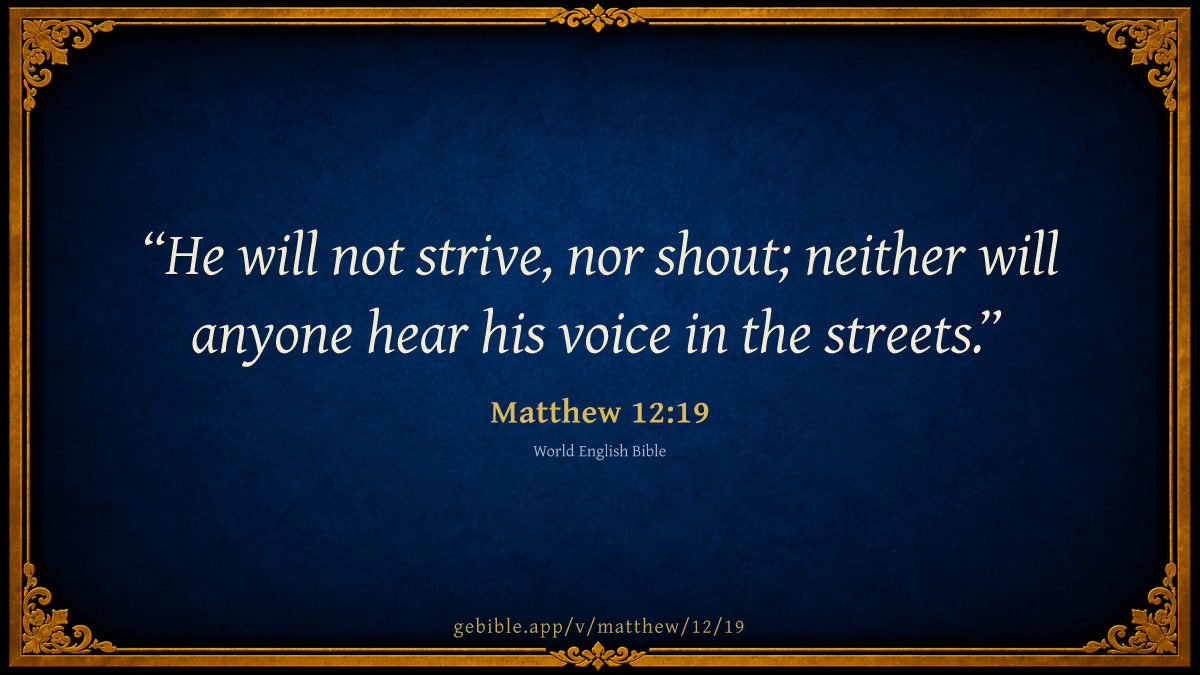
He will not strive, nor shout; neither will anyone hear his voice in the streets.
Parallel Translations
-
He will not strive, nor shout; neither will anyone hear his voice in the streets.
-
He shall not stryve he shall not crye nether shall eny man heare his voyce in the streetes
-
He shall not striue, nor crie, neither shall any man heare his voyce in the streetes.
Cross-references (6)
Passages linked to Matthew 12:19 in the Treasury of Scripture Knowledge, ordered by reader-vote popularity; verse text shown in World English Bible.
- Matthew 11:29 Take my yoke upon you, and learn from me, for I am gentle and humble in heart; and you will find rest for your souls.
- John 18:36-38 Jesus answered, “My Kingdom is not of this world. If my Kingdom were of this world, then my servants would fight, that I wouldn’t be delivered to the Jews. But now my Kingdom is not from here.” Pilate therefore said to him, “Are you a king then?” Jesus answered, “You say that I am a king. For this reason I have been born, and for this reason I have come into the world, that I should testify to the truth. Everyone who is of the truth listens to my voice.” Pilate said to him, “What is truth?” When he had said this, he went out again to the Jews, and said to them, “I find no basis for a charge against him.
- 2 Timothy 2:24-25 The Lord’s servant must not quarrel, but be gentle toward all, able to teach, patient, in gentleness correcting those who oppose him: perhaps God may give them repentance leading to a full knowledge of the truth,
- 2 Corinthians 10:1 Now I Paul, myself, entreat you by the humility and gentleness of Christ, I who in your presence am lowly among you, but being absent am bold toward you.
- Zechariah 9:9 Rejoice greatly, daughter of Zion! Shout, daughter of Jerusalem! Behold, your King comes to you! He is righteous, and having salvation; lowly, and riding on a donkey, even on a colt, the foal of a donkey.
- Luke 17:20 Being asked by the Pharisees when God’s Kingdom would come, he answered them, “God’s Kingdom doesn’t come with observation;
Cross-references from openbible.info (CC BY 4.0)
Explain this verse (13 sources)
Historical commentary, presented as a primary source — not an endorsement.
Private notes
Saved on this device only — never synced or sent anywhere.
John Trapp 1656 · Public Domain 19 He shall not strive, nor cry; neither shall…
19 He shall not strive, nor cry; neither shall any man hear his voice in the streets.
Ver. 19. He shall not strive] To bear away the bell from others.
Read full note →
Nor cry] "Nor lift up his voice," saith the prophet, as loth to lie hidden, and therefore making an "O yes," as desirous of vain glory and popular applause. Laudes nec curat nec quaerit humanas. He despiseth it as a little stinking breath, or the slavering of men’s lips which he disdains to suck in.
John Trapp, A Commentary or Exposition upon All the Books of the Old and New Testament (1647–1656) — public domain. Text from a community e-Sword module.
Matthew Poole 1685 · Public Domain These words declare the meekness, and gentleness, and modesty…
These words declare the meekness, and gentleness, and modesty of our blessed Saviour. His meekness, that he should not do his work in any passion or roughness, nor carry on his kingdom with any strife or violence. Therefore when the Pharisees took counsel against him, he made no opposition, but peaceably withdrew, until the time came when he was to be delivered; and then he as meekly yielded up himself, rebuking Peter for but drawing a sword for him, and healing his ear which he had wounded. His not crying, nor lifting up his voice, or suffering his voice to be heard in the streets, might either signify his meekness, not crying out to stir up any sedition; or not setting a trumpet to his mouth, when he had wrought a miracle, that people might take notice of it; instead of it he charged the persons healed not to publish it.
Matthew Poole's English Annotations on the Holy Bible (1683–1685) — public domain. Text from a community e-Sword/MySword module.
John Gill 1763 · Public Domain But when the Pharisees heard it,.... Very probably not…
But when the Pharisees heard it,.... Very probably not the same that went out, and held a council against Christ to destroy him, Mat 12:14 but others that were come from Judea and Jerusalem, and were with him in the house, and saw the miracle: these, when they heard what the people said, and how ready they were to believe, and own Jesus to be the Messiah, in order to prevent it, being filled with envy and malice,
they said, this fellow doth not cast out devils but by Beelzebub, the prince of devils. They could not deny the miracle, or that it was one; but to deprive him of the glory of it, and even reproach him for it, and to bring him into contempt with the people, they not only speak of him in a scornful manner, "this" sorry man, "this" vile fellow; but ascribe the miracle he wrought to familiarity with the devil, to diabolical influence and skill in magic art: they pretended he was in confederacy with Satan, and was carrying on his interest: and therefore, that he might gain credit and reputation, the prince of devils suffered the inferior ones to remove at his word: and of these their ancestors, the Jews have learnt to fix this vile imputation, and blasphemous piece of slander upon Christ; who, they say (o), brought enchantments, or witchcrafts, out of Egypt, in the cuttings of his flesh, whereby he performed the things he did. Concerning Beelzebub; see Gill on Mat 10:25 here called "the prince of devils"; it being a prevailing notion among the Jews, that there is one devil who is the head of all the rest, and who is by them sometimes called Asmodeus: they say (p), when Solomon sinned against the Lord, he sent to him , "Asmodeus the king of the devils", and drove him from his throne, and so elsewhere (q): and sometimes Samael, who is styled (r) Samael the prince, , "the king of devils"; and the angel Samael, the wicked, , "the head of all the Satans", or devils (s): and we often read (t) of , "the prince of hell"; by whom the same is meant, as here, by Beelzebub; for if anyone devil is more wicked, odious, and execrable than the rest, the chief of them may be thought to be so; for which reason he is here mentioned.
Read full note →
(o) T. Hieros. Sabbat, fol. 13. 4. T. Bab. Sabbat, fol. 104. 2. (p) Targum in Eccl. i. 12. (q) T. Bab. Pesach, fol. 110. 1. Gittin, fol. 68. 1. & Raziel, fol. 41. 2. (r) Zohar in Deut. fol. 120. 3. (s) Debarim Rabba, fol. 245. 3. (t) T. Bab. Sanhedrim, fol. 52. 1. Imre Binah in Zohar in Gen. fol. 22. 3.
John Gill's Exposition of the Whole Bible (1746–1763) — public domain (CC PDM 1.0). Text via the HelloAO Bible API.
John Wesley 1765 · Public Domain He shall not strive, nor clamour; neither shall any…
He shall not strive, nor clamour; neither shall any man hear his voice in the streets - That is, he shall not be contentious, noisy, or ostentatious: but gentle, quiet, and lowly. We may observe each word rises above the other, expressing a still higher degree of humility and gentleness.
John Wesley, Explanatory Notes Upon the Whole Bible (1754–1765) — public domain. Text via the GEBible commentary corpus.
Adam Clarke 1810 · Public Domain Verse 19. He shall not strive, nor cry] The…
Verse 19. He shall not strive, nor cry] The spirit of Christ is not a spirit of contention, murmuring, clamour, or litigiousness. He who loves these does not belong to him. Christ therefore fulfilled a prophecy by withdrawing from this place, on account of the rage of the Pharisees.
Adam Clarke's Commentary on the Bible (1810–1826) — public domain. Text from a community e-Sword/MySword module.
Haydock's Catholic Bible Commentary 1859 · Public Domain He shall not contend. These words do not occur…
He shall not contend. These words do not occur in the prophet, but are added by St. Matthew to express more fully the sense, because he offered himself up to the will of his heavenly Father, and delivered himself into the hands of those who persecuted him. (St. Thomas Aquinas) Nor cry out; because, like a lamb, in the hands of the shearer, he opened not his mouth.
George Leo Haydock (1774–1849), Haydock's Catholic Family Bible and Commentary, 1859 edition — public domain. Excludes Psalms (Douay-Rheims chapter numbering differs from Protestant) and Deuterocanonical books (Catholic canon only).
Robert Jamieson, A. R. Fausset & David Brown 1871 · Public Domain He shall not strive nor cry; neither shall any…
He shall not strive nor cry; neither shall any man hear his voice in the streets.
Jamieson, Fausset & Brown — Commentary Critical and Explanatory on the Whole Bible (1871) — public domain (CC PDM 1.0). Text via the HelloAO Bible API.
Daniel D. Whedon 1874 · Public Domain 19. He shall not strive — Here the peaceful…
19. He shall not strive — Here the peaceful character of the Saviour is set in beautiful contrast with the greatness of his deeds. Though he rule the nations with his law, he shall be peaceful and noiseless. His victories shall be the victories of peace. The rulers of Christendom have sometimes spread Christianity by the sword; but that was in express contradiction both to the personal character of Christ and to the precepts and principles of his Gospel. Strive — To strive is to fight. Our Lord at this time retreated from publicity to avoid all contest or strife. Nor cry — He shall raise no battle cry. Voice in the streets — Rallying his partisans to the riot and the sedition.
Daniel D. Whedon (gen. ed.), Commentary on the Old and New Testaments (1874–1909) — public domain. Text from a community e-Sword module.
The Cambridge Bible for Schools and Colleges 1878 · Public Domain 19, 20. These verses describe the gentleness and forbearance…
19, 20. These verses describe the gentleness and forbearance of Christ. He makes no resistance or loud proclamation like an earthly prince. The bruised reed and the feebly-burning wick may be referred to the failing lives which Jesus restores and the sparks of faith which He revives.
The Cambridge Bible for Schools and Colleges (gen. ed. J. J. S. Perowne; Cambridge University Press, 1878–1918) — public domain. Text from a community e-Sword module.
Ellicott's Commentary for English Readers 1878 · Public Domain (19) He shall not strive, nor cry.—The words point…
(19) He shall not strive, nor cry.—The words point to the pervading calmness which had impressed itself upon the mind of the Evangelist, and which stood out in marked contrast to the wrangling of Jewish scribes, the violence of Roman officers, yet more, it may be, to that of false prophets and leaders of revolt, such as Judas of Galilee had been. St. Matthew had probably known something of each of those types of character, and felt how different that of the Christ was from all of them.
A Bible Commentary for English Readers, edited by Charles John Ellicott (1878–1897) — public domain. Text from a community e-Sword module.
The Pulpit Commentary 1880 · Public Domain He shall not strive, nor cry. In Isaiah the…
He shall not strive, nor cry. In Isaiah the clause is, "He shall not cry aloud nor lift up his voice (a alw qxy al);" and so the LXX But "strive" would represent one very frequent connotation of "cry aloud" and its synonyms, for in Eastern lands disputants use their voice much more loudly than we do. This close connexion between the two ideas is seen also in the Syriac Version of Isaiah,. where "lift up his voice" is translated narib , a word meaning primarily "he shall strive," and only secondarily "he shall lift up his voice." It is possible, but not probable, that Matthew"s "strive" is taken directly from narib, adopting its primary and commoner meaning, and transposed. Neither shall any man hear his voice in the streets. A slight paraphrase of the original, "nor cause his voice to he heard in the street," perhaps due to different vocalization of the Hebrew.
The power that may be in silent farces.
Read full note →
This passage from Isaiah is given to show that one most characteristic feature of our Lord"s ministry was anticipated in prophecy. He avoided publicity; he shrank from contentions; he would not thrust himself into danger; he was absolutely content to do a quiet work, by personal influence, daily teachings, and kindly deeds of helpfulness, and of "heavenly, Divine charity." Silent forces are the mightiest. Silent light does more than bursting lightning; silent gravitation does more than rumbling earthquake. A thought, a truth, may work in men"s minds as the frost works in the cliffs that guard "the inviolate sea;" and presently the results are found, as the cliffs fall on to the shores. But faith in the power of silent forces is not usual with men, more especially in the spheres of religion. We are always wanting something that can be reported in the newspapers, and bring round upon us the praise of men for our energy and activity. The quiet-souled, who are content to do good work, and to keep on doing it, leaving it with God to appraise work, and reckon results, and reward workers, can always make their appeal to Christ, who got away from crowds whenever he could, who shrank from public excitement, and laid on the altar of the Father"s service simply good, patient, quiet work. This subject may be effectively illustrated in relation to the following things:
1. The silent force of sanctified personal character.
2. The silent force of unconscious influence.
3. The silent force of ever-ready and ever-cheerful helpfulness.
4. The silent force of cultured self-denial.
5. The silent force of full convictions of truth.
The man of strong faith never needs to use strong assertion. Quietness is his strength. There is need for the noisy forces; and God is properly called by the poet "Lord of the strong things and the gentle." But our faith in the manifestly strong things, needs no buttressing. Our faith in the seemingly weak things needs much buttressing. Jesus neither "strives nor cries," but he puts forces into the world which will work, as the leaven works, until they have secured the world"s redemption. R.T.
The Pulpit Commentary (1880–1919), ed. H.D.M. Spence-Jones & Joseph S. Exell — public domain. Text from a community e-Sword module.
B. W. Johnson 1891 · Public Domain 19. He shall not strive nor cry. He shall…
19. He shall not strive nor cry. He shall be modest, retiring, and not a brazen, noisy declaimer.
B. W. Johnson's The People's New Testament with Notes (1889–1891) — public domain. Electronic text from the Christian Classics Ethereal Library (CCEL) ThML edition.
unfoldingWord translationNotes 2017 · CC BY-SA 4.0 Connecting Statement:
Connecting Statement:
Matthew continues to quote the prophet Isaiah.
Read full note →
neither will anyone hear his voice
Here people not hearing his voice represents him not speaking loudly. AT: "he will not speak loudly" (See: Metonymy)
his ... He
All occurrences of these words refer to God's chosen servant.
in the streets
This is an idiom that means "publicly." AT: "in the cities and towns" (See: Idiom)
He will not break any bruised reed; he will not quench any smoking flax
Both of these statements mean the same thing. They are metaphors emphasizing that God's servant will be gentle and kind. Both "bruised reed" and "smoking flax" represent weak and hurting people. If the metaphor is confusing, you could translate the literal meaning. AT: "He will be kind to weak people, and he will be gentle to those who are hurting" (See: Parallelism and Metaphor)
bruised reed
"damaged plant"
he will not quench any smoking flax
"he will not put out any smoking flax" or "he will not stop any smoking flax from burning"
smoking flax
This refers to a lamp wick after the flame has gone out and when it is only smoking.
flax, until
This can be translated with a new sentence: "flax. This is what he will do until"
he leads justice to victory
Leading someone to victory represents causing him to be victorious. Causing justice to be victorious represents making things right that had been wrong. AT: "he makes everything right" (See: Abstract Nouns)
in his name
Here "name" refers to the whole person. AT: "in him" (See: Synecdoche)
translationWords
voice
reed
judge
Gentile
unfoldingWord translationNotes — © Distant Shores Media and the Door43 World Missions Community, licensed CC BY-SA 4.0. Source: git.door43.org/Door43/en_tn.