
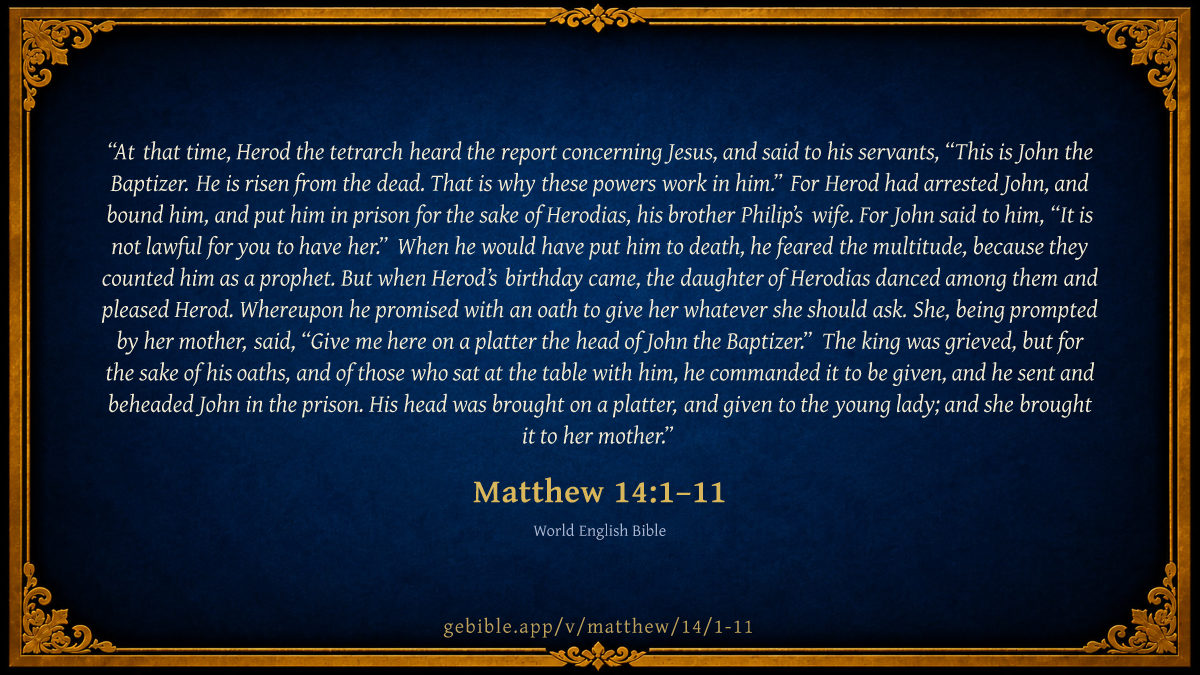
At that time, Herod the tetrarch heard the report concerning Jesus, and said to his servants, “This is John the Baptizer. He is risen from the dead. That is why these powers work in him.” For Herod had arrested John, and bound him, and put him in prison for the sake of Herodias, his brother Philip’s wife. For John said to him, “It is not lawful for you to have her.” When he would have put him to death, he feared the multitude, because they counted him as a prophet. But when Herod’s birthday came, the daughter of Herodias danced among them and pleased Herod. Whereupon he promised with an oath to give her whatever she should ask. She, being prompted by her mother, said, “Give me here on a platter the head of John the Baptizer.”
The king was grieved, but for the sake of his oaths, and of those who sat at the table with him, he commanded it to be given, and he sent and beheaded John in the prison. His head was brought on a platter, and given to the young lady; and she brought it to her mother.
Geneva Bible translators 1599 · Public Domain On vv1, 2, 6 Here is in John an example of an invincible…
Here is in John an example of an invincible courage, which all faithful Ministers of God’s word ought to follow: in Herod, an example of tyrannous vanity, pride and cruelty, and to be short, of a courtly conscience, and of their insufferable slavery, which have once given themselves over to pleasures: in Herodias and her daughter, an example of whore-like wantonness, and womanlike cruelty.
Geneva Bible (1599) marginal notes — public domain.
John Trapp 1656 · Public Domain On vv1–11 1 At that time Herod the tetrarch heard of…
1 At that time Herod the tetrarch heard of the fame of Jesus,
Ver. 1. At that time, &c.] When he was cast out by his countrymen, he was heard of at the court. The gospel, as the sea, what it loseth in one place, it getteth in another. But what? had not Herod heard of Christ till now? It is the misery of many good kings that they seldom hear the truth of things. Alphonsus king of Arragon bewailed it. And of Marcus Aurelius, one of the best Roman emperors, it is said, that he was even bought and sold by his court parasites. As for Herod, he may seem to have been of Gallio’s religion, even a mere irreligion. He lay melting in filthy pleasures, and minded not the things above. Whoredom, wine, and new wine had taken away his heart, Hos 4:11. St Luke, Luk 9:9, adds that he desired to see Christ, but yet never stirred out of doors to go to him; good motions make but a thoroughfare of wicked men’s hearts; they pass away as a flash of lightning, that dazzleth the eyes only, and leaves more darkness behind it.
John Trapp, A Commentary or Exposition upon All the Books of the Old and New Testament (1647–1656) — public domain. Text from a community e-Sword module.
Matthew Poole 1685 · Public Domain On vv1, 3, 4, 5, 6, 8, 9 This and the following history is related by Mark…
This and the following history is related by Mark more largely, Mar 6:14-30; by Luke more shortly, Luk 9:7-9. We heard before, that the Romans, under whom the Jews now were, had altered the government of the Jews from a kingdom to a tetrarchy, or government of four. Luke telleth us who were the tetrarchs, Luk 3:1. Herod (as we read there) was the tetrarch of Galilee. He had before this time put John Baptist to death, upon what occasion, and in what manner, we shall hear by and by. He heareth of the fame of Jesus. Luke saith he heard of all that was done by him, and was perplexed; that some said John the Baptist was risen from the dead; others, that Elias had appeared; others, that one of the old prophets was risen again. But Herod said, John have I beheaded: but who is this, of whom I hear such things? And he desired to see him. Mark saith, Mar 6:14, that king Herod heard of him; (for his name was spread abroad): and he said, That John the Baptist was risen from the dead, and therefore mighty works do show forth themselves in him. Others said, That it is Elias. And others said, That it is a prophet, or as one of the prophets. But when Herod heard thereof, he said, It is John, whom I beheaded: he is risen from the dead. So as it seems though others had various opinions, yet Herod was fixed in this, that this man was John the Baptist risen again from the dead. Though Luke reports him as speaking more doubtfully, (as he might do to the people), yet Matthew and Mark speak him affirming of it more confidently (probably to his courtiers and confidants). There was an opinion amongst the heathens, that the souls of men and women, when they died, went into other bodies. Some think that Herod was infected with that, and that this is the meaning of his suspicion that John was risen from the dead; that his soul, which he had forced from his body, was gone into another body, so as it might be revenged on him. Or else he thought that John was indeed raised from the dead, (which yet by search might quickly have been known), and therefore mighty works showed themselves in him.
Matthew Poole's English Annotations on the Holy Bible (1683–1685) — public domain. Text from a community e-Sword/MySword module.
William Burkitt 1703 · Public Domain On vv1, 3, 6 Observe here, 1. How strange it was the Herod…
Observe here, 1. How strange it was the Herod should not hear of the fame of Jesus till now; all the country and adjoining regions had rung of his fame, only Herod’s court hears nothing. Miserable is that greatness which keeps princes from the knowledge of Jesus Christ. How plain is it from hence that our Saviour came not to court? He once sent indeed a message to that fox (Herod) whose den he would not approach; teaching us by his example, not to affect, but to avoid, outward pomp and glory. The courts to thrive in.
Observe, 2. The misconstruction of Herod, when he heard of our Saviour’s fame: this, says he, is John the Baptist, whom I beheaded. His conscience told him he had offered an unjust violence to an innocent man; and now he is afraid that he is come again to be revenged on him for his head. A wicked man needs no worse tormentor than his own mind. O the terrors and tortures of a guilty conscience! How great are the anxieties of guilt, and the fears of divine displeasure, than which nothing is more stinging and perpetually tormenting.
William Burkitt's Expository Notes on the New Testament (1700–1703) — public domain. Text from a community e-Sword module.
Matthew Henry 1710 · Public Domain On v1 We have here the story of John's martyrdom. Observe,
We have here the story of John's martyrdom. Observe,
I. The occasion of relating this story here, Mat 14:1, Mat 14:2. Here is,
Read full note →
1. The account brought to Herod of the miracles which Christ wrought. Herod the tetrarch or chief governor of Galilee heard of the fame of Jesus. At that time, when his countrymen slighted him, upon the account of his meanness and obscurity, he began to be famous at court. Note, God will honour those that are despised for his sake. And the gospel, like the sea, gets in one place what it loses in another. Christ had now been preaching and working miracles above two years; yet, it should seem, Herod had not heard of him till now, and now only heard the fame of him. Note, It is the unhappiness of the great ones of the world, that they are most out of the way of hearing the best things (Co1 2:8). Which none of the princes of this world knew, Co1 1:26. Christ's disciples were now sent abroad to preach, and to work miracles in his name, and this spread the fame of him more than ever; which was an indication of the spreading of the gospel by their means after his ascension.
2. The construction he puts upon this (Mat 14:2); He said to his servants that told him of the fame of Jesus, as sure as we are here, this is John the Baptist; he is risen from the dead. Either the leaven of Herod was not Sadducism, for the Sadducees say, There is no resurrection (Act 23:8); or else Herod's guilty conscience (as is usual with atheists) did at this time get the mastery of his opinion, and now he concludes, whether there be a general resurrection or no, that John Baptist is certainly risen, and therefore mighty works do show forth themselves in him. John, while he lived, did no miracle (Joh 10:41); but Herod concludes, that, being risen from the dead, he is clothed with a greater power than he had while he was living. And he very well calls the miracles he supposed him to work, not his mighty works, but mighty works showing forth themselves in him. Observe here concerning Herod,
(1.) How he was disappointed in what he intended by beheading John. He thought if he could get that troublesome fellow out of the way, he might go on in his sins, undisturbed and uncontrolled; yet no sooner is that effected, than he hears of Jesus and his disciples preaching the same pure doctrine that John preached; and, which is more, even the disciples confirming it by miracles in their Master's name. Note, Ministers may be silenced, and imprisoned, and banished, and slain, but the word of God cannot be run down. The prophets live not for ever, but the word takes hold, Zac 1:5, Zac 1:6. See Ti2 2:9. Sometimes God raises up many faithful ministers out of the ashes of one. This hope there is of God's trees, though they be cut down, Job 14:7-9.
(2.) How he was filled with causeless fears, merely from the guilt of his own conscience. Thus blood cries, not only from the earth on which it was shed, but from the heart of him that shed it, and makes him Magoṙmissabib - A terror round about, a terror to himself. A guilty conscience suggests every thing that is frightful, and, like a whirlpool, gathers all to itself that comes near it. Thus the wicked flee when none pursue (Pro 28:1); are in great fear, where no fear is, Psa 14:5. Herod, by a little enquiry, might have found out that this Jesus was in being long before John Baptist's death, and therefore could not be Johannes redivivus - John restored to life; and so he might have undeceived himself; but God justly left him to this infatuation.
(3.) How, notwithstanding this, he was hardened in his wickedness; for though he was convinced that John was a prophet, and one owned of God, yet he does not express the least remorse or sorrow for his sin in putting him to death. The devils believe and tremble, but they never believe and repent. Note, There may be the terror of strong convictions, where there is not the truth of a saving conversion.
II. The story itself of the imprisonment and martyrdom of John. These extraordinary sufferings of him who was the first preacher of the gospel, plainly show that bonds and afflictions will abide the professors of it. As the first Old Testament saint, so the first New Testament minister, died a martyr. And if Christ's forerunner was thus treated, let not his followers expect to be caressed by the world. Observe here,
1. John's faithfulness in reproving Herod, Mat 14:3, Mat 14:4. Herod was one of John's hearers (Mar 6:20), and therefore John might be the more bold with him. Note, Ministers, who are reprovers by office, are especially obliged to reprove those that are under their charge, and not to suffer sin upon them; they have the fairest opportunity of dealing with them, and with them may expect the most favourable acceptance.
The particular sin he reproved him for was, marrying his brother Philip's wife, not his widow (that had not been so criminal), but his wife. Philip was now living, and Herod inveigled his wife from him, and kept here for his own. Here was a complication of wickedness, adultery, incest, besides the wrong done to Philip, who had had a child by this woman; and it was an aggravation of the wrong, that he was his brother, his half-brother, by the father, but not by the mother. See Psa 50:20. For this sin John reproved him; not by tacit and oblique allusions, but in plain terms, It is not lawful for thee to have her. He charges it upon him as a sin; not, It is not honourable, or, It is not safe, but, It is not lawful; the sinfulness of sin, as it is the transgression of the law, is the worst thing in it. This was Herod's own iniquity, his beloved sin, and therefore John Baptist tells him of this particularly. Note, (1.) That which by the law of God is unlawful to other people, is by the same law unlawful to princes and the greatest of men. They who rule over men must not forget that they are themselves but men, and subject to God. "It is not lawful for thee, any more than for the meanest subject thou hast, to debauch another man's wife." There is no prerogative, no, not for the greatest and most arbitrary kings, to break the laws of God. (2.) If princes and great men break the law of God, it is very fit they should be told of it by proper persons, and in a proper manner. As they are not above the commands of God's word, so they are not above the reproofs of his ministers. It is not fit indeed, to say to a king, Thou art Belial (Job 34:18), any more than to call a brother Raca, or, Thou fool: it is not fit, while they keep within the sphere of their own authority, to arraign them. But it is fit that, by those whose office it is, they should be told what is unlawful, and told with application, Thou art the man; for it follows there (Mat 14:19), that God (whose agents and ambassadors faithful ministers are) accepteth not the persons of princes, nor regardeth the rich more than the poor.
2. The imprisonment of John for his faithfulness, Mat 14:3. Herod laid hold on John when he was going on to preach and baptize, put an end to his work, bound him, and put him in prison; partly to gratify his own revenge, and partly to please Herodias, who of the two seemed to be most incensed against him; it was for her sake that he did it. Note, (1.) Faithful reproofs, if they do not profit, usually provoke; if they do not do good, they are resented as affronts, and they that will not bow to the reproof, will fly in the face of the reprover and hate him, as Ahab hated Micaiah, Kg1 22:8. See Pro 9:8; Pro 15:10, Pro 15:12. Veritas odium parit - Truth produces hatred. (2.) It is no new thing for God's ministers to suffer ill for doing well. Troubles abide those most that are most diligent and faithful in doing their duty, Act 20:20. Perhaps some of John's friends would blame him as indiscreet in reproving Herod, and tell him he had better be silent than provoke Herod, whose character he knew very well, thus to deprive him of his liberty; but away with that discretion that would hinder men from doing their duty as magistrates, ministers, or Christian friends; I believe John's own heart did not reproach him for it, but this testimony of his conscience for him made his bonds easy, that he suffered for well-doing, and not as a busy-body in other men's matters, Pe1 4:15.
3. The restraint that Herod lay under from further venting of his rage against John, Mat 14:5.
(1.) He would have put him to death. Perhaps that was not intended at first when he imprisoned him, but his revenge by degrees boiled up to that height. Note, The way of sin, especially the sin of persecution, is down-hill; and when once a respect to Christ's ministers is cast off and broken through in one instance, that is at length done, which the man would sooner have thought himself a dog than to have been guilty of, Kg2 8:13.
(2.) That which hindered him was his fear of the multitude, because they counted John as a prophet. It was not because he feared God (if the fear of God had been before his eyes he would not have imprisoned him), nor because he feared John, though formerly he had had a reverence for him (his lusts had overcome that), but because he feared the people; he was afraid for himself, his own safety, and the safety of his government, his abuse of which he knew had already rendered him odious to the people, whose resentments being so far heated already would be apt, upon such a provocation as the putting of a prophet to death, to break out into a flame. Note, [1.] Tyrants have their fears. Those who are, and affect to be, the terror of the mighty, are many times the greatest terror of all to themselves; and when they are most ambitious to be feared by the people, are most afraid of them. [2.] Wicked men are restrained from the most wicked practices, merely by their secular interest, and not by any regard to God. A concern for their ease, credit, wealth, and safety, being their reigning principle, as it keeps them from many duties, so it keeps them from many sins, which otherwise they would not be restrained from; and this is one means by which sinners are kept from being overmuch wicked, Ecc 7:17. The danger of sin that appears to sense, or to fancy only, influences men more than that which appears to faith. Herod feared that the putting of John to death might raise a mutiny among the people, which it did not; but he never feared it might raise a mutiny in his own conscience, which it did, Mat 14:2. Men fear being hanged for that which they do not fear being damned for.
4. The contrivance of bringing John to his death. Long he lay in prison; and, against the liberty of the subject (which, blessed be God, is secured to us of this nation by law), might neither be tried nor bailed. It is computed that he lay a year and a half a close prisoner, which was about as much time as he had spent in his public ministry, from his first entrance into it. Now here we have an account of his release, not by any other discharge than death, the period of all a good man's troubles, that brings the prisoners to rest together, so that they hear not the voice of the oppressor, Job 3:18.
Herodias laid the plot; her implacable revenge thirsted after John's blood, and would be satisfied with nothing less. Cross the carnal appetites, and they turn into the most barbarous passions; it was a woman, a whore, and the mother of harlots, that was drunk with the blood of the saints, Rev 17:5, Rev 17:6. Herodias contrived how to bring about the murder of John so artificially as to save Herod's credit, and so to pacify the people. A sorry excuse is better than none. But I am apt to think, that if the truth were known, Herod was himself in the plot; and with all his pretences of surprise and sorrow, was privy to the contrivance, and knew before what would be asked. And his pretending his oath, and respect to his guests, was all but sham and grimace. But if he were trepanned into it ere he was aware, yet because it was the thing he might have prevented, and would not, he is justly found guilty of the whole contrivance. Though Jezebel bring Naboth to his end, yet if Ahab take possession, he hath killed. So, though Herodias contrive the beheading of John, yet if Herod consent to it, and take pleasure in it, he is not only an accessary, but a principal murderer. Well, the scene being laid behind the curtain, let us see how it was acted upon the stage, and in what method. Here we have,
(1.) The humouring of Herod by the damsel's dancing upon a birthday. It seems, Herod's birthday was kept with some solemnity; in honour of the day, there must needs be, as usual, a ball at court; and, to grace the solemnity, the daughter of Herodias danced before them; who being the queen's daughter, it was more than she ordinarily condescended to do. Note, Times of carnal mirth and jollity are convenient times for carrying on bad designs against God's people. When the king was made sick with bottles of wine, he stretched out his hand with scorners (Hos 7:5), for it is part of the sport of a fool to do mischief, Pro 10:23. The Philistines, when their heart was merry, called for Samson to abuse him. The Parisian massacre was at a wedding. This young lady's dancing pleased Herod. We are not told who danced with her, but none pleased Herod like her dancing. Note, A vain and graceless heart is apt to be greatly in love with the lusts of the flesh and of the eye, and when it is so, it is entering into further temptation; for by that Satan gets and keeps possession. See Pro 23:31-33. Herod was now in a mirthful mood, and nothing was more agreeable to him than that which fed his vanity.
(2.) The rash and foolish promise which Herod made to this wanton girl, to give her whatsoever she would ask: and this promise confirmed with an oath, Mat 14:7. It was a very extravagant obligation which Herod here entered into, and no way becoming a prudent man that is afraid of being snared in the words of his mouth (Pro 6:2), much less a good man that fears an oath, Ecc 9:2. To put this blank into her hand, and enable her to draw upon him at pleasure, was too great a recompense for such a sorry piece of merit; and, I am apt to think, Herod would not have been guilty of such an absurdity, if he had not been instructed of Herodias, as well as the damsel. Note, Promissory oaths are ensnaring things, and, when made rashly, are the products of inward corruption, and the occasion of many temptations. Therefore, swear not so at all, lest thou have occasion to say, It was an error, Ecc 5:6.
(3.) The bloody demand the young lady made of John the Baptist's head, Mat 14:8. She was before instructed of her mother. Note, The case of those children is very sad, whose parents are their counsellors to do wickedly, as Ahaziah's (Ch2 22:3); who instruct them and encourage them in sin, and set them bad examples; for the corrupt nature will sooner be quickened by bad instructions than restrained and mortified by good ones. Children ought not to obey their parents against the Lord, but if they command them to sin, must say, as Levi did to father and mother, they have not seen them.
Herod having given her her commission, and Herodias her instructions, she requires John the Baptist's head in a charger. Perhaps Herodias feared lest Herod should grow weary of her (as lust useth to nauseate and be cloyed), and then would make John Baptist's reproof a pretence to dismiss her; to prevent which she contrives to harden Herod in it by engaging him in the murder of John. John must be beheaded then; that is the death by which he must glorify God; and because it was his who died first after the beginning of the gospel, though the martyrs died various kinds of deaths, and not so easy and honourable as this, yet this is put for all the rest, Rev 20:4, where we read of the souls of those that were beheaded for the witness of Jesus. Yet this is not enough, the thing must be humoured too, and not only a revenge, but a fancy must be gratified; it must be given her here in a charger, served up in blood, as a dish of meat at the feast, or sauce to all the other dishes; it is reserved for the third course, to come up with the rarities. He must have no trial, no public hearing, no forms of law or justice must add solemnity to his death; but he is tried, condemned, and executed, in a breath. It was well for him he was so mortified to the world that death could be no surprise to him, though ever so sudden. It must be given her, and she will reckon it a recompence for her dancing, and desire no more.
(4.) Herod's grant of this demand (Mat 14:9); The king was sorry, at least took on him to be so, but, for the oath's sake, he commanded it to be given her. Here is,
[1.] A pretended concern for John. The king was sorry. Note, Many a man sins with regret, that never has any true regret for his sin; is sorry to sin, yet is utterly a stranger to godly sorrow; sins with reluctancy, and yet goes on to sin. Dr. Hammond suggests, that one reason of Herod's sorrow was, because it was his birthday festival, and it would be an ill omen to shed blood on that day, which, as other days of joy, used to be graced with acts of clemency; Natalem colimus, tacete lites - We are celebrating the birthday, let there be no contentions.
[2.] Here is a pretended conscience of his oath, with a specious show of honour and honesty; he must needs do something, for the oath's sake. Note, It is a great mistake to think that a wicked oath will justify a wicked action. It was implied so necessarily, that it needed not be expressed, that he would do any thing for her that was lawful and honest; and when she demanded what was otherwise, he ought to have declared, and he might have done it honourably, that the oath was null and void, and the obligation of it ceased. No man can lay himself under an obligation to sin, because God has already so strongly obliged every man against sin.
[3.] Here is a real baseness in compliance with wicked companions. Herod yielded, not so much for the sake of the oath, but because it was public, and in compliment to them that sat at meat with him; he granted the demand that he might not seem, before them, to have broken his engagement. Note, A point of honour goes much further with many than a point of conscience. Those who sat at meat with him, probably, were as well pleased with the damsel's dancing as he, and therefore would have her by all means to be gratified in a frolic, and perhaps were as willing as she to see John the Baptist's head off. However, none of them had the honesty to interpose, as they ought to have done, for the preventing of it, as Jehoiakim's princes did, Jer 36:25. If some of the common people had been here, they would have rescued this Jonathan, as Sa1 14:45.
[4.] Here is a real malice to John at the bottom of this concession, or else he might have found out evasions enough to have got clear of his promise. Note, Though a wicked mind never wants an excuse, yet the truth of the matter is, that every man is tempted when he is drawn aside of his own lust, and enticed, Jam 1:14. Perhaps Herod presently reflecting upon the extravagance of his promise, on which she might ground a demand of some vast sum of money, which he loved a great deal better than John the Baptist, was glad to get clear of it so easily; and therefore immediately issues out a warrant for the beheading of John the Baptist, it should seem not in writing, but only by word of mouth; so little account is made of that precious life; he commanded it to be given her.
(5.) The execution of John, pursuant to this grant (Mat 14:10); He sent and beheaded John in the prison. It is probable the prison was very near, at the gate of the palace; and thither an officer was sent to cut off the head of this great man. He must be beheaded with expedition, to gratify Herodias, who was in a longing condition till it was done. It was done in the night, for it was at supper-time, after supper, it is likely. It was done in the prison, not at the usual place of execution, for fear of an uproar. A great deal of innocent blood, of martyr's blood, has thus been huddled up in corners, which, when God comes to make inquisition for blood, the earth shall disclose, and shall no more cover, Isa 26:21; Psa 9:12.
Thus was that voice silenced, that burning and shining light extinguished; thus did that prophet, that Elias, of the new Testament, fall a sacrifice to the resentments of an imperious, whorish woman. Thus did he, who was great in the sight of the Lord, die as a fool dieth, his hands were bound, and his feet put into fetters; and as a man falleth before wicked men, so he fell, a true martyr to all intents and purposes: dying, though not for the professions of his faith, yet for the performance of his duty. However, though his work was soon done, it was done and his testimony finished, for till then none of God's witnesses are slain. And God brought this good out of it, that hereby his disciples, who while he lived, though in prison, kept close to him, now after his death heartily closed with Jesus Christ.
5. The disposal of the poor remains of this blessed saint and martyr. The head and body being separated,
(1.) The damsel brought the head in triumph to her mother, as a trophy of the victories of her malice and revenge, Mat 14:11. Jerome ad Rufin, relates, that when Herodias had John the Baptist's head brought her, she gave herself the barbarous diversion of pricking the tongue with a needle, as Fulvia did Tully's. Note, Bloody minds are pleased with bloody sights, which those of tender spirits shrink and tremble at. Sometimes the insatiable rage of bloody persecutors has fallen upon the dead bodies of the saints, and made sport with them, Psa 79:2. When the witnesses are slain, they that dwell on the earth rejoice over them, and make merry, Rev 11:10; Psa 14:4, Psa 14:5.
(2.) The disciples buried the body, and brought the news in tears to our Lord Jesus. The disciples of John had fasted often whole their master was in prison, their bridegroom was taken away from them, and they prayed earnestly for his deliverance, as the church did for Peter's, Act 12:5. They had free access to him in prison, which was a comfort to them, but they wished to see him at liberty, that he might preach to others; but now on a sudden all their hopes are dashed. Disciples weep and lament, when the world rejoices. Let us see what they did.
[1.] They buried the body. Note, There is a respect owing to the servants of Christ, not only while they live, but in their bodies and memories when they are dead. Concerning the first two New Testament martyrs, it is particularly taken notice of, that they were decently buried, John the Baptist by his disciples, and Stephen by devout men (Act 8:2); yet there was no enshrining of their bones or other relics, a piece of superstition which sprung up long after, when the enemy had sowed tares. That over-doing, in respect to the bodies of the saints, is undoing; though they are not to be vilified, yet they are not to be deified.
[2.] They went and told Jesus; not so much that he might shift for his own safety (no doubt he heard it from others, the country rang of it), as they might receive comfort from him, and be taken in among his disciples. Note, First, When any thing ails us at any time, it is our duty and privilege to make Christ acquainted with it. It will be a relief to our burthened spirits to unbosom ourselves to a friend we may be free with. Such a relation dead or unkind, such a comfort lost or embittered, go and tell Jesus who knows already, but will know from us, the trouble of our souls in adversity. Secondly, We must take heed, lest our religion and the profession of it die with our ministers; when John was dead, they did not return every man to his own, but resolved to abide by it still. When the shepherds are smitten, the sheep need not be scattered while they have the great Shepherd of the sheep to go to, who is still the same, Heb 13:8, Heb 13:20. The removal of ministers should bring us nearer to Christ, into a more immediate communion with him. Thirdly, Comforts otherwise highly valuable, are sometimes therefore taken from us, because they come between us and Christ, and are apt to carry away that love and esteem which are due to him only: John had long since directed his disciples to Christ, and turned them over to him, but they could not leave their old master while he lived; therefore he is removed that they may go to Jesus, whom they had sometimes emulated and envied for John's sake. It is better to be drawn to Christ by want and loss, than not to come to him at all. If our masters be taken from our head, this is our comfort, we have a Master in heaven, who himself is our Head.
Josephus mentions this story of the death of John the Baptist (Antiq. 18.116-119), and adds, that a fatal destruction of Herod's army in his war with Aretas, king of Petrea (whose daughter was Herod's wife, whom he put away to make room for Herodias), was generally considered by the Jews to be a just judgment upon him, for putting John the Baptist to death. Herod having, at the instigation of Herodias, disobliged the emperor, was deprived of his government, and they were both banished to Lyons in France; which, says Josephus, was his just punishment for hearkening to her solicitations. And, lastly, it is storied of this daughter of Herodias, that going over the ice in winter, the ice broke, and she slipt in up to her neck, which was cut through by the sharpness of the ice. God requiring her head (says Dr. Whitby) for that of the Baptist; which, if true, was a remarkable providence.
Matthew Henry's Commentary on the Whole Bible (1708–1710) — public domain (CC PDM 1.0). Text via the HelloAO Bible API.
John Gill 1763 · Public Domain On vv2–11 And said unto his servants,.... Those of his household,…
And said unto his servants,.... Those of his household, his courtiers, with whom he more familiarly conversed; to these he expressed his fears, that it might be true what was suggested by the people, and he was ready to believe it himself;
this is John the Baptist: some copies add, "whom I have beheaded", as in Mar 6:16 the guilt of which action rose in his mind, lay heavy on him, and filled him with horror and a thousand fears:
Read full note →
he is risen from the dead; which if he was a Sadducee, as he is thought to be, by comparing Mat 16:6 with Mar 8:15 was directly contrary to his former sentiments, and was extorted from him by his guilty conscience; who now fears, what before he did not believe; and what he fears, he affirms; concluding that John was raised from the dead, to give proof of his innocence, and to revenge his death on him:
and therefore mighty works do show themselves in him, or "are wrought by him"; for though he wrought no miracles in his lifetime, yet, according to a vulgar notion, that after death men are endued with a greater power, Herod thought this to be the case; or that he was possessed of greater power, on purpose to punish him for the murder of him; and that these miracles which were wrought by him, were convincing proofs of the truth of his resurrection, and of what he was able to do to him, and what he might righteously expect from him.
John Gill's Exposition of the Whole Bible (1746–1763) — public domain (CC PDM 1.0). Text via the HelloAO Bible API.
John Wesley 1765 · Public Domain On vv1, 2, 3, 4, 5, 6, 8, 9, 10 At that time - When our Lord had spent…
At that time - When our Lord had spent about a year in his public ministry. Tetrarch - King of a fourth part of his father's dominions. Mark vi, 14.
John Wesley, Explanatory Notes Upon the Whole Bible (1754–1765) — public domain. Text via the GEBible commentary corpus.
Adam Clarke 1810 · Public Domain On vv1, 2, 3, 4, 5, 6, 8, 9, 11 Herod, having heard the fame of Christ, supposes him…
CHAPTER XIV.
Herod, having heard the fame of Christ, supposes him to be John
Read full note →
the Baptist, risen from the dead, 1, 2.
A circumstantial account of the beheading of John the Baptist,
3-12.
Five thousand men, besides women and children, fed with five
loaves and two fishes, 13-21.
The disciples take ship, and Jesus stays behind, and goes
privately into a mountain to pray, 22, 23.
A violent storm arises, by which the lives of the disciples are
endangered, 24.
In their extremity, Jesus appears to them, walking upon the
water, 25-27.
Peter, at the command of his Master, leaves the ship, and walks
on the water to meet Christ, 28-31.
They both enter the ship, and the storm ceases, 32, 33.
They come into the land of Gennesaret, and he heals many
diseased people, 34-36.
NOTES ON CHAP. XIV.
Verse 1. Herod the tetrarch] This was Herod Antipas, the son of Herod the Great. See Clarke on Mt 2:1, where an account is given of the Herod family. The word tetrarch properly signifies a person who rules over the fourth part of a country; but it is taken in a more general sense by the Jewish writers, meaning sometimes a governor simply, or a king; see Mt 14:9. The estates of Herod the Great were not, at his death, divided into four tetrarchies, but only into three: one was given by the Emperor Augustus to Archelaus; the second to Herod Antipas, the person in the text; and the third to Philip: all three, sons of Herod the Great.
Adam Clarke's Commentary on the Bible (1810–1826) — public domain. Text from a community e-Sword/MySword module.
Joseph Benson 1811 · Public Domain On vv1, 3, 8, 10 Mat 14:1-2. Now at that time — When our…
Mat 14:1-2. Now at that time — When our Lord had spent about a year in his public ministry, and had sent out his disciples to preach the gospel, to cast out devils, and to heal diseases, and they, by virtue of his name, had been successful in that work; Mar 6:12-14; Luk 9:6-7; Herod the tetrarch — King of Galilee and Peræa, the fourth part of his father’s dominions; (see note on Mat 2:1;) heard of the fame of Jesus — Now everywhere spread abroad, in consequence of the marvellous works done by him and his apostles; and said, This is John the Baptist: he is risen from the dead — Herod was a Sadducee; and the Sadducees denied the resurrection of the dead: but Sadducism staggers when conscience awakes. See the note on Mar 6:14-28.
Joseph Benson's Commentary on the Old and New Testaments (1811–1818) — public domain. Text from a community e-Sword module.
Albert Barnes 1834 · Public Domain On vv1, 2, 3, 6 Herod the tetrarch - See also Mar 6:14-16; Luk…
Herod the tetrarch - See also Mar 6:14-16; Luk 9:7-9. This was a son of Herod the Great. Herod the Great died probably in the first year after the birth of Christ, and left his kingdom to his three sons, of whom this “Herod Antipas” was one. He ruled over Galilee and Perea. See the notes at Mat 2:15. The title “tetrarch” literally denotes one who rules over a “fourth” part of any country. It came, however, to signify the governor or ruler of any province subject to the Roman emperor - Robinson, Lexicon.
Heard of the fame of Jesus - Jesus had been a considerable time engaged in the work of the ministry, and it may seem remarkable that he had not before heard of him. Herod might, however, have been absent on some expedition to a remote part of the country. It is to be remembered, also, that he was a man of much dissoluteness of morals, and that he paid little attention to the affairs of the people. He might have heard of Jesus before, but it had not arrested his attention. He did not think it a matter worthy of much regard.
Albert Barnes' Notes on the Bible (1834–1885) — public domain. Text from a community e-Sword/MySword module.
Haydock's Catholic Bible Commentary 1859 · Public Domain On vv1, 2, 3, 5, 7, 9, 11 Tetrarch. This word, derived from the Greek, signifies one…
Tetrarch. This word, derived from the Greek, signifies one that rules over the fourth part of a kingdom: as Herod then ruled over Galilee, which was but the fourth part of the kingdom of his father. (Challoner) --- St. John had been now imprisoned in the castle of Machærus about a year, at the instigation of Herodias. It is very probable that before this he would have fallen a sacrifice to her vindictive temper, had it not been for the great personal respect in which (on account of the singular holiness of his life) he was held, not only by the people, but by Herod himself. --- Josephus, in his Antiquities of the Jews, gives the following account: This Herod, who was also called Antipas, was the son of Herod the great, by his sixth wife, Cleopatra, of Jerusalem. A general opinion obtained among the Jews, that Herod’s discomfiture by the Parthians, was the effect of divine vengeance upon himself and his army, for the blood of John, surnamed the Baptist. He was a man of immaculate character, whose object was to exhort the Jews to the practice of virtue and piety, point out the necessity of repentance, and hold forth by baptism the import of regeneration to a new life, which he made to consist, not in abstaining from a particular sin, but in an habitual purity of both mind and body. Such was the influence of this great and good man, as appeared from the multitude of his disciples, and the veneration of his life and doctrines, that Herod was apprehensive of a revolt. He therefore sent him bound to prison, where by the malice of Herodias, his brother’s wife, he was afterwards put to death, which inhuman act was shortly followed by the marked vengeance of heaven on its execrable author, as the Jews were firmly convinced. (Book xviii, chap. vii.) --- For Herod going to Rome, at the instigation of Herodias, expecting to be made king, was severely reproved by the emperor Caius, (Caligula) who transferred his tetrarchy to Agrippa, in consequence of which, Herod retired with his wife to Spain, and died in exile. (Wars of the Jews. Book ii, chap. viii.) In the 18th book, and 9th chapter, Josephus says, the place of his exile was Lyons, in Gaul; that his goods were also confiscated, and that both himself and Herodias died in great misery.
George Leo Haydock (1774–1849), Haydock's Catholic Family Bible and Commentary, 1859 edition — public domain. Excludes Psalms (Douay-Rheims chapter numbering differs from Protestant) and Deuterocanonical books (Catholic canon only).
John Nelson Darby 1862 · Public Domain On v1 Matthew Chapter 14
Matthew Chapter 14
Our Gospel resumes the historical course of these revelations, but in such a manner as to exhibit the spirit by which the people were animated. Herod (loving his earthly power and his own glory more than submission to the testimony of God, and more bound by a false human idea than by his conscience, although in many things he appears to have owned the power of the truth) had cut off the head of the forerunner of the Messiah, John the Baptist; whom he had already imprisoned, in order to remove out of the sight of his wife the faithful reprover of the sin in which she lived.
Read full note →
Jesus is sensible of the import of this, which is reported to Him. Accomplishing in lowly service (however personally exalted above him), together with John, the testimony of God in the congregation, He felt Himself united in heart and in His work to him; for faithfulness in the midst of all evil binds hearts very closely together; and Jesus had condescended to take a place in which faithfulness was concerned (see Psa 40:9-10). On hearing therefore of John’s death He retires into a desert place. But while departing from the multitude who thus began to act openly in the rejection of the testimony of God, He does not cease to be the supplier of all their wants, and to testify thus that He who could divinely minister to all their need was amongst them. For the multitude, who felt these wants and who, if they had not faith, yet admired the power of Jesus, follow Him into the desert place; and Jesus, moved with compassion, heals all their sick. In the evening His disciples beg Him to send the multitude away that they may procure food. He refuses and bears a remarkable testimony to the presence, in His own Person, of Him who was to satisfy the poor of His people with bread (Psa 132:1-18). Jehovah, the Lord, who established the throne of David, was there in the Person of Him who should inherit that throne. I doubt not the twelve baskets of fragments refer to the number which, in scripture, always designates the perfection of administrative power in man.
Remark also here, that the Lord expects to find His twelve disciples capable of being the instruments of His acts of blessing and power, administering according to His own power the blessings of the kingdom. “Give ye them,” said He, “to eat.” This applies to the blessing of the Lord’s kingdom, and to the disciples of Jesus, the twelve, as being its ministers; but it is likewise an all-important principle with regard to the effect of faith in every intervention of God in grace. Faith should be able to use the power that acts in such intervention, to produce the works which are proper to that power, according to the order of the dispensation and the intelligence it has respecting it. We shall find this principle again elsewhere more fully developed.
The disciples wished to send the multitude away, not knowing how to use the power of Christ. They should have been able to avail themselves of it in Israel’s behalf, according to the glory of Him who was among them.
If now the Lord demonstrated with perfect patience by His actions that He who could thus bless Israel was in the midst of His people, He does not the less bear testimony to His separation from that people in consequence of their unbelief. He makes His disciples get into a ship to cross the sea alone; and, dismissing the multitude Himself, He goes up into a mountain apart to pray; while the ship that contained the disciples was tossing on the waves of the sea with a contrary wind: a living picture of that which has taken place. God has indeed sent forth His people to cross the stormy sea of the world alone, meeting with an opposition against which it is hard to strive. Meanwhile Jesus prays alone on high. He has sent away the Jewish people, who had surrounded Him during the period of His presence here below. The departure of the disciples, besides its general character, sets before us peculiarly the Jewish remnant. Peter individually, in coming out of the ship, goes in figure beyond the position of this remnant. He represents that faith which, forsaking the earthly accommodation of the ship, goes out to meet Jesus who has revealed Himself to it, and walks upon the sea-a bold undertaking, but based on the word of Jesus, “Come.” Yet remark here that this walk has no other foundation than, “If it be Thou,” that is to say, Jesus Himself. There is no support, no possibility of walking, if Christ be lost sight of. All depends on Him. There is a known means in the ship; there is nothing but faith, which looks to Jesus, for walking on the water. Man, as mere man, sinks by the very fact of being there. Nothing can sustain itself except that faith which draws from Jesus the strength that is in Him, and which therefore imitates Him. But it is sweet to imitate Him; and one is then nearer to Him, more like Him. This is the true position of the church, in contrast with the remnant in their ordinary character. Jesus walks on the water as on the solid ground. He who created the elements as they are could well dispose of their qualities at His pleasure. He permits storms to arise for the trial of our faith. He walks on the stormy wave as well as on the calm. Moreover the storm makes no difference. He who sinks in the waters does so in the calm as well as in the storm, and he who can walk upon them will do so in the storm as well as in the calm-that is to say, unless circumstances are looked to and so faith fail, and the Lord is forgotten. For often circumstances make us forget Him where faith ought to enable us to overcome circumstances through our walking by faith in Him who is above them all. Nevertheless, blessed be God! He who walks in His own power upon the water is there to sustain the faith and the wavering steps of the poor disciple; and at any rate that faith had brought Peter so near to Jesus that His outstretched hand could sustain him. Peter’s fault was that he looked at the waves, at the storm (which, after all, had nothing to do with it), instead of looking at Jesus, who was unchanged, and who was walking on those very waves, as his faith should have observed. Still the cry of his distress brought the power of Jesus into action, as his faith ought to have done; only it was now to his shame, instead of being in the enjoyment of communion and walking like the Lord.
Jesus having entered the ship, the wind ceases. Even so it will be when Jesus returns to the remnant of His people in this world. Then also will He be worshipped as the Son of God by all that are in the ship, with the remnant of Israel. In Gennesaret Jesus again exercises the power which shall here after drive out from the earth all the evil that Satan has brought in. For when He returns, the world will recognise Him. It is a fine picture of the result of Christ’s rejection, which this Gospel has already made known to us as taking place in the midst of the Jewish nation.
John Nelson Darby — Synopsis of the Books of the Bible: the New Testament (c. 1857–1862) — public domain. Text from a community e-Sword module.
Lange's Commentary on the Holy Scriptures 1864 · Public Domain On v1 Mat_14:1-33 (Mar_6:14-56; Luk_9:7-17; Joh_6:1-21)
B. CHRIST MANIFESTS HIMSELF AS THE HIGH PRIEST IN HIS SUFFERINGS; BEING REJECTED BY THE POLITICAL DESPOTISM OF HEROD, THE RULER OF GALILEE
Mat_14:1-33 (Mar_6:14-56; Luk_9:7-17; Joh_6:1-21)
Read full note →
Contents:—Jesus withdraws Himself from the court of Herod Antipas, who had just murdered John the Baptist. The priestly realm of the Lord in the desert among the poor people; or, the first miraculous feeding of the multitude. Priestly sway of the Lord amid the terrors of the night at sea.
1. Retirement of the Lord from the vicinity of Herod. Mat_14:1-13
1, At that time Herod the tetrarch heard of the fame of Jesus, 2And said unto his servants, This is John the Baptist; he is risen from the dead; and therefore mighty works do shew forth themselves in him.1 3For Herod had laid hold on John, and bound him, and put him [out of the way]2 in prison for Herodias’ sake,3 his brother Philip’s4
4 , wife. For John said unto him, It is not lawful for thee to have her. 5And when he would have put him to death, he feared5 the multitude, because they counted [held] him as a prophet. 6But when Herod’s birthday was kept,6 the daughter of Herodias danced before them, and pleased Herod. 7Whereupon he promised with an oath to give her whatsoever she would [should] ask. 8And she, being before instructed of [led on by]7 her mother, said, Give me here John Baptist’s head in a charger [platter].89And the king was sorry:9 nevertheless [but] for the oath’s sake, and them which sat 10[that reclined] with him at meat, he commanded it to be given her. And he sent, and beheaded John in the prison. 11And his head was brought in a charger [platter], and given to the damsel: and she brought it to her mother. 12And his disciples came, and took up the body,10 and buried it, and went and told Jesus.
13 When Jesus heard of it, he departed [withdrew from, ἀνεχώρησεν] thence by ship into a desert place apart: and when the people had heard thereof , they followed him on foot out of the cities.
EXEGETICAL AND CRITICAL
Chronological Arrangement.—The offence which Christ had experienced in His own city is followed by another offence on the part of His sovereign. This may have been another practical reason why Matthew records in this connection what had taken place on a former occasion. The chronological succession of events appears from Joh_6:1. After the return of Jesus from the festival of Purim, He passed over the Sea of Galilee, as it would seem near Tiberias. Evidently the feeding of the multitude, here recorded, was the first occasion of that kind; the circumstances are the same as in John—five loaves, two fishes, five thousand people, twelve baskets full of fragments;—the narrative being followed in both Gospels by an account of Christ’s walking on the sea. On the other hand, Luke reports the return of the Apostles (Luk_9:10), after having recorded that Herod had wished to see Jesus. Christ, however, withdraws with His disciples into the wilderness near Bethsaida (on the other side of the lake). There the miraculous feeding of the multitude took place. Mark records in the same manner and connection the motive for His passage across the sea, as also His feeding the multitude and walking on the waters. From all this we conclude that this event took place at the time when Jesus again met His disciples in Galilee, on His return from the visit to Jerusalem, which closed with His last missionary journey through Galilee. On the other hand, Mat_11:12-13, represents the Saviour as again going about with His disciples.
Mat_14:1. Herod Antipas (Ἀντίπας = Ἀντίπατρος), the son of Herod the Great and of Malthace, a Samaritan. In his testament, Herod had appointed him tetrarch of Galilee and Peræa. Antipas entered into a secret contract of marriage with Herodias, the daughter of Aristobulus, his half-brother, and the wife of another half-brother, Herod Philippus; and in consequence repudiated his lawful wife, the daughter of Aretas, king of Arabia. Aretas declared war and conquered Herod; but was prevented by the Romans from following up his victory. From motives of ambition, Herodias persuaded her weak and indolent husband to repair to Rome, after the accession of Caligula, in order to secure for himself the title of king, which had been previously obtained by Herod Agrippa, the nephew of Antipater (Jos. Antiq. 18, 7, 1). But, on the accusation of Agrippa, Antipater was deposed by the emperor, and banished to Lyons, where Herodias, his wife, followed him. He died in Spain, whither probably he was afterward transported. From the first, Herod was a light-minded, unreliable, prodigal, and luxurious prince; hence also he proved superstitious and cunning (Luk_13:32; Mar_8:15), and on certain occasions, either from folly or weakness, utterly heartless, cruel, and callous (see the history of the Passion). Jewish tradition likewise represents him in an unfavorable light. Herod Philippus, the son of a high priest’s daughter, was disinherited by his father, and lived as a private citizen. He must not be confounded with Philip the tetrarch. According to Jerome (Contra Rufin. 3:42), Herodias vented her fury even against the dead body of John the Baptist. The daughter of Herodias here spoken of was by the first marriage; her name was Salome (Jos. Antiq. 18, 5, 4).—On the title τετράρχης, comp. Bretschneider, Lexicon. The term tetrarch, or ruler over a fourth part of the country, is here used in a general sense, and as equivalent to ethnarch. Properly speaking, Herod was a triarch. See Matthew 2.
At that time.—The sovereign over the country of Jesus seems now to have heard of Him for the first time. Grotius suggests that Antipater had only returned from Rome; Baronius, that he had been engaged in war with Aretas. In our view of the matter, the tetrarch had been wholly absorbed by the pleasures and the follies of his court, until, as his conscience became aroused, he began to bestow more attention upon such events and tidings. However, it is probable that at the time when Jesus went through the various cities along the Sea of Galilee, Antipater had resided at Machærus, which was at some distance from the scene of the Saviour’s preaching.
Mat_14:2. Unto his servants,—or slaves, viz, his courtiers. An Oriental mode of expression.
This is John the Baptist.—It has sometimes been argued that Herod was a Sadducee, partly on the ground of a mistaken combination of Mar_8:15 with Mat_16:6 (the expression in the one passage being, “the leaven of Herod,” in the other, “the leaven of the Sadducees”), and partly from the notion, now exploded, that the Sadducees were immoral libertines. But then the difficulty naturally arose, how he could in that case have believed in the resurrection of the dead. Wetstein suggests that an evil conscience had awakened in his breast doubts and fears on this subject; while Meyer infers from the passage that he had not been a Sadducee. Still more unsatisfactory is the explanation offered by Grotius, and others, that Herod had referred to the transmigration of souls, as the monarch distinctly speaks of the resurrection of John. The Jews never seriously entertained such a doctrine, although it has sometimes been imputed to the Pharisees. In our opinion, Herod was neither a Pharisee nor a Sadducee by conviction, although he was identified with the latter party, chiefly, perhaps, from tendencies shared by the whole of his family. In this view of the case, it is quite conceivable that he should have spoken under the influence of a conscience roused and quickened by superstitious fears, and that all the more readily, that the people generally, and even the courtiers of Herod, seem at that time to have been speculating upon, and discussing the character and mission of Jesus. The rejection of the Pharisees must to a certain extent have counteracted the public testimony borne to Jesus. Hence some said that He was Elijah; others, that He was one of the old prophets, perhaps Jeremiah; while some broached the idea, that in Him John the Baptist was risen from the dead (Luk_9:7). We may readily suppose that, in the circumstances, some of the flatterers at court, in their desire to quiet the fears of their prince, may have caught at this. Suffice it, Herod immediately took it up. It might serve various purposes. At any rate, it implied a kind of denial of the Messiah-ship of Jesus; besides, it would diminish his guilt, accord with his superstitious disposition, flatter his theological ambition (remember Henry VIII.), and serve as apology for his desire to see Jesus, which to some might appear suspicious. Nay, he may even have given expression to these views in a semi-hypocritical manner, as “a fox,” Luk_13:32. At all events, a theological curiosity like that of Herod, and such motives, could only repel the Lord Jesus.
Mat_14:4. It is not lawful, Lev_18:16; Lev_20:21.—Josephus adds, that besides this motive for imprisoning John, Herod was also afraid lest John should excite a popular tumult (Antiq. 18, 5, 2). But this apprehension must have originated in the Baptist’s denunciations of his adultery.
Mat_14:6. Herod’s birth-day.—The anniversary of his accession to the throne, his kingly birth; Psa_2:7; 1Sa_13:1. Suicer, Thesaurus, i. p. 746; Wieseler, 293.11—The dativ. abs. [according to the true reading] is probably intended to indicate that the feast was nearing its close; hence that the guests were intoxicated, and that the excitement of thescene offered the most favorable opportunity for accomplishing the satanic purpose of Herodias.
Danced before them.—The dance of Salome was, “without doubt, mimic, and probably voluptuous. Hor. Od. 3, 6, 21.” [Meyer.] The poor girl was on the mother’s side a grandchild of Mariamne, the Asmonean princess. Her dancing was a crime not only against the Baptist, but also against Philip her own father. To engage in a profane dance, and that, as the text has it, έντῷμέσῳ—in the midst, referring probably not merely to the banqueting-hall, but to the circle of spectators which formed around her—was to forget even the decency and decorum of a Jewish maid.
Mat_14:8. But she being prepared (wrought upon, led on) by her mother.—Meyer: “προβιβασθεῖσα, induced, instigated, not instructed.” But the verb includes the idea of instructing along with that of training and determining. In the present instance, not merely was moral resistance overcome, but, evidently, cunning and detailed instructions had been given. Every one of the expressions used by her points to the determination of taking Herod by surprise.
Mat_14:9. And the king was sorry.—This is not incompatible with Mat_14:5. Herodias had on former occasions sought to kill the Baptist. (Lachmann, following Cod. C. and others, reads ἐζήτει in Mar_6:19.) But Herod (influenced by her) was merely willing, or inclined toward it (θέλων; the word θέλειν is frequently applied to inclination, where as yet there is no decision). Two opposite motives kept him in a state of indecision. On the one hand, he was urged on by the rancor of Herodias; while, on the other, he was kept back by fear of the people. Nor was his sorrow merely caused by a sudden call of conscience; he was startled by this terrible demand, made in so daring and ghastly a manner, which awakened him all at once from intoxication to full consciousness of the important political consequences of this act.
For the sake of the oath.—An instance of sinful performance of an oath (Meyer). But the remark about them that reclined with him at table is significant. Two elements besides his oath seem to have determined him—his princely honor, and the hatred of the court to the Baptist. In all this fashionable throng, no angel’s voice was heard on behalf of John.
Mat_14:11. And his head was brought in a platter.—The narrative seems to imply that the head of the Baptist was brought while the feast still lasted. This circumstance, however, suggests the place where the banquet was held. If Herod had been at Tiberias, his usual residence, the messengers would have required two days to execute their commission. Fritzsche assumes that Herod was at the time actually at Tiberias, and concludes that the narrative must be incorrect in this particular. Following the opinion of Maldonatus, Grotius, and others, Meyer holds that the feast had taken place in Machærus itself. According to Hug and Wieseler, it was celebrated at Julias or Livias, another place of residence of Antipas, situate not far from Machærus, in the mountains on the eastern side of the Dead Sea. This view seems to us to have most in its favor. Not only was there a royal palace at Livias, but the narrative, more especially in Mark, conveys the impression that the messengers of Herod were despatched to some distance.
Mat_14:12. And went and told Jesus.—An evidence that the faith of the Baptist had been entirely re-established by his embassy to Jesus, and that it had also served to attach the disciples of John to the person of the Saviour—a bond further strengthened by the death of their master. However, some of John’s disciples may have taken offence when Christ still persevered in His course of endurance and submission; and this may have driven them into the an tagonism which afterward issued in the formation of a separate sect. The execution of the Baptist took place shortly before Easter, in the year 782 (Joh_6:4). When in the summer of the year 781 Jesus returned from Judea to Galilee, John was at Znon, near Salim, in the midst of his ministerial activity. But when, toward the month of Adar (about March) of the year 782, Christ journeyed to Jerusalem to attend the festival of Purim, John had been already for some time confined to prison. Accordingly, we infer that his imprisonment must have taken place during the autumn of the year 781, and that he was confined for fully half a year. Thus his active life was somewhat shorter than that of the Lord. While the operations of Christ gradually extended from Galilee to Judea, the reverse was the case with those of the Baptist. Commencing his work in the wilderness of Judah, he gradually passed through the lower valley of the Jordan to Salim and Ænon, Joh_3:23, and lastly to the court of Herod. And as the Lord met death at Jerusalem, so His forerunner at the court of the ruler of Galilee.
Mat_14:13. When Jesus heard of this.—Referring in the first instance to the tidings brought by the disciples of John. Besides, we must not overlook, as an additional motive for Christ’s departure, the impression produced by these tidings upon the disciples. No doubt the Apostles, as well as the disciples of John, were deeply moved by the news of the Baptist’s execution. The enthusiasm with which they had returned from their first mission had in great measure given place to depression. This seems to be implied in the language of Mark: “Come ye yourselves apart, and rest a while.” Luke conveys the impression that Antipas was taking measures to brine about an interview with Jesus. This determined Christ immediately to leave the place where He then was—probably Tiberias, whither Antipas may in the interval have returned. The motives of the Saviour were, moral abhorrence and distrust of Herod, and the necessity of restoring the disciples to a right state of feeling—the more so, that Judas was in his heart already forsaking the cause of the gospel. On the eastern shore of the lake, and in the wilderness, He and they were safe under the mild sway of Philip, the only one of Herod’s sons who deserved the name of a good prince. (See the article in the Encyclops.)
Into a desert place apart.—According to Luk_9:10, in Gaulonitis, near the eastern Bethsaida. In the dominions of Philip, Jesus found a safe retreat, where His followers might recover their tone of mind, and prepare for going forth anew.
DOCTRINAL AND ETHICAL
1. On three different occasions was the Lord repelled by the duplicity and utter want of all character in Herod. On the occasion just considered, this prince was anxious for an interview, partly from political motives, and partly from superstitious curiosity, in the hope of thereby assuaging the voice of conscience. Again, shortly before the Saviour for the last time left Galilee, Herod conveyed to Him by a third party a threat, for the purpose of inducing Him immediately to quit his territory (Luk_13:31). Lastly, on the day of Christ’s final sufferings we mark the same bold and carnal intrusiveness, inducing him to ask for signs and miracles—demands which the Saviour met with unbroken silence, Luk_23:8. Thus Antipas may be designated as the representative of that class with whom the Saviour enters upon no terms,—whom He avoids when they flatter, rebukes when they threaten, and at last punishes by complete silence. Again, we may learn from the case of Antipas, the sad upshot of a disposition to be interested in , and patronizingly to condescend to, the gospel, which characterizes the relation of so many superstitious worldlings toward that which is holy.
2. Herod seems to have been inclined to bestow on the Lord the vacant place of honor formerly occupied by John at his court (comp. Mar_6:20). But Christ treats the execution of the prophet as aimed against Himself. And so it really was. After all, every true martyrdom is the martyrdom of Christ in the world.
3. Besides the two elements already adverted to—the Lord’s independence of all worldly pomp and His wisdom—we may also notice in this history both the faithfulness of John’s disciples, and the earnestness of the poor people who followed Him on foot out of all their cities.
4. It is a strange fact that the marriage offences in the families of princes during the Middle Ages appear to have been partly an heir-loom of the Crusades, and thus to point back to the Arabs and to Hagar. The Idumeans were a race kindred to the Arabs. The history of the family of Herod is full of such offences. Nor can we fail to perceive the increased importance attaching to such sins in the case of princes, though, in general, the family must ever be regarded as the root of the state.
5. The vows of Herod. Sinful vows must be repented of. Gossner: God would rather have us break our word than His word.
HOMILETICAL AND PRACTICAL
How the great of this world stand affected toward the message concerning the works of Jesus: 1. It is late of reaching them; 2. it is ill understood; 3. it is wrongly interpreted.—Herod Antipas the figure of a weak despotism, as Herod the Great was of a strong tyranny. 1. Wherein they agree: In their contempt of men, selfishness, want of feeling, cunning, and affectation of Intellectual and spiritual aspirations. 2. Wherein they differ: In the case of strong despots, pride and cruelty are foremost, and voluptuousness only secondary; while the reverse is the case with weak tyrants.—How a Herod seeks to appease his conscience: 1. By superstition; 2. by theological pretensions; 3. by an affectation of Interest in spiritual achievements.—How superstition and the service of sin support and minister to each other.—Sketch of a demoralized court: 1. Hypocritical religiosity; 2. dissolute manners and marriage scandals; 3. a poor statecraft; 4. luxurious festivities; 5. bloody donations and payments.—Sad portraiture of the world and its pomp: 1. Its religion and its theology; 2. its pretended liberty and its love: 3. its works and its feasts; 4. its interest in the Beautiful and its art; 5. its oaths and its scrupulous honor.—Bloody marriages connected with the history of martyrs (Ahab. Herod, etc.12).—The feast of Herod viewed in the light of his reign.—The festivities of worldliness.—The character of Herod—Herodias.—The courtiers.—The flattery and deceit of the fashionable world.—How the tempter watches for the moment of our intoxication.—Cordial agreement between the wicked both at the beheading of John and at the crucifixion of Christ.—The sorrow of Herod, and the fear of Pilate.—How they both thought themselves excused.—Salome; or, awful lessons given by a mother.—Art in the service of sin.—The oath of Herod; or, how he wishes to be conscientious in his own way.—The courage and faithfulness of John the Baptist.—Becoming, modest, and yet firm and faithful manner, in which the Baptist reproved the sin of Herod.—Faithful unto the end.—Different estimate attaching to the blood of prophets: 1. In the sight of the wicked, and of their blind instruments; 2. of vain people; 3. of faithful disciples; 4. of the Lord Himself.—Bloody presents of tyrants and of enemies of the truth.—How the sufferings of the saints often serve to efface both their disappointments And their weaknesses.—How the Lord applied as to Himself the death of John.—How in reality it was Christ’s death which was encompassed.—Christ suffering in His martyrs.—How moral abhorrence drives the Lord across the wide sea, and far into the wilderness.—Conduct of Jesus toward Antipas.—The decease of John a prelude to that of Christ.—Comparison between the end of John and that of Christ: 1. The one long confined, the other suddenly carried away; 2. in the one case the secrecy of the prison; in the other, the concourse of the people at Golgotha; 3. the one beheaded, the other crucified, etc.—Blessing of good princes in whose territories believers have often found a refuge.—Safe retreats which the Lord in ancient and in modern times has prepared for His own.—The servants of the Lord recovering themselves in retirement.
Starke:—Courts are generally the paradise of foxes and of flatterers.—Hedinger: Many an honest man has paid with his fortune and success, if not with his life, for the dancing, the flattery, or the calumnies of a harlot.—A sedate and devout Christian leaves dancing to goats, calves, and children, and orders his steps according to the word of God, and not the directions of the dancing-master.—Incest, adultery, and unlawful divorce, were combined in this instance.—Hedinger: Persecution, reproach, and death are like daily bread to faithful preachers.—Great lords may issue their injunctions, but they cannot annul one of God’s commandments.—The servants of the Lord must bear testimony to the truth, whatever may befall them in consequence.—J. Hall Courage and impartiality—two very necessary qualities in a preacher.—Zeisius: There is nothing in which courts are more deficient than in preachers of the truth.—Osiander: The noble and the mighty too frequently imagine that they are at liberty to do anything they please, just as if there were no God in heaven.—What folly to be afraid of man and of the devil, and not to fear God!—In the godless, one affection often restrains another; so that it is nature, not grace, which restrains them from many a sin.—A thoughtless oath.—Contradiction: To swear by the name of God in the midst of sinful festivities.—Thoughtless and daring promises.—Curse of parents who encourage their children to sin.—Canstein: There is nothing so bad or so devilish which an adulterous and shameless woman would not undertake and perform, Pro_23:27-28.—It is the way of the wicked to prefer their own honor to that of God.—Hall: It is more difficult to arrest sin in its progress than to avoid its commencement.—Zeisius: The death of God’s people is precious in His sight, however grievous the torments which men may inflict on them.—Abel the first just one under the Old, John under the New, Testament.—The birthday of Herod to full shame, that of John to full glory.—Majus: In general, harlots are not afraid of shedding blood, and often murder their own children.—Osiander: The splendid banquets of the wicked have often a very sorrowful termination.—True disciples and hearers will reverence a faithful teacher even after his death.—Zeisius: Let the bodies of the saints be honorably committed to the grave: they are the temples of the Holy Spirit.—Quesnel: Let us open our hearts to Christ.—It is an alleviation of our misery to be able to communicate it to friends.—It is an act of friendship to warn another of his danger.
Heubner:—Anecdotes on the connection between unbelief and superstition; instances of a bad conscience, of bold reproof from the pulpit, p. 205–207.—Courtiers have enough to do to discuss their worldly affairs. But when the kingdom of heaven spreads among the people, the great of this world take notice of it, if it were only on account of the political influence which it may exert.—Frequently, however, the world takes notice of what passes in the kingdom of heaven from hostility to it, or in order to mock.—The coarser unbelief, the nearer to superstition.—How did Herod come to think of John?—An uneasy conscience.—An evil conscience sees terrors everywhere.—A Jezebel could not be wanting in the history of the second Elijah.—Fear of the people often acts as a curb upon despotism.—The fear of God delivers from that of man.—Worldly festivities often become the occasion of iniquitous deeds.—Danger, when mothers try to show off their children,—Sinful promises can never be binding.—False ambition.—Tyrants are themselves under the most abject tyranny.—The head of a prophet a spectacle to gaze on. (“The body of Coligny was exposed during the massacre of St. Bartholomew, and his head sent to Rome.”)
Footnotes:
[1] Mat_14:2.—[Αἱ δυνάμεις ἐνεργοῦσιν ἐν αὐτῷ; Lange: darum walten die Wunderkräfte in ihm; Ewald: desswegen wirken die Heilmächte in ihm; J. Wesley: Therefore these mighty powers exert themselves in him; Green (Gram. of the N. T., p. 151): The Spiritual Powers are active in him; Conant and the revised N. T. of the Am. Bible Union: therefore do these powers work in him.—P. S.]
[2] Mat_14:3.—Lachmann: ἀπέθετο, after Cod. B. So also Origen twice. [Cod. Sinait. sustains the more expressive reading ἐν φυλακῇ ἀπ ἐθετο instead of ἔθετο ἐν φυλ.—P. S.]
[3] Mat_14:3.—[Conant and the N. T. of the A. B. U. more smoothly: for the sake of Herodias.—P. S.]
[4] Mat_14:3.—Φιλίππου is wanting in Cod. D., Vulg., etc. Meyer regards it as an insertion from Mark.
[5] Mat_14:5.—[Lange: er war willens (geneigt) ihn su tödten, fürchtete sich aber, etc. Conant and the N. T. of the A. B. U.: and he desired (θέλων) to put him to death, but feared (ἐφοβήθη)—P. S.]
[6] Mat_14:6.—Lachmann, Tischendorf: γενεσίοις δὲ γενομένοις, after B., D., Z. [Cod. Sinait sustains this reading for the received reading: γενεσίων δὲ ἀγομένωεν.—P. S.]
[7] Mat_14:8.—[Lange translates προβιβασθεῖσα: bearbeitet von; Luther: zugerichtet; de Wette: bewogen; Stier: angestiftet; Meyer: gefördert, dazu gebracht; Ewald still stronger: aufgestachelt. Conant: “The verb προβιβάζειν means to lead forward, to lead on, the only use of πρό in this compound. The error of the English vernacular Bible originated in the Vulgate rendering prœmonita. Margin of the Bishops’ Bible: ‘Or enticed, or induced.’ ”—P. S.]
[8] Mat_14:8.—[Tyndale, Coverdale, Cranmer, Genevan, and the Bishops’ Bible, all correctly render ἐπὶ πίνακι: in a platter (a large, shallow dish), for which the translators of King James substituted: in a charger, which also means a large dish, but now more commonly a horse used in battle. Wiclif and the Rheims Vers. have: in a dish, the Lat. Vulg.: in disco.—P. S]
[9] Mat_14:9.—The reading: ἐλυήθη is not quite sure. Lachmann and Tischendorf [also Tregelles and Alford] read with B., D., etc.: λυπηθείς. [But this does not affect the sense, nor the English rendering.—P. S.]
[10] Mat_14:12.—Lachmann, after the oldest authorities, reads: πτῶμα. [Cod. Sinait. sustains πτῶμα, corpse, against the usual σῶμα, body.—P. S.]
[11][The word γενέσια may just as well be taken in he usual sense, birthday, as is done by Meyer. See his references in loc.—P. S.]
[12][Remember also the fearful night of St. Bartholomew, Aug. 24, 1572, and the massacre of the Huguenots in Paris, after the marriage of Henry of Navarre with the sister of the king of France, to which all the leaders of the French Protestants had been treacherously invited, to be must cruelly murdered. Pope Gregory XIII., on hearing the news of the destruction of twenty or thirty thousand Protestants in one night, and the probable destruction of heresy in France, caused a Te deum to be sung in the churches of Rome, and a medal to be struck in commemoration of this infernal tragedy. This approbation is one of the foulest deeds of popery and one of the darkest spots on the pages of its history, deplored and condemned even by many Catholics. Comp. Wachler: Die Beuthochzeit, Leip., 1828, and the respective sections in the Histories of the French Reformation.—P. S.]
Lange's Commentary on the Holy Scriptures (Critical, Doctrinal, and Homiletical), ed. John Peter Lange, English translation edited by Philip Schaff (1864–1880) — public domain. Text from a community e-Sword module.
Robert Jamieson, A. R. Fausset & David Brown 1871 · Public Domain On v2 And said unto his servants--his counsellors or court-ministers.
And said unto his servants--his counsellors or court-ministers.
This is John the Baptist: he is risen from the dead, &c.--The murdered prophet haunted his guilty breast like a specter and seemed to him alive again and clothed with unearthly powers in the person of Jesus.
Read full note →
Account of the Baptist's Imprisonment and Death (Mat 14:3-12). For the exposition of this portion, see on Mar 6:17-29.
Jamieson, Fausset & Brown — Commentary Critical and Explanatory on the Whole Bible (1871) — public domain (CC PDM 1.0). Text via the HelloAO Bible API.
Daniel D. Whedon 1874 · Public Domain On vv1, 2, 3, 4, 6, 7, 8, 9, 10, 11 § 60. — DEATH OF JOHN THE BAPTIST, Mat_14:1-14.
§ 60. — DEATH OF JOHN THE BAPTIST, Mat_14:1-14.
It was while me apostles were on their trial mission that John was beheaded. Thus Jesus spreads his operations, and the harbinger leaves the scene, simultaneously. As an old writer says, Jesus provided that for one preacher slain twelve should spring up in his place.
Read full note →
1. At that time — In narrating the death of John the Baptist, Matthew follows a peculiar order of facts. He gives us: 1. A conversation of Herod with his servants, in which the king expresses the opinion that Jesus was John the Baptist risen from the dead, (Mat_14:1-2.) 2. To explain this expression of the king’s, he goes back in time, and narrates how John was slain by Herod, (Mat_14:3-12.) 3. He last informs us how Jesus retired on receiving intelligence of the Baptist’s death, (Mat_14:13.) The real order of the facts in time was, first, The Baptist’s death; second, The retirement of Jesus; and third, The conversation of Herod. The phrase, at that time, must therefore have an indefinite extension, and mean at that general period of our Lord’s ministry.
Herod — This was Herod Antipas. This prince succeeded Herod, surnamed the Great, as ruler of Galilee, in the infancy of our Saviour, and is the only Herod so called afterward in the Gospels. He was the son of Herod the Great, (of whom we have given some account in Mat_2:1,) by Malthace. When Herod the Great died, he appointed by will Archelaus, his son by the same Malthace, king of Judea, and this Antipas tetrarch of Galilee; but this will must receive the sanction of the supreme authority, Augustus, emperor of Rome. Both brothers appeared before the emperor, who so changed the arrangement as to give to Archelaus the province of Judea, with the title, not of king, but of ethnarch, (or nation-ruler;) to Herod Philip, a son by Cleopatra of Jerusalem, Batana, Trachonitis, and Auranitis, provinces lying east of the Sea of Galilee; and to this Herod Antipas, Galilee and Perea. (See note on Mat_2:22.) After the banishment of Archelaus by the emperor, Judea had no more a native king or prince. Shiloh had come, and the sceptre departed. It was placed under the general Roman prefecture of Syria, and was ruled by a series of special Roman governors, residing at Cesarea. Such was the government during the most of Jesus’s life and all of his ministry. The successive governors were Coponius, Ambivius, Annius Rufus, Valerius Gratus, and Pontius Pilate. Herod Antipas was first married to a daughter of Aretas, king of Arabia. Forming an unlawful attachment for Herodias, the wife of his brother Herod Philip, (see note on Mat_14:3,) he became involved in a course of guilt which ended in his ruin. Aretas commenced a war upon Herod to avenge the insult to his daughter. See note on Mat_14:6. Herod’s armies were defeated, and ruin seemed impending. This he evaded by appealing to Rome, and obtaining from the emperor an order requiring Aretas to desist from the war.
Herodias seemed to be his evil genius. When Herod’s nephew, Agrippa, brother of Herodias, had obtained from the emperor the title of king, she prompted her unlawful husband to ask the same dignity at Rome. Agrippa anticipated the design, and when they appeared at the court he met them with an accusation of treason against the emperor Herod was therefore deposed and banished, with Herodias, to Lyons in Gaul, where he died.
Tetrarch — A Greek word, signifying a ruler of a fourth part of a kingdom. Under the order of the emperor, the kingdom of Herod the Great was, upon his death, divided into three tetrarchies, and given to Herod’s sons, as already mentioned. The tetrarchs and ethnarchs were very ambitious of the title of king, and were often so styled by courtesy. Heard of the fame of Jesus — Herod Antipas was near at the birth of Jesus, through his life, and at his death. He had attained manhood when the arrival of the Magi, announcing a newborn rival for the throne, created a panic at the court of Herod his father. He may have shared in the excitement, and have imagined that the rival prince was slaughtered in the massacre at Bethlehem. As ruler of Galilee he was the temporal sovereign of Jesus; and from his jealousy, suspicions, and threats as ruler, Jesus was obliged to be cautious in his own movements, and to hold the enthusiasm of his followers in check. Indeed, from about this time it may be remarked that our Saviour’s influence is more spreading, yet more secret. The ruling powers of Judea have decided against him because he is no conquering Messiah. The ruler of Galilee is suspicious lest he prove a warlike opponent. Our Lord’s greatest miracles, the feeding of the multitudes, are in the dominions of Herod Philip.
Daniel D. Whedon (gen. ed.), Commentary on the Old and New Testaments (1874–1909) — public domain. Text from a community e-Sword module.
The Cambridge Bible for Schools and Colleges 1878 · Public Domain On vv1, 2, 3, 4, 5, 6, 8, 9, 11 1. At that time] During the missionary journey of…
1. At that time] During the missionary journey of the Twelve. See Mark loc. cit.
Herod] Herod Antipas, tetrarch of Galilee and Peræa. He was a son of Herod the Great, and Malthakè, a Samaritan, who was also the mother of Archelaus and Olympias. He was thus of Gentile origin, and his early associations were Gentile, for he was brought up at Rome with his brother Archelaus. He married first a daughter of Aretas, king of Arabia, and afterwards, while his first wife was still living, he married Herodias, wife of his half-brother Philip,—who was living in a private station, and must not be confused with Philip the tetrarch of Iturea. Cruel, scheming, irresolute, and wicked, he was a type of the worst of tyrants. He intrigued to have the title of tetrarch changed for the higher title of king; very much as Charles the Bold, of Burgundy, endeavoured to change his dukedom into a kingdom. In pursuance of this scheme Antipas went to Rome “to receive for himself a kingdom and return” (Luk_19:12). He was however foiled in this attempt by the arts of his nephew Agrippa, and was eventually banished to Lyons, being accused of confederacy with Sejanus, and of an intention to revolt. Herodias was his worst enemy: she advised the two most fatal errors of his reign: the execution of John Baptist, which brought him into enmity with the Jews, and the attempt to gain the royal title, the result of which was his fall and banishment. But there is a touch of nobility in the determination she took to share her husband’s exile as she had shared his days of prosperity. For Herod’s designs against our Lord, see Luk_13:31; and for the part which he took in the Passion, see Luk_23:6-12.
Read full note →
the tetrarch] Literally, the ruler of a fourth part or district into which a province was divided; afterwards the name was extended to denote generally a petty king, the ruler of a provincial district. Deiotarus, whose cause Cicero supported, was tetrarch of Galatia. He is called king by Appian, just as Herod Antipas is called king, Mat_14:9, and Mar_6:14.
Ch. Mat_14:1-12. Herod the Tetrarch puts to death John the Baptist
Mar_6:14-29, where the further conjectures as to the personality of Jesus are given, “Elias, a [or the] prophet, or as one of the prophets,” and the whole account is narrated in the vivid dramatic manner of St Mark. St Luke relates the cause of the imprisonment, Mar_3:19-20; the conjectures as to Jesus, Mat_9:7-9.
The Cambridge Bible for Schools and Colleges (gen. ed. J. J. S. Perowne; Cambridge University Press, 1878–1918) — public domain. Text from a community e-Sword module.
Ellicott's Commentary for English Readers 1878 · Public Domain On vv1–11 (1) Herod the tetrarch.—The son of Herod the Great…
XIV.
(1) Herod the tetrarch.—The son of Herod the Great by Malthace. Under his father’s will he succeeded to the government of Galilee and Peræa, with the title of Tetrarch, and as ruler of a fourth part of the Roman province of Syria. His first wife was a daughter of Aretas, an Arabian king or chief, named in 2Co_11:32 as king of the Damascenes. Herodias, the wife of his half-brother Philip (not the Tetrarch of Trachonitis, Luk_3:1, but son of Herod the Great by Mariamne, and though wealthy, holding no official position as a ruler), was daughter of Aristobulus, the son whom Herod put to death, and was therefore niece to both her husbands. Prompted partly by passion, partly by ambition, she left Philip, and became the wife of Antipas (Jos. Ant. xviii. 5, §4). The marriage, at once adulterous and by the Mosaic law doubly incestuous, shocked the conscience of all the stricter Jews. It involved Antipas in a war with the father of the wife whom he had divorced and dismissed, and it was probably in connection with this war that we read of soldiers on actual duty as coming under the teaching of the Baptist in Luk_3:14. The prophetic spirit of the Baptist, the very spirit of Elijah in his dealings with Ahab and Jezebel, made him the spokesman of the general feeling, and so brought him within the range of the vindictive bitterness of the guilty queen.
Read full note →
Heard of the fame of Jesus.—The words do not necessarily imply that no tidings had reached him till now. Our Lord’s ministry, however, had been at this time at the furthest not longer than a year, and possibly less, and Antipas, residing at Tiberias and surrounded by courtiers, might well be slow to hear of the works and teaching of the Prophet of Nazareth. Possibly, the nobleman of Capernaum (Joh_4:46), or Manaen the foster-brother of the tetrarch (Act_13:1), or Chuza his steward (Luk_8:3), may have been among his first informants, as “the servants” (the word is not that used for “slaves”) to whom he now communicated his theory as to the reported wonders.
A Bible Commentary for English Readers, edited by Charles John Ellicott (1878–1897) — public domain. Text from a community e-Sword module.
The Pulpit Commentary 1880 · Public Domain On vv1–10 Vers. 1-36. CHRIST"S POWER TO SUPPLY AND PROTECT AND…
Vers. 1-36. CHRIST"S POWER TO SUPPLY AND PROTECT AND HEAL, PREFACED BY A STATEMENT OF HEROD"S RELATION TO HIM.
Vers. 1-12. Herod"s opinion of Jesus, and a parenthetical account of his murder of John the Baptist. Parallel passages: Mar_6:14-29 Luk_9:7-9 Luk_3:19, Luk_3:20.
Read full note →
At that time; season (Revised Version); Mat_11:25, note. Herod the tetrarch; i.e. Antipas, youngest son of Herod the Great, and by one of his father"s wills named his successor on the throne, but by the last will appointed only tetrarch of Galilee and Peraea. Though not legally king, he sometimes received the title by courtesy. (ver. 9 Mar_6:14; cf. Mat_2:1, note) "In point of character, Antipas was a genuine son of old Herod sly, ambitious, and luxurious, only not so able as his father." He was deposed by Caligula, A.D. 39, when, at the instance of Herodias, he had gone to Rome to try to obtain the same title of king that had been granted to her brother Agrippa I (Schurer, I 2:18, 36). Heard of the fameheard the report (Revised Version); Mat_4:24, noteof Jesus.
Vers. 1-12. The death of John the Baptist.
I HEROD THE TETRARCH.
1. He heard of the fame of Jesus. Herod Antipas was a weak, cruel, voluptuous tyrant; he resembled his father in his vices, not in his capacity and energy of character. He heard of Christ"s miracles; it seems strange if, as the words appear to imply, he now heard of Christ for the first time. For Christ had long been preaching in Galilee; about a year, perhaps more. Great multitudes had flocked to hear him; his mighty works had excited a far spread interest and wonder. Herod may have been absent from Galilee during much of the time, possibly at the distant fortress of Machaerus, where John the Baptist, was imprisoned. But his life was spent in ostentatious display and sensual excesses. He would take no interest in a religious movement unless his fears were aroused by the popular excitement which it caused. His courtiers would not listen themselves to the preaching of Jesus; or if any did, such as the nobleman whose son was healed by the Lord at Capernaum, or Chuza, Herod"s steward (possibly identical with that nobleman), whose wife Joanna ministered to our Lord, they would not relate to the hardhearted selfish tyrant teaching so uncongenial to his character. The miracles, it is true, would excite more interest; they would stir up his curiosity. Some account of them reached him at last. Thus the ruler of Galilee was perhaps one of the last men in the province to hear of the Saviour. The great in this world are not always great in the kingdom of heaven. The tumult of political cares and the glitter of earthly pomp often prevent them from hearing the fame of Jesus. His blessed work goes on among the lowly. Souls are healed, the eyes of the blind are opened. The good news does not, reach those who dwell in kings" houses. Thank God, it is not always so; there are men high in rank who are also living near to Christ.
2. His superstitious fears. Herod is thought to have been a Sadducee. Probably he had no real religious convictions. But inconsistencies are common in human nature; the unbelieving are not unfrequently superstitious. Herod was haunted by a guilty conscience. The spectres of those whom he had foully murdered troubled his dreams. Christ"s mighty works excited his attention. No ordinary man, he knew, could do such things. It must be some one more than mortal; some one in whom the powers of the unseen world were active and energetic. And conscience whispered, and an awful shudder thrilled through the despot"s soul, "It is John John, whom I beheaded." Better to be the most miserable prisoner perishing in the gloomy dungeons of Machaerus than that tyrant, whom the world called happy, terror-stricken in his gilded palace.
3. He desired to see Christ. The Lord would not come; he departed into a desert place. "I will come and heal him," he said, when the centurion sent for him. He would not go to Herod. For what were Herod"s motives? Partly mere curiosity; partly that awful power of conscience which seems sometimes to draw the criminal to the scene of his crime or the murdered body of his victim; partly, perhaps, malice and fear; he would have slain the Lord as he had slain the prophet. The Lord Christ doth not manifest himself to those who seek him from motives such as these. Herod saw him at last. The sight did him no good; it increased his condemnation. He set Christ at nought, and shared with Pilate the guilt of his death.
II THE IMPRISIONMENT OF JOHN.
1. The sin of Herod. He had married Herodias. That wicked woman had ensnared him with her deceitful beauty. She was not contented with the quiet life of her husband Philip; she sought rank, wealth, magnificence. Antipas was the greatest prince of the family. She lured him to his ruin. She heeded not sin and shame and scandal, so that she might compass her wicked purpose. Now she was the tetrarch"s queen, but her soul was stained with the double guilt of incest and adultery. What is beauty of person when it hides a black and loathsome soul? Herod was weak and self-indulgent. He fell into the snares of Herodias. He took her from her husband. The stronger will of that wicked woman led him on from sin to sin; she became a second Jezebel to a second Ahab.
2. The rebuke of John. John had had considerable influence with Herod. "Herod feared John," St. Mark tells us, "knowing that he was a just man and a holy, and observed him or rather, "kept him in safety; and when he heard him, he did many things or rather, "he was much perplexed, and heard him gladly." Herod had paid some attention to John; partly, perhaps, from political reasons, for John had been for some time a great power in the land; partly from curiosity and some sort of languid interest in John"s mission and character. He was struck, too, with the intense earnestness of his preaching; he felt the power of his commanding personality. Worldly men sometimes take a sort of interest in religious matters. Statesmen are forced to do so from the widespread influence of religious motives. Men are attracted by a strong character or great spiritual eloquence. But this external interest in religion may coexist with irreligious habits and a hatred of religious restraints. John the Baptist knew this. He did not care to retain Herod"s favour at the cost of condoning his sin. He wanted Herod"s soul; his spiritual good, not his patronage. So he rebuked him boldly for his sin: "It is not lawful for thee to have her." John possessed in a high degree that holy courage which is so often necessary in dealing with souls. It is easy to speak to the humble and the timid of their faults; but when the sinner is great and powerful, stern, perhaps, and masterful, it needs a brave man then to set his sin before him, and to urge him to repentance. John did so plainly. The guilty pair must be separated. Nothing else could avail Herod; no affectation of religion, no costly gifts, no patronage of John"s cause. He could not be saved in his sin that was impossible; he must at any cost tear himself from it.
3. Herod"s answer. He cast John into prison. Wicked men will do the like now as far as lies in their power; they will do all they can to injure the faithful Christian who reproves them for their souls" good. So it was with Herod. John might reprove the Pharisees and Sadducees, the publicans and soldiers; but when he came to reprove Herod himself, then he shut up John in prison. It was a hard lot for one like John, accustomed to the free open life of the desert, to be penned up in some wretched dungeon. Herod would have put him to death at once; his own anger prompted him, Herodias urged him in her unfeminine malice. But he feared the people; and, as St. Mark tells us, he feared and respected John himself. Herod feared John, he feared the people; he did not fear God. John feared God, and that holy fear raised him above all other fears; he feared nothing else, but only God. Oh for that brave and holy faith to keep the fear of God in our hearts, and in that fear always to obey him! Worldly men are restrained from crime by some lower motive; it was selfish fear that kept Herod for a time from the awful guilt of murder.
III THE BIRTHDAY FEAST.
1. The dance of Salome. There were high festivities at Machaerus to celebrate Herod"s birthday or perhaps his accession to the crown. He had gathered a great company round him his lords, high captains, and chief estates of Galilee. We may be sure that his guests were entertained with all the costly luxury of the time. Even the Roman Persius had heard of the sumptuousness of these Herodian banquets (5:180). But there was one show which could not have been expected. Salome, Herod"s own niece, the great-granddaughter of Mariamne, the descendant of the long line of Asmonaean princes, so utterly forgot the delicacy of a Hebrew maiden and the decorum of a princess as to dance alone in the midst of Herod"s nobles when excited with feasting and heated with wine. Vashti, the Persian queen, had forfeited the crown rather than even appear at such a banquet. Salome, it seems, came unbidden, and in all the bright beauty of her early youth danced before the assembled guests. It was unbecoming, indecent. But the guests were delighted; and, strange to say, Herod too was pleased, though it was his own niece, and now his stepdaughter, who was thus transgressing the accepted rules of society. Feasting and wine often lead to sin. A simple life is safest for a Christian.
2. Herod"s rash oath. In his excitement and folly he promised her with an oath whatever she would ask. He invoked the holy Name of God at this wild, dissolute feast. He swore to what he knew not. Wine and luxury help the devil in his work of slaying souls. The plot had been laid. The princess was instructed by her wicked mother. The malice of hell lurked under the girlish beauty of Salome. That fatal oath was to bring the most awful guilt upon the soul of Herod. For Salome claimed his promise. "I will that thou forthwith give me in a charger the head of John the Baptist." She would have it immediately. The tetrarch was weak and vacillating; she would hold him to his wicked oath. She would have it there and then on a charger on one of the great dishes, perhaps of silver or gold, which had been used at that gorgeous banquet; a thing ghastly and horrible exceedingly. The king was sorry. He had hated John; once he wished to kill him. But not now. He feared the people; his old reverence for John returned; he shrank from the fearful deed. But he had sworn; all his courtiers had heard him. He had not cared for the shame of his niece; but he thought it shame that a prince should break his word, should be false to his oath. He thought much more of those half-drunken guests who sat around than he thought of God. For, had he thought of God"s honour, his conscience would have told him that to break such an oath was far less insulting to the honour of God than to keep it. It was sinful exceedingly to swear as Herod had done, and so to expose himself to the snare of the devil. But it was beyond all comparison more wicked to keep that wicked oath than to break it. Herod"s grief did not save him; it was only the sorrow of the world; not godly sorrow, not repentance.
3. The martyrdom. The wicked woman gave him no time for thought; she forced him to send an executioner immediately. John was beheaded in the prison. It was a noble death, the death of a hero, the death of a high saint of God. Salome might bear the bleeding head upon the golden charger a strange burden for a young and beautiful princess; Herodias might exult over it in her gratified malice. The holy martyr"s soul was safe in the Paradise of God. Herod might wear his blood stained diadem; John had received the crown of glory that fadeth not away. He has left behind him a glorious example. Let us ask God to give us his grace that we may truly repent according to the Baptist"s teaching; and after his example constantly speak the truth, boldly rebuke vice, and patiently suffer for the truth"s sake.
4. The burial. The disciples of John cared for his decent burial. Herod, conscience-stricken, perhaps, already, did not hinder them. They laid his body in the grave, and then went and told Jesus. It was as he would have wished. He himself while living had sent his own followers to Christ. "Behold the Lamb of God!" he said to them; and now that he was dead, to whom should his disciples go but to the Lord whom he had honoured, before whose face he had been sent? We should go to Christ in all our troubles; we should tell him. He will listen; he will give us his loving sympathy. He will be a Father to the fatherless, and a Husband to the widow. In our great and in our little troubles, in the bitter sorrow of bereavement, in the petty vexations of daily life, let us tell Jesus. If we come to him in faith and love, we shall never come in vain.
LESSONS.
1. Christians are sometimes called to rebuke vice; let them do it fearlessly when it is their duty.
2. Much feasting often leads to sin; the Christian must be temperate in all things.
3. Rash oaths are full of guilt; take not God"s holy Name in vain.
4. One sin leads to another; hate the beginnings of sin.
5. Bring all your troubles to Christ; he will help you to bear them.
HOMILIES BY W.F. ADENEY Vers. 1, 2. Herod"s hypothesis.
Men"s minds were much perplexed about the wonderful life of the new Prophet, and various theories were started to explain it. Here we have the king"s hypothesis. This has something in common with the other suggestions, and also a peculiar aptness in regard to Herod himself.
I IT IS NOT EASY TO ACCOUNT FOR JESUS CHRIST. The very variety of the theories shows that the problem was not solved at a glance. It was evident to his contemporaries that our Lord was no ordinary man. And yet these people saw little more than his outer life. The teaching of his apostles and the revelation of Christ in his Church have brought out far greater marvels in his nature. It we accept him and his claims, his Divine nature and mission will explain all. But if we reject him we have still to account for him. And just here is the great difficulty for all unbelievers. It is not enough for them to urge certain objections against the Christian position. Christ remains the wonder of all history. How could the carpenter of Nazareth live and teach and work and revolutionize the world as Jesus did if he was only a village artisan?
II MEN VAINLY TRY TO EXPLAIN THE NEW BY THE OLD. Herod thinks of the one great man whom he has known. Others recall the historic figures of Hebrew prophecy. (Mat_16:14) In all this there is no idea that God is surpassing antiquity; that he is making a new start with a greater revelation and glory than anything yet witnessed on earth. It was difficult to understand Jesus Christ in part, because he was not a repetition of antiquity. So long as there was no idea of a new work of God, the New Testament gospel could not be entertained. The same mistake was made later and in another way by those Jewish Christians who wished to limit Christianity by tying it to the ordinances of the old Law; and the old mistake is repeated today by those who think that Christ must be explained by what we know of the ordinary workings of human lives and characters.
III THE GUILTY CONSCIENCE INVENTS ITS OWN TORMENTOR. Herod"s hypothesis is the creation of his conscience. The stain of blood is on his soul, and it colours all his thoughts. He is a murderer, and he is haunted by suspicions of the return of his victim. He cannot silence the voice of the faithful prophet. Although he has shut him up in a dungeon, although at the instigation of his wicked wife he has lawlessly murdered him, he cannot forget him, cannot elude his warning voice. There is no escape from the guilt and consequences of sin, except by the narrow door of repentance. A king may be a slave to the terrors of his own evil conscience.
IV THE REJECTION OF CHRISTIAN TRUTH IS OFTEN ACCOMPANIED BY THE ACCEPTANCE OF A FOOLISH SUPERSTITION. Herod could not bring himself to accept the claim of Christ; yet he was willing to believe in a most extraordinary alternative. In early ages multitudes who rejected the Christian gospel yielded to the spell of ridiculous charlatans in the profession of magic. Today we see the negation of the gospel accompanied by a ready belief in what is called "spiritualism." There is no superstition so abject as the superstition of scepticism. It is the greatest mistake to suppose that the unbeliever is always walking in the white light of reason. Christian faith is the true way of escape from unchristian superstition. To believe in Christ as the Son of God who has risen from the dead is the best security for intellectual sanity in religion. W.F.A.
HOMILIES BY P.C. BARKER Vers. 1, 2, 3-5, 6-12. (see also Mar_6:14-16 17-20, 21-29 Luk_9:7-9 Luk_3:19, Luk_3:20) The ruin of reckless rashness.
Note, in introduction, that in a historic point of view this stretch of verses, numbering twelve in our Gospel and seventeen in St. Mark"s Gospel, is remarkable for the way in which it gives the information with which it is charged. The same way is identically followed in the parallel of St. Mark; and one not dissimilar in its leading feature in that of St. Luke. As regards the two former, the narrative, starting from tile fact that Herod is startled by the growing notoriety and repute of Jesus, continues (until, indeed, it finds its end) by glances at two several retrospective passages of the history (an ill history) made by him. These two retrospective glimpses concern Herod"s first and second dealings with John the Baptist how, first, he was tempted to put him in prison, and yielded to the temptation; and how, secondly, he was snared on by his own sin, in first, second, and third degree, till he put him to death by beheading him. Notice this career in its simplest steps of sin.
I A MARRIAGE ALLIANCE INCESTUOUS, ADULTEROUS, AND AT THE EXPENSE OF A HALF BROTHER.
II A GOOD MAN IMPRISONED FOR HOLY TESTIMONY AGAINST THIS, MADE IN THE UNDENIED DISCHARGE OF HIS DUTY AS A PROPHET OF RELIGION.
III BY THAT IMPRISONMENT, NOT ONLY CRUEL PRESENT INJUSTICE DONE TO THE VICTIM, BUT THE WAY PAVED FOR THE PERPETRATION OF YET WORSE CRUELTY AND INIQUITY.
IV UNDER THE STIMULUS OF DEBAUCHERY, A BOASTFUL AND RECKLESS PROMISE MADE.
V UNDER THE BLINDEDNESS OF DEBAUCHERY, A SNARE LAID, WHICH TOO EFFECTUALLY FITTED IN WITH RISKS ALREADY SELF-HAZARDED AND SELF-CHALLENGED.
VI THE SNARE ENTERED WITH VAINLY HEARD, VAINLY UTTERED REMONSTRANCES OF CONSCIENCE.
VII IN THAT SNARE A TERRIBLE FALL; AND IRRETRIEVABLE HARM BOTH DONE AND TAKEN.
VIII LATER ON, CONSCIENCE CALLING ON A VERY FAITHFUL ALLY CALLED MEMORY, STARTLED AND GALVANIZED INTO LIFE BY CIRCUMSTANCES AND EVENTS THAT SHOULD HAVE BEEN, AND EVEN EASILY MIGHT HAVE BEEN, ALL MATTER OF INTEREST AND JOY CREATORS AND STRENGTHENERS OF PEACE INSTEAD OF DISTURBERS AND DESTROYERS OF IT. B.
HOMILIES BY MARCUS DODS Vers. 1-12. John"s death.
Herod Antipas is a character not quite easy to understand, but possibly on that account all the more worth understanding. Weak men are always difficult to understand, no principle you can calculate on guiding their conduct. Herod was not a bloody man like his father, but, like Ahab, his irresolution was used by the resolution of his wife. Before his doubly unlawful marriage much hope might have been entertained for him, with men like the apostles among his peasantry, not without good influences in his own palace and family, and even himself showing an interest in the spiritual movements of his time. But this miserable woman spoilt his life. What could he do in compliance with John"s requirements when he understood her fierce, unscrupulous, vindictive temper so well as to feel quite helpless in her hands? What we learn from this act of Herod"s is:
1. That wherever a person forms connection with one less scrupulous than himself, he puts himself at a great disadvantage for living righteously. This pressure becomes extreme when the connection is so close as that of marriage. And many a marriage of this kind involves the parties in difficulties as trying if not as tragic as those which now involved Herod.
2. Again, we see the tendency of sin to spread and injure many. The sensualist often lays the flattering unction to his soul that, however vile his sin may be, he at least injures only himself. When Herod laid aside his self-respect and allowed his passions to be inflamed by the dancing of a wanton, he was not conscious of injuring any one. But before the sun was set his coarse profligacy had suddenly thrust itself into the most sacred life, and carried ruin with it. And in a thousand ways do sins of the flesh, which we flatter ourselves shall hurt nobody but ourselves, make us much wickeder than we wish, and carry us to consequences disastrous to others as well as to ourselves.
3. It is in our Lord"s treatment of Herod that we see the full result of this passage in his history. When brought before his judgment seat he would not vouchsafe a word to his judge. By his treatment of John, Herod had forfeited his right to judge our Lord. Any interest he now professed in Jesus was false. He played round the margin of higher things, and flattered himself he would one day take the plunge; but this trifling only hardened his heart, and had made him incapable of understanding the gravity and importance of the matters that were brought before him. This is no unusual experience. Many men deal so shiftily with conscience, and constantly make enjoyment their real end in life, that there is left in them no capacity for earnest spiritual thought and feeling. Had Herod saved John"s life and braved the anger of Herodias, he would probably have saved the life of Jesus also. But since that first opportunity of playing the man, he had steadily fallen, till he not only sacrificed a greater than John, but was unconscious of the enormity of his guilt. To such a man what could our Lord have to say? Here we may discern the reason why many men who seem to be inquirers after truth are left in darkness. They omit the preliminaries. Like Herod, who said nothing about John"s death, they neglect to do the obvious duties that daily call them. They do not act on the light they have, and therefore they get no more. By trifling with former convictions and dealing insincerely with conscience, they reach that molt appalling of human conditions, in which they cannot receive help even from him who is the Way, the Truth, and the Life. Turning now to the heroic figure in this tragedy, we are struck first with the completeness given to John"s character both by his rebuke of Herod and by his death. All Jews were more or less scandalized by the conduct of the king; but, so far as history informs us, none were honest enough or bold enough to tell him how his conduct stood related to the Law. (Compare conduct of courtiers of Henry VIII when asked if his divorce were lawful.) Such freedom from fear and favour as John"s is rarely attained, and attained only by those whom the truth makes free by those who are themselves living so true a life that all personal interests are eclipsed by the steady shining of the truth. That must shine whatever else goes out. We may be tempted to ask What good did John do by his boldness? He did not make Herod repent, and he only made things look more hopeless for the righteous. And so with ourselves, the good we attempt is not done, and we ourselves are permanently injured. Were it not better for us to turn forever away from those unattainable heights which only heroes can climb? But:
4. John could not have helped rebuking Herod. He was sent to turn people to repentance. Herod invited him, and he must speak.
5. Are we sure John"s conduct was fruitless? It is by admiration of such heroic acts that men are practically brought within sight of a spiritual world, in presence of which all earthly glory and gain seem poor and tarnished. It is through such acts that we are enabled to believe in the righteousness of God. Righteousness becomes a new thing when it assumes a visible form upon earth, and condemns our unrighteousness with irresistible force. Lastly, it is true direct success did not attend John"s efforts; and if we are to act righteously and courageously, we must not do so in expectation that such conduct will always bring us in this life outward comfort and personal safety. But let no one think of his own life as so commonplace, so padded round with social safeguards and comforts, that no act of heroism can ever be required of him. Acts requiring true moral courage and absolute self-sacrifice are called for every day, and your day and opportunity will no doubt also come. And out of very feeble and commonplace material heroes are made by John"s fundamental quality, fidelity to Christ. It is knowledge of Christ and sympathy with him, loyalty to him and genuine love for him, which carry the soul forward to greater things than otherwise it could dare. D.
HOMILIES BY J.A. MACDONALD Vers. 1-12. The morals of a tragedy.
Here we have a tragedy in which the principal actors are, on the one side Jesus and John the Baptist, and on the other Herod, Herodias, and Salome. We propose to bring out some of its lessons. Learn, then
I THAT THE HAUGHTIEST DESPOT IS HIMSELF RULED BY THE MEANEST THINGS.
1. What is meaner than vile passion?
(1) Capricious lust ruled the destinies of Herod. The king is ruled by the beast. The beast excites the murderer. The man is be devilled.
(2) "He that ruleth his heart is greater than he that taketh a city." Brute force may take the city. Brute force may imprison the saint. Moral force rules the heart. It vanquishes sin. It vanquishes Satan.
2. What is meaner than the pander of vile passion?
(1) This Herodias was. A despicable woman, who could abandon her living husband to consort with his brother.
(2) The tetrarch was the creature of that wretch. He consented to her stipulation that he should divorce his lawful wife. He became a murderer to please her.
(3) How much lower can the despot sink? Let those who would be honourable eschew despotism. Be admonished by the "dog in office;" by the "beggar on horseback.
II THAT THE DIVERSIONS OF THE WORLD ARE COMMON OCCASIONS OF SIN.
1. Feasting.
(1) This in the abstract is innocent. There are religious festivals.
(2) Excesses have to be avoided. (see Pro_23:31-33)
(3) The folly of the fool comes out of his merry heart.
"There cannot be a better glass, wherein to discern the face our hearts, than our pleasures; such as they are, such are we". (Bishop Hall; see Pro_10:23 Hos_7:5)
2. Dancing.
(1) This may evince a holy excitement, as when David danced before the ark. His dancing would be the hilarious stepping of a soul full of holy triumph.
(2) The dancing of Salome was of another kind. The dancing of the ballroom is a pernicious invention to excite criminal passion. It has often led to the sacrifice of chastity, and to murder afterwards to conceal shame.
(3) Christian mothers who send their daughters to the dancing school should remember the mother of Salome. (cf. 2Ch_22:3)
3. Company.
(1) The company of the good is from the Lord. It was none the less edifying to the disciples of John because a prison was the place of meeting.
(2) The company of the wicked is from the devil. It is none the less demoralizing when the meeting place is in a palace.
(3) Tyrants will have flatterers for their courtiers. They hate reprovers. John"s words were rough like his raiment. (see 1Ki_22:8 Pro_9:8 Pro_15:10-12) The prisoner is not bidden to the feast.
(4) Unlike the princes of Jehoiakim, (see Jer_36:25) the guests of Antipas had not the spirit to protest against the oaths or the murder, and so they became accomplices in both. To their notions of honour the Baptist"s head must be sacrificed.
III THAT A PARTIAL SURRENDER TO TRUTH IS NO SECURITY AGAINST CORRUPTION.
1. Herod for some time spared John"s life.
(1) In the first flush of his resentment for John"s reproof, he was minded to put John to death. In this, too, he was encouraged by Herodias. But he was restrained by his fear of the multitude, "because they counted John as a prophet.
(2) The fear of man is to the wicked a greater restraint than the fear of God. Men fear to be hanged for what they fear not to be damned. (see Ecc_7:17) The fear of man restrains; the fear of God constrains.
2. He even listened to Johns sermons.
(1) The consequence was that he had a new motive for sparing John"s life, which was still coveted by Herodias. He now "feared John, knowing. that he was a righteous man and a holy, and kept him safe.
(2) He heard John with a conviction which "much perplexed him; and he heard him gladly" Wicked men are not insensible to the beauty and power of great principles. Many such listen gladly to faithful gospel preaching.
(3) He went further; "he did many things" at the instance of John.
3. But he did not forsake all his sins.
(1) He retained Herodias. How many things in the way of reformation will men do while they hold to the sin that easily besets them!
(2) He detained the Baptist in prison. There he lay for eighteen months a term equal to that of his public ministry. Thus was the tyrant responsible for the crime the public ministry of that great might have prevented.
(3) The sequel was that, though "the king was sorry," yet he murdered his monitor to gratify his mistress.
IV THAT THE WICKED HAVE TO DREAD RETRIBUTIVE RESURRECTIONS.
1. Crime distorts the conscience.
(1) "The king was sorry.
(a) Sorry at his banquet. Note: Sorrow accompanies the joys of earth.
(b) Sorry that he had pledged his oath to the damsel when he saw the consequence.
"How human passion contradicts itself! Now war is waged for an inch of land; now half a kingdom is sacrificed to the will of a young coquette!" (Quesnel).
(2) But his honour was at stake. "Herod had so much religion as to make scruple of an oath not so much as to make scruple of a murder" (Bishop Hall). Can a wicked oath justify a wicked deed?
(3) "For the sake of them that sat at meat with him". (cf. Mar_6:21) The law of honour would condemn Herod as a coward if he did not keep his oath. Yet was he such a coward that he would rather brave the anger of God than the contempt of vain men. So he murdered a great prophet for very tenderness of conscience!
(4) "The king was sorry." Men enter on a new stage of crime when the restraints of fear yield to self-indulgence. A new step in sin is seldom made without compunction. A guilty man is ever miserable under the power of self-accusation, reproach, and remorse.
2. Phantoms arise frown the distortion.
(1) Christ had been now preaching and working miracles about two years, yet Herod had not heard of him. The fame of the good moves slowly to the great. (cf. 1Co_1:26 1Co_2:8)
(2) The guilty conscience is quick in its conclusions. Herod saw in the miracle worker John the Baptist whom he had beheaded risen from the dead. Blood cries from the conscience of the murderer. He cannot rid himself of that gory visage.
(3) Where now is the Sadducee? The "leaven of Herod" is understood to be the doctrine of the Sadducees. (cf. Mat_16:6 Mar_8:15) They denied the resurrection. (see Act_23:8) But Sadduceeism staggers when conscience is awake.
(4) The resurrections of the conscience, however, are premonitory of those of the last day. John will yet in verity confront Herod before the bar of God. J.A.M.
The Pulpit Commentary (1880–1919), ed. H.D.M. Spence-Jones & Joseph S. Exell — public domain. Text from a community e-Sword module.
John A. Broadus 1886 · Public Domain On v1 Mat 14:1-12.
Mat 14:1-12.
Jesus Is Supposed To Be John The Baptist Risen From The Dead. Account Of John’s Death
Read full note →
Thus far, Matthew’s narrative of our Lord’s ministry in Galilee, commencing with Mat 4:12, has to a great extent disregarded the order of time, and followed an arrangement according to topics, better suited to his object of proving to the Jews that Jesus is the Messiah, and explaining the true nature of the Messianic reign. (Compare on Mat 4:12; Mat 8:1; Mat 9:35; Mat 11:2; Mat 12:1.) From this point onward, he follows the order of time, with a few slight variations in Matthew 21 and Matthew 26, made for the purpose of convenience in the grouping.
I. Mat 14:1 f. Herod Supposes Jesus To Be John The Baptist Risen From The Dead
Compare Mar 6:14-16; Luk 9:7-9.
At that time (season), indefinite as in Mat 12:1, see on "Mat 11:25". Herod the tetrarch (a term explained on Mat 2:19), was the son of Herod the Great (see on Mat 2:1), and one of the three among whom he divided his dominions. The Tetrarch’s mother was a Samaritan; he was distinguished from the numerous other Herods by the name Antipas, a contraction of Antipater. He and his brother Archelaus (Mat 2:22) had spent their youth at Rome. His tetrarchy included Galilee (see on "Mat 4:12") and Perea (see on "Mat 19:1"), the region east of the Jordan, from the Sea of Galilee to the northern part of the Dead Sea. As Tetrarch of Galilee, he had been the civil ruler of Jesus almost from the first, and John’s baptizing in Perea (Joh 1:28) put him also in Herod’s power. He had now been ruling about thirty-two years. His first wife was the daughter of Aretas, (1Co 11:32) king of the Nabathaean Arabs, whose capital was the famous Petra, and whose dominions adjoined Perea on the south, the fortress of Machaerus being on the border. (See on "Mat 14:3".) After many years Herod made proposals of marriage to his niece Herodias, sister to Herod Agrippa I. (the Herod of Acts 12), and wife of his own half-brother, Herod Philip. Her husband was not the Tetrarch Philip (see on "Mat 2:20"), who married her daughter (see on "Mat 14:6"), but was another son of Herod the Great, left by him in a private station, and by Josephus called simply Herod. ("Ant." 17, 1, 2; 18, 5, 1 and 4.) The simple and natural supposition that his name was Herod Philip removes all conflict here between Josephus and the Gospels. Herodias was a woman of towering ambition, and readily accepted, if indeed she had not maneuvered to secure, the proposals of Antipas to give her a royal station, agreeing that she would divorce her husband, (compare Mar 10:12) while he must divorce his Arab wife. Although accustomed to incestuous marriages in this Herod family, the people must have been greatly outraged at the Tetrarch’s taking the wife of his still living brother, to whom she had borne a child. Hence the effort he appears to have made to get the famous John the Baptist to endorse the marriage, which would have had a powerful effect on the popular mind. The injured daughter of Aretas escaped to her father; and some years later, disputes having arisen about boundaries he was led by the double motive of revenge and interest to make war upon Herod. The latter’s army was defeated and destroyed, and he was saved from ruin by the interference of the Romans. Josephus ("Ant." 18,5,2) states that some of the Jews thought the destruction of the army a judgment from God for Herod’s treatment of John the Baptist, whom he proceeds to eulogize, (as quoted above on Mat 3:2), and says that Herod put him to death from fear that his great influence might lead to a rebellion. This account in Josephus becomes more intelligible through the facts given in the Gospels. Herod Antipas was not naturally a cruel man, but self-indulgent and unscrupulous. There were many other wicked deeds for which John felt bound to reprove him, (Luk 8:19) besides the shameful marriage. Like most weak rulers he attempted to use cunning, and Jesus afterwards called him a "fox."—The (Luk 15:32 f.) three Herods called by that name in the New Testament may be readily distinguished by remembering that "Herod the Great murdered the infants, Herod Antipas beheaded John the Baptist, and Herod Agrippa killed James and imprisoned Peter." But we know from Josephus that many others of the family bore the name of the great founder. Thus each of the Philips mentioned above was named Herod Philip, and the Agrippa before whom Paul spoke was called Herod Agrippa, like his father who slew James.
Heard of the fame of (R. V. report concerning) Jesus, compare on Mat 4:24. Herod usually resided during his latter years at Tiberias, a town on the S. W. shore of the Sea of Galilee, from which it was sometimes called Lake Tiberias (see on "Mat 4:12; Mat 4:18"). We have no account of our Lord’s ever visiting this town, and perhaps he stayed away to avoid exciting the hostility of Herod, who might be jealous of one beginning to be popularly regarded as King of the Jews. But his teachings and miracles had spread the report of him far and wide, till it penetrated even the precincts of the court. The recent mission of the Twelve (ch. 10) had probably contributed to this, for both in Mark (Mar 6:14) and Luke (Luk 9:7) the statement follows immediately upon the account of that mission, which would naturally make a great stir all over the country. Herod paid little attention to religious movements among his subjects, or he would have heard of Jesus earlier; for it had now been certainly one and a half, and probably two and a half years (see on "Mat 12:1") since our Lord’s baptism, and for a year or more he had been actively at work in Galilee, teaching and working a great number of miracles. But it was in accordance with the luxurious and rather slothful character of the Tetrarch, that he should be thus ignorant. It may be (Edersheim), that as Tiberias had been recently built (Josephus "Ant." 18, 2, 3), he was still spending much of his time at other places, which would partly account for his ignorance; yet Galilee was at anphotosy rate the most important part of his dominions.
Mat 14:2. And said unto his servants. The word is pais (see on "Mat 8:6"), literally boy and thence ’servant,’ and often applied to the officers of an Oriental court (Gen 40:20, 1Sa 16:17; 1 Samuel 1Ma 1:6, 1Ma 1:8), just as the term is in Mat 18:23, and elsewhere. We know from Luk 8:3, that "Joanna the wife of Chuza, Herod’s steward" had, apparently some time before this, accompanied Jesus in his journeyings, and ministered to him and his followers from her property. It would seem more likely that "Manaen (Menahem) the foster brother of Herod the Tetrarch ", (Act 13:1) became a Christian at a later period. This is John the Baptist, see on "Mat 3:1". He is risen from the dead, with emphasis on ’he’ (compare on Mat 1:21), implying that this remarkable person of whom they heard was not anyone else than just he, come to life again. Here is a display of philosophizing, and a touch of guilty conscience. ’From the dead,’ i.e., from among the dead. From Mar 8:15, compared with Mat 16:6, many have interred (even Plumptre) that Herod was a Sadducee, but without sufficient ground. It is not likely that he intelligently and heartily adopted the religious views of either party, but the opinions of the Pharisees as to the resurrection (see on "Mat 8:7") would form a natural basis in his mind for the notion here expressed. This notion did not originate with Herod, but was one of the conflicting opinions which he heard of as expressed among the people. (Luk 9:7)
Some Jews believed in a species of metempsychosis, the soul of a righteous dead man entering a new body born for the purpose (Josephus "War," 2, 8, 14). But in regard to Elijah, Jeremiah, and the famous prophets in general, it was believed that one of them might simply come to life again, the same in soul and body. (Luk 9:8, Luk 9:19) Herod at first questioned this theory about Jesus, (Luk 9:9) but afterwards adopted it, (Mat 14:2 Mar 6:14) and insisted on it as the only correct view. (Mar 6:16) He may possibly have concluded (Luketter.) that the people would cherish less malice against him for killing the prophet now that he was restored to them. At a later period we find this notion still maintained by some of the people. (Mat 16:14) Herod’s desire to see Jesus, (Luk 9:9) was perhaps partly that he might settle this question, but partly arose from mere curiosity to see him work a miracle; certainly the latter was his feeling a year later. (Luk 23:8-11) And therefore, viz., because he has risen from the dead, and may well thus have supernatural powers, which he did not before possess. (Joh 10:41) Mighty works, etc., or, the powers work in him. Perhaps the phrase ’miraculous powers’ would best express the sense, the term being (see on "Mat 12:38"), which frequently means miracles, regarded as works of power, but here denotes the powers exercised and manifested in the miraculous deeds. Shew forth—work, exert themselves, operate, produce their effect. In him, as the seat of their residence and exercise.
II. Mat 14:3-12. Imprisonment And Death Of John The Baptist
Mar 6:16-29 Luk 3:19 f.; Matthew and Mark here stop to tell about Herod’s putting John to death; and as introductory to that, they tell of his imprisonment, which occurred probably more than a year earlier (see on "Mat 4:12"). Luke closes the parallel passage (Luk 8:7-9) without describing the death of John; but in ending his account of John’s early preaching, he had already mentioned in advance that Herod cast John into prison. (Luk 3:19 f.) This return to a subject in one case, and anticipation of it in another, are both conformed to the fitness of things in historical narrative, which requires that the events to be narrated shall not always be strung along in the order of their actual occurrence, but grouped according to natural principles, or else the story will not be interesting and impressive. Mark here gives, as is characteristic of his Gospel, more minute and vivid details than the other Evangelists. Herod had laid hold on John, literally, ’laid hold’, the writer just stating the occurrence historically, and leaving the reader to see for himself the obvious fact that this was antecedent to what he has just before narrated.[1]
[1] This is a very common use of the Greek aorist tense. In English it may be more natural and perspicuous to use the pluperfect, but it is grammatically a very misleading practice to say that the aorist is used for the pluperfect. (Compare Buttm., p. 200.) One of the commonest and gravest errors in studying the grammar of foreign languages is to make a half conjectural translation, and then reason back from our own language to the meaning of the original; or to explain some idiom of the original by the formally different idiom which is our substantial equivalent.
Bound him and put him in prison. The place of his imprisonment and death, as we learn from Josephus ("Ant.," 18, 5, 2), was machaerus, about seven miles from the Dead Sea, on the N. E. side. Some writers wish to Jet aside the express statement of Josephus, and locate the narrative at some other point; but their arguments are of very little strength. Machaerus was first fortified by one of the Maccabaean princes, about 100 B. C., and having been destroyed by the Roman conquerors, was rebuilt and very strongly fortified by Herod the Great. The sole ancient description of the place (Josephus "War," 7, 6) has recently been strikingly confirmed by the only full modern description (Tristram ,"Land of Moab," A. D., 1873). It lies on mountains far loftier than those around Jerusalem. There are ruins of a city, covering more than a square mile. Beyond a valley rises a long flat ridge, more than a mile long and quite difficult of access, all of which was made a strong fortress. From this ridge rises a high, conical hill, the top of which is one hundred yards in diameter, and which was fortified as an impregnable citadel. In this citadel, besides a very deep well, and a very large and deep cemented cistern, are now found "two dungeons, one of them deep and its sides scarcely broken in," which have "small holes still visible in the masonry, where staples of wood and iron had once been fixed. One of these must surely have been the prison-house of John the Baptist." (Tristram.) On this high ridge Herod the Great built an extensive and beautiful palace. The vicinity of the fortress and city was remarkable for mineral fountains, bitter and sweet, hot and cold, whose mingled waters formed baths, good for various diseases, especially for strengthening the nerves. The most celebrated of these were in the valley just north of Machaerus, called the Callirrhoe (’fair-flow’), to which Herod the Great was carried not long before his death. There were also neighbouring mines of sulphur and alum. Altogether, Machaerus was a delightful summer residence for the rulers, as well as a strong fortress on the boundary between Perea and Arabia. It had for a short time been subject to King Aretas (Josephus,"Ant.," 18, 5, 1 in the Greek), but was now again held by Herod, who when visiting Peres would naturally be attracted by the mountain palace and the luxurious baths. We may suppose that on some former visit he summoned John, who did much of his preaching on the eastern bank of the Jordan, to come to Machaerus and give an opinion about his marriage, and there left him in prison. In that remote and hopeless imprisonment, in one of those deep and dark dungeons which were so cold in winter and so hot in summer, the great Baptizer languished (see on "Mat 11:2") for probably more than a year, until the court came again. He was allowed occasional visits from his followers, who brought him news of what was going on in the land—among other things of the works of Jesus (Mat 11:2)—and who finally bore his headless body to the tomb.
For Herodias’ sakes his brother Philip’s wife, see on "Mat 14:1". For John said unto him. The Greek verb is in the imperfect tense, and this is carefully reproduced by the Old Latin and the Vulgate, the Memphitic, and the Peshito. Mark also (Mar 6:18) has the same tense. It can hardly be here taken as the mere descriptive imperfect, but seems to mean that John said it repeatedly, as may also be hinted by the tense of ’being reproved’ in Luk 3:19. We are not informed how John came to give Herod his judgment, but it is likely that the Tetrarch sent for John, hoping that he would be over-awed when standing in his presence, and so would feel bound to speak favourably of the marriage-which would have a salutary effect in allaying the popular discontent. But John stood before him, apparently several times, "in the spirit and power of Elijah" before Ahab (compare on Mat 3:4). Indeed, Herod and Herodias strikingly resemble Ahab and Jezebel. In his early preaching John had been equally bold, rebuking the Pharisees and Sadducees, (Mat 3:7) as fearlessly as the masses. And now he reproves Herod, not merely for the marriage, but for all his other acts of wrong-doing. (Luk 3:19) Every great reformer sometimes finds it necessary to be very bold and outspoken. So Luther at the Diet of Worms, and Knox before Mary Stuart; and he who was "meek and lowly" to the toiling and burdened, was stern and severe towards the hypocritical Scribes and Pharisees even when he knew they were plotting to kill him, and would eventually succeed. It is not lawful, strictly it is not permissible; thou art not at liberty, viz., because the law of Moses forbade such a marriage. (Lev 18:16, Lev 20:21) The law required the marriage of a deceased and childless brother’s wife, but here the brother was still living and had a daughter. The ground of condemnation stated, (compare Mar 6:18) is not that she was his niece, though that too was forbidden by the law (as implied in Lev 18:12 f.), but his brother’s wife. Nominally, she had divorced her former husband; but while the Jewish usages of that time allowed a man to divorce his wife for almost any cause (see on "Mat 19:3"), for a woman to divorce her husband (mentioned only in Mar 10:12) was a Roman custom, which they held in great abhorrence. Josephus says ("Ant." 18. 5, 4) that "being minded to confound her country’s institutions," she made this marriage.
Mat 14:5. He feared the multitude (or crowd), because they counted him as a prophet. (compare Mat 21:26, Mat 21:46) ’Counted,’ held, regarded, is in the imperfect tense, giving their habitual way of regarding him. ’Prophet,’ see on "Mat 7:22". Observe that it was the ’crowd,’ what we call "the masses," that held this opinion; the Jewish religious rulers were quite too jealous to tolerate such an idea. (Mat 21:25-27, Mat 21:32) Mark says (Mar 6:19) literally that "Herodias had a grudge against him and wanted to kill him; and she could not; for Herod feared John, knowing him to be a righteous and holy man, and kept him safe. And upon hearing him he would be much perplexed, and would hear him gladly." All the verbs are here in the imperfect tense, describing actions continued or repeated from time to time. The apparent conflict between this statement and that of Matthew may be explained in various ways. We may suppose that Herod was angry at first, when John condemned his marriage, and censured all his wickedness and wanted to kill him, but fearing the masses, imprisoned him instead; afterwards, talking with John, and his wrath having cooled, he came to feel as Mark describes, and so continued during his imprisonment. Or it may be that while generally favourable to John, and disposed to "keep him safe" from the wrath of Herodias, he sometimes felt inclined to yield to her solicitations, but was then restrained by fear of the crowd. It seems plain that Herodias was watching for a chance to compass John’s destruction, from the expression of Mark, (Mar 5:21) "and when a convenient day was come."
Mat 14:6 f. But when Herod’s birthday was kept, or came. The correct Greek text (as in Tischendorf and Westcott Hort) has a very peculiar construction, but without difference in the substantial meaning.[1] The term ’birthday’ was also sometimes applied to the anniversary of a king’s accession (Edersh.), but Wieseler’s extended argument for so understanding it here is quite inconclusive. It is easy to suppose that when Herod’s birthday approached he was sojourning at Machaerus, accompanied by leading military and civil officials of his dominions. (Mar 6:21) The daughter of Herodias, viz., of her former marriage (see on "Mat 14:1"), was named Salome (Jos."Ant." 18, 6, 4); and also apparently sometimes called Herodias, as required by the reading of the earliest and best manuscripts in Mar 6:22, ’his daughter Herodias’ (Westcott Hort and margin Rev. Ver.), and supported by Origen’s expression here, "the dance of Herodias." It is very easy to believe that besides the name Salome, which was common in the family (borne by Herod the Great’s sister), she may have also been called by her mother’s name, even as so many men of the family were called Herod. This girl subsequently married her uncle, Philip the Tetrarch (Jos.,"Ant.," 18, 5; compare on Mat 14:1 and on Mat 2:20), but the marriage did not last long, as Philip died "in the twentieth year of the reign of Tiberias" (Josephus "Ant.," 18, 4, 6), say A. D. 33 or 34. Keim has, for the sake of his theories, revived the old notion that the crucifixion occurred in A. D. 34, and the death of John only a few months earlier; but Meyer remarks that the girl’s dancing is quite appropriate for A. D. 29, but not for A. D. 34, when she had been for some time married, perhaps was a widow. Danced before them, or in the midst; i.e., of the banqueting-hall, or of the company, and so in full view of all; it is a phrase frequently used in Greek to denote publicity. We cannot readily determine just how far this act was indecorous on her part. In all Eastern countries, women being kept in great seclusion, it has always been considered extremely improper for a female to dance in public. It is very common to hire dancing women to exhibit at entertainments (e. g., the Hindoo nautch-girls), but the business is highly disreputable, and it is commonly taken for granted that they are women of bad character. True, Jewish women lived in less seclusion than in other Eastern nations, and there are instances of their taking part by songs and dancing in public rejoicings (e. g., 1Sa 18:6); but this was considered a religious act, (compare Exo 15:20, 2Sa 6:21) and quite a different thing from taking the place of dancing-girls at a feast. The Romans, too, had their dancing-girls at entertainments, but regarded it as a disreputable calling. A Latin inscription says, "It was disgraceful both to dance, and for a virgin to come into the banqueting-hali to men who had drank freely." Cornelius Nepos: "We know that according to our manners, dancing’ is even put among vices." Cicero : "Hardly any man dances when sober (unless perchance he is crazy), whether it be in solitude or at a moderate and decorous feast". and he mentions a Greek father who was amazed at the proposition of a drunken guest that he should send for his daughter to come in. On the whole, one must reach the conclusion that if a respectable Jewish maiden came in to dance at a feast, it would be very surprising to the guests, and could hardly fail to be regarded as very unbecoming. It was therefore a bold step which Herodias took, in sending her daughter to dance before Herod and his grandees. Would they be shocked by the immodest exposure of a princess, er would they be fascinated by the novel spectacle of a high-born and charming girl going through the voluptuous movements of an Oriental dance? The experiment succeeded. She pleased Herod, and all the company. (Mar 6:22) No doubt rapturous expressions of admiration burst from the lips of the half drunken revellers. It is common for dancing girls to receive presents, proportioned to the admiration their performance has excited; and Salome might naturally expect to receive some present on the Tetrarch’s birthday. Accordingly, Herod, anxious to express his gratification, and also to play the magnificent before this grand assembly, promised with an oath to give her whatsoever she would ask. He even affected, petty ruler as he was, and not properly a king at all, to imitate the grandiloquence of the great Persian monarchs, (Est 5:3, Est 5:6, Est 7:2) and, with drunken dignity, swore to give her what she asked,"unto the half of my kingdom." (Mar 6:23)
[1] The construction is unusual but not unexampled (Jelf. sec. 699). The locative ease gives the time of the principal action, danced ’on Herod’s birthday, when it occurred.’ (Compare the locative in Mar 6:21) This need not be called a case absolute, though it corresponds to the Latin "ablative (locative) absolute;" and the Greek "genitive absolute" is itself also not really absolute, not cut loose from the rest of the construction, but gives some event or situation to which the principal action is specifically referred, for the indication of its circumstances. It was very natural that the unusual locative expression should be here changed to the familiar genitive construction, as we find it in many MSS. and the common Greek text.
Mat 14:8. And she, being before instructed (Rev. Ver., put forward) by her mother, or ’urged on,’ ’instigated.’ Our early English versions, following the Vulgate, mistranslated into ’being before instructed,’ and thus created an apparent conflict with Mark, who says (Mar 6:24) that she went out and inquired of her mother what she should ask. It is pathetic to think how many Bible students have puzzled over this manufactured difficulty.[1] We can imagine the satisfaction with which Herodias heard how well her bold scheme had succeeded, and seized the opportunity for wreaking her vengeance. The girl sympathized, and made the shocking proposal ’with haste’, (Mar 6:25) Or more exactly ’with zeal,’ eagerly. Give me here. Mark adds ’forthwith.’ Probably Salome and her mother feared that Herod would change his mind if they waited till he was sober. In a charger, more exactly, upon a dish, or ’platter’ (so translated in Luk 11:39), and signifying a bowl or dish, usually made of wood, but upon Herod’s table, probably of costlier materials. The Latin versions here have discus, from which we borrow disk and dish. Wyc. and Rheims have ’dish,’ Tyn., Cram, and Gen., ’platter’; King James introduced ’charger,’ which was formerly used in English for a large dish. It is much better to use the homely word, which at once shows the idea to be that a dish should be taken from the table. John Baptist’s head. This designation of John was evidently familiar to all, for it was used by Salome and by Herod, by our Lord, and the Evangelists generally, and by Josephus (see on "Mat 3:1").
[1] The rendering ’before instructed’ is not only unnecessary, but quite without warrant. The verb probibazo can mean instruct at all only by taking pro in the sense of forward, onward, to carry forward, to lead on; and so it has to be taken in all the known uses of the verb. Liddell and Scott give ’to teach beforehand’ as the meaning in Deu 6:7, but the proper meaning there as shown by the connection of the Septuagint and Hebrew, is simply teach. There is no authority at all in Greek usage, for the sense ’instruct beforehand,’ and the etymology forbids it. The natural meaning of urge forward, induce to a certain course (Grimm, Meyer, Weiss, etc.), is established by examples from Plato and Xenophon. The Memphitic and Peshito here render ’instructed,’ ’taught.’ Most copies of the Old Latin and the Vulgate, have praemonita; but several copies (Sabatier, Bianchini) have simply monita, or docta.
Mat 14:9-11. The king. It was quite common to call a tetrarch king, as a matter of compliment (see on "Mat 2:20"); we find this often in Josephus, as well as in the New Testament. Indeed the Greek term was often applied with great latitude to any sovereign ruler, from the Roman imperator (1Ti 2:2, 1Pe 2:17) down to petty sovereigns like Herod. Was sorry, or, grieved. The thing would be wrong, and also unpopular. (Mat 14:5) But his wife ruled him, as on many other occasions. There is no good ground for the suspicion of some writers that Herod himself planned all this thing, in order to have an excuse before the people for slaying John. The idea conflicts with the language of Matthew and of Mark, (Mar 6:20) and a drunken promise to a dancer would have seemed to the people a very poor excuse for killing a prophet. For the oath’s sake—rev. Ver., his oaths, while above in Mat 14:7 it was ’with an oath.’ Mark also (Mat 6:26) has here the plural. We may conclude that Herod had several times repeated his tipsy promise to the girl, with various oaths. And them which sat with him at meat, more exactly, reclined with him, the usual posture at table (see on "Mat 8:11"). He was superstitious about his oaths, as many very wicked men are, and was ashamed not to keep the promise he had so frequently made, and so solemnly confirmed before the assembled dignitaries. But a grossly wicked promise is better broken than kept, especially when no one will really lose thereby. As to the general subject of oaths, see on Mat 5:33-37.
The girl waited for her reward, and the king sent ’immediately.’ (Mar 6:37) Some argue that this term, with ’here’ in Mat 14:8, and’straightway’ in Mar 6:25, cannot be taken literally, because the spectacle would have spoiled all festive enjoyment; but they have forgotten how Herodias’ ancestor, Alexander Jannaeus, while holding a feast with his concubines, commanded eight hundred rebels to be crucified in full view, and their wives and children to be slain before their eyes. (Josephus "Ant.," 13, 14, 2.) A great feast usually began about the close of the day, and so it was probably late at night when the executioner came and awoke John and hurriedly beheaded him. After his weary imprisonment of more than a year, the Baptizer was now suddenly cut off. But his work was ended; he had come as the herald of the Messianic reign, and that reign was now being established; the answer of Jesus to his message (Mat 11:2 ff.) had doubtless cleared his perplexities and removed lingering doubts; there was nothing more to live for, and to die was gain. Nor is it anything very dreadful to die suddenly, if one has lived the life of faith. This murder of the greatest among the prophets in his dungeon was in itself hardly so shocking a sight, as the scene yonder in the banqueting hall. There stood the maiden, her cheek still flushed with her recent exertion, while the guests sought to drown their painful emotions in wine, and the executioner hastened on his cruel errand. When the dish was brought, with the bleeding head upon it, no doubt she took it daintily in her hands, lest a drop of blood should stain her gala dress, and tripped away to her mother, as if bearing her some choice dish of food from the king’s table. It was not uncommon to bring the head of one who had been slain to the person who ordered it, as a sure proof that the command had been obeyed. When the head of Cicero was brought to Fulvia, the wife of Antony, she spat upon it, and drawing out the tongue that had so eloquently opposed and condemned Antony, she pierced it with her hair-pin, with bitter gibes. Jerome refers to this incident, and says that Herodias did likewise with the head of John. We know not his authority for the assertion, but the darling desire of the Herod family seems to have been to ape the worst follies and cruelties of the Roman nobility.
Antipas and his family are not mentioned again by Matthew, but he appears in Luk 13:31 f. and Luk 23:7-12. Some ten years later, when Herodias’ scapegrace brother Agrippa (the Herod of Acts 12) had, through the friendship of the Emperor Caligula, been appointed king over the former tetrarchy of Philip, this ambitious woman was consumed with envy, and gave her husband no rest until, in spite of his love of ease and his caution, he went with her to Rome, to see if he could not also be formally declared king. But Agrippa sent letters to the Emperor, accusing Antipas of treasonable correspondence with the Parthians, upon which he was deposed from office and banished to Gaul or Spain (Josephus "Ant.," 18, 7, "War," 2, 9, 6), whence he never returned. The Emperor offered Herodias her freedom and her private property for her brother’s sake, but she declared that she loved her husband too well to forsake him in his misfortunes; whereupon she was banished with him. One fancies it was not that she loved her husband more, but her brother less; and it may have been a trick to excite the young Emperor’s sympathies.
Mat 14:12. There were still men who regarded themselves as distinctively John’s disciples. (See on "Mat 9:14".) But even those who adhered to him most tenaciously knew well how constantly he had pointed them to Jesus; and the report of the two sent by John on a mission of inquiry (Mat 11:2) must have made its impression on them. We may therefore suppose that most of them now attached themselves to Jesus. Some, however, continued to regard John as the Messiah. Thirty years after this we meet persons at Ephesus, "knowing only the baptism of John." (Act 18:25, Act 19:3) In the second century we find a petty Gnostic sect who held John to be the Messiah. The Greek word translated corpse (Rev. Ver.) was not very often used, and was altered by many copyists into the somewhat similar word meaning body (Com. Ver.), (likewise in Mar 15:45); and so buried him was altered into buried it. (Compare on Mat 24:28)
Thus ended the career of John the Baptizer. (See on Mat 3:1, Mat 11:2, Mat 11:11, Mat 17:12 f.; Mat 21:25-32) The traits which all remark as conspicuous in his character are self-denial, courage, and humility. For many years he lived a life of great hardship and loneliness, that he might be better fitted for his work as a reformer. As to his courage in speaking the truth, see on Luk 23:4. His humility, in constantly turning away attention from himself to another, (Joh 1:29, Joh 1:35) and his rejoicing to see that other "increase," while he himself decreased, (Joh 3:30) was so genuine and thorough that it seems to us a matter of course in his character. Belfrage (in Kitto): "In the splendour of Christ’s grace and truth John was happy to be darkened, and in such fame he was content to be forgotten Had his honours been ten thousand times brighter than they were, he would have laid them all at Christ’s feet. John in his ministry was not like the evening star—sinking into the darkness of night, but like the morning star—lost to our view in the brightness of the day." In one sense (see on "Mat 11:11"), John was really the first Christian martyr—an honour usually assigned to Stephen.
Homiletical And Practical
Mat 14:1 f. Herod the Tetrarch’s first knowledge of Jesus. (1) How ignorant is many a ruler of the great moral and religious movements going on among his subjects. (2) How quickly a man’s guilty conscience will suppose any startling event to be connected with his own wrong doing. (3) How surely will superstition misinterpret the supernatural. (4) How strongly does one crime tempt to the commission of another.
Mat 14:6. Hall: "A meet daughter for such a mother. It is not so frequently seen that the child follows the good qualities of the parent; it is seldom seen that it follows not the evil. What with traduction, what with education, it were strange if we should miss any of our parent’s misdispositions."
Mat 14:8.—Herodias’ fearful revenge. (1) As often, the offence had consisted simply in telling the truth, Mat 14:4. (2) Delay had made the desire of revenge grow fierce, Mat 14:5 Mar 6:19 f. (3) The longing for revenge caused a recognized violation of decency, Mar 6:6. (4) The demand for revenge was made with circumstances of inhuman cruelty, Mar 6:8 Mar 6:25. (5) The result was universal publicity as to the original crime, widespread popular reproach, and an uneasy conscience, Mar 6:2.
Mar 6:9. The downward progress of wrongdoing. (1) Yielding to lust and ambition, Herod forms an unlawful marriage. (2) Uneasy through popular complaint, he tries to make a prophet speak falsely. (3) Angered by the prophet’s refusal, he imprisons, and wishes he could dare to kill him. (4) Won by the prophet’s wisdom, he cannot preserve him from the wiles of his wife, Mar 6:19 f. (5) Wild with drunken revelry, he makes a foolish promise. (6) Shocked and grieved at the consequent demand, he yet has not courage to refuse. Plumptre: "Like most weak men, Herod feared to be thought weak." (7) Dreading reproach from the guests, he exposes himself to their utter contempt; for they perfectly understand the cause of the demand and the shame of his compliance. (8) Getting rid of the prophet, he falls a prey to superstitious fears of the prophet’s rising again, Mar 6:2. Hall: "The misgrounded sorrow of worldly hearts doth not withhold them from their intended sins. It is enough to vex, not enough to restrain them. Herod was sorry, but he sends the executioner for John’s head.... As many a one doth good only to be seen of men, so many a one doth evil only to satisfy the humour and opinion of others."
Mar 6:10. A remarkable death. (1) Sudden and shocking. (2) A relief from weary and hopeless confinement. (3) An occasion of everlasting disgrace to those who inflicted it. (4) To the sufferer, an introduction into eternal peace and joy.
Mar 6:6-12. Death of John the Baptist. (1) An immodest performance charming a drunken company, Mar 6:6. (2) A tipsy man indulging in magnificent promises, Mar 6:7 Mar 6:23. (3) A malignant woman seizing an opportunity for revenge, Mar 6:8. (4) A foolish pride of consistency leads a man reluctantly to do a grossly wicked deed, Mar 6:9. (5) After weary waiting, a sudden death, Mar 6:10 f.
Mar 6:12. Henry: "When anything ails us at any time, it is our duty and privilege to make Christ acquainted with it.... John had long since directed his disciples to Christ, and turned them over to him but they could not leave their old master while he lived; therefore he is removed that they may go to Jesus. It is better to be drawn to Christ by want and loss than not to come to him at all."
John A. Broadus, Commentary on the Gospel of Matthew (American Baptist Publication Society, 1886) — public domain. Text from a community e-Sword module.
The Biblical Illustrator 1887 · Public Domain On v1 Herod the tetratch heard of the fame of Jesus.
Mat_14:1-11
Herod the tetratch heard of the fame of Jesus.
Read full note →
A Court preacher
Herod is favourable to John, how could he be more unfortunate than to strike in the face the king who protects him? Is not the confidence of Herod an indication of the providence of God, not to be cast aside? This is what Court preachers of almost all epochs say to themselves. Moses was taught at the Court of Pharaoh, but said to the King, Let the people of God go. John says to Herod, It is not lawful.
I. His fidelity. He might have taken another means of fulfilling his mission, completely saving his life. He might have aroused the people against the King, and have made himself a popular hero. That is the protestation which God demands, not noisy indignation, but that humble and firm testimony in the presence of evil. But you suffer for your frankness; but who has found the secret of loving truly without suffering. False love always seeks itself; it will not alienate a heart to save it. True love, which seeks the good of others, and not its own interest, consents to be forgotten, sacrificed.
II. The recompense of this fidelity. Life for us so easy and for the old saints so terrible; we are tempted to accuse God of inexplicable severity. John dead! are you sure? Ask the authors of the crime. Herod sees him haunting him everywhere. Dead!-one cannot die when one has served God. To-day John speaks to us, his example has cheered our souls. Dead! no, in the cause which he has served nothing is useless, and if the most obscure devotion does not lose its recompense, what will be the recompense of a martyrdom such as his? Dead! but is that dying, to go to rejoin those who were witnesses of God on earth. Let me die the death of the righteous, etc. (E. Bersier, D. D.)
The Church built and enlarged by humble but heroic fidelity to truth
It is from similar devotedness that the Church has been able to arise and enlarge. When you see glittering in the air some massive cathedral, which remains standing as a testimony to the faith of past generations, think, then, of the blocks buried in the depths of the ground. None look to see them, but without those layers the edifice would fall at the first gust of a storm. Well, if to-day there is in the world a Christian Church, if there is a refuge accessible to all the sorrows of earth, an asylum where the soul escapes for ever from the oppressions of this world, a spiritual home where faith, hope, and love abide for ever; if we ourselves have been able to find there a place; it is certain that at its base there are acts of devotion without number, obscure deaths, unknown sufferings, silent sacrifices, which none can count. (E. Bersier, D. D)
Compromising Court preachers
Who knows now but that the favour of the monarch is a providential arrangement by God, for the furtherance of His Truth? Will you go, and by an early and unseasonable speech overthrow the designs of God: Yes, my brethren, this is that which Court preachers of almost all epochs say to themselves. This is that which was said at the Court of Constantine, and thus it was that that emperor was deified who murdered his own son. Alas! this is that which was said in the sixteenth century, at the Court of Henry VIII., while that monarch stained the English Reformation with his disgraceful profligacy. This is that which was said at the Court of Philip of Hesse, and it was thus that Luther, in a day of weakness, covered, with a cowardly compromise, the profligacies of that prince. This is that which was said at the Court of Louis XIV., and it was thus that Bossuet, so implacable upon this point against Luther himself, had scarcely a courageous word, in presence of scandals far more crying still. This is how Massillon reassured himself at the Regents Court. This is how, upon the free soil of America, in the face of negro slavery and of all the infamy which accompanied it, some thousands of ministers of the gospel remained a long time silent, or only spoke so peaceably that a clap of thunder might have come to startle their sleeping consciences. Ah! deplorable allurement of the favour of the world! That is why dishonoured Religion has had some Te Deum for every fortunate action of power, some absolutions for all scandals, and why to-day it is miserably compromised in all the complications of human politics, when, alone, and without other support than its very truth, it would have, perhaps, brought over the world to Jesus Christ. (E. Bersier, D. D.)
Conscience and the moral law
Herod had a motive which shut our all reason and argument. It was his guilty conscience told him this was John the Baptist. The use I make of this passage is to set before you such considerations as naturally arise from it, and are proper for the direction and government of ourselves.
I. Observe the great force and efficacy of conscience. The fears which surround the guilty are so many undoubted proofs and records of the Judges authority.
II. This moral law is promulgated to every rational creature: the work of the Law is written in the heart. The rebukes of conscience will sooner or later restore the true sense to the Law, which was darkened by the shades of false reason serving the inclinations of a corrupted heart.
III. What care the wise author of our being has taken, not only to manifest himself and his laws to us, but likewise to secure our obedience, and thereby our eternal happiness and welfare. (T. Sherlock, D.D.)
The rewards and punishment of religion are in the present as well as in the future
It is thought a great disadvantage to religion that it has only such distant hopes and fears to support it; and it is true that the great objects of our hopes and fears are placed on the ether side of the grave, whilst the temptations to sin meet us in every turn and are almost constantly present with us. But then to balance this it must be considered that though the punishments and rewards of religion are at such a distance, yet the hopes and fears are always present, and influence the happiness of our lives here, as much, and often much more, than any other good or evil which can befall us. The peace of mind which flows from doing right, the fear, anxiety, the torments which attend the guilty, will inevitably determine the condition of men to happiness or misery in our life. (T. Sherlock, D.D.)
The terrors of conscience
The state of the wicked is a very restless one. The wildness and inconsistency of Herods imagination.
I. The reproaches of conscience unavoidable, proved from
(1) Scripture;
(2) Reason;
(3) Experience. Tales of ghosts and spectres accounted for upon this principle.
II. To account for the difficulties that attend the proof of this proposition, it is to be observed-
1. That our judgments often mislead us when they are formed only upon the outside and surface of mens actions.
2. That the reprehensions of conscience are not a continued, but intermitting, disease.
3. The few instances of wicked men that go out of the world without feeling the stings of conscience, to be ascribed either to ill principles early and deeply imbibed, or to an obstinacy of temper, or to a natural and acquired stupidity. These only prove that there are monsters in the moral, as well as in the natural world, but make nothing against the settled laws of either applications. Even for pleasures sake we ought to abstain from all criminal pleasures. It is the best way to secure peace to ourselves by having it always in our consciences. Let those chiefly listen to this reprover who are otherwise set in great measure above reproof. (F. Atterbury.)
Wounds of conscience
Whatever doth violence to the plain dictates of our reason concerning virtue and vice, duty and sin, will as certainly discompose and afflict our thoughts as a wound will raise a smart in the flesh that receives it. (F. Atterbury.)
Herod, a man governed by fear
I. He is an example of how cowardice, superstition, and cruelty naturally go together.
1. Fear of his bad wife leads him to imprison John.
2. Fear of the multitude stays him from killing him.
3. Fear of his oath and fear of ridicule drive him to carry out a vow which it was wicked to make, and tenfold more wicked to keep.
4. Fear of a bad conscience makes him tremble lest Jesus should prove to be John risen from the dead to trouble him.
II. Only when Jesus is brought bound before him, and is surrounded by his men of war, does the coward gain courage to mock him. (J. P. Norris.)
Conscience a preacher
I. There can be no dispute that he is lawfully in office.
II. He has been long in office.
III. This preacher never lacks clearness of discrimination.
IV. Boldness is another characteristic of this preacher.
V. Awakening.
VI. Preaches everywhere.
VII. And as for effectiveness, wizen has this preacher been surpassed?
VIII. Benevolent.
IX. Will never stop preaching.
1. All other preaching can be effective only as it harmonizes with that of this preacher.
2. Shall the everlasting ministrations of this preacher be to us a blessing or a curse? (H. B. Hooker, D. D.)
Herod; or, the power of conscience
I. Conscience will not be silenced by wealth or earthly surroundings.
II. A guilty conscience is troubled with not only real, but imaginary, troubles.
III. A guilty conscience will torment a sinner in spite of his avowed scepticism. (T. Kelly.)
Conscience-fears
A man will give himself up to the gallows twenty years after the treacherous stroke. Nero was haunted by the ghost of his mother, whom he had put to death. Caligula suffered from want of sleep-he was haunted by the faces of his murdered victims. We can still see the corridors recently excavated on the Palatine Hill. We can walk under the vaulted passages where his assassins met him. Often weary with lying awake, writes Suetonius, sometimes he sat up in bed, at others walked in the longest porticos about the house, looking out for the approach of day. You may see the very spot where his assassins waited for him round the corner. Domitian had those long wails cased with clear agate. The mark of the slabs may still be seen. The agate reflected as in a glass any figure that might be concealed round an angle, so that a surprise was impossible. It is said that Theodoric, after ordering the decapitation of Lysimachus, was haunted in the middle of his feasts by the spectre of a gory head upon a charger. And how often must a nobler head than that of Lysimachus have haunted a more ignoble prince than Theodoric as he sat at meat and muttered shudderingly aside, It is John whom I beheaded! (H. R. Haweis.)
Conscience in defiance of sceptical decrial
Herod was a Sadducee; he appears to have been the avowed patron and protector of that sect which believed neither in the existence of spirit, whether angels, men, or devils. Yet see how the conscience of Herod crushes his creed to pieces; though he believed not in the resurrection of the dead, yet he feared that John had risen from the dead; though he despised the idea of hell as a fable, and as a bugbear, he felt within him all the horrors of Gehenna, the gnawings of a worm that dieth not, the scorchings of a fire that is not quenched. Men may try to believe that there is no existence beyond the grave; they may write upon the sepulchre, Death is an eternal sleep; these flimsy pretences burst through them like a river rushing through a mound of sand, or a roaring lion through a spiders web. (Dr. Thomas.)
Head in a charger
History tells of similar instances of barbarity. Mark Antony caused the heads of these whom he had proscribed to be brought to him while he was at table, and entertained himself by looking at them. Ciceros head being one of those brought, he ordered it to be placed on the very tribune whence Cicero had spoken against him. Agrippina, the mother of Nero, sent an officer to kill Lollia Paulina, her rival for the throne. When her head was brought, she examined it with her hands, till she discovered some mark by which the lady had been distinguished.
Troubled conscience
Though Herod thought good to set a face on it to strangers, unto whom it was not safe to bewray his fear; yet to his domestics he freely discovered his thoughts; This is John Baptist. The troubled conscience will many a time open that to familiars, which it hides from the eyes of others. Shame and fear meet together in guiltiness. (Bishop Hall.)
Need of ministerial faithfulness
There was a foolish law among the Lacedaemonians, that none should tell his neighbour any ill news which had befallen him, but every one should be left to find it out for themselves. There are many who would be glad if there was a law that could tie up ministers months from scaring them with their sins; most are more offended with the talk of hell than troubled for that sinful state that should bring them thither. But when shall ministers have a fitter time to tell sinners of their dangers, if not now, for the time cometh when no more offers of love can be done for them. (H. Smith.)
Bold in reproof
A minister without boldness is like a smooth file a knife without an edge, a sentinel that is afraid to let off his gun. If men will be bold in sin, ministers must be bold to reprove. (Gurnall.)
Conscience a tormentor
A wicked man needs no other tormentor, especially for the sins of blood, than his own heart. Revel, O Herod, and feast and frolic; and please thyself with dances, and triumphs, and pastimes: thy sin shall be as some Fury, that shall invisibly follow thee, and scourge thy guilty heart with secret lashes, and upon all occasions shall begin thy hell within thee. (Bishop Hall.)
Herod a hypocrite
Is there a worldly-minded man, that lives in some known sin, yet makes much of the preacher, frequents the church, talks godly, looks demurely, carries fair? Trust him not; he will prove, after his pious fits, like some testy horse, which goes on some paces readily and eagerly, but anon either stands still, or falls to flinging and plunging, and never leaves till he have cast his rider. (Bishop Hall.)
Influence of Balls
I was employing a very respectable woman a few days to do some work for me, and one evening she said to me, You must please to let me off earlier to-night, maam; Im going to the bail. To the ball, I exclaimed in amazement, to the ball! Yes, she said: I am at all the balls. I could not understand her; for, never going to such places myself, I am somewhat ignorant of what goes on. So she added, I am keeper of the china and am tea-maker; so I am obliged to be there; and I shall not get to bed before six oclock to-morrow morning. Oh maam! she burst out, its a dreadful life! I have seen young ladies, when they first came to this town, looking so bright, their cheeks so rosy, their eyes so dancing with joy; and before the winter was over I have not known them, they looked so old and pale and haggard and miserable. (S. S. Teachers Journal.)
Dancing
Dancing in itself, as it is a set, regular harmonious motion of the body, cannot be unlawful, more than walking or running. Circumstances may make it sinful. The wanton gesticulations of a virgin, in a wild assembly of gallants warmed with wine, could be no other than riggidh and unmaidenly. (Bishop Hall.)
Known by our pleasures
There cannot be a better glass, wherein to discern the face of our hearts, than our pleasures; such as they are, such are we; whether vain or holy. (Bishop Hall.)
Blundering wickedness
I. Herod in his first act moves too late. Herod imprisoned John, intending a crushing blow against the good cause; but it was ineffectual. He was powerless to hinder Johns work. That work was done, and not to be undone. His influence was already abroad in the air. His words were pricking the hearts of thousands. Herod could not arrest this, any more than he could lock up the atmosphere within prison bars.
II. Even if Herod could have stopped the revolution he had seized the wrong man. John had passed over the leadership to his chief. The Messiah was spreading His truth in the villages, to the northward, out of reach.
III. In bringing John to his castle to confront his royal authority, he only gives the fearless prophet A chance to come to close quarters with him. The ruler furnished a great opportunity to Gods prophet and he took it.
IV. incontinent depravity reels through revelry to blood-guiltiness. Poor and comfortless is evils triumph. (W. V. Kelley.)
The dead prophet yet alive
The prophets voice is not silenced by the executioners hand, but sounds on in the guilty, haunted soul. John troubles Herod more now than when he was alive. The prisoner does not stay down in the dungeon any more, but rooms with Herod, sits spectral at the Tetrarchs feasts, makes festival doleful as funeral, wakes him in the night, and keeps saying unpleasant things on the inner side of his ear-drum. (W. V. Kelley.)
Martyrdom of John Baptist
Learn from this-
I. That if we faithfully do our duty, we must be prepared to suffer for it. John would have received many marks of favour and acts of kindness from Herod, if only he would have kept silence on one subject; because he dared not be silent, he met with prison and death. So with us. If we are really in earnest in serving God, Satan will be sure to stir up some opposition against us. These hindrances are the tests of our faithfulness.
II. That Gods grace is always sufficient. The Baptists life and death were lonely; but, though separated from Jesus in the body, he was nearer to Him in spirit than the multitude which thronged Him. It is blessed to be constantly in Gods house, to live in an atmosphere of Divine consolation; but it is even more blessed to be content if, through no fault of our own, we are deprived of this: nothing can take away from us the satisfaction of reposing our soul simply upon the will of God.
III. That death may be viewed not with horror but with joy. Herodias sought to wreak cruel vengeance on John; she did but release him from a weary imprisonment, and open the door to his eternal bliss. If only we are ready for death can death come too soon? It is the door of release from storm and cloud, sorrow and sin. (S. W. Skeffington, M. A.)
Contrast
(1) the fearlessness of the witness to the truth, with the fickleness of the truckler to public opinion;
(2) the true consistency which adheres unswervingly to the truth and does not shrink from bearing testimony at all hazards and against all transgressors, with that false consistency which holds to a sinful promise rather than own itself to be in the wrong;
(3) the external fortunes in this world of the friends and the enemies of the truth; its enemies feasting in pomp, and carrying out unchecked their own wicked will, while its friends lie solitary in a dungeon or are cruelly murdered;
(4) their spiritual and eternal condition the witness-bearer passing from prison to rest and peace, the blasphemer going on from one enormity to another, and finally going down to his own place. (Vernon W. Hutting, B. A.)
Herods marriage with Herodias
The marriage was unlawful for three reasons.
1. The former husband of Herodias, Philip, was still living. This is expressly asserted by Josephus.
2. The former wife of Antipas was still living, and had fled to her father, Aretas, on hearing of his intention to marry Herodias.
3. Antipas and Herodias were already related to one another within the forbidden degrees of consanguinity.
Dislike of faithful rebuke
Lais broke her looking-glass because it showed the wrinkles on her face. Man; men are angry with those who tell them their faults, when they should be angry with the faults that are told them.
A charger
A somewhat capacious platter, often made of silver, which was charged or loaded with meat at banquets. The sight of the Baptists head would be a feast to Herodias and her daughter. (J. Morison)
Monarchs subject to law
How different a part did John act from that of the judges of Persia in the times of Cambyses. That madman of a monarch wished to marry his sister; and he demanded of the judges whether there were any Persian law that would sanction such a marriage. They pusillanimously answered that they could find no such law but they found another-that the monarch of Persia was at liberty to do whatsoever he pleased. (J. Morison.)
Reproving the rich
It is not uncommon for men to reprove the poor and the humble in society for their offences, but it is a rare virtue to charge crime, with unflinching fidelity, upon the higher classes. The poor are lectured on all hands, and the most contemptible clap-traps are adopted to catch their ear. But where are the Johns to lecture the rich and the royal, the Herods? (D. Thomas, D. D.)
Fidelity often provokes
Faithful rebukes, if they do not profit, usually provoke. (M. Henry.)
Faithful prelates
So Latimer presented for a new-years gift to King Henry VIII., a New Testament, with a napkin, having this posy about it. Whoremongers and adulterers God will judge. Archbishop Grindal lost Queen Elizabeths favour, and was confined, for favouring prophecies etc., as it was pretended; but in truth, for condemning an unlawful marriage of Julio, an Italian physician, with another mans wife. (John Trapp.)
Herods birthday
A mere plot. A great feast must be prepared, the states invited, the damsel must dance, the king swear, the Baptist thereupon he beheaded, that the queen may be gratified. And this tragedy was new acted at Paris. A.D. 1572, when the French massacre was committed under pretence of a wedding royal. (John Trapp.)
Like mother, like daughter
Neither good bird nor good egg. Such another hussy as this was dame Alice Pierce, a concubine to our Edward III. For when, as at a parliament in the fiftieth year of that kings reign, it was petitioned that the Duke of Lancaster, the Lord Latimer, chamberlain, and this dame Alice might be removed from court, and the petition was vehemently urged by Sir Peter la Mare; this knight afterwards, at the suit of that impudent woman, was committed to perpetual imprisonment at Nottingham. And another such history we have of one Diana Valentina mistress to Henry II., King of France whom she had so subdued that he gave her all the confiscations of goods made in the kingdom for cause of heresy. Whereupon many were burned in France for religion, as they said, but indeed to maintain the pride and satisfy the covetousness of that lewd woman. (John Trapp.)
Herods oath
Were his oaths an absolute bar upon retraction? No doubt the original promise was the original sin. He should not have made such an unconditional promise. He made it in the spirit of a braggart and a despot. His oaths were hatched in wickedness. But though thus hatched, was he not bound, when they were once in existence, to adhere to them? There was something good in adhering to them-something of respect and reverence for the Divine Being, who is either explicitly or implicitly appealed to in all oaths. But there was also something appallingly bad. There was adherence to what was utterly unlawful and wicked. He had no business to peril such lives as that of John on the freak and pleasure of Salome, or on the hate of Herodias, or on any rash words of his own. It was criminal to put any lives in such peril. If his oath had merely perilled valuable goods and chattles, then, though he had sworn to his own hurt, it would have been his duty not to change. But no oath whatsoever, and no bond whatsoever within the limits of possibility, could constitute an obligation to commit a crime. Illegitimate oaths are immoral, and should be repented of, not fulfilled. (J. Morison, D. D.)
Herods sorrow at death of the Baptist
As Andronicus, the Greek Emperor, that deep dissembler, would weep over those whom he had for no cause, caused to be executed, as if he had been the most sorrowful man alive; so this cunning murderer craftily hides his malice, and seeming sad in the face is glad at heart to be rid of the importunate Baptist, that he may sin uncontrolled. (John Trapp.)
The last struggle of conscience
In that moment there must have come before his mind his past reverence for the prophet, the joy which had for a time accompanied the strivings of a better life, possibly the counsels of his foster-brother, Manaen. Had there been only the personal influence of Herodias, these might have prevailed against it; but, like most weak men, Herod feared to be thought weak. It was not so much his regard for the oath which he had taken (that, had it been taken in secret, he might have got over), but his shrinking from the taunt, or whispered jest, or contemptuous gesture, of the assembled guests, if they should see him draw back from his plighted word. A false regard for public opinion, for what people will say or think of us in our own narrow circle, was in this, as in so many other instances, an incentive to guilt, instead of a restraint. (Dean Plumptre.)
Salomes death retributive
A tradition or legend relates that Salomes death was retributive in its outward form. She fell upon the ice, and in the fall her head was severed from the body. (Dean Plumptre.)
The Biblical Illustrator, edited by Joseph S. Exell (c. 1880s–1900s) — public domain. Text from a community e-Sword module.
The Expositor's Bible 1887 · Public Domain On v1 Chapter 12
Chapter 12
The Crisis in Galilee
Read full note →
Mat_14:1-36 - Mat_15:1-39 - Mat_16:1-12.
THE lives of John and of Jesus, lived so far apart, and with so little intercommunication, have yet been interwoven in a remarkable way, the connection only appearing at the most critical times in the life of our Lord. This interweaving, strikingly anticipated in the incidents of the nativity as recorded by St. Luke, appears, not only at the time of our Saviours baptism and first introduction to His Messianic work, but again at the beginning of His Galilean ministry, which dates from the time when John was cast into prison, and once again as the stern prophet of the desert finishes his course; for his martyrdom precipitates a crisis, to which events for some time have been tending.
The period of crisis, embracing the facts recorded in the two chapters following and in part of the sixteenth, is marked by events of thrilling interest. The shadow of the cross falls so very darkly now upon the Saviours path, that we may look for some more striking effects of light and shade, - Rembrandt-like touches, if with reverence we may so put it, - in the Evangelists picture. Many impressive contrasts will arrest ourattention as we proceed to touch briefly on the story of the time.
I-THE BANQUET OF HEROD AND THE FEAST OF CHRIST Mat_14:1-21
"Among them that are born of woman there hath not risen a greater than John the Baptist." Such was the Saviours testimony to His forerunner in the hour of his weakness; and the sequel fully justified it. The answer which came to Johns inquiry brought him no outward relief. His prison bolts were as firmly fastened as before, Herod was as inexorable, the prospect before Him as dark as ever; but he had the assurance that Jesus was the Christ, and that His blessed work of healing the sick and preaching the gospel to the poor was going on; and that was enough for him. So he was quite content to languish on, resting in the Lord and waiting patiently for Him. We learn from St. Mark that Herod was in the habit of sending for him at times, evidently interested in the strange man, probably to some extent fascinated by him, and possibly not without some lingering hope that there might be some way of reconciling the preacher of righteousness and securing the blessing of so well-accredited a messenger of Heaven. There is little doubt that at these times the way was open for John to be restored to liberty, if only he had been willing to lower his testimony against Herods sin, or consent to say no more about it; but no such thought ever crossed his noble soul. He had said, "It is not lawful for thee to have her"; and not even in the hour of deepest depression and darkest doubt did he for a moment relax the rigour of his requirements as a preacher of righteousness.
As he had lived, so he died. We shall not dwell on the details of the revolting story. It is quite realistic enough in the simple recital of the Evangelist. One cannot help recalling in this connection four hideous pictures of Salome with the head of John the Baptist recently displayed, all on the line, in the Salon at Paris. Of what possible use are such representations? To what sort of taste do they minister? There was no picture of John looking with flashing eyes at the guilty monarch as he said, "It is not lawful for thee to have her." That is the scene which is worthy of remembrance: let it abide in the memory and heart; let the tragic end serve only as a dark background to make the central figure luminous, "a burning and a shining light."
The time of Herods merciful visitation is over. So long as he kept the Baptist safe {Mar_6:19-20} from the machinations of Herodias, he retained one link with better things. The stern prisoner was to him like a second conscience; and so long as he was there within easy reach, and Herod continued from time to time to see him and hear what he had to say, there remained some hope of repentance and reformation. Had he only yielded to the promptings of his better nature, and obeyed the prophet, the way of the Lord would have been prepared, the preacher of righteousness would have been followed by the Prince of Peace; and the gospel of Jesus, with all its unspeakable blessing, would have had free course in his court and throughout his realm. But the sacrifice of the prophet to the cruelty of Herodias and the folly and wickedness of his vow put an end to such prospects; and the fame of Christs deeds of mercy, when at last it reached his ears, instead of stirring in him a living hope, aroused the demon of guilty conscience, which could not rid itself of the superstitious fear that it was John the Baptist risen from the dead. Thus passed away for ever the great opportunity of Herod Antipas.
The disciples of John withdrew in sorrow, but not in despair. They had evidently caught the spirit of their master; for as soon as they had reverently and lovingly taken up the mortal remains and buried them, they came and told Jesus.
It must have been a terrible blow to Him, - perhaps even more than it was to them, for they had Him to go to; while He had none on earth to take counsel with: He must carry the heavy burden of responsibility all alone; for even the most advanced of the Twelve could not enter into any of His thoughts and purposes; and certainly not one of them, we might indeed say not all of them together, had at this time anything like the strength and steadfastness of the great man who had just been taken away. We learn from the other accounts that at the same time the Twelve returned from their first missionary journey; so that the question would immediately come up, What was to be done? It was a critical time. Should they stir up the people to avenge the death of their prophet? This would have been after the manner of men, but not according to the counsel of God. Long ago the Saviour had set aside, as quite apart from His way of working, all appeals to force; His kingdom must be a kingdom of the truth, and on the truth He will rely, with nothing else to trust to than the power of patient love. So He takes His disciples away to the other side of the lake, outside the jurisdiction of Herod, with the thoughtful invitation: "Come ye yourselves apart into a desert place, and rest awhile."
What are the prospects of the kingdom now? Sin and righteousness have long been at strife in the court of Galilee; now sin has conquered and has the field. The great preacher of righteousness is dead; and the Christ, to Whom he bore such faithful witness, has gone to the desert. Again the sad prophecy is fulfilled: "He is despised and rejected of men; a man of sorrows, and acquainted with grief." That little boat crossing from the populous shores of Gennesaret to the desert land on the other side-what does it mean? Defeat? A lost cause? Is this the end of the mission in Galilee, begun to the music of that majestic prophecy which spoke of it as daybreak on the hills and shores of Naphtali and Zebulun, Gennesaret and Jordan? Is this the outcome of two mighty movements so full of promise and hope? Did not all Jerusalem and Judea go after John, confessing their sins and accepting his baptism? And has not all Galilee thronged after Jesus, bringing their sick to be healed, and listening, at least with outward respect and often expressed astonishment, to His words of truth and hope? Now John is dead, and Jesus is crossing with His own disciples and those of John in a boat-one boat enough to hold them all-to mourn together in a desert place apart. Suppose we had been sitting on the shore that day, and had watched it getting ever smaller as it crossed the sea, what should we have thought of the prospects? Should we have found it easy to believe in Christ that day? Verily "the kingdom of God cometh not with observation."
The multitudes will not believe on Him; yet they will not let Him rest. They have rejected the kingdom; but they would fain get as much as they can of those earthly blessings which have been scattered so freely as its signs. So the people, noticing the direction the boat has taken, throng after Him, running on foot round the northern shore. When Jesus sees them, sad and weary as He is, He cannot turn away. He knows too well that it is with no pure and lofty devotion that they follow Him; but He cannot see a multitude of people without having His heart moved with a great longing to bless them. So He "went forth, and healed their sick."
He continued His loving work, lavishing His sympathy on those who had no sympathy with Him, tilt evening fell, and the disciples suggested that it was time to send the people away, especially as they were beginning to suffer from want of food. "But Jesus said unto them, They need not depart: give ye them to eat. And they say unto Him, We have here but five loaves, and two fishes. He said, Bring them hither to Me."
The miracle which follows is of very special significance. Many things point to this.
(1) It is the one miracle which all the four Evangelists record.
(2) It occurs at a critical time in our Lords history. There has been discouragement after discouragement, repulse after repulse, despite and rejection by the leaders, obstinate unbelief and impenitence on the part of the people, the good seed finding almost everywhere hard or shallow or thorny soil, with little or no promise of the longed-for harvest. And now a crowning disaster has come in the death of John. Can we wonder that Christ received the tidings of it as a premonition of His own? Can we wonder that henceforth He should give less attention to public preaching, and more to the training of the little band of faithful disciples who must be prepared for days of darkness coming on apace-prepared for the cross, manifestly now the only way to the crown?
(3) There is the significant remark {Joh_6:4} that "the Passover was nigh." This was the last Passover but one of our Saviours life. The next was to be marked by the sacrifice of Himself as "the Lamb of God that taketh away the sin of the world." Another year, and He will have fulfilled His course, as John has fulfilled His. Was it not, then, most natural that His mind should be full, not only of thoughts of the approaching Passover, but also of what the next one must bring. This is no mere conjecture; for it plainly appears in the long and most suggestive discourse St. John reports as following immediately upon the miracle and designed for its application.
The feeding of the five thousand is indeed a sign of the kingdom, like those grouped together in the earlier part of the Gospel (Mat_8:1-34, Mat_1:1-38). It showed the compassion of the Lord upon the hungry multitude, and His readiness to supply their wants. It showed the Lordship of Christ over nature, and served as a representation in miniature of what the God of nature is doing every year, when, by agencies as far beyond our ken as those by which His Son multiplied the loaves that day, He transmutes the handful of seed-corn into the rich harvests of grain which feed the multitudes of men. It taught also, by implication, that the same God Who feeds the bodies of men with the rich abundance of the year is able and willing to satisfy all their spiritual wants. But there is something more than all this, as we might gather from the very way it is told: "And He commanded the multitude to sit down on the grass, and took the five loaves, and looking up to heaven, He blessed, and brake, and gave the loaves to the disciples, and the disciples to the multitude." Can we read these words without thinking of what our Saviour did just a year later, when He took bread and blessed it, and brake it, and gave it to the disciples and said, "Take, eat, this is My body?" {Mat_26:26} He is not, indeed, instituting the Supper now; but it is very plain that the same thoughts are in His mind as when, a year later, He did so. And what might be inferred from the recital of what He did becomes still more evident when we are told what afterwards He said-especially such utterances as these: "I am the bread of life; The bread which I will give you is My flesh, which I will give for the life of the world; Verily I say unto you, Except ye eat the flesh of the Son of man, and drink His blood, ye have no life in you."
We have, then, here, not a sign of the kingdom only, but a parable of life eternal, life to be bestowed in no other way than by the death to be accomplished at Jerusalem at the next passover, life for thousands, life ministered through the disciples to the multitudes, and not diminished in the ministering, but growing and multiplying in their hands, so that after all are fed there remain "twelve baskets full,"-far more than at the first: a beautiful hint of the abundance that will remain for the Gentile nations of the earth. That passover parable comes out of the anguish of the great Redeemers heart. Already, as He breaks that bread and gives it to the people, He is enduring the cross and despising the shame of it, for the joy set before Him of giving the bread of life to a hungry world.
One can scarcely fail at this point to contrast the feast in honour of Herods birthday with the feast which symbolised the Saviours death. "When a convenient day was come, Herod on his birthday made a supper to his lords, high captains, and chief estates of Galilee; and "the rest is well known, -the feasting, mirth, and revelry, ending in the dark tragedy, followed by the remorse of a guilty conscience, the gnawing of the worm that dieth not, the burning of the fire that is not quenched. Then think of that other feast on the green grass in the pure air of the fresh and breezy hillside-the hungry multitudes, the homely fare, the few barley loaves and the two small fishes; yet by the blessing of the Lord Jesus there was provided a repast far more enjoyable to these keen appetites than all the delicacies of the banquet to the lords of Galilee-a feast pointing indeed to a death, but a death which was to bring life and peace and joy to thousands, with abundance over for all who will receive it. The one is the feast to which the world invites; the other is the least which Christ provides for all who are willing to "labour not for the meat that perisheth, but for that which endureth unto eternal life."
II-CALM ON THE MOUNTAIN AND TROUBLE ON THE SEA.
We learn from the fourth Gospel that the immediate result of the impression made by our Lords miraculous feeding of the five thousand was an attempt on the part of the people to take Him by force and make Him a king. Thus, as always, their minds would run on political change, and the hope of bettering their circumstances thereby; while they refuse to allow themselves to think of that spiritual change which must begin with themselves, and show itself in that repentance and hunger and thirst after righteousness, which He so longed to see in them. Even His disciples, as we know, were not now, nor for a long time subsequent to this, altogether free from the same spirit of earthliness; and it is quite likely that the general enthusiasm would excite them not a little, and perhaps lead them to raise the question, as they were often fain to do, whether the time had not at last come for their Master to declare Himself openly, put Himself at the head of these thousands, take advantage of the widespread feeling of irritation and discontent awakened by the murder of John the Baptist, whom all men counted for a prophet, {Mar_11:32} hurl Herod Antipas from the high position he disgraced, and, with all Galilee under His control and full of enthusiasm for His cause, march southward on Jerusalem. This was no doubt the course of action they for the most part expected and wished; and, with One at their head Who could do such wonders, what was there to hinder complete success?
May we not also with reverence suppose that this was one of the occasions on which Satan renewed those assaults which he began in the wilderness of Judea? A little later, when Peter was trying to turn Him aside from the path of the Cross, Jesus recognised it, not merely as a suggestion of the disciple, but as a renewed temptation of the great adversary. We may well suppose, then, that at this crisis the old temptation to bestow on Him the kingdoms of the world and the glory of them-not for their own sake, of course (there could have been no temptation in that direction), but for the sake of the advancement of the interests of the heavenly kingdom by the use of worldly methods of policy and force-was presented to Him with peculiar strength.
However. this may have been, the circumstances required prompt action of some kind. It was necessary that the disciples should be got out of reach of temptation as soon as possible; so He constrained them to enter into a boat, and go before Him to the other side, while He dispersed the multitude. And need we wonder that in the circumstances He should wish to be entirely alone? He could not consult with those He trusted most, for they were quite in the dark, and anything they were at all likely to say would only increase the pressure put upon Him by the people. He had only One for His Counsellor and Comforter, His Father in heaven, Whose will He had come to do; so He must be alone with Him. He must have been in a state of great physical exhaustion after all the fatigue of the day, for though He had come for rest He had found none; but the brave, strong spirit conquers the weary flesh, and instead of going to sleep He ascends the neighbouring height to spend the night in prayer.
It is interesting to remember that it was after this night spent in prayer that He delivered the remarkable discourse recorded in the sixth chapter of St. John, in which He speaks so plainly about giving His flesh for the life of the world. It is evident, then, that, if any question had arisen in His mind as to the path of duty, when He was suddenly confronted with the enthusiastic desire of the multitudes to crown Him at once, it was speedily set at rest: He now plainly saw that it was not the will of His Father in heaven that He should take advantage of any such stirring of worldly desire, that Be must give no encouragement to any, except those who were hungering and thirsting after righteousness, to range themselves upon His side. Hence, no doubt, the sifting nature of the discourse He delivered the following day. He is eager to gather the multitudes to Himself; but He cannot allow them to come under any false assumption; -He must have spiritually-minded disciples, or none at all: accordingly He makes His discourse so strongly spiritual, directs their attention so far away from earthly issues to the issues of eternity ("I will raise him up at the last day" is the promise He gives over and over again, whereas they wanted to be raised up then and there to high places in the world), that not only did the multitude lose all their enthusiasm, but "from that time many of His disciples went back, and walked no more with Him," while even the Twelve themselves were shaken in their allegiance, as seems evident from the sorrowful question with which He turned to them: "Will ye also go away?" We may reverently suppose, then, that our Lord was occupied, during the early part of the night, with thoughts like these-in preparation, as it were, for the faithful words He will speak and the sad duty He will discharge on the morrow.
Meantime a storm has arisen on the lake-one of those sudden and often terrible squalls to which inland waters everywhere are subject, but which are greatly aggravated here by the contrast between the tropical climate of the lake, 620 feet below the level of the Mediterranean, and the cool air on the heights which surround it. The storm becomes fiercer as the night advances. The Saviour has been much absorbed, but He cannot fail to notice how angry the lake is becoming, and to what peril His loved disciples are exposed. As the Passover was nigh, the moon would be nearly full, and there would be frequent opportunities, between the passing of the clouds, to watch the little boat. As long as there seems any prospect of their weathering the storm by their own exertions He leaves them to themselves; but when it appears that they are making no progress, though it is evident that they are "toiling in rowing," He sets out at once to their relief.
The rescue which follows recalls a former incident on the same lake. {Mat_8:23-27} But the points of difference are both important and instructive. Then He was with His disciples in the ship, though asleep; in their extremity they had only to rouse Him with the cry, "Save, Lord, or we perish!" to secure immediate calm and safety. Now He was not with them; He was out of sight, and beyond the reach even of the most piercing cries. It was therefore a much severer trial than the last, and remembering the special significance of the miracle of the loaves, we can scarcely fail to notice a corresponding suggestiveness in this one. That one had dimly foreshadowed His death; did not this, in the same way, foreshadow the relations He would sustain to His disciples after His death? May we not look upon His ascent of this mountain as a picture of His ascension into heaven-His betaking Himself to His Father now as a shadow of His going to the Father then-His prayer on the mount as a shadow of His heavenly intercession? It was to pray that He ascended; and though He, no doubt, needed, at that trying time, to pray for Himself, His heart would be poured out in pleading for His disciples too, especially when the storm came on. And these disciples constrained to go off in a boat by themselves, -are they not a picture of the Church after Christ had gone to His Father, launched on the stormy sea of the world? What will they do without Him? What will they do when the winds rise and the waves roar in the dark night? Oh! if only He were here, Who was sleeping in the boat that day, and only needed to be roused to sympathise and save! Where is He now? There on the hilltop, interceding, looking down with tenderest compassion, watching every effort of the toiling rowers. Nay, He is nearer still! See that Form upon the waves! "It is a spirit," they cry; and are afraid, very much as, a little more than a year afterward, when He came suddenly into the midst of them with His "Peace be unto you," they were terrified and affrighted, and supposed that they had seen a spirit. {Luk_24:37} But presently they hear the familiar voice: "Be of good cheer: it is I; be not afraid." There can be no doubt that the remembrance of that night on the lake of Galilee would be a wondrous consolation to these disciples during the storms of persecution through which they had to pass after their Master had ascended up to heaven; and their faith in the presence of His Spirit, and His constant readiness to help and save, would be greatly strengthened by the memory of that apparently spectral Form they had seen coming across the troubled sea to their relief. Have we not some reason, then, for saying that here, too, we have not only another of the many signs of the kingdom showing our Lords power over nature and constant readiness to help His people in time of need, but a parable of the future, most appropriately following that parable of life through death set forth in the feeding of the thousands on the day before?
There seems, in fact, a strange prophetic element running all through the scenes of that wondrous time. We have already referred to the disposition on the part even of the Twelve, as manifested next day at the close of the discourse on the "bread of life," to desert Him-to show the same spirit which afterward, when the crisis reached its height, so demoralised them that "they all forsook Him, and fled"; and have we not, in the closing incident, in which Peter figures so conspicuously, a mild foreshadowing of his terrible fall, when the storm of human passion was raging as fiercely in Jerusalem as did the winds and waves on the lake of Galilee that night? There is the same self-confidence: "Lord, if it be Thou, bid me come unto Thee on the water"; the same alarm when he was brought face to face with the danger the thought of which he had braved; then the sinking, sinking as if about to perish, yet not hopelessly (for the Master had prayed for him that his faith should not fail); then the humble prayer, "Lord, save me"; and the gracious hand immediately stretched out to save. Had the adventurous disciple learnt his lesson well that day, what it would have saved him! May we not say that there is never a great and terrible fall, however sudden it seems, which has not been preceded by warnings, even long before, which, if heeded, would have certainly averted it? How much need have the disciples of Christ to learn thoroughly the lessons their Lord teaches them in His gentler dealings, so that when darker days and heavier trials come they may be ready, having taken unto themselves the whole armour of God to withstand in the evil day, and having done all, to stand.
There are many other important lessons which might be learnt from this incident, but we may not dwell on them; a mere enumeration of some of them may, however, he attempted. It was faith, in part at least, which led the apostle to make this venture; and this is, no doubt, the reason why the Lord did not forbid it. Faith is too precious to be repressed; but the faith of Peter on this occasion is anything but simple, clear, and strong: there is a large measure of self-will in it, of impulsiveness, of self-confidence, perhaps of love of display. A confused and encumbered faith of this kind is sure to lead into mischief, -to set on foot rash enterprises, which show great enthusiasm, and perhaps seem to rebuke the caution of the less confident for the time, but which come to grief, and in the end bring no credit to the cause of Christ. The rash disciples enterprise is not, however, an entire failure: he does succeed so far; but presently the weakness of his faith betrays itself. As long as the impulse lasted, and his eye was fixed on his Master, all went well; but when the first burst of enthusiasm was spent, and he had time to look round upon the waves, he began to sink. But how encouraging it is to observe that, when put to extremity, that which is genuine in the man carries it over all the rest!-the faith which had been encumbered extricates itself, and becomes simple, clear, and strong; the last atom of self-confidence is gone, and with it all thought of display; nothing but simple faith is left in that strong cry of his, "Lord, save me!"
Nothing could be imagined better suited than this incident to discriminate between self-confidence and faith. Peter enters on this experience with the two well mixed together, -so well mixed that neither he himself nor his fellow-disciples could distinguish them; but the testing process precipitates one and clarifies the other, -lets the self-confidence all go and brings out the faith pure and strong. Immediately, therefore, his Lord is at his side, and he is safe; -a great lesson this on faith, especially in revealing its simplicity. Peter tried to make a grand thing of it: he had to come back to the simple, humble cry, and the grasping of his Saviours outstretched hand.
The same lesson is taught on a larger scale in the brief account of the cures the Master wrought when they reached the other side, where all that was asked was the privilege of touching His garments hem, "and as many as touched were made perfectly whole"; not the great ones, not the strong ones, but "as many as touched." Only let us keep in touch with Him, and all will assuredly be well with us both in time and in eternity.
III-ISRAEL AFTER THE FLESH AND ISRAEL AFTER THE SPIRIT. {Matt. 15}
Issue is now joined with the ecclesiastical leaders at Jerusalem, who send a deputation to make a formal complaint. When Jerusalem was last mentioned in our Gospel it was in connection with a movement of quite a different character. The fame of the Saviours deeds of mercy in Galilee had then just reached the capital, the result being that many set out at once to find out what new thing this might be: "There followed Him great multitudes of people from Galilee, and from Decapolis, and from Jerusalem, and from Judea, and from beyond Jordan." {Mat_4:25} That wave of interest in the south had now died down; and instead of eager multitudes there is a small sinister band of cold, keen-witted, hard-hearted critics. It was a sad change, and must have brought new distress to the Saviours troubled heart; but He is none the less ready to face the trial with His wonted courage and unfailing readiness of resource.
Their complaint is trivial enough. It is to be remembered, of course, that it was not a question of cleanliness, but of ritual; not even of ritual appointed by Moses, but only of that prescribed by certain traditions of their fathers which they held in superstitious veneration. These traditions, by a multitude of minute regulations and restrictions, imposed an intolerable burden on those, who thought it their duty to observe them; while the magnifying of trifles had the natural effect of keeping out of sight the weightier matters of the law. Not only so, but the most trivial regulations were sometimes so managed as to furnish an excuse for neglect of the plainest duties. Our Lord could not therefore miss the opportunity of denouncing this evil, and accordingly He exposes it in the plainest and strongest language.
The question with which He opens His attack is most incisive. It is as if He said, "I am accused of transgressing your tradition. What is your tradition? It is itself transgression of the law of God." Then follows the striking illustration, showing"how by their rules of tradition they put it within the power of any heartless son to escape entirely the obligation of providing even for his aged father or mother-an illustration, be it remembered, which brought out more than a breach of the fifth"commandment; for by what means was it that the ungrateful son escaped his obligation? By taking the name of the Lord in vain; for surely there could be no greater dishonour to the name of God than meanly to mark as dedicated to Him ("Corban") what ought to have been devoted to the discharge of an imperative filial duty. Besides, it was not at all necessary that the money or property should be actually dedicated to sacred uses; it was only necessary to say that it was, only necessary to pronounce over it that magic word Corban, and then the mean hypocrite could use it for the most selfish purposes-for any purpose, in fact, he chose, except that purpose for which it was his duty to use it. It is really difficult to conceive such iniquity wrapped up in a cloak of so-called religion. No wonder our Lord was moved to indignation, and applied to His critics the strong language of the prophet: "Ye hypocrites, well did Isaiah prophesy of you, saying, This people honoureth Me with their lips; but their heart is far from Me, teaching as their doctrines the precepts of men" (R.V). No wonder that He turned away from men who were so deeply committed to a system so vile, and that He explained, not to His questioners, but to the multitude who had gathered round, the principle on which He acted.
There seems, however, to have been more of sorrow than of anger in His tone and manner. How else could the disciples have asked Him such a question as that which follows: "Knowest Thou that the Pharisees were offended, after they heard this saying?" Of course the Pharisees were offended. They had most excellent reason. And the disciples would have known that He had no intention of sparing them in the least, and no concern whether they took offence or not, if His. tone had been such as an ordinary person would naturally have put into such an invective. It is probable that He said it all calmly, earnestly, tenderly, without the slightest trace of passion; from which it would not be at all unnatural for the disciples to infer that He had not fully realised how strong His language had been, and into what serious collision He had brought Himself with the leaders in Jerusalem. Hence their gentle remonstrance, the expression of those feelings of dismay with which they saw their Master break with one party after another, as if determined to wreck His mission altogether. Was it not bad policy to give serious offence to persons of such importance at so critical a time?
The Saviours answer is just what was to be expected. Policy had no place in His plan. His kingdom was of the truth; and whatever was not of truth must go, be the consequences what they might. That system of traditionalism had its roots deeply and firmly fastened in the Jewish soil; its fibres were through it all; and to disturb it was to go against a feeling that was nothing less than national in its extent. But no matter: firmly, deeply, widely rooted though it was, it was not of Gods planting, and therefore it cannot be let alone: "Every plant, which My heavenly Father hath not planted, shall be rooted up." It is for all ritualists, ancient and modern, all who teach for doctrines what are only commandments of men, seriously to ponder this most radical utterance by One Whose right it is to speak with an authority from which there is no appeal.
Having thus condemned the ritualistic teaching of the day, He disposes next of the false teachers. This He does in a way which ought to have been a warning to those persecutors and heresy-hunters who, by their unwise use of force and law, have given only larger currency to the evil doctrines they have tried to suppress. He simply says "Let them alone: they be blind leaders of the blind. And if the blind lead the blind, both shall fall into the ditch." Expose their error by all means; root it out if possible; but as for the men themselves, "let them alone."
The principle He sets forth as underlying the whole subject is the same as that which underlies His teaching in the Sermon on the Mount-viz., that "out of the heart are the issues of life." The ritualist lays stress on that which enters into the man-the kind of food which enters his mouth, the objects which meet his eye, the incense which enters his nostril; Christ sets all this aside as of no consequence in comparison with the state of the heart (Mat_15:16-20). Such teaching as this was not only irreconcilable with that of the scribes and Pharisees from Jerusalem, but it lay at the very opposite pole.
Was it on this account that after this interview Jesus withdrew as far as possible from Jerusalem? He is limited, indeed, in His range to the Holy Land, as He indicates in His conversation with the woman of Canaan; but just as after the death of John He had withdrawn out of the jurisdiction of Herod to the east, so now, after this collision with the deputation from Jerusalem, He withdraws to the far north, to the borders of Tyre and Sidon. And was it only a coincidence that, just as Jerusalem had furnished such sorry specimens of dead formalism, the distant borders of heathen Tyre and Sidon should immediately thereafter furnish one of the very noblest examples of living faith? The coincidence is certainly very striking and most instructive. The leaders from Jerusalem had been dismissed with the condemnation of their own prophet: "This people honoureth Me with their lips, but their heart is far from Me"; while out of far-away heathendom there comes one whose whole heart is poured out to Him in earnest, persevering, prevailing prayer. It is one of those contrasts with which this portion of our Lords history abounds, the force of which will appear more clearly as we proceed.
The suppliant was "a woman of Canaan," or, as she is described more definitely elsewhere, a Syro-Phoenician woman. Yet she has learned of Jesus-knows Him as the Christ, for she calls Him "Son of David"-knows Him as a Saviour, for she comes to ask that her daughter may be healed. Her application must have been a great solace to His wounded heart. He always loved to be asked for such blessings; and, rejected as He had been by His countrymen, it must have been a special encouragement to be approached in this way by a stranger. That it was so may be inferred from what He said on similar occasions. When the Roman centurion came to have his servant healed, Jesus commended his wonderful faith, and then added: "I say unto you, That many shall come from the east and west, and shall sit down with Abraham, and Isaac, and Jacob, in the kingdom of heaven." So, too, when it was announced to Him that some Greeks desired to see Him, the first effect was to sharpen the agony of His rejection by His own countrymen; but immediately He recovers Himself, looks beyond the cross and the shame to the glory that shall follow, and exclaims, "I, if I be lifted up from the earth, will draw all men unto Me." There can be no doubt that at this time of rejection in Galilee it must have been a similar consolation to receive this visit from the woman of Canaan.
How, then, can we explain His treatment of her? First, He answered her not a word. Then He reminded her that she did not belong to Israel, as if she therefore could have no claim on Him. And when she still urged her suit, in a manner that might have appealed to the hardest heart, He-gave her an answer which seems so incredibly harsh, that it is with a feeling of pain one hears it repeated after eighteen hundred years. What does all this mean? It means "praise and honour and glory" for the poor woman; for the disciples, and for all disciples, a lesson never to be forgotten. He Who knew what was in man, knew what was in this noble womans heart, and He wished to bring it out-to bring it out so that the disciples should see it, so that other disciples should see it, so that generation after generation and century after century should see it, and admire it, and learn its lesson. It cost her some minutes pain: Him also, - how it must have wrung His heart to treat her in a way so foreign to every fibre of His soul! But had He not so dealt with her, what a loss to her, to the disciples, to countless multitudes! He very much needs a shining example of living faith to set over against the dead formalism of these traditionalists; and here it is: He must bring it out of its obscurity, and set it as a star in the firmament of His gospel, to shine for ever and ever. He tested her to the uttermost, because He knew that at the end of all He could say: "O woman, great is thy faith: be it unto thee even as thou wilt." The heart of the Saviour was never filled with a deeper tenderness or a wiser and more far-seeing love than when He repulsed this woman again and again, and treated her with what seemed at the moment most inexcusable and unaccountable harshness.
The lessons which shine out in the simple story of this woman can only be touched in the slightest manner. We have already referred to the contrast between the great men of Jerusalem and this poor woman of Canaan; observe now how strikingly is suggested the distinction between Israel according to the flesh and Israel according to the spirit. The current idea of the time was that lineal descent from Abraham determined who belonged to the house of Israel and who did not. The Saviour strikes at the root of this error. He does not indeed attack it directly. For this the time has not yet come: the veil of the Temple has not yet been rent in twain. But He draws aside the veil a little, so as to give a glimpse of the truth and prepare the way for its full revealing when the time shall come. He does not broadly say, "This woman of Canaan is as good an Israelite as any of you"; but He says, "I am not sent but unto the lost sheep of the horse of Israel"-and heals her daughter notwithstanding. Was it not, then, evident that this poor woman after all did in some sense belong to the lost sheep of the house of Israel whom Jesus came to save?
The house of Israel?-what does Israel mean? Learn at Peniel. See Jacob in sore distress at the brook Jabbok. A man is wrestling with him, -wrestling with him all the night, until the break of day. It is no mere man, for Jacob finds before all is over that he has been face to face with God. The man who wrestled with him indeed was the same as He Who wrestled with this woman of Canaan. The Divine Man struggles to get away without blessing the patriarch. Jacob cries, in the very desperation of his faith, "I will not let Thee go, except Thou bless me!" The victory is won. The blessing is granted, and these words are added: "What is thy name? Jacob." "Thy name shall be called no more Jacob, but Israel" (i.e., prince with God): "for as a prince hast thou power with God and with men, and hast prevailed." Was this woman, then, or was she not, "a prince" with God? Did she, or did she not, belong to the true house of Israel? Let us now look back to vv. 8 and 9 {Mat_15:8-9}: "This people" (i.e.) the children of Israel according to the flesh "honoureth Me with their lips: but their heart is far from Me. But in vain do they worship Me." In vain do they worship: are they, then, princes with God? Nay, verily; they are only actors before Him, as the Saviour plainly says. Truly they are not all Israel who are of Israel; and just as truly they are not the only Israel who are of Israel, for here is this woman of Canaan who earns the name of Israel by as hard a contest and as great a victory as that of Jacob at the brook Jabbok, when first the name was given.
Another instructive contrast is inevitably suggested between the foremost of the apostles and this nameless woman of Canaan. The last illustration of faith was Peters venture on the water. What a difference between the strong man and the weak woman! To the strong, brave man the Master had to say "O thou of little faith! wherefore didst thou doubt?" To the weak woman, "O woman, great is thy faith." What an encouragement here to the little ones, the obscure, unnoticed disciples! "Many that are first shall be last, and the last first."
The encouragement to persevering prayer, especially to parents anxious for their children, is so obvious that it need only be named. That silence first, and then these apparent refusals, are trials of faith, to which many earnest hearts have not been strangers. To all such the example of this woman of Canaan is of great value. Her earnestness in making the case of her daughter her own (she does not say, "Have mercy on my daughter"; but, "Have mercy on me"; and again, "Lord, help me"), and her unconquerable perseverance till the answer came, have been an inspiration ever since, and will be to the end of the world.
The lesson taught by our Lords dealing with the woman of Canaan is conveyed again on a larger scale by what happened in the region of Decapolis, east of the Sea of Galilee; for it was in that region, as we learn from the more detailed account in the second Gospel, that the events which follow came to pass.
The distance from the one place to the other is considerable, and the route our Lord took was by no means direct. His object at this time seems to have been to court retirement as much as possible, that He might give Himself to the preparation of His disciples-and we may with reverence add, His own preparation also-for the sad journey southward to Jerusalem and Calvary. Besides, His work in the north is done: no more circuits in Galilee now; so He keeps on the far outskirts of the land, passing through Sidon, across the southern ridge of Lebanon, past the base of mighty Hermon, then southward to Decapolis-all the way on border territory, where the people were more heathen than Jewish in race and religion. We can imagine Him on this long and toilsome journey, looking in both directions with strange emotion-away out to the Gentile nations with love and longing; and (with what mingled feelings of pain and eagerness who can tell?) to that Jerusalem, where soon He must offer up the awful sacrifice. When, after the long journey, He came nigh to the Sea of Galilee, He sought seclusion by going up into a mountain. But even in this borderland He cannot be hid; and when the sick and needy throng around Him, He cannot turn away from them. He still keeps within the limits of His. commission, as set forth in His reply to the woman of Canaan; but, though He does not go to seek out those beyond the pale, when they seek Him, He cannot send them away; accordingly, in these heathen or semi-heathen regions, we have another set of cures and another feeding of the hungry multitude.
We need not dwell on these incidents, as they are a repetition, with variations, of what He had done at the conclusion of His work in Galilee. As to the repetition, -strange to say, there are those who cavil, whenever similar events appear successively in the story of the life and work of Christ. As if it were possible that a work like His could be free from repetition! How often does a physician repeat himself in the course of his practice? Christ is always repeating Himself. Every time a sinner comes to Him for salvation, He repeats Himself, with variations; and when need arose in Decapolis-like that which had previously arisen at Bethsaida, only more urgent, for the multitude in the present case had been three days from home, and were ready to faint with hunger-must their wants go unrelieved merely to avoid repetition? As to the telling of it-for this of course might have been avoided, on the ground that a similar event had been related before-was there not most excellent reason for it, in the fact that these people were not of the house of Israel in the literal sense? To have omitted the record of these deeds of mercy would have been to leave out the evidence they afforded that the love of Christ went out not to Jews only, but to all sick and hungry ones.
Sick and hungry-these words suggest the two great needs of humanity. Christ comes to heal disease, to Satisfy hunger; in particular, to heal the root disease of sin, and satisfy the deep hunger of the soul for God and life in Him. And when we read how He healed all manner of disease among the multitudes in Decapolis, and thereafter fed them abundantly when they were ready to faint with hunger, we see how He is set forth as a Saviour from sin and Revealer of God beyond the borders of the land of Israel.
It is worth noticing how well this general record follows the story of the woman of Canaan. Just as she-though not of Israel after the flesh-proved herself to be of Israel after the spirit, so these heathen or semi-heathen people of Decapolis forsake their paganism when they see the Christ; for of no heathen deity do they speak: they "glorified the God of Israel." {Mat_15:31} Thus we have a contrast similar to that which we recognised in the case of the woman of Canaan, between those scribes and Pharisees of Jerusalem-who drew near to the God of Israel with their lips while the heart was far away-and these people of Decapolis, who, though "afar off" in the estimation of these dignitaries of Jerusalem, are in truth "nigh" to the God of Israel. Is there not in the events of the chapter a wondrous light cast on the true meaning of the name Israel, as not according to the flesh, but according to the spirit?
IV-THE CULMINATION OF THE CRISIS.- {Mat_16:1-12}
All this time Jesus has been keeping as much out of the way of His ungrateful countrymen as the limits of His commission would permit, hovering, as it were, around the northern outskirts of the land. But when in the course of this largest circuit of all His northern journeys, He reaches Decapolis, He is so near home that He cannot but cross the lake and revisit the familiar scenes. How is He received? Do the people flock around Him as they did before? If it had been so, we should no doubt have been told. There seems to have been not a single word of welcome. Of all the multitudes He had healed and blessed, there is no one to cry, "Hosanna to the Son of David!"
His friends, if He has any, have gone back, and walk no more with Him; but His old enemies the Pharisees do not fail Him; and they are not alone now, nor, as before, in alliance only with those naturally in sympathy with them, but have actually made a league with their great opponents, the two rival parties of Pharisee and Sadducee finding in their common hatred of the Christ of God a sinister bond of union.
This is the first time the Sadducees are mentioned in this Gospel as coming in contact with Jesus. Some of them had come to the baptism of John, to his great astonishment; but, beyond this, they have as yet put in no appearance. They were the aristocracy of the land, and held the most important offices of Church and State in the capital. It is therefore the less to be wondered at that up to this time the Carpenter of Nazareth should have been beneath their notice. Now, however, the news of His great doings in the north has at last compelled attention; the result is this combination with the Pharisees, who have already been for some time engaged in the attempt to put Him down. There is indication elsewhere {Mar_8:15} that the Herodians had also united with them; so we may look upon this as the culmination of the crisis in Galilee, when all the forces of the country have been roused to active and bitter hostility.
The Pharisees and Sadducees, as is well known, were at opposite poles of thought; the one being the traditionalists, the other the sceptics, of the time, so that it was quite remarkable that they should unite in anything. They did, however, unite in this demand for a sign from heaven. Neither of them could deny that signs had been given, -that the blind had received sight, lepers had been cleansed, the lame healed, and deeds of mercy done on every side. But neither party was satisfied with this. Each was wedded to a system of thought according to which signs on earth were of no evidential value. A sign from heaven was what they needed to convince them. The demand was practically the same as that which the Pharisees and scribes had made before, {Mat_12:38} though it is put more specifically here as a sign from heaven. The reason why the Pharisees adopted the same method of attack as before is not far to seek. Their object was not to obtain satisfaction as to His claims, but to find the easiest way of discrediting them; and, knowing as they did from their past experience that the demand of a special sign would be refused, they counted on the refusal beforehand, to be Used by their new allies as well as themselves as a weapon against Him. They were not disappointed, for our Lord was no respecter of persons; therefore He spoke just as plainly and sternly when the haughty Sadducees were present as He had done before they made their appearance.
The words are stern and strong; but here again it is "more in sorrow than in anger" that He speaks. We learn from St. Mark that, as He gave His answers, "He sighed deeply in His spirit." There had been so many signs, and they were so plain and clear-signs which spoke for themselves, signs which so plainly spelt out the words, "The kingdom of heaven is among you"-that it was unspeakably sad to think that they should be blind to them all, and find it in their heart to ask for something else, which in its nature would be no sign at all, but only a portent, a barren miracle.
We can see in this how determined our Lord was not to minister to the craving for the merely miraculous. He would work no miracle for the mere purpose of exciting astonishment or even of producing conviction, when there was quite enough for all who were at all willing to receive it, in the regular, natural, and necessary development of His work as the Healer of the sick, the Shepherd of the people, the Refuge of the troubled and distressed. Had there been no signs of the times, there might have been some reason for signs in the heavens; but when there were signs in abundance of the kind to appeal to all that was best in the minds and hearts of men, why should these be discredited by resorting to another kind of sign much inferior and far less adapted to the securing of the special object for which the King of heaven had come into the world? The signs of the times were after all far more easily discerned than those signs in the heavens by which they were accustomed to anticipate both fine and stormy weather. There were signs of blessing enough to convince any doubter that the summer of heaven was easily within His reach; on the other hand, in the state of the nation, and the rapidly developing circumstances which were hastening on the fulfilment of the most terrible of the prophecies concerning it, there were signs enough to give far more certain indication of approaching judgment, than when the red and lowering morning gave token of the coming thunderstorm (Mat_16:2-3). So He tells them, convicting them of wilful blindness; and then repeats in almost identical terms the refusal He had given to the scribes and Pharisees before: "A wicked and adulterous generation seeketh after a sign; and there shall no sign be given unto it, but the sign of the prophet Jonas." {see Mat_12:39, and remarks on it}
"And He left them, and departed." How sad for Him; how awful for them! Had there been in their hearts one single aspiration for the true and good, He would not have left them so. Where are these Pharisees and Sadducees now? What do they now think of the work of that day?
"He left them, and again entering into the boat departed to the other side." {Mar_8:13} Did He ever cross the lake again? If He did, there is no record of it. He passed in sight of it in that sorrowful southward journey to Jerusalem which He must presently commence; and He will visit the same shore again after His resurrection to cheer the apostles at their toil; but this seems to have been the last crossing. What a sad one it must have been!-after a beginning so bright that it was heralded as daybreak on Gennesarets shore, after all His self-denying toil, after all the words of wisdom He has spoken and the deeds of mercy He has done upon these shores, to leave them, as He does now, rejected and despised, an outcast, to all outward appearance a failure. No wonder He is silent in that crossing of the lake; no wonder He is lost in saddest thought, turning over and over in His mind the signs of the times forced so painfully on His attention!
The disciples with Him in the boat had no share in these sad thoughts. Their minds, as it would seem, were occupied for the most part with the mistake they had made in provisioning the boat. Accordingly, when at last He broke silence, He found them quite out of touch with Him. He had been thinking of the sad unbelief of these Pharisees and Sadducees, and of the awful danger of allowing the spirit which was in them to dominate the life; hence the solemn caution: "Take heed, and beware of the leaven of the Pharisees and of the Sadducees." The disciples meantime had been counting their loaves, or rather, looking sadly on the one loaf which, on searching their baskets, they found to be all they had; and when the word leaven caught their ear, coupled with a caution as to a particular kind of it, they said one to another, "It is because we have taken no bread!" Another cause of sadness to the Master. He had been mourning over the blindness of Pharisees and Sadducees; He must now mourn over the blindness of His own disciples; and not blindness only, but also forgetfulness of a thrice-taught lesson: for why should the mere supply of bread be any cause of anxiety to them, after what they had seen once and again in these very regions to which they were going?
But these hearts were not shut against Him; theirs was not the blindness of those that will not see; accordingly, the result is very different. He did not leave them and depart; nor, on the other hand, did He explain in so many words what He meant. It was far better that they should find out for themselves. The riddles of nature and of life are not furnished with keys. They must be discerned by thoughtful attention; so, instead of providing them a key to His little parable, He puts them in the way of finding it for themselves by asking them a series of questions which convinced them of their thoughtlessness and faithlessness, and led them to recognise His true meaning (Mat_16:8-12).
William Robertson Nicoll, ed., The Expositor's Bible (London: Hodder & Stoughton, 1887–1910) — public domain. 65 of 66 books (1 Corinthians is not separately keyed, as that volume carries no machine-parseable verse references); section-level commentary keyed to the opening verse. Introductory and overview sections not keyed to a specific passage are excluded.
B. W. Johnson 1891 · Public Domain On vv1–11 1. Herod the tetrarch. Compare Mark 6:14–29 and Luke…
1. Herod the tetrarch. Compare Mark 6:14–29 and Luke 9:7–9. Herod Antipas, one of the sons of “Herod the King.” See notes on Matt. 2:1, for information on the Herods. Called the tetrarch, or ruler of a fourth part, because he inherited one-fourth of the kingdom of his father. Heard of the fame of Jesus. Absent much of the time from Galilee in campaigns against Aretas, king of Arabia, he probably did not hear much until his return home.
B. W. Johnson's The People's New Testament with Notes (1889–1891) — public domain. Electronic text from the Christian Classics Ethereal Library (CCEL) ThML edition.
The Preacher's Complete Homiletical Commentary 1892 · Public Domain On v1 Mat_14:1. At that time.—Season (R.V.). In our idiom we…
CRITICAL NOTES
Mat_14:1. At that time.—Season (R.V.). In our idiom we should bring out the idea by giving a somewhat different turn to the expression, viz., about that time (Morison). Herod.—Antipas, son of Herod the Great by Malthace. Under his father’s will he succeeded to the government of Galilee and Peræa, with the title of tetrarch, as ruler of a fourth part of the Roman province of Syria (Plumptre).
Read full note →
Mat_14:2. He is risen from the dead.—The policy of the tetrarch connected him with the Sadducean priestly party rather than with the more popular and rigid Pharisees, and a comparison of Mat_16:6, with Mar_8:15, at least suggests the identity of the “leaven of Herod” with that of the Sadducees. The superstitious terror of a conscience stained with guilt is stronger than his scepticism as a Sadducee (Plumptre). Therefore, etc.—(See R.V.). In consequence of having risen from the dead he is thought to be possessed of larger powers (Carr).
Mat_14:3. In prison.—At Machærus, in Peræa, on the eastern side of the Dead Sea, near the southern frontier of the tetrarchy. Here Antipas had a palace and a prison under one roof, as was common in the East (cf. Neh_3:25). It was the ordinary arrangement in feudal castles. At Machærus, now M’khaur, remains of buildings are still visible. These are probably the rains of the Baptist’s prison. Herod was living in this border fortress in order to prosecute the war with his offended father-in-law, Aretas. He was completely vanquished—a disaster popularly ascribed to his treatment of John the Baptist (Carr). Herodias.—Daughter of Aristobulus, son of Herod the Great.
Mat_14:4. It is not lawful.—Josephus adds that besides this motive for imprisoning John, Herod was also afraid lest John should excite a popular tumult (Ant., XVIII. Mat_14:2). But this apprehension must have originated in the Baptist’s denunciations of his adultery (Lange). Her first marriage was with her full uncle, and her second, if marriage it can be called, when her husband and Herod’s wife were both living, was with her step-uncle, and thus triply unlawful (Maclaren).
Mat_14:6. The daughter of Herodias.—Salome. Danced.—The kind of dancing is obviously that which disgraces the East to the present day. Nothing but shamelessness or inveterate malice, or both combined, could have driven a princess of royal blood to practise such a profession before the assembled magnates and the Roman officers of the court of Herod (Reynolds).
Mat_14:8. Being before instructed.—Better, being prompted or instigated. The word does not imply that the girl had been instructed before she danced what to ask for, and St. Mark distinctly states (Mar_6:24) that she went out from the banquet hall to ask her mother what use she was to make of the tetrarch’s promise. The mother’s absence shows that the supper was one for men only, and that it was among them, flushed as they were with wine, that the daughter had appeared in reckless disregard of all maiden modesty (Plumptre). A charger.—A wooden platter or trencher.
Mat_14:9. The king.—The tetrarch is freely called king, inasmuch as he was a sovereign within his territory (Morison). Oath’s sake.—The sake of his oaths (R.V.). It would appear that Herod had repeated his oath; perhaps, in the exuberance of his enthusiasm, he had repeated it (ibid.).
Mat_14:11. His head was brought.—If Herod had been at Tiberias, his usual residence, the messengers would have required two days to execute their commission. Following the opinion of Maldonatus, Grotius, and others, Meyer holds that the feast had taken place in Machærus itself. According to Hug and Wieseler, it was celebrated at Julias or Livias, another place of residence of Antipas, situate not far from Machærus, in the mountains on the eastern side of the Dead Sea. This view seems to us to have most in its favour (Lange). If the festivity was held in the palace at Tiberias, then, not improbably, John had been removed to that place, as Herod might wish to have him under his own eye (Morison).
MAIN HOMILETICS OF THE PARAGRAPH.—Mat_14:1-12
The approach of danger.—This passage is like an episode. The name of the Saviour is mentioned only at its beginning and end. All the rest of the story is an account of the way in which Herod, the tetrarch, was led to put John the Baptist to death; of what there was, on the one hand, to deter him from committing so great a crime; and what there was, on the other, to bring it about. The consideration of these points will probably show us why we have them related, viz. because of the light they throw on the position of the Saviour at this particular time.
I. What there was to deter.—There was, first, the general opinion of the “multitude” of that day respecting the Baptist. They all “counted him a prophet” indeed (Mat_14:5). It was a serious thing to lay hands on any one who was even believed to stand in such a highly exceptional place. Prophets had not been at all plentiful for many years now in the land. To touch this “prophet,” therefore, now at last vouchsafed, was a very serious thing, if there was any degree of truth in the common belief. Even, indeed, if there were none at all in it, such a step was one which involved no slight measure of risk. The family of the Herods had found it well worth while, from a worldly point of view, to profess respect for the religious opinions, and even prejudices, of the Jews; witness the temple itself in the condition of glory to which Herod the Great had brought it in direct pursuance of a policy of that kind. To kill John the Baptist, therefore, in the circumstances named, would be to reverse that policy in a most dangerous and ostentatious degree. It would be to outrage the belief of the “multitudes” instead of respecting it, and that in a most scandalous way. Well, therefore, might one whose family position had not always been independent of popular feeling (cf. the probable reference of Luk_19:14), hesitate on this account before determining to put John the Baptist to death. Also, next, there was much in Herod’s own opinion of that eminent servant of God to make him hesitate before doing so. Evidently he had some idea himself that John was truly a prophet. Elsewhere, indeed, (Mar_6:20) we are told expressly that he knew “that he was a righteous man and a holy, and kept him safe.” As also that “when he heard him, he did many things (so some ancient authorities), and heard him gladly.” Even here, also, where nothing is said expressly to quite the same effect, there are several indications, hardly less strong, of the same impression within him. It is clear, e.g. that he thought John the Baptist a kind of man in connection with whom the performance of miracles to almost any extent—not excluding even the greatest of all, that of being raised again from the dead—might not unreasonably be expected (Mat_14:2). Most awful, therefore, even to his mind, must have been the actual step of ordering such a man’s death—the death of one who might be expected, afterwards, to be brought back again from the dead! Be his words what they might be in other respects (Mat_14:4), it was no light thing to put an end to them by taking his life!
II. What brought it about.—Herod’s own love of sensual indulgence was the first thing to do this. Already the strength of this evil influence had leaped over several hindrances in its way. Already it had led him to no small measure of crime. He had put away one who belonged to him of right; he had taken one who belonged to another, and that other his “brother”; he had done this notwithstanding the plain remonstrances of a man whom he looked upon (see above) as a prophet (Mat_14:4); and lastly, because that man had still continued to disapprove of his conduct, he had taken him away from his work and confined him in prison, and even thought of his death (Mat_14:5). In this way, therefore, he had placed himself on the incline which sloped down to that murder; and had begun that in his heart which, if it went on, would end in that crime (cf. Jas_1:15; 1Jn_3:15). The bitter enmity of Herod’s partner in evil was the next thing which helped to bring this crying consummation about. This is one of the evils—the great evils—of partnership in trangression. It seldom happens that both partners are equally advanced in obduracy and perverseness. It happens still more seldom that the less advanced of the two holds the other one back. How should this be indeed when they are both on that “slope” of which we have spoken? Does not that slope itself, rather, give all its advantage to that which is already, so to speak, the naturally heavier will of the two? And must it not be, therefore, that, in the end, they both come to the foot, whatever reluctance on the part of one of them there may be for a time? It was so in this case, because of yet another cause of which we are told. Shall we say there came that which tripped up Herod as he was trying to steady himself on that “slope”? If we did, it would not be an inapt description of what finally led to his fall. The “daughter of Herodias” came in and so “danced” as to make “the king” dance in thought, as it were, and “promise with an oath to give her whatsoever she should ask.” She, “put forward” by her mother—apparently beforehand—asked for the head of the Baptist. He, sorely “grieved,” and still most unwilling to do so, felt constrained to give way. He feared his “oath”; he feared them that “sat” by; he feared, in short, to do right; and so became distinguished ever afterwards as the “Herod” who put John the Baptist to death.
This was the man who had now heard of the miracles of Jesus. What was to be expected, that being the case? That the two would soon be brought into contact, if things went on as before. That this would lead necessarily, Herod being such as he was, to their being brought into conflict. And that this, finally, would expose the Saviour to a danger not known by Him previously, even to that of which, probably some time after, we read in Luk_13:31. From this time, therefore, we must look on the Saviour as not so free as He had been; and as moving about with yet another thundercloud over His head. Here He is in the country and under the notice of the murderer of the Baptist—of another Ahab, as it were, sitting to rule with another Jezebel by his side. The position adds to the pathos as well as to the solemnity of all that He bore for our sakes.
HOMILIES ON THE VERSES
Mat_14:1-12. The martyrdom of John.—It takes a long time for news of Christ to reach the ears of Herod. Peasants hear of Him before princes whose thick palace walls and crowds of courtiers shut out truth. Note the alarm of the conscience-stricken king. In his terror he makes confidants of his slaves, overleaping the barriers of position in his need of some ears to pour his fears into. He was right in believing that he had not finished with John, and in expecting to meet him again with mightier power to accuse and condemn. “If ’twere done when ’tis done,” says Macbeth; but it is not done. There is a resurrection of deeds as well as of bodies. We may best gather up the lessons of the narrative by taking the actors in the tragedy.
I. We have in Herod the depths of evil possible to a weak character. The singular double which he, Herodias, and John present to Ahab, Jezebel, and Elijah, has often been noticed. In both cases a weak king is drawn opposite ways by the stronger-willed temptress at his side, and by the stern ascetic from the desert. How John had found his way into “kings’ houses” we do not know; but, as he carried thither his undaunted boldness of plain-spoken preaching of morality and repentance, it was inevitable that he should find his way from the palace to the dungeon.
1. In this wicked world weak men will always be wicked men; for it is less trouble to consent than to resist, and there are more siren voices to whisper “Come” than prophets to thunder “It is not lawful.” Strength of will is needful for all noble life.
2. We may learn from this man, also, how far we may go on the road of obedience to God’s will, and yet leave it at last. What became of all his eager listening, of his partial obedience (Mar_6:20), of his care to keep John safe from Herodias’ malice? All vanished like early dew. What became of his conscience-stricken alarms on hearing of Christ? Did they lead to any deep convictions? They faded away and left him harder than before. Convictions not followed out ossify the heart. If he had sent for Christ, and told Him his fears all might have been well.
3. He shows us, too, the intimate connection of all sins. The common root of every sin is selfishness, and the shapes which it takes are protean and interchangeable. Sensual crimes and cruelty are closely akin. Sins are gregarious, and a solitary sin is more seldom seen than a single swallow.
4. Herod is an illustration, too, of a conscience fantastically sensitive, while it is dead to real crimes. He has no twinges for his sin with Herodias, and no effective ones at killing John, but he thinks it would be wrong to break his oath. The two things often go together; and many a brigand in Calabria, who would cut a throat without hesitation, would not miss mass or rob without a little image of the Virgin in his hat.
II. The next actors in the tragedy are Herodias and her daughter.—Her portrait is drawn in a few strokes, but they are enough. In strength of will and unscrupulous carelessness of human life she is the sister of Jezebel, and curiously like Shakespeare’s awful creation, Lady Macbeth; but she adds a strain of sensuous passion to their vices, which heightens the horror. Many a shameless woman would have shrunk from sullying a daughter’s childhood by sending her to play the part of a shameless dancing-girl before a crew of half-tipsy revellers, and from teaching her young lips to ask for murder. But Herodias sticks at nothing, and is as insensible to the duty of a mother as to that of a wife. We have a hideous picture of corrupted womanhood. The criminality of the daughter largely depends upon her age, of which we have no knowledge. Probably she was old enough to be her mother’s fellow-conspirator, rather than her tool, and had learned only too well her lessons of impurity and cruelty. She inherited and was taught evil; that was her misfortune. She made it her own; that was her crime.
III. There is something dramatically appropriate in the silent death of the lonely forerunner.—The faint noise of revelry may have reached his ears, as he brooded there, and wondered if the coming King would never come for his enlargement. The King has come and set His servant free, sending him to prepare His way before Him, in the dim regions beyond. A world where Herod sits in the festal chamber, and John lies headless in the dungeon, needs some one to set it right.
IV. It needed some courage for John’s disciples to come to that gloomy, blood-stained fortress, and bear away the headless trunk which scornful cruelty had flung out to rot unburied. When reverent love and sorrow had done their task what was the little flock without a shepherd to do? They show by their action that their master had profited from his last message to Jesus. At once they turn to Him, and, no doubt, the bulk of them were absorbed in the body of His followers. The best thing any of us can do is to “go and tell Jesus” our loneliness, and let it bind us more closely to him.—A. Maclaren, D.D.
Mat_14:1-2. Miseries of a guilty conscience.—I. Conscience is no respecter of persons.
II. A guilty conscience possesses a retentive memory.
III. Is exposed not only to real, but to imaginary woes.
IV. Will torment a man in spite of all his intellectual theories and all the articles of his religious creed.—Homilist.
Mat_14:3-5. John the Baptist’s death.—
1. Faithful ministers will not spare to tell even kings their sins.
2. It is no new thing that kings and great men take it evil to be reproved of their sins and are ready to persecute faithful preachers.
3. The Lord can make any means serve to keep His servant’s life so long as He pleaseth, as here He maketh the fear of the people a means of John’s safety for a time.
4. Wicked men do not abstain from any sin but for worldly reasons; they do nothing for regard to God. Herod “feared the multitude.”—David Dickson.
Mat_14:3. The influence of women on kings.—A princess of the house of Bourbon, on being asked why the reigns of queens were, in general, more prosperous than the reigns of kings, replied, “Because, under kings, women govern; under queens, men.”
Mat_14:6-11. Herod’s sacrifice of John the Baptist.—
1. When a man hath a mind to an evil work, a time shall be found fit for the doing of it.
2. A time of carnal feasting is a time for plotting and practising against God’s servants.
3. A foolish and graceless heart is easily taken with a small delight, as Herod is marvellously pleased with a damsel’s dancing.
4. A foolish delight is able to ensnare a man for practising a wicked work, as Herod’s vain delight engageth him in a rash general promise and oath, and so he is engaged in the murder of the Lord’s servant.
5. Such as the parents are, such is the education of their children.
6. The malice of the wicked against reprovers of their sin is deadly. John Baptist’s head must pass for his reproof of incest.
7. Malicious persons will prefer the satisfaction of their malice to anything else. Herodias had rather have John’s head than half a kingdom.
8. A graceless soul may have a wrestling with his lusts ere he commit a sin, and may be sorrowful for carnal reasons to do some wicked deed, as Herod here is loth to kill John
9. A natural conscience is not able to resist a temptation, though it may restrain a man for a time, for Herod, though he be sorry, yet he yieldeth.
10. A sinner ensnared is holden by bands which he might lawfully break, as Herod here by a rash oath.
11. That which indeed is a man’s shame will appear unto a foolish sinner to be his credit; and when credit appears, it will more prevail with the wicked than either conscience or carnal fear. Herod here for their sakes that sat with him at meat doth yield that John shall lose his head.
12. God’s dearest servants may be taken away by a light occasion, after that the Lord hath ended His work by them, as here John dieth at the desire of a wanton lass.
13. The bodies of the saints may be abused after death at the pleasure of the persecutors, as John’s head here is made a spectacle to his foes.—David Dickson.
Mat_14:6. Herod’s ballroom.—
1. Before the ball.—The news of Christ’s miracles had reached Herod. He was startled. Who is this Jesus? John risen from the dead? Why these fears? John had reproved Herod, and Herod imprisoned John for eighteen months. The guilt of an unlawful marriage was on his conscience. He rushes into gaiety to drown his troubles. The pleasures of the feast and the ballroom “minister to a mind diseased.” Men fly to the ball, the theatre, the card-table, the tavern, not simply for pleasure’s sake, and to “taste life’s glad moments,” but to drown care, to smother conscience, to laugh away the impressions of the last sermon, to soothe an uneasy mind, to relieve the burden, or to pluck out the sting of conscious guilt! O slaughter-houses of souls! O shambles, reeking with blood!
II. During the ball.—A gay scene. The lust of the flesh, the lust of the eye, and the pride of life are there. All that can minister to these are there. Herod is there, stupefying conscience. The fair daughter is there, in all the splendour of gay wantonness. The vile mother is there, lascivious and revengeful. Courtiers are there in pomp and glitter. Music and mirth are there. The dance and the song. But some are absent: John is not there; his disciples are not there. Jesus is not there, nor His disciples. They were present at the marriage festival at Cana; but this ball-room is not for them. It is not the place for a follower, either of Jesus or of John. The beauty of “this world” is one thing, and the beauty of the “world to come” another. These scenes of vanity are instructive; they present the world in its most fascinating aspects.… These balls are the most seductive specimens of pure worldliness that can be found. Surely the god of this world knows how to enchant both eye and ear. Here the natural man is at home. It is a place where God is not; where the cross is not; where such things as sin and holiness must not be named. It is a ball where the knee is not bent except in the waltz; where music in the praise of Jesus is not heard; where the book of God and the name of God would be out of place; where you might speak of Jupiter, Venus, Apollo, but not of Jesus.… It was during that ball that the murder of John was plotted and consummated (“Lust hard by hate,” Milton); that a drunken, lustful king, urged on by two women, perpetrated that foul deed.… Such are the masquerades of time.… Such was the coarse worldliness of old days; but is the refined worldliness of modern times less fatal to the soul?… “Ye adulterers and adulteresses, know ye not that the friendship of the world is enmity with God?”
III. After the ball.—Of the chief actors in this ball-room murder nothing more is said. They pass to the judgment seat. They have sent John before them to receive his reward.… His lips are silenced, and his disciples bury the body; then they go and tell Jesus. Jesus hears of the murder and is silent!… This is the day of endurance and patient suffering. The day of recompense is coming.—H. Bonar, D.D.
Murderous though beautiful.—Beautiful, innocent-looking creatures are sometimes deadly in their influence The Lucilia hominivorax is rather more than the third of an inch in length; the head is large, downy, and of a golden yellow. The thorax is dark blue and very brilliant, with gay reflections of purple. The wings are transparent, yet prettily tinged; their margins as well as the feet are black. This innocent-looking insect is very beautiful, yet it is an assassin. M. Coquerel has informed us that it sometimes occasions the death of those wretched convicts who have been transported to the distant penitentiary of Cayenne. When this fly gets into the mouth or nostrils it lays its eggs there, and when they are changed into larvæ, the death of the victim generally follows. The larvæ are lodged in the interior of the nasal orifices and the frontal sinuses, and their mouths are armed with two very sharp mandibles. They have been known to reach the ball of the eye, and to gangrene the eyelids. They enter the mouth, corrode and devour the gums and the entrance of the throat, so as to transform those parts into a mass of putrid flesh, a heap of corruption. What an emblem are these of the pleasures which, in an unsuspicious form, are apt to fasten themselves upon man—beautiful in appearance, yet ruinous in result!—Scientific Illustrations and Symbols.
Remarkable days of high festival are accompanied with great danger of falling into sin.—Bengel.
Dancing.—A sedate and devout Christian leaves dancing to goats, calves, and children, and orders his steps according to the word of God, and not the directions of the dancing-master.—Hedinger.
Mat_14:9. Herod an example of an alleged necessity of sinning.—There is a world of sad meaning in the little word that qualifies the intimation of Herod’s grief. “The king was exceeding sorry; yet—” (Mar_6:26). “He was sorry; nevertheless——.” The full half of all the sins of men on earth are committed in this very way, with a feeling of sorrow and an excuse of necessity. But yet even this most trimming waverer—“but yet”—may demand a hearing. He has his reasons—“For his oath’s sake,” etc. And they are strong enough reasons; an oath in heaven and a pledge on earth—the entanglement of a double obligation, on which God above and man below may equally insist. Are the reasons valid? Such a question we need scarcely ask or answer. But are they alleged honestly, and in good faith? This is a more interesting inquiry, and in dealing with, it we must distinguish between excuses of weakness and apologies for wilfulness.
I. Is it a case of weakness?—Is it in all sincerity that you pitifully urge the plea—You have gone too far to draw back? You would fain do so; but yet——. Certainly you are entitled to sympathy. It may be proper, however, to ask you, in all tenderness, two questions deeply affecting your responsibility:—
1. How came you into such a position?—You are pledged before God; there is your oath. Now, this may mean that you really have involved yourselves so deeply as to admit of a question of conscience or scruple of religion being raised when you attempt to draw back. The far more probable supposition is that what you mistake for a sacred pledging of yourselves in the sight of God, is really nothing more than your being committed in your own opinion. You have formed a resolution more or less deliberately, and it is a mortification of your self-esteem to find that you must alter your course. And then, you are pledged, not only in your own mind, but in the judgment or opinion of men. Have you learned that wickedness makes a tool of wickedness? That tutors in sin invariably become tyrants? Truly you are to be pitied. But the question must be pressed upon you: How came you into a position so embarassing?
(1) That you may apprehend and feel your guilt. There is a risk of your being fondled in the cradle of a spurious sentimental sympathy, when it would be far better for you to be startled, were it even as by the alarum of judgment and the trump of doom.
(2) That you may not despair of recovery. The listless impression of utter helplessness that creeps into the soul when folly or excess has contrived to cast its lethargic spell over you, is like the stupor that steals upon the senses of the benumbed traveller as, weary and wayworn, amid the northern ice, he yields to the seduction of an insidious slumber. It is real kindness to break, however painfully, that sleep of death.
2. What really hinders your escape from your present embarrassment?—Assuming still that yours is a case of weakness rather than wilfulness, we ask you to consider the real value and force of your excuses. To what do they amount? Your vow, your oath—what is that but a feeling of false pride? The opinion or expectation of your fellow-men—what is that but a feeling of false shame? Even at the last hour, might not Herod have frankly owned a fault in himself, and fearlessly disowned the fellowship of those “who sat at meat with him”? Had he summoned up courage enough to abandon his false pride and his false shame, that night, so dark and bloody, might have been to him, ere it closed, the dawn of a bright and blessed day.
II. But the partition between weakness and wilfulness is very slight and tender.—The growth of this wilful spirit may be traced:
1. In your more deliberate justifying of yourselves.
2. In your more daring defiance of God.
We close with two brief remarks.
1. How unsatisfying, at the best, are these pleas!
2. And how unsubstantial!—R. S. Candlish, D.D.
Herod’s oath.—There are two things required in an oath:
1. That it be lawfully taken.
2. That it be lawfully observed and kept. Herod offended against both these. For:
1. He sinned against the first because he took an oath in a vain and foolish thing, without any necessity.
2. He sinned against the second, for he was not content to swear foolishly, but, which was worse, he did wickedly perform and grant what was wickedly desired.—Richard Ward.
Mat_14:12. A solitary death; a great sorrow.—
I. Our text tells of a death.—It was a sudden and violent death. It was a solitary death. No congenial spirit was with the departing to cheer him with a thought of hope or with a breath of prayer. The life itself went out in inactivity. It might seem, man might call it, a failure. Its latest days were its least brilliant.
II. His disciples came and took up the body and buried it.—They who might not minister to the life shall minister to the death. No jealousy, no tyranny, survives death; so now the disciples are free to come and take the body.
III. Unhappy that sorrow which cannot tell itself to Jesus.—There are such sorrows. The burning fever of passion, whether in the form of baffled lust, or dissatisfied ambition, or self-defeated speculation, will not, scarcely can, go, quite as it is, to tell Jesus. And yet if it would, it would not be cast out. Little do we know, the best of us, of the largeness of that heart.—C. J. Vaughan, D.D.
John’s burial.—
1. The faithful must not be ashamed at the suffering of the saints, but testify their respect to the living and to the dead.
2. When pastors are cut off men must resort to the Chief Shepherd so much the more.—David Dickson.
Telling Jesus.—
I. They went and told.—
1. Human sorrow must speak.
2. Will speak to the tried friend.
3. Will make an effort to find him—they went.
II. They told Jesus.—
1. He waited to be told.
2. Was willing to be told.
3. Encouraged them to tell. Go and tell Jesus your doubts, fears, sins, sorrows.—J. C. Gray.
The Preacher's Complete Homiletical Commentary (gen. ed. Joseph S. Exell; Funk & Wagnalls, c. 1892) — public domain (pre-1929). A full-Bible homiletical/sermon-outline anthology covering 65 of 66 books (2 John is absent from the source module). Text from a community e-Sword module.
William B. Godbey 1900 · Public Domain On v3 Mat 14:3-5; Mar 6:17-20; Luk 3:19-21. Mark: “For Herod…
ARREST & IMPRISONMENT OF JOHN THE BAPTIST
Mat 14:3-5; Mar 6:17-20; Luk 3:19-21. Mark: “For Herod himself, having sent, arrested John, and bound him in prison, on account of Herodias, the wife of his brother Philip, because he married her. For John said to Herod, It is not lawful for thee to have the wife of thy brother. And Herodias hated him, and wished to kill him; and was not able. For Herod revered John, knowing him to be a righteous and holy man; and he continued to hold him in prison, and hearing him, continued to do many things, and he was hearing him delightfully.” Matthew: “And wishing to kill him, he feared the multitude, because they had him as a prophet.” Luke: “And Herod the tetrarch, being convicted by him concerning Herodias, the wife of Philip, his brother, and concerning all those wicked things which Herod did, added also this to all, he also shut up John in prison.” We see from the concurrent histories of this dark tragedy, as given by Matthew, Mark, and Luke, that John the Baptist extended no royal courtesy whatever to the king and queen; but, looking them in the face, thus boldly and fearlessly exposed them in the presence of all the people, pronouncing his withering condemnation against their unlawful matrimony, Herodias, being the legal wife of his brother Philip — not the Philip who was at that time tetrarch of Iturea and Trachonitis (Luk 3:1), but of another Philip, who was his half-brother. Here we see a notable case of an honest preacher going into prison and to the executioner’s block, losing all his liberties, and even his life, rather than withhold a solitary item of the truth. If the preachers nowadays were to expose and condemn all of the unlawful marriages in their congregations, thousands of them would lose their pastoral heads, especially in the wealthy city churches. O how the present age needs preachers having the backbone of John the Baptist! This illustrates the absolute necessity of entire sanctification on the part of the clergy, as nothing but this grace can qualify the preacher to tell the truth under all circumstances, regardless of his reputation, financial interest, and his ecclesiastical head. In this whole transaction, Herod shows up a better spirit than Herodias. You see plainly from Mark that Herod imprisoned John, and kept him in prison nearly two years, to keep Herodias from killing him. If he had not been protected by those impregnable prison-walls, and kept night and day under lock and key, the queen would have hired an assassin to go and murder him. Machaerus, a city and strong fortification, which our dragoman pointed out to us, on the east bank of the Dead Sea, where Herod also had a palace and spent a portion of his time, was the place of John’s imprisonment. During these twenty months, which wound up with his decapitation through the stratagem of Herodias, Herod frequently heard John preach. Mark says: “Knowing him to be a righteous and holy man.” We become righteous in regeneration, and holy in sanctification. Hence you see that King Herod, an intelligent, unconverted Church-member, had gumption enough to believe in the two works of grace — i.e., regeneration and sanctification — and see them both in John the Baptist. Mark here informs us that John’s preaching had a powerful effect on Herod, who, like multiplied thousands of unsaved Church-members, wanted to be good. “And hearing him, he continued to do many things, and he continued to hear him delightfully.” All this took place during those twenty months of his imprisonment at Machaerus, where Herod had a palace, and spent much of his time, meanwhile holding John in prison to keep his haughty wife from having him killed, she, of course, being too mad at him to ever hear him any more, though her royal husband heard him very frequently, ever and anon, and was delighted with the wonderful truth so ably and faithfully dispensed by his prisoner. “He continued to do many things;” i.e., he was very religious, and obeyed John in many things, being literally carried away by the red-hot truth which he preached; yet he never made the final surrender and got saved; finally permitting his diabolical wife to constrain him to imbue his hands in the innocent blood of the preacher under whose ministry he had been delighted these two years, shed many a tear, and made many a holy vow.
William B. Godbey, Commentary on the New Testament (1896–1900) — public domain. Text from a community e-Sword module.
The Sermon Bible 1900 · Public Domain On v1 Mat 14:9-10
Mat 14:9-10
It is quite clear that, in spite of his promise, Herod had no right to behead John the Baptist. He had no right to make such a promise, to begin with; and when he had made it, he was for that reason bound to break it. Nor is it difficult to define the principle which governs all these cases. If a man has no right to do a thing, his promising to do it does not give him the right. Such a promise is void, to begin with.
Read full note →
I. Conflicts of duty are, no doubt, sometimes quite real, and even a very good man does not see clearly which of the lines to follow. But far, far more common are the conflicts of duty in which right is all on one side, and only the appearance of right on the other. What, for instance, can be commoner than the false law of fellowship, which makes any one who has joined in wrong unwilling to do right, because it would seem like deserting his companions? While he is putting off amendment for his companions’ sake, he could not do them a greater service than to commence at once, and give them courage to do what they are longing to do, but dare not. But he does not see this, and he will not be allowed to see it; and so he puts this imaginary barrier between himself and his duty, and has a sort of sense that his conscience is in doubt, and that if he is not doing one duty he is doing another.
II. As a rule, these perplexities only beset those who begin by wrongdoing. All wrongdoing has a tendency to call for other wrongdoing, either as its natural and proper sequel, or as its only protection. Herod would most certainly not have had to choose between breaking his word and putting John the Baptist to death, if he had not begun by illegally putting the prophet in prison. The conflict, in fact, is one of the sequels of previous faults, and one of the severest punishments. And if we would avoid the temptation of such a conflict, we must watch our steps.
Bishop Temple, Rugby Sermons, 2nd series, p. 282.
References: Mat 14:1, Mat 14:2.—Preacher’s Monthly, vol. iii., p. 335. Mat 14:1-14.—Parker, Inner Life of Christ, vol. ii., p. 296. Mat 14:2.—T. Kelly, Pulpit Trees, p. 133.
Mat 14:10-12
I. If you consider the manner of John the Baptist’s death, as Scripture brings it before us, I cannot help thinking that at first sight it will seem to you rather disappointing. The death of John the Baptist is as nearly as possible what we should have expected it not to be; he becomes a martyr, but without any of the glories which light up a martyr’s death; he is shut up by Herod in a castle; there he lingers on month by month, until at length a wicked woman asks for his head, and Herod sends an executioner to murder him in prison.
II. At the time of John’s death he had finished his work. His work was not to preach the Gospel, but to point to, and prepare the way for, Him who did preach it; and if Christ was now come, what more need of John? You may say, perhaps, that it was but a poor reward for John the Baptist, that after he had laboured earnestly as the messenger of Christ, he should be shut up in prison, and allowed to drag on a weary existence there, and at last lose his life to please Herodias. This is perfectly true, if you look at the matter from a merely human point of view. But the question is, not whether a man thinks it time to leave this world, but whether he has done God’s work in it. The lesson He would teach us is, that we should give to Him the prime of our faculties, and consecrate to His service our health and strength, and then leave it to Him, without a murmur or a sigh, to determine, as seems best to Him, how we shall leave this world when our work is done.
III. St. John was the forerunner of Christ; so far, we cannot be exactly like him. But in what spirit did he go before Christ? This is really the question of questions. The spirit in which he went before Christ was that of simple obedience and bold determination to do God’s will. He has taught us that we are to do our duty simply, boldly, and sincerely, as in the fear of God. We are to act as believing that God’s eye is upon us; that He knows our acts, our words, our thoughts; that we are His and not our own; that we have a great work to do for Him, and a short day in which to do it, and a long night before us in which no work can be done.
Bishop Harvey Goodwin, Parish Sermons, 5th series, p. 248.
Reference: Mat 14:10.—Preacher’s Monthly, vol. vii., p. 45.
Mat 14:12
(with Mat 28:8)
The grave of the dead John, and the grave of the living Jesus. The grave of John was the end of a "school." The grave of Jesus was the beginning of a Church. Why? The only answer is the message which the women brought back from the empty sepulchre on that Easter Day: "The Lord is risen." The whole history of the Christian Church, and even its very existence, is unintelligible, except on the supposition of the resurrection. But for that the fate of John’s disciples would have been the fate of Christ; they would have melted away into the mass of the nation, and at most there would have been one more petty Galilean sect, that would have lived on for a generation, and died out when the last of his companions died.
I. The first point to be considered is that the conduct of Christ’s disciples after His death was exactly the opposite of what might have been expected. (1) They held together. The natural thing for them to do would have been to disband; for the one bond was gone. (2) Their conceptions of Jesus underwent a remarkable change on His death. The death that should have cast a deeper shadow of incomprehensibleness over His strange and lofty claims poured a new light upon them, which made them all plain and clear. (3) Another equally unlikely sequel of the death of Jesus is the unmistakable moral transformation effected on the disciples. Timorous and tremulous before, something or other touched them into altogether new boldness and self-possession.
II. The disciples’ immediate belief in the resurrection furnishes a reasonable, and the only reasonable, explanation of the facts. There is no better historical evidence of a fact than the existence of an institution built upon it—coeval with it.
III. Such a belief could not have originated or maintained itself unless it had been true.
IV. The message of Easter is a message to us as truly as it was to the heavy-hearted unbelieving men that first received it. The one proof of a life beyond the grave is the resurrection of Jesus Christ. Therefore let us be glad with the gladness of men plucked from a dark abyss of doubt and uncertainty, and planted on the rock of solid certainty.
A. Maclaren, The Secret of Power, p. 159.
I. Our text tells of a death. It was a sudden and violent death. It was a solitary death. No congenial spirit was with the departing, to cheer him with a thought of hope or with a breath of prayer. The life itself went out in inactivity. It might seem, man might call it, a failure. Its latest days were its least brilliant.
II. His disciples came and took up the body and buried it. They who might not minister to the life shall minister to the death. No jealousy, no tyranny, survives death; so now the disciples are free to come and take the body. There is scarcely one tie in life stronger or more indestructible than that which binds the scholar to his master, if each be what he ought to be. If indeed the relation has been at once paternal and brotherly and ministerial, cemented by mutual love, and consecrated by a common love for One in whom each has his being, then the co-existence is delightful beyond words, and the separation in death bitter—only not to despair. How much more then this discipleship to one actually sent of God—to one who was the kinsman, the friend, the harbinger of Jesus. Scarcely any funeral was ever like that one,—the surprise, the shock, the anguish, the indignation, yet also, let us believe, the thanksgiving of heart and soul which accompanied the laying of that still young life to its latest and only satisfying rest in the enjoyment of a world where doubt is not, where God is. When we think of it we can almost place ourselves beside that tomb, and then go straight with these mourners and tell Jesus.
III. Unhappy that sorrow which cannot tell itself to Jesus. There are such sorrows. The burning fever of passion, whether in the form of baffled lust or dissatisfied ambition or self-defeated speculation, will not, scarcely can, go, quite as it is, to tell Jesus. And yet if it would, it would not be cast out, Little do we know, the best of us, of the largeness of that heart. We, who feel ourselves grieved and wearied, we scarce know why, by the search for something which never comes, by the perpetual baffling of hope undefined and effort misdirected, we are the men sought. Part with the dead lord, with the usurper of the heart’s heart, bury him out of thy sight, and come and tell Jesus.
C. J. Vaughan, Words of Hope, p. 233.
References: Mat 14:12.—Preacher’s Monthly, vol. viii., p, 41. Mat 14:13, Mat 14:14.—A. Scott, Christian World Pulpit, vol. xxii., p. 266. Mat 14:13-21.—A. B. Bruce, The Training of the Twelve, p. 120; Preachers Monthly, vol. iii., p. 291.
Mat 14:14
A Great Multitude a Sad Sight.
I. The Redeemer’s reason for compassionating the great multitude is a reason of universal application. It was a reason for feeling compassion for that assemblage that day in Palestine; it is a reason for feeling compassion for any assemblage whatever. Christ’s pity was not moved by any of those accidental and temporary causes which exist at some times and in some places, and not elsewhere. Sinfulness and the need of a Saviour are things which press, whether felt or not, upon all human beings. That spiritual malady of sin from which the Great Physician alone can save us is one that is wide as the human race. He sees in it the weightiest reason for compassionating any mortal, through every stage of his existence—from the first quiet slumber in the cradle to the rigid silence in the shroud.
II. The Redeemer’s reason for feeling compassion toward the multitude was the strongest reason for doing so. When we think what sin is and what sin tends to, we cannot but feel how rightly the Saviour judged. For sin is indeed man’s sorest disease and man’s greatest unhappiness. And sin, if unpardoned, leads to death—death spiritual and eternal. A sinful soul is a soul stricken with the worst of diseases, leading to the most awful of deaths. It was because Christ looked on into the unseen world, and discerned the wrath in which sin unpardoned would land the soul, that He felt so deep a compassion as He looked on the great multitude gathered in the Eastern desert.
III. If Jesus thought the sight of a great multitude a sad sight, if He could not look upon the multitude but with compassion, it must have been because He could not look but with compassion on each individual soul in the multitude. And as that multitude was a fair sample of the human race, it follows that Christ feels that there is something for Him to pity as He looks on each of us—on each separate human being. Let us be clothed with humility. It is the right frame of spirit for beings such as you and me. Let us go humbly to the foot of the Cross, and, feeling our helplessness, let us patiently wait till the kind Saviour shall look upon us with compassion and take away our sins.
A. K. H. B., The Graver Thoughts of a Country Parson, 1st series, p. 142.
Mat 14:15-21
Jesus and His Bounty.
I. The problem of the disciples. The desert place, the night, and the multitude without food, presented a problem that might well constitute reason for anxiety to any that were of a sympathetic nature. The disciples were prepared for the desert themselves, with or without food; but to be there with five thousand men, besides women and children, and all hungering, was a very different matter. There was no provision in their faith for so unexpected an event. Their advice was to send the multitude away to provide for themselves. There is an easy way out of present difficulties which, if taken, may lead to difficulties in the future which may be of a more unyielding kind than any which beset the present. Great confusion might ensue by sending the multitude hungering away. The disciples seem to have forgotten (1) that the people had followed their Master, not them; (2) that the Master knew as much and more of the multitude than they did; (3) that the Master was moved with compassion towards the people.
II. The solution of the Master. "Give ye them to eat," said the Master. The command seemed extravagant; but they knew that it had not been His habit to gather in where He had not scattered abroad. It made them feel how inadequate they were, with the little they had, to obey it. They had only five loaves and two fishes, do as they would, and with a multitude to feed. The loaves were, however, just what the people needed. We have all some little which, if wisely used, may be of benefit to our fellows. Whatever of good and holy things we have should be holily and usefully employed. The two talents are as valuable within their sphere as five are within theirs. The Master took the five loaves and two fishes from the disciples, and manifested His great power through that which they gave Him. He brought them into the fellowship of His mystery. Our first condition of usefulness is to take the little we have to Christ, if only we have the little. And we shall find that if we have taken whatever of thought and feeling and opportunity we have, and if all have been blessed by Him, that that which is blessed by Him is equal to all that life’s occasion demands; but without being blessed our loaves remain five, and the people, however frantic our effort, continue hungering.
J. O. Davies, Sunrise on the Soul, p. 321.
References: Mat 14:15-21.—Parker, Inner Life of Christ, vol. ii., p. 304; T. Birkett Dover, The Ministry of Mercy, p. 109. Mat 14:17, Mat 14:18.—Spurgeon, Sermons, vol. viii., No. 453. Mat 14:19.—Preacher’s Monthly, vol. viii., p. 139. Mat 14:19, Mat 14:20.—J. Shaw, Christian World Pulpit, vol. xx., p. 76; W. Gresley, Parochial Sermons, p. 209. Mat 14:22-26.—Parker, Inner Life of Christ, vol. ii., p. 312. Mat 14:22-33.—A. B. Bruce, The Training of the Twelve, p. 128; J. Hawker, Christian World Pulpit, vol. xvii., p. 168. Mat 14:23.—Homiletic Magazine, vol. vi., p. 327; Parker, Hidden Springs, p. 326.
Mat 14:24
I. Very evidently the first thing here suggested is that the way of duty is not always easy. In saying that I do not allude to the inner difficulties which we have frequently to overcome before we enter upon the path of obedience, but rather to those hindrances which come upon us from without, while we are honestly trying to go forward in the course which, believing it to be commanded us by God, we have begun. Let any one set out to do anything positive or aggressive for Christ, and all experience declares that before he has gone far he will have to face a contrary wind.
II. Now, what shall we say to sustain ourselves amid an experience like this? (1) This, at least, we may take to ourselves for comfort—namely, that we are not responsible for the wind. That is a matter outside of us and beyond our control, and for all such things we are not to be blamed. The contrary wind is in God’s providence, and is to be made the best of; nay, so soon as we recognize that it is in God’s providence, we will make the best of it. (2) The attention required for bearing up against the contrary wind may take us, for the time being, out of the way of some subtle temptation. In general, all such adverse providences have operated in keeping us nearer the mercy-seat, and in leading us to depend more implicitly—or, as the hymn has put it, to "lean" more "hardly"—on the support of the Lord. (3) There may be much in contending with a contrary wind to prepare us for higher service in the cause of Christ. Our Lord withdrew to the mountain to give the disciples a foretaste of what should come when He went up to heaven; and I have a firm conviction that much of that persistence of the apostles in the face of persecution, which so strongly impresses us as we read the early chapters of the Acts of the Apostles, had its root in the remembrance of what they had learned in this night’s contending with adverse winds on the Galilean lake. This was one of their first experiments in walking alone, and it helped to steady them afterwards. (4) As we bend to our oars while the wind is contrary, we may take to ourselves the comfort that the Lord Jesus is closely watching us.
W. M. Taylor, Contrary Winds and other Sermons, p. 7.
References: Mat 14:24.—T. Birkett Dover, The Ministry of Mercy, p. 116. Mat 14:26.—Spurgeon, Sermons, vol. xvi., No. 957. Mat 14:27.—W. F. Hook, Sermons on the Miracles, vol. ii., p. 1; J. Hiles Hitchens, Christian World Pulpit, vol. xiii., p. 203; J. E. Vaux, Sermon Notes, 4th series, p. 86; J. C. Jones, Studies in St. Matthew, p. 215. Mat 14:28.—Spurgeon, Three Hundred Outlines on the New Testament, p. 22. Mat 14:28, Mat 14:29.—Preacher’s Monthly, vol. vii., p. 95; J. Keble, Sermons for the Christian Year, vol. iii., p. 221; J. M. Neale, Occasional Sermons, p. 144.
Mat 14:30
There are three conditions of soul: some think they are sinking and are not; some are sinking and do not know; some are sinking and do know it—know it truly and miserably.
I. Let me gather up the steps towards the sinking. An emotional state, with abrupt and strong reactions; a self-exaltation; a breaking out under a good and religious aspect of an old infirmity and sin; a disproportion between the act and the frame of mind in which the act was done; neglect of ordinary means with not sufficient calculation of difficulties; a devious eye; a want of concentration; a regard to circumstances more than to the Power which wields them; a certain inward separation from God; a human measurement; a descent to a fear—unnecessary, dishonouring fear; depression; a sense of perishing; beginning to sink.
II. Let us see the escape. In his humiliation and fear and emptiness, the eye of St. Peter, which had wandered in the pride of his first confident marching, went back to Christ. It was the mark that he was a child of God still. It was the mark in the judgment-hall; it was the mark now; it is the mark everywhere. You who feel that you have sunk and are sinking, go back again, and let Jesus be to you, and you be to Jesus, as it once was. Those declining steps and sinking affections want the Saviour more than ever, and He is the Saviour still. The same eye is towards you, as loving, as gentle, as affectionate and kind. Return—away from every wind that blows and every wave that beats—away from the gulfs that yawn, and the depths that will swallow you up—away from your own guilty self—look to Jesus.
J. Vaughan, Fifty Sermons, 9th series, p. 154.
References: Mat 14:30.—Spurgeon, Evening by Evening, p. 14. Mat 14:31.—Ibid., vol. v., No. 246, vol. xxxi., No. 1,856; A. P. Peabody, Christian World Pulpit, vol. xii., p. 174; Spurgeon, My Sermon Notes: Gospels and Acts, p. 41. Mat 14:36.—J. Keble, Sermons for Saints’ Days, p. 382.
The Sermon Bible, ed. William Robertson Nicoll (1888–1900) — public domain. Text from a community e-Sword module.
J. R. Dummelow 1909 · Public Domain On v1 Death of the Baptist. Feeding the Five Thousand. Walking…
Death of the Baptist. Feeding the Five Thousand. Walking on the Sea
1, 2. Herod's opinion of Jesus (Mar_6:14; Luk_9:7).
Read full note →
1. Herod the tetrarch] son of Herod the Great, received by his father's will the government (tetrarchy) of Galilee and Peræa. His first wife was the daughter of the Arabian prince Aretas, called in 2Co_11:32 king of Damascus. During a visit to his half-brother, Herod Philip (not the tetrarch), who lived as a private citizen in Rome, he became enamoured of his wife, Herodias, and persuaded her to leave her husband. He at once divorced his own wife, and married her. The marriage gave the greatest offence to devout Jews, for (1) it was unlawful to take a brother's wife after his death, much less while he was alive (Lev_18:16; Lev_20:21). The only exception was when the brother died without an heir (Deu_25:5-10). (2) Herodias was the niece of her new husband: see art. 'Dynasty of the Herods.'
2. This is John the Baptist] The belief was the effect of a guilty conscience working upon a superstitious mind.
3-5. Arrest of John (Mar_6:17; Luk_3:19). The manner in which St. Matthew and St. Mark insert the arrest of John at this point, instead of in its proper historical place, the beginning of the Galilean ministry, is conclusive proof that their narratives are not independent. Either they borrow from one another, or from some common source: see art. 'The Synoptic Gospels.'
5. When he would have put him to death] This agrees with Josephus, who says that John was arrested for political reasons. 'Herod, who feared lest the great influence John had over the people might put it into his power and inclination to raise a rebellion, thought it best by putting him to death to prevent any mischief that he might cause.' St. Mark, on the other hand, represents Herod as friendly to John. 'Herod feared John, knowing him to be a just and holy roan, and he kept him safe. And when he heard him, he was much perplexed and heard him gladly.'
The truth seems to be that Herod was really friendly to John, and favourably impressed by his preaching, but that John's denunciation of his new marriage rendered it difficult for that prince to protect him. He therefore yielded, though reluctantly, to the influence of Herodias, and first had John arrested, and then executed. But since it would have been impolitic to disclose the true reason of these proceedings, it was given out that John was suspected of treasonable practices.
6-12. Execution of the Baptist (Mar_6:21). The dramatic circumstances of the death of John are recorded only in the Gospels. Josephus simply says, 'Accordingly he was sent a prisoner, out of Herod's suspicious temper, to Machærus, the castle I before mentioned, and was there put to death.'
6. Birthday] One of the Greek customs introduced by the Herods. The Hebrews regarded the keeping of birthdays as a part of idolatrous worship. The daughter] Her name was Salome. She soon afterwards married her uncle, Philip the tetrarch. Danced] Another instance of Greek manners. It was the custom of the Greeks after a banquet to witness the performances of professional female dancers, which were of a mimetic and licentious character. For a woman of Salome's rank and position to play such a part was an outrage on decency. J. Lightfoot, however, takes a more favourable view of Salome's conduct—'she danced according to the custom of the nation, viz. to express joy, and to celebrate the day.'
7. With an oath] cp. the rash vow of Jephthah, Jdg_11:31. In the OT. Ahasuerus makes exactly the same promise to Esther (Est_5:3). Whatsoever she would ask] St. Mark adds, 'even to the half of my kingdom,' a rhetorical expression for a very great reward. The incident is in accordance with Eastern manners. 'Shah Abbas (Shaft of Persia) being one day drunk, gave a woman who danced much to his satisfaction the fairest khan in all Ispahan, which yielded a great revenue to the shah (to whom it belonged) in chamber-rents. The vizier having put him in mind of it next morning, took the liberty to tell him that it was unjustifiable prodigality, so the shah ordered her to be given a hundred “tomans,” with which she was forced to be content' (Thevenot).
8. Being before instructed] RV 'being put forward.' A charger] i.e. a dish.
10. He sent] Josephus says that John was imprisoned at Machærus, a fortress 5 m. E. of the Dead Sea.
11. She brought it] The judgment of God fell upon Antipas and Herodias for their crime. Their country suffered severely in the disastrous war with Aretas, and when the guilty pair visited Rome to demand from Caligula the title of king, they were banished to Lyons, in Gaul, on a charge of misgovernment.
13-21. Feeding the five thousand (Mar_6:30; Luk_9:10; Joh_6:1). The only miracle recorded by the four evangelists, and also one of the most wonderful. It cannot be accounted for, as some of the miracles of healing possibly can, as the powerful effect of mind over mind, or of mind over body, but is distinctly a physical miracle incapable of natural explanation.
Some critics still accept Paulus's rationalising explanation of the miracle, viz. that the generosity of Jesus and His apostles in sharing their few loaves and fishes with others induced many more, who had brought food with them, to distribute it, and so enough was found for all. But Paulus's theory does not explain, (1) how St. Mark (i.e. Peter) came to describe it as a miracle; (2) how St. John, who was also present, came to describe it as a miracle; (3) why our Lord, if it was not a miracle, described it as such, and that in the oldest tradition (Mar_8:19 = Mat_16:9); (4) why the multitudes, who must have known the facts, were stirred to such enthusiasm by this 'sign' that they were convinced that He was the Messiah, and sought to make Him king by force (Joh_6:14-15).
Considered as a parable the miracle teaches, (1) Christ's creative power and lordship over nature; (2) His benevolence and bounty, giving His people enough and more than enough; (3) that He is the spiritual food of mankind, the bread of life, sustaining the souls of those who believe on Him. In particular the miracle is a figure of the Lord's Supper, in which, through the agency of His ministers, He feeds the multitudes with 'the spiritual food of His most precious Body and Blood': see on John 6. St Mark's account is the fullest, and (except St. John's) the most graphic.
13. Heard of it] On hearing of the death of John, Jesus thought it better to retire from the kingdom of Antipas, until it was clear whether the designs of Antipas were directed against Him also. He therefore retired across the lake to Bethsaida Julias, in the dominion of Philip. His speedy return may be accounted for by the receipt of news that he had nothing to fear.
St. Mark gives another reason for the retirement. The Twelve had just returned from their mission, and Jesus wished to give them a little rest. His intention, however, was frustrated by the presence of the multitudes. This period (just before the second Passover) marks the culminating point of Jesus' popularity. But the tide was about to turn. His refusal to be made king (Joh_6:14-15) displeased His more enthusiastic followers, and the Pharisaic opposition, already begun, became more active and effective.
15. His disciples] In St. John the initiative comes from our Lord Himself, and what is here put into the mouth of the disciples is said by Philip. The time] RV 'the hour,' i.e. the hour at which Jesus usually concluded His religious instructions.
17. We have here] According to St. John a boy had them for sale. The disciples could be said to have what they could so readily obtain.
19. To sit down] lit. 'to recline.' St. Mark says that the people sat down in separate companies, which he compares to the beds in a garden.
He blessed, etc.] A close resemblance to the consecration in the Lord's Supper. The miracle is to be regarded as taking place at this moment. The disciples] As Jesus did not baptise, so He did not personally feed the multitudes, but used the ministry of the Apostles, thus preparing them for their future ministry. They had just been engaged in the ministry of the Word. Now they are entrusted (in type and figure) with the ministry of the Sacraments.
20. Twelve baskets] Kophinoi were large baskets such as were frequently carried by Jews. Each of the apostles had one. The gathering up of the fragments for future use was a lesson in economy, a protest against waste.
22-33. The walking on the sea (Mar_6:45; Joh_6:15). Another physical miracle, also belonging to the oldest tradition. As it is attested by actual eyewitnesses, it cannot be resolved into a legend or allegory, but must be accepted as an historic fact. Symbolically interpreted, it represents the struggles of the soul and of the Church with the troubles of the world, and the succour which Christ gives in the darkest hour of temptation and adversity.
The attempts to translate 'walking upon the sea' in Mat_14:25 and Mat_14:26 by 'walking towards the sea,' or 'walking above the sea' (i.e. on the shore), scarcely require refutation. They are inconsistent with the general tenor of the narrative, which places the ship in the middle of the sea, and lays stress upon the fear of the disciples at so astounding a spectacle.
22. Constrained] The apostles were most unwilling to be sent away. St. John explains the reason. The people were desirous to make Jesus king by force, and the apostles thoroughly sympathised with the popular enthusiasm.
23. A mountain] RV 'the mountain,' i.e. the mountainous country surrounding the lake.
The evening] But it was evening some time earlier (Mat_14:15), before the multitudes were fed. The explanation is that the Jews reckoned two evenings, the first corresponding very much to our afternoon (St. Luke, Mat_9:12, defines it as 'when the day began to decline'); the second extending from twilight to darkness. Here the second evening is meant.
25. The fourth watch] This is Roman reckoning. The fourth or last watch was from 3 to 6 a.m. The Jews reckoned only three watches, beginning at 6 p.m.
26. A spirit] RV 'an apparition.' St. Mark adds that 'He would have passed by them,' doubtless to test their faith, or to draw from them some expression of their need of Him: cp. Luk_24:37.
28. Peter] The incident is only in St. Matthew. It is thoroughly in keeping with St. Peter's character, confident and enthusiastic, and unconscious of his own weakness. 'So faith in the Lord's strengthening and upholding power conducts us securely over the agitated sea of a sinful life, but assuredly it too often happens that the weakness of this faith sinks down into the waters' (Olshausen). Well is it for us if we cry with Peter, 'Lord, save me.'
32. Into the ship] Not inconsistent with St. John's statement, 'they were willing to receive him into the ship.' They were willing and did so.
33. They that were in the ship] the apostles and the crew. The Son of God] The first time, in the Synoptic Gospels, that the title is applied to Jesus by men.
34-36. Healings in the land of Gennesaret (Mar_6:53). Enthusiasm is still at its height.
34. The land of Gennesaret] A fertile plain on the W. side of the lake towards its N. end, extending southwards from Capernaum.
Josephus says of it, 'Such is the fertility of the soil that it rejects no plant, and accordingly all are here cultivated by the husbandmen, for so genial is the air, that it suits every variety. Nature here nourishes fruits of opposite climes and maintains a continual supply of them. Thus she produces the most royal of all, the grape and the fig, during ten months without intermission, while the other varieties ripen the year round.' The rabbis called it 'a paradise,' and 'a garden of princes.'
36. The hem] RV 'border': see on Mat_9:20. As many] Multitudes healed. No failures. Most of Christ's miracles unrecorded.
J. R. Dummelow, A Commentary on the Holy Bible (Macmillan, 1909) — public domain. Text from a community e-Sword module.
J. W. McGarvey 1914 · Public Domain On v1 J. W. McGarvey's The Fourfold Gospel [LXII. Herod Antipas].
J. W. McGarvey's The Fourfold Gospel [LXII. Herod Antipas].
LXII. HEROD ANTIPAS SUPPOSES JESUS TO BE JOHN. aMATT. XIV. 1-12; bMARK VI. 14-29; cLUKE IX. 7-9.
Read full note →
b14 And c7 Now a1 At that season bKing Herod [Herod Antipas, son of Herod the Great. See Mat_10:41), but there was a prevalent idea among the ancients that departed spirits were endowed with superhuman powers, and Herod therefore supposed that the risen John had brought these powers with him from the spirit world.] cAnd he sought to see him. [Jesus purposely kept out of the reach of Herod, knowing the treacherous cunning of his nature ( Luk_13:32), and Herod's curiosity was not gratified until the day of Christ's crucifixion ( Luk_23:8-12), and then its gratification was without sanctification.] b15 But others said, It is Elijah. And others said, It is a prophet, even as one of the prophets. 16 But Herod, when he heard thereof, said, John, whom I beheaded, he is risen. [Some thought that Elijah might have returned, as the Scripture declared, or that Jesus might be a prophet just like the great prophets of old. Matthew, by introducing what follows with the word "for," gives us the reason why Herod clung to this singular opinion of Jesus. He did so because this opinion was begotten in the morbid musings of a conscience stained with the blood of John.] 17 For Herod himself had sent forth [370] and laid hold upon John, aand bound him, and put him in prison the sake of Herodias, his brother Philip's wife. bfor he had married her. [Herodias was the daughter of Aristobulus, who was the half-brother of Herod Philip I. and Herod Antipas, and these two last were in turn half-brothers to each other. Herodias, therefore, had married her uncle Herod Philip I, who was disinherited by Herod the Great, and who lived as a private citizen in Rome. When Herod Antipas went to Rome about the affairs of his tetrarchy, he became the guest of his brother Herod Philip I., and repaid the hospitality which he received by carrying off the wife of his host.] 18 For John said unto Herod, It is not lawful for thee to have thy brother's wife. [The marriage was unlawful of three reasons: 1. The husband of Herodias was still living; 2. The lawful wife of Antipas (the daughter of Aretas, king or emir of Arabia) was still living; 3. Antipas and Herodias, being nephew and niece, were related to each other within the forbidden degrees of consanguinity.] 19 And Herodias set herself against him, and desired to kill him; but she could not: 20 for Herod feared John, knowing that he was a righteous and holy man, and kept him safe. And when he heard him, he was much perplexed, and he heard him gladly. a5 And when he would have put him to death, he feared the multitude, because they counted him as a prophet. [Herod feared both John and his influence. His fear of the man as a prophet caused him to shelter John against any attempts which his angry wife might make to put him to death, and led him to listen to John with enough respect to become perplexed as to whether it were better to continue in his course or repent. At other times, when the influence of Herodias moved him most strongly, and he forgot his personal fear of John, he was yet restrained by fear of John's influence over the people.] 6 But when Herod's birthday came, b21 And when a convenient day was come [A day suited to the purposes of Herodias. The phrase refers to Mar_6:19], that Herod on his birthday made a supper to his lords, and the high captains, and [371] the chief men of Galilee; 22 and when the daughter of Herodias herself [the language seems to indicate that others had first come in and danced] came in and danced, ain the midst, bshe pleased Herod and them that sat at meat with him [This dancer was Salome, daughter of Herod Philip and niece of Herod Antipas. The dancing of the East was then, as now, voluptuous and indecent, and nothing but utter shamelessness or inveterate malice could have induced a princess to thus make a public show of herself at such a carousal]; a7 Whereupon he promised with an oath to give her whatsoever she should ask. band the king said unto the damsel, Ask of me whatsoever thou wilt, and I will give it thee. 23 And he sware unto her, Whatsoever thou shalt ask of me, I will give it thee, unto the half of my kingdom. [The rashness of the king's promise is characteristic of the folly of sin. Riches, honors, kingdoms, souls are given for a bauble in the devil's market.] 24 And she went out, and said unto her mother, What shall I ask? [She may have known beforehand what to ask. If so, she retired and asked her mother that the brunt of the king's displeasure might fall upon her mother.] And she said, The head of John the Baptist. a8 And she, being put forward by her mother, bcame in straightway with haste unto the king [she wished to make her request known before the king had time to put limitations upon her asking], and asked, saying, { asaith bI will that thou forthwith give me ahere on a platter the head of John the Baptist. [She asked for the prophet's head that she and her mother might have the witness of their own eyes to the fact that he was dead, and that they might not be deceived about it.] 9 And the king was grieved; bwas exceeding sorry [because the deed went against his conscience and his sense of policy as above stated]; but for the sake of his oaths, and of them that { awhich sat at meat, bhe would not reject her. ahe commanded it to be given [The oath alone would not have constrained Herod to grant Salome's request, for if left alone [372] he would rightly have construed the request as not coming within the scope of the oath. The terms of his oath looked to and anticipated a pecuniary present, and not the commission of a crime. But Herod's companions, being evil men, joined with the evil women against the man of God, and shamed Herod into an act which committed him forever to a course of guilt. Thus, a bad man's impulses are constantly broken down by his evil companions]; b27 And straightway the king forth a soldier of his guard, aand beheaded John in the prison. band commanded to bring his head: and he went and beheaded him in the prison, 28 and brought his head ahis head was brought bon a platter, and gave it aand given bto the damsel: and the damsel abrought it bgave it to her mother. [To the anxious, unrestful soul of Herodias this seemed a great gift, since it assured her that the voice of her most dangerous enemy was now silent. But as Herod was soon filled with superstitious fears that John had risen in the person of Christ, her sense of security was very short-lived. The crime stamped Herod and Herodias with greater infamy than that for which John had rebuked them.] 29 And when his disciples heard i thereof, they came and took up his athe corpse, band laid it in a tomb. aand buried him; and went and told Jesus. [Herod had feared that the death of John would bring about a popular uprising, and his fears were not mistaken. As soon as they had decently buried the body of the great preacher, John's disciples go to Jesus, expecting to find in him a leader to redress the Baptist's wrongs. They knew the friendship of John for Jesus, and, knowing that the latter intended to set up a kingdom, they believed that this would involve the overthrow of Herod's power. They were ready now to revolt and make Jesus a king. See Mat_12:13, Joh_6:1, Joh_6:2, Joh_6:15. But Jesus would not aid them to seek the bitter fruits of revenge, nor did he intend to set up such a kingdom as they imagined.]
[FFG 369-373]
J. W. McGarvey (with Philip Y. Pendleton), Commentaries on the New Testament (The Fourfold Gospel, 1914; Acts; and the epistles) — public domain. Text from a community e-Sword/MySword module.
C. I. Scofield 1917 · Public Domain On v1 Called Antipas; son of Herod the Great, (See Scofield…
Herod
Called Antipas; son of Herod the Great, (See Scofield "Mat 2:1") and Malthace, a Samaritan woman; brother of Archelaus, see margin, See Scofield "Mat 2:22" a daughter of King Aretas; Herodias, wife of his half-brother, Philip.
The Scofield Reference Bible (1917 edition), notes by C. I. Scofield — public domain. Text from a community e-Sword module.
Arno C. Gaebelein 1922 · Public Domain On v1 2. John’s Martyrdom.
2. John’s Martyrdom.
The Fourfold Attitude of the Rejected King.
Read full note →
CHAPTER 14
1. John’s Martyrdom. (Mat 14:1-11.)
2. The Disciples of John with the Lord Jesus. (Mat 14:12.)
3. Feeding the Five Thousand. (Mat 14:13-21.)
4. Praying on the Mountain-top. (Mat 14:22-23.)
5. Walking on the Sea; Coming to His Disciples. (Mat 14:24-36.)
The fourteenth chapter contains the record of events put together so as to harmonize with the purpose of this Gospel. The Lord had revealed the mysteries of the kingdom of the heavens, mysteries, as we have seen, repeated by the Lord in His seven messages to the churches in Rev 2:1-29; Rev 3:1-22. At the end of the previous chapter we learned once more of His rejection. “They were offended at Him.” In the chapter before us He appears as the rejected One. The right key to understand the events described here, is to look upon all dispensationally. We have in them a description of what takes place while the King is absent and rejected by His own people. At the end of this chapter He comes in the fourth watch, and with His coming brings the calm for the troubled sea and His troubled disciples.
The first incident we find is the martyrdom of John the Baptist. Herod stands with his kingdom and abomination for the world, the prince of this age, and his persecutions. The record is put in here to show that during the absence of the King, the world will hate and persecute those who are of the Truth, but it carries us on to the end likewise, when a false king will rule once more -- the Antichrist; typified by Herod.
The second incident is the miraculous feeding of the five thousand men, besides women and children. He had gone to a desert place, but the crowds followed Him, and He supplies their need in His own miraculous way. The keeping of His people is here demonstrated, while on the other hand, we find spiritual lessons, which lead us deeper, especially if we compare this section with the record in the Gospel of John.
The third incident is the storm on the sea, lasting a whole night, during which the Lord is absent. He went into the mountain apart to pray, which is a picture of His presence with the Father during this age. This section is especially rich in dispensational lessons. We learn from this short outline of the fourteenth chapter, that it forms a kind of bird’s-eye view of the age, which follows the rejection of our Lord.
“At that time Herod, the tetrarch, heard of the fame of Jesus, and said to his servants, This is John the Baptist; he is risen from the dead, and because of this, these works of power display their force in him” (Mat 14:1-2).
The Herod mentioned here is not the Herod in the second chapter of the Gospel. The Herod under which the children of Bethlehem were slain was Herod the Great, an Idumean who had been proclaimed king of the Jews by Rome and exercised his evil reign under the protection of Rome. After his death Archelaus became tetrarch of Judea, Samaria and Idumea, Philip of Trachonitis and Herod Antipas of Galilee and Peraea, who also had the title of tetrarch. It is this Herod who is before us in this chapter He was married to a daughter of King Aretas of Arabia. He lived, however, in open adultery with Herodias, the wife of his brother Philip. Like his father, Herod the Great, he was a wicked man, the murderer of John the Baptist. He was followed by Herod Agrippa, under whose regime the persecution of the Christians broke out in Jerusalem.
The dreadful end of this wicked king is described in Act 12:1-25. He was smitten by an angel of God and eaten by worms. His son, named likewise Herod Agrippa, took his place.
These Herods -- who ruled under Rome over Immanuel’s land and were such bloody men, false kings upon a throne, which was not theirs -- are all types of Antichrist, that false king, who comes in his own name and will be received by the Jews.
During this entire age “the mystery of iniquity already works,” and in the end of it that wicked one will be revealed. Satan rules over the world now, and by and by, his power will have full sway for a little while, and then through the revived Roman Empire, the beast out of the sea, a false king, the great final Herod, will rule and reign, as well as the beast out of the earth.
These dispensational facts make it clear why the story of John’s martyrdom is introduced now in this Gospel. It is brought forth here to show that alongside of the kingdom of the heavens in its mysteries, there is the kingdom of the world culminating in a wicked leader, the man of sin and son of perdition.
The incident itself comes in at the time when our Lord sent out His disciples. In the fourth chapter we heard that John was delivered up (Mat 4:12). In the eleventh he sent his disciples from the prison to the Lord, and now his fate is made known after the Lord had revealed the secret things.
On account of the report concerning Jesus, Herod is troubled, like his father before him was troubled, when the wise men from the east came to Jerusalem. Conscience speaks with a loud voice, and though Herod was neither a Pharisee nor a Sadducee, he is superstitious and looks upon Jesus as John the Baptist risen from the dead. It is still so; where there is no faith, superstitions hold sway. And why was he troubled and uneasy? Why did his conscience speak? “For Herod had seized John, and had bound him and put him in prison on account of Herodias, the wife of his brother Philip. For John had said to him, It is not lawful for thee to have her. And while desiring to kill him, he feared the crowd, because they held him for a prophet. But when Herod’s birthday was celebrated, the daughter of Herodias danced before them, and pleased Herod; whereupon he promised with oath to give her whatsoever she should ask. But she, being set on by her mother, says, Give me here upon a dish the head of John the Baptist. And the king was grieved; but on account of the oaths, and those lying at table with him, he commanded it to be given. And he sent and beheaded John in the prison; and his head was brought upon a dish, and was given to the damsel, and she carried it to her mother. And his disciples came and took the body and buried it and came and told Jesus. And Jesus having heard it, went away thence by ship to a desert place apart” (Mat 14:3-13).
What a scene of wickedness and crime, lust and blood shed is here revealed! It is the true picture of the world, the lust of the flesh, the lust of the eyes and the pride of life. And this world, this age is unchanged. It is not improved and gradually subdued. This evil world is not getting better. It is not giving up its lust and pride, its hatred and persecution under “the civilizing influence of Christendom” as it is claimed. The things manifested here by the Spirit of God, as they transpired at the merry feast of Herod are the same today. The hatred of the Truth and the servant of the Lord is the same. The lust of the flesh and the eyes and the pride of life have not changed a particle. All is present with all its disgusting features in the midst of the boasted “civilizing influences of Christendom.”
John had been faithful in discharging his God-given ministry. Openly he had confronted the despot with his evil doing and a dungeon becomes his lot. How often it has been repeated throughout the age. How many faithful servants have been hated and persecuted thus. The world receives not the truth, but hates it. Having rejected the Lord and hated Him, the world rejects and hates Him who is of the truth. How sad to look upon that which professes to be the church, that which professes to be Christian and to see it in friendship with the world! At last professing and apostate Christendom will form that great world center, and center of abomination and wickedness, “ Babylon the Great,” and in her will be found the blood of prophets and saints, and of all the slain upon the earth (Rev 18:24).
Oh, let us herald it forth, separation from the world! “Adulteresses, know ye not that friendship with the world is enmity with God? Whoever, therefore, is minded to be the friend of the world is the constituted enemy of God” (Jas 4:4). May it reach our conscience that we may live indeed as such who are in the world but not of the world, not conformed to this world, but transformed by the renewing of our mind. Like John the Baptist, let us be faithful in our testimony, no matter what the consequences may be.
John represents here also him who is one of the two witnesses. Elijah will come once more, not now, but at the Jewish end of the age; not in this country, but in Israel ‘s land. As a witness, with his companion, he will witness against the beast, and will be slain by it, as John was slain by Herod.
We pass over the details of that libertine feast, the dance, unquestionably indecent, the beastly mother, with her awful request. Of Herod we read, he was grieved on account of the request. He feared the crowd on the one hand, and on the other he feared those who lay at table with him. He wanted to appear religious. If he made an oath and it was heard by those with him, and he did not keep it, they would surely tell it abroad. If his religiousness led him to commit a murder it is a small matter. How often it has been repeated! Under the garb of religiousness crimes upon crimes have been committed, and the end is not yet.
What a moment it must have been when the messenger entered the dungeon of John and his life is taken. “And he sent and beheaded John in prison.” This is all the Spirit of God tells us of it. No doubt John met the messenger in the triumph of faith.
John’s disciples came and took the headless body and buried it and then they came and told Jesus.
There they found the comfort and the hope of resurrection and life. What words of cheer He may have given to them we do not read here, but we are sure they came not in vain to Him. And shall we come in vain to Him with our cares and griefs, trials and losses? Go and tell Jesus Christ your Lord!
Such then is the world in its hatred and such what the servants of Christ may expect from the world.
Our Lord having heard the report went away to a desert place apart. He knew that it was only a little while longer and He would be rejected, condemned and crucified. But His time had not yet come. He would not hasten matters, however, even if then Herod would have attempted to do anything to him he would have not succeeded. How the Spotless and Holy One must have felt in that hour, when wickedness had reached such a climax! Yet He is silent No word comes from His lips. No word of disapproval no word of judgment or wrath. Thus He is silent throughout this present evil age until that day comes, His own day, when He will keep silent no longer.
And now as He goes away by ship into a desert place apart, truly as the Rejected One. The multitudes hearing of it follow Him on foot from the cities. They seek Him in the wilderness, in the place of rejection. In the Gospel of John, chapter 6, we have the full record of what follows and likewise the condition of the people. Here we have only a brief description. “And going out He saw a great multitude, and was moved with compassion about them, and healed their infirm” (Mat 14:14). A few words only, but how His grace shines in them. Though He knew their hearts, which were far from seeking Him, yet was He moved with compassion. This is the second time we read of His compassion for the people. Not alone did He pity them but He healed their infirm. It must have kept Him busy as He moved among them, touching the sick and healing their diseases. “But when even was come, His disciples came to Him saying: The place is desert and much of the daytime already gone by; dismiss the crowds that they may go in the villages and buy food for themselves” (Mat 14:15). What a contrast between the compassionate Lord and His disciples! How little they had learned of Him and of His gracious ways. Most likely while He was still occupied with the people and still stretching forth His hands with healing power, they interrupted Him in His blessed work, reminding Him of the physical needs of the multitudes. As if He knew not Himself what they needed, as if He cared not for them and their welfare! It was unbelief which manifested itself thus. They even ask the Lord to dismiss the multitudes, to send them away. Heartless, they would have let them find their way back to their villages to satisfy their wants. Instead of looking to the Lord they looked to circumstances, to the numbers of the people. They did not reckon with Him and His power, who fed Israel for forty years in the wilderness, who sent the ravens to Elijah. Such is unbelief. How calm and sublime is the Lord’s answer. No word of reproof falls from His blessed lips. “But Jesus said to them, They have no need to go; give ye them to eat.” There was surely no need to go away empty from Him, no need to go elsewhere and seek what He so plentifully can give and does give to all who trust Him. They have no need to go. In this word He reveals Himself once more as the omnipotent Lord. A desert place, and He declares a crowd of five thousand men, besides women and children, have no need to go, to leave Him, to find bread to satisfy their hunger. But still more, He tells His disciples, “give ye them to eat.” This they could not understand. They had very little to minister to the great needs of such a company. That the Lord could feed them they had not considered, and that they, in giving them to eat, could count on His power to minister to their need was far from their thoughts. Yet this is the lesson which the Lord wanted to teach them and us likewise. He is the All-sufficient One. He has all power, and there is no need for anyone to go away empty from Him. He wishes to minister to the needs of His people, through His own. “Give ye them to eat” is still His loving word, and He backs it up with all His grace and riches in glory. We mean, of course, all this of a ministry in spiritual things.
Let us think of this as we minister the things of God, whether it be the Gospel or the ministry of His Word, for the edification of believers. All is entrusted to us by the Head of the Body. He Himself will minister through our ministry if the heart rests believingly in Him and faith looks away from circumstances and difficulties to a rich and gracious Lord in Glory. He knows the needs of all. He is still the compassionate One, and as Lord in glory tells His servants: “Give ye them to eat.” Oh for faith to count on Him and His gracious power.
And now they speak, “But they say to Him, We have not here save five loaves and two fishes” (Mat 14:17). From the Gospel of John we learn that the Lord said to Philip, “Whence shall we buy loaves that these may eat? But this He said trying him, for He knew what He was going to do. Philip answered Him, Loaves for two hundred denarii are not sufficient for them, that each may have some little portion. One of His disciples, Andrew, Simon Peter’s brother, says to Him, There is a little boy here who has five barley loaves and two small fishes; but this, what is it for so many?” (Joh 6:5-9). They even had not the small supply themselves, but it was in the hands of a little boy. How suggestive! It was little, very little they possessed, and it was in the hands of a little boy, one who was weak. It is so with ourselves and the little we have. Blessed are we indeed if we do know how little it is which is in our hands and how much is lacking. But let it not be in unbelief, thinking it is such a little bit, which cannot be used. Nothing is too small, nothing too little, if it is brought to Him; yea, He has chosen the weak things. “Bring them here to Me” is His command. What condescension, He does not despise the little we have, He does not set it aside in manifesting His power. How easy it would have been for Him to speak only a word in that desert place and bread would have fallen again upon the ground, for the crowds to gather and take with them. He wishes to use the little, the weak things, to show forth His power. It is the way He works throughout this age, in which He is the Rejected One.
“Bring them here to Me,” and do we bring what we have to Him always? Is every service first brought to Him for blessing? Is the little put into His hands first for blessing? Are all our undertakings really brought to Him; our little, our all, put at His disposal? If we bring it to Him He will bless it and with His blessing we can go forth to minister to others. There can be and will be no lack in such ministry in dependence upon Him.
This is true ministry. How far Christendom has drifted away from it, and how short we come of it, with our unbelieving hearts. We ever reckon with circumstances and difficulties and not with the loving, gracious and all sufficient Lord in glory! May we learn and profit by His Word.
“And having commanded the multitudes to recline upon the grass, having taken the five loaves and two fishes, He looked up to heaven and blessed; and having broken the loaves He gave them to the disciples, and the disciples gave them to the multitudes” (Mat 14:18-19). He blessed and broke the bread, and the broken bread is first put into the hands of the disciples, and after they received they gave it to the people. This is the divine order of ministry. The little handed over to Him, He blesses and we receive first of Him, and what we receive from His hands we can pass on to others. (In the Gospel of John He Himself feeds with His own hands the crowds. The ministry of the disciples is not mentioned there, because in John He is described as the Divine One.)
What a scene it must have been! Five thousand men besides women and children crowding about Him, and at His loving command they lay down upon the grass and after they found rest He feeds them with His bread. In looking upon that blessed picture we think of Him as Jehovah-Roi, the Lord, my Shepherd. “The Lord is my Shepherd; I shall not want. He maketh me to lie down in green pastures.” It is fulfilled here. Jehovah, the Shepherd, is present with His people. Jehovah, the Shepherd, gives them rest and then in the green pastures He refreshes them. Thus He acts still. Rest and food in Him and through Him are still His precious gifts to all who put their trust in Him. He Himself is our Rest and our Bread. He satisfies the poor with bread. It is prophetic. He will yet be the great Shepherd of Israel and gather His people, His scattered sheep, and supply their wants. We read of it in that restoration Psalm, the one hundred and thirty-second: “For the Lord hath chosen Zion ; He hath desired it for His habitation. This is my rest forever; here will I dwell; for I have desired it. I will abundantly bless her provision; I will satisfy her poor with bread.”
“And all ate and were filled, and they took up what was over and above of fragments twelve hand baskets full. But those that had eaten were about five thousand men besides women and children” (Mat 14:20-21). Here is the miracle. The little was not only sufficient for all, but more was left over at the end than they had in the beginning. His blessing was not only upon the little for all, but He blessed it in such a manner that from it came an abundant increase. It is not different now in the ministry of spiritual things. The more we give out, having received from Him, the greater the increase and possession for us in the end.
In the Gospel of John the definite teachings of our Lord concerning life through Him and in Him the true bread come down from heaven, and the sustenance of that life, are connected with this episode. John’s Gospel is the place for that. In the feeding of the people as recorded in Matthew and the applications we have made of it, we have brought out the character of the age, the age in which Israel has rejected her King. Let us notice that the feeding of the multitude closes abruptly. In Joh 6:15 we read they would make Him king. But the attempt was carnal. No faith in Him, no devotion to His person was behind it, and the Searcher of hearts had to declare unto them when the crowds sought Him again: “Verily, verily I say unto you, ye seek Me, not because ye saw the miracles, but because ye did eat of the loaves and were filled” (Joh 6:20). In Matthew’s Gospel the whole scene closes without any record about the behaviour of the multitudes. Significantly we read at once: “And immediately He compelled the disciples to go on board the ship, and to go before Him to the other side until He should have dismissed the multitudes. And having dismissed the multitudes, He went up into the mountain apart to pray.”
Every word here is pregnant with meaning. He compelled the disciples to go on board ship. A change is to take place by His own arrangement and the people are dismissed by Himself. All this indicates the setting aside of Israel, their rejection, though never complete nor final. He Himself goes up into the mountain apart to pray. The whole night is spent by Him there in the presence of the Father. He is absent, both from the crowds and from His disciples, and while the multitudes He had fed scatter, His disciples are tossed upon the sea. In the prophet Hosea we read that Jehovah saith “I will go and return to My place” (Hos 5:15). His going upon the mountain speaks of His withdrawal and the place which He occupies in the presence of the Father, as intercessor and advocate. The third incident recorded, the stormy night, the storm-tossed disciples, the coming Lord in the fourth watch, Peter’s separation to meet him, the morning which brings peace and the renewed healing by the returned Lord, all is full of meaning and rich in typical application.
The night is a picture of the time during which He is absent, this present evil age in which we live. His return from the mountain in the morning foreshadows His second coming and the beginning of a new age.
And now we read what happens in that night during His absence. “But the ship was now in the midst of the sea, distressed by the waves for the wind was contrary” (Mat 14:24). While He is away night and storm reign and His own are in distress, the wind is contrary. Could we find a better description of the present age than a stormy sea, a contrary wind and a dark night? Surely the age is perfectly portrayed by these. It is an age of storm, peril and night. How strange that with the most emphatic as well as plain statements of holy writ concerning the characteristics of this age, the greater part of the professing church can teach precisely the opposite and speak of it as an age of peace, light and progress. Surely Scripture is very definite that Satan is the god of this age, and night increases under his rule; peace is impossible. We find in the very short description of that night in which the Lord was absent, a description of the age. It is true still and the one who believes otherwise and expects peace and calm now will be sadly disappointed.
But if the night, the rising waves, the contrary wind, are pictures of the age, what can the little ship mean, which sails across the storm sea? The applications which are made of the ship are manifold. A favored one is to use it as a type of the church and speak of the disciples as believers who are in the church and who have their fears and doubts, who tremble in view of the towering waves and the contrary wind. But such an application cannot be made to correspond with the teaching of the Word concerning the true church. The true church is above the waters, above the storms, in union with Himself who is in the presence of God. The frightened disciples, full of fears and expecting every moment the deep to swallow them up, could hardly be taken as types of the true believer, who knows his position in Christ. He, too, is above the storm, and though he may be storm-tossed, as much as this little ship upon the sea, though Satan’s power may ever play about him and the wind be contrary, yet through it all does he not fear, but sings the song which is heard above the howling wind, “For I am persuaded, that neither death, nor life, nor angels, nor principalities, nor powers, nor things present, nor things to come, nor height, nor depth, nor any other creature, shall be able to separate us from the love of God, which is in Christ Jesus our Lord.”
What does the ship mean? It may be taken in a general way to be a type of the Jewish people. The Lord absent from those who are in a sense His own to whom He came, and who rejected Him, who refused Him, are upon the sea. The sea represents the nations; the waves and the wind, the persecutions and the distress which come upon them. It is an excellent portrayal of the history of God’s ancient people from the time they refused their King until He returns to be received by them. This ship with fluttering sails, broken masts, tossed like a ball from wave to wave, blown hither and thither, uncontrollable and yet controlled, ever in danger and never in danger of going down -- this ship is the type of the Jewish ship, the Jewish nation. It is still upon the sea. It is still the same old storm-tossed vessel. The winds more than ever contrary. It seeks an harbor now, trying to cast anchor on the shore of their own land, but a boisterous wind is coming and while the ship is miraculously kept, there will be no haven, no peace, till He comes again who is their King, the Son of David.
But this application, correct as it is, is too general. We have spoken of the ship and not of the disciples. The disciples must be taken as the type of the Jewish remnant. We saw from the tenth chapter that the disciples sent forth then were representing the Jewish remnant. When the Lord Jesus Christ left the earth and went to the Father’s house to prepare a place, He did not leave a church behind. There was no church on the earth when our Lord ascended upon high, and when He comes back to earth again He will not find the church on the earth, but He will come back to be received by the remnant of His earthly people. It is in this light the incident has to be interpreted, which however does not forbid applications in other directions.
“And in the fourth watch of the night He went toward them, walking upon the sea. But when the disciples saw Him walking upon the sea, they were troubled, saying, It is an apparition; and they cried out for fear” (Mat 14:25-26).
He had left His place on the mountain and returned. His return was in the fourth watch of the night, right before the dawning of the morning. And as He left that place on the mountain when He was here in the earth, so will He arise and leave the place on His Father’s throne and come back to earth, to the very land where He was once rejected. First, He will leave His place and descend from heaven with a shout and come into the air, where we shall meet Him. The fourth watch is the time when He leaves His place and comes. The fourth watch is now. The gradual approaching of the Lord, His person seen dimly in the distance, the fear of the disciples who cry out for terror, instead of shouting for joy that He is coming, all finds its proper application. How many there are in Christendom, for whom the coming of the Lord and the events connected with it have no joy, but bring fear and terror to the heart. And these days, the days of the fourth watch, are filled with signs which herald His coming. The true believer, however, knows no fear in the fourth watch, for he waits and watches for His coming, and if it were possible to get a glimpse of the Coming One leaving His Father’s throne, descending into the air, the believing heart would rejoice. We love His appearing, and the fact that He is coming but intensifies the longing of the heart to see Him as He is. The believer knows no such fear as the Jewish disciples had, when they saw Him walking on the water. Had they known, it is the Lord, and that He comes to bring peace and safety, we doubt not their cries would have ceased. All has a meaning for the Jewish remnant, which will be on the scene when our glorious hope has been realized.
“But immediately Jesus spake unto them saying, Be of good courage: it is I; be not afraid” (Mat 14:27). These precious, comforting words were heard above the roaring of the hurricane and the noise of many waters. May we hear them continually in the midst of increasing difficulties, in the hour of test and trial, in affliction, in the dark valley of suffering and in the experiences we call “disappointments.” Blessed are we if we do. The darkest place, even if it is the dungeon, will become illuminated and resound with joyous praise. Surely Paul in Rome must have heard these precious words, “Be of good courage -- it is I -- be not afraid!” May we take all from His hands by believing we are in His hands and thus face every trial, every tempest, with the assurance that there is nothing to be feared.
But in the ship, in that company is one who recognizes the voice, one who recognizes Him through the mist of the storm and the vanishing shadows of the night. And Peter answered and said: “Lord, if it be Thou, bid me to come to Thee upon the waters. And He said, Come. And Peter having descended from the ship, walked on the waters to go to Jesus.” Here another significant type is before us. We shall soon learn from this Gospel that the Lord announces the building of His church. In the sixteenth chapter we find the words, “Upon this rock I will build My church.” We learn that it was Peter who said, “Thou art Christ, the Son of the living God,” and upon this rock, Christ in resurrection, the Lord announces His church will be built. To Peter also the keys of the kingdom were committed, and how he could use them we find in the book of Acts. Now church means “out-calling,” not only an out-calling from the nations, but an out-calling from that which is passed, the Jewish things. Peter, so prominent in this incident, in his act of faith in leaving the ship, turning his back upon his frightened kinsmen, stepping on the waters, going to Jesus to meet Him, stands as a type for the church. It is true all the truth concerning the church was revealed through Paul, the Apostle to the Gentiles. It is true, through Paul the company was led forth out of the ship to go forth to meet the Coming One, but Peter also stands in his action typically for these truths, which we have later so fully revealed in the Pauline epistles.
It is separation, and this separation was an act of faith which we see here. It is the true position of the church, as well as the individual believer. The old Jewish ship is to be left behind. The path for the church is the path of faith. The object before the church is the coming Lord. The word from Him is, Come. The walk to be like His walk. He has triumphed over sin and death, the world and Satan; the waves and storms cannot harm nor hinder Him. And we are associated with Him. He wants us to walk on the water. This is the calling of the church. Separation first unto Him. Obedience to His Word and then walking on the water to meet Him.
Alas! where is it now, this church separated, gone out to meet the Bridegroom? That which calls itself church is a miserable ship, worse than the Jewish ship after which the modern “church” is only too often modeled. As individual believers, however, separation is possible. You, dear reader, in the midst of all the confusion and failure, in this fourth watch, you may hear His voice, “Come.” He is coming. He wants you to take the path of faith, the path He walked Himself. “Behold the Bridegroom! Go ye out to meet Him!” Have you gone out to meet Him?
“But seeing the wind boisterous, He was afraid; and beginning to sink he cried out, saying, Lord save me. And immediately Jesus stretched out His hand and took hold of him, and said unto him, O thou of little faith, wherefore didst thou doubt?”
All is again pregnant with meaning.
What made Peter sink after he stepped out so boldly and walked on the stormy waves to meet his Lord? It was a boisterous wind; and Peter, instead of looking to Jesus only, was frightened by that boisterous wind and began to sink. Has this not been repeated in our own experience? We heard His voice, we separated ourselves, we followed Him, and then the enemy raised some boisterous wind. He always does when we desire to follow the Lord in all things. Oh, how often we made the same mistake which Peter made! Looking away from the Coming One, the One who is able to save to the uttermost, our feet began to sink and to slip back. But could Peter ever have sunk down? Never! Nor can the believer ever perish. But Jesus lifted Peter up, and he stood again on the waves, triumphing now through His power over the boisterous wind, and then he walked not towards Jesus, but he walked with Jesus. Even so He deals with us in His great mercy, never leaving nor forsaking us, saving us out of the tempestuous sea.
How beautifully this fits into the dispensational picture we have already given. There is a time coming when Satan will bring on a very boisterous wind. It is called the “hour of temptation” in Revelation. That old serpent is even now getting ready for it. But the Lord will never let His own sink. Jesus stretched forth His hand and caught Peter. He takes him by the hand, and both go now to the ship. So will He catch up His waiting church, and will return with His saints to bring peace.
And as they came into the ship the wind ceased. Satan’s power was at an end as soon as Jesus was in the ship. When He comes back to earth again there will be peace, and not before. The great need of the world is to have the King back. What a glorious picture that must have been -- Jesus and Peter coming to the ship! The sun was now shedding the first rays over the sea, the dark night was over, the anxiety of the little flock was turned into joy and laughter, while the raging sea became as calm and smooth as if there had never been a storm. How much grander it will be when the Lord comes back with His saints, and the sun of righteousness will rise with healing in his wings!
“Then they that were in the ship came and worshipped Him, saying: Truly, Thou art the Son of God.”
It seems they had never believed this. The great stumbling block with the Jew is yet, “He made Himself God.” Again and again we are being asked by them, “Can God have a Son?” Many of the Jews acknowledge Jesus today as a reformer and a good man, but never as Son of God. They will know Him when He comes, and the nation will fall at His pierced feet and worship Him as the King and Son of the Living God.
The closing verses of the fourteenth chapter of Matthew speak of Jesus going to the opposite shore, where He healed the diseased. “And when they had crossed over, they came to the land of Gennesaret. And when the men of that place had recognized Him, they sent in all that region round about, and they brought unto Him all that were sick. And they besought Him that they might only touch the hem of His garment; and as many as touched were made perfectly whole.” It happened in the place where they had rejected Him. This may be taken as a true type of the blessed work of redemption, salvation and restoration which will take place during the millennium.
Arno C. Gaebelein, The Annotated Bible (1913–1922) — public domain. Text from a community e-Sword module.
Paul E. Kretzmann 1924 · Public Domain On vv1, 3, 6, 9 The Death of John the Baptist.
The Death of John the Baptist.
The fame of Jesus reaches Herod:
Read full note →
v. 1. At that time Herod the tetrarch heard of the fame of Jesus,
v. 2. and said unto his servants, This is John the Baptist; he is risen from the dead, and therefore mighty works do show forth themselves in him.
Herod Antipas, son of Herod the Great, was tetrarch of Galilee and Perea until 39 A. D. In ambition, political sagacity, and love of splendor he equaled his father. The new city of Tiberius on the Sea of Galilee was a monument of his luxurious tastes. At that time the tidings of Jesus reached the royal palace. Herod had been so busy with his political schemes at Rome, with his adulterous pleasures, and with his ambitious plans in general, that he had paid little attention to his country. Just now, however, he seems to have made Tiberius his residence for some time, and so he heard of Jesus, about whom the whole country was speaking. He immediately draws the conclusion that it must be John the Baptist resurrected who was performing such extraordinary miracles. Evidently the conscience of Herod was bothering him on account of the murder of John the Baptist, of which he was guilty.
Paul E. Kretzmann, Popular Commentary of the Bible (1921–1924) — public domain. Text from a community e-Sword module.
unfoldingWord translationNotes 2017 · CC BY-SA 4.0 On vv1, 3, 6, 8, 10 General Information:
General Information:
These verses explain Herod's reaction when he heard about Jesus. This event happens some time after the events that follow in the narrative. (See: Order of Events)
Read full note →
About that time
"In those days" or "While Jesus was ministering in Galilee"
heard the news about Jesus
"heard reports about Jesus" or "heard about the fame of Jesus"
He said
"Herod said"
has risen from the dead
The words "from the dead" speak of all dead people together in the underworld. To rise from the dead speaks of coming alive again.
Therefore these powers are at work in him
Some Jews at that time believed if a person came back from the dead he would have powers to do mighty things.
translationWords
Herod Antipas
tetrarch
Jesus
servant
John (the Baptist)
raise
die
power
unfoldingWord translationNotes — © Distant Shores Media and the Door43 World Missions Community, licensed CC BY-SA 4.0. Source: git.door43.org/Door43/en_tn.
Tyndale Open Study Notes 2022 · CC BY-SA 4.0 On vv1, 2, 3, 4, 6, 7, 8 14:1 Herod Antipas’s official title was tetrarch (ruler of…
14:1 Herod Antipas’s official title was tetrarch (ruler of a fourth part of a kingdom) of Galilee and Perea (4 BC—AD 39; see 2:19-22). Jesus referred to Antipas as “that fox” (Luke 13:32), and John the Baptist justly condemned him for adultery (Matt 14:3-12; Luke 3:19-20).
Tyndale Open Study Notes — © Tyndale Open Resources, licensed CC BY-SA 4.0. Text via the HelloAO Bible API.