
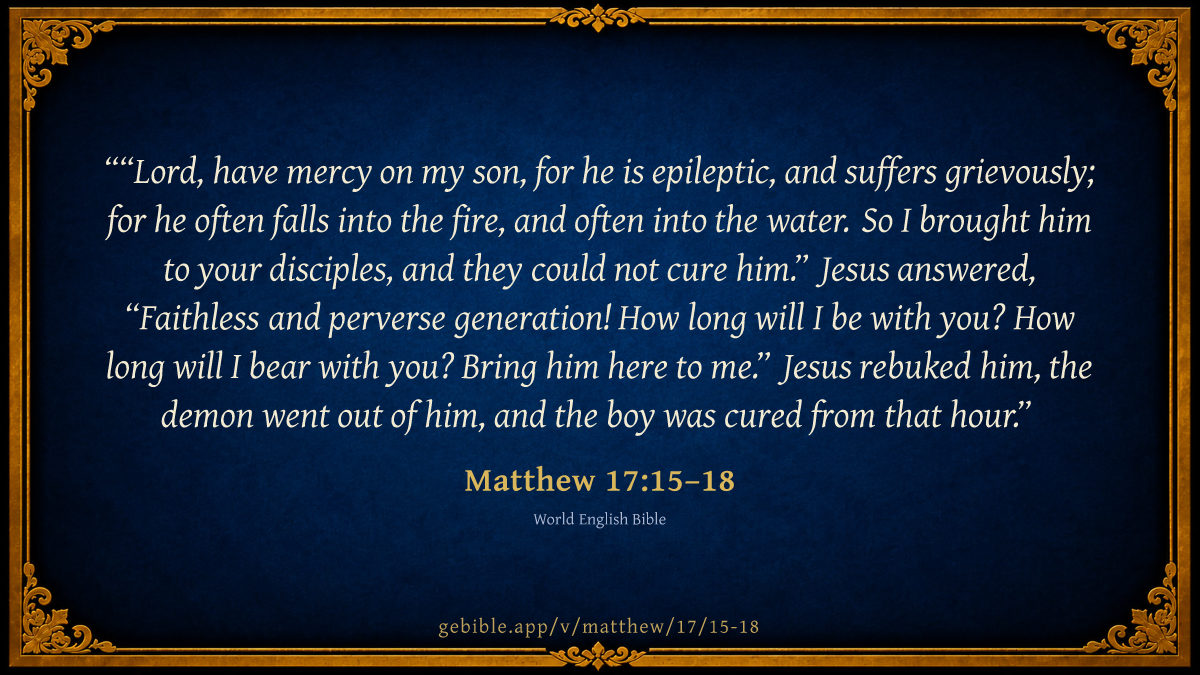
“Lord, have mercy on my son, for he is epileptic, and suffers grievously; for he often falls into the fire, and often into the water. So I brought him to your disciples, and they could not cure him.”
Jesus answered, “Faithless and perverse generation! How long will I be with you? How long will I bear with you? Bring him here to me.” Jesus rebuked him, the demon went out of him, and the boy was cured from that hour.
Geneva Bible translators 1599 · Public Domain On v15 They that at certain times of the moon are…
They that at certain times of the moon are troubled with the falling sickness, or any other kind of disease: but in this place, we must so take it, that besides the natural disease, he had a devilish frenzy.
Geneva Bible (1599) marginal notes — public domain.
John Trapp 1656 · Public Domain On vv15–18 15 Lord, have mercy on my son: for he…
15 Lord, have mercy on my son: for he is lunatick, and sore vexed: for ofttimes he falleth into the fire, and oft into the water.
Ver. 15. For he is lunatic] Or, he hath the falling sickness, as the symptoms show. A common disease, but (besides that) the devil was in it. {a} The old manslayer makes advantage of our natural diseases (which are therefore the bath of the devil, and the bed of diseases) to exercise his cruelty upon the poor creature by Divine permission; seeking by the infirmities of the body to bring sin upon the soul.
Read full note →
For ofttimes he falls into the fire, &c.] The devil pushing him in, as it were, to destroy him, but could not. He is limited, and cannot do as he would, else he would soon end us. If God chastise us with his own bare hand, or by men like ourselves, whip us, as it were, privately and at home, let us thank him, and think ourselves far better dealt with than if he should deliver us up to the public officer, to his tormentor, to be scourged with scorpions at his pleasure. The wicked he often casts into the fire of lust and water of drunkenness, and they complain not: like a sleepy man (fire burning in his bed straw), he cries not out, when others haply lament his case that see afar off, but cannot help him. It hath "set him on fire round about, yet he knew it not: and it burned him, yet he laid it not to heart," Isa 42:25. See Pro 23:34-35.
And oft into the water] Urbanus Regius, in a sermon of his at Wittenberg, made mention of a certain maid possessed by the devil; and when she should have been prayed for in the congregation, the devil made as if he had been departed out of her. But before the next public meeting, Satan returned, and drove the maid into a deep water, where she presently perished.
{a} Lunaticus speculum miseriae humanae, et malitiae Satanae. Pareus.
John Trapp, A Commentary or Exposition upon All the Books of the Old and New Testament (1647–1656) — public domain. Text from a community e-Sword module.
Matthew Poole 1685 · Public Domain On v17 Mark relates this part of the history much more…
Mark relates this part of the history much more largely, Mar 9:19-27, he answereth him, and saith, O faithless generation, how long shall I be with you? how long shall I suffer you? Bring him unto me. And they brought him unto him: and when he saw him, straightway the spirit tare him; and he fell on the ground, and wallowed foaming. And he asked his father, How long is it ago since this came unto him? And he said, Of a child. And oft times it hath cast him into the fire, and into the waters, to destroy him: but if thou canst do any thing, have compassion on us, and help us. Jesus said unto him, if thou canst believe, all things are possible to him that believeth. And straightway the father of the child cried out, and said with tears, Lord, I believe; help thou mine unbelief. When Jesus saw that the people came running together, he rebuked the foul spirit, saying unto him, Thou dumb and deaf spirit, I charge thee, come out of him, and enter no more into him. And the spirit cried, and rent him sore, and came out of him: and he was as one dead; insomuch that many said, He is dead. But Jesus took him by the hand, and lifted him up; and he arose. Luke relates this shorter, but addeth nothing to what is in the other evangelists, Luk 9:41,42. Then Jesus answered and said, O faithless and perverse generation. Christ here calls them so not with respect to justifying faith, but that faith which respected the Divine power as to working miracles. Every revelation of the Divine will is the object of faith; Christ had revealed to the Jews that he was sent of God, and furnished with such a power; this the Jews, and particularly the scribes, did not believe. The faith of the father of this child was but very weak in the case; no more, as we shall see afterwards, was the faith of the disciples; so as he may be understood to respect them all, though in different degrees. He calls them perverse, because they had so often seen and experienced his power of this nature, yet their faith was not clear and strong. He biddeth that the young man should be brought to him, and it was done. And when he saw him, ( saith Mark), straightway the spirit tare him, & c. Our Saviour could easily have prevented this, but probably he suffered it that the miracle might be more evident. However, it letteth us see how hardly the devil parteth with his possession in us in any degree, and how ready he is to run to the length of his line in doing us mischief. Christ asked his father how long he had been so vexed; his father tells him, from a child. By this also the miracle was more illustrious, which probably was the reason why Christ propounded the question. No evils are too inveterate for Christ to remove. The father renewth his request, and in it showeth the weakness of his faith: If (saith he) thou canst do any thing. His coming to Christ, and crying to him, argued that he believed he could do something; his saying if thou canst do any thing speaks the weakness of his faith. Christ tells him, if he could believe, all things are possible. Nothing ties God’s hands but his creatures’ unbelief. It is said, that Christ could not in Capernaum do many mighty works because of their unbelief. Upon this the father cries out,
Lord, I believe; help thou mine unbelief. Men may truly believe, and yet have a mixture of unbelief. God rewards a weak faith, to souls labouring under the sense of their weakness, and desiring an increase of strength. Christ rebukes the spirit (called a dumb and deaf spirit, because it made the person such that was thus affected with it). Christ commands the spirit out, and so to come out as never more to enter into him. The evil spirit roars, rends him, comes out, and leaveth him as one dead: which still confirmeth us in his malice to mankind; he will do what harm he can when he cannot do us the harm he would.
Matthew Poole's English Annotations on the Holy Bible (1683–1685) — public domain. Text from a community e-Sword/MySword module.
William Burkitt 1703 · Public Domain On vv17–18 These words are a severe rebuke given by Chrsit…
These words are a severe rebuke given by Chrsit to his own disciples.
Where, observe, The person upbraided, his discples: and the sin upbraided with, unbelief. O faithless generation! Yet was it not the total want of faith, but the weakness and imperfection of faith, that they were upbraided with and reproved for.
Read full note →
Hence learn, 1. That secret unbelief may lie hid and undiscerned in a person’s heart, which neither others nor himself may take notice of, until some trial doth discover it. The disciples were not sensible of that unbelief which lay hid in them, till this occasion did discover it.
Learn, 2. That the great obstacle and obstruction of all blessings, both spiritual and temporal, coming to us, is our unbelief: O faithless generation! Others conceive that these words were not spoken to the disciples but to the Scribes, which Mark 9. says, at this time were disputing with Christ’s disciples, and perhaps insulting over them, as having found out a distemper which could not be cured by Christ’s name and power; and these he called now, as he had done heretofore, a generation of vipers.
William Burkitt's Expository Notes on the New Testament (1700–1703) — public domain. Text from a community e-Sword module.
John Gill 1763 · Public Domain On vv15–18 Lord, have mercy on my son,.... He addressed him…
Lord, have mercy on my son,.... He addressed him with great marks of honour and respect, not only by gesture, but by words; he craves mercy, pity, and compassion; for the case he had to present, was a miserable one; and his earnestness and importunity he hoped might be excused, since it was for a child of his own. Luke adds "for he is mine only child"; and therefore his affection for him must be thought to be very strong, and he greatly concerned for its grievous affliction, and earnestly desirous of its health and life.
For he is lunatic: not a mad man, but troubled with the epileptic disease; upon which, as on madness or lunacy, the changes and full of the moon have an influence: hence the next clause,
Read full note →
and sore vexed, is rendered in the Arabic version, "and sore vexed at the beginning of full moons"; at which times, he had very grievous and frequent fits of his disorder:
for ofttimes he falleth into the fire, and oft into the water: which shows it to be the "epilepsy", or "falling sickness", he was afflicted with; which, whenever it seized him, whether by the fireside, or by the side of a river or brook, or any place of water, or in any other dangerous situation, he fell into it, not being able to help himself, or avoid any danger to which he was exposed. A larger account of this child's disorder, and of the circumstances of his cure, are related by Mar 9:17 where this case will be more fully considered. See Gill on Mar 9:17. See Gill on Mar 9:18.
John Gill's Exposition of the Whole Bible (1746–1763) — public domain (CC PDM 1.0). Text via the HelloAO Bible API.
John Wesley 1765 · Public Domain On vv15, 17 He is lunatic - This word might with great…
He is lunatic - This word might with great propriety he used, though the case was mostly preternatural; as the evil spirit would undoubtedly take advantage of the influence which the changes of the moon have on the brain and nerves.
John Wesley, Explanatory Notes Upon the Whole Bible (1754–1765) — public domain. Text via the GEBible commentary corpus.
Adam Clarke 1810 · Public Domain On vv15–18 Verse 15. My son - is lunatic] σεληνιαζεται. One…
Verse 15. My son - is lunatic] σεληνιαζεται. One who was most affected with this disorder at the change and full of the moon. See Clarke on Mt 4:24. But this lunacy was occasioned by a demon, see Mt 17:18, and Mr 9:17; Lu 9:38. In this case, the devil intended to hide himself under the appearance of a natural disorder, that no supernatural means might be resorted to for his expulsion. See a remarkable account on Lu 9:39.
Falleth ofttimes into the fire, and oft into the water.] The paroxysms of his disorder frequently recurred; and among his numerous falls, some were into the fire and some into the water: so that, on this account, his life was in continual danger. Those who are under the influence of the devil are often driven to extremes in every thing. Such are often driven into the fire of presumption, or the waters of despair. Satan takes advantage of our natural temper, state of health, and outward circumstances, to plague and ruin our souls.
Adam Clarke's Commentary on the Bible (1810–1826) — public domain. Text from a community e-Sword/MySword module.
Albert Barnes 1834 · Public Domain On vv15–18 Lord, have mercy - The word “Lord” here means…
Lord, have mercy - The word “Lord” here means “Sir,” a title of civility, not implying divinity.
My son - This was an only son (Luke). He was possessed with a devil. This calamity was attended with the following symptoms: he was lunatic (see the notes at Mat 4:24); he was sore vexed; that is, he suffered greatly, or was greatly afflicted; he fell often suddenly, in the manner of persons having epileptic fits; he was dumb - that is, he was mute except when the seizure was coming upon him, for Luke says that when the spirit took him he cried suddenly out; he foamed and gnashed with his teeth, and wasted away, or became poor and emaciated. Luke Luk 9:39 adds of the evil spirit, “it teareth him that he foameth again, and, bruising him, hardly departeth from him;” that is, scarcely departed from him, or he had only short intervals of reason, for so the passage in Luke, “bruising him, hardly departeth from him,” should be translated.
Albert Barnes' Notes on the Bible (1834–1885) — public domain. Text from a community e-Sword/MySword module.
Haydock's Catholic Bible Commentary 1859 · Public Domain On vv15, 18 I brought him to thy disciples. By these words…
I brought him to thy disciples. By these words the man here mentioned privately accuses the apostles, though the impossibility of the cure is not always to be attributed to the weakness of God’s servants, but sometimes to the want of faith in the afflicted. (St. Jerome) --- Stand astonished at the folly of this man! how he accuses the apostles before Jesus! But Christ frees them from this inculpation, imputing the fault entirely to the man himself. For it is evident, from many circumstances, that he was weak in faith. Our Saviour does not inveigh against this man alone, not to wound his feelings too sensibly, but against the whole people of the Jews. We may infer, that many of the bystanders entertained false notions of his disciples, from these words of deserved reproach: O! unbelieving and incredulous generation, how long shall I be with you? In which words, he shews us how much he wished for his passion, and his departure hence. (St. John Chrysostom) --- We must not imagine that our Saviour, who was meekness and mildness itself, uttered on this occasion words of anger and intemperance. Not unlike a feeling and tender physician, observing his patient totally disregarding his prescriptions, he says, How long shall I visit you; how long shall I order one thing, and you do the contrary? Thus Jesus is not angry with the man, but with the vices of the man; and in him he upbraids the Jews, in general, for their incredulity and perversity. (St. Jerome) --- The general sentiment is, that these reproaches are limited to the people; some extend them to the apostles. See below, ver. 19. (Bible de Vence)
George Leo Haydock (1774–1849), Haydock's Catholic Family Bible and Commentary, 1859 edition — public domain. Excludes Psalms (Douay-Rheims chapter numbering differs from Protestant) and Deuterocanonical books (Catholic canon only).
Daniel D. Whedon 1874 · Public Domain On vv15–17 15. Lunatic — Insane, and deprived by the evil…
15. Lunatic — Insane, and deprived by the evil spirit of his reasoning faculties. Mark gives a vivid description of the power of the demon and the sufferings of the victim. The terrible convulsions to which he had been subjected had rent and torn him “from a child.”
Daniel D. Whedon (gen. ed.), Commentary on the Old and New Testaments (1874–1909) — public domain. Text from a community e-Sword module.
The Cambridge Bible for Schools and Colleges 1878 · Public Domain On vv15, 17 15. for he is lunatick] This is the only…
15. for he is lunatick] This is the only special instance of cure in the case of a lunatic. They are mentioned as a class, ch. Mat_4:24. The word literally means “affected by changes of the moon.” There appears to be some truth in the notion that there is an access of mania at the time of lunar changes. See Belcher, Our Lord’s Miracles of Healing, p. 131.
St Mark describes the child as foaming, gnashing with his teeth, and pining away. St Luke mentions that he “crieth out.” All these were epileptic symptoms; “the child was a possessed epileptic lunatic.”
The Cambridge Bible for Schools and Colleges (gen. ed. J. J. S. Perowne; Cambridge University Press, 1878–1918) — public domain. Text from a community e-Sword module.
Ellicott's Commentary for English Readers 1878 · Public Domain On vv15–18 (15) Lunatick.—See Note on Mat_4:24. The other Gospels add…
(15) Lunatick.—See Note on Mat_4:24. The other Gospels add some further touches. The boy had a “dumb spirit.” When the spirit seized him it “tore him,” and he foamed at the mouth, and gnashed with his teeth. Slowly, and as with difficulty, the paroxysm passed off, and the sufferer was wasting away under the violence of the attacks. The phenomena described are, it need hardly be said, those of epilepsy complicated with insanity, a combination common in all countries, and likely to be aggravated where the “seizure,” which the very word epilepsy implies, was the work of a supernatural power. A prolonged melancholy, an indescribable look of sadness, a sudden falling, and loss of consciousness, with or without convulsions, or passing into a tetanic stiffness, a periodical recurrence coinciding often with the new or full moon (hence probably the description of the boy as “lunatick”), grinding the teeth, foaming at the mouth, are all noted by medical writers as symptoms of the disease. The names by which it was known in the earlier stages of medical science were all indicative of the awe with which men looked on it. It was the “divine,” the “sacred” disease, as being a direct supernatural infliction. The Latin synonym, morbus comitialis, came from the fact that if a seizure of this kind occurred during the comitia, or assemblies of the Roman Republic, it was looked upon as of such evil omen that the meeting was at once broken up, and all business adjourned. Whether there was in this case something more than disease, viz., a distinct possession by a supernatural force, is a question which belongs to the general subject of the “demoniacs” of the Gospel records. (See Note on 8:28.) Here, at any rate, our Lord’s words (Mat_17:21) assume, even more emphatically than elsewhere, the reality of the possession. (See Mar_9:25.)
A Bible Commentary for English Readers, edited by Charles John Ellicott (1878–1897) — public domain. Text from a community e-Sword module.
The Pulpit Commentary 1880 · Public Domain On vv15–18 This verse in the Vulgate is contained in ver.…
This verse in the Vulgate is contained in ver. 14. Have mercy on my son. According to St. Luke, the father makes his plea more touching by adding that he was his only son an appeal to which the Saviour"s tender heart was always open, as when he stopped the bier at Nain, and said to the childless widow, "Weep not." He is lunatic (selhniaxetai). The Revised Version most unnecessarily renders the verb, he is epileptic. Doubtless the case in many respects simulated epilepsy, and might have been so described; but it seems inexpedient to conceal the actual word used, which gave the popular and probably correct view of one phase of the complaint. Surely a real fact well known to medical science underlies the term lunacy, in the catalogue of the diseased persons who were brought to Christ to be healed, (Mat_4:24) we find a class called lunatics, distinct from the paralytic and possessed. It is by no means an exploded fallacy that the moon has some mysterious influence on certain constitutions, and produces an aggravation of symptoms in accordance with some of its changes. It was from observation of this phenomenon that this form of insanity was termed seleniasmus or lunacy. In the present instance the disease was complicated and of no ordinary nature. The other synoptists state that the child was possessed by a demon. This was the fact which differentiated the malady from any merely organic sickness. It was in truth epilepsy accompanied by or occasioned by demoniacal possession. St. Matthew does not mention the possession in his introductory account, but he afterwards (ver. 18) speaks of the demon departing. Sore vexed (kakwv pascei); is in evil case; suffers grievously.
He was affected with terrible paroxysms, which are detailed more at length by Mark and Luke. Matthew narrates some of the effects of the mania upon the victim. Ofttimes he falleth into the fire. The fits, coming on suddenly and without warning, brought the sufferer into imminent dangers, perhaps produced suicidal tendencies, which urged him to destroy himself.
The Pulpit Commentary (1880–1919), ed. H.D.M. Spence-Jones & Joseph S. Exell — public domain. Text from a community e-Sword module.
B. W. Johnson 1891 · Public Domain On vv15–18 15. My son; for he is a lunatic. Epileptic,…
15. My son; for he is a lunatic. Epileptic, in the Revision. The symptoms are those of epilepsy, in this case caused by demoniac possession. The son was a child (Luke 9:38). He was dumb as well as epileptic (Mark).
B. W. Johnson's The People's New Testament with Notes (1889–1891) — public domain. Electronic text from the Christian Classics Ethereal Library (CCEL) ThML edition.
C. I. Scofield 1917 · Public Domain On v18 demon. (See Scofield "Mat 7:22")
devil
demon. (See Scofield "Mat 7:22")
The Scofield Reference Bible (1917 edition), notes by C. I. Scofield — public domain. Text from a community e-Sword module.
Paul E. Kretzmann 1924 · Public Domain On v17 The rebuke and the cure:
The rebuke and the cure:
v. 17. Then Jesus answered and said, 0 faithless and perverse generation, how long shall I be with you? How long shall I suffer you? Bring him hither to Me.
Read full note →
v. 18. And Jesus rebuked the devil, and he departed out of him; and the child was cured from that very hour.
A cry of the utmost weariness, almost of impatience. It includes all those present: the disciples, because of their lack of understanding and the smallness of their faith; all the people, because they were slow of heart to believe Him to be the Messiah. Faithless they are, having either too small a faith or no faith at all; and perverted, corrupt, turned the wrong way, unwilling to heed and to follow the way He was pointing out to them, the way of salvation and sanctification. They were permitting themselves to be led astray. He was weary of it all. He longed to be delivered of the dullness, the stupidity, the perverseness of this generation. But He was not unkind or ungracious. His words were a rebuke, not the peevish exclamation of a disappointed man. He had the boy brought to Him, He saw the evidence of the demon’s power, He made use of His divine power in earnestly rebuking the demon, and the result was a complete cure from that very hour. The devil may sometimes, by God’s permission, torture the body by some sickness, incurable before men, but the souls of them that put their trust in Jesus are in His hands, safe against all the Evil One’s attempts to possess them.
Paul E. Kretzmann, Popular Commentary of the Bible (1921–1924) — public domain. Text from a community e-Sword module.
unfoldingWord translationNotes 2017 · CC BY-SA 4.0 On v17 Unbelieving and corrupt generation, how
Unbelieving and corrupt generation, how
"This generation does not believe in God and does not know what is right or wrong. How"
Read full note →
how long will I have to stay with you? How long must I bear with you?
These questions show Jesus is unhappy with the people. AT: "I am tired of being with you! I am tired of your unbelief and corruption!" (See: Rhetorical Question)
the boy was healed
This can be stated in active form. AT: "the boy became well" (See: Active or Passive)
from that hour
This is an idiom. AT: "immediately" or "at that moment" (See: Idiom)
translationWords
Jesus
generation
rebuke
demon
hour, hours
unfoldingWord translationNotes — © Distant Shores Media and the Door43 World Missions Community, licensed CC BY-SA 4.0. Source: git.door43.org/Door43/en_tn.
Tyndale Open Study Notes 2022 · CC BY-SA 4.0 On v17 17:17 faithless and corrupt people: The expression is often…
17:17 faithless and corrupt people: The expression is often used for moral depravity (see Deut 32:5, 19-22). Normally, this exclamation of Jesus was directed at the unbelieving Jewish crowds or leaders who refuse to acknowledge God’s presence in him (see Matt 12:39). Here, however, it was a sharp criticism of his disciples’ failure to trust Jesus and his saving, healing power.
Tyndale Open Study Notes — © Tyndale Open Resources, licensed CC BY-SA 4.0. Text via the HelloAO Bible API.