
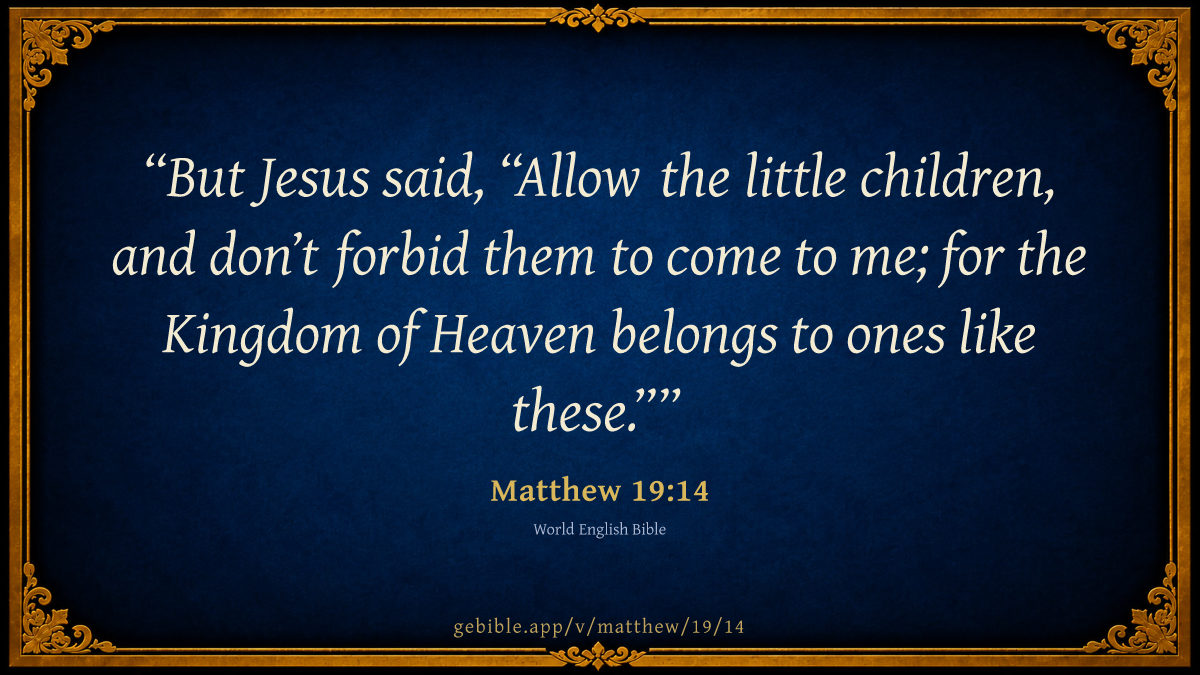
But Jesus said, “Allow the little children, and don’t forbid them to come to me; for the Kingdom of Heaven belongs to ones like these.”
Parallel Translations
-
But Jesus said, “Allow the little children, and don’t forbid them to come to me; for the Kingdom of Heaven belongs to ones like these.”
-
But Iesus sayde: suffre the chyldren and forbid them not to come to me: for of suche is the kyngdome of heven.
-
But Iesus sayd, Suffer the litle children, and forbid them not to come to me: for of such is the kingdome of heauen.
Examined in Scripture Analysis
Contradictions (1)
Questions where the Bible appears to say two different things, with the passages on each side set together.
Cross-references (14)
Passages linked to Matthew 19:14 in the Treasury of Scripture Knowledge, ordered by reader-vote popularity; verse text shown in World English Bible.
- Matthew 18:3 and said, “Most certainly I tell you, unless you turn, and become as little children, you will in no way enter into the Kingdom of Heaven.
- Luke 18:16-17 Jesus summoned them, saying, “Allow the little children to come to me, and don’t hinder them, for God’s Kingdom belongs to such as these. Most certainly, I tell you, whoever doesn’t receive God’s Kingdom like a little child, he will in no way enter into it.”
- 1 Corinthians 14:20 Brothers, don’t be children in thoughts, yet in malice be babies, but in thoughts be mature.
- Matthew 11:25 At that time, Jesus answered, “I thank you, Father, Lord of heaven and earth, that you hid these things from the wise and understanding, and revealed them to infants.
- Mark 10:14 But when Jesus saw it, he was moved with indignation, and said to them, “Allow the little children to come to me! Don’t forbid them, for God’s Kingdom belongs to such as these.
- 1 Peter 2:1-2 Putting away therefore all wickedness, all deceit, hypocrisies, envies, and all evil speaking, as newborn babies, long for the pure milk of the Word, that with it you may grow,
- Genesis 17:24-26 Abraham was ninety-nine years old when he was circumcised in the flesh of his foreskin. Ishmael, his son, was thirteen years old when he was circumcised in the flesh of his foreskin. In the same day both Abraham and Ishmael, his son, were circumcised.
- Judges 13:7 but he said to me, ‘Behold, you shall conceive and bear a son; and now drink no wine nor strong drink. Don’t eat any unclean thing, for the child shall be a Nazirite to God from the womb to the day of his death.’ ”
- 1 Samuel 1:11 She vowed a vow, and said, “Yahweh of Armies, if you will indeed look at the affliction of your servant and remember me, and not forget your servant, but will give to your servant a boy, then I will give him to Yahweh all the days of his life, and no razor shall come on his head.”
- Genesis 21:4 Abraham circumcised his son, Isaac, when he was eight days old, as God had commanded him.
- 1 Samuel 1:24 When she had weaned him, she took him up with her, with three bulls, and one ephah of meal, and a container of wine, and brought him to Yahweh’s house in Shiloh. The child was young.
- 1 Samuel 2:18 But Samuel ministered before Yahweh, being a child, clothed with a linen ephod.
- Genesis 17:7-8 I will establish my covenant between me and you and your offspring after you throughout their generations for an everlasting covenant, to be a God to you and to your offspring after you. I will give to you, and to your offspring after you, the land where you are traveling, all the land of Canaan, for an everlasting possession. I will be their God.”
- 1 Samuel 1:22 But Hannah didn’t go up, for she said to her husband, “Not until the child is weaned; then I will bring him, that he may appear before Yahweh, and stay there forever.”
Cross-references from openbible.info (CC BY 4.0)
Explain this verse (14 sources)
Historical commentary, presented as a primary source — not an endorsement.
Private notes
Saved on this device only — never synced or sent anywhere.
John Trapp 1656 · Public Domain 14 But Jesus said, Suffer little children, and forbid…
14 But Jesus said, Suffer little children, and forbid them not, to come unto me: for of such is the kingdom of heaven.
Ver. 14. For of such is the kingdom] That is, all the blessings of heaven and earth comprised in the covenant belong both to these and such as these, Mat 18:3. Let them, therefore, have free recourse to me, who will both own them and crown them with life eternal.
John Trapp, A Commentary or Exposition upon All the Books of the Old and New Testament (1647–1656) — public domain. Text from a community e-Sword module.
Matthew Poole 1685 · Public Domain Both Mark and Luke add something to this story.…
Both Mark and Luke add something to this story. Mark saith, Mar 10:14-16, When Jesus saw it, he was much displeased, and said unto them, Suffer the little children to come unto me, and forbid them not: for of such is the kingdom of God. Verily I say unto you, Whosoever shall not receive the kingdom of God as a little child, he shall not enter therein. And he took them up in his arms, put his hands upon them, and blessed them. Luke saith the same, Luk 18:16, only he saith, he called them unto him, and leaves out what Mark hath, Mar 10:16 of Christ taking them up in his arms, putting his hands upon them, and blessing them. From this text divines will prove the baptism of children, because theirs is the kingdom of heaven; which whether we understand of the church, and the dispensation of the grace of Christ under the gospel, viz. that the gospel church is made up of infants as well as more adult persons, or that the grace of Christ under the gospel, viz. remission of sins through the blood of Christ, doth belong to some children, as well as to grown persons; or of the kingdom of glory, viz. children shall go to heaven as well as grown persons; the argument is well drawn from this text, Those who have a right to a membership in the church are to be baptized; or, Those who have a right to the kingdom of glory may be baptized. But one or both of these are affirmed in this text. We must take heed we do not found infant baptism upon the example of Christ in this text, for it is certain that he did not baptize these children; Mark only saith, he took them up in his arms, put his hands upon them, and blessed them. The argument for infant baptism from this text is founded upon his words, uttered on this occasion, not upon his practice. Mark addeth, that our Saviour told them, that unless a man received the kingdom of God as a little child, he could not enter into it. But we opened those words before, Mat 18:3, where we met with the same in effect.
See Poole on "Mat 18:3".
Matthew Poole's English Annotations on the Holy Bible (1683–1685) — public domain. Text from a community e-Sword/MySword module.
John Gill 1763 · Public Domain But Jesus said, suffer little children.... This he said…
But Jesus said, suffer little children.... This he said to show his humility, that he was not above taking notice of any; and to teach his disciples to regard the weakest believers, and such as were but children in knowledge; and to inform them what all ought to be, who expect the kingdom of heaven; for it follows;
and forbid them not to come unto me, now, or at any other time;
Read full note →
for of such is the kingdom of heaven; that is, as the Syriac renders it, "who are as these" or as the Persic version, rather paraphrasing than translating, renders it, "who have been humble as these little children": and it is as if our Lord should say, do not drive away these children from my person and presence; they are lively emblems of the proper subjects of a Gospel church state, and of such that shall enter into the kingdom of heaven: by these I may instruct and point out to you, what converted persons should be, who have a place in my church below, and expect to enter into my kingdom and glory above; that they are, or ought to be, like such children, harmless and inoffensive; free from rancour and malice, meek, modest, and humble; without pride, self-conceit, and ambitious views, and desires of grandeur and superiority. Christ's entire silence about the baptism of infants at this time, when he had such an opportunity of speaking of it to his disciples, had it been his will, has no favourable aspect on such a practice. It is not denied that little children, whether born of believers or unbelievers, which matters not, may be chosen of God, redeemed by the blood of Christ, and have the passive work of the Spirit on their souls, and so enter into heaven; but this is not the sense of this text. It was indeed a controversy among the Jews, whether the little children of the wicked of Israel, , "go into the world to come": some affirmed, and others denied; but all agreed, that the little children of the wicked of the nations of the world, do not. They dispute about the time of entrance of a child into the world to come; some say, as soon as it is born, according to Psa 22:31 others, as soon as it can speak, or count, according to Psa 22:30 others as soon as it is sown, as the gloss says, as soon as the seed is received in its mother's womb, though it becomes an abortion; according to the same words, "a seed shall serve thee": others, as soon as he is circumcised, according to Psa 88:15 others, as soon as he can say "Amen", according (z) to Isa 26:2 All weak, frivolous, and impertinent.
(z) T. Bab. Sanhedrim, fol. 110. 2.
John Gill's Exposition of the Whole Bible (1746–1763) — public domain (CC PDM 1.0). Text via the HelloAO Bible API.
John Wesley 1765 · Public Domain Of such is the kingdom of heaven - Little…
Of such is the kingdom of heaven - Little children, either in a natural or spiritual sense, have a right to enter into my kingdom. Matt. xviii, 3.
John Wesley, Explanatory Notes Upon the Whole Bible (1754–1765) — public domain. Text via the GEBible commentary corpus.
Adam Clarke 1810 · Public Domain Verse 14. Of such is the kingdom of heaven.]…
Verse 14. Of such is the kingdom of heaven.] Or, the kingdom of heaven is composed of such. This appears to be the best sense of the passage, and utterly ruins the whole inhuman diabolic system of what is called non-elect infants' damnation; a doctrine which must have sprung from Moloch, and can only be defended by a heart in which he dwells. A great part of God's kingdom is composed of such literally; and those only who resemble little children shall be received into it: see on Mt 18:3. Christ loves little children because he loves simplicity and innocence; he has sanctified their very age by passing through it himself - the holy Jesus was once a little child.
Adam Clarke's Commentary on the Bible (1810–1826) — public domain. Text from a community e-Sword/MySword module.
Albert Barnes 1834 · Public Domain Jesus said, Suffer little children, ... - Mark adds,…
Jesus said, Suffer little children, ... - Mark adds, he was much displeased at what the disciples said. It was a thing highly gratifying to him, and which he earnestly sought, that children should be brought to him, and a case where it was very improper that they should interfere.
Of such is the kingdom of heaven - The kingdom of heaven evidently means here the church. See the notes at Mat 3:2. In Mark and Luke it is said he immediately added, “Whosoever shall not receive the kingdom of God as a little child shall not enter therein.” Whosoever shall not be humble, unambitious, and docile, shall not be a true follower of Christ or a member of his kingdom. Of such as these - that is, of persons with such tempers as these - is the church to be composed. He does not say of those infants, but of such persons as resemble them, or are like them in temper, is the kingdom of heaven made up. As emblematic, therefore, of what his own followers were to be, and as having traits of character so strongly resembling what he required in his followers, it was proper that they should be brought to him. At the same time, it was proper on their own account that they should be brought to him, and that his blessing should be sought on them.
Read full note →
All are fallen; all have, a tendency to sin, and none but Jesus can save them. Little children, too, are in a world of sickness and death, and in the beginning of life it is proper to invoke on them the blessing of the Saviour. They are to live forever beyond the grave; and as they have just entered on a career of existence which can never terminate, it is an appropriate act to seek the blessing of that Saviour who only can make them happy forever, as they enter on their career of existence. No act, therefore, can be more proper than that by which parents, in a solemn ordinance of religion, give them up to God in baptism, consecrating them to his service, and seeking for them the blessing of the Saviour. It is probable - it is greatly to be hoped - that all infants will be saved. No contrary doctrine is taught in the sacred Scriptures. But it does not appear to be the design of this passage to teach that all infants will be saved. It means simply that they should be suffered to be brought to Christ as amiable, lovely, and uncorrupted by the world; as having traits of mind resembling those among real Christians; and as themselves needing his blessing.
Albert Barnes' Notes on the Bible (1834–1885) — public domain. Text from a community e-Sword/MySword module.
Haydock's Catholic Bible Commentary 1859 · Public Domain Jesus said ... Suffer the little children, &c. He…
Jesus said ... Suffer the little children, &c. He here blames the conduct of the apostles, and shews that his assertions in praise of virginity, were not meant as derogatory from the holiness of the marriage state, by giving his blessing to these little ones, the fruits of lawful wedlock; and declares that the kingdom of heaven is the portion of such as resemble these little ones, by the innocence of their lives and simplicity of their hearts. He, moreover, shews that confidence in our own strength, in our own free-will, and in our merits, is an invincible obstacle to salvation. St. Mark (x. 16) says, that embracing them, and laying hands upon them, he blessed them. Hence probably arose the ancient custom of presenting children to bishops and priests, to receive their blessing, beside that of confirmation immediately after baptism. --- Nicephorus tells us that the celebrated St. Ignatius, afterwards bishop of Antioch, was one of these children who, on this occasion, received Christ’s blessing. --- If we would enter into the kingdom of heaven, we must imitate the virtues of little children. Their souls are free from every passion; void of every thought of revenge, they approach those who have grieved them as to their best friends. Though the parent repeatedly chastise his child, it still will adhere to him, still it love him, and prefer him in all his poverty to all the fascinating charms of dazzling gold and purple. They seek not beyond what is necessary, they admire not the beauty of the body, they are not grieved at the loss of worldly wealth, therefore does the Saviour of the world say, that theirs is the kingdom of heaven. (St. John Chrysostom, hom. lxiii.)
George Leo Haydock (1774–1849), Haydock's Catholic Family Bible and Commentary, 1859 edition — public domain. Excludes Psalms (Douay-Rheims chapter numbering differs from Protestant) and Deuterocanonical books (Catholic canon only).
Daniel D. Whedon 1874 · Public Domain 14. Suffer little children — Our Lord does not…
14. Suffer little children — Our Lord does not merely say, suffer these children, but suffer all little children to come unto me. Of such — Of children and of childlike souls. For the adult man must become childlike to be fit for the kingdom of heaven.
Our Lord did not here baptize these children; for Christian baptism was not freely used until after his resurrection. But he does declare why they are proper subjects of baptism, namely, because they are subjects of the kingdom of heaven. And we are expressly told that “except a man be born of water” as well as “of spirit” he is not fully and formally recognized as in that kingdom. In other words, he who is an internal subject of that kingdom needs baptism to constitute him an external member. If he be an internal member of that kingdom he is a proper subject of baptism. Our Lord here declares that infants are internal members of this kingdom; therefore, we infer, they are proper subjects of baptism.
Read full note →
In relation to the moral condition of infants, Mr. Watson says:
“We are bound to conclude that, in some sense, ‘the kingdom of heaven’ is composed of them; they are its subjects, and partakers of its blessings. That this kingdom signifies the spiritual kingdom of Christ upon earth, and also that glorious reign of God over redeemed and glorified men in a future world, are points not to be disputed; and the words of our Lord, if they relate to one, must relate to both. If little children are the subjects of his spiritual kingdom on earth, then, until the moment that by actual sin they bring personal condemnation upon themselves, they remain heirs of the kingdom of eternal glory; and if they become the subjects of the latter by dying, then a previous vital relation must have existed on earth between them and Christ as their Redeemer and Sanctifier; or else we must assign the sanctification of the nature of man, which even in infants is fallen and corrupt, to a future state, which is contrary to the Scriptures.”
Daniel D. Whedon (gen. ed.), Commentary on the Old and New Testaments (1874–1909) — public domain. Text from a community e-Sword module.
The Cambridge Bible for Schools and Colleges 1878 · Public Domain 14. of such is the kingdom of heaven] Love,…
14. of such is the kingdom of heaven] Love, simplicity of faith, innocence, and above all, humility, are the ideal characteristics of little children, and of the subjects of the kingdom.
The Cambridge Bible for Schools and Colleges (gen. ed. J. J. S. Perowne; Cambridge University Press, 1878–1918) — public domain. Text from a community e-Sword module.
Ellicott's Commentary for English Readers 1878 · Public Domain (14) Suffer little children, and forbid them not .…
(14) Suffer little children, and forbid them not . . .—St. Mark adds that Jesus “was much displeased,” and represents Him as reproducing almost verbally the teaching of Mat_18:3. The tenderness of His sympathy was kindled into indignation at the rough indifference of the disciples. As in thousands of those whose lives have been modelled after His pattern, the love of children was not weaker, but stronger, precisely because it depended on no human relationship, but sprang from His seeing in them the children of His Father.
Of such is the kingdom of heaven.—That is, the kingdom of heaven belongs to such as these, is theirs as by inheritance.
A Bible Commentary for English Readers, edited by Charles John Ellicott (1878–1897) — public domain. Text from a community e-Sword module.
The Pulpit Commentary 1880 · Public Domain Suffer the little children, and forbid them not, to…
Suffer the little children, and forbid them not, to come unto me. He speaks as though the infants were ready and eager to come to him, if they were not prevented. He thus intimates the truth that, though incompetent to undo, stand God"s blessing, children were not incompetent to receive it. There was no natural impediment to bar the way. Unconscious intents, under the Mosaic dispensation, were admitted to the privileges of the Jewish Church by the rite of circumcision; in Christ"s kingdom analogous mercies were to be extended to them. From this passage has been derived a cogent argument for infant baptism, because Christ herein showed, not only that tender age and immaturity of reason put no obstacle in the way of his blessing, but that children were the standard by which fitness for his kingdom was to be tested. For of such is the kingdom of heaven. They who would enter Christ"s kingdom must be pure, simple, obedient, as little children. (comp. Mat_18:3) That is why he says, "of such," not "of these," intimating that it is not to the age, but to the disposition and character, that he refers. Some, not so suitably, confine the saying to such as are dedicated to God in baptism. It is well said that what children now are is God"s work; what they shall be hereafter is their own.
The Pulpit Commentary (1880–1919), ed. H.D.M. Spence-Jones & Joseph S. Exell — public domain. Text from a community e-Sword module.
B. W. Johnson 1891 · Public Domain 14. Suffer little children. Do not hinder them, either…
14. Suffer little children. Do not hinder them, either by word, or by a bad example. To come unto me. Whatever mortal, young or old, wishes to come to Christ should be encouraged. For of such is the kingdom of heaven. Those who have the loving simplicity, humility, and trust of children. See @Matt. 18:1–14. These words show, (1) that children are not, as some have taught, totally depraved; (2) that the earlier they come to Christ the better; (3) that they should not be hindered from coming by injudicious teaching; (4) that parents should bring them to the Savior.
B. W. Johnson's The People's New Testament with Notes (1889–1891) — public domain. Electronic text from the Christian Classics Ethereal Library (CCEL) ThML edition.
C. I. Scofield 1917 · Public Domain (See Scofield "Mat 3:2")
kingdom
(See Scofield "Mat 3:2")
The Scofield Reference Bible (1917 edition), notes by C. I. Scofield — public domain. Text from a community e-Sword module.
Paul E. Kretzmann 1924 · Public Domain Christ’s rebuke:
Christ’s rebuke:
v. 14. But Jesus said, Suffer little children, and forbid them not to come unto Me; for of such is the kingdom of heaven.
Read full note →
v. 15. And He laid His hands on them, and departed thence.
Jesus was openly displeased by the interference of the disciples. Let them alone, He says, do not bother them. To interfere with a child’s coming to Jesus is to put an obstruction in one’s own path to salvation. And hinder them not in their coming to Me. Every encouragement should be given the children that they may learn to know and love their Savior. For the kingdom of heaven is made up of such as they. The children themselves, with their simple trust and faith in Jesus, and all such as they, all that have the same confiding trust and spirit of faith, they make up the membership of the kingdom of God, they truly belong to His Church. All the blessings of His kingdom are theirs, even long before, yea, just because they have not come to the full use of their reason. A baptized child has just as full and complete a claim upon heaven as the most advanced Christian. This Jesus further stresses by giving outward evidence of His feeling toward the little children. He laid His hands upon them in blessing. He publicly acknowledged them as His own.
Paul E. Kretzmann, Popular Commentary of the Bible (1921–1924) — public domain. Text from a community e-Sword module.