Psalms 110:1(v44)Yahweh says to my Lord, “Sit at my right hand, until I make your enemies your footstool for your feet.”
Hebrews 1:13(v44)But which of the angels has he told at any time, “Sit at my right hand, until I make your enemies the footstool of your feet?”
Acts 2:34-35(v44)For David didn’t ascend into the heavens, but he says himself, ‘The Lord said to my Lord, “Sit by my right hand until I make your enemies a…
1 Corinthians 15:25(v44)For he must reign until he has put all his enemies under his feet.
Romans 1:3-4(v45)concerning his Son, who was born of the offspring of David according to the flesh, who was declared to be the Son of God with power,…
Show all 33 cross-references
Hebrews 1:3(v44)His Son is the radiance of his glory, the very image of his substance, and upholding all things by the word of his power, who, when he had…
Hebrews 10:12-13(v44)but he, when he had offered one sacrifice for sins forever, sat down on the right hand of God, from that time waiting until his enemies are…
Revelation 22:16(v45)I, Jesus, have sent my angel to testify these things to you for the assemblies. I am the root and the offspring of David, the Bright and…
Hebrews 12:2(v44)looking to Jesus, the author and perfecter of faith, who for the joy that was set before him endured the cross, despising its shame, and…
Genesis 3:15(v44)I will put hostility between you and the woman, and between your offspring and her offspring. He will bruise your head, and you will bruise…
Revelation 19:19–20:3(v44)I saw the beast, and the kings of the earth, and their armies, gathered together to make war against him who sat on the horse, and against…
2 Samuel 23:2(v43)“Yahweh’s Spirit spoke by me. His word was on my tongue.
Isaiah 63:1-6(v44)Who is this who comes from Edom, with dyed garments from Bozrah? Who is this who is glorious in his clothing, marching in the greatness of…
John 8:58(v45)Jesus said to them, “Most certainly, I tell you, before Abraham came into existence, I AM.”
Revelation 20:11-15(v44)I saw a great white throne, and him who sat on it, from whose face the earth and the heaven fled away. There was found no place for them. I…
Philippians 3:8(v44)Yes most certainly, and I count all things to be a loss for the excellency of the knowledge of Christ Jesus, my Lord, for whom I suffered…
1 Timothy 3:16(v45)Without controversy, the mystery of godliness is great: God was revealed in the flesh, justified in the spirit, seen by angels, preached…
Revelation 4:2(v43)Immediately I was in the Spirit. Behold, there was a throne set in heaven, and one sitting on the throne
Psalms 21:9(v44)You will make them as a fiery furnace in the time of your anger. Yahweh will swallow them up in his wrath. The fire shall devour them.
Mark 12:36(v43)For David himself said in the Holy Spirit, ‘The Lord said to my Lord, “Sit at my right hand, until I make your enemies the footstool of…
Luke 19:27(v44)But bring those enemies of mine who didn’t want me to reign over them here, and kill them before me.’ ”
John 20:28(v44)Thomas answered him, “My Lord and my God!”
1 Corinthians 1:2(v44)to the assembly of God which is at Corinth—those who are sanctified in Christ Jesus, called saints, with all who call on the name of our…
Philippians 2:6-8(v45)who, existing in the form of God, didn’t consider equality with God a thing to be grasped, but emptied himself, taking the form of a…
Hebrews 2:14(v45)Since then the children have shared in flesh and blood, he also himself in the same way partook of the same, that through death he might…
Hebrews 3:7(v43)Therefore, even as the Holy Spirit says, “Today if you will hear his voice,
Psalms 2:8-9(v44)Ask of me, and I will give the nations for your inheritance, the uttermost parts of the earth for your possession. You shall break them…
Luke 2:26-27(v43)It had been revealed to him by the Holy Spirit that he should not see death before he had seen the Lord’s Christ. He came in the Spirit…
Acts 1:16(v43)“Brothers, it was necessary that this Scripture should be fulfilled, which the Holy Spirit spoke before by the mouth of David concerning…
Acts 2:30-31(v43)Therefore, being a prophet, and knowing that God had sworn with an oath to him that of the fruit of his body, according to the flesh, he…
Romans 9:5(v45)of whom are the fathers, and from whom is Christ as concerning the flesh, who is over all, God, blessed forever. Amen.
2 Peter 1:21(v43)For no prophecy ever came by the will of man: but holy men of God spoke, being moved by the Holy Spirit.
Revelation 1:10(v43)I was in the Spirit on the Lord’s day, and I heard behind me a loud voice, like a trumpet
Cross-references from openbible.info (CC BY 4.0)
Explain this passage (13 sources)
Historical commentary, presented as a primary source — not an endorsement.
John Trapp1656 · Public DomainOn vv43–4543 He saith unto them, How then doth David…
43 He saith unto them, How then doth David in spirit call him Lord, saying,
Ver. 43. How then doth David in spirit] The Spirit possessed David after a sort, and by his mouth uttered what he would publish to the Church concerning the Godhead of Christ. "Holy men spake of old as they were acted by the Holy Ghost," as they were forcibly moved, or borne away, and, as it were, carried out of themselves by the Holy Ghost (φερομενοι), 2Pe 1:21.
John Trapp, A Commentary or Exposition upon All the Books of the Old and New Testament (1647–1656) — public domain. Text from a community e-Sword module.
John Gill1763 · Public DomainOn v43And no man was able to answer him a…
And no man was able to answer him a word,.... They saw the dilemma they were reduced to, either to acknowledge the deity of the Messiah, or confess their ignorance; and neither of them they cared to do, and therefore judged it to be the wisest part to be silent.
Neither durst any man from that day forth ask him any more questions: neither Pharisees nor Sadducees, for the same is observed by Luk 20:40 of the Sadducees particularly, and was true of all sorts, and every sect, of men among them: and thus our Lord was freed from a cavilling, captious, and troublesome generation of men, from this time forward, to the time of his sufferings, which was not very long after; for this was the third day before the passover, as appears from Mat 26:1.
Read full note →
Next: Matthew Chapter 23
John Gill's Exposition of the Whole Bible (1746–1763) — public domain (CC PDM 1.0). Text via the HelloAO Bible API.
John Wesley1765 · Public DomainOn vv43–44How doth David then by the Spirit - By…
How doth David then by the Spirit - By inspiration, call him Lord? If he be merely the son (or descendant) of David? If he be, as you suppose, a mere man, the son of a man?
John Wesley, Explanatory Notes Upon the Whole Bible (1754–1765) — public domain. Text via the GEBible commentary corpus.
Adam Clarke1810 · Public DomainOn vv43–45Verse 43. How then doth David in spirit (or…
Verse 43. How then doth David in spirit (or by the Spirit - by the inspiration of the Spirit of God) call him Lord? saying,
Adam Clarke's Commentary on the Bible (1810–1826) — public domain. Text from a community e-Sword/MySword module.
Haydock's Catholic Bible Commentary1859 · Public DomainOn v45If David then call him Lord, how is he…
If David then call him Lord, how is he his son? It was allowed of a certain truth, that the Messias was to be the son of David. Christ shews them by David’s own words, that he was the Lord as well as the son of David: and this is what they could not answer to. (Witham) --- Jesus Christ here inculcates to the Pharisees, that two natures must be admitted in the Messias; in one of which, viz. in his human nature, he is the son of David, and as such inferior to him; and in the other, viz. in his divine nature, he is the son of God, and consequently superior to David; whence this latter, by the inspiration of the Holy Ghost, justly calls him Lord. (Tirinus) --- Jesus Christ does not wish them to think that the Messias is not the son of David, but only wished to rectify their opinion concerning him. When therefore he asks how he is the son, he teaches them that he is not, after the manner they understand it, the mere Son, but what is much more, the Lord also, of David. (St. John Chrysostom, hom. lxxii.)
====================
George Leo Haydock (1774–1849), Haydock's Catholic Family Bible and Commentary, 1859 edition — public domain. Excludes Psalms (Douay-Rheims chapter numbering differs from Protestant) and Deuterocanonical books (Catholic canon only).
Daniel D. Whedon1874 · Public DomainOn vv43–4543. In spirit — That this signifies under divine…
43. In spirit — That this signifies under divine inspiration is clear from Mark, who expresses it, “For David himself by the Holy Ghost said.” Our Lord decides that David was the author of the Psalm, and that he wrote under divine inspiration.
Daniel D. Whedon (gen. ed.), Commentary on the Old and New Testaments (1874–1909) — public domain. Text from a community e-Sword module.
The Cambridge Bible for Schools and Colleges1878 · Public DomainOn v4441–46. The Son of David
41–46. The Son of David
Mar_12:35-37; Luk_20:41-44
Read full note →
44. The Lord said unto my Lord] Psa_110:1. According to the Hebrew, “Jehovah said to Adoni,” i. e. to my sovereign Lord, the Messiah, the Son of David.
said] The Hebrew word translated “said” implies divine inspiration, hence “in spirit” (Mat_22:43). Canon Perowne translates, “the oracle of Jehovah unto my lord.”
Sit thou on my right hand] As My co-regent, having power equal to Mine. This verse is quoted in 1Co_15:25; Heb_1:13; Heb_10:12-13. (Cp. for the expression ch. Mat_20:21.)
The Cambridge Bible for Schools and Colleges (gen. ed. J. J. S. Perowne; Cambridge University Press, 1878–1918) — public domain. Text from a community e-Sword module.
Ellicott's Commentary for English Readers1878 · Public DomainOn v43(43) Doth David in spirit call him Lord?—The words…
(43) Doth David in spirit call him Lord?—The words assume (1) that David was the writer of Psalms 110; (2) that in writing it, he was guided by a Spirit higher than his own; (3) that the subject of it was no earthly king of the house of David, but the far off Christ. On this point there was an undisturbed consensus among the schools of Judaism, as represented by the Targums and the Talmud. It was a received tradition that the Christ should sit on the right hand of Jehovah and Abraham on His left. Its application to the Christ is emphatically recognised by St. Peter (Act_2:34), and by St. Paul, though indirectly (Col_3:1). In the argument of the Epistle to the Hebrews, it occupies well-nigh the chief place of all (Heb_1:3; Heb_5:6). The only hypothesis on which any other meaning can be assigned to it is, that it was written, not by David, but of him. Here it will be enough to accept our Lord’s interpretation, and to track the sequence of thought in His question. The words represent the LORD (Jehovah) as speaking to David’s Lord (Adonai), as the true king, the anointed of Jehovah. But if so, what was the meaning of that lofty title? Must not He who bore it be something more than the son of David by mere natural descent? If the scribes had never even asked themselves that question, were they not self-convicted of incompetency as religious teachers?
A Bible Commentary for English Readers, edited by Charles John Ellicott (1878–1897) — public domain. Text from a community e-Sword module.
The Pulpit Commentary1880 · Public DomainOn vv43–45He saith. They had answered glibly enough, not knowing…
He saith. They had answered glibly enough, not knowing what was to come of their natural admission; now Christ puts a difficulty before them which might have led them to pause and reflect upon what that assertion might connote. How then? Pwv oun ; If Christ is David"s Son, how is it then, in what sense can it be said, etc.? Doth David in spirit can him Lord. "In spirit" means speaking under the inspiration of the Holy Spirit an argument surely for the Divine authority of the Old Testament, when "holy men of God spake as they were moved by the Holy Ghost". (2Pe_1:21) Christ proceeds to quote a passage from Ps 110, acknowledged by the Jews to be Davidic and Messianic. Both these positions have been called in question in modem days, and sceptical critics have hence presumed to infer ignorance or deceit on the part of Christ; i.e. either that he did not know that the authorship was wrongly attributed to David, and that the psalm really referred to Maccabean times, or that, knowing these facts, he deliberately ignored them and endorsed a popular error in order to give colour to his argument. The statement of such a charge against our Lord is a sufficient refutation. Universal tradition, extending to this very time, which gave to the psalm a Messianic interpretation, is surely more worthy of credit than a theory elaborated in the present century, which in no respect regards the natural signification of the language, and can be made to support the novel idea only by forced and unreal accommodations. By speaking of David as having uttered the quoted words, Christ does not formally state that this king wrote the psalm; he merely gives the accepted view which classed it as Davidic. The authorship did not matter in his application; his argument was equally sound, whoever was the writer.
The Pulpit Commentary (1880–1919), ed. H.D.M. Spence-Jones & Joseph S. Exell — public domain. Text from a community e-Sword module.
B. W. Johnson1891 · Public DomainOn vv43–4543. Call him Lord. David then, by inspiration, calls…
43. Call him Lord. David then, by inspiration, calls his own Son his Lord, which shows that he is more than David's Son.
B. W. Johnson's The People's New Testament with Notes (1889–1891) — public domain. Electronic text from the Christian Classics Ethereal Library (CCEL) ThML edition.
Paul E. Kretzmann1924 · Public DomainOn v43Driving home the conclusion:
Driving home the conclusion:
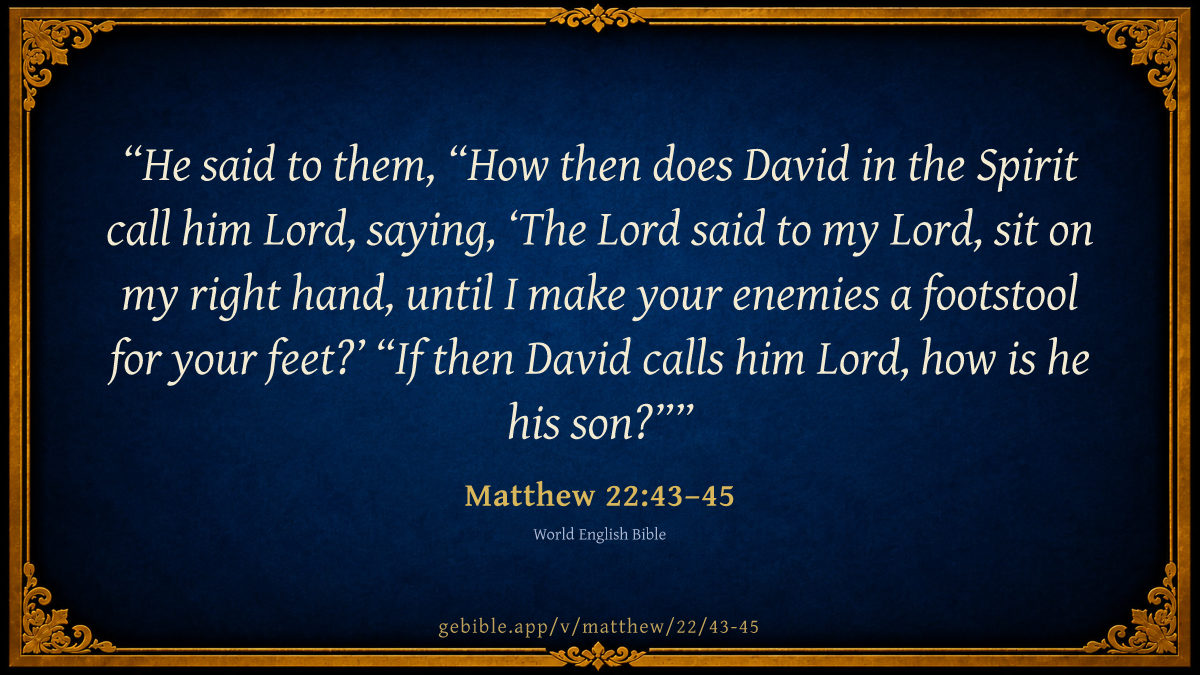
v. 43. He saith unto them, How, then, doth David in spirit call Him Lord, saying,
Read full note →
v. 44. The Lord said unto my Lord, Sit Thou on My right hand till I make Thine enemies Thy footstool?
v. 45. If David, then, call Him Lord, how is He his Son?
v. 46. And no man was able to answer Him a word, neither durst any man from that day forth ask Him any more questions.
That the Messiah was to be an offspring of David is stated so often in the Old Testament that every Jew was accustomed to call Him by that name, as a matter of fact. But the Pharisees had never compared the various passages concerning the Messiah, His person and His work, and were for that reason ignorant of His mission. The fact of the twofold nature in Christ was plainly taught in the Old Testament, but their eyes had been blinded by their false hopes and aspirations. "Jesus refers only to that fact that David, Psa 110:1, calls Him his Lord: If, then, David, He says, calls Him Lord, how is He his Son? It sounds strange and is contrary to nature that a father calls his son a lord, that he also becomes subject to him and serves him. Now, David calls Christ his Lord, and such a Lord to whom God Himself says: Sit Thou at My right hand, etc. , that is, Be equal with Me, known and adored as very, true God; for on God’s chair or at His right hand no other may properly sit; He is so jealous that He will permit no one else to sit as His equal with Him, as He says in the Prophet Isaiah, chapter 48:11: Neither will I give My honor, etc. Since, then, He places Christ on a level with Him, the latter must be more than all creatures. " To be Lord on high, equal with God, and yet to be the Son of David, according to the flesh, to have the divinity and the humanity combined in one person, that is the Messiah of prophecy. And what the learned Jews could not understand and explain, which made them speechless and utterly discomfited, is the great comfort of the believers of all time. "That is appreciating the person of Christ and knowing whose Son He is, namely, a Son of David; for He is a man, but yet also a Lord of David, as He that is sitting at the right hand of God and has His enemies, sin, death, and hell, as a footstool for His feet. Therefore, he who is in need of salvation against such enemies, let him not seek it with Moses, not through the Law, his own works, and piety; let him seek it with the Son and Lord of David, there he will surely find it. This the blind Pharisees do not know, therefore they do not respect the Lord Christ; they are satisfied with what they know out of the Law, how one should love God and one’s neighbor. And yet it is impossible to know God, much less to love God, unless one knows Christ. As He says Mat 11:27: No one knows the Father but the Son, and to whom the Son revivals it. But here we see the riches of the superabundant goodness and mercy of God, that God spared not His only-begotten Son, but delivers Him into the death of the cross for us, in order that we, liberated from sins, through Him should live forever. That is an eternal, boundless, fathomless love and mercy, which no man can know unless he knows Christ."
Summary.Jesus tells the parable of the marriage-feast, answers the question of the Herodians regarding tribute-money, convicts the Sadducees with their denial of the resurrection, gives the Pharisees the proper information as to the greatest commandment, and proposes a question concerning the twofold nature of the Messiah which they are unable to answer.
Paul E. Kretzmann, Popular Commentary of the Bible (1921–1924) — public domain. Text from a community e-Sword module.
unfoldingWord translationNotes2017 · CC BY-SA 4.0On vv43, 45General Information:
General Information:
Jesus quotes from the Psalms to show that the Christ is more than just "the son of David."
Read full note →
How then does David in the Spirit call him Lord
Jesus uses a question to make the religious leaders think deeply about the Psalm he is about to quote. AT: "Then, tell me why David in the Spirit calls him Lord" (See: Rhetorical Question)
David in the Spirit
"David, whom the Holy Spirit is inspiring." This means the Holy Spirit is influencing what David says.
call him
Here "him" refers to the Christ, who is also the descendant of David.
The Lord said
Here "Lord" refers to God the Father.
to my Lord
Here "Lord" refers to the Christ. Also, "my" refers to David. This means the Christ is superior to David.
Sit at my right hand
To sit at the "right hand of God" is a symbolic action of receiving great honor and authority from God. AT: "Sit in the place of honor beside me" (See: Symbolic Action)
until I make your enemies your footstool
This is an idiom. AT: "until I conquer your enemies" or "until I make your enemies bow down before you" (See: Idiom)
Tyndale Open Study Notes2022 · CC BY-SA 4.0On vv44–4522:44 The quotation is from Ps 110:1, which is…
22:44 The quotation is from Ps 110:1, which is frequently cited by New Testament authors to describe Jesus (see Acts 2:34-35; 1 Cor 15:25; Heb 1:13; 2:8; 10:12-13; Rev 3:21).
 GEBible — Godless Engineer's Bible App
John Trapp 1656 · Public Domain On vv43–45 43 He saith unto them, How then doth David…
43 He saith unto them, How then doth David in spirit call him Lord, saying,
Ver. 43. How then doth David in spirit] The Spirit possessed David after a sort, and by his mouth uttered what he would publish to the Church concerning the Godhead of Christ. "Holy men spake of old as they were acted by the Holy Ghost," as they were forcibly moved, or borne away, and, as it were, carried out of themselves by the Holy Ghost (φερομενοι), 2Pe 1:21.
John Trapp, A Commentary or Exposition upon All the Books of the Old and New Testament (1647–1656) — public domain. Text from a community e-Sword module.
John Gill 1763 · Public Domain On v43 And no man was able to answer him a…
And no man was able to answer him a word,.... They saw the dilemma they were reduced to, either to acknowledge the deity of the Messiah, or confess their ignorance; and neither of them they cared to do, and therefore judged it to be the wisest part to be silent.
Neither durst any man from that day forth ask him any more questions: neither Pharisees nor Sadducees, for the same is observed by Luk 20:40 of the Sadducees particularly, and was true of all sorts, and every sect, of men among them: and thus our Lord was freed from a cavilling, captious, and troublesome generation of men, from this time forward, to the time of his sufferings, which was not very long after; for this was the third day before the passover, as appears from Mat 26:1.
Read full note →
Next: Matthew Chapter 23
John Gill's Exposition of the Whole Bible (1746–1763) — public domain (CC PDM 1.0). Text via the HelloAO Bible API.
John Wesley 1765 · Public Domain On vv43–44 How doth David then by the Spirit - By…
How doth David then by the Spirit - By inspiration, call him Lord? If he be merely the son (or descendant) of David? If he be, as you suppose, a mere man, the son of a man?
John Wesley, Explanatory Notes Upon the Whole Bible (1754–1765) — public domain. Text via the GEBible commentary corpus.
Adam Clarke 1810 · Public Domain On vv43–45 Verse 43. How then doth David in spirit (or…
Verse 43. How then doth David in spirit (or by the Spirit - by the inspiration of the Spirit of God) call him Lord? saying,
Adam Clarke's Commentary on the Bible (1810–1826) — public domain. Text from a community e-Sword/MySword module.
Haydock's Catholic Bible Commentary 1859 · Public Domain On v45 If David then call him Lord, how is he…
If David then call him Lord, how is he his son? It was allowed of a certain truth, that the Messias was to be the son of David. Christ shews them by David’s own words, that he was the Lord as well as the son of David: and this is what they could not answer to. (Witham) --- Jesus Christ here inculcates to the Pharisees, that two natures must be admitted in the Messias; in one of which, viz. in his human nature, he is the son of David, and as such inferior to him; and in the other, viz. in his divine nature, he is the son of God, and consequently superior to David; whence this latter, by the inspiration of the Holy Ghost, justly calls him Lord. (Tirinus) --- Jesus Christ does not wish them to think that the Messias is not the son of David, but only wished to rectify their opinion concerning him. When therefore he asks how he is the son, he teaches them that he is not, after the manner they understand it, the mere Son, but what is much more, the Lord also, of David. (St. John Chrysostom, hom. lxxii.)
====================
George Leo Haydock (1774–1849), Haydock's Catholic Family Bible and Commentary, 1859 edition — public domain. Excludes Psalms (Douay-Rheims chapter numbering differs from Protestant) and Deuterocanonical books (Catholic canon only).
Daniel D. Whedon 1874 · Public Domain On vv43–45 43. In spirit — That this signifies under divine…
43. In spirit — That this signifies under divine inspiration is clear from Mark, who expresses it, “For David himself by the Holy Ghost said.” Our Lord decides that David was the author of the Psalm, and that he wrote under divine inspiration.
Daniel D. Whedon (gen. ed.), Commentary on the Old and New Testaments (1874–1909) — public domain. Text from a community e-Sword module.
The Cambridge Bible for Schools and Colleges 1878 · Public Domain On v44 41–46. The Son of David
41–46. The Son of David
Mar_12:35-37; Luk_20:41-44
Read full note →
44. The Lord said unto my Lord] Psa_110:1. According to the Hebrew, “Jehovah said to Adoni,” i. e. to my sovereign Lord, the Messiah, the Son of David.
said] The Hebrew word translated “said” implies divine inspiration, hence “in spirit” (Mat_22:43). Canon Perowne translates, “the oracle of Jehovah unto my lord.”
Sit thou on my right hand] As My co-regent, having power equal to Mine. This verse is quoted in 1Co_15:25; Heb_1:13; Heb_10:12-13. (Cp. for the expression ch. Mat_20:21.)
The Cambridge Bible for Schools and Colleges (gen. ed. J. J. S. Perowne; Cambridge University Press, 1878–1918) — public domain. Text from a community e-Sword module.
Ellicott's Commentary for English Readers 1878 · Public Domain On v43 (43) Doth David in spirit call him Lord?—The words…
(43) Doth David in spirit call him Lord?—The words assume (1) that David was the writer of Psalms 110; (2) that in writing it, he was guided by a Spirit higher than his own; (3) that the subject of it was no earthly king of the house of David, but the far off Christ. On this point there was an undisturbed consensus among the schools of Judaism, as represented by the Targums and the Talmud. It was a received tradition that the Christ should sit on the right hand of Jehovah and Abraham on His left. Its application to the Christ is emphatically recognised by St. Peter (Act_2:34), and by St. Paul, though indirectly (Col_3:1). In the argument of the Epistle to the Hebrews, it occupies well-nigh the chief place of all (Heb_1:3; Heb_5:6). The only hypothesis on which any other meaning can be assigned to it is, that it was written, not by David, but of him. Here it will be enough to accept our Lord’s interpretation, and to track the sequence of thought in His question. The words represent the LORD (Jehovah) as speaking to David’s Lord (Adonai), as the true king, the anointed of Jehovah. But if so, what was the meaning of that lofty title? Must not He who bore it be something more than the son of David by mere natural descent? If the scribes had never even asked themselves that question, were they not self-convicted of incompetency as religious teachers?
A Bible Commentary for English Readers, edited by Charles John Ellicott (1878–1897) — public domain. Text from a community e-Sword module.
The Pulpit Commentary 1880 · Public Domain On vv43–45 He saith. They had answered glibly enough, not knowing…
He saith. They had answered glibly enough, not knowing what was to come of their natural admission; now Christ puts a difficulty before them which might have led them to pause and reflect upon what that assertion might connote. How then? Pwv oun ; If Christ is David"s Son, how is it then, in what sense can it be said, etc.? Doth David in spirit can him Lord. "In spirit" means speaking under the inspiration of the Holy Spirit an argument surely for the Divine authority of the Old Testament, when "holy men of God spake as they were moved by the Holy Ghost". (2Pe_1:21) Christ proceeds to quote a passage from Ps 110, acknowledged by the Jews to be Davidic and Messianic. Both these positions have been called in question in modem days, and sceptical critics have hence presumed to infer ignorance or deceit on the part of Christ; i.e. either that he did not know that the authorship was wrongly attributed to David, and that the psalm really referred to Maccabean times, or that, knowing these facts, he deliberately ignored them and endorsed a popular error in order to give colour to his argument. The statement of such a charge against our Lord is a sufficient refutation. Universal tradition, extending to this very time, which gave to the psalm a Messianic interpretation, is surely more worthy of credit than a theory elaborated in the present century, which in no respect regards the natural signification of the language, and can be made to support the novel idea only by forced and unreal accommodations. By speaking of David as having uttered the quoted words, Christ does not formally state that this king wrote the psalm; he merely gives the accepted view which classed it as Davidic. The authorship did not matter in his application; his argument was equally sound, whoever was the writer.
The Pulpit Commentary (1880–1919), ed. H.D.M. Spence-Jones & Joseph S. Exell — public domain. Text from a community e-Sword module.
B. W. Johnson 1891 · Public Domain On vv43–45 43. Call him Lord. David then, by inspiration, calls…
43. Call him Lord. David then, by inspiration, calls his own Son his Lord, which shows that he is more than David's Son.
B. W. Johnson's The People's New Testament with Notes (1889–1891) — public domain. Electronic text from the Christian Classics Ethereal Library (CCEL) ThML edition.
Paul E. Kretzmann 1924 · Public Domain On v43 Driving home the conclusion:
Driving home the conclusion:
v. 43. He saith unto them, How, then, doth David in spirit call Him Lord, saying,
Read full note →
v. 44. The Lord said unto my Lord, Sit Thou on My right hand till I make Thine enemies Thy footstool?
v. 45. If David, then, call Him Lord, how is He his Son?
v. 46. And no man was able to answer Him a word, neither durst any man from that day forth ask Him any more questions.
That the Messiah was to be an offspring of David is stated so often in the Old Testament that every Jew was accustomed to call Him by that name, as a matter of fact. But the Pharisees had never compared the various passages concerning the Messiah, His person and His work, and were for that reason ignorant of His mission. The fact of the twofold nature in Christ was plainly taught in the Old Testament, but their eyes had been blinded by their false hopes and aspirations. "Jesus refers only to that fact that David, Psa 110:1, calls Him his Lord: If, then, David, He says, calls Him Lord, how is He his Son? It sounds strange and is contrary to nature that a father calls his son a lord, that he also becomes subject to him and serves him. Now, David calls Christ his Lord, and such a Lord to whom God Himself says: Sit Thou at My right hand, etc. , that is, Be equal with Me, known and adored as very, true God; for on God’s chair or at His right hand no other may properly sit; He is so jealous that He will permit no one else to sit as His equal with Him, as He says in the Prophet Isaiah, chapter 48:11: Neither will I give My honor, etc. Since, then, He places Christ on a level with Him, the latter must be more than all creatures. " To be Lord on high, equal with God, and yet to be the Son of David, according to the flesh, to have the divinity and the humanity combined in one person, that is the Messiah of prophecy. And what the learned Jews could not understand and explain, which made them speechless and utterly discomfited, is the great comfort of the believers of all time. "That is appreciating the person of Christ and knowing whose Son He is, namely, a Son of David; for He is a man, but yet also a Lord of David, as He that is sitting at the right hand of God and has His enemies, sin, death, and hell, as a footstool for His feet. Therefore, he who is in need of salvation against such enemies, let him not seek it with Moses, not through the Law, his own works, and piety; let him seek it with the Son and Lord of David, there he will surely find it. This the blind Pharisees do not know, therefore they do not respect the Lord Christ; they are satisfied with what they know out of the Law, how one should love God and one’s neighbor. And yet it is impossible to know God, much less to love God, unless one knows Christ. As He says Mat 11:27: No one knows the Father but the Son, and to whom the Son revivals it. But here we see the riches of the superabundant goodness and mercy of God, that God spared not His only-begotten Son, but delivers Him into the death of the cross for us, in order that we, liberated from sins, through Him should live forever. That is an eternal, boundless, fathomless love and mercy, which no man can know unless he knows Christ."
Summary.Jesus tells the parable of the marriage-feast, answers the question of the Herodians regarding tribute-money, convicts the Sadducees with their denial of the resurrection, gives the Pharisees the proper information as to the greatest commandment, and proposes a question concerning the twofold nature of the Messiah which they are unable to answer.
Paul E. Kretzmann, Popular Commentary of the Bible (1921–1924) — public domain. Text from a community e-Sword module.
unfoldingWord translationNotes 2017 · CC BY-SA 4.0 On vv43, 45 General Information:
General Information:
Jesus quotes from the Psalms to show that the Christ is more than just "the son of David."
Read full note →
How then does David in the Spirit call him Lord
Jesus uses a question to make the religious leaders think deeply about the Psalm he is about to quote. AT: "Then, tell me why David in the Spirit calls him Lord" (See: Rhetorical Question)
David in the Spirit
"David, whom the Holy Spirit is inspiring." This means the Holy Spirit is influencing what David says.
call him
Here "him" refers to the Christ, who is also the descendant of David.
The Lord said
Here "Lord" refers to God the Father.
to my Lord
Here "Lord" refers to the Christ. Also, "my" refers to David. This means the Christ is superior to David.
Sit at my right hand
To sit at the "right hand of God" is a symbolic action of receiving great honor and authority from God. AT: "Sit in the place of honor beside me" (See: Symbolic Action)
until I make your enemies your footstool
This is an idiom. AT: "until I conquer your enemies" or "until I make your enemies bow down before you" (See: Idiom)
translationWords
David
Holy Spirit
lord
adversary
unfoldingWord translationNotes — © Distant Shores Media and the Door43 World Missions Community, licensed CC BY-SA 4.0. Source: git.door43.org/Door43/en_tn.
Tyndale Open Study Notes 2022 · CC BY-SA 4.0 On vv44–45 22:44 The quotation is from Ps 110:1, which is…
22:44 The quotation is from Ps 110:1, which is frequently cited by New Testament authors to describe Jesus (see Acts 2:34-35; 1 Cor 15:25; Heb 1:13; 2:8; 10:12-13; Rev 3:21).
Tyndale Open Study Notes — © Tyndale Open Resources, licensed CC BY-SA 4.0. Text via the HelloAO Bible API.