
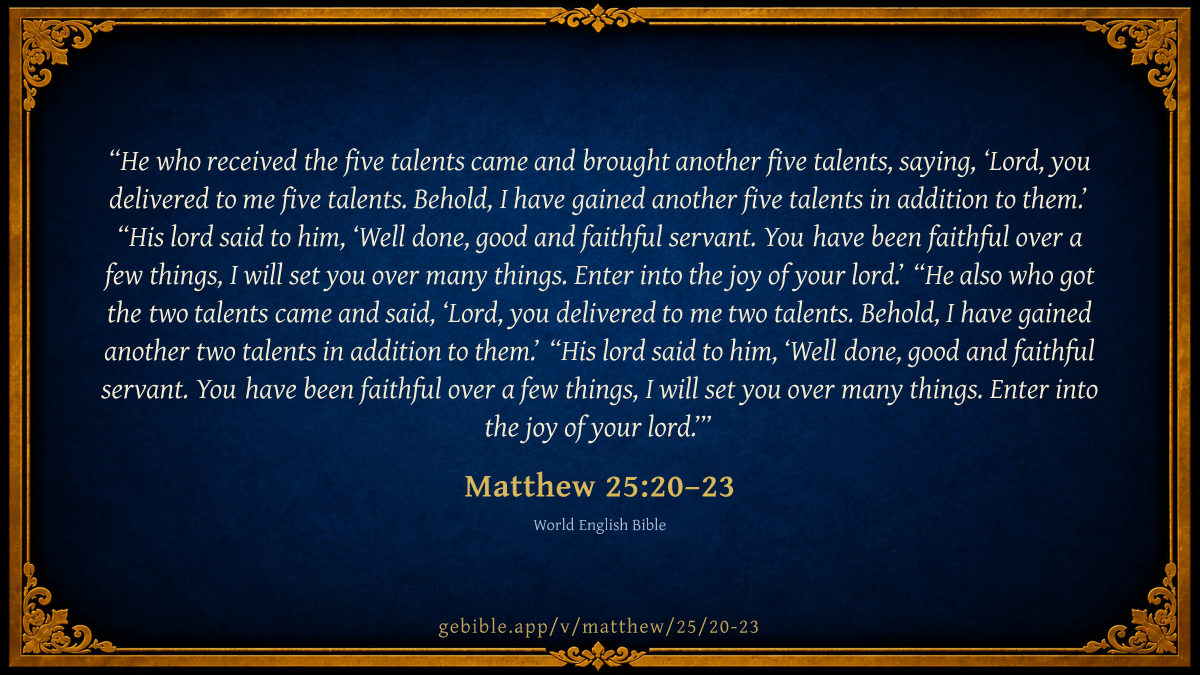
He who received the five talents came and brought another five talents, saying, ‘Lord, you delivered to me five talents. Behold, I have gained another five talents in addition to them.’
“His lord said to him, ‘Well done, good and faithful servant. You have been faithful over a few things, I will set you over many things. Enter into the joy of your lord.’
“He also who got the two talents came and said, ‘Lord, you delivered to me two talents. Behold, I have gained another two talents in addition to them.’
“His lord said to him, ‘Well done, good and faithful servant. You have been faithful over a few things, I will set you over many things. Enter into the joy of your lord.’
Geneva Bible translators 1599 · Public Domain On v21 Come, and receive the fruit of goodness, now the…
Come, and receive the fruit of goodness, now the Lord’s joy is doubled, John 15:11, that my joy may remain in you, and your joy be fulfilled.
Geneva Bible (1599) marginal notes — public domain.
John Trapp 1656 · Public Domain On vv20–23 20 And so he that had received five talents…
20 And so he that had received five talents came and brought other five talents, saying, Lord, thou deliveredst unto me five talents: behold, I have gained beside them five talents more.
Ver. 20. He that had received five] He was first called to an account, and if four, or but one of his five talents had lain dead and unoccupied he had been doomed for his ill husbandry. See that ye receive not any grace of God in vain; neither envy those that have much; a proportion is expected, Non tantum otiosi, sed cunctatores plectentur. Thou idle, and therefore evil servant, Mat 25:26.
John Trapp, A Commentary or Exposition upon All the Books of the Old and New Testament (1647–1656) — public domain. Text from a community e-Sword module.
Matthew Poole 1685 · Public Domain On v20 This part of the parable teacheth us only these…
This part of the parable teacheth us only these things:
1. That some persons in this world make a very good use and improvement of those gifts and good things which God hath entrusted them with, according to the measure with which God hath entrusted them.
Read full note →
2. That those who do so shall in the day of judgment have a liberal reward in the kingdom of glory, called here
the joy of their Lord.
That God doth not expect an equality of service from all, but a service proportionable to those gifts which God hath given men; and those shall go to heaven who have made a due improvement of the gifts with which God hath blessed them, though it be not proportionable to the service which others, of greater parts, and who have had greater advantages and opportunities, have made: if men have but two talents, yet if they gain other two, they shall go to heaven at last, as well as those who have had five, and improved them to the gaining of other five.
We must take heed of concluding from this part of the parable, that those who have most given them ordinarily do make the best improvement of them, for daily experience teacheth us the contrary, neither is the parable brought to instruct us in any such thing.
Matthew Poole's English Annotations on the Holy Bible (1683–1685) — public domain. Text from a community e-Sword/MySword module.
John Gill 1763 · Public Domain On vv20–23 And so he that had received five talents,.... Or…
And so he that had received five talents,.... Or the greatest gifts: as this man is the first to whom his Lord gave any talents, and the first that went and traded with them; he is also the first that is reckoned with; who
came and brought other five talents: he came freely and cheerfully, with a holy confidence and intrepidity of mind, and gave in his account very readily, both of what he had received, and of what he had gained;
Read full note →
saying, Lord, thou deliveredst unto me five talents, behold I have gained besides them five talents more. True ministers of the Gospel frankly own, that what gifts they have are delivered to them by Christ; and such are willing that he should have all returned to him, principal and increase: it is not to be imagined that this will be said in so many express words by them, nor will there be any need thereof; for Christ will not be ignorant of what they have been doing, and of what use they have been of; but the sense is, that as all will be manifest to Christ the searcher of hearts, with whom they have to do, so the account will stand fair and open; and it will be seen and known by all, that such and such faithful ministers of Christ have behaved in this agreeable manner, and have been thus and thus serviceable in his interest.
John Gill's Exposition of the Whole Bible (1746–1763) — public domain (CC PDM 1.0). Text via the HelloAO Bible API.
Joseph Benson 1811 · Public Domain On vv21–22 Mat 25:21. His lord said unto him, Well done…
Mat 25:21. His lord said unto him, Well done — “The original word, Ευ, well done, has a peculiar force and energy, far beyond what we can express in English. It was used by auditors or spectators in any public exercise, to express the highest applause, when any part had been excellently performed.” — Doddridge. Good and faithful servant — Those that own and honour God now, he will own and confess hereafter, and their diligence and integrity will be found to praise and honour and glory at the appearing of Jesus Christ. 1st, Their persons will be accepted. He that now knows their integrity will then bear witness to it; and they that are now found faithful, will then be declared to be Song of Solomon 2 d, Their performances will be accepted, Well done. Christ will call those, and those only, good servants, who have done well; for it is by a patient continuance in well doing that we seek for and obtain this glory and honour: and it is on condition of our doing that which is good, that we shall have praise of the same. Thou hast been faithful over a few things, I will make thee ruler, &c. — It is usual, in the courts of princes and families of great men, to advance those to higher offices who have been faithful in lower. Christ is a master that will prefer his servants who acquit themselves well. He has honour in store for those that honour him, — a crown, a throne, a kingdom. Here they are beggars: in heaven they shall be rulers and princes. Observe, reader, the disproportion between the work and the rewards. There are but few things in which the saints are serviceable to the glory of God, but many things wherein they shall be glorified with God. The charge we receive from God, the work we do for God in this world, is but little, very little, compared with the joy set before us: put together all our services, all our sufferings, all our improvements, all the good we do to others, all we obtain to ourselves, and they are but a few things, next to nothing, not fit to be named the same day with the glory to be revealed. Enter thou into the joy of thy Lord — The joy which he himself has purchased and provided for his servants; the joy of the redeemed, bought with the sorrow of the Redeemer; the joy which he himself is in possession of, and which he had his eye upon when he endured the cross and despised the shame, Heb 12:2; the joy of which he himself is the fountain and centre; for it is joy in the Lord, who is our exceeding joy. Into this joy glorified saints shall enter, that is, shall have a full and complete possession of it; as the heir, when he comes to age, enters upon his estate. Here the joy of our Lord enters into the saints, in the earnest of the Spirit, but shortly they shall enter into it, and shall be in it to all eternity, possessing fulness of joy and unspeakable pleasures for evermore.
Joseph Benson's Commentary on the Old and New Testaments (1811–1818) — public domain. Text from a community e-Sword module.
Albert Barnes 1834 · Public Domain On vv20–21 I have gained - Gained by trading or by…
I have gained - Gained by trading or by honest industry, Mat 25:16.
Albert Barnes' Notes on the Bible (1834–1885) — public domain. Text from a community e-Sword/MySword module.
Haydock's Catholic Bible Commentary 1859 · Public Domain On v20 I have gained other five. Free-will, aided by the…
I have gained other five. Free-will, aided by the grace of God, doth evidently merit as we see here.
George Leo Haydock (1774–1849), Haydock's Catholic Family Bible and Commentary, 1859 edition — public domain. Excludes Psalms (Douay-Rheims chapter numbering differs from Protestant) and Deuterocanonical books (Catholic canon only).
Daniel D. Whedon 1874 · Public Domain On vv20–21 20. Behold, I have gained — With a sweet…
20. Behold, I have gained — With a sweet and cheerful boldness does the faithful servant come before his Lord. Behold, I have gained, as it is in Matthew; and, Thy pound hath gained, as it is in Luke. These united expressions show how man and God unite in the performance of Christian duty. But even in Matthew the servant recognizes that it is the five talents which thou deliveredst unto me.
Daniel D. Whedon (gen. ed.), Commentary on the Old and New Testaments (1874–1909) — public domain. Text from a community e-Sword module.
The Cambridge Bible for Schools and Colleges 1878 · Public Domain On vv20–21 20. moe] for more, the reading of the Authorised…
20. moe] for more, the reading of the Authorised Version (1611), altered in later editions. Cp. Shaks. ful. Cæs. ii. 1:
“Bru. Is he alone?
Read full note →
Luc. No, sir, there are moe with him.”
(Bible Word-Book, p. 321).
The Cambridge Bible for Schools and Colleges (gen. ed. J. J. S. Perowne; Cambridge University Press, 1878–1918) — public domain. Text from a community e-Sword module.
Ellicott's Commentary for English Readers 1878 · Public Domain On vv20–21 (20) I have gained beside them five talents more.—The…
(20) I have gained beside them five talents more.—The result of the right use of opportunities could not be otherwise expressed within the limits of the imagery of the parable. In the kingdom of God the gain commonly takes another form than the mere increase of the gifts or opportunities which we call “talents” (though even here that increase is often the result of faithfulness), and appears as good done to men and souls gained for God.
A Bible Commentary for English Readers, edited by Charles John Ellicott (1878–1897) — public domain. Text from a community e-Sword module.
The Pulpit Commentary 1880 · Public Domain On vv20–23 He that had received the five talents. The slaves…
He that had received the five talents. The slaves appear in the same order as they had come to receive the deposits. The first comes joyfully, showing boldness in his day of judgment, (1Jn_2:17) because he has dealt faithfully and diligently, and prospered in his labours. Thou deliveredst unto me. He rightly acknowledges that all he had came from his lord, and that it was his duty and his pleasure to increase the deposit for his master"s benefit. The long delay had not made him careless and negligent; rather, he had used the time profitably, and thereby added greatly to his gains. I have gained beside them (ep autoiv). The two last words are omitted by Westcott and Hort, Tischendorf, and the Revised Version. If they are not genuine, they are, at any rate, implied in the account of the transaction. The Vulgate has, Alia quinque superlucratus sum. The good servant says, Behold, as if he pointed with joy to the augmented wealth of his master. He does not speak boastfully; he does not praise himself for his success; he had simply done his best with the means entrusted to him, and he can speak of the result with real pleasure. (comp. 2Co_1:14 Php_4:1 1Th_2:19) So in a religious sense the obligation to improve talents is even more imperative. "The manifestation of the Spirit is given to each one to profit withal". (1Co_12:7) The grace which he receives he must employ for his own sanctification, as a member of Christ, for the edification of others, for the interests of God"s Church; such work will show that he is worthy of his Lord"s trust and faithful in his stewardship.
The Pulpit Commentary (1880–1919), ed. H.D.M. Spence-Jones & Joseph S. Exell — public domain. Text from a community e-Sword module.
B. W. Johnson 1891 · Public Domain On vv20–22 20. He that had received five talents, etc. He…
20. He that had received five talents, etc. He had doubled what he had received, and in acknowledgment that all was due to his lord who had given all and whose he was, he brought all to lay at his feet.
B. W. Johnson's The People's New Testament with Notes (1889–1891) — public domain. Electronic text from the Christian Classics Ethereal Library (CCEL) ThML edition.
C. I. Scofield 1917 · Public Domain On vv21, 23 Well done
Well done
The Lord’s commendation may be earned by the weakest of His servants; it is given for faithful service.
The Scofield Reference Bible (1917 edition), notes by C. I. Scofield — public domain. Text from a community e-Sword module.
unfoldingWord translationNotes 2017 · CC BY-SA 4.0 On v22 Connecting Statement:
Connecting Statement:
Jesus continues telling the parable about the servants and the talents. (See: Parables and Biblical Money)
Read full note →
I have made two more talents
"I have earned two more talents"
Well done
"You have done well" or "You have done right." Your culture might have an expression that a master (or someone in authority) would use to show that he approves of what his servant (or someone under him) has done. See how you translated this in Matthew 25:21.
Enter into the joy of your master
The phrase "Enter into the joy" is an idiom. Also, the master is speaking about himself in the third person. AT: "Come and be happy with me" See how you translated this in Matthew 25:21. (See: Idiom and First, Second, or Third Person)
translationWords
servant
unfoldingWord translationNotes — © Distant Shores Media and the Door43 World Missions Community, licensed CC BY-SA 4.0. Source: git.door43.org/Door43/en_tn.
Tyndale Open Study Notes 2022 · CC BY-SA 4.0 On v21 25:21 See Matt 24:45-51; Luke 16:10. • Let’s celebrate…
25:21 See Matt 24:45-51; Luke 16:10. • Let’s celebrate together is a metaphor for the Father’s approval and perhaps for the messianic banquet (see Matt 6:1, 4, 6, 18; 9:9-17).
Tyndale Open Study Notes — © Tyndale Open Resources, licensed CC BY-SA 4.0. Text via the HelloAO Bible API.