
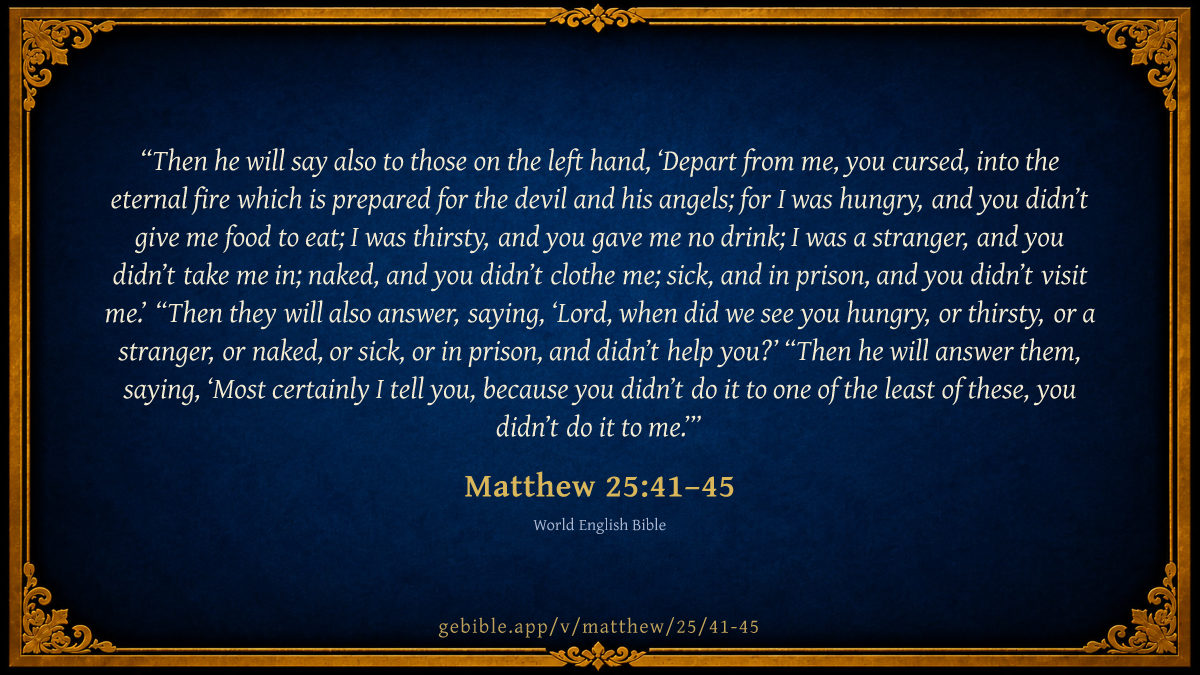
Then he will say also to those on the left hand, ‘Depart from me, you cursed, into the eternal fire which is prepared for the devil and his angels; for I was hungry, and you didn’t give me food to eat; I was thirsty, and you gave me no drink; I was a stranger, and you didn’t take me in; naked, and you didn’t clothe me; sick, and in prison, and you didn’t visit me.’
“Then they will also answer, saying, ‘Lord, when did we see you hungry, or thirsty, or a stranger, or naked, or sick, or in prison, and didn’t help you?’
“Then he will answer them, saying, ‘Most certainly I tell you, because you didn’t do it to one of the least of these, you didn’t do it to me.’
John Trapp 1656 · Public Domain On vv41–45 41 Then shall he say also unto them on…
41 Then shall he say also unto them on the left hand, Depart from me, ye cursed, into everlasting fire, prepared for the devil and his angels:
Ver. 41. Then shall he say also, &c.] Then: judgment as it begins here at God’s house, so shall it at the last day. The elect shall be crowned, and then the reprobates doomed and damned.
Read full note →
Depart from me, ye cursed, &c.] A sentence that breathes out nothing but fire and brimstone, stings and horrors, woe, and, alas, torments without end and past imagination. Mercy, Lord, saith the merciless miser. No, saith Christ, Depart, be packing.
Yet bless me before I go.
"Depart, ye cursed."
To some good place then.
To hell fire, not material fire, but worse in many respects.
But let me then come out again.
It is everlasting fire, eternity of extremity. This is the hell of hell; this puts the damned to their ουαι ουαι, as much as if they should say, ουκ αει, ουκ αει, Not ever, Lord, torment us thus. But they have a will to sin ever; and being worthless they cannot satisfy God’s justice in any time; therefore is their fire everlasting.
But let me have some good company in my misery.
"The devil and his angels."
But who appointed me this hard condition?
It was prepared of old. The all-powerful wisdom did, as it were, sit down and devise most tormenting temper for that most formidable fire. And here it is hard to say, whether be more woeful, "Depart from me, ye cursed," or that which followeth, "into everlasting fire;" pain of loss, or pain of sense. Sure it is, that the tears of hell are not sufficient to bewail the loss of heaven; the worm of grief gnaws as painful as the fire burns. If those good souls, Act 20:37-38, wept because they should see Paul’s face no more, how deplorable is the eternal deprivation of the beatiful vision!
John Trapp, A Commentary or Exposition upon All the Books of the Old and New Testament (1647–1656) — public domain. Text from a community e-Sword module.
Matthew Poole 1685 · Public Domain On v41 The great King and Judge of the whole earth…
The great King and Judge of the whole earth had before given sentence for those on his right hand, who are now possessed of their kingdom, and sit with him to judge the world. He now comes to sentence the goats at the left hand, whose judgment is to eternal misery; lying in two things:
1. In a departure from God, so as never more to have any favour from him.
Read full note →
2. In a sense of pain and misery, exceeding that which fire causeth to a body consuming with it.
In this life wicked men are capable of some presence of God with them, and receive several favours from God, in gifts of common providence and common grace; which might serve either as encouragements to allure them, or means to help them, in turning to God: but having abused these, the righteous God in that day will totally depart from them, and they shall receive no more tokens of kindness and favour from him; and whereas, by the advantages they had from such a presence of Divine providence, as God was pleased in this life to allow them, they lived in some degrees of pleasure and liberty, which they were not thankful for, they shall at that day be condemned to eternal torments. Nor shall the justice of God be impeached for disproportioning eternal torments to temporary sinnings; for the infiniteness of the Majesty offended, to which satisfaction is due, is to be considered, and is so amongst men, who think it reasonable to recompense a prince or nobleman for an injury done to them with ten thousand pounds, which they would not recompense to an equal with so many shillings.
Beside that, every sinner hath sinned in suo infinito, to the utmost line of his time, and wanted nothing but more time to have sinned more, for he had a will to have sinned infinitely. This everlasting fire is said to be prepared for the devil and his angels; not because it was not also prepared for men, but the evil angels were condemned to it before man had sinned, so that man comes but into a share with the evil angels; and by this God also lets us know that they are the children of the devil by evil works, Joh 8:44; 1Jo 3:8. Having determined their punishments, and pronounced their sentence, he comes to justify himself in it: For I was an hungred, and ye gave me no meat, &c. For here may be interpreted as a causal; for though none merits his own salvation, yet every sinner’s destruction is of himself, and he meriteth his condemnation. The mentioning only of sins of omission, and those only as to acts of charity, doth not only teach us that sins of omission are enough to damn us, but that omissions of acts of charity to the distressed members of Christ are such sins, as, if not repented of, and washed off with the blood of Christ, are enough to condemn us to the pit of hell; and such things as God doth keep in mind, and will in a more special manner reckon with men for. I cannot pass by a reflection which I find almost all interpreters make upon this text: If those in the day of judgment shall be sent to hell who do not feed the poor members of Christ, and give them to drink when they are thirsty, what shall be done to those who pluck the bread out of their mouths which they have got in the sweat of their face, and spill the drink which their own labours or others’ liberality hath given them to drink? If those shall have their portion with the devil and his angels who give not entertainment to them when they are banished and strangers, what shall become of them who are instruments of their banishment, and to make them strangers? If it shall go so hard with those that clothe them not when they are naked, what shall become of those who any way help to strip them naked? If those shall not escape the vengeance of God who do not visit them when they are sick, and in prison, where shall they appear who cast them into prisons, and are means of those diseases that shorten their lives, by their barbarous usages of them? Those that smite their fellow servants had need be sure that it be not for well doing. Our Lord here tells us, that the wicked in that day will say, When saw we thee an hungred, &c. they did not deny that they had refused to give bread to the hungry; but they deny that they ever saw Christ an hungred, and did not feed him. Persecutors have always ill names to give the servants of God, pretending still a great reverence for God and Christ. But mark our Lord’s answer, and that with an oath:
Verily I say unto you, Inasmuch as ye did it not to one of the least of these, ye did it not to me. It is no matter what you thought of or called those to whom you showed no mercy; you see they are here at my right hand. You might have known them to be my sheep, you saw them hear my voice, and following me: you, in casting them into prison, cast me; in starving them, you starved me; and in stripping them of their goods, you stripped me. Therefore, go, ye cursed, into everlasting fire, prepared for the devil and his angels.
Matthew Poole's English Annotations on the Holy Bible (1683–1685) — public domain. Text from a community e-Sword/MySword module.
William Burkitt 1703 · Public Domain On vv41–42 Here we have the sentence of condemnation denounced against…
Here we have the sentence of condemnation denounced against the wicked.
Where observe, 1. The posture in which they are found; at Christ’s left hand. this doth not so much denote the ignominy of the place (though placing at the left hand is less honourable) as the impiety of their choice; they took up with left-handed mercies, the mercies of the footstool, wealth and riches, dignity and honour. As for the good things which are at God’s right hand for evermore, they never sought after these. Verily a man may know his future state by his present choice.
Read full note →
Observe, 2. The title given to wicked men, Ye cursed. Not cursed of my Father, because cursing is God’s strange work; we force him to it, he delights not in it.
Observe, 3. The sentence itself.
Where note, 1. The punishment of loss, Depart from me.
Learn thence, 1. That it is the hell of hell to the damned, that they must everlastingly depart from, and lose the comfortable fruition and enjoyment of, God in Christ: it is to be deprived of an infinite good. Hell is a deep dungeon, where the sunshine of God’s presence never cometh.
2. The punishment of sense, Depart into everlasting fire.
Where note, Its severity it is fire: its eternity, it is everlasting fire.
Learn thence, That there are everlasting torments in hell prepared for the wicked; there is a state of torment, and a place of torment, provided by God. All princes have not only their palace, but their prison. God has the palace of heaven, for the enjoyment of himself and his friends; and the prison of hell, for punishing his enemies. The nature of the damned’s misery is set out by fire; the whole man, body and soul, shall be tormented in it.
1. The body in all its members, their eyes with affrighted spectacles, the devil and his angels, and their old companions in sin: every time they behold these, it revives their guilt, and enrages their despair. Their ears are filled with yellings and howlings, and hideous outcries.
2. The soul shall suffer in hell, by reflecting upon its own choice, by remembering time sinfully wasted, seasons of grace sadly slighted, the mercies of God unworthily abused.
Lord! how will the rememberance of past mercies aggravate present miseries!
Note farther, 1. That Christ saith not of the punishment, as he doth of the blessing, that it was prepared from the beginning of the world, lest it should be thought that God designed men’s punishment before they sinned.
Note, 2. That although Christ saith, Come, ye blessed of my Father, he saith not, Go, ye cursed of my Father, because God is the Author and Procurer of men’s happiness, but man only is the author of his own misery.
Note, 3. That Christ speaks of this eternal misery by fire, as designed originally not for man, but for the devil and his angels; but man, by giving up himself to the power and thraldom of sin and Satan, and working himself down to the infernal regions, becomes like unto him in torments, whom he so much resembled in manners and qualities.
William Burkitt's Expository Notes on the New Testament (1700–1703) — public domain. Text from a community e-Sword module.
John Gill 1763 · Public Domain On vv41–45 For I was an hungered, and ye gave me…
For I was an hungered, and ye gave me no meat,.... Hence it appears, that these were such as dwelt among Christians, and professed the Christian name, and yet disregarded the poor members of Christ in distress, when it was in the power of their hands to help them; but when they were hungry and ready to starve for want of food, did not communicate to them for Christ's sake; which showed I that they had no true faith in him, and love to him, and therefore are justly condemned by him; whereas such who never knew Christ, nor any of his people, or any obligation they were under to regard any for Christ's sake, these will never be condemned for the non-performance of these things:
I was thirsty, and ye gave me no drink; as not the least morsel of bread to eat, so not so much as a cup of cold water to drink; which with what follows, are manifest tokens and evidences, that they did not belong to Christ, were not true believers in him, nor had they any real love to him: the grace of God was not in them, and therefore had neither right unto, nor meetness for, the kingdom of heaven; but were righteously banished from the presence of the Lord, and sent to dwell among everlasting burnings; for righteous it was, that such as they who would not show any love to him here, should not dwell with him for ever hereafter.
John Gill's Exposition of the Whole Bible (1746–1763) — public domain (CC PDM 1.0). Text via the HelloAO Bible API.
John Wesley 1765 · Public Domain On vv41, 44 Depart into the everlasting fire, which was prepared for…
Depart into the everlasting fire, which was prepared for the devil and his angels - Not originally for you: you are intruders into everlasting fire.
John Wesley, Explanatory Notes Upon the Whole Bible (1754–1765) — public domain. Text via the GEBible commentary corpus.
Adam Clarke 1810 · Public Domain On vv41–44 Verse 41. Depart from me, ye cursed] Or, Ye…
Verse 41. Depart from me, ye cursed] Or, Ye cursed! depart. - These words are the address of the king to the sinners; and contain the reason why they are to be separated from blessedness: Ye are cursed, because ye have sinned, and would not come unto me that ye might have life. - No work of piety has proceeded from your hand, because the carnal mind, which is enmity against me, reigned in your heart; and ye would not have me to reign over you. Depart! this includes what some have termed the punishment of loss or privation. Ye cannot, ye, shall not be united to me - Depart! O terrible word! and yet a worse is to come.
Into everlasting fire] This is the punishment of sense. Ye shall not only be separated from me, but ye shall be tormented, awfully, everlastingly tormented in that place of separation.
Read full note →
Prepared for the devil and his angels] The devil and his angels sinned before the creation of the world, and the place of torment was then prepared for them: it never was designed for human souls; but as the wicked are partakers with the devil and his angels in their iniquities, in their rebellion against God, so it is right that they should be sharers with them in their punishment. We see here, plainly, why sinners are destroyed, not because there was no salvation for them, but because they neglected to receive good, and do good. As they received not the Christ who was offered to them, so they could not do the work of righteousness which was required of them. They are cursed, because they refused to be blessed; and they are damned, because they refused to be saved.
Adam Clarke's Commentary on the Bible (1810–1826) — public domain. Text from a community e-Sword/MySword module.
Joseph Benson 1811 · Public Domain On vv41, 44 Mat 25:41-43. Then shall he say to them on…
Mat 25:41-43. Then shall he say to them on the left hand — In this account of our Lord’s proceedings at this awful time, the absolution of the righteous is represented as taking place before the condemnation of the wicked, to show that God takes greater delight in rewarding than in punishing. Depart from me — In this world they were often called to come to Christ, to come for life and rest; but they turned a deaf ear to his calls; justly, therefore, are they bid to depart from him, who would not come to him. Depart from me, the Fountain of all good; from me, the Saviour, and therefore from all hope of salvation; I will never have any thing more to say to you, or do with you. But if they must depart from Christ, might they not be dismissed with a blessing? with one kind and compassionate word at least? No: Depart, ye cursed — They that would not come to Christ to inherit a blessing, must depart from him under the burden of a curse, the curse of the law, due to every one that breaks it; and that of the gospel, which belongs to all that disobey it. But observe, Christ calls the righteous the blessed of his Father; for their blessedness is owing purely to the grace of God: but the wicked are called only, ye cursed, for their damnation is entirely of themselves. Into everlasting fire, prepared — Not originally for you: you are intruders into this everlasting misery; but for the devil and his angels — This declaration of our Lord, compared with Mat 25:34, where the kingdom of heaven is expressly said to be prepared for the righteous, seems to have been intended to teach us that God’s original design was to make men happy, and that their becoming miserable is the effect of their own voluntary iniquity and perverseness, in rejecting the counsel of God against themselves. No sooner was man created, than a state of consummate felicity was formed for him and his posterity. But the fire of hell was prepared for the devil and his angels, namely, after their fall: and because wicked men partake with devils in their sin of rebellion against God, they are doomed to share with them in their punishment. Perhaps, also, the fire of hell is here said to be made for the devil and his angels, to intimate the greatness of the misery to which sinners dying in sin shall be consigned. The punishment which they shall suffer is of the heaviest kind, being the punishment of devils.
Joseph Benson's Commentary on the Old and New Testaments (1811–1818) — public domain. Text from a community e-Sword module.
Albert Barnes 1834 · Public Domain On vv41, 45 On the left hand - The wicked.
On the left hand - The wicked.
Ye cursed - That is, you who are devoted to destruction, whose characters deserve everlasting punishment, and who are about to enter into it. “To curse” is the opposite of “to bless.” It implies a negation of all the blessings of heaven, and a positive infliction of eternal sufferings.
Read full note →
Everlasting fire - “Fire,” here, is used to denote punishment. The image is employed to express extreme suffering, as a death by burning is one of the most horrible that can be conceived. The image was taken, probably, from the fires burning in the Valley of Hinnom. See the notes at Mat 5:22. It has been asked whether the wicked will be burned in literal fire, and the common impression has been that they will be. Respecting that, however, it is to be observed:
1.That the main truth intended to be taught refers not to the manner of suffering, but to the certainty and intensity of it.
2.That the design, therefore, was to present an image of terrific and appalling suffering - an image well represented by fire
3.That this image was well known to the Jews Isa 66:24, and therefore expressed the idea in a very strong manner.
4.That all the truth that Christ intended to convey appears to be expressed in the certainty, intensity, and eternity of future torment.
5.That there is no distinct affirmation respecting the mode of that punishment, where the mode was the subject of discourse.
6.That to us it is a subject of comparatively little consequence what will be the mode of punishment.
The fact that the wicked will be eternally punished, cursed of God, should awe every spirit, and lead every man to strive most earnestly to secure his salvation. As, however, the “body” will be raised, it is not unreasonable to suppose that a mode of punishment will be adopted suited to the body - perhaps bearing some analogy to suffering here, in its various forms of flames, and racks, and cold, and heat, and disease, and ungratified desire, and remorse - perhaps the concentration of all earthly woes, all that makes man miserable here, poured upon the naked body and spirit of the wicked in hell forever and ever.
Prepared for the devil - The devil is the prince of evil spirits. This place of punishment was suited for him when he rebelled against God, Jud 1:6; Rev 12:8-9.
His angels - His messengers, his servants, or those angels that he drew off from heaven by his rebellion, and whom he has employed as his “messengers” to do evil. The word may extend also to all his followers - fallen angels or people. There is a remarkable difference between the manner in which the righteous will be addressed, and the wicked. Christ will say to the one that the kingdom was prepared for them; to the other, that the fire was not prepared for “them,” but for another race of beings. they will inherit it because they have the same character “as the devil,” and are therefore suited to the same place - not because it was originally “prepared for them.”
Albert Barnes' Notes on the Bible (1834–1885) — public domain. Text from a community e-Sword/MySword module.
Haydock's Catholic Bible Commentary 1859 · Public Domain On vv41–42 Prepared for the devil. When Christ invited the just…
Prepared for the devil. When Christ invited the just to his heavenly kingdom, he calls it a kingdom prepared for them from the foundation of the world; a kingdom of inexpressible happiness, which from all eternity he designed for those who he knew would faithfully serve him. But, when he pronounces the sentence of the reprobate, he speaks in a widely different manner. He calls it an everlasting fire, prepared not for them, but for the devils and wicked spirits, their accomplices. They have chosen to cast themselves into it; they must therefore look upon themselves as the authors of all their miseries and sufferings. (St. John Chrysostom, hom. lxxx.) --- The pain of loss is here expressed by depart from me, and the pain of sense by eternal fire. (Menochius and Maldonatus)
George Leo Haydock (1774–1849), Haydock's Catholic Family Bible and Commentary, 1859 edition — public domain. Excludes Psalms (Douay-Rheims chapter numbering differs from Protestant) and Deuterocanonical books (Catholic canon only).
Daniel D. Whedon 1874 · Public Domain On vv41, 44, 45 41. Prepared for the devil and his angels —…
41. Prepared for the devil and his angels — Sad mistake of these men! A glorious kingdom was prepared and predestinated for them (see our comment on Mat_25:34) from the foundation of the world; but lo! they have missed that predestinated lot, and fallen into an everlasting fire not intended for them, but prepared for the devil and his angels! As if God had provided no hell for men! He had secured a Redeemer mighty enough, and a heaven capacious enough for all, and had made no other arrangements. So God’s plans of mercy are not accomplished, and his predestinations are not fulfilled. But as they had made themselves utterly unfit for heaven, he stows them away forever in the devil’s lake of fire.
Daniel D. Whedon (gen. ed.), Commentary on the Old and New Testaments (1874–1909) — public domain. Text from a community e-Sword module.
The Cambridge Bible for Schools and Colleges 1878 · Public Domain On v45 45. Inasmuch as ye did it not] Men will…
45. Inasmuch as ye did it not] Men will be judged not only for evil done, but for good left undone.
The Cambridge Bible for Schools and Colleges (gen. ed. J. J. S. Perowne; Cambridge University Press, 1878–1918) — public domain. Text from a community e-Sword module.
Ellicott's Commentary for English Readers 1878 · Public Domain On vv41, 44 (41) Ye cursed.—The omission of the words “of My…
(41) Ye cursed.—The omission of the words “of My Father,” which might have seemed necessary to complete the parallelism with Mat_25:34, is every way significant. He is not the author of the curse. Those who have brought themselves under the curse by their own evil deeds He no longer acknowledges as His.
A Bible Commentary for English Readers, edited by Charles John Ellicott (1878–1897) — public domain. Text from a community e-Sword module.
The Pulpit Commentary 1880 · Public Domain On vv41, 42, 44, 45 Unto them on the left hand. The sentence on…
Unto them on the left hand. The sentence on these is comprised in vers. 41-45. It is conveyed in terms parallel to that on the righteous; but how infinite the difference! Depart from me! Not "Come!" (ver. 34). What a world of misery is contained in this word, "Depart"! As the light of God"s countenance is happiness, so banishment from his presence is utter woe. What it implies we know not; we will not attempt to imagine. God preserve us from ever knowing! Ye cursed. He had called the righteous, "blessed of my Father;" he does not term these, "cursed of my Father," because God willeth not the death of a sinner. "Not he laid the curse upon them, but their own works" (St. Chrysostom, in loc. ). It was no part of God"s design that any of his creatures should suffer this misery. "God made not death, neither hath he pleasure in the destruction of the living. For he created all things, that they might have their being...but ungodly men with their words and works called death unto them". (RAPC Wis 1:13, etc.) Into everlasting fire (to pur to aiwnion , the fire which is even lasting). To the poignant regret for the loss of happiness and of the presence of God there is added physical anguish, expressed metaphorically by the term "fire." This is called everlasting, and however in these days of compromise we may seek to minimize or modify the attribute, it was so understood by our Lord"s hearers (see below on ver. 46). Prepared for the devil and his angels. This region or sphere of torment was not, as the kingdom of the righteous, prepared for man originally; it was particularly designed (to htoimasmenon) for Satan and his myrmidons, (see 2Pe_2:4, 2Pe_2:9) and will not be perfected till the last judgment. (Rev_20:10) There is no hint of its being remedial or corrective; and what it is to the devil it must be to those who share it with him. It is man"s own doing that he is unfit for the company of saints and angels, and, having made himself like unto the evil spirits by rebellion and hatred of good, he must consort with them and share their doom. It seems as though there were no proper place for man"s punishment; there is no book of death corresponding to the book of life; (Rev_20:12, etc.) the wicked are in an anomalous state, and, shut out by their own action from their proper inheritance, fall into the society of demons. How to reconcile this destiny, which seems inconceivably terrible, with God"s mercy, love, and justice, has always proved a stumbling block to free thinkers. It is, indeed, a mystery which we cannot understand, and which Christ has purposely left unexplained. We can only bow the head and say, "Shall not the Judge of all the earth do right?". (Gen_18:25)
The Pulpit Commentary (1880–1919), ed. H.D.M. Spence-Jones & Joseph S. Exell — public domain. Text from a community e-Sword module.
B. W. Johnson 1891 · Public Domain On vv41, 42, 44, 45 41. Depart from me, ye cursed, into everlasting fire.…
41. Depart from me, ye cursed, into everlasting fire. Those that have sought the Lord on earth shall be with him forever (1 Thess. 4:17). Those who have turned away from him shall be turned away from him forever. The punishment is everlasting banishment from his presence (2 Thess. 1:9). Ye cursed. Under the Jewish law, anything irretrievably condemned and devoted to death was called “accursed” (Deut. 13:17). The same term applied to the wicked is a sentence of eternal death. Into everlasting fire, prepared for the devil and his angels. Fire is probably used, as in many other places in the Scripture, as symbol of the bitter punishment of the wicked. Note, (1) it is everlasting; (2) prepared, not for man, but for the devil and his angels. Those who choose his service will have his portion.
B. W. Johnson's The People's New Testament with Notes (1889–1891) — public domain. Electronic text from the Christian Classics Ethereal Library (CCEL) ThML edition.
C. I. Scofield 1917 · Public Domain On v41 (See Scofield "Heb 1:4")
angels
(See Scofield "Heb 1:4")
The Scofield Reference Bible (1917 edition), notes by C. I. Scofield — public domain. Text from a community e-Sword module.
Paul E. Kretzmann 1924 · Public Domain On v41 The sentence upon the unrighteous:
The sentence upon the unrighteous:
v. 41. Then shall He say also unto them on the left hand, Depart from Me, ye cursed, into everlasting fire, prepared for the devil and his angels.
Read full note →
v. 42. For I was an hungered, and ye gave Me no meat; I was thirsty, and ye gave Me no drink;
v. 43. I was a stranger, and ye took Me not in; naked, and ye clothed Me not; sick and in prison, and ye visited Me not.
v. 44. Then shall they also answer Him, saying, Lord, when saw we Thee an hungered, or athirst, or a stranger, or naked, or sick, or in prison, and did not minister unto Thee?
v. 45. Then shall He answer them, saying, Verily I say unto you, Inasmuch as ye did it not to one of the least of these, ye did it not to Me.
v. 46. And these shall go away into everlasting punishment, but the righteous into life eternal.
A fearful arraignment and a just of those on the left hand of the King: Instead of the "Blessed" which they expected a "Cursed," instead of the "Come" a "Depart from Me. " Several very important points: He does not say, Cursed of My Father, for they have brought the curse upon themselves. The everlasting fire was not prepared for them, but really only for the devil and his angels. And this fire was not prepared from the beginning of the world, God had no counsel according to which He willed the damnation of any man. They have no one to blame but themselves, this just sentence strikes them by no one’s fault but their own. By the same method of appraisal of values which Christ used in the case of the righteous, they have been weighed and found wanting. They have not spent their life in the activity of good works flowing from the love of Christ. They may have gloried in deeds which are accounted great in the sight of men, and which are wont to receive headline notices in the daily papers. But in the peculiar works of true charity, in the little deeds of service from day to day, in that life of kindness which is the natural outflow of a heart filled with faith and love toward Christ, they have been altogether deficient. Therefore all their works, even those upon which they have prided themselves, were evil, since they were not of faith. And who can picture the terror of the hypocrites among the Christians, "that had the form of godliness, but denied the power thereof, when on the Last Day their lack of mercy is reckoned against them! True, if Christ were to appear in person on earth, with a proper press-agent and manager, undoubtedly the world would be willing enough to dine Him and fete Him. But that is not the service He is looking for. What is done to one of the least of these, His brethren, in simple love, flowing like a pure stream, from a heart filled with faith in Him, that is recorded as being done to Him. As for the unrighteous, their doom is sealed: everlasting punishment is their lot, while the righteous, those justified through their faith in the Redeemer, will go into everlasting life. The former, by their own fault, have forfeited the happiness of Christ’s love and eternal glory; the latter, through the love and mercy of Jesus, which have become theirs by faith, will inherit the joys of everlasting blessing.
Summary.In order to emphasize the need of watchfulness and faithfulness, Jesus tells the parables of the ten virgins and of the talents, and gives a detailed description of the Last Judgment.
Paul E. Kretzmann, Popular Commentary of the Bible (1921–1924) — public domain. Text from a community e-Sword module.
unfoldingWord translationNotes 2017 · CC BY-SA 4.0 On vv41, 44 Then he will
Then he will
"Then the King will." Jesus is speaking about himself in the third person. (See: First, Second, or Third Person)
Read full note →
you cursed
"you people whom God has cursed"
the eternal fire that has been prepared
This can be stated in active form. AT: "the eternal fire that God has prepared" (See: Active or Passive)
his angels
his helpers
naked, but you did not clothe me
The words "I was" preceding "naked" are understood. AT: "I was naked, but you did not give me clothes" (See: Ellipsis)
sick and in prison
The words "I was" preceding "sick" are understood. AT: "I was sick and in prison" (See: Ellipsis)
translationWords
curse
eternity
hell
Satan
angel
unfoldingWord translationNotes — © Distant Shores Media and the Door43 World Missions Community, licensed CC BY-SA 4.0. Source: git.door43.org/Door43/en_tn.