
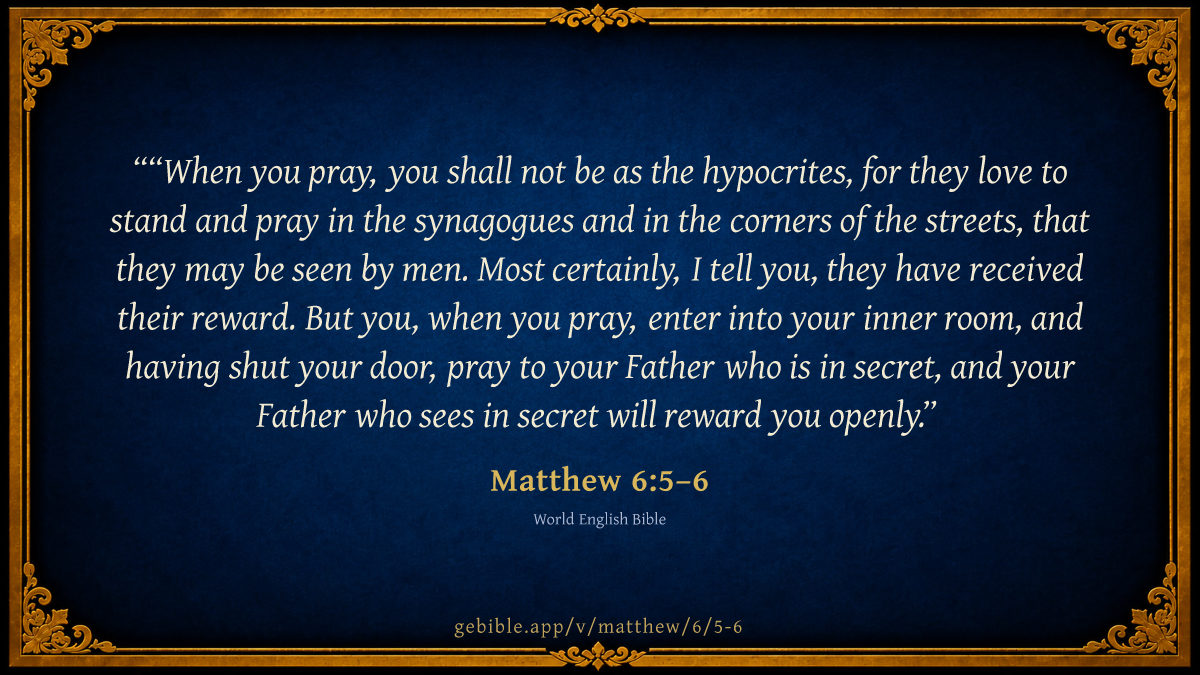
“When you pray, you shall not be as the hypocrites, for they love to stand and pray in the synagogues and in the corners of the streets, that they may be seen by men. Most certainly, I tell you, they have received their reward. But you, when you pray, enter into your inner room, and having shut your door, pray to your Father who is in secret, and your Father who sees in secret will reward you openly.
Show the surrounding paragraph
Matthew 6:5-6 sits inside this longer paragraph.
“When you pray, you shall not be as the hypocrites, for they love to stand and pray in the synagogues and in the corners of the streets, that they may be seen by men. Most certainly, I tell you, they have received their reward. But you, when you pray, enter into your inner room, and having shut your door, pray to your Father who is in secret, and your Father who sees in secret will reward you openly. In praying, don’t use vain repetitions, as the Gentiles do; for they think that they will be heard for their much speaking. Therefore don’t be like them, for your Father knows what things you need, before you ask him. Pray like this: ‘Our Father in heaven, may your name be kept holy. Let your Kingdom come. Let your will be done on earth as it is in heaven. Give us today our daily bread. Forgive us our debts, as we also forgive our debtors. Bring us not into temptation, but deliver us from the evil one. For yours is the Kingdom, the power, and the glory forever. Amen.’
Parallel Translations
-
“When you pray, you shall not be as the hypocrites, for they love to stand and pray in the synagogues and in the corners of the streets, that they may be seen by men. Most certainly, I tell you, they have received their reward.
But you, when you pray, enter into your inner room, and having shut your door, pray to your Father who is in secret, and your Father who sees in secret will reward you openly.
-
And when thou prayest thou shalt not be as the ypocrytes are. For they love to stond and praye in the synagoges and in the corners of the stretes because they wolde be sene of men. Verely I saye vnto you they haue their rewarde.
But when thou prayest entre into thy chamber and shut thy dore to the and praye to thy father which ys in secrete: and thy father which seith in secret shall rewarde the openly.
Show all 3 translations
-
And when thou prayest, be not as the hypocrites: for they loue to stand, and pray in the Synagogues, and in the corners of the streetes, because they would be seene of men. Verely I say vnto you, they haue their rewarde.
But when thou prayest, enter into thy chamber and when thou hast shut thy doore, pray vnto thy Father which is in secret, and thy Father which seeth in secret, shall rewarde thee openly.
Examined in Scripture Analysis
Contradictions (1)
Questions where the Bible appears to say two different things, with the passages on each side set together.
Cross-references (46)
- 2 Kings 4:33 (v6) He went in therefore, and shut the door on them both, and prayed to Yahweh.
- Matthew 14:23 (v6) After he had sent the multitudes away, he went up into the mountain by himself to pray. When evening had come, he was there alone.
- Isaiah 65:24 (v6) It will happen that before they call, I will answer; and while they are yet speaking, I will hear.
- Psalms 34:15 (v6) Yahweh’s eyes are toward the righteous. His ears listen to their cry.
- Acts 9:40 (v6) Peter sent them all out, and knelt down and prayed. Turning to the body, he said, “Tabitha, get up!” She opened her eyes, and when she saw…
Show all 46 cross-references
- Isaiah 26:20 (v6) Come, my people, enter into your rooms, and shut your doors behind you. Hide yourself for a little moment, until the indignation is past.
- Matthew 6:2 (v5) Therefore when you do merciful deeds, don’t sound a trumpet before yourself, as the hypocrites do in the synagogues and in the streets,…
- Luke 18:10-11 (v5) “Two men went up into the temple to pray; one was a Pharisee, and the other was a tax collector. The Pharisee stood and prayed to himself…
- Luke 18:13 (v5) But the tax collector, standing far away, wouldn’t even lift up his eyes to heaven, but beat his breast, saying, ‘God, be merciful to me, a…
- Matthew 6:18 (v6) so that you are not seen by men to be fasting, but by your Father who is in secret, and your Father, who sees in secret, will reward you.
- Mark 11:25 (v5) Whenever you stand praying, forgive, if you have anything against anyone; so that your Father, who is in heaven, may also forgive you your…
- Matthew 26:36-39 (v6) Then Jesus came with them to a place called Gethsemane, and said to his disciples, “Sit here, while I go there and pray.” He took with him…
- Isaiah 55:6-7 (v5) Seek Yahweh while he may be found. Call on him while he is near. Let the wicked forsake his way, and the unrighteous man his thoughts. Let…
- Matthew 6:4 (v6) so that your merciful deeds may be in secret, then your Father who sees in secret will reward you openly.
- Acts 10:9 (v6) Now on the next day as they were on their journey, and got close to the city, Peter went up on the housetop to pray at about noon.
- Ephesians 3:14 (v6) For this cause, I bow my knees to the Father of our Lord Jesus Christ,
- Jeremiah 29:12 (v5) You shall call on me, and you shall go and pray to me, and I will listen to you.
- Genesis 32:24-29 (v6) Jacob was left alone, and wrestled with a man there until the breaking of the day. When he saw that he didn’t prevail against him, the man…
- Isaiah 1:15 (v5) When you spread out your hands, I will hide my eyes from you. Yes, when you make many prayers, I will not hear. Your hands are full of…
- Acts 10:30 (v6) Cornelius said, “Four days ago, I was fasting until this hour, and at the ninth hour, I prayed in my house, and behold, a man stood before…
- Romans 8:5 (v6) For those who live according to the flesh set their minds on the things of the flesh, but those who live according to the Spirit, the…
- James 4:6 (v5) But he gives more grace. Therefore it says, “God resists the proud, but gives grace to the humble.”
- Daniel 6:10 (v5) When Daniel knew that the writing was signed, he went into his house (now his windows were open in his room toward Jerusalem) and he…
- Matthew 7:7-8 (v5) “Ask, and it will be given you. Seek, and you will find. Knock, and it will be opened for you. For everyone who asks receives. He who seeks…
- Luke 18:1 (v5) He also spoke a parable to them that they must always pray, and not give up,
- Luke 20:47 (v5) who devour widows’ houses, and for a pretense make long prayers: these will receive greater condemnation.”
- Ephesians 6:18 (v5) with all prayer and requests, praying at all times in the Spirit, and being watchful to this end in all perseverance and requests for all…
- Luke 11:43 (v5) Woe to you Pharisees! For you love the best seats in the synagogues, and the greetings in the marketplaces.
- Psalms 5:2 (v5) Listen to the voice of my cry, my King and my God; for I pray to you.
- Psalms 55:17 (v5) Evening, morning, and at noon, I will cry out in distress. He will hear my voice.
- Matthew 21:22 (v5) All things, whatever you ask in prayer, believing, you will receive.”
- James 5:15-16 (v5) and the prayer of faith will heal him who is sick, and the Lord will raise him up. If he has committed sins, he will be forgiven. Confess…
- Proverbs 16:5 (v5) Everyone who is proud in heart is an abomination to Yahweh: they shall certainly not be unpunished.
- Daniel 9:4-19 (v5) I prayed to Yahweh my God, and made confession, and said, “Oh, Lord, the great and dreadful God, who keeps covenant and loving kindness…
- Luke 14:12-14 (v5) He also said to the one who had invited him, “When you make a dinner or a supper, don’t call your friends, nor your brothers, nor your…
- Matthew 9:38 (v5) Pray therefore that the Lord of the harvest will send out laborers into his harvest.”
- Mark 12:38 (v5) In his teaching he said to them, “Beware of the scribes, who like to walk in long robes, and to get greetings in the marketplaces,
- Colossians 4:2-3 (v5) Continue steadfastly in prayer, watching in it with thanksgiving, praying together for us also, that God may open to us a door for the…
- Matthew 23:13 (v5) “Woe to you, scribes and Pharisees, hypocrites! For you devour widows’ houses, and as a pretense you make long prayers. Therefore you will…
- John 1:48 (v6) Nathanael said to him, “How do you know me?” Jesus answered him, “Before Philip called you, when you were under the fig tree, I saw you.”
- John 16:24 (v5) Until now, you have asked nothing in my name. Ask, and you will receive, that your joy may be made full.
- 1 Thessalonians 5:17 (v5) Pray without ceasing.
- Job 27:8-10 (v5) For what is the hope of the godless, when he is cut off, when God takes away his life? Will God hear his cry when trouble comes on him?…
- Proverbs 15:8 (v5) The sacrifice made by the wicked is an abomination to Yahweh, but the prayer of the upright is his delight.
- Matthew 23:6 (v5) and love the place of honor at feasts, the best seats in the synagogues,
- Matthew 6:16 (v5) “Moreover when you fast, don’t be like the hypocrites, with sad faces. For they disfigure their faces, that they may be seen by men to be…
Cross-references from openbible.info (CC BY 4.0)
Explain this passage (23 sources)
Historical commentary, presented as a primary source — not an endorsement.
Private notes
Saved on this device only — never synced or sent anywhere.
Geneva Bible translators 1599 · Public Domain On v5 He reprehendeth two foul faults in prayer, ambition, and…
He reprehendeth two foul faults in prayer, ambition, and vain babbling.
Geneva Bible (1599) marginal notes — public domain.
John Trapp 1656 · Public Domain On vv5–6 5 And when thou prayest, thou shalt not be…
5 And when thou prayest, thou shalt not be as the hypocrites are: for they love to pray standing in the synagogues and in the corners of the streets, that they may be seen of men. Verily I say unto you, They have their reward.
Ver. 5. And when thou prayest] A duty of that necessity, that neither the immutability of God’s decree, Dan 9:2-3, nor the infallibility of the promises, Eze 36:37, nor the effectual intercession of our Lord Christ (who taught his disciples to pray), can dispense with us for not doing it. The Jews accounted it an "abomination of desolation" when the dally sacrifice was intermitted and suspended, as under Antiochus. Our Saviour perfumed his whole course, nay, his cross, with this incense, and thereby purchased us this privilege, paved us this "new and living way" to the throne of grace, Heb 10:20; a sure and safe way to get mercy, Heb 10:16. The ark was never separated from the mercy seat, to show that God’s mercy is near unto such as affect his presence. Some favours he hath reserved to this duty, that will not otherwise be yielded, Psa 106:23; Eze 22:30. As when he is fully resolved to ruin a people or person, he silenceth his servants, and forbids them to solicit him any further, as he did Samuel interceding for Saul, and Jeremiah for Jerusalem.
Read full note →
Be not as the hypocrites] Who pretend to pray much, but indeed can do nothing at it, because destitute of the "spirit of grace and supplication;" without whose help we know neither what nor how to pray, Zec 12:10; Rom 8:26: nay, Peter, James, and John will be sleeping when they should be praying in the very hour of temptation, Mat 26:38. There may be good words and wishes found in a worldling’s mouth, "Who will show us any good?" but none but a David can with faith, feeling, and fervency say, "Lord, lift up the light of thy countenance upon me," Psa 4:6. Balaam may break forth into wishes and woulds, "Oh, let me die the death of the righteous," &c.; but can he pray, as David in like case, Psa 26:9; "Oh, take not away my soul with sinners, nor my life with bloody men!" A hypocrite may tell a persuasive tale for himself in earthly regards, or howl upon his bed in the want of outward comforts; cry in extremity, as a prisoner at the bar, as a pig under the knife; or importune God for grace, as a bridge to lead him to heaven, not for any beauty he seeth or sweetness he finds in it. But will he pray always, will he delight himself in God? saith Job. {a} No, surely, he neither doth nor can do it. When God defers to help at a pinch, as Saul, 1Sa 13:8, when grief and vexations increase, he frets and meddles no more with calling upon God, but grunts against him because he handles him not after his own mind, and betaketh himself to some other course. If God will not come at his call and be at his beck, away to the witch of Endor, with Saul, 1Sa 28:7; to the god of Ekron, as Ahaziah; to Baalim and Ashteroth, with the revolted Israelites, 2Ki 1:2. {b} Wherein he is like to those barbarous Chinois, that whip their gods when they answer them not; or that resolute Ruffus, that profanely painted God on the one side of his shield and the devil on the other, with this inscription, Si tu me nolis, iste rogitat: or that desperate king of Israel, "Behold," saith he, "this evil is from the Lord, and what should I wait for the Lord any longer?" 2Ki 6:33. Lo, this is the guise of a godless hypocrite. Either "he calleth not upon God" (which is the description David giveth of him, Psa 14:4), but is possessed, as it were, with a dumb devil, both in church and chamber; or if by reading or otherwise he have raked together some good petitions, and strive to set some life upon them in the utterance, that he may seem to be well gifted; yet he doth it not to serve God, but merely to serve himself upon God: "he draweth not nigh with a true heart," Heb 10:22, uprightly propounding God’s service in prayer, and not only his own supply and satisfaction. He is not brought into God’s presence with love and desire, as Psa 40:8. He labours not with strife of heart to worship him with his faith, trust, hope, humility, self-denial, being well content that God’s will be done, however, and truly seeking his glory, though himself be not profited, acknowledging the kingdom, power, and glory to be his, Mat 6:13. Lastly, working not by a right rule, from a right principle, not for a right end; he cannot undergo the strife of prayer, as Jacob, who wrestled by might and sleight (so much the Hebrew word importeth, ויאבק, Gen 32:24-26), much less can he continue long in it, as David, he is soon sated, soon tired, Psa 27:4; Psa 119:81; Psa 119:123. If men observe him not, applaud him not, he giveth over that course, as tedious and unsavoury, that wherein he finds no more good relish than in the white of an egg or a dry chip. And in any extraordinary trouble, instead of calling upon God, he runs from him, Isa 33:14, as Saul did, 1Sa 28:7.
For they love to pray standing, &c.] Stand they might; so did the publican. And when ye stand and pray, saith our Saviour, not disliking the gesture, Luk 18:13; Mar 9:25. It was commonly used among the Jews in the temple, especially at the solemn feasts, what time there was such resort of people from all parts, that they could hardly stand one by another. The primitive Christians also stood praying in their public assemblies, between Easter and Whitsuntide especially, in token of our Saviour’s standing up from the dead. Whence came that proverb among them, "Were it not for standing in prayer, the world would not stand." {c} Other gestures and postures of the body in prayer we read of. David and Elijah sat and prayed, 1Ch 17:16; 1Ki 19:4. Peter and Paul kneeled and prayed, Act 9:40; Eph 4:13. Moses and Aaron fell on their faces and prayed, Num 16:22. In secret prayer there is more liberty to use that gesture that may most quicken us and help the duty: Elijah put his head between his knees in prayer (as one that would strain every vein in his heart). But in public our behaviour must be such as may witness our communion and desire of mutual edification; there must he uniformity, no rents or divisions, 1Co 14:40; and special care taken that our inward affection answer our external devotion; that we stand not in the synagogues, as these, with desire to be seen of men (as Saul was higher than the rest by head and shoulders), for that is putrid hypocrisy, hateful even among heathens. Cicero taxeth Gracchus for this, that he referred all his actions, not to the rule of virtue, but to the favour of the people, that he might have esteem and applause from them.
That they may be seen of men] This was the wind that set the windmill to work, the poise that made the clock strike. Pliny telleth us that the nightingale singeth far longer and better when men be by than otherwise. If Jehonadab had not seen the zeal that Jehu had for the Lord of hosts, he had been nothing so hot nor (in his own conceit) so happy. But Christian modesty teacheth a wise man not to expose himself to the fairest show, but rather to seek to be good than seem to be so. {d} Not so every loose and ungirt Christian: these, like Jeroboam’s wife, never put on demure apparel but when they are to speak with the prophets; are never so holy as at church, and in the presence of those whose holiness they reverence.
{a} Hos 7:14. When God is rending away his soul, he roars. Job 27:9.
{b} Flectere si nequeo superos, Acheronta movebo. Ab Ekron ubi colebatur Beelzebub, factus videtur, Acheron.
{c} Absque stationibus non substiteret mundus. Tertul.
{d} Sed vox tu es, praeterea nihil. Laco ad Philon. Falleris, esse aliquid si cupis, esque nihil.
John Trapp, A Commentary or Exposition upon All the Books of the Old and New Testament (1647–1656) — public domain. Text from a community e-Sword module.
Matthew Poole 1685 · Public Domain On vv5–6 Our Saviour here cautions them against the same thing…
Our Saviour here cautions them against the same thing in prayer, as he had done before in giving alms, viz. hypocrisy and ostentation, doing this duty upon that design, merely to be taken notice of and applauded by men; it was lawful to pray
standing in the synagogues, but not to do it merely to be taken notice of by men for devout persons, nor yet to confine themselves to praying in the synagogues. If they chose to pray standing, that they might be more conspicuous, and in the synagogues, because those places were more holy, (as they might dream), or, which seems rather to be here meant, because there most people would see them, for which purpose only they chose corners of streets, as was the old popish custom upon which account they set up crosses at three way leets?, &c., these things were sinful: but to pray standing was usual, Mar 11:25; and to pray in the synagogues and in the temple standing was usual, Luk 18:13. But those who do it merely for vain glory
Read full note →
have their reward, and must expect none from God.
Matthew Poole's English Annotations on the Holy Bible (1683–1685) — public domain. Text from a community e-Sword/MySword module.
William Burkitt 1703 · Public Domain On v5 Here our Saviour warns his disciples against the same…
Here our Saviour warns his disciples against the same Pharisaical hypocrisy in praying, which he had before reproved in almsgiving. It was lawful to pray in the synagogues, and to pray standing, and that before men; but to do this upon design to be applauded by men, is condemned by Christ. Our business in prayer lies with God; we are not to concern ourselves how men like our performances; it is sufficient if God doth approve and will accept them. To cure the foregoing vanity, Christ directs to secret prayer, in our closets, where God is the witness, and will be the rewarder of our sincerity.
Note, That secret prayer is a commanded and encouraged duty, and when in sincerity performed, shall be attended with a public and glorious reward; Pray to thy Father which is in secret, &c.
William Burkitt's Expository Notes on the New Testament (1700–1703) — public domain. Text from a community e-Sword module.
Matthew Henry 1710 · Public Domain On v5 In prayer we have more immediately to do with…
In prayer we have more immediately to do with God than in giving alms, and therefore are yet more concerned to be sincere, which is what we are here directed to. When thou prayest (Mat 6:5). It is taken for granted that all the disciples of Christ pray. As soon as ever Paul was converted, behold he prayeth. You may as soon find a living man that does not breathe, as a living Christian that does not pray. For this shall every one that is godly pray. If prayerless, then graceless. "Now, when thou prayest, thou shalt not be as the hypocrites are, nor do as they do," Mat 6:2. Note, Those who would not do as the hypocrites do in their ways and actions must not be as the hypocrites are in their frame and temper. He names nobody, but it appears by Mat 23:13, that by the hypocrites here he means especially the scribes and Pharisees.
Now there were two great faults they were guilty of in prayer, against each of which we are here cautioned - vain-glory (Mat 6:5, Mat 6:6); and vain repetitions, Mat 6:7, Mat 6:8.
Read full note →
I. We must not be proud and vain-glorious in prayer, nor aim at the praise of men. And here observe,
1. What was the way and practice of the hypocrites. In all their exercises of devotion, it was plain, the chief thing they aimed at was to be commended by their neighbours, and thereby to make an interest for themselves. When they seemed to soar upwards in prayer (and if it be right, it is the soul's ascent toward God), yet even then their eye was downwards upon this as their prey. Observe,
(1.) What the places were which they chose for their devotions; they prayed in the synagogues, which were indeed proper places for public prayer, but not for personal. They pretended hereby to do honour to the place of their assemblies, but intended to do honour to themselves. They prayed in the corners of the streets, the broad streets (so the word signifies), which were most frequented. They withdrew thither, as if they were under a pious impulse which would not admit delay, but really it was to cause themselves to be taken notice of. There, where two streets met, they were not only within view of both, but every passenger turning close upon them would observe them, and hear what they said.
(2.) The posture they used in prayer; they prayed standing; this is a lawful and proper posture for prayer (Mar 11:25, When ye stand praying), but kneeling being the more humble and reverent gesture, Luk 22:41; Act 7:60; Eph 3:14, their standing seemed to savour of pride and confidence in themselves (Luk 18:11), The Pharisee stood and prayed.
(3.) Their pride in choosing these public places, which is expressed in two things: [1.] They love to pray there. They did not love prayer for its own sake, but they loved it when it gave them an opportunity of making themselves noticed. Circumstances may be such, that our good deeds must needs be done openly, so as to fall under the observation of others, and be commended by them; but the sin and danger is when we love it, and are pleased with it, because it feeds the proud humour. [2.] It is that they may be seen of men; not that God might accept them, but that men might admire and applaud them; and that they might easily get the estates of widows and orphans into their hands (who would not trust such devout, praying men?) and that, when they had them, they might devour them without being suspected (Mat 23:14); and effectually carry on their public designs to enslave the people.
(4.) The product of all this, they have their reward; they have all the recompence they must ever expect from God for their service, and a poor recompence it is. What will it avail us to have the good word of our fellow-servants, if our Master do not say, Well done? But if in so great a transaction as is between us and God, when we are at prayer, we can take in so poor a consideration as the praise of men is, it is just that that should be all our reward. They did it to be seen of men, and they are so; and much good may it do them. Note, Those that would approve themselves to God by their integrity in their religion, must have to regard to the praise of men; it is not to men that we pray, nor from them that we expect an answer; they are not to be our judges, they are dust and ashes like ourselves, and therefore we must not have our eye to them: what passes between God and our own souls must be out of sight. In our synagogue-worship, we must avoid every thing that tends to make our personal devotion remarkable, as they that caused their voice to be heard on high, Isa 58:4. Public places are not proper for private solemn prayer.
2. What is the will of Jesus Christ in opposition to this. Humility and sincerity are the two great lessons that Christ teaches us; Thou, when thou prayest, do so and so (Mat 6:6); thou in particular by thyself, and for thyself. Personal prayer is here supposed to be the duty and practice of all Christ's disciples.
Observe, (1.) The directions here given about it.
[1.] Instead of praying in the synagogues and in the corners of the streets, enter into thy closet, into some place of privacy and retirement. Isaac went into the field (Gen 24:63), Christ to a mountain, Peter to a housetop. No place amiss in point of ceremony, if it do but answer the end. Note, Secret prayer is to be performed in retirement, that we may be unobserved, and so may avoid ostentation; undisturbed, and so may avoid distraction; unheard, and so may use greater freedom; yet if the circumstances be such that we cannot possibly avoid being taken notice of, we must not therefore neglect the duty, lest the omission be a greater scandal than the observation of it.
[2.] Instead of doing it to be seen of men, pray to thy Father who is in secret; to me, even to me, Zac 7:5, Zac 7:6. The Pharisees prayed rather to men than to God; whatever was the form of their prayer, the scope of it was to beg the applause of men, and court their favours. "Well, do thou pray to God, and let that be enough for thee. Pray to him as a Father, as thy Father, ready to hear and answer, graciously inclined to pity, help, and succour thee. Pray to thy Father who is in secret." Note, In secret prayer we must have an eye to God, as present in all places; he is there in thy closet when no one else is there; there especially nigh to thee in what thou callest upon him for. By secret prayer we give God the glory of his universal presence (Act 17:24), and may take to ourselves the comfort of it.
(2.) The encouragements here given us to it.
[1.] Thy Father seeth in secret; his eye is upon thee to accept thee, when the eye of no man is upon thee to applaud thee; under the fig-tree, I saw thee, said Christ to Nathaniel, Joh 1:48. He saw Paul at prayer in such a street, at such a house, Act 9:11. There is not a secret, sudden breathing after God, but he observes it.
[2.] He will reward thee openly; they have their reward that do it openly, and thou shalt not lose thine for thy doing it in secret. It is called a reward, but it is of grace, not of debt; what merit can there be in begging? The reward will be open; they shall not only have it, but have it honourably: the open reward is that which hypocrites are fond of, but they have not patience to stay for it; it is that which the sincere are dead to, and they shall have it over and above. Sometimes secret prayers are rewarded openly in this world by signal answers to them, which manifests God's praying people in the consciences of their adversaries; however, at the great day there will be an open reward, when all praying people shall appear in glory with the great Intercessor. The Pharisees ha their reward before all the town, and it was a mere flash and shadow; true Christians shall have theirs before all the world, angels and men, and it shall be a weight of glory.
II. We must not use vain repetitions in prayer, Mat 6:7, Mat 6:8. Though the life of prayer lies in lifting up the soul and pouring out the heart, yet there is some interest which words have in prayer, especially in joint prayer; for in that, words are necessary, and it should seem that our Saviour speaks here especially of that; for before he said, when thou prayest, he here, when ye pray; and the Lord's prayer which follows is a joint prayer, and in that, he that is the mouth of others is most tempted to an ostentation of language and expression, against which we are here warned; use not vain repetitions, either alone or with others: the Pharisees affected this, they made long prayers (Mat 23:14), all their care was to make them long. Now observe,
1. What the fault is that is here reproved and condemned; it is making a mere lip-labour of the duty of prayer, the service of the tongue, when it is not the service of the soul. This is expressed here by two words, Battologia, polulogia. (1.) Vain repetitions - tautology, battology, idle babbling over the same words again and again to no purpose, like Battus, Sub illis montibus erant, erant sub montibus illis; like that imitation of the wordiness of a fool, Ecc 10:14, A man cannot tell what shall be; and what shall be after him who can tell? which is indecent and nauseous in any discourse, much more in speaking to God. It is not all repetition in prayer that is here condemned, but vain repetitions. Christ himself prayed, saying the same words (Mat 26:44), out of more than ordinary fervour and zeal, Luk 22:44. So Daniel, Dan 9:18, Dan 9:19. And there is a very elegant repetition of the same words, Ps. 136. It may be of use both to express our own affections, and to excite the affections of others. But the superstitious rehearsing of a tale of words, without regard to the sense of them, as the papists saying by their beads so many Ave-Marys and Paternosters; or the barren and dry going over of the same things again and again, merely to drill out the prayer to such a length, and to make a show of affection when really there is none; these are the vain repetitions here condemned. When we would fain say much, but cannot say much to the purpose; this is displeasing to God and all wise men. (2.) Much speaking, an affectation of prolixity in prayer, either out of pride or superstition, or an opinion that God needs either to be informed or argued with by us, or out of mere folly and impertinence, because men love to hear themselves talk. Not that all long prayers are forbidden; Christ prayed all night, Luk 6:12. Solomon's was a long prayer. There is sometimes need of long prayers when our errands and our affections are extraordinary; but merely to prolong the prayer, as if it would make it more pleasing or more prevailing with God, is that which is here condemned; it is not much praying that is condemned; no, we are bid to pray always, but much speaking; the danger of this error is when we only say our prayers, and not when we pray them. This caution is explained by that of Solomon (Ecc 5:2), Let thy words be few, considerate and well weighed; take with you words (Hos 14:2), choose out words (Job 9:14), and do not say every thing that comes uppermost.
2. What reasons are given against this.
(1.) This is the way of the heathen, as the heathen do; and it ill becomes Christians to worship their God as the Gentiles worship theirs. The heathen were taught by the light of nature to worship God; but becoming vain in their imaginations concerning the object of their worship, no wonder they became so concerning the manner of it, and particularly in this instance; thinking God altogether such a one as themselves, they thought he needed many words to make him understand what was said to him, or to bring him to comply with their requests; as if he were weak and ignorant, and hard to be entreated. Thus Baal's priests were hard at it from morning till almost night with their vain repetitions; O Baal, hear us; O Baal, hear us; and vain petitions they were; but Elijah, in a grave, composed frame, with a very concise prayer, prevailed for fire from heaven first, and then water, Kg1 18:26, Kg1 18:36. Lip-labour in prayer, though ever so well laboured, if that be all, is but lost labour.
(2.) "It need not be your way, for your Father in heaven knoweth what things ye have need of before ye ask him, and therefore there is no occasion for such abundance of words. It does not follow that therefore ye need not pray; for God requires you by prayer to own your need of him and dependence on him, and to please his promises; but therefore you are to open your case, and pour out your hearts before him, and then leave it with him." Consider, [1.] The God we pray to is our Father by creation, by covenant; and therefore our addresses to him should be easy, natural, and unaffected; children do not use to make long speeches to their parents when they want any thing; it is enough to say, my head, my head. Let us come to him with the disposition of children, with love, reverence, and dependence; and then they need not say many words, that are taught by the Spirit of adoption to say that one aright, Abba, Father. [2.] He is a Father that knows our case and knows our wants better than we do ourselves. He knows what things we have need of; his eyes run to and fro through the earth, to observe the necessities of his people (Ch2 16:9), and he often gives before we call (Isa 65:24), and more than we ask for (Eph 3:20), and if he do not give his people what they ask, it is because he knows they do not need it, and that it is not for their good; and of that he is fitter to judge for us than we for ourselves. We need not be long, nor use many words in representing our case; God knows it better than we can tell him, only he will know it from us (what will ye that I should do unto you?); and when we have told him what it is, we must refer ourselves to him, Lord, all my desire is before thee, Psa 38:9. So far is God from being wrought upon by the length or language of our prayers, that the most powerful intercessions are those which are made with groanings that cannot be uttered, Rom 8:26. We are not to prescribe, but subscribe to God.
Matthew Henry's Commentary on the Whole Bible (1708–1710) — public domain (CC PDM 1.0). Text via the HelloAO Bible API.
John Gill 1763 · Public Domain On vv5–6 And when thou prayest, thou shalt not be as…
And when thou prayest, thou shalt not be as the hypocrites,.... As the Scribes and Pharisees; whose posture in prayer, the places they chose to pray in, and the view they had therein, are particularly taken notice of:
for they love to pray standing in the synagogues, and in the corners of the streets, that they may be seen of men. It was their usual custom to pray "standing"; nay, it is established by their canons.
Read full note →
"There are eight things, (says Maimonides (u),) that a man that prays ought to take heed to do; and the first he mentions is "standing"; for, says he, no man may pray , "but standing"; if he is sitting in a ship, or in a cart, if he can stand, he must stand; if not, he may sit in his place and pray.''
Several hints of this custom there are in the Misna (w).
"On their fast days they used to bring out the ark into the streets-- , "and they stood in prayer", or praying; and caused an old man to go down before the ark, who was used to recite prayers, and he said them.''
Again (x),
"whoever , "stood praying", and remembered that any uncleanness attended him, he might not break off, but he might shorten.''
Yea, standing itself is interpreted of praying; for it is said (y),
"and Abraham rose up early in the morning to the place, where he stood, , "and there is no prayer but standing";''
though sometimes they prayed sitting, as David did, Sa2 7:18 so it is said of R. Jose, and R. Eleazar, that , "they sat and prayed", and afterwards rose up and went on their way (z). So it was likewise customary to go to the synagogues, and there pray; and indeed they were places built and appointed for this purpose.
"Wherever there were ten Israelites, a house ought to be provided, in which they may go to prayer at every time of prayer; and this place is called a synagogue (a).''
Hence some have thought, that not such places are here designed, but any assembly, or concourse of people gathered together upon any occasion; but such an interpretation will find no place, when the following things are observed.
"For ever let a man go, morning and evening, to the synagogue; for no prayer is heard at any time, but in the synagogue; and everyone that hath a synagogue in his city, and does not pray in it with the congregation, is called a bad neighbour (b).''
Again (c),
"he that prays in the house of the Lord, is as if he offered up a pure offering.''
Now, partly on account of the publicness of the place, and partly because they thought their prayers were only heard there, therefore they chose to pray in the synagogues; and also in
the corners of the streets, where two streets met, and they might be the more easily seen. This was also a common thing to pray in the streets:
"says R. Jochanan, I saw R. Jannai stand and pray in the streets of Tzippore (d).''
And a little after, it is said of another, that he stood and prayed "in the streets"; though such places were not reckoned holy, as the synagogues were.
"The street of a city, (says Maimonides (e),) although the people pray in it at fasts and stations, because that there is a great collection of people, and the synagogues cannot hold them, has no holiness in it, because it is accidental, and not appointed for prayer.''
Wherefore streets were only used in case of necessity, or by such of the Pharisees, who chose to be seen of men. A reason is given for this practice in another place (f), where it is asked,
"why do they go out to the streets, i.e. on their fast days? to show that we are reckoned as if we were carried captive before thee: says Joshua ben Levi, because they prayed in "secret", and were not answered; therefore they went without, "that they might be made public".''
Now let it be observed, that neither the posture, nor places of prayer, are condemned by our Lord, but their view in all to
be seen of men; and a considerable emphasis lies upon the word "love"; they loved "standing" in prayer, rather than any other posture, because they could be better seen; and they loved to be in the synagogues and streets, rather than in their closets; they liked public better than private prayer, because it gained them applause among men.
Verily I say unto you, they have their reward; they gain their point; they have what they seek for; and this is all they will have.
(u) Hilch. Tephilla. c. 5. sect. 1, 2. (w) Misn. Taanith, c. 2. sect. 1, 2. (x) Misn. Beracot, c. 3. sect. 5. (y) Zohar in Lev. fol. 47. 1. T. Bab. Beracot, fol. 26. 2. (z) Zohar in Exod. fol. 4. 4. (a) Maimon. Hilch. Tephilla, c. 11. 1. (b) lb. c. 8. sect. 1. T. Bab. Beracot, fol. 8. 1. & Piske Tosephot Beracot, c. 1. art. 7. (c) T. Hieros. Beracot, fol. 8. 4. (d) Ib. fol. 8. 3. & 9. 1. (e) Hilch. Tephilla, c. 11. sect. 21. Vid. Maimon. & Bartenora in Misn. Megilla, c. 3. sect. 1. (f) T. Hieros. Taaniot, fol. 65. 1.
John Gill's Exposition of the Whole Bible (1746–1763) — public domain (CC PDM 1.0). Text via the HelloAO Bible API.
John Wesley 1765 · Public Domain On vv5–6 The synagogues - These were properly the places where…
The synagogues - These were properly the places where the people assembled for public prayer, and hearing the Scriptures read and expounded. They were in every city from the time of the Babylonish captivity, and had service in them thrice a day on three days in the week. In every synagogue was a council of grave and wise persons, over whom was a president, called the ruler of the synagogue. But the word here, as well as in many other texts, signifies any place of public concourse.
John Wesley, Explanatory Notes Upon the Whole Bible (1754–1765) — public domain. Text via the GEBible commentary corpus.
Adam Clarke 1810 · Public Domain On vv5–6 Verse 5. And when thou prayest] Οταν προσευχη. Προσευχη,…
Verse 5. And when thou prayest] Οταν προσευχη. Προσευχη, prayer, is compounded of προς with, and ευχη a vow, because to pray right, a man binds himself to God, as by a vow, to live to his glory, if he will grant him his grace, c. ευχομαι signifies to pour out prayers or vows, from ευ well, and χεω, I pour out probably alluding to the offerings or libations which were poured out before, or on the altar. A proper idea of prayer is, a pouring out of the soul unto God, as a free-will offering, solemnly and eternally dedicated to him, accompanied with the most earnest desire that it may know, love, and serve him alone. He that comes thus to God will ever be heard and blessed. Prayer is the language of dependence; he who prays not, is endeavouring to live independently of God: this was the first curse, and continues to be the great curse of mankind. In the beginning, Satan said, Eat this fruit; ye shall then be as God; i.e. ye shall be independent: the man hearkened to his voice, sin entered into the world, and notwithstanding the full manifestation of the deception, the ruinous system is still pursued; man will, if possible, live independently of God; hence he either prays not at all, or uses the language without the spirit of prayer. The following verses contain so fine a view, and so just a definition, of prayer, that I think the pious reader will be glad to find them here.
WHAT IS PRAYER?
Read full note →
Prayer is the soul's sincere desire,
Unuttered or expressed,
The motion of a hidden fire
That trembles in the breast:
Prayer is the burden of a sigh,
The falling of a tear,
The upward gleaming of an eye,
When none but God is near.
Prayer is the simplest form of speech
That infant lips can try;
Prayer, the sublimest strains that reach
The Majesty on high:
Prayer is the Christian's vital breath,
The Christian's native air,
His watch-word at the gates of death,
He enters heaven by prayer.
Prayer is the contrite sinner's voice,
Returning from his ways,
While angels in their songs rejoice,
And say, Behold he prays!
The saints in prayer appear as one,
In word, in deed, in mind,
When with the Father and the Son
Their fellowship they find.
Nor prayer is made on earth alone:
The Holy Spirit pleads;
And Jesus, on th' eternal throne,
For sinners intercedes.
"O Thou, by whom we come to God!
The Life, the Truth, the Way,
The path of prayer thyself hast trod,
Lord, teach us how to pray!"
MONTGOMERY.
Thou shalt not be as the hypocrites] υποκριται. From υπο under, and κρινομαι to be judged, thought: properly a stage-player, who acts under a mask, personating a character different from his own; a counterfeit, a dissembler; one who would be thought to be different from what he really is. A person who wishes to be taken for a follower of God, but who has nothing of religion except the outside.
Love to pray standing in the synagogues and in the corners of the streets] The Jewish phylacterical prayers were long, and the canonical hours obliged them to repeat these prayers wherever they happened to be; and the Pharisees, who were full of vain glory, contrived to be overtaken in the streets by the canonical hour, that they might be seen by the people, and applauded for their great and conscientious piety. See Lightfoot. As they had no piety but that which was outward, they endeavoured to let it fully appear, that they might make the most of it among the people. It would not have answered their end to kneel before God, for then they might have been unnoticed by men; and consequently have lost that reward which they had in view: viz. the esteem and applause of the multitude. This hypocritical pretension to devotion is common among the Asiatics. Both Hindoos and Mohammedans love to pray in the most public places, at the landing places of rivers, in the public streets, on the roofs of the covered boats, without the least endeavour to conceal their outside devotion, that they may be seen of men.
Adam Clarke's Commentary on the Bible (1810–1826) — public domain. Text from a community e-Sword/MySword module.
Joseph Benson 1811 · Public Domain On v5 Mat 6:5-6. When thou prayest — Which, if thou…
Mat 6:5-6. When thou prayest — Which, if thou art my disciple indeed, thou wilt often do: thou shalt not be as the hypocrites — Praying out of vain ostentation. For they love to pray standing in the synagogues — In the sight of numbers of people. Of the synagogues see note on Mat 4:23. And in the corners of the streets — Where several ways meet, that they may be seen of men — May be beheld by many, and admired as persons of singular piety. Verily, they have their reward —
This admiration of those that observe them, is all the reward they ever shall have. But thou, when thou prayest — And dost not intend to use a social, but a private means of grace, enter into thy closet — Or any other retired apartment; and when thou hast shut thy door — To prevent interruption, and to exclude spectators, pray to thy Father which is in secret — Perform the duty without noise or show, by which it will appear that thou art influenced by a principle of true piety, by the fear or love of God, and a regard to his will and glory. It must be observed, that Christ does not here condemn all prayer made in places of public worship, seeing both he and his disciples often prayed with the Jews in the synagogues, Luk 4:16; nor any public devotions in the house of God; but, speaking only here of private prayer, he would have that performed agreeably to the nature of it, and so in secret; and condemns them only who affected to do that duty in public places, that others might take notice of them, and regard them as devout religious persons for so doing.
Joseph Benson's Commentary on the Old and New Testaments (1811–1818) — public domain. Text from a community e-Sword module.
Albert Barnes 1834 · Public Domain On vv5–6 And when thou prayest ... - Hypocrites manifested the…
And when thou prayest ... - Hypocrites manifested the same spirit about prayer as almsgiving; it was done in public places. The word “synagogues,” here, clearly means, not the place of worship of that name, but places where many were accustomed to assemble - near the markets or courts, where they could be seen of many. Our Lord evidently could not mean to condemn prayers in the synagogues. It might be said that he condemned ostentatious prayer there, while they neglected secret prayer; but this does not appear to be his design. The Jews were much in the habit of praying in public places. At certain times of the day they always offered their prayers. Wherever they were, they suspended their employment and paid their devotions. This is also practiced now everywhere by Muslims, and in many places by Roman Catholics. It seems, also, that they sought publicity, and regarded it as proof of great piety.
Albert Barnes' Notes on the Bible (1834–1885) — public domain. Text from a community e-Sword/MySword module.
Haydock's Catholic Bible Commentary 1859 · Public Domain On vv5–6 Hypocrisy is forbidden in all these three good works…
Hypocrisy is forbidden in all these three good works of justice, but not the doing of them openly for the glory of God, the edification of our neighbour, and our own salvation. Let your light so shine before men, i.e. let your work be so done in public, that the intention remain in secret. (St. Gregory)
George Leo Haydock (1774–1849), Haydock's Catholic Family Bible and Commentary, 1859 edition — public domain. Excludes Psalms (Douay-Rheims chapter numbering differs from Protestant) and Deuterocanonical books (Catholic canon only).
Robert Jamieson, A. R. Fausset & David Brown 1871 · Public Domain On vv5–6 And when thou prayest, thou shalt--or, preferably, "when ye…
And when thou prayest, thou shalt--or, preferably, "when ye pray ye shall."
not be as the hypocrites are: for they love to pray standing in the synagogues and in the corners of the streets--(See on Mat 6:2).
Read full note →
that they may be seen of men. Verily I say unto you, They have, &c.--The standing posture in prayer was the ancient practice, alike in the Jewish and in the early Christian Church. But of course this conspicuous posture opened the way for the ostentatious.
Jamieson, Fausset & Brown — Commentary Critical and Explanatory on the Whole Bible (1871) — public domain (CC PDM 1.0). Text via the HelloAO Bible API.
Daniel D. Whedon 1874 · Public Domain On vv5–6 b. Sincerity in prayer.
b. Sincerity in prayer.
5. Prayest — From sincerity in alms our Lord proceeds to sincerity in prayer. Hypocrites — The Greek word is, literally, play actors. These anciently not only acted a part, but wore a mask. Hence they became a symbol of persons who assumed a false character, especially in religion. Standing — A usual posture of the Jews in prayer. The early Christians followed a more uniform practice of kneeling. See Act_9:40; Act_20:36. The posture is not essential, but so far as the act is significant, kneeling is assuredly the more reverential. Dr. Thomson says of the Moslem prayers: “I would be glad to believe there was ordinarily any corresponding moral and religious feeling connected with this exterior manifestation of devotion. The Moslems themselves, however, have no such idea. They are rather afraid of any one who is especially given to prayer — their prayers, I mean. They have a proverb: ‘If your neighbour has made the pilgrimage to Mecca once, watch him; if twice, avoid his society; if three times, move into another street.’“
Read full note →
Corners of the streets — Where streets intersected and so brought large crowds. The Jerusalem Talmud is quoted as saying: “Rabbi Janai stood and prayed in the corner of the street Trippor, repeating an additional prayer at each of the four corners.”
Daniel D. Whedon (gen. ed.), Commentary on the Old and New Testaments (1874–1909) — public domain. Text from a community e-Sword module.
The Cambridge Bible for Schools and Colleges 1878 · Public Domain On vv5–6 (b) Prayer, Mat_6:5-15.
(b) Prayer, Mat_6:5-15.
5. pray standing] The posture of standing was as closely associated with prayer as that of sitting was with teaching.
The Cambridge Bible for Schools and Colleges (gen. ed. J. J. S. Perowne; Cambridge University Press, 1878–1918) — public domain. Text from a community e-Sword module.
Ellicott's Commentary for English Readers 1878 · Public Domain On vv5–6 (5) Standing in the synagogues.—The Jewish custom, more or…
(5) Standing in the synagogues.—The Jewish custom, more or less prevalent throughout the East, and for a time retained at certain seasons in the Christian Church, was to pray standing, with outstretched, uplifted hands, and there was nothing in the attitude as such that made it an act of ostentatious devotion; nor would there have been any ostentation in thus joining in the common prayer of the congregation assembled in the synagogue. What our Lord’s words point to, was the custom of going into the synagogue, as men go now into the churches of Latin Christendom, to offer private devotion (as, e.g., in the parable of the Pharisee and the publican), and of doing this so as to attract notice, the worshipper standing apart as if absorbed in prayer, while secretly glancing round to watch the impression which he might be making on others who were looking on.
In the corners of the streets.—Not the same word as in Mat_6:3, but the broad, open places of the city. There, too, the Pharisees might be seen, reciting their appointed prayers—probably the well-known eighteen acts of devotion which were appointed for the use of devout Israelites—and with the tallith or veil of prayer over their head.
A Bible Commentary for English Readers, edited by Charles John Ellicott (1878–1897) — public domain. Text from a community e-Sword module.
The Pulpit Commentary 1880 · Public Domain On vv5–6 Vers. 5-15. Prayer.
Vers. 5-15. Prayer.
Vers. 5-8. Matthew only.
Read full note →
And when thou prayest, thou shalt not be, etc.; Revised Version, plural. Ver. 5 is addressed to the disciples generally, ver. 6 to them individually. (For the future, cf. Mat_5:48, note) As the hypocrites are (ver. 2, note). The "Didache," following this passage, says, "Neither pray ye as the hypocrites," referring, like our Lord, to practices affected chiefly by the Pharisees. For they love (oti filousi). Not to be translated "they are wont." Our Lord points out the cause of this their custom. It was not that the synagogue was more convenient (he is, of course, thinking of their private prayers), or that they were accidentally overtaken by the prayer-hour when in the street, but their innate love of display made them choose these places "that they may be seen of men" (cf. ver. 16, and contrast ver. 2). To pray standing in the synagogues and in the corners of the streets; to stand and pray, etc. (Revised Version), giving, however, slightly more emphasis on "stand" than its position warrants. The emphasis is really on the place, not on the posture, which was only what was usual among Jews. (cf. Mar_11:25 Luk_18:11, Luk_18:13) There is no thought of taking up their position, standing still. (stayentev , Act_5:20; cf. Luk_18:11, Luk_18:40) (For the practice here condemned by our Lord, cf. Lightfoot, "Hor. Hebr.," "R. Jochauau said, I saw R. Jannai standing and praying in the streets of Tsippor, and going four cubits, and then praying the Additionary Prayer.") They have, etc. (ver. 2, note).
Vers. 5-8. As to the duty of prayer.
As, in those duties of religion which take the shape of charitable action towards man, the first law of all is that they be rendered with purity of motive and with directness of aim, free from self-consciousness and free from consciousness, either morbid or calculated upon, of the gaze of others, so certainly in that duty (identical at the same time with highest privilege) which marks the intelligent personal approach of men to God, viz. their approach in prayer, is it necessary
I THAT IT BE PERFORMED WITHOUT ANY OSTENTATION OF SANCTITY BEFORE MEN.
II THAT IT BE ADDRESSED TO GOD WITH UNDIVIDED HOMAGE, UNDISTRACTED THOUGHT.
III THAT IT CONSIST OF PETITIONS OF KNOWN AND DISTINCT MEANING, NOT VAGUE, NOT REPETITIOUS, NOT MULTIPLIED FOR MUCH SPEAKING"S SAKE ONLY.
IV THAT WE REMEMBER THAT IT IS NOT EITHER TO TELL GOD WHAT HE DOES NOT ALREADY KNOW, OR TO DICTATE OR SUGGEST TO HIM WHAT TO DO OR WHAT TO GIVE; BUT TO CONFESS TO HIM THAT WE DO KNOW AND FEEL OUR OWN NEEDS, TO ACKNOWLEDGE THAT WE KNOW HE ONLY CAN SUPPLY THEM, AND TO SUBMIT THE TIME AND THE CHOICE OF THE WAY TO DO SO, TO HIM AND HIS ALL-SOVEREIGN WISDOM. B.
Vers. 5-8. Prayer.
The duty of prayer is assumed. To be without prayer is to be without religion. "Behold, he prayeth," is another way of saying," He has become a Christian". (Act_9:11) Prayer is the language and homage of dependence. The idea is that of coming to God for a blessing with a vow (prosecuh , from prov ," with," and euch ," a vow"), viz. to fulfil the conditions upon which his blessings are promised. The elements of acceptable prayer are
I SINCERITY.
1. The prayer of the hypocrite is deception.
(1) He deceives his fellow. His object is to be seen of men to pray. But his piety to God is but a semblance. God sees no prayer in it. The men who credit the hypocrite with piety are deceived.
(2) He deceives himself. He gets what he seeks, viz. the praise of men. But what is it? It is inconsiderate. It is fickle. It is short-lived. And vain as it is, it is not deserved.
2. The prayer of the hypocrite is idolatry.
(1) The true God is not worshipped. The hypocrite"s prayer is a slight upon him. His praise is not even sought.
(2) In seeking the praise of men, the hypocrite, like other idolaters, makes his god in his own image. His prayer is to men. They are his idols.
(3) In seeking the praise of men, the hypocrite worships himself. He sees himself in his idol. Idolatry is an inverted self-worship.
3. The true mans prayer is true.
(1) He prays to God as his Father. He has kindredness of nature to the God of truth. To be seen of men is not in his calculation.
(2) He seeks the commendation of his God. This is to him the one thing infinitely desirable.
II SIMPLICITY. The expedients of hypocrisy are avoided.
1. As to posture.
(1) Standing is not, in itself, a posture unsuitable to prayer. (cf. Neh_9:4 Mar_11:25 Luk_18:11-13) The change of posture from kneeling to standing may be found helpful to the spirit of prayer.
(2) Standing "to be seen of men" is quite another thing. Kneeling, if this be its purpose, is equally reprehensible.
(3) The spirit may kneel to God in humility, or stand before him in ready obedience, when the body is otherwise engaged.
2. As to place.
(1) The "synagogue" was the proper place for public prayer. Note: In public worship we should avoid whatever might tend to make our personal devotion remarkable.
(2) The synagogue was not the place for private devotions. The custom of opening churches for private worshippers tends to encourage hypocrisy.
(3) The "corners of the streets" where the people were in concourse were favourable to ostentation. The hypocrites "loved to pray" there. They did not love to pray.
(4) Secret prayer should be in secret. The true God is himself in secret. In secret he is sought and found. God seeth in secret. (cf. Joh_1:48 Act_9:11) By secret prayer we give God the glory of universal presence. The true man may find a closet in the busy throng. The closet is in the heart. There we may shut the door against the world, the flesh, and the devil. Secret prayer should be in retirement to avoid
(a) ostentation,
(b) distraction.
Isaac went into the field; (Gen_24:63) Christ went up into a mountain; Peter found a closet on the housetop.
3. As to manner.
(1) Long prayers are sometimes proper. (cf. 1Ki_18:26 Luk_6:12 Act_19:34) But in this case the virtue does not lie in their length.
(2) Long prayers are to be avoided as tending to weary, and therefore to distract the suppliant. (cf. Job_9:14 Ecc_5:2 Hos_14:2)
(3) They are to be avoided as encouraging vain repetitions. To repeat words without meaning is especially vain. Repetitions suppose ignorance or inattention on the part of God. They are heathenish. (see 1Ki_18:26, 1Ki_18:36) True prayer is not the language of the lip, but of the heart.
(4) Those who would not be "as the hypocrites" in action and manner must not be "as the hypocrites" in spirit and temper.
III FAITH.
1. Prayer gives no information to God.
(1) "Thy Father seeth in secret." God reads all hearts.
(2) "Your Father knoweth what things ye have need of." God knows his own resources.
(3) He knoweth "before ye ask him." "Known unto God are all his works from the beginning.
2. Prayer is enjoined to help us to feel our need.
(1) God requires the sense of their need in suppliants for their own sake, viz. that they may value the blessings they may receive.
(2) Prayer is admirably suited to awaken and deepen this sense of need.
(3) By the sense of our need we "make known our requests to God". (Php_4:6)
3. It is also enjoined to encourage our faith in God.
(1) We come to God as our "Father." He is our Father by creation. By covenant.
(2) He has the heart and resources of a Father. What merit is there in our prayers? Yet such is the heart of kindness of our Father that he places them amongst our services. "Thy Father which seeth in secret shall recompense thee.
(3) He is our heavenly Father. So his rewards contrast with those received from men by the hypocrite. While the hypocrite in gaining the praises of men "has received his reward," and has no more to expect, the true man will evermore continue to receive his rewards from the everlasting Father. That eye of God which is formidable to the hypocrite is bliss to the sincere and true. J.A.M.
The Pulpit Commentary (1880–1919), ed. H.D.M. Spence-Jones & Joseph S. Exell — public domain. Text from a community e-Sword module.
John A. Broadus 1886 · Public Domain On v5 Mat 6:5-15.
Mat 6:5-15.
Good Works Without Ostentation
Read full note →
II. Prayer
Mat 6:5. The general principle of Mat 5:1, that good works must not be performed ostentatiously, is now applied to a second example (compare on Mat 6:2). And when thou prayest. The correct text is, and when ye pray. It was early changed in some copies into "thou prayest," to agree with the singular verbs which precede. But throughout this passage (v. l-18) the plural is used in the general injunctions, (Mat 6:1, Mat 6:5, Mat 6:16) and the singular in the pointed personal applications. (Mat 6:2-4, Mat 6:6, Mat 6:17-18) Compare on Mat 5:23. Hypocrites, compare on Mat 6:2. Synagogues, see on "Mat 4:23". Some would take the word here in its etymological sense, as denoting "gatherings" anywhere, but there is no propriety in departing from the usual meaning. It was not wrong to pray in the synagogues, which was a common usage; but these hypocrites prayed there rather than in secret, and did so for the purpose of display. In the corners of the streets, they could be seen from four directions, and be delightfully conspicuous. The word for "streets" is different from that of Mat 4:3, and denotes broad, spacious streets. To pray standing. Three postures in prayer are mentioned in Scripture; standing, (1Sa 1:26; Mar 11:23; Luk 18:11, Luk 18:15) kneeling; (2Ch 6:13; Dan 6:10; Luk 22:41; Act 7:60, Act 9:40, Act 20:36, Act 21:5) and in eases of peculiar awe or distress, prostration on the face. (Num 16:22; Jos 5:14; Dan 8:17; Mat 26:39; Rev 11:16) Standing being therefore a common posture, it is plain that this formed no part of the display, which consisted in choosing the most public places to parade their devotions. The Talmud of Babylon says that persons would sometimes stand three hours in a public place and a praying posture (Lightfoot). The excuse for such parade of devotion was found in the idea that when the hour of prayer arrived, one must pray wherever he was; so with the Mohammedans now, who may often be seen praying in the most public places. The practice of indolently sitting during prayer finds no support either in Scripture precedent, in (unless 2Sa 7:18 be claimed as such) the natural feeling of propriety, or in devout experience.
Verily I say unto you, see on "Mat 5:18". They have, have received—"have in full." See on "Mat 6:26".
Mat 6:6. But thou, changing again to the singular number for pointed personal an application (see on "Mat 5:23"). The word rendered closet signifies originally a store-room, and then any private or retired room. Rev. Ver.,"inner chamber."It is frequently applied in the Septuagint to a bed-chamber; compare Isa 26:20,"Come, my people, enter thou into thy chambers, and shut thy doors about thee: hide thyself as it were for a little moment, until the indignation be overpast." Compare also Mat 24:26 Luk 12:3. The notion that our Lord designs to refer to a particular room on the top of a Jewish house, or over the main entrance of the building, is unwarranted, and unnecessarily restricts the meaning of the passage. The inner chamber may in fact often be best found in the solitude of nature: as Jesus frequently did. (Mar 1:35, Mar 6:46, Mar 14:32) Shut thy door, the word denoting that it is not only closed, but fastened, thus giving the idea of the most complete privacy. (Compare 2Ki 4:33) In secret our Father is present, in secret he sees, and though men will not recompense, he will. Compare Pro 15:3.(Openly is a spurious addition, as in Mat 6:4)
Mat 6:7 f. Slightly digressing in a very natural way from the precise line of thought in Mat 6:1-18, and resuming the plural of general address, our Lord here appends a censure of another and kindred fault in prayer, in the injunction, use not vain repetitions. The Greek has a rare word formed so that its sound shall resemble the sense (onomatopoeia), and used to express stuttering, the indistinct speech of little children, or any confused babble. This well represents the practice common in the public worship of some of the heathen, as when the priests of Baal continued from morning until noon to cry: "o Baal, hear us I ", (1Ki 18:26) and the multitude in the theatre at Ephesus for two hours shouted, "Great is Diana of the Ephesians." (Act 19:34) A great crowd continuing to repeat the same words, every one for himself, would make just the babbling noise which the Greek word expresses; and so would a single person, when, wearily and without interest, and as rapidly as possible, repeating the same word or phrase. Tyndale rendered "babble not much," followed by Great Bible and Geneva. The Com. Ver. rendering, "use not vain repetitions," was suggested by the commentary of Beza, whose guidance that version frequently follows. It is possible that as a stutterer often repeats the same word, the Greek word came to be used to denote idle and unmeaning repetitions in general. The idea of the heathen was that for (in) their much speaking they would be heard. So the Roman comic writer Terence makes one person tell another not to stun the gods with thanksgivings, "unless you judge them to have no more sense than yourself, so as to think they do not understand anything unless it has been said a hundred times." The Jews must have been inclining to the same practice, thinking that there was merit in saying over certain words of prayer many times. In Talmud Bab., R. Hanin says,"If prayer is prolonged, it will mot be without effect." Another objects that it may make one sick, and a third that it may make him gloomy. Compare Mar 12:40, "And for a pretence make long prayers." Yet Ecc 5:2 had pointed out the impropriety of much speaking in prayer, "Therefore let thy words be few," and the apocryphal book of Sirach (Ecclus.) Sir 7:1, said, "Do not prattle in a multitude of elders, and do not repeat a word in thy prayer." So the Roman poet Plautus says, "Transact divine things in few words." The practice of praying a long time, as a formal observance, would naturally lead to unmeaning repetition. The Buddhist monks at the present time, will for whole days together cry aloud the sacred syllable Um; and some Mohammedans "turn about in a circle, and pronounce the name of God until they drop down." After a Mohammedan funeral in some countries, devout men assemble, and repeat Allah el Allah." God is God, "three thousand times. A traveller in Persia tells of a man "who prayed so loud and so long that he lost his voice, and then groaned out, in voiceless accents, the name of God fifty times." (Tholuck.) So in some prayers recorded in the Avesta, and in the old Egyptian writings. M. Huc tells of Buddhist students in Chinese Tartary, who will put a written prayer on a wheel, which is turned with a crank, or even by wind or water; and they believe that every revolution is a prayer, and adds to their merit. In like manner, Roman Catholics now think it very devout to repeat many times—often fifteen, and in some cases a hundred and fifty times—the Ave Maria (Hail, Mary), and the Pater Noster (Our Father, i. e., the Lord’s Prayer), and count the repetitions by slipping the beads of the rosary—thus employing (Tholuek) the very prayer our Saviour set in contrast to such notions and practices. This use of a rosary is a Buddhist practice, which came through the Mohammedans to the Spanish Christians. But our Father (see on Mat 6:9) is not slow to attend, as Elijah mockingly represented Baal to be, nor unable to understand unless it is said a hundred times; he knoweth what we need, not only as soon as we ask it once, but even before we ask it. Observe, however, two things: (1) God’s knowing before we ask is no pray in order to give him information, but to express our own desire, out feeling of need and dependence. Not that prayer, as many say, is designed simply to influence ourselves; men would pray very little if they really believed that to be all. We pray, as hoping thereby to induce God to grant what we desire; and his foreknowledge and even predestination of all things is no more an objection to praying than to acting. (2) Our Saviour cannot mean that long-continued praying is in itself improper, for he himself sometimes spent a whole night in prayer, (Luk 6:12) and he spoke more than one parable to encourage perseverance in prayer; nor is it necessarily wrong to repeat the same words—a thing sometimes very natural when we are deeply in earnest—for in Gethsemane he "prayed a third time, saying again the same words." (Mat 26:44) The difference between these and the practice condemned is plain. Augustine justly distinguishes between much speaking in prayer, and much praying.
Mat 6:9. After this manner therefore pray ye, with a strong emphasis (as the Greek shows) on "ye." This injunction is presented as a consequence of what precedes. Since it is unavailing for us, and unworthy of our God, to pray as the heathen do, (compare Mat 6:7, Mat 5:47) therefore do ye pray thus. The special (though of course not exclusive) design with which the prayer that follows is here introduced is to put in contrast with that of which he has just been speaking (Mat 5:7) a specimen of the right kind of prayer. He thus teaches them "by example as well as by precept," to avoid the faults in question. Regarded from this point of view, we are struck with the comprehensiveness and simplicity of the prayer, truly the very opposite of "much speaking," of babbling repetitions and boisterous passion. How vast its scope, how varied its applications, how simple its language. Tertullian already observed that it is "as copious in meaning as it is condensed in expression." Yet with all this comprehensiveness, there is no propriety in gravely defending, as some do, and seeking to establish by artificial exposition, the mere rhetorical hyperbole which Tertullian adds ("On Prayer," chap. 1), that "in this prayer is comprised a compend of the whole gospel."
Substantially the same prayer is recorded in Luk 11:2-4 as a specimen or model of prayer in general, given in response to a special request from one of the disciples. Now we know that Jesus repeated many striking or important sayings at different times and in different connections (see General Introduction to Matthew 5). There is thus no difficulty in understanding that he gave this prayer on two different occasions. They who think otherwise must either suppose that Matthew has artificially constructed this discourse out of scattered materials, or that Luke has introduced on an unreal occasion (Luk 11:1) what actually belonged to this discourse; and there is no sufficient ground for either supposition. Recent studies in the harmony of the Gospels (Wieseler, Clark’s Harmony) make it highly probable that the occasion on which Luke gives the prayer was long after the Sermon on the Mount, during the last few months of our Lord’s ministry, and away in Judea or Perea. But even if it be supposed that the prayer was given only once, it would remain true that the two Evangelists have recorded it in very different terms. Even in the common Greek Text and the Common Version, there are several different expressions; and the unquestionably correct text given in the Revised Version makes the differences quite considerable.
Mat 6:9-13.
Our Father who art in heaven,
hallowed be thy name.
Thy kingdom come.
Thy will be done, as in heaven, so on earth.
Give us this day our daily bread.
And forgive us our debts,
As we also have forgiven our debtors.
And bring us not into temptation,
But deliver us from the evil one.
Luk 11:2-4.
Father,
hallowed be thy name.
Thy kingdom come.
Give us day by day our daily bread.
And forgive us our sins ;
For we ourselves also forgive every one that is
indebted to us.
And bring us not into temptation.
If then our Lord gave the prayer on two occasions, he gave it in quite different terms, which shows, beyond all question, that it was not intended as a form of prayer, to be repeated in the same words. If, on the other hand, it be supposed that he gave the prayer only once, then the Evangelists certainly did not understand it to be a form of prayer, or they would not have recorded it in such different terms. There is no important difference in the substance of the two prayers; for the petition, "Thy will be done," etc., only brings into special prominence something that is involved in "Thy kingdom come," and the petition, "But deliver us from the evil one" only gives the other side of the foregoing, "And bring us not into temptation." There is no material difference in the two prayers, but there is certainly a great difference in form. It is entirely proper in praying, and indeed very desirable, to repeat any passage of Scripture that seems specially appropriate. Few passages, if any, would be so often appropriate for such a purpose as this prayer, because it is so rich and sweet, and because the Saviour expressly gave it, on both occasions, as a model of praying. But in the face of the above facts, it cannot for a moment be maintained that he has made it our duty to repeat this prayer whenever we pray, or to use these precise words from beginning to end whenever we feel moved to adopt the prayer.
The common title "The Lord’s Prayer" has been in use among Christians from an early period, being found already in Cyprian, about A. D. 250, if in no earlier writer,[1] The prayer contains no allusion to the mediation of Christ, says nothing about asking in his name, for which the disciples were not yet prepared. (Joh 16:23 f.) Like many other portions of Scripture, it was especially adapted to the precise times in which it was spoken, and the interpretation and applications of it must be made accordingly.
[1] In the fourth century we find it maintained that only the baptized may repeat this prayer, some holding that the unbaptized could not properly say "Our Father," others that they could not partake of "the supersubstantial bread" in the Eucharist. (See Suicer, "Euche.")
It is often asserted by modern Jews and rationalistic Christian writers that no portion of this prayer is original; for they say that all its petitions are found in the Talmud or in the liturgies now used among the Jews, and supposed by them to be ancient. Let us collect and consider the facts. They must be mainly stated at second hand; but the sources will be indicated.
"Our Father, who is in Heaven," occurs often in the Jewish liturgies. One of the Jewish prayers contains: "Let us sanctify thy name in the world, as they sanctify it in the high heavens." Among the prayers the Kaddish is especially valued, and has to be often recited: "Magnified and sanctified be his great name in the world which, according to his good pleasure, he created, and may he spread abroad his reign in your days; and may his redemption blossom forth, and may Messiah be at hand and deliver his people." (Wet.). And there are various other prayers that God’s name may be sanctified. In the Talmud a Rabbi says: "Every prayer in which the name of God is not mentioned is no prayer." And another says: "That prayer in which the kingdom of God is not named, is no prayer." As a matter of course, the Jewish prayers often include many petitions in regard to God’s kingdom, though the exact phrase, "Thy kingdom come," has not been cited, the nearest approach to it being, "Reveal the glory of thy kingdom upon us speedily." The Talmud of Bab. (Berach. f. 29b) gives short prayers proper for time of peril, derived from several Rabbis, and among them this: "Rabbi Eliezer says, ’Do thy will in heaven above, and give place to those that fear thee below; and do what thou pleasest.’ " The same treatise (f. 60 b), gives as a prayer before falling asleep: "Do not make us enter into the hand (power) of sin, nor into the hand of temptation, nor into the hand of contempt." And again (f. 16 b): "Rabbi was wont thus to pray: ’Let it be thy good pleasure to deliver us from impudent men and impudence, from an evil man and from an evil chance, from an evil affection, from an evil companion, from an evil neighbour, from Satan the destroyer, from a hard judgment, and from a hard adversary,’ " [So Lightfoot, Wetstein, Sepp, and Wünsche, in his German translation of Talmud Bab., Vol. I., A. D. 1886. Schwab’s French translation of Talmud Jerusalem has "from a corrupter," instead of "from Satan the destroyer."]
It thus appears that no parallel has been found to several important clauses of the prayer, such as "Thy will be done, as in heaven, so on earth," or the prayer for daily bread, to which nothing similar has been adduced save one of the short prayers in the Talmud, "The wants of thy people Israel are many, their thought is limited; may it please thee, O Lord our God, to give each one what he needs for nourishment, and to every creature what it lacks" —which is really no parallel at all. Nor is any parallel offered to the petition that we may be forgiven as we forgive, upon which our Lord laid special stress by repeating its thought after the close of the prayer (Mat 6:14 f.) The nearest approach is in Ecclus. Sir 28:2. (See below on "Mat 6:12".)
Again, the resemblance in several cases is not very marked, as in "Thy kingdom come," "Deliver us from the evil one." The only exact parallels are to the address, "Our Father who art in heaven," and to the petitions," hallowed be thy name," and "Bring us not into temptation."
In all these cases of resemblance the expression is one most natural to be employed. In regard to calling God our Father, see below; and petitions as to God’s name and kingdom, and as to temptations, must of course enter sometimes into Jewish prayers. What then is the amount of the charge that the prayer is not original? Some of its petitions have no parallel in Jewish literature, and others only partial parallels. And as to the resemblances, exact or partial, a little reflection shows that nothing else would have been natural. Is it reasonable to suppose that the Great Teacher would give as a model of prayer to his followers a series of petitions that were throughout such as nobody had ever thought of or felt the need of? A wise teacher links new instruction to what is already known and felt. And our Lord’s ethical and devotional instructions would have been really less efficient if they had been marked by the startling originality which some have unwisely claimed for them. Grotius: "Our Lord was far removed from all affectation of unnecessary novelty." Those, on the other hand, who have represented this prayer as entirely wanting in originality, are refuted by the facts; for we have seen that several of the petitions are without parallel, and that the cases of resemblance are perfectly natural; while the brevity and comprehensiveness of the prayer as a whole are wonderful in the extreme. It may be added, without treating it as an important fact in the present case, that some prayers in the Jewish liturgies are unquestionably more recent than the time of Christ, (see Margoliouth, Weiss, Ebrard in Herzog), and that even prayers and other matters in the Talmud may have been derived from the New Testament. The Rabbis borrowed freely from Greeks and afterwards from Arabians, and it is by no means so certain as some modern Jews imagine, that they did not also borrow from Jesus and his apostles. But the explanation of the matter before us is independent of that question.
The prayer naturally falls into two divisions, and it is an instructive and impressive fact that the first petitions are those which relate to God, his kingdom and his glory, and hose relating to ourselves come afterwards, as being of less importance. Bengel: "The first three are thy, thy, thy; the others, us, us, us." So likewise the Ten Commandments fall into two parts; the former setting forth our duty to God, the latter to our neighbour. At the present day, the prevalent tendency is to begin with human nature and wants, and to ask how Christianity suits itself to these; the Bible teaches us to think of God, and ask how we may suit ourselves to his nature and will. As we are afterwards taught to seek his kingdom first, (Mat 6:33) so here to pray first that it may come. Yet the distinction in the prayer is not absolute, since the fulfilment of the first petitions will be also for our good, and the fulfilment of the others will be also for God’s glory. There has been much useless discussion in Germany as to whether the prayer contains seven petitions (the Lutheran view, following Augustine), or only six (the Reformed or Calvinian view, following Chrysostom), according as we consider Sir 28:13 to be one petition or two. Some writers try to find in the several petitions sets of threes, as if illustrating the Trinity; but this is artificial and fanciful.
Mat 6:9. Our Father. The use of the plural, throughout the prayer, instead of changing to the singular, as is done in Sir 28:2, Sir 28:6, Sir 28:17, evidently presents this as a specimen of social rather than secret prayer; and so, involves prayer for each other, and not for ourselves alone. Compare Mat 18:19 Mal 2:10. The thought of God as our Father is presented in some passages of the Old Testament, (as Isa 63:16; Psa 103:13; Deu 32:6) and oftener in subsequent Jewish writings (Tob 13:4; Ecclus. Sir 28:1; Sir 51:10; Wis 2:16; Wis 14:3); and the later Jews have several prayers in which God is addressed as "our Father in heaven," an idea doubtless drawn by them from the Old Testament The heathen, too, were not wholly unfamiliar with the thought. Max Müller: "We have in the Veda the invocation Dyauspiter , the Greek Zeu pater, the Latin Jupiter; and that means in all the three languages what it meant before these languages were torn asunder—it means heaven-Father." (Boardman.) Plutarch says that the superstitious man recognizes only that which is sovereign in God, and not the fatherly; and Seneca, that God has a fatherly mind towards good men. But it is Jesus who has rendered this idea so clear and precious; distinctly comparing the feelings of human parents towards their children, (Mat 7:11) and making the great thought familiar by frequent repetition. In one sense God is the Father of all men, as in one sense all men are brothers; and so we can fitly speak of the Fatherhood of God and the Brotherhood of man; and yet it is only believers in Christ who can in the fullest sense call God Father, (1Jn 3:1; Joh 8:42) and call each other brethren. (1Jn 3:14) In heaven. God, who is everywhere present, is constantly represented in Scripture as making his special abode, and the special manifestation of the presence of his glory, in heaven. Aristotle noticed that this idea was common to all nations. But the heathen made heaven itself, variously personified, an object of worship; while in Scripture, heaven is but the dwelling-place of God. (Compare Plumptre.)
hallowed be thy name. To pray that his name, Jehovah, by which he is distinguished from all heathen deities, and marked out as his people’s God, may be sanctified, regarded and treated as holy (compare Exo 20:8 Lev 22:2, Lev 22:32 Eze 36:23, 1Pe 3:15, and contrast "despise my name "Mal 1:6), involves the idea of praying that God, in all his character and dealings, may be reverenced and glorified. Compare such expressions as "they that love thy name," "that know thy name" in the Old Testament, and "glorify thy name" in Joh 12:28 Rev 15:4. This idea of taking the proper name as representing the person in his entire character, is altogether natural, but was rendered peculiarly impressive to the Israelitish mind by their remarkable reverence for the name of Jehovah—a reverence which at length became superstitious, so that the later Jews would never pronounce that proper name at all, but uttered instead of it the word Adonai, which means Lord—and this led to the translation of Jehovah in the Septuagint by Kyrios, and in the English by Lord. The Anglo-Saxon word "hallow," though often employed in the Old Testament, is used nowhere in the King James Version of the New Testament, except here and Luk 11:2. Elsewhere that version uses the Latin word sanctify. But in this familiar and cherished prayer the old Anglo-Saxon word was retained (compare on Mat 1:18, as to the use of Holy Ghost). So likewise the Latin Vulgate, while translated anew from the Hebrew, retained the old Latin Version of the Psalms, as being so familiar that change would not be tolerated; and the English Book of Common Prayer, though altered elsewhere to suit the King James Version, retains still the translation of the Psalms from the Great Bible, or Coverdale.
Mat 6:10. Thy kingdom come. Of the three words, kingship, reign, and kingdom, to which the Greek word here employed is equivalent (see on "Mat 3:2"), it would be best in this and many passages to use the second term reign, since we can use only one. The reference is plainly to that Messianic reign which all devout Jews were expecting, (Mar 15:43 Luk 23:51) and which John and Jesus had been proclaiming as now near at hand. (Mat 3:2, Mat 4:17) The prayer that it might come would in the minds of our Lord’s hearers refer especially to the beginning of the reign, the introduction of the kingdom; (Luk 17:20 f.) but just as in the prophetic view the whole period from the beginning of Messiah’s reign to its ultimate triumph, frequently appears as a point, so in the full sense the coming of that reign or kingdom includes the idea of its complete establishment. It is therefore perfectly legitimate for us to use the petition with our minds specially directed towards the consummation of Christ’s reign, the complete establishment of his kingdom, his final glorious triumph, when the kingship (sovereignty) of the world, shall become our Lord’s and his Christ’s. (Rev 11:15) Thy will be done is more exactly thy will come to pass, ’take place,’ the same verb as in Mat 1:22 (see foot-note "Mat 1:22"), Mat 5:18, Mat 24:6, Mat 24:34 (where it is rendered ’come to pass,’ in Com. Ver.), and the same expression as in Mat 26:42, and Act 21:14. This of course involves the idea that moral creatures are to do his will, as in Mat 7:21, Mat 12:50 (where the word ’do’ is employed), but it expresses a more comprehensive thought. Theological writers distinguish three senses of the term will. God’s will of purpose always comes to pass, in heaven, earth, and hell. But his will of desire does not yet always come to pass on earth as it does in heaven. He wished Jerusalem to be saved, (Luk 13:34) and they would not. He does not "wish that any should perish, but that all should come to repentance", (2Pe 3:9) and yet many refuse to repent, and perish. He wishes "all men to be saved", (1Ti 2:4) yet many are led captive by Satan according to his own will. And God’s will of command, how often and how flagrantly it is disobeyed; how few of his moral creatures on earth are prepared to say,"I delight to do thy will, O my God", (Psa 40:8) or as Jesus said, literally,"My food is to do the will of him that sent me"; (Joh 4:34) how few are joined to Christ by the fullness of that tie,"Whosoever shall do the will of my Father who is in heaven, he is my brother, and sister, and mother." (Mat 12:50) In earth as it is in heaven. The Rev. Ver., As in heaven, so on earth, gives the order of the Greek, and makes a difference in the emphasis.—We ought to be continually praying this prayer. In heaven, everything takes place as God wishes, everything is perfectly pleasing in his sight. Ah! when shall it be so on earth? When shall his reign fully come, and his will take place, ’as in heaven, (so) also upon earth?’ O Lord, how long!—This impressive petition is really involved in the foregoing, simply stating separately one element of it; for when God’s reign is fully come, his will must come to pass, etc. When therefore this is omitted from the prayer on the second occasion, (Luk 11:12) we perceive that no principal thought of the prayer is thus lost. Yet this is by no means a mere repetition or expansion, for it brings into prominence one practical element of God’s reign, which we ought specially to desire and aim to bring about. Some (e. g., Westcott and Hort’s Greek Testament) would affix "as in heaven, so also upon earth," to all the three foregoing petitions, making it apply separately to each of them. This is a possible view, but not probable. (1) The words would not harmonize so well with "thy reign come," as with "thy name be sanctified," and "thy will come to pass." (2) The omission of these words in Luk 11:2 would thus be harder to account for.
Mat 6:11. Here begins the second division of the prayer, that which contains petitions for ourselves (compare on Mat 6:9). The grammatical construction here changes. The foregoing clauses pray that something may come to pass in the course of God’s providence. The succeeding clauses directly petition God to give and forgive. Daily bread. Bread naturally represents food in general, all that is necessary to support life, of which bread is commonly esteemed the most important and indispensable part. (Mar 3:20, 2Th 3:12 Pro 30:8, margin.) There seems to be no warrant for understanding the term as here including spiritual nourishment. It is altogether natural and proper to draw the inference that if we are bidden to ask God for bodily food, we need quite as much to ask him for that of the soul; but inference is a different thing from interpretation. Conant: "The beauty and propriety of this single petition for earthly good (restricted to that without which life cannot subsist), has been felt in all ages of the church." Many Fathers, and many in every age, have wrongly insisted upon "spiritualizing" the passage, as they have done with well-nigh everything in Scripture. Against the overdriven spirituality which affects to be too indifferent to earthly good to think it worth asking for, Jesus vindicates a place for earthly good in our prayers. In the present age, it is especially important to urge that men shall pray for temporal good, since so many think that the recognized presence of law in all temporal things puts them beyond the sphere of prayer; as if that would not exclude God from his universe; and as if there were not law in spiritual things also. The word (epiousion) rendered daily, is extremely rare and obscure. Origen says, that it was not found in any Greek writer or in colloquial use, but seemed to have been coined by the Evangelists. Only three senses of the term have now any advocates: (1) ’(bread) for to-morrow,’ and so ’daily,’ Bishop Lightfoot, Meyer, Grimm, Wunsche, Nicholson, margin of Rev. Test.; (2) ’needful,’ Godet, Keim, Keil, Cremer, margin of Rev. Test. (American Revisers); (3) ’supersubstantial,’ Jerome in Matthew, and many Romanists. Etymological considerations[1] strongly favour (1), and render (3) practically impossible. Bishop Lightfoot, "On a Fresh Revision of the New Testament" App., has conclusively shown (and McClellan and Canon Cook vainly strive to meet his facts and arguments), how strongly (1) is supported by the early versions, being uniformly given by the Old Latin (and even Jerome retains it in Luke), by both the Egyptian versions, the Old Syriac, and the "Gospel according to the Hebrews."Origen preferred (2), explaining it as meaning needful for the soul—a spiritualizing conception, which suited Origen’s turn of mind and habitual methods of interpretation; and he gave this view great currency among the Greek Christians (see Suicer) and the later Syrians. Jerome, by an impossible etymology, rendered it. ’supersubstantial’ in Matthew, though retaining in Luke the ’daily’ of the Old Latin, and is followed in both passages by Wyclif and the Rheims version. Many Romanist writers have tried to use this rendering in Matthew for the support of transubstantiation, though the Romanist prayer-books have uniformly retained ’daily.’ Plumptre strangely adopts Jerome’s rendering, understanding it to mean "over and above material substance" (in which a material word is gratuitously inserted), and thus entirely restricting the petition to spiritual bread. In (1) "Give us today our bread for to-morrow," would mean our daily bread, if we remember that one should not let the day close without knowing how he is to have food for the next morning. It is very difficult to see how (2) could ever have suggested the idea of daily, which is found in all the earlier versions, and often referred to by Greek Fathers (Suicer). Moreover, the idea of (2) could have been easily expressed by existing Greek words, while that of (1) would have required the coining of a Greek adjective (Origen above). The objection to (1) is that it seems to conflict with Mat 6:34, "Be not anxious for the morrow"; but it is fairly answered that the way to prevent such anxiety is to pray that to-morrow’s bread may be given us to-day, as in Php 4:6, the remedy for anxiety is prayer; and if Mat 6:34 prohibits prayer for to-morrow’s bread, then (Achelis) Mat 6:31 would prohibit prayer for any food. If we combine all the evidence, it would seem that (1) must be very decidedly preferred.[2] With this compare Jas 2:15, Rev. Ver., "And in lack of daily food "; Pro 30:8, lit., "Feed me with my portion (or allowance) of bread"; (Act 6:1; 2Ki 25:30) also the fact that the manna was given one day’s supply at a time. This day, or simply ’to-day.’ In Luk 11:8 it is ’day by day.’ The phrase in Matthew is said by various Fathers (Wet.) to have led to the daily repetition of this prayer, which is mentioned as early as the beginning of the third century; but Luke’s phrase shows that at least in the second case nothing of the sort was contemplated.
[1] Epiousios comes easily and naturally from he epiousa, ’the oncoming (day),’ a very common expression for ’to-morrow’ or ’next day.’ As to the possible etymology for (2), and the etymological impossibility of (3), see the special treatises and the lexicons.
[2] Mark. Paspati, a Greek gentleman of Constantinople, published (Athens, 1883), a lecture on the English Revised Version, in which he says (p. 14), that the word epiousios "is in general use among the Greeks. Many poor people complain that they cannot gain their bread. Epiousios means whatever can sustain or maintain." Mr. Sakellarios writes from Athens (Feb. 1886), that the word "was and is used in the sense of necessary, food necessary for sustenance." Now it is well known, as above stated, that this interpretation prevailed among the Greek Fathers, and so Mark. Constantine interprets, in his Greek comm. on Matt. and Mark (Athens, 1878). So far as the word is now generally used among the Greeks in that sense, it is evidently a mere appropriation of a Scripture term as commonly understood. Mark. Paspati remarks (p. 12) upon the frequent use of Scriptural expressions among the Greeks, including phrases relating to Pilate and to Satan. There is here then no independent testimony as to the meaning of the word.—It should be added that Mark. Paspati’s elucidations in general show a lack of acquaintance with scientific philology.—Warth and Löckle, Stud. u. Krit., 1884, No. 4, argue that the phrase may mean to-day’s bread, because epiousa, ’oncoming’ (which commonly means to-morrow), is occasionally used by a person speaking at or before dawn with reference to the then approaching day. They suppose the prayer to have been designed as a morning prayer—and it would have to be made very early, to render such a sense possible. This view is highly ingenious, but too fine spun to be probable in so simple and general a prayer. (Rejected by Cremer, ed. 4) Moreover how would this idea be expressed in Aramaic.
Mat 6:12. Debts. This term is here used for transgressions, sins. In Aramaic, the native language of our Lord and the Evangelists, the word debt (chob) is very often used for sin. See numerous examples from the Targums in Buxtorf. This use is perfectly natural in itself, since an obligation to God which is not duly met becomes to us a sin; compare the illustration of sin by a debt in Mat 18:21, Mat 18:24, Mat 18:28. In like manner the English word duty denotes that which is due, owed. (Plumptre.) Accordingly in Mat 6:14 f., the same idea is represented by ’trespasses,’ transgressions. And in Luke, (Luk 11:4, Rev. Ver.) the prayer reads, "And forgive us our sins; for we ourselves also forgive every one that is indebted to us." So clear is it that debts here means sins that Tyndale translates in Mat 6:12 by trespasses and trespassers; but this is unwarranted, and was not followed by any other English translators. Observe that this petition is connected with the foregoing by and. The life sustained by daily bread is not enough; we need also the forgiveness of sin (Weiss); compare ’And bring,’ Mat 6:13. As we forgive—or, as in Rev. Ver.—also have forgiven—our debtors. This does not present our forgiveness of others as the ground of our being forgiven, nor as strictly the measure of God’s forgiveness towards us (for he forgives perfectly’, while everything in us is imperfect); but by comparing the forgiveness we supplicate with that we have shown, it states very impressively the idea, afterwards still further emphasized in Mat 6:14 f., that the unforgiving cannot be forgiven. Observe that the Revised text (no doubt correct) makes it "have forgiven," already before we seek forgiveness—not a mere momentary effort at forgiveness, trumped up for the nonce. In Luk 11:4, it is, ’For we ourselves also forgive every one that is indebted to us,’ which means not simply present but habitual forgiveness, as shown by the ’every one? Luke’s term ’for’ might seem to make our forgiving the ground of our being forgiven; but it rather means that there is no unforgivingness on our part to form an obstacle to our being forgiven. Compare Mat 5:7; Luk 23:34; 1Ti 1:3, and the beautiful illustration in the parable of Mat 18:21-35. The gospel ground of forgiveness—the atonement and intercession of Christ—in of course not here stated. The disciples could not have clearly understood a reference to it until after Christ’s death, resurrection, and ascension.
The Greeks and Romans admired shining instances of forgiveness, but did not venture to inculcate or seem to expect it. A Jewish sage of about B. C. 200 (Ecclus. Sir 28:2), urged that men must forgive if they hoped to be forgiven: "Forgive thy neighbour his wrongdoing, and then when thou hast prayed, thy sins shall be forgiven." (Compare Ecclus. Sir 28:1-5.) But it is Christianity that has made this a thing actual and looked for. Ecce Homo : "The forgiveness of injuries, which was regarded in the ancient world as a virtue indeed, but an almost impossible one, appears to the moderns in ordinary cases a plain duty..... a new virtue has been introduced into human life. Not only has it been inculcated, but it has passed so completely into the number of recognized and indispensable virtues, that every one in some degree practices it, and that by not practising it men incur odium and loss of character. To the other great changes wrought in men’s minds by Christ, this is now to be added, the most signal and beneficent, if not the greatest of all." (Compare on Mat 5:38 f.) But, like many terms expressive of Christian duty, the word forgive has come to be often used in a weakened sense, and many anxious minds are misled by its ambiguity. If forgive means merely to "bear no malice" (Ecclus. Sir 28:7), to abstain from revenge, leaving that to God, (Rom 12:19) then in that sense we ought to forgive every wrongdoer, even though impenitent, and still our enemy. But this is not the Scripture use of the word forgive; and in the full sense of the term it is not our duty, and not even proper, to forgive one who has wronged us until he confesses the wrong, and this with such unquestioned sincerity and genuine change of feeling and purpose as to show him worthy of being restored to our confidence and regard. Thus our Lord says, (Luk 17:3, Rev. Ver.) "If thy brother sin, rebuke him; and if he repent, forgive him." Here again the example of our Heavenly Father illustrates the command to us. He sends rain and sunshine on the evil and the good (compare on Mat 5:45), but he does not forgive men, restoring them to his confidence and affection, until they sincerely and thoroughly repent. In judging as to the sincerity and trustworthiness of those who profess repentance, our Lord inculcated great patience, and charitable judgment. If a wrong forgiven is repeated a second or third time, we are apt to lose all patience and refuse to forgive again; but he said, "If he sin against thee seven times in the day, and seven times turn again to thee, saying, I repent; thou shalt forgive him." (Luk 17:4, Rev. Ver.) Nay, in Mat 18:21 f., he makes it even "seventy times seven" —not of course as an exact limit, but as a general and very strong injunction of long-suffering and charitable judgment towards human infirmity.
Mat 6:13. And lead—or, bring—us not into temptation. Here again ’and,’ because the forgiveness of past sin is not enough; we need also preservation from sin in future. All the early English versions have ’lead,’ doubtless influenced by the Latin inducas. The Latin Fathers, Tertullian and Cyprian, explain it to mean ’Do not suffer us to be led,’ and Augustine says (Wet.) that many so pray, and that it so reads in many (Latin) copies; but that in the Greek he has never found anything but: ’Do not bring us.’ This is the uniform reading and unquestionable meaning of the Greek, and the difference is important. Men lead each other into temptation by offering Inducements to do wrong; but the thought here is of God’s so ordering things in his providence as to bring us into trying circumstances, which would put our principles and characters to the test. This providential action does not compel us to do wrong, for such conditions become to us the occasion of sin only when our own evil desires are the impelling cause. (Jas 1:13-15) The same conditions properly met would but manifest and strengthen one’s piety, as when God "did prove Abraham", (Gen 23:1. Rev. Ver.) or allowed Satan to test the fidelity and patience of Job. There is thus no contradiction between this petition and the precept, (Jas 1:2, Rev. Ver.)"Count it all joy when ye fall into manifold temptations." One may be tested (see on "Mat 4:1" for the explanation of ’tempt’), either with good or with evil intent. In the evil sense, God "tempteth no man." (Jas 1:13) The humble believer, self-distrustful because conscious of remaining tendencies to sin, and weakness in restraining them, prays that God will not bring him into temptation. (Compare Mat 26:41, 1Co 7:5 Gal 5:7) And yet, when God sees fit, notwithstanding his prayer and effort, to bring him into temptation, he is then to rejoice,(Jas 1:2) because when met in the strength of the Lord, it will certainly be overcome, (1Co 10:13) because it will develop his Christian character and thus prove a blessing, (Jas 1:3 ff.) and because it will secure for him an eternal reward. (Mat 5:12; Jas 1:12; Rom 8:18) In like manner (Mansel), our Lord directed the apostles to avoid persecution, (Mat 10:23) though he had told them to rejoice when persecuted. (Mat 5:10-12) But deliver us from evil, or, the evil one. This is not really a distinct petition from the foregoing, but further unfolds and separately states something involved therein. When therefore it was omitted on the second occasion, (Luk 11:4) no principal thought of the prayer was lost. (Compare above on Mat 6:10) The Greek phrase rendered’the evil one’ is here ambiguous, as in Mat 5:37, and may equally well mean evil. The same expression is certainly masculine, and means Satan in Mat 13:19, Mat 13:38 Eph 6:16, 1Jn 2:13-14, 1Jn 3:12, 1Jn 5:19; (compare Mat 6:18) it is clearly neuter, meaning evil in the abstract, in Luk 6:45 Rom 12:9, 1Th 5:22 (and several examples of the neuter plural, ’evil things’); while the meaning is doubtful in Mat 5:37, Mat 5:39, Mat 6:13 Joh 17:15, 2Th 3:3. It is understood here as masculine, meaning Satan, by Tert., Origen. Cyril (Jerus.), Gregory Nyss., Chrys., Thee. Phyl., Erasmus, Zwingli, Beza, Bengel, Fritz., Olsh., Ebrard, Meyer, Grimm, Wordsworth, Reuss, Plumptre. It is taken as neuter, meaning evil in general, by Augustine, Luther, Melanchthon, Tholuck, Ewald, Bleek, Stier, Lange, Alford, Conant, Weiss, Cremer, Keil, Achelis. Those who object so vehemently to translating here by "the evil one" are usually influenced largely by sentiment and habit, and sometimes by scepticism as to the real personality of Satan. But the New Testament familiarly associates evil with the evil one, as its leading embodiment and central director (e. g., Act 5:3; Joh 13:27, Joh 8:44) It is therefore quite impossible to escape from that idea, if we believe the Scriptures. It can never be certainly determined whether the phrase is masculine or neuter in this passage and in Joh 17:15. But the more frequent occurrence of the clearly masculine use, with the tendency of the New Testament to speak rather of evil persons and evil actions than of evil in the abstract, makes it more probable that the sense is masculine in each of these interesting passages. The Revisers have bravely followed the stronger probability (putting ’evil’ in the margin), though it was inevitable that there would be a great outcry. Compare Humphrey. As to the substantial meaning, it is the same in either case, as Calvin already remarks, and in fact either involves the other.
The doxology to this prayer in Com. Ver. is beyond all question spurious,[1] and rightly omitted by Rev. Ver. We may give up the pleasing and familiar words with regret, but surely it is more important to know what the Bible really contains and really means, than to cling to something not really in the Bible, merely because it gratifies our taste, or even because it has for us some precious associations.
[1] It is wanting in the Uncial MSS. à, B, D, G, and in five cursives, and many other cursives have marks in the text or notes on the margin, showing that it is doubtful; also wanting in several copies of the Old Latin, in the Vulgate, and the Memphitic. Especially remarkable is the adverse testimony of Fathers. Thus Tertullian, in his interpretation of this prayer, calls the phrase "But deliver us from evil" the conclusion; and not a single Latin Father who comments on the prayer has the doxology except the Anonymous comm. So with Greek commentators, except Chrysostom and his followers. Cyril of Jerusalem, in concluding his exposition, says: " ’From the evil one.’ And the opposing demon is evil, from whom we pray to be delivered. Then, after the completion of the prayer you say ’Amen,’ sealing thereby the contents of the prayer." Gregory of Nyssa: "From the evil one who in this world possesses the power, fromwhommay we be delivered by the grace of Christ, because to him be the power and the glory, together with the Father and the Holy Spirit, now, and forever and ever, Amen "—these words concluding Gregory’s exposition of the whole prayer. This and several similar Patristic conclusions show the origin of our familiar doxology, namely, in the custom of concluding a prayer with some form of doxology. And several early versions appear to exhibit this doxology in the process of gradual formation. Time the Old Syriac has, "Because thine is the kingdom and the glory for ever and ever." The Thebaic gives another independent form: "Because thine is the strength and the power for ever and ever."The "Teaching of the Twelve Apostles," Matthew 8-10, "For thine is the power and the glory forever," once with this prayer, and then with two other prayers there proposed for use in the Eucharist. And one copy of the Old Latin: "Because thine is the power forever and ever." We are thus able to explain how the doxology came in here, if originally wanting; while if originally present, it would be impossible to account for its omission, since it is beautifully appropriate, and could not be at all objectionable either to heretics or to the orthodox. Now remembering that it is wanting in several of the earliest Greek manuscripts and earliest versions, that there is no mention of it in a number of detailed Patristic expositions of the prayer, and that we see it growing up before our eyes in the earliest versions which contain it (perhaps suggested by 1Ch 29:11), we can have no doubt that the doxology is spurious. It will doubtless continue to be used in liturgies like other ancient doxologies (e. g.,"Glory be to the Father, and to the Son, and to the Holy Ghost: as it was in the beginning, is now and ever shall be, world without end, Amen"), but it is not a part of Scripture. Nor was it introduced into the Book of Common Prayer until the time of Charles II.
Mat 6:14 f. The fact that this alone of all the topics of the prayer is taken up a second time, and amplified by stating it both positively and negatively, ought to impress upon us very deeply the importance of forgiving if we wish to be forgiven. Compare Mat 18:21-35; Mar 11:25; Luk 17:3 f. For introduces what follows as a confirmation of Mat 6:12. Trespasses, more literally transgressions, interprets the word ’debts’ in Mat 6:12; hence the practice of substituting this word in repeating the prayer.
Homiletical And Practical
Mat 6:5 f. Origen: ’The hypocrites wearing the mask of goodness, are actors in their own theatre, the synagogues and the corners of the streets.’ Henry: ’Those who would not do as the hypocrites do in their way and actions, must not be as the hypocrites are in their frame and temper. As it is a terror to hypocrites, so it is a comfort to sincere Christians, that God sees in secret.’—There might be ostentation in a much less public place than the synagogue or the street, and there might be true, unostentatious prayer elsewhere than in a private room. These places merely illustrate a principle, which is to be applied according to circumstances. It is therefore a mistake to suppose that our Lord here forbids individual prayer except when in solitude. The publican of the parable prayed openly, and aloud, with striking manifestations of grief, in the court of the temple, attracting the contemptuous observation of the Pharisee, and no doubt of others; yet his prayer was acceptable. Jesus himself sometimes made private prayer in the presence of his disciples. (Luk 11:1) Still, literal privacy is best where it is attainable, and our Saviour frequently sought it in the open air, at early dawn, or at night. Solitude is favourable to self-examination, and to individual communion with the Father.
Landor: ’Solitude is the antechamber of God.’
Young: ’O lost to reason, lost to lofty thought, Lost to the noblest sallies of the soul, Who think it solitude to be alone!’
Chrys.: "Some, even when their person is concealed, make themselves manifest to all by their voice." One advantage of praying in solitude is that then we need feel no hesitation in speaking aloud, which greatly aids in restraining wandering thoughts, and attaining a deeper solemnity and emotion. Regularity in private prayer is indispensable to the attainment and maintenance of a high order of piety. It is well to lift the heart to God, even for a moment, whenever we feel special inclination or need; but at stated hours we must pray, even though we feel no inclination. Thus may we combine the advantages of regularity and impulse.—How rich the reward of regular private devotion. How it soothes the perturbed spirit, strengthens for every trial, and sweetens every pleasure. Strange and sad that one who has known the blessedness of this privilege should ever permit himself to neglect it. Chrys.: "Let us not then make our prayer by the gesture of our body, nor by the loudness of our voice, but by the earnestness of our mind: neither with noise and clamour, and for display, so as even to disturb those that are near us, but with all modesty, and with contrition in the mind, and with inward tears." Theophyl.: "What, then, shall I not pray in church? By all means, but with a right intention, and without display, for it is not the place that hurts, but the manner and the aim. Many in fact, when praying in secret, are doing it to please men." Euthym.: "If thou wishest spectators, thou hast, instead of all, God himself." Würt. Bible (Lange): "Those brief ejaculatory prayers sent up to heaven in few words, and which may be uttered even while engaged in our daily labour, are by far the richest and best."—Henry: (Mat 15:25) "Secret prayer is to be performed in retirement, that we may be unobserved, and so may avoid ostentation; undisturbed, and so may avoid distraction; unheard, and so may use the greater freedom."
Mat 6:7. Cyprian: "God hears not the voice, but the heart." Calvin: "In true prayer the tongue does not go faster than the heart; the grace of God is not attained by the empty utterance of words, but the pious heart sends forth its affections like arrows to penetrate into heaven." —To keep repeating the same thought in synonyms is a fault of the same nature as these vain repetitions, though less gross. Gill: "The omniscience of God is a considerable argument, and a great encouragement to prayer; he knows our persons and our wants beforehand; and as he is able to help us, we have reason to believe he will."
Mat 6:9. Cyril: "Christ commands us to pray briefly, because he knows our minds are easily led off into wandering thoughts, especially in time of prayer." Quesnel (Lange): "A king who himself draws up the petition which is to be presented must surely take great pleasure in granting it." (Isa 65:24; Joh 16:23) beda (Blyth): "A prayer sweetened by the name of Father, makes me confident of getting all I ask." Maldonatus: "The very name of father prays for us; because it is the part of a father to provide things necessary for his children." Euthym.: "He that lives a bad life, and calls God his Father, lies both against God and himself." Chrys.: "We must then pray straightway, and lift our mind on wings and exalt it above the earth and attach it to the heavens; for he commands us to say, ’Our Father who art in the heavens.’" Williams: "The opening invocation presents the Parentage, ’Our Father,’ the Brotherhood, ’Our Father’; and the Home, ’Our Father which art in heaven.’" Griffith: "We pray for our Father’s honour, dominion, service; and then for our own preservation, pardon, protection." Theophyl.: "For as God is blasphemed for my sake, so also for my sake he is sanctified, that is, glorified as holy." —If we wish and pray that God’s name may be hallowed, we ought ourselves never to speak irreverently, either of him, or of anything that is sacred from its connection with him (compare on Mat 5:33-37); and if "actions speak louder than words," it is still more important to avoid acts which would profane anything that he has made holy. Is it not polluting and blaspheming the Name of God, for people to say prayers or sing praises to him when they are grossly wicked, and have no present intention to turn from their wicked ways? (Compare Ruskin.) No church would employ a notorious drunkard, or adulterer, or an avowed infidel, to read the Bible in public worship, because of his being a good elocutionist; why employ such a man to sing solos in praise of God because he is a good vocalist? Weiss: "The! fear of God is the source of all religious life and the antecedent condition of all that is asked for in the progress of this prayer."
Mat 6:10. stanford: "Oh, it is coming! The reign of the Father is sure in due season to show itself, for no power can ever frustrate his purpose or falsify his word." Williams: "To pray for Christ’s kingdom is to pray for the conversion of sinners and the edification and sanctification of disciples. It is to ask the evangelization of the Gentiles and the restoration of the Jews. It is to implore that Antichrist may fall, and the idols perish from under the whole heaven. It is to profess sympathy with all that relieves and elevates and enfranchises man; and to implore the removal of all that corrupts and debases him, and that sells him, soul and body, to the service of the Evil One......... Did we but know aright the necessities of our kind, and the truest, deepest wants of our own souls, the hourly burden of intercession, from our acts, and plans, and alms, and prayers, would still be, ’Let thy kingdom come.’" Milton: "Come forth out of thy royal chambers, O Prince of all the kings of the earth! Put on the visible robes of thy imperial majesty, take up that unlimited sceptre which thy Almighty Father hath bequeathed thee; for now the voice of thy bride calls thee, and all creatures sigh to be renewed."
Chrys.: "He hath enjoined each one of us who pray, to take upon himself the care of the whole world. For he did not at all say, ’Thy will be done in me,’ or ’in us,’ but everywhere on the earth; so that error may be destroyed, and truth implanted, and all wickedness cast out, and virtue return, and no difference in this respect be henceforth between heaven and earth." Seneca: "Let men be pleased with whatever God pleases." Epictetus: "Do not seek for things to happen as thou wishest; but wish for things to happen as they do happen." Pythagoras: "It shows knowledge and sense if we do not strive against, and worry at, Divine Providence."—This petition means not merely resignation to God’s will when painful;
(Mat 26:42; Act 21:14) but we pray that God’s will may come to pass, and should accordingly be striving to bring to pass whatever we believe to be his will.
Mat 6:11. Boardman: "This teaches (1) Our dependence on God—give/ (2) Modesty in our requests—bread;(3) Trustfulness—this day;(4) Brotherhood—us, our."Ruskin: "No words could be burning enough to tell the evils which have come on the world from men’s using this petition thoughtlessly, and blasphemously praying God to give them what they are deliberately resolved to steal..... For the man who is not, day by day, doing work which will earn his dinner, must be stealing his dinner."
Mat 6:12. We incur debt to God by sins of omission, as truly as by sins of commission. Compare Mat 25:42. And as every wise business man takes distinct account of all his pecuniary debts, so we should think over and deal with our moral debts. Boardman: "This is the way in which our Heavenly Father forgives us, for his Son’s sake, our debts. We, finite, sinful mortals, contracted the debt in the currency of earth; the Son of God paid the debt, so to speak, in the currency of heaven." Theophyl."For God takes me as an exemplar; and what I do to another, he does to me." Euthym.: "He makes us masters of the forgiveness of our sins." Boardman: "Here is a man who has been bitterly wronged by another; he says to him, ’I forgive you this, but I cannot forget it.’ He enters his closet and prays: ’Father, forgive me, as I have forgiven him! Say to me in words that thou forgivest me, but do not forget my offences! Blot them not out of the book of thy remembrance I Do to me as I do to him!’ Oh, how often does this prayer, if offered sincerely, mean a curse." Seneca: "Let him easily pardon who needs pardon."
Mat 25:13. Theophyl.: "Men are weak, wherefore we must not fling ourselves into temptations; but, if we have fallen into them, must pray that we may not be swallowed up."—We do very wrong when we expose servants or other dependents to temptation, by negligently giving them opportunity to defraud us, or by failing to pay them what they really need for support, or by showing them only the more forbidding aspects of our own life as professed Christians, thus inclining them to think ill of Christianity. Lange: "Thou who temptest others to sin, who exposest thyself wantonly to temptation, or who in temptation tightest yet not with the armour of God, why wilt thou mock God by praying, ’Lead us not into temptation?’" (1Pe 5:6; Eph 6:11) Origen: "Let us pray that when struck by the fiery darts of the evil one we may not be kindled: and they are not kindled who with the shield of faith quench all the fiery darts which he sends against them." (Eph 6:16) Ruskin: "Supposing we were first of all quite sure that we had prayed, honestly, the prayer against temptation, and that we would thankfully be refused anything we had set our hearts upon, if indeed God saw that it would lead us into evil, might we not have confidence afterwards that he.... would turn our hearts in the way that they should go?" Boardman: "Well may this petition take its place as the conclusion of the Pattern Prayer. The evil it deprecates is the summary of all woe on man’s part: the deliverance it craves is the summary of all love on God’s part."[1]
[1] Blyth on the Lord’s Prayer, re-published by James Pott, New York, contains an immense collection of quotations from ancient and modern writers, one of which has been used above.
The Lord’s Prayer:
I. That God may be glorified. 1. His name be hallowed. 2. His reign come. 3. His will come to pass, etc.
II. That we may be blessed. 1. Temporal wants. 2. Spiritual wants; (a) Forgiven our sins; (b) Preserved from temptation, and delivered from Satan.
We may imagine (Bengel) that in heaven all these petitions will be turned into praises. "God’s name is sanctified: his reign is come: his will comes to pass. He has forgiven us our sins: he has put an end to temptation: he has delivered us from Satan."
John A. Broadus, Commentary on the Gospel of Matthew (American Baptist Publication Society, 1886) — public domain. Text from a community e-Sword module.
The Biblical Illustrator 1887 · Public Domain On vv5–6 And when thou prayest.
Mat_6:5
And when thou prayest.
Read full note →
Nine things pertain to the knowledge of true prayer
I. To know what prayer is.
II. How many sorts of prayer there be.
III. The necessity of prayer. Four things provoke us to pray.
1. Gods commandment.
2. Sin in us.
3. Our weak nature.
4. Subtilty of the enemy.
IV. To whom we ought to pay.
V. By whom we should pray.
VI. Where to pray.
VII. What to pray.
VIII. The excellency of prayer.
IX. What we must do that our prayers may be heard. (John Bradford.)
Secret prayer
I. Let us notice the improper, manner in which the pharisees presented their supplication to Genesis
1. They were presented in an improper place.
2. It was sinful in its object.
3. It was worthless as to its issue.
II. The opposite method we are commanded to adopt.
1. The hallowed work in which we are to engage.
2. The place to which we are to retire.
(1) An exclusion of company;
(2) A withdrawment from secular affairs.
3. The approbation which shall be given.
III. A few considerations to engage you to the discharge of this important duty.
1. The Divine command.
2. The example with which we are furnished in the sacred writings.
3. The necessity of secret prayer.
4. The advantages of private devotion.
5. The vital connection with our public usefulness. (J. E. Good.)
Private prayer
1. It is a test of a man, what he is when alone with God.
2. Observe the personal words, so endearing.
3. It implies that you go to the closet for the purpose of prayer, you are to separate yourself from all outer things.
4. Take with you Fatherly views of God.
5. A Father likes to hear everything; He never refuses a secret. (J. Vaughan, M. A.)
The Biblical Illustrator, edited by Joseph S. Exell (c. 1880s–1900s) — public domain. Text from a community e-Sword module.
B. W. Johnson 1891 · Public Domain On vv5–6 5. And when thou prayest, thou shalt not be,…
5. And when thou prayest, thou shalt not be, etc. The second example of the right and wrong kind of righteousness is now given. That men ought to pray is assured. The wrong way is that of the hypocrites, the men who make a public show of their devotions that they may have the name of sanctity. Love to pray standing in the synagogues. These love, not to pray, but to pray where they will be seen, and pray that they may be seen. So the Pharisees took pains to be in some public place, where they could strike an attitude of prayer in the sight of many observers. The same spirit is often seen still.
B. W. Johnson's The People's New Testament with Notes (1889–1891) — public domain. Electronic text from the Christian Classics Ethereal Library (CCEL) ThML edition.
C. I. Scofield 1917 · Public Domain On v5 i.e. the praise of men.
reward
i.e. the praise of men.
The Scofield Reference Bible (1917 edition), notes by C. I. Scofield — public domain. Text from a community e-Sword module.
Paul E. Kretzmann 1924 · Public Domain On vv5–6 The wrong manner of praying:
The wrong manner of praying:
v. 5. And when thou prayest, thou shall not be as the hypocrites are; for they love to pray standing in the synagogues and in the corners of the streets, that they may be seen of men.
Read full note →
Prayer is the communion of the soul with God, a confidential imparting of all needs, desires, and conditions of feeling to the heavenly Father. The faithful Israelites had the custom of observing the hours of prayer, either in their own homes or in some secluded spot in the Temple, Dan 6:10; Act 3:1. But the Pharisees proved themselves true actors also here. They love to stand, it is dear to their hearts, they make a practice of it which is pleasing to their vanity and conceit. Standing in the most conspicuous places, in the synagogue before the assembled congregation, at the corners of the streets, at cross-roads, where they might expect a great number of loungers and passers-by to watch them in gaping admiration, they made their prayers. Their real object was, of course, to be observed of men, to attract attention, for which purpose their very standing posture was an ostentation. Strange that the hour of prayer always overtook them in the most public places!
Paul E. Kretzmann, Popular Commentary of the Bible (1921–1924) — public domain. Text from a community e-Sword module.
unfoldingWord translationNotes 2017 · CC BY-SA 4.0 On v5 Connecting Statement:
Connecting Statement:
Jesus begins to teach about prayer.
Read full note →
General Information:
Jesus is talking to a group of people about what they as individuals should and should not do. All occurrences of "you" and "your" in verses 5 and 7 are plural; in verse 6 they are singular, but in some languages they may need to be plural. (See: Forms of You)
so that they may be seen by people
It is implied that those who see them will give them honor. This can be stated in active form. AT: "so that people will see them and give them honor" (See: Assumed Knowledge and Implicit Information and Active or Passive)
Truly I say to you
"I tell you the truth." This phrase adds emphasis to what Jesus says next.
enter your inner chamber. Shut the door
"go to a private place" or "go where you can be alone"
Father who is in secret
Possible meanings are 1) no one can see God. AT: "Father, who is invisible" or 2) God is in that private place with the praying person. AT: "Father, who is with you in private"
Father
This is an important title for God. (See: Translating Son and Father)
your Father who sees in secret
"your Father will see what you do in private and"
do not make useless repetitions
Possible meanings are 1) the repetitions are useless. AT: "do not keep uselessly saying things over and over again" or 2) the words or sentences are meaningless. AT: "do not keeping repeating meaningless words"
they will be heard
This can be stated in active form. AT: "their false gods will hear them" (See: Active or Passive)
translationWords
pray
hypocrite
synagogue
amen
receive
reward
God the Father
Gentile
unfoldingWord translationNotes — © Distant Shores Media and the Door43 World Missions Community, licensed CC BY-SA 4.0. Source: git.door43.org/Door43/en_tn.
Tyndale Open Study Notes 2022 · CC BY-SA 4.0 On vv5–6 6:5 When you pray: Jews prayed regularly at 9…
6:5 When you pray: Jews prayed regularly at 9 am and 3 pm (see Acts 3:1) and had frequent times of public prayer. Hypocrites deliberately sought to be in public places at such times, to be seen by all.
Tyndale Open Study Notes — © Tyndale Open Resources, licensed CC BY-SA 4.0. Text via the HelloAO Bible API.