
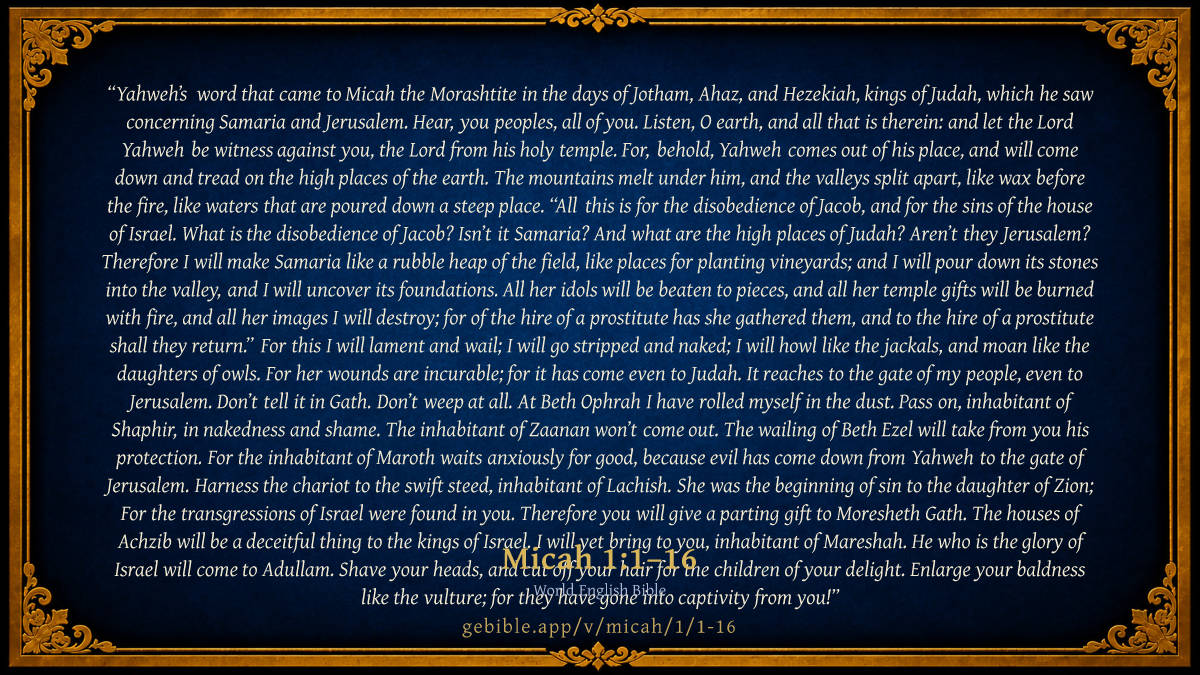
Yahweh’s word that came to Micah the Morashtite in the days of Jotham, Ahaz, and Hezekiah, kings of Judah, which he saw concerning Samaria and Jerusalem.
Hear, you peoples, all of you. Listen, O earth, and all that is therein: and let the Lord Yahweh be witness against you, the Lord from his holy temple.
For, behold, Yahweh comes out of his place, and will come down and tread on the high places of the earth.
The mountains melt under him, and the valleys split apart, like wax before the fire, like waters that are poured down a steep place.
“All this is for the disobedience of Jacob, and for the sins of the house of Israel. What is the disobedience of Jacob? Isn’t it Samaria? And what are the high places of Judah? Aren’t they Jerusalem?
Therefore I will make Samaria like a rubble heap of the field, like places for planting vineyards; and I will pour down its stones into the valley, and I will uncover its foundations.
All her idols will be beaten to pieces, and all her temple gifts will be burned with fire, and all her images I will destroy; for of the hire of a prostitute has she gathered them, and to the hire of a prostitute shall they return.”
For this I will lament and wail; I will go stripped and naked; I will howl like the jackals, and moan like the daughters of owls.
For her wounds are incurable; for it has come even to Judah. It reaches to the gate of my people, even to Jerusalem.
Don’t tell it in Gath. Don’t weep at all. At Beth Ophrah I have rolled myself in the dust.
Pass on, inhabitant of Shaphir, in nakedness and shame. The inhabitant of Zaanan won’t come out. The wailing of Beth Ezel will take from you his protection.
For the inhabitant of Maroth waits anxiously for good, because evil has come down from Yahweh to the gate of Jerusalem.
Harness the chariot to the swift steed, inhabitant of Lachish. She was the beginning of sin to the daughter of Zion; For the transgressions of Israel were found in you.
Therefore you will give a parting gift to Moresheth Gath. The houses of Achzib will be a deceitful thing to the kings of Israel.
I will yet bring to you, inhabitant of Mareshah. He who is the glory of Israel will come to Adullam.
Shave your heads, and cut off your hair for the children of your delight. Enlarge your baldness like the vulture; for they have gone into captivity from you!
John Calvin 1540 · Public Domain On vv1–16 Among the Minor Prophets, Micah comes next, who is…
Among the Minor Prophets, Micah comes next, who is commonly called Micaiah. But he was the second, as they say, of this name; for the first was the Micaiah who had a contest with the wicked king Ahab; and he then exercised his Prophetic office. But the second was in the same age with Isaiah, perhaps a little later: at least Isaiah had been performing his office some years before Micah had been called. It appears then that he was added to Isaiah, that he might confirm his doctrine; for that holy man had to do with ungodly men, with men of a hardened neck, yea, and so wicked, that they were wholly irreclaimable. That their doctrine therefore might be more entitled to credit, it pleased God that Isaiah and Micah should deliver their message at the same time, as it were, with one mouth, and avow their consent, that all the disobedient might be proved guilty.
But I will now come to his words: for the contents of this Book suggest what is useful for our instruction.
Read full note →
This inscription, in the first place, shows the time in which Micah lived, and during which God employed his labors. And this deserves to be noticed: for at this day his sermons would be useless, or at least frigid, except his time were known to us, and we be thereby enabled to compare what is alike and what is different in the men of his age, and in those of our own: for when we understand that Micah condemned this or that vice, as we may also learn from the other Prophets and from sacred history, we are able to apply more easily to ourselves what he then said, inasmuch as we can view our own life as it were in a mirror. This is the reason why the Prophets are wont to mention the time in which they executed their office.
But how long Micah followed the course of his vocation we cannot with certainty determine. It is, however, probable that he discharged his office as a Prophet for thirty years: it may be that he exceeded forty years; for he names here three kings, the first of whom, that is Jotham, reigned sixteen years; and he was followed by Ahab, who also reigned as many years. If then Micah was called at the beginning of the first reign, he must have prophesied for thirty-two years, the time of the two kings. Then the reign of Hezekiah followed, which continued to the twenty-ninth year: and it may be, that the Prophet served God to the death, or even beyond the death, of Hezekiah. We hence see that the number of his years cannot with certainty be known; though it be sufficiently evident that he taught not for a few years, but that he so discharged his office, that for thirty years he was not wearied, but constantly persevered in executing the command of God.
I have said that he was contemporary with Isaiah: but as Isaiah began his office under Uzziah, we conclude that he was older. Why then was Micah joined to him? That the Lord might thus break down the stubbornness of the people. It was indeed enough that one man was sent by God to bear witness to the truth; but it pleased God that a testimony should be borne by the mouth of two, and that holy Isaiah should be assisted by this friend and, as it were, his colleague. And we shall hereafter find that they adopted the very same words; but there was no emulation between them, so that one accused the other of theft, when he repeated what had been said. Nothing was more gratifying to each of them than to receive a testimony from his colleague; and what was committed to them by God they declared not only in the same sense and meaning, but also in the same words, and, as it were, with one mouth.
Of the expression, that the word was sent to him, we have elsewhere reminded you, that it ought not to be understood of private teaching, as when the word of God is addressed to individuals; but the word was given to Micah, that he might be God’s ambassador to us. It means then that he came furnished with commands, as one sustaining the person of God himself; for he brought nothing of his own, but what the Lord commanded him to proclaim. But as I have elsewhere enlarged on this subject, I now only touch on it briefly.
This vision, he says, was given him against two cities Samaria and Jerusalem It is certain that the Prophet was specifically sent to the Jews; and Maresah, from which he arose, as it appears from the inscription, was in the tribe of Judah: for Morasthite was an appellative, derived from the place Maresah. But it may be asked, why does he say that visions had been given him against Samaria? We have said elsewhere, that though Hosea was specifically and in a peculiar manner destined for the kingdom of Israel, he yet by the way mingled sometimes those things which referred to the tribe or kingdom of Judah: and such was also the case with our Prophet; he had a regard chiefly to his own kindred, for he knew that he was appointed for them; but, at the same time, he overlooked not wholly the other part of the people; for the kingdom of Israel was not so divided from the tribe of Judah that no connection remained: for God was unwilling that his covenant should be abolished by their defection from the kingdom of David. We hence see, that though Micah spent chiefly his labors in behalf of the Jews, he yet did not overlook or entirely neglect the Israelites.
But the title must be restricted to one part of the book; for threatenings only form the discourse here. But we shall find that promises, full of joy, are also introduced. The inscription then does not include all the contents of the book; but as his purpose was to begin with threatenings, and to terrify the Jews by setting before them the punishment that was at hand, this inscription was designedly given. There is, at the same time, no doubt but that the Prophet was ill received by the Jews on this account; for they deemed it a great indignity, and by no means to be endured, to be tied up in the same bundle with the Israelites; for Samaria was an abomination to the kingdom of Judah; and yet the Prophet here makes no difference between Samaria and Jerusalem. This was then an exasperating sentence: but we see how boldly the Prophet performs the office committed to him; for he regarded not what would be agreeable to men, nor endeavored to draw them by smooth things: though his message was disliked, he yet proclaimed it, for he was so commanded, nor could he shake off the yoke of his vocation. Let us now proceed —
John Calvin's Commentaries (1540-1563) — public domain. Text from the Calvin Translation Society English edition (1840s-50s) via the Christian Classics Ethereal Library (ccel.org). Calvin's coverage is partial (roughly two-thirds of the Bible); uncommented books and verses are honest gaps, never fabricated. The 19th-century editor's footnotes and remarks are omitted so the notes are faithfully Calvin's own voice.
Geneva Bible translators 1599 · Public Domain On vv1, 2, 3, 5, 7, 10, 11, 12, 13, 14, 15 Born in Moresheth, a city of Judah.
Born in Moresheth, a city of Judah.
Geneva Bible (1599) marginal notes — public domain.
John Trapp 1656 · Public Domain On vv1–16 Mic 1:1 The word of the LORD that came…
Mic 1:1 The word of the LORD that came to Micah the Morasthite in the days of Jotham, Ahaz, [and] Hezekiah, kings of Judah, which he saw concerning Samaria and Jerusalem.
Ver. 1. The word of the Lord, &c.] {See Trapp on "Hos 1:1"}
Read full note →
To Micah the Morasthite] To distinguish him from Micaiah, the son of Imlah, who prophesied in Ahab’s days, over a hundred years before this. Micah the Morasthite, so called from the place of his birth or abode, which is made famous by him (as Abder was by Democritus, Hippo by Austin), and not he by it. Ambrose saith his name signifieth Quis iste? Who is this? Who (saith that father in answer)? not one of the common sort, but an elect vessel to carry God’s name to his people. Jerome, from his title, Morasthite, interpreted, calleth him cohaeredem Christi, co-heir with Christ, of whom and his kingdom he sweetly prophesieth; and may, therefore, be called the evangelical prophet; as was Isaiah, his contemporary, with whom he hath many things common; and this one thing above him, that he nameth Bethlehem, Christ’s birthplace, Mic 5:2, for the which (as well as for his boldness, Jer 26:18) he was famous in the Church, Mat 2:6 Joh 7:42.
In the days of Jotham, Ahaz, Hezekiah] Ahaz standeth between Jotham and Hezekiah, as a thistle or thorn between two lilies, or roses. Manasseh comes after, and degenerates into his grandfather Ahaz. To his time Micah attained not, much less to Josiah’s, as Isidore hath it; for between Jotham and Josiah were a hundred and twenty years at least. It is probable that Micah prophesied forty years, if not more; wherein he saw many changes and met with many molestations; had cause enough to cry out with his colleague, "Who hath believed our report?" "My leanness, my leanness," &c. Yet held he on his course; as being of Latimer’s mind, who, speaking in one of his sermons of a minister that gave this answer why he left off preaching? viz. because he saw he did no good. This, saith Latimer, is a naughty, a very naughty answer.
Which he saw] sc. with the eyes of his mind for the use of the Church; whereto this prophecy comes commended, first, as "the word of the Lord," and, secondly, as extraordinarily revealed to this prophet.
Concerning Samaria and Jerusalem] Samaria seemeth to be first named because most guilty before God. They are yoked together, because there was scarcely ever a better (Aholah and Aholibah, sisters in sin), and one the much worse for the other’s neighbourhood. Jerusalem would take it in high scorn, likely, to be matched with Samaria, so much slighted and shunned by her, Joh 4:9, as Papists now do to be set by Protestants, Turks by Christians (the word of a Mussulman bears down all other testimony among them). But this prophet is very bold (as it is said of Isaiah’s contemporaries, Rom 10:20), binds them both up in one bundle, and spareth not to show Judah their transgressions, and the house of Jacob their sins.
John Trapp, A Commentary or Exposition upon All the Books of the Old and New Testament (1647–1656) — public domain. Text from a community e-Sword module.
Matthew Poole 1685 · Public Domain On vv1–16 The word of the Lord that came: thus Hosea…
The word of the Lord that came: thus Hosea begins his prophecy, Hos 1:1, and Joe 1:1, and Jon 1:, and Zep 1:1, which see.
Micah: though Hierom, Epiphanius, and Dorotheus are said to report this Micah to be the same with the son of Imlah, 1Ki 22:8, yet R. Sol. Jarchi's reason why this could not be is satisfactory, for one generation and almost a half intervened between Ahab and Jotham; Ahab died about A.M. 3046, Jotham began to reign about A.M. 3190, by which it appears there were one hundred and forty-four years between Micaiah the son of Imlah and Micah our prophet.
Read full note →
The Morasthite: whether Mareshah, rebuilt by Rehoboam 2Ch 11:8, (called also Beth-gebarim in after-time,) of which 2Ch 11:14 of this chapter, or whether Moresheth, of which 2Ch 11:15, gave him this surname, and whether because Micah was born there or else did dwell there, is not easily resolved, nor material if it were resolved.
In the days of Jotham: it is not said what year of Jotham this prophet begun, it is probable it was about the beginning of Jotham's reign, A.M. 3190, of which we have this character, 2Ki 15:34,35, He did right, &c., yet the high places were not removed. Religion was not wholly corrupted as in Israel, yet was it exceedingly abased with their own mixtures.
Ahaz; the very worst of all Judah's kings, all things considered; he brought the Baalitical idolatry into Judah.
Hezekiah; the best son of the worst father, who reformed Judah. How long Micah prophesied during his reign we can but conjecture, possibly till the fourteenth year of Hezekiah. So this prophet may be supposed to have prophesied sixteen years in Jotham's time, as many under Ahaz, and fourteen under Hezekiah, in all forty-six years, and survived the captivity of Israel ten years, which he lamented as well as foretold.
Kings of Judah; Judah only named, but Benjamin is included.
Which he saw: see Amo 1:1.
Concerning Samaria; the metropolis of the kingdom of the ten tribes, and by a well-known figure put for the whole kingdom, as Jerusalem, chief city of Judah, is, by the same figure, put for the whole kingdom. As both had linked together in sinning, God doth link them together in suffering, and commands Micah to do so.
Matthew Poole's English Annotations on the Holy Bible (1683–1685) — public domain. Text from a community e-Sword/MySword module.
Matthew Henry 1710 · Public Domain On vv1, 8 Here is, I. A general account of this prophet…
Here is, I. A general account of this prophet and his prophecy, Mic 1:1. This is prefixed for the satisfaction of all that read and hear the prophecy of this book, who will give the more credit to it when they know the author and his authority. 1. The prophecy is the word of the Lord; it is a divine revelation. Note, What is written in the Bible, and what is preached by the ministers of Christ according to what is written there, must be heard and received, not as the word of dying men, which we may be judges of, but as the word of the living God, which we must be judged by, for so it is. This word of the Lord came to the prophet, came plainly, came powerfully, came in a preventing way, and he saw it, saw the vision in which it was conveyed to him, saw the things themselves which he foretold, with as much clearness and certainty as if they had been already accomplished. 2. The prophet is Micah the Morasthite; his name Micah is a contraction of Micaiah, the name of a prophet some ages before (in Ahab's time, Kg1 22:8); his surname, the Morasthite, signifies that he was born, or lived, at Moresheth, which is mentioned here (Mic 1:14), or Mareshah, which is mentioned Mic 1:15, and Jos 15:44. The place of his abode is mentioned, that any one might enquire in that place, at that time, and might find there was, or had been, such a one there, who was generally reputed to be a prophet. 3. The date of his prophecy is in the reigns of three kings of Judah - Jotham, Ahaz, and Hezekiah. Ahaz was one of the worst of Judah's kings, and Hezekiah one of the best; such variety of times pass over God's ministers, times that frown and times that smile, to each of which they must study to accommodate themselves, and to arm themselves against the temptations of both. The promises and threatenings of this book are interwoven, by which it appears that even in the wicked reign he preached comfort, and said to the righteous then that it should be well with them; and that in the pious reign he preached conviction, and said to the wicked then that it should be ill with them; for, however the times change, the word of the Lord is still the same. 4. The parties concerned in this prophecy; it is concerning Samaria and Jerusalem, the head cities of the two kingdoms of Israel and Judah, under the influence of which the kingdoms themselves were. Though the ten tribes have deserted the houses both of David and Aaron, yet God is pleased to send prophets to them.
II. A very solemn introduction to the following prophecy (Mic 1:2), in which, 1. The people are summoned to draw near and give their attendance, as upon a court of judicature: Hear, all you people, Note, Where God has a mouth to speak we must have an ear to hear; we all must, for we are all concerned in what is delivered. "Hear, you people" (all of them, so the margin reads it), "all you that are now within hearing, and all others that hear it at second hand." It is an unusual construction; but those words with which Micah begins his prophecy are the very same in the original with those wherewith Micaiah ended his, Kg1 22:28. 2. The earth is called upon, with all that therein is, to hear what the prophet has to say: Hearken, O earth! The earth shall be made to shake under the stroke and weight of the judgments coming; sooner will the earth hear than this stupid senseless people; but God will be heard when he pleads. If the church, and those in it, will not hear, the earth, and those in it, shall, and shame them. 3. God himself is appealed to, and his omniscience, power, and justice, are vouched in testimony against this people: "Let the Lord God be witness against you, a witness that you had fair warning given you, that your prophets did their duty faithfully as watchmen, but you would not take the warning; let the accomplishment of the prophecy be a witness against your contempt and disbelief of it, and prove, to your conviction and confusion, that it was the word of God, and no word of his shall fall to the ground." Note, God himself will be a witness, by the judgments of his hand, against those that would not receive his testimony in the judgments of his mouth. He will be a witness from his holy temple in heaven, when he comes down to execute judgment (Mic 1:3) against those that turned a deaf ear to his oracles, wherein he witnessed to them, out of his holy temple at Jerusalem.
Read full note →
III. A terrible prediction of destroying judgments which should come upon Judah and Israel, which had its accomplishment soon after in Israel, and at length in Judah; for it is foretold, 1. That God himself will appear against them, Mic 1:3. They boasted of themselves and their relation to God, as if that would secure them; but, though God never deceives the faith of the upright, he will disappoint the presumption of the hypocrites, for, behold, the Lord comes forth out of his place, quits his mercy-seat, where they thought they had him fast, and prepares his throne for judgment; his glory departs, for they drive it from them. God's way towards this people had long been a way of mercy, but now he changes his way, he comes out of his place, and will come down. He had seemed to retire, as one regardless of what was done, but now he will show himself, he will rend the heavens, and will come down, not as sometimes, in surprising mercies, but in surprising judgments, to do things not for them, but against them, which they looked not for, Isa 64:1; Isa 26:21. 2. That when the Creator appears against them it shall be in vain for any creature to appear for them. He will tread with contempt and disdain upon the high places of the earth, upon all the powers that are advanced in competition with him or in opposition to him; and he will so tread upon them as to tread them down and level them. High places, set up for the worship of idols or for military fortifications, shall all be trodden down and trampled into the dust. Do men trust to the height and strength of the mountains and rocks, as if they were sufficient to bear up their hopes and bear off their fears? They shall be molten under him, melted down as wax before the fire, Psa 68:2. Do they trust to the fruitfulness of the valleys, and their products? They shall be cleft, or rent, with those fiery streams that shall come pouring down from the mountains when they are melted. They shall be ploughed and washed away as the ground is by the waters that are poured down a steep place. God is said to cleave the earth with rivers, Hab 3:9. Neither men of high degree, as the mountains, nor men of low degree, as the valleys, shall be able to secure either themselves or the land from judgments of God, when they are sent with commission to lay all waste, and, like a sweeping rain, to leave no food, Pro 28:3. This is applied particularly to the head city of Israel, which they hoped would be a protection to the kingdom (Mic 1:6.) I will make Samaria, that is now a rich and populous city, as a heap of the field, as a heap of dung laid there to be spread, or as a heap of stones gathered together to be carried away, and as plantings of a vineyard, as hillocks of earth raised to plant vines in. God will make of that city a heap, of that defenced city a ruin, Isa 25:2. Their altars had been as heaps in the furrows of the fields (Hos 12:11) and now their houses shall be so, as ruinous heaps. The stones of the city are poured down into the valley by the fury of the conqueror, who will thus be revenged on those walls that so long held out against him. They shall be quite pulled down, so that the very foundations shall be discovered, that had been covered by the superstructure; and not one stone shall be left upon another.
IV. A charge of sin upon them, as the procuring cause of these desolating judgments (Mic 1:5): For the transgression of Jacob is all this. If it be asked, "Why is God so angry, and why are Jacob and Israel thus brought to ruin by his anger?" the answer is ready: Sin has done all the mischief; sin has laid all waste; all the calamities of Jacob and Israel are owing to their transgressions; if they had not gone away from God, he would never have appeared thus against them. Note, External privileges and professions will not secure a sinful people from the judgments of God. If sin be found in the house of Israel, if Jacob be guilty of transgression and rebellion, God will not spare them; no, he will punish them first, for their sins are of all others most provoking to him, for they are most reproaching. But it is asked, What is the transgression of Jacob? Note, When we feel the smart of sin it concerns us to enquire what the sin is which we smart for, that we may particularly war against that which wars against us. And what is it? 1. It is idolatry; it is the high places; that is the transgression, the great transgression which reigns in Israel; that is spiritual whoredom, the violation of the marriage-covenant, which merits a divorce. Even the high places of Judah, though not so bad as the transgression of Jacob, were yet offensive enough to God, and a remaining blemish upon some of the good reigns. Howbeit the high places were not taken away. 2. It is the idolatry of Samaria and Jerusalem, the royal cities of those two kingdoms. These were the most populous places, and where there were most people there was most wickedness, and they made one another worse. These were the most pompous places; there men lived most in wealth and pleasure, and they forgot God. These were the places that had the greatest influence upon the country, by authority and example; so that from them idolatry and profaneness went forth throughout all the land, Jer 23:15. Note, Spiritual distempers are most contagious in persons and places that are most conspicuous. If the head city of a kingdom, or the chief family in a parish, be vicious and profane, many will follow their pernicious ways, and write after a bad copy when great ones set it for them. The vices of leaders and rulers are leading ruling vices, and therefore shall be surely and sorely punished. Those have a great deal to answer for indeed that not only sin, but make Israel to sin. Those must expect to be made examples that have been examples of wickedness. If the transgression of Jacob is Samaria, therefore shall Samaria become a heap. Let the ringleaders in sin hear this and fear.
V. The punishment made to answer the sin, in the particular destruction of the idols, Mic 1:7. 1. The gods they worshipped shall be destroyed: The graven images shall be beaten to pieces by the army of the Assyrians, and all the idols shall be laid desolate. Samaria and her idols were ruined together by Sennacherib (Isa 10:11), and their gods cast into the fire, for they were no gods (Isa 37:19); and this was the Lord's doing: I will lay the idols desolate. Note, If the law of God prevail not to make men in authority destroy idols, God will take the work into his own hands, and will do it himself. 2. The gifts that passed between them and their gods shall be destroyed; for all the hires thereof shall be burnt with fire, which may be meant either of the presents they made to their idols for the replenishing of their altars, and the adorning of their statues and temples (these shall become a prey to the victorious army, which shall rifle not only private houses, but the houses of their gods), or of the corn, and wine, and oil, which they called the rewards, or hires, which their idols, their lovers, gave them (Hos 2:12); these shall be taken from them by him whom (by ascribing them to their dear idols) they had defrauded of the honour due to him. Note, That cannot prosper by which men either are hired to sin or hire others to sin; for the wages of sin will be death. She gathered it of the hire of the harlot, and it shall return to the hire of a harlot. They enriched themselves by their leagues with the idolatrous nations, who gave them advantages, to court them into the service of their idols, and their idols' temples were enriched with gifts by those who went a whoring after them. And all this wealth shall become a prey to the idolatrous nations, and so be the hire of a harlot again, wages to an army of idolaters, who shall take it as a reward given them by their gods. It shall be a present to king Jareb, Hos 10:6. What they gave to their idols, and what they thought they got by them, shall be as the hire of a harlot; the curse of God shall be upon it, and it shall never prosper, nor do them any good. It is common that what is squeezed out by one lust is squandered away upon another.
Matthew Henry's Commentary on the Whole Bible (1708–1710) — public domain (CC PDM 1.0). Text via the HelloAO Bible API.
John Gill 1763 · Public Domain On vv1–16 The word of the Lord that came to Micah…
The word of the Lord that came to Micah the Morasthite,.... So called, either from Mareshah, mentioned Mic 1:15; and was a city in the tribe of Judah, Jos 15:44; as the Targum, Jarchi, Kimchi, and Zacutus (i); or rather from Moresheth, from which Moreshethgath, Mic 1:14; is distinguished; which Jerom (k) says was in his time a small village in the land of Palestine, near Eleutheropolis. Some think these two cities to be one and the same; but they appear to be different from the account of Jerom (l) elsewhere. The Arabic version reads it, Micah the son of Morathi; so Cyril, in his commentary on this place, mentions it as the sense of some, that Morathi was the father of the prophet; which can by no means be assented to:
in the days of Jotham, Ahaz, and Hezekiah, kings of Judah; by which it appears that he was contemporary with Isaiah, Hoses, and Amos, though they began to prophesy somewhat sooner than he, even in the days of Uzziah; very probably he conversed with these prophets, especially Isaiah, with whom he agrees in many things; his style is like his, and sometimes uses the same phrases: he, being of the tribe of Judah, only mentions the kings of that nation most known to him; though he prophesied against Israel, and in the days of Zachariah, Shallum, Menahem, Pekahiah, Pekah, and Hoshea:
Read full note →
which he saw concerning Samaria and Jerusalem; in the vision of prophecy; Samaria was the metropolis of the ten tribes of Israel, and is put for them all; as Jerusalem was of the tribes of Judah and Benjamin, and is put for them Samaria is mentioned first, because it was the head of the greatest body of people; and as it was the first in transgression, it was the first in punishment.
(i) Juchashin, fol. 12. 1. (k) Prolog. in Mic. (l) Epitaph. Paulae, ut supra. (tom. 1. operum, fol. 60. A. B.)
John Gill's Exposition of the Whole Bible (1746–1763) — public domain (CC PDM 1.0). Text via the HelloAO Bible API.
John Wesley 1765 · Public Domain On vv1–16 The title and preface, ver. 1, 2. Warning of…
The title and preface, ver. 1, 2. Warning of desolating judgments at hand, ver. 3-7, The prophet's sorrow, and the general sorrow for them, ver. 8-16.
Hezekiah - The best son, of the worst father. How long Micah prophesied during his reign, we can but conjecture, possibly 'till the fourteenth year of Hezekiah. So this prophet may be supposed to have prophesied sixteen years in Jotham's time, as many under Ahaz, and fourteen under Hezekiah, in all forty-six years. And he survived the captivity of Israel ten years, which he lamented as well as foretold.
John Wesley, Explanatory Notes Upon the Whole Bible (1754–1765) — public domain. Text via the GEBible commentary corpus.
Adam Clarke 1810 · Public Domain On vv1, 2, 3, 5, 6, 7, 8, 9, 10, 11, 12, 13, 14, 15, 16 Chronological Notes relative to this Book
THE BOOK OF THE PROPHET MICAH
Chronological Notes relative to this Book
Read full note →
-Year from the Creation, according to Archbishop Usher, 3254.
-Year of the Julian Period, 3964.
-Year since the Flood, 1598.
-Year from the vocation of Abram, 1171.
-Year since the first celebration of the Olympic games in Elis by the Idaei Dactyli, 704.
-Year from the destruction of Troy, according to the general computation of chronologers, 434.
-Year since the commencement of the kingdom of Israel, by the Divine appointment of Saul to the regal dignity, 346.
-Year from the foundation of Solomon's temple, 262.
-Year since the division of Solomon's monarchy into the kingdoms of Israel and Judah, 226.
-Year since the restoration of the Olympic games at Elis by Lycurgus, Iphitus, and Cleosthenes, 135.
-Year from the foundation of the kingdom of Macedon by Caranus, 65.
-Year from the foundation of the kingdom of Lydia by Ardysus, 49.
-All before this reign concerning Lydia is entirely fabulous.
-Year since the conquest of Coroebus at Olympia, usually called the first Olympiad, 27.
-Third year of the seventh Olympiad.
-Year before the building of Rome, according to the Varronian computation, 4.
-Year from the building of Rome, according to Cato and the Fasti Consulares, 3.
-Year from the building of Rome, according to Polybius the historian, 2.
-Year before the building of Rome, according to Fabius Pictor, 2.
-Year before the commencement of the era of Nabonassar, 2.
-Year before the birth of Christ, 746.
-Year before the vulgar era of Christ's nativity, 750.
-Cycle of the Sun, 16.
-Cycle of the Moon, 12.
-Twenty-first year of Theopompus, king of Lacedaemon, of the family of the Proclidae.
-Twenty seventh year of Polydorus, king of Lacedaemon, of the family of the Eurysthenidae.
-Twelfth year of Alyattes, king of Lydia.
-Fifth year of Charops, the first decennial archon of the Athenians.
-Fourth year of Romulus, the first king of the Romans.
-Tenth year of Pekah, king of Israel.
-Ninth year of Jothan, king of Judah.
CHAPTER I
The prophet begins with calling the attention of all people to
the awful descent of Jehovah, coming to execute his judgments
against the kingdoms of Israel and Judah, 1-5;
first against Samaria, whose fate the prophet laments on the
dress of mourners, and with the doleful cries of the fox or
ostrich, 6-8;
and then against Jerusalem, which is threatened with the
invasion of Sennacherib. Other cities of Judah are likewise
threatened; and their danger represented to be so great as to
oblige them to have recourse for protection even to their
enemies the Philistines, from whom they desired at first to
conceal their situation. But all resources are declared to be
vain; Israel and Judah must go into captivity, 9-16.
NOTES ON CHAP. I
Verse 1. The word of the Lord that came to Micah the Morasthite] For all authentic particulars relative to this prophet, see the preface.
In the days of Jotham, Ahaz, and Hezekiah] These three kings reigned about threescore years; and Micah is supposed to have prophesied about forty or fifty years; but no more of his prophecies have reached posterity than what are contained in this book, nor is there any evidence that any more was written. His time appears to have been spent chiefly in preaching and exhorting; and he was directed to write those parts only that were calculated to profit succeeding generations.
Adam Clarke's Commentary on the Bible (1810–1826) — public domain. Text from a community e-Sword/MySword module.
Joseph Benson 1811 · Public Domain On vv1, 2, 5, 6, 8, 10, 13, 16 Mic 1:1. In the days of Jotham, Ahaz, and…
Mic 1:1. In the days of Jotham, Ahaz, and Hezekiah — Micah is thought to have prophesied about sixteen years in Jotham’s time, as many under Ahaz, and fourteen under Hezekiah: in all, forty-six years. And he survived the captivity of Israel ten years, which he lamented as well as foretold. Which he saw concerning Samaria and Jerusalem — Concerning both the kingdoms of Israel and Judah, whereof Samaria and Jerusalem were the capital cities. It is said, Which he saw, &c., because the prophets having the general name of seers, every kind of prophecy, in whatever way delivered, seems to have been generally called a vision.
Joseph Benson's Commentary on the Old and New Testaments (1811–1818) — public domain. Text from a community e-Sword module.
Albert Barnes 1834 · Public Domain On vv1–16 The word of the Lord that came to Micah…
The word of the Lord that came to Micah ... which he saw - No two of the prophets authenticate their prophecy in exactly the same way. They, one and all, have the same simple statement to make, that this which they say is from God, and through them. A later hand, had it added the titles, would have formed all upon one model. The title was an essential part of the prophetic book, as indicating to the people afterward, that it was not written after the event. It was a witness, not to the prophet whose name it bears, but to God. The prophet bare witness to God, that what he delivered came from Him. The event bare witness to the prophet, that he said this truly, in that he knew what God alone could know - futurity. Micah blends in one the facts, that he related in words given him by God, what he had seen spread before him in prophetic vision. His prophecy was, in one, “the word of the Lord which came to him,” and “a sight which he saw.”
Micah omits all mention of his father. His great predecessor was known as Micaiah son of Imlah. Micah, a villager, would be known only by the name of his native village. So Nahum names himself “the Elkoshite;” Jonah is related to be a native “of Gath-hepher;” Elijah, the Tishbite, a sojourner in the despised Gilead 1Ki 17:1; Elisha, of Abelmeholah; Jeremiah, of Anathoth; forerunners of Him, and taught by His Spirit who willed to be born at Bethlehem, and, since this, although too little to be counted “among the thousands of Judah,” was yet a royal city and was to be the birthplace of the Christ, was known only as Jesus of Nazareth, “the Nazarene.” No prophet speaks of himself, or is spoken of, as born at Jerusalem, “the holy city.” They speak of themselves with titles of lowliness, not of greatness.
Read full note →
Micah dates his prophetic office from kings of Judah only, as the only kings of the line appointed by God. Kings of Israel are mentioned in addition, only by prophets of Israel. He names Samaria first, because, its iniquity being most nearly full, its punishment was the nearest.
Albert Barnes' Notes on the Bible (1834–1885) — public domain. Text from a community e-Sword/MySword module.
Haydock's Catholic Bible Commentary 1859 · Public Domain On vv1–16 Morasthite, "of Maresa," (Chaldean; chap. i. 14.; Calmet) a…
Morasthite, "of Maresa," (Chaldean; chap. i. 14.; Calmet) a village near Eleutheropolis. (St. Jerome) --- Kings. They reigned about sixty years. (Calmet)
George Leo Haydock (1774–1849), Haydock's Catholic Family Bible and Commentary, 1859 edition — public domain. Excludes Psalms (Douay-Rheims chapter numbering differs from Protestant) and Deuterocanonical books (Catholic canon only).
Lange's Commentary on the Holy Scriptures 1864 · Public Domain On v1 Micah 1
FIRST DIVISION
FIRST DISCOURSE
Read full note →
Micah 1
1 Word of Jehovah, which came to Micah the Morasthite, in the days of Jotham, Ahaz, Hezekiah, kings of Judah, which he saw concerning Judah and Jerusalem.
2Hear, all ye peoples,
Attend, O earth,1 and all that is therein!
And let the Lord, Jehovah, be a witness against you,
The Lord from his holy temple.
3 For, behold Jehovah cometh forth out of his place,
And cometh down, and treadeth on the high places of the earth.
4And the mountains melt under him,
And the valleys cleave asunder,
As wax before the fire,
As waters poured down a descent.
5For the transgression of Jacob is all this,
And for the sins of the house of Israel.
Who is the transgression2 of Jacob?
Is it not Samaria?
And who are the high places of Judah?
Are they not Jerusalem?
6 And I3 will make Samaria a heap in the field,
Plantations of vines;
And will pour down into the ravine the stones thereof,
And lay bare her foundations.
7 And all her carved images shall be broken in pieces,
And all her hires be burned with fire;
And all her idols4 will I make a desolation:
For from the hire of a harlot has she gathered,
And to the hire of a harlot shall they return.
8 For this let me wail and howl,
Let me go stripped and naked;
I will make a wailing like the jackals, And a mourning like the ostriches.
9 For deadly are her wounds;
For it has come unto Judah:
He has reached unto the gate of my people, unto Jerusalem.
10 In Gath [Annunciation5] announce it not;
In Acco6 [vale of tears] weep not;
In Bethleaphra [Dusthouse] I wallow in the dust,
11 Pass on with you, inhabitant of Shaphir [Fairview],
In shameful nakedness.
The inhabitant of Zaanan [Outlet] goeth not out;
The wailing of Beth-ezel7 [house of separation]
Taketh from you its standing-place.
12For the inhabitant of Maroth [Bitterness] is anxious about good,
For evil has come down from Jehovah,
To the gate of Jerusalem.
13 Bind the chariot to the courser, inhabitant of Lachish;
The beginning of sin was she to the house of Zion;
For in thee were found the transgressions of Israel.
14 Therefore must thou give a release8
For Moresheth-gath [Gath’s possession];
The houses of Achzib [Place of deceit]9 shall be a deception
To the kings of Israel.
15Yet will I bring an heir to thee
Inhabitant of Mareshah [Possession];10
To Adullam will come the glory of Israel.11
16 Make ihee bald and shave thy head,
For the sons of thy delight;
Enlarge thy baldness as the eagle;
For they are carried away from thee.
EXEGETICAL AND CRITICAL
The Judgment upon Samaria and the land of Judah. Concerning the inscription and the date of the writing, see the Introduction.12 The event fore told is, evidently, in the immediate historical sense, besides the capture of Samaria (Mic_1:6), the. expedition which, after this conquest, the Assyrian king (Salmanasar, [Shalmanezer,] or Sargon) sent out, under his general Tartan, against Philistia and Egypt (Isaiah 20 :), and which sorely wasted Judah (Mic_1:9 ff.). The same fact formed the subject also of the prophecy of Isa_5:5 ff., with which ours has otherwise much similarity (cf. also on Mic_1:10).
The discourse, in a rapid but beautiful flow, runs through a great circle of thought. Its structure is outwardly characterized by several leading themes which are expressed in brief sentences of lively rhythm, and about which as fixed centres the discourse revolves (5 b, 9 b, 12 b). It thus fells, in respect to its contents, into two main portions, each of which has an exordium and two subdivisions:
1. The threatening of the destruction of Ephraim, Mic_1:2-7.
(a) Exordium, Mic_1:2.
(b) General threatening, Mic_1:3-5.
(c) Special threatening, Mic_1:6-7.
2. The lamentation over the chastisement of the land of Judah, Mic_1:8-16.
(a) Exordium and new theme, Mic_1:8-9.
(b) Song of lament, Mic_1:10-12.
(c) Particular description, Mic_1:13-16.
In form, we clearly distinguish the two parts, symmetrical in the number (25) of their members, Mic_1:2-7; Mic_1:10-16, from the lyrical part thrown in between Mic_1:8-9.
1. The threatening, Mic_1:2-7. The exordium, Mic_1:2, attaches itself directly through the exclamation: Hear ye peoples all,13 to the discourse of Micah’s namesake in the Book of Kings (1Ki_22:28), with whom our author had the common fate of being compelled to encounter false prophets (compare Mic_2:11, with 1Ki_22:23). In other respects also our Micah coincides frequently with the Book of Kings. Compare the allusion Mic_6:16 the phrase m Mic_4:4, with 1Ki_5:5; 1Ki_4:13-14, with 1Ki_22:11; 1Ki_22:24; the mode of writing אָבִֽי (instead of אָביא), Mic_1:15, with 1Ki_21:29; so that even Hitzig cannot shut out the perception that the historical sources of that book must have lain before him to read. Whether the address עמים dedenotes merely the tribes of Israel, or all nations, is hard to decide. For the former view speaks not only the further tenor of the discourse, which is directed to Israel alone, but also the parallel Deu_32:8. For, towards the game snug of Moses, the subsequent sentences of this exordium point hack (as indeed that song sounds on through the whole course of prophecy); Attend, O land and its fulness. Cf. Jer_22:29; Jer_8:16. Micalt expressly addresses the land alone, and omits the addition commonly made to the other repetitions of this phrase, “and O ye heavens,” which would give to ארצ the signification “earth:” there is the same limitation to Israel as in ammim. The land is appealed to, as in the first of the passages cited from Jeremiah 14 not, as in Isa_1:2, as witness of a judgment, or, as in Ps. I. 4, a messenger; but Jeliovan’s complaints begun in the very address; give attention, and let the Lord Jehovah become a witness against you;בּ in a hostile sense, as 1Sa_12:5; Mal_3:5; the lord, irotn his holy temple; whence all his holy and powerful announcement go forth over the land (Amo_1:2). The temple is emphatically a temple of the holiness of Jehovah, because by the massacres and deeds of judgment which proceed from it does He show hims’df as the Holy One, (Isa_5:16).
Mic_1:3-5. The Testimony itself. Jehovah will in person, and that soon (part. c. הִנֵּה), appear in a theophany (Psa_18:50) for judgment. for behold Jehovah conies forth out of His place. From the temple proceeds the discourse of God, his appearance from heaven, for there He has his habitation (Psa_2:4); and comes down and treads oa the heights of the earth, i.e., the mountains (Mic_1:4), which are nearest to heaven, and the highest of which, Sinai, saw the first theophany of God concerning his people (Deu_33:2; Hab_3:3). The word בָּמְהֵָי is, according to the constant reading of the Keri, regarded and pointed as plural of an obsolete form בֹּמֶת, while the Kcthib everywhere reads בָּמֹתֵי, or בָּמוֹתֵי, a double plural of בָּמָה (Gcs. § 87, 5, Rem. I).
Mic_1:4. And the mountains melt under him, and the valleys cleave asunder as the wax before the fire, as water poured down a descent. The description rests as in other places, on the analogy of a tempest, when the mountains are veiled in clouds, and the earth, dissolved into flowing mud, pours down so that deep gullies are torn through the plains (Jdg_5:5). Mountain and valley, height and depth are, furthermore, a more I comprehensive expression for the shaking of the whole land. The two comparisons, c, d, have the down rushing torrent of water for their object; the first is proper and one often employed (Psa_68:3), the second comes back to the reality; the כְּ is often (pleonastically) used in such comparisons also (Isa_1:7; Isa_14:19). As salvation comes amid the peacefulness of surrounding nature (Isaiah 11 :), so the judgment with prodigious disturbances of the natural course of things (Mat_24:7; Mat_24:29); for it is the consequence of sin, which has broken up the harmony of the world.
Mic_1:5 connects this representation with its ground in the present state of things, For the transgression of Jacob is all this, and for the sins of the house of Israel. “בּ pretii, compare e.g., 1 Sam. 3:27, 30. “Hitzig. “House” is, as often, collective for “sons.” But the discourse does not pause with even this statement; it proceeds to a more exact indication in the decisive sentence 5 b: Who is the transgression of Jacob? Is it not Samaria? In Samaria sin has reached such a climax that it has become the substance of the popular life, and from the capital outward has poisoned and polluted all the land (Hos_6:10). And already from this point forward the light is thrown in a striking parallel on the sin and fate of Judah, to which principally he will later turn: and who are the heights of Judah? Is it not Jerusalem? Jerusalem is a prominent city; the hills on which it lies should be sanctuaries of God (Psa_99:9), but as it now stands, the eternal heights have, through idolatry, become Bamoth (Eze_36:2) sensu odioso, i. e., hieh places for idols (1Ki_15:14).
It is accordingly not doubtful on whom the judgment of God must take effect. First Samaria: Mic_1:6-7. Therefore will I make Samaria a heap in the field, plantations of vines:i. e., not merely lay it in ruins (Hos_12:12), but make it waste for so long a time that husbandmen shall devote the depopulated region to tillage, and convert the fertile territory (Isa_28:1) into a vineyard; and pour down the stones of it into the valley, down from the hill on which it lay (Amo_6:1) (Robinson, Bib. Res. in Pal., 3:138 ff., 1st ed.; cf. Joseph., Ant., 13:10, § 3), and lay bare its foundations, i.e., destroy it to the very ground (Fs. 137:7). “The whole mountain on which the ancient city lay is now cultivated to the summit, but in the middle of it, on the field, a heap of ruins is to be seen, and not far off lies a miserable village, Jabustiah." Quandt.
Mic_1:7. And all her carved images (פּסל, Exo_34:1) shall be broken in pieces; and all her hires be burned with fire. Hires (of harlotry) are primarily the consecrated offerings lavished on the idol altars, by which the preparations for the service were maintained (Ros., Casp., Keil); for, since God is the rightful husband of Israel (Hos_2:18 ff.), idolatry is whoredom (Hos_9:1). But they are also all the possessions of the city, because she looks upon her riches not as the gift of God, but of the idols, her paramour (Hos_2:7; Hos_2:15), (Hitzig). And all her idols will I make a desolation. For from the hire of a harlot has she gathered, and to the hire of a harlot shall they return: become a prey to other idolaters, who will devote these things again to their idols, שׁוּב, as in Gen_3:19.
2. The lamentation, Mic_1:8-16. Already in Mic_1:8, the prophet turns and prepares the transition Mic_1:8-9, to the new discourse, which according to 5 b is directed against Judah. For, that the complaint has reference specially to Judah appears from the connection and contents of what follows. It belongs to the theanthropic element in the nature of prophecy, that the prophets, on the one hand, standing above the people, utter with seeming mer-cilessness the decrees of God’s justice, while on the other, as members of the people, they enter sym-pathizingly into the deepest popular suffering. Therefore let me lament and wail, let me go stripped and naked.אילכה has the incorrect scriptio plena, like Psa_19:14; Exo_35:31; שֵׁילל, from the stem שׁלל, after the formation הֵירָר (Isa_16:9), signifies robbed, spdiatus; the Masoretes have without reason substituted another form שֹׁלָל, after Job_12:17. Wherein the robbery consists is shown by the addition: naked, i. e. without the over garment (1Sa_19:24). The prophet’s complaint also is symbolical prophecy; when he represents his nakedness as robbery it becomes the emblem of the fate of his people (cf. Isa_20:3 ff.). I will make a complaint like the jackals, and a mourning like the ostriches. In Job_30:29, also these animals appear as types of the cries of pain.
Mic_1:9. For deadly are her wounds [lit., “the strokes” inflicted upon her]. The plural מַכּוֹת is construed with the fem. sing, of the predicate according to Ew. 317 a [Ges. § 147 b] There is implied in the subject the thought that the sad fate comes from God, is from above; in the pred., the common comparison of public calamities to diseases. (Isa_1:5 ff.) The suffix to מכות takes the place of a genit. obj.; it refers to Samaria. The prophet mourns so bitterly over the afflictions appointed to Samaria, because they are deadly; and deadly for all Israel; for they come even to Judah; HE (Jehovah, cf. Job_3:20) reaches even to the gate of my people, to Jerusalem. Therefore are the wounds deadly, because they strike the heart of the land and the seat of the sanctuary; and yet according to Mic_1:5 b, it cannot be otherwise. The gate is, in eastern countries, the place of solemn assembly: hence Jerusalem is called the gate of God’s people, because there Israel held his solemn courts (Isa_33:20). Notice the affecting increase of intensity in the discourse, which reaches its climax, in the last clause of verse ninth. With this the theme is given also of the new turn to the thought, and now begins,—
Mic_1:10, the proper lamentation itself. Following a view common in the O. T. (Psa_25:3; Lam_2:17), he thinks first of the malicious joy of their heathen neighbors. In Gath announce it not, the Philistine city on the northwest border of Judah. With this expression the prophet recalls an earlier occurrence, David’s lamentation over the death of Saul and Jonathan (2 Sam. i. 20). The paronomasia which he finds in the words of the song—for גּת may be regarded, like לת1Sa_4:19, as an infinitive from נּגד—gives him occasion to repeat this figure to the end of the chapter, in ever new applications. (Compare the translation, where the paronomasia is indicated mostly alter the manner of Riickert).15 The very next member shows another instance of this play on words. The present text seems indeed to be capable of meaning only: Weep not. But in the apparent inf. abs. בָּכוֹ, there lurks (as Reland, Pal. Illustr., 534 flf., first perceived) a contraction בְעַכּוֹ: in Acco weep not. Acco is the later Ακη or ΙΙτολεμαΐς, a city of the Canaanites lying northward on the coast (Jdg_1:31). That such contraction in fact exists is proved by a comparison of the LXX: who, according to the common reading of the Vatican, translate οἱ Ἐνακειμ, with the statement in Euseb. (Onomast., ed. Larsow, p. 188), that in Micah, a city named Ἐνακείμ is mentioned. This can refer only to the passage before us, and the statement in Eusebius rests evidently on the LXX: But the word Ἐνακείμ which they offer is nothing. The Enakites, of whom alone they could be thinking, did not, according to Jos_11:21, dwell so far up as Acco, and are besides always called Ἐνακίμ or υἱοὶ Ἐνάκ by the LXX: Hence the Alexandrian reading οἱ ἐν Αχείμ is evidently preferable. (Some MSS. and the Aldina read ἐν Βαχείμ, not understanding the contraction, and regarding the בְּ as belonging to the name). In Ἀχείμ, Ἀκείμ, then, we have the name of a city, especially if with Hitzig we assume that it was originally ἐν Ακει, and that the μ has been drawn back by mistake from the following μη.—For our explanation speaks first, the fact that thus the parallelism is completely established, and the grammatical impossibility of connecting an inf. abs. with אל instead of לא is avoided. And secondly, that the contraction is possible is proved by the analogous examples נִשׁקָה for נשׁקעה, Amo_8:8; בִּי for בָלָה ׃ בְּעִי for בּעלה, Jos_19:3; Jos_15:29, and the altogether analogous לָמוֹPsa_28:8, for לְעַמּוֹ, the replacement of the sharpened syllable by the lengthening of the vowel being a familiar fact. Finally, that it was necessary, when a paronomasia obvious to the ear was aimed at, is obvious.
After the malignant triumph of their enemies, the prophet sees next the sorrow of his fellow-countrymen. A series of devastated places meets the eye of the seer, and their names become to him the texts of his lamentation and gloomy previsions. Whether the designation of the places is connected, as in Isaiah 10 :., with the route of the hostile army is, owing to their generally more or less questionable position, and to the absence of any such express intimation as we have in Isaiah, very doubtful. So much at least is clear, however, that the territory in which the places named are contained reaches but a little beyond Jerusalem on the east, while westwardly it stretches to the border of the Philistines at Gath; that, accordingly, just such cities are named as must naturally be most harmed by an army streaming over Judith upon Philistia. The preterites are prophetic.16For Bethleaphra, on account of the misfortune of the Benjamite city Ophra, (Jos_18:23), not far from Jerusalem, I scatter dust on myself [better, “roll myself in the dust”], in token of deep affliction; cf. Jer_6:26, in accordance with which passage the useless correction of the margin is here made. Verba sentiendi are construed with בּ (Ew. § 217 f. 2 B.) [Ges. s. v. B. 5 c]; בּית is an addition to names of places which may also be omitted (cf. ver. below, and Ges., Thes., 193).
Mic_1:11. Set out on thy journey inhabitant of Shafir (pleasantness) in shameful nakedness. The dat. eth. לכם is in the plural because ישׁבת here, and in all the following verses is understood collectively; עבר stands here, as in Exo_32:27, in antithesis to שׁוּב: depart, go away. Shaphir lay, according to the Onom., near Eleu-theropolis, and is perhaps identical with the Shamir, Jos_15:48, which was on the southwest of the mountain of Judah, עריה בשׂת nakedness-shame = shameful nakedness, is a compound idea, like Psa_45:5, humility-righteousness, and stands in ace. adv. (cf. Pro_31:9.
The meaning of what follows becomes plain when once we take מספּד as an ace. of direction, as it often stands with יצא (Gen_27:3; 1Ch_5:18). Not the inhabitant of Zaanan (departure) shall go forth for mourning at Bethhaezel [Kleinert, Nimmhausen; Ges , Fixed hoise]. Zaanan is perhaps the Zenan mentioned in Jos_15:37, in the western lowland, and Bethhaezel (cf. on Mic_1:10) the Azel named by Zech. (Zec_14:5), which lay at the foot of Mount Olivet,and had gained, according to that passage, a mournful celebrity in the days of Uzziah, not long before Micah’s time, from the fact that the people took refuge there in a great earthquake. There seems to have been an annual mourning held at that place, as was usual in commemorating such national calamities (Zec_12:11). This, according to our verse, can no more be the case with the cities of Judah, for which Zaanan, on account of the paronomasia, is made a representative, for he, who executes the judgment, as Mic_1:9, takes away from you his (Ezel’s) stations. It is carried away according to God’s appointment, by the enemies’ hand. Herein also lies a paronomasia, because אצל as well as לקת means: to take away. Hitzig translates: Zaanan goes not forth because the lamentation of the neighborhood takes away from you its standing-place. Umbreit: The grief of Bethhaezel turns away its places for you. Keil: The cry of Bethhaezel takes away from you the standing with it. [Maurer: "Planclus Bethaezel, i. e., quod oppressi ab hostibus tenentur Bethhaezelenses, id aufort vobis hospitium ejus, facit ut nullum ibi refugium haheatis."]17
Mic_1:12. for—as leading sentence must be supplied all along, from Mic_1:8, “I cannot”—the inhabitant of Maroth [bitterness] writhes in pain because of the [lost] prosperity. Maroth, a village, as the mention of it in connection with Ezel shows, lying near Jerusalem; otherwise of no significance. לְ before the object of emotion (Ew. 217 d. 2 c). For, so the discourse turns, with a resumption of the main theme from Mic_1:9, to its last division, evil conies down from Jehovah unto the gate of Jerusalem.
In place of the sympathizing lamentation we have again, as at the beginning, the prophetic threat, first in the indirect, imperative form, so that actions are enjoined upon the object of the threatening, which must come as immediate effects of the threatened, judgment (Isa_2:10); Mic_1:13. Harness the chariot to the courser,inhabitant of Laehish, to escape, namely, from the punishment. The play upon words here lies in the homophony of the roots רכשׁ and לכשׁ. Lachish, a fortified city, not far from Eleutheropolis, still remaining as a ruin under the name of um Lakis. The beginning of the sin was it for the daughter of Jerusalem, for the population of Jerusalem, that in thee were found the transgressions of Israel, i. e., the idolatry of the ten tribes, which had, accordingly, first found admission at Laehish, and from thence had inundated Judah (Mic_6:16).
Mic_1:14. Therefore wilt thou give the release upon Moresheth Gath. Laehish is no longer addressed, as the connection shows, but Israel, which throughout, even in Mic_1:6, is the object; and לכן is, as frequently, a free connective. At the marriages of princes a dowry was given, and this is expressed by נָהַן שִׁלּוּתִים (1Ki_9:16); this Israel gives to the enemy in the form of Moresheth—although certainly not freely renounced. But there lies at the same time in the idea of שִׁלּוּתִים the side thought that one divorces himself from the abandoned property, Jer_3:8 (Hitzig). Hence also the play on the words: the homophonous מֹארָשָׁה signifies the betrothed (Deu_32:23). On Moresheth-Gath, i.e., Moresheth near Gath, the home of the prophet, which likewise lay in the southwest portion of Judah, cf. the Introd. 2. The houses of Achzib [deception] will become a deceitful brook to the king of Israel.אַכְזָבִים, are brooks which dry up in the summer, and deceive the thirsty wayfarer who knowing their site, goes in search of them (Jer_15:18; Job_6:15 ff.; Psa_126:4). Like them will Achzib slip from the hands of the kings of Israel, i. e., those of Judah, for after the destruction of Samaria, the kingdom of the ten tribes has ceased. The city lay, like the others, in the lowland of Judaia (Jos_15:44); now the ruins Kussabeh.
Mic_1:15. I will moreover bring (אָבִי instead of אביא, as in 1Ki_21:29,) the conqueror upon thee, inhabitant of Mareshah (conquered town). Maresha near Achzib (Jos_15:44) is the present Marasch (Tobler, Dritte Wanderung, p. 139, 142 f.); even to Adullam (Jos_12:15; Jos_15:35) northward from Maresha, but not discovered as yet, shall the nobility (Isa_5:13) of Israel come, namely, to hide themselves in the mountain caves there, in which David once sought refuge from Saul (1Sa_22:1).
The prophet has named twelve cities of Judah, six in the lamentation, and six in the threatening, and, still further intensifying his lament, closes the whole, Mic_1:16, with an address to the mourning mother, Israel, who must see her children dragged away into exile (Jer_31:15; Isa_3:26). Make thee bald and shear thy head—in spite of the prohibition, Deu_14:1, this had remained a common sign of sorrowful lamentation for the dead (Jer_26:6; cf. Job_1:20; Isa_15:2)—for the sons of thy delight; enlarge thy baldness like the eagle (the giiffin vulture is meant, which is often met with in Egypt and Syria, and has the whole forepart of the head bare of feathers); for they are carried away from thee, led away captives.
DOCTRINAL AND ETHICAL
Very differently goes the course of the two sister kingdoms (cf. Ezek. Micah 23:.), and yet goes with both to the same destruction. The sacred heights, on which the Lord will set his foot when He comes down to his people, have become in Judah also heights of corruption. What has she now of advantage over her apostate sister, Samaria, whom yet the Lord had let go her own way (cf. Romans 3 :)? She has„indeed, much still; she has the-holy temple, the fountain of God’s holy ordinances, and with that the certainty that God cannot allow her to be utterly destroyed, although ho has overthrown Samaria to the very foundation. But through judgment must Judah pass like Samaria; the holy ordinances profit not the sinful generation to whom they have become a dead and despised possession (cf. 2Ma_5:19 f.). Nay, such a possession insures to the people among whom it exists, a serious trial, for God’s holiness, proceeding from the “Temple of his i holiness,” is a beaming light which becomes a consuming fire when it finds no longer life but death I round about it (Isa_10:17). All the names of auspicious presage become then omens of judgment. For, as sin is the distortion of that which should be between man and God, the judgment is the turning straight again of that which has been turned awry (Psa_18:27 b). Israel, the mother who parted from God (Hos_2:8), has neglected her children; therefore will she have no friends in these children, but in her widowhood be also childless. Where the churches become empty the church herself is to blame for it.
Hengstenberg: The discourse, beginning with the general judgment of the world, turns suddenly to the judgment upon Israel. This is to be explained only from the relation in which the two judgments stand to each other, they being in essence completely the same, and different only in space, time, and unessential circumstances; so that one can say, that in every partial judgment upon Israel there is the world-judgment. Here, as always in the threatenings of the prophets, we must take care that we do not, in a particular historical event, lose sight of the animating idea. Let this be rightly apprehended, and it will appear that a particular, historical occurrence may indeed be specially intended, but never can exhaust the prediction; that in this passage also we ought not, on account of the primary reference to the Chaldtean (?) catastrophe, at all to exclude that in which, before or afterward, the same law was realized.
Rieger: From the (threatening) nature of the time we may most easily perceive the purport and aim of such prophecies, namely, to rebuke the then prevailing sins, to announce the judgment of God on account of them, but ever also to bring forward the promises of Christ, and thus to call to repentance; most especially to support believers, that they may find effectual comfort in the general disorder, and abide in patient waiting for the kingdom of God and Christ. Nay, when many were first awakened from their sleep under the punishment of their sins, they would be turned by words of this kind to their covenant God, and not despair of his promise.
On the Fulfillment. Keil: Micah prophesies in this chapter, for the most part, not particular definite punishments, but the judgment in general, without precise indications as to its accomplishment, so that his prediction embraces all the judgments against Judah which took place from the Assyrian invasion on until the Roman catastrophe.
HOMILETICAL AND PRACTICAL
The judgment must begin at the house of God.
1. It must begin, for God, the injured One, is Judge of the, world; Mic_1:2-4.
2. It must begin at the house of God, i. e., at the congregation of his people. For -
(a) He has here his seat and place; yer. 2.
(b) Upon this his eye first falls when He comes to judge the whole earth; Mic_1:3.
(c) Here is the right knowledge of God, to have fallen away from which to idolatry is a peculiar guilt; Mic_1:5 b, 7.
3. In the congregation, moreover, it strikes all; Mic_1:8-16.
(a) Not the godless only but the pious also, who see it come and must share in the sorrow and lamentation; Mic_1:8-9.
(b) Not merely the capital, but all places are stations and signs of the judgment; Mic_1:10-15.
(c) Not merely the sin itself, but the generation that practice it must away to the place of punishment; Mic_1:16.
Mic_1:2. When Jehovah speaks, the whole land must tremble. Land and people belong together, and He smites both, the field for man’s sake (Gen_3:17). Hence the creation also siahs for the redemption which comes to it too with the glorious liberty of the sons of God (Rom_8:19).
Mic_1:3. Jehovah is not a God afar off but always going forth out of his holy places to see and to judge what is on the earth.
Mic_1:4. His holy congregation lies so near his heart that for their sake he shakes the earth. Mic_1:5. Great cities, great sins (Gen_4:17; Isa_14:21).
Mic_1:6. When man builds without God, let it be ever so firmly fastened with stones to the strongest ground, the storm breaks from above, lays bare the foundation, and hurls the stones asunder. The best established church-system, when it becomes essentially sinful, is, in God’s hands, a spider’s web. The judgment deeds of God are declarative; while He lays bare the ground, He shows that it is sinful, and with that the annihilation is pronounced.
Mic_1:8. God’s spirit in the congregation itself sympathizes with, when it must punish, the congregation. His righteousness is a self-infliction upon his love.
Mic_1:13. God retains accurately in mind the individual responsibilities and the starting-points of sin. Popular sins proceed from certain places, from certain classes, out over the whole; the whole is judged, but the root is not forgotten.
Theophylact (on Mic_1:1) : The prophets spoke to hard and disobedient hearts; hence they said: The vision is divine, and from God is the Word; thatthe world might give heed to the Word, and not despise them. Matthew, however, spake to believing and obedient souls, and therefore placed nothing of this kind at the beginning. Or thus: The prophets saw in the spirit what they saw, since the Holy Spirit made the exhibition, and so they named it, a vision. But Matthew saw it not spiritually and in a representation, but had bodily intercourse with Him, heard Him by the senses, saw Him in the flesh; therefore he says not “vision,” but Book of the generation of Jesus Christ.
Osiander (on Mic_1:3) : At the present day it is not necessary in preaching to call persons and places by name, in which we must proceed very prudently, in order not to tear down more than we build up; and yet the preacher may use such freedom and plainness in indicating errors and vices that those who need improvement may feel themselves aimed at, and repent and be saved.
Hengstenberg (on Mic_1:11): The instances of play upon words are no mere empty sport. They have throughout a practical aim. The threatening is to be located by them. Whoever thought of one of the designated places, in him was the thought of the divine judgment quickened.
Ch. B. Michaelis (on Mic_1:12): From Jehovah, he adds to make it plain that the calamity came not by blind chance, but was brought about by the supreme control of God, the righteous Judge.
Starke: Mic_1:1. Teachers must have a regular call, partly because of the divine command (Heb_5:4), partly for the sake of order (1Co_14:40). Preachers must not preach differently from God’s Word (1Pe_4:11). Those who practice like sins may expect like punishments
Mic_1:2. The Lord be a witness in you; let the Lord bear witness in you. For he who takes to heart the word concerning the judgment is convinced of his sins thereby, and feels the wrath of God. Even yet also God always puts in the mouth of his servants what He has to speak to his people, especially when teachers and hearers heartily call upon Him for this.
Mic_1:3. So secure is the natural man, that he perceives not God’s presence, nay even denies it, until He finally makes his presence known by notable punishments. God descends not actually, or as it regards his being, but He ceases to conceal himself, to be long-suffering, and begins to punish sin, to reveal and expose it. He assumes in effect another kind of presence.
Mic_1:5. God pours not out his anger upon innocent people. "Desine peccare et civitas non peribit" (Ambros.). Divine services set up without God’s word, although with good intention, are an abomination before God. And,
Mic_1:6, God’s judgments against the false systems of worship are terrible; for He is jealous of his own honor.
Mic_1:7. Idolaters have in general more of worldly goods than those who serve the true God.
Mic_1:10. It is often advisable to withhold our tears that the world may not rejoice over our misfortune. If one will weep he must do it before the outbreak of judgments, for when they are already here it is too late.
Mic_1:11. When God will punish a land for its sins He takes away their courage from the people.
Mic_1:12. That is the way of most men : that they mourn over the loss of their goods but not over their sins. On account of their bodily troubles, also, the righteous sometimes fall into great sorrow and fear.
Mic_1:13. Offenses given remain not unpunished.
Mic_1:14. Well may a stronghold proudly bear the name of deception, when it with its walls and good preparations causes the besiegers to be deceived in their hope. Princes should not trust in strong castles and towns, because they may be disappointed in them.
Mic_1:16. Those who give themselves up to luxury are at last given up to miserable slavery. When a man makes his children effeminate, he makes for himself grief and heart-pangs.
Pfaff: Mic_1:1. Think not, ye great sinners, that the word of the Lord which was formerly spoken concerning the Jews is of no concern to you, it is written for your punishment also.
Mic_1:2. When the Lord speaks we should listen, yea, and give good heed : with great reverence, with all humility, with fear and trembling, with most willing obedience.
Mic_1:8. God’s servants properly mourn over the wretched condition of their congregations. It would indeed be a poor promise of their doing anything to improve them if they did not pour out their tears before God, and if it did not touch their heart that the people are drawing near to their judgment.
Rieger: Even to the last (Micah lived still after the fall of Samaria), God shows that He has no pleasure in the death of the sinner, but, before the outbreak of such judgments, seeks once more by his word to save what can be saved. But He teaches us also that we should not, from the riches of his word, the crowd of gifted servants of God, the earnestness with which they urge the word of the Lord, be drawn into security, nor suppose ourselves on these accounts far from the evil day; but if often in respect to these circumstances, we seem to see planting and cultivation, it is often also near to the hewing down.
Mic_1:2. What a case it is when the protection which they hitherto had enjoyed from the golden altar in the temple of God, is thus declared at an end! (Rev_9:13 ff.)
Mic_1:4. All should truly feel their inability to stand before God, and not only with their power, but also with heart and courage, be like melted wax.
Mic_1:7. How accurately God knows in what way a property has been gathered, and how He directs himself in punishment accordingly!
Mic_1:11. How far God lets himself down in his word, in that He connects what He has determined in his holy temple with the names which we have given of old to our towns, in order the better to impress it upon us!
Quandt: That God by his prophets causes this dark picture to be drawn for the people, is itself a fact which affords hope. For if He had had pleasure in the death of the wicked, He would, straightway, and without wasting many words, have let them go to destruction. If He still takes the trouble to threaten, this threatening can only be a sign of his enduring love. The Last Hay has many solemn types in the precursory days of the wrath of God; and the universal judgment at the last has many a preliminary token in the partial judgments that are taking place on particular peoples.
Mic_1:4. The mountains symbolize the high and mighty in the creation; their melting down, therefore, signifies the annihilation of earthly greatness. The valleys symbolize the masses of the nations; the rending of them, therefore, their crumbling and being turned into dust, like water, signifies the annihilation of the nations.
Mic_1:9. A preacher renders poor service to God and man, when he remains silent about the plague which God threatens to sinners; but when he has plagues to announce, he should never do it with laughing mouth, nor even with indifferent manner, but, like Micah, with sorrow and with tears, as being also a child of the people, who suffers when all suffer. Our God will have even for his Job’s-posts messengers who are not only obedient but also full of sympathy.
[Dr. Pusey: Mic_1:3. Since the nature of God is goodness, it is proper and co-natural to Him to be propitious, have mercy and spare. In this way, the place of God is his mercy. When then He passeth from the sweetness of pity to the rigor of equity, and, on account of our sins, showeth Himself severe (which is, as it were, alien from Him), He goeth forth out of his place. Cited from Dion.
Mic_1:6. There is scarce a sadder natural sight than the fragments of human habitation, tokens of man’s labor, his luxury, amid the rich beauty of nature when man himself is gone. For they are tracks of sin and punishment, man’s rebellion and God’s judgment, man’s unworthiness of the good natural gifts of God.
Mic_1:7. All forsaking of God being spiritual fornication from Him who made his creatures for himself, the hires are all that man could gain by that desertion of his God, all employed in man’s intercourse with his idols, whether as bribing his idols to give him what are the gifts of God, or as himself bribed by them For there is no pure service, save that of the love of God. —Yet herein were the heathen more religious than the Christian worldling. The heathen did not offer an ignorant service to they knew not what. Our idolatry of mammon, as being less abstract, is more evident self worship, a more visible ignoring, and so a more open dethroning of God, a worship of a material prosperity, of which we seem ourselves to be the authors, and to which we habitually immolate the souls of men, so habitually that we have ceased to be conscious of it.
Mic_1:10. The blaspheming of the enemies of God is the sorest part of his chastisements,—it is hard to part with home, with country, to see all desolate, which one ever loved. But far, far above for temporal good, while living in bitterness, bittei desolate, which one ever loved. But far, far above all, is it, if, in the disgrace and desolation, God’s honor seems to be injured.
Mic_1:12. Strange contradiction! Yet a contradiction, which the whole unchristian world is continually enacting; nay, from which christians have often to be awakened, to look for good to themselves, nay, to pray for temporal good, while living in bitterness, bitter ways, displeasing to God. the words are calculated to be a religious proveb. “Living in sin,” as we say, dwelling in bitterness, she looked for good. Bitternesses! for it is an evil thing and bitter, that thou hast forsaken the lord thy god, and that my fear is not in thee.
Mic_1:13. Beginning of sin to—what a world of evil lies in the three words!—TR,
Footnotes:
[1]Mic_1:2.—Although Dr. Kleinert, in the confessedly difficult question, Who are comprehended within the scope of this address? leans to the opinion that עַמִּים means “peoples,” and not “tribes of Israel,” still he would have אֶרֶץ denote simply the “land” of Israel. We prefer the judgment of Maurer and others (falling in with the Eng. vers.) which regards the people of the “earth” as summoned to the great controversy. This leaves, indeed, some difficulty, if the next clause be understood to refer strictly to the sacred nation, but not serious. Nothing, however, but the apparent unanimity of commentators in such reference, would prevent the present writer from suggesting that the בִּ in- בָּכֶם should be regarded rather in its more usual signification, “in,” “among.” Then the conception would be that God makes this great display of judgment in the midst of the nations, at the central point, in Palestine. All would thus be preliminary to the announcement of its occasion and object, until the fifth verse, which points directly to Israel and Judah.—Tr.]
[2]Mic_1:5.—“פֶּשַׁע et בָּמוֹה, meton, pro eorundem causa et auctore.” Maurer.—Tr.]
[3]Mic_1:6.—וְשַׂמְתִּי. Dr. Pusey, speaking (p. 292) of the simplicity of Micah’s style, as exemplified in the frequent use of the conjunction and, in place of more explanatory conjunctions, says very truly what admits of wider application than lie gives it: “An English reader loses some of the force of this simplicity by the paraphrase, which, for the simple copula, substitutes the inference or contrast, therefore, then, but, notwithstanding, which lie in the subjects themselves The English reader might have been puzzled, at first sight, by the monotonous simplicity of the and, and, joining together the mention of events, which stand either as the contrast or the consequence of those which precede them. The English version accordingly has consulted for the reader or hearer, by drawing out for him the contrast or consequence which lay beneath the surface. But this gain of clearness involved giving up so far the majestic simplicity of the Prophet, who at times speaks of things as they lay in the Divine Mind, and as, one by one, they would be unfolded to man, without explaining the relation in which they stood to one another.” It might well be added that it is often difficult to make this relation more plain than the prophet has expressed it, with full certainty of not having made it something different.—Tr.]
[4]Mic_1:9.—Kleinert understands God to be the subject here (with Eng. Vers.), which is not unlike the prophet’s sudden changes of person, but the mase. form of the verb may possibly be accounted for by the general want of concord (sing. adj. for plur., and sing, verb for plural) in the preceding clauses, cf. Maur. and Hitz.—Tr.]
[5]Mic_1:10.—Kleinert, in his version of Mic_1:10-15, has followed the plan of adding to the names of places mentioned, other names (real or imaginary), denoting more plainly the sense which he supposes the prophet to have attached to them in his play upon the words. A different etymology is thus assumed in several instances,for the geographical names, from that ascribed to them by the best authorities. Gath, e. g., which Gesen. derives from יָגַן and Fürst from גָּתַת. Kleinert treats here as if from נָּגַד Similarly with Zaanan, and Beth-ezel.—Tr.]
[6][Mic_1:10.—Dr. Pusey (with Rosenm, Hieron., Eng. Vers.): “Weep not at all” (lit., weeping, weep not). Weeping is the stillest expression of grief. We speak of “weeping in silence.” Yet this also was too visible a token of grief Their weeping would be the joy and laughter of God:s enemies.” In a foot-note he severely, almost scornfully, rejects the interpretation of our author (and most modern commentators), and brings strong reasons in support of his censure. (Kleinert’s reasons may be seen in the Exeget. note.) He seems to me not to have allowed enough for the requirements of the parallelism in this connection, and to have maintained a sense of the clause which is strikingly incompatible with the conspicuous mourning of the next member.—Tr.]
[7] [Mic_1:11.—Locus vexatissimus! The exceeding conciseness of the expression renders it simply impossible, at this day, to say with full confidence whether c should be connected with the preceding, as the terminus ad quern, or with the following as its subject. Dr. Kleinert adopts the former view, and translates,—
The population of Zaanan (Auszug) will not go out
To the mourning to Bethhaezel (House of removal),
For he takes away from you his place.
He thus approximates to the view of the Eng. Vers. But Hitzig, Umbreit, and Keil, quoted in the Exeget. notes, all regard “the mourning,” etc., as the subject of the following verb. With this agree Maurer and Pusey :—
The mourning of Beth-ezel
Will take (or takes) from you its standing;
each with some varieties of interpretation. Translating as we have done, literally, the meaning is likely to be: “The distressed inhabitants of Zaanan cannot leave their walls, because the supposed neighboring town of Beth-ezel can give no standing in it, being to like affliction from besieging foes.” Zone gives a peculiar rendering; “(Yet) has not inhabitants of Zaanan gone forth, (and) the funeral procession of Beth Hazel (already) takes its station by you.”—Tr.
[8][Mic_1:14.—שִׁלּוּחִים, lit. “dismissions,” and applicable to the act or form of giving up possession of anything Some prefer to take it here in the sense of “dowry” or “bridal presents,” with which the father sent his daughter away (released her to her husband) in marriage (1Ki_9:16). The effect is the same.—Tr.]
[9][Mic_1:14.—Kieinert, following, Hitzig, translates אַכְזָב, “deceitful brook,” relying apparently on Jer_15:18; but there the addition of מַיִּם לאׄ נֶאְֶמָנוּ along warrants that metaphor in אַכְזָב.—Tr.]
[10][Mic_1:15.—So First; Gesen: “hill city.”—Tr.]
[11][Mic_1:15.—The choice which the English version gives between this and: “He will come to Adullam the glory of Israel,” still remains open, each rendering being supported by many high authorities.—Tr.]
[12][“No two of the prophets authen ticate their prophecy in exactly the same way. They, one and all, have the same simple statement to make—that this which they say is from God and through them. A later hand, had it added the titles, would have formed all on the same model. The title was an essential part of the pophetic book, as indicating to the people afterwards, that it was not writtenafter the event. It was a witness, not to the prophet whose name it hears, but to God.” Pusey.—Tr.]
[13][“כֻּלָּם, negligentius, pro כֻּלְּכֶם.” Maurer.—Tr.]
[14][But in this passage the context plainly restricts the application of the term to the country of Isrsel. The phrase, “Hear, O Earth,” had become stereotyped as a solemn in vocation of the world itself to appear as a witness or a party in God’s contest withmankind. Vid. Textual and Gram. on this verse.—Tr].
[15] [Cowles on this passage, well says: “The remainting part of this chapter, is a graphic painting of the first results of the Assyrian invasion, as they were felt in one city after another along the line of his mareh. In most of the cases, the things said of each city are a play on the significant name of that city—a method of writing well adapted to impress the idea upon the memory. Sometimes there is merely a resemblance i sound between the prominent word spoken of a city and the name of that city. Both of these cases fall under that figure of speech, technically called a parononiasia. The latter form of it—resembiance in sounds—is of course untranslatable. The other form—a play upon the signifuance of the name of a city—is as if one should exclaim: what! is there quarrelling in Concord? war in Salem [Peace]; family fends in Philadelphia [Brotheriy Love; slavery in Freetown?”
Dr. Pusey (Intr. to Min. Proph., p. 293): “His description of the destruction of the ities or villages of Judah corresponds in vividness to Isaiah’s ideal march of Sennacherib. The flame of war spreads from place to place, but Micah relieves the sameness of the description of misery by every variety which language allows. He speaks of them in his own person, or to them; he describes the calamity in post in futrue, or by the use of imperative. The verbal allusions are crowed together in a way unexampled elsewhere. Moderns have spoken of them as not after their caste, or have apologized for them. The mighty prophet who wrought a repentance greater-than his great contemporary Isaiah, knew well what would impress the people to whom he spoke. The Hebrew names had definite meanings. We can well imagine how, as name after name passed from the prophet’s mouth, connected with some note of woe, all around awaited anxiously, to know upon what place the fire of the prophet’s word would next fall, and as at last it had fallen upon little and mighty round about Jerusalem, the names of the places would ring in teir ears as heralds of the coming woe; they would be like so many monuments, inscribed beforehand with the titles of departed greatness, reminding Jerusalem itself of its portion of the prophecy, that evil should come from the Lord unto the gate of Jerusalem,”—Tr.]
[16][The abrupt change, indicative of intensity of excitemen, from the imperf. in Mic_1:8, to the pret. in Mic_1:9-12, and to the imperat. in 11, 13, 16, is worthy of attention.—Tr.]
[17][Cf. the Textual and Gram. note on this passage.—Tr.]
Lange's Commentary on the Holy Scriptures (Critical, Doctrinal, and Homiletical), ed. John Peter Lange, English translation edited by Philip Schaff (1864–1880) — public domain. Text from a community e-Sword module.
Robert Jamieson, A. R. Fausset & David Brown 1871 · Public Domain On vv3–16 tread upon the high places of the earth--He shall…
tread upon the high places of the earth--He shall destroy the fortified heights (compare Deu 32:13; Deu 33:29) [GROTIUS].
Jamieson, Fausset & Brown — Commentary Critical and Explanatory on the Whole Bible (1871) — public domain (CC PDM 1.0). Text via the HelloAO Bible API.
Daniel D. Whedon 1874 · Public Domain On vv1, 2, 5, 8, 9, 10, 11, 12, 13, 15 1. Title. Indicates the author and the time of…
1. Title. Indicates the author and the time of his activity. On the person of the prophet see Introduction, p. 356; on the chronological data, pp. 361ff.
Samaria — The capital of the northern kingdom (Mic_1:6).
Read full note →
Jerusalem — The capital of the southern kingdom (Mic_3:12).
Daniel D. Whedon (gen. ed.), Commentary on the Old and New Testaments (1874–1909) — public domain. Text from a community e-Sword module.
The Cambridge Bible for Schools and Colleges 1878 · Public Domain On vv1–16 1. Heading (see Introduction)
1. Heading (see Introduction)
1. Micah the Morasthite] i.e. Micah of Moresheth-gath (see Mic_1:14).
Read full note →
which he saw] To ‘see’ is a very early and very natural synonym for ‘to prophesy;’ ‘he that is now (called) a Prophet was beforetime called a Seer’ (1Sa_9:9). Hence the prophecies of Isaiah are called a ‘vision’ (Isa_1:1; comp. Nah_1:1, Oba_1:1). Another figure for prophecy is ‘hearing’ (see Isa_21:10; Isa_28:22). The meaning is that the prophet has an inward perception of certain facts through the influence of the Divine Spirit (Zec_7:12).
The Cambridge Bible for Schools and Colleges (gen. ed. J. J. S. Perowne; Cambridge University Press, 1878–1918) — public domain. Text from a community e-Sword module.
Ellicott's Commentary for English Readers 1878 · Public Domain On vv1, 2, 4, 5, 6, 7, 8, 9, 10, 11, 12, 13, 14, 15, 16 (1) Micah the Morasthite.—Unlike Joel, who identifies himself by…
(1) Micah the Morasthite.—Unlike Joel, who identifies himself by his father’s name, Micah introduces his personality with reference to his native village, Moresheth-gath, which was situated in the lowland district of Judah. The name—a shortened form of Micaiah, meaning “Who is like Jehovah”—was not an uncommon one among the Jews, but it was chiefly famous in times prior to the prophet, through Micaiah, the son of Imlah, who, about 150 years previously, had withstood Ahab and his false prophets.
Samaria and Jerusalem.—The younger capital is placed first because it was the first to fall through the greater sinfulness of the northern kingdom. The chief cities are mentioned as representatives of the wickedness of the respective nations.
A Bible Commentary for English Readers, edited by Charles John Ellicott (1878–1897) — public domain. Text from a community e-Sword module.
The Pulpit Commentary 1880 · Public Domain On vv1–16 Ver. 1-ch. Hos_1:1 and Zep_1:1. It is often used…
Ver. 1-ch. Hos_1:1 and Zep_1:1. It is often used for some particular message to a prophet, as Jer_1:4, 11 2:1 Eze_3:16. Micah the Morasthite; i.e. Micah of Moresheth-Gath (ver. 14), a village in the lowland of Judaea, near Eleutheropolis, some twenty miles southwest of Jerusalem (see Introduction, In the days of Jotham, Ahaz, and Hezekiah. Thus Micah was a contemporary of Isaiah, though his ministry did not begin as soon or last as long as that prophet"s; (see Isa_1:1) he was a little later than Hosea and Amos, who prophesied under Uzziah, the father of Jotham. Kings of Judah are mentioned because the prophet"s mission was to Judah, as the line of election; but, like Amos, he prophesied against Samaria also. However divided, the two nations are regarded as one people. Which he saw. What he saw in vision or by inward illumination he here relates in words. Thus the prophecies of Isaiah, Obadiah, Nahum, etc., are called "visions." Concerning Samaria and Jerusalem. Samaria comes first, as being ripe for punishment, and the first to feel the avenger. The capitals of the two kingdoms Israel and Judah stand for the people themselves.
Ver. 1. True spiritual teachers.
Read full note →
A preface is often regarded as of comparative unimportance, and many readers ignore it and pass on to the perusal of the work itself. Let not this preface to the Book of Micah be thus summarily dismissed. Every word of God is "profitable." This introductory verse is very suggestive of teachings bearing upon holy service in the cause of God in our own age. The Hebrew prophets were not merely foretellers; they were also the religious educators of the people amongst whom they laboured. We are reminded here that
I TRUE SPIRITUAL TEACHERS ARE ENTRUSTED WITH A REVELATION FROM GOD. Note:
1. This revelation is given in the form of words. "The word of the Lord that came to Micah." Thoughts may be communicated by utterance, actions, and in writing. In the olden time God communicated his thoughts to Moses on the mount and to the Israelites by the living voice, and to the seers by dreams and visions. In all times he has unfolded his thoughts in actions. (Psa_19:1, Psa_19:2) To us he reveals his thoughts in the written Word. And it is just in proportion as, taught by the Divine Spirit, we enter into the meaning of the Word of God, and recognize in its teachings a message committed unto us to deliver, that we are qualified to be teachers of spiritual truth. (2Co_5:18, 2Co_5:19)
2. This revelation comes to us stamped with Divine authority. "The word of the Lord." There was no tone of uncertainty about the utterances of the Hebrew seers; nothing that was speculative, theoretical, problematical, in what they said; nothing that could be described as the creation of their own fancy and imagination. Whilst each prophet retained his own individual peculiarities and natural gifts, so. that a pleasing variety meets us in their writings, each announcement was accompanied by Thus saith the Lord. In our own day all the resources of sanctified genius and endowment should be laid upon the altar of service to God; but let all uncertainty be dismissed. The messenger must not betray a hesitating tone, as though doubtful whether he has any message to deliver. He has glorious certainties to announce, an authoritative message to declare; and, with confident and unwavering trust, should go forth and publish the bright realities of our faith.
3. This revelation is made very real to the inner consciousness of the teacher. "The word of the Lord that came to Micah," "which he saw concerning Samaria and Jerusalem." It was an inward experience with the prophet, a deep inwrought conviction. The word of the Lord took possession of his very soul, and became part and parcel of his very being, touching, quickening, inspiring his whole nature. The circumstances of his nation, too, were vividly presented to him, and the events to be fulfilled were as real as though they had already taken place or were transpiring before his eyes. "Which he saw." The same expression is used with reference to Amos (Amo_1:1) and Habakkuk. (Hab_1:1) So still: "That which we have heard," etc. (Joh_1:1-3) A deeper experimental acquaintance with the truth to be proclaimed would impart to the heralds of it a holier earnestness, and would clothe them with mighty energy and irresistible power. "Let your heart take in by its secret veins that, which comes pure from Heaven in showers of blessing: so shall its issues, so far as your influence extends, contribute to fertilize the wilderness" (Arnot). And the heart must be in sympathy with those to whom the truth is to be communicated. The circumstances of his nation pressed upon the heart of Micah. So Ezekiel (Eze_3:15) and Paul. (Rom_10:1) George Fox said, "I prayed to God that he would baptize my heart into the sense of all conditions, so that I might be able to enter into the needs and sorrows of all.
II TRUE SPIRITUAL TEACHERS HAVE OFTEN BEEN RAISED UP AND PREPARED FOR THEIR WORK IN RETIRED AND. OBSCURE PLACES. "The word of the Lord that came to Micah the Morasthite." Many of the Hebrew prophets sprang from humble and retired localities. Elkosh, Gathhepher, Tishbe, Abel-Meholah, Anathoth, Moresheth-Gath, how comparatively insignificant and unknown these places appear! And yet out of them respectively came Nahum, Jonah, Elijah, Elisha, Jeremiah, and Micah. Country life has its special advantages by way of preparing the mind and heart for holy service. It affords a better opportunity for getting the spirit affected with the power and goodness of God as expressed in his works; for scenes of natural beauty are continually unfolded to the view, and of which the citizen is deprived. "God made the country, man the town." Quiet retirement, too, is more available, securing thus facilities for meditation, reflection, and heart communion. There is so much less to distract and divert the attention than is presented amidst life in the great centres. Yet he who lives in retirement, if designed for prominent service, will not fail, even in his remoteness from the activities of city life, to inform himself concerning the character of the age in which he lives, and to keep himself abreast with it, but will be observant of "the signs of the times," and will familiarize himself with these, even as Micah, away in Moresheth-Gath, was familiar with the moral and spiritual condition of his people, and with the doings of kings and nobles, prophets and priests. It is often a source of discouragement to some engaged in service to God that they are called upon to work in very retired spheres, and they ardently long for more scope and wider influence. It should be no slight consolation to such that their spheres, though retired, may nevertheless afford them far reaching power for good. Perchance under their care may be those whom God has designed for very influential service, and that through their ministry these are being prepared for their life work; and that in due course, leaving the village and going forth to their mission in city or town, at home or it may be in some far off land, they will carry with them holy influences which have been exerted upon them by one who may never be known to fame, but whose "witness shall be in heaven, and whose record shall be on high.
III TRUE SPIRITUAL TEACHERS WILL ADAPT THEMSELVES TO THE AGE THEY ARE TO SEEK TO INFLUENCE. "The word... in the days of Jotham, Ahaz, and Hezekiah, kings of Judah." An examination of the period indicates that it was an age:
1. Thoroughly corrupt. Nobles, priests, prophets, had alike corrupted their way. Micah denounced with holy boldness the sins of the times. (Mic_2:1, Mic_2:2, 7-11 3:1-4, 5, 7)
2. Manifestly formal. In sublime diction Micah enforced the spirituality of genuine worship and the practical character of sincere piety. (Mic_6:6-8)
3. Utterly unpatriotic. With loyal spirit he recalled the past of their national history, which should have stirred their hearts anew. (Mic_2:12 Mic_6:4, 5 7:14, 15, 20)
4. Setting in darkness. The cup of iniquity was fast filling. The fate of Samaria was sealed. Jerusalem also was reserved for desolation. But whilst declaring the coming judgments, Micah also declared the Divine mercy to the penitent, (Mic_7:18) and, whilst announcing the approaching ruin, he looked beyond the gathering darkness and the falling shadows, and saw by faith "the mighty Child" appearing in the obscure village of Bethlehem in an age to come, and who should prove himself "a Shepherd more royal even than David," and who should usher in "a peace even more universal than that of Solomon". (Mic_5:2) And so did this distinguished seer adapt himself to the age he was commissioned to serve. And in like manner, he who would work successfully in the present day must fully consider the nature of the times, and the special needs of men. Failure does not always arise from want of ability, but often from lack of adaptation. The thing done is good enough in itself, but is not suited to the occasion. There is a Hindu proverb, "The chariot is weak at sea, and the ship on land." In no respect did the Divine Master, the great Prophet of the Church, more thoroughly excel all other instructors than in the marvellous suitability of all his methods and utterances to the deepest needs of those amongst whom he laboured.
Learn:
1. To depend upon God for the teaching of his Spirit, and to receive the truth from him.
2. To gather up strength in retirement for future service.
3. To seek to be inspired with holy courage, so as to declare all the counsel of God.
4. To strengthen your hearts amidst present difficulties and darkness by the prospect of that full and complete salvation which shall be accomplished by Christ.
HOMILIES BY D. THOMAS Vers. 1, 2. Divine revelation.
"The word of the Lord that came to Micah the Morasthite in the days of Jotham, Ahaz, and Hezekiah, kings of Judah, which he saw concerning Samaria and Jerusalem. Hear, all ye people; hearken, O earth," etc. Micah calls himself a Morasthite because he was a native of Moresheth-Gath, a small town of Judea. He prophesied in the days of Jotham, Ahaz, and Hezekiah, kings of Judah, and his prophetic mission commenced soon after that of Isaiah. He was contemporary with him, as well as with Hosea and Amos. His prophecies were directed to Samaria, the capital city of Israel, and also to Jerusalem. Hence we find denunciations against Samaria mingled with prophecies concerning Judah and Jerusalem. One of his predictions, it seems, saved the life of Jeremiah, who would have been put to death for foretelling the destruction of the temple, had not Micah foretold the same thing a hundred years before. The book is commonly divided into three sections ch, 1. and 2.; ch. 3. to 5.; ch. 6. and 7. Each of these opens with a summons to hear God"s message, and then proceeds with expostulations and threatenings, which are followed by glorious promises. His style is bold, fiery, and abrupt, and has not a little of the poetic grandeur of Isaiah. His sudden transitions from one subject to another often make his writings difficult to explain. "It is not," says Delitzsch, "a little remarkable that Micah should adopt as the first sentence of his prophecy that with which his namesake concluded his denouncement against Ahab". (1Ki_22:28) Hengstenborg is of opinion that "he quoted the words designedly, in order to show that his prophetic agency was to be considered as a confirmation of that of his predecessor, who was so zealous for God, and that he had more in common with him than the bare name." We may take these words as suggesting certain thoughts concerning Divine revelation, or the Bible.
I IT IS THE "WORD OF THE LORD." What is a word?
1. A mind manifesting power. In his word a true man manifests himself, his thought, feeling, character; and his word is important according to the measure of his faculties, experiences, attainments. Divine revelation manifests the mind of God, especially the moral characteristics of that mind his rectitude, holiness, mercy, etc.
2. A mind influencing power. Man uses his word to influence other minds, to bring other minds into sympathy with his own. Thus God uses his Word. He uses it to correct human errors, dispel human ignorance, remove human perversities, and turn human thought and sympathy into a course harmonious with his own mind.
II IT IS "THE WORD OF THE LORD" MADE TO INDIVIDUAL MEN. It "came to Micah the Morasthite." It did not come to all men of his age and country in common. It came to him and a few more. Why certain men were chosen as the special recipients of God"s word is a problem whose solution must be left for eternity. If it be said The men to whom God made special communications were men whose mental faculties, moral genius, and habits specially qualified them to become recipients, and if all men had the same qualifications, all would have Divine communications, the difficulty is not removed by this; for it might still be asked Why have not all men such qualifications? The fact remains that "Holy men of God spake as they were moved by the Holy Ghost.
III IT IS "THE WORD OF THE LORD" MADE TO INDIVIDUAL MEN FOR ALL MANKIND. "Hear, all ye people; hearken, O earth, and all that therein is!" God did not speak to any individual man specially in order that the communication might be kept to himself, but that he might communicate it to others. He makes one man the special recipient of truth that he may become the organ and promoter of it. God"s Word is for the world, and the man who has it should give it forth. God enlightens, renovates, and roves man by man. D.T.
The Pulpit Commentary (1880–1919), ed. H.D.M. Spence-Jones & Joseph S. Exell — public domain. Text from a community e-Sword module.
The Biblical Illustrator 1887 · Public Domain On vv1, 3, 8, 13 The Word of the Lord that came to Micah…
Mic_1:1-2
The Word of the Lord that came to Micah the Morasthite
Read full note →
Divine revelation
I.
It is the word of the lord. What is a word?
1. A mind manifesting power. In his word a true man manifests himself, his thought, feeling, character. His word is important according to the measure of his faculties, experiences, attainments. Divine revelation manifests the mind of God, especially the moral characteristics of that mind--His rectitude, holiness, mercy, etc.
2. A mind influencing power. Man uses his word to influence other minds, to bring other minds into sympathy with his own. Thus God uses His Word. He uses it to correct human errors, dispel human ignorance, remove human perversities, and turn human thought and sympathy into a course harmonious with His own mind.
II. It is made to individual men. It came to Micah, not to his con temporaries. Why certain men were chosen as the special recipients of Gods Word is a problem whose solution must be left for eternity.
III. It is for all mankind. God did not speak to any individual man specially that the communication might be kept to himself, but that he might communicate it to others. He makes one man the special recipient of truth that he may become the organ and promoter of it. Gods Word is for the world. (Homilist.)
Moresheth
This was a place in the Shepbelah, or range of low hills which lie between the hill country of Judah and the Philistine plain. It is the opposite exposure from the wilderness of Tekoa, some seventeen miles away across the watershed. As the home of Amos is bare and desert, so the home of Micah is fair and fertile. The irregular chalk hills are separated by broad glens, in which the soil is alluvial and red, with room for cornfields on either side of the perennial, or almost perennial streams. The olive groves on the braes are finer than either those of the plain below or of the Judaean table land above. There is herbage for cattle. Bees murmur everywhere, larks are singing, and although today you may wander in the maze of hills for hours without meeting a man, or seeing a house, you are never out of sight of the traces of human habitation, and seldom beyond the sound of the human voice--shepherds and ploughmen calling to their flocks and to each other across the glens. There are none of the conditions, or of the occasions, of a large town. But, like the south of England, the country is one of villages and homesteads, breeding good yeomen--men satisfied and in love with their soil, yet borderers with a fair outlook and a keen vigilance and sensibility. The Shephelah is sufficiently detached from the capital and body of the land to beget in her sons an independence of mind and feeling, but so much upon the edge of the open world as to endue them at the same time with that sense of the responsibilities of warfare, which the national statesmen, aloof and at ease in Zion, could not possibly have shared. Upon one of the westmost terraces of the Shephelah, nearly a thousand feet above the sea, lay Moresheth itself. (Geo. Adam Smith, D. D.)
The Biblical Illustrator, edited by Joseph S. Exell (c. 1880s–1900s) — public domain. Text from a community e-Sword module.
The Expositor's Bible 1887 · Public Domain On v1 Micah 1
MICAH THE MORASTHITE
Micah 1
Read full note →
SOME time in the reign of Hezekiah, when the kingdom of Judah was still inviolate, but shivering to the shock of the fall of Samaria, and probably while Sargon the destroyer was pushing his way past Judah to meet Egypt at Raphia, a Judean prophet of the name of Micah, standing in sight of the Assyrian march, attacked the sins of his people and prophesied their speedy overthrow beneath the same flood of war. If we be correct in our surmise, the exact year was 720-719 B.C. Amos had been silent thirty years. Hoses hardly fifteen; Isaiah was in the midway of his career. The title of Micahs book asserts that he had previously prophesied under Jotham and Ahaz, and though we have seen it to be possible, it is by no means proved, that certain passages of the book date from these reigns.
Micah is called the Morasthite. {Mic_1:1, Jer_26:18} For this designation there appears to be no other meaning than that of a native of Moresheth-Gath, a village mentioned by himself. {Mic_1:14} It signifies Property or Territory of Gath, and after the fall of the latter, which from this time no more appears in history, Moresheth may have been used alone. Compare the analogous cases of Helkath (portion of-) Galilee, Ataroth, Chesulloth, and Iim.
In our ignorance of Gaths position, we should be equally at fault about Moresheth, for the name has vanished, were it not for one or two plausible pieces of evidence. Belonging to Gath, Moresheth must have lain near the Philistine border: the towns among which Micah includes it are situated in that region; and Jerome declares that the name-though the form, Morasthi, in which he cites it is suspicious-was in his time still extant in a small village to the east of Eleutheropolis or Beit-Jibrin. Jerome cites Morasthi as distinct from the neighboring Mareshah, which is also quoted by Micah beside Moresheth-Gath.
Moresheth was, therefore, a place in the Shephelah, or range of low hills which lie between the hill country of Judah and the Philistine plain. It is the opposite exposure from the wilderness of Tekoa, some seventeen miles away across the watershed. As the home of Amos is bare and desert, so the home of Micah is fair and fertile. The irregular chalk hills are separated by broad glens, in which the soil is alluvial and red, with room for cornfields on either side of the perennial or almost perennial streams. The olive groves on the braes are finer than either those of the plain below or of the Judean tableland above. There is herbage for cattle. Bees murmur everywhere, larks are singing, and although today you may wander in the maze of hills for hours without meeting a man or seeing a house, you are never out of sight of the traces of ancient habitation, and seldom beyond sound of the human voice-shepherds and ploughmen calling to their flocks and to each other across the glens. There are none of the conditions or of the occasions of a large town. But, like the south of England, the country is one of villages and homesteads, breeding good yeomen-men satisfied and in love with their soil, yet borderers with a far outlook and a keen vigilance and sensibility. The Shephelah is sufficiently detached from the capital and body of the land to beget in her sons an independence of mind and feeling, but so much upon the edge of the open world as to endue them at the same time with that sense of the responsibilities of warfare, which the national statesmen, aloof and at ease in Zion, could not possibly have shared.
Upon one of the west-most terraces of this Shephelah, nearly a thousand feet above the sea, lay Moresheth itself. There is a great view across the undulating plain with its towns and fortresses, Lachish, Eglon, Shaphir, and others, beyond which runs the coast road, the famous war-path between Asia and Africa. Ashdod and Gaza are hardly discernible against the glitter of the sea, twenty-two miles away. Behind roll the round bush-covered hills of the Shephelah, with Davids hold at Adullam, the field where he fought Goliath, and many another scene of border warfare; while over them rises the high wall of the Judean plateau, with the defiles breaking through it to Hebron and Bethlehem.
The valley-mouth near which Moresheth stands has always formed the southwestern gateway of Judea, the Philistine or Egyptian gate, as it might be called, with its outpost at Lachish, twelve miles across the plain. Roads converge upon this valley-mouth from all points of the compass. Beit-Jibrin, which lies in it, is midway between Jerusalem and Gaza, about twenty-five miles from either, nineteen miles from Bethlehem, and thirteen from Hebron. Visit the place at any point of the long history of Palestine, and you find it either full of passengers or a center of campaign. Asa defeated the Ethiopians here. The Maccabees and John Hyrcanus contested Mareshah, two miles off, with the Idumeans. Gabinius fortified Mare-shah. Vespasian and Saladin both deemed the occupation of the valley necessary before they marched upon Jerusalem. Septimius Severus made Beit-Jibrin the capital of the Shephelah, and laid out military roads, whose pavements still radiate from it in all directions. The Onomasticon measures distances in the Shephelah from Beit-Jibrin. Most of the early pilgrims from Jerusalem by Gaza to Sinai or Egypt passed through it, and it was a center of Crusading operations, whether against Egypt during the Latin kingdom or against Jerusalem during the Third Crusade. Not different was the place in the time of Micah. Micah must have seen pass by his door the frequent embassies which Isaiah tells us went down to Egypt from Hezekiahs court, and seen return those Egyptian subsidies in which a foolish people put their trust instead of in their God.
In touch, then, with the capital, feeling every throb of its folly and its panic, but standing on that border which must, as he believed, bear the brunt of the invasion that its crimes were attracting, Micah lifted up his voice. They were days of great excitement. The words of Amos and Hosea had been fulfilled upon Northern Israel. Should Judah escape, whose injustice and impurity were as flagrant as her sisters? It were vain to think so. The Assyrians had come up to her northern border. Isaiah was expecting their assault upon Mount Zion. The Lords Controversy was not closed. Micah will summon the whole earth to hear the old indictment and the still unexhausted sentence.
The prophet speaks:-
"Hear ye, peoples all; Hearken, O Earth, and her fullness! That Jehovah may be among you to testify, The Lord from His holy temple! For, lo! Jehovah goeth forth from His place; He descendeth and marcheth on the heights of the earth."
"Molten are the mountains beneath Him, And the valleys gape open, Like wax in face of the fire Like water poured over a fall."
God speaks:-
"For the transgression of Jacob is all this, And for the sins of the house of Israel. What is the transgression of Jacob? is it not Sarnaria? And what is the sin of the house of Judah? is it not Jerusalem? Therefore do I turn Samaria into a ruin of the field, And into vineyard terraces; And I pour down her stones to the glen And lay hare her foundations. All her images are shattered, And all her hires are being burned in the fire; And all her idols I lay desolate, For from the hire of a harlot they were gathered, And to a harlots hire they return."
The prophet speaks:-
"For this let me mourn, let me wail. Let me go barefoot and stripped (of my robe), Let me make lamentations like the jackals, And mourning like the daughters of the desert, For her stroke is desperate; Yea, it hath come unto Judah! It hath smitten right up to the gate of my people. Up to Jerusalem."
Within the capital itself Isaiah was also recording the extension of the Assyrian invasion to its walls, but in a different temper. {Isa_10:28} He was full of the exulting assurance that, although at the very gate, the Assyrian could not harm the city of Jehovah, but must fall when he lifted his impious hand against it. Micah has no such hope: he is overwhelmed with the thought of Jerusalems danger. Provincial though he be, and full of wrath at the danger into which the politicians of Jerusalem had dragged the whole country, he profoundly mourns the peril of the capital, "the gate of my people," as he fondly calls her. Therefore we must not exaggerate the frequently drawn contrast between Isaiah and himself. To Micah also Jerusalem was dear, and his subsequent prediction of her overthrow {Mic_3:12} ought to be read with the accent of this previous mourning for her peril. Nevertheless his heart clings most to his own home, and while Isaiah pictures the Assyrian entering Judah from the north by Migron, Michmash, and Nob, Micah anticipates invasion by the opposite gateway of the land, at the door of his own village. His elegy sweeps across the landscape so dear to him. This obscure province was even more than Jerusalem his world, the world of his heart. It gives us a living interest in the man that the fate of these small villages, many of them vanished, should excite in him more passion than the fortunes of Zion herself. In such passion we can incarnate his spirit. Micah is no longer a book, or an oration, but flesh and blood upon a home and a countryside of his own. We see him on his housetop pouring forth his words before the hills and the far-stretching heathen land. In the name of every village within sight he reads a symbol of the curse that is coming upon his country, and of the sins that have earned the curse. So some of the greatest poets have caught their music from the nameless brooklets of their boyhoods fields; and many a prophet has learned to read the tragedy of man and Gods verdict upon sin in his experience of village life. But there was more than feeling in Micahs choice of his own country as the scene of the Assyrian invasion. He had better reasons for his fears than Isaiah, who imagined the approach of the Assyrian from the north. For it is remarkable how invaders of Judea, from Sennacherib to Vespasian and from Vespasian to Saladin and Richard, have shunned the northern access to Jerusalem and endeavored to reach her by the very gateway at which Micah stood mourning. He had, too, this greater motive for his fear, that Sargon; as we have seen, was actually in the neighborhood, marching to the defeat of Judahs chosen patron, Egypt. Was it not probable that, when the latter was overthrown, Sargon would turn back upon Judah by Lachish and Mareshah? If we keep this in mind we shall appreciate, not only the fond anxiety, but the political foresight that inspires the following passage, which is to our Western taste so strangely cast in a series of plays upon place-names. The disappearance of many of these names, and our ignorance of the transactions to which the verses allude, often render both the text and the meaning very uncertain. Micah begins with the well-known play upon the name of Garb; the Acco which he couples with it is either the Phoenician port to the north of Carmel, the modern Acre, or some Philistine town, unknown to us, but in any case the line forms with the previous one an intelligible couplet: "Tell it not in Tell-town; Weep not in Weep-town." The following Beth-le-Aphrah, "House of Dust," must be taken with them, for in the phrase "roll thyself" there is a play upon the name Philistine. So, too, Shaphir, or Beauty, the modern Suafir, lay on the Philistine Region. Saanan and Bethesel and Maroth are unknown; but if Micah, as is probable, begins his list far away on the western horizon and comes gradually inland, they also are to be sought for on the maritime plain. Then he draws nearer by Lachish, on the first hills, and in the leading pass towards Judah, to Moresheth-Gath, Achzib, Mareshah, and Adullam, which all lie within Israels territory and about the prophets own home. We understand the allusion, at least, to Lachish in Mic_1:13. As the last Judean outpost towards Egypt, and on a main road thither, Lachish would receive the Egyptian subsidies of horses and chariots, in which the politicians put their trust instead of in Jehovah. Therefore she "was the beginning of sin to the daughter of Zion." And if we can trust the text of Mic_1:14, Lachish would pass on the Egyptian ambassadors to Moresheth-Gath, the next stage of their approach to Jerusalem. But this is uncertain. With Moresheth-Gath is coupled Ach-zib, a town at some distance from Jeromes site for the former, to the neighborhood of which, Mareshah, we are brought back again in Mic_1:15. Adullam, with which the list closes, lies some eight or ten miles to the northeast of Mareshah.
The prophet speaks:-
"Tell it not in Gath, Weep not in Aeco. In Beth-le-Aphrah roll thyself in dust. Pass over, inhabitress of Shaphir, thy shame uncovered! The inhabitress of Saanan shall not march forth The lamentation of Beth-esel taketh from you its standing. The inhabitress of Maroth trembleth for good, For evil hath come down from Jehovah to the gate of Jerusalem. Harness the horse to the chariot, inhabitress of Lachish, That hast been the beginning of sin to the daughter of Zion";
"Yea, in thee are found the transgressions of Israel Therefore thou givest to Moresheth-Gath The houses of Aehzib shall deceive the kings of Israel. Again shall I bring the Possessor [conqueror] to thee inhabitress of Mareshah; To Adullam shall come the glory of Israel. Make thee bald, and shave thee for thy darlings; Make broad thy baldness like the vulture, For they go into banishment from thee."
This was the terrible fate which the Assyrian kept before the peoples with whom he was at war. Other foes raided, burned, and slew: he carried off whole populations into exile.
Having thus pictured the doom which threatened his people, Micah turns to declare the sins for which it has been sent upon them.
William Robertson Nicoll, ed., The Expositor's Bible (London: Hodder & Stoughton, 1887–1910) — public domain. 65 of 66 books (1 Corinthians is not separately keyed, as that volume carries no machine-parseable verse references); section-level commentary keyed to the opening verse. Introductory and overview sections not keyed to a specific passage are excluded.
The Preacher's Complete Homiletical Commentary 1892 · Public Domain On vv1, 3, 10 Mic_1:2. Hear] Lit. Hear, ye peoples all of them…
CRITICAL NOTES.
Mic_1:2. Hear] Lit. Hear, ye peoples all of them “Some 140 or 150 years had flowed by since Micaiah, son of Imlah, had closed his prophecy in these words. Now they burst out anew. From age to age the Word of God holds its course, ever receiving new fulfilments, never dying out, until the end shall come” [Pusey]. All therein] Heb. the fulness thereof (Psa_24:1). Similar appeals in Isa_1:2, and Deu_32:1. Witness] in a hostile sense, in judgment, as 1Sa_12:5; Mal_3:5. Temple] i.e. from heaven where he is enthroned (Psa_11:4), and from whence wrath is revealed (Rom_1:18).
Read full note →
HOMILETICS
THE PROPHETIC MESSAGE.—Mic_1:1-2
“The Prophet’s first address is throughout of a threatening and punitive character; it is not till quite the close, that the sun of Divine grace breaks brightly through the thunder-clouds of judgment” [Keil]. In these words we have an appeal to all nations to observe the message of the Prophet.
I. A message from God. “The word of the Lord.” All prophets have the same truth to assert. Their message is Divine and not from “the will of man.” It declares the purpose, reveals the mercy and the judgment of God. It is seen in prophetic vision, felt and known to be certain and true. It bears witness to God in the hearts of men and in the nations of the earth.
II. A message from God through man. “That came to Micah.” The Prophet and no other man of his day was specially chosen to declare the word of the Lord. He was qualified by vision and spiritual intercourse with God. There is a human as well as a Divine element in the spoken or written word. God acts not on, but in and through, man. Vital energy was not lost in a passive state, and growth reduced to mere existence. The prophets spoke not by mechanical impulse or dictation. Their natural and spiritual gifts were not set aside. They had sympathy with truth and men. Their intellect and heart were fixed on the same pursuit, and God’s word found them in a waiting position.
III. A message from God through man for all people. For the people of the present and the future generations.
1. The present. Samaria and Jerusalem were immediately concerned, the chief cities of the two kingdoms. Judgment first begins at the house of God. Jerusalem, God’s people, must not be spared. But other people are often prominent in sin and punishment. Samaria is put first as chief in provocation. God deals in equity with men and chastises according to desert. Some are threatened and comforted; others judged without mercy. We expect equity in our intercourse with each other. Shall not the Judge of the earth do right, mete justice to each individually and to all men in everything? At last all ranks will be adjusted, and to every one will be given his due.
2. The future. “Hear, all ye people.” God warns the future through the present generations. Angels and men, heaven and earth, are cited to witness the solemn scene. The whole creation stands in court, to reprove the sins of men, and testify to the justice of Divine pleading. The guilty cannot escape. The “holy temple” will not protect the hypocrite, as tutelar deities were thought to protect the heathen. The majesty of God from heaven will overawe and silence the sinner. God will purge his floor, and discern between his nominal and real people. “He shall call to the heavens from above, and to the earth, that he may judge his people.”
HOMILETIC HINTS AND SUGGESTIONS
Mic_1:2. The Word. Micaiah son of his lmlah closed his prophecy with these words (1Ki_22:28). The ministrations of one prophet are a continuation of his predecessors. They are not parts or parcels, but connected with Divine revelation in every age, and fill up one grand design. Hence learn,
1. The benevolence of the Word.
2. The adaptation of the Word.
3. The perpetuity of the Word.
Hear, all people. The judgment of Israel
1. A warning to all people.
2. A type of final judgment. God by the fulfilment of this word is a “witness” to the guilt of sin and the equity of his conduct. He warns before the stroke. Seek to be saved, and rest not in holy places and carnal security.
Hearken, O earth.
1. The trial of the Great Judges 2. The parties accused.
3. The witnesses called.
4. The seat of the Judge—The Judgment of the visible Church. It is Divine, public, searching, solemn, and righteous.
Holy temple. The elevation, supremacy, and invisibility of God’s throne [Spurgeon]. “The Lord is in his holy temple, the Lord’s throne is in heaven: his eyes behold, his eyelids try, the children of men.”
ILLUSTRATIONS TO CHAPTER 1
Mic_1:1. Word. The Word of God is the bodying forth of his mind, the incarnation of his thought, the vehicle of his will; by which he would bring himself near to us, to woo us and awe us, to attract us by his love or terrify us by his judgments. It is the sum of all that the world knows of him. It is the expression of his character, the history of his procedure [Legge].
The Preacher's Complete Homiletical Commentary (gen. ed. Joseph S. Exell; Funk & Wagnalls, c. 1892) — public domain (pre-1929). A full-Bible homiletical/sermon-outline anthology covering 65 of 66 books (2 John is absent from the source module). Text from a community e-Sword module.
J. R. Dummelow 1909 · Public Domain On v1 Judgment on Samaria and Judah
Judgment on Samaria and Judah
Sargon destroyed Samaria, the capital of North Israel, 722 or 721. Micah, about 720 b.c., declaring (Mic_1:6) that Samaria's fall has been due to its sin, announces a like fate for Jerusalem, guilty of a like sin (Mic_1:9). To the prophet this ruin of the people is not like that of the other nations Assyria has destroyed. Since God is manifesting Himself in it, Micah summons the nations to witness the event (Mic_1:2-4). The scourge will fall most heavily on the capitals, because the sin of the people has centred there (Mic_1:5).
Read full note →
Micah sees the route of the invaders through Philistia and SW. Judah, and as he was a native of the district, he laments the fate of the villages he has known (Mic_1:10-16). Sargon may have marched along this route to attack Egypt at Raphia, 720 or 719 b.c.
1. Micah] A shortened form of Micaiah, 'who is like Jehovah.' Morasthite] native of Moreshethgath: cp. Mic_1:14. Which he saw] The revelation was made to his inward eye: cp. 1Sa_9:9.
2. All ye people] RV 'ye peoples, all of you.' His holy temple] i.e. heaven, as in Hab_2:20; Isa_63:15. Israel's ruin is to be an object-lesson to the nations.
4. God's judgments in figures taken from earthquake, storm, and lightning.
5. The first Jacob must mean the whole nation, the second the ten tribes. High places of Judah] LXX and Syr. read, 'sin of the house of Judah.' The capitals, Samaria and Jerusalem, were the centres of moral and religious corruption.
6, 7. The verbs should be read as presents, 'I am making,' etc.
6. Plantings of a vineyard] Samaria is to become heaps of stones, like the stoneheaps over which vines were trained. Into the valley] Samaria stood on a hill (1Ki_16:24).
7. The hires thereof] the offerings at the idol shrines. For she gathered, etc.] The wealth of the offerings and plating on the idols, part of which has been gathered through the unchasteness of their women at the idol shrines (cp. Deu_23:17-18), will be carried to foreign lands, and dedicated to similar idolatries and similar foul rites.
8. Stripped and naked] i.e. without the outer garment (cp. 1Sa_19:24); here used as a sign of mourning. Dragons] RV 'jackals.' Owls] RV 'ostriches.' As a patriot Micah laments the calamities he predicts.
9. He is come] RV 'it' (i.e. the wound) 'reacheth.' The gate was the seat of the old men, the scene of justice. Jerusalem is called the gate of the people, as the centre of its wisdom and justice.
10-16. The vv. contain a series of wordplays on the names of villages in SW. Judah. The text is often obscure, and the point of some of the references depends on local allusions which we have lost. The district may have suffered when Sargon marched by this route to attack Egypt at Raphia, and when he captured Ashdod in 711 b.c.
10. At Gath] cp. 2Sa_1:20. In both cases the meaning is, 'Let us in our defeat be spared the malicious glee of our foes.' There is a word-play in the Hebrew here which may be imitated by saying, 'Tell it not in Tell-Town.' The Heb. for 'tell' and for 'Gath' being somewhat similar in sound. Weep ye not at all] read, 'in Akko (or Bokim) weep ye not.' 'Bokim' means 'weeping.' House of Aphrah] or, Beth le Aphrah. Aphrah and dust (Heb. aphar) are very similar. 'In House of Dust, roll thyself in dust.'
11. Saphir] 'beauty-town' with its beauty shamed. Zaanan] in sound like the Heb. for 'outgoing.' The town of outgoings shall be straitly shut up. In the mourning, etc.] RV 'the wailing of Bethezel shall take from you the stay thereof.' Bethezel may mean 'the house of stay.' Bethezel shall be so busy lamenting its own fate that it cannot support any one.
12. For the inhabitant, etc.] RM 'for the inhabitant of Maroth is in travail (labour) for good, because evil is come down.' This fresh bitterness gives a new justification to the name of Maroth = 'bitternesses' when good was so much desired.
13. Bind the chariot to the swift beast] i.e. 'you shall need your swiftest beasts for your flight.' Lachish suggested by similarity of sound, the Heb. reckesh, i.e. 'swift beast.' We have not the key to the allusion in the end of this verse. It may mean that Israel's idolatry made its first entry into Judah through Lachish.
14. Presents] RV 'a parting gift,' the marriage portion of a bride: cp. 1Ki_9:16. Judah shall be obliged to relinquish Moreshethgath ('the possession of Gath'), once her possession, to the conqueror. The houses of Achzib] shall be achzab, 'deceitful,' i.e. the kings of Judah shall no longer be able to rely on their support.
15. Mareshah] which may mean possession. 'I will bring to the possession a new possessor,' i.e. the king of Assyria. He shall come, etc.] read, 'the glory of Israel shall come even unto Adullam.' David, the glory of Israel, had already found shelter there (1Sa_22:1). If those who are the glory of Israel return thither for refuge, it may be to rise with new vigour as David did. The threat is also a promise.
16. Make thee bald] artificial baldness was a sign of mourning (Lev_19:27; Deu_14:1). Eagle] probably griffon vulture. Judah is here addressed as a woman mourning over the loss of her children.
J. R. Dummelow, A Commentary on the Holy Bible (Macmillan, 1909) — public domain. Text from a community e-Sword module.
C. I. Scofield 1917 · Public Domain On vv1, 6 Nineveh (See Scofield "Nah 1:1")
Marg
Nineveh (See Scofield "Nah 1:1")
The Scofield Reference Bible (1917 edition), notes by C. I. Scofield — public domain. Text from a community e-Sword module.
Arno C. Gaebelein 1922 · Public Domain On v1 Analysis and Annotation
Analysis and Annotation
THE FIRST PROPHETIC MESSAGE
Read full note →
CHAPTER 1
1. The introduction (Mic 1:1)
2. Judgment announced (Mic 1:2-5)
3. The destruction of Samaria (Mic 1:6-7)
4. The lamentation of the prophet over the coming judgment (Mic 1:8-16)
Mic 1:1. This introduction tells us two things. In the first place, we learn that this book contains the word of the Lord that came to Micah, the Morasthite; in the second place, we are told when Micah exercised his office. As stated in the introduction, he was contemporary with Isaiah, probably for about twenty-nine years. Criticism has attacked the authorship of this book also. Since criticism began, with Ewald, to question the unity of this little book, it has raged with increasing violence, until Professor Cheyne, improving on Robertson Smith in the Encyclopedia Britannica, concludes: “In no part of chapters 4-7 can we venture to detect the hand of Micah.” There is no need to answer such statements. The unity of the book of Micah is fully demonstrated by the message it contains. If chapters 4-7 were not written by Micah, will the critics give us light on who the author is?
Mic 1:2-5. The opening message is sublime, it is an appeal to all the nations, the whole earth and all that is in it, to listen to the witness of the Lord Jehovah against them, the witness which comes from His holy temple. The other Micah (Micaiah, the same as Micah) the son of Imlah, uttered similar words 1Ki 22:28. He next describes the Lord coming out of His place, the place where He dwells in mercy, to come down and tread upon the high places of the earth. He is coming to judge; He is coming in wrath. The nations are to hear it, that the judgment is for the transgression of Jacob and for the sins of the house of Israel. On Mic 1:4 see Psa 18:7-10; Psa 68:8 and Jdg 5:4. The near fulfillment was the double judgment which came upon the two kingdoms, the kingdom of the ten tribes, Samaria, and the kingdom of Judah. But the description of the coming of the Lord in judgment also relates to that great future event, the day of the Lord.
Mic 1:6-7. The sin of Israel was Samaria, it originated there and consisted of idol worship; the sins of Judah were the high places in Jerusalem. (See Jer 32:35.) Complete destruction of Samaria would come with this announced judgment and all her graven images would be broken to pieces, and her whoredoms burned with fire Joe 2:3; Hos 2:7.
Mic 1:8-16. Here is the lamentation of Micah as directed by the Spirit of God, not only over the fate of Samaria, but over Judah as well. He weeps for both Samaria and Judah. “I will wail and howl; I will go stripped and naked; I will make a wailing like the jackals, and a mourning like the owls (ostriches).” It shows how these men of God entered in a whole-souled manner into the divine revelations they received. It created deep soul exercise. This must be the result of faith in the prophetic word with all His people at all times. In verse nine (Mic 1:9) the prophet speaks of one who comes to execute the threatened judgment. “He is come unto the gate of my people, even to Jerusalem.” This enemy is the Assyrian whom Micah beholds advancing and who came before the gates of Jerusalem. (See Isa 10:1-34.) The Assyrian was used in ending the kingdom of Israel; Babylon under Nebuchadnezzar was the instrument used against Judah and Jerusalem. Sennacherib came against Jerusalem, but it was Shalmaneser, king of Assyria, who carried Israel away into captivity. Isaiah’s prophecy enters more fully into this. He describes both the Assyrian and the Babylonian power. And both will appear again at the close of the times of the Gentiles. The little horn of Daniel’s prophecy in chapter 7, the head of the confederated nations, the revived Roman Empire, corresponds with the final King of Babylon, while the final Assyrian is the other little horn in Dan 8:1-27. (See annotations on Dan 7:1-28; Dan 8:1-27) .
Mic 1:10-13 correspond to Isa 10:28-34; it is a description of the advance of the Assyrian. The coming disaster is not to be published in Gath, that is, the Philistines are not to hear of it. (See 2Sa 1:20.) There is a remarkable play of words in these statements. It may be literally rendered as follows: “Weep not in Weep-town; in Dust-town (the meaning of Aphrah) roll thyself in dust”; then a contrast, “in Beauty-town (Saphir means beauty) be in nakedness and shame; and in March-town (the meaning of Zaanan) march not forth.”
The inhabitant of Maroth waited anxiously for good, but evil came from the LORD unto the gate of Jerusalem (Maroth means bitterness). In the Assyrian cylinder, known as Taylor’s cylinder, Sennacherib mentions the great gate of Jerusalem.
Then follows a call to Lachish to escape. “Bind the chariot to the swift beast.” Lachish was a fortified city, as the excavations have shown, and was taken by Sennacherib. Here is still another play of words in the original. Lachish means “Horse-town,” so that it can be translated “Bind the chariot to the horse, O inhabitant of Horse-town.” It has been suggested that the sin mentioned in connection with Lachish was that “the horses of the sun” in connection with idolatry were kept there 2Ki 23:11).
In Mic 1:14 the prophet mentions his home town Moresheth-gath; there is to be a parting gift for she shall go into captivity. And Achzib will not keep the invader back; Achzib means a lie--the “Lie-town” shall be a lie to the kings of Israel, a false hope.
The heir who is to possess Moreshah is the Assyrian, and “the glory of Israel shall come even unto Adullam,” the nobles of Israel shall gather in the cave of Adullam, like outcasts. (See 1Sa 22:1.)
They were now to mourn, expressed in making themselves bald Job 1:20; Isa 15:2; Isa 22:12; Jer 16:6), for they are gone into captivity.
Arno C. Gaebelein, The Annotated Bible (1913–1922) — public domain. Text from a community e-Sword module.
Paul E. Kretzmann 1924 · Public Domain On vv1, 8 Ephraim’s Destruction Threatened
Ephraim’s Destruction Threatened
v. 1. The word of the Lord that came to Micah, the Morasthite, in the days of Jotham, Ahaz, and Hezekiah, kings of Judah, which he saw concerning Samaria and Jerusalem, the two capitals being named as representative of the respective nations.
Read full note →
v. 2. Hear, all ye people, Cf 1Ki 22:28; hearken, O earth, and all that therein is, Cf Isa 1:2; and let the Lord God be witness against you, in testifying to their transgressions, the Lord from His holy temple, that is, from heaven; Cf Psa 11:4.
v. 3. For, behold, the Lord cometh forth out of His place, as one getting ready to execute His vengeance, and will come down and tread upon the high places of the earth, on the mountains, as the places where He has revealed Himself to His people in more than one instance.
v. 4. And the mountains shall be molten under Him, dissolving before His almighty power, and the valleys shall be cleft, cleaving asunder before His majesty, as wax before the fire and as the waters that are poured down a steep place, tearing down the abysses and causing a general dissolution of the entire surface of the earth.
v. 5. For the transgression of Jacob is all this, as a due recompense for the wickedness of the covenant people, and for the sins of the house of Israel. What is the transgression of Jacob? Is it not Samaria? The sin of idolatry had reached such a climax in Samaria that it was part and parcel of the life of the people. And what are the high places of Judah? Are they not Jerusalem? The inhabitants of Jerusalem had also become so guilty of idolatry that its hills were entirely devoted to the worship of idols.
v. 6. Therefore I will make Samaria as an heap of the field, as ruins that fall into dust and finally become a part of the soil, and as plantings of a vineyard, that is, places where vineyards may be planted; and I will pour down the stones thereof, those which King Omri had used in building the city, into the valley, and I will discover, lay bare, the foundations thereof, destroying it to the very ground.
v. 7. And all the graven images thereof shall be beaten to pieces and all the hires thereof, namely, those of spiritual harlotry, the consecrated offerings placed on the idol altars, shall be burned with the fire, and all the idols thereof will I lay desolate, making them a wilderness; for she gathered it of the hire of an harlot, by her spiritual adultery, and they shall return to the hire of an harlot, for the rich treasures were taken away by the enemies and devoted to their own idols. The vanity of false worship, also in this respect, seems rarely to strike the consciousness of idolaters.
Paul E. Kretzmann, Popular Commentary of the Bible (1921–1924) — public domain. Text from a community e-Sword module.
unfoldingWord translationNotes 2017 · CC BY-SA 4.0 On vv1, 2, 5, 6, 8, 11, 13, 15 General Information:
General Information:
God speaks through Micah to the people of Israel using poetry. (See: Parallelism)
Read full note →
the word of Yahweh that came
This idiom is used to explain that a God gave a message to someone. AT: "the message that Yahweh spoke" (See: Idiom)
Yahweh
This is the name of God that he revealed to his people in the Old Testament. See the translationWord page about Yahweh concerning how to translate this.
the Morashtite
This means he is from Moresheth which is a town in Judah. (See: How to Translate Names)
in the days of Jotham, Ahaz, and Hezekiah, kings of Judah
"when Jotham, Ahaz, and Hezekiah were kings of Judah"
which he saw
"which he heard in a vision"
translationWords
word of God
Yahweh
Micah
Jotham
Ahaz
Hezekiah
king
Judah
Samaria
Jerusalem
unfoldingWord translationNotes — © Distant Shores Media and the Door43 World Missions Community, licensed CC BY-SA 4.0. Source: git.door43.org/Door43/en_tn.
Tyndale Open Study Notes 2022 · CC BY-SA 4.0 On vv1, 2, 3, 4, 5, 6, 8, 9, 10, 11, 12, 13, 14, 15, 16 1:1 Micah is presumably a short form of Micaiah,…
1:1 Micah is presumably a short form of Micaiah, which means “Who is like the Lord?” • Moresheth was a fortress city located a short distance southeast of Gath in the low-lying hills of southwestern Judah. • Jotham, Ahaz, and Hezekiah (see Micah Book Introduction, “Setting”): The reigns of these three kings covered about 65 years total (about 750–686 BC). • God’s message came to Micah in visions. • Samaria and Jerusalem were the capitals of northern Israel and Judah. Sometimes these city names refer to their entire countries.
Tyndale Open Study Notes — © Tyndale Open Resources, licensed CC BY-SA 4.0. Text via the HelloAO Bible API.