Deuteronomy 18:10-12(v12)There shall not be found with you anyone who makes his son or his daughter to pass through the fire, one who uses divination, one who tells…
Isaiah 8:19-20(v12)When they tell you, “Consult with those who have familiar spirits and with the wizards, who chirp and who mutter,” shouldn’t a people…
Revelation 22:15(v12)Outside are the dogs, the sorcerers, the sexually immoral, the murderers, the idolaters, and everyone who loves and practices falsehood.
Isaiah 2:20(v12)In that day, men shall cast away their idols of silver and their idols of gold, which have been made for themselves to worship, to the…
Isaiah 2:6-8(v12)For you have forsaken your people, the house of Jacob, because they are filled from the east, with those who practice divination like the…
Ezekiel 6:9(v13)Those of you that escape will remember me among the nations where they are carried captive, how I have been broken with their lewd heart,…
Zechariah 13:2-4(v12)It will come to pass in that day, says Yahweh of Armies, that I will cut off the names of the idols out of the land, and they will be…
Revelation 19:20(v12)The beast was taken, and with him the false prophet who worked the signs in his sight, with which he deceived those who had received the…
Exodus 34:13(v14)but you shall break down their altars, and dash in pieces their pillars, and you shall cut down their Asherah poles;
Ezekiel 36:25(v13)I will sprinkle clean water on you, and you will be clean. I will cleanse you from all your filthiness, and from all your idols.
Isaiah 2:8(v13)Their land also is full of idols. They worship the work of their own hands, that which their own fingers have made.
Isaiah 17:7-8(v13)In that day, people will look to their Maker, and their eyes will have respect for the Holy One of Israel. They will not look to the…
Isaiah 27:9(v12)Therefore by this the iniquity of Jacob will be forgiven, and this is all the fruit of taking away his sin: that he makes all the stones of…
Ezekiel 37:23(v13)They won’t defile themselves any more with their idols, nor with their detestable things, nor with any of their transgressions; but I will…
Hosea 2:16-17(v13)It will be in that day,” says Yahweh, “that you will call me ‘my husband,’ and no longer call me ‘my master.’ For I will take away the…
Hosea 14:3(v13)Assyria can’t save us. We won’t ride on horses; neither will we say any more to the work of our hands, ‘Our gods!’ for in you the…
Hosea 14:8(v13)Ephraim, what have I to do any more with idols? I answer, and will take care of him. I am like a green cypress tree; from me your fruit is…
Zechariah 13:2(v13)It will come to pass in that day, says Yahweh of Armies, that I will cut off the names of the idols out of the land, and they will be…
Cross-references from openbible.info (CC BY 4.0)
Explain this passage (15 sources)
Historical commentary, presented as a primary source — not an endorsement.
John Calvin1540 · Public DomainOn vv12–14I will cut off, he says, the sorcerers, כשפים,…
I will cut off, he says, the sorcerers, כשפים, cashephim Some render the word jugglers, and others, augurs or diviners. We cannot know of a certainty what kind of superstition it was, nor the other which immediately follows: for the Prophet mentions here two words which mean nearly the same thing. There is no doubt but that some, in that age, were called augurs or diviners, and others called jugglers or astrologers who are now called fortune-tellers. But on this subject there is no necessity of much labor; for the Prophet simply shows here that the people could not be preserved by Gods unless they were cleansed from these defilements. These superstitions, we know, were forbidden and condemned by God’s Law: but the Law was not able to restrain the wickedness of that people; for they continually turned aside to these evils. God then here shows, that until they had purged the Church, it could not continue safe. Now, in these words, the Prophet reminds the Jews, and also the Israelites, for their benefit, that it was, and had been, through their own fault, that they labored under constant miseries and were not helped by the hand of God. — How so? Because there was no room, as God shows here, for the exercise of his favor; for they were full of auguries and divinations, and of other diabolical arts. “How,” he says, “can I help you, for I have no agreement with Satan? As you are wholly given to wicked superstitions, my favor is rejected by you.”
One thing is, that the Prophet intended to humble the people, so that every one might know that it had been through their fault, that God had not brought them help as they wished: but there is another thing, — God promises a cleansing, which would open a way for his favor, — I will take away, he says, all the diviners Let us then know, that it ought to be deemed the greatest benefit when God takes away from us our superstitions and other vices. For since a diminution, however hard and grievous it may be at first, is useful to us, as we see, when we willfully and openly drive away God from us; is it not a singular favor in God when he suffers us not to be thus separated from him, but prepares a way for himself to be connected with us, and has ever his hand extended to bring us help? Thus much as to these two kinds of impediments.
John Calvin's Commentaries (1540-1563) — public domain. Text from the Calvin Translation Society English edition (1840s-50s) via the Christian Classics Ethereal Library (ccel.org). Calvin's coverage is partial (roughly two-thirds of the Bible); uncommented books and verses are honest gaps, never fabricated. The 19th-century editor's footnotes and remarks are omitted so the notes are faithfully Calvin's own voice.
John Trapp1656 · Public DomainOn vv12–14Mic 5:12 And I will cut off witchcrafts out…
Mic 5:12 And I will cut off witchcrafts out of thine hand; and thou shalt have no [more] soothsayers:
Ver. 12. And I will cut off witchcrafts, &c.] As before God had promised to take away such things as in themselves are not evil, but only by our abuse; so here he will also remove from his people things simply evil and unlawful, such as are witchcrafts, idolatry, &c., that he may make way for mercy, which he is ready to give were they but fit to receive it. The word here rendered witchcrafts hath the signification of changing or turning; and is used for unlawful devilish arts and artisans: כשׁף hence βασκαινω, fascino, to bewitch. It is also applied to false teachers and their magic acts, Gal 3:1-29 : 1Ki 18:23. See a like promise Zec 13:2. {See Trapp on "Zec 13:2"} See Mal 3:5. {See Trapp on "Mal 3:5"}
Read full note →
And thou shalt have no more soothsayers] Or star gazers, diviners, fortune tellers. One derivation of the word clepeth them nebulones or knaves; as those that undertake to foretell future things, ex nebulis, by the clouds, planets, star, by calculating nativities, and the like unlawful practices of judiciary astrology, necromancy, pyromancy, oneiromancy, aruspicy, sortilegy, and other diabolical arts of that nature. The Ephesians were much addicted to such wicked practices: hence the proverb εφεσια γραμματα for the black art. The Samaritans also, Act 8:11; and hence that malicious slander of the Jews, "Say we not well that thou art a Samaritan," that is, one that dealeth with the devil, Joh 8:48; for otherwise they knew that Christ was no Samaritan, but a Galilean, as they called him in scorn, in truth a Bethlehemite, as Mic 5:2. The Jews themselves are taxed, Isa 2:6, that they were soothsayers, like the Philistines; and told that God had therefore forsaken them, or sent them away into captivity. See more against this sort of sin and sinners, Isa 44:24-26; Isa 47:12-14; Jer 10:2; Jer 10:25 Dan 2:1-3, &c.; but especially Deu 18:10-11, where we have these five arguments (as one well observeth) against astrological and other unlawful predictions. First, that all such are abomination to the Lord, Deu 18:12; Secondly, that for such arts the Canaanites were driven out; Thirdly, that unless men cast away the use of the said arts they cannot be perfect, that is, upright and sincere with God, Deu 18:13; Fourthly, that godly men must differ from Canaanites and heathens, in the abandoning of such arts, Deu 18:14; Lastly, that instead of such ways of prediction, the Lord raiseth up Christ, the great prophet, to foretell unto them what is meet for them to foreknow, Deu 18:15 cf. Act 3:23. To seek to know more is condemned for curiosity and rashness by Christ himself, in his own disciples, Act 1:7; it derogateth from the glory of Christ, in whom are hid all the treasures of wisdom and knowledge: it is to go a whoring from Christ, Lev 20:6, and is therefore in this text fitly yoked with idolatry. It is here also reckoned among those things that must be cut off, if Christ’s kingdom shall be set up among us. So that if there were no other text of Scripture against that wickedness but this alone, it were sufficient.
John Trapp, A Commentary or Exposition upon All the Books of the Old and New Testament (1647–1656) — public domain. Text from a community e-Sword module.
Matthew Poole1685 · Public DomainOn vv12–14In this verse the Lord foretells the downfall of…
In this verse the Lord foretells the downfall of all unlawful arts which had been in use, though forbidden by the law of God, Lev 20:27. Though Israel should have consulted with God alone, yet they did consult with sorcerers. So did Manasseh, and before him, 2Ki 17:17.
Thou shalt have no more soothsayers; the very art shall be out of use, and none shall openly, as formerly, consult with them, or they make profession of foretelling events, or what a lucky day or hour to set upon an enterprise, or to curse, as Balaam would have done, an enemy to make way for victory; no more of these; the oracles ceased when Christ was born: much to this purpose Zec 13:2; Mal 3:5. God will, in mercy to his people, take away these stumbling-blocks, these occasions of sin.
Matthew Poole's English Annotations on the Holy Bible (1683–1685) — public domain. Text from a community e-Sword/MySword module.
John Gill1763 · Public DomainOn vv12–14And I will cut off witchcrafts out of thine…
And I will cut off witchcrafts out of thine hand,.... Such as were formerly practised among the Jews, though forbidden them, and in mystical Babylon, or the antichristian church, whose sorceries are mentioned, Rev 9:21; but nothing of this kind will be found in the Christian church, consisting of Jews and Gentiles, in the latter day; all unlawful arts, cheating and juggling in religious matters, will cease, and be no more:
and thou shalt have no more soothsayers; or diviners, that cast a mist over people's eyes, and deceived them with false appearances of things; that pretended to know times and seasons, when it was or was not a good day to go abroad, or to make merchandise; that judged by the clouds, and by the position of the heavens, what would come to pass hereafter; and though such sort of men were formerly indulged, connived at, and caressed among the Jews, they should be so no more; nor should they apply to such persons for advice and counsel; nor would they need it, nor should they use it; see Deu 18:10.
John Gill's Exposition of the Whole Bible (1746–1763) — public domain (CC PDM 1.0). Text via the HelloAO Bible API.
John Wesley1765 · Public DomainOn vv12–14I will cut off - God will in mercy…
I will cut off - God will in mercy to his people take away these occasions of sin.
John Wesley, Explanatory Notes Upon the Whole Bible (1754–1765) — public domain. Text via the GEBible commentary corpus.
Adam Clarke1810 · Public DomainOn vv12–13Verse 12. I will cut off witchcrafts] Thou shalt…
Verse 12. I will cut off witchcrafts] Thou shalt seek help only in Jehovah thy God. They have had neither soothsayers, images, groves, nor high places, from the captivity to the present day.
Adam Clarke's Commentary on the Bible (1810–1826) — public domain. Text from a community e-Sword/MySword module.
Joseph Benson1811 · Public DomainOn v12Mic 5:12-15. And I will cut off witchcrafts, &c.…
Mic 5:12-15. And I will cut off witchcrafts, &c. — Here is foretold the downfall of all unlawful arts and devices, which had been used by the Jews in former ages, to obtain the knowledge of future events: that God would, in mercy to his people, take away these occasions of sinning. Thy graven images also will I cut off — I will abolish every species of idolatry. This was effected, even among the Jews, by that severe judgment the Babylonish captivity, from which time they have abhorred the use of images in divine worship, and indeed have been kept from worshipping any false god. And I will pluck up thy groves — The usual scenes of idolatrous worship. It is justly observed by Mr. Scott here, that though the reformation of the Jews, after their return from Babylon, might be alluded to in this passage, yet the purification of the Christian Church from all antichristian corruptions of faith and worship, and all idolatry and superstition, seems more immediately to be predicted. “The reliance on human merits for justification, the external pomp used in worship, and the oppressive exercise of human authority in mere matters of conscience, will be entirely destroyed by the clear light of divine truth, and the power of divine grace; and simplicity and purity in doctrine, worship, and practice, will prevail, when the enemies of the church shall be destroyed.” And I will execute vengeance in anger, &c. — When I have purged my people from their corruptions, I will severely vindicate their cause, to the utter destruction of all their unbelieving enemies. Such as they have not heard — In an unprecedented manner. God will give his Son either the hearts or necks of his enemies, and make them either his friends or his footstool.
Joseph Benson's Commentary on the Old and New Testaments (1811–1818) — public domain. Text from a community e-Sword module.
Haydock's Catholic Bible Commentary1859 · Public DomainOn vv13–14
CHAPTER V.
George Leo Haydock (1774–1849), Haydock's Catholic Family Bible and Commentary, 1859 edition — public domain. Excludes Psalms (Douay-Rheims chapter numbering differs from Protestant) and Deuterocanonical books (Catholic canon only).
Robert Jamieson, A. R. Fausset & David Brown1871 · Public DomainOn vv12–14witchcrafts out of thine hand--that is, which thou now…
witchcrafts out of thine hand--that is, which thou now usest.
Jamieson, Fausset & Brown — Commentary Critical and Explanatory on the Whole Bible (1871) — public domain (CC PDM 1.0). Text via the HelloAO Bible API.
Daniel D. Whedon1874 · Public DomainOn vv12–1312. Witchcrafts and soothsayers will be removed.
12. Witchcrafts and soothsayers will be removed.
Witchcrafts — That witchcrafts were practiced in Judah in Micah’s age is stated also by Isaiah (Isa_2:6; Isa_8:19), but what was their precise nature cannot be determined, though necromancy seems to have played an important part (Isa_8:19). Some think that the expression “out of thine hand” limits the prophet’s implied condemnation to such “arts” as were performed with the hand. However, this is doubtful, since “out of thine hand” is equivalent to “from you” (compare Mic_2:1, “in the power of their hand,” equivalent to “in their power”; compare also Isa_1:12). The term used here is a general term denoting black arts and practices of every sort.
Read full note →
Soothsayers — This also is a general term, denoting the persons who practice the “witchcrafts” mentioned in 12a. The Hebrew word seems to be a derivative from a noun meaning “cloud”; hence it may denote primarily persons who professed to read a hidden meaning in the movements of the clouds.
Daniel D. Whedon (gen. ed.), Commentary on the Old and New Testaments (1874–1909) — public domain. Text from a community e-Sword module.
The Cambridge Bible for Schools and Colleges1878 · Public DomainOn vv12–1412. witchcrafts] Sorcery was highly developed in Syria and…
12. witchcrafts] Sorcery was highly developed in Syria and Palestine; the ancient Semites brought it from their early home in Mesopotamia (see Lenormant’s Chaldean Magic). Comp. Isa_2:6, Numbers 22-24, Deu_18:10-13.
soothsayers] More precisely, diviners of the clouds (the clouds were much studied by the Chaldean diviners); or perhaps, cloud-makers (-falling, beneficent dew, and on the other to ths among savages, ‘rain-makers’).
The Cambridge Bible for Schools and Colleges (gen. ed. J. J. S. Perowne; Cambridge University Press, 1878–1918) — public domain. Text from a community e-Sword module.
Ellicott's Commentary for English Readers1878 · Public DomainOn v14(14) I will pluck up thy groves—i.e., either the…
(14) I will pluck up thy groves—i.e., either the statues, pillars, or trees connected with the worship of Baal and Astarte. Some such statue was placed by Manasseh even in the house of the Lord, from which it was brought out and burnt by Josiah (2Ki_23:6).
Thy cities—i.e., the pollutions, tumults, &c., of which the cities were the strongholds.
A Bible Commentary for English Readers, edited by Charles John Ellicott (1878–1897) — public domain. Text from a community e-Sword module.
The Pulpit Commentary1880 · Public DomainOn vv12–14Witchcrafts. Magic and sorcery, which were much practised in…
Witchcrafts. Magic and sorcery, which were much practised in Syria and Palestine, as in Chaldea, the literature of which country consists in great part of spells and charms. It is to the belief in the efficacy of such incantations that we owe the episode of Balak and Balaam (Numbers 22-24), and the enactments in the Law; e.g. Deu_18:10, etc. (comp. Isa_2:6 Isa_47:12) Septuagint, ta farmaka sou , "thy poisons;" Vulgate, maleficia . Soothsayers; properly, cloud diviners, or storm makers; either persons who professed to divine by means of the shape and colour of clouds, or, as the old Scandinavian witches, charlatans who assumed the power of musing and directing storms. Cheyne compares the common name of sorcerers among savages, "rain makers."
The Pulpit Commentary (1880–1919), ed. H.D.M. Spence-Jones & Joseph S. Exell — public domain. Text from a community e-Sword module.
unfoldingWord translationNotes2017 · CC BY-SA 4.0On v12General Information:
General Information:
Yahweh continues speaking to the people of Israel.
Read full note →
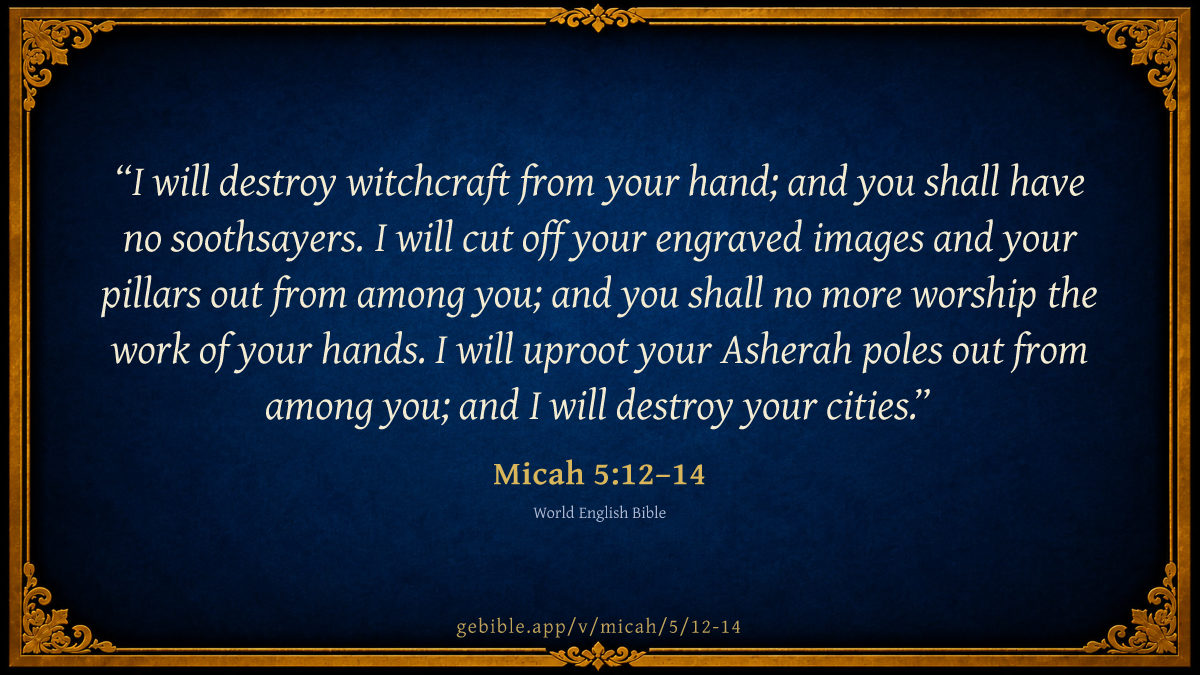
the witchcraft in your hand
Being in the "hand" represents the actions that the person does. AT: "the witchcraft that you do" (See: Metonymy)
your hand ... you will ... your carved ... your stone ... among you. You will ... your hands ... your Asherah ... among you ... your cities
Yahweh continues to speak to the people of Israel as if they were one man. (See: Forms of You)
the workmanship of your hands
The abstract noun "workmanship" can be translated using the verb "make." AT: "what your hands have made" (See: Abstract Nouns)
will uproot your Asherah poles
Yahweh speaks of Asherah poles as if they were trees that he would pull out of the ground. AT: "will pull your Asherah poles out of the ground" (See: Metaphor)
Tyndale Open Study Notes2022 · CC BY-SA 4.0On v135:13-14 sacred pillars . . . Asherah poles: Stones…
5:13-14 sacred pillars . . . Asherah poles: Stones were set up as places or objects of worship; they could represent pagan deities. The Asherah poles were green poles or trees that represented the goddess Asherah and her powers of fertility. Both the stones and the trees may have had sexual implications—one male, the other female. Asherah was seen as the mother of gods and El’s (or Baal’s) consort.

John Calvin 1540 · Public Domain On vv12–14 I will cut off, he says, the sorcerers, כשפים,…
I will cut off, he says, the sorcerers, כשפים, cashephim Some render the word jugglers, and others, augurs or diviners. We cannot know of a certainty what kind of superstition it was, nor the other which immediately follows: for the Prophet mentions here two words which mean nearly the same thing. There is no doubt but that some, in that age, were called augurs or diviners, and others called jugglers or astrologers who are now called fortune-tellers. But on this subject there is no necessity of much labor; for the Prophet simply shows here that the people could not be preserved by Gods unless they were cleansed from these defilements. These superstitions, we know, were forbidden and condemned by God’s Law: but the Law was not able to restrain the wickedness of that people; for they continually turned aside to these evils. God then here shows, that until they had purged the Church, it could not continue safe. Now, in these words, the Prophet reminds the Jews, and also the Israelites, for their benefit, that it was, and had been, through their own fault, that they labored under constant miseries and were not helped by the hand of God. — How so? Because there was no room, as God shows here, for the exercise of his favor; for they were full of auguries and divinations, and of other diabolical arts. “How,” he says, “can I help you, for I have no agreement with Satan? As you are wholly given to wicked superstitions, my favor is rejected by you.”
One thing is, that the Prophet intended to humble the people, so that every one might know that it had been through their fault, that God had not brought them help as they wished: but there is another thing, — God promises a cleansing, which would open a way for his favor, — I will take away, he says, all the diviners Let us then know, that it ought to be deemed the greatest benefit when God takes away from us our superstitions and other vices. For since a diminution, however hard and grievous it may be at first, is useful to us, as we see, when we willfully and openly drive away God from us; is it not a singular favor in God when he suffers us not to be thus separated from him, but prepares a way for himself to be connected with us, and has ever his hand extended to bring us help? Thus much as to these two kinds of impediments.
John Calvin's Commentaries (1540-1563) — public domain. Text from the Calvin Translation Society English edition (1840s-50s) via the Christian Classics Ethereal Library (ccel.org). Calvin's coverage is partial (roughly two-thirds of the Bible); uncommented books and verses are honest gaps, never fabricated. The 19th-century editor's footnotes and remarks are omitted so the notes are faithfully Calvin's own voice.
John Trapp 1656 · Public Domain On vv12–14 Mic 5:12 And I will cut off witchcrafts out…
Mic 5:12 And I will cut off witchcrafts out of thine hand; and thou shalt have no [more] soothsayers:
Ver. 12. And I will cut off witchcrafts, &c.] As before God had promised to take away such things as in themselves are not evil, but only by our abuse; so here he will also remove from his people things simply evil and unlawful, such as are witchcrafts, idolatry, &c., that he may make way for mercy, which he is ready to give were they but fit to receive it. The word here rendered witchcrafts hath the signification of changing or turning; and is used for unlawful devilish arts and artisans: כשׁף hence βασκαινω, fascino, to bewitch. It is also applied to false teachers and their magic acts, Gal 3:1-29 : 1Ki 18:23. See a like promise Zec 13:2. {See Trapp on "Zec 13:2"} See Mal 3:5. {See Trapp on "Mal 3:5"}
Read full note →
And thou shalt have no more soothsayers] Or star gazers, diviners, fortune tellers. One derivation of the word clepeth them nebulones or knaves; as those that undertake to foretell future things, ex nebulis, by the clouds, planets, star, by calculating nativities, and the like unlawful practices of judiciary astrology, necromancy, pyromancy, oneiromancy, aruspicy, sortilegy, and other diabolical arts of that nature. The Ephesians were much addicted to such wicked practices: hence the proverb εφεσια γραμματα for the black art. The Samaritans also, Act 8:11; and hence that malicious slander of the Jews, "Say we not well that thou art a Samaritan," that is, one that dealeth with the devil, Joh 8:48; for otherwise they knew that Christ was no Samaritan, but a Galilean, as they called him in scorn, in truth a Bethlehemite, as Mic 5:2. The Jews themselves are taxed, Isa 2:6, that they were soothsayers, like the Philistines; and told that God had therefore forsaken them, or sent them away into captivity. See more against this sort of sin and sinners, Isa 44:24-26; Isa 47:12-14; Jer 10:2; Jer 10:25 Dan 2:1-3, &c.; but especially Deu 18:10-11, where we have these five arguments (as one well observeth) against astrological and other unlawful predictions. First, that all such are abomination to the Lord, Deu 18:12; Secondly, that for such arts the Canaanites were driven out; Thirdly, that unless men cast away the use of the said arts they cannot be perfect, that is, upright and sincere with God, Deu 18:13; Fourthly, that godly men must differ from Canaanites and heathens, in the abandoning of such arts, Deu 18:14; Lastly, that instead of such ways of prediction, the Lord raiseth up Christ, the great prophet, to foretell unto them what is meet for them to foreknow, Deu 18:15 cf. Act 3:23. To seek to know more is condemned for curiosity and rashness by Christ himself, in his own disciples, Act 1:7; it derogateth from the glory of Christ, in whom are hid all the treasures of wisdom and knowledge: it is to go a whoring from Christ, Lev 20:6, and is therefore in this text fitly yoked with idolatry. It is here also reckoned among those things that must be cut off, if Christ’s kingdom shall be set up among us. So that if there were no other text of Scripture against that wickedness but this alone, it were sufficient.
John Trapp, A Commentary or Exposition upon All the Books of the Old and New Testament (1647–1656) — public domain. Text from a community e-Sword module.
Matthew Poole 1685 · Public Domain On vv12–14 In this verse the Lord foretells the downfall of…
In this verse the Lord foretells the downfall of all unlawful arts which had been in use, though forbidden by the law of God, Lev 20:27. Though Israel should have consulted with God alone, yet they did consult with sorcerers. So did Manasseh, and before him, 2Ki 17:17.
Thou shalt have no more soothsayers; the very art shall be out of use, and none shall openly, as formerly, consult with them, or they make profession of foretelling events, or what a lucky day or hour to set upon an enterprise, or to curse, as Balaam would have done, an enemy to make way for victory; no more of these; the oracles ceased when Christ was born: much to this purpose Zec 13:2; Mal 3:5. God will, in mercy to his people, take away these stumbling-blocks, these occasions of sin.
Matthew Poole's English Annotations on the Holy Bible (1683–1685) — public domain. Text from a community e-Sword/MySword module.
John Gill 1763 · Public Domain On vv12–14 And I will cut off witchcrafts out of thine…
And I will cut off witchcrafts out of thine hand,.... Such as were formerly practised among the Jews, though forbidden them, and in mystical Babylon, or the antichristian church, whose sorceries are mentioned, Rev 9:21; but nothing of this kind will be found in the Christian church, consisting of Jews and Gentiles, in the latter day; all unlawful arts, cheating and juggling in religious matters, will cease, and be no more:
and thou shalt have no more soothsayers; or diviners, that cast a mist over people's eyes, and deceived them with false appearances of things; that pretended to know times and seasons, when it was or was not a good day to go abroad, or to make merchandise; that judged by the clouds, and by the position of the heavens, what would come to pass hereafter; and though such sort of men were formerly indulged, connived at, and caressed among the Jews, they should be so no more; nor should they apply to such persons for advice and counsel; nor would they need it, nor should they use it; see Deu 18:10.
John Gill's Exposition of the Whole Bible (1746–1763) — public domain (CC PDM 1.0). Text via the HelloAO Bible API.
John Wesley 1765 · Public Domain On vv12–14 I will cut off - God will in mercy…
I will cut off - God will in mercy to his people take away these occasions of sin.
John Wesley, Explanatory Notes Upon the Whole Bible (1754–1765) — public domain. Text via the GEBible commentary corpus.
Adam Clarke 1810 · Public Domain On vv12–13 Verse 12. I will cut off witchcrafts] Thou shalt…
Verse 12. I will cut off witchcrafts] Thou shalt seek help only in Jehovah thy God. They have had neither soothsayers, images, groves, nor high places, from the captivity to the present day.
Adam Clarke's Commentary on the Bible (1810–1826) — public domain. Text from a community e-Sword/MySword module.
Joseph Benson 1811 · Public Domain On v12 Mic 5:12-15. And I will cut off witchcrafts, &c.…
Mic 5:12-15. And I will cut off witchcrafts, &c. — Here is foretold the downfall of all unlawful arts and devices, which had been used by the Jews in former ages, to obtain the knowledge of future events: that God would, in mercy to his people, take away these occasions of sinning. Thy graven images also will I cut off — I will abolish every species of idolatry. This was effected, even among the Jews, by that severe judgment the Babylonish captivity, from which time they have abhorred the use of images in divine worship, and indeed have been kept from worshipping any false god. And I will pluck up thy groves — The usual scenes of idolatrous worship. It is justly observed by Mr. Scott here, that though the reformation of the Jews, after their return from Babylon, might be alluded to in this passage, yet the purification of the Christian Church from all antichristian corruptions of faith and worship, and all idolatry and superstition, seems more immediately to be predicted. “The reliance on human merits for justification, the external pomp used in worship, and the oppressive exercise of human authority in mere matters of conscience, will be entirely destroyed by the clear light of divine truth, and the power of divine grace; and simplicity and purity in doctrine, worship, and practice, will prevail, when the enemies of the church shall be destroyed.” And I will execute vengeance in anger, &c. — When I have purged my people from their corruptions, I will severely vindicate their cause, to the utter destruction of all their unbelieving enemies. Such as they have not heard — In an unprecedented manner. God will give his Son either the hearts or necks of his enemies, and make them either his friends or his footstool.
Joseph Benson's Commentary on the Old and New Testaments (1811–1818) — public domain. Text from a community e-Sword module.
Haydock's Catholic Bible Commentary 1859 · Public Domain On vv13–14
CHAPTER V.
George Leo Haydock (1774–1849), Haydock's Catholic Family Bible and Commentary, 1859 edition — public domain. Excludes Psalms (Douay-Rheims chapter numbering differs from Protestant) and Deuterocanonical books (Catholic canon only).
Robert Jamieson, A. R. Fausset & David Brown 1871 · Public Domain On vv12–14 witchcrafts out of thine hand--that is, which thou now…
witchcrafts out of thine hand--that is, which thou now usest.
Jamieson, Fausset & Brown — Commentary Critical and Explanatory on the Whole Bible (1871) — public domain (CC PDM 1.0). Text via the HelloAO Bible API.
Daniel D. Whedon 1874 · Public Domain On vv12–13 12. Witchcrafts and soothsayers will be removed.
12. Witchcrafts and soothsayers will be removed.
Witchcrafts — That witchcrafts were practiced in Judah in Micah’s age is stated also by Isaiah (Isa_2:6; Isa_8:19), but what was their precise nature cannot be determined, though necromancy seems to have played an important part (Isa_8:19). Some think that the expression “out of thine hand” limits the prophet’s implied condemnation to such “arts” as were performed with the hand. However, this is doubtful, since “out of thine hand” is equivalent to “from you” (compare Mic_2:1, “in the power of their hand,” equivalent to “in their power”; compare also Isa_1:12). The term used here is a general term denoting black arts and practices of every sort.
Read full note →
Soothsayers — This also is a general term, denoting the persons who practice the “witchcrafts” mentioned in 12a. The Hebrew word seems to be a derivative from a noun meaning “cloud”; hence it may denote primarily persons who professed to read a hidden meaning in the movements of the clouds.
Daniel D. Whedon (gen. ed.), Commentary on the Old and New Testaments (1874–1909) — public domain. Text from a community e-Sword module.
The Cambridge Bible for Schools and Colleges 1878 · Public Domain On vv12–14 12. witchcrafts] Sorcery was highly developed in Syria and…
12. witchcrafts] Sorcery was highly developed in Syria and Palestine; the ancient Semites brought it from their early home in Mesopotamia (see Lenormant’s Chaldean Magic). Comp. Isa_2:6, Numbers 22-24, Deu_18:10-13.
soothsayers] More precisely, diviners of the clouds (the clouds were much studied by the Chaldean diviners); or perhaps, cloud-makers (-falling, beneficent dew, and on the other to ths among savages, ‘rain-makers’).
The Cambridge Bible for Schools and Colleges (gen. ed. J. J. S. Perowne; Cambridge University Press, 1878–1918) — public domain. Text from a community e-Sword module.
Ellicott's Commentary for English Readers 1878 · Public Domain On v14 (14) I will pluck up thy groves—i.e., either the…
(14) I will pluck up thy groves—i.e., either the statues, pillars, or trees connected with the worship of Baal and Astarte. Some such statue was placed by Manasseh even in the house of the Lord, from which it was brought out and burnt by Josiah (2Ki_23:6).
Thy cities—i.e., the pollutions, tumults, &c., of which the cities were the strongholds.
A Bible Commentary for English Readers, edited by Charles John Ellicott (1878–1897) — public domain. Text from a community e-Sword module.
The Pulpit Commentary 1880 · Public Domain On vv12–14 Witchcrafts. Magic and sorcery, which were much practised in…
Witchcrafts. Magic and sorcery, which were much practised in Syria and Palestine, as in Chaldea, the literature of which country consists in great part of spells and charms. It is to the belief in the efficacy of such incantations that we owe the episode of Balak and Balaam (Numbers 22-24), and the enactments in the Law; e.g. Deu_18:10, etc. (comp. Isa_2:6 Isa_47:12) Septuagint, ta farmaka sou , "thy poisons;" Vulgate, maleficia . Soothsayers; properly, cloud diviners, or storm makers; either persons who professed to divine by means of the shape and colour of clouds, or, as the old Scandinavian witches, charlatans who assumed the power of musing and directing storms. Cheyne compares the common name of sorcerers among savages, "rain makers."
The Pulpit Commentary (1880–1919), ed. H.D.M. Spence-Jones & Joseph S. Exell — public domain. Text from a community e-Sword module.
unfoldingWord translationNotes 2017 · CC BY-SA 4.0 On v12 General Information:
General Information:
Yahweh continues speaking to the people of Israel.
Read full note →
the witchcraft in your hand
Being in the "hand" represents the actions that the person does. AT: "the witchcraft that you do" (See: Metonymy)
your hand ... you will ... your carved ... your stone ... among you. You will ... your hands ... your Asherah ... among you ... your cities
Yahweh continues to speak to the people of Israel as if they were one man. (See: Forms of You)
the workmanship of your hands
The abstract noun "workmanship" can be translated using the verb "make." AT: "what your hands have made" (See: Abstract Nouns)
will uproot your Asherah poles
Yahweh speaks of Asherah poles as if they were trees that he would pull out of the ground. AT: "will pull your Asherah poles out of the ground" (See: Metaphor)
translationWords
hand
divination
image
column
worship
Asherah
avenge
anger
wrath
nation
unfoldingWord translationNotes — © Distant Shores Media and the Door43 World Missions Community, licensed CC BY-SA 4.0. Source: git.door43.org/Door43/en_tn.
Tyndale Open Study Notes 2022 · CC BY-SA 4.0 On v13 5:13-14 sacred pillars . . . Asherah poles: Stones…
5:13-14 sacred pillars . . . Asherah poles: Stones were set up as places or objects of worship; they could represent pagan deities. The Asherah poles were green poles or trees that represented the goddess Asherah and her powers of fertility. Both the stones and the trees may have had sexual implications—one male, the other female. Asherah was seen as the mother of gods and El’s (or Baal’s) consort.
Tyndale Open Study Notes — © Tyndale Open Resources, licensed CC BY-SA 4.0. Text via the HelloAO Bible API.