
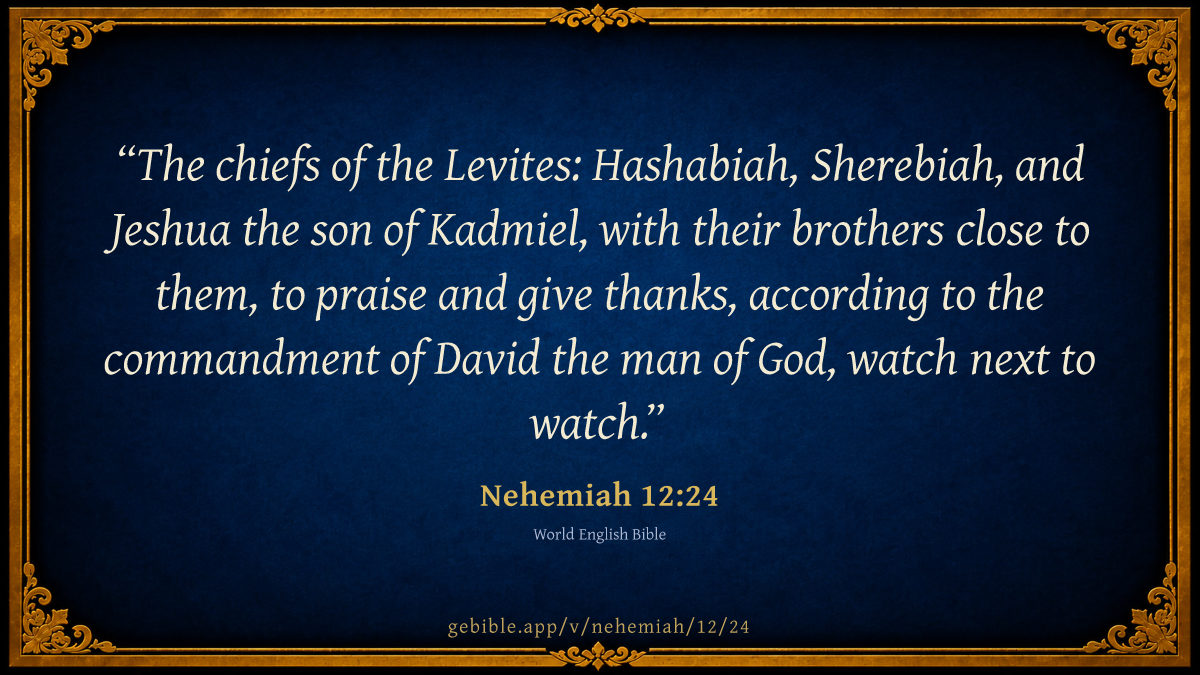
The chiefs of the Levites: Hashabiah, Sherebiah, and Jeshua the son of Kadmiel, with their brothers close to them, to praise and give thanks, according to the commandment of David the man of God, watch next to watch.
Parallel Translations
-
The chiefs of the Levites: Hashabiah, Sherebiah, and Jeshua the son of Kadmiel, with their brothers close to them, to praise and give thanks, according to the commandment of David the man of God, watch next to watch.
-
And the chief of the Levites: Hashabiah, Sherebiah, and Jeshua the son of Kadmiel, with their brethren over against them, to praise and to give thanks, according to the commandment of David the man of God, ward over against ward.
-
And the chiefs of the Levites: Hashabiah, Sherebiah, and Jeshua the son of Kadmiel, with their brethren over against them, to praise and give thanks, according to the commandment of David the man of God, ward against ward.
Cross-references (15)
Passages linked to Nehemiah 12:24 in the Treasury of Scripture Knowledge, ordered by reader-vote popularity; verse text shown in World English Bible.
- 1 Chronicles 25:1-26 Moreover, David and the captains of the army set apart for the service certain of the sons of Asaph, and of Heman, and of Jeduthun, who were to prophesy with harps, with stringed instruments, and with cymbals. The number of those who did the work according to their service was: of the sons of Asaph: Zaccur, Joseph, Nethaniah, and Asharelah. The sons of Asaph were under the hand of Asaph, who prophesied at the order of the king. Of Jeduthun, the sons of Jeduthun: Gedaliah, Zeri, Jeshaiah, Shimei, Hashabiah, and Mattithiah, six, under the hands of their father Jeduthun, who prophesied in giving thanks and praising Yahweh with the harp. Of Heman, the sons of Heman: Bukkiah, Mattaniah, Uzziel, Shebuel, Jerimoth, Hananiah, Hanani, Eliathah, Giddalti, Romamti-Ezer, Joshbekashah, Mallothi, Hothir, and Mahazioth. All these were the sons of Heman the king’s seer in the words of God, to lift up the horn. God gave to Heman fourteen sons and three daughters. All these were under the hands of their father for song in Yahweh’s house, with cymbals, stringed instruments, and harps, for the service of God’s house: Asaph, Jeduthun, and Heman being under the order of the king. The number of them, with their brothers who were instructed in singing to Yahweh, even all who were skillful, was two hundred eighty-eight. They cast lots for their offices, all alike, the small as well as the great, the teacher as well as the student. Now the first lot came out for Asaph to Joseph; the second to Gedaliah, he and his brothers and sons were twelve; the third to Zaccur, his sons and his brothers, twelve; the fourth to Izri, his sons and his brothers, twelve; the fifth to Nethaniah, his sons and his brothers, twelve; the sixth to Bukkiah, his sons and his brothers, twelve; the seventh to Jesharelah, his sons and his brothers, twelve; the eighth to Jeshaiah, his sons and his brothers, twelve; the ninth to Mattaniah, his sons and his brothers, twelve; the tenth to Shimei, his sons and his brothers, twelve; the eleventh to Azarel, his sons and his brothers, twelve; the twelfth to Hashabiah, his sons and his brothers, twelve; for the thirteenth, Shubael, his sons and his brothers, twelve; for the fourteenth, Mattithiah, his sons and his brothers, twelve; for the fifteenth to Jeremoth, his sons and his brothers, twelve; for the sixteenth to Hananiah, his sons and his brothers, twelve; for the seventeenth to Joshbekashah, his sons and his brothers, twelve; for the eighteenth to Hanani, his sons and his brothers, twelve; for the nineteenth to Mallothi, his sons and his brothers, twelve;
- Deuteronomy 33:1 This is the blessing with which Moses the man of God blessed the children of Israel before his death.
- Joshua 14:6 Then the children of Judah came near to Joshua in Gilgal. Caleb the son of Jephunneh the Kenizzite said to him, “You know the thing that Yahweh spoke to Moses the man of God concerning me and concerning you in Kadesh Barnea.
- 1 Kings 17:24 The woman said to Elijah, “Now I know that you are a man of God, and that Yahweh’s word in your mouth is truth.”
- 1 Chronicles 23:1-32 Now David was old and full of days; and he made Solomon his son king over Israel. He gathered together all the princes of Israel, with the priests and the Levites. The Levites were counted from thirty years old and upward; and their number by their polls, man by man, was thirty-eight thousand. David said, “Of these, twenty-four thousand were to oversee the work of Yahweh’s house, six thousand were officers and judges, four thousand were doorkeepers, and four thousand praised Yahweh with the instruments which I made for giving praise.” David divided them into divisions according to the sons of Levi: Gershon, Kohath, and Merari. Of the Gershonites: Ladan and Shimei. The sons of Ladan: Jehiel the chief, Zetham, and Joel, three. The sons of Shimei: Shelomoth, Haziel, and Haran, three. These were the heads of the fathers’ households of Ladan. The sons of Shimei: Jahath, Zina, Jeush, and Beriah. These four were the sons of Shimei. Jahath was the chief, and Zizah the second; but Jeush and Beriah didn’t have many sons; therefore they became a fathers’ house in one reckoning. The sons of Kohath: Amram, Izhar, Hebron, and Uzziel, four. The sons of Amram: Aaron and Moses; and Aaron was separated, that he should sanctify the most holy things, he and his sons, forever, to burn incense before Yahweh, to minister to him, and to bless in his name, forever. But as for Moses the man of God, his sons were named among the tribe of Levi. The sons of Moses: Gershom and Eliezer. The sons of Gershom: Shebuel the chief. The sons of Eliezer were: Rehabiah the chief; and Eliezer had no other sons; but the sons of Rehabiah were very many. The sons of Izhar: Shelomith the chief. The sons of Hebron: Jeriah the chief, Amariah the second, Jahaziel the third, and Jekameam the fourth. The sons of Uzziel: Micah the chief, and Isshiah the second. The sons of Merari: Mahli and Mushi. The sons of Mahli: Eleazar and Kish. Eleazar died, and had no sons, but daughters only: and their brothers the sons of Kish took them as wives. The sons of Mushi: Mahli, Eder, and Jeremoth, three. These were the sons of Levi after their fathers’ houses, even the heads of the fathers’ houses of those who were counted individually, in the number of names by their polls, who did the work for the service of Yahweh’s house, from twenty years old and upward. For David said, “Yahweh, the God of Israel, has given rest to his people; and he dwells in Jerusalem forever. Also the Levites will no longer need to carry the tabernacle and all its vessels for its service.” For by the last words of David the sons of Levi were counted, from twenty years old and upward. For their office was to wait on the sons of Aaron for the service of Yahweh’s house, in the courts, and in the rooms, and in the purifying of all holy things, even the work of the service of God’s house; for the show bread also, and for the fine flour for a meal offering, whether of unleavened wafers, or of that which is baked in the pan, or of that which is soaked, and for all measurements of quantity and size; and to stand every morning to thank and praise Yahweh, and likewise in the evening; and to offer all burnt offerings to Yahweh, on the Sabbaths, on the new moons, and on the set feasts, in number according to the ordinance concerning them, continually before Yahweh; and that they should keep the duty of the Tent of Meeting, the duty of the holy place, and the duty of the sons of Aaron their brothers, for the service of Yahweh’s house.
- 2 Chronicles 8:14 He appointed, according to the ordinance of David his father, the divisions of the priests to their service, and the Levites to their offices, to praise and to minister before the priests, as the duty of every day required; the doorkeepers also by their divisions at every gate, for David the man of God had so commanded.
- Ezra 2:40 The Levites: the children of Jeshua and Kadmiel, of the children of Hodaviah, seventy-four.
- Ezra 3:10-11 When the builders laid the foundation of Yahweh’s temple, they set the priests in their clothing with trumpets, with the Levites the sons of Asaph with cymbals, to praise Yahweh, according to the directions of David king of Israel. They sang to one another in praising and giving thanks to Yahweh, “For he is good, for his loving kindness endures forever toward Israel.” All the people shouted with a great shout, when they praised Yahweh, because the foundation of Yahweh’s house had been laid.
- Nehemiah 8:7 Also Jeshua, Bani, Sherebiah, Jamin, Akkub, Shabbethai, Hodiah, Maaseiah, Kelita, Azariah, Jozabad, Hanan, Pelaiah, and the Levites, caused the people to understand the law; and the people stayed in their place.
- Nehemiah 9:4 Then Jeshua, Bani, Kadmiel, Shebaniah, Bunni, Sherebiah, Bani, and Chenani of the Levites stood up on the stairs, and cried with a loud voice to Yahweh their God.
- Nehemiah 10:9-13 The Levites: namely, Jeshua the son of Azaniah, Binnui of the sons of Henadad, Kadmiel; and their brothers, Shebaniah, Hodiah, Kelita, Pelaiah, Hanan, Mica, Rehob, Hashabiah, Zaccur, Sherebiah, Shebaniah, Hodiah, Bani, and Beninu.
- Nehemiah 11:17 and Mattaniah the son of Mica, the son of Zabdi, the son of Asaph, who was the chief to begin the thanksgiving in prayer, and Bakbukiah, the second among his brothers; and Abda the son of Shammua, the son of Galal, the son of Jeduthun.
- Nehemiah 12:8-9 Moreover the Levites: Jeshua, Binnui, Kadmiel, Sherebiah, Judah, and Mattaniah, who was over the thanksgiving, he and his brothers. Also Bakbukiah and Unno, their brothers, were close to them according to their offices.
- 1 Timothy 6:11 But you, man of God, flee these things, and follow after righteousness, godliness, faith, love, perseverance, and gentleness.
- 2 Timothy 3:17 that each person who belongs to God may be complete, thoroughly equipped for every good work.
Cross-references from openbible.info (CC BY 4.0)
Explain this verse (11 sources)
Historical commentary, presented as a primary source — not an endorsement.
Private notes
Saved on this device only — never synced or sent anywhere.
Geneva Bible translators 1599 · Public Domain That is, one after another, and every one in…
That is, one after another, and every one in his course.
Geneva Bible (1599) marginal notes — public domain.
Matthew Poole 1685 · Public Domain Of which See Poole "Neh 12:9".
Of which See Poole "Neh 12:9".
Matthew Poole's English Annotations on the Holy Bible (1683–1685) — public domain. Text from a community e-Sword/MySword module.
John Gill 1763 · Public Domain Mattaniah, and Bakbukiah, Obadiah, Meshullam, Talmon, Akkub, were porters,....…
Mattaniah, and Bakbukiah, Obadiah, Meshullam, Talmon, Akkub, were porters,.... At the gates of the temple, see Ch1 9:15,
keeping the ward, at the thresholds of the gates; of the temple, where they stood and watched; or "at the collection of the gates", meaning either where the people were gathered together, or where money gathered was laid up; and so some render it, "the treasuries of the gates": unless a place called Asuppim should be meant, Ch1 26:15.
John Gill's Exposition of the Whole Bible (1746–1763) — public domain (CC PDM 1.0). Text via the HelloAO Bible API.
Albert Barnes 1834 · Public Domain Jeshua the son of Kadmiel - If the reading…
Jeshua the son of Kadmiel - If the reading be sound, this Jeshua must have been the head of the Levitical family of Kadmiel in the time of Joiakim; but (compare Neh 8:7; Neh 9:4), some read “Jeshua, Bani, Kadmiel,” etc.
Ward over against ward - i. e., “alternately,” one part of the choir corresponding the other.
Albert Barnes' Notes on the Bible (1834–1885) — public domain. Text from a community e-Sword/MySword module.
Haydock's Catholic Bible Commentary 1859 · Public Domain Order. Hebrew, "ward over-against ward." One company kept guard…
Order. Hebrew, "ward over-against ward." One company kept guard while another retired. (Menochius)
George Leo Haydock (1774–1849), Haydock's Catholic Family Bible and Commentary, 1859 edition — public domain. Excludes Psalms (Douay-Rheims chapter numbering differs from Protestant) and Deuterocanonical books (Catholic canon only).
Daniel D. Whedon 1874 · Public Domain 24. The commandment of David — See 1Ch_16:4; 1Ch_23:30.
24. The commandment of David — See 1Ch_16:4; 1Ch_23:30.
Ward over against ward — One company of singers opposite another company, so as to worship antiphonally. See note on Ezr_3:11.
Daniel D. Whedon (gen. ed.), Commentary on the Old and New Testaments (1874–1909) — public domain. Text from a community e-Sword module.
The Cambridge Bible for Schools and Colleges 1878 · Public Domain 24. And the chief of the Levites] Once more…
24. And the chief of the Levites] Once more a brief list is given of the chief Levite families.
Hashabiah] This name occurs in Neh_10:12, and Ezr_8:19, but not in Neh_12:8-9. Probably the same as Hashabneiah (Neh_9:5).
Read full note →
Sherebiah] Cf. Neh_12:8, Neh_9:5, Neh_10:13; Ezr_8:18.
Jeshua the son of Kadmiel] We have here an almost certain error in the text ‘Jeshua ben-Kadmiel’ instead of ‘Jeshua, Bani, (or Binnui), Kadmiel.’ Cf. Neh_12:8, Neh_10:9. In favour of this emendation is to be cited the reading of the LXX. υἱοὶ (b’nê) Καδμιήλ.
over against them] Cf. Neh_12:9. LXX. κατεναντίον αὐτῶν, Vulg. ‘per vices suas.’
to praise and (R.V. to) give thanks] The reference is to the anti-phonal singing of the Levites in the Temple worship.
according to the commandment of David the man of God] The reference is to the organization of the Levitical singers by David mentioned in 1Ch_16:4; 1Ch_23:30.
On the title ‘the man of God’ applied to David cf. 2Ch_8:14.
ward over (R.V. omit) against ward] The same phrase occurs in 1Ch_26:16.
The Cambridge Bible for Schools and Colleges (gen. ed. J. J. S. Perowne; Cambridge University Press, 1878–1918) — public domain. Text from a community e-Sword module.
Ellicott's Commentary for English Readers 1878 · Public Domain (24) And the chief.—The account resumes with the Levites,…
(24) And the chief.—The account resumes with the Levites, and gives a list of the extant officers of the Temple, many names being the same as in earlier times.
A Bible Commentary for English Readers, edited by Charles John Ellicott (1878–1897) — public domain. Text from a community e-Sword module.
The Pulpit Commentary 1880 · Public Domain LIST OF THE CHIEF LEVITICAL FAMILIES IN THE TIME…
LIST OF THE CHIEF LEVITICAL FAMILIES IN THE TIME OF JOIAKIM AND LATER. (Neh_12:24-26) That family, rather than personal, names are here intended is sufficiently shown in the final summary of ver. 26, since the same individuals cannot have flourished under Joiakim (B.C. 490-460) and also under Nehemiah (B.C. 444-430). The actual names Jeshua, Kadmiel, Hashabiah, Shersbiah, etc. are all found as family names.
Hashabiah. See above, Neh_9:5 Neh_10:11. Sherebiah. Compare Neh_9:4, 5 10:12 12:8. Jeshua, the son of Kadmiel. For ben, "son," we should probably read "Bani," a common Levitical name, (Neh_9:4, 5 10:13) in which case the passage would run as follows: the chief of the Levites were Hashabiah, Sherebiah, Jeshua, Bani, Kadmiel, with their brethren," etc. To praise and to give thanks, according to the commandment of David. Compare 1Ch_15:16 1Ch_23:5 1Ch_25:3, etc. Man of God is an epithet not often applied to David. It occurs, however, again in ver. 36, and also in 2Ch_8:14. Ward over against ward. Antiphonically division over against division.
The Pulpit Commentary (1880–1919), ed. H.D.M. Spence-Jones & Joseph S. Exell — public domain. Text from a community e-Sword module.
The Biblical Illustrator 1887 · Public Domain According to the Commandment Of David the man of…
Neh_12:24
According to the Commandment Of David the man of God.
Read full note →
Posthumous influence
A mans influence after he is dead. He is still present with his people.
I. By his will. The commandment of David. The grip of the dead is on our fields and churches, our schools and hospitals.
II. By his writings. Immortality of genius. Davids psalms. Solomons proverbs. The writings of Shakespeare, Milton, Bunyan, and many others.
III. By his example. David the man of God. For good or evil a man lives. For good or evil his deeds will live after him. The memory of the just is blessed. (Homiletic Commentary.)
The Biblical Illustrator, edited by Joseph S. Exell (c. 1880s–1900s) — public domain. Text from a community e-Sword module.
unfoldingWord translationNotes 2017 · CC BY-SA 4.0 Hashabiah, Sherebiah ... Jeshua ... Kadmiel ... David ...…
Hashabiah, Sherebiah ... Jeshua ... Kadmiel ... David ... Mattaniah, Bakbukiah, Obadiah, Meshullam, Talmon, and Akkub ... Joiakim ... Jeshua ... Jozadak ... Nehemiah ... Ezra
These are names of men. (See: How to Translate Names)
Read full note →
who stood opposite them to give praise and to give thanks, responding section by section
This refers to how they sang some of their songs in worship. A leader or one group would sing a phrase, then one or two groups that "stood opposite them" would sing a phrase in response.
obedience to the command of David
King David had commanded the Levites how they were to organize and lead worship.
in the days of Joiakim ... Jozadak, and in the days of Nehemiah the governor and of Ezra ... scribe
The date was fixed by listing those who were leading the Jews at the time. "when Joiakim ... Jozadak was high priest, and when Nehemiah was governor and Ezra ... was the scribe"
translationWords
Levi
praise
obey
David
God
Obadiah
gate
servant
son
govern
Ezra
priest
scribe
unfoldingWord translationNotes — © Distant Shores Media and the Door43 World Missions Community, licensed CC BY-SA 4.0. Source: git.door43.org/Door43/en_tn.