Nehemiah 9:20-27 sits inside this longer paragraph.
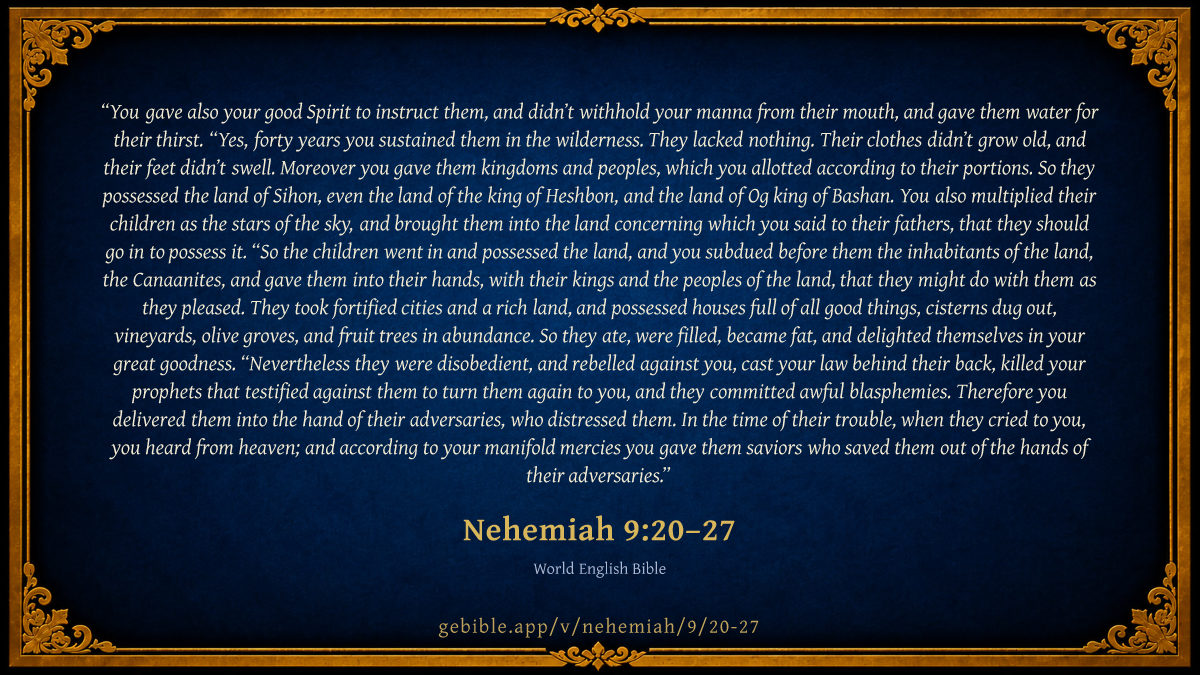
16“But they and our fathers behaved proudly, hardened their neck, didn’t listen to your commandments, 17and refused to obey. They weren’t mindful of your wonders that you did among them, but hardened their neck, and in their rebellion appointed a captain to return to their bondage. But you are a God ready to pardon, gracious and merciful, slow to anger, and abundant in loving kindness, and didn’t forsake them. 18Yes, when they had made themselves a molded calf, and said, ‘This is your God who brought you up out of Egypt,’ and had committed awful blasphemies; 19yet you in your manifold mercies didn’t forsake them in the wilderness. The pillar of cloud didn’t depart from over them by day, to lead them in the way; neither did the pillar of fire by night, to show them light, and the way in which they should go. 20You gave also your good Spirit to instruct them, and didn’t withhold your manna from their mouth, and gave them water for their thirst.
21“Yes, forty years you sustained them in the wilderness. They lacked nothing. Their clothes didn’t grow old, and their feet didn’t swell. 22Moreover you gave them kingdoms and peoples, which you allotted according to their portions. So they possessed the land of Sihon, even the land of the king of Heshbon, and the land of Og king of Bashan. 23You also multiplied their children as the stars of the sky, and brought them into the land concerning which you said to their fathers, that they should go in to possess it.
24“So the children went in and possessed the land, and you subdued before them the inhabitants of the land, the Canaanites, and gave them into their hands, with their kings and the peoples of the land, that they might do with them as they pleased. 25They took fortified cities and a rich land, and possessed houses full of all good things, cisterns dug out, vineyards, olive groves, and fruit trees in abundance. So they ate, were filled, became fat, and delighted themselves in your great goodness.
26“Nevertheless they were disobedient, and rebelled against you, cast your law behind their back, killed your prophets that testified against them to turn them again to you, and they committed awful blasphemies. 27Therefore you delivered them into the hand of their adversaries, who distressed them. In the time of their trouble, when they cried to you, you heard from heaven; and according to your manifold mercies you gave them saviors who saved them out of the hands of their adversaries. 28But after they had rest, they did evil again before you; therefore you left them in the hands of their enemies, so that they had the dominion over them; yet when they returned, and cried to you, you heard from heaven; and many times you delivered them according to your mercies, 29and testified against them, that you might bring them again to your law. Yet they were arrogant, and didn’t listen to your commandments, but sinned against your ordinances (which if a man does, he shall live in them), turned their backs, stiffened their neck, and would not hear. 30Yet many years you put up with them, and testified against them by your Spirit through your prophets. Yet they would not listen. Therefore you gave them into the hand of the peoples of the lands.

Geneva Bible translators 1599 · Public Domain On vv21, 22, 26 Though the way was tedious and long.
Though the way was tedious and long.
Geneva Bible (1599) marginal notes — public domain.
John Trapp 1656 · Public Domain On vv20–27 Neh 9:20 Thou gavest also thy good spirit to…
Neh 9:20 Thou gavest also thy good spirit to instruct them, and withheldest not thy manna from their mouth, and gavest them water for their thirst.
Ver. 20. Thou gavest also thy good spirit] viz. To their governors and teachers, Num 11:16-17; Num 11:25-26. Yea, to every good soul, that they might be all taught of God, led into all truth and holiness, Eph 5:9. For which end God hath promised to pour his Spirit upon all flesh, that is, the best thing upon the basest, Joe 2:28. Next to the sending of his Son in the flesh (which is called the gift, Joh 4:10, and the benefit, 1Ti 6:2), what can God do more for his people than to give them his good spirit? this is to give them all good things in one, Mat 7:11 Luk 11:13.
Read full note →
And withheldest not thy manna] See Neh 9:15. It is twice mentioned, as a singular and signal mercy. And it is well observed by a reverend writer, that this manna and water from the rock (which was Christ in the gospel) were given this people before the law, the sacraments of grace before the legal covenant. The grace of God preventeth our obedience; therefore shall we keep the law of God, because we have a Saviour.
John Trapp, A Commentary or Exposition upon All the Books of the Old and New Testament (1647–1656) — public domain. Text from a community e-Sword module.
Matthew Poole 1685 · Public Domain On vv20, 21, 22, 25, 26 Thou gavest also thy good spirit; which thou didst…
Thou gavest also thy good spirit; which thou didst graciously and plentifully impart unto Moses, and then unto the seventy eiders, Num 11:17,25,26, to the end that they might be able to direct and govern thy people wisely, and in thy fear.
Matthew Poole's English Annotations on the Holy Bible (1683–1685) — public domain. Text from a community e-Sword/MySword module.
John Gill 1763 · Public Domain On vv20–27 Thou gavest also thy good spirit to instruct them,....…
Thou gavest also thy good spirit to instruct them,.... In the knowledge of the laws delivered to them; the spirit of prophecy, according to Ben Melech, and which Aben Ezra interprets of the spirit put upon the seventy elders, Num 11:17,
and withheldest not thy manna from their mouth; all the while they were in the wilderness, until they came to Canaan's land; called the Lord's manna, because prepared by him, and given by him to them; a part or portion and gift from the Lord, as Ben Melech, from whence it had its name, see Exo 16:15
Read full note →
and gavest them water for their thirst; which seems to have respect to the last rock stricken for them, after their many provocations in the wilderness, Num 20:11.
John Gill's Exposition of the Whole Bible (1746–1763) — public domain (CC PDM 1.0). Text via the HelloAO Bible API.
John Wesley 1765 · Public Domain On v22 Divide - The Heathen nations, whom God in a…
Divide - The Heathen nations, whom God in a great measure destroyed, and the remainders of them he dispersed into corners; that whereas before the Israelites came, they had large habitations, now they were cooped up, some in one town, and some in another, in the several corners of their land, while the Israelites dwelt in a large place, and had the possession of their whole land, some few and small parcels excepted.
John Wesley, Explanatory Notes Upon the Whole Bible (1754–1765) — public domain. Text via the GEBible commentary corpus.
Adam Clarke 1810 · Public Domain On vv21, 22, 25, 27 Verse 21. Their clothes waxed not old] See Clarke…
Verse 21. Their clothes waxed not old] See Clarke on De 8:4.
Adam Clarke's Commentary on the Bible (1810–1826) — public domain. Text from a community e-Sword/MySword module.
Joseph Benson 1811 · Public Domain On vv20, 22, 25, 27 Neh 9:20. Thou gavest also thy good Spirit to…
Neh 9:20. Thou gavest also thy good Spirit to instruct them — Which thou didst graciously and plentifully impart, first unto Moses, and then unto the seventy elders, (Num 11:17-26,) to the end that they might be able to direct and govern thy people wisely, and in thy fear.
Joseph Benson's Commentary on the Old and New Testaments (1811–1818) — public domain. Text from a community e-Sword module.
Albert Barnes 1834 · Public Domain On vv22, 25, 26, 27 Thou didst divide them into corners - i. e.,…
Thou didst divide them into corners - i. e., parts of the holy land; or as some prefer “thou didst distribute them on all sides.”
Albert Barnes' Notes on the Bible (1834–1885) — public domain. Text from a community e-Sword/MySword module.
Haydock's Catholic Bible Commentary 1859 · Public Domain On vv20, 21, 22, 24, 25, 26, 27 Spirit. The conducting angel. (Menochius) --- God enlightened and…
Spirit. The conducting angel. (Menochius) --- God enlightened and moved the hearts of the people, by his grace; which he gave in abundance to Moses. (Calmet)
George Leo Haydock (1774–1849), Haydock's Catholic Family Bible and Commentary, 1859 edition — public domain. Excludes Psalms (Douay-Rheims chapter numbering differs from Protestant) and Deuterocanonical books (Catholic canon only).
Robert Jamieson, A. R. Fausset & David Brown 1871 · Public Domain On v22 Moreover thou gavest them kingdoms and nations--that is, put…
Moreover thou gavest them kingdoms and nations--that is, put them in possession of a rich country, of an extensive territory, which had been once occupied by a variety of princes and people.
and didst divide them into corners--that is, into tribes. The propriety of the expression arose from the various districts touching at points or angles on each other.
Read full note →
the land of Sihon, and the land of the king of Heshbon--Heshbon being the capital city, the passage should run thus: "the land of Sihon or the land of the king of Heshbon."
Jamieson, Fausset & Brown — Commentary Critical and Explanatory on the Whole Bible (1871) — public domain (CC PDM 1.0). Text via the HelloAO Bible API.
Daniel D. Whedon 1874 · Public Domain On v22 22. Thou gavest them kingdoms and nations — Namely,…
22. Thou gavest them kingdoms and nations — Namely, the kingdoms and peoples of the land of Canaan.
Divide them into corners — Or, divide them according to borders. That is, thou didst divide those kingdoms (their territory) according to definite boundary lines. The conquered land was distributed among the Israelites according to their tribes, as is recorded in the Book of Joshua So Bertheau and Keil explain; but others, as Gesenius, refer the suffix to the Israelites, thus: thou didst distribute them (the Israelites) into various quarters.
Daniel D. Whedon (gen. ed.), Commentary on the Old and New Testaments (1874–1909) — public domain. Text from a community e-Sword module.
The Cambridge Bible for Schools and Colleges 1878 · Public Domain On vv20–27 20. thy good spirit] Referring possibly to Num_11:17 ‘And…
20. thy good spirit] Referring possibly to Num_11:17 ‘And I will take of the spirit which is upon thee and will put it upon them,’ 23–29, but mainly to the general Divine teaching of the people, cf. Isa_63:11, ‘Where is he that brought them out of the sea with the shepherds of his flock? Where is he that put his holy spirit in the midst of them?’ For the expression ‘thy good spirit’ cf. Psa_143:10, Marg. ‘Let thy good spirit lead me.’
to instruct] i.e. to make them understand. For the use of the verb ‘sakal,’ see note on Neh_8:12; cf. Psa_32:8, ‘I will instruct thee and lead thee in the way which thou shalt go.’
Read full note →
thy manna] The reference here seems to be to Num_11:6-9; that in Neh_9:15 had been to Exo_16:14-36.
Similarly ‘water for their thirst’ refers to the second miraculous gift of water described in Num_20:2-8 (not to Exo_17:3-6).
The Cambridge Bible for Schools and Colleges (gen. ed. J. J. S. Perowne; Cambridge University Press, 1878–1918) — public domain. Text from a community e-Sword module.
Ellicott's Commentary for English Readers 1878 · Public Domain On vv20, 22, 27 (20) Thy good spirit.—Probably a reference to Num_11:17; Num_11:25.…
(20) Thy good spirit.—Probably a reference to Num_11:17; Num_11:25. The epithet given to the Spirit is in Psa_143:10. But His teaching function occurs here only, and is a remarkable anticipation of the New Testament.
A Bible Commentary for English Readers, edited by Charles John Ellicott (1878–1897) — public domain. Text from a community e-Sword module.
The Pulpit Commentary 1880 · Public Domain On vv20, 22, 23, 24, 25, 26, 27 Thou gavest them also thy good Spirit to instruct…
Thou gavest them also thy good Spirit to instruct them. The "good Spirit" of God is mentioned in Psa_143:10; and the fact of God"s "instructing and teaching" men in Psa_32:8. But instruction by God"s Spirit is nowhere else distinctly mentioned in the Old Testament.
The Holy Spirit as a Teacher.
Read full note →
"Thou gavest also thy good Spirit to instruct them." This assertion is more emphatically true of Christians than of Israel. We live under "the dispensation of the Spirit," when the "promise of the Spirit" is more abundantly fulfilled. We have here
I A WONDERFUL DISPLAY OF DIVINE MERCY. It is in the midst of the narration of Israel"s pride and stubbornness that this statement is made. So it is to a rebellious world that God"s Spirit comes to instruct, restore, and save.
II AN INVALUABLE GIFT.
1. Its nature. Special Divine influence and operation the Holy Spirit acting on and in the minds and hearts of men.
(1) In and through inspired men and their utterances by speech or writing. "Holy men of God spake as they were moved by the Holy Ghost." By such inspiration what might have been otherwise learned is taught more clearly and authoritatively, and the truths which especially relate to salvation, which could not have been otherwise known, are revealed.
(2) In the hearts of men generally. Those especially to whom the gospel comes enjoy this great blessing, for their enlightenment, conviction, conversion, regeneration, and sanctification.
(3) Through the Church. That is, through the speech and life of Christians, and in connection with Christian fellowship, worship, and ordinances. Not, however, as a magical influence to be dispensed at the will of men.
2. Its goodness. "Thy good Spirit." Intended not to describe the personal goodness of the Holy Spirit, but the value of his influence to men. Amongst the gifts of God to Israel named in the context, this was incalculably the best. The gifts of God which we call providential are invaluable; those of his grace are of far higher value, and of these this is the greatest. Without the Spirit no other Divine gift would avail for our highest and everlasting well-being. This renders all other blessings truly blessed. The good Spirit makes all things good to us, even those which we call evil, yea, those which in themselves are evil.
III A GRAND OPPORTUNITY. "To instruct them." Each one of us may have the inestimable advantage of a Divine Teacher who not only speaks to the ear, or the eye, but enters the heart, and whose instructions are the most essential to our welfare. He makes "wise unto salvation." The only conditions are faith in him and his teaching, willingness to learn and practise his lessons, and prayer for his influences.
IV A HEAVY RESPONSIBILITY. In proportion to the value of God"s gifts are the responsibilities they impose. No responsibility can, therefore, be so heavy as that which arises from the gift of the Holy Ghost; the presence amongst us, the influence upon us, of a Divine Person proffering and pressing his aid to lead us to God, goodness, and heaven. Happy those who receive him into. their hearts as a permanent guest and guide the life of their life, the soul of their soul. But let us take heed lest we "grieve the Holy Spirit of God," or "do despite unto the Spirit of grace," and he depart from us utterly and for ever, leaving us to the "sorer punishment" which falls on those to whom God comes most nearly and graciously, and is rejected by them.
The Pulpit Commentary (1880–1919), ed. H.D.M. Spence-Jones & Joseph S. Exell — public domain. Text from a community e-Sword module.
The Biblical Illustrator 1887 · Public Domain On v26 Nevertheless they were disobedient, and rebelled against Thee.
Neh_9:26-29
Nevertheless they were disobedient, and rebelled against Thee.
Read full note →
Provocations and punishment
I. How justly we may be charged, as the Jews in the text, with having wrought great provocations. This will be manifest if we consider--
1. To what a prodigious height all kinds of iniquity are raised amongst us. Atheism, infidelity, blasphemy, intemperance, impurity, commercial immorality.
2. What engagements we are under to abstain from all transgressions of the laws of God.
3. That our sins have been committed against the most prevailing attempts of the Spirit of God to restrain and reclaim us from them.
4. That our sins have been committed against many and great mercies.
5. That our sins have been committed against the discipline of Gods rod and those many judgments He hath sent to teach us righteousness.
II. That we have great reason to fear that our great provocations may be punished by God as those of the Jews were. Conclusion: What is the most effectual means to prevent the punishment our great provocations threaten us with? (Lilly Butler.)
And testifiedst against them, that Thou mightest bring them again unto Thy law.
Gods laws
Some years ago I was enjoying a ramble on the Portsdown Hills, a favourite resort of the Portsmouth people, and commanding a delightful view of the sea. They are all open to the public, except a few places which are carefully fenced off. Are these the most luxurious spots, where the grass is softest and the moss most green? No, indeed, these are the broken and precipitous parts, where serious accidents might occur. Gods laws are just like these fences. Gods love has placed fences there to keep us from hurting ourselves. (F. S. Webster.)
Danger signals
In travelling along our great railroads we pass many signal stations. In connection with each of these there is a man appointed, one of whose duties it is to see that the way is clear. If a bridge should be broken, or any obstruction is on the road, he is expected to ring a bell, wave a flag, or make a signal of some kind, so that the driver of any train coming along the road may know in time to stop his train before any harm is done. And the flag the man waves, or the signal he puts out, is the warring given to approaching trains to save them from injury. In the journey that we are pursuing through this life we are sure to meet with many dangers. The Bible is the guide-book which God has given us to use on the journey. And the warnings found in this book are the signals to tell us of the dangers that lie along our path in order that we may avoid them. We cannot be safe in our journey through the world unless we are careful to mind these warnings.
The Biblical Illustrator, edited by Joseph S. Exell (c. 1880s–1900s) — public domain. Text from a community e-Sword module.
unfoldingWord translationNotes 2017 · CC BY-SA 4.0 On vv20, 22, 23, 25, 26 Connecting Statement:
Connecting Statement:
In these verses, the Levites continue to praise Yahweh in the presence of the people of Israel.
Read full note →
Your good Spirit ... your manna ... water
The writer changes the usual word order to emphasize the good things Yahweh gave his people. Your language may have another way of emphasizing these items.
instruct
teach
your manna you did not withhold from their mouths
This litotes can be expressed positively. AT: "you generously gave them manna" (See: Litotes)
from their mouths
The mouth is a synecdoche for the whole person. AT: "from them" (See: Synecdoche)
translationWords
good
Holy Spirit
manna
water
desert
unfoldingWord translationNotes — © Distant Shores Media and the Door43 World Missions Community, licensed CC BY-SA 4.0. Source: git.door43.org/Door43/en_tn.
Tyndale Open Study Notes 2022 · CC BY-SA 4.0 On vv24–26 9:24 You subdued whole nations: See Josh 6–12.
9:24 You subdued whole nations: See Josh 6–12.
Tyndale Open Study Notes — © Tyndale Open Resources, licensed CC BY-SA 4.0. Text via the HelloAO Bible API.