Numbers 11:28-30 sits inside this longer paragraph.
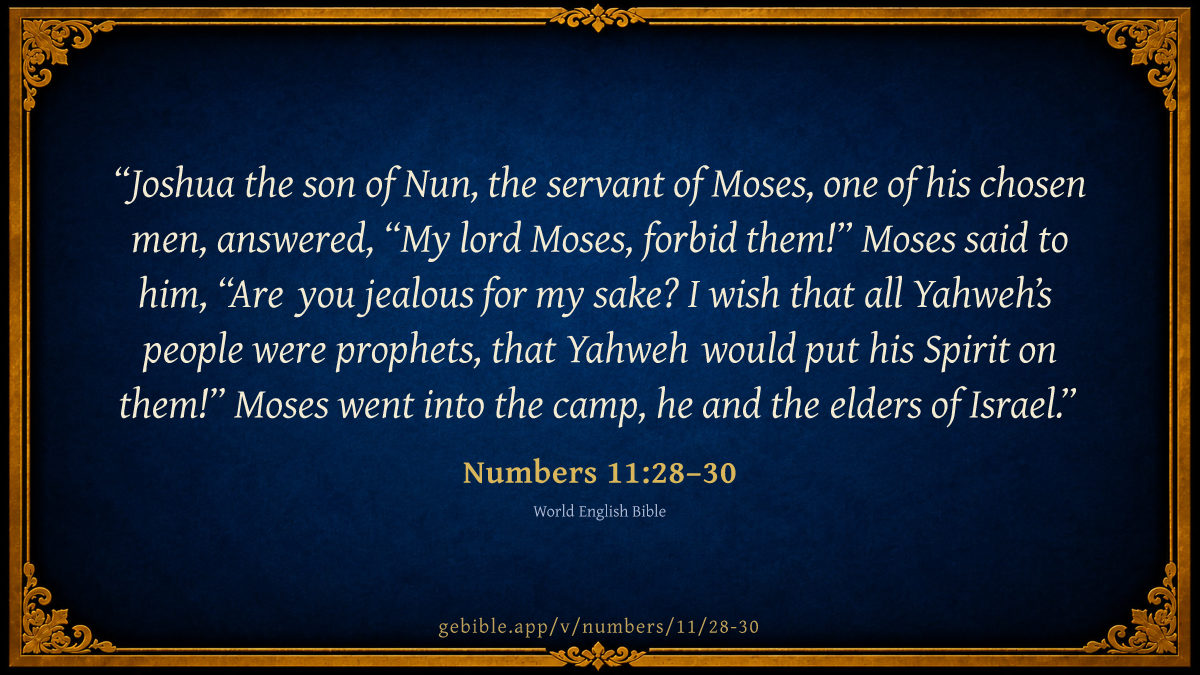
28Joshua the son of Nun, the servant of Moses, one of his chosen men, answered, “My lord Moses, forbid them!”
29Moses said to him, “Are you jealous for my sake? I wish that all Yahweh’s people were prophets, that Yahweh would put his Spirit on them!”
30Moses went into the camp, he and the elders of Israel. 31A wind from Yahweh went out and brought quails from the sea, and let them fall by the camp, about a day’s journey on this side, and a day’s journey on the other side, around the camp, and about two cubits above the surface of the earth. 32The people rose up all that day, and all of that night, and all the next day, and gathered the quails. He who gathered least gathered ten homers; and they spread them all out for themselves around the camp. 33While the meat was still between their teeth, before it was chewed, Yahweh’s anger burned against the people, and Yahweh struck the people with a very great plague. 34The name of that place was called Kibroth Hattaavah, because there they buried the people who lusted.

Geneva Bible translators 1599 · Public Domain On v28 Or, a young man whom he had chosen from…
Or, a young man whom he had chosen from his youth.
Such blind zeal was in the Apostles, Mark 9:38; Luke 9:44.
Geneva Bible (1599) marginal notes — public domain.
John Trapp 1656 · Public Domain On vv28–29 Num 11:28 And Joshua the son of Nun, the…
Num 11:28 And Joshua the son of Nun, the servant of Moses, [one] of his young men, answered and said, My lord Moses, forbid them.
Ver. 28. My lord Moses, forbid.] Thus, "the spirit that is in us lusteth to envy." {Jas 4:5} Nero omnium erat aemulus, qui quoquo mode animum vulgi moverint, Nero envied every man that excelled.
John Trapp, A Commentary or Exposition upon All the Books of the Old and New Testament (1647–1656) — public domain. Text from a community e-Sword module.
Matthew Poole 1685 · Public Domain On vv28–30 One of his young men, or one of his…
One of his young men, or one of his choice ministers, a chosen or excellent person; which may be emphatically added, to note that even great and good men may mistake and misjudge about the works of God. Or, from his youth, as the words will bear, and the Chaldee, Syriac, &c. render it. So it may be added as a reason why Joshua above others were concerned for Moses’s honour and authority. He feared either schism or sedition, or that by their usurpation of authority independently upon Moses, and separately from him, his power and esteem might be lessened, as the next words show.
Matthew Poole's English Annotations on the Holy Bible (1683–1685) — public domain. Text from a community e-Sword/MySword module.
John Gill 1763 · Public Domain On vv28–30 And Joshua the son of Nun, the servant of…
And Joshua the son of Nun, the servant of Moses,.... That waited upon him, and ministered to him, and executed his orders, especially in civil things, and was to be his successor:
one of his young men; not that Joshua was a young man in age, for he must be now between fifty and sixty years of age; see Gill on Exo 33:11; nor does the word necessarily suppose that those men were young among whom Joshua was; but choice excellent persons, the principal servants of Moses, at the head of whom Joshua was being his prime minister: the Targum of Onkelos and the Syriac version render it, "from his youth", joining it with the word servant, as if he was the servant of Moses from his youth, or ever since he was a young man; but Moses had not been out of Midian but about two years, where he had kept his father's sheep; however, he
Read full note →
answered and said, my lord Moses, forbid them; prophesying, restrain them from it, suffer them not to go on in it; he would have him exert his authority as the chief magistrate, which he thought was affected by their prophesying without his knowledge and consent; and because a word from the root here used signifies a prison, some here interpret it,"put them in prison,''which is a sense Jarchi mentions; but it can hardly be thought that Joshua meant that such rigorous measures should be taken, only that they should be rebuked for what they had done, and be charged for the future to be silent.
John Gill's Exposition of the Whole Bible (1746–1763) — public domain (CC PDM 1.0). Text via the HelloAO Bible API.
John Wesley 1765 · Public Domain On vv28–30 One of his young men - Or, one of…
One of his young men - Or, one of his choice ministers, which may be emphatically added, to note that even great and good men may mistake about the works of God. Forbid them - He feared either schism, or sedition, or that by their usurpation of authority, independently upon Moses, his power and esteem might be lessened.
John Wesley, Explanatory Notes Upon the Whole Bible (1754–1765) — public domain. Text via the GEBible commentary corpus.
Adam Clarke 1810 · Public Domain On vv28–29 Verse 28. My lord Moses, forbid them.]
Verse 28. My lord Moses, forbid them.]
How often have I blindly done
Read full note →
What zealous Joshua did,
Impatient to the rulers run,
And cried, "My lords, forbid!
Silence the schismatics, constrain
Their thoughts with ours t' agree,
And sacrifice the souls of men
To idol UNITY!"
Adam Clarke's Commentary on the Bible (1810–1826) — public domain. Text from a community e-Sword/MySword module.
Joseph Benson 1811 · Public Domain On vv29–30 Num 11:29. Enviest thou for my sake? — Art…
Num 11:29. Enviest thou for my sake? — Art thou grieved because the gifts and graces of God’s Spirit are imparted to others besides me? Or rather, Art thou jealous for my sake? Art thou afraid that their exercising these prophetic gifts will be a diminution of my honour? Would God that all the Lord’s people were prophets — That they were all so inspired by his Spirit as to be enabled to speak to his praise, and to the edification of others! He saith prophets, not rulers, for that, he knew, could not be. Thus we see, though Joshua was Moses’s particular friend and confidant, and though he said this out of respect for Moses, whose honour he was very unwilling to see lessened by the call of those elders, yet Moses reproves him, as Christ did the disciples on the occasion just mentioned, and, in him, all who are of such a spirit. “We must take care,” says Henry, “that we do not secretly grieve at the gifts, graces, or usefulness of others, and that we be not forward to condemn and silence those that differ from us, as if they did not follow Christ, because they do not follow him with us. Shall we reject those whom Christ has owned? or restrain any from doing good because they are not in every thing of our mind? Moses was of another spirit; so far from silencing these two, and quenching the spirit in them, he wishes that all the Lord’s people were prophets, and that he would put his Spirit upon them. Not that he would have had any to set up for prophets who were not duly qualified; or that he expected the spirit of prophecy to be made thus common; but he thus expresseth the love and esteem he had for all the Lord’s people, the complacency he took in the gifts of others, and how far he was from being displeased at Eldad and Medad’s prophesying from under his eye. Such an excellent spirit as this blessed Paul was of; rejoicing that Christ was preached, though it were by those who therein intended to add affliction to his bonds, Php 1:16. We ought to be pleased that God is served and glorified, and good done, though to the lessening of our credit and the credit of our way.”
Joseph Benson's Commentary on the Old and New Testaments (1811–1818) — public domain. Text from a community e-Sword module.
Haydock's Catholic Bible Commentary 1859 · Public Domain On vv28, 30 Chosen among the seventy, and designed, from his youth,…
Chosen among the seventy, and designed, from his youth, to be the general, and successor of Moses; the Hebrew may be understood in all these senses. See Exodus xvii. 10. (Calmet) --- Josue was afraid lest they had assumed this air of authority in opposition to Moses. St. John addressed our Saviour, under the same impressions of zeal, Luke ix. 49.
George Leo Haydock (1774–1849), Haydock's Catholic Family Bible and Commentary, 1859 edition — public domain. Excludes Psalms (Douay-Rheims chapter numbering differs from Protestant) and Deuterocanonical books (Catholic canon only).
Daniel D. Whedon 1874 · Public Domain On vv28–29 28. Joshua — See Exo_17:9, and the Introduction to…
28. Joshua — See Exo_17:9, and the Introduction to the Book of Joshua, page 7.
My lord — This title of respect is applied to Moses by Aaron in Num_12:11, and by the people in Num_32:25.
Read full note →
Forbid them — This is the beginning of religious intolerance for nonconformity in worship.
Daniel D. Whedon (gen. ed.), Commentary on the Old and New Testaments (1874–1909) — public domain. Text from a community e-Sword module.
The Cambridge Bible for Schools and Colleges 1878 · Public Domain On vv28–29 28. Joshua was not one of the seventy, but…
28. Joshua was not one of the seventy, but was attached to the sacred Tent as its aedituus or caretaker. Cf. Exo_33:11.
one of his chosen men] R.V. marg. is probably right—from his youth. But Joshua was still in his youth (Exo_33:11). The narrator, writing long after the event, adds parenthetically a general description of Joshua, not merely a description of what he had been at the moment.
The Cambridge Bible for Schools and Colleges (gen. ed. J. J. S. Perowne; Cambridge University Press, 1878–1918) — public domain. Text from a community e-Sword module.
Ellicott's Commentary for English Readers 1878 · Public Domain On vv28–29 (28) My lord Moses, forbid them.—The motive which prompted…
(28) My lord Moses, forbid them.—The motive which prompted Joshua in making this request appears to have been similar to that which led St. John to forbid the man to cast out devils who did not follow with the Apostles (Mar_9:38-39; Luk_9:49-50). But as the man did not cast out devils in his own name, but in that of Christ, so in this case Eldad and Medad prophesied in virtue of the spirit which rested upon them from above, of which the Holy Ghost, not Moses, was the giver. The motives which deterred Eldad and Medad from going to the tent of meeting are unknown. The history teaches the freeness and the sovereignty of the Holy Spirit’s influences, as afterwards did that of Cornelius, when the Holy Ghost fell upon him and upon those who were with him, previously to the reception of baptism, and they spoke with tongues and magnified God (Act_10:44-48).
A Bible Commentary for English Readers, edited by Charles John Ellicott (1878–1897) — public domain. Text from a community e-Sword module.
The Pulpit Commentary 1880 · Public Domain On vv28–30 Joshua the son of Nun. See on Exo_17:9. As…
Joshua the son of Nun. See on Exo_17:9. As before, he is called Joshua by anticipation. One of his young men. This implies that there were others who to some extent shared his duties towards Moses; but that Joshua stood in a peculiar relation to his master is evident from Exo_24:13 Exo_32:17, as well as from this passage itself. My lord Moses, forbid them. Probably he did not know that they had been enrolled, and he was naturally jealous for the honour of Moses a jealousy which was not at all unnecessary, as the events of the next chapter proved. The prophesying of Eldad and Medad in the camp might well seem like the setting up of an independent authority, not in harmony with that of Moses.
The Pulpit Commentary (1880–1919), ed. H.D.M. Spence-Jones & Joseph S. Exell — public domain. Text from a community e-Sword module.
unfoldingWord translationNotes 2017 · CC BY-SA 4.0 On v28 stop them
stop them
"tell them to stop prophesying"
Read full note →
Are you jealous for my sake?
Moses uses this question to rebuke Joshua. It can be translated as a statement, if necessary. AT: "You should not be jealous for my sake." (See: Rhetorical Question)
Are you jealous for my sake?
What Joshua might have been jealous about can be stated clearly if needed. AT: "Are you concerned that they might be taking away something that belongs to me?" or "Are you concerned that people will not respect my authority?" (See: Assumed Knowledge and Implicit Information)
that he would put his Spirit on them all
Moses speaks of God's Spirit giving people power as if God were to put his Spirit on them. AT: "that God's Spirit would give them all power" (See: Metaphor)
translationWords
Joshua
lord
jealous
Israel
unfoldingWord translationNotes — © Distant Shores Media and the Door43 World Missions Community, licensed CC BY-SA 4.0. Source: git.door43.org/Door43/en_tn.
Tyndale Open Study Notes 2022 · CC BY-SA 4.0 On v28 11:28-29 Joshua’s zealous protest was prompted by his jealousy…
11:28-29 Joshua’s zealous protest was prompted by his jealousy in a worthy but immature desire to safeguard his master’s status. Moses was humble (Num 12:3) and was not threatened by Eldad and Medad’s prophecy. Instead, he was magnanimous about sharing the spotlight and happy to learn that God was working through others in such special ways. Moses had leadership qualities that the younger Joshua had not yet acquired (cp. Mark 9:38-40).
Tyndale Open Study Notes — © Tyndale Open Resources, licensed CC BY-SA 4.0. Text via the HelloAO Bible API.