
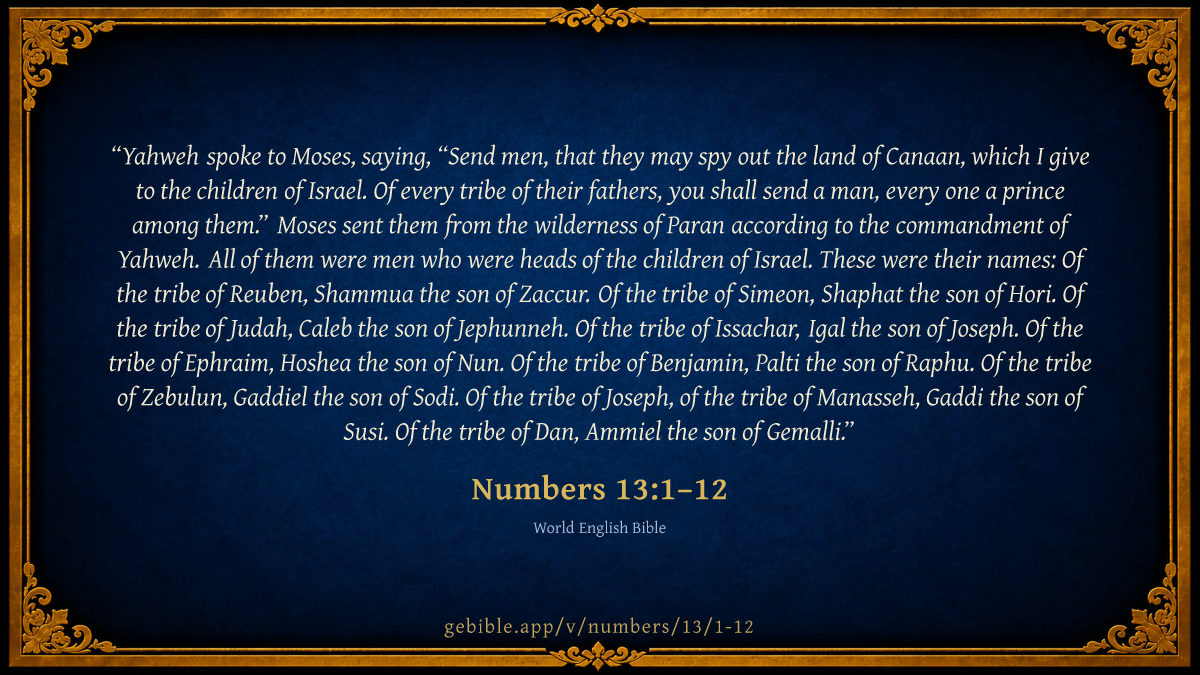
Yahweh spoke to Moses, saying, “Send men, that they may spy out the land of Canaan, which I give to the children of Israel. Of every tribe of their fathers, you shall send a man, every one a prince among them.”
Moses sent them from the wilderness of Paran according to the commandment of Yahweh. All of them were men who were heads of the children of Israel.
These were their names: Of the tribe of Reuben, Shammua the son of Zaccur.
Of the tribe of Simeon, Shaphat the son of Hori.
Of the tribe of Judah, Caleb the son of Jephunneh.
Of the tribe of Issachar, Igal the son of Joseph.
Of the tribe of Ephraim, Hoshea the son of Nun.
Of the tribe of Benjamin, Palti the son of Raphu.
Of the tribe of Zebulun, Gaddiel the son of Sodi.
Of the tribe of Joseph, of the tribe of Manasseh, Gaddi the son of Susi.
Of the tribe of Dan, Ammiel the son of Gemalli.
Geneva Bible translators 1599 · Public Domain On vv1, 3, 4, 9 That is, in Rithmah, which was in Paran, Num.…
That is, in Rithmah, which was in Paran, Num. 33:18.
Geneva Bible (1599) marginal notes — public domain.
John Trapp 1656 · Public Domain On vv1, 2, 3, 6 Num 13:1 And the LORD spake unto Moses, saying,
Num 13:1 And the LORD spake unto Moses, saying,
Ver. 1. And the Lord spake.] Yielding to the people’s importunity, and winking at their infidelity; for he had before spied out the land for them, {Eze 20:6} and searched it out, {Deu 1:33} but that satisfied them not; seeing was, with them, believing. See Deu 1:22.
John Trapp, A Commentary or Exposition upon All the Books of the Old and New Testament (1647–1656) — public domain. Text from a community e-Sword module.
Matthew Poole 1685 · Public Domain On vv2, 11 Do as the people press thee to do.
Do as the people press thee to do.
Of every tribe of their fathers, i.e. which comes from their several parents or patriarchs.
Read full note →
A ruler; a person of wisdom and authority, which might make his witness more considerable with the people.
Matthew Poole's English Annotations on the Holy Bible (1683–1685) — public domain. Text from a community e-Sword/MySword module.
Matthew Henry 1710 · Public Domain On v1 Here we have, I. Orders given to send spies…
Here we have, I. Orders given to send spies to search out the land of Canaan. It is here said, God directed Moses to send them (Num 13:1, Num 13:2), but it appears by the repetition of the story afterwards (Deu 1:22) that the motion came originally from the people; they came to Moses, and said, We will send men before us; and it was the fruit of their unbelief. They would not take God's word that it was a good land, and that he would, without fail, put them in possession of it. They could not trust the pillar of cloud and fire to show them the way to it, but had a better opinion of their own politics than of God's wisdom. How absurd was it for them to send to spy out a land which God himself had spied out for them, to enquire the way into it when God himself had undertaken to show them the way! But thus we ruin ourselves by giving more credit to the reports and representations of sense than to divine revelation; we walk by sight, not by faith; whereas, if we will receive the witness of men, without doubt the witness of God is greater. The people making this motion to Moses, he (perhaps not aware of the unbelief at the bottom of it) consulted God in the case, who bade him gratify the people in this matter, and send spies before them: "Let them walk in their own counsels." Yet God was no way accessory to the sin that followed, for the sending of these spies was so far from being the cause of the sin that if the spies had done their duty, and the people theirs, it might have been the confirmation of their faith, and of good service to them.
II. The persons nominated that were to be employed in this service (Num 13:4, etc.), one of each tribe, that it might appear to be the act of the people in general; and rulers, person of figure in their respective tribes, some of the rulers of thousands or hundreds, to put the greater credit upon their embassy. This was designed for the best, but it proved to have this ill effect that the quality of the persons occasioned the evil report they brought up to be the more credited and the people to be the more influenced by it. Some think that they are all named for the sake of two good ones that were among them, Caleb and Joshua. Notice is taken of the change of Joshua's name upon this occasion, Num 13:16. He was Moses's minister, but had been employed, though of the tribe of Ephraim, as general of the forces that were sent out against Amalek. The name by which he was generally called and known in his own tribe was Oshea, but Moses called him Joshua, in token of his affection to him and power over him; and now, it should seem, he ordered others to call him so, and fixed that to be his name henceforward. Oshea signifies a prayer for salvation, Save thou; Joshua signifies a promise of salvation, He will save, in answer to that prayer: so near is the relation between prayers and promises. Prayers prevail for promises, and promises direct and encourage prayers. Some think that Moses designed, by taking the first syllable of the name Jehovah and prefixing it to his name, which turned Hoshea into Jehoshua, to put an honour upon him, and to encourage him in this and all his future services with the assurances of God's presence. Yet after this he is called Hoshea, Deu 32:44. Jesus is the same name with Joshua, and it is the name of our Lord Christ, of whom Joshua was a type as successor to Moses, Israel's captain, and conqueror of Canaan. There was another of the same name, who was also a type of Christ, Zac 6:11. Joshua was the saviour of God's people from the powers of Canaan, but Christ is their Saviour from the powers of hell.
Read full note →
III. The instructions given to those spies. They were sent into the land of Canaan the nearest way, to traverse the country, and to take account of its present state, Num 13:17. Two heads of enquiry were given them in charge, 1. Concerning the land itself: See what that is (Num 13:18, and again, Num 13:19), see whether it be good or bad, and (Num 13:20) whether it be fat or lean. All parts of the earth do not share alike in the blessing of fruitfulness; some countries are blessed with a richer soil than others. Moses himself was well satisfied that Canaan was a very good land, but he sent these spies to bring an account of it for the satisfaction of the people; as John Baptist sent to Jesus, to ask whether he was the Christ, not to inform himself, but to inform those he sent. They must take notice whether the air was healthful or no, what the soil was, and what the productions; and, for the better satisfaction of the people, they must bring with them some of the fruits. 2. Concerning the inhabitants - their number, few or many - their size and stature, whether strong able-bodied men or weak, - their habitations, whether they lived in tents or houses, whether in open villages or in walled towns, - whether the woods were standing as in those countries that are uncultivated, through the unskillfulness and slothfulness of the inhabitants, or whether the woods were cut down, and the country made champaign, for the convenience of tillage. These were the things they were to enquire about. Perhaps there had not been of late years such commerce between Egypt and Canaan as there was in Jacob's time, else they might have informed themselves of these things without sending men on purpose to search. See the advantage we may derive from books and learning, which acquaint those that are curious and inquisitive with the state of foreign countries, at a much greater distance than Canaan was now from Israel, without this trouble and expense.
IV. Moses dismisses the spies with this charge, Be of good courage, intimating, not only that they should be themselves encouraged against the difficulties of this expedition, but that they should bring an encouraging account to the people and make the best of every thing. It was not only a great undertaking they were put upon, which required good management and resolution, but it was a great trust that was reposed in them, which required that they should be faithful.
Matthew Henry's Commentary on the Whole Bible (1708–1710) — public domain (CC PDM 1.0). Text via the HelloAO Bible API.
John Gill 1763 · Public Domain On vv1–12 And the Lord Spake unto Moses,.... When in the…
And the Lord Spake unto Moses,.... When in the wilderness of Paran, either at Rithmah or Kadesh; this was on the twenty ninth day of the month Sivan, on which day, the Jews say (o), the spies were sent to search the land, which was a scheme of the Israelites' own devising, and which they first proposed to Moses, who approved of it as prudential and political, at least he gave his assent unto it to please the people, and carried the affair to the Lord, and consulted him about it; who, rather permitting than approving, gave the following order; for the motion carried in it a good deal of unbelief, calling in question whether the land was so good as had been represented unto them, fearing it was not accessible, and that it would be difficult to get into it, and were desirous of knowing the best way of getting into it before they proceeded any further; all which were unnecessary, if they would have fully trusted in the Lord, in his word, promise, power, providence, and guidance; who had told them it was a land flowing with milk and honey; that he would show them the way to it, by going before them in a pillar of cloud and fire; that he would assuredly bring them into it, having espied it for them, and promised it unto them; so that there was no need on any account for them to send spies before them; however, to gratify them in this point, he assented to it:
saying; as follows.
Read full note →
(o) Ib. ut supra, (Seder Olam Rabba, c. 8. p. 24. & Meyer. Annotat. in ib. p. 338.) Pesikta, Chaskuni.
John Gill's Exposition of the Whole Bible (1746–1763) — public domain (CC PDM 1.0). Text via the HelloAO Bible API.
John Wesley 1765 · Public Domain On vv1, 2, 8, 11 The sending of the spies into Canaan, ver. 1-17.…
The sending of the spies into Canaan, ver. 1-17. The instructions given them, ver. 18-20. Their journey and return, ver. 21-25. Their report, ver. 26-33.
Speak unto Moses - In answer to the peoples petition about it, as is evident from Deut. i, 22. And it is probable, the people desired it out of diffidence of God's promise.
John Wesley, Explanatory Notes Upon the Whole Bible (1754–1765) — public domain. Text via the GEBible commentary corpus.
Adam Clarke 1810 · Public Domain On vv1–2 Twelve men, one out of every tribe, are sent…
CHAPTER XIII
Twelve men, one out of every tribe, are sent to examine the
Read full note →
nature and state of the land of Canaan, 1-3.
Their names, 4-16.
Moses gives them particular directions, 17-20.
They proceed on their journey, 21, 22.
Come to Eshcol, and cut down a branch with a cluster of grapes,
which they bear between two of them upon a staff, 23, 24.
After forty days they return to Paran, from searching the land,
and show to Moses and the people the fruit they had brought with
them, 25, 26.
Their report-they acknowledge that the land is good, but that
the inhabitants are such as the Israelites cannot hope to
conquer, 27-29.
Caleb endeavours to do away the bad impression made, by the
report of his fellows, upon the minds of the people, 30.
But the others persist in their former statement, 31:
and greatly amplify the difficulties of conquest, 32, 33.
NOTES ON CHAP. XIII
Adam Clarke's Commentary on the Bible (1810–1826) — public domain. Text from a community e-Sword/MySword module.
Joseph Benson 1811 · Public Domain On vv1, 8, 11 Num 13:1-2. The Israelites being now come to the…
Num 13:1-2. The Israelites being now come to the borders of Canaan, Moses commanded them, in the name of God, to go up and possess it, reminding them of his promise to give them the possession of it, and exhorting them not to fear nor be discouraged, Deu 1:21. But the unbelieving and distrustful multitude, forgetting the power and faithfulness of God, were afraid to venture on this hazardous undertaking, as they thought it, till some persons were sent to examine and bring them information what sort of country it was, and what kind of people they should have to contend with. We will send men before us, said they, and they shall search out the land, and bring us word again, Deu 1:22. Moses, therefore, in compliance with their request, is directed by God to send proper persons, chosen from all the tribes, for this purpose. Every one a ruler among them — Not those called princes of the tribes, in the first chapter of this book, but men of wisdom and authority, and rulers or officers of an inferior kind.
Joseph Benson's Commentary on the Old and New Testaments (1811–1818) — public domain. Text from a community e-Sword module.
Albert Barnes 1834 · Public Domain On vv1–2 And the Lord spake - The mission of the…
And the Lord spake - The mission of the spies was first suggested by the Israelites themselves. See Deu 1:22.
Albert Barnes' Notes on the Bible (1834–1885) — public domain. Text from a community e-Sword/MySword module.
Haydock's Catholic Bible Commentary 1859 · Public Domain On vv1, 3, 6, 12 Pharan, at Rethma, chap. xxxiii. 48.; though Barradius confounds…
Pharan, at Rethma, chap. xxxiii. 48.; though Barradius confounds that station with that at Cades-barne. The Samaritan copy inserts here a long passage, taken probably from Deuteronomy i. 20, 21, and 22, which shews that the Hebrews first proposed the sending spies, out of timidity; which God severely punished in the sequel, though in his anger he here consents to their proposal, which seemed to originate in motives of prudence, ver. 3.
George Leo Haydock (1774–1849), Haydock's Catholic Family Bible and Commentary, 1859 edition — public domain. Excludes Psalms (Douay-Rheims chapter numbering differs from Protestant) and Deuterocanonical books (Catholic canon only).
Lange's Commentary on the Holy Scriptures 1864 · Public Domain On v1 The Fall of the Old Generation in the Wilderness…
THIRD SECTION
The Fall of the Old Generation in the Wilderness of Paran. The Spies. The Despondency, the Stubbornness and the Judgment
Read full note →
Num_13:1 to Num_14:45
In this section we read the history of Israel in the wilderness in the narrower sense, the tragic history of their first cardinal and temporary rejection. God never rejected His entire people, though He did reject single generations of the nation in a conditional sense. This first time one generation died in the wilderness; another time two generations died in the Babylonish captivity; and after the destruction of Jerusalem and later, countless generations fell under the sentence of dispersion. Moreover, individual tribes more or less detached themselves from the total of Israel before the deportation of the Ten Tribes to Assyria. But never did the entire nation go to destruction. Again and again the prophets renew the promise of salvation to a pious remnant, an election, and that in a form ever greater and more glorious. But as, on the one hand, the entire nation is never meant, so also, on the other, the single individual as such is never meant. Even the vacillating, lost multitude is indeed judged as a nation, but not in the relation of the individual to Jehovah, and in the end there shall issue from each visitation a fruit of righteousness. It is the history of humanity on a reduced scale. It is characteristic, that several modern critics, from goethe on, have desired to eliminate this providential central point of the wanderings of Israel, the proper theocratic idea of it, in order to make prominent in the history what remains almost an insignificant military caravan expedition through the desert.
___________________
The Spies and their Report
Num_13:1-33
1And the Lord spake unto Moses, saying, 1Send thou men, that they may 22search the land of Canaan, which I give unto the children of Israel: of every tribe of their fathers shall ye send a man, every one a 3ruler among them. 3And Moses by the commandment of the Lord sent them from the wilderness of Paran: 4all those men were heads of the children of Israel. And these were their names; 5Of the tribe of Reuben, Shammua the son of Zaccur. Of the tribe of Simeon, Shaphat the son of Hori. 6Of the tribe of Judah, Caleb the son of Jephunneh. 7Of the tribe of Issachar, Igal the son of Joseph. 8Of the tribe of Ephraim. Oshea the son of Nun. 9Of the tribe of Benjamin, Palti the son of Raphu. 10Of the tribe of Zebulun, Gaddiel the son of Sodi. 11Of the tribe of Joseph, namely, 12of the tribe of Manasseh, Gaddi the son of Susi. Of the tribe of Dan, Ammiel the son of Gemalli. 13Of the tribe of Asher, Sethur the son of Michael. 14Of the tribe of Naphtali, Nahbi the son of Vophsi. 15Of the tribe of Gad, Geuel 16the son of Machi. These are the names of the men which Moses sent to spy out the land. And Moses called Oshea the son of Nun, Jehoshua.
17And Moses sent them to spy out the land of Canaan, and said unto them, Get you up this way 4southward, and go up into the mountain: 18And see the land, what it is; and the people that dwelleth therein, whether they be strong or weak, few or many. 19And what the land is that they dwell in, whether it be good or bad; and what cities they be that they dwell in, whether in 5tents, or in strong holds; 20And what the land is, whether it be fat or lean, whether there be wood therein, or not. And be ye of good courage, and bring of the fruit of the land. Now the time was the time of the first ripe grapes.
21So they went up, and 6searched the land from the wilderness of Zin unto Rehob, as men come to Hamath. 22And they ascended 7by the south, and came unto Hebron; 8where Ahiman, Sheshai, and Talmai, the children of Anak, were. (Now Hebron was built seven years before Zoan in Egypt.) 23And they came unto the 9brook of Eshcol, and cut down from thence a branch with one cluster of grapes, and they bare it between two upon a staff; and they brought of the pomegranates, and of the figs. 24The place was called the1brook 10Eshcol, because of the cluster of grapes which the children of Israel cut down from thence. 25And they returned from 11searching of the land after forty days.
26And they went and came to Moses, and to Aaron, and to all the congregation of the children of Israel, unto the wilderness of Paran, to Kadesh; and brought back word unto them, and unto all the congregation, and shewed them the fruit of the land. 27And they told him, and said, We came unto the land whither thou sentest us, and surely it floweth with milk and honey; and this is the fruit of it. 28Nevertheless the people be strong that dwell in the land, and the cities are 12walled, and very great: and moreover we saw the children of Anak there. 1329The Amalekites dwell in the land of the south: and the Hittites, and the Jebusites, and the Amorites, dwell in the mountains: and the Canaanites dwell by the sea, and by the coast of Jordan. 30And Caleb stilled the people before Moses, and said, Let us go up at once, and possess it; for we are well able to overcome it. 31But the men that went up with him said, We be not able to go up against the people; for they are stronger than we. 32And they brought 14up an evil report of the land which they had fsearched unto the children of Israel, saying, The land, through which we have gone to search it, is a land that eateth up the inhabitants thereof; and all the people that we saw in it are 15men of a great stature. 33And there we saw the giants, the sons of Anak, which come of the giants: and we were in our own sight as grasshoppers, and so we were in their sight.
TEXTUAL AND GRAMMATICAL
[Num_13:22. It is generally thought that instead of וַיּבֹא we should read וַיָּבֹאוּ, “for a plural precedes, and such is the reading of the Sam., 2 Codd. K, and all the ancient versions except Onkelos and Gr. Ver.” Maurer.
“Two facts are mentioned in Num_13:22-24, which occurred in connection with their mission, and were of great importance to the whole congregation. These single incidents are linked on, however, in a truly Hebrew style, to what precedes, viz., by an imperf. with Vav consec,” Keil. See further in Exeget. and Crit.—Tr.].
EXEGETICAL AND CRITICAL
1. The sending out of the spies, Num_13:1-20. The occasion of this is, on the one hand, the desire of the people (Deu_1:22), on the other the command of Jehovah. The locality from which the sending proceeds is the wilderness of Paran (Num_12:16), or, more exactly defined, Kadesh (Num_13:26; Deu_1:20). On the site of Kadesh see Keil in loc. [and Translator’s note below]. The men who were chosen for the expedition were required to be princes of the branch of a tribe from the individual tribes, (not the princes of the several tribes themselves), men of importance and reliable.16 They are definitely enrolled according to the particular tribes. All twelve tribes are represented, except Levi, which is omitted according to its destination. But Knobel is at pains to make it appear that Ephraim, too, is without representation, or that, according to one source, Joshua was not among the spies, while, according to the other, he was (see the note in Keil, in loc.).
The official change of the name Oshea to Joshua, which Moses effected on the occasion of this expedition, was already prepared by previous significant things, just as the official naming of Peter in the Evangelical history. The significant thing is that such names grow up by degrees until they are punctuated. One may still distinguish from this the author’s prolepsis.
2. The instruction to the spies, Num_13:17-20. (a). Whither? Into the south-land (Negeb) of Canaan, and then to the mountains. Against Knobel, who thinks that only the mountains of Judah are meant, Keil justly maintains that all the mountain land of Canaan is meant, the mountains of the Amorites (Deu_1:7; Deu_1:19). [See Translator’s note below]. As a matter of course, Knobel’s aim is to detect a discrepancy.
(b). For what object? To inspect the land, (1) the people; (2) the cities (whether fenced or encampments); (3) the vegetation. They were to bring back with them samples of the fruits of the land. It was about the season of the first ripe grapes. “In Palestine the first grapes ripen in August, partly even in July (comp. Robinson, II., p. 100), whereas the vintage takes place in September and October (comp. V. Schubert, R. III., p. 112 sq.; Tobler, Denkblætter aus Jerusalem, p. 111).”
3. The journey, Num_13:21. The most northern part of the wilderness of Paran was the wilderness of Zin (in the Talmud: low palm). From this latter (the Wady Murreh) they started and came as far as Rehob, “to come to Hamath,” i.e., from where one comes to Hamath. In any case this Rehob lay in the extreme north of Palestine, for Hamath, called later Epiphania, was situated on the Orontes. Robinson supposed he identified Rehob in the place Kalat Honin which Keil disputes [see also Smith’s Bib. Dict., sub. voc.—Tr.].
Here connects the statement of their return, Num_13:25.
At this point Keil makes a very appropriate remark with reference to Ewald, where see his note. It is a peculiarity of Hebrew historic narrative that it places the end and result of events as much as possible at the head of the account, and then afterwards brings in the details of the more important accompanying circumstances. Keil cites as examples 1Ki_6:9; 1Ki_6:15; Jos_4:11 sqq.; Jdg_20:35 sqq. In poetry this is the character of the novel as distinguished from the form of the romance. In this way Genesis 2 is related to Genesis 1 Thus here the narrative in Num_13:22-24 is overtaken, because with the antithesis: “the large grapes, but the children of Anak, too,” the tragic knot is tied. Thus then they came to Hebron (union), there were Ahiman (brother of the gift?), Sheshai (the white?) and Talmai (abounding in furrows? fruit-land), the sons of Anak an ancient giant race (long-necked), Deu_9:2 Goliath is an example of there being straggling remnants of these in later times. They were descended from Arbah, from whom Hebron was called Kirjath Arbah; but Anak designates the people, see Jos_15:14; Jdg_1:20. Hebron was a very ancient city (see on Gen_13:18); it was built seven years before Zoan in Egypt, Num_13:22. “Zoan, i.e., Tanis of the Greeks and Romans, San of the Arabians, Dschane in the Coptic writings, was situated on the east side of the Tanitic arm of the Nile, not far from its mouth, and was the residence of Pharaoh in Moses’ time,” Keil, see Gen_13:18; Gen_23:2 sqq.
It is still a question whether וַיָּבאֹוּ is to be substituted for ֹוַיָּבא. The narrator says: “and one came also.” And what reason could he have for that? It seems to be wholly assumed that the twelve spies always remained together. Verily not a good method of scouting. Moreover, at a later period, Joshua sent out only two spies to Jericho. One may assume that these twelve also subdivided themselves variously. Thus, then, a few in particular came to Hebron.
Thus, also, after another episode they came to the brook Eshcol (cluster of grapes, grapes) Num_13:23. And they cut down the great cluster that two men bore on a pole. This could only be on their return home. Their motive for so carrying it was to preserve it fresh. They took in addition some pomegranates and figs. It has been conjectured that a valley to the north of Hebron is meant, where grow the largest and most beautiful grapes of the land, also pomegranates, figs and other fruits in abundance (Keil with reference to Robinson, I. p. 316 compared with p. 314, and II. p. 442). In that case the spies with their great cluster needed care to get by the children of Anak unobserved (see Keil on a double derivation of the name). [On Eshcol see Translator’s note below].
4. The Report of the Spies, Num_13:26-33. The spies give confirmation before the assembly of the people, that the land agrees with the old promise, and they exhibit their fruits; then, however, there immediately follows a but, but—the אֶפֶם כִּי: a strong nation; fenced cities; sons of Anak are there; Amalekites in the south; Hittites, Jebusites, Amorites in the mountains; Canaanites in the lowlands by the sea and by Jordan (Gen_20:1). Caleb seeks to soothe the excited people by resolute confidence of conquest. That Joshua does not make a speech confirms Knobel in the assumption that he was not one of them. The rest of the spies, of course, oppose Caleb. The land, they say, eateth up its inhabitants. The strange expression would say: they so press one another for its possession that they grind each other up. A second exaggeration: all the people that we saw in it are men of great stature. And still further they contradict themselves: we also saw giants there; of course they would make the impression that these children of Anak were like the dreadful giants that lived before the flood. In the last exaggeration was manifested the extravagance of the cowards: we were in our own sight as grasshoppers, and so we were in their sight. Truly an expressive type of the lying fear with which worldly-mindedness has ever depicted the difficult approaches to the kingdom of God.
[Kadesh, Num_13:26. In a copious note at the end of chap. 13, the Editor of The Bible Comm. maintains that “Kadesh is to be identified with Ain-el-Weibeh, which lies in the Arabah, about ten miles north of the place in which Mt. Hor abuts on that valley.” Robinson (II., § 12., June 2) leads in this view, and is followed by many. The view commended by Lange in referring to Keil, and which is maintained by Ritter, Kurtz and Mr. Thrupp, the original writer on Numbers in the Bib. Comm. and many others, is that advocated by Messrs. Rowlands and Williams (Holy City, I. 463 sqq.), and by Mr. Wilton (Negeb. pp. 79, 80). This view identifies Kadesh with el-Ain, which is about sixty miles west of Mt. Hor, and twenty miles further north (according to the map in Palmer’s Desert of the Exodus), or about fifty miles west of Ain-el-Weibeh. In this view E. H. Palmer concurs, who says: “The name Kadesh (though belonging more particularly to the open space immediately below the cliff (Sela) in which Ain Gadis, or the spring of Kadesh, rises, might easily have been extended to the whole region, as the name of the spot in which the most important events took place. This would account for the apparent discrepancies in the Biblical references to the locality, which at one time is said to be in the wilderness of Paran (Num_13:26), at another, in the wilderness of Zin (Deu_32:51), and again, is defined with Heshmon as being one of the uttermost cities of the tribe of Judah southward [Jos_15:3-4; Jos_15:27].
“I concur with Wilton (The Negeb., p. 124) in believing that the wilderness of Paran comprised the whole desert Et Tih, and that Mt. Paran was the southernmost portion of the mountain plateau in the northeast, at present inhabited by the Azazimeh Arabs and known as Jebel Magrah. To one encamped in the wilderness of Kadesh, that is the open plain into which Wady Gadis debouches, Jebel Magrah would be always the most conspicuous object in the scene, and would completely shut out the view of the more fertile mountains beyond.…
“The Israelites were encamped, according to my theory, at the foot of the line of cliffs in which Ain Gades takes its rise, and their intention was evidently to march straight upon Palestine by the short and easy route which skirts the western edge of the mountains. The spies were to get them up by the way of the Negeb [south-land], not by the plains in which the Canaanites were assembling, but to go up into the mountains. This they could only do by skirting the southern end of the Azazimeh mountains, and striking into the heart of the plateau at Wady Ghamr. Having then penetrated into Palestine by this road, and searched the country as far as the plain of Cœle-Syria, they returned by way of Hebron, and explored (as coming from the North, they might now do without suspicion) the route by the western edge of the mountain. In one of these extensive valleys (perhaps in Wady Hanein, where miles of grape-mounds even now meet the eye [not more than sixteen miles north of Kadesh.—Tr.]), they cut the gigantic cluster of grapes, and gathered the pomegranates and figs.”—Desert of the Exod., chap. xxv.—Tr.]
Footnotes:
[1]Send for thee.
[2]spy.
[3]princes.
[4]in the South.
[5]camps.
[6]speed.
[7]in the South.
[8]and there were.
[9]Or, valley.
[10]That is, a cluster of grapes.
[11]spying.
[12]fenced.
[13]Amalek dwells.
[14]out.
[15]Heb. men of statures.
[16][Dr. Lange inserts in the Scripture text in loc. the meanings of the names, Num_13:4 sqq. For convenience they are added here. Shammua=announcement, message. Zaccur=a male. Shaphat=judge. Hori=elder and prince. Caleb=one who attacks. Jephunneh=a way paved. Igal=he will redeem. Oshea=help. Nun=posterity. Palti=deliverance. Raphu=healed. Gaddiel=happiness of God. Sodi=confidant. Gaddi=my happiness. Susi=horseman. Ammiel=of the people of God. Gemalli=camel-owner? avenger. Sethur=veiled, secret. Michael=who is as God. Nahbi=hidden. Vophsi=a rich one? prince. Guel=highness of God. Machi=a poor one. Joshua=whose help Jehovah.—Tr.]
Lange's Commentary on the Holy Scriptures (Critical, Doctrinal, and Homiletical), ed. John Peter Lange, English translation edited by Philip Schaff (1864–1880) — public domain. Text from a community e-Sword module.
Robert Jamieson, A. R. Fausset & David Brown 1871 · Public Domain On v3 those men were heads of the children of Israel--Not…
those men were heads of the children of Israel--Not the princes who are named (Num 10:14-16, Num 10:18-20, Num 10:22-27), but chiefs, leading men though not of the first rank.
Jamieson, Fausset & Brown — Commentary Critical and Explanatory on the Whole Bible (1871) — public domain (CC PDM 1.0). Text via the HelloAO Bible API.
Daniel D. Whedon 1874 · Public Domain On v1 1. Send thou men — Although Canaan had been…
1. Send thou men — Although Canaan had been promised to the Israelites as a God-given inheritance on the condition of their fidelity, yet this promise did not render the means of conquest unnecessary. All the strategy of war was required, such as the ambuscade (Jos_8:13) and spies, (Jos_2:1,) in order to success. God’s promises are not designed to supersede, but to stimulate, human activity. Moreover, this reconnaissance afforded to the spies a test of faith in Jehovah, and their report tested the whole nation.
Every one a ruler — R.V., “a prince.” Spies in war are usually not men of high rank, but adventurers who court peril for gain or praise; but these spies, though not the tribe-princes named in chaps. i and vii, are rulers or princes selected from their tribes because of their eminence. From Deu_1:22, we infer that the policy of sending out the spies originated with the Israelites themselves, and was permitted by God as a concession to the weakness of their faith, with a warning to “be of good courage.” Strong faith would have accepted Jehovah’s description of Canaan, and would have leaned on his ability to bring them in according to his oft-repeated promise, without any reconnaissance. Thus suggests the Jewish Midrash. The order of the tribes differs from that in Num_1:5-15, only in the separation of Zebulun from the other sons of Leah in Num_13:10, and in Num_13:11 Manasseh from Ephraim, who together constitute the tribe of Joseph, but are always counted as two tribes, in accordance with the prediction of the dying Jacob in Gen_48:5-6.
Daniel D. Whedon (gen. ed.), Commentary on the Old and New Testaments (1874–1909) — public domain. Text from a community e-Sword module.
The Cambridge Bible for Schools and Colleges 1878 · Public Domain On vv1, 2, 6 1–24. The spies are sent out, and search the…
1–24. The spies are sent out, and search the land.
The Cambridge Bible for Schools and Colleges (gen. ed. J. J. S. Perowne; Cambridge University Press, 1878–1918) — public domain. Text from a community e-Sword module.
Ellicott's Commentary for English Readers 1878 · Public Domain On vv1, 2, 3, 6, 8 (1) And the Lord spake unto Moses . .…
XIII.
(1) And the Lord spake unto Moses . . . —There is no inconsistency between this statement and that which is contained in Deu_1:22, where the sending of the spies is represented as having originated with the people. It is there said that the saying pleased Moses well; but it would be wholly inconsistent with the character and conduct of Moses to suppose that in a matter of such importance he should have acted in a accordance with the suggestion of the people, or upon his own judgment, without seeking direction from God. The command which was given to Moses must not be regarded as implying of necessity that the expedition of the spies was, in the first instance, ordained by God, any more than the command which was afterwards given to Balaam to accompany the messengers of Balak was any indication that God originally commanded, or approved of his journey.
A Bible Commentary for English Readers, edited by Charles John Ellicott (1878–1897) — public domain. Text from a community e-Sword module.
C. H. Mackintosh 1880 · Public Domain On v1 Numbers 13
Numbers 13
"And the Lord spake unto Moses, saying, Send thou men that they may search the land of Canaan, which I give unto the children of Israel: of every tribe of their fathers shall ye send a man, every one a ruler among them. And Moses by the commandment of the Lord sent them from the wilderness of Paran." Verses 1-3.
Read full note →
In order fully to understand the foregoing commandment, we must look at it in connection with a passage in the Book of Deuteronomy, where Moses, in going over the facts of Israel’s marvellous history in the wilderness, reminds them of the following important and interesting circumstance: "And when we departed from Horeb, we went through all that great and terrible wilderness, which ye saw by the way of the mountain of the Amorites, as the Lord our God commanded us; and we came to Kadesh-Barnea. and I said unto you, Ye are come unto the mountain of the Amorites, which the Lord our God doth give unto us. Behold, the Lord thy God hath set the land before thee: go up and possess it, as the Lord God of thy fathers hath said unto thee; fear not, neither be discouraged. And ye came near unto me every one of you, and said, we will send men before us, and they shall search us out the land, and bring us word again by what way we must go up, and into what cities we shall come." Deut. 1: 19-22.
Now here we have the moral root of the fact stated in Numbers 13: 2. It is evident that the Lord gave the commandment concerning the spies because of the moral condition of the people. Had they been governed by simple faith, they would have acted on those soul-stirring words of Moses, "Behold, the Lord thy God hath set the land before thee: go up and possess it, as the Lord God of thy fathers hath said unto thee; fear not, neither be discouraged." There is not a single syllable about spies, in this splendid passage. What does faith want of spies, when it has the word and the presence of the living God? If Jehovah had given them a land, it must be worth having. And had He not? Yes, truly; and not only so, but He had borne testimony to the nature and character of that land in the following glowing words," For the Lord thy God bringeth thee into a good land, a land of brooks of water, of fountains and depths that spring out of valleys and hills; a land of wheat, and barley, and vines, and fig trees, and pomegranates, a land of oil olive and honey; a land wherein thou shalt eat bread without scarceness, thou shalt not lack anything in it; a land whose stones are iron, and out of whose hills thou mayest dig brass." Deut 8: 7-9.
Should not all this have sufficed for Israel? Ought they not to have been satisfied with the testimony of God? had not He spied out the land for them, and told them all about it? And was not this enough? What need of sending men to spy the land? Did not God know all about it! Was there a spot "from Dan to Beersheba" with which he was not perfectly acquainted? Had He not selected this land and allotted it, in His own eternal counsels, for the seed of Abraham His friend? Did He not know all about the difficulties? and was He not able to surmount them? Why, then, did they "come near every one of them, and say, We will send men before us, and they shall search us out the land, and bring us word again!"
Ah! reader, these questions come right home to our hearts. they find us out, and make thoroughly manifest where we are. It is not for us to sit down and coolly animadvert upon the ways of Israel in the wilderness; to point out error here, and failure there? We must take all these things as types set before us for our admonition. They are beacons, erected by a friendly and faithful hand, to warn us off from the dangerous shoals, quicksands, and rocks which lie along our course, and threaten our safety. This, we may be sure, is the true way to read every page of Israel’s history, if we would reap the profit which our God has designed for us in penning such a record.
But, it may be the reader is disposed to ask a question here. "Did not the Lord expressly command Moses to send spies. And if so, how was it wrong for Israel to send them? True, the Lord did command Moses to send the spies, in Numbers 13; but this was in consequence of the moral condition of the people, as set forth in Deuteronomy 1. We shall not understand the former unless we read it in the light of the latter. we learn, most distinctly, From Deuteronomy 1: 22, that the idea of sending the spies had its origin in the heart of Israel. God saw their moral condition, and He issued a command in full keeping therewith.
If the reader will turn to the opening pages of the first book of Samuel, he will find something similar in the matter of the appointment of a king. The Lord commanded Samuel to hearken to the voice of the people, and make them a king. (1 Sam. 8: 22) Was it that He approved of the plan? Most surely not; on the contrary, He declares plainly that it was a positive rejection of Himself. Why then command Samuel to appoint a king! The command was given in consequence of Israel’s condition. They were growing weary of the position of entire dependence upon an unseen arm; and they longed for an arm of flesh. They desired to be like the nations around them, and to have a king who should go out before them, and fight their battles for them. Well, God gave them their request, and they were very speedily called to prove the worthlessness of their plan. Their king proved a most complete failure, and they had to learn that it was an evil and a bitter thing to forsake the living God and lean on a broken reed of their own selection.
Now, we see the same thing in the matter of the spies. There can be no question, in the mind of any spiritual person who studies the entire subject, as to the fact that the scheme of sending the spies was the fruit of unbelief. A simple heart that trusted God would never have thought of such a thing. What! are we to send poor mortals to spy out a land which God has graciously given to us, and which He has so fully and faithfully described? Far be the thought; nay, rather let us say, "It is enough; the land is the gift of God, and as such it must be good. His word is enough for our hearts; we want no spies; we seek for no mortal testimony to confirm the word of the living God. He has given; He has spoken; this is enough."
But alas! Israel was not in a condition to adopt such language. They would send spies. They wanted them, their hearts craved them: the desire for them lay in the very depths of the soul; Jehovah knew this, and hence He issued a commandment in direct reference to the moral state of the people.
The reader would do well to ponder this subject, in the light of scripture. He will need to compare Deuteronomy 1 with Numbers 13. It is possible he may find difficulty in judging of the true nature and moral roots of the act of sending the spies, from the fact that the thing was ultimately done in pursuance of "the commandment of the Lord." But we must ever remember that the fact of the Lord’s commanding the thing to be done does not, by any means, prove that the people were right in seeking it. The giving of the law at Mount Sinai; the sending of the spies; and the appointment of a king, are all proofs of this. No doubt God overruled all these things for His own glory and for man’s ultimate blessing; but still the law could not be viewed as the expression of the heart of God; the setting up of a king was a positive rejection of Himself; and we may say that the sending of men to spy out the land of promise proved, very distinctly, that the heart of Israel was not fully satisfied with Jehovah. The whole affair was the fruit of their weakness and unbelief, though acquiesced in by God because of their condition, and overruled by Him, in His infinite goodness and unerring wisdom, for the unfolding of His ways and the display of His glory. All this comes fully out as we pursue the history.
"And Moses sent them (the spies) to spy out the land of Canaan, and said unto them, Get you up this way southward, and go up into the mountain: and see the land what it is; and the people that dwelleth therein, whether they be strong or weak, few or many; and what the land is that they dwell in, whether it be good or bad; and what cities they be that they dwell in, whether in tents, or in strong holds; and what the land is, whether it be fat or lean, whether there be wood therein or not. And be ye of good courage, and bring of the fruit of the land. Now the time was the time of the first ripe grapes. So they went up, and searched the land from the wilderness of Zin unto Rehob, as men come to Hamath..... And they came unto the brook of Eshcol, and cut down from thence a branch with one cluster of grapes, and they bare it between two upon a staff; and they brought of the pomegranates, and of the figs. the place was called the brook Eshcol, because of the cluster of grapes which the children of Israel cut down from thence. And they returned from searching of the land after forty days. And they went and came to Moses, and to Aaron, and to all the congregation of the children of Israel, unto the wilderness of Paran, to Kadesh; and brought back word unto them, and unto all the congregation, and showed them the fruit of the Land. And they told him, and said, We came unto the land whither thou sentest us, and surely it floweth with milk and honey; and this is the fruit of it." Numbers 13: 17-27.
Here, then, was the fullest confirmation of all that the Lord had said concerning the land - the testimony of twelve men as to the fact that the land flowed with milk and honey - the testimony of their own senses as to the character of the fruit of the land. Furthermore, there was the telling fact that twelve men had actually been in the land, had spent forty days in travelling up and down therein, had drunk of its springs and eaten of its fruits. And what, according to the judgement of faith, would have been the plain inference to be drawn from such a fact? Why, simply, that the same hand which had conducted twelve men into the land could conduct the whole congregation.
But alas! the people were not governed by faith, but by dark and depressing unbelief; and even the spies themselves - the very men who had been sent for the purpose of assuring and confirming the congregation-even they, with two brilliant exceptions, were under the power of the same God-dishonouring spirit. In short, the whole scheme proved a failure. The issue only made manifest the true condition of the hearts of the people. Unbelief was dominant. The testimony was plain enough: "We came unto the land whither thou sentest us, and surely it floweth with milk and honey; and this is the fruit of it." There was nothing whatever lacking on God’s side of the question. The land was all that He had said, the spies themselves being witnesses; but let us hearken to what follows. "Nevertheless the people be strong that dwell in the land, and the cities are walled, and very great: and moreover we saw the children of Anak there." Verse 28.
There is always sure to be a "nevertheless" where man is concerned, and when unbelief is at work. The unbelieving spies saw the difficulties - great cities, high walls, tall giants. All these things they saw; but they did not see Jehovah at all. They looked at the things that were seen, rather than at the things that were unseen. Their eye was not fixed upon Him who is invisible. Doubtless, the cities were great; but God was greater. The walls were high; but God was higher. The giants were strong but God was stronger.
Thus it Is that faith ever reasons. Faith reasons from God to the difficulties: it begins with Him. Unbelief, on the contrary, reasons from the difficulties to God: it begins with them. This makes all the difference. It is not that we are to be insensible to the difficulties; neither are we to be reckless. Neither insensibility nor yet recklessness is faith. There are some easy-going people who seem to get along through life! on the principle of taking things by the smooth handle. This is not faith. Faith looks the difficulties straight in the face; it is fully alive to the roughness of the handle. It is not ignorant, not indifferent - not reckless; but what? IT BRINGS IN THE LIVING GOD. It looks to Him; it leans on Him; it draws from Him. Here lies the grand secret of its power. It cherishes the calm and deep conviction that there never was a wall too high for the Almighty God - never a city too great - never a giant too strong. In short, faith is the only thing that gives God His proper place; and, as a consequence, is the only thing that lifts the soul completely above the influences of surrounding circumstances, be they what they may. Of this precious faith, Caleb was the exponent, when he said, "Let us go up at once and possess it; for we are well able to overcome it." These are the pure accents of that lively faith that glorifies God and makes nothing of circumstances.
But alas! the great majority of the spies were no more governed by this lively faith than the man who sent them; and hence, the one believer was talked down by the ten infidels. "The men that went up with him said, We be not able to go up against the people." The language of infidelity was flatly opposed to the language of faith. The latter, looking at God, said," We are well able." The former, looking at the difficulties, said, "We are not able." Thus it was and thus it is. The eyes of faith are ever covered by the living God, and therefore difficulties are not seen. The eyes of unbelief are covered with the circumstances, and therefore God is not seen. Faith brings in God, and therefore all is bright and easy. Unbelief always shuts God out, and therefore all is dark and difficult.
"And they brought up an evil report of the land which they had searched unto the children of Israel, saying, The land, through which we have gone to search it, is a land that eateth up the inhabitants thereof; and all the people that we saw in it are men of a great stature. And there we saw the giants, the sons of Anak, which come of the giants; and we were in our own sight as grasshoppers, and so we were in their sight." Not a word about God. He is entirely shut out. Had they thought of Him - had they brought the giants into comparison with Him, then it would have made not one whit of difference as to whether they themselves were grasshoppers, or whether they were men. But, in point of fact they, by their shameful unbelief, reduced the God of Israel to the level of a grasshopper.
It is very remarkable, that whenever infidelity is at work, it will always be found characterised by this one fact, namely, it shuts out God. This will be found true in all ages, in all places, and under all circumstances. There is no exception. Infidelity can take account of human affairs,, it can reason upon them, and draw conclusions from them; but all its reasonings and all its conclusions are based upon the exclusion of God. The force of its arguments depends upon shutting Him out, and keeping Him out. Only introduce God, and all the reasonings of infidelity crumble into dust beneath your feet. Thus, in the scene before us, What is faith’s reply to all the objections advanced by those ten unbelievers? Its one simple, all-satisfying reply, to which there can be no rejoinder, is - GOD!
Reader, do you know anything of the force and value of this most blessed answer! Do you know God? Does He fill the entire range of your soul’s vision? Is He the answer to your every question? the solution of your every difficulty? Do you know the reality of walking, day by day, with the living God? Do you know the tranquillising power of leaning upon Him," through all the changes and chances of this mortal life?" If not, let me entreat of you not to go on for one hour in your present state. The way is open. God has revealed Himself in the face of Jesus Christ, as the relief, the resource, and the refuge of every needy soul. Look to Him now - even now," while he may be found; call upon him while he is near." "Whosoever shall call upon the name of the Lord shall be saved;" and "He that believeth shall never be confounded."
But if, on the other hand, you do, through grace, know God as your Saviour - your Father, then seek to glorify Him in all your ways, by a childlike unquestioning confidence in all things. Let Him be a perfect covering for your eyes, under all circumstances, and thus, in spite of all difficulties, your soul shall be kept in perfect peace.
C. H. Mackintosh, Notes on the Pentateuch — public domain. Text from a community e-Sword module.
The Pulpit Commentary 1880 · Public Domain On vv1, 2, 3, 4, 6, 8, 11 THE REBELLION AT KADESH (chapters 13, 14).
THE REBELLION AT KADESH (chapters 13, 14).
NOTE TO CHAPTERS XIII, XIV ON THE POSITION OF KADESH AND THE ROUTE TAKEN BY THE ISRAELITES.
Read full note →
The old name of Kadesh was En-mishpat, (Gen_14:7) or the "Well of Judgment." Its later and more familiar name was equivalent to "the sanctuary" or "holy place" (compare the Arabic name for Jerusalem, "El Kuds"). It is possible that it received this name from the long sojourn of the tabernacle in its neighbourhood; (Deu_1:46) but it is more likely that it possessed some character of sanctity from ancient times, a character which would very well harmonize with the fact that justice was administered there. It is evident that in order to obtain any clear and connected idea of the history of Israel between the departure from Sinai and the encampment upon the plains of Moab, it is above all necessary to fix approximately the position of this place, which for one generation was the most important place in the whole world. It was no doubt from the neighbourhood of Kadesh that the spies were sent, and it was certainly to Kadesh that they returned from searching the land. (Num_13:26) From Kadesh the first disastrous attempt was made to invade the country, and from thence again the final journey began which led the nation round the coasts of Edom to the plains of Moab. Thus Kadesh was of all places, next to Mount Sinai, the one associated with the most momentous events of those momentous years, marking at once the terminus of their first journey (which should have been their last), the beginning of their tedious wanderings, and the starting point of their final march. So far, however, from there being any certainty or agreement as to the site of Kadesh, we find two sites proposed widely separated from one another, each maintained and each assailed by powerful arguments, which divide between them the suffrages of geographers and commentators; and besides these there are others less powerfully supported.
The view adopted in the notes to this book is that of the travelers Rowland and Williams, and of the great majority of the German commentators: it is fully stated and minutely argued in Kurtz"s "History of the Old Covenant" (volume 3 in Clark"s "Foreign Theol. Lib."). According to these authorities Kadesh is to be recognized in the plain and fountain of Kudes, just within the north-west corner of the mountains of the Azazimeh. (see note on Num_10:12) This desert plain, some ten miles by six in extent, is screened from ordinary observation by the outer mountain walls of the Azazimat, which shut it off on the west from the desert road from Sinai to Hebron, on the north from the Wady Murreh. At the north-east of the plain is a bold and bare rock, a promontory of the northern mountain rampart, from the. foot of which issues a copious spring, which begins by falling in cascades into the bed of a torrent, and ends by losing itself in the sands. Amongst the Wadys which open into the plain is one which bears the name of Redemat (see note on Num_12:16). It is uncertain whether there is any easy communication between this plain and the Wady Murreh, but there are several passes on the western side which lead by a slight circuit to the southern table-lands of Palestine.
The view adopted by the majority of English commentators is that of the traveler Robinson. According to these authorities Kadesh must be sought in the Arabah, the broad depression which runs northward from the head of the Elanitic Gulf until it meets the Ghor below the Dead Sea. By most of those who hold this view the site of Kadesh is placed at Ain-el-Weibeh, ten miles to the north of Mount Hor, and opposite the opening (from the east)of the Wady el Ghuweir, which affords the only easy passage through Edom to the north-west. Others, however, prefer Ain Hash, a few miles further north. The local peculiarities of either place are such as to satisfy the requirements of the narrative, although they would not by themselves have recalled the scenes with which Kadesh is associated.
Of other theories none perhaps need to be considered here, because none can reasonably enter into competition with the two already mentioned; they avoid none of the difficulties with which these are beset, while they incur others of their own. If, indeed, Rabbinical tradition (followed in this case by Jerome) were worth anything, it would decide the question in favour of Petra, the Aramaic name of which (Rekem) uniformly takes the place of Kadesh in the Syriac and Chaldee, and in the Talmud. Kadesh-Barnea in the Targums is Rekem-Geiah. Petra itself (of which the ancient name apparently was Selah, (2Ki_14:7) the very word used in Num_20:10, Num_20:11) stands in a gorge famous for its giant cliffs, still called the Wady Musa, concerning which the local tradition is that it was cleft by the rod of Moses. But apart from these resemblances of name, which are so fallacious, and these legends, which are so worthless, there is absolutely nothing to connect Kadesh with Petra; on the contrary, the position of Petra, far away from Palestine, on the skirts of Mount Hor, and in the heart of Edom, distinguish it sharply from the Kadesh of the Bible story. The two can only be identified on the supposition that the sacred narrative, as it stands, is mistaken and misleading.
In examining briefly the arguments by which the western and eastern sites respectively are maintained and assailed, it will be better to dismiss the evidence (such as it is) afforded by modern nomenclature, which is always open to grave suspicion, and is at best of very variable value. The Wady Retemat, e.g., is so named from the broom plant, which is very plentiful in the peninsula, and may have lent a similar name to many another place.
In favour of the western site, that of the so-called plain of Kudes, we have the following arguments in addition to the marked natural features which suggested the identification.
1. Previous mentions of Kadesh would certainly dispose us (in the absence of any indication that there was more than one place of that name) to look for it to the south of Palestine, and rather to the south-west than to the southeast. In Gen_14:7 it is mentioned in connection with the "country of the Amalekites," which was apparently between Canaan and Egypt. In the same region we may place with more confidence the well of Hagar, (Gen_16:14) which is placed between "Kadesh and Bered." It is difficult to think that this Kadesh could possibly have been in the Arabah. Gerar, again, which was certainly near to Beersheba, is placed (Gen_20:1) "between Kadesh and Shut." These notices are indeed indefinite, but they certainly point to the western rather than to the eastern site.
2. Subsequent mentions of Kadesh point in the same direction. In chapter 34:4, 5 and Jos_15:3, 4 the southern frontier of Judah, which was also that of Canaan, is traced from the scorpion cliffs at the head of the Ghor to the Mediterranean (see note on the first passage). On this frontier Kadesh occurs in such a way that we should look for it not at one extremity, but somewhere about the middle of the line. The same is still more clearly the case in Eze_47:19, where only three points are given on the southern frontier, of which Kadesh is the middle one. It is, again: very difficult to imagine that this Kadesh could have been in the Arabah.
3. It is a weaker argument, but still of some moment, that Kadesh is pointedly said to have been in the "wilderness of Paran", (Num_12:16 Num_13:3) and also to have been in or near the wilderness of Zin. (Num_13:21 Num_20:1) But the eastern site of Kadesh far up the Arabah does not seem to answer to this double description near]y as well as the western. The plain of Kudes is strictly within the limits of that southern desert now called et-Tih, and yet it is quite close to the Wady Murreh, which with its sandy expansions towards the east may well have been the wilderness of Zin. (see note on Num_13:21) In favour of the eastern site, the only argument of real weight is founded upon the repeated statement that Kadesh was close upon the territory of Edom. In Num_20:16, e.g., it is spoken of to the king of Edom as "a city in the uttermost of thy borders." But the only position in which the children of Israel would be at once on the borders of Canaan and on the borders of Edom as commonly understood, would be in the neighbourhood of Ain el-Weibeh, with the pass of es-Safah on their left, and the Wady Ghuweir on their right, as they looked northwards. With this agrees the statement that they came to Kadesh "by the way of Mount Seir", (Deu_1:2) and the fact that there is no station mentioned between Kadesh and Mount Her, (Num_33:37) although the western site is seventy miles from that mountain.
4. The necessity indeed of placing Kadesh on the border of Edom must be conclusive in favour of the eastern site, if the common assumption is correct that the name and territory of Edom were bounded westwards by the Arabah. It is, however, contended, with some show of reason, that the kings of Edom had extended their authority at this time over the country of the Azazimeh as far as the plain of Kudes. There is, at any rate, nothing improbable in this, because this great mountain fastness is almost as sharply severed from Canaan as from Mount Seir, properly so called; and in fact it never appears to have been in possession of the Canaanites. When, however, the southern boundary line is traced in detail, (Num_34:3,jos Num_15:1, Num_15:2, Num_15:21) it is said to have extended ydeyAl, "on the sides," or lWbGAla, "to the borders," of Edom, and this expression can hardly be satisfied by the single point of contact at the south-east corner of Judah, especially when we consider the long list of cities which were on or near this border. (Jos_15:21-32) Again, when the extreme southern and northern points of Joshua"s conquest are mentioned, (Jos_11:17 Jos_12:7) the former is "the bald mountain which goeth up Seir a natural feature which we look for in vain (for it cannot possibly be the low line of the scorpion cliffs), unless it be the northern rampart of the Azazimat. We have seen that the Hormah to which the Israelites were repelled on their first invasion is placed (Deu_1:44) "in Seir," which can hardly be Mount Seir in its ordinary restricted sense. If the name Seir has to be sought anywhere outside of Edom proper, it would seem more natural to find it in the northern part of the wilderness of Paran, where it is said to be still common, than anywhere else. And if this extension of Edom can be established, there appears to be no further objection of any moment to the western site. Mount Hor would still be on the coast or edge of the land of Edom, because it would be the meeting-point of the two boundaries, the one striking westwards across the Arabah, the other southwards down the Arabah. The absence of any name between Kadesh and Her is not conclusive, because the people certainly made journeys of several days without any regular halt. (see note on Num_10:33)
Upon the whole the question may fairly be stated thus:
1. The general tenor of the narrative would lead us to suppose that the host of Israel had marched from Sinai through the midst of the desert of Paran, by the route which led most directly to the extreme south of Palestine; and if they did this, they must have passed near to Rowland"s Kadesh.
2. The natural features of this site, its position with regard to the desert of et-Tih and the Wady Murreh, its distance from Sinai, (Deu_1:2) and its proximity to the Negeb and the plateau of Rakhmah, seem to harmonize better with all that we read about Kadesh than the corresponding characteristics of the rival site.
3. The general effect of the various mentions of Kadesh, both before and after, is undeniably, though not decidedly, in favour of the western site.
4. The minor arguments which are urged on one side or the other may be allowed to balance one another, for it is certain that neither is free from difficulty.
5. The difficulty with respect to Edom is a very serious one, and with many will be decisive against Rowland"s Kadesh.
6. What must turn the scale one way or the other is the independent evidence that the border of Edom extended at this time across the Arabah, and included the northeast portion of the desert of Paran, viz., the mountain mass which fronted the southern edge of Canaan. There is some evidence that this was the case, and it cannot be met by the simple assertion that the territory of Edom consisted only of Mount Seir, and that Mount Seir lay wholly to the east of the Arabah.
It is to be expected that travel and research in these regions now so inaccessible, and, after all said and written, so little known, will before long bring fresh and more decisive evidence to light. In the mean time that view is consistently maintained in these notes which, if it had apparently the greatest difficulty to surmount, yet receives the greatest amount of positive support from the general and incidental testimony of the Scripture record. One lesson emerges clearly from the obscurity involving this question, which appears to us so important to the understanding of God"s holy word: the geography of the Bible must be of very small importance indeed as compared with its moral and religious teachings. These are not affected by any ignorance of localities and routes. The rebellion of Kadesh has exactly the same moral for us (Heb_3:19 Heb_4:11) whether Kadesh was in the Azazimat or the Arabah; and the very uncertainty in which its site is involved may be designed to remind us that it is very easy to exaggerate the value of these outward details to the neglect of those inward teachings which alone are in the highest sense important.
Chapters 13, 14. The revolt of Israel.
In these two chapters we have, as the writer to the Hebrews teaches us, a Divinely-recorded "example of unbelief" (Heb_4:11) of that aeiyeia which we cannot satisfactorily translate, because it is a disbelief which prompts and produces, and so appears in practice as, disobedience; of that apeiyeia which is to the Christian"s life exactly what the "evil heart of unbelief" (apistiav ) is to the Christian"s faith. The fall of Israel is "written," and fully written, "for our admonition," because the like temper and the like behaviour leads in us to the like misery and loss. Spiritually, therefore, we see the Israel of God
1. Brought very nigh to the promised rest, almost within sight, and actually within taste.
2. Refusing to enter that rest through disbelief.
3. Sentenced to exile from the rest they would not enter.
4. Attempting (vainly) to eater that rest in their own unbidden and unblessed ways. And subordinately to this great and striking lesson, we have other lessons and examples both of good and evil.
I CONSIDER, THEREFORE, IN RESPECT OF THIS upodeigma apeiyeiav
1. That the place where Israel now lay was "in the wilderness of Paran" that great and terrible wilderness; but it was also "in the wilderness of Zin" which was the southern frontier of Canaan; and therefore (wherever Kadesh may have been) the desert journey lay behind him, and his rest was close before him: only one steep climb and he would begin to enter into the land of promise. Even so are we placed today. God has brought us with a mighty hand within reach of home; has led us by a way we knew not of; has given us a law and a worship; has fed us with heavenly food; has separated us (outwardly at least) from a perishing world. Rest lies before us: rest in this world from sin and self; (Heb_4:10) in the next from sorrow and sadness too. (Rev_14:13) It is not far away, not out of reach; it only needs a little patient effort to make that rest our own.
2. That it pleased God not only to tell the people about the land of promise, but to let them see its goodness, as it were, for themselves through the report of their own brethren, representative men whom he suffered to view the land. Even so it is the good pleasure of God that, concerning the happiness of a holy life, we should have not only his promise, but the testimony of men also, even of our brethren. Yea, concerning the glories of the world to come, how great they are, we have the report of men to whom it hath been given to "go up thither," to see what "eye hath not seen," to hear "what ear hath not heard," even "unspeakable things" which could only be set forth to us in types and figures. (2Co_12:2, 2Co_12:3, compared with Rom_8:18 Rev_4:1 Rev_21:10, &c.);
3. That the people at Kadesh not only heard the report of Canaan, but tasted of the fruits of it which the spies brought back; and they might know by these fruits how much pleasanter a land it was than Egypt itself, even apart from its slavery. Even so it is given to us in Christ not only to hear by report, but to taste also of the good things of the world to come. (Heb_6:4, Heb_6:5) It is a fact of experience that we may partake to some extent, here and now, of delights which no more spring from the conditions of unregenerate human nature than those fruits could have grown in the desert of Paran delights which are as superior to the luxuries of sin as the grapes of Eshcol to the pungent dainties of Egypt. Nothing can rob us of the consciousness that we have tasted them, and it is this which makes heaven so real to us, as Canaan to them.
4. That none of the spies concealed from them the fact that the land which invited them had its grave difficulties, as well as its great attractions: milk and honey and fruit, and all good things, but many strong foes to be conquered first. Even so it is not concealed by any that great obstacles and sore conflicts stand between the longing soul and the promised rest. If any represented the entry into the inheritance of the saints as an easy thing and unopposed, he would but contradict the Master himself (Mar_8:34, 35 Luk_13:24 Rev_2:26, &c.); and his inspired servants. (1Co_9:26, 27 Heb_4:1 Jam_1:3, 12 2Pe_1:10, 11 2Jn_1:8 Jud_1:20, 21)
5. That the obstacles which confronted Israel in the gigantic size and fortified cities of their foes were truly formidable, and to the military science of that day insuperable. Even so the powers of evil which bar our upward way are indeed mighty, and that for two especial reasons:
(1) as wielded and swayed by beings of superhuman origin and power; (Eph_6:12)
(2) as having entrenched themselves in the ancient and (as it were) invincible habits, customs, and tendencies of the human race. (cf. 2Co_10:4, 2Co_10:5) And note that while the former ground of hopelessness becomes less and less potent as faith shrinks within her deepest channels, so the second becomes more and more alarming. Those evil principles which nineteen centuries of Christianity have failed to expel from Christian society are indeed formidable hindrances.
6. That the faithless among the spies led the people astray in two ways:
(1) by exaggerating the real difficulties which existed, and
(2) by ignoring the Divine aid they would have in overcoming them. When they did enter they found no Nephilim, nor do their foes seem to have been as a rule superior in size to themselves. And God had brought them through far greater perils, and made them victors over far more formidable foes. (cf. Exo_14:15, Exo_14:31)
Even so the counsels of the natural man are doubly false:
(1) as exaggerating the real difficulty of leading a life of holiness and attaining unto rest, raising up creatures of the imagination, and magnifying existing obstacles, to excuse cowardice and sloth;
(2) as putting out of sight the fact that when God calls us to a certain thing he pledges himself to give us the strength we need. (Exo_3:12 Deu_33:25 1Co_10:13) The natural man would ever persuade us that heaven and peace are not attainable in the way which God points out as the way; that it is not possible in this or that position to lead a holy life, or to give up this or that sin, or to attain a real mastery over self which is mere unbelief. (2Co_12:9, 10 Php_4:13; cf. 2Ki_6:16, 2Ki_6:17)
7. That the faithful among the spies (in whom was "another spirit") gave counsel, "Let us go up at once and possess it, for we are well able to overcome it. And herein were three points:
(1) to "go up," because the ascent, whether from the Arabah or the Wady Murreh, was necessarily steep;
(2) to go up "at once," because delay would strengthen the hands of their enemies, and could only weaken theirs, as offending the Lord;
(3) to go up at once, because the victory was assured to them if they did, with the help of God. Even so is the voice of the Spirit, and of all who are led by the Spirit, however full an acquaintance they may have with the dangers and difficulties of the spiritual life (1) to go up, because it is an ascent, and must involve toil and fatigue; (Act_14:22)
(2) to set out "at once," because any delay may be fatal, (Heb_3:13 Jam_4:13, Jam_4:14) and must add to the difficulty;
(3) to proceed with holy confidence, because, although we have to "overcome," and that by dint of doing and suffering, yet it is God who fighteth and God who getteth the victory in us. (Rom_8:37 Php_2:13 Col_1:27)
8. That the crisis of Israel"s fate was come when they had to choose between these persuasions. God had brought them to the very verge of Canaan, but they could not enter unless their will united itself to his will, unless they chose to go on in his name and strength. Their future was at that hour in their own hands, and they wrecked it because they did not trust God, because their faith was too weak to pass into obedience in the face of serious discouragement. Even so are our eternal fortunes placed (in a certain true sense) in our own hands. Holiness and heaven are set before us, brought within our reach in Christ; the "rest which remaineth" is ours, to be entered on now, today; and God calls upon us to enter, and encourages us by the voice and experience of those who have made trial of it. And it may be we will not go on; it is too hard too much to encounter; too difficult too many obstacles in the way. It may be we find the prospect so much less easy and encouraging than we had fancied. We will not make the effort, or undertake the risk,. looking to Divine grace for success; and therefore we too cannot enter in because of unbelief. We must bear the evil consequences; we have ruined ourselves; we have shut ourselves out from happiness and heaven. And note that as this crisis (although in some sense often anticipated) only happened once to Israel in the wilderness, so does the true crisis in his spiritual fortunes happen only once (as far as we can see) in the lives of many men. There is a set time when they are called, in some unmistakable way, to make a bold and decisive advance in the spiritual life, which will leave them really masters of themselves, and so at rest. If, then, they shrink from taking it because it is hard, or because (as they say) they are not worthy or prepared for it they forfeit the rest prepared for them, and doom themselves to a fruitless wandering in dry places.
9. That the first fruit of that refusal to advance was mourning, the second murmuring, the third flat rebellion. Even so when we, being called, shrink from going on unto perfection, the first consequence is that unhappiness which is both a symptom of disaffection to God and a part of it; the second is a complaining spirit, as though we had been ill-treated, and a readiness to put the blame on others, perhaps our best friends; the third is a desperate intention to throw off the yoke of religion altogether, and to return to the old license of sin from which we had escaped.
10. That the proposal to return to Egypt was as infeasible as it was wicked. Had it been possible to get there, it is certain that even the poor luxuries of their former slavery would never have been given back to them. Even so the faint-hearted and faithless Christian can yet never be as the heathen, or even as the ungodly, again: for one thing, he knows enough of true happiness and freedom to find the yoke of open sin intolerable; for another, the pleasures of sin are departed for him: he may sin, and recklessly, but it will not have the zest it once had, when it was in a manner natural to him. The ungodly do enjoy the pleasures of sin, such as they are; the half-converted who draw back are of all men most miserable: they will not have Canaan, and they cannot have Egypt, and there is nothing for them but the wilderness. (cf. Heb_10:38, Heb_10:39, in the true version)
11. That the punishment which God inflicted upon the rebels was perpetual exile from the land which they would not enter. Thus he simply took them at their own word; (Num_14:28) for though they had imagined the alternative of return to Egypt, that was impossible. Even so the sentence which Christ passes upon them that will not come to him is simply, "Depart from me". (Mat_25:41) If men will not labour to enter into rest, (Heb_4:11) there is no alternative before them but perpetual unrest, lasting as long as they last; and this is itself "the fire prepared for the devil and his angels," for this is the natural state of evil spirits apart from artificial and temporary disguises. (Mat_12:43; cf. Isa_57:20, Isa_57:21)
And note that the anudroi topoi and the anapausiv of Mat_12:43 exactly correspond to the wilderness of Paran on the one hand, and to Canaan on the other. (cf. Mat_11:29)
And note again, with regard to the punishment inflicted
1. That all who were numbered (and none other) were counted worthy of punishment, as having been enrolled for the military service of the Lord, but having mutinied. So will our sentence (if we incur it) be one passed not on aliens, or enemies, but on servants who have betrayed their trust, on soldiers who have disobeyed their orders and turned their backs upon their Captain. (1Co_7:22Co 1Co 3:24 2Ti_2:3, 2Ti_2:4)
2. That only the adult generation, who were strong and able, were excluded; their little ones, whom they counted so helpless, and of whom they said they would be a prey, inherited the land. Even so in the kingdom of his grace the wise and prudent are left out, and the proud are scattered in the imagination of their hearts, whilst unto babes mysteries are revealed. (cf. Mat_18:3 Mat_19:14 1Co_1:26-28 2Co_12:10)
3. That the years of exile were reckoned in exact accordance with the days of searching. So must there be a perfect correspondence between sin and its punishment a correspondence which is not merely on the surface (as in their case), but lies deep down in the nature of man, so that sin works out its own revenges both in kind and in measure. (cf. Luk_12:47)
II CONSIDER AGAIN, IN RESPECT OF THE VAIN ATTEMPT TO CONQUER CANAAN FOR THEMSELVES
1. That the people added to their former sin an opposite sin despairing first, and presuming after. Even so do many think to atone for the unbelief and sloth and disobedience of the past by a presumptuous reliance upon their own strength of character and of will for the future. So when one is compelled to acknowledge his irreligion and sin, he sets up to mend his life himself, saying, "I will," and "I have made up my mind," and "I am determined," being governed as much by self-will in running the way of God"s commandments as before in refusing to run.
2. That they sought to justify their attempt by a hasty acknowledgment of their sin, and by a presumptuous appropriation of God"s promises, as though the land was theirs whenever and however they chose to take it. Even so do many put aside all genuine repentance and self-humiliation for their grievous sins, when those sins are brought home to them, speaking and acting as if a bare acknowledgment of sin (which cannot be avoided) replaced them at once in the favour of God, and gave them a sure title to all the blessings of the covenant.
3. That they went against their foes without Moses, and without the ark, as if they could do without Divine help today what yesterday they had despaired of doing with that help. Even so when men have discovered the folly of their sins by sharp experience, they will set to work to lead a good life and to overcome temptations without the means of grace, without the presence and aid of Jesus, without any ground of confidence that he is with them in their strife.
4. That the result was speedy and disastrous defeat at the hands of their enemies. Even so have all men fared who have tried to achieve holiness and heaven without the Divine aid carefully sought and constantly had. (Heb_4:16 Heb_12:28)
III CONSIDER AGAIN, WITH RESPECT TO THE SPIES AND THE LAND OF PROMISE
1. That the proposal to search the land did not at first proceed from God, but probably from a secret disaffection on the part of the people, nevertheless, he made it his own. Even so there are many things in the Church of God which have their first origin in human defection from the obedience of faith, which yet, as not being wrong in themselves, God has adopted and made a part of that order of things which is our practical probation. A great part of Christian civilization, e.g., had its real origin in pride, ambition, or covetousness; nevertheless, it is certain that God has adopted it, and we could not go back from it without flying in the face of providence.
2. That the change whereby Hoshea (help) became Jehoshua (God"s help) was either made or declared at this time. Even so when it is any question of finding the way to heaven, or making any report concerning it, no "help" is of any avail which is not clearly and avowedly "God"s help". (Act_26:22)
3. That the instructions given by Moses seem to have erred by directing attention, too much to possible difficulties. Even so it is a frequent error, and a natural one, in rulers of the Church that they direct attention too much to matters of worldly policy and to outward difficulties, and thereby encourage a spirit of cowardice and discouragement which they do not themselves share.
4. That Hebron was older than Zoan. Most likely they thought that Zoan, the residence of Pharaoh, was the oldest place in the world, but, as a fact, Hebron was seven years (a perfect number) older still. Even so we think and speak naturally of the present order of things as though it always had been, as though all the prestige of antiquity at any rate were on its side. In truth the country to which we go is infinitely older, having been prepared for us "before the foundation of the world.
5. That the valley of Esheol had a new meaning given to its name because of the famous cluster which they bare thence. Even so many an old name in the Bible becomes instinct with new meaning through its association with the joys of the world to come (cf. Paradise, Zion, &c.); and so many a scene in our individual lives, being connected with some spiritual happiness.
6. That the spies confirmed all that God had said of the land. Even so those who have had visions of heaven, and those too among ourselves who have tasted of its sweetness and its gifts in a heaven]y life on earth, must needs testify that all which God hath said of its blessedness is most true, and not exaggerated.
7. That Caleb differed from the rest of the spies, and was the only reliable counselor, in that he had "another spirit," and "fulfilled to walk after" the Lord. Even so the faithful Christian, whom it is safe to follow, is known among the many faithless
(1) as being led by another spirit from that which sways the disaffected and disobedient; (Rom_8:15 Eph_2:2)
(2) as having not merely promised, or begun, or set out, but "fulfilled" to follow Christ in the way he went. (1Co_11:1 Eph_5:1 1Th_1:6)
1. That the other spies died by the hand of God, as having turned their brethren away from Canaan. Even so it is a fearful sin, and one that will be fearfully avenged, to discourage the wavering, and to provide those that are disaffected with arguments and reasons against a religious life.
2. That Joshua and Caleb lived on, sharing the present punishment, but not destroyed by it, because cheered with certain hope. Even so in an evil age, amidst an unspiritual people, the faithful few must live sadly, but they live. The Lord knoweth them that are his, and they shall stand in their lot at the end of days. (Jer_45:5 Dan_12:13 Mal_3:16, 17 2Ti_2:19) And note, that the spies were specially directed to see "whether there be wood "in the holy land, or not; i.e., trees (Septuagint, dendra ), which did not grow in the wilderness. It is especially told us that in the holy city there grows the tree of life (Rev_2:7) yea, many trees of life, such as we vainly seek here. (Eze_47:12 Rev_22:2) And note again, that in the bunch of grapes borne upon a staff the ancient commentators saw an image of Christ crucified. "Christus est botrus qui pependit in ligno" ("St. Aug. c. Faust.," 12:42). The two that bear are the two peoples, Jew and Gentile; they who go before see not what they carry; they who come after carry the same, and see what they carry.
IV CONSIDER AGAIN, IN RESPECT TO THE LAST FRUITLESS APPEAL OF JOSHUA AND CALEB, (Num_14:6-9) that they urged very truly
1. That the land was exceeding good. Even so is the land set before us, whether it be the life of holiness and devotion here or the life of perfection beyond; it floweth with milk and honey, because all that is most wholesome and pleasant is to be had freely without money and without price.
2. That the Lord would bring them in, if he delighted in them and there could be no doubt of that, after what he had done. Even so, if the Lord delight in us, as he has said and proved abundantly, he can surely give us victory and give us possessions, for his Spirit is able to sustain our weakness, and all things are his. (Rom_8:26, Rom_8:31, 37 1Co_3:21, 1Co_3:22)
3. That the one thing which could harm them was rebellion. Even so the only thing which a Christian has to fear, the only thing which can keep him far from rest, out of heaven, is disaffection towards God. If he does not believe God"s word; if he shrinks from really putting it to the test; if he will not in an actual case go forth in faith of his promised aid to overcome a temptation, to live down an evil habit, to practice a recognized virtue, then he sins through unbelief, and forfeits grace. (Luk_12:5 Heb_4:2 Heb_10:23-26, Heb_10:35, 36 Rev_2:5, 16 3:16)
4. That their foes were not in fact formidable, but rather an advantage, as providing them with sustenance. Even so there is nothing in temptation or in trial, apart from unfaithfulness in us, which need seriously stand in our way. Our enemies, natural or supernatural, are powerless against him in us. And when met as they should be, they are our greatest helps to holiness and heaven, for neither can be attained except by "overcoming." No one does so much for us as he who persecutes us, for he makes ours the eighth and highest beatitude, which we cannot have otherwise. No one helps us so fast to heaven as the devil himself, resisted, withstood, trampled down. (Mat_5:11, 12 Rom_8:28 1Pe_1:7 1Pe_4:13 Jam_1:2-4, Jam_1:12)
5. That fear was unreasonable, since the Lord was with them, viz., in his ark and cloudy pillar. Even so our watchword is "Emmanuel," the Lord with us in the incarnation of the eternal Son. and in his perpetual presence with all and each of us, and in his assurance of our Father"s love, and in his entire adoption of our interests as his own. (Mat_28:20 Luk_12:32Jo Luk_14:1, 2 Heb_13:6 Rev_6:2)
V CONSIDER AGAIN, WITH RESPECT TO THE INTERCESSION OF MOSES AND THE ANSWER OF GOD
1. That the sin of the people and the wrath they incurred brought out the noblest trait in Moses" character. In his perfect unselfishness, and in his ardour of intercession, he reached the true ideal of a mediator. Even so the fall and condemnation of the human race were the conditions (and necessary conditions, as far as we can see) of the manifestation of redeeming love and power in Christ. And as Israel is (in the long run) more ennobled by the heroism of Moses than it is disgraced by the cowardice of the people, so did humanity rise more in the righteousness of Christ than it fell in the vileness of Adam and the rest. (Rom_5:15, Rom_5:17, Rom_5:20)
2. That God did not desire the sin of the people, but he so dealt with their sin as to bring out the singular goodness of his servant. Even so it was not of God that man should fall into condemnation, but it was overruled by him for unspeakable good in the self-sacrifice of his dear Son. (Rom_5:8 Gal_2:20 1Jn_4:9, 1Jn_4:10)
3. That the offer made to Moses by God was intended to be refused, for it was a temptation to advance himself at the expense of the people. Even so our Lord was "driven" into the wilderness by the Spirit to be tempted with the offer of all the kingdoms of the world; (Mat_4:9 Mar_1:12, 13) and the temptation was often repeated. (Joh_6:15)
4. That one element in the nobleness of Moses" character was his unconsciousness of his own unselfishness. He did not even decline the tempting proposal, he only ignored it, as though it had never been made. And on subsequent occasions, while he often referred to his fault and punishment, he never alluded to his self-sacrifice. (cf. Deu_1:37, Deu_1:38) Even so the true beauty of a Christian character is its simplicity, candour, and absence of self-conceit, such as we admire (and our Lord too) in children. (Mat_18:1-4 1Co_13:4)
5. That the effectual intercession of Moses was based on two arguments: that God would not destroy his own work begun; that God would not belie his own character revealed. Even so is all-prevailing Christian prayer based upon the same foundations: we plead with God his own work begun in us or others; (Php_1:6, 20; cf. Job_10:3 Psa_138:8) we plead with him his eternal love and mercy declared in Christ, and extended to sinners in clays past. And note that the work which God hath wrought for us is on an infinitely greater scale, and of infinitely greater moment and renown, than the exodus of Israel. The character also and mercy of God, which was revealed to Moses in a name, is manifested to us in the person of his Son.
6. That God was very ready to pardon at the intercession of Moses, although his wrath was hot; and this partly because Moses showed a courage, a love, and an indifference to self which pleased God, but chiefly because as mediator he represented the Mediator who was to come. (Psa_106:23) Even so our Lord himself was heard for his devoutness, (Heb_5:7) his holiness, (Heb_7:26) and his absolute self-sacrifice; (Heb_9:14) and by virtue alike of what he was, and what he did, is the only Mediator between God and man. (1Ti_2:5 Heb_9:15)
7. That God alone "pardoned," yet he pardoned "according to the word" of his servant Moses. Even so in the highest sense "who can forgive sins but God only?". (Mar_2:7) Nevertheless, God had given such power (i.e., authority) unto men that the Divine pardon was bestowed on penitent sinners "according to the word" of Jesus, (Mat_9:2, Mat_9:6) and through him of his apostles. (Mat_18:18 Joh_20:21-23 2Co_2:10; cf. 2Sa_12:13) Again, forgiveness of sin is no arbitrary thing, but bestowed only upon repentance and faith; and yet it is bestowed "according to the word" of the humblest Christian. (1Jn_5:16 Jam_5:16)
8. That God"s pardon did not cancel the temporal consequences of sin. Israel, as Israel, was spared for a glorious future; but the rebels as individuals were self- doomed to exile and destruction. Even so the pardoning" love of God, although it saves the sinner, yet it does not abolish the natural consequence of his sin. Just as God"s pardon to Israel allowed the young and innocent to grow up, while the old and stubborn died off, so in the renewed man the grace of God so quickens and strengthens the good that it gathers strength and courage while the evil dies slowly out. Nevertheless, the consequences of sin remain in body and mind, and even in soul. David never recovered his fall, either in outward fortunes (2Sa_12:10) or in character, (cf. 1Ki_1:2 1Ki_2:6, 1Ki_2:9, &c.); or probably in peace of mind. Many Christians sin lightly, trusting always to repent and be forgiven, not knowing that every sin leaves some evil behind it.
HOMILIES BY W. BINNIE Chapter 13. The spies.
The tribes have at length reached the border of the promised land. Leaving the wilderness of Sinai, they have traveled northwards till they have reached Kadesh-barnea, a place situated in the Arabah, the long valley reaching from the Dead Sea to the Gulf of Akabah, and which may be said to be a prolongation of the Jordan valley southwards to the Red Sea. From Kadesh the people can see, rising before them towards the north-west, the steep ascent which leads into the hill country, the destined inheritance of the tribe of Judah. The march from Egypt, including the twelve months" sojourn in Horeb, has occupied only sixteen months; yet the tribes already stand on the threshold of the promised rest, and Moses is in high hopes that within a few weeks they will have taken possession of the long-expected inheritance. In this chapter we see the first appearance of the cloud which soon shrouded in darkness the fair prospect. Instead of going resolutely forward with the shining pillar of the Divine presence for their guide, the people desired to have the land "repotted upon" by chosen men of their own company. These spies brought back a report which put the congregation in fear, and they refused to enter in. Observe
I WHERE THIS PROPOSAL TO SEND FORWARD SPIES ORIGINATED. Thirty-eight years later, Moses laid the blame of it on the people. (Deu_1:22) He adds, however, that "the saying pleased him well," and that it was agreed to without difficulty, so that the statement in the text which represents the Lord as directing the spies to be sent is quite consistent with the one in Deuteronomy. There was nothing in itself sinful in the people"s proposal, and it received the Divine approval. Nevertheless, it was in the circumstances a doubtful project. It betrayed a lurking distrust of the Lord"s promise and leadership. They wanted to see for themselves before committing themselves further. Prudence is without doubt a virtue. Before beginning to build our tower we are to count the cost. (Luk_14:28) There are times when this needs to be earnestly preached. Men are apt to make great ventures for the world, rushing forward blindly enough. But let these same men be asked to venture much for God, they will be sufficiently cautious. They will sit down and count the cost; they will have the land diligently searched before invading it. Men do well to be prudent, provided only that they do not leave God"s promise out of their calculations. Where God"s command and promise are clearly given, the greatest boldness is the truest wisdom. When Paul received the command to pass over to Macedonia, and plant the Church of Christ in Europe, he did not send over Timothy and Luke to search out the land and see whether they and Silas and he were equal to the work. Had he done that, he never would have taken ship for Europe. Where God"s command is clear, our wisdom is to venture upon great things for God, and to expect great things from God.
II HOW THE PROPOSAL WAS CARRIED OUT. Twelve men were chosen, one for every tribe. These men, climbing the steep ascent from Kadesh, traveled through the thirsty south country (the Negeb) as far as to Hebron. From Hebron they went up by the brook Eshcol into the hill country, "the mountain of the Amorites," the long ridge midway between Jordan and the sea, which extends from the south country till it is lost among the roots of Lebanon. Every step in the journey opened up scenes of beauty and varied fruitfulness which must have delighted eyes accustomed only to the monotony of the Nile valley. It was a land flowing with milk and honey. The proof of its fertility they brought back with them. The cluster from Eshcol declared that the land was one worth fighting for. A trait this which has fixed itself for ever in the imagination of the Church.
For are not these Eshcol grapes a figure of those foretastes of the Better Country which the Lord grants his people here in the wilderness? No doubt there was much to be said that was less promising. The country was exceedingly populous. The inhabitants belonged to many races, and everywhere there appeared tokens of highly-advanced civilization. There had been great progress since Jacob went down to Egypt. There was much, therefore, to impress the spies with a sense of extreme difficulty in the task lying before the congregation. But the spies saw something which ought to have armed them against fear. They saw Hebron and that cave hard by which contained the bones of Abraham and Sarah, of Isaac and Rebekah, of Jacob and Leah; the cave where the progenitors of Israel were buried, in the sure and steadfast hope that the land would yet be the inheritance of their seed. They being dead were still speaking, and their testimony might well have put unbelief to shame.
III THE TENOR AND EFFECT OF THE SPIES REPORT. On one point the spies were unanimous. The land was good. Beyond that there was disagreement.
1. The majority kept harping on the difficulties they had discovered the walled cities, the giants, the multitudes of people. They added, moreover, this, That the land ate up the inhabitants a statement which probably refers to the circumstance (a remarkable one it is) that Palestine had been the meeting-place and battle-ground of many nations, where one nation had exterminated another.
2. The minority did not call in question the facts on which their brethren harped. But they set them in another light. Read chapter 14:7-9. And this suggests THE LESSON the story of the spies is fitted to teach. When God makes the way of duty plain, we must beware how we suffer our minds to dwell on the difficulties to be encountered. To do so will be apt simply to weaken our hands. "The fearful and unbelieving" have no portion in the heavenly city, but are shut out. Faith laughs at impossibilities, for it knows that in the Lord"s strength it can do all things. B.
HOMILIES BY D. YOUNG Vers. 1-20. The mission of the spies.
I THE ORIGIN OF THE MISSION. We know from Deu_1:22 that this commandment of God followed on a resolution of the people. It was their wish that spies should go forth and tell them something of the way beforehand. And even Moses fell in with them. It would seem an easier thing to be meek than to take no thought for the morrow. Even Moses the servant of God must be taking up to-morrow"s burdens before the time. How much better it would have been patiently and trustfully to wait upon the cloud and the trumpets! (Num_9:15-23 Num_10:1-10) But since the people"s hearts are so, God sends the spies. The unfitness of Israel for immediate entrance into the promised land was showing itself more and more, and God sent these searchers, that in their searching both they and the people they represented might also be searched. May we not as it were detect a tone of rebuke and remonstrance in the words, "which I will give unto the children of Israel"? The Israelites by demanding this mission were trying to guard themselves on a side that really needed no defense, while leaving" themselves more and more exposed to all the perils of an unbelieving mind.
II THE MEN WHO WERE SENT. Whether by choice of Moses or the people we are not told, but probably there was much careful consultation on the matter, according to human wisdom. Doubtless they seemed the best men for the purpose; chosen for physical endurance, quickness of eye, tact in emergencies, and good judgment of the land and people. Yet some very important requisites were evidently not considered. Out of the twelve, only two were men of faith in God and deep convictions as to the destiny of Israel. A great deal depends on the sort of men we send in any enterprise for God. Believing and devout spirits can see prospects others cannot see, because they have resources which others have not. Perhaps in the whole nation there were not twelve men to be found of the right stamp in every particular, and even if they had been found, they might have failed in commanding popular confidence. We can easily imagine that Caleb and Joshua had not a very comfortable time with their colleagues, and that it was not a very easy matter to agree upon a report. But such as they were, they went forth. The people had come to depend on twelve limited minds like their own, each with its own way of looking at things, instead of on him who had already done such great things the unchangeable One, the ample Providence, the sure Defense.
III THE INFORMATION REQUIRED. Moses gives them their instructions (verses 17-20), and they come from a man who is acting rather in accordance with the wishes of the people than in strict harmony with previous revelations from God. Had not God said to Moses, or ever the chains of Egypt were loosed, that he would bring his people into the land of the Canaanites, a land flowing with milk and honey, a land promised in solemn covenant to Abraham, Isaac, and Jacob, when as yet they were strangers in it? (Exo_3:17 Exo_6:3, Exo_6:4) It was the people who, in their unbelief and carnal anxiety, wanted something in the way of human testimony. Let them, therefore, indicate such details of inquiry as in their opinion were necessary. They were like a suspicious buyer, who, not content with the word of the person from whom he makes his purchase, though he be a man of tried integrity, hunts round for all sorts of independent testimony, even from those who may have very doubtful capacity as witnesses. "A land flowing with milk and honey, is it? See then if it be such a good land. See if the people appreciate its fertility by their cultivation of it. Observe the climate and the people themselves, if they be a strong, stalwart race, and numerous. Do they live peacefully among themselves, or in strongholds?" There was not a sentence in these instructions but threw some doubt on the wisdom, power, and faithfulness of Jehovah. When God sends out people to do such work as delights his heart, it is in a very different spirit; as he sent out the single stripling, unaccustomed to war, against the giant; as Jesus sent out the twelve on their gospel mission, encumbered with as few material resources as possible. The land to be searched was the]and in which their honoured progenitors had lived; but there is no word to say, "Tell us of Bethel, and of the plain of Mature, and the cave of Machpelah in Hebron." And to crown all, the result shows that they took all this trouble and waited these forty days for useless information. The fear of God is the beginning of wisdom. Y.
Vers. 1-20. Moses standing in the breach, or the power of intercessory prayer.
The PRAYERS of the Bible open up a field of singularly interesting and instructive study. One thing particularly remarkable in them is that such a large proportion are intercessory. The earliest prayer of any length recorded in Scripture is that of Abraham in Genesis 18. It is an intercession for Sodom. It would seem that, while prayer of every kind is made welcome in heaven, a peculiarly gracious welcome is prepared for the prayers in which the petitioner forgets himself for the time, in the ardour of his desire for the good of others. It is in connection with the command to "pray one for another" that the assurance is given, "the effectual fervent prayer of a righteous man availeth much". (Jam_5:16) And one can perceive that the intercessory prayers of the Bible saints have been recorded in Scripture by the Holy Spirit with a peculiarly affectionate care. In this highest kind of prayer Moses excelled. During his long leadership of the people, dangers from without and murmurings from amongst the people themselves gave frequent occasion for deprecating God"s wrath and invoking his help; and Moses never failed to rise to such occasions. His intercessions are amongst the most instructive of any on record.
I THE OCCASION OF THE PRESENT PRAYER. The people have at length reached the threshold of the promised land; but beyond the threshold they will not advance. Disbelieving the promise, they first insisted on sending spies; and then, when the spies returned, they would hear only the bad report. They even proposed to stone Moses, choose a new leader, and go back to Egypt. They would not listen to Joshua and Caleb, and were only restrained by a threatening" appearance of the Lord in the cloud above the tabernacle. So greatly was the wrath of God kindled, that he threatened to consume the congregation utterly, and raise up a more faithful people in their stead. "I will smite them; I will disinherit them; I will make of thee a greater nation and mightier than they." Moses may have been I believe he was unprepared for the incredible perversity of the present outbreak of rebellion; but he was not unprepared for the threatening which it provoked. A similar outbreak had been followed with the same threatening at Sinai. And Moses did not fail to remember how, on that occasion, the threatened destruction had been averted by his intercession. (Exo_32:7-14) So, now also, he with reverent boldness "stood before the Lord in the breach, to turn away his wrath, lest he should destroy them". (Psa_106:23)
II THE PRAYER. It is summed up in one word, "Pardon! (verse 19). "Pardon, I beseech thee, the iniquity of this people." Forgive, yet this once, their perverse disobedience; revoke the sentence pronounced against them; fulfill thy promise by granting them the land. I need not say more about this petition. The remarkable thing in the prayer is not what Moses asks, but THE ARGUMENT WITH WHICH HE ENFORCES HIS REQUEST. First, he pleads that the honour of God"s great name is at stake. The Lord had been pleased to put his name on the children of Israel. He had chosen them to be his special possession, making them the depositaries of his oracles and ordinances, and the witnesses for his truth. All this was now become matter of notoriety. In the mind of the nations round about the name of the Lord was identified with the seed of Abraham. Verses 13-16, q.d., "If the tribes perish here, the Egyptians will hear of it, and what will they think? The signs wrought in their sight, both in Egypt and at the Red Sea, have taught them that thou, the God of Jacob, art the Most High, and that thou hast chosen Israel for thy people; and the report of thy doings in Horeb, and by the way, have deepened the impression made by the Egyptian signs. Let not this salutary impression be effaced by discomfiture now. Let not Egypt from behind, and the Canaanites in front, shout in derision of thy great name. I much fear that this argument does not usually find the place of prominence in our prayers that it finds here in Moses" prayer. The interest of God"s name his truth and cause in the earth does not lie so near our hearts. Yet it certainly ought. "Hallowed be thy name" should get the place of honour in our prayers. More particularly, we ought to guard against everything which would bring reproach on true religion in the view of the outside world. Christians are to "walk in wisdom toward them that are without." There are still Egyptians and Canaanites watching to hear, and eager to spread, any report regarding the professed people of Christ which they think can be made use of to the disparagement of Divine truth and the Christian cause. Secondly, Moses pleads the Lord"s promise. Along with verses 17, 18 read Exo_34:5-7. The reference cannot be mistaken. Q.d., "Didst not thou show me thy glory in Horeb, and was not thy glory this, viz., that thou hast mercy? Didst not thou declare to me that thy name is the Lord, the Lord God, merciful and gracious, forgiving iniquity and transgression? Into this name I will now run. In this name I take refuge. Remember thy word on which thou hast caused me to hope. Let thy name be now manifested in forgiving this people. There is no encouragement in prayer to be compared with that which is got from the study of God"s promises. "He hath said therefore we may boldly say". (Heb_13:5, Heb_13:6) What God has promised to give, we may ask without wavering. Thirdly, Moses pleads former mercies (verse 19). Next to the promise of God, the remembrance of former instances of kindness received in answer to prayer ministers encouragement to pray still, and not faint. Such then was the prayer of Moses at Kadesh-barnea the prayer which turned away the fatal sword of God"s wrath from Israel. I am much inclined to think that instances of like success in prayer are not so rare as many suppose; that, on the contrary, if an inspired historian were to write the annals of our families, churches, communities, it would be found that not seldom public judgments have been turned aside by the intervention of the Lord"s hidden ones his Noahs and Daniels and Jobs. When all secret things are brought to light, these intercessors will not fail to obtain recognition and reward. B.
The Pulpit Commentary (1880–1919), ed. H.D.M. Spence-Jones & Joseph S. Exell — public domain. Text from a community e-Sword module.
The Biblical Illustrator 1887 · Public Domain On v1 Send thou men, that they may search the land…
Num_13:1-20
Send thou men, that they may search the land of Canaan.
Read full note →
Glimpses of the better land
I. The search.
II. The retreat,
III. An emblem of Gods dealings with His people.
1. The children of Israel were sent back to the wilderness on account of their sin.
2. While they are sent in judgment, they go back of their own accord.
3. Though the fruit of sin, and the token of Gods righteous displeasure, all was overruled for their good.
4. Though chastened they are not cast off.
(1) They are Divinely delivered.
(2) They are Divinely sustained.
(3) They are Divinely guided.
(4) They are Divinely chastened.
IV. Improvement.
1. Let young believers be not high-minded, but fear.
2. Let backsliders remember and weep.
3. Let tried and troubled saints take fresh courage. (Islay Burns, D. D.)
The sending forth of the spies
I. The origin of this expedition (cf. Deu_1:20-25).
1. God had Himself declared to them the excellence of the land (Exo_3:8; Exo_33:3).
2. He had promised to guide them to the land (Exo_32:34; Exo_33:2; Exo_33:14). Moreover, He was visibly present with them in the majestic pillar of cloud and fire.
3. He had promised to drive out the heathen nations and give them possession of the land (Exo_23:20-33; Deu_1:8).
4. He commanded them to go up and possess the land (Deu_1:8; Deu_1:21).
5. Yet their answer was, We will send men before us, and they shall search us out the laud, &c. (Deu_1:22). Clearly their duty was not to send men to search out the land, but trusting in God, to obey His voice and go and take possession of the land. God may allow us to carry out our unbelieving plans to our own confusion. If we will lean unto our own understanding, He will let us take our way until we find what utter folly our fancied wisdom is.
II. The agents in this expedition. Of every tribe of their fathers shall ye send a man, every one a ruler among them, &c. (Num_13:2-16). Three points here require notice.
1. The wisdom of this arrangement.
(1) in sending one man from each tribe. By this arrangement every tribe would have a witness of its own.
(2) In sending a leading man from each tribe. They were approved men of influence, and therefore their testimony would be the more likely to be credited.
2. The scarcity of worthy leaders. We see here that a large proportion of even these leading men, these rulers and heads of the children of Israel, were unworthy of the position which they occupied.
3. The diversity of human fame. The names of these twelve men have been handed down to the present time; but how different are the positions which they occupy! History perpetuates the memory of Nero as well as of St. Paul, of Judas Iscariot as well as of Jesus Christ. We are making our posthumous reputation now; let us take heed that it be of a worthy character.
III. The aims of this expedition. They were to report as to the condition of--
1. The land, whether it was fertile or barren, whether it was wooded or bare, &c.
2. The towns, whether they were walled and fortified or open and unprotected, &c.
3. The people, whether they were strong or weak, whether they were few or many, &c.
IV. The spirit appropriate to this expedition. And be ye of good courage. (W. Jones.)
The twelve spies
I. Their selection.
1. One from each tribe. That each tribe, without preference or distinction, might be represented.
2. Each was a man of mark. Every one a ruler. Heads of the children of Israel. Men of judgment and discretion. This the more needful--
(1) Because the journey was perilous.
(2) Because the object was important. Men able to judge of the soil, and inhabitants.
3. They were chosen and sent by Moses. Their various characters prove the impartiality of Moses. He could doubtless have found in each tribe a man after his own heart. Probably he allowed the people of each tribe to have a voice in the matter.
II. Their commission.
1. They were to spy out the whole land. Not to give a report upon some few favourable or unfavourable aspects of it.
2. They were to observe the people, and note especially their numbers, character, habits, and strength.
3. They were to bring particulars of the dwellings of the people; whether cities, tents, or otherwise. From this, their habits and power of resistance might be inferred.
4. They were carefully to examine the soil, whether fit for pasturage or tillage, whether it was fat or lean.
5. To confirm and illustrate what they might say of the soil, they were to bring of the fruit of the land.
6. They were to be fearless. God would have them in His keeping.
III. Their journey.
1. In the glorious summer-time, thus commissioned, they set out on their enterprise. Time when the country looked most beautiful.
2. They passed up through the whole country, from the south to the extreme north; even to Hamath.
3. Returning, they visited Hebron. Should not the remembrance of him who dwelt there (Abraham) have encouraged them to believe in their conquest of the country?
4. At a place afterwards called Eshcol (the place of grapes, or the cluster), they cut down a large bunch of grapes; and collecting also some figs and pomegranates, they returned with much information after forty days.
IV. Their report.
1. Things in which they agreed. Concerning the country, soil, fruit, people. They showed the fruit they had brought.
2. Things about which they differed. Their ability to conquer this wonderful country.
3. Effect of their representations.
(1) Immediate. People discouraged and tumultuous (Num_13:30; Num_14:1-5). They began to rebel. Were for returning to Egypt.
(2) Ultimate. Delayed the stay in the desert, and the conquest of Canaan for many years.
4. Only Joshua and Caleb faithful; these were silenced and out-voted. Minorities have often been in the right. Reason: goodness and wisdom generally with the few. (J. C. Gray.)
Wise travellers
To us at this day the use may be twofold. First, to such as travel to see foreign countries, that they observe fit things in them, so make good use of their travel, not neglecting things profitable, and sucking up all venom, that the corruption of those places may yield, as too many do, to their own, not only temporal, but eternal woe, and to the poisoning of many others when they return. Secondly, to magistrates, ministers, and all of good disposition, it may be a pattern of care and endeavour, according to the places and power they have, to work liking in men of the true Canaan that shall endure for ever, and a daily disliking of the pleasures of Egypt, this transitory and sinful world, that bewitcheth so many to their endless woe and confusion. (Bp. Babington.)
The promised land
We have a heavenly Canaan, towards which we are journeying; and we are told by an oracle, even more sure than the Urim and Thummim, There remaineth therefore a rest for the people of God. This, then, being the case, can we do better than apply to ourselves the injunction in the text, and search out the land which is our promised abode? True it is, we cannot send men as the Jews did, for who shall ascend into heaven, save the Son of God which came down from heaven? The city which we seek is no fancy of the imagination. But shall we open the book of their record, and note what inspired lips have spoken concerning the New Jerusalem? Shall we tell you of the gates, each made of a single pearl, and the foundations of twelve manner of precious stones? When the gates of that city shall close upon the ransomed spirit, will it be on these things that the undying eye will be fixed, or rather upon the face of Him who sitteth upon the throne, the triune Jehovah, the glorified Jesus? He who hath washed us in His own blood, and made us kings and priests to God and to the Lamb, will be the supreme object of our admiration and worship. Such is the land towards which we are hastening--an inheritance not doubtful, but secured to us by two immutable things, by which it is impossible for God to lie. And now, having heard this good report, shall we gird on our swords and prepare, as disciples of the Lord, to fight the good fight of faith, and declare in the heart-stirring words of Caleb, Let us go up and possess it, for we are well able to overcome it. Press forward, then; the voice of our Captain is cheering us onward--Fear not, it is your Fathers good pleasure to give you the kingdom. Angels are rejoicing at our progress; and not only so, but fighting on our side; Satan and his apostate legions are fleeing before the triumphant cross. Shall we plead our terrors at the Anakim, while the sword of the Eternal is drawn on our behalf? Away with the thought; though they hedge us in on every side, in the name of the Lord we will destroy them. Yet let us not go on this warfare without counting the cost; the enemies against whom we have to contend are giants indeed. We wrestle not against flesh and blood, but against principalities and powers, against the rulers of the darkness of this world, against spiritual wickedness in high places. These our foes are watchful as well as powerful; they are most malignant; they know our weak parts, and can tempt us most craftily; they are in league with the corruption of our own nature, and are often most dangerous when least suspected. Are we prepared, against such antagonists as these, not only to draw the sword, but to cast away the scabbard? (H. Christmas, M. A.)
Moses called Oshea . . . Jehoshua.--
The change of Joshuas name
Originally called Hoshea, or Salvation, this name was changed, when he led the spies, to Jehoshua, or The Lord is Salvation. And it has never ceased to seem significant to the Christian that this name of Joshua should have been that by which our Lord was called. In its Greek form, Jesus, it was given to Him because He was to save His people from their sins. By His distinctive name among men He was linked to Joshua, and in the salvation He accomplishes for His people we are therefore led to expect the same leading characteristics as distinguished the salvation of Israel by Joshua.
1. We are, in the first place, reminded by this parallel that the help afforded to us in Christ is Gods help, and this in a fuller sense than was true in Israels case.
2. Again, we are reminded by this parallel, that as in the conquest of the land by Joshua, so in our salvation, is there a somewhat perplexing mixture of miracle and hard fighting. Sometimes the rivers that flow deep before us open at our approach, and we pass over dryshod. At other times we are allowed to fall into ambuscades. And just as the Israelites, when they found the Jordan open before them and the walls of Jericho fall down, supposed that the conquest of the land was to be completed without their drawing their swords, and were in consequence defeated before Ai, so are the great mass of those who enter the Christian life presuming that God will give them the land of uprightness, purity of heart, and holiness of life, with scarcely an effort on their part. And therefore, though there was miracle on the side of Israel, yet this rule was distinctly laid down as the rule by which the territory was allotted to the tribes, that each was to have what each could take, and hold against the enemy. This is the law of our acquisitions also. What becomes really ours is what we fight for inch by inch, killing as we go, slaughtering the obstinate foe on his own soil, so that the property be left to us uncontested. Gods grant is useless to us if we will not draw the sword and conquer it, if we will not wield the axe and clear it. These two united form the strongest of titles, Gods grant and our own conquest. (Marcus Dods, D. D.)
The Biblical Illustrator, edited by Joseph S. Exell (c. 1880s–1900s) — public domain. Text from a community e-Sword module.
The Preacher's Complete Homiletical Commentary 1892 · Public Domain On v1 Num_13:1-2. And the Lord spake unto Moses, &c.
CRITICAL AND EXPLANATORY NOTES
Num_13:1-2. And the Lord spake unto Moses, &c.
Read full note →
It appears from Deu_1:22-23, that the sending of the spies to search out the land was suggested by the people and approved by Moses; and here it is permitted by the Lord. God had commanded them to go and take possession of the land; and the motion to send the spies was an expression of their unbelief.
Everyone a ruler among them. By a comparison of the names of these “rulers” with those of “the princes of the tribes” (Num_1:5-16), we see that they were not the same in any one case. These now sent forth were doubtless selected from the chiefs of each tribe for their fitness for the work entrusted to them. In Num_13:3 they are spoken of as “heads of the children of Israel;” i.e., heads of families.
Num_13:16. And Moses called Oshea … Jehoshua. Oshea, Hoshea, or Hosea signifies help or deliverance. To this Moses added a syllable of the sacred Name, and made it Jehoshua, contracted into Joshua, which signifies Jehovah is help, or deliverance; or, “whose help is Jehovah.” This verse does not imply that the alteration in the name was made at this time. It was probably made at the time of, and in consequence of his victory over the Amalekites (Exo_17:8-16).
Num_13:17. Get you up this way southward. Or, “Get you up there in the south country.” The Negeb (south country) primarily signifies a dry, parched district, from nagab, to be dried up, to be withered. This name was applied to the southern and least fertile district of Canaan, which “extended northward from Kadesh to within a few miles of Hebron, and from the Dead Sea westward to the Mediterranean (cf. especially Jos_15:21-32).”
And go up into the mountain. The hill-country of Palestine, including the mountains of Judah and Ephraim or Israel. The expressions “the south” country and “the mountain” seem intended to set forth the whole land of Canaan.
Num_13:19. In tents, or camps, i.e., in open or unwalled villages.
Num_13:20. The time of the first-ripe grapes. The first grapes ripen in Palestine as early as August, and sometimes even in July; and the vintage takes place in September and October. It appears to us most probable that the spies were despatched early in August. Dr. Kitto, however, conjectures that “probably they set out early in September, and returned about the middle of October.”
Num_13:21. The wilderness of Zin. The north-eastern portion of the great desert of Paran, and part of the southern border of the Promised Land (Num_34:4; Jos_15:1-3). (See notes on “The wilderness of Paran,” Num_12:16).
Rehob as men come to Hamath, or “at the entrance of Hamath,” i.e., at the commencement of the territory of that name, on the northern boundary of Canaan. Rehob was probably the Bethrehob of Jdg_18:28, near to Dan-Laish, the modern Tell el Kady.
Hamath, the principal city of Upper Syria, from the time of the Exodus to that of the prophet Amos. It is situated on the Orontes. Antiochus Epiphanes changed its name to Epiphaneia. Hamah is its present name.
The spies went through the whole land from the southern to the northern frontier.
Num_13:22. Came unto Hebron. Hebron signifies an associate or friend. A most ancient city, situated amongst the mountains (Jos_20:7), 20 Roman miles south of Jerusalem, and the same distance north of Beersheba. It was a well known place when Abram entered Canaan about 3800 years ago (Gen_13:18). Trapp points out that at Hebron “lay buried those three reverend couples: Abraham and Sarah, Isaac and Rebekah, Jacob and Leah (Gen_49:31) Here David began his reign over Israel (2Sa_2:1), and hither came Mary to visit Elizabeth (Luk_1:39).”
The original name of Hebron was Kirjath-Arba, the city of Arba, so called from Arba, the father of Anak and progenitor of the Anakim (Jos_15:13-14; Jos_21:11).
Ahiman, Sheshai, and Talmai, the children of Anak. Probably the names not of individuals, but of tribes of Anakim; for we meet with them again fifty years or more after this time (Jos_15:14).
Anak, the name of the ancestor of the Anakim, signifies long-necked.
Now Hebron was built seven years before Zoan in Egypt. “Some think,” says Dr. A. Claire, “it was to humble the pride of the Egyptians, who boasted the highest antiquity, that this note concerning the higher antiquity of Hebron was introduced by Moses.”
Zoan, an ancient city situated near the eastern border of Lower Egypt, and called by the Greeks and Romans Tunis. At the time of the Exodus the Pharaoh dwelt at Zoan (Psa_78:43).
Num_13:23. The brook of Eshcol, or, The valley of the cluster, or bunch; a fertile wady, probably about two miles north of Hebron, where the largest and best grapes in the whole of Palestine are grown, besides apricots, figs, pomegranates, &c., in abundance.
One cluster of grapes and they bare it, &c. Not simply because of the size of the cluster did they carry it in this way, but chiefly to prevent its being bruised. Clusters of grapes of great size are found in Palestine. “Phny mentions,” says Dr. A. Clarke, “bunches of grapes in Africa each of which was larger than an infant. Paul Lucas mentions some bunches which he saw at Damascus that weighed above forty-five pounds. I myself once cut down a bunch of grapes nearly twenty pounds in weight. Those who live in cold climates can scarcely have any conception to what perfection both grapes and other fruits grow in climates that are warm, and where the soil is suitable to them.”
Num_13:26. Kadesh signifies the Holy Place or Sanctuary. Great uncertainty exists as to the situation of Kadesh. Dr. Robinson identified it with Ain el-Weibeh, on the western side of the Arabah; and this identification has been generally accepted by English geographers as the most probable. Dean Stanley (Sinai and Pal., pp. 93–96) identifies Kadesh with Petra. But Petra was in the heart of Edom, while Kadesh is said to be “in the uttermost border” of that land (Num_20:16). And in Num_33:37 an encampment at Mount Hor is mentioned as quite distinct from the encampment at Kadesh, and Mount Hor is situated close to Edom. Moreover, in Num_34:4, and Jos_15:3, Kadesh is reckoned as part of the land of Canaan. Keil and Del. are of the opinion that “the name Kadesh embraces a large district of the desert of Zin, and is not confined to one particular spot.” The conclusion of Mr. Hayman (Smith’s Bible Dict., arts. “Kadesh” and “Wilderness of the Wandering”) seems to us satisfactory: “It seems that Kadesh probably means, firstly, a region of the desert spoken of as having a relation, sometimes with the wilderness of Paran, and sometimes with that of Zin (comp. Num_13:21; Num_13:26); and secondly, a distinct city within that desert limit.”
Num_13:32. A land that eateth up the inhabitants thereof does not mean “that it was so barren and unfruitful that it did not produce food sufficient for the inhabitants of it.” Keil and Del. give what we regard as the correct interpretation: “The land was an apple of discord, because of its fruitfulness and situation; and as the different nations strove for its possession, its inhabitants wasted away.”
THE SENDING FORTH OF THE SPIES
(Num_13:1-20)
The people have now arrived at the border of the Promised Land; and there seems to be no reason why they may not, if they will, speedily enter and take possession of it. But instead of this, they propose to send spies into the land to investigate it, and bring back a report to them. The results of this in the subsequent history were both great and disastrous.
Consider:—
I. The Origin of this Expedition.
“And the Lord spake unto Moses, saying, send thou men,” &c. (Num_13:1-2). But we find, from the history as given in Deu_1:20-25, that the proposal to search the land originated with the people themselves, and was an expression of their unbelief, and, at the least, a failure to render prompt obedience to the command of the Lord. Let us see how the case stood at this time.
(1) God had Himself declared to them the excellence of the land (Exo_3:8; Exo_33:3).
(2) He had promised to guide them to the land (Exo_32:34; Exo_33:2; Exo_33:14). Moreover, He was visibly present with them in the mysterious and majestic pillar of cloud and fire.
(3) He had promised to drive out the heathen nations and give them possession of the land (Exo_23:20-33; Deu_1:8).
(4) He commanded them to “go up and possess” the land (Deu_1:8; Deu_1:21).
(5) Yet their answer was, “We will send men before us, and they shall search us out the land,” &c. (Deu_1:22). Clearly their duty was not to send men to search out the land, but trusting in God, to obey His voice and go and take possession of the land. Their proposition involved a sinful distrust of the presence of God with them and of His promises to them; it also involved a failure in their obedience to Him. Moses did not suspect the unbelief which had suggested their proposal; and approving it himself, he asked counsel of the Lord, who permitted it. God may allow us to carry out our unbelieving plans to our own confusion. If we will “lean unto our own understanding,” He will let us take our way until we find what utter folly our fancied wisdom is. (a). In this way in after years when they demanded a king, God directed Samuel to “hearken unto their voice, and make them a king” (1Sa_8:5-22). Our business is not to suggest alterations in or additions to the Divine plans, but heartily to trust and promptly to obey the Divine Word.
II. The Agents in this Expedition.
“Of every tribe of their fathers shall ye send a man, every one a ruler among them,” &c. (Num_13:2-16). Three points here require notice:
1. The wisdom of this arrangement.
(1) In sending one man from each tribe. By this arrangement every tribe was represented, and would have a witness of its own.
(2) In sending a leading man from each tribe. They were approved men, men of influence, and therefore their testimony would be the more likely to be received and credited.
2. The scarcity of worthy leaders. We see here that a large proportion of even these leading men, these “rulers” and “heads of the children of Israel,” were inferior men and unworthy of the position which they occupied. Here are the names of twelve men, and ten of them seem to have been feeble and common-place men, and (as we shall hereafter see) deficient in faith, in enterprise, and in courage. How many of the world’s heroes and leaders are mentally weak and morally inferior, or even corrupt men! The true hero and the worthy leader often fail of recognition except by a superior few. Hitherto in the world’s history the majority of the leaders of men have been feeble and cowardly, and very often base and corrupt. (b)
3. The diversity of human fame. The names of these twelve men have been handed down from generation to generation, and at the present time the record which contains them is to be found throughout the whole of the known world; but how different are the positions which they occupy! Two of them, Joshua and Caleb, are in the foremost rank of saints and heroes: while the other ten are known as the chief agents in arresting the progress of the nation for more than thirty-eight years. History perpetuates the memory of Nero as well as of St. Paul, of Judas Iscariot as well as of Jesus Christ. We are making our posthumous reputation now; let us take heed that it be of a worthy character. (c)
III. The Aims of this Expedition.
“And Moses sent them to spy out the land of Canaan, and said unto them, Get you up,” &c. (Num_13:17-20). They were to examine and report as to the condition of—
1. The land, whether it was fertile or barren, whether it was wooded or bare, &c.
2. The towns, whether they were walled and fortified or open and unprotected, &c.
3. The people, whether they were strong or weak, whether they were few or many, &c.
Their investigation was to be thorough. “Get you up there in the south country, and go up into the mountain.” They were to search the whole land of Canaan. Partial investigations are apt to prove misleading.
Their report was to be verified. “And bring of the fruit of the land.” They were charged to bring of the fruit as a confirmation of their testimony.
IV. The Spirit appropriate to this Expedition.
“And be ye of good courage.” The mission with which they were entrusted would require firm and fearless hearts; for if the object of their journey had been discovered by the Canaanites, it would have fared ill with them. They needed courage, too, in order that they might view things hopefully, and bring back an inspiring report. Want of courage in its leaders is a sore hindrance and calamity to any people. The courage they needed could spring only from faith in God, and could he sustained only by faith in Him. Faith in Him is the soul of all true heroism. (d)
ILLUSTRATIONS
(a) A man sets his mind on standing on some high place; he points to a pillar and says that if he could ascend to its summit he would see from that lofty elevation glimpses of heaven, and he determines that he will stand upon that summit, whatever hazards he may incur. At length God grants him his request, and when the man has ascended to the eminence which he coveted, what does he find? Sand, sand, sand! Mile on mile of sand—sand for mile on mile! And now he wishes to descend; but how to get down is his great difficulty. There may be no way down but that which involves suicide. Yet the man was determined to reach that elevation; nothing could stand between him and his wish; he urged God to grant him his request; with importunate desire he besought that he might have his way; and there is no punishment heavier than that which falls upon any man when God allows him to take his own course.—Joseph Parker, D.D.
(b) The servile imitancy of mankind might be illustrated under the figure, itself nowise original, of a Flock of Sheep Sheep go in flocks for three reasons: First, because they are of a gregarious temper, and love to be together: Secondly, because of their cowardice; they are afraid to be left alone: Thirdly, because the common run of them are dull of sight, to a proverb, and can have no choice in roads; sheep can in fact see nothing; in a celestial Luminary, and a scoured pewter Tankard they would discern only that both dazzled them, and were of unspeakable glory. How like their fellow-creatures of the human species! Men, too, are gregarious; then surely faint-hearted enough, trembling to be left by themselves; above all, dull-sighted, down to the verge of utter blindness. Thus are we seen ever running in torrents, and mobs, if we run at all; and after what foolish scoured Tankards, mistaking them for Suns! Foolish Turnip-lanterns likewise, to all appearance supernatural, keep whole nations quaking, their hair on end Neither know we, except by blind habit, where the good pastures lie: solely when the sweet grass is between our teeth, we know it, and chew it; also when grass is bitter and scant, we know it,—and bleat and butt: these last two facts we know of a truth and in very deed. Thus do Man and Sheep play their parts on this nether Earth; wandering restlessly in large masses, they know not whither; for most part, each following his neighbour, and his own nose.—Thomas Carlyle.
(c) Posthumous influence invests life with enhanced dignity. While Bunyan lived he was but as a mustard-seed; now he is as a great cathedral tree, in which ten thousand voices are lifted up in laudatory and grateful song! “Thou fool! that which thou sowest is not quickened except it die.” No living man is complete. While your heart beats you are undergoing a process. Time will mellow you; age will tone your character. Do not urge society to give you a verdict just now. Society is too heated and confused to pronounce upon you with the accuracy of deliberation and the dignity of repose. Death will befriend you. A most solemn and righteous estimation of character is often introduced by death. The green hillock in the yard of the dead is a judgment-seat which might appal an unjust judge. Your appeal, then, under all misapprehension and misrepresentation, must be to the new hours which Time has yet to strike from her bell, and which shall chime out many a reversal of condemnation, and many a fulfilment of expectation long deferred.—Joseph Parker. D.D.
(d) The courage that can go forth, once and away, to Chalk-Farm, and have itself shot, and snuffed out, with decency, is nowise wholly what we mean here. Such courage we indeed esteem an exceeding small matter; capable of co-existing with a life full of falsehood, feebleness, poltroonery, and despicability. Nay, oftener it is cowardice rather that produces the result: for consider, Is the Chalk-Farm pistoleer inspired with any reasonable Belief and Determination; or is he hounded on by haggard indefinable Fear,—how he will be cut at public places, and “plucked geese of the neighbourhood” will wag their tongues at him a plucked goose? If he go, then, and be shot without shrieking or audible uproar, it is well for him: nevertheless there is nothing amazing in it. Courage to manage all this has not perhaps been denied to any man, or to any woman. Thus, do not recruiting sergeants drum through the streets of manufacturing towns, and collect ragged losels enough; every one of whom, if once dressed in red, and trained a little, will receive fire cheerfully for the small sum of one shilling per diem, and have the soul blown out of him at last, with perfect propriety. The Courage that dares only die, is on the whole no sublime affair; necessary, indeed, yet universal; pitiful when it begins to parade itself. On this Globe of ours, there are some thirty-six persons that manifest it, seldom with the smallest failure, during every second of time. Nay, look at Newgate: do not the offscourings of creation, when condemned to the gallows as if they were not men but vermin, walk thither with decency, and even to the scowls and hootings of the whole universe give their stern goodnight in silence? What is to be undergone only once, we may undergo; what must be, comes almost of its own accord. Considered as Duellist, what a poor figure does the fiercest Irish Whiskerando make, compared with any English Game-cook, such as you may buy for fifteen pence!
The Courage we desire and prize is not the courage to die decently, but to live manfully. This, when by God’s grace it has been given, lies deep in the soul; like genial heat, fosters all other virtues and gifts; without it they could not live. In spite of our innumerable Waterloos and Peterloos, and such campaigning as there has been, this Courage we allude to, and call the only true one, is perhaps rarer in these last ages, than it has been in any other since the Saxon Invasion under Hengist. Altogether extinct it can never be among men; otherwise the species Man were no longer for this world: here and there, in all times, under various guises, men are sent hither not only to demonstrate but exhibit it, and testify, as from heart to heart, that it is still possible, still practicable.—Thomas Carlyle.
GLIMPSES OF THE BETTER LAND
(Num_13:1-2)
I. The search.
II. The retreat.
III. An emblem of God’s dealings with His people.
1. The children of Israel were sent back to the wilderness on account of their sin.
2. While they are sent in judgment, they go back of their own accord.
3. Though the fruit of sin, and the token of God’s righteous displeasure, all was overruled for their good.
4. Though chastened and afflicted they are not cast off.
(1) They are Divinely delivered.
(2) They are Divinely sustained.
(3) They are Divinely guided.
(4) They are Divinely chastened.
IV. Improvement.
1. Let young believers be not high-minded, but fear.
2. Let backsliders remember and weep.
3. Let tried and troubled saints take fresh courage.—J. Burns.
THE EXPLORATION OF THE PROMISED LAND BY THE SPIES, AN ILLUSTRATION OF HUMAN INQUIRIES INTO DIVINE REALMS
(Num_13:21-25)
I. The exploration of the Promised Land by the Spies was thorough.
“So they went up, and searched the land from the wilderness of Zin unto Rehob, at the entrance of Hamath.” They went quite through the land from the Negeb in the south to Rehob on the northern border. In this they are worthy of imitation by inquirers into Divine realms. It is the shallow and superficial students of Nature, of Providence, and of the Bible who carp and cavil at the discoveries which they make; for such investigators can only make obscure, partial, one sided discoveries. If man would be admitted into the secrets of Nature, of Providence, or of the Bible; if he would discover the power, the wisdom, and the grace which are enshrined in them; if he would be brought into communion with the mind and spirit of their Divine Author, he must investigate them thoroughly, patiently, and reverently. (a)
II. The exploration of the Promised Land by the spies led to the discovery of difficulties.
1. They discovered formidable enemies to their taking possession of the land. “And they came unto Hebron; where Ahiman, Sheshai, and Talmai, the children of Anak, were.” Before they entered upon the Promised Land the Israelites would have to conquer these mighty tribes. We cannot attain unto a large and correct acquaintance with the revelation of God in Nature, Providence, or the Bible, without battling with and overcoming many and grave difficulties. We cannot attain unto self-conquest, self-possession, without patient, persistent, and courageous warfare. We cannot inherit the Promised Land of Divine privileges without determined struggles with powerful foes. Our own unbelief, carnality, worldliness, and selfishness; the corrupt influences of society; and the temptations of the devil,—these are the Anakim with which we must contend, and which we must conquer if we would enter into full possession of our Promised Land. No true kingdom is ever entered except “through much tribulation.” (b)
2. They discovered these formidable enemies where they least expected them. It was at Hebron that they found the Anakim. Now Hebron was sacred in the annals of the greatest of their ancestors. Abraham and Sarah, Isaac and Rebekah, Jacob and Leah all found their last resting place there (Gen_23:19-20; Gen_49:31); yet there they find the tribes that are likely to offer the stoutest resistance to their taking the land. “In that place where they expected the greatest encouragements they met with the greatest discouragements. Where the bodies of their ancestors kept possession for them the giants kept possession against them.” So with us in Christian life and enterprise, it is not where we feel there is danger and are guarding against it that our real foes and grave perils are; but in places and in circumstances where we least expect them. How often have godly men failed where they seemed most strong! Abraham was preëminent for faith; yet he fell into sin more than once through the failure of his faith in little trials. Peter deemed his courage unquestionable and invincible; yet it was his courage that gave way in the hour of trial.
III. The exploration of the Promised Land by the spies led to the discovery of rich treasures.
“And they came unto the brook of Eshcol, and cut down from thence,” &c. (23–25).
1. The discovered treasures were rich. The valley of Eshcol was celebrated for its abundant and choice fruits. One very large and rich bunch of grapes they cut and conveyed from thence to the people. “They cut down from thence a branch with one cluster, and they bare it between two upon a staff,” &c. (c)
How rich are the fruits of that inheritance of Divine privilege to which God calls us! What satisfaction, peace, hope, joy! &c.
2. The discovered treasures were various. “Grapes, pomegranates, and figs.” How various are the treasures and delights God bestows upon His people! They have joy in the new discoveries of truth; joy in high and holy fellowships; joy in Christ-like service; joy in loving and being loved, &c.
3. Specimens of the discovered treasures were carried to the people by the explorers. “They cut down a branch with one cluster,” &c. The probability is that Caleb and Joshua brought this cluster; for the other explorers were not disposed to encourage the people to attempt to to take possession of the land. The knowledge and enjoyments we now have of Divine things are but specimens and foretastes of what is reserved in heaven for us. The “fulness of joy,” and the “far more exceeding and eternal weight of glory,” await us in the hereafter.
4. The discovered treasures deeply impressed the mind of the explorers and of those who saw the specimens. We see this from the fact that the valley from which the bunch of grapes was cut was henceforth called, “the valley of the cluster.” “The place was called the brook Eshcol, because of the cluster of grapes which the children of Israel cut down from thence.” Were we not blinded and prejudiced by sin, the rich treasures of Gospel grace would so impress our hearts that we should eagerly seek Him in whom they are stored and through whom they are bestowed.
ILLUSTRATIONS
(a) Only those who wait upon the Bible through a life-time of prayer, study, and patience, can be rewarded with an intelligent and beautiful reverence for it, as for “the Wisdom of God in a mystery.” Think! it is not simply Wisdom, but the Wisdom of God, and not simply the Wisdom of God, but the Wisdom of God in a mystery.
Very notable is the agreement between the Book, and every man’s deep nature. “Deep calleth unto deep.” The Bible is the only profoundly human thing in the world. The world, and all that is in the world, are in agreement only with our shallow nature. When conscience awakes from its sensual slumbers, there is a marvellous agreement between its suspicions, its fears, its dark utterances, and the Old Testament. The true Mount Sinai is in the human soul. But there are also deep and far-reaching longings in man, as well as conscience, and the New Testament is a complete answer to all these longings.
The Bible seems to be the law of my own being out written. It meets every difficulty, it throws light on every mystery, it supplies every want, it leaves nothing to be desired.
There is much in the Book to exercise both patience and hope; and I need both. I need patience, under the present dark and corrupt condition of nature, and I need hope, that the mystery of God will be finished. It is finished in our Lord Jesus Christ. When all the redeemed shall have the Spirit of Christ for their spirit, and when all matter shall be like unto His glorious Body, then the mystery of God will be finished also in the universe.—John Pulsford.
(b) Any service for God, if it be done at all, should be hard work. If you want to be feather-bed soldiers, go and enlist somewhere else; but Christ’s soldiers must fight, and they will find the battle rough and stern. We, of the Church militant, are engaged in no mimic manœuvres and grand parades; our life is real and earnest; our battle, though not with flesh and blood, is with spiritual wickedness in high places, and it involves hard blows and keen anguish. You must look for real fighting if you become a soldier of Christ, and O, Sir, if the excuse for fainting be that the work is toilsome, that it is too much a drag upon you, why did you begin it? You ought to have known this at the first. You should have counted the cost. But, ah, let me add, the work was not toilsome when your heart was loving, neither would it now be so hard if your soul were right with God. This is but an unworthy excuse. Ardent spirits love difficulties; fervent love delights in making sacrifices; they would not wish to swim for ever in smooth seas of pleasure; they know that manhood’s truest glory lies in contending with and overcoming that which is hard. Give to the child the easy task, but let the man have something worth the doing to perform. Instead of shrinking because the work is tedious, we ought to gird up our loins and push on the enterprise with all the greater force.—C. H. Spurgeon.
(c) In conformity with the text before us, the size and richness of the clusters of the grapes in many parts of Palestine excite more astonishment than even the size and richness of the grapes. An Italian traveller, Mariti, avers, that in different parts of Syria he saw clusters that would be a sufficient burden for one man. A German traveller, Neitzschutz, declares, with some solemnity of assertion, that in the mountains of Israel he had seen and eaten from vine clusters that were half an ell long, and the grapes of which were equal to two finger joints in length. A very intelligent French traveller, Nau, is still more particular. He declares that one who had seen the vine only in the vine countries of France and Italy, could form no just conception of the size to which the clusters attain in Syria. He had himself seen clusters weighing ten or twelve pounds; and he had reason to believe that in the Archipelago clusters of thirty or forty pounds were not uncommon. A still older traveller of the same nation, Doubdan, tells us that, travelling near Bethlehem, he found himself in a delighful valley, replete with rose-trees and aromatic plants, and planted with vines. This was that which tradition regards as the valley of Eshcol, from which the spies obtained their cluster. Not being there in the season, he did not see the fruit himself; but he was assured that clusters of ten and twelve pounds were not seldom gathered from these vines. We share the doubt, however, that this was the vale of Eshcol, which seems rather to have been near to Hebron. It was in this neighbourhood that Nau saw the large vine-clusters of which he makes mention. In this quarter the hill-sides are still thickly planted with vineyards, the vines of which are laden with large clusters of delicious grapes. It is beyond a doubt that the cluster in question was gathered in the south of Palestine; for as the spies had seen these grapes in their outward way, it would have been absurd for them to gather any but at the last available point towards their own encampment. As striking an instance as any that we have quoted, has occurred in our own country, in regard to the produce of a Syrian vine at Welbeck, the seat of the Duke of Portland. A bunch from this vine was sent, in 1819, as a present to the Marquis of Buckingham, which weighed nineteen pounds. It was conveyed to its destination, more than twenty miles distant, on a staff, by four labourers, two of whom bore it in rotation; thus affording a striking illustration of the means adopted by the explorers in transporting the Eshcol cluster. The greatest diameter of this Welbeck cluster was nineteen inches and a half; its circumference four feet and a half; and its length nearly twenty-three inches.—John Kitto, D.D., F.S.A.
ESHCOL
(Num_13:23)
“They came unto the brook of Eshcol, and cut down from thence a branch with one cluster of grapes.”
We reach the brook of Eshcol through a humbling path. When Sinai is left the march of Israel advances prosperously. There is no check. And now a few more steps will plant the pilgrim-host in Canaan.
Surely courage will new brace each nerve, &c. But is it so? Alas! they pause. The unworthy thought creeps in—perchance the nations are too strong for us, &c. Thus they distrust: and tremblingly propose to search the country by spies. They follow sight—not faith. And unbelief is not dead It lurks in corners of each heart, &c. Beware—look inward.… He is the fool of fools, who tests Divine assurances in the scales of mortal vision.
The spies are named. They are sent forth to ascertain whether their God be true, &c.
Contemplate that cluster which they bear—that earnest of rich fields. These grapes are proof of Canaan’s exuberant fertility. So, too, there is a heavenly Eshcol before faith’s eye. It shows delicious clusters. The joy before Christ cheered His heart. The joy before us should gird up our loins. The racer bounds when he discerns the goal just won. Come, then, in Eshcol’s grapes read faith’s amazing prize.
Heaven! It is the palace of the great Eternal. Salvation for its walls—its gates are praise. Its atmosphere is perfect love. It is the home prepared of God before the worlds were made, for His redeemed children. It is the mansion which the ascended Jesus still labours to make fit. It is so fair that all Jehovah’s skill cannot increase the beauty.…
This cluster was the vine’s perfection. So, too, perfection is the essence of our heaven. Nothing can enter there to stain, &c. Oh! what a contrast to our present state!… But our high home is barricaded against sin.
Here the foul tempter all day long is spreading nets. There is no saint too saintly for his vile approach. In Eden he approached the innocent. To Jesus he said, Worship me.… But in heaven this misery has ceased. Satan is without—far off—the bottomless pit has shut its mouth upon him.
Here fears rush in. The ground is slippery. A precipice is near. We tremble on the brink.… May I not, after all, fail of salvation! But fear dies at heaven’s gate. The happy company realize that they are lofty above injury.
Earth is affliction’s home. A troop of sorrows compass us about. Death tears away the much-loved friend. Sickness invades the frame.… But heaven is a wide sea of bliss without a ripple. All tears are wiped away. We bathe in oceans of delight.
Here unbelief oft gathers, as a chilly cloud. It mantles the soul in darkness.… But in heaven a present God is always everywhere. We cannot move beyond the sunshine of His love.
Here we thirst for knowledge, but we reach it not. How much concerning God is utterly beyond our grasp. Blindness curtails our prospect. Clouds narrow our circumference. But heaven is a realm without horizon. We know God, as we are known. We love intelligently, &c.
In the true Eshcol’s cluster there is this richer fruit; Jesus is seen. This is the crown of heaven. The rising of the sun makes day. The presence of the king constitutes the court. The revelation of the Lord, without one intervening cloud, is the grand glory of the endless kingdom.
Believer, what will it be to gaze on the manifested beauty of Him, who is altogether lovely! What, to comprehend all that Jesus is! What, never to lose sight of Him!
Are you a traveller towards this heaven? When you behold the grapes of Eshcol, do you know that the vineyard is your sure heritage? The kingdom is for the subjects of the King. Are you His by faith? This is that Spirit-implanted confidence, which looks to Eshcol, and claims all Canaan as a promised home.—Henry Law, D.D.
THE REPORTS OF THE SPIES, AND THE LESSONS THESE REPORTS TEACH US
(Num_13:26-33)
I. Examine the Reports of the Spies.
First: The report of the majority. The impression produced upon ten of the explorers from their survey differed from that produced upon the other two. We will first attend to the testimony of the ten.
1. They testify to the fertility of the land. “Surely it floweth with milk and honey; and this is the fruit of it” (See remarks on Num_13:23-25, and comp. Deu_8:7-9).
2. They set forth the difficulties in the way of taking the land. Speedily they pass from the cheering announcement of the fertility of the country to a gloomy and discouraging representation of the grave difficulties which opposed their possession of it. “Nevertheless, the people be strong that dwell in the land,” &c. (Num_13:28-29; Num_13:32-33). These obstacles which seemed to them insuperable were of two classes:—
(1) The defences of the cities. “The cities are walled and very great.” In their eyes every town was an impregnable stronghold.
(2) The strength and stature of the inhabitants. “Moreover, we saw the children of Anak there,” &c. “All the people that we saw in it are men of great stature,” &c.
3. They declare their inability to take the land. “We be not able to go up against the people, for they are stronger than we.” And yet the army of Israel numbered 600,000 able men, and was well organized.
4. They suggest the difficulty of maintaining possession of the land. “It is a land that eateth up the inhabitants thereof.” According to their representation, by reason of the fertility of its soil and the importance of its situation, different nations contended for its possession; so that they who held it must needs be armed and watchful, and frequently suffer loss in battle.
5. They exhibit the most despicable cowardice. Surely the tone of their report is utterly unworthy of men who a new that the army of Israel was 600,000 strong. Alas! they were almost destitute of the higher attributes of manhood. If we would estimate the cowardice of their conduct aright we have but to compare, or rather contrast it with the conduct of Caleb (Num_13:30), or with that of David (1Sa_17:32-37). (a)
6. They manifest the most deplorable and sinful unbelief. In framing their conclusions and delivering their report they utterly ignored the Lord God. Faith in Him was entirely absent. Unbelief was supreme. Their unbelief was aggravated in its sinfulness by reason of—
(1) The promises which He had repeatedly made to them. Had He not assured them again and again that he would give them the land?
(2) The mighty works which He had wrought for them. Is it possible that they have forgotten the wonders wrought for them in Egypt and at the Red Sea? Could they discover no significance or feel no inspiration to faith in the daily miracle of the manna?
(3) The visible symbol of His presence with them. The miraculous and majestic Pillar of His Presence was visible to every eye. Yet despite all these things unbelief held undisputed supremacy within them.
Second: The Report of the minority. Caleb and Joshua seem to have agreed with the report of the ten other spies in some particulars; but in two most important matters they differed from them.
(1) Their impression of their relative power was different; they held that they were “well able to overcome” the inhabitants of the land.
(2) Their advice as to their practical action was different; they counselled that they should “go up at once and possess” the land. In considering the conduct of Caleb, who was supported by Joshua, let us notice—
1. The exhortation which he addressed to the people. “Let us go up at once, and possess it.” He exhorts to
(1) Mutual action. “Let us go up.” There is far more inspiration in, “Let us go,” than in Let them go, or than in Go ye.
(2) Prompt action. “Let us go up at once.” He would lose no time in debating what they could do, or what they should do; but urges immediate and bold action.
(3) Confident action. “Let us go up at once, and possess it.” “He does not say, ‘Let us go up, and conquer it;’ he looks upon that to be as good as done already; but, ‘Let us go up, and possess it; there is nothing to be done but to enter, and take the possession which God our great Lord is ready to give us.’ ”
2. The assurance by which he enforced this exhortation. “For we are well able to overcome it.” The fortified cities and the giant peoples did not appal Caleb and Joshua. They were confident that Israel could vanquish the Canaanites and take the land.
3. The faith in God which inspired this assurance. The confidence of these two brave men was neither in the strength and courage of their army, nor in the skill and spirit of their leaders; but in the Lord their God. This is made abundantly clear in Num_13:8-9 of the following chapter. This faith of theirs had sure and splendid warranty in—
(1) The divine promises to Israel.
(2) The divine performances for Israel.
(3) The Divine Presence with Israel. Their faith was profoundly reasonable. Can walled cities or armies of giants withstand the Almighty? (b) Their faith was thoroughly religious. It rested in God; it honoured Him.
II. Deduce the Lessons arising from these reports.
1. A statement may be true as to matters of fact, yet false and evil in its spirit and influence. The report of the ten spies was true as to actual facts; but the balance or proportion of its statements was false, the spirit which breathed in it was mean and cowardly, and its influence was extremely pernicious. A man may be guilty of lying while speaking the truth in words. You may lie by an accent, by disproportion of the respective branches of a narrative, by undue warmth in one thing and coldness in another, by the drapery in which bare facts are clothed. Truthfulness is a thing not merely of words, but first and chiefly of spirit.
2. The cause of God has never been left without some true witnesses. Here there were ten faithless cowards, but there were two brave believers; ten who brought an evil report, but two who brought a good report. “Thou hast a few names even in Sardis which have not defiled their garments.”
3. Majorities are not trustworthy criteria of truth and right. Of the twelve explorers “only two deal faithfully and truly, the rest were treacherous and hollow-hearted hypocrites.” “Vox populi vox Dei, is true only in a community of holy beings—true only in heaven. In a corrupt world like ours it is impossible for language to embody a greater falsehood. As the devil leads the world captive at his will, Vox populi vox diaboli, is the truth here.” The popularity of a doctrine, or a cause, or a party, is no guarantee of its truth or righteousness. Because the many tread the wrong path our obligation to tread the right path is in no wise diminished. “Error does not become truth because majorities accept it, and truth does not become falsehood because a minority only accept it.” Let us follow those things which are right and true whether they be popular or not.
4. To judge by appearances only is foolish, sinful, and perilous. The report of the ten spies was based solely upon what they saw through their bodily eyes! it does not take any account whatever of the presence, or power, or promise of God. In ordinary everyday purposes and duties he is a foolish man who trusts solely to bodily sight for guidance. To walk by sight alone instead of by faith; to accept the testimony of the senses, and reject the testimony of the soul; to trust our own reasonings rather than the Word of God, is egregious folly and heinous sin. Well does Mr. Carlyle say, “There is but one thing without honour; smitten with eternal barrenness, inability to do or to be: insincerity, unbelief. He who believes no thing, who believes only the shows of things, is not in relation with nature and fact at all.” (c)
NOTE.—The points suggested in the preceding article are too numerous and important for one discourse. Three sermons may without difficulty be arranged on this section,—one, on a discouraging report; another, on an encouraging exhortation; and a third, on modern lessons from ancient reports.
ILLUSTRATIONS
(a) Moral cowardice is the source of every mean and pitiful thing, renders a man afraid of duty, afraid of death; so that when the moment for action arrives, he equivocates, intreats, fears. Moral courage is religion in action; moral cowardice is religion in defeat. Oh, brother, exclaims a strenuous thinker, never strike sail to a fear, come gently into port or sail with God over the seas. Without courage, the courage of the heart, no one can be truly great. This is a courage that does not depend on thews or sinews, but on the soul. It animated the patriots and martyrs of old, as it animates the patriots and martyrs of to-day. Moral courage makes the man, the absence of it the knave, the driveller, and the fool. It is to the age’s dishonour that its intellectual tendencies are marked with the characters of fear. Yet courage must be guided by purity and truth; since divested of these, it is shorn of half its strength.—H. McCormac.
(b) He who walks by sight only, walks in a blind alley. He who does not know the freedom and joy of reverent, loving speculation, wastes his life in a gloomy cell of the mouldiest of prisons. Even in matters that are not distinctively religious, faith will be found to be the inspiration and strength of the most useful life. It is faith that does the great work of the world. It is faith that sends men in search of unknown coasts. It is faith that retrims the lamp of inquiry, when sight is weary of the flame. It is faith that unfastens the cable and gives men the liberty of the seas. It is faith that inspires the greatest works in civilization. So we cannot get rid of religion unless we first get rid of faith, and when we get rid of faith we give up our birthright and go into slavery for ever.—Joseph Parker, D.D.
(c) Imagine a man who disbelieves everything he cannot see with his naked eye. Suppose that it should come to pass to-morrow that everything shall be taken away which cannot be read by the naked eye, or that has not been discovered by the naked eye. What will come? Shut up the heavens, for astronomy must go; and cover over the fields, for botany shall tell little to the naked eye. All science, indeed, would be impoverished, insulted, degraded. Yet the man who cannot read his own mother’s letter without the aid of an eyeglass, insists upon reading the infinite and eternal God by his own unassisted powers; says, that whatsoever is too mysterious for his natural understanding is but worthy of insult, degradation, and contempt. I charge him, before God’s face, with insulting his own common sense, and contradicting the highest experiences of mankind.—Ibid.
Walking by sight is just this—“I believe in myself;” whereas walking by faith is—“I believe in God.” If I walk by sight, I walk by myself; if I walk by faith, then there are two of us, and the second One—ah! how great, how glorious, how mighty is He—the Great All-in-all—God-all-sufficient! Sight goes a warfare at its own charges, and becomes a bankrupt, and is defeated. Faith goes a warfare at the charges of the King’s Exchequer, and there is no fear that Faith’s bank shall ever be broken. Sight builds the house from its own quarry, and on its own foundation, but it begins to build and is never able to finish, and what it does build rests on the sand and falls. But faith builds on the foundation laid in eternity, in the fair colours of the Saviour’s blood, in the covenant of grace. It goes to God for every stone to be used in the building, and brings forth the top-stone with shouting of “Grace, grace unto it.”—C. H. Spurgeon.
Where men are called of God to go forth, it should be theirs instantly and gladly to obey, how dark soever or stormy the night into which they move. Life is a discipline. Shrewd men say they want to know whither they are going before they set out on a journey; but men of higher shrewdness, men of Christian faith, often go out into enterprise and difficulty without being able to see one step before them. The watchword of the noblest, truest souls is, “to walk by faith, not by sight;” faith has a wider dominion and a more splendid future.—Joseph Parker, D.D.
THE ANCIENT CANAAN, A TYPE OF HEAVEN
(Num_13:30)
I. In what respects the ancient Canaan was a type of heaven.
1. It was a promised land, and the right of possession was founded on the promise.
2. It was a land in which God was peculiarly present.
3. It was a land of fruition.
4. It was a free gift.
II. As the Israelites had dangers, difficulties, and discouragements on their way to Canaan, so have Christians in their progress to heaven.
1. There are formidable foes to be encountered.
2. There are adversaries in timid and faint hearted associates.
3. The Israelites in their progress were made dependent on the Lord for all things.
III. Consider the resolution: “Let us go up at once and possess it.”
1. The title to it is sure.
2. We have means and ordinances by which needed strength is supplied.
3. Here we have many foretastes of the good land.—The Evangelical Preacher quoted in “The Biblical Museum.”
CALEB.—A CALL TO INQUIRY AND COURAGE
(Num_13:30)
Glance at the history. This incident sets forth vividly some of the difficulties which lie in the way of the higher kingdom, the kingdom of Jesus Christ, and it is in this view that I intend to regard the graphic narrative.
I. The kingdom of heaven challenges the inquiry of all men. It addresses an appeal to human reason and to human trust. Though itself a revelation, and therefore not to be handled as a common thing, nor to be tested by common instruments, yet Christianity invites the most careful inquest. It does not seek to rest upon the human intellect as a burden, but to shine upon it as a light; it does not fasten itself upon the human heart as an excrescence, but blesses and enriches it with a new and mightier life. If Christianity may be represented under the image of a land such as ancient Canaan, then it is fair to say of it, that it offers right of way over its hills and through its valleys, that its fruits and flowers are placed at the disposal of all travellers, and that he who complains that the land is shut against him speaks not only ungratefully, but most falsely.
There are not wanting men who say that Christianity forbids inquiry.
The kingdom of heaven is the highest revelation of the mind of God to the mind of man. The mind must be at its highest possible point of energy in order to lay hold of the doctrines which constitute that revelation. To get the mind to the point requires the excitement of the heart; for mind is never fully alive whilst the moral powers are dormant. When the heart is moved in its deepest passions, and the mind is set in its highest key, the man is prepared to enter upon the great studies to which he is invited by the Gospel.
It is certainly true, and ought to be taken account of in this connection, that some people have peculiar notions of what is meant by inquiry. In the first instance, they dismiss everything like reverence; in the next place, they make themselves the standard and measure of all truth; and in the third place, they seek to materialize and debase everything that is spiritual and heavenly. This is not inquiry, it is insolent self-sufficiency: it is not the spirit of a student seeking light, it is the spirit of a braggart who thinks the sun inferior to his spark. The tone of mind must be in harmony with the subject considered; in every department of intellectual life it is required that a student be self-controlled, patient, docile; that his temper be subdued, and that his conclusions be reached through long and earnest watching of processes. This is required in all sciences; why not in the science of sciences—the knowledge and worship of the true God?
II. Different reports will of course be brought by the inquirers. It was so in the case of the spies—it will be so in all inquiry. The result of the survey will be according to the peculiarities of the surveyors. As streams are impregnated by the soils over which they flow, so subjects are affected by the individualism of the minds through which they pass. Thus Christianity may be said to be different things to different minds. To the speculative man it is a great attempt to solve deep problems in theology; to the controversialist it is a challenge to debate profound subjects on new ground; to the poet it is a dream, a wondrous vision many-coloured as the rainbow, a revelation many-voiced as the tunes of the wind or the harmonies of the sea. Each inquirer will have his own way of reporting the result of his inquiry. Christian testimony is not of one unchanging sort. One Christian will report his experience in highly intellectual phraseology, as if God had entered his heart through the shining chambers of his mind; another will show that he has reached peace through many a stormy conflict with doubt; another will speak the language of music as though he had been taught it in intercourse with the angels; another will stammer by reason of sobs and tears. Yet the subject is the same, the result is the same—this is the diversity that is unity—
“Ten thousand thousand are their tongues, But all their joys are one.”
1. Some inquirers will see all the hindrances.
2. All will confess that there is something good in the land.
3. Those who hold back by reason of the difficulties will come to a miserable end. (a) We don’t escape by false reasoning. (b) We don’t escape by fear.
Application:
1. Some have shown the spirit of Caleb—what is your testimony?
2. Will any resolve now, in Divine strength, to follow the Lord fully?
Observe that it is the spirit of Caleb which is commended.—Joseph Parker, D.D.
THE SPIES
(Num_13:32, and Num_14:6-7)
The land of Canaan is a very excellent picture of religion. The children of Israel must stand as the representatives of the great mass of mankind. The great mass of mankind never try for themselves what religion is; they neither search our sacred books, nor taste and try our religion. But this is what they do; they consider those who make a profession of religion as spies who have entered the land, and they look upon our character and our conduct as the message we bring back to them. And if they find that our report is a gloomy one or an unholy one, they turn aside and they say, “It is not a good land; we will not enter into it, for its difficulties are great, but its enjoyments are few.”
I. The ungodly world are not to be excused for that instead of investigating religion for themselves, they usually trust to the representation of others.
The worldly man looks at a Christian to see whether his religion be joyful. “By this,” says he, “shall I know whether there is that in religion which will make a man glad. If I see the professor of it with a joyous countenance, then I will believe it to be a good thing.” But hast thou any right to put it to that test? Is not God to be counted true, even before we have proved Him? Would you not know from Scripture, if you were to take the Bible and read it, that everywhere the Christian is commanded to rejoice, because it is comely for him? Psa_32:11; 1Th_5:16; Php_4:4. Again, you say you will test the holiness of Christ’s religion by the holiness of Christ’s people. The proper test that you ought to use is to try it yourselves—to “taste and see that the Lord is good.” Your business is yourselves to enter into its valleys and pluck its grapes; yourselves to climb its hills and see its inhabitants. Inasmuch as God has given you a Bible, He intended you to read it, and not to be content with reading men. You have no right tc judge religion from anything extra or external from itself.
It will be in vain for you to say at the day of Judgment, “Such and such a man was inconsistent, therefore I despised religion.” In business, &c., you were independent enough. You are asked to follow Christ Himself. Until, then, you can find a flaw in His character, a mistake in His conduct, you have no right to fling the inconsistency of His followers in the teeth of Christ, nor to turn from Him because His disciples forsake Him and flee. “Every man shall bear his own burden.”
II. Bring forth the bad spies.
These spies are to be judged, not by what they say, but by what they do; for to a worldling, words are nothing—acts are everything.
1. I produce a man who brings up an evil report of the land, for he is of a dull and heavy spirit. If he preaches, he takes this text—“Through much tribulation we must enter into the kingdom.” He never mentions God’s people, without calling them, “God’s tried children.” He is always in the valley, &c. See him at home.…
Hear him pray.… These men are evil spies.… Permit me to bear my testimony. “Her ways are ways of pleasantness,” &c. It is a land that floweth with milk and honey, &c.
2. The next one makes very boastful pretensions to piety. Everybody says when they see him in his good frames in chapel or elsewhere, “What a dear good man he is!” Follow him to business. He will not swear, but he will lie. He won’t out-and-out rob, but he will cheat.… What does the world say of religion when they see these people? They say at once, “Well, if this be religion, we had better have none of it.”.… But while you have met with hypocrites, you have met with men whom you could not doubt. Do not believe the ill report of the hypocrite and the unholy man.
3. The Christian man,.… there are times when his witness is not consistent. When you see an angry Christian—and such a thing may be seen; and when you meet with a Christian who is proud—and such a thing has been known; when you catch a Christian overtaken in a fault, as you may sometimes do, then his testimony is not consistent. He contradicts then what he has at other times declared by his acts.… If sometimes you see a Christian man betrayed into a hasty or a wrong expression, do not set it down to our religion, set it down to our poor fallen humanity.
III. Now we have some good spies.
1. An aged Christian. “Fifty and six years have I served Him, and I have never found Him once unfaithful.”
2. The sufferer. “He has made my bed in all my sickness; He has given me joy in my sorrows,” &c.
3. A Christian merchant; he is immersed in the cares of this life, and yet he always finds time to prepare for a world that is to come. Men said of him in the Exchange and in the Market, “If there is a Christian, it is that man.” Such a man brings up a good report of the land.
4. My sisters, it is possible for you, too, to bring up a good report. We have known an ungodly husband converted by a godly wife. When you have done what you can for Christ, by holy, patient, quiet meekness, you are good spies; you have brought a good report of the land.
5. And you, servants, can do the same. A religious servant girl ought to be the best servant anywhere.
IV. The great necessity of bringing out a uniformly good testimony concerning religion.
1. Every unguarded word you use, every inconsistent act, puts a slur on Christ. Do not suffer His escutcheon to be tarnished; do not permit His banner to be trampled in the dust.
2. If you do wrong, the world will be quite sure to notice you. Remember, too, that the world always wears magnifying glasses to look at Christians’ faults. If we have more privileges, and more culture, and make more profession, we ought to live up to them, and the world is quite right in expecting us to do so.
3. If you do not bring a good testimony for your religion, an evil testimony will defeat a great deal of good. The Christian may flow on in a steady course of life, unseen, unheard; but you are sure to hear of him if he makes a fall. Be watchful, therefore, &c.
As for you who fear not God, remember, if Christians do sin, that shall not be an excuse for you.—C. H. Spurgeon.
The Preacher's Complete Homiletical Commentary (gen. ed. Joseph S. Exell; Funk & Wagnalls, c. 1892) — public domain (pre-1929). A full-Bible homiletical/sermon-outline anthology covering 65 of 66 books (2 John is absent from the source module). Text from a community e-Sword module.
The Sermon Bible 1900 · Public Domain On v1 Consider what duty or privilege may be shadowed out…
Num 13:25
Consider what duty or privilege may be shadowed out to us by the mission of "the spies" to the Holy Land, which God Himself ordered. It shows us the heart desiring, the imagination picturing, the intellect grasping, the faith appropriating, that which is not yet seen. We are to study and survey the land, to have the will to enter, and the faith to pluck, and prayer to bring home its fruits.
Read full note →
I. Those who have not yet really entered the Canaan of the present time, the invisible kingdom of Christ, should "send on" their thoughts more definitely and practically into those things which give a man peace, and on the borders of which we are already standing.
II. When we come to deal with any special difficulty in life, we should do well first to compass it in our own mind, and acquainting ourselves with it as accurately as we can beforehand, calculate the undertaking. We should go round and round the trial, the temptation, or the enterprise in our own thoughts before we encounter it. Almost all the great battles of life are fought first, and all the great victories of life are won first, in anticipation in a man’s own breast.
III. Previously to prayer it is an excellent habit to "send on" the thoughts among the promises. Let faith pioneer the way. Send your mind to find and gather the promises which cluster round the petition you are going to make.
IV. There is a still higher use of the faculty of prescient thought, for about nothing should our minds be so busy as about the land of our eternal inheritance. These are the thoughts which do a man good. They are heaven-born images, which meet us by "the way of the wilderness."
J. Vaughan, Sermons, 15th series, p. 68.
References: Num 13:30.—Parker, vol. iv., p. 53. Num 13:32.—Spurgeon, Sermons, vol. iv., No. 197. Num 13-14. 1-25.—Parker, vol. iii., p. 206. Num 13, Num 14—W. M. Taylor, Moses the Lawgiver, p. 323. Num 14:2.—Spurgeon, Morning by Morning, p. 121. Num 14:6, Num 14:7.—Spurgeon, Sermons, vol. iv., No. 197. Num 14:7, Num 14:8.—R. M. McCheyne, Additional Remains, p. 120. Num 14:10.—H. T. Robjohns, Christian World Pulpit, vol. xv., p. 88.
The Sermon Bible, ed. William Robertson Nicoll (1888–1900) — public domain. Text from a community e-Sword module.
J. R. Dummelow 1909 · Public Domain On v1 The Sending of the Spies and their Report
The Sending of the Spies and their Report
8. Oshea] RV 'Hoshea,' meaning 'help' or 'salvation.' Joshua, or Jehoshua (Num_13:16), means 'Jehovah is my help': see on Exo_17:9.
Read full note →
17. Southward] RV by (RM 'into') the South': lit. 'into the Negeb': see on Gen_12:9. The spies, however, really went northward on this occasion, first through the Negeb, and then through the mountainous district lying N. of it, here called 'the mountain,' afterwards the 'hill-country of Judah,' to the W. of the Dead Sea.
20. Time of the firstripe grapes] i.e. about the end of July.
21. The wilderness of Zin lay N. or NE. of the wilderness of Paran, and may have formed part of it. Its chief town was Kadesh-Barnea (Num_13:26). Rehob and Hamath were in the extreme N. of the country: see Jdg_18:28; Num_34:8.
The spies traversed the entire land from S. to N. The length of Canaan is about 180 m., and its average breadth between the Méditerranean Sea and the River Jordan about 40 m. The country may be regarded as consisting of three strips running N. and S. There is (1) the Maritime Plain extending inwards from the coast to a distance of from 4 to 15 m., very fertile, and including the famous Plain of Sharon and the Lowlands of the Philistines. (2) Behind this rises the 'Hill Country,' forming, as it were, the backbone of the Holy Land, and falling precipitously on the E. down to (3) the valley of the Jordan and the Dead Sea, which divides the land of Canaan from the Highlands of Gilead and Moab E. of the Jordan. See art. 'Palestine.' In the earliest monumental records which we have, this land is called the 'land of the Canaanites' or the 'land of the Amorites,' from which it may be inferred that these were the tribes originally inhabiting it. At a very early period the Hittites, a powerful kingdom to the N. of Canaan, established themselves in the country and have left monuments of their influence. At the time of the Israelitish Conquest the land was inhabited by a mixture of tribes. Of these, the principal were the Canaanites (i.e. probably 'Lowlanders'), dwelling in the Maritime Plain and the valley of the Jordan, the Hittites and the Jebusites in the S., in what was afterwards called Judæa, the Hivites to the N. of these in what came to be known as Samaria, and etili further N. the Perizzites. The Amorites (i.e. probably the 'Highlanders') were found in the N. and also in the S. to the E. of the Jordan. The Philistines had also obtained a settlement in the southern part of the Maritime Plain: see Deu_2:23; Till recently it was thought that, prior to the Conquest by the Israelites, Canaan was an unknown and uncivilised country. We know now that long before that time, as early as 3500 bc., BabyIonian kings ruled over Canaan, and that the Babylonian language and civilisation were spread over the country. After the Baby-Ionian influence came the Egyptian. At Telel Amarna in Egypt there has been discovered agreat number of tablets datingabout 1400 bc., i.e. not long before the Conquest of Canaan by the Israelites. These tablets prove to be mostly letters to the king of Egypt from tributary princes in Canaan written in the Babylonian language. From them we learn that about the time of the exodus Canaan was subject to Egypt, and that instead of being a country of semibarbarians, it possessed a highly developed civilisation, in the ruling power at least. 'At that period Canaan had already behind it a long civilised past. The country was filled with schools and libraries, with richly furnished palaces, and workshops of artisans.
The cities on the coast had their fleets, partly of merchantmen, partly of warships, and an active trade was carried on with all parts of the known world.' But at the time of the exodus Egypt was beginning to lose its hold of the country. The native tribes were restless and rebellious, and Canaan was ready to be 'the prey of the first resolute invader who had strength and courage at his back.' These facts, recently discovered, throw a flood of light upon the Israelitish Conquest of the country. They explain how it was possible for the Israelites to enter and take possession of it. And they are valuable also as proving that long before the Captivity, as early as the exodus, the Israelites were in close contact, not only with Egyptian, but with Babylonian civilisation and religion.
23. The brook (mg valley) of Eshcol] lay a little to the N. of Hebron, in a district still renowned for its fertility, and especially for its vineyards. The cluster of grapes was carried by two men, not so much on account of its weight as its size, in order that it might not be crushed.
26. To Kadesh] see on Num_13:21. This was the most important station of the journey. The people remained here for the greater part of thirty-eight years between the sending of the spies and the entrance into Canaan: see on Num_20:1. According to Deu_1:19, Deu_1:22 the spies were sent out from Kadesh.
32. Eateth up the inhabitants] This refers to the warlike character of the inhabitants, who devour each other in strife.
33. The giants] Heb. the Nephilim. The word is found only here and in Gen_6:4. The report of the spies is of course exaggerated, but the original inhabitants seem to have been of unusual stature and strength: cp. Deu_2:11; 1Sa_17:4-7, and on Num_21:33-35.
J. R. Dummelow, A Commentary on the Holy Bible (Macmillan, 1909) — public domain. Text from a community e-Sword module.
Arno C. Gaebelein 1922 · Public Domain On v1 4. At Kadesh-Barnea and Israel’s Unbelief
4. At Kadesh-Barnea and Israel’s Unbelief
CHAPTER 13
Read full note →
1. The command to search out the land (Num 13:1-3)
2. The names of the spies (Num 13:4-16)
3. Directions given (Num 13:17-20)
4. Their explorations (Num 13:21-25)
5. The report they brought (Num 13:26-33)
The crisis is reached with this chapter. The events of the preceding chapters are the prelude to the complete failure and disaster. To understand the situation we must consult Deu 1:21-24. Moses spoke in faith when he said, “Behold, the Lord thy God hath set the land before thee; go up and possess it, as the Lord God of thy fathers hath said unto thee; fear not, neither be discouraged.” And the people’s answer was that men be sent to search out the land. It was unbelief once more. They wanted to see first before they acted upon the Word of God. The saying also pleased Moses. No doubt he asked the Lord and received an answer from Him, which is recorded in the opening verses of this chapter.
Leading men are selected to act as spies. Reuben here stands first, Simeon follows, Levi is left out, for the Levites were not to have an inheritance in the land, Judah (praise) is the third. Caleb, the son of Jephunneh, who represents the tribe of Judah is here mentioned for the first time. Caleb means “brave,” “whole hearted.” Joshua’s name is given also as “Oshea.” Oshea means “saviour” and Joshua is “Jehovah is Saviour.” The name of Joshua is found some 250 times in the Bible. He is the type of the Lord Jesus Christ. The name “Jesus” is the Greek equivalent. Caleb and Joshua were the only two in the whole company who trusted In Jehovah. And Jehovah rewarded them for their faith. Another interesting name is “Sethur” (verse 13). His name means “mysterious.” The four letters of the name of Sethur give the number 666. He may have been the leader of the opposition, as Antichrist has this number (Rev. 13).
They found the land exactly as it had been described. “We came unto the land whither thou sentest us, and surely it floweth with milk and honey; and this is the fruit of it.” They brought a great cluster of grapes, pomegranates and figs. These tell us of spiritual food and service, which is for those who possess the land, our heavenly portion in Christ. They could not deny that Jehovah’s promise was true. They carried the evidences of it upon their shoulders while they carried unbelief in their hearts. They looked at the children of Anak, the giants, which dwelled in the land and not to Jehovah, who had delivered them from the Egyptians. If they had reckoned with the Lord and trusted Him, not they, but the giants would have appeared to them as grasshoppers. Caleb said in faith, “Let us go up at once and possess it.” Their unbelieving hearts refused and declared, “We are not able to go up.” They brought an evil report of the land. The Hebrew for “bringing up an evil report” is in Pro 10:18 translated “uttering a slander.” Unbelief slanders God; it is an insult to the Lord.
And all this has many lessons for us. The church is called to possess a heavenly portion. This is typified by Canaan. Christendom has made a worse failure than Israel by not entering into the inheritance and by turning back to the world. And besides this, there are the lessons connected with our individual experience.
Arno C. Gaebelein, The Annotated Bible (1913–1922) — public domain. Text from a community e-Sword module.
Paul E. Kretzmann 1924 · Public Domain On v1 The Sending of the Spies
The Sending of the Spies
v. 1. And the Lord spake unto Moses, saying,
Read full note →
v. 2. Send thou men that they may search the land of Canaan, explore and inspect it from every angle, which I give unto the children of Israel; of every tribe of their fathers shall ye send a man, every one a ruler among them. The men were not to be identical with the princes of the tribes, as named Num 1:5-16, but they were, nevertheless, to be notable for ability and leadership.
v. 3. And Moses, by the commandment of the Lord, sent them from the Wilderness of Paran; for their camp at that time was on the southern border of the Land of Promise. All those men were heads of the children of Israel, chosen from the officers-of the tribes, since they seemed especially endowed for the work of this mission.
v. 4. And these were their names: of the tribe of Reuben, Shammua, the son of Zaccur.
v. 5. of the tribe of Simeon, Shaphat, the son of Hori.
v. 6. of the tribe of Judah, Caleb, the son of Jephunneh.
v. 7. of the tribe of Issachar, Igal, the son of Joseph.
v. 8. of the tribe of Ephraim, Oshea, the son of Nun.
v. 9. of the tribe of Benjamin, Paiti, the son of Baphu.
v. 10. of the tribe of Zebulun, Gaddiel, the son of Sodi.
v. 11. of the tribe of Joseph, namely, of the tribe of Manasseh, Gaddi, the son of Susi.
v. 12. of the tribe of Dan, Ammiel, the son of Gemalli.
v. 13. of the tribe of Asher, Sethus, the son of Michael.
v. 14. of the tribe of Naphtali, Nahbi, the son of Vophsi.
v. 15. of the tribe of Gad, Geuel, the son of Machi.
v. 16. These are the names of the men which Moses sent to spy out the land. And Moses called Oshea, the son of Nun, Jehoshua, the change being from the simple word "help" to the more complete and comforting "help of Jehovah," "he whose help is Jehovah. " This fact is recorded in this connection, since the incidents here narrated were of such vital importance in the life of the future leader of Israel; but the actual change of name probably took place long before this.
v. 17. And Moses sent them to spy out the land of Canaan, to get all the information possible regarding the land, the products, the cities, the industries, the inhabitants, and whatever other matters they might find interesting, and said unto them, Get you up this way southward, and go up into the mountain; they were to begin their work in the southern district of Canaan, which represented the stage of transition from the state of wilderness to that of a highly cultivated country, and were then to make their way northward into the more mountainous districts;
v. 18. and see the land, what it is, in what condition as to soil and cultivation it was; and the people that dwelleth therein, whether they he strong, valiant and courageous, or weak, timid and faint-hearted, few or many;
v. 19. and what the land is that they dwell in, also in regard to climate, whether it be good or bad; and what cities they be that they dwell in, whether in tents or in strongholds, in open camps or in permanent, fortified towns and cities;
v. 20. and what the land is, whether it be fat or lean, namely, so far as fertility of the soil was concerned, whether there be wood therein, or not; for the forests of a land are a very important item in its material prosperity. And be ye of good courage, they should attend to the work entrusted to them with all brave diligence, and bring of the fruit of the land, as a sample of its productivity. Now the time was the time of the first ripe grapes, late summer or the beginning of autumn. This charge of Moses was intended to give them the valiant, undaunted hearts which they needed for the discharge of their difficult mission.
Paul E. Kretzmann, Popular Commentary of the Bible (1921–1924) — public domain. Text from a community e-Sword module.
unfoldingWord translationNotes 2017 · CC BY-SA 4.0 On vv1, 3, 5, 9 which I have given
which I have given
God had decided that the land of Canaan would belong to the people of Israel, but they had not yet moved into it. AT: "which I have decided to give" or "which I will soon give" (See: Predictive Past)
Read full note →
Each man must be a leader among them
"Each man whom you send must be a leader among his tribe"
translationWords
Yahweh
Moses
send
Canaan
people group
Israel
tribe
unfoldingWord translationNotes — © Distant Shores Media and the Door43 World Missions Community, licensed CC BY-SA 4.0. Source: git.door43.org/Door43/en_tn.
Tyndale Open Study Notes 2022 · CC BY-SA 4.0 On v1 13:1–14:45 Twelve spies investigated the rich land of Canaan…
13:1–14:45 Twelve spies investigated the rich land of Canaan and found it defended by formidable foes. Israel’s disobedience in earlier chapters foreshadows more of the same. The Israelites lacked the obedience, courage, and faith to take the land, so the Lord destined them to spend forty years in the Sinai wilderness; that generation failed to receive their inheritance in the Promised Land.
13:1-16 Moses selected a leader from each tribe to explore the territory that God had promised to give the Hebrews. The tribes listed are those of ch 1, though the order is different. Caleb and Joshua are later shown to be men of faith (14:30).
Tyndale Open Study Notes — © Tyndale Open Resources, licensed CC BY-SA 4.0. Text via the HelloAO Bible API.