
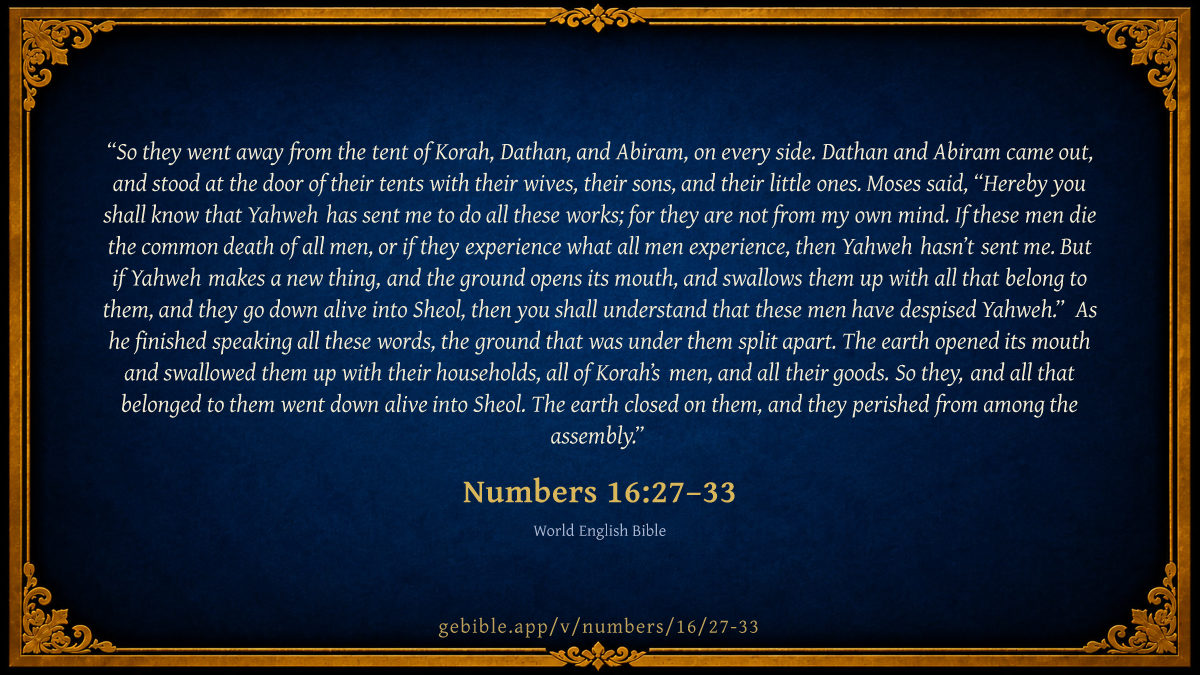
So they went away from the tent of Korah, Dathan, and Abiram, on every side. Dathan and Abiram came out, and stood at the door of their tents with their wives, their sons, and their little ones.
Moses said, “Hereby you shall know that Yahweh has sent me to do all these works; for they are not from my own mind. If these men die the common death of all men, or if they experience what all men experience, then Yahweh hasn’t sent me. But if Yahweh makes a new thing, and the ground opens its mouth, and swallows them up with all that belong to them, and they go down alive into Sheol, then you shall understand that these men have despised Yahweh.”
As he finished speaking all these words, the ground that was under them split apart. The earth opened its mouth and swallowed them up with their households, all of Korah’s men, and all their goods. So they, and all that belonged to them went down alive into Sheol. The earth closed on them, and they perished from among the assembly.
Geneva Bible translators 1599 · Public Domain On vv28, 30 I have not forged them of mine own brain.
I have not forged them of mine own brain.
Geneva Bible (1599) marginal notes — public domain.
John Trapp 1656 · Public Domain On vv27–33 Num 16:27 So they gat up from the tabernacle…
Num 16:27 So they gat up from the tabernacle of Korah, Dathan, and Abiram, on every side: and Dathan and Abiram came out, and stood in the door of their tents, and their wives, and their sons, and their little children.
Ver. 27. Came out and stood.] As out facing Moses, and scorning the judgment threatened. Deus quem destruit dementat. Hardened sinners make no more of God’s dreadful threatenings, than behemoth doth of iron weapons, which he esteemeth as straws.
John Trapp, A Commentary or Exposition upon All the Books of the Old and New Testament (1647–1656) — public domain. Text from a community e-Sword module.
Matthew Poole 1685 · Public Domain On vv27, 28, 29, 30, 32, 33 Their tents were not far asunder, being both on…
Their tents were not far asunder, being both on the south side of the tabernacle, as appears from Num 2:10; 3:29.
Stood in the door of their tents; an argument of their foolish confidence, pride, and impudence, obstinacy, and impenitency, whereby they declared that they neither feared God nor reverenced man, and made themselves ripe for the approaching judgment.
Matthew Poole's English Annotations on the Holy Bible (1683–1685) — public domain. Text from a community e-Sword/MySword module.
John Gill 1763 · Public Domain On vv27–33 So they gat up from the tabernacle of Korah,…
So they gat up from the tabernacle of Korah, Dathan, and Abiram, on every side,.... The place where they met together and made their general rendezvous; this it seems was encompassed on all sides by people out of the several tribes, who either wished them well in their undertaking, or were curious to know how it would issue:
and Dathan and Abiram came out; out of the tabernacle of Korah, and went to their own tents; and came out of them:
Read full note →
and stood in the door of their tents, and their wives, and their sons,
and their little children; in an audacious manner, as not fearing God nor man; they carried their heads high, and were not in the least daunted at what they were threatened with; and by their looks and gestures bid defiance to Moses and the elders with him.
John Gill's Exposition of the Whole Bible (1746–1763) — public domain (CC PDM 1.0). Text via the HelloAO Bible API.
John Wesley 1765 · Public Domain On vv27, 28, 29, 32, 33 Stood in the door - An argument of their…
Stood in the door - An argument of their foolish confidence, obstinacy and impenitency, whereby they declared that they neither feared God, nor reverenced man.
John Wesley, Explanatory Notes Upon the Whole Bible (1754–1765) — public domain. Text via the GEBible commentary corpus.
Adam Clarke 1810 · Public Domain On vv30, 33 Verse 30. If the Lord make a new thing]…
Verse 30. If the Lord make a new thing] ואם בריאה יברא יהוה veim beriah yibra Yehovah, and if Jehovah should create a creation, i. e., do such a thing as was never done before.
And they go down quick into the pit] שאלה sheolah, a proof, among many others, that שאל sheol, signifies here a chasm or pit of the earth, and not the place called hell; for it would be absurd to suppose that their houses had gone to hell; and it would be wicked to imagine that their little innocent children had gone thither, though God was pleased to destroy their lives with those of their iniquitous fathers.
Adam Clarke's Commentary on the Bible (1810–1826) — public domain. Text from a community e-Sword/MySword module.
Joseph Benson 1811 · Public Domain On vv27, 28, 29, 32 Num 16:27. Stood in the door — An argument…
Num 16:27. Stood in the door — An argument of their foolish confidence, obstinacy, and impenitence, whereby they declared that they neither feared God nor reverenced man.
Joseph Benson's Commentary on the Old and New Testaments (1811–1818) — public domain. Text from a community e-Sword module.
Albert Barnes 1834 · Public Domain On vv27, 32 Stood in the door of their tents - Apparently…
Stood in the door of their tents - Apparently in contumacious defiance.
Albert Barnes' Notes on the Bible (1834–1885) — public domain. Text from a community e-Sword/MySword module.
Haydock's Catholic Bible Commentary 1859 · Public Domain On vv27, 30, 32, 33 People, (frequentia). The Septuagint generally translate tappam by aposkene,…
People, (frequentia). The Septuagint generally translate tappam by aposkene, "family and effects," of every denomination. (Calmet) --- Here was a full assembly waiting for the event, between fear and hope. As these rebels would not come, when Moses sent for them, he condescended to go to them, and denounced the impending ruin, ver. 14, 25. He commits his whole cause to God, and is willing to be rejected as a vile impostor, if God do not shew, by a miraculous and exemplary punishment of his opponents, that what he had hitherto done, as the head of the people, and particularly in the consecration of Aaron, was by his direction. (Haydock) --- He had before proved his mission by miracles, Exodus iv. (Worthington)
George Leo Haydock (1774–1849), Haydock's Catholic Family Bible and Commentary, 1859 edition — public domain. Excludes Psalms (Douay-Rheims chapter numbering differs from Protestant) and Deuterocanonical books (Catholic canon only).
Robert Jamieson, A. R. Fausset & David Brown 1871 · Public Domain On vv27–28 the tabernacle of Korah, Dathan, and Abiram--Korah being a…
the tabernacle of Korah, Dathan, and Abiram--Korah being a Kohathite, his tent could not have been in the Reubenite camp, and it does not appear that he himself was on the spot where Dathan and Abiram stood with their families. Their attitude of defiance indicated their daring and impenitent character, equally regardless of God and man.
Jamieson, Fausset & Brown — Commentary Critical and Explanatory on the Whole Bible (1871) — public domain (CC PDM 1.0). Text via the HelloAO Bible API.
Daniel D. Whedon 1874 · Public Domain On vv27–33 27. Stood in the door of their tents —…
27. Stood in the door of their tents — Their attitude was not that of penitence, but of curiosity or defiance. Earnest prayer might have saved them even then, but men abandoned by the grieved Spirit of God cannot pray.
Their little children — To these this sudden and awful death was not a punishment but a calamity. See Jos_7:24, note. Little children are still perishing through the folly, brutality, and neglect of their parents. There is no mention here of the children of Korah, some of whom, if not all, escaped, (Num_26:11,) probably because they did not consent to their father’s crime.
Daniel D. Whedon (gen. ed.), Commentary on the Old and New Testaments (1874–1909) — public domain. Text from a community e-Sword module.
The Cambridge Bible for Schools and Colleges 1878 · Public Domain On vv27, 30 27. the tabernacle of Korah &c.] Read the tabernacle…
27. the tabernacle of Korah &c.] Read the tabernacle of Jehovah. See on Num_16:24.
The Cambridge Bible for Schools and Colleges (gen. ed. J. J. S. Perowne; Cambridge University Press, 1878–1918) — public domain. Text from a community e-Sword module.
Ellicott's Commentary for English Readers 1878 · Public Domain On vv27, 28, 30, 32 (27) And Dathan and Abiram came out . .…
(27) And Dathan and Abiram came out . . . —No mention is made of the position of Korah at this time, neither is any mention made of his sons, who, as we learn from Num_26:11, “died not” when the company of Korah died. His descendants are mentioned in 1Ch_6:22-38, and mention is made of “the sons of Korah” in the titles of eleven of the Psalms. Samuel the prophet and Heman the singer were of this family (1Ch_6:22; 1Ch_6:33).
A Bible Commentary for English Readers, edited by Charles John Ellicott (1878–1897) — public domain. Text from a community e-Sword module.
The Pulpit Commentary 1880 · Public Domain On vv27–32 And Dathan and Abiram... stood in the door of…
And Dathan and Abiram... stood in the door of their tents. To see what Moses would do. Nothing is said of Korah.
The Pulpit Commentary (1880–1919), ed. H.D.M. Spence-Jones & Joseph S. Exell — public domain. Text from a community e-Sword module.
unfoldingWord translationNotes 2017 · CC BY-SA 4.0 On vv28, 31, 33 By this you will know
By this you will know
Here "this" refers to what Moses will say next.
Read full note →
the earth opens its mouth and swallows them
Moses speaks as if the earth were alive and the opening in the ground into which these people would fall were a large mouth that would eat them. AT: "and they fall into it and are buried underneath the ground" (See: Simile)
translationWords
know
Yahweh
send
works
die
create
family
life
Hades
unfoldingWord translationNotes — © Distant Shores Media and the Door43 World Missions Community, licensed CC BY-SA 4.0. Source: git.door43.org/Door43/en_tn.
Tyndale Open Study Notes 2022 · CC BY-SA 4.0 On vv28, 31 16:28-30 Moses had faith that God would enact his…
16:28-30 Moses had faith that God would enact his own justice, and God did so (16:31-35; cp. 1 Kgs 18:18-40). • into the grave: Sheol was the place of the dead (see 1 Sam 2:6; 2 Sam 22:5-6; Job 3:20-22; Ps 16:10; Acts 2:27-33; 1 Cor 15:15; Rev 20:13-14).
Tyndale Open Study Notes — © Tyndale Open Resources, licensed CC BY-SA 4.0. Text via the HelloAO Bible API.