Numbers 19:7-12 sits inside this longer paragraph.
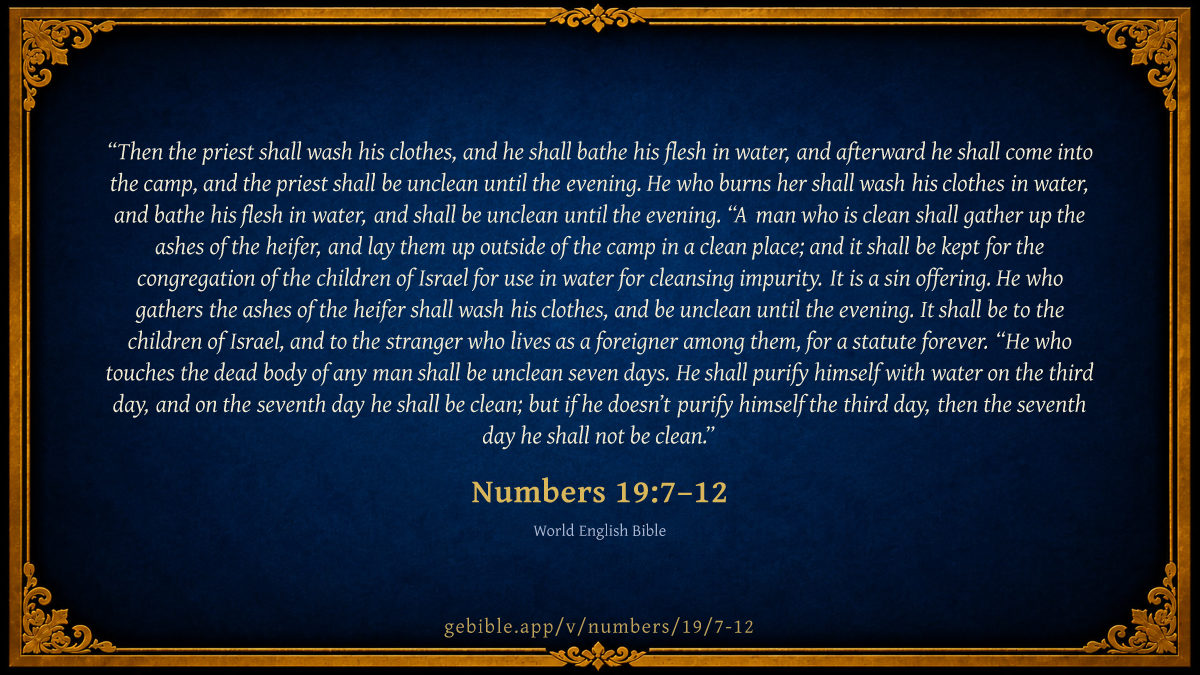
1Yahweh spoke to Moses and to Aaron, saying, 2“This is the statute of the law which Yahweh has commanded. Tell the children of Israel to bring you a red heifer without spot, in which is no defect, and which was never yoked. 3You shall give her to Eleazar the priest, and he shall bring her outside of the camp, and one shall kill her before his face. 4Eleazar the priest shall take some of her blood with his finger, and sprinkle her blood toward the front of the Tent of Meeting seven times. 5One shall burn the heifer in his sight; her skin, and her meat, and her blood, with her dung, shall he burn. 6The priest shall take cedar wood, hyssop, and scarlet, and cast it into the middle of the burning of the heifer. 7Then the priest shall wash his clothes, and he shall bathe his flesh in water, and afterward he shall come into the camp, and the priest shall be unclean until the evening. 8He who burns her shall wash his clothes in water, and bathe his flesh in water, and shall be unclean until the evening.
9“A man who is clean shall gather up the ashes of the heifer, and lay them up outside of the camp in a clean place; and it shall be kept for the congregation of the children of Israel for use in water for cleansing impurity. It is a sin offering. 10He who gathers the ashes of the heifer shall wash his clothes, and be unclean until the evening. It shall be to the children of Israel, and to the stranger who lives as a foreigner among them, for a statute forever.
11“He who touches the dead body of any man shall be unclean seven days. 12He shall purify himself with water on the third day, and on the seventh day he shall be clean; but if he doesn’t purify himself the third day, then the seventh day he shall not be clean. 13Whoever touches a dead person, the body of a man who has died, and doesn’t purify himself, defiles Yahweh’s tabernacle; and that soul shall be cut off from Israel; because the water for impurity was not sprinkled on him, he shall be unclean. His uncleanness is yet on him.

Geneva Bible translators 1599 · Public Domain On vv7, 8, 9, 12 Meaning, Eleazar.
Meaning, Eleazar.
Geneva Bible (1599) marginal notes — public domain.
John Trapp 1656 · Public Domain On vv7–11 Num 19:7 Then the priest shall wash his clothes,…
Num 19:7 Then the priest shall wash his clothes, and he shall bathe his flesh in water, and afterward he shall come into the camp, and the priest shall be unclean until the even.
Ver. 7. The priest shall wash his clothes.] To show the contagion and pollution of sin, {2Co 7:1} and imperfection of the legal priesthood.
Read full note →
Unclean until the evening.] So Num 19:8; Num 19:10. We had need take time till the evening, to humble our souls, and bewail our unworthiness of the blood of Christ.
John Trapp, A Commentary or Exposition upon All the Books of the Old and New Testament (1647–1656) — public domain. Text from a community e-Sword module.
Matthew Poole 1685 · Public Domain On vv7, 9, 10, 11, 12 Partly to teach us the imperfection of the Levitical…
Partly to teach us the imperfection of the Levitical priesthood, in which the priest himself was defiled by some parts of his work, and the absolute necessity of a better and holier priesthood; and partly to show that Christ himself, though he had no sin of his own, yet was reputed by men, and judged by God, as an unclean and sinful person, by reason of our sins which were laid upon him, Isa 53:12; 2Co 5:21.
Matthew Poole's English Annotations on the Holy Bible (1683–1685) — public domain. Text from a community e-Sword/MySword module.
Matthew Henry 1710 · Public Domain On v11 Directions are here given concerning the use and application…
Directions are here given concerning the use and application of the ashes which were prepared for purification. they were laid up to be laid out; and therefore, though now one place would serve to keep them in, while all Israel lay so closely encamped, yet it is probable that afterwards, when they came to Canaan, some of these ashes were kept in every town, for there would be daily use for them. Observe,
I. In what cases there needed a purification with these ashes. No other is mentioned here than the ceremonial uncleanness that was contracted by the touch of a dead body, or of the bone or grave of a dead man, or being in the tent or house where a dead body lay, Num 19:11, Num 19:14-16. This I look upon to have been one of the greatest burdens of the ceremonial law, and one of the most unaccountable. He that touched the carcase of an unclean beast, or any living man under the greatest ceremonial uncleanness, was made unclean by it only till the evening, and needed only common water to purify himself with; but he that came near the dead body of man, woman, or child, much bear the reproach of his uncleanness seven days, must twice be purified with the water of separation, which he could not obtain without trouble and charge, and till he was purified must not come near the sanctuary upon pain of death.
Read full note →
1. This was strange, considering, (1.) that whenever any died (and we are in deaths oft) several persons must unavoidable contract this pollution, the body must be stripped, washed, wound up, carried out, and buried, and this could not be done without many hands, and yet all defiled, which signifies that in our corrupt and fallen state there is none that lives and sins not; we cannot avoid being polluted by the defiling world we pass through, and we offend daily, yet the impossibility of our being sinless does not make sin the less polluting. (2.) that taking care of the dead, to see them decently buried, is not only necessary, but a very good office, and an act of kindness, both to the honour of the dead and the comfort of the living, and yet uncleanness was contracted by it, which intimates that the pollutions of sin mix with and cleave to our best services. There is not a just man upon earth that doeth good and sinneth not; we are apt some way or other to do amiss even in our doing good. (3.) That this pollution was contracted by what was done privately in their own houses, which intimates (as bishop Patrick observes) that God sees what is done in secret, and nothing can be concealed from the divine Majesty. (4.) This pollution might be contracted, and yet a man might never know it, as by the touch of a grave which appeared not, of which our Saviour says, Those that walk over it are not aware of it (Luk 11:44), which intimates the defilement of the conscience by sins of ignorance, and the cause we have to cry out, "Who can understand his errors?" and to pray, "Cleanse us from secret faults, faults which we ourselves do not see ourselves guilty of."
2. But why did the law make a dead corpse such a defiling thing? (1.) Because death is the wages of sin, entered into the world by it, and reigns by the power of it. Death to mankind is another thing from what it is to other creatures: it is a curse, it is the execution of the law, and therefore the defilement of death signifies the defilement of sin. (2.) Because the law could not conquer death, nor abolish it and alter the property of it, as the gospel does by bringing life and immortality to light, and so introducing a better hope. Since our Redeemer was dead and buried, death is no more destroying to the Israel of God, and therefore dead bodies are no more defiling; but while the church was under the law, to show that it made not the comers thereunto perfect, the pollution contracted by dead bodies could not but form in their minds melancholy and uncomfortable notions concerning death, while believers now through Christ can triumph over it. O grave! where is thy victory? Where is thy pollution?
II. How the ashes were to be used and applied in these cases. 1. A small quantity of the ashes must be put into a cup of spring water, and mixed with the water, which thereby was made, as it is here called, a water of separation, because it was to be sprinkled on those who were separated or removed from the sanctuary by their uncleanness. As the ashes of the heifer signified the merit of Christ, so the running water signified the power and grace of the blessed Spirit, who is compared to rivers of living water; and it is by his operation that the righteousness of Christ is applied to us for our cleansing. Hence we are said to be washed, that is, sanctified and justified, not only in the name of the Lord Jesus, but by the Spirit of our God, Co1 6:11; Pe1 1:2. Those that promise themselves benefit by the righteousness of Christ, while they submit not to the grace and influence of the Spirit, do but deceive themselves, for we cannot put asunder what God has joined, nor be purified by the ashes otherwise than in the running water. 2. This water must be applied by a bunch of hyssop dipped in it, with which the person or thing to be cleansed must be sprinkled (Num 19:18), in allusion to which David prays, Purge me with hyssop. Faith is the bunch of hyssop wherewith the conscience is sprinkled and the heart purified. Many might be sprinkled at once, and the water with which the ashes were mingled might serve for many sprinklings, till it was all spent; and a very little lighting upon a man served to purify him, if done with that intention. In allusion to this application of the water of separation by sprinkling, the blood of Christ is said to be the blood of sprinkling (Heb 12:24), and with it were are said to be sprinkled from an evil conscience (Heb 10:22), that is, we are freed from the uneasiness that arises from a sense of our guilt. And it is foretold that Christ, by his baptism, shall sprinkle many nations, Isa 52:15. 3. The unclean person must be sprinkled with this water on the third day after his pollution, and on the seventh day, Num 19:12-19. The days were reckoned (we may suppose) from the last time of his touching or coming near the dead body; for he would not begin the days of his cleansing while he was still under a necessity of repeating the pollution; but when the dead body was buried, so that there was no further occasion of meddling with it, then he began to reckon his days. Then, and then only, we may with comfort apply Christ's merit to our souls, when we have forsaken sin, and cease all fellowship with the unfruitful works of death and darkness. The repetition of the sprinkling teaches us often to renew the actings of repentance and faith, wash as Naaman, seven times; we need to do that often which is so necessary to be well done. 4. Though the pollution contracted was only ceremonial, yet the neglect of the purification prescribed would turn into moral guilt: He that shall be unclean and shall not purify himself, that soul shall be cut off, Num 19:20. Note, It is a dangerous thing to contemn divine institutions, though they may seem minute. A slight wound, if neglected, may prove fatal; a sin we call little, if not repented of, will be our ruin, when great sinners that repent shall find mercy. Our uncleanness separates us from God, but it is our being unclean and not purifying ourselves that will separate us for ever from him: it is not the wound that is fatal, so much as the contempt of the remedy. 5. Even he that sprinkled the water of separation, or touched it, or touched the unclean person, must be unclean till the evening, that is, must not come near the sanctuary on that day, Num 19:21, Num 19:22. Thus God would show them the imperfection of those services, and their insufficiency to purify the conscience, that they might look for the Messiah, who in the fulness of time should by the eternal Spirit offer himself without spot unto God, and so purge our consciences from dead works (that is, from sin, which defiles like a dead body, and is therefore called a body of death), that we may have liberty of access to the sanctuary, to serve the living God with living sacrifices.
Matthew Henry's Commentary on the Whole Bible (1708–1710) — public domain (CC PDM 1.0). Text via the HelloAO Bible API.
John Gill 1763 · Public Domain On vv7–12 Then the priest shall wash his clothes,.... The Targum…
Then the priest shall wash his clothes,.... The Targum of Jonathan has it,"he that slew the cow,''and Aben Ezra, the priest that burnt it; but it seems to mean Eleazar, the priest that sprinkled the blood, and by touching that was defiled and needed washing; and so the Jews (l) say, all that were employed about it, from the beginning to the end, were defiled in their garments; not only he that slew it, and burnt it, and sprinkled its blood, but he that took and cast in the cedar wood, &c. as we find also he that gathered the ashes of it as well as burnt it: this creature was reckoned so impure, though its ashes were for purifying, that whoever had anything to do with it was unclean, as the scapegoat, which had the sins of all Israel on it; and this as that was typical of Christ, made sin for his people, that he might cleanse them from sin: it may point at the sin of the priests and people of Israel, in putting Christ to death, and yet there was cleansing from that sin, in the precious blood of Christ, as well as from all others:
and he shall bathe his flesh in water; in forty seahs of water, as the Targum of Jonathan; not his clothes only, but his body was to be dipped in water:
Read full note →
and afterward he shall come into the camp: when his clothes and flesh are washed, but not before:
and the priest shall be unclean until the even; though washed, and therefore, though he is said to go into the camp upon washing, this is to be understood, after the evening is come: so Jarchi directs to interpret the passage, transpose it, says he, and so explain it; and he shall be unclean until the evening, and after that he may come into the camp, not only the camp of Israel, but the camp of the Shechinah, as the same writer.
(l) Misn. Parah, c. 4. sect. 4.
John Gill's Exposition of the Whole Bible (1746–1763) — public domain (CC PDM 1.0). Text via the HelloAO Bible API.
John Wesley 1765 · Public Domain On vv7, 9, 10, 12 Shall be unclean - Partly to teach us the…
Shall be unclean - Partly to teach us the imperfection of the Levitical priesthood, in which the priest himself was defiled by some parts of his work, and partly to shew that Christ himself, though he had no sin of his own, yet was reputed by men, and judged by God, as a sinful person, by reason of our sins which were laid upon him.
John Wesley, Explanatory Notes Upon the Whole Bible (1754–1765) — public domain. Text via the GEBible commentary corpus.
Adam Clarke 1810 · Public Domain On vv9, 11, 12 Verse 9. For a water of separation] That is,…
Verse 9. For a water of separation] That is, the ashes were to be kept, in order to be mixed with water, Nu 19:17, and sprinkled on those who had contracted any legal defilement.
Adam Clarke's Commentary on the Bible (1810–1826) — public domain. Text from a community e-Sword/MySword module.
Joseph Benson 1811 · Public Domain On vv7, 9, 12 Num 19:7. The priest shall be unclean — Partly…
Num 19:7. The priest shall be unclean — Partly to teach us the imperfection of the Levitical priesthood, in which the priest himself was defiled by some parts of his work, and partly to show that Christ himself, though he had no sin of his own, yet was reputed by men, and judged by God, as a sinful person, by reason of our sins, which were laid upon him.
Joseph Benson's Commentary on the Old and New Testaments (1811–1818) — public domain. Text from a community e-Sword module.
Albert Barnes 1834 · Public Domain On vv9–11 Water of separation - In Num 8:7, the water…
Water of separation - In Num 8:7, the water of purification from sin is the “water of purifying.” So that which was to remedy a state of legal separation is here called “water of separation.”
Albert Barnes' Notes on the Bible (1834–1885) — public domain. Text from a community e-Sword/MySword module.
Haydock's Catholic Bible Commentary 1859 · Public Domain On vv10, 12 Strangers. Even those who had not embraced the Jewish…
Strangers. Even those who had not embraced the Jewish religion. (Grotius) --- Thus, the baptism of Christ brings salvation both to the Jews and to the Gentiles. (St. Augustine)
George Leo Haydock (1774–1849), Haydock's Catholic Family Bible and Commentary, 1859 edition — public domain. Excludes Psalms (Douay-Rheims chapter numbering differs from Protestant) and Deuterocanonical books (Catholic canon only).
Robert Jamieson, A. R. Fausset & David Brown 1871 · Public Domain On vv7, 11, 12 the priest shall be unclean until the even--The ceremonies…
the priest shall be unclean until the even--The ceremonies prescribed show the imperfection of the Levitical priesthood, while they typify the condition of Christ when expiating our sins (Co2 5:21).
Jamieson, Fausset & Brown — Commentary Critical and Explanatory on the Whole Bible (1871) — public domain (CC PDM 1.0). Text via the HelloAO Bible API.
Daniel D. Whedon 1874 · Public Domain On vv7, 9, 10, 11, 12 7. Wash his clothes, and… flesh — “This washing…
7. Wash his clothes, and… flesh — “This washing of the garments and the body — what is it but the cleansing of our faculties, external and internal.” — Augustine.
Unclean until the even — The only necessary contact of the priest with the heifer was in the sprinkling of the blood. The heifer, like all sin offerings, may be regarded as unclean, for the reason that the sins of men were imputed to the sin sacrifice, as the sins of the world were putatively laid upon Christ. “It is evident from the whole that there was no natural or necessary connexion between the sprinkling of the ashes of the heifer upon a person and cleansing him from sin. It was simply the divine appointment that gave efficacy to the act.” — Bush.
Daniel D. Whedon (gen. ed.), Commentary on the Old and New Testaments (1874–1909) — public domain. Text from a community e-Sword module.
The Cambridge Bible for Schools and Colleges 1878 · Public Domain On vv9, 12 9. it shall be kept] i.e. the ashes, for…
9. it shall be kept] i.e. the ashes, for which the Heb. word is singular, not plural.
a water of impurity] i.e. a water for the removal of impurity. Cf. ‘water of sin’ (Num_8:7). The word niddâh, ‘impurity,’ signifies something loathsome or abominable.
Read full note →
it is a sin-offering] The cow (not the water) could be called a sin-offering because it was burnt; but, since the ashes are the object of chief importance, the word hattâ’th (‘sin-offering’) must be understood in the more general sense of ‘something which removes sin.’ LXX. ἅγνισμα.
The Cambridge Bible for Schools and Colleges (gen. ed. J. J. S. Perowne; Cambridge University Press, 1878–1918) — public domain. Text from a community e-Sword module.
Ellicott's Commentary for English Readers 1878 · Public Domain On vv7, 10, 11, 12 (7) Then the priest . . . —The Targum…
(7) Then the priest . . . —The Targum of Jonathan refers these words to the priest who killed the heifer, and Ibn Ezra to the priest who burnt it; but the reference is more probably, as in the preceding verse, to Eleazar.
A Bible Commentary for English Readers, edited by Charles John Ellicott (1878–1897) — public domain. Text from a community e-Sword module.
The Pulpit Commentary 1880 · Public Domain On vv7, 9, 10, 11, 12 The priest shall be unclean until the even, i.e.,…
The priest shall be unclean until the even, i.e., the priest who superintended the sacrifice, and dipped his finger in the blood. Every one of these details was devised in order to express the intensely infectious character of death in its moral aspect. The very ashes, which were so widely potent for cleansing (verse 10), and the cleansing water itself (verse 19), made every one that touched them, even for the purifying of another, himself unclean. At the same time the ashes, while, as it were, so redolent of death that they must be kept outside the camp, were most holy, and were to be laid up by a clean man in a clean place (verse 9). These contradictions find their true explanation only when we consider them as foreshadowing the mysteries of the atonement.
The Pulpit Commentary (1880–1919), ed. H.D.M. Spence-Jones & Joseph S. Exell — public domain. Text from a community e-Sword module.
Paul E. Kretzmann 1924 · Public Domain On v11 The Use of the Water
The Use of the Water
v. 11. He that toucheth the dead body of any man shall be unclean seven days. It made no difference what the age of the dead person was or what relationship existed, the one that touched the dead body was defiled.
Read full note →
v. 12. He shall purify himself with it, the water of purification, on the third day, and on the seventh day he shall be clean; but if he purify not himself the third day, then the seventh day he shall not be clean. Neglect in complying with the rules simply lengthened the time needed for purification.
v. 13. Whosoever toucheth the dead body of any man that is dead, of any soul, no matter of what age and sex, and purifleth not himself, deflleth the Tabernacle of the Lord; and that soul shall be cut off from Israel; a refusal to comply with the rules resulted in death to the offender; because the water of separation was not sprinkled upon him, he shall be unclean; his uncleanness is yet upon him. Unless atonement was made, such a person forfeited his life.
v. 14. This is the law when a man dieth in a tent: all that come into the tent and all that is in the tent shall be unclean seven days.
v. 15. And every open vessel which hath no covering bound upon it, tied firmly to it by means of a string or cord, to keep out the odor of decay, is unclean.
v. 16. And whosoever toucheth one that is slain with a sword in the open fields, even for the purpose of burial, or a dead body, or a bone of a man, or a grave, shall be unclean seven days. It was for this reason that the Jewish elders were so strict about marking the graves, especially shortly before a large festival, lest some one inadvertently touch such a grave and be defiled. Cf Mat 23:27.
v. 17. And for an unclean person, one defiled in the manner just described, they shall take of the ashes of the burnt heifer of purification for sin, and running water shall be put thereto, added to and mixed with the ashes, in a vessel;
v. 18. and a clean person shall take hyssop, on account of the cleansing powers ascribed to it, and dip it in the water, as thus prepared, and sprinkle it upon the tent, and upon all the vessels, and upon the persons that were there, and upon him that touched a bone, a skeleton, or one slain, or one dead, or a grave;
v. 19. and the clean person shall sprinkle upon the unclean on the third day and on the seventh day; and on the seventh day he, the defiled person, shall purify himself, and wash his clothes, and bathe himself in water, and shall be clean at even.
v. 20. And the man that shall be unclean and shall not purify himself, deliberately and willfully neglect the act of purification, that soul shall be cut off from among the congregation, as the Lord here repeats for the sake of emphasis, because he hath defiled the Sanctuary of the Lord; the water of separation hath not been sprinkled upon him; he is unclean.
v. 21. And it shall be a perpetual statute unto them, that he that sprinkleth the water of separation shall wash his clothes; and he that toucheth the water of separation shall be unclean until even, both having come in contact with the uncleanness of death in the rite of purification.
v. 22. And whatsoever the unclean person toucheth shall be unclean; and the soul that toucheth it, the water of purification, shall be unclean until even. These rites of external purification were symbols of the inner, spiritual cleansing which should be found in all true believers. "The ashes of an heifer sprinkling the unclean sanctifieth to the purifying of the flesh; how much more shall the blood of Christ. . purge your conscience from dead works to serve the living God!" Heb 9:13-14. The water of purification is also a type of the water of Baptism, for by having our souls sprinkled from an evil conscience, we have boldness to enter into the Holiest by the blood of Jesus, Heb 10:19-22.
Paul E. Kretzmann, Popular Commentary of the Bible (1921–1924) — public domain. Text from a community e-Sword module.
unfoldingWord translationNotes 2017 · CC BY-SA 4.0 On vv7, 9, 11 Then he must wash his clothes
Then he must wash his clothes
Here "he" refers to Eleazar the priest.
Read full note →
he will remain unclean
Being unacceptable to God or unfit to do any sacred work is spoken of as not being clean. (See: Metaphor)
translationWords
clean
unfoldingWord translationNotes — © Distant Shores Media and the Door43 World Missions Community, licensed CC BY-SA 4.0. Source: git.door43.org/Door43/en_tn.
Tyndale Open Study Notes 2022 · CC BY-SA 4.0 On vv7, 9, 11 19:7-10 Three people were needed to produce and collect…
19:7-10 Three people were needed to produce and collect the heifer’s ashes—Eleazar, the man who burned the animal, and the man who gathered its ashes. All three became ritually impure for a day because of this process. This was also true for the person who used the finished product, a potion made from the ash dust and water (cp. 19:21) that had the same defiling effect as blood associated with sacrifices (Lev 6:27-28).
Tyndale Open Study Notes — © Tyndale Open Resources, licensed CC BY-SA 4.0. Text via the HelloAO Bible API.