
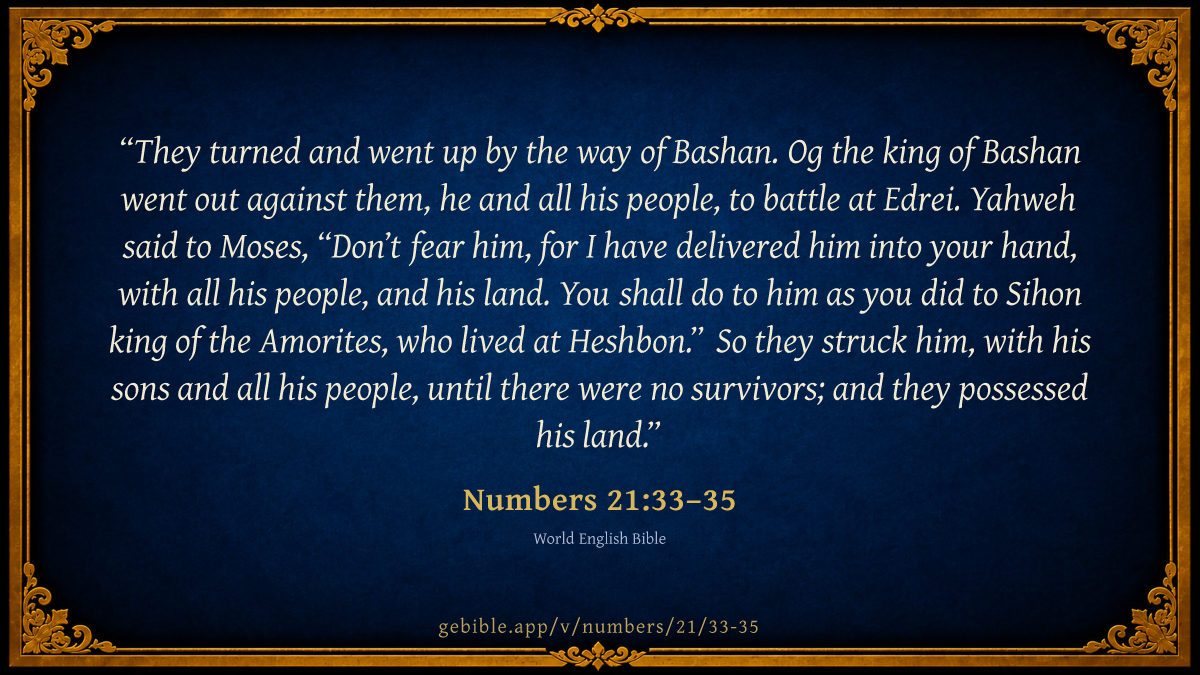
They turned and went up by the way of Bashan. Og the king of Bashan went out against them, he and all his people, to battle at Edrei.
Yahweh said to Moses, “Don’t fear him, for I have delivered him into your hand, with all his people, and his land. You shall do to him as you did to Sihon king of the Amorites, who lived at Heshbon.”
So they struck him, with his sons and all his people, until there were no survivors; and they possessed his land.
Matthew Poole 1685 · Public Domain On vv33–34 Og also was a king of the Amorites, of…
Og also was a king of the Amorites, of whom see Deu 3:1,11. And it may seem that Sihon and Og were the leaders or captains of two great colonies which came out of Canaan, and drove out the former inhabitants of these places.
Bashan, a rich country, famous for its pastures and breed of cattle, Deu 32:14; Psa 22:12; Jer 1:19, and for its oaks, Eze 27:6.
Matthew Poole's English Annotations on the Holy Bible (1683–1685) — public domain. Text from a community e-Sword/MySword module.
John Wesley 1765 · Public Domain On v33 Og - Who also was a king of the…
Og - Who also was a king of the Amorites. And it may seem that Sihon and Og were the leaders or captains of two great colonies which came out of Canaan, and drove out the former inhabitants of these places. Bashan - A rich country, famous for its pastures and breed of cattle, and for its oaks.
John Wesley, Explanatory Notes Upon the Whole Bible (1754–1765) — public domain. Text via the GEBible commentary corpus.
Adam Clarke 1810 · Public Domain On v35 Verse 35. So they smote him, and his sons]…
Verse 35. So they smote him, and his sons] There is a curious note of Dr. Lightfoot here, of which I should think it wrong to deprive the reader.
"Sihon and Og conquered, A. M. 2553. Of the life of Moses, 120. From the Exodus, 40. It is now six and twenty generations from the creation, or from Adam to Moses; and accordingly doth Psa. cxxxvi, rehearse the durableness of God's mercy six and twenty times over, beginning the story with the creation, and ending it in the conquest of Sihon and Og. The numerals of the name יהוה Jehovah amount to the sum of six and twenty."
Read full note →
ON some difficulties in this chapter Dr. Kennicott makes the following observations: -
"This one chapter has several very considerable difficulties; and some verses, as now translated, are remarkably unintelligible, A true state of this chapter is not, however, to be despaired of; and it has in it some circumstances which merit more than common attention. It contains the history of the last part of the travels of the Israelites in their way to the promised land; beginning with them at Mount Hor, the thirty-fourth encampment, and concluding with them, as in their forty-second and last encampment, near Jordan, in the country which they had acquired by conquest over Sihon, king of the Amorites.
"It begins with saying - that King Arad, the Canaanite, who dwelt in the south, (in the land of Canaan, Nu 33:40), attacked Israel and was defeated, and that Israel destroyed their cities; and that, after destroying these Canaanite cities, and consequently after being in a part of Canaan, a part of the very country they were going to, on the west of the Dead Sea, they returned towards the Red Sea, and near the eastern tongue or gulf of the Red Sea, on the south of Edom, marched round Edom to the east of the Dead Sea, in order to enter Canaan from the east side of Jordan!
"This surprising representation of so vast and dangerous a march, quite unnecessarily performed, is owing to two circumstances. The first is, (Nu 21:1), the Canaanites heard that Israel was coming by the way of the spies, meaning, by the way the spies went from Kadesh-Barnea into Canaan. But this being impossible, because Israel had now marched from Meribah-Kadesh to Mount Hor, beyond Ezion-gaber, and were turning round Edom, to the south-east; it is happy that the word rendered spies, in our version, is in the Greek a proper name, (Atharim,) which removes that difficulty: and the other difficulty (Nu 21:2-3) is removed by the Greek version likewise, according to which, the vow made, with the facts subsequent, does not signify destroying the Canaanite cities, but devoting them to destruction at some future time. See Wall's Crit. Notes.
"It proceeds with saying, that after defeating the Canaanites at Mount Hor, they journeyed from Mount Hor by the way of the Red Sea, (in the road from Ammon, Midian, c., to the eastern gulf of the Red Sea,) to compass the land of Edom that on their murmuring for want both of bread and of water they were punished by fiery serpents, after which they marched to Oboth, and thence to Ije-abarim in the wilderness, east of Moab. The encampments of the Israelites, amounting to forty-two, are recorded all together, in historical succession, in Nu 33:1-49, where Ije-abarim is the 38th; Dibon-gad, 39; Almon-Diblathaim, 40; mountains of Abarim, 41; and the plains of Moab, by Jordan, 42. This regular detail in Nu 33:1-49 has occasioned great perplexity as to Nu 21:10-20, where, after the stations at Oboth and Ije-abarim, in Nu 21:10-11, we have, in Nu 21:19-20, the words Mattanah, Nahaliel, and Bamoth; which are usually considered as the proper names of three places, but widely different from the three proper names after Ije-abarim in the catalogue at Nu 33:44-48.
"But there is, in reality, no inconsistency here. In the plain and historical catalogue (Nu 33:44-48) the words are strictly the proper names of the three places; but here the words Mattanah, Nahaliel, and Bamoth follow some lines of poetry, and seem to form a continuation of the song. They evidently express figurative and poetical ideas. The verbs journeyed from and pitched in are not found here, though necessary to prose narration: see verses 10 and 11 here, and Nu 33:44-48. Lastly, verse 20th, (in this 21st chapter), usually supposed to express the last encampment, does not. Pisgah signifies a hill; and the Israelites could not encamp on the top of any single hill, such as this is described. Balak took Balaam to the top of Peor, which looketh toward Jeshimon, (Nu 23:28), which Peor undoubtedly was in Moab. He took him to another hill in Moab, when he took him (Nu 23:14) to the top of Pisgah, in the field of Zophim. And if the Pisgah or hill in Nu 21:20, was in the country of Balak, it could not point out the last encampment, which was not in Balak's country, but north of Arnon.
"The word Mattanah probably alludes to a place distinguished by some gift or blessing from God. Fagius says: Nomen loci, ab eventu aquarum quas Dominus ibi dedit, sic appellati; מתנה nam significat donum -
'The name of the place was so called, from the circumstance of the waters which the Lord gave there; for Mattanah signifies a gift.' נהליאל Nahaliel is torrentes Dei; i. e., great streams, particularly seasonable or salutary. And במות Bamoth (Nu 21:28) may point out any high places of signal benefit in the country of Moab, or it may answer to the last station but one, which was the mountains of Abarim.
If, therefore, these words were meant to express poetically some eminent blessing, what blessing was so likely to be then celebrated as copious streams of water? And after they had wandered nearly forty years through many a barren desert, and after (compare De 8:15) having passed through that great and terrible wilderness, wherein were fiery serpents and drought, where there was no water, it is no wonder they should shout for joy at finding water in plenty, and finding it almost on the banks of Arnon, the last river they were to pass, in their way to their last station, east of Jordan. No wonder they should sing in poetic rapture, that after the wilderness was (Mattanah) the GIFT of GOD; meaning the great well in Moab, dug by public authority; and no wonder that, after such a gift, there were (Nahaliel) blessed streams, by which they passed, till they came to (Bamoth) the high places from which, perhaps, these streams descended. And the thanksgiving ends, where the blessing was no longer wanted, on their coming down into the valley, along the banks of Arnon, which was then the north boundary of Moab.
"The Israelites had spent no less than thirty-eight years in coming from Kadesh-Barnea to their encampment north of Zared. Here, at this fortieth station, they were commanded to pass through Moab by ער Ar, the chief city; but were not to stop till they came to the valley on the south of Arnon. At this last station but one they probably continued no longer than was necessary for sending messengers to Sihon, king of the Amorites, at Heshbon, and receiving his answer. They then crossed the Arnon; and having vanquished Sihon and Og, took possession of the forty-second and last encampment.
"This one chapter has three pieces of poetry, either fragments or complete; and poetry, seldom found in a historical narrative, may be here accounted for from the exuberance of joy which must have affected these wearied travellers, when arriving thus happily near their journey's end. What occurs first is in Nu 21:14; and has often been called the fragment of an old Amorite song. But it may have been Amorite or Moabite, or either or neither, for the subject matter of it, as it is generally understood, if indeed it can be said to be understood at all. The words את והב בסופה ואת הנתליס ארנו , usually supposed to contain this fragment, do not signify, as in our English version, What he did in the Red Sea, and in the brooks of Arnon. Without enumerating the many interpretations given by others, I shall offer a new one, which seems to make good sense, and a sense very pertinent.
"Observe first, that there must have been a place called Suph, near the conflux of the Arnon and Jordan; because Moses, whilst in that last station, begins Deuteronomy with saying, he was on this side (i. e., east) of Jordan, over against Suph. By this word is not here meant the Red Sea; partly, because that has every where else the word for sea before it, and partly, because of the great distance of the Red Sea now from Moses. The single word, therefore, signifies here some place in itself obscure, because no where mentioned but in these two passages. And yet we cannot wonder that Moses should mention it twice, as the word Suph, introduced in speaking of the two last encampments, recalled to mind the Sea of Suph, so glorious to Israel, near the beginning of their march towards Canaan.
"Moses had now led Israel from the Red Sea to the river Arnon, through many dreadful dangers, partly from hostile nations, partly from themselves; such dangers as no other people ever experienced, and such as no people could have surmounted, without the signal favour of the Almighty. And here, just before the battles with Sihon and Og, he reminds them of Pharaoh, c. and he asserts, that in the history of the wars it shall be recorded that JEHOVAH, who had triumphantly brought Israel through the Sea of Suph, near Egypt, at first, had now conducted him to Suph, near Arnon; that
JEHOVAH went with him to SUPH,
And he came to the streams of Arnon.
"This version removes the difficulties urged by Hobbes, page 266, fol. 1750; by Spinoza, page 108, 4to., 1670; and retailed in a deistical pamphlet called The Doubts of the Infidels, page 4, 8vo., 1781.
"The general meaning of the next piece of poetry seems to be this: that at some distance from the city of Ar, by which the Israelites were to pass, (De 2:18), they came to A WELL of uncommon size and magnificence, which seems to have been sought out, built up, and adorned for the public, by the rulers of Moab. And it is no wonder that, on their arrival at such a well, they should look upon it as a blessing from Heaven, and speak of it as a new miracle in their favour.
17. Then Israel sang this song: -
Spring up, O WELL! Sing ye hitherto!
18. THE WELL! princes searched it out;
The nobles of the people have digged it;
By their decree, by their act of government,
So, after the wilderness, was Mattanah!
19. And after Mattanah were Nahaliel!
And after Nahaliel were Bamoth!
20. And after Bamoth was the valley;
Where, in the country of Moab,
Appeareth the top of Pisgah,
Which is over against Jeshimon.
See Dr. KENNICOTT'S Remarks upon Select Passages in the Old Testament.
Adam Clarke's Commentary on the Bible (1810–1826) — public domain. Text from a community e-Sword/MySword module.
Joseph Benson 1811 · Public Domain On v33 Num 21:33. Og — Who was also a king…
Num 21:33. Og — Who was also a king of the Amorites. And it may seem that Sihon and Og were the leaders or captains of two great colonies which came out of Canaan, and drove out the former inhabitants of these places. Bashan — A rich country, famous for its pastures and breed of cattle, and for its oaks.
Joseph Benson's Commentary on the Old and New Testaments (1811–1818) — public domain. Text from a community e-Sword module.
Albert Barnes 1834 · Public Domain On v33 In these apparently unimportant words is contained the record…
In these apparently unimportant words is contained the record of the Israelite Num 32:39 occupation of Gilead north of the Jabbok; a territory which, though populated, like southern Gilead, by the Amorites (Deu 3:9; Jos 2:10, etc.), formed part of the domain of Og king of Bashan, who was himself of a different race Deu 3:2; Jos 12:5; Jos 13:11. We are not told whether they were led there by express warrant of God, or whether their advance upon Bashan was provoked by Og and his people.
At Edrei - Now Edhra’ah, commonly Der’a; situate on a branch of the Jarmuk. This river formed the boundary between Gilead and Bashan.
Albert Barnes' Notes on the Bible (1834–1885) — public domain. Text from a community e-Sword/MySword module.
Haydock's Catholic Bible Commentary 1859 · Public Domain On v33 Og, the king of the most fertile country of…
Og, the king of the most fertile country of Basan, was of gigantic stature, Deuteronomy iii. 11. The Rabbins relate many fables concerning him. --- Edrai was 15 miles to the north of the torrent Jeboc, (Calmet) which was the southern extremity of this territory. (Haydock)
George Leo Haydock (1774–1849), Haydock's Catholic Family Bible and Commentary, 1859 edition — public domain. Excludes Psalms (Douay-Rheims chapter numbering differs from Protestant) and Deuterocanonical books (Catholic canon only).
Robert Jamieson, A. R. Fausset & David Brown 1871 · Public Domain On vv33–34 they turned and went up by the way of…
they turned and went up by the way of Bashan--a name given to that district from the richness of the soil--now Batanea or El-Bottein--a hilly region east of the Jordan lying between the mountains of Hermon on the north and those of Gilead on the south.
Og--a giant, an Amoritish prince, who, having opposed the progress of the Israelites, was defeated.
Jamieson, Fausset & Brown — Commentary Critical and Explanatory on the Whole Bible (1871) — public domain (CC PDM 1.0). Text via the HelloAO Bible API.
Daniel D. Whedon 1874 · Public Domain On vv33–35 33. Bashan is thus bounded: on the north by…
33. Bashan is thus bounded: on the north by Mount Hermon, on the east by Salcah, the Geshurites, and the Maachathites, on the south by the “border of Gilead,” and on the west by the Jordan valley. This, with “half Gilead,” was allotted to the half-tribe of Manasseh. Recent explorers have discovered in this region almost fabulous wonders in the number of ruined cities, their cyclopean architecture and surprising preservation confirming the scriptural statement that the Rephaim, the giants, once flourished here. “The cities built and occupied some forty centuries ago by these old giants exist even yet. I have traversed their streets; I have opened the doors of their houses; I have slept peacefully in their long-deserted halls.” — J.L. Porter. “The richness of the whole district was of itself sufficient attraction for the invaders, for the oaks of Bashan and the vast herds of cattle that roamed its forest glades and green meadows were its boast and glory, while the landscapes and pastoral wealth of Gilead were hardly less famous. Lovely natural parks, frequent glades covered with heavy crops of wheat and barley, and with trees and shrubs grouped in charming variety, dark forests forming the background, charm the traveller even now.” — Geikie. Og, the last representative of the giant race, was lord of sixty fenced cities. Himself, his sons, and his people were defeated and exterminated by Israel at Edrei after the conquest of Sihon, his friend and ally according to Josephus. His enormous stature is corroborated by an appeal to a relic still existing in the time of the author of Deu_3:11. His unusual size and prowess as a warrior excited among the Israelites a dread which God himself alleviated by his special encouragement to Moses before the battle, “Fear him not.”
Edrei — “The Strong.” There were apparently two towns in Bashan of this name. One is mentioned in Deu_1:4, and Jos_12:4, identified as the modern Dera, or Draa, on the east of the pilgrim-road between Remtha and Mezareib. At this southern Edrei Keil supposes that the great battle was fought, from the improbability that King Og would suffer Israel’s invading army to march to the northern frontier of his kingdom, the site of the other Edrei, without contesting his advance. See Jos_13:31, note. The capital of Og was almost unassailable, being built in a hollow artificially scooped out of the top of a hill, which the deep gorge of the Hiero-max isolates from the country around. Its streets may be still seen running inall directions beneath the present town of Adraha.
Daniel D. Whedon (gen. ed.), Commentary on the Old and New Testaments (1874–1909) — public domain. Text from a community e-Sword module.
The Cambridge Bible for Schools and Colleges 1878 · Public Domain On vv33–35 33. by the way to the Bashan] The name,…
33. by the way to the Bashan] The name, which usually has the article, seems to signify ‘soft and fertile ground.’ The Bashan was ‘the broad and fertile tract of country on the E . of Jordan, bounded (somewhat roughly) on the S. by the Yarmûk and a line passing through Edre‘i and Salecah (mentioned as border cities in Deu_3:10), on the E . by the imposing range of extinct volcanoes called the Jebel Ḥaurân, on the W. by Geshur and Ma‘acah (see Jos_12:5), and on the N. stretching out towards Hermon (cf. Deu_33:22)’ (Driver, Enc. Bibl. [Note: nc. Bibl. Encyclopaedia Biblica.] 495). It was noted for its rich pastures, its well-fed herds of cattle and its oak forests.
The Cambridge Bible for Schools and Colleges (gen. ed. J. J. S. Perowne; Cambridge University Press, 1878–1918) — public domain. Text from a community e-Sword module.
The Pulpit Commentary 1880 · Public Domain On vv33–35 They turned and went up by the way of…
They turned and went up by the way of Bashan. The brevity of the narrative does not allow us to know who went upon this expedition, or why they went. It may have been only the detachment which had reconnoitered and taken Jaazer, and they may have found themselves threatened by the forces of Og, and so led on to further conquests beyond the Jabbok. Og the king of Bashan. Og was himself of the aboriginal giant race which had left so many remnants, or at least so many memories, in these regions; (see on Deu_2:10-12, 20-23Jo 12:4 13:12) but he is classed with Sihon as a king of the Amorites (Jos_2:10) because his people were chiefly at least of that race. Bashan itself comprised the plain now known as Jaulan and Haulan beyond the Jarmuk (now Mandhur), the largest affluent of the Jordan, which joins it a few miles below the lake of Tiberias. The kingdom of Og, however, extended over the northern and larger part of Gilead, a much more fertile territory than Bashan proper. (see on Deu_3:1-17) At Edrei. Probably the modern Edhra"ah, or Der"a, situate on a branch of the Jarmuk, some twenty-four miles from Bozrah. The ancient city lies buried beneath the modern village, and was built, like the other cities of Bashan, in the most massive style of architecture. The cities of Og were so strong that the Israelites could not have dispossessed him by any might of their own if he had abode behind his walls. Either confidence in his warlike prowess or some more mysterious cause (see on Jos_24:12) impelled him to leave his fortifications, and give battle to the Israelites to his own utter defeat.
The Pulpit Commentary (1880–1919), ed. H.D.M. Spence-Jones & Joseph S. Exell — public domain. Text from a community e-Sword module.
unfoldingWord translationNotes 2017 · CC BY-SA 4.0 On v33 went out against them
went out against them
"attacked them"
Read full note →
Do to him as you did to Sihon king of the Amorites
The Israelites had completely destroyed Sihon. AT: "Destroy him like you destroyed Sihon king of the Amorites"
So they killed him
"So the army of Israel killed Og"
none of his people were left alive
This can be stated in active form. AT: "all of his people were dead" (See: Active or Passive)
they took over his land
"they took control of his land"
translationWords
Bashan
king
Yahweh
fear
son
people group
life
unfoldingWord translationNotes — © Distant Shores Media and the Door43 World Missions Community, licensed CC BY-SA 4.0. Source: git.door43.org/Door43/en_tn.
Tyndale Open Study Notes 2022 · CC BY-SA 4.0 On vv33, 35 21:33-35 Ancient Bashan was located east of the Sea…
21:33-35 Ancient Bashan was located east of the Sea of Galilee. • King Og, like Sihon, was an Amorite (see study note on 21:13). This brief account of Israel’s defeat of Og is expanded in Deut 3:1-11.
Tyndale Open Study Notes — © Tyndale Open Resources, licensed CC BY-SA 4.0. Text via the HelloAO Bible API.