
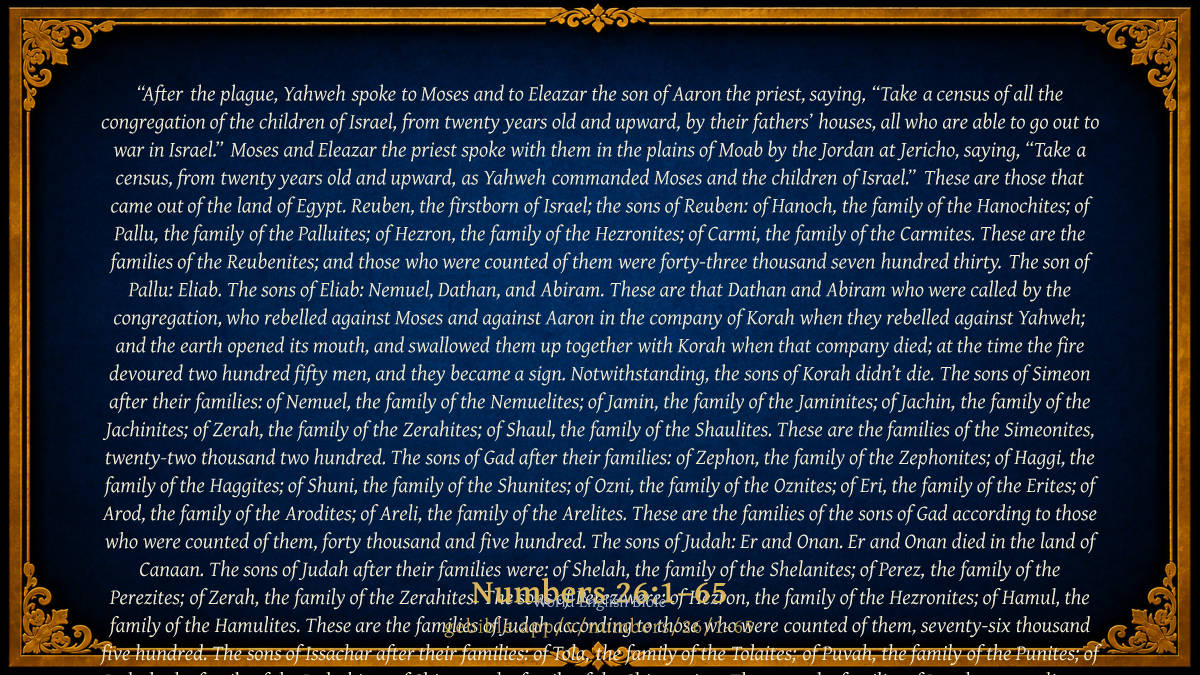
After the plague, Yahweh spoke to Moses and to Eleazar the son of Aaron the priest, saying, “Take a census of all the congregation of the children of Israel, from twenty years old and upward, by their fathers’ houses, all who are able to go out to war in Israel.” Moses and Eleazar the priest spoke with them in the plains of Moab by the Jordan at Jericho, saying, “Take a census, from twenty years old and upward, as Yahweh commanded Moses and the children of Israel.” These are those that came out of the land of Egypt.
Reuben, the firstborn of Israel; the sons of Reuben: of Hanoch, the family of the Hanochites; of Pallu, the family of the Palluites; of Hezron, the family of the Hezronites; of Carmi, the family of the Carmites. These are the families of the Reubenites; and those who were counted of them were forty-three thousand seven hundred thirty. The son of Pallu: Eliab. The sons of Eliab: Nemuel, Dathan, and Abiram. These are that Dathan and Abiram who were called by the congregation, who rebelled against Moses and against Aaron in the company of Korah when they rebelled against Yahweh; and the earth opened its mouth, and swallowed them up together with Korah when that company died; at the time the fire devoured two hundred fifty men, and they became a sign. Notwithstanding, the sons of Korah didn’t die. The sons of Simeon after their families: of Nemuel, the family of the Nemuelites; of Jamin, the family of the Jaminites; of Jachin, the family of the Jachinites; of Zerah, the family of the Zerahites; of Shaul, the family of the Shaulites. These are the families of the Simeonites, twenty-two thousand two hundred. The sons of Gad after their families: of Zephon, the family of the Zephonites; of Haggi, the family of the Haggites; of Shuni, the family of the Shunites; of Ozni, the family of the Oznites; of Eri, the family of the Erites; of Arod, the family of the Arodites; of Areli, the family of the Arelites. These are the families of the sons of Gad according to those who were counted of them, forty thousand and five hundred. The sons of Judah: Er and Onan. Er and Onan died in the land of Canaan. The sons of Judah after their families were: of Shelah, the family of the Shelanites; of Perez, the family of the Perezites; of Zerah, the family of the Zerahites. The sons of Perez were: of Hezron, the family of the Hezronites; of Hamul, the family of the Hamulites. These are the families of Judah according to those who were counted of them, seventy-six thousand five hundred. The sons of Issachar after their families: of Tola, the family of the Tolaites; of Puvah, the family of the Punites; of Jashub, the family of the Jashubites; of Shimron, the family of the Shimronites. These are the families of Issachar according to those who were counted of them, sixty-four thousand three hundred. The sons of Zebulun after their families: of Sered, the family of the Seredites; of Elon, the family of the Elonites; of Jahleel, the family of the Jahleelites. These are the families of the Zebulunites according to those who were counted of them, sixty thousand five hundred. The sons of Joseph after their families: Manasseh and Ephraim. The sons of Manasseh: of Machir, the family of the Machirites; and Machir became the father of Gilead; of Gilead, the family of the Gileadites. These are the sons of Gilead: of Iezer, the family of the Iezerites; of Helek, the family of the Helekites; and Asriel, the family of the Asrielites; and Shechem, the family of the Shechemites; and Shemida, the family of the Shemidaites; and Hepher, the family of the Hepherites. Zelophehad the son of Hepher had no sons, but daughters: and the names of the daughters of Zelophehad were Mahlah, Noah, Hoglah, Milcah, and Tirzah. These are the families of Manasseh. Those who were counted of them were fifty-two thousand seven hundred. These are the sons of Ephraim after their families: of Shuthelah, the family of the Shuthelahites; of Becher, the family of the Becherites; of Tahan, the family of the Tahanites. These are the sons of Shuthelah: of Eran, the family of the Eranites. These are the families of the sons of Ephraim according to those who were counted of them, thirty-two thousand five hundred. These are the sons of Joseph after their families. The sons of Benjamin after their families: of Bela, the family of the Belaites; of Ashbel, the family of the Ashbelites; of Ahiram, the family of the Ahiramites; of Shephupham, the family of the Shuphamites; of Hupham, the family of the Huphamites. The sons of Bela were Ard and Naaman: the family of the Ardites; and of Naaman, the family of the Naamites. These are the sons of Benjamin after their families; and those who were counted of them were forty-five thousand six hundred. These are the sons of Dan after their families: of Shuham, the family of the Shuhamites. These are the families of Dan after their families. All the families of the Shuhamites, according to those who were counted of them, were sixty-four thousand four hundred. The sons of Asher after their families: of Imnah, the family of the Imnites; of Ishvi, the family of the Ishvites; of Beriah, the family of the Berites. Of the sons of Beriah: of Heber, the family of the Heberites; of Malchiel, the family of the Malchielites. The name of the daughter of Asher was Serah. These are the families of the sons of Asher according to those who were counted of them, fifty-three thousand and four hundred. The sons of Naphtali after their families: of Jahzeel, the family of the Jahzeelites; of Guni, the family of the Gunites; of Jezer, the family of the Jezerites; of Shillem, the family of the Shillemites. These are the families of Naphtali according to their families; and those who were counted of them were forty-five thousand four hundred. These are those who were counted of the children of Israel, six hundred one thousand seven hundred thirty.
Yahweh spoke to Moses, saying, “To these the land shall be divided for an inheritance according to the number of names. To the more you shall give the more inheritance, and to the fewer you shall give the less inheritance. To everyone according to those who were counted of him shall his inheritance be given. Notwithstanding, the land shall be divided by lot. According to the names of the tribes of their fathers they shall inherit. According to the lot shall their inheritance be divided between the more and the fewer.”
These are those who were counted of the Levites after their families: of Gershon, the family of the Gershonites; of Kohath, the family of the Kohathites; of Merari, the family of the Merarites. These are the families of Levi: the family of the Libnites, the family of the Hebronites, the family of the Mahlites, the family of the Mushites, and the family of the Korahites. Kohath became the father of Amram. The name of Amram’s wife was Jochebed, the daughter of Levi, who was born to Levi in Egypt. She bore to Amram Aaron and Moses, and Miriam their sister. To Aaron were born Nadab and Abihu, Eleazar and Ithamar. Nadab and Abihu died when they offered strange fire before Yahweh. Those who were counted of them were twenty-three thousand, every male from a month old and upward; for they were not counted among the children of Israel, because there was no inheritance given them among the children of Israel. These are those who were counted by Moses and Eleazar the priest, who counted the children of Israel in the plains of Moab by the Jordan at Jericho. But among these there was not a man of them who were counted by Moses and Aaron the priest, who counted the children of Israel in the wilderness of Sinai. For Yahweh had said of them, “They shall surely die in the wilderness.” There was not a man left of them, except Caleb the son of Jephunneh, and Joshua the son of Nun.
Geneva Bible translators 1599 · Public Domain On vv1, 3, 9, 10, 19, 51, 53, 64, 65 Which came for their whoredom and idolatry.
Which came for their whoredom and idolatry.
Geneva Bible (1599) marginal notes — public domain.
John Trapp 1656 · Public Domain On vv2, 9, 10, 11, 44 Num 26:2 Take the sum of all the congregation…
Num 26:2 Take the sum of all the congregation of the children of Israel, from twenty years old and upward, throughout their fathers’ house, all that are able to go to war in Israel.
Ver. 2. From twenty.] {See Trapp on "Num 1:3"}
John Trapp, A Commentary or Exposition upon All the Books of the Old and New Testament (1647–1656) — public domain. Text from a community e-Sword module.
Matthew Poole 1685 · Public Domain On vv1, 2, 3, 4, 7, 8, 10, 11, 12, 13, 14, 15, 16, 17, 18, 21, 22, 23, 25, 27, 29, 30, 34, 35, 36, 38, 39, 40, 42, 43, 44, 46, 47, 51, 53, 54, 55, 56, 58, 59, 62, 65 After the plague, last mentioned, Num 25:8,9.
After the plague, last mentioned, Num 25:8,9.
Eleazar, his father being dead, was high priest.
Matthew Poole's English Annotations on the Holy Bible (1683–1685) — public domain. Text from a community e-Sword/MySword module.
Matthew Henry 1710 · Public Domain On vv1, 5, 52, 57, 63 Observe here, 1. That Moses did not number the…
Observe here, 1. That Moses did not number the people but when God commanded him. David in his time did it without a command, and paid dearly for it. God was Israel's king, and he would not have this act of authority done but by his express orders. Moses, perhaps, by this time, had heard of the blessing with which Balaam was constrained, sorely against his will, to bless Israel, and particularly the notice he took of their numbers; and he was sufficiently pleased with that general testimony borne to this instance of their strength and honour by an adversary, though he knew not their numbers exactly, till God now appointed him to take the sum of them. 2. Eleazar was joined in commission with him, as Aaron had been before, by which God honoured Eleazar before the elders of his people, and confirmed his succession. 3. It was presently after the plague that this account was ordered to be taken, to show that though God had in justice contended with them by that sweeping pestilence, yet he had not made a full end, nor would he utterly cast them off. God's Israel shall not be ruined, though it be severely rebuked. 4. They were now to go by the same rule that they had gone by in the former numbering, counting those only that were able to go forth to war, for this was the service now before them.
Matthew Henry's Commentary on the Whole Bible (1708–1710) — public domain (CC PDM 1.0). Text via the HelloAO Bible API.
John Gill 1763 · Public Domain On vv1, 2, 3, 4, 5, 8, 9, 10, 11, 12, 15, 19, 23, 26, 28, 35, 38, 42, 44, 48, 51, 52 And it came to pass after the plague,.... Related…
And it came to pass after the plague,.... Related in the preceding chapter; how long after is not certain, perhaps before the war with Midian, exhorted to in the latter part of the foregoing chapter, and of which an account is given, Num 31:1,
that the Lord spake unto Moses; out of the tabernacle, or out of the cloud:
Read full note →
and unto Eleazar the son of Aaron the priest; the Lord had been used to speak to Moses and to Aaron; but now Aaron being dead, and Eleazar his son succeeding him in the priesthood, is joined with Moses, and the order here given is directed to them both:
saying: as follows.
John Gill's Exposition of the Whole Bible (1746–1763) — public domain (CC PDM 1.0). Text via the HelloAO Bible API.
John Wesley 1765 · Public Domain On vv1, 2, 7, 10, 11, 12, 14, 18, 22, 34, 38, 43, 51, 53, 55, 56, 65 Orders for numbering the people, ver. 1-4. Their families…
Orders for numbering the people, ver. 1-4. Their families and number, ver. 5-51. Directions for dividing the land between them, ver. 52-55. The families and number of the Levites, ver. 56- 62. Notice taken of the death of them that were first numbered, ver. 62-65.
John Wesley, Explanatory Notes Upon the Whole Bible (1754–1765) — public domain. Text via the GEBible commentary corpus.
Adam Clarke 1810 · Public Domain On vv1, 2, 10, 11, 51, 55 Moses and Eleazar are commanded to take the sum…
CHAPTER XXVI
Moses and Eleazar are commanded to take the sum of the
Read full note →
Israelites, in the plains of Moab, 1-4.
Reuben and his posterity, 43,730, ver. 5-11.
Simeon and his posterity, 22,200, ver. 12-14.
Gad and his posterity, 40,500, ver. 15-18.
Judah and his posterity, 76,500, ver. 19-22.
Issachar and his posterity, 64,300, ver. 23-25.
Zebulun and his posterity, 60,500, ver. 26, 27.
Manasseh and his posterity, 52,700, ver. 28-34.
Ephraim and his posterity, 32,500, ver. 35-37.
Benjamin and his posterity, 45,600, ver. 38-41.
Dan and his posterity, 64,400, ver. 42, 43.
Asher and his posterity, 53,400, ver. 44-47.
Naphtali and his posterity, 45,400, ver. 48-50.
Total amount of the twelve tribes, 601,730, ver. 51.
The land is to be divided by lot, and how, 52-56.
The Levites and their families, 57, 58.
Their genealogy, 59-61.
Their number, 23,000, ver. 62.
In this census or enumeration not one man was found, save Joshua
and Caleb, of all who had been reckoned 38 years before, the
rest having died in the wilderness, 63-65.
NOTES ON CHAP. XXVI
Adam Clarke's Commentary on the Bible (1810–1826) — public domain. Text from a community e-Sword/MySword module.
Joseph Benson 1811 · Public Domain On vv2, 7, 10, 11, 12, 14, 18, 22, 33, 34, 37, 42, 47, 51, 53, 55, 56, 65 Num 26:2. Take the sum of all the congregation…
Num 26:2. Take the sum of all the congregation — They were numbered twice before, Exo 30:11-12; Num 1:1-2. Now they are numbered a third time, to demonstrate the faithfulness of God, both in cutting all those off whom he had threatened to cut off, (Num 14:29,) and in a stupendous increase of the people, according to his promise, notwithstanding all their sins, and the sweeping judgments inflicted upon them; and to prepare the way for the equal division of the land, which they were now going to possess.
Joseph Benson's Commentary on the Old and New Testaments (1811–1818) — public domain. Text from a community e-Sword module.
Albert Barnes 1834 · Public Domain On vv1, 5, 10, 11, 51, 56, 59, 62, 64 After the plague - These words serve to show…
After the plague - These words serve to show approximately the date at which the census was taken, and intimate the reason for the great decrease in numbers which was found to have taken place in certain tribes. Compare Deu 4:3 and Num 26:5 note in this chapter.
Albert Barnes' Notes on the Bible (1834–1885) — public domain. Text from a community e-Sword/MySword module.
Haydock's Catholic Bible Commentary 1859 · Public Domain On vv1, 2, 4, 7, 9, 10, 12, 14, 17, 18, 22, 25, 27, 29, 30, 34, 37, 38, 41, 43, 47, 50, 54, 55, 58, 59, 64 Shed. Hebrew and Septuagint, "after the plague," which destroyed…
Shed. Hebrew and Septuagint, "after the plague," which destroyed so many. (Chaldean) After all who had murmured were cut off, the new progeny is numbered. (St. Jerome) (Worthington)
George Leo Haydock (1774–1849), Haydock's Catholic Family Bible and Commentary, 1859 edition — public domain. Excludes Psalms (Douay-Rheims chapter numbering differs from Protestant) and Deuterocanonical books (Catholic canon only).
Lange's Commentary on the Holy Scriptures 1864 · Public Domain On v1 The New Numbering of the People after the Great…
THIRD SECTION
The New Numbering of the People after the Great Judgment Executed upon It
Read full note →
Num_26:1-65
1And it came to pass after the plague, that the Lord spake unto Moses and unto Eleazar the son of Aaron the priest, saying, 2Take the sum of all the congregation of Israel, from twenty years old and upward, throughout their fathers’ house, all that are able to go to war in Israel. 3And Moses and Eleazar the priest spake with them in the plains of Moab by Jordan near Jericho, saying, 4Take the sum of the people, from twenty years old and upward; as the Lord commanded Moses and the children of Israel, which went forth out of the land of Egypt.
5Reuben, the eldest son of Israel: the children of Reuben; Hanoch, of whom cometh the family of the Hanochites: of Pallu, the family of the Palluites: 6Of Hezron, the family of the Hezronites: of Carmi, the family of the Carmites. 7These are the families of the Reubenites: and they that were numbered of them were forty and three thousand and seven hundred and thirty. 8And the sons of Pallu; Eliab. 9And the sons of Eliab; Nemuel, and Dathan, and Abiram. This is that Dathan and Abiram, which were famous in the congregation, who strove against Moses and against Aaron in the company of Korah, when they strove against the Lord: 10And the earth opened her mouth, and swallowed them up together with Korah, when that company died, what time the fire devoured two hundred and fifty men: and they became a sign. 11Notwithstanding the children of Korah died not.
12The sons of Simeon after their families: of 1Nemuel, the family of the Nemuelites: of Jamin, the family of the Jaminites: of 2Jachin, the family of the Jachinites: 13Of 3Zerah, the family of the Zarhites: of Shaul, the family of the Shaulites. 14These are the families of the Simeonites, twenty and two thousand and two hundred.
15The children of Gad after their families: of 4Zephon, the family of the Zephonites: of Haggi, the family of the Haggites: of Shuni, the family of the Shunites: 16, 17Of 5Ozni, the family of the Oznites: of Eri, the family of the Erites: Of 6Arod 18the family of the Arodites: of Areli, the family of the Arelites. These are the families of the children of Gad according to those that were numbered of them, forty thousand and five hundred.
19The sons of Judah were Er and Onan: and Er and Onan died in the land of Canaan. 20And the sons of Judah after their families were; of Shelah, the family of the Shelahites: of Pharez, the family of the Pharzites: of Zerah, the family of the Zarhites. 21And the sons of Pharez were: of Hezron, the family of the Hezronites: 22of Hamul, the family of the Hamulites. These are the families of Judah according to those that were numbered of them, three-score and sixteen thousand and five hundred.
23Of the sons of Issachar after their families: of Tola, the family of the Tolaites: 24of 7Pua, the family of the Punites: Of 8Jashub, the family of the Jashubites: of 25Shimron, the family of the Shimronites. These are the families of Issachar according to those that were numbered of them, threescore and four thousand and three hundred.
26Of the sons of Zebulun after their families: of Sered, the family of the Sardites: of Elon, the family of the Elonites: of Jahleel, the family of the Jahleelites. 27These are the families of the Zebulunites according to those that were numbered of them, threescore thousand and five hundred.
28The sons of Joseph after their families were Manasseh and Ephraim. 29Of the sons of Manasseh: of Machir, the family of the Machirites: and Machir begat 30Gilead: of Gilead come the family of the Gileadites. These are the sons of Gilead: of 9Jeezer, the family of the Jeezerites: of Helek, the family of the Helekites: 31And of Asriel, the family of the Asrielites: and of Shechem, the family of the 32Shechemites: And of Shemida, the family of the Shemidaites: and of Hepher, the family of the Hepherites.
33And Zelophehad the son of Hepher had no sons, but daughters: and the names of the daughters of Zelophehad were Mahlah, and Noah, Hoglah, Milcah, and Tirzah. 34These are the families of Manasseh, and those that were numbered of them, fifty and two thousand and seven hundred.
35These are the sons of Ephraim after their families: of Shuthelah, the family of the Shuthalhites: of 10Becher, the family of the Bachrites: of Tahan, the family 36of the Tahanites. And these are the sons of Shuthelah: of Eran, the family of 37the Eranites. These are the families of the sons of Ephraim according to those that were numbered of them, thirty and two thousand and five hundred. These are the sons of Joseph after their families.
38The sons of Benjamin after their families: of Bela, the family of the Belaites: of Ashbel, the family of the Ashbelites: of 11Ahiram, the family of the Ahiramites: 39Of 12Shupham, the family of the Shuphamites: of Hupham, the family of the Huphamites. 40And the sons of Bela were 13Ard and Naaman: of Ard, the family 41of the Ardites: and of Naaman, the family of the Naamites. These are the sons of Benjamin after their families: and they that were numbered of them were forty and five thousand and six hundred.
42These are the sons of Dan after their families: of 14Shuham, the family of the Shuhamites. These are the families of Dan after their families. 43All the families of the Shuhamites, according to those that were numbered of them, were threescore and four thousand and four hundred.
44Of the children of Asher after their families: of Jimna, the family of the Jimnites: of Jesui, the family of the Jesuites: of Beriah, the family of the Beriites. 45Of the sons of Beriah: of Heber, the family of the Heberites: of Malchiel, the family of the Malchielites. 46And the name of the daughter of Asher was Sarah. 47These are the families of the sons of Asher according to those that were numbered of them: who were fifty and three thousand and four hundred.
48Of the sons of Naphtali after their families: of Jahzeel, the family of the Jahzeelites: of Guni, the family of the Gunites: 49Of Jezer, the family of the Jezerites: 50of 15Shillem, the family of the Shillemites. These are the families of Naphtali according to their families: and they that were numbered of them were forty and 51five thousand and four hundred. These were the numbered of the children of Israel, six hundred thousand and a thousand seven hundred and thirty.
52And the Lord spake unto Moses, saying, 53Unto these the land shall be divided for an inheritance according to the number of names. 54To many thou shalt 16give the more inheritance, and to few thou shalt 17give the less inheritance: to every one shall his inheritance be given according to those that were numbered of him. 55Notwithstanding the land shall be divided by lot: according to the names of the tribes of their fathers they shall inherit. 56According to the lot shall the possession thereof be divided between many and few.
57And these are they that were numbered of the Levites after their families: of Gershon, the family of the Gershonites; of Kohath, the family of the Kohathites; 58of Merari, the family of the Merarites. These are the families of the Levites: the family of the Libnites, the family of the Hebronites, the family of the Mahlites, the family of the Mushites, the family of the Korathites. And Kohath begat Amram. 59And the name of Amram’s wife was Jochebed, the daughter of Levi, whom her mother bare to Levi in Egypt: and she bare unto Amram, Aaron and Moses, and Miriam their sister. 60And unto Aaron was born Nadab and Abihu, Eleazar and Ithamar. 61And Nadab and Abihu died, when they offered strange fire before the Lord. 62And those that were numbered of them were twenty and three thousand, all males from a month old and upward: for they were not numbered among the children of Israel, because there was no inheritance given them among the children of Israel.
63These are they that were numbered by Moses and Eleazar the priest, who numbered the children of Israel in the plains of Moab by Jordan near Jericho. 64But among these there was not a man of them whom Moses and Aaron the priest numbered, when they numbered the children of Israel in the wilderness of Sinai. 65For the Lord had said of them, They shall surely die in the wilderness. And there was not left a man of them, save Caleb the son of Jephunneh, and Joshua the son of Nun.
EXEGETICAL AND CRITICAL
The more definite preparations for the entrance into Canaan begin with this chapter. It gives us an enlargement, as well as a parallel to the numbering in chap. 1, and has its application in the partition of the land of promise in Joshua 14. et seq. An enlargement as to the right of inheritance is found in the succeeding chap. Num_26:1-11; the following section, Num_26:12-23, contains the calling of Joshua to the leadership of the people after the approaching departure of Moses. Then chap. 28. completes the ordinances for sacrifices and feasts with reference to the approaching settlement in Canaan. Lastly we have the law in regard to vows, chap. 30. Upon this follows the final reckoning with the heathen in the retaliatory raid against the Midianites.
The general object of the mustering is to fix anew the order and number of the army, after it has in the new generation been purified through two death-visitations, especially by the last great catastrophe as by fire, and also after the entire older generation, with the exception of the chosen men Caleb and Joshua, and Moses, whose death was at hand, had passed away. The more definite purpose, however, is the organization of the people with reference to the approaching division of the inheritance according to their fighting strength. Hence the families of the different tribes are enumerated in detail.
To avoid repetition we shall not pursue here the inquiry as to the significance of individual names, but may here also refer to the importance of the names for a proper estimate of the religious and popular character of the Israelites.
Num_26:1-4. The order for the mustering. See Numbers 1. et seq. [After the plague. “The words fix approximately the date at which the census was taken, and intimate the reason for the great decrease in numbers which was found to have taken place in certain tribes.” Speak. Com. While this may be true with respect to the tribe of Simeon, who were perhaps involved more deeply in the sin of Zimri, there is no sufficient reason to think that a like explanation can be given for the difference in numbers as to the other tribes. Forty years in a life like that which they led, affords ample room for these differences without supposing any extraordinary reason for them. There is no striking variation except with Simeon.—A. G.]18
A special motive is intimated; because they were encamped in the plains of Moab, by Jordan, near Jericho. Hence the numeration here relates to the settlement in Canaan, whereas before it has respect to the army organization. The dependence upon the early numbering occasions the beauty and simplicity of the record here. [The ellipsis in Num_26:4 is rightly supplied in our version from Num_26:2. Take the sum. “The words ‘from the children of Israel’ in Num_26:4 onwards form the introduction to the enumeration of the different tribes, and the verb יהְיוּ, were, must be supplied.” Keil. So Lange also and the LXX.—A. G.]
Num_26:5-11. Reuben branches into four families, numbers 43,730. [That the number of the families has no connection with the number of the tribe is evident from a comparison of Reuben with Dan. There may have been families not enumerated here, who for some reason may hare attached themselves to more powerful houses; and it is not necessary to suppose that all the lineal descendants of each house are named. Bible Com.: “A variety of circumstances would naturally tend to bring into prominence some branches of the same parent stock, and throw others into the background.”—A. G.] The grandsons of Pallus of the second family, besides Nemuel (or Jemuel), were the rebels Dathan and Abiram. With the allusion to these names, the account goes back to the fearful end of these insurgents. This end, however, is clearly to be distinguished from the fire-judgment upon the 250 offerers of incense, who themselves a sign, left behind them a sign in the brazen covering upon the altar. The remarkable exception of the children of Korah, the prime mover in the rebellion, who kept themselves from the uproar, and did not perish, is dwelt upon. [The children of Korah died not.—Wordsworth: “Therefore God does not visit the sins of the fathers on the children, unless the children follow the fathers in sin.” A great truth no doubt; but all truth is many-sided. How far is it true that the children’s following in the sins of their father is judicial, without interfering with their freedom in choosing to do so? Bible Com.: “Samuel the prophet was of this family, 1Ch_6:22 seq.; Heman, ‘the king’s seer,’ 1Ch_25:5.”—A. G.]
Num_26:12-14. Simeon, five families, numbers 22,200. Obed’s family (Gen_46:10) had become extinct—Nemuel=Jemuel. [Keil: Yod and Nun are often interchanged. See Ges., Thes., pp. 833 and 557; and Zerah is a name of the same import with Zohar (Zerah, the rising of the sun; Zohar, candor, splendor).”—A. G.]
Num_26:15-18. Gad.—Seven families, numbers 40, 500. Ozni is named Egbon, Gen_46:16.
Num_26:19-22. Judah, three families, the third subdivided, numbers 76,500. Er and Onan had perished in Canaan.
Num_26:23-25. Issachar.—Four families, numbers 64,300. Jashub is called Job, Gen_46:13. The two names have the same signification, to return.
Num_26:26-27. Zebulon.—Three families, numbers 60,560. [Wordsworth calls attention to the fact that while the three tribes under Reuben had decreased, all those under Judah had increased. The tribes were probably influenced by each other’s example, may have fallen into like sins, and suffered under common judgments.—A. G.]
Num_26:28-34. Joseph—Manasseh.—The family of his son Machir was continued in that of Gilead. This appears subdivided into six families. But besides these, there is another family of the Machirites and Gileadites alluded to, i. e. a branch not clearly defined. Numbers 52,700. [Keil: The genealogical accounts in Num 27:36; Joshua 17. harmonize, except that Jeezer here is Ariezer in Jos_17:2, Heber’s son Zelophehad left only five daughters, whose names are given here to prepare the way for the legal regulations in chaps. 27. and 36.—A. G.]
Num_26:35-37. Joseph—Ephraim.—Three families and a fourth additional house from Shuthelah his eldest son. Numbers 32,500. Comp. 1Ch_7:20.
Num_26:38-41. Benjamin.—Seven families, of which five were founded by sons and two by grandsons, i. e. grandsons who branched off into separate houses. Numbers 45,600. [The differences in the names, Gen_46:21, may be explained on the supposition that grandsons appear as sons, and partly by the probability that some of those named in Genesis had died like Obed in Simeon childless, or without founding distinct families.—A. G.]
Num_26:42-43. Dan.—One family from Shuham (Gen_46:23, Hushim), which, however, divided itself into several smaller families. Numbers 64,400.
Num_26:44-47. Asher. Three families from sons, two from grandsons. He had one daughter Sarah. Numbers 53,400. Ishua of Genesis 46. is wanting here, probably as in other cases he had founded no family.
Num_26:48-50. Naphtali. Four families. Numbers 45,400.
The total number of persons is 601,730. Compare throughout the genealogical table in Genesis 46. and 1 Chronicles 7, as well as the commentaries upon them. [A comparison of the totals here and in chap. 1. shows a small loss. The people which had grown so rapidly in Egypt had scarcely held its own through the wilderness, with its sins and judgments. That one generation merely filled the gaps made vacant by the death of that which preceded it, shows that other than merely natural causes were at work in the wasting of the earlier generation, and confirms the history of the wilderness-life.—A. G.]
Num_26:52-56. Instructions for the division of the land. First regulation: Each tribe must have a territory whose limits shall be proportionate to its own size. According to the number of names.—Second regulation: It must be decided by lot (between equal territories) which shall fall to each tribe. [The lot was not to determine the extent of the possession, but the relative situation, and was used not only to prevent dissatisfaction and disputes, “but that every tribe might receive with gratitude its possession as assigned to it by God Himself who determines the lot.”—A. G.] Third regulation: Each inheritance bears the name of the ancestor of the tribe.
Num_26:57-62. Mustering of the Levites. We have merely a sketch or outline for the sake of completing the list. For since this last enumeration is mainly with reference to the inheritance, and the Levites were not to have any inheritance or possession, they occupy little space here. Thus, 1. The three chief houses: Gershon, Kohath, and Merari. 2. The particular individual houses: Libnites from Gershon. Hebronites from Kohath, Mahlites and Mushites from Merari, the Korhites likewise from Kohath. 3. We notice a significant fact which forms the central point in this narrative, and has occasioned some difficulty. Kohath’s son is called Amram, the father of Aaron, Moses, and Miriam bears the same name. This illustrious family is through the identity of names brought back closely to its ancestor Levi. [The recurrence of the same names constitutes no difficulty. But Jochebed could not have been the daughter of Levi in the strict sense. Generations have come and gone between Levi and the mother of Moses. She was a daughter of Levi in the sense that she was a descendant. The term does not necessarily determine the nearness of the relation. The words her mother are correctly supplied by our translators. The subject is wanting, and as Keil holds, “must be derived from the verb itself.” The other constructions—“who was born; Vulg. Onkelos; Syr.: “whom his wife bare;” Jarchi, Aben-Ezra—seem forced or inconsistent with the text.—A. G.] 4. The sons of Aaron come out into great prominence. The entire sum of the Levites from a month old and upward was 23,000.
Num_26:63-65. Jehovah’s penalty had been fulfilled; the old generation, with the exception of Caleb and Joshua, had all passed away; i. e., of course those only who were more than twenty years of age when the earlier mustering occurred. [See Deu_2:14-15. The entire generation of warriors, those who were twenty years and upward, had perished before Israel crossed the Zered; but the fact that the penal sentence had been thus carried out comes in fitly here, when the new generation has just been mustered.—A. G.]
DOCTRINAL AND ETHICAL
The new numbering of the people represents the importance of preserving and renewing constantly the registers of the people by the church and the state. Statistics in its nobler sense and purpose.
HOMILETICAL HINTS
The new generation and society spring up over the graves of the old. The life which has been saved and purified comes out more fully and grandly after the death penalties had been executed. Cultured society should ever be on its guard and protect itself, even in the consciousness of its condition and strength. It is a sad condition of society when the standing of its members is entirely lost, either in the world or in the wilderness. The religious and moral import of the census.
Footnotes:
[1]Marg., Gen_46:10; Ezek. 6:15, Jemuel.
[2]1Ch_4:24, Jarib.
[3]Gen_46:10, Zohar.
[4]Gen_46:10, Ziphion.
[5]or Ezbon, Gen_46:16.
[6]Gen_46:16, Arodi.
[7]or Phuvah.
[8]or Job.
[9]called Abiezer, Jos_17:2, etc.
[10]1Ch_7:20, Bered.
[11]Gen_46:21, Ehi: 1Ch_8:1, Aharah.
[12]Gen_46:21, Muppim and Huppim.
[13]1Ch_8:3, Addar.
[14]or Hushim.
[15]1Ch_7:13, Shallum.
[16]Heb. multiply his inheritance.
[17]Heb. diminish his inheritance.
[18] Hirsch holds that the enumeration was made partly with reference to the Peor corruption, from which every one must now clear himself, and show his lineage beyond question; and with reference to the settlement in Canaan, each one was to answer or give his name, his house, his family, his tribe, and thus make clear that he belonged to Israel, and had part in its work and blessing.—A. G.]
Lange's Commentary on the Holy Scriptures (Critical, Doctrinal, and Homiletical), ed. John Peter Lange, English translation edited by Philip Schaff (1864–1880) — public domain. Text from a community e-Sword module.
Robert Jamieson, A. R. Fausset & David Brown 1871 · Public Domain On vv2, 7, 10, 11, 12, 53, 54, 55, 58, 62, 64 Take the sum of all the congregation--The design of…
Take the sum of all the congregation--The design of this new census, after a lapse of thirty-eight years, was primarily to establish the vast multiplication of the posterity of Abraham in spite of the severe judgments inflicted upon them; secondarily, it was to preserve the distinction of families and to make arrangements, preparatory to an entrance into the promised land, for the distribution of the country according to the relative population of the tribes.
Jamieson, Fausset & Brown — Commentary Critical and Explanatory on the Whole Bible (1871) — public domain (CC PDM 1.0). Text via the HelloAO Bible API.
Daniel D. Whedon 1874 · Public Domain On vv1, 2, 3, 4, 5, 10, 11, 12, 13, 14, 15, 16, 17, 23, 24, 28, 29, 33, 35, 38, 39, 42, 44, 48, 51, 53, 55, 57, 59, 61, 62, 63 THE SECOND CENSUS, Num_26:1-51.
THE SECOND CENSUS, Num_26:1-51.
1. After the plague — This had swept away the last of the generation doomed to death before entering Canaan. Comp. Num_26:64-65, and Num_14:32-34.
Read full note →
Moses… Eleazar — Moses and Aaron were in superintendence of the first census board. Num_1:3, note. In this census there was probably a board of assistant enumerators as in the first, (Num_1:4-15,) but they are not mentioned.
Daniel D. Whedon (gen. ed.), Commentary on the Old and New Testaments (1874–1909) — public domain. Text from a community e-Sword module.
The Cambridge Bible for Schools and Colleges 1878 · Public Domain On vv1, 4, 5, 9, 10, 11, 52, 54, 55, 57, 58, 59, 61, 62, 63 1–4. Moses and Eleazar are commanded by God to…
1–4. Moses and Eleazar are commanded by God to number the fighting men of 20 years of age and upwards.
The Cambridge Bible for Schools and Colleges (gen. ed. J. J. S. Perowne; Cambridge University Press, 1878–1918) — public domain. Text from a community e-Sword module.
Ellicott's Commentary for English Readers 1878 · Public Domain On vv1, 2, 4, 7, 10, 11, 14, 18, 19, 21, 29, 37, 51, 53, 59, 62, 64 (1) And it came to pass after the plague…
XXVI.
(1) And it came to pass after the plague . . . —The plague probably destroyed the remnant of the generation which had come out of Egypt, and which had been numbered in the wilderness of Sinai.
A Bible Commentary for English Readers, edited by Charles John Ellicott (1878–1897) — public domain. Text from a community e-Sword module.
C. H. Mackintosh 1880 · Public Domain On v1 Numbers 26
Numbers 26
This, though one of the longest chapters in our book, does not call for much in the way of remark or exposition. In it we have the record of the second numbering of the people, as they were about to enter upon the promised land. How sad to think that, out of the six hundred thousand men of war which were numbered, at the first, only two remain - Joshua and Caleb! All the rest lay mouldering in the dust, buried beneath the sand of the desert, all passed away. The two men of simple faith remained to have their faith rewarded. As for the men of unbelief, the inspired apostle tells us "Their carcasses fell in the wilderness."
Read full note →
How solemn! How full of instruction and admonition for us! Unbelief kept the first generation from entering the land of Canaan, and caused them to die in the wilderness. This is the fact on which the Holy Ghost grounds one of the most searching warnings and exhortations anywhere to be found in the compass of the inspired volume. Let us hear it! "Wherefore .....take heed, brethren, lest there be in any of you an evil heart of unbelief, in departing from the living God. But exhort one another daily while it is called To day; lest any of you be hardened through the deceitfulness of sin. For we are made partakers of Christ, if we hold the beginning of our confidence steadfast unto the end; while it is said, To day, if ye will hear his voice, harden not your hearts, as in the provocation. For some, when they had heard, did provoke: howbeit not all that came out of Egypt by Moses. But with whom was he grieved forty years? was it not with them that had sinned, Whose carcasses fell in the wilderness? And to whom sware he that they should not enter into his rest, but to them that believed not? So we see that they could not enter in because of unbelief. Let us therefore fear, lest a promise being left us of entering into His rest, any of you should seem to come short of it. For unto us was the gospel preached, as well as unto them: but the word preached did not profit them, not being mixed with faith in them that heard." Hebrews 3: 7 - Hebrews 4: 1, 2.
Here lies the great practical secret. The word of God mixed with faith. Precious mixture! the only thing that can really profit any one. We may hear a great deal; we may talk a great deal; we may profess a great deal; but we may rest assured that the measure of real spiritual power - power to surmount difficulties - power to overcome the world - power to get on - power to possess ourselves of all that God has bestowed upon us - the measure of this power is simply the measure in which God’s word is mixed with faith. That word is settled for ever in Leaven; and if it is fixed in our hearts, by faith, there is a divine link connecting us with heaven and all that belongs to it; and, in proportion as our hearts are thus livingly linked with heaven and the Christ who is there, shall we be practically separated from this present world, and lifted above its influence. Faith takes possession of all that God has given. It enters into that within the veil; it endures as seeing Him who is invisible; it occupies itself with the unseen and eternal, not with the seen and the temporal. Men think possession sure; faith knows nothing sure but God and His word. Faith takes God’s word and locks it up in the very innermost chamber of the heart, and there it remains as hid treasure - the only thing that deserves to be called treasure. The happy possessor of this treasure is rendered thoroughly independent of the world. He may be poor as regards the riches of this perishing scene; but if only he is rich in faith, he is the possessor of untold wealth - "durable riches and righteousness" - "the unsearchable riches of Christ."
Reader, these are not the pencillings of fancy - the mere visions of the imagination. No; they are substantial verities - divine realities, which you may now enjoy in all their preciousness. If you will only take God at His word - only believe what He says because he says it - for this is faith - then verily you have this treasure, which renders its possessor entirely Independent of this scene where men live only by the sight of their eyes. The men of this world speak of "the positive" and "the real," meaning thereby what they can see and experience; in other words, the things of time and sense - the tangible - the palpable. Faith knows nothing positive, nothing real, but the word of the living God.
Now it was the lack of this blessed faith that kept Israel out of Canaan, and caused six hundred thousand carcasses to fall in the wilderness. And it is the lack of this faith that keeps thousands of God’s people in bondage and darkness, when they ought to be walking in liberty and light - that keeps them in depression and gloom, when they ought to be walking in the joy and strength of God’s full salvation - that keeps them in fear of judgement, when they ought to be walking in the hope of glory - that keeps them in doubt as to whether they shall escape the sword of the destroyer in Egypt, when they ought to be feasting on the old corn of the land of Canaan.
Oh! that God’s people would consider these things in the secret of His presence and in the light of His word! Then indeed they would better know and more fully appreciate the fair inheritance which faith finds in the eternal word of God - they would more clearly apprehend the things which are freely given to us of God in the Son Of His love. May the Lord send out His light and His truth, and lead His people into the fullness of their portion in Christ, so that they may take their true place, and yield a true testimony for Him, while waiting for His glorious advent.
C. H. Mackintosh, Notes on the Pentateuch — public domain. Text from a community e-Sword module.
The Pulpit Commentary 1880 · Public Domain On vv1, 2, 3, 4, 5, 7, 8, 10, 11, 12, 15, 20, 23, 26, 29, 33, 35, 38, 42, 44, 48, 51, 52, 53, 55, 58, 59, 62, 64, 65 THE SECOND MUSTERING (verses 64); but this is opposed…
THE SECOND MUSTERING (verses 64); but this is opposed to the statement in Deu_2:14, Deu_2:15, and is essentially improbable. The victims of the plague would surely be those who had joined themselves to Baal-Peor; and these again would surely be the younger, not the older, men in Israel. It is part of the moral of the story that these offenders deprived themselves, not merely of a few remaining days, but of many years of happy rest which might have been theirs.
Vers. 1-65. The final numbering of the elect. Both the numberings of the children of Israel are to be spiritually interpreted of that knowledge which God has of his elect, and of their inscription in the registers of life. The people of God are to him as his flock is to the shepherd; he knows his sheep, and calleth his own sheep by name, and leadeth them out to the journey, or leadeth them in to rest. Again, the people of God are to him as his army is to the captain; they are drawn up (tetagmenoi , cf. Act_13:48) and set in array unto eternal life, every one in his proper place, so that each may act most to his own advantage, and to the advantage of all. "The Lord knoweth them that are his", (2Ti_2:19) according to the saying, "I know thee by name", (Exo_33:17 Isa_43:1) and, "I will not blot out his name out of the book of life". (Rev_3:5; cf. Php_4:3) But as the numberings of Israel were two, and a great distinction between them, so God"s knowledge of his elect has a double character, which is in some important respects strongly contrasted. The first numbering (see the homiletic notes on Nu 1) was for that march which was to prove a fiery trial to all, and did in fact involve the destruction of most, albeit entirely through their own default; the second numbering was for the actual entry into and possession of their long-promised rest. In like manner there is a twofold election on the part of God, according to which his people are counted his indeed, and are personally known to him. There is the election unto grace, whereby we have been called out of darkness, and made the soldiers of the cross, and assigned our place in the "one body", (Col_3:15) to share in its privileges and trials, its strifes and consolations; there is also the election unto glory, whereby, when the probation is past and the temptation overcome, we are numbered unto eternal life and inheritance among the saints. On this distinction hangs all the teaching of this chapter. Consider, therefore, with respect to this mustering as a whole
Read full note →
I THAT THERE SHOULD HAVE BEEN BUT ONE CENSUS TAKEN, SINCE ALL WHO WERE NUMBERED AT SINAI WERE NUMBERED FOR VICTORY AND FOR SPEEDY INHERITANCE IN CANAAN. That a second muster was needful at all was entirely due to the rebellion at Kadesh, and the subsequent rejection of that generation. Even so there is in the will of God concerning us, as declared at large in the gospel, but one election and one enrolling in the ranks of salvation. All who are called to grace are designed for glory; none are enlisted under the cross but may, and should, attain the crown; the Christian name and calling is not a mockery in any case. That there is a double election, that names may be blotted out of the book of life, that it is not possible to maintain a consistent scheme of salvation on the ground of the Divine predestination alone, is all due, and only due, to the sin and cowardice of men, which does not indeed cancel the election or impair the glory of God"s Church, but does alter the personal composition of that Church.
II THAT AS A FACT NOT ONE (ORDINARY)NAME REMAINED IN THE SECOND MUSTER WHICH BELONGED TO THE FIRST. Even so there is not in any case an assurance that those who are called to grace will persevere unto glory. Not all indeed will, but all may, be lost through their own rebellion. The two lists, of the baptized and of the finally saved, ought (in a true sense) to be coincident; as a fact they will no doubt be startlingly dissimilar.
III THAT THOSE FORMERLY ENROLLED DISAPPEARED ONE BY ONE, ACCORDING TO THE DECLARATION OF GOD, BECAUSE THEY HAD REFUSED AT KADESH TO ENTER INTO REST. Even so if men fall out of the number of such as are being saved, (oi swzomenoi , Act_2:47) it is simply because they have refused to enter upon their lot, and have counted themselves unworthy of, or unequal to, the attainment of eternal life.
IV THAT, NEVERTHELESS, SOME NAMES WERE FOUND IN BOTH LISTS; as those of Caleb, Joshua, Eleazar, and presumably many of the Levites. Even so it is abundantly evident, not only from the testimony of Scripture, but from the example of our brethren, that nothing in our probation need be fatal to our hopes, if only we he true to God and to ourselves. Arid note that here is one of the great contrasts between that dispensation and ours, that whereas only two individuals out of the twelve tribes obtained inheritance at the last, there will be of us "a great multitude whom no man can number." Nevertheless, we have the same warning. (cf. Luk_13:23, Luk_13:24)
V THAT IN EACH CASE THE MUSTERING WAS LIMITED TO THE SAME CLASS OF MEN VIZ., SUCH AS WERE FIT TO BEAR ARMS. Even so there is no difference between election to grace and to glory as far as the position and character of the individual is concerned. The two states are so far one, even when looked at from the side of man, that whoso is called to the one needs nothing more to be ready for the other; he only needs to remain what he is, a soldier of Christ, in order to be crowned. (cf. Rev_2:7, &c.);
VI THAT THE TOTAL NUMBER OF ALL ISRAEL REMAINED PRACTICALLY STATIONARY; so that as many entered after all as had refused at Kadesh. Even so God will have his kingdom filled, (Luk_14:21-23) and his calling is without repentance; (Rom_11:29) so that if some fall short of salvation, others will be found to take their place. And note that the long waiting of Israel in the wilderness was due to the necessity of an evil generation dying out, and another growing up to equal it in numbers. It may be that the long and unexpected tarrying of Christ is due to a like necessity; that the number of the elect is slowly filled up amidst the defection and unworthiness of so many.
VII THAT THE VARIOUS TRIBES OF ISRAEL SHOWED A REMARKABLE VARIATION; some showing a great increase, others a decrease quite as great. Even so while the Church of Christ as a whole maintains, it may be, its position relative to the rest of the world, how great has been the variation in size and importance of various branches of the Church! Think, e.g., what the Greek-speaking Churches were at one time: and how they are now reduced; and, on the other hand, to what relative importance have the English-speaking Churches grown from small beginnings.
VIII THAT IN ONE CASE WE CAN TRACE THE CAUSE OF DECLINE WITH SOME ASSURANCE. Simeon, the tribe of Zimri, omitted in the blessing of Moses. must have joined himself more especially to Baal-Peor. Even so the one thing which we can unhesitatingly assign as the fruitful cause of loss of spiritual life and decay of Churches is immorality. Doubtless purity of doctrine is most potent for good, but impurity of life is still more potent for evil. That Church will train fewest souls for heaven which gives most place to those fleshly lusts which war against the soul. And note that this census was taken "after the plague" which followed on the harlotry of Baal-Peor; for the thousands who perished then were not of them that were doomed at Kadesh, (see Deu_2:14) but of those who would have inherited Canaan in a few months. So it is "after the plague" of fleshly sin and of its ruinous effects that the servants of God are numbered for eternal life. "The pure in heart shall see God". (cf. Gal_5:19-21 Eph_5:5 Rev_22:15)
IX THAT IN ANOTHER CASE WE CAN DISCERN A POSSIBLE REASON FOR DECAY, IN THAT ALL THE TRIBES UNDER THE LEADERSHIP OF REUBEN FELL OFF IN NUMBERS (Reuben, Simeon, Gad). This may point to the unhappy effects of bad example, and the contagious nature of a turbulent and self-willed spirit in religious matters.
X THAT, ON THE CONTRARY, ALL THE CAMPS WHICH WERE UNDER THE STANDARD OF JUDAH INCREASED (Judah, Issachar, Zebulun). For to Judah, as having the birthright, appertained now the promise, "In thee and in thy seed shall all nations be blessed." Thus for the sake of Jesus, who sprang from the tribe of Judah, the companions of Judah were blessed long ago: and this no doubt because his character and example were more or less in accordance with the dignity of his position.
XI THAT AFTER ALL THE CAUSES OF INCREASE OR DECLINE ARE FOR THE MOST PART UNKNOWN, AND LIE BENEATH THE SURFACE OF THE SACRED RECORD. How little do we know of the inner history of Ephraim and Manasseh, which has left no trace in the narrative, and yet had such important effects in their comparative prosperity! Even so how little do we know of the real life of Churches; how little can we estimate those forces which determine their spiritual growth or decadence!
XII THAT NOTHING BROUGHT TO LIGHT THE GREAT DIFFERENCES BETWEEN THE TRIBES EXCEPT THE MUSTERING ON THE VERGE OF JORDAN. Even so nothing can really test the comparative excellence, the success or failure, of a Church, except the verdict of "that day," and the numbers then found worthy to stand before the Son of man.
Consider also, with respect to the Levites
THAT THEY HAD INCREASED, BUT NOT NEARLY SO MUCH AS THEY SHOULD HAVE DONE, CONSIDERING THEIR IMMUNITIES AND PRIVILEGES. Four tribes, although under the condemnation of Kadesh, had prospered more than they. Even so it is certain that no situation of vantage, ecclesiastical or religious, delivers us from spiritual loss, or really makes religious progress easier. Many who have fewer advantages and greater difficulties, many even who have at some time fallen under greater condemnation, will nevertheless outstrip us in the heavenly race.
Consider again, with respect to the inheritance of each tribe in Canaan
I THAT ITS SITUATION WAS TO BE DECIDED BY LOT, i.e., BY DIVINE DISPOSITION, APART FROM HUMAN CHOICE OR FAVOUR. Even so our "place in heaven" will be allotted to us by God himself, being predestinated for us according to his infinite wisdom, without any respect of persons.
II THAT ITS BOUNDARIES WERE TO BE DETERMINED BY ESTIMATION OF THE SIZE AND NEEDS OF EACH. Even so our "place in heaven" will be our own, not only as given to us of God"s free grace, but as being exactly suited for us, and precisely adapted to our measure of spiritual growth.
Consider again, with respect to the sins of Korah
THAT THEY DID NOT PERISH WITH THEIR FATHER (NOT BEING OF HIS "COMPANY"), BUT LIVED TO FOUND AN HONOURABLE AND USEFUL FAMILY IN ISRAEL. Even so God does not visit the sins of the fathers upon the children, unless the children also" hate him." It is a thing pleasing to God when the children retrieve the forfeited honour of their father"s name by their good works. How often does the Church of God find its ornaments and supports amongst the children of its greatest enemies!
HOMILIES BY D. YOUNG Vers. 1-62. The second census.
I THE PURPOSE OF IT.
1. The number of those able to go to war in Israel had still to be ascertained. Though the people are now reposing in unaccustomed and grateful quietude, with the promised Canaan just over against them, it is being impressed upon them in many ways that they must win it by conquest. The children, while inheriting the promises given to their fathers, inherit at the same time the services which the fathers had been found incompetent and unworthy to render. We may gather from this repeated census that God would have his people in every generation to count up their strength for conflict. It is only too easy to depreciate and forget our spiritual resources, and think them less than they are. Even a man like Elijah professed himself left alone, when the Lord knew there were still in Israel seven thousand who had not bowed to Baal. Those going forward into life must be made ready, so far as the advice and arrangements of ethers can make them ready, both for the certain conflict peculiar to each person, and for a part in the great battle against darkness and wrong which goes on through every age, under the leadership of Christ himself.
2. Possession of the land had to be prepared for (verses 52-56). The conflict will be a great, an arduous, and a taxing one, but it will assuredly end in victory. God"s command to prepare for war brings as its logical and cheering sequence the command to prepare for possession. God is able to make regulations for the future, which, if men were spontaneously to make them for themselves, would savour of braggadocio. (Num_15:2)
II THE EXACT TIME AT WHICH IT WAS MADE. It was after the plague. We may presume that Israel had been to some extent purified by this visitation, although the plague was doubtless no respecter of persons, but involved innocent and guilty in one common temporal suffering, according to the fixed law of our fallen nature that the sins of the fathers are visited on the children. The dreadful result which the infecting idolatries of Moab had brought upon Israel was indeed a very impressive intimation that the full strength of the people was required. Those numbered in the army by reason of fit age were to see to it, and examine their hearts, and become as fit as possible in all other respects.
III THE METHOD. Still the same as before, by tribes. There had been many changes, losses, and sad disturbances during this time of wandering and severity, but each tribe had kept itself distinct. They were still ranged in the same order round the tabernacle, and regarding it from the same point of view. So if we take a period, say of forty years, in the course of Christ"s Church, we shall find the sects at the beginning of the period still existent at the end of it. The men who looked at truth from a certain point of view at the beginning have their spiritual successors who look at truth from the same point of view. The differences, the marked, emphasized, and pertinacious differences, found amongst believers are not so much between truth and error as between different aspects of the same external object.
IV THE RESULT. It must have been anxiously waited for, not only to see the grand total, but the relative position of each tribe. The result shows somewhat fewer in number, but, as we have suggested, they were possibly purer in quality. Some tribes have increased, others decreased. In Simeon there is a most extraordinary falling away, but still it was quite within truth to say that for practical purposes the number had not diminished. Yes; but if Israel had not been passing through a temporary curse there ought to have been, and probably would have been, a marked and exhilarating increase. But instead of increase there is a slight decrease. Things had not been going lately as they did in Egypt, when "the children of Israel were fruitful, and increased abundantly, and multiplied, and waxed exceeding mighty; and the land was filled with them". (Exo_1:7) Certainly if one goes by the actual state of the people, there is but little room for Balaam"s cheering words concerning the dust of Jacob and the fourth part of Israel. (Num_23:10) In the light of this second census the whole narrative is seen to harmonize in a most subtle way. If Israel were under a curse these forty years, if there were a real suspending of God"s favour and of the previous communications of his energy, it is just what might be expected that at the end of the period the people would be found no further forward than at the beginning 600, 000 when they left Sinai, 600, 000 still when they reach Jordan. Y.
The Pulpit Commentary (1880–1919), ed. H.D.M. Spence-Jones & Joseph S. Exell — public domain. Text from a community e-Sword module.
The Biblical Illustrator 1887 · Public Domain On vv2, 9, 63 Take the sum of all the congregation.
Num_26:2
Take the sum of all the congregation.
Read full note →
Divine enumeration
God is a God of numbers. He is always numbering. He may number to find out who are present, but in numbering to find out who are present He soon comes to know who are absent. He knows the total number, but it is not enough for Him to know the totality; He must know whether Davids place is empty, whether the younger son has gone from the fathers house, whether one piece of silver out of ten has been lost, whether one sheep out of a hundred has gone astray. We are all of consequence to the Father, because He does not look upon us through the glory of His majesty, but through the solicitude of His fatherhood and His love. We need this kind of thought in human life: living would be weary work without it. This chapter reads very much like the other chapter in which the census was first taken . . . The historic names are the same, but what a going-down in the detail! We must enter into this thought and follow its applications if we would be wise in history; generic names are permanent, but the detail of life is a panorama continually changing. It is so always and everywhere. The world has its great generic and permanent names, and it is not enough to know these and to recite them with thoughtless fluency. Who could not take the statistics of the world in general names? Then we should have the wise and the foolish, the rich and the poor, the faithful and the faithless, the good and the bad. That has been the record of life from the beginning ; and yet that is too broadly-lined to be of any real service to us in the estimate of human prayers and human moral quality. What about the detailed numbers, the individual men, the particular households, the children in the crowd? It was in these under-lines that the great changes took place. The bold, leading names remained the same, but they stood up like monumental stones over graves in which thousands of men had been buried. So with regard to our own actions; we speak of them too frequently with generic vagueness; we are wanting in the persistent criticism that will never allow two threads of life to be intertangled, that must have them separated and specifically examined. God will have no roughness of judgment, no bold vagueness, no mere striking of averages; but heart-searching, weighing--not the action: any manufactured scales might weigh a deed. He will have the motive weighed, the invisible force, the subtle, ghostly movement that stirs the soul; not to be found out by human wisdom, but to be seized, detected, examined, estimated, and determined by the living Spirit of the living God. The sin of the individual does not destroy the election of the race. Israel is still here, but almost countless thousands of Israelites have sinned and gone to their doom. With all this individual criticism and specific numbering, do not imagine that it lies within the power of any man to stop the purpose or arrest the kingdom of God. There is a consolatory view of all human tumult and change, as well as a view that tries the faith and exhausts the patience of the saint. It is pitiful for any Christian man to talk about individual instances of lapse or faithlessness, as though they touched the infinite calm of the mind of God, and the infinite integrity of the covenant of Heaven. It is so in all other departments of life--why not so on the largest and noblest scale? The nation may be an honest nation, though a thousand felons may be under lock and key at the very moment when the declaration of the national honesty is made; the nation may be declared to be a healthy country, though ten thousand men be burning with fever at the very moment the declaration of health is made. So the Church of the living Christ, redeemed at an infinite cost, sealed by an infinite love, is still the Lambs bride, destined for the heavenly city, though in many instances there may be defalcation, apostasy--yea, very treason against truth and good. Live in the larger thought; do not allow the mind to be distressed by individual instances. The kingdom is one, and, like the seamless robe, must be taken in its unity. Individuals must not trust to ancestral piety. Individual Israelites might have quoted the piety of many who had gone before; but that piety goes for nothing when the individual will is in rebellion against God. No man has any overplus of piety. No man may bequeath his piety to his posterity. A man cannot bequeath his learning-how can he bequeath his holiness? (J. Parker, D. D.)
The apparent insignificance and the real importance of human life
These uninteresting verses suggest--
I. The apparent insignificance of human life. How dull are the details, and how wearisome the repetitions of this chapter! What a number of obscure names of unknown persons it contains!
II. The real importance of human life. This will appear if we consider that--
1. Every man has his own individuality of being and circumstances.
2. Every man has his own possibilities.
3. Every man has his own influence.
4. Every man has his own accountability.
5. Every man is an object of deep interest to God.
To Him nothing is mean, nothing unimportant. (W. Jones.)
The interesting hidden in the commonplace
I. Here is the commonplace.
II. Here is the interesting in the commonplace. If we look into this chapter carefully we shall discover certain words which are suggestive of deep and tender interests. Sons is a word of frequent occurrence so also is the word children; we also read of daughters (Num_26:33), and of a daughter (Num_26:46). A profound human interest attaches to words like these. They imply other words of an interest equally deep and sacred; e.g., father, mother. The humblest, dullest, most commonplace life has its relations. The least regarded person in all the thousands of Israel was Homebodys bairn. We also read of death (Num_26:19); most of the names which are here recorded belonged to men who, were gathered to their fathers; from the time of the twelve sons of Jacob here mentioned to the time of this census in the plains of Moab, many thousands of Israelites had died, of all ranks and of all ages. Reflection upon these facts awakens a mournful interest in the mind.
III. The importance of the commonplace. Impatience of the ordinary and the prosaic is an evidence of an unsound judgment and an unhealthy moral life.
1. Most of lifes duties are commonplace. Yet how important it is that these duties he faithfully fulfilled!
2. The greater number of persons are commonplace.
3. The greater part of life is commonplace. Be it ours to give the charm of poetry to prosaic duties, by doing them heartily; and to ennoble our commonplace lives by living them faithfully and holily. (W. Jones.)
The Biblical Illustrator, edited by Joseph S. Exell (c. 1880s–1900s) — public domain. Text from a community e-Sword module.
The Expositor's Bible 1887 · Public Domain On v1 Numbers 26; Numbers 27
A NEW GENERATION
Numbers 26; Numbers 27
Read full note →
THE numbering at Sinai before the sojourn in the Desert of Paran has its counterpart in the numbering now recorded. In either case those reckoned are the men able to go forth to war, from twenty years old and upward. Once, an easy entrance into the land of promise may have been expected; but that dream has long passed away. Now the Israelites are made clearly to understand that the last effort will require the whole warlike energy they can summon, the best courage of every one who can handle sword or spear. There has been hitherto comparatively little fighting. The Amalekites at an early stage, afterwards the Amorites and the Bashanites, have had to be attacked. Now, however, the serious strife is to begin. Peoples long established in Canaan have to be assailed and dispossessed. Let the number of capable men be reckoned that there may be confidence for the advance.
Nothing is to be won without energy, courage, unity, wise preparation and adjustment of means to ends. True, the battle is the Lords and He can give victory to the few over the many, to the feeble over the strong. But not even in the case of Israel are the ordinary laws suspended. This people has an advantage in its faith. That is enough to support the army in the coming struggle; and the Israelites must make Canaan theirs by force of arms. For, surely, in a sense, there is right on the other side, the right of prior possession at least. The Canaanites, Hittites, Jebusites, Hivites have tilled the land, planted vineyards, built cities, and fulfilled, so far, their mission in the world. They, indeed, never feel themselves secure. Often one tribe falls on the territory of another, and takes possession. The right to the soil has to be continually guarded by military power and courage. It is not wonderful to Amorites that another race should attempt the conquest of their land. But it would be strange, humanly speaking impossible, that a weaker, less capable people should master those who are presently in occupation.
By the great laws that govern human development, the dominant laws of God we may call them, this could not be. Israel must show itself powerful, must prove the right of might, otherwise it shall not even yet obtain the inheritance it has long been desiring. The might of some nations is purely that of animal physique and dogged determination. Others rise higher in virtue of their intellectual vigour, splendid discipline, and ingenious appliances. Man for man, Israelites should be a match for any people, bet cause there is trust in Jehovah, and hope in His promise. Now the trial of battle is to be made; the Hebrews are to realise that they will need all their strength.
Do we ever imagine that the law of endeavour shall be relaxed for us, either in the physical or in the spiritual region? Is it supposed that at some point, when after struggling through the wilderness we have but a narrow stream between us and the coveted inheritance, the object of our desire shall be bestowed in harmony with some other law, having been procured by other efforts than our own? Thinking so, we only dream. What we gain by our endeavour-physical, intellectual, spiritual-can alone become a real possession. The future discipline of humanity is misunderstood, the forecast is altogether wrong, when this is not comprehended. In this world we have that for which we labour; nothing more. So-called properties and domains do not belong to their nominal owners, who have merely "inherited." The literature of a country does not belong to those who possess books in which it is contained; it is the domain of men and women who have toiled for every ell and inch of ground. And spiritually, while all is the gift of God, all has to be won by efforts of the soul. Before humanity lies a Canaan, a Paradise. But no easy way of acquisition shall ever be found, no other way indeed than has all along been followed. The men of God able to go forth to war need to be numbered and brought under discipline for the conquests that remain. And what is yet to be won by moral courage and devotion to the highest shall have to be kept in like manner.
The second numbering of the people showed that a new generation filled the ranks. Plagues that swept away thousands, or the slow, sure election of death, had taken all who left Egypt excepting a few. It was the same Israel, yet another. Is, then, the nation of account, and not the individuals who compose it? Perhaps the two numberings may be intended to guard us against this error; at all events, we may take them so. Man by man, the host was reckoned at Sinai; man by man it is reckoned again in the plains of Moab. There were six hundred and three thousand five hundred and fifty: there are six hundred and one thousand seven hundred and thirty. The numberings by the command of Jehovah could not but mean that His eye was upon each. And when the new race looked back along the wilderness way, each group remembering its own graves over which the sand of the desert was blown, there might at least be the thought that God also remembered, and that the mouldering dust of those who, despite their transgression, had been brave and loving and honest, was in His keeping. Israel was experiencing a singular break in its history. It would begin its new career in Canaan without memorials, except that cave at Machpelah where, centuries before, Abraham and Sarah, Isaac and Jacob, had been buried, and the field at Shechem where the body of Joseph was laid. No graves but these would be the monuments of Israel. In Jehovah, the Ancient of Days, lay the history, with Him the career of the tribes.
The past receding, the future advancing, and God the sole abiding link between them. For us, as for Israel, notwithstanding all our care of the monuments and gains of the past, that is the one sustaining faith; and it is adequate, inspiring. The swift decay of life, the constant flux of humanity, would be our despair if we had not God.
"Thou carriest them away as with a flood; they are as asleep: In the morning they are like grass which groweth up, In the morning it flourisheth and groweth up; In the evening it is cut down and withereth."
So the "Prayer of Moses the man of God," under the saddening thought of mortality. But God is "from everlasting to everlasting," "the dwelling place of His people in all generations." The life that begins in the Divine will, and enjoys its day under the Divine care, blends with the current, yet is not absorbed. A generation or a people lives only as the men and women that compose it live. Such is the final judgment, Christs judgment, by which all providence is to be interpreted. An Israelite might enter much into the national hope, and to some extent forget himself for the sake of it. But his proper life was never in that forgetfulness: it was always in personal energy of will and soul that contributed to the nations strength and progress. The tribes, Reuben, Simeon, Judah, and the rest, are mustered. But the men make the tribes, give them quality, value; or rather, of the men, those who are brave, faithful, and true.
That each life is a fact in the Eternal overflowing Life, conscious of all-in this there is comfort for us who are numbered among the millions, with no particular claim to reminiscence, and aware, at any rate, that when a few years pass the world will forget us. In vain the most of us seek a niche in the Valhalla of the race, or the record of a single line in the history of our time. Whatever our suffering or achieving, are we not doomed to oblivion? The grave-yard will keep our dust, the memorial stone will preserve our names-but for how long? Until in the evolutions that are to come the ploughshare of a covetous age tears up the soil we imagine to be consecrated for ever. But there is a memory that does not grow old, in which for good or evil we are enshrined. "We all live unto God." The Divine consciousness of us is our strength and hope. It alone keeps the soul from despair-or, if the life has not been in faith, stings with a desperate reassurance. Does God remember us with the love He beareth to His own? In any case each human life is held in an abiding consciousness, a purpose which is eternal.
The page of Israels history, we are reading preserves many names. It is in outline a genealogy of the tribes. Reubens sons are Hanoch, Pallu, Hezron, Carmi. The son of Pallu is Eliab. The sons of Eliab are Nemuel, Dathan, and Abiram. And of Dathan and Abiram we are reminded that they strove against Moses and Aaron in the company of Korah; and the earth opened her mouth and swallowed them up. The judgment of evildoers is commemorated. The rest have their praise in this alone, that they held aloof from the sin. Turn to other tribes, Zebulun, Asher, Naphtali, for instance, and in the case of each the names of those who were heads of families are given. In the First Book of Chronicles the genealogy is extended, with various details of settlement and history. In what are we to find the explanation of this attempt to preserve the lineage of families, and the ancestral names? If the progenitors were great men distinguished by heroism, or by faith, the pride of the descendants might have a show of reason. Or again, if the families had kept the pure Hebrew descent we should be able to understand. But no greatness is assigned to the heads of families, not a single mark of achievement or distinction. And the Israelites did not preserve their purity of race. In Canaan, as we learn from the Book of Judges, they "dwelt among the Canaanites, the Hittite, and the Amorite, and the Perizzite, and the Hivite, and the Jebusite: and they took their daughters to be their wives, and gave their own daughters to their sons, and served their gods". {Jdg_3:5-6}
The sole reason we can find for these records is the consciousness of a duty which the Israelites felt; but did not always perform-to keep themselves separate as Jehovahs people. In the more energetic minds, through all national defection and error, that consciousness survived. And it served its end. The Bene-Israel, tracing their descent through the heads of families and tribes to Jacob, Isaac, Abraham, realised their distinctness from other races and entered upon a unique destiny which is not yet fulfilled. It is a singular testimony to what on the human side appears as an idea, a sentiment; to what on the Divine side is a purpose running through the ages. Because of this human sentiment and this Divine purpose, the former maintained apparently by the pride of race, by genealogies, by traditions often singularly unspiritual, but really by the over-ruling providence of God, Israel became unique, and filled an extraordinary place among the nations. Many things co-operated to make her a people regarding whom it could be said: "Israel never stood quietly by to see the world badly governed, under the authority of a God reputed to be just. Her sages burned with anger over the abuses of the world. A bad man, dying old, rich, and at ease, kindled their fury; and the prophets in the ninth century B.C. elevated this idea to the height of a dogma. The childhood of the elect is full of signs and prognostics, which are only recognised afterwards." A race may treasure its ancient records and venerated names to little purpose, may preserve them with no other result than to mark its own degeneracy and failure. Israel did not. The Unseen King of this people so ordered their history that greater and still greater names were added to the rolls of their leaders, heroes, and prophets, until the Shiloh came.
By the computations that survive, a diminished yet not greatly diminished number of fighting men was reckoned in the plains of Moab. Some tribes had fallen away considerably, others had increased; Simeon notably among the former, Judah and Manasseh among the latter. The causes of diminution and increase alike are purely conjectural. Simeon may have beer involved in the sin of Baal-peor more than the others and suffered proportionately. Yet we cannot suppose that, on the whole, character had much to do with numerical strength. Assuming the transgressions of which the history informs us and the punishments that followed them, we must believe that the tribes were on much the same moral plane. In the natural course of things there would have been a considerable increase in the numbers of men. The hardships and judgments of the desert and the defection of some by the way are general causes of diminution. We have also seen reason to believe that a proportion, not perhaps very great, remained at Kadesh, and did not take the journey round Edom. It is certainly worthy of notice with regard to Simeon that the final allocation of territory gave to this tribe the district in which Kadesh was situated. The small increase of the tribe of Levi is another fact shown by the second census; and we remember that Simeon and Levi were brethren (Gen_49:5).
The numbering in the plains of Moab is connected in Num_26:54 with the division of the land among the tribes. "To the more thou shalt give the more inheritance, and to the fewer thou shalt give the less inheritance: to every one according to those that were numbered of him shall his inheritance be given." The principle of allocation is obvious and just. No doubt the comparative value of different parts of Canaan was to be taken into account. There were fertile plains on the one hand, barren highlands on the other. These reckoned for, the greater the tribe the larger was to be the district assigned to it. An elementary rule; but how has it been set aside! Vast districts of Great Britain are almost without inhabitants; others are overcrowded. An even distribution of people over the land capable of tillage is necessary to the national health. In no sense can it be maintained that good comes of concentrating population in immense cities. But the policy of proprietors is not more at fault than the ignorant rush of those who desire the comforts and opportunities of town life.
The twenty-seventh chapter is partly occupied with the details of a case which raised a question of inheritance. Five daughters of one Zelophehad of the tribe of Manasseh appealed to Moses on the ground that they were the representatives of the household, having no brother. Were they to have no possession because they were women? Was the name of their father to be taken away because he had no son? It was not to be supposed that the want of male descendants had been a judgment on their father. He had died in the wilderness, but not as a rebel against Jehovah, like those who were in the company of Korah. He had "died in his own sins." They petitioned for an inheritance among the brethren of their father.
The claim of these women appears natural if the right of heirship is acknowledged in any sense, with this reservation, however, that women might not be able properly to cultivate the land, and could not do much in the way of defending it. And these, for the time, were considerations of no small account. The five sisters may of course have been ready to undertake all that was necessary as occupiers of a farm, and no doubt they reckoned on marriage. But the original qualification that justified heirship of land was ability to use the resources of the inheritance and take part in all national duties. The decision in this case marks the beginning of another conception - that of the personal development of women. The claim of the daughters of Zelophehad was allowed, with the result that they found themselves called to the cultivation of mind and life in a manner which would not otherwise have been open to them. They received by the judgment here recorded a new position of responsibility as well as privilege. The law founded on their case must have helped to make the women of Israel intellectually and morally vigorous.
The rules of inheritance among an agricultural people, exposed to hostile incursions, must, like that of Num_27:8, assume the right of sons in preference to daughters; but under modern social conditions there are no reasons for any such preference, except indeed the sentiment of family, and the maintenance of titles of rank. But the truth is that inheritance, so-called, is every year becoming of less moral account as compared with the acquisitions that are made by personal industry and endeavour. Property is only of value as it is a means to the enlargement and fortifying of the individual life. The decision on behalf of the daughters of Zelophehad was of importance for what it implied rather than for what it actually gave. It made possible that dignity and power which we see illustrated in the career of Deborah, whose position as a "mother in Israel" does not seem to have depended much, if at all, on any accident of inheritance; it was reached by the strength of her character and the ardour of her faith.
The generation that came from Egypt has passed away, and now {Num_27:12} Moses himself receives his call. He is to ascend the mountain of Abarim and look forth over the land Israel is to inhabit; then he is to be gathered to his people. He is reminded of the sin by which Aaron and he dishonoured God when they failed to sanctify Him at the waters of Meribah. The burden of the Book of Numbers is revealed. The brooding sadness which lies on the whole narrative is not cast by human mortality but by moral transgression and defect. There is judgment for revolt, as of those who followed Korah. There are men who like Zelophehad die "in their own sins," filling up the time allowed to imperfect obedience and faith, the limit of existence that fails short of the glory of God. And Moses, whose life is lengthened that his honourable task may be fully done, must all the more conspicuously pay the penalty of his high misdemeanour. With the goal of Israels great destiny in view the narrative moves from shadow to shadow. Here and throughout, this is a characteristic of Old Testament history. And the shadows deepen as they rest on lives more capable of noble service, more guilty in their disbelief and defiance of Jehovah.
The rebuke which darkens over Moses at the close and lies on his grave does not obscure the greatness of the man; nor have all the criticisms of the history in which he plays so great a part overclouded his personality. The opening of Israels career may not now seem so marvellous in a sense as once it seemed, nor so remote from the ordinary course of Providence. Development is found where previously the complete law, institution, or system appeared to burst at once into maturity. But the features of a man look clearly forth on us from the Pentateuehal narrative; and the story of the life is so coherent as to compel a belief in its veracity, which at the same time is demanded by the circumstances of Israel. A beginning there must have been, in the line which the earliest prophets continued, and that beginning in a single mind, a single will. The Moses of these books of the exodus is one who could have unfolded the ideas from which the nationality of Israel sprang: a man of smaller mind would have made a people of more ordinary frame. Institutions that grow in the course of centuries may reflect their perfected form on the story of their origin; it is, however, certain this cannot be true of a faith. That does not develop. What it is at its birth it continues to be; or, if a change takes place, it will be to the loss of definiteness and power. Kuenen himself makes the three universal religions to be Judaism, Mohammedanism, and Christianity. The analogy of the two latter is conclusive with regard to the first-that Moses was the author of Israels faith in Jehovah.
And this involves much, both with regard to the human characteristics and the Divine inspiration of the founder, much that an after-age would have been utterly incapable of imagining. When we find a life depicted in these Penta-teuchal narratives, corresponding in all its features with the place that has to be filled, revealing one who, under the conditions of Israels nativity, might have made a way for it into sustaining faith, it is not difficult to accept the details in their substance. The records are certainly not Moses own. They are exoteric, now from the peoples point of view, now from that of the priests. But they present with wonderful fidelity and power what in the life of the founder went to stamp his faith on the national mind. And the marvellous thing is that the shadows as well as the lights in the biography serve this great end. The gloom that falls at Meribah and rests on Nebo tells of the character of Jehovah, bears witness to the Supreme Royalty which Moses lived and laboured to exalt. A living God, righteous and faithful, gracious to them that trusted and served Him, who also visited iniquity-such was the Jehovah between whom and Israel Moses stood as mediator, such the Jehovah by whose command he was to ascend the height of Abarim to die.
To die, to be gathered to his people-and what then? It is at death we reckon up the account and estimate the value and power of faith. Has it made a man ready for his change, ripened his character, established his work on a foundation as of rock? The command which at Horeb Moses received long ago, and the revelation of God he there enjoyed, have had their opportunity; to what have they come?
The supreme human desire is to know the nature, to understand the distinctive glory of the Most High. At the bush Moses had been made aware of the presence with him of the God of his fathers, the Fear of Abraham, Isaac, and Jacob. His duty also had been made clear. But the mystery of being was still unsolved. With sublime daring, therefore, he pursued the inquiry: "Behold when I come unto the children of Israel, and shall say unto them, The God of your fathers hath sent me unto you; and they shall say to me, What is His name? what shall I say unto them? "The answer came in apocalypse, in a form of simple words:-"I AM THAT I AM." The solemn Name expressed an intensity of life, a depth and power of personal being, far transcending that of which man is conscious. It belongs to One who has no beginning, whose life is apart from time, above the forces of nature, independent of them. Jehovah says, "I am not what you see, not what nature is, standing forth into the range of your sight; I Am in eternal separation, self-existent, with underived fulness of power and life." The remoteness and incomprehensibility of God remain, although much is revealed. Whatever experience of life each man sums up for himself in saying "I am," aids him in realising the life of God. Have we aspired? have we loved? have we undertaken and accomplished? have we thought deeply? Does any one in saying "I am" include the consciousness of long and varied life?-the "I Am" Of God comprehends all that. And yet He changes not. Beneath our experience of life which changes there is this great Living Essence. "I AM THAT I AM," profoundly, eternally true, self-consistent, with whom is no beginning of experience or purpose, yet controlling, harmonising, yea, originating all in the unfathomable depths of an eternal Will.
Ideas like these, we must believe, shaped themselves, if not clearly, at least in dim outline before the mind of Moses, and made the faith by which he lived. And how had it proved itself as the stay of endeavour, the support of a soul under heavy burdens of duty, trial, and sorrowful consciousness? The reliance it gave had never failed. In Egypt, before Pharaoh, Moses had been sustained by it as one who had a sanction for his demands and actions which no king or priest could claim. At Sinai it had given spiritual strength and definite authority to the law. It was the spirit of every oracle, the underlying force in every judgment. Faith in Jehovah, more than natural endowments, made Moses great. His moral vision was wide and clear because of it, his power among the people as a prophet and leader rested upon it. And the fruit of it, which began to be seen when Israel learned to trust Jehovah as the one living God and girt itself for His service, has not even yet been all gathered in. We pass by the theories of philosophy regarding the unseen to rest in the revelation of God which embodies Moses faith. His inspiration, once for all, carried the world beyond polytheism to monotheism, unchallengeably true, inspiring, sublime.
There can be no doubt that death tested the faith of Moses as a personal reliance on the Almighty. How he found sufficient help in the thought of Jehovah when Aaron died, and when his own call came, we can only surmise. For him it was a familiar certainty that the Judge of all the earth did right. His own decision went with that of Jehovah in every great moral question; and even when death was involved, however great a punishment it appeared, however sad a necessity, he must have said, Good is the will of the Lord. But there was more than acquiescence. One who had lived so long with God, finding all the springs and aims of life in Him, must have known that irresistible power would carry on what had been begun, would complete to its highest tower that building of which the foundation had been laid. Moses had wrought not for self but for God; he could leave his work in the Divine hand with absolute assurance that it would be perfected. And as for his own destiny, his personal life, what shall we say? Moses had been what he was through the grace of Him whose name is "I AM THAT I Am" He could at least look into the dim region beyond and say, "It is Gods will that I pass through the gate. I am spiritually His, and am strong in mind for His service. I have been what He has willed, excepting in my transgression. I shall be what He wills; and that cannot be ill for me; that will be best for me." God was gracious and forgave sin, though He could not suffer it to pass unjudged. Even in appointing death the Merciful One could not fail to be merciful to His servant. The thought of Moses might not carry him into the future of his own existence, into what should be after he had breathed his last. But God was His; and he was Gods.
So the personal drama of many acts and scenes draws to a close with forebodings of the end, and yet a little respite ere the curtain falls. The music is solemn as befits the night-fall, yet has a ring of strong purpose and inexhaustible sufficiency. It is not the "still sad music of humanity" we hear with the words, "Get thee up into this mountain of Abarim, and behold the land which I have given unto the children of Israel. And when thou hast seen it, thou also shalt be gathered unto thy people, as Aaron thy brother was gathered." It is the music of the Voice that awakens life, commands and inspires it, cheers the strong in endeavour and soothes the tired to rest. He who speaks is not weary of Moses, nor does He mean Moses to be weary of his task. But this change lies in the way of Gods strong purpose, and it is assumed that Moses will neither rebel nor repine. Far away, in an evolution unforeseen by man, will come the glorification of One who is the Life indeed; and in His revelation as the Son of the Eternal Father Moses will share. With Christ he will speak of the change of death and that faith which overcomes all change.
The designation of Joshua, who had long been the minister of Moses, and perhaps for some time administrator of affairs, is recorded in the close of the chapter. The prayer of Moses assumes that by direct commission the fitness of Joshua must be signified to the people. It might be Jehovahs will that, even yet, another should take the headship of the tribes. Moses spake unto the Lord, saying, "Let Jehovah, the God of the spirits of all flesh, appoint a man over the congregation which may go out before them, and which may come in before them, and which may lead them out and which may bring them in: that the congregation of Jehovah be not as Sheep which have no shepherd." One who has so long endeavoured to lead, and found it so difficult, whose heart and soul and strength have been devoted to make Israel Jehovahs people, can relax his hold of things without dismay only if he is sure that God will Himself choose and endow the successor. What aimless wandering there would be if the new leader proved incompetent, wanting wisdom or grace! How far about might Israels way yet be, in another sense than the compassing of Edom! Before the Friend of Israel Moses pours out his prayer for a shepherd fit to lead the flock.
And the oracle confirms the choice to which Providence has already pointed. Joshua the son of Nun, "a man in whom is the spirit," is to have the call and receive the charge. His investiture with official right and dignity is to be in the sight of Eleazar the priest and all the congregation. Moses shall put of his own honour upon Joshua and declare his commission. Joshua shall not have the whole burden of decision resting upon him, for Jehovah will guide him. Yet he shall not have direct access to God in the tent of meeting as Moses had. In the time of special need Eleazar "shall inquire for him by the judgment of the Urim before Jehovah." Thus instructed, he shall exercise high authority.
"A man in whom is the spirit"-such is the one outstanding personal qualification. "The God of the spirits of all flesh" finds in Joshua the sincere will, the faithful heart. The work that is to be done is not of a spiritual kind, but grim fighting, control of an army and of a people not yet amenable to law, under circumstances that will try a leaders firmness, sagacity, and courage. Yet, even for such a task, allegiance to Jehovah and His purpose regarding Israel, the enthusiasm of faith, high spirit, not experience-these are the commendations of the chief. Qualified thus, Joshua may occasionally make mistakes. His calculations may not always be perfect, nor the means he employs exactly fitted to the end. But his faith will enable him to recover what is momentarily lost; his courage will not fail. Above all, he will be no opportunist guided by the turn of events, yielding to pressure or what may appear necessity. The one principle of faithfulness to Jehovah will keep him and Israel in a path which must be followed, even if success in a worldly sense be not immediately found. The priest who inquires of the Lord by Urim has a higher place under Joshuas administration than under that of Moses. The theocracy will henceforth have a twofold manifestation, less of unity than before. And here the change is of a kind which may involve the gravest consequences. The simple statement of Num_27:21 denotes a very great limitation of Joshuas authority as leader. It means that though on many occasions he can both originate and execute, all matters of moment shall have to be referred to the oracle. There will be a possibility of conflict between him and the priest with regard to the occasions that require such a reference to Jehovah. In addition there may be the uncertainty of responses through the Urim, as interpreted by the priest. It is easy also to see that by this method of appealing to Jehovah the door was opened to abuses which, if not in Joshuas time, certainly in the time of the judges, began to arise.
It may appear to some absolutely necessary to refer the Urim to a far later date. The explanation given by Ewald, that the inquiry was always by some definite question, and that the answer was found by means of the lot, obviates this difficulty. The Urim and Thummim, which mean "clearness and correctness," or as in our passage the Urim alone, may have been pebbles of different colours, the one representing an affirmative, the other a negative reply. But inquiry appears to have been made by these means after certain rites, and with forms which the priest alone could use. It is evident that absolute sincerity on his part, and unswerving loyalty to Jehovah, were an important element in the whole administration of affairs. A priest who became dissatisfied with the leader might easily frustrate his plans. On the other hand, a leader dissatisfied with the responses would be tempted to suspect and perhaps set aside the priest. There can be no doubt that here a serious possibility of divided counsels entered into the history of Israel, and we are reminded of many after events. Yet the circumstances were such that the whole power could not be committed to one man. With whatever element of danger, the new order had to begin.
Moses laid his hands on Joshua and gave him his charge. As one who knew his own infirmities, he could warn the new chief of the temptations he would have to resist, the patience he would have to exercise. It was not necessary to inform Joshua of the duties of his office. With these he had become familiar. But the need for calm and sober judgment required to be impressed upon him. It was here he was defective, and here that his "honour" and the maintenance of his authority would have to be secured. Deuteronomy mentions only the exhortation Moses gave to be strong and of a good courage, and the assurance that Jehovah would go before Joshua, would neither fail him nor forsake him. But though much is recorded, much also remains untold. An education of forty years had prepared Joshua for the hour of his investiture. Yet the words of the chief he was so soon to lose must have had no small part in preparing him for the burden and duty which he was now called by Jehovah to sustain as leader of Israel.
William Robertson Nicoll, ed., The Expositor's Bible (London: Hodder & Stoughton, 1887–1910) — public domain. 65 of 66 books (1 Corinthians is not separately keyed, as that volume carries no machine-parseable verse references); section-level commentary keyed to the opening verse. Introductory and overview sections not keyed to a specific passage are excluded.
The Preacher's Complete Homiletical Commentary 1892 · Public Domain On v1 Num_26:1. The plague. See Num_25:9.
CRITICAL AND EXPLANATORY NOTES
Num_26:1. The plague. See Num_25:9.
Read full note →
Num_26:4. Take the sum of the people. These words are supplied in the A. V. to fill up an ellipsis; and it seems to us that they are correctly supplied. Or the verse might be read thus: “From twenty years old and upward” (shall ye take the number of the children of Israel) “as the Lord commanded,” &c.
Num_26:1-4. See pp. 3–7; 10, 11.
Num_26:9-11. See pp. 289–312.
Num_26:12-14. The tribe of Simeon shows the greatest decrease, as compared with the number taken at Sinai. Then the tribe numbered 59, 300; now it numbers only 22, 200; which is a decrease of 37, 100. Zimri, who was so disgracefully conspicuous in the recent and terrible transgressions, was a prince of this tribe (Num_25:14). It is probable that his pernicious example was largely followed in the tribe, and consequently that many perished by the plague; hence, the great decrease.
Num_26:51. The total number of adult male Israelites, exclusive of Levites, was 601,730; being a decrease of 1,820 from the number taken at Sinai 38 years before. But had it not been for the recent plague, there would have been an increase of more than 22,000.
This chapter does not offer many homiletical suggestions; and some of those which it does offer we have noticed in the numbering of the people at Sinai; our treatment of it will, therefore, be necessarily brief.
THE DIVINE COMMAND AND DIRECTIONS FOR NUMBERING THE PEOPLE
(Num_26:1-4)
On this subject little need be added to what was said concerning the numbering in the desert of Sinai (see pp. 3–7, 10, 11). The chief differences in the two censuses refer—
i. To the place in which the census was taken. That was “in the wilderness of Sinai;” with the Promised Land far away; this was “in the plains of Moab, by Jordan, near Jericho.” Now their wanderings are over; the land of their destiny and their desire was clearly in view, &c.
ii. To the time at which the census was taken. Thirty-eight years have elapsed since the last was taken. During those years many thousands have found their graves in the desert; an entire generation has passed away; a truer and braver generation has arisen. During those years in several very important respects the history of the nation had been arrested by reason of the sins of the generation which died in the wilderness.
iii. To the design with which the census was taken. Several of the purposes which the former numbering served (see pp. 5, 6) would be served by this also. But in addition to those this was intended—
(1) as a preparation for the war against Midian, which the Lord had commanded;
(2) as a preparation for the conquest of Canaan; and
(3) as a preparation for a wise and equitable division of that land amongst the tribes and families of Israel. For the accomplishment of the last-named object this census was absolutely necessary.
THE APPARENT INSIGNIFICANCE AND THE REAL IMPORTANCE OF HUMAN LIFE
(Num_26:5-51)
These uninteresting verses suggest—
I. The apparent insignificance of human life.
How dull are the details, and how wearisome the repetitions of this chapter! What a number of obscure names of unknown persons it contains! Most of them were without doubt very ordinary, commonplace-people; few were remarkable for intellectual activity or power; many were mean in soul; some were selfish and cowardly; others were base and wicked. Scarcely half a dozen persons can we find mentioned here who were brave or brilliant, noble or noteworthy, great or gifted. As a rule human life, as it appears here, is an ordinary and apparently insignificant thing. And this is a fair representation of human life in our own age and country. In the great majority of instances human lives seem obscure, insignificant, mean; in many instances they seem wicked and worthless. (a)
II. The real importance of human life.
This will appear if we consider that—
1. Every man has his own individuality of being and circumstances. No two souls are exactly alike; neither do the circumstances of any two persons correspond in every respect. How interesting does the poorest and dullest life become when we realise that, at least in some respects, it is a unique thing in the universe. (b)
2. Every man has his own possibilities. In the most unpromising life great possibilities slumber. “There is a spirit in man; and the inspiration of the Almighty giveth them understanding.” As a spiritual being every man is capable of eternal progress and blessedness, or of endless loss and ruin. (c)
3. Every man has his own influence. There is no life in the universe which does not affect others for good or for evil. “You cannot live,” as Bushnell says, “without exerting influence. The doors of your soul are open on others, and theirs on you. You inhabit a house which is well-nigh transparent; and what you are within, you are ever showing yourself to be without, by signs that have no ambiguous expression. If you had the seeds of a pestilence in your body, you would not have a more active contagion than you have in your tempers, tastes, and principles. Simply to be in this world, whatever you are, is to exert an influence—an influence, too, compared with which mere language and persuasion are feeble.” (d)
4. Every man has his own accountability. The man who has but one talent, is as certainly responsible for the use of that one, as the man of five talents is for the use of his five (Mat_25:14-30). “We must all appear before the judgment-seat of Christ; that every one,” &c. “Every one of us shall give account of himself to God.”
5. Every man is an object of deep interest to God. To Him nothing is mean, nothing unimportant. He taught His apostles that they “should not call any man common or unclean.” He knows what human nature is, and He has evinced the deepest and tenderest concern for its well-being. The poorest and obscurest human life—
(1) was created by Him. “Have we not all one Father? hath not one God created us?” “God hath made of one blood all nations of men,” &c.
(2) Is sustained by Him. “He giveth to all life, and breath, and all things.… In Him we live, and move, and have our being.”
(3) Was redeemed by Him. Christ “died for all” (2Co_5:15). “That whosoever believeth in Him should not perish, but have everlasting life.” “Go ye into all the world, and preach the Gospel to every creature.” No creature is too insignificant for the Divine interest, or too obscure for the Divine regard; and His interest and regard attest the importance of every one to whom they are extended. Mark the deep and gracious interest which our Lord manifested in the timid and long-afflicted woman who “touched the hem of His garment” (Mar_5:25-34), and in little children (Mat_19:13-15), and in the woman of Samaria (Joh_4:4-42), and in many others who would commonly be deemed unimportant, insignificant, and of little worth. (e)
Let us learn never to slight even the lowliest and obscurest of our fellow-creatures. Let us respect human nature, as such, because it is a Divine creation; because it is Divinely redeemed, and because it was the medium of the supreme manifestation of God (comp. Php_2:5-9). (f)
“Honour all men.”
ILLUSTRATIONS
(a) You must have already noticed that this chapter is as true as any chapter in human history, especially as it shows so clearly what we ourselves have found out, that the most of people are extremely uninteresting. They are names and nothing more. They are producers and consumers, tenants and taxpayers, and that is all; they are without wit, music, piquancy, enterprise, or keenness of sympathy. They listen to your best anecdotes, and say, “m”; they hear of Livingstone with a shudder; they suppose there must be a great noise at Niagara. Such people were Seth and Enos, Mahalaleel and Jared; respectable, quiet, plodding; said “Good night” to one another regularly, and remarked briefly upon the weather, and died. Just what many now-a-days seem to do. Put down on paper everything that has passed between you and some people, and you will find how very little paper is needed. Now I want to show you that such people are often unjustly estimated, and to remind you that if all stars were of the same size the sky would look very odd, much like a vast chess-board with circles instead of squares.—Joseph Parker, D.D.
(b) We are all men, and yet no two men are alike. In every history you find the great man and the little man; the poetic dreamer and the prosaic clown; the daring adventurer and the self-regarding coward; the child of genius and the creature of darkness; yet all claim to be men, and all may theoretically acknowledge the same God and Redeemer. These are facts with which we have to deal, whether we open the Bible or not, whether we acknowledge a system of Divine Providence or not, whether we are atheists or saints.—Ibid.
(c) Even the worst man has the seal of God upon him somewhere. We must not forget that man is man, whatever be his creed or his status, and that his very manhood should be the guarantee of some excellence. The men of the world and the men of the Church are God’s; the barren rock is His, as is the glowing garden of the sunniest summer; the worm crawling on the outermost edge of life, and the angel shining above the stars, are both under the care of God. Do not, then, speak of one man as if he were created by the devil, and another as if descended from heaven. Let us even in the worst expect to find some broken ray of former glory, as in the best we shall find some evil which makes us mourn that he is not better still.—Ibid.
(d) For illustrations on this point see pp. 485, 486.
(e) The play and interplay of everything that is within man, and the products of this play and interplay, are all before the mind of God. And He contemplates man, not merely as a creature that is subject to the laws of gravity, of light, of hunger and thirst, and to the wants that the body begets; but as a creature that carries within him a soul-force that is prolific, vastly productive, and full of little unregarded points of history. God sees and sympathises with all the things that relate to the welfare of man; though they be infinitesimal, though they be fugitive, and though they be unthought of even by the subject of them. There is nothing that can transpire, which has any connection with the moral benefit of His creatures, that God is indifferent to.—H. W. Beecher.
(f) Thy Maker has become like thyself. Is that too strong a word to use? He without whom was not anything made that was made, is that same Word which tabernacled among us and was made flesh, made flesh in such a way that He was tempted in all points like as we are, yet without sin. O manhood, was there ever such news as this for thee! Poor manhood, thou weak worm of the dust, far lower than the angels, lift up thy head, and be not afraid! Poor manhood, born in weakness, living in toil, covered with sweat, and dying at last to be eaten by the worms, be not thou abashed, even in the presence of seraphs, for next to God is man, and not even an archangel can come in between; nay, not next to God, there is scarcely that to be said, for Jesus, who is God, is man also; Jesus Christ, eternally God, was born, and lived and died as we also do.—C. H. Spurgeon.
THE INTERESTING HIDDEN IN THE COMMONPLACE
(Num_26:5-51)
I. Here is the commonplace.
The forty-seven verses before us are prosaic and dull reading. They tell us that the sons of Reuben were Hanoch, Pallu, Hezron, and Carmi; they give us similar details concerning the other sons of Jacob; they tell us that the families of the respective tribes numbered so many, and so many; and they further inform us that certain persons died. And in this long list of names there are very few that have any history connected with them to awaken our interest; and so it certainly seems a monotonous and tedious chapter. But in this respect it resembles human life in all ages and countries. How commonplace, and even humdrum, is the life of by far the greater part of mankind! how uneventful, ordinary, &c. (a)
II. Here is the interesting in the commonplace.
If we look into this chapter carefully we shall discover certain words which are suggestive of deep and tender interests. Sons is a word of frequent occurrence, so also is the word children; we also read of daughters (Num_26:33), and of a daughter (Num_26:46). A profound human interest attaches to words like these. They imply other words of an interest equally deep and sacred; e.g., father, mother. Unspeakable and unfathomable solicitudes were awakened in the parents’ hearts by each child named in this chapter or included in this census. What hopes and fears, what desires and prayers, what wealth of holiest love, gathered round the infancy and childhood of every one of the “six hundred thousand and a thousand seven hundred and thirty” who were “able to go to war in Israel!” The humblest, dullest, most commonplace life has its relations. The least regarded person in all the thousands of Israel was “somebody’s bairn.”
We also read of death (Num_26:19); most of the names which are here recorded belonged to men who were gathered to their fathers; from the time of the twelve sons of Jacob here mentioned to the time of this census in the plains of Moab, many thousands of Israelites had died, of all ranks and of all ages. Reflection upon these facts awakens a mournful interest in the mind. Some had died in infancy, beauteous buds of rich promise, leaving bereaved parents to mourn in pain and sore disappointment. And some had died in young and vigorous manhood, workers smitten down just as they were setting resolutely to work; they passed away leaving many a gentle maiden desolate and heart-stricken. And others had died in life’s prime, leaving widows and orphans to mourn their irreparable loss. Loving mothers, too, had heard the home-call, and must needs resign their dear children to the care of other hearts and the tendance of other hands.
Again, frequent mention is made in this chapter of the family and of families; and these words are suggestive of pure and beautiful associations. Family life involves and promotes mutual affection, and forbearance, and helpfulness; it enshrines and fosters some of the holiest experiences and exercises of which human nature is capable.
Thus in this commonplace census-record we discover themes of profound and perennial interest.
III. The importance of the commonplace.
Impatience of the ordinary and the prosaic is an evidence of an unsound judgment and an unhealthy moral life.
1. Most of life’s duties are commonplace. The duties of our trade or profession, and the duties of our family and social relations, are, for the most part, unromantic, monotonous, and, many would say, dull. Yet, how important it is that these duties be faithfully fulfilled! (b)
2. The greater number of persons are commonplace. Persons characterised by extraordinary endowments, or brilliant abilities, or other marked distinctions, are very rare. The great majority of mankind are plain, prosaic people. (c)
3. The greater part of life is commonplace. To say that extraordinary scenes, circumstances, and deeds are very exceptional, is a manifest truism; and yet many persons, in whom the craving for the exciting and the sensational is deep and frequent, need to be reminded of the truism. If the ordinary and common-place be sound and true, all will be well; but if these be corrupt and false, all will be ill. (d)
Be it ours to give the charm of poetry to prosaic duties, by doing them heartily; and to ennoble our commonplace lives, by living them faithfully and holily. (e)
ILLUSTRATIONS
(a) For an illustration on this point, see p. 496.
(b) The best part of human history is never written at all. Family life, patient service, quiet endurance, the training of children, the resistance of temptation—these things are never mentioned by the historian. The man who burns down an abbey or a minster is immortalised in history; the poor house-wife who makes a pound go as far as thirty shillings, and pinches herself that she may give her boy a quarter’s more schooling, is not known even to have lived. Guy Fawkes is known all over the world; but your honest father, who has given you a good example and a good training, is hardly known six doors away from his own residence. If we remember these things we shall mitigate the contempt with which we are apt to speak of so-called nobodies. Because we admire brilliance we need not despise usefulness. When your little child is ill, he needs kindness more than genius, and it will be of small service to him if his mother is good at epigrams, but bad at wringing out a wet cloth for his burning brow.—Joseph Parker, D.D.
(c) It is wonderful how oddly and whimsically fame is gained: Methuselah is famed because he was the oldest man, and Sampson because he was the strongest man; another is known because he can walk upon a tight rope, and another because he can swim across a channel. If it were in my power to preach the most splendid sermon ever uttered by mortal lips, not a newspaper in the world would take the slightest notice of it; but if I put up an umbrella in the pulpit or tore the pulpit Bible in two, many a paragraph would report the eccentricity. A splendid sermon would be thought of as interesting only to the few, but an act of folly would be regarded as of universal interest. Thus it is (though it may not seem so) that things get into history. Robertson, of Brighton, was hardly known in his own town during his life-time, whereas another clergyman in Brighton dressed himself in a coat of many colours, and made quite a figure in the principal newspapers. Any man living can have a world-wide notoriety to-morrow, can have his name telegraphed throughout the whole range of civilisation, and be the subject of editorial comment throughout Christendom. Shoot any member of the royal family, and see if this be not so. Everybody knows that Methuselah lived nine hundred and sixty-nine years, but nobody knows that but for you two orphan boys would never have had a chance in life. No preacher has a really world-wide name, known in slums and garrets, backwoods, steamboats, thoroughfares and palaces, who did not in some way get it through “contemptible speech.”—Ibid.
(d) The circumstances which have most influence upon the happiness of mankind, the changes of manners and morals, the transition of communities from poverty to wealth, from knowledge to ignorance, from ferocity to humanity—these are, for the most part, noiseless revolutions. Their progress is rarely indicated by what historians are pleased to call important events. They are not achieved by armies, or enacted by senates. They are sanctioned by no treaties, and recorded in no archives. They are carried on in every school, in every church, behind ten thousand counters, at ten thousand firesides. The upper current of society presents no certain criterion by which we can judge of the direction in which the under-current flows. We read of defeats and victories, but we know that nations may be miserable amidst victories and prosperous amidst defeats. We read of the fall of wise ministers and of the rise of profligate favourites. But we must remember how small a proportion the good or evil affected by a single statesman can bear, to the good or evil of a great social system.—Lord Macaulay.
(e) The hour will be dark in which we pine for things romantic at the expense of a quiet and deep life. Christianity teaches us that no child is to be despised, no work is to be considered mean, and that suffering may have all the honour of service. Woe to us when we can live only on stimulants! When the house is accounted dull, when only sensational books can be endured, when music and drama and painted show are essential to our happiness, life has gone down to a low ebb and death is at the door. Let us do our quiet work as if we were preparing for kings, and watch attentively at the door, for the next comer may be the Lord Himself.—Joseph Parker, D.D.
THE DISTINGUISHED RISING OUT OF THE COMMONPLACE
(Num_26:9)
“Famous in the congregation.”
There are several persons mentioned in this chapter to whom these words may be applied; some of them being famous for their gifts and virtues, and others, alas! for their failings and vices. Here are—
I. Distinguished rebels.
“This Dathan and Abiram, famous in the congregation, strove against Moses,” &c. (Num_26:9-10, and Num_16:1-35; and see pp. 289–301, 305–307, 311, 312). Korah, Dathan, and Abiram were notorious by reason of—
1. Their sin, which comprised envy, rebellion, presumption, and profanity.
2. Their punishment. Korah was consumed by fire from Jehovah (see p. 290), and the earth opened and swallowed up Dathan and Abiram.
Let us regard these prominent sinners as beacons, and shun the sins which ruined them.
II. Distinguished profaners of sacred ordinances.
“Nadab and Abihu died, when they offered,” &c. (Num_26:61; Lev_10:1-11; and see pp. 45, 46).
1. Their sin.
2. Their punishment. (On both these points see pp. 45, 46.) These profane persons also should be regarded as beacons. Shun profanity; be reverent.
III. Distinguished leaders and rulers.
“Moses and Aaron” (Num_26:64), “Moses and Eleazar the priest” (Num_26:63). Here are three persons honourably distinguished; and Moses especially so.
Moses was famous for—
1. His great abilities and attainments. He was eminently gifted and learned. “Moses was learned,” &c. (Act_7:22).
2. His saintly character. Very remarkable is the testimony to this in Num_12:3-8. See pp. 219–220. (a) Aaron also was a good man (see pp. 385, 386), and so was Eleazar.
3. His great mission. Under the Lord God Moses was the emancipator, the leader, the law-giver, and the ruler of Israel. Aaron, too, had rendered signal and invaluable services to the people. And Eleazar was a useful man.
4. His extensive influence. Perhaps no man in any age of the world’s history has exercised a more extensive influence than Moses, both as regards time and space. (b)
These honourably distinguished men let us look up to as examples, and imitate their excellencies.
IV. Distinguished heroes.
“Caleb the son of Jephunneh, and Joshua the son of Nun” (Num_26:65). These men were “famous in the congregation” by reason of—
1. Their faith in God. See Num_13:30; Num_14:8-9; and pp. 237, 238.
2. Their courage in duty. See pp. 247, 248.
3 Their faithfulness to God. Striking testimony is borne concerning Caleb in this respect in Num_14:24 (and see pp. 260–262). And “Joshua’s life has been noted as one of the very few which are recorded in history with some fulness of detail, yet without any stain upon them.”
4. Their eminent services. Caleb, as one of the spies and as a brave man, and Joshua as a spy, as a general, and as the successor of Moses, rendered illustrious and priceless service to the nation.
5. Their honourable destiny. Of all those who were numbered at Sinai, from twenty years old and upwards, Joshua and Caleb were the only ones who were permitted to enter and possess the Promised Land (Num_26:64-65). This was the reward of their faithfulness, &c.
In them also we have examples worthy of imitation in many respects.
Lessons.
1. Mere distinction is not a thing to be coveted. The character of the distinction is a question of vital importance. (c)
2. Men may rise to the highest distinctions from the common ranks of their fellow men. With the exception of the education which Moses received, none of these illustrious men had any advantages of birth, training, or social status; but the reverse. (d)
3. The highest spiritual distinctions may be attained by every man through Jesus Christ. By the grace of God eminent goodness is possible to each of us. We may be “made kings and priests unto God” by Jesus Christ. (e)
4. The supreme importance of personal character and conduct. We are making our reputation now. A destiny of glory or of shame we are day by day preparing ourselves for.
ILLUSTRATIONS
(a) To do a good thing or a great thing occasionally is not enough to constitute true nobility of character. At the basis of all such character there must be some diviner elements, and just as those elements are allowed to predominate within do they lend grandeur to all that we do. Just as Jesus taught His disciples that the childlike disposition was essential to their having a place in the kingdom, so the Great Man must think nothing of his own sacrifices, but do everything in the spirit of perfect self-oblivion, This condition of soul is inseparable from those profounder virtues whose moral force can be determined only by their moral fitness, and which shed the truest glory on every form of human greatness.
Such virtues shone brightly in the man Moses, in whose character we lack no attribute—no excellence. It was the rich and rare combination of these higher qualities which gave strength and completeness to his whole man. Had he been less virtuous he would have been less illustrious. His graces gave lustre and glory to his actions. Pure in the last and lowest recess of his heart, he left the impression of his moral perfection on all that he did. If it be the virtuous soul that truly lives—lives “though the whole world turn to coal,” and burn to ashes, then what must have been the force and the fulness of Moses’s virtue! It was purged from all that is sickly and sentimental, and had in it a strength and a robustness indicative of the man.—Robert Ferguson, LL.D.
(b) His is indeed a noble character that lives through all time; though formed and built up within the limits of an earthly life, it suffers not from the waste of years; and after the sweep of ages multiplied by ages it retains its integrity and glory, and like some first and fixed star, shines with undiminished light and lustre. It is, in a certain sense, true that all character is deathless—that it is something which survives all the changes and the dissolutions of this lower world, and is destined to come out as an abiding and immutable reality in the future; but they are the few whose principles and whose doings can be recommended as a deeper study, or whose life can be held up as a model for universal imitation. They must be men of rare composition, and in whom meet all the higher and the richer qualities of both the mind and the heart. Theirs must be a sublime consecration to the common good, and they must have no other idea of life than to fulfil the purposes of Heaven and to add to the sum of human happiness. They must not pass their days in any dreamy, visionary sentimentalism; but watching the course of events, must brace themselves up for corresponding action. Catching the inspiration of a higher world, they must be heroic for God and for truth. Here Moses stands first and most conspicuous. In no man did the force of principle reach a higher ascendancy, and in no man can we discover a truer majesty of character. From the very first the conduct of his people had been such as might hate ruffled the most placid bosom, and provoked the meekest spirit, but he was pacific when he might have been militant, patient when he might have been indignant, and even heart-loving when he might have invoked the wrath of Heaven on their heads. His was a noble heart: one purer or truer never beat within a human breast. Noble by nature, he was nobler still in the height and the force of his virtue. Not only is his name hewn out on Time as on a rock, but he “stands on Time as on a pedestal,” with the eyes of all nations fixed upon him, and with the people of every land offering to him the incense of a loftier praise. His is a name greater than that of the Pharaohs, and a monument his which will outlive the years of the pyramids.—Ibid.
(c) For an illustration on this point, see p. 498. (c)
(d) More true greatness comes from the cottage than the palace. Socrates worked with his father as a statuary; and with chisel in hand had learned to touch the stone into a figure, ere he knew how to reason with philosophers in the schools. Luther came up from the dark deep mines at Mansfield to be the head and the leader of a movement only second in importance to the introduction of Christianity. Richardson, in the humble capacity of a printer’s apprentice, was wont to buy his own candle, that his master might not be defrauded and steal an hour from sleep to improve his mind and lay the foundation for future literary fame. The author of Lorenzo de Medici, surrounded by the dry dust of a lawyer’s office, and with nothing more than the rudiments of a common education, rose to the highest eminence; while Morrison, the Chinese scholar and missionary, laboured at the trade of a last and boot-maker, and kept his lamp from being blown out by so placing a volume of Matthew Henry’s Commentary, as at once to guard the flame, and make it easy for him to lay up its contents in his mind and memory. Genius and greatness are the property of no one class. Heaven bestows His gifts according to His own will, but that will is supremely gracious to every order and every rank. While a Moses is taken from the court of Pharaoh, an Elisha is found following the plough: there is a David tending sheep, as well as a Daniel mingling with princes. If Milton is qualified to be the secretary of the Protector of England, at a crisis in England’s history, Bunyan is Divinely taught to be the guide and the counsellor of his race on their way to glory.—Ibid.
(e) The child-spirit is true greatness. “Whoso abaseth himself shall be exalted.” “Let this mind be in you which was also in Christ Jesus.” “Pigmies are pigmies still, though perched on Alps, and pyramids are pyramids in vales.” A man may be great in grace. By the very necessity of the case all outward distinctions must become less and less, but spiritual attributes endure as long as the being of the soul—Joseph Parker, D.D.
It seems to me
’Tis only noble to be good.
Kind hearts are more than coronets,
And simple faith than Norman blood.
—Tennyson.
RULES FOR THE DISTRIBUTION OF THE PROMISED LAND
(Num_26:52-56)
In these directions concerning the division of the land, two rules are laid down:—
i. The extent of each inheritance must be in proportion to the number of persons in each tribe and family. “And the Lord spake unto Moses, saying, Unto these the land shall be divided for an inheritance according to the number of names,” &c. (Num_26:52-54). Note, the entire equitableness of this rule, and see in it an illustration of all God’s dealings with men in this respect. “The works of His hands are verity and judgment,” &c. (Psa_111:7-8). “Just and true are Thy ways, Thou King of saints.”
ii. The situation of each inheritance must be determined by lot. “Notwithstanding the land shall be divided by lot,” &c. (Num_26:55-56). It seems that first, lots were to be drawn for the determination of the general situation of the territory of each tribe, and then these territories were to be divided according to the number of persons in the respective tribes and families. Note, the wisdom of this arrangement. It would tend—
(1) to prevent dissatisfaction, jealousies, and strife;
(2) to inspire in each tribe the persuasion that their inheritance was appointed them by God Himself. The result of the lot was regarded by most nations as determined by God (comp. Pro_16:33; Pro_18:18). So its use was appointed in this case that the Israelites “might rest in that division no less than if it had been done by the immediate voice of God from heaven.”
We may further consider these arrangements as an illustration of—
I. The sovereignty of God in bestowing His gifts.
1. The manifestation of this sovereignty. It is exhibited
(1) in His appointment of the rules for the division of the land; and
(2) in His determination of the locality of the territory of each tribe. (a)
2. The righteousness of His sovereignty. The rules which He gave to Moses for this important business were conspicuously equitable. (b)
II. The truth that in the arrangements of God provision is made for all His creatures.
By the commands here given to Moses adequate provision is made for every family of Israel. In the order of creation He provided for the supply of human needs before He created man. He makes constant provision for beasts, birds, and all the inferior orders of creation (Psa_104:27-28; Psa_145:15-16; Psa_147:9); and shall He not much more regard man and his needs? And as a matter of fact, in return for man’s labour, the earth bringsforth an abundant supply for the necessities of all men. (c)
Our subject presents to us—
1. A reason for contentment. Since God appoints our lot, let us be content with it, and make the best of it. “My times are in Thy hand.” “He shall choose our inheritance for us.” (d)
2. A reason for thankfulness. Let God’s provision for us awaken our gratitude to Him. “Bless the Lord, O my soul,” &c. (Psa_103:1-5).
ILLUSTRATIONS
(a) His sovereignty is manifest in the bestowing much wealth and honour upon some, and not vouchsafing it to the more industrious labours and attempts of others. Some are abased, and others are elevated; some are enriched, and others impoverished; some scarce feel any cross, and others scarce feel any comfort in their whole lives; some sweat and toil, and what they labour for runs out of their reach; others sit still, and what they wish for falls into their lap. One of the same clay hath a diadem to beautify his head, and another wants a covering to protect him from the weather. One hath a stately palace to lodge in, and another is scarce master of a cottage where to lay his head. A sceptre is put into one man’s hand, and a spade into another’s; a rich purple garnisheth one man’s body, while another wraps himself in dunghill rags. The poverty of some, and the wealth of others, is an effect of the Divine sovereignty, whence God is said to be the Maker of the poor as well as the rich (Pro_22:2), not only of their persons, but of their conditions. The earth and the fulness thereof in His propriety; and He hath as much a right as Joseph had to bestow changes of raiment upon what Benjamins He please.—Charnocke.
(b) This dominion, though it be absolute, is not tyrannical, but it is managed by the rules of wisdom, righteousness, and goodness. If His throne be in the heavens, it is pure and good; because the heavens are the purest parts of the creation, and influence by their goodness the lower earth, Since He is His own rule, and His nature is infinitely wise, holy, and righteous, He cannot do a thing but what is unquestionably agreeable with wisdom justice, and purity. In all the exercises of His sovereign right, He is never unattended with those perfections of his nature. Might not God by his absolute power have pardoned men’s guilt, and thrown the invading sin out of His creatures? but in regard of His truth pawned in His threatening, and in regard of His justice, which demanded satisfaction, He would not. Might not God by His absolute sovereignty admit a man into His friendship, without giving him any grace? but in regard of the incongruity of such an act to His wisdom and holiness, He will not. May He not by His absolute power refuse to accept a man that desires to please Him, and reject a purely innocent creature? but in regard of His goodness and righteousness, He will not. Though innocence be amiable in its own nature, yet it is not necessary in regard of God’s sovereignty, that He should love it; but in regard of His goodness it is necessary, and He will never do otherwise. As God never acts to the utmost of His power, so He never exerts the utmost of His sovereignty; because it would be inconsistent with those other properties which render Him perfectly adorable to the creature.—Ibid.
(c) For illustrations on this point, see p. 202.
(d) Are you labouring in a village, and does it ever enter into your head that you would like to labour in London? You had better not, you had better not entertain that notion; it hath driven some men almost crazy, and it is a very perilous thing to play with—a notion of that kind, that a man is adapted to metropolitan life when probably he is adapted to nothing of the sort. “To fill up the sphere we have” should be our duty and our joy. “It is only a nutshell.” Well, then, it will take less filling. “It is only a little village.” Well, then, you will make your work the more manifest and the more speedy. I do not say that every man is to abide just where he is. Nothing of the kind; but whilst he is there, he is bound by every consideration that can stir a true man’s heart and strength, to make the very best of his position.—Joseph Parker, D.D.
For another illustration on this point, see p. 166.
THE NUMBERING OF THE LEVITES
(Num_26:57-62)
On this subject, comp. Num_3:14-22; and see pp. 53–55.
On Num_26:61 comp. Lev_10:1-11; and see pp. 45, 46.
On Num_26:62, the last clause, compare Num_18:20; and see pp. 339–347.
AFFLICTION: ITS TRIALS AND CONSOLATIONS
(Num_26:61)
These words refer to one of the most interesting of the narratives of the Old Testament. It is contained in the tenth chap. of Leviticus.…
Alas for Aaron, the father of these young men! His was a bitter portion—to see his sons on whom he had just looked with delight, as set apart for the most honourable of offices, stretched suddenly at his feet! Not only slain; but slain under circumstances so appalling. They fell not merely in consequence of sin, but whilst in the very act of its commission, without a moment for repentance; so that hope, always ready in such cases to fasten even on straws, could scarcely have found place in Aaron’s breast. Could Aaron feel too deeply, or lament too bitterly the slaughter of his children? Alas! for Aaron, he has more to do than to bear the grievous trial! He must bear it without a sigh, without a tear, as though he felt it not; but sternly acquiesced in the righteousness of the visitation. For no sooner had Nadab and Abihu fallen than Moses delivered the message from God to Aaron—“I will be sanctified in them that come nigh Me; and before all the people I will be glorified.” This was nothing but to announce authoritatively to the afflicted father that his sons had died for their sin; and must have added to the anguish which came climbing up for vent. But the message, moreover, required submission. And Aaron exhibited this submission: “Aaron held his peace.”
But, surely, he may weep! Surely he and his surviving children may obtain at least that relief which sorrow finds in the being expressed. No! even this is denied him. It would be inconsistent with the sanctity of the priestly office that those who bear it should display any grief at occurrences by which that sanctity has been defended and demonstrated. “And Moses said unto Aaron, and unto Eleazar and Ithamar, his sons, Uncover not your heads, neither rend your clothes; lest ye die, and lest wrath come upon all the people.” Others, as Moses went on to say, may bewail the dead; but not those who had loved them best, and must feel their loss most. Indeed, it were not easy to exaggerate the greatness of the trial thus allotted to Aaron. It is a beautiful thing in the Christian religion that it is so constructed with a due regard to our natural sensibilities that it neither supposes us stoics, nor seeks to make us such; not demanding of us that we should not sorrow, but only that we should not sorrow even as those who have no hope. Indeed, tears are nature’s relief—nature’s balm; and, through a mysterious power, they ease the pain by which they are produced. We have cause, then, to be thankful, not only for the consolation which the Gospel offers so abundantly to the mourning, but for the power and the privilege of weeping. And when ye feel how much of love there is, not only in the chastisement which causes the tears, but in the allowance to shed them, then you may estimate the heaviness of the trial which Aaron had to bear, and you will look at once with commiseration and admiration on the high priest of Israel, as he bends by his dead children, and yet obeys to the letter the rigid command which prevented him showing any of the ordinary indications of grief.
It appears clear, from the remainder of the history, that Aaron, though he suppressed the signs of sorrow, was disquieted at heart, and so overpowered and overcome as scarcely to be master of his actions.… Not only was Aaron forbidden to mourn; it was required of him that he should proceed with the business of a complicated ritual—that ritual, of the peril of swerving from which had just been given so tremendous a proof. No wonder, then, if, in his agitation and perplexity, the high priest omit on so trying a day certain prescribed forms, or make mistakes in the performance of his office. This seems to have been exactly what took place. A goat had been offered as a sin-offering, and, according to the Levitical law, the flesh of the sin offering ought to be eaten by the priest in the holy place. When, however, Moses came to inquire, he found the goat had been burnt without the tabernacle, in place of being eaten according to the law. Then Moses expostulated; fearing, in all likelihood, that this act of disobedience would produce a repetition of the awful scene of the morning. “Wherefore have ye not eaten the sin-offering in the holy place? Ye should, indeed, have eaten it in the holy place as I commanded.” And then Aaron, though not immediately addressed, but knowing that the blame was with him, if with any—Aaron took on himself to reply. And we do not think that, in the whole range of Scripture, there are more plaintive or more pathetic words than his reply. He begins by stating that there had on the whole been due attention to the services of the ministry. “Behold this day have they offered their sin-offering and their burnt-offering before the Lord.” … He felt, notwithstanding what had been duly done, that there had been a departure from the law, and that it became him to say something to account for it, or to excuse it. But must he enlarge on his affliction, and, by dwelling on its greatness, seek to extenuate his omission? He could not do this. His heart was overflowing; and, if he had once given vent to his feelings, he would have been completely unmanned, and thus would have transgressed the commandment, which forbad his showing grief. He, therefore, trusted himself to give only, as it were, a hint of his sufferings, believing that an affectionate brother could not need more. He only said, “Such things have befallen me!” Oh! what a vast amount of suppressed anguish, of hidden, but agonised feeling, seems gathered into these few syllables, uttered, we may believe, with an almost choked voice—“Such things have befallen me.” And then he just ventures a doubt, which would seem to show that he had not acted altogether through inadvertency, but partly from a feeling that he was not in a fit temper to partake of the sacrifice—“If I had eaten the sin-offering to-day, should it have been accepted in the sight of the Lord?” Moses has nothing to say against this touching reply from his brother. It seems to have satisfied him. And forasmuch as we must regard him as guided through the whole transaction by the immediate direction of God, we may consider that the answer of Aaron was such as found acceptance with the Almighty himself. Moses was the instrument in making known the Divine will; and he was “content”—that is the expression in Scripture.
Now, it is upon this CONTENTMENT of Moses, considered as expressive of the approval of God, that we design to ground the remainder of our discourse.
The case with which we are presented is simply this, There is a man who is suffering beneath the oppression of extraordinary affliction. His grief causes him to neglect some portion of religious duty, or incapacitates him, as he imagines, for its discharge. Undoubtedly he is to blame; but God, who knoweth our frailty, remembering we are but dust, accepts in excuse the greatness of his sorrow; and restrains the vengeance which the fault might have otherwise provoked.
Let us separate the case from its original circumstances; and let us see whether we may not expect, whenever there is a similar case, that there will be a similar acceptance of the severity of sorrow in excuse for some failure of duty.… Grief tends to unfit us for religious duties, while it makes more essential their unwearied discharge. We can never have greater need to study the Bible, never greater to offer petitions to God, than when visited with trouble; and yet it is often more than commonly hard, when trouble is upon us, to fix attention on Scripture, or be instant in prayer. The Christian will, on that very account, write bitter things against himself, and aggravate his suffering by self-reproach and condemnation.
It not unfrequently happens that cases such as this fall within the observation of the minister. He visits an individual, perhaps the mother of a family, from whom there has been suddenly snatched away an object of deep love. He finds her scarcely able to exert any control over her feelings. She can do little but weep and utter complaints to show the anguish of her soul. And it is no part of the Christian minister’s office to upbraid the mourner, as though it were not lawful to sorrow thus bitterly. He will rather show by his expressions of sympathy that he is fully sensible of the greatness of her affliction, and will mingle his tears with hers in just tribute to the dead. But then it will be his endeavour to impress on the sufferer the duties of affliction, urge to the striving to be resigned to God’s will, and to the finding consolation in God’s Word. And this will bring out fresh complaint; the sufferer will lament that she cannot pray; that the heart seems turned to stone, so that when she has most need of religion, she has become altogether incapacitated for its duties. What should bind her to her Maker seems only to estrange her more from Him. Indeed, this would be a perplexing case for the minister, if he were not warranted in replying, that great grief, by its very nature, stupefies the mind, and that God is too gracious to impute to His children omissions or failures which such grief may occasion. He may say to the sufferer that she is not to try her religion by what it is when stunned by the blow; and that her Creator, who can accurately distinguish between wilful neglect, and that produced by the bewilderment of an overwrought spirit, will assuredly not be extreme in marking what he knows anguish has kept her from performing. He will never be warranted in telling an offender that he might safely neglect religious duties; but when he finds that affliction has caused certain duties to be neglected, and that the neglect was one of the things which pressed on the conscience, he is warranted, we believe, in referring to the contentment of Moses, when he had heard Aaron’s answer, and endeavouring so to soothe the agitated parent. And this does not less hold good under circumstances of sickness. It is beyond all dispute, that bodily pain is a most engrossing thing; so that whilst it is being endured, the soul, in general, can do little more than sympathise with its suffering tenement. Even the righteous, when dread sickness is on them, feel disabled for spiritual exercises, though conscious that they were never more in need of communion with God. Accordingly, one continually hears complaints from pious persons, as disease bears them down, that they cannot fix their minds as they desire on heavenly things; that they cannot pray with fervency, much less rejoice in tribulation. The just way of dealing with these persons, seems to be that of requiring them to take their difficulties into account when they would estimate their spiritual condition. They do utterly wrong in judging of what they are on a sick bed, by what they do on a sick bed, and feel, as they toss to and fro, that they cannot find rest. I never ask how a Christian died; but how a Christian lived.
We have a few words to say on another supposition—namely, that it was not through inadvertence, but rather through design, as feeling himself but ill-prepared to eat the sin-offering, that Aaron did not exactly conform to the prescriptions of the law. If you consider the words which Aaron uses—“And if I had eaten the sin-offering to-day, should it have been accepted in the sight of the Lord?” you may judge that Aaron had probably imagined that it would be better for him to burn the sin-offering, though contrary to law, than to eat it with heaviness of heart. There was perhaps a feeling in him that he was not in a fit temper to partake of the sacrifice. And if this were the case, we must gather from the contentment which Moses expressed—not perhaps that he acquiesced in the reasons which Aaron alleged—but that even a mistake, when caused by a reverential fear of the mysteries of religion, will be looked upon compassionately by God, who reads the heart.
Now we would imitate Moses in this particular, and not deal harshly with those who, from the same reason as Aaron, neglected to feed on the sin-offering, in and through the sacrament of the Lord’s Supper. It may be true that the majority of those who absent themselves from the sacrament, absent themselves in contempt of so awful a mystery, or in assumed respect for, which is but a cloak for determination not to separate from the world. But there are some who are tremblingly alive to the sacredness of the ordinance; who would receive it if they dared, but who are withheld by a consciousness of their sinfulness, a sinfulness which they deplore and long to remove. This was Aaron’s case, and God forbid that this should be harshly dealt with! They are under a mistake; but their mistake is in one sense only an excellence. We would teach them that their feeling of unfitness constitutes their fitness for the sacrament or “means of grace,” which is not for those (if such there are) who have no sins to struggle with and lament. We would thus not upbraid them with their mistake, but endeavour to show that it was only to be proved in order to its being corrected. We do not suppose that Moses would have been “content,” had he found on successive days that the sin-offering had not been eaten. He had said enough to show that Aaron was wrong; but whilst abstaining from reproving for the past, he undoubtedly expected that he would obey the law for the future. It is the same with those whom an habitual sense of unworthiness has withheld from the sacrament. They may plead their excuse whilst they have not been duly taught what the sacrament requires from its recipients; but it partakes of the nature of sin, if they continue absent when they know that a feeling of unworthiness is the very thing required.—H. Melville, B.D.
THE FAITHFULNESS OF GOD
(Num_26:63-65)
In these verses we have a triple illustration of the Divine faithfulness:—
I. The faithfulness of God to His threatenings.
“These are they that were numbered,” &c. (Num_26:63-65). The judgment which God pronounced thirty-eight years previous He has now completely fulfilled (comp. Num_14:11-39; and see pp. 250–252, 257, 258, 263, 265). (a)
1. The immense number of the condemned does not avail for the escape of any one of them. Sentence was passed upon upwards of six hundred thousand men; “and there was not left a man of them.” “Though hand join in hand,” &c. (Pro_11:21).
2. The lapse of time before the complete execution of the sentence does not avail for the escape of any one. Thirty-eight years passed away before the judgment pronounced was fully carried out; but ultimately not one upon whom it was passed escaped. “Because sentence against an evil work is not,” &c. (Ecc_8:11; 2Pe_3:3-10). (b)
II. The faithfulness of God to His purposes.
Though God completely out off that rebellious generation; yet for the carrying out of His own plans He raised up another and far superior generation (comp. Num_14:12; Num_14:31; and see pp. 251, 264). (c)
III. The faithfulness of God to His promises.
He promised to spare Caleb and Joshua, and to bring them unto the Promised Land (chap Num_14:23; Num_14:30); and He spared them, and in due season brought them into that land (see pp. 258, 264). (d)
Here is encouragement to trust Him.
Conclusion.
The great lesson of the subject is a solemn warning against unbelief. This warning is urgently enforced in Heb_3:7 to Heb_4:2. Let us give earnest heed unto it, so that at last we may enter into the perfect and heavenly rest.
ILLUSTRATIONS
(a) For illustrations on this point, see pp. 225, 374.
(b) God says, “To-day I will work a wonder in your eyes; ye shall see marvellous things; I will beat down the proud throne and the great mountain.” He says that, and then leaves us there. And a thousand years go by; the proud throne is still there, and the great mountain rears its shoulders through a thousand summers and a thousand winters. Men say, “The word has been forgotten.” But the word is there. It is a factor in human history, and is working, and will work. It may be in ten thousand years the word comes up, and the men of the day say to one another, “All this is done that it might be fulfilled which was spoken by the prophet,”—Joseph Parker, D.D.
For another illustration on this point, see p. 312.
(c) It is necessary to our conception of an infinitely perfect Being, that we admit an eternal purpose regarding all that He has done or said. The idea of experiments undertaken and abandoned is, so far as He is concerned, utterly untenable. So is that of a change of purpose. “He is of one mind.” He has purposed all He does, and He does or will do all He has purposed. Whether He create a world, or redeem a man, it is in pursuance of His eternal will that it should be so.—W. Leask, D.D.
(d) If He enters into engagements, promises, and covenants, He acts with perfect freedom. These are acts of grace to which He is under no compulsion; and they can never, therefore, be reluctant engagements which He would wish to violate, because they flow from a ceaseless and changeless inclination to bestow benefits, and a delight in the exercise of goodness. They can never be made in haste or unadvisedly; for the whole case of His creatures to the end of time is before Him, and no circumstances can arise which to Him are new or unforeseen. He cannot want the power to fulfil His promises, because He is omnipotent; He cannot promise beyond His ability to make good, because His fulness is infinite; finally, “He cannot deny Himself,” because He is “not a man that He should lie, nor the son of man that He should repent;” and thus every promise which He has made is guaranteed, as well by His natural attributes of wisdom, power, and sufficiency, as by His perfect moral rectitude.—Richard Watson.
Every promise is built upon four pillars:—God’s justice or holiness, which will not suffer Him to deceive; His grace or goodness, which will not suffer Him to forget; His truth, which will not suffer Him to change; and His power, which makes Him able to accomplish.—H. G. Salter.
For additional illustrations on God’s faithfulness, see p. 460.
The Preacher's Complete Homiletical Commentary (gen. ed. Joseph S. Exell; Funk & Wagnalls, c. 1892) — public domain (pre-1929). A full-Bible homiletical/sermon-outline anthology covering 65 of 66 books (2 John is absent from the source module). Text from a community e-Sword module.
The Sermon Bible 1900 · Public Domain On v1 The reason why Nadab and Abihu were selected for…
Num 26:61
The reason why Nadab and Abihu were selected for instant punishment was not necessarily that they had committed a sin more atrocious in itself than that at the same time perpetrated by others of the people, but there were ends to be answered in their case which did not exist in that of other offenders. Nothing could have been better adapted to the impressing both priesthood and people with a sense of the awfulness of instituted ordinances and of the reverence due to every tittle of the law than such a catastrophe as the one before us.
Read full note →
I. Under this crushing trial we read of Aaron one brief sentence, more affecting than the most elaborate description: "And Aaron held his peace." It appears clear from the remainder of the history that Aaron, though he suppressed the signs of sorrow, was disquieted at heart, and so overpowered and overcome as to be scarcely master of his actions. Not only was he forbidden to mourn; he was required to proceed with the business of a complicated ritual. No wonder that, in his agitation and perplexity, he made mistakes in the performance of his office. Moses found that the goat had been burnt without the tabernacle in place of being eaten according to the law. He expostulated with Aaron, and in the whole range of Scripture there are no more pathetic words than Aaron’s reply: "Such things have befallen me." God seems to have accepted the excuse, for we read that "Moses was content."
II. From the contentment of Moses, as expressive of the approval of God, we may gather these lessons: (1) The severity of sorrow is accepted as an excuse for some failure in duty. God is not rigid in exacting His dues when our soul is disquieted and cast down within us. (2) The same holds good under circumstances of sickness. We should never ask how a Christian died, but how he lived. The sick-bed is of all places the most unfitted for beginning religion, and so it is frequently the least favourable to the display of its growth.
H. Melvill, Penny Pulpit, No. 2021.
References: Num 26:11.—Parker, vol. iii., p. 349. Num 26—Parker, vol. iii., p. 341, and vol. v., pp. 60, 61. 26-Deu 1:1.—J. Monro Gibson, The Mosaic Era, p. 315. Deu 27:12-23.—Parker, vol. iv., p. 8. Deu 27:18.—Ibid., p. 61. Num 27—Ibid., p. 2. Num 28:10.—Ibid., p. 62. Num 31:8.—Expositor, 2nd series, vol. v., p. 413; H. Alford, Quebec Chapel Sermons, vol. iii., p. 218. Num 31:16.—Expositor, 2nd series, vol. v., p. 409. Num 31:37.—Parker, vol. iv., p. 63. Num 32:1-5.—Ibid., p. 17. Num 32:6.—Spurgeon, Evening by Evening, p. 219.
The Sermon Bible, ed. William Robertson Nicoll (1888–1900) — public domain. Text from a community e-Sword module.
J. R. Dummelow 1909 · Public Domain On v1 The Second Numbering of the People
The Second Numbering of the People
The first took place thirty-eight years before (see Numbers 1) at Mt. Sinai. The people are shortly to enter Canaan, and this second enumeration is made in view of the prospective division of the land among the twelve tribes: see Num_26:52-56. The total result shows a decrease of 1,820. While Manasseh has increased by no less than 20,500, Simeon has decreased by the extraordinary amount of 37,100. The latter tribe may have suffered most severely in the recent plague, seeing that Zimri was a Simeonite (Num_25:14).
Read full note →
55. The casting of lots is of the nature of an appeal to God, and was resorted to in order to detect a culprit (Jos_7:14; 1Sa_14:42; Jon_1:7), to select an office-bearer (1Sa_10:20; 1Ch_24:4-5; Act_1:26), or to make a division of property as here (cp. Mat_27:35). See also Lev_16:8 and the note on Urim and Thummim, Exo_28:30. In the case before us, lots were cast to determine the locality of each tribe's inheritance, but its size was regulated by the number of the names, the relative fertility of each locality being also no doubt taken into consideration. The twelve lots, which would be tablets of wood or stone, each inscribed with the name of a tribe, were probably put in an urn; and, as the name of each portion of land was called out, the high priest or representative of a tribe (see Num_34:16-29) drew a lot, and the tribe whose name was drawn inherited that territory. The precise boundaries would be adjusted afterwards, according to the population shown by the census.
64, 65. See Num_14:22-28.
J. R. Dummelow, A Commentary on the Holy Bible (Macmillan, 1909) — public domain. Text from a community e-Sword module.
Arno C. Gaebelein 1922 · Public Domain On v1 3. The Second Numbering
3. The Second Numbering
CHAPTER 26
Read full note →
1. The command to number (Num 26:1-4)
2. The census taken (Num 26:5-50)
3. The total number (Num 26:51)
4. The inheritance (Num 26:52-56)
5. The Levites (Num 26:57-62)
6. The new generation (Num 26:63-65)
The reader will find the comparison of these two numberings in the annotations of the first chapter. The increase and decrease of the different tribes may be learned by consulting that table. The many names in their meaning teach many lessons of interest. At the close of the chapter we have the fact stated that the penal sentence which God had pronounced upon the people who came out of Egypt (Num 14:29; Num 14:38) had been executed. God kept His Word, as He always will.
“Of the vast total of upwards of 600,000 then enumerated, Caleb and Joshua alone had their names registered in the present census. This, however, is to be understood with a qualification. It is evident from Jos 14:1; Jos 22:13, that both Eleazar and Phinehas did actually enter into the promised land. How is this consistent with the statement here made? We reply that the sentence of exclusion applied to the other tribes which were enumerated on two former occasions, and in which the Levites were not embraced. We do not read that they had any share in the transaction which brought the divine denunciation upon the mass of the people. This tribe did not, like the others, send a spy into Canaan, nor does it appear that it concurred in the general murmuring which the report of the spies occasioned.”
Arno C. Gaebelein, The Annotated Bible (1913–1922) — public domain. Text from a community e-Sword module.
Paul E. Kretzmann 1924 · Public Domain On vv1, 16, 52 The Muster of the Host
The Muster of the Host
v. 1. And it came to pass after the plague, which struck the people on account of the idolatrous, adulterous practices introduced by the Midianites and Moabites, that the Lord spake unto Moses and unto Eleazar, the son of Aaron, the priest, saying,
Read full note →
v. 2. Take the sum of all the congregation of the children of Israel, this being the formal census before entering into the Land of Promise, from twenty years old and upward, throughout their fathers’ house, all that are able to go to war in Israel, as it was done in the Wilderness of Sinai, chaps. 1 and 2.
v. 3. And Moses and Eleazar, the priest, spake with them, with regard to this mustering, in the Plains of Moab by Jordan, on the eastern side, near Jericho, saying,
v. 4. Take the sum of the people, from twenty years old and upward, as the Lord commanded Moses and the children of Israel which went forth out of the land of Egypt. This is the heading or introduction to the enumeration of the people by their tribes.
v. 5. Reuben, the eldest son of Israel: the children of Reuben: Hanoch, of whom cometh the family of the Hanochites; of Pallu, the family of the Palluites;
v. 6. of Hezron, the family of the Hezronites; of Carmi, the family of the Carmites.
v. 7. These are the families of the Reubenites; and they that were numbered of them were forty and three thousand and seven hundred and thirty (43,730).
v. 8. And the sons of Pallu: Eliab.
v. 9. And the sons of Eliab: Nemuel, and Dathan, and Abiram. This is that Dathan and Abiram which were famous in the congregation, who strove against Moses and against Aaron in the company of Korah, when they strove against the Lord;
v. 10. and the earth opened her mouth and swallowed them up together with Korah when that company died, when the two Reubenites with their families, together with Korah and his servants or immediate followers, were swallowed by the abyss, what time the fire devoured two hundred and fifty men; and they became a sign, Num 16:38; 1Co 10:6.
v. 11. Notwithstanding the children of Korah died not, for they had not joined their father in his rebellion. Samuel, the prophet, was a member of this family, 1Ch 6:22-28, as was Heman, the singer, 1Ch 25:5.
v. 12. The sons of Simeon after their families: of Nemuel, the family of the Nemuelites; of Jamin, the family of the Jaminites; of Jachin, the family of the Jachinites;
v. 13. of Zerah, the family of the Zarhites; of Shaul, the family of the Shaulites.
v. 14. These are the families of the Simeonites, twenty and two thousand and two hundred (22,200). Note that the family of Obed, Gen 46:10, had become extinct, that Nemuel is equivalent with Jemuel, Exo 6:15, and Zohar with Zerah, Gen 46:10.
v. 15. The children of Gad after their families: of Zephon, the family of the Zephonites; of Haggi, the family of the Haggites; of Shuni, the family of the Shunites;
v. 16. of Ozni (or Ezbon, Gen 46:16), the family of the Oznites; of Eri, the family of the Erites;
v. 17. of Arod, the family of the Arodites; of Areli, the family of the Arelites.
v. 18. These are the families of the children of Gad according to those that were numbered of them, forty thousand and five hundred (40,500).
v. 19. The sons of Judah were Er and Onan; and Er and Onan died in the land of Canaan, Genesis 38.
v. 20. And the sons of Judah after their families were: of Shelah, the family of the Shelanites; of Pharez, the family of the Pharzites; of Zerah, the family of the Zarhites.
v. 21. And the sons of Pharez were: of Hezron, the family of the Hezronites; of Hamul, the family of the Hamulites.
v. 22. These are the families of Judah according to those that were numbered of them, threescore and sixteen thousand and five hundred (76,500). Cf Gen 38:6 ff; Gen 46:12; 1Ch 2:3-5.
v. 23. of the sons of Issachar after their families: of Tola, the family of the Tolaites; of Pua (or, Phuvah), the family of the Punites;
v. 24. of Jashub (or. Job), the family of the Jashubites; of Shimron, the family of the Shimronites.
v. 25. These are the families of Issachar according to those that were numbered of them, threescore and four thousand and three hundred (64,300).
v. 26. of the sons of Zebulun after their families; of Sered, the. family of the Sardites; of Elon, the family of the Elonites; of Jahleel, the family of the Jahleelites.
v. 27. These are the families of the Zebulunites according to those that were numbered of them, threescore thousand and five hundred (60,500). Cf Gen 46:14. While the three tribes under Reuben had decreased, due, probably, to the same transgressions and their punishments, all those under Judah had increased.
v. 28. The sons of Joseph after their families were Manasseh and Ephraim, both of whom had been elevated to the position of heads of tribes, Genesis 48.
v. 29. of the sons of Manasseh: of Machir, the family of the Machirites; and Machir begat Gilead; of Gilead come the family of the Gileadites.
v. 30. These are the sons of Gilead: of Jeezer (or Abiezer, Jos 17:2), the family of the Jeezerites; of Helek, the family of the Helekites;
v. 31. and of Asriel, the family of the Asrielites; and of Shechem, the family of the Shechemites;
v. 32. and of Shemida, the family of the Shemidaites; and of Hepher, the family of the Hepherites.
v. 33. And Zeiophehad, the son of Hepher, had no sons, but daughters; and the names of the daughters of Zeiophehad were Mahlah, and Noah, Hoglah, Milcah, and Tirzah.
v. 34. These are the families of Manasseh, and those that were numbered of them, fifty and two thousand and seven hundred (52,700).
v. 35. These are the sons of Ephraim after their families: of Shuthe-lah, the family of the Shuthalhites; of Becher (or Bered), the family of the Bach-rites; of Tahan, the family of the Tahanites.
v. 36. And these are the sons of Shu-thelah: of Eran, the family of the Eranites.
v. 37. These are the families of the sons of Ephraim according to those that were numbered of them, thirty and two thousand and five hundred (32,500). These are the sons of Joseph after their families.
v. 38. The sons of Benjamin after their families: of Bela, the family of the Belaites; of Ashbel, the family of the Ashbelites; of Ahiram (or Ehi, Gen 46:21; or Aharah, 1Ch 8:1), the family of the Ahiramites;
v. 39. of Shupham, the family of the Shuphamites; of Hupham, the family of the Huphamites (Muppim and Huppim, Gen 46:21).
v. 40. And the sons of Bela were Ard and Naaman: of Ard, the family of the Ardites; and of Naaman, the family of the Naamites.
v. 41. These are the sons of Benjamin after their families; and they that were numbered of them were forty and five thousand and six hundred (45,600). Note that the same man may have borne different names, or that grandsons appear as sons, since some of the men did not found distinct families.
v. 42. These are the sons of Dan after their families: of Shuham, the family of the Shuhamites (Hushim, Gen 46:23). These are the families of Dan after their families. Only the most numerous and influential families are enumerated.
v. 43. All the families of the Shuhamites, according to those that were numbered of them, were threescore and four thousand and four hundred (64,400).
v. 44. of the children of Asher after their families: of Jimna, the family of the Jimnites; of Jesui, the family of the Jesuites; of Beriah, the family of the Beriites.
v. 45. of the sons of Beriah: of Heber, the family of the Heberites; of Malchiel, the family of the Malchielites.
v. 46. And the name of the daughter of Asher was Sarah. In this case, three families were founded by sons, and two by grandsons.
v. 47. These are the families of the sons of Asher according to those that were numbered of them; who were fifty and three thousand and four hundred (53,400).
v. 48. of the sons of Naphtali after their families: of Jahzeel, the family of the Jahzeelites; of Guni, the family of the Gunites;
v. 49. of Jezer, the family of the Jezerites; of Shillem, the family of the Shillemites.
v. 50. These are the families of Naphtali according to their families; and they that were numbered of them were forty and five thousand and four hundred (45,400). Cf Gen 46:24; 1Ch 7:30.
v. 51. These were the numbered of the children of Israel, six hundred thousand and a thousand seven hundred and thirty (601,730). "A comparison of the totals here and in Chapter 1 shows a small loss. The people which had grown so rapidly in Egypt had scarcely held its own through the wilderness, with its sins and judgments. That one generation merely filled the gaps made vacant by the death of that which preceded it shows that other than merely natural causes were at work in the wasting of the earlier generations and confirms the history of the wilderness life. " (Gosman. )
Paul E. Kretzmann, Popular Commentary of the Bible (1921–1924) — public domain. Text from a community e-Sword module.
unfoldingWord translationNotes 2017 · CC BY-SA 4.0 On vv1, 3, 5, 8, 10, 12, 15, 19, 23, 26, 28, 30, 33, 35, 38, 42, 44, 48, 51, 52, 54, 57, 60, 63, 65 Count all the community
Count all the community
They were only to count the men, not the women. The full meaning of this statement can be made clear. AT: "Count all the men of the community" (See: Assumed Knowledge and Implicit Information)
Read full note →
twenty years old and up
"20 years old and older" (See: Numbers)
translationWords
plague
Yahweh
Moses
Eleazar
Aaron
priest
people group
Israel
year
family
unfoldingWord translationNotes — © Distant Shores Media and the Door43 World Missions Community, licensed CC BY-SA 4.0. Source: git.door43.org/Door43/en_tn.
Tyndale Open Study Notes 2022 · CC BY-SA 4.0 On vv1, 8, 33, 51, 52, 57, 62, 63 26:1-65 After nearly forty years, Israel again registered their…
26:1-65 After nearly forty years, Israel again registered their men of military age (cp. chs 1–4) as they camped on the plains of Moab . . . across from Jericho. The overall population had changed only slightly, with 603,550 in the first registration and 601,730 in the second. This nearly complete replacement of population (26:63-65) showed that the Lord was faithful to Israel in spite of their repeated acts of rebellion.
26:1-4 As in the first registration, Moses and Eleazar (who had replaced Aaron) instructed the tribal leaders in the tabulation process.
Tyndale Open Study Notes — © Tyndale Open Resources, licensed CC BY-SA 4.0. Text via the HelloAO Bible API.