
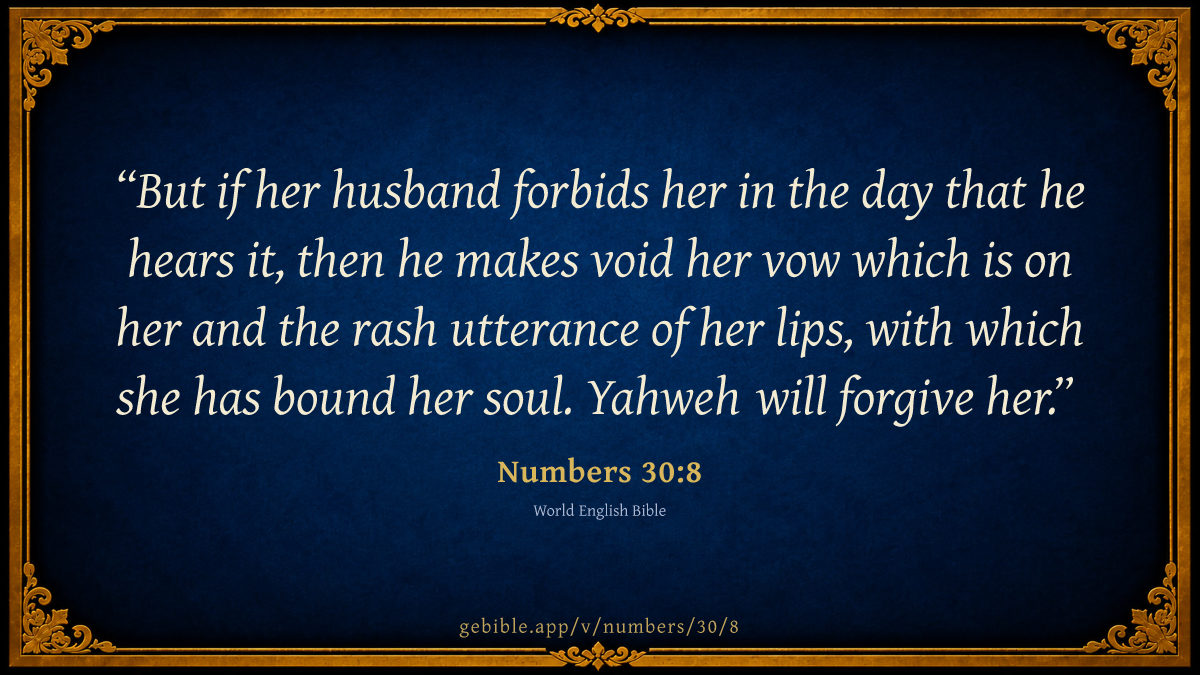
But if her husband forbids her in the day that he hears it, then he makes void her vow which is on her and the rash utterance of her lips, with which she has bound her soul. Yahweh will forgive her.
Parallel Translations
-
But if her husband forbids her in the day that he hears it, then he makes void her vow which is on her and the rash utterance of her lips, with which she has bound her soul. Yahweh will forgive her.
-
But if her husband disallowed her on the day that he heard it; then he shall make her vow which she vowed, and that which she uttered with her lips, wherewith she bound her soul, of none effect: and the LORD shall forgive her.
-
(30-9) But if her husband disallow her in the day that he heareth it, then he shall make void her vow which is upon her, and the clear utterance of her lips, wherewith she hath bound her soul; and the LORD will forgive her.
Cross-references (4)
Passages linked to Numbers 30:8 in the Treasury of Scripture Knowledge, ordered by reader-vote popularity; verse text shown in World English Bible.
- Genesis 3:16 To the woman he said, “I will greatly multiply your pain in childbirth. You will bear children in pain. Your desire will be for your husband, and he will rule over you.”
- 1 Corinthians 14:34 Let the wives be quiet in the assemblies, for it has not been permitted for them to be talking except in submission, as the law also says,
- Ephesians 5:22-24 Wives, be subject to your own husbands, as to the Lord. For the husband is the head of the wife, as Christ also is the head of the assembly, being himself the savior of the body. But as the assembly is subject to Christ, so let the wives also be to their own husbands in everything.
- 1 Corinthians 7:4 The wife doesn’t have authority over her own body, but the husband. Likewise also the husband doesn’t have authority over his own body, but the wife.
Cross-references from openbible.info (CC BY 4.0)
Explain this verse (2 sources)
Historical commentary, presented as a primary source — not an endorsement.
Private notes
Saved on this device only — never synced or sent anywhere.
John Gill 1763 · Public Domain But if her husband disallow her on the day…
But if her husband disallow her on the day that he heard it,.... Expresses his dislike of it; and this he does as soon as he hears it, at least that same day; according to the Jews (x), within the space of twenty four hours:
then he shall make her vow which she vowed, and that which she uttered with her lips, wherewith she bound her soul, of none effect; by contradicting it, and forbidding the performance of it; or however by declaring to her, or to others, that it is not agreeable to his mind and will that it should be fulfilled:
Read full note →
and the Lord shall forgive her; excuse her performance of the vow, and not impute sin to her on that account, nor punish for the breach of it, she being under the cover of her husband, and obliged to submit to his will. According to Jarchi, the Scripture speaks of a woman that vows to be a Nazarite; her husband hears and makes it void; but she does not know it, and transgresses her vow, and drinks wine, and is defiled with the dead, so that she has need of forgiveness, though it is made void; and if vows made void, he adds, have need of pardon, much more those that are not.
(x) Leo Modena's History of Rites, &c. par. 2. c. 4.
John Gill's Exposition of the Whole Bible (1746–1763) — public domain (CC PDM 1.0). Text via the HelloAO Bible API.
unfoldingWord translationNotes 2017 · CC BY-SA 4.0 the vow that she has made ... the rash…
the vow that she has made ... the rash talk of her lips
"the vow that she has made ... that is, the rash talk of her lips." These two phrases refer to the same thing. The second phrase describes the vow that the woman made. (See: Parallelism)
Read full note →
the rash talk of her lips
The phrase "the rash talk" refers to the rash promise that she made. Here "her lips" means the woman herself. She is referred to as "her lips" because lips are related to what she says. AT: "the rash things she has said" or "her rash promise" (See: Synecdoche)
with which she has bound herself
Here Moses speaks of how a woman has committed herself to fulfilling a promise as if her promise were a physical object that she had bound to her body. AT: "which she has committed herself to fulfill" (See: Metaphor)
Yahweh will release her
Here Moses speaks about Yahweh forgiving the woman for not fulfilling her vow as if he were releasing her from something that bound her. The full meaning of this statement can be made clear. AT: "Yahweh will forgive her" or "Yahweh will forgive her for not fulfilling her vow" (See: Metaphor and Assumed Knowledge and Implicit Information)
translationWords
Yahweh
unfoldingWord translationNotes — © Distant Shores Media and the Door43 World Missions Community, licensed CC BY-SA 4.0. Source: git.door43.org/Door43/en_tn.