
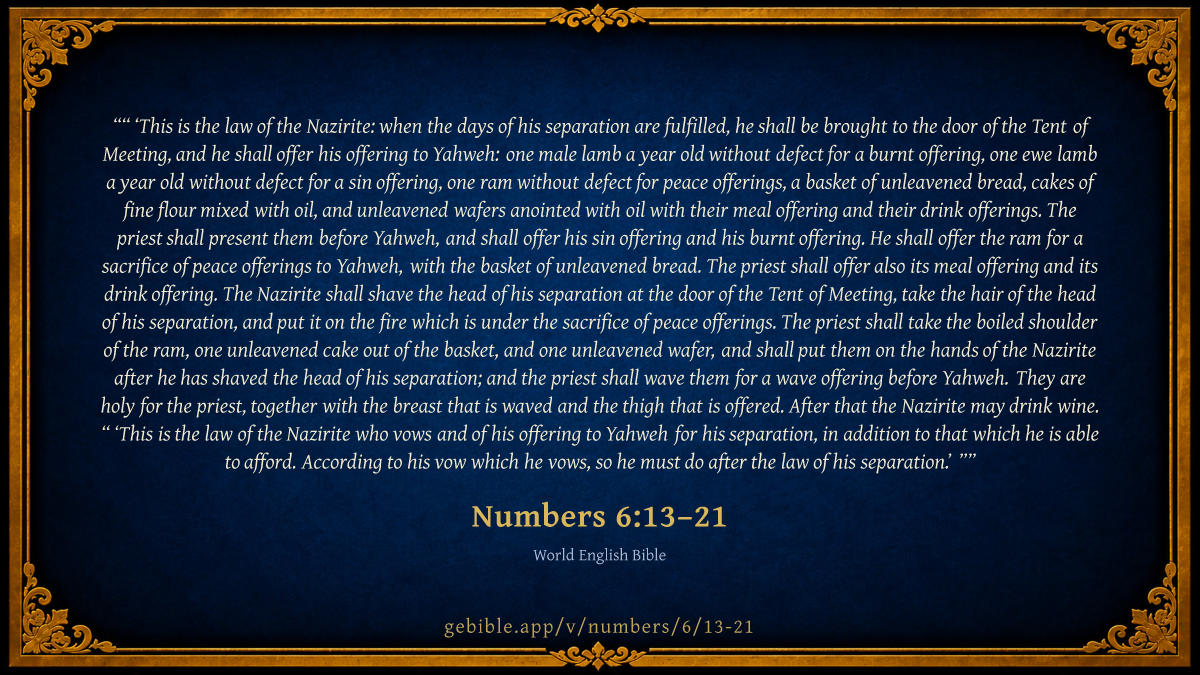
“ ‘This is the law of the Nazirite: when the days of his separation are fulfilled, he shall be brought to the door of the Tent of Meeting, and he shall offer his offering to Yahweh: one male lamb a year old without defect for a burnt offering, one ewe lamb a year old without defect for a sin offering, one ram without defect for peace offerings, a basket of unleavened bread, cakes of fine flour mixed with oil, and unleavened wafers anointed with oil with their meal offering and their drink offerings. The priest shall present them before Yahweh, and shall offer his sin offering and his burnt offering. He shall offer the ram for a sacrifice of peace offerings to Yahweh, with the basket of unleavened bread. The priest shall offer also its meal offering and its drink offering. The Nazirite shall shave the head of his separation at the door of the Tent of Meeting, take the hair of the head of his separation, and put it on the fire which is under the sacrifice of peace offerings. The priest shall take the boiled shoulder of the ram, one unleavened cake out of the basket, and one unleavened wafer, and shall put them on the hands of the Nazirite after he has shaved the head of his separation; and the priest shall wave them for a wave offering before Yahweh. They are holy for the priest, together with the breast that is waved and the thigh that is offered. After that the Nazirite may drink wine.
“ ‘This is the law of the Nazirite who vows and of his offering to Yahweh for his separation, in addition to that which he is able to afford. According to his vow which he vows, so he must do after the law of his separation.’ ”
Geneva Bible translators 1599 · Public Domain On vv18, 20, 21 In token that his vow is ended.
In token that his vow is ended.
For the hair which was consecrated to the Lord, might not be cast into any profane place.
Geneva Bible (1599) marginal notes — public domain.
John Trapp 1656 · Public Domain On vv13, 14, 16, 18, 19, 20, 21 Num 6:13 And this [is] the law of the…
Num 6:13 And this [is] the law of the Nazarite, when the days of his separation are fulfilled: he shall be brought unto the door of the tabernacle of the congregation:
Ver. 13. And this is the law of the Nazarite.] The third part of it, to teach him thankfulness, that most needful, but much neglected duty.
John Trapp, A Commentary or Exposition upon All the Books of the Old and New Testament (1647–1656) — public domain. Text from a community e-Sword module.
Matthew Poole 1685 · Public Domain On vv13, 14, 15, 18, 19, 20, 21 By the priest’s appointment and direction.
By the priest’s appointment and direction.
Matthew Poole's English Annotations on the Holy Bible (1683–1685) — public domain. Text from a community e-Sword/MySword module.
John Gill 1763 · Public Domain On vv13–21 And he shall offer his offering unto the Lord,....…
And he shall offer his offering unto the Lord,.... The Nazarite was to present his offering at the door of the tabernacle, to the priest, in order to be offered for him to the Lord:
one he lamb of the first year without blemish for a burnt offering; according to the law, manner, and custom of a burnt offering, as Aben Ezra observes, which, whether of the herd or of the flock, was to be a male and unblemished, and not more than a year old, Lev 1:3,
Read full note →
and one ewe lamb of the first year without blemish for a sin offering; as was the manner and custom of a sin offering, to be a female, as is remarked by the same writer, see Lev 4:32,
and one ram without blemish for peace offerings; all sorts of offerings were offered on this occasion; a "sin offering", though the vow was performed, and not any mistake made, or anything omitted that was known; yet, lest there should be any secret and unknown breach of the law of Nazariteship committed, a sin offering was required: this teaches us that there may be secret and unknown sins committed by the best of men, in their most sacred and solemn services; and that there is no justification before God by the best works of men, find that the purest and most perfect stand in need of the atoning sacrifice of Christ: a "burnt offering" was to be offered, which usually followed the sin offering, as it did here, though mentioned first, see Num 6:16; and which was done by way of thanksgiving to God for his acceptance of the sin offering: and "peace offerings" were, as Aben Ezra observes, for joy that he had performed his vow: the burnt offering was wholly the Lord's, the sin offering the priest had his part of, and the peace offerings the Nazarite and his friends ate of, and so everyone had their share in these oblations.
John Gill's Exposition of the Whole Bible (1746–1763) — public domain (CC PDM 1.0). Text via the HelloAO Bible API.
John Wesley 1765 · Public Domain On vv14, 15, 18, 19, 20, 21 A sin-offering - Whereby he confessed his miscarriages, notwithstanding…
A sin-offering - Whereby he confessed his miscarriages, notwithstanding the strictness of his vow and all the diligence which he could use, and consequently acknowledged his need of the grace of God in Christ Jesus the true Nazarite. For peace- offerings - For thankfulness to God, who had given him grace to make and in some measure to keep such a vow. So he offered all the three sorts of offerings, that he might so far fulfil all righteousness and profess his obligation to observe the will of God in all things.
John Wesley, Explanatory Notes Upon the Whole Bible (1754–1765) — public domain. Text via the GEBible commentary corpus.
Adam Clarke 1810 · Public Domain On vv18, 21 Verse 18. Shall take the hair - and put…
Verse 18. Shall take the hair - and put it in the fire] The hair was permitted to grow for this purpose; and as the Nazarite was a kind of sacrifice, offered to God through the whole term of his nazarate or separation, and no human flesh or blood could be offered on the altar of the Lord, he offered his hair at the conclusion of his separation, as a sacrifice - that hair which was the token of his complete subjection to the Lord, and which was now considered as the Lord's property.
The Hindoos, after a vow, do not cut their hair during the term of their vow; but at the expiration of it they shave it off at the place where the vow was made.
Read full note →
That the hair of the head was superstitiously used among different nations, we have already had occasion to remark; (See Clarke on Le 19:27;) and that the Gentiles might have learned this from the Jews is possible, though some learned men think that this consecration of the hair to a deity was in use among the heathens before the time of Moses, and in nations who had no intercourse or connection with the Jews.
Adam Clarke's Commentary on the Bible (1810–1826) — public domain. Text from a community e-Sword/MySword module.
Joseph Benson 1811 · Public Domain On vv14, 18, 19, 20 Num 6:14. A sin-offering — Whereby he confessed his…
Num 6:14. A sin-offering — Whereby he confessed his miscarriages, notwithstanding the strictness of his vow, and all the diligence which he could use, and consequently acknowledged his need of the grace of God in Christ Jesus, the true Nazarite. For peace-offerings — For thankfulness to God, who had given him grace to make, and, in some measure, to keep such a vow. So he offered all the three sorts of offerings, that he might so far fulfil all righteousness, and profess his obligation to observe the will of God in all things.
Joseph Benson's Commentary on the Old and New Testaments (1811–1818) — public domain. Text from a community e-Sword module.
Haydock's Catholic Bible Commentary 1859 · Public Domain On vv13, 18, 20, 21 He. The priest.
He. The priest.
George Leo Haydock (1774–1849), Haydock's Catholic Family Bible and Commentary, 1859 edition — public domain. Excludes Psalms (Douay-Rheims chapter numbering differs from Protestant) and Deuterocanonical books (Catholic canon only).
Robert Jamieson, A. R. Fausset & David Brown 1871 · Public Domain On v13 when the days of his separation are fulfilled, &c.--On…
when the days of his separation are fulfilled, &c.--On the accomplishment of a limited vow of Nazaritism, Nazarites might cut their hair wherever they happened to be (Act 18:18); but the hair was to be carefully kept and brought to the door of the sanctuary. Then after the presentation of sin offerings and burnt offerings, it was put under the vessel in which the peace offerings were boiled; and the priest, taking the shoulder (Lev 7:32), when boiled, and a cake and wafer of the meat offering, put them on the hands of the Nazarites to wave before the Lord, as a token of thanksgiving, and thus released them from their vow.
Jamieson, Fausset & Brown — Commentary Critical and Explanatory on the Whole Bible (1871) — public domain (CC PDM 1.0). Text via the HelloAO Bible API.
Daniel D. Whedon 1874 · Public Domain On vv13, 14, 15, 16, 18, 19, 20, 21 13. This is the law of the Nazarite —…
13. This is the law of the Nazarite — The following verses (13-21) contain the rites required for the discharge of a Nazarite of days, prescribing the mode of expressing his gratitude for the attainment of the object of his vow and for its successful termination. The whole list of sacrifices described in Leviticus i-vii is exhausted, with the exception of the trespass offering, which is appropriated to a broken vow.
He shall be brought — Literally, he shall bring him, or it — that is, the offering. We are left in doubt whether the priest brings the Nazarite, or he brings himself or his sacrifice, or some unknown person presents him. The English happily expresses the ambiguity.
Daniel D. Whedon (gen. ed.), Commentary on the Old and New Testaments (1874–1909) — public domain. Text from a community e-Sword module.
The Cambridge Bible for Schools and Colleges 1878 · Public Domain On vv13, 14, 18, 19, 20, 21 13–21. The ceremony at the completion of the vow.…
13–21. The ceremony at the completion of the vow. This consisted of three parts: (a) The Nazirite brought a burnt-offering, sin-offering, and peace-offering, with the usual meal-offering and libations attached to the burnt-offering and the sin-offering (see Num_15:4-6), and the priest offered them (Num_6:13-17). (b) He shaved his head, standing near the door of the Tent by the altar in the court, and threw the hair into the fire on the altar that was consuming the fat of the peace-offering (Num_6:18). (c) After the fat was burnt, the priest waved the shoulder of the peace-offering and part of the meal-offering, and took them as his own perquisite, together with the breast and the ‘thigh of contribution’ which usually fell to him. A sacrificial feast, not here mentioned, must have followed, at which the meat was eaten, and perhaps the Nazirite joined in it, for the worshipper in all other cases had a share in the peace-offering (see art. ‘Sacrifice’ in Hastings’ DB. iv. 338).
The Cambridge Bible for Schools and Colleges (gen. ed. J. J. S. Perowne; Cambridge University Press, 1878–1918) — public domain. Text from a community e-Sword module.
Ellicott's Commentary for English Readers 1878 · Public Domain On vv14, 15, 18, 21 (14) And he shall offer.—The word which is here…
(14) And he shall offer.—The word which is here rendered offer is different from that which is used in Num_6:11, and means literally to bring near. The cognate noun is Corban—a word which St. Mark translates into Greek dovon, and which means a gift offered to God. (Comp. St. Mat_15:5-6; St. Mar_7:11). The sin-offering was an offering of atonement for sins committed during the period of the consecration of the Nazirite, and the burnt-offering typified the entire consecration of the body, soul, and spirit of the offerer to the Lord.
A Bible Commentary for English Readers, edited by Charles John Ellicott (1878–1897) — public domain. Text from a community e-Sword module.
The Pulpit Commentary 1880 · Public Domain On vv13, 14, 15, 18, 19, 20, 21 When the days of his separation are fulfilled. The…
When the days of his separation are fulfilled. The original law contemplated only a vow for a certain period, longer or shorter. All the Nazirites, however, of whom we read in Scripture were lifelong Nazirites: Samson, (Jud_1:13:5) Samuel, (1Sa_1:11) John the Baptist. (Luk_1:15) In all these cases, however, the vow was made for them before their birth. Hegesippus (in Euseb. 2:23) tells us that James, the Lord"s brother, was a Nazirite: "He did not drink wine nor strong drink, and no razor came on his head."
The Pulpit Commentary (1880–1919), ed. H.D.M. Spence-Jones & Joseph S. Exell — public domain. Text from a community e-Sword module.
Paul E. Kretzmann 1924 · Public Domain On v13 The Nazarite Sacrifices
The Nazarite Sacrifices
v. 13. And this is the law of the Nazarite, when the days of his separation are fulfilled, when he has completed the period for which his vow was in force: He shall be brought unto the door of the Tabernacle of the Congregation,
Read full note →
v. 14. and he shall offer his offering unto the Lord, one he-lamb of the first year without blemish for a burnt offering, and one ewe-lamb of the first year without blemish for a sin-offering, the former to establish complete fellowship between Jehovah and the worshiper, the latter to atone for any sins of weakness that may have happened during the period of separation, and one ram without blemish for peace-offerings,
v. 15. and a basket of unleavened bread, cakes of fine flour mingled with oil, and wafers of unleavened bread anointed with oil, as they were prescribed for every peace-offering, Lev 7:12, and their meat-offering, and their drink-offerings, as they pertained to the burnt offerings and to the peace-offerings, in the form of flour, oil, and wine, Num 15:3-15.
v. 16. And the priest shall bring them before the Lord, and shall offer his sin-offering and his burnt offering;
v. 17. and he shall offer the ram for a sacrifice of peace-offerings unto the Lord, with the basket of unleavened bread; the priest shall offer also his meat-offering and his drink-offering.
v. 18. And the Nazarite shall shave the head of his separation, the head of hair which had so long remained unshorn as a token of his devotion to Jehovah, at the door of the Tabernacle of the Congregation, and shall take the hair of the head of his separation, and put it in the fire which is under the sacrifice of the peace-offerings, thus dedicating the ornamental covering of his head entirely to Jehovah.
v. 19. And the priest shall take the sodden shoulder, the upper part of the fore quarter, of the ram, and one unleavened cake out of the basket, and one unleavened wafer, and shall put them upon the hands of the Nazarite, after the hair of his separation is shaven;
v. 20. and the priest shall wave them for a wave-offering before the Lord. This is holy for the priest, with the wave-breast and heave-shoulder, Exo 29:27-28. And after that the Nazarite may drink wine, he is absolved from the external obligations attending his vow.
v. 21. This is the law of the Nazarite "who hath vowed, and of his offering unto the Lord for his separation, beside that that his hand shall get, whatever else he may afford in the line of gifts to Jehovah; according to the vow which he vowed, so he must do after the law of his separation. Nazarite vows are not enjoined in the New Testament, but it may often serve for a Christian’s self-discipline if he practices some form of self-denial, especially if there are many people in need of assistance.
Paul E. Kretzmann, Popular Commentary of the Bible (1921–1924) — public domain. Text from a community e-Sword module.
unfoldingWord translationNotes 2017 · CC BY-SA 4.0 On vv13, 16, 18, 19, 21 of his separation
of his separation
Here "separation" means "dedication." Also, this abstract noun can be expressed as a verb. AT: "of his dedication" or "that he has dedicated himself" (See: Idiom or Abstract Nouns)
Read full note →
He must be brought
This can be stated in active form. AT: "Someone must bring him" or "He must go" (See: Active or Passive)
He must present his offering to Yahweh
He must bring his offering to the priest to be sacrificed to Yahweh. The full meaning of this statement can be made clear. AT: "He must present his offering to Yahweh by bringing it to the priest to be sacrificed" or "He must present his offering to Yahweh by bringing it to the priest who will sacrifice it" (See: Assumed Knowledge and Implicit Information)
bread made without yeast
This can be stated in active form. AT: "bread he made without yeast" (See: Active or Passive)
fine flour mixed with oil
This can be stated in active form. AT: "fine flour that he mixed with oil" (See: Active or Passive)
wafers without yeast rubbed with oil
This can be stated in active form. AT: "wafers without yeast which he rubbed with oil" (See: Active or Passive)
wafers without yeast
small pieces of flat bread
together with their grain offering and drink offerings
The word "their" refers to the other offerings that the Nazirite man was told to bring. Often grain offerings and drink offerings were required to accompany other types of sacrifices. The full meaning of this statement can be made clear. AT: "together with the grain offering and drink offering that Yahweh required to accompany the other offerings" (See: Assumed Knowledge and Implicit Information)
translationWords
law, laws
Nazirite
blemish
ewe
fellowship offering
bread
yeast
oil
grain offering
drink offering
unfoldingWord translationNotes — © Distant Shores Media and the Door43 World Missions Community, licensed CC BY-SA 4.0. Source: git.door43.org/Door43/en_tn.