Proverbs 10:1(v1)The proverbs of Solomon. A wise son makes a glad father; but a foolish son brings grief to his mother.
Proverbs 2:1-9(v3)My son, if you will receive my words, and store up my commandments within you, so as to turn your ear to wisdom, and apply your heart to…
Job 22:22(v3)Please receive instruction from his mouth, and lay up his words in your heart.
Proverbs 8:5(vv2, 4)You simple, understand prudence! You fools, be of an understanding heart!
Proverbs 7:4(v2)Tell wisdom, “You are my sister.” Call understanding your relative,
Show all 38 cross-references
1 Kings 3:28(v3)All Israel heard of the judgment which the king had judged; and they feared the king; for they saw that the wisdom of God was in him, to do…
1 Chronicles 22:9(v1)Behold, a son shall be born to you, who shall be a man of peace. I will give him rest from all his enemies all around; for his name shall…
1 Chronicles 28:5(v1)Of all my sons (for Yahweh has given me many sons), he has chosen Solomon my son to sit on the throne of Yahweh’s kingdom over Israel.
Proverbs 8:10-11(v3)Receive my instruction rather than silver, knowledge rather than choice gold. For wisdom is better than rubies. All the things that may be…
Proverbs 8:17(v4)I love those who love me. Those who seek me diligently will find me.
Deuteronomy 4:5-6(v2)Behold, I have taught you statutes and ordinances, even as Yahweh my God commanded me, that you should do so in the middle of the land…
Psalms 119:9(v4)How can a young man keep his way pure? By living according to your word.
Ecclesiastes 1:1(v1)The words of the Preacher, the son of David, king in Jerusalem:
1 Kings 2:12(v1)Solomon sat on David his father’s throne; and his kingdom was firmly established.
1 Kings 3:9-12(v2)Give your servant therefore an understanding heart to judge your people, that I may discern between good and evil; for who is able to judge…
1 Kings 4:31-32(v1)For he was wiser than all men; than Ethan the Ezrahite, Heman, Calcol, and Darda, the sons of Mahol: and his fame was in all the nations…
Psalms 119:130(v4)The entrance of your words gives light. It gives understanding to the simple.
Proverbs 8:12(v4)“I, wisdom, have made prudence my dwelling. Find out knowledge and discretion.
Proverbs 8:32(v4)“Now therefore, my sons, listen to me, for blessed are those who keep my ways.
Proverbs 9:4-6(v4)“Whoever is simple, let him turn in here!” As for him who is void of understanding, she says to him, “Come, eat some of my bread, Drink…
Proverbs 17:16(v2)Why is there money in the hand of a fool to buy wisdom, since he has no understanding?
Proverbs 25:1(v1)These also are proverbs of Solomon, which the men of Hezekiah king of Judah copied out.
2 Timothy 3:15-17(v2)From infancy, you have known the holy Scriptures which are able to make you wise for salvation through faith, which is in Christ Jesus.…
2 Samuel 12:24-25(v1)David comforted Bathsheba his wife, and went in to her, and lay with her. She bore a son, and he called his name Solomon. Yahweh loved him;…
Psalms 19:7(v4)Yahweh’s law is perfect, restoring the soul. Yahweh’s covenant is sure, making wise the simple.
Psalms 34:11(v4)Come, you children, listen to me. I will teach you the fear of Yahweh.
Proverbs 1:22-23(v4)“How long, you simple ones, will you love simplicity? How long will mockers delight themselves in mockery, and fools hate knowledge? Turn…
Proverbs 2:10-11(v4)For wisdom will enter into your heart. Knowledge will be pleasant to your soul. Discretion will watch over you. Understanding will keep you,
Proverbs 3:21(v4)My son, let them not depart from your eyes. Keep sound wisdom and discretion:
Proverbs 4:5-7(v2)Get wisdom. Get understanding. Don’t forget, and don’t deviate from the words of my mouth. Don’t forsake her, and she will preserve you.…
Proverbs 7:7-24(v4)I saw among the simple ones. I discerned among the youths a young man void of understanding, passing through the street near her corner, he…
Proverbs 16:16(v2)How much better it is to get wisdom than gold! Yes, to get understanding is to be chosen rather than silver.
Ecclesiastes 12:9(v1)Further, because the Preacher was wise, he still taught the people knowledge. Yes, he pondered, sought out, and set in order many proverbs.
Isaiah 35:8(v4)A highway will be there, a road, and it will be called “The Holy Way”. The unclean shall not pass over it, but it will be for those who…
2 Timothy 2:22(v4)Flee from youthful lusts; but pursue righteousness, faith, love, and peace with those who call on the Lord out of a pure heart.
Titus 2:6(v4)Likewise, exhort the younger men to be sober minded.
1 Chronicles 29:28(v1)He died at a good old age, full of days, riches, and honor; and Solomon his son reigned in his place.
Ecclesiastes 11:9–12:1(v4)Rejoice, young man, in your youth, and let your heart cheer you in the days of your youth, and walk in the ways of your heart, and in the…
38 distinct cross-references across this passage (39 total citations).
Cross-references from openbible.info (CC BY 4.0)
Explain this passage (26 sources)
Historical commentary, presented as a primary source — not an endorsement.
Geneva Bible translators1599 · Public DomainOn vv1–4This word Proverb, or Parable, signifieth a grave and…
This word Proverb, or Parable, signifieth a grave and notable sentence, worthy to be kept in memory: and is sometimes taken in the evil part for a mock or scoff.
Geneva Bible (1599) marginal notes — public domain.
John Trapp1656 · Public DomainOn vv1–4Pro 1:1 The proverbs of Solomon the son of…
Pro 1:1 The proverbs of Solomon the son of David, king of Israel;
Ver. 1. The Proverbs.] Or, Master sentences; maxims, axioms, speeches of special precellence and predominance; received rules {a} that must overrule matters, and mightily prevail in the minds of men. The principal, no doubt, they are of those three thousand mentioned in 1Ki 4:32, and far beyond those golden sayings {b} of Phocylides (profanely preferred before those holy parables by that apostate Julian, ausu nefario), as having in them more sentences than words, {c} and being so far above all human praise for weight and worth, that, as Salust writes of Carthage, I had better speak nothing of them than too little, since too much is too little.
Read full note →
Of Solomon.] Who better, a deal, deserves to be styled "Master of the sentences" than Peter Lombard; and to be esteemed πανσοφος και παντα ανθρωπεια επισταμενος, as one {d} saith of Homer; or as another saith of Jerome, that he was a man, quem nullum scibile latuit, that knew all that was knowable by a man.
King of Israel.] King in Jerusalem, {Ecc 1:1} which was now the Israel of Israel, as Athens was, in its flourish, said to be the Greece of Greece; {e} yea, the soul, and sun, and eye of Greece; {f} yea, the common school of all mankind. {g} For King Solomon exceeded all the kings of the earth both in riches and in wisdom. "And all the world sought to Solomon, to hear his wisdom, which God had put into his heart." {1Ki 10:24} For "the more wise the preacher was, the more he taught the people knowledge, and caused them to hear, and searched forth many parables"; {Ecc 12:9, marg.} even "words of delight." {Pro 1:10, marg.} {See Trapp in "Pro 1:10"}
{a} משׁל ξשׁμι, Dominari, quae vitae dominae et moderatrices esse debent.
{b} Eπη χρυσεα.
{c} De Euripide Cicero pronunciavit plures esse in eo sententias quam verba.
{d} Xenophon.
{e} Eλλας ελλαδος. - Euripid.
{f} φυχη και ηλιος, και οφθαλμος Eλλαδος. - Demost.
{g} Kοινον παιδευτηριον παντων ανθρωπων. - Thucyd. and Diodor.
John Trapp, A Commentary or Exposition upon All the Books of the Old and New Testament (1647–1656) — public domain. Text from a community e-Sword module.
Matthew Poole1685 · Public DomainOn vv1–4Of Solomon; proceeding from Solomon, and most of them…
Of Solomon; proceeding from Solomon, and most of them digested by him into this book. See the preface.
Matthew Poole's English Annotations on the Holy Bible (1683–1685) — public domain. Text from a community e-Sword/MySword module.
Matthew Henry1710 · Public DomainOn v1We have here an introduction to this book, which…
We have here an introduction to this book, which some think was prefixed by the collector and publisher, as Ezra; but it is rather supposed to have been penned by Solomon himself, who, in the beginning of his book, proposes his end in writing it, that he might keep to his business, and closely pursue that end. We are here told,
I. Who wrote these wise sayings, Pro 1:1. They are the proverbs of Solomon. 1. His name signifies peaceable, and the character both of his spirit and of his reign answered to it; both were peaceable. David, whose life was full of troubles, wrote a book of devotion; for is any afflicted? let him pray. Solomon, who lived quietly, wrote a book of instruction; for when the churches had rest they were edified. In times of peace we should learn ourselves, and teach others, that which in troublous times both they and we must practise. 2. He was the son of David; it was his honour to stand related to that good man, and he reckoned it so with good reason, for he fared the better for it, Kg1 11:12. He had been blessed with a good education, and many a good prayer had been put up for him (Psa 72:1), the effect of both which appeared in his wisdom and usefulness. The generation of the upright are sometimes thus blessed, that they are made blessings, eminent blessings, in their day. Christ is often called the Son of David, and Solomon was a type of him in this, as in other things, that he opened his mouth in parables or proverbs. 3. He was king of Israel - a king, and yet it was no disparagement to him to be an instructor of the ignorant, and a teacher of babes - king of Israel, that people among whom God was known and his name was great; among them he learned wisdom, and to them he communicated it. All the earth sought to Solomon to hear his wisdom, which excelled all men's (Kg1 4:30; Kg1 10:24); it was an honour to Israel that their king was such a dictator, such an oracle. Solomon was famous for apophthegms; every word he said had weight in it, and something that was surprising and edifying. His servants who attended him, and heard his wisdom, had, among them, collected 3000 proverbs of his which they wrote in their day-books; but these were of his own writing, and do not amount to nearly a thousand. In these he was divinely inspired. Some think that out of those other proverbs of his, which were not so inspired, the apocryphal books of Ecclesiasticus and the Wisdom of Solomon were compiled, in which are many excellent sayings, and of great use; but, take altogether, they are far short of this book. The Roman emperors had each of them his symbol or motto, as many now have with their coat of arms. But Solomon had many weighty sayings, not as theirs, borrowed from others, but all the product of that extraordinary wisdom which God had endued him with.
Read full note →
II. For what end they were written (Pro 1:2-4), not to gain a reputation to the author, or strengthen his interest among his subjects, but for the use and benefit of all that in every age and place will govern themselves by these dictates and study them closely. This book will help us, 1. To form right notions of things, and to possess our minds with clear and distinct ideas of them, that we may know wisdom and instruction, that wisdom which is got by instruction, by divine revelation, may know both how to speak and act wisely ourselves and to give instruction to others. 2. To distinguish between truth and falsehood, good and evil - to perceive the words of understanding, to apprehend them, to judge of them, to guard against mistakes, and to accommodate what we are taught to ourselves and our own use, that we may discern things that differ and not be imposed upon, and may approve things that are excellent and not lose the benefit of them, as the apostle prays, Phi 1:10. 3. To order our conversation aright in every things, Pro 1:3. This book will give, that we may receive, the instruction of wisdom, that knowledge which will guide our practice in justice, judgment, and equity (Pro 1:3), which will dispose us to render to all their due, to God the things that are God's, in all the exercises of religion, and to all men what is due to them, according to the obligations which by relation, office, contract, or upon any other account, we lie under to them. Note, Those are truly wise, and none but those, who are universally conscientious; and the design of the scripture is to teach us that wisdom, justice in the duties of the first table, judgment in those of the second table, and equity (that is sincerity) in both; so some distinguish them.
III. For whose use they were written, Pro 1:4. They are of use to all, but are designed especially, 1. For the simple, to give subtlety to them. The instructions here given are plain and easy, and level to the meanest capacity, the wayfaring men, though fools, shall not err therein; and those are likely to receive benefit by them who are sensible of their own ignorance and their need to be taught, and are therefore desirous to receive instruction; and those who receive these instructions in their light and power, though they be simple, will hereby be made subtle, graciously crafty to know the sin they should avoid and the duty they should do, and to escape the tempter's wiles. He that is harmless as the dove by observing Solomon's rules may become wise as the serpent; and he that has been sinfully foolish when he begins to govern himself by the word of God becomes graciously wise. 2. For young people, to give them knowledge and discretion. Youth is the learning age, catches at instructions, receives impressions, and retains what is then received; it is therefore of great consequence that the mind be then seasoned well, nor can it receive a better tincture than from Solomon's proverbs. Youth is rash, and heady, and inconsiderate; man is born like the wild ass's colt, and therefore needs to be broken by the restraints and managed by the rules we find here. And, if young people will but take heed to their ways according to Solomon's proverbs, they will soon gain the knowledge and discretion of the ancients. Solomon had an eye to posterity in writing this book, hoping by it to season the minds of the rising generation with the generous principles of wisdom and virtue.
IV. What good use may be made of them, Pro 1:5, Pro 1:6. Those who are young and simple may by them be made wise, and are not excluded from Solomon's school, as they were from Plato's. But is it only for such? No; here is not only milk for babes, but strong meat for strong men. This book will not only make the foolish and bad wise and good, but the wise and good wiser and better; and though the simple and the young man may perhaps slight those instructions, and not be the better for them, yet the wise man will hear. Wisdom will be justified by her own children, though not by the children sitting in the market-place. Note, Even wise men must hear, and not think themselves too wise to learn. A wise man is sensible of his own defects (Plurima ignoro, sed ignorantiam meam non ignoro - I am ignorant of many things, but not of my own ignorance), and therefore is still pressing forward, that he may increase in learning, may know more and know it better, more clearly and distinctly, and may know better how to make use of it. As long as we live we should strive to increase in all useful learning. It was a saying of one of the greatest of the rabbim, Qui non auget scientiam, amittit de ea - If our stock of knowledge by not increasing, it is wasting; and those that would increase in learning must study the scriptures; these perfect the man of God. A wise man, by increasing in learning, is not only profitable to himself, but to others also, 1. As a counsellor. A man of understanding in these precepts of wisdom, by comparing them with one another and with his own observations, shall by degrees attain unto wise counsels; he stands fair for preferment, and will be consulted as an oracle, and entrusted with the management of public affairs; he shall come to sit at the helm, so the word signifies. Note, Industry is the way to honour; and those whom God has blessed with wisdom must study to do good with it, according as their sphere is. It is more dignity indeed to be counsellor to the prince, but it is more charity to be counsellor to the poor, as Job was with his wisdom. Job 29:15, I was eyes to the blind. 2. As an interpreter (Pro 1:6) - to understand a proverb. Solomon was himself famous for expounding riddles and resolving hard questions, which was of old the celebrated entertainment of the eastern princes, witness the solutions he gave to the enquiries with which the queen of Sheba thought to puzzle him. Now here he undertakes to furnish his readers with that talent, as far as would be serviceable to the best purposes. "They shall understand a proverb, even the interpretation, without which the proverb is a nut uncracked; when they hear a wise saying, though it be figurative, they shall take the sense of it, and know how to make use of it." The words of the wise are sometimes dark sayings. In St. Paul's epistles there is that which is hard to be understood; but to those who, being well-versed in the scriptures, know how to compare spiritual things with spiritual, they will be easy and safe; so that, if you ask them, Have you understood all these things? they may answer, Yea, Lord. Note, It is a credit to religion when men of honesty are men of sense; all good people therefore should aim to be intelligent, and run to and fro, take pains in the use of means, that their knowledge may be increased.
Matthew Henry's Commentary on the Whole Bible (1708–1710) — public domain (CC PDM 1.0). Text via the HelloAO Bible API.
John Gill1763 · Public DomainOn vv1–4The proverbs of Solomon,.... Who is said to make…
The proverbs of Solomon,.... Who is said to make three thousand proverbs, Kg1 4:32; but whether any of them are contained in this book cannot be said: however, it is certain that they are not all in it, since, if you except the first "nine" chapters, which are the introduction to the Proverbs, there are but six hundred and fifty-nine verses in it; and if they are taken in, they make but nine hundred and fifteen, which are not a third part of the proverbs said to be made by him: however, here are as many and such as God thought fit should be preserved for instruction in all future ages. It was usual with the ancients in all countries, when any truth was found, and established by experience, to wrap it up in a few apt words, with or without a figure; that it might be the better understood and more easily retained, and which were always venerable and greatly attended to: and of this kind are these proverbs; only with this difference, that these are of divine inspiration, and the others not. The word used for them comes from one which signifies "similitude" and "dominion" (g); because many of them are similes or comparisons, and are delivered out in figurative expressions, in metaphors and allegories, and the like; and have all of them a commanding power, authority, and influence upon the mind, obliging to an attention to them. The name of Solomon is put to them, the more to recommend them; who had a wise and understanding heart, as large as the sand of the sea, and was wiser than all men, Kg1 4:29; and was an eminent type of Christ, who spake in proverbs also, Joh 16:25. He is further described by his pedigree and office,
the son of David, king of Israel; a wise son of a wise father, and king over a wise and understanding people. These titles are added for the further commendation of the book; and it may be observed that they are such as belong to the Messiah, Solomon's antitype, one that is greater than he, Mat 1:1.
Read full note →
(g) A rad. "dominatus est----lvmn comparatus, similis, consimilis factus est", Buxtorf. "Mirum est quod radix significans antoritatem cum imperio, significat etiam parabolas vel sermones figuratos----verba quae vocantur, habent autoritatem, nobis ideam immittunt, dicentis ut nos supereminentis, saltem sapientia, ingenio, doctrina; nos persuadent et pondere suo, quasi imperio noe ducunt". Gusset. Ebr. Comment. p. 845.
John Gill's Exposition of the Whole Bible (1746–1763) — public domain (CC PDM 1.0). Text via the HelloAO Bible API.
John Wesley1765 · Public DomainOn vv1–4The title of the book, shewing the general design…
The title of the book, shewing the general design of it, ver. 1-6. The first principle of it recommended, ver. 7-9. A caution against bad company, ver. 10-19. Wisdom's reasonings with the sons of men, and the certain ruin of those who will not hearken unto them, ver. 20-33.
John Wesley, Explanatory Notes Upon the Whole Bible (1754–1765) — public domain. Text via the GEBible commentary corpus.
Adam Clarke1810 · Public DomainOn vv1–4-Year from the Creation, 3004. -Year before the birth…
THE PROVERBS
-Year from the Creation, 3004. -Year before the birth of Christ, 996.
Read full note →
-Year before the vulgar era of Christ's nativity, 1000.
-Year since the Deluge, according to Archbishop Usher and the English Bible, 1348.
-Year from the destruction of Troy, 185.
-Year before the first Olympiad, 224. -Year before the building of Rome, 247.
CHAPTER I
The design of the proverbs, 1-6.
An exhortation to fear God, and believe his word, because of
the benefit to be derived from it, 7-9;
to avoid the company of wicked men, who involve themselves in
wretchedness and ruin, 10-19.
Wisdom, personified, cries in the streets, and complains of the
contempt with which she is treated, 20-23.
The dreadful punishment that awaits all those who refuse her
counsels, 24-33.
NOTES ON CHAP. I
Verse 1. The proverbs of Solomon] For the meaning of the word proverb, see the introduction; and the dissertation upon parabolical writing at the end of the notes on Mt 13:58. Solomon is the first of the sacred writers whose name stands at the head of his works.
Adam Clarke's Commentary on the Bible (1810–1826) — public domain. Text from a community e-Sword/MySword module.
Joseph Benson1811 · Public DomainOn vv1–2Pro 1:1. The proverbs of Solomon — “Solomon is…
Pro 1:1. The proverbs of Solomon — “Solomon is the first of the sacred writers whose name appears at the head of his works. The name alone of so wise and so great a prince is a sufficient recommendation to engage men to hear and to read. For we naturally love to see and to listen to persons of illustrious name and extraordinary capacity, particularly when those qualities are joined with sovereign power. The style of this work, the brevity of his sentences, and the parabolical turn, close, short, sententious, are also reasons for studying it: long discourses fatigue; all men have not leisure to attend to, or penetration to comprehend them. But precepts delivered in parables are always pleasing to hear.” See Calmet and Dodd. The reader will observe proverbs are ancient, wise, and short sayings, in common use, whereof some are plain and easy, others intricate and obscure. This way of treating serious subjects was very common and familiar with the Jews. Jesus Christ delivered most of his instructions to the people in a way somewhat similar to this, namely, in parables. This method of instruction serves well to teach wisdom, truth, and justice, and to caution men against error, vice, and dissipation.
Joseph Benson's Commentary on the Old and New Testaments (1811–1818) — public domain. Text from a community e-Sword module.
Albert Barnes1834 · Public DomainOn vv1–4The long exhortation Proverbs 1–9, characterized by the frequent…
The long exhortation Proverbs 1–9, characterized by the frequent recurrence of the words “my son,” is of the nature of a preface to the collection of the “Proverbs of Solomon” Pro 10:1. On Pro 1:1-7, see the introduction to Proverbs.
Albert Barnes' Notes on the Bible (1834–1885) — public domain. Text from a community e-Sword/MySword module.
Charles Bridges1846 · Public DomainOn v1THE Book naturally opens with a short account of…
THE Book naturally opens with a short account of its author. Solomon is recorded as the wisest of men; a man of wisdom, because a man of prayer. (1Ki 3:12 . Compare Pro 2:1-9 .) His extraordinary wisdom was the admiration of the world. (1Ki 3:28 ; 1Ki 4:34 .) Had he been the son of Jeroboam, he would have commanded respect; much more as the son of David, formed by his godly prayers (Psa 72:1 ) and counsels. (Pro 4:1-4 . 1Ki 2:1-4 . 1Ch 28:9 .) And if a King’s sayings even though without intrinsic merit, are preserved, the wise teaching of this King of Israel (Ecc 1:1 ; Ecc 12:9-10 ) may well demand our especial interest.
Valuable, however, as were Solomon’s maxims for their own wisdom (exceeding the sages of his own or any other time) (1Ki 4:29-31 ); they claim our reverence upon infinitely higher ground. "Behold! A greater than Solomon is here." (Mat 12:42 ). Often does he speak in the person (Pro 1:20; Pro 8:1-36 . Pro 9:1-18 . Pro 23:26 ) always under the inspiration (2Ti 3:16 ) of "the wisdom of God;" so that his sayings are truly "Divine sentences in the lips of the King." (Pro 16:10 .)
Read full note →
The great end of this inestimable book is to teach, not secular or political wisdom (though many excellent rules of each are interspersed) (Pro 6:1-11 ; Pro 27:23-27 ; with Pro 11:14 ; Pro 14:28, Pro 14:34 ; Pro 20:18 ); but that knowledge of God (Pro 1:7 ), which, while it "maketh wise unto salvation, perfects and furnishes the man of God unto all good works." (2Ti 3:15-17 . Tit 2:11-12 .) Its glowing privileges are set forth (Pro 3:13-18 .) It is pressed upon us with intense earnestness, as "the principal thing," our very "life." (Pro 4:5-9, Pro 4:13 .) Instruction is the means of gaining it. We are directed to perceive the words of understanding; to receive the instruction as a complete rule of wisdom, justice, judgment, and equity (Compare Pro 2:9 ); sound principles, and their practical application. Here also the simple, so readily deluded (Pro 14:15 ; Pro 21:11 . Eze 45:20 ), learn that subtlety, so needful to discriminate between truth and error (Php 1:10 . 1Th 5:21 ); to guard them from false teachers (Psa 17:4 . 1Jn 4:1 . Compare Act 17:11 ); and to "convince gainsayers." (Tit 1:9 ; Tit 2:8 Compare Mat 22:15-46 .) Specially is the young man directed to this book.†1 His undisciplined ardor runs to waste. His mind fluctuates at the mercy of the winds of opinion in the world around him; and greatly does he need some settled master-principles to fix his purpose, choice, and conduct. Here then he finds knowledge and discretion; a religion, not of imagination, impulse, or sentiment; but the sound practical energy of Scriptural truth.
Footnotes
†1 Psa 119:9. Over the gates of Plato’s school, it was written: MhdeiV agewmetrhtoV eisitw. (). (Literally — Let no one who is not a geometrician enter.) But very different is the inscription over these doors of Solomon — Let the ignorant, simple, foolish, young enter. Cartwright in loc. — Lavater in c. iv. 4:20-22.
Charles Bridges, An Exposition of the Book of Proverbs (1846) — public domain. Text from a community e-Sword module.
Haydock's Catholic Bible Commentary1859 · Public DomainOn vv1, 2, 4Israel. The dignity of the author, and the importance…
Israel. The dignity of the author, and the importance of the subject, invite us to read. (St. Basil) --- Solomon is the first whose name is placed at the head of any work in Scripture. (Calmet)
George Leo Haydock (1774–1849), Haydock's Catholic Family Bible and Commentary, 1859 edition — public domain. Excludes Psalms (Douay-Rheims chapter numbering differs from Protestant) and Deuterocanonical books (Catholic canon only).
Lange's Commentary on the Holy Scriptures1864 · Public DomainOn v1General Superscription to the Collection
General Superscription to the Collection
Announcement of the Author of the Collection, of its Object, and of its great value
Read full note →
Pro_1:1-6
1 Proverbs of Solomon, the son of David,
the King of Israel:
2 to become acquainted with wisdom and knowledge,
to comprehend intelligent discourse,
3 to attain discipline of understanding,
righteousness, justice and integrity,
4 to impart to the simple prudence,
to the young man knowledge and discretion;—
5 let the wise man hear and add to his learning,
and the man of understanding gain in control,
6 that he may understand proverb and enigma,
words of wise men and their dark sayings.
Introductory Section
True wisdom as the basis and end of all moral effort, impressed by admonition and commendation upon the hearts of youth
Pro_1:7 to Pro_9:18
7 The fear of Jehovah is the beginning of knowledge;
wisdom and discipline fools despise.
First group of Admonitory or Gnomic Discourses
Pro_1:8 to Pro_3:35
1. The teacher of wisdom admonishes his son to avoid the way of vice
Pro_1:8-19
8 Hearken, my son, to thy father’s instruction,
and refuse not the teaching of thy mother;
9 for they are a graceful crown to thy head,
and jewels about thy neck.—
10 My son, if sinners entice thee,
consent thou not!
11 If they say, “Come with us, and we will lie in wait for blood,
will plot against the innocent without cause;
12 we will swallow them, like the pit, living,
and the upright, like those that descend into the grave;
13 we will find all precious treasure,
will fill our houses with spoil!
14 Thou shalt cast in thy lot among us;
one purse will we all have!”
15 My son! go not in the way with them,
keep back thy foot from their path!
16 For their feet run to evil,
and haste to shed blood;
17 for in vain is the net spread
before the eyes of all (kinds of) birds:
18 and these watch for their own blood,
they lie in wait for their own lives.
19 Such are the paths of every one that grasps after unjust gain;
from its own master it taketh the life.
Pro_1:20-33
2. Warning delineation of the perverse and ruinous conduct of the fool, put into the mouth of wisdom (personified).
20 Wisdom crieth aloud in the streets,
on the highways she maketh her voice heard:
21 in the places of greatest tumult she calleth,
at the entrances to the gates of the city she giveth forth her words:
22 “How long, ye simple, will ye love simplicity,
and scorners delight in scorning,
and fools hate knowledge!
23 Turn ye at my reproof!
Behold I will pour out upon you my spirit,
my words will I make known to you!
24 Because I have called and ye refused,
I stretched out my hand, and no man regarded it,
25 and ye have rejected all my counsel,
and to my reproof ye have not yielded;
26 therefore will I also laugh at your calamity,
will mock when your terror cometh;
27 when like a storm your terror cometh,
and your destruction sweepeth on like a whirlwind,
when distress and anguish cometh upon you.
28 Then will they call upon me, and I not answer,
they will seek me diligently and not find me.
29 Because they have hated sound wisdom
and have not desired the fear of Jehovah,
30 have not yielded to my counsel
and have despised all my reproof,
31 therefore shall they eat of the fruit of their way
and be surfeited with their own counsels.
32 For the perverseness of the simple shall slay them,
and the security of fools destroy them:
33 he, however, who hearkeneth to me shall dwell secure,
and have rest without dread of evil!”
GRAMMATICAL AND CRITICAL
Pro_1:2. [We have in Pro_1:2-4; Pro_1:6 final clauses, introduced by לְ, and indicating the object with which these wise sayings are recorded. That purpose is disciplinary, first with reference to “the young man,” and then to him who is already “wise.” This discipline is contemplated not from the point of view of him who imparts, but that of those who receive it. These considerations determine our choice of words in translating several of the terms employed. Thus in Pro_1:2 we render לָדַעַת not “to know,” as this suggests the finished result rather than the process, which is “to become acquainted with, to acquire;” so Zöckler, zu erkennen; De Wette, kennen zu lernen; Noyes, “from which men may learn;” a little less definitely, E. V., “to know;” incorrectly Holden, “respecting the knowledge.” These wise sayings are to guide to and result in knowledge; but the verbs, except in Pro_1:4, represent not the teaching, imparting, communicating, but the discerning and seizing. In respect to the two shades of meaning to be given to מוּסָר see the exeg. notes. Gesen. and Fuerst agree in the etymology (יסר); Fuerst, however, carries back the radical meaning one step farther; G., “to chastise, correct, instruct;” F., “to bind or restrain, chastise,” etc. It should, therefore, be borne in mind that more than the imparting of information is intended by the word, it is discipline, sometimes merely intellectual but more frequently moral.—אִמְרֵי בִינָה, lit., “words of discernment,” “words of understanding” (so E. V., Noyes, Muenscher); Stuart, “words of the intelligent;” De Wette like Zöckler, “verständige Reden;” Van Ess and Allioli, with whom Holden seems to agree, “die Worte (Regeln) der Klugheit” “the words (rules) of prudence.”—A.].
Pro_1:3. [מוּסַר הַשְׂכֵּל,—our author’s conception (see exeg. notes) corresponds with that of Fuerst also, who makes the genitive not merely objective, as De Wette, etc., seem to do (“discipline of understanding,” “die Zucht der vernunft”), but makes it final, contemplating the end: Fuerst, “Z. zur Besonnenheit,” Zöckler, “einsichtsvolle Zucht,” discipline full of discernment, insight, understanding, i.e., in its results. The rendering of most of our English expositors is ambiguous or suggests other ideas: E. V. and Muenscher, “instruction of wisdom;” Holden, “instruction in wisdom;” Noyes, “the instruction of prudence;” Stuart, “of discreetness.”—מֵשָׁרִים, plural of that which is “ideally extended” and pleasurable; Böttcher, Ausf. Lehrb., §699.—A.].
Pro_1:5. [E. V., followed by Holden and Muenscher, “a wise man will hear;” Noyes, “may hear;” Stuart, more forcibly, “let the wise man listen,” like our author, “es höre” and Böttcher § 950, d., “Fiens debitum”) “es soll hören”. De Wette makes this a final clause, like those of the three preceding verses, “dass der Weise höre;” but see exeg. notes. וְיוֹסֶף is given by Böttcher (§ 964, 2) as an illustration of the “consultive” use of the Jussive; Stuart makes it an ordinary Imperf., and renders “and he will add;” but his explanations are not pertinent; the וְ need not be “conversive,” it is simply copulative, and יוֹסֵף which he assumes as the normal Imperf., is already a Jussive.—A.]. לֶקַח, properly that which is “taken, received, transmitted” (comp. the verb לקח “to attain,” above in Pro_1:3) is like the Aram. קַבַּלָה (from קִבְּל, to take), and like the Latin traditio [in its passive sense]. The parallel term תַּחְבֻּלוֹת (from חָבַל, to lead, according to the analogy of the Arabic, and cognate with חֶבֶל, cable, and חֹבֵל, steersman) is by the LXX correctly rendered by κυβέρνησις.
Pro_1:6. Luther’s translation of the 1st clause, “that he may understand proverbs and their interpretation,” cannot possibly be right; for מְלִיצָה, if it was designed to convey any other idea than one parallel to מָשָׁל could not on any principle dispense with the suffix of the 3d person ־ָתוֹ), its, comp. Vulgate: “animadvertat parabolam et interpretationem.” [This is also the rendering of the E. V., which is followed by Holden, while Noyes, Stuart, Muenscher and Wordsworth, De Wette and Van Ess agree with the view taken by our author.—A.].
Pro_1:7. אֱוִילִים derived from אָוַל crassus fuit; to be gross or dull of understanding;—Gesen., however, derives it from the radical idea “to be perverse, turned away,” and Fuerst “to be slack, weak, lax or lazy.” [Wordsworth adopts the latter explanation—A.].
Pro_1:8. [The different renderings given to the verb of the 2d clause while agreeing in their substantial import, “forsake,” “neglect,” “reject,” do not reproduce with equal clearness the radical idea, which is that of “spreading,” then of “scattering.”—A ].
Pro_1:10. תּבֵא, scriptio defectiva, for תֹּאבֵא, as some 50 MSS. cited by Kennicott and De Rossi in fact read, while some others prefer a different pointing אַל־תָּבֹא [thou shalt not go], which is however an unwarranted emendation. The LXX had the correct conception: μὴ βουληθῇς, and the Vulgate: ne acquiescas.—[Comp. Green’s Heb. Gram., § 111, 2, b, and § 177, 3. Böttcher discusses the form several times in different connections, §§ 325, d, and n. 2,—429, B, and 1164, 2, b,—and after enumerating the six forms which the MSS. supply,תֹּבֶה ,תֹּאבֵא ,תֹּאבֶה ,תָּבֹא ,תָּבוֹא, and תּוֹבֵא decides that the original form, whose obscurity suggested all these modifications, was תּאֹב = תֹּבְא. In signification he classes it with the “dehortative” Jussives.—A.].
Pro_1:11. [E. V., Noyes, Wordsworth, Luther, Van Ess agree with one another in connecting the adverb with the verb, while De Wette, Holden, Stuart, Muenscher regard it as modifying the adjective, “him whose innocence is of no avail to protect him.”—A.].
Pro_1:12. [E. V., Stuart and Muenscher, like our author connect חַיִּים with the object of the main verb; Umbreit and Hitzig (see exeg. notes) are followed by De Wette, Holden, Noyes in connecting it with the comparative clause.—יוֹרְדֵי בוֹר, for construction see e.g., Green, §§ 271, 2 and 254, 9, b.—A.].
Pro_1:16. [יָרוּצוּ, masc. verb with feminine subject; Bött., § 936, II., C. a; Green, § 275,1. c—A.].
Pro_1:20. The Wisdom who is here speaking is in this verse called חָכְמוֹת which is not a plural but “a new abstract derivative from חָכְמָה, formed with the ending וֹת” (Ewald, § 165, c) a form which is also found e.g. in תְּחֹמוֹת, Psa_78:15. The name recurs in the same form in Pro_9:1; Pro_24:7. [Böttcher, however, regards this as an example of the pluralis extens., to denote emphatically “true wisdom.” See § 679, d, 689, C., b, 700, c and n. 4. There is no difficulty in connecting a verb fem. sing, with a subject which, although plural in form is singular in idea.—A.].—תָּרֹנָּה, crieth aloud, from רָנַן, comp. Lam_2:19; Lamentations 3 d sing. fem. as also in Pro_8:3 (Ewald, 191, c). [Comp. Green, § 97,1, a, and Bött., § 929, d, who with his usual minuteness endeavors to trace the development of this idiom.—A.].
Pro_1:21. Zöckler, an den larmvollsten Orten; De Wette, an der Ecke lärmender Strassen; Fuerst, der bewegten Strassen; Holden, like the Eng. Ver., in the chief place of concourse.
Pro_1:22. [For the vocalization of תְּאֵהֲבוּ see Green, §§ 60, 3, c, 111, 2, e. For the use of the perfect חָמְדוּ sea Bött., § 948, 2. He illustrates by such classical perfects as ἔγνωκα, οἷδα, μέμαα,memini, novi, and renders this form by concupiverint.—A.].
Pro_1:23. [אַבִּיעָה, an instance of the intentional Imperf., in what Böttcher calls its “voluntative” signification,—§ 965, 1.—A.].
Pro_1:27. [כְּשַׁאֲוָה, K’ri כְּשׁוֹאָה, the former derived from שׁאו or שׁאה, the latter from שׁוא, of which verbs the latter is obsolete except in derivatives, while the former occurs in one passage in Is. in the Niphal. The signification seems to be one, and the forms variations growing out of the weakness of the 2d and 3d radicals. Comp. Bött., §§ 474, a, and 811, 2.—A.].
Instead of the Infin. בְּבוֹא, we have in the 2d member, since בְּ is not repeated, the Imperf. יֶאֱתֶה (Ewald, 337, b) [Stuart, § 129, 3, n. 2].—A.
Pro_1:28. [יִמְצָאֻנְנִי ,יְשַׁחֲרֻנְנִי ,יִקְרָאֻנְנִי. These are among the few instances in which the full plural ending וּן is found before suffixes. Green, § 105, a, Bött., § 1047, f.—A.].
Pro_1:29. For the use of תַּחַת כִּי, “therefore because,” compare Deu_34:7, and also the equivalent combination תַּחַת אֲשֶׁר in 2Ki_22:7; 2Ch_21:12.
EXEGETICAL
1. Pro_1:1-6. The superscription to the collection, which is quite long, as is common with the titles of Oriental books, is not designed to be a “table of contents” (Umbreit), nor to give merely the aim of the book (so most commentators, especially Ewald, Bertheau, Elster, etc.). But beside the author of the book (Pro_1:1), it is intended to give first its design (Pro_1:2-3), and then, in addition, its worth and use (Pro_1:4-6), and so to commend the work in advance as salutary and excellent (Starke, Delitzsch). Accordingly it praises the book as a source of wholesome and instructive wisdom: 1) for the simple-minded and immature (Pro_1:4); 2) for those who are already wise and intelligent, but who are to gain still more insight and understanding from its maxims and enigmas (Pro_1:5-6).—Proverbs of Solomon, etc.—In regard to the primary meaning of מָשָׁל, and in regard to the special signification which prevails here in the superscription, “Proverbs of Solomon” (maxims, aphorisms, not proverbs [in the current and popular sense]), see Introd., § 11.—To become acquainted with wisdom and knowledge.—In respect to חָכְמָה and its synonyms (בִּינָה and דַּעַת) consult again the Introd., § 2, note 3. “מוּסָר properly “chastisement,” signifies education, moral training, good culture and habits, the practical side, as it were, of wisdom (LXX: παιδεία; Vulg.: disciplina). In Pro_1:2 the expression stands as synonymous with “wisdom” (חָכְמָה), as in Pro_4:13; Pro_23:23, and frequently elsewhere; in ver.3, on the contrary, it designates an element preparatory to true wisdom and insight,—one serving as their foundation, and a preliminary condition to them. For the “discipline of understanding” (מוַּסַר הַשְׂכֵּל, Pro_1:3) is not, as might be conceived, “discipline under which the understanding is placed,” but “discipline, training to reason, to a reasonable, intelligent condition” (as Hitzig rightly conceives it); compare the “discipline of wisdom” (מוּסַר חָכְמָח), Pro_15:33, and for “understanding” (הַשְׂכֵּל), insight, discernment, a rational condition, see particularly Pro_21:16. Umbreit and Ewald regard הַשְׂכֵּל as equivalent to thoughtfulness (“a discipline to thoughtfulness,” Zuchtigung zur Besonnenheit”); by this rendering, however, the full meaning of the conception is not exhausted.—Righteousness, justice and integrity. The three Hebrew terms מִשְׁפָּט ,עֶדֶק and מֵיּשָׁרִים are related to each other as “righteousness, justice, and integrity, or uprightness” (Gerechtigkeit, Recht und Geradheit). The first of the three expressions describes what is fitting according to the will and ordinance of God the supreme Judge (comp. Deu_33:19); the second, what is usage and custom among men (Isa_42:1; 1Sa_27:11): the third, what is right and reasonable, and in accordance with a walking in the way of truth, and so denotes a straight-forward, honorable and upright demeanor.
Pro_1:4. To impart to the simple prudence.—The telic infinitive (לָתֵת) is co-ordinate with the two that precede in Pro_1:2-3, and has the same subject. Therefore the same construction is to be employed here also (to become acquainted with—to attain—to impart); and we are not, by the introduction of a final clause, to make the contents of this 4th verse subordinate to the preceding, as the LXX do (ί̔να δῷ κ. τ. λ.), and likewise the Vulg. (ut detur, etc.), and Luther (“that the simple may become shrewd, and young men reasonable and considerate”). The “simple” (פְּתָאִים), properly, the “open,” those who are readily accessible to all external impressions, and therefore inexperienced and simple, νήπιοι, ἄκακοι (as the LXX appropriately render the word in this passage; comp. Rom_16:18). With respect to the relation of this idea to that of the “fool” (כְּסִיל ,נָבָל) compare what will be said below on Pro_1:32, and also Introd., § 3, note 2.—Prudence (עָרְמָה, derived from עָרַם) signifies properly nakedness, smoothness (comp. theadj. עָרִוּם [“subtle” E.V.], naked, i.e., slippery, crafty; used of the serpent, Gen_3:1); therefore metaphorically “the capacity for escaping from the wiles of others” (Umbreit), “the prudence which guards itself against injury” (Pro_22:3; 1Sa_23:22).—To the young man knowledge and discretion.—Discretion, thoughtfulness (מְזִמָּה, LXX, έ̓ννοια), denotes here in connection with “knowledge” (דַּעַת) the characteristic of thoughtful, well considered action, resting upon a thorough knowledge of things,—therefore, circumspection, caution.
Pro_1:5. Not the simple and immature only, but also the wise .and intelligent, are to derive instruction from Solomon’s proverbs. This idea is not, as might be supposed, thrust in the form of a parenthesis into the series of final clauses beginning with Pro_1:2, and reaching its conclusion in Pro_1:6, so that the verb (יִשְׁמַע) is to be conceived of as rendering the clause conditional, and is to be translated “if he hears” (Umbreit, Elster); it begins a new independent proposition, whose imperfect tenses are to be regarded as voluntative, and upon which the new infinitive clause with לְ in Pro_1:6 is dependent (Ewald. Bertheau, and commentators generally).—Let the wise man hearken and add to his learning.—As to the expression” add to his learning” (יוֹסֶף לֶקַח) comp. Pro_9:9; Pro_16:12. The peculiar term rendered “learning” (see critical notes above) is a designation of knowledge, doctrine, instructive teaching in general; comp. Pro_1:22; Pro_1:29. The word rendered “control,” or mastery, is an abstract derivative, strengthened by the ending וֹת (Ewald, Gramm., § 179 a., note 3), and expresses here in an appropriate and telling figure the idea of “skill and facility in the management of life.” Comp.Pro_11:14; Pro_12:5; Job_37:12, etc. Its relation to “learning” (לֶקַח) is quite like that of “discipline” to “wisdom” in Pro_1:2; it supplies the practical correlative to the other idea which is predominantly theoretical.
Pro_1:6. To understand proverb and enigma, etc.—[“The climax of the definition of wisdom”—Stanley]. The infinitive (לְהָבִין) supplies the announcement of the end required by Pro_1:5 : to this end is the wise man to gain in knowledge and self-command or Self-discipline, that he may understand the proverbs and profound sayings of the wise, i.e., may know how to deal appropriately with them. It is not the mere understanding of the wisdom of proverbs by itself that is here indicated as the end of the wise man’s “increase in knowledge and mastery,” but practice and expertness in using this wisdom; it is the callere sententias sapientum which imparts a competence to communicate further instruction to the youth who need discipline. If the telic infinitive (לְהָבִין) be taken in this frequent sense, for which may be compared among other passages Pro_8:9; Pro_17:10; Pro_17:24; Dan. 1:27, we do not need with Bertheau to give the expression a participial force (by virtue of the fact that he understands,—understanding proverbs, etc.),—nor to maintain with Hitzig and others that Pro_1:6 is not grammatically connected with Pro_1:5, on the ground that it is not conceivable that the “learning to understand the words of wise men” should be made an object of the endeavor of such as are wise already. It is an intensified acquaintance with wisdom that is here called for, a knowledge in the sense of the passage, “to him that hath shall be given, and he shall have abundance,” Mat_13:12; comp. Joh_1:16; Rom_1:17; 2Co_3:18. For the verbal explanation of “enigma” and “dark saying” (מְלִיצָה and חִידָה). see Introd., § 11, note 2. Certain as it is that both expressions here are only designed to embody in a concrete form the idea of obscure discourse that requires interpretation (the parallelism with “proverbs” and “words of wise men” (מָשָׁל and דִּבְרֵי חֲכָמִים) shows this beyond dispute), we have no warrant. for finding in this verse a special allusion to the obscure, enigmatical contents of chap. 30, and so for insisting upon its very late origin, as Hitzig does (see in reply Ewald). Nevertheless, it follows from the comprehensiveness of the plural expression “words of wise men” (comp. Pro_22:17 and Ecc_9:17; Ecc_12:11) that no one could have prefixed to his work an introduction like that before us, who was not conscious that he had collected with proverbs of Solomon many others that were not directly from him (comp. §12 of the Introd.).
2. Pro_1:7 is not to be regarded as a part of the superscription, as Ewald, Bertheau, Elster, Keil, etc., treat it, but is the general proposition introducing the series of didactic discourses that follows;—a motto, as it were, for the first or introductory main division of the book, as Umbreit happily expresses it; comp. Hitzig in loc. The proverb has also passed into the Arabic, and here also frequently stands at the commencement of collections of proverbs, whether because it is ascribed to Mohammed, as is sometimes done in such cases, or because it is cited as coming from Solomon. Compare Von Diez, Denkwürdigkeiten, II., 459; Meidani, ed. Freytag, III., 29, 610; Erpenius, Sent. quæd. Arab., p. 45. In the Old Testament [and Apocrypha], moreover, the same maxim occurs several times, especially in Pro_9:10; Ecclesiast. Pro_1:16; Pro_1:25; Psa_111:10. From the passage last cited the LXX repeat in our verse the words appended to the first clause:Ἀρχὴ σοφίας φόβος κυρίον, σύνεσις δὲ ἀγαθὴ̓ πᾶσιν τοῖς ποιοῦσιν αὑτήν [“and a good understanding have all they that do it”].—Beginning.—(רֵאשׁית is here equivalent to תְּחִלָּה found in the parallel passage, Pro_9:10; it is therefore correctly rendered in Ecclesiast, and the LXX by ἀρχὴ in the sense of “beginning”); compare Pro_4:7, “the beginning of wisdom;” not, as the words themselves would allow, “that which is highest in wisdom,” “the noblest or best wisdom.” [The latter is given as a marginal reading in the E. V, and is retained and defended by Holden; so also by Trapp and others.—A.].—Fools.—The word designates properly the hardened, the stupid,—those fools who know nothing of God (Jer_4:22), and therefore refuse and contemptuously repel His salutary discipline (comp. above, note to Pro_1:2).
3. Pro_1:8-19. These verses show in an example so shaped as to convey an earnest warning, how we are to guard ourselves against the opposite of the fear of God, against depravity, which is, at the same time, the extremest folly. They contain, therefore, a warning against, turning aside to the way of vice, given as the first illustration of the truth expressed in Pro_1:7.
Pro_1:8-9.—My son.—The salutation of the teacher of wisdom, who is here represented as “father” in order to illustrate to his pupil the inner reality and nature of their mutual relation (comp. 1Co_4:15; Phm_1:10). The “mother” who is mentioned in connection with this “father” is only a natural expansion of the idea of the figure, suggested by the law of poetic parallelism,—and not a designation of wisdom personified, who does not appear before Pro_1:20. [Wordsworth and many of the older English expositors regard this as a specific address by Solomon to Rehoboam; this interpretation, however, lacks the support of Oriental usage, and too much restricts the scope of the Book of Proverbs. The large majority, however, of English and American commentators (e.g., Trapp, Holden, Bridges, Wordsworth, Muenscher) find here a more specific commendation of filial docility and obedience. Stuart more nearly agrees with our author in making the “father” and “mother” figurative rather than literal terms—A.].—Law (תּוֹרָה), here doctrina, instructive precepts in general; as in several other instances in our book it is used of the instruction given by parents to their children, e.g., Pro_3:1; Pro_4:2; Pro_7:2; Pro_28:7; Pro_28:9.—For they are a graceful Grown to thy head.—“Wreath of grace” (לִוְיַת חֵן) graceful crown, as in Pro_4:9. The comparison of the teachings of wisdom with pearls which one hangs as a necklace about the neck, a figure which is a great favorite every where in the East, recurs again in Pro_3:3; Pro_6:21; Ecclesiast. Pro_6:30.
Pro_1:10. Transition to an intelligible admonitory example; hence the repetition of the familiar salutation “My son,” which occurs once more in Pro_1:15, at the beginning of the apodosis. Sinners (הַטָּאִים).—Sinners by profession, habitual sinners, as in Psa_1:1; here those in particular whose business is murder (comp. Gen_4:7-8), robbers who are murderers.-
Pro_1:11. We will lie in wait for blood, etc.—The two verbs (אָרַב and עָפַן) both signify to lie in wait for, to lay snares artfully (as the huntsman for the game, with noose and net). The adverb (הִנָּם) is probably more correctly construed with the verb (lie in wait without cause, i.e., without having any reason for revenge and enmity), than with the adjective,—although this latter combination is also grammatically admissible. But with the conception “him that is innocent in vain,” i.e., the man to whom his innocence shall be of no avail against us, the parallel passages (Psa_35:19; Psa_69:4; Lam_3:52) correspond less perfectly than with that to which we have given the preference; comp. Hitzig in loc.
Pro_1:12—Will swallow them, like the pit, living.—The “living” (חַיִּים) can refer only to the suffix pronoun (in נִבְלָעֵם). The connection with “like the pit” (כִּשְׁאוֹל), to which Umbreit and Hitzig give the preference, gives the peculiarly hard sense “as the pit (swallows) that which lives.” Comp. rather Psa_55:15 : “they must go down living into the pit;” and also Psa_124:3; Pro_30:16, and the account of the destruction of Koran’s company, Num_16:30; Num_16:33.—The upright (תְּמִימִים) is accusative, object of the verb (בָּלַע), and therefore stands evidently as synonymous with נְקִיִּים (innocent, comp. Psa_19:13); it is accordingly to be interpreted as referring to moral integrity or uprightness, and not of bodily soundness (as Ewald, Bertheau, and others claim).—Those that descend into the grave (יוֹרֵדֵי בוֹר)—that sink into the sepulchre, i.e., the dead; comp. Psa_28:1; Psa_88:4; Psa_143:7.
Pro_1:13-14. Reasons for the treacherous proposal of the murderers.—Thou shalt cast in thy lot among us—i.e., thou shalt, as one having equal right with us, cast lots for the spoil, comp. Psa_22:18; Neh_10:35.
Pro_1:15 sq. The warning,—given as an apodosis to the condition supposed in Pro_1:11. As to the figurative expressions in Pro_1:15, comp. Psa_1:1; Jer_14:10; Pro_4:26; for Pro_1:16 compare Isa_59:7, and the passage suggested by it, Rom_3:15. Without adequate grounds, Hitzig conjectures that Pro_1:16 is spurious, because, he says, it agrees almost literally with Isaiah (as cited), and, on the other hand, is wanting in the Cod. Vatic. of the LXX. Literal quotations from earlier Biblical writers are in Isaiah above all others nothing uncommon; and with quite as little reason will the omission of a verse from the greatly corrupted LXX text of our book furnish ground, without other evidence, for suspecting its genuineness (see Introd., § 13).
Pro_1:17. “The winged” (properly “lords of the wing;” בַּעַל כָּנָף, as in Ecc_10:20) is hardly a figurative designation of those plotted against by the robbers, and threatened by treacherous schemes, so that the meaning would be “in vain do they lie in wait for their victims; these become aware of their danger, and so their prize, escapes the assailants” (so Döderlein, Ziegler, Bertheau, Elster, etc.). For 1) the causal conj. “for” (כִּי) authorizes us to look for a direct reason for the warning contained in Pro_1:15; Proverbs 2) the allusion to the possible failure of the plans of the wicked men would not be a moral motive, but a mere prudential consideration, such as would harmonize very poorly with the general drift of the passage before us; and 3) the expression “before the eyes” (בְּעֵינֵי) stands evidently in significant contrast with “in vain” (חִנָּם); it is designed to set the fact that the net is clearly in sight over against the fact that the birds nevertheless fly into it,—and so to exhibit their course as wholly irrational.—Therefore we should interpret with Umbreit, Ewald, Hitzig, etc.; like thoughtless birds that with open eyes fly into the net, so sinners while plotting destruction for others plunge themselves in ruin. Only with this explanation, with which we may compare Job_18:8, will the import of Pro_1:18 agree: there “and these, these also” (וְהֵם) puts the sinners in an emphatic way side by side (not in contrast) with the birds, and the suffixes designate the own blood, the own souls of the sinners. Between the two verses there is therefore the relation of an imperfectly developed comparison suggested by the “also” (וְ) as in Pro_25:25; Pro_27:21; comp. Introd., § 14. [The view of English expositors is divided, like that of the German scholars cited by our author. Bishop Hall, Trapp, Henry and Noyes, e.g. agree with him in finding here a comparison, while D’Oyly and Mant, Holden, Bridges, Wordsworth, Stuart, Muenscher find a contrast. The argument based on the particles כִּי and וְ it must be admitted has very little force; for כִּי (see Ewald, § 321, b.) may be used positively or negatively in intense asseveration, “yea, surely,” or “nay;” while וְ, it is well known, has a very generous variety of uses, among which is the antithetic, in which case it may be rendered “but” or “and yet” (Ewald, § 330, a.).—A.].—They lie in wait for their own lives. The LXX, which at the end of this verse adds the peculiar but hardly genuine clause, ἡ δὲ καταστροφὴ ἀνδρῶν παρανόμων κακὴ (“and the destruction of transgressors is evil, or great”) seems, instead of “they lie in wait for their own lives” (יִצְפְּנוּ לְנַפְשׁוֹתָם) to have read “they heap up evil” (יִצְבְּרוּ רַע לְי); for it renders the second number by “θησαυρίζουσιν ἑαυτοῖς κακὰ” (they treasure up evils for themselves). Comp. Heidenheim in the article cited in the Introd., § 13, note 1.
Pro_1:19. Retrospect and conclusion; comp. Job_8:13; Job_18:21.—Spoil (בֶּצַע) gain unlawfully acquired, as in Pro_28:16. The combination בֹּצֵעַ בֶּצַע is found also in Pro_15:27. The subject of the verb “takes” (יִקַח) is בֶּצַע; “the life of its owner it, unjust gain, takes away.” Luther, following the LXX, Vulgate, and most of the ancient expositors, renders “that one (i.e., of the rapacious) takes life from another.” But the idea “ownership, owner” (בְּעָלִים) has no reference to the relation between partners in violence and those like themselves, but to that existing between an object possessed and its possessor.
4. Pro_1:20-33. After this warning against the desperate counsels of the wicked there follows in this second admonitory discourse a warning against the irrational and perverse conduct of fools. In the former case it was contempt of the fear of God, in the latter it is contempt of wisdom against which the warning is directed. Both passages, therefore, refer back distinctly to the motto that introduces them in Pro_1:7. The admonition against folly, which is now to be considered, is put appropriately into the mouth of wisdom personified,—as is also, later in the book, the discourse on the nature and the origin of wisdom (Pro_8:1 sq).—On the street and in public places wisdom makes herself heard; not In secret, for she need not be ashamed of her teaching, and because she is a true friend of the people seeking the welfare of all, and therefore follows the young and simple, the foolish and ungodly, everywhere where they resort; comp. Christ’s command to His disciples, Mat_10:27; Luk_14:21, As in these passages of the New Testament, so in that before us, human teachers (the wise men, or the prophets, according to Ecclesiast. Pro_24:33; Wis_7:27) are to be regarded as the intermediate instrumentality in the public preaching of wisdom.
Pro_1:21. In the places of greatest tumult she calleth, etc. “The tumultuous” (חֹמִיּוֹת), comp. Isa_22:2; 1Ki_1:41, can signify here nothing but the public streets full of tumult, the thoroughfares. The “beginning” (רֹאשׁ) of these highways or thoroughfares is, as if were, their corner; the whole expression points to boisterous public places. The LXX seem to have read חוֹמוֹת “walls,” since it translates ἐπ’ ά̓κρων τειχέων [on high walls]. Before the second clause the same version has the addition “ἐπὶ δὲ πύλαις δυναστῶν παρεδρεύει” [and at the gates of the mighty she sits], an expansion of the figure in which there is no special pertinence. In the city (בָּעִיר) is probably to be regarded as a closer limitation of “at the entrances of the gates” (בְּפִתְחֵי שְׁעָרִים), i.e., on the inner, the city side of the entrances at the gates: it is not then to be regarded as an antithesis, as Umbreit, Bertheau, Hitzig, etc., claim, [nor is it to be detached and connected with the next clause, as Stuart claims].
Pro_1:22. How long, ye simple, will ye love simplicity? The discourse of Wisdom begins in the same way as Psa_4:2. In regard to the distinction between “simple” (פְּתִי) and “scorner” (לֵץ), comp. Introd. § 3, note 2; and above, the remarks on Pro_1:4.—The perfect tense in the second clause (חָמְדוּ), which standing between the imperfects of the 1James , 3 d clauses is somewhat unusual, is to be conceived of as inchoative (like the verb “despise” בָּזוּ in Pro_1:7), and therefore properly signifies “become fond of,” and not “be fond of.” [See, however, the critical note on this verse].
Pro_1:23. Turn ye at my reproof,—i.e., from your evil and perverse way. I will pour out upon you my spirit. The spirit of wisdom is to flow forth copiously, like a never-failing spring; comp. Pro_18:4; and with reference to the verb “pour out” (חִבִּיעַ) which “unites in itself the figures of abundant fullness and refreshing invigoration” (Umbreit, Elster) comp. Pro_15:2; Psa_78:2; Psa_119:171.
Pro_1:24, in connection with 25, is an antecedent clause introduced by “because” (יַעַן), to which Pro_1:26-27 correspond as conclusion. The perfects and imperfects with ו consec. in the protasis describe a past only in relation to the verbs of the apodosis, and may therefore well be rendered by the present, as Luther has done: “Because I call and ye refuse,” etc. To stretch forth the hand, in order to beckon to one, is a sign of calling for attention,—as in Isa_65:2. The verb in Pro_1:25, f. c. (פָּרַע) is doubtless not “undervalue, despise” as Hitzig explains, following the analogy of the Arabic), but “cast off, reject,” as in Pro_4:15, (Umbreit, Ewald, Elster and commentators generally; comp. Luther’s “let go, fahren lassen”). [As between the two the English Version is equivocal, “set at naught”].
Pro_1:26. “Laugh” and “mock” (שַׂחַק and לָעַג) here as in Psa_2:4.
Pro_1:27 depicts the style and manner in which calamity comes upon fools, “and accumulates expression to work upon the fancy” (Hitzig). Instead of the K’thibh כשאוה according to the K’ri we should read כְּשׁוֹאָה, and this should be interpreted in the sense of “tempest” (comp. Pro_3:25; Zep_1:15). Thus most commentators correctly judge, while Hitzig defends for the expression the signification “cataract,” which however is appropriate in none of the passages adduced, and also fails in Job_30:14 (comp. Delitzsch on this passage).—In regard to the alliteration צָרָה וְצוּקָה distress and anguish, comp. Isa_30:6; Zep_1:15.
Pro_1:28. They shall seek me diligently שָׁחַר, a denominative verb from שַחַר, “the morning dawn,” signifies to seek something while it is yet early, in the obscurity of the morning twilight, and so illustrates eager, diligent seeking. [Of the recent commentators in English, Noyes only retains and emphasizes the rendering of the E. V., “they shall seek me early.” The rest do not find the idea of time in the verb, except by suggestion.—A.]. Comp., with respect to the general idea of the verse, Pro_8:17; Hos_5:15. [Observe also the force of the transition from the 2d person of the preceding verse, to the 3d person in this and the verses following.—A.].
Pro_1:29. The “because” (תַּחַת כִּי) is not dependent on Pro_1:28, but introduces the four-fold antecedent clause (Pro_1:29-30), which Pro_1:31 follows as its conclusion. With Pro_1:31 comp. Isa_3:10; Psa_88:3; Psa_123:4, where the figure of satiety with a thing expresses likewise the idea of experiencing the evil consequences of a mode of action. מוֹעֵצות, evil devices, as also Psa_5:10.
Pro_1:32-33. Confirmatory and concluding propositions, connected by “for” (כִּי).—מְשּׁוּבָה, turning away from wisdom and its salutary discipline, therefore resistance, rebelliousness. Comp. Jer_8:5, Hos_11:5, where it signifies turning away or departure from God. “Security” (שַׁלְוָה) idle, easy rest, the carnal security of the obdurate; comp. Jer_22:21. A beautiful contrast to this false ease is presented in the true peace of the wise and devout, as Pro_1:33 describes it.
DOCTRINAL AND ETHICAL
As long ago as the time of Melanchthon it was recognized as a significant fact, that wisdom claims as her hearers and pupils not only the simple, the young and the untaught, but those also who are already advanced in the knowledge of truth, the wise and experienced. He remarks on Pro_1:5 : “To his proposition he adds an admonition what the hearer ought to be. A wise hearer will profit, as saith the Lord: To him that hath shall be given. And again, He shall give the Holy Spirit to those that seek, not to those that despise, not to those that oppose with barbarous and savage fierceness. These despisers of God, the Epicureans and the like, he here says do not profit, but others, in whom are the beginnings of the fear of God, and who seek to be controlled by God, as it is said: Ask and ye shall receive.”3 Susceptibility therefore both must manifest,—those who are beginners under the instruction of wisdom, and those who are more advanced; otherwise there is no progress for them. It is indeed divine wisdom in regard to the acquisition of which these assertions are made; and in the possession of this wisdom, and in the communication of it as a teacher, no man here below ever attains perfection, so as to need no further teaching. It is precisely as it is within the department of the New Testament with the duty of faith, and of growth in believing knowledge, which duty in no stage of the Christian life in this world ever loses its validity and its binding power. Comp. Luk_17:5; Eph_4:15-16; Col_1:11; Col_2:19; 2Th_1:3; 2Pe_3:18.
2. The thoroughly religious character of wisdom as our book designs to inculcate it, appears not only in the jewel which sparkles foremost in its necklace of proverbs (Pro_1:7 : “The fear of Jehovah is the beginning of wisdom, etc.”), but also in the fact that in the introductory admonition, in Pro_1:10, it is Sinners (so designated without preamble or qualification), the חַטָּאִים (Luther, “the base knaves,” die bösen Buben), whose seductive conduct is put in contrast with the normal deportment of the disciple of wisdom. Observe further that in the very superscription, Pro_1:2-3, the ideas of discipline, righteousness, justice and uprightness are appended to that of wisdom as synonymous with it. The wise man is therefore eo ipso, also the just, the pious, the upright, the man who walks the way of truth. Inasmuch, however, as the ideas of righteousness, justice and uprightness (מֵישָׁרִים ,מִשְפָט ,צֶדֶק), here, as every where else in the Old Testament, express the idea of correspondence with the revealed moral law, the law, the law of Moses, therefore the wise man is the man who acts and walks in accordance with law, the true observer of the law, who “walks in all the commandments and ordinances of the Lord blameless” (Luk_1:6; comp. Deu_5:33; Deu_6:22; Psa_119:1). True wisdom, knowledge, and spiritual culture, are to be found within the sphere of Old Testament revelation only where the law of the Lord is truly observed. Mere morality in the sense of the modern humanitarian free-thinking and polite culture could not at all show itself there; moral rectitude must also always be at the same time legal rectitude. Nay it stands enacted also under the New Testament that “whosoever shall break one of these least commandments, and shall teach men so, shall be called the least in the kingdom of heaven” (Mat_5:19); that “the weightier matters of the law, judgment, mercy and faith,” together with its less significant demands, must be fulfilled (Mat_23:23); that he only can be called a possessor of “the wisdom that is from above,” and “a perfect man,” who “offends not in word” (Jam_3:2; Jam_3:17). The fear of the Lord, which according to Pro_1:7 is the beginning of wisdom, while again in Pro_1:29 it is presented as the synonyme of the same idea (comp. Pro_2:5; Pro_9:10, etc.) consists, once for all, in a complete devotion to God, an unconditional subjection of one’s own individuality to the beneficent will of God as revealed in the law (comp. Deu_6:2; Deu_6:13; Deu_10:20; Deu_13:4; Psa_119:63, etc.). How then can he be regarded as fearing God, who should keep only a part of the divine commands, or who should undertake to fulfil them only according to their moral principle, and did not seek also to make the embodying letter of their formal requirements the standard of his life—in the Old Testament with literal strictness, in the New Testament in spirit and in truth?
From these observations it will appear what right Bruch has to maintain (in the work before cited, p. 128), that in the collection of the Proverbs of Solomon, and in general in the gnomic writers of Israel, the idea of wisdom is substituted for that of righteousness which is common in other parts of the Old Testament. Righteousness and wisdom according to this view would be essentially exclusive the one of the other; since the former conception “had usually attached itself to a ceremonial righteousness through works,” and had appeared “to make too little reference to the theoretical conditions of all higher moral culture.” In the Introduction, (§ 15, note) we have already commented on the one-sidedness and the misconception involved in this view, according to which the doctrine of wisdom (the Hhokmah-system) was Antinomian and rationalistic in the sense of the purely neggative Protestantism of modern times. Further arguments in its refutation we shall have occasion to adduce in the exposition of the several passages there cited (see particularly Pro_14:9; Pro_28:4 sq.; Pro_29:18; Pro_29:24, etc.) See also the doctrinal observations on Pro_3:9.
3. That the reckless transgressor destroys himself by his ungodly course, that he runs with open eyes into the net of destruction spread out before him, and, as it were, lies in wait for his own life to strangle it,—this truth clearly presented in Pro_1:17-18 is a characteristic and favorite tenet in the teaching of wisdom in the Old Testament. Comp. particularly Pro_8:36, where wisdom exclaims “Whoso sinneth against me, wrongeth his own soul; all they that hate me love death.” So also Pro_15:32; Pro_26:27; Ecc_10:8; Psa_7:15; Sir_27:29 (the figure of the pit which the wicked digs, to fall into it at last himself). But in the Prophets also essentially the same thought recurs; thus when Jehovah (in Eze_18:31; Eze_33:11) exclaims “Why will ye die, ye of the house of Israel?” Of passages from the New Testament we may cite here Rom_2:5; 1Ti_6:9-10; Gal_6:8; Jam_5:3-5, etc. Both propositions are alike true, that true wisdom, being one with the fear of God and righteousness, is “a tree of life to all that lay hold upon her” (Pro_3:18; Pro_11:30; Pro_15:4; comp. Pro_4:13; Pro_4:22; Pro_19:23, etc.),—and that on the other hand a walking in folly and in forgetfulness of God is a slow self-murder, a destruction of one’s own life and happiness. See the two concluding propositions of our chapter (Pro_1:32-33) and the admirable poetic development of this contrast in the Psa_1:4. The explanation given above (on Pro_1:20) of the fact that wisdom is exhibited as preaching upon the streets, i.e., in reference to her benevolent and philanthropic character, which impels her to follow sinners, and to make the great masses of the needy among the people the object of her instructive and converting activity, seems to us to correspond better with the spirit of the doctrine of wisdom in the Old Testament, than either that of Umbreit, according to which “it is only in busy life that the rich stream of experience springs forth, from which wisdom is drawn,” or that of Ewald, which recognizes, in the free public appearance of wisdom an effective contrast to the light-shunning deeds, and the secret consultations of the sinners who have just been described, (which explanation, besides, would apply only to this passage, and not to its parallels in Pro_8:2-3, and Pro_9:3). The tendency of the Old Testament Hhokmah. was essentially popular, looking to the increased prosperity of the nation, to the promotion of philanthropic ends in the noblest sense of the word. Love, true philanthropy is everywhere the keynote to its doctrines and admonitions. “Forgiving, patient love (Pro_10:12), love that does good even to enemies (Pro_25:11 sq.), which does not rejoice over an enemy’s calamity (Pro_24:17 sq.), which does not recompense like with like (Pro_24:28 sq.), but commits all to God (Pro_20:22), love in its manifold varieties, as conjugal love, parental love, the love of a friend, is here recommended with the clearness of the New Testament and the most expressive cordiality.” (Delitzsch, as above cited, p. 716). Why then should not that yearning and saving love for sinners which ventures into the whirl and tumult of great crowds to bear testimony to divine truth, and to reclaim lost souls,—why should not this also constitute a chief characteristic in this spiritual state modelled so much like the standard of the New Testament? It appears—in how many passages!—as the type of, nay, as one with the spirit of Him who also “spake freely and openly before the world, in the synagogue and in the temple whither the Jews always resorted” (Joh_18:20); who, when He said something in secret to His disciples, did it only to the end that they should afterward “preach it upon the house-tops” (Mat_10:27); who allowed himself to be taunted as “a man gluttonous, and a wine-bibber, a friend of publicans and sinners,” because He had come to seek and to save the lost (Mat_11:19; Luk_19:10). It is at least significant that the Lord, just in that passage in which he is treating of the publicity of His working, and of the impression which His condescending intercourse with publicans, sinners and the mass of the people had made upon the Jews, designates Himself distinctly (together with His herald and forerunner, John the Baptist) as the personal Wisdom; Mat_11:19; Luk_7:35. It is as though He had by this expression intended to call up in fresh remembrance Solomon’s representation of wisdom preaching in the streets, and to refer to His own identity with the spirit of the Old Testament revelation that spoke through this wisdom (the “spirit of Christ,” 1Pe_1:11). Comp. Mart. Geier and Starke on this passage. These authors appropriately remind us of the universality of the New Testament’s proclamation of salvation, and its call penetrating everywhere (Rom_10:18; Col_1:6; Col_1:28); they are in error, however, in suspecting in the supposed plural הָכְמוֹת (Pro_1:18) an intimation of the numberless ways in which wisdom is proclaimed in the world. The true conception of this seeming plural may be found above in the Exegetical and Critical Notes on this passage.
HOMILETICAL AND PRACTICAL
Homily upon the entire first chapter. Solomon’s discourse upon wisdom as the highest good. 1) Its design, for young and old, learned and unlearned (Pro_1:1-6). 2) Its substance: commendation of the fear of God as the beginning and essence of all wisdom (Pro_1:7). 3) Its aim: a) warning against betrayal into profligacy as being the opposite of the fear of God (Pro_1:8-19); b) warning against the foolish conduct of the world as being the opposite of wisdom (Pro_1:20-33).—The wisdom of the Old Testament as a type of true Christian feeling and action: a) with respect to God as the supreme author and chief end of all moral effort (Pro_1:1-9); b) with respect to the world, as the seducing power, that draws away from communion with God (Pro_1:10-19); c) with respect to the way and manner in which Divine wisdom itself reveals itself as an earnest and yet loving preacher of righteousness (Pro_1:20-33).—Fear of God the one thing that is needful in all conditions of life: a) in youth as well as in age (Pro_1:4 sq.); b) in circumstances of temptation (Pro_1:10 sq.); c) in the tumult and unrest of public life (Pro_1:20 sq.); d) in prosperity and adversity (Pro_1:27 sq.).
Stöcker:—Threefold attributes of the lover of wisdom: 1) in relation to God: the fear of God (1–7); 2) in relation to one’s neighbors,—and specifically, a) to one’s parents; obedience (8, 9); b) to others: the avoidance of evil company (10–19); 3) in relation to one’s self; diligent use of the opportunity to become acquainted with wisdom.
Separate passages.
Pro_1:1-6. See above, Doctrinal and Ethical principles. 1.—
Starke:—The aim of the book, and that which should be learned from it, are pointed out in these verses in various almost equivalent words. The aim is, however, substantially twofold: 1) that the evil in man be put away; 2) that good be learned and practised.—Wohlfarth:—the necessity of the culture of our mind and heart. Not the cultivated, but the undisciplined, oppose the law ! God “will have all men come to the knowledge of the truth,” 1Ti_1:4.—[Pro_1:4. Cartwright (quoted by Bridges):—“Over the gates of Plato’s school it was written—Μηδείζ ἀγεωμέτρητοζ εἰσίτω—Let no one who is not a geometrician enter. But very different is the inscription over these doors of Solomon—Let the ignorant, simple, foolish, young, enter!”]
Pro_1:7-9. The blessedness of the fear of God, and the unblessed condition of forgetfulness of God,—illustrated in the relation 1) of children to their parents; 2) of subjects to authorities; 3) of Christians to Christ, the Lord of the Church.—The proposition “The fear of the Lord is the beginning of wisdom” must constitute the foundation of all the culture of the children of God, as the experience of the truth that “to love Christ is better than all knowledge” is to constitute its capstone and completion.
Pro_1:8-9, in general a peculiarly appropriate text for a sermon on education.—Luther (a marginal comment on Pro_1:7). “He who would truly learn must first be a man fearing God. He, however, who despises God asks for no wisdom, suffers no chastisement nor discipline.”—Melanchthon (on Pro_1:7):—The fear of God, which is one with true reverence for God, includes: 1) right knowledge of God; 2) a genuine standing in fear before God; 3) faith, or the believing consecration to God, which distinguishes this fear from all servile dread, and fleeing from God; 4) the worship of God which aids to a true reconciliation with Him, a well ordered and assured control of the whole life. Therefore the fear of God is not merely beginning—it is quite the sum of all wisdom, the right manager of all our counsels in prosperity and adversity.—Melanchthon (again) on Pro_1:8-9 :—He only reveals genuine fear of God who hearkens to the divinely instituted ministry (ministerium docendi) in the Church; and to this ministry parents also belong, so far forth as they are to “bring up their children in the nurture and admonition of the Lord,” Eph_6:4. “Forsake not the law of thy mother,” i.e., hearken always to the word of God as it has been communicated to the Church, and through the Church to all the children of God in the writings of the Prophets and Apostles. As a reward God here promises to those who practise this obedience to His word a wreath upon the head and a beautiful necklace about the neck. The wreath betokens dominion, distinction, successful results in all that one undertakes for himself and others, so that he becomes an instrument of blessing and a vessel of mercy for the people of God, according to the type of the devout kings, David, Jehoshaphat, Hezekiah, etc., and not a vessel of wrath after the likeness of a Saul, Absalom, etc. The necklace signifies the gift of discourse, or of the command of wholesome doctrine, through the power of the word.—Starke (on Pro_1:7):—True wisdom is no such thing as the heathen sages taught, built upon reason and the human powers, inflated, earthly, and useless with respect to salvation; but it is “the wisdom that is from above, which is first pure, then peaceable, gentle and easy to be entreated, full of mercy and good fruits, without partiality and without hypocrisy” (Jam_3:17). The fear of God is, however, of two kinds, the servile and the childlike; and only the latter is here meant, 1Jn_4:18.—On Pro_1:8-9. From the fear of God as belonging to the first table of the law, Solomon passes on to the second table, and begins with obedience to parents: in this connection however it is assumed that parents also fulfil their duty, with regard to the correct instruction of their children; Eph_6:4.—Zeltner:—Many simple ones, who, however, fear God from the heart, have made such progress in the knowledge of the Holy Scriptures, that they have outstripped many of the learned. True wisdom is easy to be learned, if only there be true fear of God in the heart, Ecclesiast. Pro_1:22 sq.—Lange:—(Salom. Licht und Recht). The fear of God is a desire flowing from the knowledge of the essence of all essences—of the will and the gracious acts of God,—a sincere desire heartily to love Him as the highest good, in deepest humility to honor Him, in child-like confidence to hope the best from Him, and to serve Him with denial of self, willingly and steadfastly; and all this in conformity to His revealed will. Comp. above, Melanchthon, and also S. Bohlius, Ethica Sacra: “To fear God is nothing but to follow God, or to imitate none but God.”4
[Pro_1:7. Arnot:—“What God is inspires awe; what God has done for His people commands affection. See here the centrifugal and centripetal forces of the moral world, holding the creature reverently distant from the Creator, yet compassing the child about with everlasting love, to keep him near a Father in heaven.”
Pro_1:8. “This verse of the Proverbs flows from the same well spring that had already given forth the fifth commandment.”]
Pro_1:10-19. Calwer Handbuch: The first rule for youth, “Follow father and mother,” is immediately followed by the second, “Follow not base fellows.”—Starke:—As a good education of children lays the first foundation for their true well being, so temptation lays the first foundation for their destruction.—The world, in order the better to lead others astray, is wont to adorn its vices with the finest colors. There be most of all on thy guard; where the world is most friendly it is most dangerous. It is a poisoned sweetmeat.—If thou art God’s child, engrafted in Christ the living vine by holy baptism, thou hast received from Him new powers to hate evil and conquer all temptations.—On Pro_1:16-19 :—The ungodly have in their wickedness their calamity also,—and must (by its law) prepare this for one another.—Luther (marginal comment on Pro_1:17): “This is a proverb, and means “It fares with them as is said, ‘In vain is the net,’ etc.; i.e., their undertaking will fail, they will themselves perish.”
[Pro_1:10. Arnot:—This verse, in brief compass and transparent terms, reveals the foe and the fight. With a kindness and wisdom altogether paternal, it warns the youth of the Danger that assails him, and suggests the method of Defence.]
Pro_1:20 sq. Geier (on Pro_1:20-21):—“All this declares the fervor and diligence of heavenly wisdom in alluring and drawing all to itself: just as a herald with full lungs and clear voice endeavors to summon all to him.”—Lange:—Eternal wisdom sends forth a call of goodness and grace to the pious, and a call to holiness and righteousness addressed to the ungodly. O that all would read and use aright this record written out thus in capitals!—Calwer Handb.:—Wisdom’s walk through the streets. The Lord and His Spirit follows us every where with monition and reminder. Here wisdom is portrayed especially as warning against the evil consequences of disobedience, and as pointing to the blessings of obedience.—Wohlfarth: The words of grief over the unthankfulness and blindness of men which Solomon here puts into the mouth of wisdom,—we hear them, alas! even to-day. Truth has become… .the common property of all men: in thousands upon thousands of churches and schools, from the mouth of innumerable teachers, in millions of written works, it speaks, instructs, warns, pleads, adjures, so that we with wider meaning than Solomon can say, it is preached in highways and byways. If, on the one hand, we must greatly rejoice over this, how should we not in the same measure mourn that so many despise and scorn this call of wisdom! Is it not fearful to observe how parents innumerable keep their children from schools—how many despise the preaching of the gospel, etc.? Let us therefore learn how slow man is to good, how inclined to evil, how careless he is just in connection with his richest privileges, etc.
Pro_1:22 sq. Starke:—Wisdom divides men here into three classes: 1) The simple or foolish: 2) mockers; 3) the abandoned. Through her call, “Turn you at my reproof,” etc., she aims to transform these into prudent, thoughtful, devout men.—No one can receive the Holy Spirit of Christ and be enlightened with Divine wisdom, and not turn to the sacrifice of Christ (Joh_14:15 sq.—Pro_16:7 sq.), renounce evil, and begin a new life (Psa_34:15).—Lange :—If man does not follow the counsel of eternal wisdom, but walks according to the impulse of his own will, he comes at last to the judgment of obduracy.—W. Stein (Fast day sermon on Pro_1:23-33):—How does eternal, heavenly wisdom aim to awaken us to penitence? 1) She uncovers our sins; 2) she proclaims heavy judgments; 3) she offers us shelter and points out the way of eternal salvation.—[Pro_1:23. Flavel:—This great conjunction of the word and Spirit makes’ that blessed season of salvation the time of love and of life.—J. Howe:—When it is said, “Turn,” etc., could any essay to turn be without some influence of the Spirit? But that complied with tends to pouring forth a copious effusion not to be withstood.—Arnot:—The command is given not to make the promise unnecessary, but to send us to it for help. The promise is given not to supersede the command, but to encourage us in the effort to obey.—When we turn at His reproof, He will pour out His Spirit; when He pours out His Spirit, we will turn at His reproof; blessed circle for saints to reason in.
Pro_1:24-28. Arnot:—When mercy was sovereign, mercy used judgment for carrying out mercy’s ends; when mercy’s reign is over and judgment’s reign begins, then judgment will sovereignly take mercy past, and wield it to give weight to the vengeance stroke.
Pro_1:32. South:—Prosperity ever dangerous to virtue: 1) because every foolish or vicious person is either ignorant or regardless of the proper ends and rules for which God designs the prosperity of those to whom He sends it; 2) because prosperity, as the nature of man now stands, has a peculiar force and fitness to abate men’s virtues and heighten their corruptions; 3) because it directly indisposes them to the proper means of amendment and recovery.—Baxter:—Because they are fools they turn God’s mercies to their own destruction; and because they prosper, they are confirmed in their folly.]
Footnotes:
[3]Propostioni addit admonitionem, qualem oporteat auditorem esse. Sapiens auditor proficiet, sicut Dominus inquit: Habenti dabitur. Item: Dabit spiritum sanctum petentibus, non contemnentibus, non repugnantibus barbarica et cyclopica ferocia. Hos contemptores Dei, ut Epicureos et similes, ait hic non proficere, sed alios, in quibus sunt initia timoris Dei, et qui petunt se regi a Deo, sicut dicitur Petite et accipietis.
[4]“Timere Deum nihil aliud est quam sequi Deum sive neminem imitari præter Deum.”
Lange's Commentary on the Holy Scriptures (Critical, Doctrinal, and Homiletical), ed. John Peter Lange, English translation edited by Philip Schaff (1864–1880) — public domain. Text from a community e-Sword module.
Robert Jamieson, A. R. Fausset & David Brown1871 · Public DomainOn vv2–4To know . . . instruction--literally, "for knowing," that…
To know . . . instruction--literally, "for knowing," that is, such is the design of these writings.
wisdom--or the use of the best means for the best ends, is generally employed in this book for true piety.
Read full note →
instruction--discipline, by which men are trained.
to perceive--literally, "for perceiving," the design (as above)
understanding--that is, words which enable one to discern good and evil.
Jamieson, Fausset & Brown — Commentary Critical and Explanatory on the Whole Bible (1871) — public domain (CC PDM 1.0). Text via the HelloAO Bible API.
Daniel D. Whedon1874 · Public DomainOn vv1–4TITLE, OBJECT, AND MOTTO, Pro_1:1-7.
TITLE, OBJECT, AND MOTTO, Pro_1:1-7.
1. The Proverbs — The first sentence is the title or superscription of the book, though not, as in modern usage, set apart as such, but run in to the body of the text. The same usage is found elsewhere, as in many of the Psalms; for example, Psalms 15 (in the Hebrew.) Also in the New Testament, Mat_1:1, “The book of the generation of Jesus Christ;” also, Mar_1:1. Compare Pro_10:1; Pro_25:1.
Read full note →
A proverb is a sententious maxim, or a short, comprehensive, and weighty saying, expressed frequently, but not always, in metaphorical language; or the terms are employed in an unusual and peculiar sense, and are, therefore, more or less obscure, requiring some effort of the mind to apprehend them. This seeming disadvantage is compensated by the stronger impression following such mental effort; and, consequently, by an easier and more perfect retention in the memory. The Hebrew word משׁלים, meshalim, from משׁל, mashal — 1, to rule; 2, to liken, to make like, or be like — involves the idea of an authoritative, influential, or important saying, implying or expressing a comparison, simile, or metaphor of some kind. Hence it is used, in a very general and comprehensive way, for a similitude or parable, Ezra 17:2; 24:3: Jdg_9:7, etc.; 2Sa_12:1, etc.; 2Ki_14:9; for a sententious saying or apothegm, such as consists in the ingenious comparison of two things, sentiments, etc., as in many of the proverbs of this book; for a proverb proper, or a byword, as in 1Sa_10:12; Eze_12:22-23; for a verse, song, or poem, the members of which, by the laws of parallelism, consist of two hemistichs similar in form and sense, or the one in antithesis with the other. It is specially used of prophecy, Num_23:7; Num_23:18; of a didactic discourse, Job_27:1; Job_29:1; Psa_49:5; Psa_78:2; sometimes of a satirical poem or song of derision, as in Deu_28:37. Our word proverb, in its more specific sense, (taken as an abbreviation of proverbia, for words, that is, many in one, or a word for many,) is a suitable name for this book, a great portion of which consists of short, comprehensive utterances, giving character to the work. But in the more generic sense of the Hebrew word we have the book completely covered. One word, meshalim, stands for the whole.
Daniel D. Whedon (gen. ed.), Commentary on the Old and New Testaments (1874–1909) — public domain. Text from a community e-Sword module.
The Cambridge Bible for Schools and Colleges1878 · Public DomainOn vv1–4The Title. Chap. Pro_1:1
The Title. Chap. Pro_1:1
1. proverbs] Properly resemblances. Here used of (1) short, pithy sentences, either couched in the form of a similitude, or comparison, or gathering up under their common principle or issue classes of events or actions, which resemble one another in the identity of that principle or issue; such proverbs forming the bulk of the Book from the 10th chapter to the end: (2) longer and more elaborate didactic addresses, such as are contained in the first nine chapters of the Book, and occasionally interspersed in its later portions. See Introd. ch. ii. p. 18.
Read full note →
of Solomon] This does not mean that Solomon was the author of the whole Book, for parts of it are distinctly ascribed to other authors (Pro_24:23, Pro_30:1, Pro_31:1), but that in the main it proceeds from him, and that he is the acknowledged father of this kind of Hebrew literature. See Introd. ch. iii. p. 25.
The Cambridge Bible for Schools and Colleges (gen. ed. J. J. S. Perowne; Cambridge University Press, 1878–1918) — public domain. Text from a community e-Sword module.
Ellicott's Commentary for English Readers1878 · Public DomainOn vv1–41.—INTRODUCTION DESCRIBING THE PURPOSE OF THE BOOK (Pro_1:1-6).
1.—INTRODUCTION DESCRIBING THE PURPOSE OF THE BOOK (Pro_1:1-6).
(1) Proverbs.—For the various senses of the Hebrew mâshâl thus translated, see Introduction.
Read full note →
Solomon.—The absolute quiet and prosperity of the reign of Solomon (the man of peace), as described in 1Ki_4:20, sqq., would naturally be conducive to the growth of a sententious philosophy; whereas the constant wars and dangerous life of David had called forth the impassioned eloquence of the Psalms.
A Bible Commentary for English Readers, edited by Charles John Ellicott (1878–1897) — public domain. Text from a community e-Sword module.
The Pulpit Commentary1880 · Public DomainOn vv1–4Vers. 1-6. Part I THE TITLE AND SUPERSCRIPTION. The…
Vers. 1-6. Part I THE TITLE AND SUPERSCRIPTION. The superscription of the Proverbs, which extends from ver. 1 to ver. 6, furnishes us with an epitome in short and concise language of the general scope and bearing of the book, and points out its specific utility, both to the inexperienced and to those already wise. Thus
(1) in ver. 1 it gives the name of the author to whom the proverbs are attributed;
Read full note →
(2) in vers. 2 and 3 it declares the aim, object, or design of the collection, which is to lead to the acquirement of wisdom generally; and
(3) in vers. 4-6 it proceeds to indicate the special utility the collection will be to two main classes to the simple and immature, on the one hand, in opening and enlarging their understanding, and so providing them with prudent rules of conduct by which they may regulate the course of life; and, on the other, to the wise and intelligent, in further increasing their knowledge or learning, and thus rendering them competent to comprehend, and also to explain to others less favourably situated than themselves, other proverbs, or enigmas, or sayings, of a like recondite nature to those now to be brought before them.
The title of the book embodied in the text is, "The Proverbs of Solomon the son of David, King of Israel," but the shorter designation by which it was and is known among the Jews is Mishle (ylevmi), taken from the word with which the book begins. Analogously, in the Authorized Version it is styled "The Proverbs," and the heading in the LXX is Paoimiai Solomwntov . The outside title in the Vulgate is more elaborately given as, "Liber Proverbiorum, quem Hebraei Misle appellant" ("The Book of the Proverbs, which the Hebrews call Misle"). In the Talmud it is called the "Book of Wisdom" (hmkh rps, Sepher Kokhmah); and Origen (Eusebius, "Hist. Ec:," 6:25) designates it Mislwy , the Greek form of the Hebrew M"shaloth (twOlvm). Among the ancient Greek Fathers, e.g. Clement, Hegesippus, Irenaeus, the book was known by a variety of titles, all more or less descriptive of its contents as a repository of wisdom.
The proverbs of Solomon. The word which is here translated "proverbs" is the original mishle (ylevmi), the construct case of mashal (lvm), which, again, is derived from the verb mashal (lvm), signifying
(1) "to make like," "to assimilate," and
(2) "to have dominion" (Gesenius).
The radical signification of mashal is "comparison" or "similitude," and in this sense it is applied generally to the utterances of the wise. In Num_23:7, 8 it is used of the prophetic predictions of Balaam; certain didactic psalms, e.g. Psa_49:5 and Psa_78:2, are so designated, and in Job (Job_27:1 and Job_29:1) it describes the sententious discourses of wise men. While all these come under the generic term of m"shalim, though few or no comparisons are found in them, we find the term mashal sometimes used of what are proverbs in the sense of popular sayings. Compare "Therefore it became a proverb (lvm), Is Saul also among the prophets?"; (1Sa_10:12) and see also other instances in Eze_16:4 and Eze_18:2. In this sense it is also found in the collection before us. The predominant idea of the term, however, is that of comparison or similitude, and as such it is better represented by the Greek parabolh (from paraballw , "to set or place side by side"), literally, a placing beside, or comparison, than by paroimia , "a byword," or "a trite wayside saying," though in the Greek of the synoptic Gospels paroimia is equivalent to parabolh . The English word "proverb" insufficiently renders the wider scope of meaning conveyed in the Hebrew mashal, and is not quite accurately rendered here, since of proverbs in our ordinary signification of that word there are comparatively few in this collection. The Hebrew word here means "maxims," "aphorisms," "wise counsels." Of Solomon. Most modern commentators (Delitzsch, Zockler, Fuerst, Stuart, Plumptre, etc.), while attributing, in a greater or less degree, the authorship of the book to Solomon, regard the insertion of his name in the title as indicating rather that he is the dominant spirit among those wise men of his age, some of whose sayings are here incorporated with his own. King of Israel, as forming the second hemistich of the verse, goes with "Solomon," and not "David." This is indicated in the Authorized Version by the position of the comma. The Arabic Version omits allusion to David, and reads, "Proverbia, nempe documenta Salomonis sapientis, qui regnavit super filios Israel." The proverbial or parabolic form of teaching was a recognized mode of instruction among the Hebrews, and in the Christian Church is recommended by St. Clement of Alexandria ("Strom.," lib. 11, init. ).
HOMILIES BY E. JOHNSON Vers. 1-6. Design and character of proverbial wisdom.
We may regard the opening words as a general index of the contents, as a designation of the object, and a statement of the value and profit of the teaching, of the book.
I ITS DESIGN IS TO IMPART PRACTICAL SENSE.
1. And first, this in general includes the information of the understanding and of the memory by wisdom. This Hebrew word (chokmah) denotes, strictly, all that is fixed for human knowledge. We may render it "insight." In other places in the Bible, the judge, (1Ki_3:28) the artist, (Exo_28:3) or the man of skill and renown in general, are thus said to be men of insight, craft, or cunning, in the original and good sense of those words. Applied to religion and conduct, it means insight into the principles of right conduct, the knowledge of how to walk before God, choosier the right and avoiding the wrong path the knowledge of the way to peace and blessedness.
2. The training of the will. The word rendered "instruction" denotes moral education or training. Here, then, is the practical side of the matter. Not only sound intelligence is aimed at, but pure feeling, right affections, the will guided by the polar star of duty. All this is general.
3. But next, particulars, falling within this great scope, are pointed out, viz. "the attainment of justice and right and fair dealing." The first is all that pertains to God, the supreme Judge his eternal order and will. The second refers to established custom and usage among men to law, in the human sense. The third, an expressive word, signifying literally what is straight, points to straightforward, honourable, and noble conduct.
4. But the book has a special object in view, and a special class: "To hold out prudence to simple ones, and knowledge and reflectiveness to boys. " Each of these words has its peculiar force. The Hebrew expression for the first class is literally the "open ones," i.e. those who in ignorance and inexperience are open to every impression, good or bad; simple-minded ones (not fools, which is another idea), who are readily governed by the opinions and examples of stronger minds. They need that prudence, or caution, which the hints of proverbial sense may supply, to enable them to glide out of danger and avoid snares (for the word rendered "subtilty" denotes smoothness, like that of the slippery snake). Boys, or youths also, stand in peculiar need of "thoughtfulness a habit of reflecting with attention and forethought upon life and different modes of conduct. The Book of Proverbs, all must see, is specially adapted for these classes. But not for them alone.
5. The book is a book for all. The wise man may listen and gain instruction; for men "grow old, learning something fresh each day." And the intelligent man may obtain guidance. For although by middle life the general principles and maxims of wisdom may have been stored up, still the applications of them, the exceptions to them, form a vast field forever growing acquisition. Knowledge is practically infinite; we can think of no bounds to it. New perplexities continually arise, new cases of conscience present themselves, old temptations revive in fresh combinations; and the records of others" experience continually flash new light from angles of observation distinct from our own.
II THE CHARACTER AND VALUE OF THE BOOK. (Ver. 6)
1. It is a collection of proverbs. Condensed wisdom. Landmarks in the field of experience. Beacons of warning from dangerous shores. Objects of interest in life"s travel. Finger posts The "wit of many, the wisdom of one." A portable property of the intellect. A currency honoured in every land. "Jewels five words long, that on the outstretch"d forefinger of all time sparkle forever." They may be compared to darts, to stings, to goads. They arouse the memory, awake the conscience; they fix the floating impressions of truth in forms not easily forgotten. These Bible proverbs are in poetical form; and of them it may well be said, with George Herbert, "A verse finds him who a sermon flies.
2. The mode of speech is often figurative. The word rendered "dark saying" means a profound saying, enigma, "thing hidden", (Mat_13:35 Psa_78:2) "obscure allegory" (Augustine). An example of this parabolic way of speaking is found in Agur"s discourse (Pr 30). The power of it, like the power of pictures and of all sensuous symbols and poetical images, lies in the fact that the form "half reveals and half conceals the soul within," and thus excites the curiosity, fixes the attention, stimulates exertion of thought in the listener. The best preachers leave much for the hearers to fill up for themselves. Suggestive teaching is the richest; it makes the pupil teach himself, Such is the method of our Lord in his parables; but not the only method; to be combined, as with him and here, with the direct mode of statement. The application is: "Take heed how ye hear." "To him that hath it shall be given." All wisdom is of God; the teacher and the disciple are both listeners at the living oracle of eternal truth. Knowledge is essential to religion, and growth belongs to both. J. (Luk_17:5 Eph_4:15, 16 Col_1:11 Col_2:19 2Th_1:3 2Pe_3:18)
HOMILIES BY W. CLARKSON Vers. 1-6. The ideal teacher.
Solomon had all possible advantages to qualify him for the work of a teacher of men. He had
(1) special endowments from the hand of his Creator; (1Ki 3)
(2) a heritage of rich experience from the life of his father, beside parental counsels from his lips;
(3) the best instruction which the kingdom could afford, and surely there must have been much wisdom to learn from so wise and faithful a teacher as the Prophet Nathan. (2Sa 12) Who, then, should be so well able as he was to give us the ideal of a true teacher? We are reminded by these verses that he is the man who
I IS AFFECTED BY THE PRESENCE OF IGNORANCE AND ERROR. He notices the "simple" man and the "young man" (ver. 4); he has regard to the fact that there are those about him who need to be led into the paths of "justice and judgment and equity"(ver. 3). His eye rests on these; his mind perceives how urgently they need the "instruction" and "understanding" which will save them from the perils to which they are exposed; his heart goes out to them; his sympathies embrace them; he desires "to give subtilty to the simple, to the young man knowledge and discretion." He is, therefore, the man who
II CONVEYS KNOWLEDGE.
1. He seeks to impart a knowledge of facts; to give "instruction" (ver. 2); to make known to the simple-minded and inexperienced the truth that "all is not gold that glitters," that men are often very different from that which they seem to be, that under a fair exterior there may lurk uttermost corruption, that the sweetest morsels may be the introduction to bitterest consequences, etc.
2. He seeks also to convey a knowledge of principles; to give "understanding;" to make plain to the mind distinctions between that which is true and that which is false, that which is honourable and that which is shameful, that which elevates and that which lowers, that which is permissible and that which is desirable. He is, further, the man who
III IMPARTS WISDOM. He will not be content until he has instilled into the mind and introduced to the heart discretion (ver. 4) and wisdom itself (ver. 2). Wisdom is the pursuit of the highest end by the surest means. No teacher of men who recognizes his true position will ever be contented until he has led his disciples to walk in the path of wisdom to be seeking after the noblest ends for which God gave us our being, and to be seeking them by those ways which are sure to lead thereto.
1. Our highest wisdom is to seek "the kingdom of God, and his righteousness". (Mat_6:33)
2. Our one "Way" is the Son of God himself. (Joh_14:6) The true teacher thus becomes the man who
IV CONDUCTS TO MORAL EXCELLENCE. For he who is the child of wisdom will also receive the instruction of "justice and judgment and equity." He will be a man who will have continual regard to the claims of his fellow men; who will shrink from encroaching on their rights; who will endeavour to give to them the consideration, the care, the kindness, which they may rightly look for as children of the same Father, as disciples of the same Saviour, as citizens of the same kingdom, as travellers to the same home. The ideal teacher will also be a man who
V FOSTERS INTELLECTUAL GROWTH. (Vers. 5, 6) We ourselves are not truly and satisfactorily progressing except our mental capacities are being developed, and thus truth and wisdom are being seen with clearer eye and held with tighter grasp. The wise man is therefore bent on training, exercising, bracing the intellectual faculties of his disciple, so that he "will increase learning," will "attain to wise counsels," will think out and see through the proverbs and problems, the puzzles and perplexities, which come up for investigation. We know something in order that we may know much. We are wise that we may become wiser. We climb the first slope of the hill of heavenly truth that we may ascend the one which is beyond; we master the "deep things of God" that we may look into those which are deeper and darker still. Ours is ever to be the spirit of holy inquiry; not of querulous impatience, but of patient, untiring effort to understand all those truths which are within our reach, waiting for the fuller revelation of the days which are to come. C.
The Pulpit Commentary (1880–1919), ed. H.D.M. Spence-Jones & Joseph S. Exell — public domain. Text from a community e-Sword module.
The Biblical Illustrator1887 · Public DomainOn vv1–4The proverbs of Solomon.
Pro_1:1-7
The proverbs of Solomon.
Read full note →
The Book of Proverbs
1. The book does not consist of proverbs entirely. Much of it is the language of pious exhortation and spiritual precept.
2. The book contains many worldly precepts. Some have a selfish, secular sound. But--
(1) It is well to inquire whether the supposed purely prudential maxim is really so entirely a citizen of this world as it seems to be.
(2) It is well to remember that many even of our Saviours discourses might seem open to the charge of being moral and social, rather than spiritual and heavenly.
(3) Such precepts by implication convey the assurance that a religious life is intimately connected with worldly conduct; depends upon it; grows out of it; is bound up with it; fails or flourishes because of it. Illustrate by suretyship.
3. The pre-eminent place in the book is assigned to Wisdom, which is one of the names of Jesus Christ.
4. The proverbs contained in the book are peculiar in form. They are highly antithetical. They often contain a double or threefold antithesis.
5. The point of a proverb may often be missed by inattention; sometimes it needs acuteness to see the point.
6. The matter of the Proverbs calls for attention. Note how they concern the gift of speech, riches, and poverty, such sins as sloth. They proclaim great practical truths, and are often of great strength and sweetness. (Dean Burgon.)
The proverbs of Solomon
1. The proverbs of Solomon are pleasing to refined taste. He was a preacher accustomed to employ acceptable words full of pungent and profitable instruction.
2. In the second place, proverbs are practical in their use. True religion is not of the head only, nor of the heart only; it is the cultivator of all our faculties, and acts upon our whole person, in its legitimate development, as the God of nature forms a tree or flower, unfolding all parts at the same time, breathing life and beauty on every leaf. The portion of sacred record now under consideration is of especial importance to young persons. The inculcation of duty is no less essential than the defence of doctrine. It is the symptom of a diseased condition, when a patient desires intoxicating draughts rather than wholesome aliment. When a religionist is more voracious of excitement than instruction, and is much more prompt to fight for a dogma than to illustrate his infallibility by a noble demeanour, he would do well to search into the divinity of a faith which is so barren of heavenly deeds.
3. Thirdly, sacred proverbs are ennobling in their tendency.
(1) They present the most concise forms of wisdom.
(2) In proverbs we have the most profitable type of wisdom. Their statements of doctrine may not be so explicit as in some later portions of Scripture, but what they do assert is of the very highest importance. In particular we are here taught to combine reflection with action--nourishing a mind that ponders over a heart that prays.
(3) The proverbs of Solomon are invaluable, because they most clearly teach the importance of correct and immovable principles in the heart; conduct full of nobleness and integrity in every walk of life; the necessity and usefulness of self-discipline; and the importance of bringing every purpose as well as every act to the test of Gods holy Word.
4. Fourthly, the scriptural maxims, the merits of which we are discussing, are not only pleasing to the taste, practical in their use, and ennobling in their tendency, but they are saving in their design. (E. L. Magoon.)
Authoritative maxims
This is the meaning of the term Proverbs in the original. A proverb is a weighty sentiment, moral or prudential, expressed in sententious language. It is the recorded verdict of men, sealed by experience, and reserved for future guidance. The proverbs of a people have no small influence upon their character, and sometimes they have a very evil influence. Let one which is erroneous in its morality, or perverted in its application, become current, and it seems to give the sanction of reason, experience, and almost of inspiration to that which is wrong, e.g., Charity begins at home. This has nourished selfishness and checked benevolence. There is this advantage in a proverb, that it directs the conduct without perplexing the mind or burdening the memory. Proverbs are to the morals of a people what gold coin is to its currency--portable, rich, and always passable. The form in which the Bible proverbs are expressed is usually that of parallelism, or in two parts, the second line repeating the sentiment of the first, or sometimes its opposite. (W. H. Lewis, D. D.)
The preacher
Solomon went through a peculiar experience of his own, and God, who in nature gives sweet fruit to men through the root-sap of a sour crab, when a new nature has been engrafted on the upper stem, did not disdain to bring forth fruits of righteousness through those parts of the kings experience that cleaved most closely to the dust. The heights of human prosperity he had reached; the paths of human learning he had trodden farther than any in his day; the pleasures of wealth, and power, and pomp he had tasted in all their variety. The man who has drained the cup of pleasure can best tell the taste of its dregs. The fatal facility with which men glide into the worship of men is a reason why some of the channels chosen for conveying the mind of God were marred by glaring deficiencies. For engraving the life-lessons of His Word, our leather uses only diamonds; but in every diamond there is a flaw, in some a greater, and in some a less; and who shall dare to dictate to the Omniscient the measure of defect that binds Him to fling the instrument as a useless thing away? Two principles cover the whole case. All things are of God. All things are for your sakes.
1. The universality of Gods government.
2. The special use for His own people to which He turns every person and every thing. Here is a marvel. Not a line of Solomons writings tends to palliate Solomons sins. (William Arnot, D.D.)
The proverbs of Solomon
No one subject is long pursued in this treatise, nor is there any coherence and connection between its parts. Yet there is a general design running through it, to instruct young people at their entrance into public and active life. This Book of Proverbs is short and soon read. It will perhaps be slighted on account of its contents, as a mere system of dry morality, by those who had rather deal in discourses of the mystic and enthusiastic kind, and admire that sort of rapturous and ecstatic devotion. But whether they will allow it or no, this book contains the main parts of pure and undefiled religion, and lays down the best of rules for the prudent conduct of life, and for obtaining the favour of God and the testimony of an approving conscience. By wisdom Solomon means true religion and virtue, as by folly he means disobedience and vice. Following is an abstract of the acts of religion and morality recommended by him.
I. Positive duties. The foundation of religion is laid upon the principle of fearing God. He exhorts us to love wisdom and to prize it above all things, as the only way and the infallible way to obtain it. He exhorts us to love wisdom betimes, and to make it the first choice, the first object of our affections. He exhorts young persons to honour and obey their parents, and to regard their instructions. He advises discretion in choosing friends. He exhorts to chastity, purity, contentment, control of temper, meekness, mercifulness, industry, etc.
II. Negative duties. He dissuades from fornication and adultery, from sloth and idleness, from pernicious company; he advises to shun strife, contention, rebellion; to keep the heart free from irregular passions, and not to be vicious in any way, or oppressors. He exhorts to avoid suretyship as a most dangerous indiscretion. He teaches not to trust in riches, in friends, in superior abilities, nor to value ourselves for our oblations and sacrifices, for any of the externals or ceremonials of religion. He earnestly exhorts us not to be scoffers and scorners of religion.
III. The motives by which these moral duties are enforced, and the recompenses which are promised to those who practise them. And they are no less than every advantage that a man can reasonably desire in this life; they are the favour of God and His protection, and along with it the testimony of a good consciences courage and confidence, safety from evil, long life, health, plenty, riches, honours, reputation both present and posthumous, and an inheritance that shall descend to childrens children. (John Jorton, D. D.)
Truths made compact and portable
The late Dr. James Hamilton said justly that we ought to be thankful to any one who makes a great truth portable. Our memories are weak. Like travellers in the desert or amidst Polar ice, we want to be lightly laden; and yet we must carry on our own shoulders the equipments required for all the journey. And some teachers have not the art of packing. They give out their thoughts in a style so verbose that to listen is a feat and to remember would be a miracle. Occasionally, however, there arises a master spirit, who in the wordy wilderness espies the important principle, and who has the faculty of separating it from surrounding truisms, and reproducing it in convenient and compact dimensions. From the mountain of sponge he extracts the ounce of iodine; from the bushel of dry petals he distils the flask of otto; or, what comes nearer our purpose, from bulky decoctions he extracts the nutritious or the fragrant particles, and in a few tiny packets gives you the essence of a hundred meals. Of such truth-condensers the most distinguished in our country is Bacon. Knowledge is power. They are two things--unity and uniformity. Reading maketh a full man; conference a ready man; and writing an exact man. Truths like these flash like revelations, or shine as the most brilliant novelties on the page of our mighty thinker; but many of them are truths which he had heard discoursed by drowsy pedants, or vaguely muttered by the multitude, and it is the work of his genius to reduce vagueness to precision, and concentrate an ocean of commonplace into a single aphorism. By making the truth portable he made it useful.
Proverbial sayings of wise men
The seven wise men of Greece acquired their fame from the proverbial sayings they originated or adopted. Solon of Athens took for his motto, Know thyself; Chilon of Sparta, Consider the end; Thales of Miletos, Who hateth suretyship is sure; Bias of Priene, Most men are bad; Cleobulus of Lindos, The golden mean, or Avoid extremes; Pittacos of Mitylene, Seize time by the forelock; Periander of Corinth, Nothing is impossible to industry. (Christian Million.)
Profitable use of the Book of Proverbs
An old man, well known for his goodness, is full of sparkling epigrams, which he attributes to his habit of reading the Book of Proverbs through each month. (F. B. Meyer, B. A.)
Proverbs
A proverb is the child of experience.
The Biblical Illustrator, edited by Joseph S. Exell (c. 1880s–1900s) — public domain. Text from a community e-Sword module.
The Preacher's Complete Homiletical Commentary1892 · Public DomainOn v1Pro_1:1. Proverbs. See Introduction.
CRITICAL NOTES.—
Pro_1:1. Proverbs. See Introduction.
Read full note →
Pro_1:2. Instruction, properly “chastisement,” signifying moral training, admonition, then good habits, the practical side of wisdom.
Pro_1:3. Wisdom. A different word from that in Pro_1:2. It means “prudence.” Justice relates to a man’s attitude in relation to God, and would be better translated “righteousness.” Judgment includes our duties to our fellow-men and should be rendered “justice.” Equity is “uprightness,” “sincerity of purpose.”
Pro_1:4. Subtlety, “prudence,” Simple, literally “the open,” those easily persuaded.
MAIN HOMILETICS OF THE PARAGRAPH.—Pro_1:1-4
THE AUTHOR, HIS METHOD, AND HIS OBJECT
I. Four things connected with Solomon would tend to commend his proverbs to the Hebrew nation.
1. His remarkable antecedents. The influence of any man in this world depends very much upon his antecedents. If they happen to be such as are held in esteem by society, they form at once letters of commendation for him, and often prove stepping-stones to great positions. The question, “Whence art thou?” is more often asked than “What art thou?” Perhaps this was even more true of Hebrew society than it is of English. Solomon was the son of a king. The king whom he claimed as his father was the man whom God had honoured more than any other since the days of Moses. He was not only a king, but a prophet and a poet, who had no equal in the day in which he lived. He was more than this. His reputation as a warrior, more than anything else, endeared him to a people who looked upon him in this light as the best representative of their nation. The fact that Solomon was the “son of David,” would ensure him the ear of the Jewish people throughout all their generations.
2. His personal position. He was not only the son of a king but a king himself—a king who had attained the highest pinnacle of royal greatness.
3. His practical wisdom. The instance of this narrated in 1Ki_3:16-28, proved to Israel that “the wisdom of God was in him to do judgment.” Who so fit to utter proverbs concerning human life as a man who could thus so skilfully bring to light the hidden counsels of the heart? The Son of God Himself speaks of Solomon as a wise man (Mat_12:42).
4. The variety of his experience. Experience is always a good reason why men should speak their thoughts. Those are most fitted to counsel others who have travelled by the same path before them. Solomon’s experience had been great and varied. He knew the real value of all that is held in estimation by men. See Eccles., chapters 1 and
2. These considerations gave weight to his words in the day in which he lived and among his own people, and have done so in every succeeding age and in every nation in which his proverbs have been made known.
II. The form in which Solomon communicates his thoughts. A proverb is a large amount of wisdom wrapped up in the fewest possible words. It is like a corn-seed which, though a tiny thing in itself, encloses that which may expand and increase until it furnishes food for millions. Even a child may carry a large sum of money when it is in the form of golden coin, although his strength would be quite unequal to the task if the same amount were in baser metal. One diamond may constitute a small fortune, and may be easily carried and concealed upon the person, but its value in iron could only be lifted by the united strength of many. The proverb stands in the same relation to mental and moral wisdom as gold and diamonds do to copper or iron. It is so portable that it can be carried and retained by the weakest memory.
III. The main object of the utterer of these proverbs. “To give subtilty to the simple.” The man who has to travel a dangerous path may be ignorant of the way to arrive at his destination in safety. His simplicity arises from his ignorance. Anyone who has gone the same way before, and has thus experimentally gained the knowledge which he lacks, can make him wise upon this subject. Solomon had trodden the greater part of the path of human life, those who had not done so were the simple, or ignorant, to whom he here desires to impart the knowledge which might save them from moral ruin. There were those in the days of Solomon, as there are now, who would take advantage of simplicity to destroy character. Solomon desires to preserve and strengthen character by showing how to avoid and resist sin.
OUTLINES AND SUGGESTIVE COMMENTS
Pro_1:1. The Bible is not given to teach us philosophy, but religion: not to show us the way to science, but the way to holiness and heaven. Notwithstanding, therefore, the extent and variety of Solomon’s knowledge in botany, in natural history, and other departments of science, we have in preservation none whatever of his discoveries or his speculations on such subjects.—Wardlaw.
The Queen of Sheba came from the uttermost parts of the earth to hear Solomon’s wisdom. Did she come so far upon uncertain reports, and shall not we receive with gladness his instructions, since he is come to us to be our teacher?—Lawson.
Pro_1:2. The general idea of wisdom is, that it consists in the choice of the best ends, and of the best means for their attainment. This definition admits of application both in a lower and higher department. In the first place it may be applied to the whole conduct of human life,—in all its daily intercourse and ordinary transactions, and amidst all its varying circumstances.… To accommodate our conduct to these variations—to suit to all of them the application of the great general principles and precepts of the divine law, and “to guide our affairs with discretion” in them all, requires “wisdom.” And for enabling us to act our part rightly, creditably, and usefully, from day to day, there is in this book an immense fund of admirable counsel and salutary direction.
And then, secondly, the knowledge of wisdom may be taken in its higher application—to interests of a superior order, to spiritual duties, to the wellbeing of the better part, to all that regards true religion and the salvation of the soul. Wisdom, in this book, is generally understood in this its highest application, as might indeed be expected in a book of instructions from God. How important soever may be the successful and prudential regulation of our temporal affairs, yet in a divine communication to man, as an immortal creature, we cannot conceive it to be the only, or the principal subject.—Wardlaw.
Pro_1:3. “To perceive the words of understanding” is a phrase which may be interpreted as meaning the power of justly distinguishing between good and evil counsel—between that which is right in its principle and salutary in its operations, and that which is unsound and pernicious.—Wardlaw.
All through Ecclesiastes and throughout the present book, the more mental aspects of sin are always made prominent—piety is called wisdom. The saints are the wise. The impenitent man is a fool. Nothing could be more natural than that just here there should be the broad assertion that knowledge is piety. Nothing could be more seminal. A new heart comes from a new light. If a man sees, he believes, he loves, he hopes, he serves, he repents, he rejoices; and this as but new forms of the one blessed illumination.—Miller.
Pro_1:4. There are none that need to be politicians more than they that desire to serve God because they have to deal with most politic enemies … No gift is worse taken, though never so well bestowed, than this is, where there is no feeling of the want of it. The simple seeth not his defects, the young man thinketh that he seeth great abundance of ability in himself.—Jermin.
The teacher offers to save the young and inexperienced from the slower and more painful process of learning by experience.—Plumptre.
Over the gates of Plato’s school it was written: “Let no one who is not a geometrician enter.” But very different is the inscription over these doors of Solomon: “Let the ignorant, simple, foolish, young, enter.”—Cartwright.
The Preacher's Complete Homiletical Commentary (gen. ed. Joseph S. Exell; Funk & Wagnalls, c. 1892) — public domain (pre-1929). A full-Bible homiletical/sermon-outline anthology covering 65 of 66 books (2 John is absent from the source module). Text from a community e-Sword module.
The Sermon Bible1900 · Public DomainOn v1The Book of the Proverbs of Solomon is a…
Pro 1:1
The Book of the Proverbs of Solomon is a collection, under the guidance of inspiration, of the short sayings of wise and pious men which up to that time had been more or less current, with many of course of his own intermixed. When we have them before us, we seem to have an insight into the minds of the very wisest of men, we almost commune with them, and know the point of view in which they regarded human life and all its affairs.
Read full note →
I. We see the estimate they formed of human nature, its weakness and corruption. How full the Book of Proverbs is of the folly of mankind!
II. Again, what a vast collection of sayings we have in this book relating to human life, to human duty: the fear of God, charity to man, modesty, humility, forbearance, industry, self-denial! Here we see that another plain use and design of the whole book is to give us a quantity of short and summary expressions of deep truths of practice, such as we can carry about with us and call to mind when we want them. This book will imprint upon our minds the great truths of God’s providence and the profundity of God’s judgment. The Proverbs show Divine justice already partially commenced and exhibited in this life; and the Gospel carries out this view, and completes it in the world of futurity.
J. B. Mozley, Sermons Parochial and Occasional, p. 96.
References: Pro 1:1.—W. Arnot, Laws from Heaven for Life on Earth, 1st series, p. 9; J. W. Burgon, Ninety-one Short Sermons, No. 89; R. Wardlaw, Lectures on the Book of Proverbs, vol. i., p. 1.
Pro 1:1-4
It might seem at first as if no precepts of this kind, drawn from the experience of a social state most unlike our own, could be of much service to us. But much that is true of man at any time is true at all times. The counsels of the teacher look forwards rather than backwards. With but little change of outward circumstance, they are true even now. Their inner, substantial truth can never become obsolete.
I. (1) The first great danger against which the young man is warned on his entrance upon life is that of wild, lawless robbery. Still the tempter leads men captive at once by their covetousness and their weakness. (2) And so also of that which we have come to speak of as pre-eminently the sin of great cities, the evil which spreads over and corrupts every form of civilised society. Vivid as the picture was of what was seen in Jerusalem "in the twilight, in the evening, in the black and dark night," it might almost seem to have been photographed from the streets of London. (3) Indolence, self-sufficiency, cowardice—where can we find these portrayed in more vivid colours than here?
II. Having seen that the perils of life were the same, you will be able to recognise also the identity of the excellence presented to the youth of Israel and the youth of Christendom for their admiration. That ideal is at once noble and attainable. It meets men in their homes and in their work, in the marketplace and in the council-chamber, and bids them be wise, and righteous, and blessed there.
III. Through all excellences in man or woman there runs that which is the source and condition of them all, even the fear of the Lord.
IV. Such a life, having this root, bearing such fruits, is noble and honourable at all times. The wisdom of the Old Testament presented it as the true pattern for men to aim at. The wisdom of the New Testament does not reject it. But we should stop short of the whole counsel of God if we were to stop here. Wisdom manifested in the flesh, the Son of God, who was also the Son of man, has in word and act, by precept and example, disclosed a height and a depth beyond even this excellence.
E. H. Plumptre, Theology and Life, p. 184.
Reference: Pro 1:2-9.—R. Wardlaw, Lectures on the Book of Proverbs, vol. i., p. 10.
Pro 1:6
A great deal of the world’s wisdom is contained in proverbs. But it must be allowed that some of the world’s proverbs are faulty and imperfect, and therefore unsafe rules for a Christian to follow. The proverbs of Solomon are all good and holy in their tendency. How could they be otherwise, proceeding as they do from the good and Holy Spirit of God?
I. The book commences with the "fear of the Lord" as the root of the whole matter. Everything else without this is of no avail. If we have not learned to acknowledge God, to set Him before us, to be in His fear, we know nothing yet as we ought to know it. (1) The fear of God will urge us to a profitable study of the Holy Scriptures. (2) The fear of God will especially influence us in our devotions. (3) The fear of God will bring us to the business of the day in the right frame of mind to carry it on. (4) The fear of God will enable us to bear the trials and disappointments of life. (5) In the last trial of all, in the hour of death, we shall assuredly reap the fruit of having lived in the fear of the Lord, for then we shall have nothing else to fear.
II. Another proverb addresses itself especially to the young: "My son, hear the instruction of thy father, and forsake not the law of thy mother." The dutiful son, the loving daughter, are characters that find favour in the sight of God and man. If the young would have the Lord’s favour, they must seek it in the paths of duty and obedience; and there, by God’s grace, they shall find it.
III. "My son, if sinners entice thee, consent thou not." In other words, avoid bad company. Take care that your pleasures are innocent pleasures; take care that they are such as do not leave a sting behind.
J. Edmunds, Sixty Sermons, p. 414.
Reference: Pro 1:6.—W. Arnot, Laws from Heaven, 1st series, p. 15.
Pro 1:7
I understand by the fear of the Lord an abiding and reverent sense of the presence of God and of accountableness to Him. And in order for this to exist, God must not be the creature of each man’s imagination, a fiction adapted to each man’s prejudices and caprice, but that real, personal Being which we have every reason to believe God to have revealed Himself to be, such in character, as to love, holiness, and justice, as He has declared Himself in His word.
I. The fear of God is the beginning of knowledge, because knowledge, being the apprehension of facts and application of them to life, cannot properly begin, or be placed on a right foundation, without first apprehending and applying a fact which includes and which modifies all other facts whatever.
II. Knowledge is the food of the soul. The knowledge which is to train the soul must begin, continue, and end in the apprehension of God—of God as first, and of all other things as He has made them to be to us exponents of, and testimonies to, Himself.
III. A third and no less powerful reason is this: knowledge, understood as the mere accumulation of facts, is inoperative upon life. If knowledge is to be of any real use to help and renovate man, the affections must be wrought upon at the very outset of teaching. There is but one personal Agent whose influence and presence can abide through life, can alike excite hope, and fear, and love in the infant, in the child, in the youth, in the man, in the aged, and on the bed of death; and that One is God Himself. Unless He be known first and known throughout, knowledge will abide alone in the head, and will not find a way to the heart: man will know, but will not grow by it; will know, but will not act upon it; will know for narrow, and low, and selfish purposes, but never for blessing to himself or to others, never for the great ends of his being and never for glory to his God. The fear of the Lord is not a barren fact, like the shape of the earth or the course of the seasons; it is a living, springing, transmuting affection, capable of enduing even ordinary facts with power to cheer and to bless, and to bear fruit in men’s hearts and lives.
H. Alford, Quebec Chapel Sermons, vol. vii., p. 1.
Reference: Pro 1:7.— W. Arnot, Laws from Heaven, 1st series, p. 19.
Pro 1:7-9
Solomon grounds the fear of God, the basis of the whole religious life, upon the duty of obedience to parents.
I. It is not mere children to whom he is speaking; he is addressing young persons who have come to that period of life at which they can go wrong if they will, when the actual restraint of parents is past.
II. It is the mark of a young person being very much fallen from the safe narrow path, when he allows himself to be tempted, whether in company or in his own heart, to be ashamed or think lightly of the law of his father and his mother. If the lessons of childhood which we learn from our mothers be really and truly the most valuable that we ever do learn, is not Solomon right in speaking of him as in the true road to wisdom who reverences the law of his mother, and wears it with pride as a precious chain about his neck, and in declaring, on the other hand, the folly and wickedness of him who despises his mother’s lessons?
III. That habit of mind which is indicated by the figure of the text is the habit of mind which leads to all high and noble feelings. Give me a man who has shown himself in all respects a good and dutiful son, and I have very little fear that he will be a good member of society, a loyal subject of the Queen, a man of open and honourable heart, a good husband, and a good father. This will be the case because excellence in all these conditions of life requires the same simplicity of heart, the same unselfishness, the same practical wisdom, and the same obedience to the behests of gratitude and of conscience which the keeping of the Fifth Commandment requires.
Bishop Harvey Goodwin, Parish Sermons, 2nd series, p. 262.
References: Pro 1:8.—W. Arnot, Laws from Heaven, 1st series, p. 25. Pro 1:9.—Ibid., p. 30.
Pro 1:10
There are two chief sources of temptation which Solomon indicates in these chapters, and which, when we have stripped off the figure or the accidental circumstances of age and time, are not less applicable to our days than to his.
I. The first is sensuality, figured and summed up in that repeated picture of the "strange woman which flattereth with her tongue, which forsaketh the guide of her youth, and forgetteth the covenant of her God."
II. The other is that of evil companionship.
You may see in chap. ii. the two distinguished very clearly and put as the two things from which wisdom, discretion, understanding, should preserve you.
"My son, if sinners entice thee, consent thou not." The particular sins to which Solomon imagines the young man as being enticed are not at the moment sins of sensuality, but sins of violence. He is invited to join, to throw in his lot with, a band of brigands or highwaymen. The words describe the temptation to sin offered by companionship—sin of lawlessness, sin of daring, sin of cruelty, and sin of injustice. There is the natural temptation to go with a multitude, to feel that we are in the stream. There are the subtle temptations, which make use in part of our better nature, to adventure, to braving risk, to standing by companions. It may be a little matter at first, a youthful freak, but it will be defended presently by falsehood; and will they have the courage to draw back then? "He that walketh with wise men shall be wise, but the companion of fools shall be destroyed."
E. C. Wickham, Wellington College Sermons, p. 216.
I. Look, first, at the case supposed. (1) It is a common case. Sinners do entice. It is the nature of sin to make men tempters one of another. Men do not like to sin alone. Sinfulness begets a spirit of mischief; and if a man injures himself, he desires to see somebody else injured. (2) It is a serious case. Generally speaking, the tempters are stronger than the tempted. Temptation, when it is presented, is presented to a nature more or less susceptible. To be enticed is to be in danger of yielding to the inducement and of falling into sin. This is a serious case, but (3) it is by no means a hopeless one. "Consent thou not."
II. Notice the advice given. (1) Without consent the temptation cannot take effect, and without consent the temptation can do no real harm. (2) "Consent thou not," for if you do consent, "be sure your sin will find you out."
S. Martin, Westminster Chapel Pulpit, 2nd series, No. 17.
This verse, in brief compass and transparent terms, reveals the foe and the fight. It is a Father’s voice. It speaketh unto us as unto children. With a kindness and wisdom altogether paternal, it warns the youth of the danger that assails him, and suggests the method of defence.
I. The danger is, "if sinners entice thee." There are enticers and enticements, the fowler and his snare. (1) The enticers of youth may be divided into two great classes: the internal and the external. The sinners that entice from within are the man’s own thoughts and desires; the sinners that entice from without are fellow-men who, having gone astray themselves, are busy leading others after them. (2) Among the enticements we may name: (a) the theatre; (b) the customs of society encouraging the use of intoxicating drinks.
II. The defence prescribed is, "Consent thou not." It is a blunt, peremptory command. Your method of defence must be different from the adversary’s mode of attack. His strength lies in making gradual approaches, yours in a resistance sudden, resolute, total. The means of resisting (we do not speak here of the first and best means: the word of God and prayer) are: (1) refinement of manners; (2) profitable study; (3) benevolent effort; (4) improving company.
W. Arnot, Laws from Heaven, 1st series, p. 34.
References: Pro 1:10.—Preacher’s Monthly, vol. ii., p. 151, and vol. iii., p. 337; Clergyman’s Magazine, vol. ix., p. 96. Pro 1:10-19.—R. Wardlaw, Lectures on Proverbs, vol. i., p. 23; T. G. Horton, Homiletic Quarterly, vol. iv., p. 141. Pro 1:17.—Outline Sermons to Children, p. 62. Pro 1:19.—W. Arnot, Laws from Heaven, 1st series, p. 57.
Pro 1:20-22
The wisdom of God is a manifold wisdom. While it centres bodily in Christ, and thence issues as from its source, it is reflected and re-echoed from every object and every event. Every law of nature and every event in history has a tongue by which wisdom proclaims God’s holiness and rebukes man’s sin. Three classes of persons seem to be singled out here, and to each is administered an appropriate reproof:—
I. The simple, who love simplicity. Probably we should not be far from the truth if we should accept this term in the Proverbs as intended to indicate that class of sinners whose leading characteristic is the absence of good rather than positive activity in evil.
II. The scorners, who love scorning. This class meet the threatening realities of eternity not by an easy indifference, but by a hardy resistance. They have a bold word ever ready to ward solemn thoughts away: a sneer at the silliness of a saint, an oath to manifest courage, or a witty allusion to Scripture which will make the circle ring again with laughter. Scorners love scorning. The habit grows by indulgence. It becomes a second nature.
III. The fools, who hate knowledge. Fools are those who have reached the very highest degrees of evil. Here it is intimated that they hate knowledge; and knowledge has its beginning in the fear of God. "How long shall fools hate knowledge?" Unless they learn to love it soon, they will hate it for ever.
W. Arnot, Laws from Heaven, 1st series, p. 64.
References: Pro 1:20-23.—R. M. McCheyne, Additional Remains, p. 9. Pro 1:20-33.—H. W. Beecher, Christian World Pulpit, vol. xxiv., p. 291; R. Wardlaw, Lectures on Proverbs, vol. i., p. 38.
Pro 1:23
I. Observe carefully what it is which God here requires from the scornful and the simple. He prescribes none of those lofty performances which in other parts of Scripture are distinctly affirmed to lie far beyond men’s power; it only asks that they would "turn at God’s reproof;" and it manifestly assumes that they might turn if they would. God’s call upon you is nicely adapted to the energies you actually possess. It is not a call to change your heart, and root out from the soul the ingrained love of evil; but it is a call that you reform your practice, and purge your life of its grosser evils. This you can do. We infer from this passage that every man who has a wish to repent has an instant task in which he is bound to engage: the task of ceasing to do evil and striving to do well; and therefore we set him to the task.
II. Consider the promise which God makes in the text, which evidently applies to those only who "turn at His reproof." Who can turn at God’s reproof without the help of God’s Spirit? And yet, according to our text, our turning is the condition of our obtaining the Spirit, so that our gaining what we need seems to take for granted that we have it already. There is undoubtedly something here that looks like contradiction, and the whole business of practical religion is involved in the removal of the difficulty. The unconverted man will tell us that, since he has not the Spirit, it is useless for him to make any effort to pray, or even to attempt a reformation of his practice. In all such objections there is a strange forgetfulness that the men whom the Bible addresses are already under the dispensation of the Spirit, not in the state of unredeemed creatures, but members for the most part of the visible Church. We cannot treat any such as beings in whom there are no actings of the Spirit of God. You may make an excuse of your helplessness; you may make an excuse of God’s election; you may plead that the act of prayer presupposes that for which you are to pray, and the act of labour that for which you are to toil: but there is sufficient reason why the promises of the text have not been made part of your experience if you have failed to do that which, through the strength already communicated, you might have done: failed to obey the oft-repeated exhortation of the Lord, "Turn you at My reproof."
H. Melvill, Penny Pulpit, No. 1539.
Reference: Pro 1:23.—W. Arnot, Laws from Heaven, 1st series, p. 72.
Pro 1:24-28.
The words of the text are awful, but not hopeless; they pronounce God’s judgment on the finally impenitent; the penitent they but awaken, that they may "hear the voice of the Son of God and live."
I. The sentence pronounced is final. God is indeed longsuffering; He warns, calls, recalls, manifoldly, in various places; publicly, aloud, so that they must hear: but if, hearing, they will not hearken, a time will come when not only will He not hear those who would not hear Him, but all these calls will but increase their anguish and misery. Such is the fullest and most terrible meaning of the words; and in this they relate to the time when God will no longer pity nor spare, but the ungodly, who would not turn at His rebuke, shall perish by it.
II. But because, in their fullest sense, these words relate to the day of days, the day of judgment, is there then no sense in which they are fulfilled in this life, or are the fears which they awaken in the sinner’s heart misplaced fears? By no means. Fear they should awaken, only not despair. Besides the great images of the day of judgment, when fire, or floods, or hurricanes, or earthquakes, or volcanoes, or man at once swallow up a whole people or city in one wide desolation, and end their trial here by sudden destruction, there are in the lives or deaths of individuals other events which so far partake of the same character, that they are final. All suffering, mental or bodily, has a twofold character: it is at once punishment and chastisement; it at once expresses God’s hatred for the sin and mercy to the sinner; it is at once the wrath and love of Almighty God. And of these judgments many are for this life without remedy. God warns that He may not strike; but when He does strike, a man’s whole life is changed. Whether for correction or for punishment, the restoration of penitents or the ripening of saints, we do see varied forms of sudden affliction, agonising, irremediable, darkening life at once, making the sufferer, if in this life only we had hope in Christ, of all men most miserable.
III. If God’s fire do fall, then man’s only wisdom is with what strength he has; darkened though his path be by the bewildering of past sin, to grope his way onward in the new path wherein God hath set him. The past is, in one sense, closed. It stands fixed as adamant, yet to him, as paradise to Adam, inaccessible. Yet, through God’s overflowing mercy, there remains trial still. God answereth not in temporal mercies, that He may answer in eternal lovingkindness. He lets us eat of the fruit of our own way, that by its bitterness we may learn to leave our own way and choose His. There is trial yet; and where there is trial, there is God’s strength ready to aid, and a Saviour looking on to uphold and to crown in heaven, where we see only that we deserved hell.
E. B. Pusey, Sermons from Advent to Whitsuntide, vol. i., p. 171.
Pro 1:24-28
I. God in mercy visits a rebellious generation. He calls, stretches out His hands, gives counsel, and administers reproof.
II. A rebellious generation neglect or resist the gracious visitation of God.
III. They shall eat the fruit of their own ways, and be filled with their own devices. As certainly as a husbandman in harvest reaps only what he sowed in spring, shall they, who in life sow sin, reap wrath in judgment.
W. Arnot, Laws from Heaven, 1st series, p. 78.
Pro 1:24-31
I. The person represented as speaking these very solemn and terrible words is that same wisdom which is represented in the verses before the text as making most gracious offers to all who will hear her voice. We shall make a right use of the language if we conclude from it that the wisdom of God will not speak for ever in the way of warning and rebuke, but that a time will come to those who do not listen to her words, when her voice will bring no comfort to their hearts, and contrariwise will fill them with anguish.
II. To us Christians wisdom is presented in a very distinct and personal form, namely, as embodied in the Lord Jesus Christ. As the excellence of the promises of wisdom could not be understood until interpreted by the coming of Christ, so the curses pronounced by wisdom had nothing of their full weight, until they fell upon those who have seen "Jesus Christ evidently set forth crucified amongst them," and who, nevertheless, have counted His blood as worthless, and so have done despite to the Spirit of Grace. The love of Christ only measures the wrath of God against those who neglect it: as the blood of Christ saved, so also the blood of Christ condemns.
Bishop Harvey Goodwin, Parish Sermons, 3rd series, p. 120.
Reference: Pro 1:27, Pro 1:28.—C. C. Bartholomew, Sermons Chiefly Practical, p. 341.
Pro 1:28
Christ’s Gospel gives out the forgiveness of sins; and as this is its very essence, so also in what we read connected with Christ’s Gospel, the tone of encouragement, of mercy, of lovingkindness to sinners is ever predominant. But there is yet another language, which is to be found alike in the Old Testament and in the New, a language not indeed so common as the language of mercy, but yet repeated many times; a language which we also need as fully as it was ever needed, and of whose severity we can no more spare one tittle than we can spare anything of the comfort of the other. The language to which I allude is expressed amongst other passages by the words of the text.
I. We should, I suppose, allow that these words were at no time in any man’s earthly life so true as they will be at the day of judgment. Carry this principle a little farther, and we come to our own case. The words of the text will be more true at the day of judgment than they ever are on earth, and yet on earth they are often true substantially and practically. And even so, they may be more true to each of us a few years hence than they are at this moment; and yet, in a certain degree, they may be true at this moment—true, not absolutely and entirely, but partially; so true as to give a most solemn earnest, if we are not warned in time, of their more entire truth hereafter—first in this earthly life, then, most perfectly of all, when we shall arise at the last day.
II. Unanswered prayers, broken resolutions, are they not actually a calling on God without His hearing us; a seeking Him without finding Him? We know what it is that hinders God from hearing us always: because we are not thoroughly one in His Son Christ Jesus. Of all of us, those who the least like to pray, who have prayed with the least benefit, have the most need to pray again. If they have sought God, without finding Him, let them take heed that this be not their case for ever.
T. Arnold, Sermons, vol. iv., p. 85.
Pro 1:33
I. The fear of evil is the element of it, with which man has most directly to do.
II. It is precisely this fear of evil which, by God’s help, we are to conquer; the evil itself is wholly beyond our power. "Man is born to trouble."
III. How is the power to be won? (1) By realising how purely independent of things is man’s peace and happiness. (2) By taking a true measure of the range of our being and its resources. (3) By perfect filial trust in God.
J. Baldwin Brown, The Sunday Afternoon, p. 304.
Reference: Pro 1:33.— Spurgeon, Morning by Morning, p. 188.
The Sermon Bible, ed. William Robertson Nicoll (1888–1900) — public domain. Text from a community e-Sword module.
Alexander MacLaren1905 · Public DomainOn v1Pro 1:1 - Pro 1:19.
Proverbs
A YOUNG MAN’S BEST COUNSELLOR
Read full note →
Pro 1:1 - Pro 1:19.
This passage contains the general introduction to the book of Proverbs. It falls into three parts-a statement of the purpose of the book {Pro 1:1 - Pro 1:6}; a summary of its foundation principles, and of the teachings to which men ought to listen {Pro 1:7 - Pro 1:9}; and an antithetic statement of the voices to which they should be deaf {Pro 1:10 - Pro 1:19}.
I. The aim of the book is stated to be twofold-to enable men, especially the young, to ‘know wisdom,’ and to help them to ‘discern the words of understanding’; that is, to familiarise, by the study of the book, with the characteristics of wise teachings, so that there may be no mistaking seducing words of folly for these. These two aims are expanded in the remaining verses, the latter of them being resumed in Pro 1:6, while the former occupies the other verses.
We note how emphatically the field in which this wisdom is to be exercised is declared to be the moral conduct of life. ‘Righteousness and judgment and equity’ are ‘wise dealing,’ and the end of true wisdom is to practise these. The wider horizon of modern science and speculation includes much in the notion of wisdom which has no bearing on conduct. But the intellectual progress {and conceit} of to-day will be none the worse for the reminder that a man may take in knowledge till he is ignorant, and that, however enriched with science and philosophy, if he does not practise righteousness, he is a fool.
We note also the special destination of the book-for the young. Youth, by reason of hot blood and inexperience, needs such portable medicines as are packed in these proverbs, many of them the condensation into a vivid sentence of world-wide truths. There are few better guides for a young man than this book of homely sagacity, which is wisdom about the world without being tainted by the bad sort of worldly wisdom. But unfortunately those who need it most relish it least, and we have for the most part to rediscover its truths for ourselves by our own, often bitter, experience.
We note, further, the clear statement of the way by which incipient ‘wisdom’ will grow, and of the certainty of its growth if it is real. It is the ‘wise man’ who will ‘increase in learning,’ the ‘man of understanding’ who ‘attains unto sound counsels.’ The treasures are thrown away on him who has no heart for them. You may lavish wisdom on the ‘fool,’ and it will run off him like water off a rock, fertilising nothing, and stopping outside him.
The Bible would not have met all our needs, nor gone with us into all regions of our experience, if it had not had this book of shrewd, practical common-sense. Christianity is the perfection of common sense. ‘Godliness hath promise of the life which now is.’ The wisdom of the serpent, which Jesus enjoins, has none of the serpent’s venom in it. It is no sign of spirituality of mind to be above such mundane considerations as this book urges. If we hold our heads too high to look to our road and our feet, we are sure to fall into a pit.
II. Pro 1:7 - Pro 1:9 may be regarded as a summary statement of the principle on which the whole book is based, and of the duty which it enjoins. The principle is that true wisdom is based on religion, and the duty is to listen to parental instruction. ‘My son,’ is the address of a teacher to his disciples, rather than of a father to his child. The characteristic Old Testament designation of religion as ‘the fear of Jehovah’ corresponds to the Old Testament revelation of Him as the Holy One,-that is, as Him who is infinitely separated from creatural being and limitations. Therefore is He ‘to be had in reverence of all’ who would be ‘about Him’; that fear of reverential awe in which no slavish dread mingles, and which is perfectly consistent with aspiration, trust, and love. The Old Testament reveals Him as separate from men; the New Testament reveals Him as united to men in the divine man, Christ Jesus. Therefore its keynote is the designation of religion as ‘the love of God’; but that name is no contradiction of the earlier, but the completion of it.
That fear is the beginning or basis of wisdom, because wisdom is conceived of as God’s gift, and the surest way to get it is to ‘ask of God’ {Jas 1:5}. Religion is, further, the foundation of wisdom, inasmuch as irreligion is the supreme folly of creatures so dependent on God, and so hungering after Him in the depths of their being, as we are. In whatever directions a godless man may be wise, in the most important matter of all, his relations to God, he is unwise, and the epitaph for all such is ‘Thou fool!’
Further, religion is the fountain of wisdom, in the sense of the word in which this book uses it, since it opens out into principles of action, motives, and communicated powers, which lead to right apprehension and willing discharge of the duties of life. Godless men may be scientists, philosophers, encyclopaedias of knowledge, but for want of religion, they blunder in the direction of their lives, and lack wisdom enough to keep them from wrecking the ship on the rocks.
The Israelitish parent was enjoined to teach his or her children the law of the Lord. Here the children are enjoined to listen to the instruction. Reverence for traditional wisdom was characteristic of that state of society, and since a divine revelation stood at the beginning of the nation’s history, it was not unreasonable to look back for light. Nowadays, a belief’s being our fathers’ is with many a reason for not making it ours. But perhaps that is no more rational than the blind adherence to the old with which this emancipated generation reproaches its predecessors. Possibly there are some ‘old lamps’ better than the new ones now hawked about the streets by so many loud-voiced vendors. The youth of this day have much need of the exhortation to listen to the ‘instruction’ {by which is meant, not only teaching by word, but discipline by act} of their fathers, and to the gentler voice of the mother telling of law in accents of love. These precepts obeyed will be fairer ornaments than jewelled necklaces and wreathed chaplets.
III. On one side of the young man are those who would point him to the fear of Jehovah; on the other are seducing whispers, tempting him to sin. That is the position in which we all stand. It is not enough to listen to the nobler voice. We have resolutely to stop our ears to the baser, which is often the louder. Facile yielding to the cunning inducements which strew every path, and especially that of the young, is fatal. If we cannot say ‘No’ to the base, we shall not say ‘Yes’ to the noble voice. To be weak is generally to be wicked; for in this world the tempters are more numerous, and to sense and flesh, more potent than those who invite to good.
The example selected of such enticers is not of the kind that most of us are in danger from. But the sort of inducements held out are in all cases substantially the same. ‘Precious substance’ of one sort or another is dangled before dazzled eyes; jovial companionship draws young hearts. The right or wrong of the thing is not mentioned, and even murder and robbery are presented as rather pleasant excitement, and worth doing for the sake of what is got thereby. Are the desirable consequences so sure? Is there no chance of being caught red-handed, and stoned then and there, as a murderer? The tempters are discreetly silent about that possibility, as all tempters are. Sin always deceives, and its baits artfully hide the hook; but the cruel barb is there, below the gay silk and coloured dressing, and it-not the false appearance of food which lured the fish-is what sticks in the bleeding mouth.
The teacher goes on, in Pro 1:15 - Pro 1:19, to supply the truth which the tempters tried to ignore. He does so in three weighty sentences, which strip the tinsel off the temptation, and show its real ugliness. The flowery way to which they coax is a way of ‘evil’; that should be enough to settle the question. The first thing to ask about any course is not whether it is agreeable or disagreeable, but Is it right or wrong? Pro 1:17 is ambiguous, but probably the ‘net’ means the tempters’ speech in Pro 1:11 - Pro 1:14, and the ‘bird’ is the young man supposed to be addressed. The sense will then be, ‘Surely you are not foolish enough to fly right into the meshes, and to go with your eyes open into so transparent sin!’
Pro 1:18 points to the grim possibility already referred to, that the would-be murderers will be caught and executed. But its lesson is wider than that one case, and declares the great solemn truth that all sin is suicide. Who ever breaks God’s law slays himself.
What is true about ‘covetousness,’ as Pro 1:19 tells, is true about all kinds of sin-that it takes away the life of those who yield to it, even though it may also fill their purses, or in other ways may gratify their desires. Surely it is folly to pursue a course which, however it may succeed in its immediate aims, brings real death, by separation from God, along with it. He is not a very wise man who ties his gold round him when the ship founders. He is not parted from his treasure certainly, but it helps to sink him. We may get what we want by sinning, but we get also what we did not want or reckon on-that is, eternal death. ‘This their way is their folly.’ Yet, strange to tell, their posterity ‘approve their sayings,’ and follow their doings.
Alexander MacLaren, Expositions of Holy Scripture (1904–1910) — public domain. Text from a community e-Sword module.
J. R. Dummelow1909 · Public DomainOn v1The chapter falls into three principal divisions.
The chapter falls into three principal divisions.
1-6. Title and Introduction explaining the object of the whole book, which is to instruct the inexperienced and add to the educated man's knowledge. It is assumed that good conduct is an art which can be taught. But the learner must be in sympathy with the subject; a right judgment concerning moral truth is attainable only by those who hunger and thirst after righteousness. The method of instruction is by proverbs, figures, parables and vivid pictures, and is therefore substantially the same as that which our Lord adopted.
Read full note →
7-19. A Warning against Companionship with Robbers. We are at first astounded at finding such a warning necessary. Only in days of weak government, such as the 5th and 4th cent. b.c., when the rulers were mere representatives of a distant foreign monarch, was such a state of affairs possible.
20-33. Wisdom's Call and Threats. Wisdom is represented as a preacher, who goes out into the streets, the broad places near the city gates, the long gateways through which men enter or leave the town, the 'dusky lane and wrangling mart,' there to lift up her voice. As the prophets (Isa_20:2; Jer_5:1; Mic_1:8) went amongst their fellows, as Socrates was daily found in the marketplace conversing with all who would, as Jesus Himself ever taught in synagogues and in the Temple, where all the Jews come together (Joh_18:20), so Wisdom is not fastidious or exclusive; none can complain that they have been denied the opportunity of hearing. But the hour is now past. The simpletons, the unbelieving scoffers and the crassly stupid are threatened with swift and sudden punishment. For the Wisdom which here speaks is not of quite the same spirit as that of NT., which is peaceful, gentle, easy to be entreated, full of mercy (Jam_3:17): there is more of Elijah than of Christ in it.
4. Read, 'to give prudence to the simple.' The simple, open to each new impression, believes anything. The prudent, or subtle, has learnt caution from experience.
7. A motto for the whole book. True morality is based on a right relation to God. Fear is the keynote of OT. piety; not slavish terror, but reverence and humility.
8. The teacher addresses the learner as 'My son': parents will also give moral instruction.
9. Read, 'a chaplet of grace.' At banquets the heads of the guests were crowned with garlands. Chains] cp. Gen_41:42; Dan_5:29.
12. Grave] 'Sheol' (RV) and the pit are the cheerless under-world, away from God and all real life, which the dead were supposed to inhabit (Pro_2:18; Pro_23:14).
17. Warning is useless: they do not see that they are rushing to destruction.
23. Turn and listen whilst I declare my purpose.
31. Mediæval theologians taught that molten gold would be poured down the throats of the avaricious in hell and that other vices also would be punished in kind. 'That they might learn that by what things a man sinneth, by these he is punished '(Wis_11:16).
32. When simpletons turn away from instruction they shall suffer for it. 'He who will not be ruled by the rudder must be ruled by the rocks.' Prosperity] RM 'carelessness,' false security. 'Serious things tomorrow,' the Greek tyrant said, thrusting under the pillow of his couch the letter which would nave saved his from assassination.
J. R. Dummelow, A Commentary on the Holy Bible (Macmillan, 1909) — public domain. Text from a community e-Sword module.
Arno C. Gaebelein1922 · Public DomainOn v1Analysis and Annotations
Analysis and Annotations
A detailed analysis, as we have made it in other books, cannot be fully made in this collection of proverbs. Most of them are detached and each has a message by itself. To interpret each separately, to point out the many spiritual lessons, as well as prophetic application, to show their relation to other portions of the Word of God and to explain them by incidents taken from the Bible, would require volumes; and even then the spiritual meaning would not be exhausted. All we can do is to hint at their meaning and give some annotations which, under God, may be helpful in the closer study of this book
Read full note →
I. INSTRUCTIONS OF WISDOM GIVEN TO SOLOMON
CHAPTER 1
1. The Introduction (Pro 1:1-7)
2. Warning against evil companions and covetousness (Pro 1:8-19)
3. The appeal of wisdom (Pro 1:20-33)
Pro 1:1-7. The introductory words of these verses present the object of the book. These proverbs were given to Solomon, and contain instructions he received from the Lord. They are given to him that he might know wisdom. The word “wisdom” is the characteristic word of this book for it occurs in the original language 42 times, which is 6 times 7. Six in Scripture is the human number, while 7 is the divine number. Wisdom is the first thing to be acquired, and that is followed by instruction, or admonition, to receive the instruction, the discipline of wisdom. The instructions are in justice, judgment and equity and they give subtilty to the simple. The word “subtilty” means prudence; the word “simple” has the meaning of “guileless.” Solomon was a young man when the Lord answered his prayer for a wise and understanding heart, and in these proverbs given to him he received “knowledge and discretion” (thoughtfulness). Thus by the Word of God comes wisdom and that produces understanding and a moral character in the man who trusteth in the Lord and is obedient to Him. To hear marks the wise man, and hearing will increase learning, learning will give understanding so that proverbs can be understood and also the interpretation. The latter word is only used once more in the Old Testament. It has the meaning of “satire.” The words of the wise and their dark sayings (riddles) are the words of the wise men of this world, the philosophers. The meaning is not that these wise men were the instructors of the young monarch, but that the divinely given proverbs rightly understood would protect him from accepting the foolish things of human wisdom, of philosophy. “This verse (Pro 1:6) intimates that the aim of the book is to confer an initiation which will make the possessor free of all the mysteries of the wise” (T.T. Perowne).
Pro 1:7 contains the keynote to the entire book. (See Pro 9:10; Ecc 12:13; Job 28:28; Psa 111:10.) The word “fear” means a godly fear, reverence. This fear of the Lord is mentioned fourteen times in Proverbs. This childlike reverence, so sadly lacking among the young of our day, is the beginning of knowledge; there is no true knowledge apart from the fear of the Lord. It means to acknowledge the Lord, adore and worship Him, bow in faith to His revelation and put it above everything else. The foolish despise wisdom and instruction, they follow the philosophies of this world. To acknowledge the Lord to reverence and fear Him is thus written over the portal of the house of wisdom.
Pro 1:8-19. The practical instructions begin with an exhortation of obedience to the father and mother. “My son” is the address of the Lord to Solomon, who thus acknowledges him as His child. Obedience to parents is not only commanded in the law dispensation; it is as prominent in the dispensation of grace, as we learn from Eph 6:1 and Col 3:20. One of the marks of the last days among those who profess Christianity who have the form of godliness but have not the power of it, is “disobedience to parents” (2Ti 3:1-17). Such disobedience, so prominent today among professing Christians, is coupled with disobedience to God and rejection of His Word. Much of the ungodliness today has its source in this disobedience. This is followed by warning against wicked associates, those who are lawless and desperate men, thieves and murderers, who pass through the country greedy for gain. Solomon is exhorted not to walk in the way with them. The one who fears the Lord walks in separation and keeps away from the paths of the wicked. Pro 1:16 is quoted by Paul in the third chapter of Romans. There is a striking resemblance of this passage to Psa 10:1-18 in which we have a description of the wicked, prophetically indicating the man of sin. (See annotations on that Psalm.)
Pro 1:20-23. Wisdom now speaks and wisdom in this first section of Proverbs is a person, a divine person. The eighth chapter gives us a wonderful vision of that Person, the Son of God, who is the Wisdom. First stands the call of Wisdom. The call may be answered or rejected. Wisdom promises if the call is obeyed, “Behold, I will pour my Spirit unto you, I will make known my words unto you.” But if the call is refused the consequences will be disastrous. The appeal of wisdom closes with a precious promise.
But whoso hearkeneth unto me shall dwell safely
And shall be quiet from fear of evil.
This appeal of wisdom, the call, the promise, the refusal and the calamity of the refusal to listen to Him who speaks furnishes an excellent theme for preaching the Gospel to the unsaved.
Arno C. Gaebelein, The Annotated Bible (1913–1922) — public domain. Text from a community e-Sword module.
Paul E. Kretzmann1924 · Public DomainOn v1The Title and the Introduction
The Title and the Introduction
v. 1. The proverbs of Solomon, the son of David, king of Israel, 1Ki 1:39; 1Ki 2:12, a proverb, in this connection, designating a maxim or aphorism rather than a popular proverbial saying;
Read full note →
v. 2. to know, to become most intimately acquainted with, wisdom and instruction, the latter word referring to education, moral training, the practical Bide of wisdom, by which it finds its application in everyday life; to perceive the words of understanding, enabling one to discern between good and evil;
v. 3. to receive the instruction of wisdom, justice, and judgment, and equity, a training to a reasonable, intelligent condition, to understand what is in agreement with duty and right and uprightness in one s entire behavior;
v. 4. to give subtilty, cleverness, prudence, discernment, to the simple, to all who are too easily inclined to yield to the allurements of sin, to the young man, who is still inexperienced, knowledge and discretion, the thoughtfulness, circumspection, and caution which weighs every matter carefully and never plunges headlong into danger. The author now shows that writings of this nature will be appreciated by such as are trying to shape their conduct in life in accordance with the will of God.
v. 5. A wise man will hear, realizing the value of such instruction and therefore yielding a willing ear, and will increase learning, adding to the stock already at his disposal, not haughtily insisting that he knows it all; and a man of understanding, one who has some insight into the demands of the proper Christian conduct, shall attain unto wise counsels, gladly accepting and adopting all the measures which prudent knowledge suggests;
v. 6. to understand a proverb and the interpretation, that is, enigma, figurative speech, readily to see and apply the lessons contained in the maxims of this book; the words of the wise and their dark sayings, the lessons which they clothe in such figures and parabolic utterances that they require careful study. No true wisdom is easily acquired, least of all that pertaining to a God-fearing conduct in life.
Paul E. Kretzmann, Popular Commentary of the Bible (1921–1924) — public domain. Text from a community e-Sword module.
unfoldingWord translationNotes2017 · CC BY-SA 4.0On vv1, 4General Information:
General Information:
Verses 2-33 are poetry. (See: Poetry)
Read full note →
to teach wisdom and instruction
This can be reworded so that the abstract nouns "wisdom" and "instruction" can be stated as adjectives or verbs. AT: "to teach you how to be wise and to instruct you about how to live moral lives" (See: Abstract Nouns)
to teach words of insight
"to help you understand wise teachings"
that you may receive
Here "you" refers to the readers. If it is more natural in your language you can state it as an inclusive "we." AT: "that we may receive" (See: Forms of You and Inclusive "We")
may receive instruction in order to live
This can be reworded so that the abstract noun "instruction" is stated as a verb. AT: "may be instructed how to live" (See: Abstract Nouns)
Tyndale Open Study Notes2022 · CC BY-SA 4.0On vv1, 2, 41:1 Solomon is the foremost authority on Israelite wisdom…
1:1 Solomon is the foremost authority on Israelite wisdom (see 1 Kgs 3:1-28; 4:32). Many proverbs are ascribed to Solomon, but he did not write all of them (see Prov 22:17; 24:23; 25:1; 30:1; 31:1).

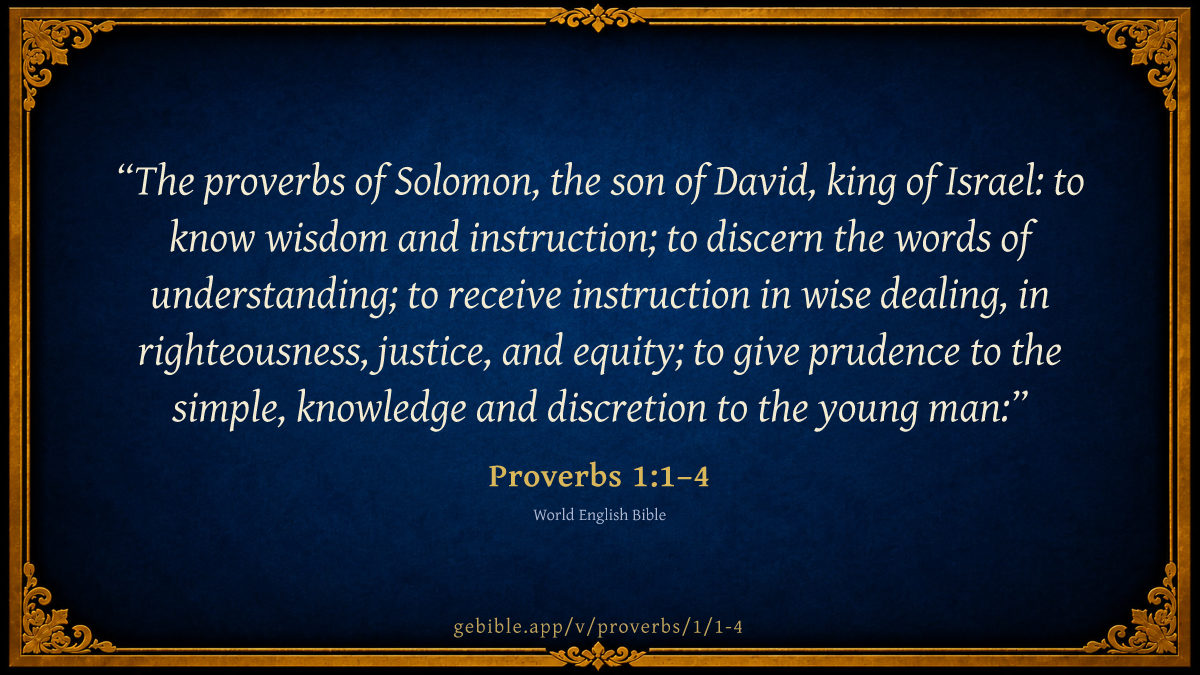
Geneva Bible translators 1599 · Public Domain On vv1–4 This word Proverb, or Parable, signifieth a grave and…
This word Proverb, or Parable, signifieth a grave and notable sentence, worthy to be kept in memory: and is sometimes taken in the evil part for a mock or scoff.
Geneva Bible (1599) marginal notes — public domain.
John Trapp 1656 · Public Domain On vv1–4 Pro 1:1 The proverbs of Solomon the son of…
Pro 1:1 The proverbs of Solomon the son of David, king of Israel;
Ver. 1. The Proverbs.] Or, Master sentences; maxims, axioms, speeches of special precellence and predominance; received rules {a} that must overrule matters, and mightily prevail in the minds of men. The principal, no doubt, they are of those three thousand mentioned in 1Ki 4:32, and far beyond those golden sayings {b} of Phocylides (profanely preferred before those holy parables by that apostate Julian, ausu nefario), as having in them more sentences than words, {c} and being so far above all human praise for weight and worth, that, as Salust writes of Carthage, I had better speak nothing of them than too little, since too much is too little.
Read full note →
Of Solomon.] Who better, a deal, deserves to be styled "Master of the sentences" than Peter Lombard; and to be esteemed πανσοφος και παντα ανθρωπεια επισταμενος, as one {d} saith of Homer; or as another saith of Jerome, that he was a man, quem nullum scibile latuit, that knew all that was knowable by a man.
King of Israel.] King in Jerusalem, {Ecc 1:1} which was now the Israel of Israel, as Athens was, in its flourish, said to be the Greece of Greece; {e} yea, the soul, and sun, and eye of Greece; {f} yea, the common school of all mankind. {g} For King Solomon exceeded all the kings of the earth both in riches and in wisdom. "And all the world sought to Solomon, to hear his wisdom, which God had put into his heart." {1Ki 10:24} For "the more wise the preacher was, the more he taught the people knowledge, and caused them to hear, and searched forth many parables"; {Ecc 12:9, marg.} even "words of delight." {Pro 1:10, marg.} {See Trapp in "Pro 1:10"}
{a} משׁל ξשׁμι, Dominari, quae vitae dominae et moderatrices esse debent.
{b} Eπη χρυσεα.
{c} De Euripide Cicero pronunciavit plures esse in eo sententias quam verba.
{d} Xenophon.
{e} Eλλας ελλαδος. - Euripid.
{f} φυχη και ηλιος, και οφθαλμος Eλλαδος. - Demost.
{g} Kοινον παιδευτηριον παντων ανθρωπων. - Thucyd. and Diodor.
John Trapp, A Commentary or Exposition upon All the Books of the Old and New Testament (1647–1656) — public domain. Text from a community e-Sword module.
Matthew Poole 1685 · Public Domain On vv1–4 Of Solomon; proceeding from Solomon, and most of them…
Of Solomon; proceeding from Solomon, and most of them digested by him into this book. See the preface.
Matthew Poole's English Annotations on the Holy Bible (1683–1685) — public domain. Text from a community e-Sword/MySword module.
Matthew Henry 1710 · Public Domain On v1 We have here an introduction to this book, which…
We have here an introduction to this book, which some think was prefixed by the collector and publisher, as Ezra; but it is rather supposed to have been penned by Solomon himself, who, in the beginning of his book, proposes his end in writing it, that he might keep to his business, and closely pursue that end. We are here told,
I. Who wrote these wise sayings, Pro 1:1. They are the proverbs of Solomon. 1. His name signifies peaceable, and the character both of his spirit and of his reign answered to it; both were peaceable. David, whose life was full of troubles, wrote a book of devotion; for is any afflicted? let him pray. Solomon, who lived quietly, wrote a book of instruction; for when the churches had rest they were edified. In times of peace we should learn ourselves, and teach others, that which in troublous times both they and we must practise. 2. He was the son of David; it was his honour to stand related to that good man, and he reckoned it so with good reason, for he fared the better for it, Kg1 11:12. He had been blessed with a good education, and many a good prayer had been put up for him (Psa 72:1), the effect of both which appeared in his wisdom and usefulness. The generation of the upright are sometimes thus blessed, that they are made blessings, eminent blessings, in their day. Christ is often called the Son of David, and Solomon was a type of him in this, as in other things, that he opened his mouth in parables or proverbs. 3. He was king of Israel - a king, and yet it was no disparagement to him to be an instructor of the ignorant, and a teacher of babes - king of Israel, that people among whom God was known and his name was great; among them he learned wisdom, and to them he communicated it. All the earth sought to Solomon to hear his wisdom, which excelled all men's (Kg1 4:30; Kg1 10:24); it was an honour to Israel that their king was such a dictator, such an oracle. Solomon was famous for apophthegms; every word he said had weight in it, and something that was surprising and edifying. His servants who attended him, and heard his wisdom, had, among them, collected 3000 proverbs of his which they wrote in their day-books; but these were of his own writing, and do not amount to nearly a thousand. In these he was divinely inspired. Some think that out of those other proverbs of his, which were not so inspired, the apocryphal books of Ecclesiasticus and the Wisdom of Solomon were compiled, in which are many excellent sayings, and of great use; but, take altogether, they are far short of this book. The Roman emperors had each of them his symbol or motto, as many now have with their coat of arms. But Solomon had many weighty sayings, not as theirs, borrowed from others, but all the product of that extraordinary wisdom which God had endued him with.
Read full note →
II. For what end they were written (Pro 1:2-4), not to gain a reputation to the author, or strengthen his interest among his subjects, but for the use and benefit of all that in every age and place will govern themselves by these dictates and study them closely. This book will help us, 1. To form right notions of things, and to possess our minds with clear and distinct ideas of them, that we may know wisdom and instruction, that wisdom which is got by instruction, by divine revelation, may know both how to speak and act wisely ourselves and to give instruction to others. 2. To distinguish between truth and falsehood, good and evil - to perceive the words of understanding, to apprehend them, to judge of them, to guard against mistakes, and to accommodate what we are taught to ourselves and our own use, that we may discern things that differ and not be imposed upon, and may approve things that are excellent and not lose the benefit of them, as the apostle prays, Phi 1:10. 3. To order our conversation aright in every things, Pro 1:3. This book will give, that we may receive, the instruction of wisdom, that knowledge which will guide our practice in justice, judgment, and equity (Pro 1:3), which will dispose us to render to all their due, to God the things that are God's, in all the exercises of religion, and to all men what is due to them, according to the obligations which by relation, office, contract, or upon any other account, we lie under to them. Note, Those are truly wise, and none but those, who are universally conscientious; and the design of the scripture is to teach us that wisdom, justice in the duties of the first table, judgment in those of the second table, and equity (that is sincerity) in both; so some distinguish them.
III. For whose use they were written, Pro 1:4. They are of use to all, but are designed especially, 1. For the simple, to give subtlety to them. The instructions here given are plain and easy, and level to the meanest capacity, the wayfaring men, though fools, shall not err therein; and those are likely to receive benefit by them who are sensible of their own ignorance and their need to be taught, and are therefore desirous to receive instruction; and those who receive these instructions in their light and power, though they be simple, will hereby be made subtle, graciously crafty to know the sin they should avoid and the duty they should do, and to escape the tempter's wiles. He that is harmless as the dove by observing Solomon's rules may become wise as the serpent; and he that has been sinfully foolish when he begins to govern himself by the word of God becomes graciously wise. 2. For young people, to give them knowledge and discretion. Youth is the learning age, catches at instructions, receives impressions, and retains what is then received; it is therefore of great consequence that the mind be then seasoned well, nor can it receive a better tincture than from Solomon's proverbs. Youth is rash, and heady, and inconsiderate; man is born like the wild ass's colt, and therefore needs to be broken by the restraints and managed by the rules we find here. And, if young people will but take heed to their ways according to Solomon's proverbs, they will soon gain the knowledge and discretion of the ancients. Solomon had an eye to posterity in writing this book, hoping by it to season the minds of the rising generation with the generous principles of wisdom and virtue.
IV. What good use may be made of them, Pro 1:5, Pro 1:6. Those who are young and simple may by them be made wise, and are not excluded from Solomon's school, as they were from Plato's. But is it only for such? No; here is not only milk for babes, but strong meat for strong men. This book will not only make the foolish and bad wise and good, but the wise and good wiser and better; and though the simple and the young man may perhaps slight those instructions, and not be the better for them, yet the wise man will hear. Wisdom will be justified by her own children, though not by the children sitting in the market-place. Note, Even wise men must hear, and not think themselves too wise to learn. A wise man is sensible of his own defects (Plurima ignoro, sed ignorantiam meam non ignoro - I am ignorant of many things, but not of my own ignorance), and therefore is still pressing forward, that he may increase in learning, may know more and know it better, more clearly and distinctly, and may know better how to make use of it. As long as we live we should strive to increase in all useful learning. It was a saying of one of the greatest of the rabbim, Qui non auget scientiam, amittit de ea - If our stock of knowledge by not increasing, it is wasting; and those that would increase in learning must study the scriptures; these perfect the man of God. A wise man, by increasing in learning, is not only profitable to himself, but to others also, 1. As a counsellor. A man of understanding in these precepts of wisdom, by comparing them with one another and with his own observations, shall by degrees attain unto wise counsels; he stands fair for preferment, and will be consulted as an oracle, and entrusted with the management of public affairs; he shall come to sit at the helm, so the word signifies. Note, Industry is the way to honour; and those whom God has blessed with wisdom must study to do good with it, according as their sphere is. It is more dignity indeed to be counsellor to the prince, but it is more charity to be counsellor to the poor, as Job was with his wisdom. Job 29:15, I was eyes to the blind. 2. As an interpreter (Pro 1:6) - to understand a proverb. Solomon was himself famous for expounding riddles and resolving hard questions, which was of old the celebrated entertainment of the eastern princes, witness the solutions he gave to the enquiries with which the queen of Sheba thought to puzzle him. Now here he undertakes to furnish his readers with that talent, as far as would be serviceable to the best purposes. "They shall understand a proverb, even the interpretation, without which the proverb is a nut uncracked; when they hear a wise saying, though it be figurative, they shall take the sense of it, and know how to make use of it." The words of the wise are sometimes dark sayings. In St. Paul's epistles there is that which is hard to be understood; but to those who, being well-versed in the scriptures, know how to compare spiritual things with spiritual, they will be easy and safe; so that, if you ask them, Have you understood all these things? they may answer, Yea, Lord. Note, It is a credit to religion when men of honesty are men of sense; all good people therefore should aim to be intelligent, and run to and fro, take pains in the use of means, that their knowledge may be increased.
Matthew Henry's Commentary on the Whole Bible (1708–1710) — public domain (CC PDM 1.0). Text via the HelloAO Bible API.
John Gill 1763 · Public Domain On vv1–4 The proverbs of Solomon,.... Who is said to make…
The proverbs of Solomon,.... Who is said to make three thousand proverbs, Kg1 4:32; but whether any of them are contained in this book cannot be said: however, it is certain that they are not all in it, since, if you except the first "nine" chapters, which are the introduction to the Proverbs, there are but six hundred and fifty-nine verses in it; and if they are taken in, they make but nine hundred and fifteen, which are not a third part of the proverbs said to be made by him: however, here are as many and such as God thought fit should be preserved for instruction in all future ages. It was usual with the ancients in all countries, when any truth was found, and established by experience, to wrap it up in a few apt words, with or without a figure; that it might be the better understood and more easily retained, and which were always venerable and greatly attended to: and of this kind are these proverbs; only with this difference, that these are of divine inspiration, and the others not. The word used for them comes from one which signifies "similitude" and "dominion" (g); because many of them are similes or comparisons, and are delivered out in figurative expressions, in metaphors and allegories, and the like; and have all of them a commanding power, authority, and influence upon the mind, obliging to an attention to them. The name of Solomon is put to them, the more to recommend them; who had a wise and understanding heart, as large as the sand of the sea, and was wiser than all men, Kg1 4:29; and was an eminent type of Christ, who spake in proverbs also, Joh 16:25. He is further described by his pedigree and office,
the son of David, king of Israel; a wise son of a wise father, and king over a wise and understanding people. These titles are added for the further commendation of the book; and it may be observed that they are such as belong to the Messiah, Solomon's antitype, one that is greater than he, Mat 1:1.
Read full note →
(g) A rad. "dominatus est----lvmn comparatus, similis, consimilis factus est", Buxtorf. "Mirum est quod radix significans antoritatem cum imperio, significat etiam parabolas vel sermones figuratos----verba quae vocantur, habent autoritatem, nobis ideam immittunt, dicentis ut nos supereminentis, saltem sapientia, ingenio, doctrina; nos persuadent et pondere suo, quasi imperio noe ducunt". Gusset. Ebr. Comment. p. 845.
John Gill's Exposition of the Whole Bible (1746–1763) — public domain (CC PDM 1.0). Text via the HelloAO Bible API.
John Wesley 1765 · Public Domain On vv1–4 The title of the book, shewing the general design…
The title of the book, shewing the general design of it, ver. 1-6. The first principle of it recommended, ver. 7-9. A caution against bad company, ver. 10-19. Wisdom's reasonings with the sons of men, and the certain ruin of those who will not hearken unto them, ver. 20-33.
John Wesley, Explanatory Notes Upon the Whole Bible (1754–1765) — public domain. Text via the GEBible commentary corpus.
Adam Clarke 1810 · Public Domain On vv1–4 -Year from the Creation, 3004. -Year before the birth…
THE PROVERBS
-Year from the Creation, 3004. -Year before the birth of Christ, 996.
Read full note →
-Year before the vulgar era of Christ's nativity, 1000.
-Year since the Deluge, according to Archbishop Usher and the English Bible, 1348.
-Year from the destruction of Troy, 185.
-Year before the first Olympiad, 224. -Year before the building of Rome, 247.
CHAPTER I
The design of the proverbs, 1-6.
An exhortation to fear God, and believe his word, because of
the benefit to be derived from it, 7-9;
to avoid the company of wicked men, who involve themselves in
wretchedness and ruin, 10-19.
Wisdom, personified, cries in the streets, and complains of the
contempt with which she is treated, 20-23.
The dreadful punishment that awaits all those who refuse her
counsels, 24-33.
NOTES ON CHAP. I
Verse 1. The proverbs of Solomon] For the meaning of the word proverb, see the introduction; and the dissertation upon parabolical writing at the end of the notes on Mt 13:58. Solomon is the first of the sacred writers whose name stands at the head of his works.
Adam Clarke's Commentary on the Bible (1810–1826) — public domain. Text from a community e-Sword/MySword module.
Joseph Benson 1811 · Public Domain On vv1–2 Pro 1:1. The proverbs of Solomon — “Solomon is…
Pro 1:1. The proverbs of Solomon — “Solomon is the first of the sacred writers whose name appears at the head of his works. The name alone of so wise and so great a prince is a sufficient recommendation to engage men to hear and to read. For we naturally love to see and to listen to persons of illustrious name and extraordinary capacity, particularly when those qualities are joined with sovereign power. The style of this work, the brevity of his sentences, and the parabolical turn, close, short, sententious, are also reasons for studying it: long discourses fatigue; all men have not leisure to attend to, or penetration to comprehend them. But precepts delivered in parables are always pleasing to hear.” See Calmet and Dodd. The reader will observe proverbs are ancient, wise, and short sayings, in common use, whereof some are plain and easy, others intricate and obscure. This way of treating serious subjects was very common and familiar with the Jews. Jesus Christ delivered most of his instructions to the people in a way somewhat similar to this, namely, in parables. This method of instruction serves well to teach wisdom, truth, and justice, and to caution men against error, vice, and dissipation.
Joseph Benson's Commentary on the Old and New Testaments (1811–1818) — public domain. Text from a community e-Sword module.
Albert Barnes 1834 · Public Domain On vv1–4 The long exhortation Proverbs 1–9, characterized by the frequent…
The long exhortation Proverbs 1–9, characterized by the frequent recurrence of the words “my son,” is of the nature of a preface to the collection of the “Proverbs of Solomon” Pro 10:1. On Pro 1:1-7, see the introduction to Proverbs.
Albert Barnes' Notes on the Bible (1834–1885) — public domain. Text from a community e-Sword/MySword module.
Charles Bridges 1846 · Public Domain On v1 THE Book naturally opens with a short account of…
THE Book naturally opens with a short account of its author. Solomon is recorded as the wisest of men; a man of wisdom, because a man of prayer. (1Ki 3:12 . Compare Pro 2:1-9 .) His extraordinary wisdom was the admiration of the world. (1Ki 3:28 ; 1Ki 4:34 .) Had he been the son of Jeroboam, he would have commanded respect; much more as the son of David, formed by his godly prayers (Psa 72:1 ) and counsels. (Pro 4:1-4 . 1Ki 2:1-4 . 1Ch 28:9 .) And if a King’s sayings even though without intrinsic merit, are preserved, the wise teaching of this King of Israel (Ecc 1:1 ; Ecc 12:9-10 ) may well demand our especial interest.
Valuable, however, as were Solomon’s maxims for their own wisdom (exceeding the sages of his own or any other time) (1Ki 4:29-31 ); they claim our reverence upon infinitely higher ground. "Behold! A greater than Solomon is here." (Mat 12:42 ). Often does he speak in the person (Pro 1:20; Pro 8:1-36 . Pro 9:1-18 . Pro 23:26 ) always under the inspiration (2Ti 3:16 ) of "the wisdom of God;" so that his sayings are truly "Divine sentences in the lips of the King." (Pro 16:10 .)
Read full note →
The great end of this inestimable book is to teach, not secular or political wisdom (though many excellent rules of each are interspersed) (Pro 6:1-11 ; Pro 27:23-27 ; with Pro 11:14 ; Pro 14:28, Pro 14:34 ; Pro 20:18 ); but that knowledge of God (Pro 1:7 ), which, while it "maketh wise unto salvation, perfects and furnishes the man of God unto all good works." (2Ti 3:15-17 . Tit 2:11-12 .) Its glowing privileges are set forth (Pro 3:13-18 .) It is pressed upon us with intense earnestness, as "the principal thing," our very "life." (Pro 4:5-9, Pro 4:13 .) Instruction is the means of gaining it. We are directed to perceive the words of understanding; to receive the instruction as a complete rule of wisdom, justice, judgment, and equity (Compare Pro 2:9 ); sound principles, and their practical application. Here also the simple, so readily deluded (Pro 14:15 ; Pro 21:11 . Eze 45:20 ), learn that subtlety, so needful to discriminate between truth and error (Php 1:10 . 1Th 5:21 ); to guard them from false teachers (Psa 17:4 . 1Jn 4:1 . Compare Act 17:11 ); and to "convince gainsayers." (Tit 1:9 ; Tit 2:8 Compare Mat 22:15-46 .) Specially is the young man directed to this book.†1 His undisciplined ardor runs to waste. His mind fluctuates at the mercy of the winds of opinion in the world around him; and greatly does he need some settled master-principles to fix his purpose, choice, and conduct. Here then he finds knowledge and discretion; a religion, not of imagination, impulse, or sentiment; but the sound practical energy of Scriptural truth.
Footnotes
†1 Psa 119:9. Over the gates of Plato’s school, it was written: MhdeiV agewmetrhtoV eisitw. (). (Literally — Let no one who is not a geometrician enter.) But very different is the inscription over these doors of Solomon — Let the ignorant, simple, foolish, young enter. Cartwright in loc. — Lavater in c. iv. 4:20-22.
Charles Bridges, An Exposition of the Book of Proverbs (1846) — public domain. Text from a community e-Sword module.
Haydock's Catholic Bible Commentary 1859 · Public Domain On vv1, 2, 4 Israel. The dignity of the author, and the importance…
Israel. The dignity of the author, and the importance of the subject, invite us to read. (St. Basil) --- Solomon is the first whose name is placed at the head of any work in Scripture. (Calmet)
George Leo Haydock (1774–1849), Haydock's Catholic Family Bible and Commentary, 1859 edition — public domain. Excludes Psalms (Douay-Rheims chapter numbering differs from Protestant) and Deuterocanonical books (Catholic canon only).
Lange's Commentary on the Holy Scriptures 1864 · Public Domain On v1 General Superscription to the Collection
General Superscription to the Collection
Announcement of the Author of the Collection, of its Object, and of its great value
Read full note →
Pro_1:1-6
1 Proverbs of Solomon, the son of David,
the King of Israel:
2 to become acquainted with wisdom and knowledge,
to comprehend intelligent discourse,
3 to attain discipline of understanding,
righteousness, justice and integrity,
4 to impart to the simple prudence,
to the young man knowledge and discretion;—
5 let the wise man hear and add to his learning,
and the man of understanding gain in control,
6 that he may understand proverb and enigma,
words of wise men and their dark sayings.
Introductory Section
True wisdom as the basis and end of all moral effort, impressed by admonition and commendation upon the hearts of youth
Pro_1:7 to Pro_9:18
7 The fear of Jehovah is the beginning of knowledge;
wisdom and discipline fools despise.
First group of Admonitory or Gnomic Discourses
Pro_1:8 to Pro_3:35
1. The teacher of wisdom admonishes his son to avoid the way of vice
Pro_1:8-19
8 Hearken, my son, to thy father’s instruction,
and refuse not the teaching of thy mother;
9 for they are a graceful crown to thy head,
and jewels about thy neck.—
10 My son, if sinners entice thee,
consent thou not!
11 If they say, “Come with us, and we will lie in wait for blood,
will plot against the innocent without cause;
12 we will swallow them, like the pit, living,
and the upright, like those that descend into the grave;
13 we will find all precious treasure,
will fill our houses with spoil!
14 Thou shalt cast in thy lot among us;
one purse will we all have!”
15 My son! go not in the way with them,
keep back thy foot from their path!
16 For their feet run to evil,
and haste to shed blood;
17 for in vain is the net spread
before the eyes of all (kinds of) birds:
18 and these watch for their own blood,
they lie in wait for their own lives.
19 Such are the paths of every one that grasps after unjust gain;
from its own master it taketh the life.
Pro_1:20-33
2. Warning delineation of the perverse and ruinous conduct of the fool, put into the mouth of wisdom (personified).
20 Wisdom crieth aloud in the streets,
on the highways she maketh her voice heard:
21 in the places of greatest tumult she calleth,
at the entrances to the gates of the city she giveth forth her words:
22 “How long, ye simple, will ye love simplicity,
and scorners delight in scorning,
and fools hate knowledge!
23 Turn ye at my reproof!
Behold I will pour out upon you my spirit,
my words will I make known to you!
24 Because I have called and ye refused,
I stretched out my hand, and no man regarded it,
25 and ye have rejected all my counsel,
and to my reproof ye have not yielded;
26 therefore will I also laugh at your calamity,
will mock when your terror cometh;
27 when like a storm your terror cometh,
and your destruction sweepeth on like a whirlwind,
when distress and anguish cometh upon you.
28 Then will they call upon me, and I not answer,
they will seek me diligently and not find me.
29 Because they have hated sound wisdom
and have not desired the fear of Jehovah,
30 have not yielded to my counsel
and have despised all my reproof,
31 therefore shall they eat of the fruit of their way
and be surfeited with their own counsels.
32 For the perverseness of the simple shall slay them,
and the security of fools destroy them:
33 he, however, who hearkeneth to me shall dwell secure,
and have rest without dread of evil!”
GRAMMATICAL AND CRITICAL
Pro_1:2. [We have in Pro_1:2-4; Pro_1:6 final clauses, introduced by לְ, and indicating the object with which these wise sayings are recorded. That purpose is disciplinary, first with reference to “the young man,” and then to him who is already “wise.” This discipline is contemplated not from the point of view of him who imparts, but that of those who receive it. These considerations determine our choice of words in translating several of the terms employed. Thus in Pro_1:2 we render לָדַעַת not “to know,” as this suggests the finished result rather than the process, which is “to become acquainted with, to acquire;” so Zöckler, zu erkennen; De Wette, kennen zu lernen; Noyes, “from which men may learn;” a little less definitely, E. V., “to know;” incorrectly Holden, “respecting the knowledge.” These wise sayings are to guide to and result in knowledge; but the verbs, except in Pro_1:4, represent not the teaching, imparting, communicating, but the discerning and seizing. In respect to the two shades of meaning to be given to מוּסָר see the exeg. notes. Gesen. and Fuerst agree in the etymology (יסר); Fuerst, however, carries back the radical meaning one step farther; G., “to chastise, correct, instruct;” F., “to bind or restrain, chastise,” etc. It should, therefore, be borne in mind that more than the imparting of information is intended by the word, it is discipline, sometimes merely intellectual but more frequently moral.—אִמְרֵי בִינָה, lit., “words of discernment,” “words of understanding” (so E. V., Noyes, Muenscher); Stuart, “words of the intelligent;” De Wette like Zöckler, “verständige Reden;” Van Ess and Allioli, with whom Holden seems to agree, “die Worte (Regeln) der Klugheit” “the words (rules) of prudence.”—A.].
Pro_1:3. [מוּסַר הַשְׂכֵּל,—our author’s conception (see exeg. notes) corresponds with that of Fuerst also, who makes the genitive not merely objective, as De Wette, etc., seem to do (“discipline of understanding,” “die Zucht der vernunft”), but makes it final, contemplating the end: Fuerst, “Z. zur Besonnenheit,” Zöckler, “einsichtsvolle Zucht,” discipline full of discernment, insight, understanding, i.e., in its results. The rendering of most of our English expositors is ambiguous or suggests other ideas: E. V. and Muenscher, “instruction of wisdom;” Holden, “instruction in wisdom;” Noyes, “the instruction of prudence;” Stuart, “of discreetness.”—מֵשָׁרִים, plural of that which is “ideally extended” and pleasurable; Böttcher, Ausf. Lehrb., §699.—A.].
Pro_1:5. [E. V., followed by Holden and Muenscher, “a wise man will hear;” Noyes, “may hear;” Stuart, more forcibly, “let the wise man listen,” like our author, “es höre” and Böttcher § 950, d., “Fiens debitum”) “es soll hören”. De Wette makes this a final clause, like those of the three preceding verses, “dass der Weise höre;” but see exeg. notes. וְיוֹסֶף is given by Böttcher (§ 964, 2) as an illustration of the “consultive” use of the Jussive; Stuart makes it an ordinary Imperf., and renders “and he will add;” but his explanations are not pertinent; the וְ need not be “conversive,” it is simply copulative, and יוֹסֵף which he assumes as the normal Imperf., is already a Jussive.—A.]. לֶקַח, properly that which is “taken, received, transmitted” (comp. the verb לקח “to attain,” above in Pro_1:3) is like the Aram. קַבַּלָה (from קִבְּל, to take), and like the Latin traditio [in its passive sense]. The parallel term תַּחְבֻּלוֹת (from חָבַל, to lead, according to the analogy of the Arabic, and cognate with חֶבֶל, cable, and חֹבֵל, steersman) is by the LXX correctly rendered by κυβέρνησις.
Pro_1:6. Luther’s translation of the 1st clause, “that he may understand proverbs and their interpretation,” cannot possibly be right; for מְלִיצָה, if it was designed to convey any other idea than one parallel to מָשָׁל could not on any principle dispense with the suffix of the 3d person ־ָתוֹ), its, comp. Vulgate: “animadvertat parabolam et interpretationem.” [This is also the rendering of the E. V., which is followed by Holden, while Noyes, Stuart, Muenscher and Wordsworth, De Wette and Van Ess agree with the view taken by our author.—A.].
Pro_1:7. אֱוִילִים derived from אָוַל crassus fuit; to be gross or dull of understanding;—Gesen., however, derives it from the radical idea “to be perverse, turned away,” and Fuerst “to be slack, weak, lax or lazy.” [Wordsworth adopts the latter explanation—A.].
Pro_1:8. [The different renderings given to the verb of the 2d clause while agreeing in their substantial import, “forsake,” “neglect,” “reject,” do not reproduce with equal clearness the radical idea, which is that of “spreading,” then of “scattering.”—A ].
Pro_1:10. תּבֵא, scriptio defectiva, for תֹּאבֵא, as some 50 MSS. cited by Kennicott and De Rossi in fact read, while some others prefer a different pointing אַל־תָּבֹא [thou shalt not go], which is however an unwarranted emendation. The LXX had the correct conception: μὴ βουληθῇς, and the Vulgate: ne acquiescas.—[Comp. Green’s Heb. Gram., § 111, 2, b, and § 177, 3. Böttcher discusses the form several times in different connections, §§ 325, d, and n. 2,—429, B, and 1164, 2, b,—and after enumerating the six forms which the MSS. supply,תֹּבֶה ,תֹּאבֵא ,תֹּאבֶה ,תָּבֹא ,תָּבוֹא, and תּוֹבֵא decides that the original form, whose obscurity suggested all these modifications, was תּאֹב = תֹּבְא. In signification he classes it with the “dehortative” Jussives.—A.].
Pro_1:11. [E. V., Noyes, Wordsworth, Luther, Van Ess agree with one another in connecting the adverb with the verb, while De Wette, Holden, Stuart, Muenscher regard it as modifying the adjective, “him whose innocence is of no avail to protect him.”—A.].
Pro_1:12. [E. V., Stuart and Muenscher, like our author connect חַיִּים with the object of the main verb; Umbreit and Hitzig (see exeg. notes) are followed by De Wette, Holden, Noyes in connecting it with the comparative clause.—יוֹרְדֵי בוֹר, for construction see e.g., Green, §§ 271, 2 and 254, 9, b.—A.].
Pro_1:16. [יָרוּצוּ, masc. verb with feminine subject; Bött., § 936, II., C. a; Green, § 275,1. c—A.].
Pro_1:20. The Wisdom who is here speaking is in this verse called חָכְמוֹת which is not a plural but “a new abstract derivative from חָכְמָה, formed with the ending וֹת” (Ewald, § 165, c) a form which is also found e.g. in תְּחֹמוֹת, Psa_78:15. The name recurs in the same form in Pro_9:1; Pro_24:7. [Böttcher, however, regards this as an example of the pluralis extens., to denote emphatically “true wisdom.” See § 679, d, 689, C., b, 700, c and n. 4. There is no difficulty in connecting a verb fem. sing, with a subject which, although plural in form is singular in idea.—A.].—תָּרֹנָּה, crieth aloud, from רָנַן, comp. Lam_2:19; Lamentations 3 d sing. fem. as also in Pro_8:3 (Ewald, 191, c). [Comp. Green, § 97,1, a, and Bött., § 929, d, who with his usual minuteness endeavors to trace the development of this idiom.—A.].
Pro_1:21. Zöckler, an den larmvollsten Orten; De Wette, an der Ecke lärmender Strassen; Fuerst, der bewegten Strassen; Holden, like the Eng. Ver., in the chief place of concourse.
Pro_1:22. [For the vocalization of תְּאֵהֲבוּ see Green, §§ 60, 3, c, 111, 2, e. For the use of the perfect חָמְדוּ sea Bött., § 948, 2. He illustrates by such classical perfects as ἔγνωκα, οἷδα, μέμαα,memini, novi, and renders this form by concupiverint.—A.].
Pro_1:23. [אַבִּיעָה, an instance of the intentional Imperf., in what Böttcher calls its “voluntative” signification,—§ 965, 1.—A.].
Pro_1:27. [כְּשַׁאֲוָה, K’ri כְּשׁוֹאָה, the former derived from שׁאו or שׁאה, the latter from שׁוא, of which verbs the latter is obsolete except in derivatives, while the former occurs in one passage in Is. in the Niphal. The signification seems to be one, and the forms variations growing out of the weakness of the 2d and 3d radicals. Comp. Bött., §§ 474, a, and 811, 2.—A.].
Instead of the Infin. בְּבוֹא, we have in the 2d member, since בְּ is not repeated, the Imperf. יֶאֱתֶה (Ewald, 337, b) [Stuart, § 129, 3, n. 2].—A.
Pro_1:28. [יִמְצָאֻנְנִי ,יְשַׁחֲרֻנְנִי ,יִקְרָאֻנְנִי. These are among the few instances in which the full plural ending וּן is found before suffixes. Green, § 105, a, Bött., § 1047, f.—A.].
Pro_1:29. For the use of תַּחַת כִּי, “therefore because,” compare Deu_34:7, and also the equivalent combination תַּחַת אֲשֶׁר in 2Ki_22:7; 2Ch_21:12.
EXEGETICAL
1. Pro_1:1-6. The superscription to the collection, which is quite long, as is common with the titles of Oriental books, is not designed to be a “table of contents” (Umbreit), nor to give merely the aim of the book (so most commentators, especially Ewald, Bertheau, Elster, etc.). But beside the author of the book (Pro_1:1), it is intended to give first its design (Pro_1:2-3), and then, in addition, its worth and use (Pro_1:4-6), and so to commend the work in advance as salutary and excellent (Starke, Delitzsch). Accordingly it praises the book as a source of wholesome and instructive wisdom: 1) for the simple-minded and immature (Pro_1:4); 2) for those who are already wise and intelligent, but who are to gain still more insight and understanding from its maxims and enigmas (Pro_1:5-6).—Proverbs of Solomon, etc.—In regard to the primary meaning of מָשָׁל, and in regard to the special signification which prevails here in the superscription, “Proverbs of Solomon” (maxims, aphorisms, not proverbs [in the current and popular sense]), see Introd., § 11.—To become acquainted with wisdom and knowledge.—In respect to חָכְמָה and its synonyms (בִּינָה and דַּעַת) consult again the Introd., § 2, note 3. “מוּסָר properly “chastisement,” signifies education, moral training, good culture and habits, the practical side, as it were, of wisdom (LXX: παιδεία; Vulg.: disciplina). In Pro_1:2 the expression stands as synonymous with “wisdom” (חָכְמָה), as in Pro_4:13; Pro_23:23, and frequently elsewhere; in ver.3, on the contrary, it designates an element preparatory to true wisdom and insight,—one serving as their foundation, and a preliminary condition to them. For the “discipline of understanding” (מוַּסַר הַשְׂכֵּל, Pro_1:3) is not, as might be conceived, “discipline under which the understanding is placed,” but “discipline, training to reason, to a reasonable, intelligent condition” (as Hitzig rightly conceives it); compare the “discipline of wisdom” (מוּסַר חָכְמָח), Pro_15:33, and for “understanding” (הַשְׂכֵּל), insight, discernment, a rational condition, see particularly Pro_21:16. Umbreit and Ewald regard הַשְׂכֵּל as equivalent to thoughtfulness (“a discipline to thoughtfulness,” Zuchtigung zur Besonnenheit”); by this rendering, however, the full meaning of the conception is not exhausted.—Righteousness, justice and integrity. The three Hebrew terms מִשְׁפָּט ,עֶדֶק and מֵיּשָׁרִים are related to each other as “righteousness, justice, and integrity, or uprightness” (Gerechtigkeit, Recht und Geradheit). The first of the three expressions describes what is fitting according to the will and ordinance of God the supreme Judge (comp. Deu_33:19); the second, what is usage and custom among men (Isa_42:1; 1Sa_27:11): the third, what is right and reasonable, and in accordance with a walking in the way of truth, and so denotes a straight-forward, honorable and upright demeanor.
Pro_1:4. To impart to the simple prudence.—The telic infinitive (לָתֵת) is co-ordinate with the two that precede in Pro_1:2-3, and has the same subject. Therefore the same construction is to be employed here also (to become acquainted with—to attain—to impart); and we are not, by the introduction of a final clause, to make the contents of this 4th verse subordinate to the preceding, as the LXX do (ί̔να δῷ κ. τ. λ.), and likewise the Vulg. (ut detur, etc.), and Luther (“that the simple may become shrewd, and young men reasonable and considerate”). The “simple” (פְּתָאִים), properly, the “open,” those who are readily accessible to all external impressions, and therefore inexperienced and simple, νήπιοι, ἄκακοι (as the LXX appropriately render the word in this passage; comp. Rom_16:18). With respect to the relation of this idea to that of the “fool” (כְּסִיל ,נָבָל) compare what will be said below on Pro_1:32, and also Introd., § 3, note 2.—Prudence (עָרְמָה, derived from עָרַם) signifies properly nakedness, smoothness (comp. theadj. עָרִוּם [“subtle” E.V.], naked, i.e., slippery, crafty; used of the serpent, Gen_3:1); therefore metaphorically “the capacity for escaping from the wiles of others” (Umbreit), “the prudence which guards itself against injury” (Pro_22:3; 1Sa_23:22).—To the young man knowledge and discretion.—Discretion, thoughtfulness (מְזִמָּה, LXX, έ̓ννοια), denotes here in connection with “knowledge” (דַּעַת) the characteristic of thoughtful, well considered action, resting upon a thorough knowledge of things,—therefore, circumspection, caution.
Pro_1:5. Not the simple and immature only, but also the wise .and intelligent, are to derive instruction from Solomon’s proverbs. This idea is not, as might be supposed, thrust in the form of a parenthesis into the series of final clauses beginning with Pro_1:2, and reaching its conclusion in Pro_1:6, so that the verb (יִשְׁמַע) is to be conceived of as rendering the clause conditional, and is to be translated “if he hears” (Umbreit, Elster); it begins a new independent proposition, whose imperfect tenses are to be regarded as voluntative, and upon which the new infinitive clause with לְ in Pro_1:6 is dependent (Ewald. Bertheau, and commentators generally).—Let the wise man hearken and add to his learning.—As to the expression” add to his learning” (יוֹסֶף לֶקַח) comp. Pro_9:9; Pro_16:12. The peculiar term rendered “learning” (see critical notes above) is a designation of knowledge, doctrine, instructive teaching in general; comp. Pro_1:22; Pro_1:29. The word rendered “control,” or mastery, is an abstract derivative, strengthened by the ending וֹת (Ewald, Gramm., § 179 a., note 3), and expresses here in an appropriate and telling figure the idea of “skill and facility in the management of life.” Comp.Pro_11:14; Pro_12:5; Job_37:12, etc. Its relation to “learning” (לֶקַח) is quite like that of “discipline” to “wisdom” in Pro_1:2; it supplies the practical correlative to the other idea which is predominantly theoretical.
Pro_1:6. To understand proverb and enigma, etc.—[“The climax of the definition of wisdom”—Stanley]. The infinitive (לְהָבִין) supplies the announcement of the end required by Pro_1:5 : to this end is the wise man to gain in knowledge and self-command or Self-discipline, that he may understand the proverbs and profound sayings of the wise, i.e., may know how to deal appropriately with them. It is not the mere understanding of the wisdom of proverbs by itself that is here indicated as the end of the wise man’s “increase in knowledge and mastery,” but practice and expertness in using this wisdom; it is the callere sententias sapientum which imparts a competence to communicate further instruction to the youth who need discipline. If the telic infinitive (לְהָבִין) be taken in this frequent sense, for which may be compared among other passages Pro_8:9; Pro_17:10; Pro_17:24; Dan. 1:27, we do not need with Bertheau to give the expression a participial force (by virtue of the fact that he understands,—understanding proverbs, etc.),—nor to maintain with Hitzig and others that Pro_1:6 is not grammatically connected with Pro_1:5, on the ground that it is not conceivable that the “learning to understand the words of wise men” should be made an object of the endeavor of such as are wise already. It is an intensified acquaintance with wisdom that is here called for, a knowledge in the sense of the passage, “to him that hath shall be given, and he shall have abundance,” Mat_13:12; comp. Joh_1:16; Rom_1:17; 2Co_3:18. For the verbal explanation of “enigma” and “dark saying” (מְלִיצָה and חִידָה). see Introd., § 11, note 2. Certain as it is that both expressions here are only designed to embody in a concrete form the idea of obscure discourse that requires interpretation (the parallelism with “proverbs” and “words of wise men” (מָשָׁל and דִּבְרֵי חֲכָמִים) shows this beyond dispute), we have no warrant. for finding in this verse a special allusion to the obscure, enigmatical contents of chap. 30, and so for insisting upon its very late origin, as Hitzig does (see in reply Ewald). Nevertheless, it follows from the comprehensiveness of the plural expression “words of wise men” (comp. Pro_22:17 and Ecc_9:17; Ecc_12:11) that no one could have prefixed to his work an introduction like that before us, who was not conscious that he had collected with proverbs of Solomon many others that were not directly from him (comp. §12 of the Introd.).
2. Pro_1:7 is not to be regarded as a part of the superscription, as Ewald, Bertheau, Elster, Keil, etc., treat it, but is the general proposition introducing the series of didactic discourses that follows;—a motto, as it were, for the first or introductory main division of the book, as Umbreit happily expresses it; comp. Hitzig in loc. The proverb has also passed into the Arabic, and here also frequently stands at the commencement of collections of proverbs, whether because it is ascribed to Mohammed, as is sometimes done in such cases, or because it is cited as coming from Solomon. Compare Von Diez, Denkwürdigkeiten, II., 459; Meidani, ed. Freytag, III., 29, 610; Erpenius, Sent. quæd. Arab., p. 45. In the Old Testament [and Apocrypha], moreover, the same maxim occurs several times, especially in Pro_9:10; Ecclesiast. Pro_1:16; Pro_1:25; Psa_111:10. From the passage last cited the LXX repeat in our verse the words appended to the first clause:Ἀρχὴ σοφίας φόβος κυρίον, σύνεσις δὲ ἀγαθὴ̓ πᾶσιν τοῖς ποιοῦσιν αὑτήν [“and a good understanding have all they that do it”].—Beginning.—(רֵאשׁית is here equivalent to תְּחִלָּה found in the parallel passage, Pro_9:10; it is therefore correctly rendered in Ecclesiast, and the LXX by ἀρχὴ in the sense of “beginning”); compare Pro_4:7, “the beginning of wisdom;” not, as the words themselves would allow, “that which is highest in wisdom,” “the noblest or best wisdom.” [The latter is given as a marginal reading in the E. V, and is retained and defended by Holden; so also by Trapp and others.—A.].—Fools.—The word designates properly the hardened, the stupid,—those fools who know nothing of God (Jer_4:22), and therefore refuse and contemptuously repel His salutary discipline (comp. above, note to Pro_1:2).
3. Pro_1:8-19. These verses show in an example so shaped as to convey an earnest warning, how we are to guard ourselves against the opposite of the fear of God, against depravity, which is, at the same time, the extremest folly. They contain, therefore, a warning against, turning aside to the way of vice, given as the first illustration of the truth expressed in Pro_1:7.
Pro_1:8-9.—My son.—The salutation of the teacher of wisdom, who is here represented as “father” in order to illustrate to his pupil the inner reality and nature of their mutual relation (comp. 1Co_4:15; Phm_1:10). The “mother” who is mentioned in connection with this “father” is only a natural expansion of the idea of the figure, suggested by the law of poetic parallelism,—and not a designation of wisdom personified, who does not appear before Pro_1:20. [Wordsworth and many of the older English expositors regard this as a specific address by Solomon to Rehoboam; this interpretation, however, lacks the support of Oriental usage, and too much restricts the scope of the Book of Proverbs. The large majority, however, of English and American commentators (e.g., Trapp, Holden, Bridges, Wordsworth, Muenscher) find here a more specific commendation of filial docility and obedience. Stuart more nearly agrees with our author in making the “father” and “mother” figurative rather than literal terms—A.].—Law (תּוֹרָה), here doctrina, instructive precepts in general; as in several other instances in our book it is used of the instruction given by parents to their children, e.g., Pro_3:1; Pro_4:2; Pro_7:2; Pro_28:7; Pro_28:9.—For they are a graceful Grown to thy head.—“Wreath of grace” (לִוְיַת חֵן) graceful crown, as in Pro_4:9. The comparison of the teachings of wisdom with pearls which one hangs as a necklace about the neck, a figure which is a great favorite every where in the East, recurs again in Pro_3:3; Pro_6:21; Ecclesiast. Pro_6:30.
Pro_1:10. Transition to an intelligible admonitory example; hence the repetition of the familiar salutation “My son,” which occurs once more in Pro_1:15, at the beginning of the apodosis. Sinners (הַטָּאִים).—Sinners by profession, habitual sinners, as in Psa_1:1; here those in particular whose business is murder (comp. Gen_4:7-8), robbers who are murderers.-
Pro_1:11. We will lie in wait for blood, etc.—The two verbs (אָרַב and עָפַן) both signify to lie in wait for, to lay snares artfully (as the huntsman for the game, with noose and net). The adverb (הִנָּם) is probably more correctly construed with the verb (lie in wait without cause, i.e., without having any reason for revenge and enmity), than with the adjective,—although this latter combination is also grammatically admissible. But with the conception “him that is innocent in vain,” i.e., the man to whom his innocence shall be of no avail against us, the parallel passages (Psa_35:19; Psa_69:4; Lam_3:52) correspond less perfectly than with that to which we have given the preference; comp. Hitzig in loc.
Pro_1:12—Will swallow them, like the pit, living.—The “living” (חַיִּים) can refer only to the suffix pronoun (in נִבְלָעֵם). The connection with “like the pit” (כִּשְׁאוֹל), to which Umbreit and Hitzig give the preference, gives the peculiarly hard sense “as the pit (swallows) that which lives.” Comp. rather Psa_55:15 : “they must go down living into the pit;” and also Psa_124:3; Pro_30:16, and the account of the destruction of Koran’s company, Num_16:30; Num_16:33.—The upright (תְּמִימִים) is accusative, object of the verb (בָּלַע), and therefore stands evidently as synonymous with נְקִיִּים (innocent, comp. Psa_19:13); it is accordingly to be interpreted as referring to moral integrity or uprightness, and not of bodily soundness (as Ewald, Bertheau, and others claim).—Those that descend into the grave (יוֹרֵדֵי בוֹר)—that sink into the sepulchre, i.e., the dead; comp. Psa_28:1; Psa_88:4; Psa_143:7.
Pro_1:13-14. Reasons for the treacherous proposal of the murderers.—Thou shalt cast in thy lot among us—i.e., thou shalt, as one having equal right with us, cast lots for the spoil, comp. Psa_22:18; Neh_10:35.
Pro_1:15 sq. The warning,—given as an apodosis to the condition supposed in Pro_1:11. As to the figurative expressions in Pro_1:15, comp. Psa_1:1; Jer_14:10; Pro_4:26; for Pro_1:16 compare Isa_59:7, and the passage suggested by it, Rom_3:15. Without adequate grounds, Hitzig conjectures that Pro_1:16 is spurious, because, he says, it agrees almost literally with Isaiah (as cited), and, on the other hand, is wanting in the Cod. Vatic. of the LXX. Literal quotations from earlier Biblical writers are in Isaiah above all others nothing uncommon; and with quite as little reason will the omission of a verse from the greatly corrupted LXX text of our book furnish ground, without other evidence, for suspecting its genuineness (see Introd., § 13).
Pro_1:17. “The winged” (properly “lords of the wing;” בַּעַל כָּנָף, as in Ecc_10:20) is hardly a figurative designation of those plotted against by the robbers, and threatened by treacherous schemes, so that the meaning would be “in vain do they lie in wait for their victims; these become aware of their danger, and so their prize, escapes the assailants” (so Döderlein, Ziegler, Bertheau, Elster, etc.). For 1) the causal conj. “for” (כִּי) authorizes us to look for a direct reason for the warning contained in Pro_1:15; Proverbs 2) the allusion to the possible failure of the plans of the wicked men would not be a moral motive, but a mere prudential consideration, such as would harmonize very poorly with the general drift of the passage before us; and 3) the expression “before the eyes” (בְּעֵינֵי) stands evidently in significant contrast with “in vain” (חִנָּם); it is designed to set the fact that the net is clearly in sight over against the fact that the birds nevertheless fly into it,—and so to exhibit their course as wholly irrational.—Therefore we should interpret with Umbreit, Ewald, Hitzig, etc.; like thoughtless birds that with open eyes fly into the net, so sinners while plotting destruction for others plunge themselves in ruin. Only with this explanation, with which we may compare Job_18:8, will the import of Pro_1:18 agree: there “and these, these also” (וְהֵם) puts the sinners in an emphatic way side by side (not in contrast) with the birds, and the suffixes designate the own blood, the own souls of the sinners. Between the two verses there is therefore the relation of an imperfectly developed comparison suggested by the “also” (וְ) as in Pro_25:25; Pro_27:21; comp. Introd., § 14. [The view of English expositors is divided, like that of the German scholars cited by our author. Bishop Hall, Trapp, Henry and Noyes, e.g. agree with him in finding here a comparison, while D’Oyly and Mant, Holden, Bridges, Wordsworth, Stuart, Muenscher find a contrast. The argument based on the particles כִּי and וְ it must be admitted has very little force; for כִּי (see Ewald, § 321, b.) may be used positively or negatively in intense asseveration, “yea, surely,” or “nay;” while וְ, it is well known, has a very generous variety of uses, among which is the antithetic, in which case it may be rendered “but” or “and yet” (Ewald, § 330, a.).—A.].—They lie in wait for their own lives. The LXX, which at the end of this verse adds the peculiar but hardly genuine clause, ἡ δὲ καταστροφὴ ἀνδρῶν παρανόμων κακὴ (“and the destruction of transgressors is evil, or great”) seems, instead of “they lie in wait for their own lives” (יִצְפְּנוּ לְנַפְשׁוֹתָם) to have read “they heap up evil” (יִצְבְּרוּ רַע לְי); for it renders the second number by “θησαυρίζουσιν ἑαυτοῖς κακὰ” (they treasure up evils for themselves). Comp. Heidenheim in the article cited in the Introd., § 13, note 1.
Pro_1:19. Retrospect and conclusion; comp. Job_8:13; Job_18:21.—Spoil (בֶּצַע) gain unlawfully acquired, as in Pro_28:16. The combination בֹּצֵעַ בֶּצַע is found also in Pro_15:27. The subject of the verb “takes” (יִקַח) is בֶּצַע; “the life of its owner it, unjust gain, takes away.” Luther, following the LXX, Vulgate, and most of the ancient expositors, renders “that one (i.e., of the rapacious) takes life from another.” But the idea “ownership, owner” (בְּעָלִים) has no reference to the relation between partners in violence and those like themselves, but to that existing between an object possessed and its possessor.
4. Pro_1:20-33. After this warning against the desperate counsels of the wicked there follows in this second admonitory discourse a warning against the irrational and perverse conduct of fools. In the former case it was contempt of the fear of God, in the latter it is contempt of wisdom against which the warning is directed. Both passages, therefore, refer back distinctly to the motto that introduces them in Pro_1:7. The admonition against folly, which is now to be considered, is put appropriately into the mouth of wisdom personified,—as is also, later in the book, the discourse on the nature and the origin of wisdom (Pro_8:1 sq).—On the street and in public places wisdom makes herself heard; not In secret, for she need not be ashamed of her teaching, and because she is a true friend of the people seeking the welfare of all, and therefore follows the young and simple, the foolish and ungodly, everywhere where they resort; comp. Christ’s command to His disciples, Mat_10:27; Luk_14:21, As in these passages of the New Testament, so in that before us, human teachers (the wise men, or the prophets, according to Ecclesiast. Pro_24:33; Wis_7:27) are to be regarded as the intermediate instrumentality in the public preaching of wisdom.
Pro_1:21. In the places of greatest tumult she calleth, etc. “The tumultuous” (חֹמִיּוֹת), comp. Isa_22:2; 1Ki_1:41, can signify here nothing but the public streets full of tumult, the thoroughfares. The “beginning” (רֹאשׁ) of these highways or thoroughfares is, as if were, their corner; the whole expression points to boisterous public places. The LXX seem to have read חוֹמוֹת “walls,” since it translates ἐπ’ ά̓κρων τειχέων [on high walls]. Before the second clause the same version has the addition “ἐπὶ δὲ πύλαις δυναστῶν παρεδρεύει” [and at the gates of the mighty she sits], an expansion of the figure in which there is no special pertinence. In the city (בָּעִיר) is probably to be regarded as a closer limitation of “at the entrances of the gates” (בְּפִתְחֵי שְׁעָרִים), i.e., on the inner, the city side of the entrances at the gates: it is not then to be regarded as an antithesis, as Umbreit, Bertheau, Hitzig, etc., claim, [nor is it to be detached and connected with the next clause, as Stuart claims].
Pro_1:22. How long, ye simple, will ye love simplicity? The discourse of Wisdom begins in the same way as Psa_4:2. In regard to the distinction between “simple” (פְּתִי) and “scorner” (לֵץ), comp. Introd. § 3, note 2; and above, the remarks on Pro_1:4.—The perfect tense in the second clause (חָמְדוּ), which standing between the imperfects of the 1James , 3 d clauses is somewhat unusual, is to be conceived of as inchoative (like the verb “despise” בָּזוּ in Pro_1:7), and therefore properly signifies “become fond of,” and not “be fond of.” [See, however, the critical note on this verse].
Pro_1:23. Turn ye at my reproof,—i.e., from your evil and perverse way. I will pour out upon you my spirit. The spirit of wisdom is to flow forth copiously, like a never-failing spring; comp. Pro_18:4; and with reference to the verb “pour out” (חִבִּיעַ) which “unites in itself the figures of abundant fullness and refreshing invigoration” (Umbreit, Elster) comp. Pro_15:2; Psa_78:2; Psa_119:171.
Pro_1:24, in connection with 25, is an antecedent clause introduced by “because” (יַעַן), to which Pro_1:26-27 correspond as conclusion. The perfects and imperfects with ו consec. in the protasis describe a past only in relation to the verbs of the apodosis, and may therefore well be rendered by the present, as Luther has done: “Because I call and ye refuse,” etc. To stretch forth the hand, in order to beckon to one, is a sign of calling for attention,—as in Isa_65:2. The verb in Pro_1:25, f. c. (פָּרַע) is doubtless not “undervalue, despise” as Hitzig explains, following the analogy of the Arabic), but “cast off, reject,” as in Pro_4:15, (Umbreit, Ewald, Elster and commentators generally; comp. Luther’s “let go, fahren lassen”). [As between the two the English Version is equivocal, “set at naught”].
Pro_1:26. “Laugh” and “mock” (שַׂחַק and לָעַג) here as in Psa_2:4.
Pro_1:27 depicts the style and manner in which calamity comes upon fools, “and accumulates expression to work upon the fancy” (Hitzig). Instead of the K’thibh כשאוה according to the K’ri we should read כְּשׁוֹאָה, and this should be interpreted in the sense of “tempest” (comp. Pro_3:25; Zep_1:15). Thus most commentators correctly judge, while Hitzig defends for the expression the signification “cataract,” which however is appropriate in none of the passages adduced, and also fails in Job_30:14 (comp. Delitzsch on this passage).—In regard to the alliteration צָרָה וְצוּקָה distress and anguish, comp. Isa_30:6; Zep_1:15.
Pro_1:28. They shall seek me diligently שָׁחַר, a denominative verb from שַחַר, “the morning dawn,” signifies to seek something while it is yet early, in the obscurity of the morning twilight, and so illustrates eager, diligent seeking. [Of the recent commentators in English, Noyes only retains and emphasizes the rendering of the E. V., “they shall seek me early.” The rest do not find the idea of time in the verb, except by suggestion.—A.]. Comp., with respect to the general idea of the verse, Pro_8:17; Hos_5:15. [Observe also the force of the transition from the 2d person of the preceding verse, to the 3d person in this and the verses following.—A.].
Pro_1:29. The “because” (תַּחַת כִּי) is not dependent on Pro_1:28, but introduces the four-fold antecedent clause (Pro_1:29-30), which Pro_1:31 follows as its conclusion. With Pro_1:31 comp. Isa_3:10; Psa_88:3; Psa_123:4, where the figure of satiety with a thing expresses likewise the idea of experiencing the evil consequences of a mode of action. מוֹעֵצות, evil devices, as also Psa_5:10.
Pro_1:32-33. Confirmatory and concluding propositions, connected by “for” (כִּי).—מְשּׁוּבָה, turning away from wisdom and its salutary discipline, therefore resistance, rebelliousness. Comp. Jer_8:5, Hos_11:5, where it signifies turning away or departure from God. “Security” (שַׁלְוָה) idle, easy rest, the carnal security of the obdurate; comp. Jer_22:21. A beautiful contrast to this false ease is presented in the true peace of the wise and devout, as Pro_1:33 describes it.
DOCTRINAL AND ETHICAL
As long ago as the time of Melanchthon it was recognized as a significant fact, that wisdom claims as her hearers and pupils not only the simple, the young and the untaught, but those also who are already advanced in the knowledge of truth, the wise and experienced. He remarks on Pro_1:5 : “To his proposition he adds an admonition what the hearer ought to be. A wise hearer will profit, as saith the Lord: To him that hath shall be given. And again, He shall give the Holy Spirit to those that seek, not to those that despise, not to those that oppose with barbarous and savage fierceness. These despisers of God, the Epicureans and the like, he here says do not profit, but others, in whom are the beginnings of the fear of God, and who seek to be controlled by God, as it is said: Ask and ye shall receive.”3 Susceptibility therefore both must manifest,—those who are beginners under the instruction of wisdom, and those who are more advanced; otherwise there is no progress for them. It is indeed divine wisdom in regard to the acquisition of which these assertions are made; and in the possession of this wisdom, and in the communication of it as a teacher, no man here below ever attains perfection, so as to need no further teaching. It is precisely as it is within the department of the New Testament with the duty of faith, and of growth in believing knowledge, which duty in no stage of the Christian life in this world ever loses its validity and its binding power. Comp. Luk_17:5; Eph_4:15-16; Col_1:11; Col_2:19; 2Th_1:3; 2Pe_3:18.
2. The thoroughly religious character of wisdom as our book designs to inculcate it, appears not only in the jewel which sparkles foremost in its necklace of proverbs (Pro_1:7 : “The fear of Jehovah is the beginning of wisdom, etc.”), but also in the fact that in the introductory admonition, in Pro_1:10, it is Sinners (so designated without preamble or qualification), the חַטָּאִים (Luther, “the base knaves,” die bösen Buben), whose seductive conduct is put in contrast with the normal deportment of the disciple of wisdom. Observe further that in the very superscription, Pro_1:2-3, the ideas of discipline, righteousness, justice and uprightness are appended to that of wisdom as synonymous with it. The wise man is therefore eo ipso, also the just, the pious, the upright, the man who walks the way of truth. Inasmuch, however, as the ideas of righteousness, justice and uprightness (מֵישָׁרִים ,מִשְפָט ,צֶדֶק), here, as every where else in the Old Testament, express the idea of correspondence with the revealed moral law, the law, the law of Moses, therefore the wise man is the man who acts and walks in accordance with law, the true observer of the law, who “walks in all the commandments and ordinances of the Lord blameless” (Luk_1:6; comp. Deu_5:33; Deu_6:22; Psa_119:1). True wisdom, knowledge, and spiritual culture, are to be found within the sphere of Old Testament revelation only where the law of the Lord is truly observed. Mere morality in the sense of the modern humanitarian free-thinking and polite culture could not at all show itself there; moral rectitude must also always be at the same time legal rectitude. Nay it stands enacted also under the New Testament that “whosoever shall break one of these least commandments, and shall teach men so, shall be called the least in the kingdom of heaven” (Mat_5:19); that “the weightier matters of the law, judgment, mercy and faith,” together with its less significant demands, must be fulfilled (Mat_23:23); that he only can be called a possessor of “the wisdom that is from above,” and “a perfect man,” who “offends not in word” (Jam_3:2; Jam_3:17). The fear of the Lord, which according to Pro_1:7 is the beginning of wisdom, while again in Pro_1:29 it is presented as the synonyme of the same idea (comp. Pro_2:5; Pro_9:10, etc.) consists, once for all, in a complete devotion to God, an unconditional subjection of one’s own individuality to the beneficent will of God as revealed in the law (comp. Deu_6:2; Deu_6:13; Deu_10:20; Deu_13:4; Psa_119:63, etc.). How then can he be regarded as fearing God, who should keep only a part of the divine commands, or who should undertake to fulfil them only according to their moral principle, and did not seek also to make the embodying letter of their formal requirements the standard of his life—in the Old Testament with literal strictness, in the New Testament in spirit and in truth?
From these observations it will appear what right Bruch has to maintain (in the work before cited, p. 128), that in the collection of the Proverbs of Solomon, and in general in the gnomic writers of Israel, the idea of wisdom is substituted for that of righteousness which is common in other parts of the Old Testament. Righteousness and wisdom according to this view would be essentially exclusive the one of the other; since the former conception “had usually attached itself to a ceremonial righteousness through works,” and had appeared “to make too little reference to the theoretical conditions of all higher moral culture.” In the Introduction, (§ 15, note) we have already commented on the one-sidedness and the misconception involved in this view, according to which the doctrine of wisdom (the Hhokmah-system) was Antinomian and rationalistic in the sense of the purely neggative Protestantism of modern times. Further arguments in its refutation we shall have occasion to adduce in the exposition of the several passages there cited (see particularly Pro_14:9; Pro_28:4 sq.; Pro_29:18; Pro_29:24, etc.) See also the doctrinal observations on Pro_3:9.
3. That the reckless transgressor destroys himself by his ungodly course, that he runs with open eyes into the net of destruction spread out before him, and, as it were, lies in wait for his own life to strangle it,—this truth clearly presented in Pro_1:17-18 is a characteristic and favorite tenet in the teaching of wisdom in the Old Testament. Comp. particularly Pro_8:36, where wisdom exclaims “Whoso sinneth against me, wrongeth his own soul; all they that hate me love death.” So also Pro_15:32; Pro_26:27; Ecc_10:8; Psa_7:15; Sir_27:29 (the figure of the pit which the wicked digs, to fall into it at last himself). But in the Prophets also essentially the same thought recurs; thus when Jehovah (in Eze_18:31; Eze_33:11) exclaims “Why will ye die, ye of the house of Israel?” Of passages from the New Testament we may cite here Rom_2:5; 1Ti_6:9-10; Gal_6:8; Jam_5:3-5, etc. Both propositions are alike true, that true wisdom, being one with the fear of God and righteousness, is “a tree of life to all that lay hold upon her” (Pro_3:18; Pro_11:30; Pro_15:4; comp. Pro_4:13; Pro_4:22; Pro_19:23, etc.),—and that on the other hand a walking in folly and in forgetfulness of God is a slow self-murder, a destruction of one’s own life and happiness. See the two concluding propositions of our chapter (Pro_1:32-33) and the admirable poetic development of this contrast in the Psa_1:4. The explanation given above (on Pro_1:20) of the fact that wisdom is exhibited as preaching upon the streets, i.e., in reference to her benevolent and philanthropic character, which impels her to follow sinners, and to make the great masses of the needy among the people the object of her instructive and converting activity, seems to us to correspond better with the spirit of the doctrine of wisdom in the Old Testament, than either that of Umbreit, according to which “it is only in busy life that the rich stream of experience springs forth, from which wisdom is drawn,” or that of Ewald, which recognizes, in the free public appearance of wisdom an effective contrast to the light-shunning deeds, and the secret consultations of the sinners who have just been described, (which explanation, besides, would apply only to this passage, and not to its parallels in Pro_8:2-3, and Pro_9:3). The tendency of the Old Testament Hhokmah. was essentially popular, looking to the increased prosperity of the nation, to the promotion of philanthropic ends in the noblest sense of the word. Love, true philanthropy is everywhere the keynote to its doctrines and admonitions. “Forgiving, patient love (Pro_10:12), love that does good even to enemies (Pro_25:11 sq.), which does not rejoice over an enemy’s calamity (Pro_24:17 sq.), which does not recompense like with like (Pro_24:28 sq.), but commits all to God (Pro_20:22), love in its manifold varieties, as conjugal love, parental love, the love of a friend, is here recommended with the clearness of the New Testament and the most expressive cordiality.” (Delitzsch, as above cited, p. 716). Why then should not that yearning and saving love for sinners which ventures into the whirl and tumult of great crowds to bear testimony to divine truth, and to reclaim lost souls,—why should not this also constitute a chief characteristic in this spiritual state modelled so much like the standard of the New Testament? It appears—in how many passages!—as the type of, nay, as one with the spirit of Him who also “spake freely and openly before the world, in the synagogue and in the temple whither the Jews always resorted” (Joh_18:20); who, when He said something in secret to His disciples, did it only to the end that they should afterward “preach it upon the house-tops” (Mat_10:27); who allowed himself to be taunted as “a man gluttonous, and a wine-bibber, a friend of publicans and sinners,” because He had come to seek and to save the lost (Mat_11:19; Luk_19:10). It is at least significant that the Lord, just in that passage in which he is treating of the publicity of His working, and of the impression which His condescending intercourse with publicans, sinners and the mass of the people had made upon the Jews, designates Himself distinctly (together with His herald and forerunner, John the Baptist) as the personal Wisdom; Mat_11:19; Luk_7:35. It is as though He had by this expression intended to call up in fresh remembrance Solomon’s representation of wisdom preaching in the streets, and to refer to His own identity with the spirit of the Old Testament revelation that spoke through this wisdom (the “spirit of Christ,” 1Pe_1:11). Comp. Mart. Geier and Starke on this passage. These authors appropriately remind us of the universality of the New Testament’s proclamation of salvation, and its call penetrating everywhere (Rom_10:18; Col_1:6; Col_1:28); they are in error, however, in suspecting in the supposed plural הָכְמוֹת (Pro_1:18) an intimation of the numberless ways in which wisdom is proclaimed in the world. The true conception of this seeming plural may be found above in the Exegetical and Critical Notes on this passage.
HOMILETICAL AND PRACTICAL
Homily upon the entire first chapter. Solomon’s discourse upon wisdom as the highest good. 1) Its design, for young and old, learned and unlearned (Pro_1:1-6). 2) Its substance: commendation of the fear of God as the beginning and essence of all wisdom (Pro_1:7). 3) Its aim: a) warning against betrayal into profligacy as being the opposite of the fear of God (Pro_1:8-19); b) warning against the foolish conduct of the world as being the opposite of wisdom (Pro_1:20-33).—The wisdom of the Old Testament as a type of true Christian feeling and action: a) with respect to God as the supreme author and chief end of all moral effort (Pro_1:1-9); b) with respect to the world, as the seducing power, that draws away from communion with God (Pro_1:10-19); c) with respect to the way and manner in which Divine wisdom itself reveals itself as an earnest and yet loving preacher of righteousness (Pro_1:20-33).—Fear of God the one thing that is needful in all conditions of life: a) in youth as well as in age (Pro_1:4 sq.); b) in circumstances of temptation (Pro_1:10 sq.); c) in the tumult and unrest of public life (Pro_1:20 sq.); d) in prosperity and adversity (Pro_1:27 sq.).
Stöcker:—Threefold attributes of the lover of wisdom: 1) in relation to God: the fear of God (1–7); 2) in relation to one’s neighbors,—and specifically, a) to one’s parents; obedience (8, 9); b) to others: the avoidance of evil company (10–19); 3) in relation to one’s self; diligent use of the opportunity to become acquainted with wisdom.
Separate passages.
Pro_1:1-6. See above, Doctrinal and Ethical principles. 1.—
Starke:—The aim of the book, and that which should be learned from it, are pointed out in these verses in various almost equivalent words. The aim is, however, substantially twofold: 1) that the evil in man be put away; 2) that good be learned and practised.—Wohlfarth:—the necessity of the culture of our mind and heart. Not the cultivated, but the undisciplined, oppose the law ! God “will have all men come to the knowledge of the truth,” 1Ti_1:4.—[Pro_1:4. Cartwright (quoted by Bridges):—“Over the gates of Plato’s school it was written—Μηδείζ ἀγεωμέτρητοζ εἰσίτω—Let no one who is not a geometrician enter. But very different is the inscription over these doors of Solomon—Let the ignorant, simple, foolish, young, enter!”]
Pro_1:7-9. The blessedness of the fear of God, and the unblessed condition of forgetfulness of God,—illustrated in the relation 1) of children to their parents; 2) of subjects to authorities; 3) of Christians to Christ, the Lord of the Church.—The proposition “The fear of the Lord is the beginning of wisdom” must constitute the foundation of all the culture of the children of God, as the experience of the truth that “to love Christ is better than all knowledge” is to constitute its capstone and completion.
Pro_1:8-9, in general a peculiarly appropriate text for a sermon on education.—Luther (a marginal comment on Pro_1:7). “He who would truly learn must first be a man fearing God. He, however, who despises God asks for no wisdom, suffers no chastisement nor discipline.”—Melanchthon (on Pro_1:7):—The fear of God, which is one with true reverence for God, includes: 1) right knowledge of God; 2) a genuine standing in fear before God; 3) faith, or the believing consecration to God, which distinguishes this fear from all servile dread, and fleeing from God; 4) the worship of God which aids to a true reconciliation with Him, a well ordered and assured control of the whole life. Therefore the fear of God is not merely beginning—it is quite the sum of all wisdom, the right manager of all our counsels in prosperity and adversity.—Melanchthon (again) on Pro_1:8-9 :—He only reveals genuine fear of God who hearkens to the divinely instituted ministry (ministerium docendi) in the Church; and to this ministry parents also belong, so far forth as they are to “bring up their children in the nurture and admonition of the Lord,” Eph_6:4. “Forsake not the law of thy mother,” i.e., hearken always to the word of God as it has been communicated to the Church, and through the Church to all the children of God in the writings of the Prophets and Apostles. As a reward God here promises to those who practise this obedience to His word a wreath upon the head and a beautiful necklace about the neck. The wreath betokens dominion, distinction, successful results in all that one undertakes for himself and others, so that he becomes an instrument of blessing and a vessel of mercy for the people of God, according to the type of the devout kings, David, Jehoshaphat, Hezekiah, etc., and not a vessel of wrath after the likeness of a Saul, Absalom, etc. The necklace signifies the gift of discourse, or of the command of wholesome doctrine, through the power of the word.—Starke (on Pro_1:7):—True wisdom is no such thing as the heathen sages taught, built upon reason and the human powers, inflated, earthly, and useless with respect to salvation; but it is “the wisdom that is from above, which is first pure, then peaceable, gentle and easy to be entreated, full of mercy and good fruits, without partiality and without hypocrisy” (Jam_3:17). The fear of God is, however, of two kinds, the servile and the childlike; and only the latter is here meant, 1Jn_4:18.—On Pro_1:8-9. From the fear of God as belonging to the first table of the law, Solomon passes on to the second table, and begins with obedience to parents: in this connection however it is assumed that parents also fulfil their duty, with regard to the correct instruction of their children; Eph_6:4.—Zeltner:—Many simple ones, who, however, fear God from the heart, have made such progress in the knowledge of the Holy Scriptures, that they have outstripped many of the learned. True wisdom is easy to be learned, if only there be true fear of God in the heart, Ecclesiast. Pro_1:22 sq.—Lange:—(Salom. Licht und Recht). The fear of God is a desire flowing from the knowledge of the essence of all essences—of the will and the gracious acts of God,—a sincere desire heartily to love Him as the highest good, in deepest humility to honor Him, in child-like confidence to hope the best from Him, and to serve Him with denial of self, willingly and steadfastly; and all this in conformity to His revealed will. Comp. above, Melanchthon, and also S. Bohlius, Ethica Sacra: “To fear God is nothing but to follow God, or to imitate none but God.”4
[Pro_1:7. Arnot:—“What God is inspires awe; what God has done for His people commands affection. See here the centrifugal and centripetal forces of the moral world, holding the creature reverently distant from the Creator, yet compassing the child about with everlasting love, to keep him near a Father in heaven.”
Pro_1:8. “This verse of the Proverbs flows from the same well spring that had already given forth the fifth commandment.”]
Pro_1:10-19. Calwer Handbuch: The first rule for youth, “Follow father and mother,” is immediately followed by the second, “Follow not base fellows.”—Starke:—As a good education of children lays the first foundation for their true well being, so temptation lays the first foundation for their destruction.—The world, in order the better to lead others astray, is wont to adorn its vices with the finest colors. There be most of all on thy guard; where the world is most friendly it is most dangerous. It is a poisoned sweetmeat.—If thou art God’s child, engrafted in Christ the living vine by holy baptism, thou hast received from Him new powers to hate evil and conquer all temptations.—On Pro_1:16-19 :—The ungodly have in their wickedness their calamity also,—and must (by its law) prepare this for one another.—Luther (marginal comment on Pro_1:17): “This is a proverb, and means “It fares with them as is said, ‘In vain is the net,’ etc.; i.e., their undertaking will fail, they will themselves perish.”
[Pro_1:10. Arnot:—This verse, in brief compass and transparent terms, reveals the foe and the fight. With a kindness and wisdom altogether paternal, it warns the youth of the Danger that assails him, and suggests the method of Defence.]
Pro_1:20 sq. Geier (on Pro_1:20-21):—“All this declares the fervor and diligence of heavenly wisdom in alluring and drawing all to itself: just as a herald with full lungs and clear voice endeavors to summon all to him.”—Lange:—Eternal wisdom sends forth a call of goodness and grace to the pious, and a call to holiness and righteousness addressed to the ungodly. O that all would read and use aright this record written out thus in capitals!—Calwer Handb.:—Wisdom’s walk through the streets. The Lord and His Spirit follows us every where with monition and reminder. Here wisdom is portrayed especially as warning against the evil consequences of disobedience, and as pointing to the blessings of obedience.—Wohlfarth: The words of grief over the unthankfulness and blindness of men which Solomon here puts into the mouth of wisdom,—we hear them, alas! even to-day. Truth has become… .the common property of all men: in thousands upon thousands of churches and schools, from the mouth of innumerable teachers, in millions of written works, it speaks, instructs, warns, pleads, adjures, so that we with wider meaning than Solomon can say, it is preached in highways and byways. If, on the one hand, we must greatly rejoice over this, how should we not in the same measure mourn that so many despise and scorn this call of wisdom! Is it not fearful to observe how parents innumerable keep their children from schools—how many despise the preaching of the gospel, etc.? Let us therefore learn how slow man is to good, how inclined to evil, how careless he is just in connection with his richest privileges, etc.
Pro_1:22 sq. Starke:—Wisdom divides men here into three classes: 1) The simple or foolish: 2) mockers; 3) the abandoned. Through her call, “Turn you at my reproof,” etc., she aims to transform these into prudent, thoughtful, devout men.—No one can receive the Holy Spirit of Christ and be enlightened with Divine wisdom, and not turn to the sacrifice of Christ (Joh_14:15 sq.—Pro_16:7 sq.), renounce evil, and begin a new life (Psa_34:15).—Lange :—If man does not follow the counsel of eternal wisdom, but walks according to the impulse of his own will, he comes at last to the judgment of obduracy.—W. Stein (Fast day sermon on Pro_1:23-33):—How does eternal, heavenly wisdom aim to awaken us to penitence? 1) She uncovers our sins; 2) she proclaims heavy judgments; 3) she offers us shelter and points out the way of eternal salvation.—[Pro_1:23. Flavel:—This great conjunction of the word and Spirit makes’ that blessed season of salvation the time of love and of life.—J. Howe:—When it is said, “Turn,” etc., could any essay to turn be without some influence of the Spirit? But that complied with tends to pouring forth a copious effusion not to be withstood.—Arnot:—The command is given not to make the promise unnecessary, but to send us to it for help. The promise is given not to supersede the command, but to encourage us in the effort to obey.—When we turn at His reproof, He will pour out His Spirit; when He pours out His Spirit, we will turn at His reproof; blessed circle for saints to reason in.
Pro_1:24-28. Arnot:—When mercy was sovereign, mercy used judgment for carrying out mercy’s ends; when mercy’s reign is over and judgment’s reign begins, then judgment will sovereignly take mercy past, and wield it to give weight to the vengeance stroke.
Pro_1:32. South:—Prosperity ever dangerous to virtue: 1) because every foolish or vicious person is either ignorant or regardless of the proper ends and rules for which God designs the prosperity of those to whom He sends it; 2) because prosperity, as the nature of man now stands, has a peculiar force and fitness to abate men’s virtues and heighten their corruptions; 3) because it directly indisposes them to the proper means of amendment and recovery.—Baxter:—Because they are fools they turn God’s mercies to their own destruction; and because they prosper, they are confirmed in their folly.]
Footnotes:
[3]Propostioni addit admonitionem, qualem oporteat auditorem esse. Sapiens auditor proficiet, sicut Dominus inquit: Habenti dabitur. Item: Dabit spiritum sanctum petentibus, non contemnentibus, non repugnantibus barbarica et cyclopica ferocia. Hos contemptores Dei, ut Epicureos et similes, ait hic non proficere, sed alios, in quibus sunt initia timoris Dei, et qui petunt se regi a Deo, sicut dicitur Petite et accipietis.
[4]“Timere Deum nihil aliud est quam sequi Deum sive neminem imitari præter Deum.”
Lange's Commentary on the Holy Scriptures (Critical, Doctrinal, and Homiletical), ed. John Peter Lange, English translation edited by Philip Schaff (1864–1880) — public domain. Text from a community e-Sword module.
Robert Jamieson, A. R. Fausset & David Brown 1871 · Public Domain On vv2–4 To know . . . instruction--literally, "for knowing," that…
To know . . . instruction--literally, "for knowing," that is, such is the design of these writings.
wisdom--or the use of the best means for the best ends, is generally employed in this book for true piety.
Read full note →
instruction--discipline, by which men are trained.
to perceive--literally, "for perceiving," the design (as above)
understanding--that is, words which enable one to discern good and evil.
Jamieson, Fausset & Brown — Commentary Critical and Explanatory on the Whole Bible (1871) — public domain (CC PDM 1.0). Text via the HelloAO Bible API.
Daniel D. Whedon 1874 · Public Domain On vv1–4 TITLE, OBJECT, AND MOTTO, Pro_1:1-7.
TITLE, OBJECT, AND MOTTO, Pro_1:1-7.
1. The Proverbs — The first sentence is the title or superscription of the book, though not, as in modern usage, set apart as such, but run in to the body of the text. The same usage is found elsewhere, as in many of the Psalms; for example, Psalms 15 (in the Hebrew.) Also in the New Testament, Mat_1:1, “The book of the generation of Jesus Christ;” also, Mar_1:1. Compare Pro_10:1; Pro_25:1.
Read full note →
A proverb is a sententious maxim, or a short, comprehensive, and weighty saying, expressed frequently, but not always, in metaphorical language; or the terms are employed in an unusual and peculiar sense, and are, therefore, more or less obscure, requiring some effort of the mind to apprehend them. This seeming disadvantage is compensated by the stronger impression following such mental effort; and, consequently, by an easier and more perfect retention in the memory. The Hebrew word משׁלים, meshalim, from משׁל, mashal — 1, to rule; 2, to liken, to make like, or be like — involves the idea of an authoritative, influential, or important saying, implying or expressing a comparison, simile, or metaphor of some kind. Hence it is used, in a very general and comprehensive way, for a similitude or parable, Ezra 17:2; 24:3: Jdg_9:7, etc.; 2Sa_12:1, etc.; 2Ki_14:9; for a sententious saying or apothegm, such as consists in the ingenious comparison of two things, sentiments, etc., as in many of the proverbs of this book; for a proverb proper, or a byword, as in 1Sa_10:12; Eze_12:22-23; for a verse, song, or poem, the members of which, by the laws of parallelism, consist of two hemistichs similar in form and sense, or the one in antithesis with the other. It is specially used of prophecy, Num_23:7; Num_23:18; of a didactic discourse, Job_27:1; Job_29:1; Psa_49:5; Psa_78:2; sometimes of a satirical poem or song of derision, as in Deu_28:37. Our word proverb, in its more specific sense, (taken as an abbreviation of proverbia, for words, that is, many in one, or a word for many,) is a suitable name for this book, a great portion of which consists of short, comprehensive utterances, giving character to the work. But in the more generic sense of the Hebrew word we have the book completely covered. One word, meshalim, stands for the whole.
Daniel D. Whedon (gen. ed.), Commentary on the Old and New Testaments (1874–1909) — public domain. Text from a community e-Sword module.
The Cambridge Bible for Schools and Colleges 1878 · Public Domain On vv1–4 The Title. Chap. Pro_1:1
The Title. Chap. Pro_1:1
1. proverbs] Properly resemblances. Here used of (1) short, pithy sentences, either couched in the form of a similitude, or comparison, or gathering up under their common principle or issue classes of events or actions, which resemble one another in the identity of that principle or issue; such proverbs forming the bulk of the Book from the 10th chapter to the end: (2) longer and more elaborate didactic addresses, such as are contained in the first nine chapters of the Book, and occasionally interspersed in its later portions. See Introd. ch. ii. p. 18.
Read full note →
of Solomon] This does not mean that Solomon was the author of the whole Book, for parts of it are distinctly ascribed to other authors (Pro_24:23, Pro_30:1, Pro_31:1), but that in the main it proceeds from him, and that he is the acknowledged father of this kind of Hebrew literature. See Introd. ch. iii. p. 25.
The Cambridge Bible for Schools and Colleges (gen. ed. J. J. S. Perowne; Cambridge University Press, 1878–1918) — public domain. Text from a community e-Sword module.
Ellicott's Commentary for English Readers 1878 · Public Domain On vv1–4 1.—INTRODUCTION DESCRIBING THE PURPOSE OF THE BOOK (Pro_1:1-6).
1.—INTRODUCTION DESCRIBING THE PURPOSE OF THE BOOK (Pro_1:1-6).
(1) Proverbs.—For the various senses of the Hebrew mâshâl thus translated, see Introduction.
Read full note →
Solomon.—The absolute quiet and prosperity of the reign of Solomon (the man of peace), as described in 1Ki_4:20, sqq., would naturally be conducive to the growth of a sententious philosophy; whereas the constant wars and dangerous life of David had called forth the impassioned eloquence of the Psalms.
A Bible Commentary for English Readers, edited by Charles John Ellicott (1878–1897) — public domain. Text from a community e-Sword module.
The Pulpit Commentary 1880 · Public Domain On vv1–4 Vers. 1-6. Part I THE TITLE AND SUPERSCRIPTION. The…
Vers. 1-6. Part I THE TITLE AND SUPERSCRIPTION. The superscription of the Proverbs, which extends from ver. 1 to ver. 6, furnishes us with an epitome in short and concise language of the general scope and bearing of the book, and points out its specific utility, both to the inexperienced and to those already wise. Thus
(1) in ver. 1 it gives the name of the author to whom the proverbs are attributed;
Read full note →
(2) in vers. 2 and 3 it declares the aim, object, or design of the collection, which is to lead to the acquirement of wisdom generally; and
(3) in vers. 4-6 it proceeds to indicate the special utility the collection will be to two main classes to the simple and immature, on the one hand, in opening and enlarging their understanding, and so providing them with prudent rules of conduct by which they may regulate the course of life; and, on the other, to the wise and intelligent, in further increasing their knowledge or learning, and thus rendering them competent to comprehend, and also to explain to others less favourably situated than themselves, other proverbs, or enigmas, or sayings, of a like recondite nature to those now to be brought before them.
The title of the book embodied in the text is, "The Proverbs of Solomon the son of David, King of Israel," but the shorter designation by which it was and is known among the Jews is Mishle (ylevmi), taken from the word with which the book begins. Analogously, in the Authorized Version it is styled "The Proverbs," and the heading in the LXX is Paoimiai Solomwntov . The outside title in the Vulgate is more elaborately given as, "Liber Proverbiorum, quem Hebraei Misle appellant" ("The Book of the Proverbs, which the Hebrews call Misle"). In the Talmud it is called the "Book of Wisdom" (hmkh rps, Sepher Kokhmah); and Origen (Eusebius, "Hist. Ec:," 6:25) designates it Mislwy , the Greek form of the Hebrew M"shaloth (twOlvm). Among the ancient Greek Fathers, e.g. Clement, Hegesippus, Irenaeus, the book was known by a variety of titles, all more or less descriptive of its contents as a repository of wisdom.
The proverbs of Solomon. The word which is here translated "proverbs" is the original mishle (ylevmi), the construct case of mashal (lvm), which, again, is derived from the verb mashal (lvm), signifying
(1) "to make like," "to assimilate," and
(2) "to have dominion" (Gesenius).
The radical signification of mashal is "comparison" or "similitude," and in this sense it is applied generally to the utterances of the wise. In Num_23:7, 8 it is used of the prophetic predictions of Balaam; certain didactic psalms, e.g. Psa_49:5 and Psa_78:2, are so designated, and in Job (Job_27:1 and Job_29:1) it describes the sententious discourses of wise men. While all these come under the generic term of m"shalim, though few or no comparisons are found in them, we find the term mashal sometimes used of what are proverbs in the sense of popular sayings. Compare "Therefore it became a proverb (lvm), Is Saul also among the prophets?"; (1Sa_10:12) and see also other instances in Eze_16:4 and Eze_18:2. In this sense it is also found in the collection before us. The predominant idea of the term, however, is that of comparison or similitude, and as such it is better represented by the Greek parabolh (from paraballw , "to set or place side by side"), literally, a placing beside, or comparison, than by paroimia , "a byword," or "a trite wayside saying," though in the Greek of the synoptic Gospels paroimia is equivalent to parabolh . The English word "proverb" insufficiently renders the wider scope of meaning conveyed in the Hebrew mashal, and is not quite accurately rendered here, since of proverbs in our ordinary signification of that word there are comparatively few in this collection. The Hebrew word here means "maxims," "aphorisms," "wise counsels." Of Solomon. Most modern commentators (Delitzsch, Zockler, Fuerst, Stuart, Plumptre, etc.), while attributing, in a greater or less degree, the authorship of the book to Solomon, regard the insertion of his name in the title as indicating rather that he is the dominant spirit among those wise men of his age, some of whose sayings are here incorporated with his own. King of Israel, as forming the second hemistich of the verse, goes with "Solomon," and not "David." This is indicated in the Authorized Version by the position of the comma. The Arabic Version omits allusion to David, and reads, "Proverbia, nempe documenta Salomonis sapientis, qui regnavit super filios Israel." The proverbial or parabolic form of teaching was a recognized mode of instruction among the Hebrews, and in the Christian Church is recommended by St. Clement of Alexandria ("Strom.," lib. 11, init. ).
HOMILIES BY E. JOHNSON Vers. 1-6. Design and character of proverbial wisdom.
We may regard the opening words as a general index of the contents, as a designation of the object, and a statement of the value and profit of the teaching, of the book.
I ITS DESIGN IS TO IMPART PRACTICAL SENSE.
1. And first, this in general includes the information of the understanding and of the memory by wisdom. This Hebrew word (chokmah) denotes, strictly, all that is fixed for human knowledge. We may render it "insight." In other places in the Bible, the judge, (1Ki_3:28) the artist, (Exo_28:3) or the man of skill and renown in general, are thus said to be men of insight, craft, or cunning, in the original and good sense of those words. Applied to religion and conduct, it means insight into the principles of right conduct, the knowledge of how to walk before God, choosier the right and avoiding the wrong path the knowledge of the way to peace and blessedness.
2. The training of the will. The word rendered "instruction" denotes moral education or training. Here, then, is the practical side of the matter. Not only sound intelligence is aimed at, but pure feeling, right affections, the will guided by the polar star of duty. All this is general.
3. But next, particulars, falling within this great scope, are pointed out, viz. "the attainment of justice and right and fair dealing." The first is all that pertains to God, the supreme Judge his eternal order and will. The second refers to established custom and usage among men to law, in the human sense. The third, an expressive word, signifying literally what is straight, points to straightforward, honourable, and noble conduct.
4. But the book has a special object in view, and a special class: "To hold out prudence to simple ones, and knowledge and reflectiveness to boys. " Each of these words has its peculiar force. The Hebrew expression for the first class is literally the "open ones," i.e. those who in ignorance and inexperience are open to every impression, good or bad; simple-minded ones (not fools, which is another idea), who are readily governed by the opinions and examples of stronger minds. They need that prudence, or caution, which the hints of proverbial sense may supply, to enable them to glide out of danger and avoid snares (for the word rendered "subtilty" denotes smoothness, like that of the slippery snake). Boys, or youths also, stand in peculiar need of "thoughtfulness a habit of reflecting with attention and forethought upon life and different modes of conduct. The Book of Proverbs, all must see, is specially adapted for these classes. But not for them alone.
5. The book is a book for all. The wise man may listen and gain instruction; for men "grow old, learning something fresh each day." And the intelligent man may obtain guidance. For although by middle life the general principles and maxims of wisdom may have been stored up, still the applications of them, the exceptions to them, form a vast field forever growing acquisition. Knowledge is practically infinite; we can think of no bounds to it. New perplexities continually arise, new cases of conscience present themselves, old temptations revive in fresh combinations; and the records of others" experience continually flash new light from angles of observation distinct from our own.
II THE CHARACTER AND VALUE OF THE BOOK. (Ver. 6)
1. It is a collection of proverbs. Condensed wisdom. Landmarks in the field of experience. Beacons of warning from dangerous shores. Objects of interest in life"s travel. Finger posts The "wit of many, the wisdom of one." A portable property of the intellect. A currency honoured in every land. "Jewels five words long, that on the outstretch"d forefinger of all time sparkle forever." They may be compared to darts, to stings, to goads. They arouse the memory, awake the conscience; they fix the floating impressions of truth in forms not easily forgotten. These Bible proverbs are in poetical form; and of them it may well be said, with George Herbert, "A verse finds him who a sermon flies.
2. The mode of speech is often figurative. The word rendered "dark saying" means a profound saying, enigma, "thing hidden", (Mat_13:35 Psa_78:2) "obscure allegory" (Augustine). An example of this parabolic way of speaking is found in Agur"s discourse (Pr 30). The power of it, like the power of pictures and of all sensuous symbols and poetical images, lies in the fact that the form "half reveals and half conceals the soul within," and thus excites the curiosity, fixes the attention, stimulates exertion of thought in the listener. The best preachers leave much for the hearers to fill up for themselves. Suggestive teaching is the richest; it makes the pupil teach himself, Such is the method of our Lord in his parables; but not the only method; to be combined, as with him and here, with the direct mode of statement. The application is: "Take heed how ye hear." "To him that hath it shall be given." All wisdom is of God; the teacher and the disciple are both listeners at the living oracle of eternal truth. Knowledge is essential to religion, and growth belongs to both. J. (Luk_17:5 Eph_4:15, 16 Col_1:11 Col_2:19 2Th_1:3 2Pe_3:18)
HOMILIES BY W. CLARKSON Vers. 1-6. The ideal teacher.
Solomon had all possible advantages to qualify him for the work of a teacher of men. He had
(1) special endowments from the hand of his Creator; (1Ki 3)
(2) a heritage of rich experience from the life of his father, beside parental counsels from his lips;
(3) the best instruction which the kingdom could afford, and surely there must have been much wisdom to learn from so wise and faithful a teacher as the Prophet Nathan. (2Sa 12) Who, then, should be so well able as he was to give us the ideal of a true teacher? We are reminded by these verses that he is the man who
I IS AFFECTED BY THE PRESENCE OF IGNORANCE AND ERROR. He notices the "simple" man and the "young man" (ver. 4); he has regard to the fact that there are those about him who need to be led into the paths of "justice and judgment and equity"(ver. 3). His eye rests on these; his mind perceives how urgently they need the "instruction" and "understanding" which will save them from the perils to which they are exposed; his heart goes out to them; his sympathies embrace them; he desires "to give subtilty to the simple, to the young man knowledge and discretion." He is, therefore, the man who
II CONVEYS KNOWLEDGE.
1. He seeks to impart a knowledge of facts; to give "instruction" (ver. 2); to make known to the simple-minded and inexperienced the truth that "all is not gold that glitters," that men are often very different from that which they seem to be, that under a fair exterior there may lurk uttermost corruption, that the sweetest morsels may be the introduction to bitterest consequences, etc.
2. He seeks also to convey a knowledge of principles; to give "understanding;" to make plain to the mind distinctions between that which is true and that which is false, that which is honourable and that which is shameful, that which elevates and that which lowers, that which is permissible and that which is desirable. He is, further, the man who
III IMPARTS WISDOM. He will not be content until he has instilled into the mind and introduced to the heart discretion (ver. 4) and wisdom itself (ver. 2). Wisdom is the pursuit of the highest end by the surest means. No teacher of men who recognizes his true position will ever be contented until he has led his disciples to walk in the path of wisdom to be seeking after the noblest ends for which God gave us our being, and to be seeking them by those ways which are sure to lead thereto.
1. Our highest wisdom is to seek "the kingdom of God, and his righteousness". (Mat_6:33)
2. Our one "Way" is the Son of God himself. (Joh_14:6) The true teacher thus becomes the man who
IV CONDUCTS TO MORAL EXCELLENCE. For he who is the child of wisdom will also receive the instruction of "justice and judgment and equity." He will be a man who will have continual regard to the claims of his fellow men; who will shrink from encroaching on their rights; who will endeavour to give to them the consideration, the care, the kindness, which they may rightly look for as children of the same Father, as disciples of the same Saviour, as citizens of the same kingdom, as travellers to the same home. The ideal teacher will also be a man who
V FOSTERS INTELLECTUAL GROWTH. (Vers. 5, 6) We ourselves are not truly and satisfactorily progressing except our mental capacities are being developed, and thus truth and wisdom are being seen with clearer eye and held with tighter grasp. The wise man is therefore bent on training, exercising, bracing the intellectual faculties of his disciple, so that he "will increase learning," will "attain to wise counsels," will think out and see through the proverbs and problems, the puzzles and perplexities, which come up for investigation. We know something in order that we may know much. We are wise that we may become wiser. We climb the first slope of the hill of heavenly truth that we may ascend the one which is beyond; we master the "deep things of God" that we may look into those which are deeper and darker still. Ours is ever to be the spirit of holy inquiry; not of querulous impatience, but of patient, untiring effort to understand all those truths which are within our reach, waiting for the fuller revelation of the days which are to come. C.
The Pulpit Commentary (1880–1919), ed. H.D.M. Spence-Jones & Joseph S. Exell — public domain. Text from a community e-Sword module.
The Biblical Illustrator 1887 · Public Domain On vv1–4 The proverbs of Solomon.
Pro_1:1-7
The proverbs of Solomon.
Read full note →
The Book of Proverbs
1. The book does not consist of proverbs entirely. Much of it is the language of pious exhortation and spiritual precept.
2. The book contains many worldly precepts. Some have a selfish, secular sound. But--
(1) It is well to inquire whether the supposed purely prudential maxim is really so entirely a citizen of this world as it seems to be.
(2) It is well to remember that many even of our Saviours discourses might seem open to the charge of being moral and social, rather than spiritual and heavenly.
(3) Such precepts by implication convey the assurance that a religious life is intimately connected with worldly conduct; depends upon it; grows out of it; is bound up with it; fails or flourishes because of it. Illustrate by suretyship.
3. The pre-eminent place in the book is assigned to Wisdom, which is one of the names of Jesus Christ.
4. The proverbs contained in the book are peculiar in form. They are highly antithetical. They often contain a double or threefold antithesis.
5. The point of a proverb may often be missed by inattention; sometimes it needs acuteness to see the point.
6. The matter of the Proverbs calls for attention. Note how they concern the gift of speech, riches, and poverty, such sins as sloth. They proclaim great practical truths, and are often of great strength and sweetness. (Dean Burgon.)
The proverbs of Solomon
1. The proverbs of Solomon are pleasing to refined taste. He was a preacher accustomed to employ acceptable words full of pungent and profitable instruction.
2. In the second place, proverbs are practical in their use. True religion is not of the head only, nor of the heart only; it is the cultivator of all our faculties, and acts upon our whole person, in its legitimate development, as the God of nature forms a tree or flower, unfolding all parts at the same time, breathing life and beauty on every leaf. The portion of sacred record now under consideration is of especial importance to young persons. The inculcation of duty is no less essential than the defence of doctrine. It is the symptom of a diseased condition, when a patient desires intoxicating draughts rather than wholesome aliment. When a religionist is more voracious of excitement than instruction, and is much more prompt to fight for a dogma than to illustrate his infallibility by a noble demeanour, he would do well to search into the divinity of a faith which is so barren of heavenly deeds.
3. Thirdly, sacred proverbs are ennobling in their tendency.
(1) They present the most concise forms of wisdom.
(2) In proverbs we have the most profitable type of wisdom. Their statements of doctrine may not be so explicit as in some later portions of Scripture, but what they do assert is of the very highest importance. In particular we are here taught to combine reflection with action--nourishing a mind that ponders over a heart that prays.
(3) The proverbs of Solomon are invaluable, because they most clearly teach the importance of correct and immovable principles in the heart; conduct full of nobleness and integrity in every walk of life; the necessity and usefulness of self-discipline; and the importance of bringing every purpose as well as every act to the test of Gods holy Word.
4. Fourthly, the scriptural maxims, the merits of which we are discussing, are not only pleasing to the taste, practical in their use, and ennobling in their tendency, but they are saving in their design. (E. L. Magoon.)
Authoritative maxims
This is the meaning of the term Proverbs in the original. A proverb is a weighty sentiment, moral or prudential, expressed in sententious language. It is the recorded verdict of men, sealed by experience, and reserved for future guidance. The proverbs of a people have no small influence upon their character, and sometimes they have a very evil influence. Let one which is erroneous in its morality, or perverted in its application, become current, and it seems to give the sanction of reason, experience, and almost of inspiration to that which is wrong, e.g., Charity begins at home. This has nourished selfishness and checked benevolence. There is this advantage in a proverb, that it directs the conduct without perplexing the mind or burdening the memory. Proverbs are to the morals of a people what gold coin is to its currency--portable, rich, and always passable. The form in which the Bible proverbs are expressed is usually that of parallelism, or in two parts, the second line repeating the sentiment of the first, or sometimes its opposite. (W. H. Lewis, D. D.)
The preacher
Solomon went through a peculiar experience of his own, and God, who in nature gives sweet fruit to men through the root-sap of a sour crab, when a new nature has been engrafted on the upper stem, did not disdain to bring forth fruits of righteousness through those parts of the kings experience that cleaved most closely to the dust. The heights of human prosperity he had reached; the paths of human learning he had trodden farther than any in his day; the pleasures of wealth, and power, and pomp he had tasted in all their variety. The man who has drained the cup of pleasure can best tell the taste of its dregs. The fatal facility with which men glide into the worship of men is a reason why some of the channels chosen for conveying the mind of God were marred by glaring deficiencies. For engraving the life-lessons of His Word, our leather uses only diamonds; but in every diamond there is a flaw, in some a greater, and in some a less; and who shall dare to dictate to the Omniscient the measure of defect that binds Him to fling the instrument as a useless thing away? Two principles cover the whole case. All things are of God. All things are for your sakes.
1. The universality of Gods government.
2. The special use for His own people to which He turns every person and every thing. Here is a marvel. Not a line of Solomons writings tends to palliate Solomons sins. (William Arnot, D.D.)
The proverbs of Solomon
No one subject is long pursued in this treatise, nor is there any coherence and connection between its parts. Yet there is a general design running through it, to instruct young people at their entrance into public and active life. This Book of Proverbs is short and soon read. It will perhaps be slighted on account of its contents, as a mere system of dry morality, by those who had rather deal in discourses of the mystic and enthusiastic kind, and admire that sort of rapturous and ecstatic devotion. But whether they will allow it or no, this book contains the main parts of pure and undefiled religion, and lays down the best of rules for the prudent conduct of life, and for obtaining the favour of God and the testimony of an approving conscience. By wisdom Solomon means true religion and virtue, as by folly he means disobedience and vice. Following is an abstract of the acts of religion and morality recommended by him.
I. Positive duties. The foundation of religion is laid upon the principle of fearing God. He exhorts us to love wisdom and to prize it above all things, as the only way and the infallible way to obtain it. He exhorts us to love wisdom betimes, and to make it the first choice, the first object of our affections. He exhorts young persons to honour and obey their parents, and to regard their instructions. He advises discretion in choosing friends. He exhorts to chastity, purity, contentment, control of temper, meekness, mercifulness, industry, etc.
II. Negative duties. He dissuades from fornication and adultery, from sloth and idleness, from pernicious company; he advises to shun strife, contention, rebellion; to keep the heart free from irregular passions, and not to be vicious in any way, or oppressors. He exhorts to avoid suretyship as a most dangerous indiscretion. He teaches not to trust in riches, in friends, in superior abilities, nor to value ourselves for our oblations and sacrifices, for any of the externals or ceremonials of religion. He earnestly exhorts us not to be scoffers and scorners of religion.
III. The motives by which these moral duties are enforced, and the recompenses which are promised to those who practise them. And they are no less than every advantage that a man can reasonably desire in this life; they are the favour of God and His protection, and along with it the testimony of a good consciences courage and confidence, safety from evil, long life, health, plenty, riches, honours, reputation both present and posthumous, and an inheritance that shall descend to childrens children. (John Jorton, D. D.)
Truths made compact and portable
The late Dr. James Hamilton said justly that we ought to be thankful to any one who makes a great truth portable. Our memories are weak. Like travellers in the desert or amidst Polar ice, we want to be lightly laden; and yet we must carry on our own shoulders the equipments required for all the journey. And some teachers have not the art of packing. They give out their thoughts in a style so verbose that to listen is a feat and to remember would be a miracle. Occasionally, however, there arises a master spirit, who in the wordy wilderness espies the important principle, and who has the faculty of separating it from surrounding truisms, and reproducing it in convenient and compact dimensions. From the mountain of sponge he extracts the ounce of iodine; from the bushel of dry petals he distils the flask of otto; or, what comes nearer our purpose, from bulky decoctions he extracts the nutritious or the fragrant particles, and in a few tiny packets gives you the essence of a hundred meals. Of such truth-condensers the most distinguished in our country is Bacon. Knowledge is power. They are two things--unity and uniformity. Reading maketh a full man; conference a ready man; and writing an exact man. Truths like these flash like revelations, or shine as the most brilliant novelties on the page of our mighty thinker; but many of them are truths which he had heard discoursed by drowsy pedants, or vaguely muttered by the multitude, and it is the work of his genius to reduce vagueness to precision, and concentrate an ocean of commonplace into a single aphorism. By making the truth portable he made it useful.
Proverbial sayings of wise men
The seven wise men of Greece acquired their fame from the proverbial sayings they originated or adopted. Solon of Athens took for his motto, Know thyself; Chilon of Sparta, Consider the end; Thales of Miletos, Who hateth suretyship is sure; Bias of Priene, Most men are bad; Cleobulus of Lindos, The golden mean, or Avoid extremes; Pittacos of Mitylene, Seize time by the forelock; Periander of Corinth, Nothing is impossible to industry. (Christian Million.)
Profitable use of the Book of Proverbs
An old man, well known for his goodness, is full of sparkling epigrams, which he attributes to his habit of reading the Book of Proverbs through each month. (F. B. Meyer, B. A.)
Proverbs
A proverb is the child of experience.
The Biblical Illustrator, edited by Joseph S. Exell (c. 1880s–1900s) — public domain. Text from a community e-Sword module.
The Preacher's Complete Homiletical Commentary 1892 · Public Domain On v1 Pro_1:1. Proverbs. See Introduction.
CRITICAL NOTES.—
Pro_1:1. Proverbs. See Introduction.
Read full note →
Pro_1:2. Instruction, properly “chastisement,” signifying moral training, admonition, then good habits, the practical side of wisdom.
Pro_1:3. Wisdom. A different word from that in Pro_1:2. It means “prudence.” Justice relates to a man’s attitude in relation to God, and would be better translated “righteousness.” Judgment includes our duties to our fellow-men and should be rendered “justice.” Equity is “uprightness,” “sincerity of purpose.”
Pro_1:4. Subtlety, “prudence,” Simple, literally “the open,” those easily persuaded.
MAIN HOMILETICS OF THE PARAGRAPH.—Pro_1:1-4
THE AUTHOR, HIS METHOD, AND HIS OBJECT
I. Four things connected with Solomon would tend to commend his proverbs to the Hebrew nation.
1. His remarkable antecedents. The influence of any man in this world depends very much upon his antecedents. If they happen to be such as are held in esteem by society, they form at once letters of commendation for him, and often prove stepping-stones to great positions. The question, “Whence art thou?” is more often asked than “What art thou?” Perhaps this was even more true of Hebrew society than it is of English. Solomon was the son of a king. The king whom he claimed as his father was the man whom God had honoured more than any other since the days of Moses. He was not only a king, but a prophet and a poet, who had no equal in the day in which he lived. He was more than this. His reputation as a warrior, more than anything else, endeared him to a people who looked upon him in this light as the best representative of their nation. The fact that Solomon was the “son of David,” would ensure him the ear of the Jewish people throughout all their generations.
2. His personal position. He was not only the son of a king but a king himself—a king who had attained the highest pinnacle of royal greatness.
3. His practical wisdom. The instance of this narrated in 1Ki_3:16-28, proved to Israel that “the wisdom of God was in him to do judgment.” Who so fit to utter proverbs concerning human life as a man who could thus so skilfully bring to light the hidden counsels of the heart? The Son of God Himself speaks of Solomon as a wise man (Mat_12:42).
4. The variety of his experience. Experience is always a good reason why men should speak their thoughts. Those are most fitted to counsel others who have travelled by the same path before them. Solomon’s experience had been great and varied. He knew the real value of all that is held in estimation by men. See Eccles., chapters 1 and
2. These considerations gave weight to his words in the day in which he lived and among his own people, and have done so in every succeeding age and in every nation in which his proverbs have been made known.
II. The form in which Solomon communicates his thoughts. A proverb is a large amount of wisdom wrapped up in the fewest possible words. It is like a corn-seed which, though a tiny thing in itself, encloses that which may expand and increase until it furnishes food for millions. Even a child may carry a large sum of money when it is in the form of golden coin, although his strength would be quite unequal to the task if the same amount were in baser metal. One diamond may constitute a small fortune, and may be easily carried and concealed upon the person, but its value in iron could only be lifted by the united strength of many. The proverb stands in the same relation to mental and moral wisdom as gold and diamonds do to copper or iron. It is so portable that it can be carried and retained by the weakest memory.
III. The main object of the utterer of these proverbs. “To give subtilty to the simple.” The man who has to travel a dangerous path may be ignorant of the way to arrive at his destination in safety. His simplicity arises from his ignorance. Anyone who has gone the same way before, and has thus experimentally gained the knowledge which he lacks, can make him wise upon this subject. Solomon had trodden the greater part of the path of human life, those who had not done so were the simple, or ignorant, to whom he here desires to impart the knowledge which might save them from moral ruin. There were those in the days of Solomon, as there are now, who would take advantage of simplicity to destroy character. Solomon desires to preserve and strengthen character by showing how to avoid and resist sin.
OUTLINES AND SUGGESTIVE COMMENTS
Pro_1:1. The Bible is not given to teach us philosophy, but religion: not to show us the way to science, but the way to holiness and heaven. Notwithstanding, therefore, the extent and variety of Solomon’s knowledge in botany, in natural history, and other departments of science, we have in preservation none whatever of his discoveries or his speculations on such subjects.—Wardlaw.
The Queen of Sheba came from the uttermost parts of the earth to hear Solomon’s wisdom. Did she come so far upon uncertain reports, and shall not we receive with gladness his instructions, since he is come to us to be our teacher?—Lawson.
Pro_1:2. The general idea of wisdom is, that it consists in the choice of the best ends, and of the best means for their attainment. This definition admits of application both in a lower and higher department. In the first place it may be applied to the whole conduct of human life,—in all its daily intercourse and ordinary transactions, and amidst all its varying circumstances.… To accommodate our conduct to these variations—to suit to all of them the application of the great general principles and precepts of the divine law, and “to guide our affairs with discretion” in them all, requires “wisdom.” And for enabling us to act our part rightly, creditably, and usefully, from day to day, there is in this book an immense fund of admirable counsel and salutary direction.
And then, secondly, the knowledge of wisdom may be taken in its higher application—to interests of a superior order, to spiritual duties, to the wellbeing of the better part, to all that regards true religion and the salvation of the soul. Wisdom, in this book, is generally understood in this its highest application, as might indeed be expected in a book of instructions from God. How important soever may be the successful and prudential regulation of our temporal affairs, yet in a divine communication to man, as an immortal creature, we cannot conceive it to be the only, or the principal subject.—Wardlaw.
Pro_1:3. “To perceive the words of understanding” is a phrase which may be interpreted as meaning the power of justly distinguishing between good and evil counsel—between that which is right in its principle and salutary in its operations, and that which is unsound and pernicious.—Wardlaw.
All through Ecclesiastes and throughout the present book, the more mental aspects of sin are always made prominent—piety is called wisdom. The saints are the wise. The impenitent man is a fool. Nothing could be more natural than that just here there should be the broad assertion that knowledge is piety. Nothing could be more seminal. A new heart comes from a new light. If a man sees, he believes, he loves, he hopes, he serves, he repents, he rejoices; and this as but new forms of the one blessed illumination.—Miller.
Pro_1:4. There are none that need to be politicians more than they that desire to serve God because they have to deal with most politic enemies … No gift is worse taken, though never so well bestowed, than this is, where there is no feeling of the want of it. The simple seeth not his defects, the young man thinketh that he seeth great abundance of ability in himself.—Jermin.
The teacher offers to save the young and inexperienced from the slower and more painful process of learning by experience.—Plumptre.
Over the gates of Plato’s school it was written: “Let no one who is not a geometrician enter.” But very different is the inscription over these doors of Solomon: “Let the ignorant, simple, foolish, young, enter.”—Cartwright.
The Preacher's Complete Homiletical Commentary (gen. ed. Joseph S. Exell; Funk & Wagnalls, c. 1892) — public domain (pre-1929). A full-Bible homiletical/sermon-outline anthology covering 65 of 66 books (2 John is absent from the source module). Text from a community e-Sword module.
The Sermon Bible 1900 · Public Domain On v1 The Book of the Proverbs of Solomon is a…
Pro 1:1
The Book of the Proverbs of Solomon is a collection, under the guidance of inspiration, of the short sayings of wise and pious men which up to that time had been more or less current, with many of course of his own intermixed. When we have them before us, we seem to have an insight into the minds of the very wisest of men, we almost commune with them, and know the point of view in which they regarded human life and all its affairs.
Read full note →
I. We see the estimate they formed of human nature, its weakness and corruption. How full the Book of Proverbs is of the folly of mankind!
II. Again, what a vast collection of sayings we have in this book relating to human life, to human duty: the fear of God, charity to man, modesty, humility, forbearance, industry, self-denial! Here we see that another plain use and design of the whole book is to give us a quantity of short and summary expressions of deep truths of practice, such as we can carry about with us and call to mind when we want them. This book will imprint upon our minds the great truths of God’s providence and the profundity of God’s judgment. The Proverbs show Divine justice already partially commenced and exhibited in this life; and the Gospel carries out this view, and completes it in the world of futurity.
J. B. Mozley, Sermons Parochial and Occasional, p. 96.
References: Pro 1:1.—W. Arnot, Laws from Heaven for Life on Earth, 1st series, p. 9; J. W. Burgon, Ninety-one Short Sermons, No. 89; R. Wardlaw, Lectures on the Book of Proverbs, vol. i., p. 1.
Pro 1:1-4
It might seem at first as if no precepts of this kind, drawn from the experience of a social state most unlike our own, could be of much service to us. But much that is true of man at any time is true at all times. The counsels of the teacher look forwards rather than backwards. With but little change of outward circumstance, they are true even now. Their inner, substantial truth can never become obsolete.
I. (1) The first great danger against which the young man is warned on his entrance upon life is that of wild, lawless robbery. Still the tempter leads men captive at once by their covetousness and their weakness. (2) And so also of that which we have come to speak of as pre-eminently the sin of great cities, the evil which spreads over and corrupts every form of civilised society. Vivid as the picture was of what was seen in Jerusalem "in the twilight, in the evening, in the black and dark night," it might almost seem to have been photographed from the streets of London. (3) Indolence, self-sufficiency, cowardice—where can we find these portrayed in more vivid colours than here?
II. Having seen that the perils of life were the same, you will be able to recognise also the identity of the excellence presented to the youth of Israel and the youth of Christendom for their admiration. That ideal is at once noble and attainable. It meets men in their homes and in their work, in the marketplace and in the council-chamber, and bids them be wise, and righteous, and blessed there.
III. Through all excellences in man or woman there runs that which is the source and condition of them all, even the fear of the Lord.
IV. Such a life, having this root, bearing such fruits, is noble and honourable at all times. The wisdom of the Old Testament presented it as the true pattern for men to aim at. The wisdom of the New Testament does not reject it. But we should stop short of the whole counsel of God if we were to stop here. Wisdom manifested in the flesh, the Son of God, who was also the Son of man, has in word and act, by precept and example, disclosed a height and a depth beyond even this excellence.
E. H. Plumptre, Theology and Life, p. 184.
Reference: Pro 1:2-9.—R. Wardlaw, Lectures on the Book of Proverbs, vol. i., p. 10.
Pro 1:6
A great deal of the world’s wisdom is contained in proverbs. But it must be allowed that some of the world’s proverbs are faulty and imperfect, and therefore unsafe rules for a Christian to follow. The proverbs of Solomon are all good and holy in their tendency. How could they be otherwise, proceeding as they do from the good and Holy Spirit of God?
I. The book commences with the "fear of the Lord" as the root of the whole matter. Everything else without this is of no avail. If we have not learned to acknowledge God, to set Him before us, to be in His fear, we know nothing yet as we ought to know it. (1) The fear of God will urge us to a profitable study of the Holy Scriptures. (2) The fear of God will especially influence us in our devotions. (3) The fear of God will bring us to the business of the day in the right frame of mind to carry it on. (4) The fear of God will enable us to bear the trials and disappointments of life. (5) In the last trial of all, in the hour of death, we shall assuredly reap the fruit of having lived in the fear of the Lord, for then we shall have nothing else to fear.
II. Another proverb addresses itself especially to the young: "My son, hear the instruction of thy father, and forsake not the law of thy mother." The dutiful son, the loving daughter, are characters that find favour in the sight of God and man. If the young would have the Lord’s favour, they must seek it in the paths of duty and obedience; and there, by God’s grace, they shall find it.
III. "My son, if sinners entice thee, consent thou not." In other words, avoid bad company. Take care that your pleasures are innocent pleasures; take care that they are such as do not leave a sting behind.
J. Edmunds, Sixty Sermons, p. 414.
Reference: Pro 1:6.—W. Arnot, Laws from Heaven, 1st series, p. 15.
Pro 1:7
I understand by the fear of the Lord an abiding and reverent sense of the presence of God and of accountableness to Him. And in order for this to exist, God must not be the creature of each man’s imagination, a fiction adapted to each man’s prejudices and caprice, but that real, personal Being which we have every reason to believe God to have revealed Himself to be, such in character, as to love, holiness, and justice, as He has declared Himself in His word.
I. The fear of God is the beginning of knowledge, because knowledge, being the apprehension of facts and application of them to life, cannot properly begin, or be placed on a right foundation, without first apprehending and applying a fact which includes and which modifies all other facts whatever.
II. Knowledge is the food of the soul. The knowledge which is to train the soul must begin, continue, and end in the apprehension of God—of God as first, and of all other things as He has made them to be to us exponents of, and testimonies to, Himself.
III. A third and no less powerful reason is this: knowledge, understood as the mere accumulation of facts, is inoperative upon life. If knowledge is to be of any real use to help and renovate man, the affections must be wrought upon at the very outset of teaching. There is but one personal Agent whose influence and presence can abide through life, can alike excite hope, and fear, and love in the infant, in the child, in the youth, in the man, in the aged, and on the bed of death; and that One is God Himself. Unless He be known first and known throughout, knowledge will abide alone in the head, and will not find a way to the heart: man will know, but will not grow by it; will know, but will not act upon it; will know for narrow, and low, and selfish purposes, but never for blessing to himself or to others, never for the great ends of his being and never for glory to his God. The fear of the Lord is not a barren fact, like the shape of the earth or the course of the seasons; it is a living, springing, transmuting affection, capable of enduing even ordinary facts with power to cheer and to bless, and to bear fruit in men’s hearts and lives.
H. Alford, Quebec Chapel Sermons, vol. vii., p. 1.
Reference: Pro 1:7.— W. Arnot, Laws from Heaven, 1st series, p. 19.
Pro 1:7-9
Solomon grounds the fear of God, the basis of the whole religious life, upon the duty of obedience to parents.
I. It is not mere children to whom he is speaking; he is addressing young persons who have come to that period of life at which they can go wrong if they will, when the actual restraint of parents is past.
II. It is the mark of a young person being very much fallen from the safe narrow path, when he allows himself to be tempted, whether in company or in his own heart, to be ashamed or think lightly of the law of his father and his mother. If the lessons of childhood which we learn from our mothers be really and truly the most valuable that we ever do learn, is not Solomon right in speaking of him as in the true road to wisdom who reverences the law of his mother, and wears it with pride as a precious chain about his neck, and in declaring, on the other hand, the folly and wickedness of him who despises his mother’s lessons?
III. That habit of mind which is indicated by the figure of the text is the habit of mind which leads to all high and noble feelings. Give me a man who has shown himself in all respects a good and dutiful son, and I have very little fear that he will be a good member of society, a loyal subject of the Queen, a man of open and honourable heart, a good husband, and a good father. This will be the case because excellence in all these conditions of life requires the same simplicity of heart, the same unselfishness, the same practical wisdom, and the same obedience to the behests of gratitude and of conscience which the keeping of the Fifth Commandment requires.
Bishop Harvey Goodwin, Parish Sermons, 2nd series, p. 262.
References: Pro 1:8.—W. Arnot, Laws from Heaven, 1st series, p. 25. Pro 1:9.—Ibid., p. 30.
Pro 1:10
There are two chief sources of temptation which Solomon indicates in these chapters, and which, when we have stripped off the figure or the accidental circumstances of age and time, are not less applicable to our days than to his.
I. The first is sensuality, figured and summed up in that repeated picture of the "strange woman which flattereth with her tongue, which forsaketh the guide of her youth, and forgetteth the covenant of her God."
II. The other is that of evil companionship.
You may see in chap. ii. the two distinguished very clearly and put as the two things from which wisdom, discretion, understanding, should preserve you.
"My son, if sinners entice thee, consent thou not." The particular sins to which Solomon imagines the young man as being enticed are not at the moment sins of sensuality, but sins of violence. He is invited to join, to throw in his lot with, a band of brigands or highwaymen. The words describe the temptation to sin offered by companionship—sin of lawlessness, sin of daring, sin of cruelty, and sin of injustice. There is the natural temptation to go with a multitude, to feel that we are in the stream. There are the subtle temptations, which make use in part of our better nature, to adventure, to braving risk, to standing by companions. It may be a little matter at first, a youthful freak, but it will be defended presently by falsehood; and will they have the courage to draw back then? "He that walketh with wise men shall be wise, but the companion of fools shall be destroyed."
E. C. Wickham, Wellington College Sermons, p. 216.
I. Look, first, at the case supposed. (1) It is a common case. Sinners do entice. It is the nature of sin to make men tempters one of another. Men do not like to sin alone. Sinfulness begets a spirit of mischief; and if a man injures himself, he desires to see somebody else injured. (2) It is a serious case. Generally speaking, the tempters are stronger than the tempted. Temptation, when it is presented, is presented to a nature more or less susceptible. To be enticed is to be in danger of yielding to the inducement and of falling into sin. This is a serious case, but (3) it is by no means a hopeless one. "Consent thou not."
II. Notice the advice given. (1) Without consent the temptation cannot take effect, and without consent the temptation can do no real harm. (2) "Consent thou not," for if you do consent, "be sure your sin will find you out."
S. Martin, Westminster Chapel Pulpit, 2nd series, No. 17.
This verse, in brief compass and transparent terms, reveals the foe and the fight. It is a Father’s voice. It speaketh unto us as unto children. With a kindness and wisdom altogether paternal, it warns the youth of the danger that assails him, and suggests the method of defence.
I. The danger is, "if sinners entice thee." There are enticers and enticements, the fowler and his snare. (1) The enticers of youth may be divided into two great classes: the internal and the external. The sinners that entice from within are the man’s own thoughts and desires; the sinners that entice from without are fellow-men who, having gone astray themselves, are busy leading others after them. (2) Among the enticements we may name: (a) the theatre; (b) the customs of society encouraging the use of intoxicating drinks.
II. The defence prescribed is, "Consent thou not." It is a blunt, peremptory command. Your method of defence must be different from the adversary’s mode of attack. His strength lies in making gradual approaches, yours in a resistance sudden, resolute, total. The means of resisting (we do not speak here of the first and best means: the word of God and prayer) are: (1) refinement of manners; (2) profitable study; (3) benevolent effort; (4) improving company.
W. Arnot, Laws from Heaven, 1st series, p. 34.
References: Pro 1:10.—Preacher’s Monthly, vol. ii., p. 151, and vol. iii., p. 337; Clergyman’s Magazine, vol. ix., p. 96. Pro 1:10-19.—R. Wardlaw, Lectures on Proverbs, vol. i., p. 23; T. G. Horton, Homiletic Quarterly, vol. iv., p. 141. Pro 1:17.—Outline Sermons to Children, p. 62. Pro 1:19.—W. Arnot, Laws from Heaven, 1st series, p. 57.
Pro 1:20-22
The wisdom of God is a manifold wisdom. While it centres bodily in Christ, and thence issues as from its source, it is reflected and re-echoed from every object and every event. Every law of nature and every event in history has a tongue by which wisdom proclaims God’s holiness and rebukes man’s sin. Three classes of persons seem to be singled out here, and to each is administered an appropriate reproof:—
I. The simple, who love simplicity. Probably we should not be far from the truth if we should accept this term in the Proverbs as intended to indicate that class of sinners whose leading characteristic is the absence of good rather than positive activity in evil.
II. The scorners, who love scorning. This class meet the threatening realities of eternity not by an easy indifference, but by a hardy resistance. They have a bold word ever ready to ward solemn thoughts away: a sneer at the silliness of a saint, an oath to manifest courage, or a witty allusion to Scripture which will make the circle ring again with laughter. Scorners love scorning. The habit grows by indulgence. It becomes a second nature.
III. The fools, who hate knowledge. Fools are those who have reached the very highest degrees of evil. Here it is intimated that they hate knowledge; and knowledge has its beginning in the fear of God. "How long shall fools hate knowledge?" Unless they learn to love it soon, they will hate it for ever.
W. Arnot, Laws from Heaven, 1st series, p. 64.
References: Pro 1:20-23.—R. M. McCheyne, Additional Remains, p. 9. Pro 1:20-33.—H. W. Beecher, Christian World Pulpit, vol. xxiv., p. 291; R. Wardlaw, Lectures on Proverbs, vol. i., p. 38.
Pro 1:23
I. Observe carefully what it is which God here requires from the scornful and the simple. He prescribes none of those lofty performances which in other parts of Scripture are distinctly affirmed to lie far beyond men’s power; it only asks that they would "turn at God’s reproof;" and it manifestly assumes that they might turn if they would. God’s call upon you is nicely adapted to the energies you actually possess. It is not a call to change your heart, and root out from the soul the ingrained love of evil; but it is a call that you reform your practice, and purge your life of its grosser evils. This you can do. We infer from this passage that every man who has a wish to repent has an instant task in which he is bound to engage: the task of ceasing to do evil and striving to do well; and therefore we set him to the task.
II. Consider the promise which God makes in the text, which evidently applies to those only who "turn at His reproof." Who can turn at God’s reproof without the help of God’s Spirit? And yet, according to our text, our turning is the condition of our obtaining the Spirit, so that our gaining what we need seems to take for granted that we have it already. There is undoubtedly something here that looks like contradiction, and the whole business of practical religion is involved in the removal of the difficulty. The unconverted man will tell us that, since he has not the Spirit, it is useless for him to make any effort to pray, or even to attempt a reformation of his practice. In all such objections there is a strange forgetfulness that the men whom the Bible addresses are already under the dispensation of the Spirit, not in the state of unredeemed creatures, but members for the most part of the visible Church. We cannot treat any such as beings in whom there are no actings of the Spirit of God. You may make an excuse of your helplessness; you may make an excuse of God’s election; you may plead that the act of prayer presupposes that for which you are to pray, and the act of labour that for which you are to toil: but there is sufficient reason why the promises of the text have not been made part of your experience if you have failed to do that which, through the strength already communicated, you might have done: failed to obey the oft-repeated exhortation of the Lord, "Turn you at My reproof."
H. Melvill, Penny Pulpit, No. 1539.
Reference: Pro 1:23.—W. Arnot, Laws from Heaven, 1st series, p. 72.
Pro 1:24-28.
The words of the text are awful, but not hopeless; they pronounce God’s judgment on the finally impenitent; the penitent they but awaken, that they may "hear the voice of the Son of God and live."
I. The sentence pronounced is final. God is indeed longsuffering; He warns, calls, recalls, manifoldly, in various places; publicly, aloud, so that they must hear: but if, hearing, they will not hearken, a time will come when not only will He not hear those who would not hear Him, but all these calls will but increase their anguish and misery. Such is the fullest and most terrible meaning of the words; and in this they relate to the time when God will no longer pity nor spare, but the ungodly, who would not turn at His rebuke, shall perish by it.
II. But because, in their fullest sense, these words relate to the day of days, the day of judgment, is there then no sense in which they are fulfilled in this life, or are the fears which they awaken in the sinner’s heart misplaced fears? By no means. Fear they should awaken, only not despair. Besides the great images of the day of judgment, when fire, or floods, or hurricanes, or earthquakes, or volcanoes, or man at once swallow up a whole people or city in one wide desolation, and end their trial here by sudden destruction, there are in the lives or deaths of individuals other events which so far partake of the same character, that they are final. All suffering, mental or bodily, has a twofold character: it is at once punishment and chastisement; it at once expresses God’s hatred for the sin and mercy to the sinner; it is at once the wrath and love of Almighty God. And of these judgments many are for this life without remedy. God warns that He may not strike; but when He does strike, a man’s whole life is changed. Whether for correction or for punishment, the restoration of penitents or the ripening of saints, we do see varied forms of sudden affliction, agonising, irremediable, darkening life at once, making the sufferer, if in this life only we had hope in Christ, of all men most miserable.
III. If God’s fire do fall, then man’s only wisdom is with what strength he has; darkened though his path be by the bewildering of past sin, to grope his way onward in the new path wherein God hath set him. The past is, in one sense, closed. It stands fixed as adamant, yet to him, as paradise to Adam, inaccessible. Yet, through God’s overflowing mercy, there remains trial still. God answereth not in temporal mercies, that He may answer in eternal lovingkindness. He lets us eat of the fruit of our own way, that by its bitterness we may learn to leave our own way and choose His. There is trial yet; and where there is trial, there is God’s strength ready to aid, and a Saviour looking on to uphold and to crown in heaven, where we see only that we deserved hell.
E. B. Pusey, Sermons from Advent to Whitsuntide, vol. i., p. 171.
Pro 1:24-28
I. God in mercy visits a rebellious generation. He calls, stretches out His hands, gives counsel, and administers reproof.
II. A rebellious generation neglect or resist the gracious visitation of God.
III. They shall eat the fruit of their own ways, and be filled with their own devices. As certainly as a husbandman in harvest reaps only what he sowed in spring, shall they, who in life sow sin, reap wrath in judgment.
W. Arnot, Laws from Heaven, 1st series, p. 78.
Pro 1:24-31
I. The person represented as speaking these very solemn and terrible words is that same wisdom which is represented in the verses before the text as making most gracious offers to all who will hear her voice. We shall make a right use of the language if we conclude from it that the wisdom of God will not speak for ever in the way of warning and rebuke, but that a time will come to those who do not listen to her words, when her voice will bring no comfort to their hearts, and contrariwise will fill them with anguish.
II. To us Christians wisdom is presented in a very distinct and personal form, namely, as embodied in the Lord Jesus Christ. As the excellence of the promises of wisdom could not be understood until interpreted by the coming of Christ, so the curses pronounced by wisdom had nothing of their full weight, until they fell upon those who have seen "Jesus Christ evidently set forth crucified amongst them," and who, nevertheless, have counted His blood as worthless, and so have done despite to the Spirit of Grace. The love of Christ only measures the wrath of God against those who neglect it: as the blood of Christ saved, so also the blood of Christ condemns.
Bishop Harvey Goodwin, Parish Sermons, 3rd series, p. 120.
Reference: Pro 1:27, Pro 1:28.—C. C. Bartholomew, Sermons Chiefly Practical, p. 341.
Pro 1:28
Christ’s Gospel gives out the forgiveness of sins; and as this is its very essence, so also in what we read connected with Christ’s Gospel, the tone of encouragement, of mercy, of lovingkindness to sinners is ever predominant. But there is yet another language, which is to be found alike in the Old Testament and in the New, a language not indeed so common as the language of mercy, but yet repeated many times; a language which we also need as fully as it was ever needed, and of whose severity we can no more spare one tittle than we can spare anything of the comfort of the other. The language to which I allude is expressed amongst other passages by the words of the text.
I. We should, I suppose, allow that these words were at no time in any man’s earthly life so true as they will be at the day of judgment. Carry this principle a little farther, and we come to our own case. The words of the text will be more true at the day of judgment than they ever are on earth, and yet on earth they are often true substantially and practically. And even so, they may be more true to each of us a few years hence than they are at this moment; and yet, in a certain degree, they may be true at this moment—true, not absolutely and entirely, but partially; so true as to give a most solemn earnest, if we are not warned in time, of their more entire truth hereafter—first in this earthly life, then, most perfectly of all, when we shall arise at the last day.
II. Unanswered prayers, broken resolutions, are they not actually a calling on God without His hearing us; a seeking Him without finding Him? We know what it is that hinders God from hearing us always: because we are not thoroughly one in His Son Christ Jesus. Of all of us, those who the least like to pray, who have prayed with the least benefit, have the most need to pray again. If they have sought God, without finding Him, let them take heed that this be not their case for ever.
T. Arnold, Sermons, vol. iv., p. 85.
Pro 1:33
I. The fear of evil is the element of it, with which man has most directly to do.
II. It is precisely this fear of evil which, by God’s help, we are to conquer; the evil itself is wholly beyond our power. "Man is born to trouble."
III. How is the power to be won? (1) By realising how purely independent of things is man’s peace and happiness. (2) By taking a true measure of the range of our being and its resources. (3) By perfect filial trust in God.
J. Baldwin Brown, The Sunday Afternoon, p. 304.
Reference: Pro 1:33.— Spurgeon, Morning by Morning, p. 188.
The Sermon Bible, ed. William Robertson Nicoll (1888–1900) — public domain. Text from a community e-Sword module.
Alexander MacLaren 1905 · Public Domain On v1 Pro 1:1 - Pro 1:19.
Proverbs
A YOUNG MAN’S BEST COUNSELLOR
Read full note →
Pro 1:1 - Pro 1:19.
This passage contains the general introduction to the book of Proverbs. It falls into three parts-a statement of the purpose of the book {Pro 1:1 - Pro 1:6}; a summary of its foundation principles, and of the teachings to which men ought to listen {Pro 1:7 - Pro 1:9}; and an antithetic statement of the voices to which they should be deaf {Pro 1:10 - Pro 1:19}.
I. The aim of the book is stated to be twofold-to enable men, especially the young, to ‘know wisdom,’ and to help them to ‘discern the words of understanding’; that is, to familiarise, by the study of the book, with the characteristics of wise teachings, so that there may be no mistaking seducing words of folly for these. These two aims are expanded in the remaining verses, the latter of them being resumed in Pro 1:6, while the former occupies the other verses.
We note how emphatically the field in which this wisdom is to be exercised is declared to be the moral conduct of life. ‘Righteousness and judgment and equity’ are ‘wise dealing,’ and the end of true wisdom is to practise these. The wider horizon of modern science and speculation includes much in the notion of wisdom which has no bearing on conduct. But the intellectual progress {and conceit} of to-day will be none the worse for the reminder that a man may take in knowledge till he is ignorant, and that, however enriched with science and philosophy, if he does not practise righteousness, he is a fool.
We note also the special destination of the book-for the young. Youth, by reason of hot blood and inexperience, needs such portable medicines as are packed in these proverbs, many of them the condensation into a vivid sentence of world-wide truths. There are few better guides for a young man than this book of homely sagacity, which is wisdom about the world without being tainted by the bad sort of worldly wisdom. But unfortunately those who need it most relish it least, and we have for the most part to rediscover its truths for ourselves by our own, often bitter, experience.
We note, further, the clear statement of the way by which incipient ‘wisdom’ will grow, and of the certainty of its growth if it is real. It is the ‘wise man’ who will ‘increase in learning,’ the ‘man of understanding’ who ‘attains unto sound counsels.’ The treasures are thrown away on him who has no heart for them. You may lavish wisdom on the ‘fool,’ and it will run off him like water off a rock, fertilising nothing, and stopping outside him.
The Bible would not have met all our needs, nor gone with us into all regions of our experience, if it had not had this book of shrewd, practical common-sense. Christianity is the perfection of common sense. ‘Godliness hath promise of the life which now is.’ The wisdom of the serpent, which Jesus enjoins, has none of the serpent’s venom in it. It is no sign of spirituality of mind to be above such mundane considerations as this book urges. If we hold our heads too high to look to our road and our feet, we are sure to fall into a pit.
II. Pro 1:7 - Pro 1:9 may be regarded as a summary statement of the principle on which the whole book is based, and of the duty which it enjoins. The principle is that true wisdom is based on religion, and the duty is to listen to parental instruction. ‘My son,’ is the address of a teacher to his disciples, rather than of a father to his child. The characteristic Old Testament designation of religion as ‘the fear of Jehovah’ corresponds to the Old Testament revelation of Him as the Holy One,-that is, as Him who is infinitely separated from creatural being and limitations. Therefore is He ‘to be had in reverence of all’ who would be ‘about Him’; that fear of reverential awe in which no slavish dread mingles, and which is perfectly consistent with aspiration, trust, and love. The Old Testament reveals Him as separate from men; the New Testament reveals Him as united to men in the divine man, Christ Jesus. Therefore its keynote is the designation of religion as ‘the love of God’; but that name is no contradiction of the earlier, but the completion of it.
That fear is the beginning or basis of wisdom, because wisdom is conceived of as God’s gift, and the surest way to get it is to ‘ask of God’ {Jas 1:5}. Religion is, further, the foundation of wisdom, inasmuch as irreligion is the supreme folly of creatures so dependent on God, and so hungering after Him in the depths of their being, as we are. In whatever directions a godless man may be wise, in the most important matter of all, his relations to God, he is unwise, and the epitaph for all such is ‘Thou fool!’
Further, religion is the fountain of wisdom, in the sense of the word in which this book uses it, since it opens out into principles of action, motives, and communicated powers, which lead to right apprehension and willing discharge of the duties of life. Godless men may be scientists, philosophers, encyclopaedias of knowledge, but for want of religion, they blunder in the direction of their lives, and lack wisdom enough to keep them from wrecking the ship on the rocks.
The Israelitish parent was enjoined to teach his or her children the law of the Lord. Here the children are enjoined to listen to the instruction. Reverence for traditional wisdom was characteristic of that state of society, and since a divine revelation stood at the beginning of the nation’s history, it was not unreasonable to look back for light. Nowadays, a belief’s being our fathers’ is with many a reason for not making it ours. But perhaps that is no more rational than the blind adherence to the old with which this emancipated generation reproaches its predecessors. Possibly there are some ‘old lamps’ better than the new ones now hawked about the streets by so many loud-voiced vendors. The youth of this day have much need of the exhortation to listen to the ‘instruction’ {by which is meant, not only teaching by word, but discipline by act} of their fathers, and to the gentler voice of the mother telling of law in accents of love. These precepts obeyed will be fairer ornaments than jewelled necklaces and wreathed chaplets.
III. On one side of the young man are those who would point him to the fear of Jehovah; on the other are seducing whispers, tempting him to sin. That is the position in which we all stand. It is not enough to listen to the nobler voice. We have resolutely to stop our ears to the baser, which is often the louder. Facile yielding to the cunning inducements which strew every path, and especially that of the young, is fatal. If we cannot say ‘No’ to the base, we shall not say ‘Yes’ to the noble voice. To be weak is generally to be wicked; for in this world the tempters are more numerous, and to sense and flesh, more potent than those who invite to good.
The example selected of such enticers is not of the kind that most of us are in danger from. But the sort of inducements held out are in all cases substantially the same. ‘Precious substance’ of one sort or another is dangled before dazzled eyes; jovial companionship draws young hearts. The right or wrong of the thing is not mentioned, and even murder and robbery are presented as rather pleasant excitement, and worth doing for the sake of what is got thereby. Are the desirable consequences so sure? Is there no chance of being caught red-handed, and stoned then and there, as a murderer? The tempters are discreetly silent about that possibility, as all tempters are. Sin always deceives, and its baits artfully hide the hook; but the cruel barb is there, below the gay silk and coloured dressing, and it-not the false appearance of food which lured the fish-is what sticks in the bleeding mouth.
The teacher goes on, in Pro 1:15 - Pro 1:19, to supply the truth which the tempters tried to ignore. He does so in three weighty sentences, which strip the tinsel off the temptation, and show its real ugliness. The flowery way to which they coax is a way of ‘evil’; that should be enough to settle the question. The first thing to ask about any course is not whether it is agreeable or disagreeable, but Is it right or wrong? Pro 1:17 is ambiguous, but probably the ‘net’ means the tempters’ speech in Pro 1:11 - Pro 1:14, and the ‘bird’ is the young man supposed to be addressed. The sense will then be, ‘Surely you are not foolish enough to fly right into the meshes, and to go with your eyes open into so transparent sin!’
Pro 1:18 points to the grim possibility already referred to, that the would-be murderers will be caught and executed. But its lesson is wider than that one case, and declares the great solemn truth that all sin is suicide. Who ever breaks God’s law slays himself.
What is true about ‘covetousness,’ as Pro 1:19 tells, is true about all kinds of sin-that it takes away the life of those who yield to it, even though it may also fill their purses, or in other ways may gratify their desires. Surely it is folly to pursue a course which, however it may succeed in its immediate aims, brings real death, by separation from God, along with it. He is not a very wise man who ties his gold round him when the ship founders. He is not parted from his treasure certainly, but it helps to sink him. We may get what we want by sinning, but we get also what we did not want or reckon on-that is, eternal death. ‘This their way is their folly.’ Yet, strange to tell, their posterity ‘approve their sayings,’ and follow their doings.
Alexander MacLaren, Expositions of Holy Scripture (1904–1910) — public domain. Text from a community e-Sword module.
J. R. Dummelow 1909 · Public Domain On v1 The chapter falls into three principal divisions.
The chapter falls into three principal divisions.
1-6. Title and Introduction explaining the object of the whole book, which is to instruct the inexperienced and add to the educated man's knowledge. It is assumed that good conduct is an art which can be taught. But the learner must be in sympathy with the subject; a right judgment concerning moral truth is attainable only by those who hunger and thirst after righteousness. The method of instruction is by proverbs, figures, parables and vivid pictures, and is therefore substantially the same as that which our Lord adopted.
Read full note →
7-19. A Warning against Companionship with Robbers. We are at first astounded at finding such a warning necessary. Only in days of weak government, such as the 5th and 4th cent. b.c., when the rulers were mere representatives of a distant foreign monarch, was such a state of affairs possible.
20-33. Wisdom's Call and Threats. Wisdom is represented as a preacher, who goes out into the streets, the broad places near the city gates, the long gateways through which men enter or leave the town, the 'dusky lane and wrangling mart,' there to lift up her voice. As the prophets (Isa_20:2; Jer_5:1; Mic_1:8) went amongst their fellows, as Socrates was daily found in the marketplace conversing with all who would, as Jesus Himself ever taught in synagogues and in the Temple, where all the Jews come together (Joh_18:20), so Wisdom is not fastidious or exclusive; none can complain that they have been denied the opportunity of hearing. But the hour is now past. The simpletons, the unbelieving scoffers and the crassly stupid are threatened with swift and sudden punishment. For the Wisdom which here speaks is not of quite the same spirit as that of NT., which is peaceful, gentle, easy to be entreated, full of mercy (Jam_3:17): there is more of Elijah than of Christ in it.
4. Read, 'to give prudence to the simple.' The simple, open to each new impression, believes anything. The prudent, or subtle, has learnt caution from experience.
6. Interpretation] RV 'figure' (Hab_2:6). Dark sayings] RV 'riddles' (Jdg_14:18; Num_12:8; Eze_17:2; Hab_2:6).
7. A motto for the whole book. True morality is based on a right relation to God. Fear is the keynote of OT. piety; not slavish terror, but reverence and humility.
8. The teacher addresses the learner as 'My son': parents will also give moral instruction.
9. Read, 'a chaplet of grace.' At banquets the heads of the guests were crowned with garlands. Chains] cp. Gen_41:42; Dan_5:29.
12. Grave] 'Sheol' (RV) and the pit are the cheerless under-world, away from God and all real life, which the dead were supposed to inhabit (Pro_2:18; Pro_23:14).
17. Warning is useless: they do not see that they are rushing to destruction.
23. Turn and listen whilst I declare my purpose.
31. Mediæval theologians taught that molten gold would be poured down the throats of the avaricious in hell and that other vices also would be punished in kind. 'That they might learn that by what things a man sinneth, by these he is punished '(Wis_11:16).
32. When simpletons turn away from instruction they shall suffer for it. 'He who will not be ruled by the rudder must be ruled by the rocks.' Prosperity] RM 'carelessness,' false security. 'Serious things tomorrow,' the Greek tyrant said, thrusting under the pillow of his couch the letter which would nave saved his from assassination.
J. R. Dummelow, A Commentary on the Holy Bible (Macmillan, 1909) — public domain. Text from a community e-Sword module.
Arno C. Gaebelein 1922 · Public Domain On v1 Analysis and Annotations
Analysis and Annotations
A detailed analysis, as we have made it in other books, cannot be fully made in this collection of proverbs. Most of them are detached and each has a message by itself. To interpret each separately, to point out the many spiritual lessons, as well as prophetic application, to show their relation to other portions of the Word of God and to explain them by incidents taken from the Bible, would require volumes; and even then the spiritual meaning would not be exhausted. All we can do is to hint at their meaning and give some annotations which, under God, may be helpful in the closer study of this book
Read full note →
I. INSTRUCTIONS OF WISDOM GIVEN TO SOLOMON
CHAPTER 1
1. The Introduction (Pro 1:1-7)
2. Warning against evil companions and covetousness (Pro 1:8-19)
3. The appeal of wisdom (Pro 1:20-33)
Pro 1:1-7. The introductory words of these verses present the object of the book. These proverbs were given to Solomon, and contain instructions he received from the Lord. They are given to him that he might know wisdom. The word “wisdom” is the characteristic word of this book for it occurs in the original language 42 times, which is 6 times 7. Six in Scripture is the human number, while 7 is the divine number. Wisdom is the first thing to be acquired, and that is followed by instruction, or admonition, to receive the instruction, the discipline of wisdom. The instructions are in justice, judgment and equity and they give subtilty to the simple. The word “subtilty” means prudence; the word “simple” has the meaning of “guileless.” Solomon was a young man when the Lord answered his prayer for a wise and understanding heart, and in these proverbs given to him he received “knowledge and discretion” (thoughtfulness). Thus by the Word of God comes wisdom and that produces understanding and a moral character in the man who trusteth in the Lord and is obedient to Him. To hear marks the wise man, and hearing will increase learning, learning will give understanding so that proverbs can be understood and also the interpretation. The latter word is only used once more in the Old Testament. It has the meaning of “satire.” The words of the wise and their dark sayings (riddles) are the words of the wise men of this world, the philosophers. The meaning is not that these wise men were the instructors of the young monarch, but that the divinely given proverbs rightly understood would protect him from accepting the foolish things of human wisdom, of philosophy. “This verse (Pro 1:6) intimates that the aim of the book is to confer an initiation which will make the possessor free of all the mysteries of the wise” (T.T. Perowne).
Pro 1:7 contains the keynote to the entire book. (See Pro 9:10; Ecc 12:13; Job 28:28; Psa 111:10.) The word “fear” means a godly fear, reverence. This fear of the Lord is mentioned fourteen times in Proverbs. This childlike reverence, so sadly lacking among the young of our day, is the beginning of knowledge; there is no true knowledge apart from the fear of the Lord. It means to acknowledge the Lord, adore and worship Him, bow in faith to His revelation and put it above everything else. The foolish despise wisdom and instruction, they follow the philosophies of this world. To acknowledge the Lord to reverence and fear Him is thus written over the portal of the house of wisdom.
Pro 1:8-19. The practical instructions begin with an exhortation of obedience to the father and mother. “My son” is the address of the Lord to Solomon, who thus acknowledges him as His child. Obedience to parents is not only commanded in the law dispensation; it is as prominent in the dispensation of grace, as we learn from Eph 6:1 and Col 3:20. One of the marks of the last days among those who profess Christianity who have the form of godliness but have not the power of it, is “disobedience to parents” (2Ti 3:1-17). Such disobedience, so prominent today among professing Christians, is coupled with disobedience to God and rejection of His Word. Much of the ungodliness today has its source in this disobedience. This is followed by warning against wicked associates, those who are lawless and desperate men, thieves and murderers, who pass through the country greedy for gain. Solomon is exhorted not to walk in the way with them. The one who fears the Lord walks in separation and keeps away from the paths of the wicked. Pro 1:16 is quoted by Paul in the third chapter of Romans. There is a striking resemblance of this passage to Psa 10:1-18 in which we have a description of the wicked, prophetically indicating the man of sin. (See annotations on that Psalm.)
Pro 1:20-23. Wisdom now speaks and wisdom in this first section of Proverbs is a person, a divine person. The eighth chapter gives us a wonderful vision of that Person, the Son of God, who is the Wisdom. First stands the call of Wisdom. The call may be answered or rejected. Wisdom promises if the call is obeyed, “Behold, I will pour my Spirit unto you, I will make known my words unto you.” But if the call is refused the consequences will be disastrous. The appeal of wisdom closes with a precious promise.
But whoso hearkeneth unto me shall dwell safely
And shall be quiet from fear of evil.
This appeal of wisdom, the call, the promise, the refusal and the calamity of the refusal to listen to Him who speaks furnishes an excellent theme for preaching the Gospel to the unsaved.
Arno C. Gaebelein, The Annotated Bible (1913–1922) — public domain. Text from a community e-Sword module.
Paul E. Kretzmann 1924 · Public Domain On v1 The Title and the Introduction
The Title and the Introduction
v. 1. The proverbs of Solomon, the son of David, king of Israel, 1Ki 1:39; 1Ki 2:12, a proverb, in this connection, designating a maxim or aphorism rather than a popular proverbial saying;
Read full note →
v. 2. to know, to become most intimately acquainted with, wisdom and instruction, the latter word referring to education, moral training, the practical Bide of wisdom, by which it finds its application in everyday life; to perceive the words of understanding, enabling one to discern between good and evil;
v. 3. to receive the instruction of wisdom, justice, and judgment, and equity, a training to a reasonable, intelligent condition, to understand what is in agreement with duty and right and uprightness in one s entire behavior;
v. 4. to give subtilty, cleverness, prudence, discernment, to the simple, to all who are too easily inclined to yield to the allurements of sin, to the young man, who is still inexperienced, knowledge and discretion, the thoughtfulness, circumspection, and caution which weighs every matter carefully and never plunges headlong into danger. The author now shows that writings of this nature will be appreciated by such as are trying to shape their conduct in life in accordance with the will of God.
v. 5. A wise man will hear, realizing the value of such instruction and therefore yielding a willing ear, and will increase learning, adding to the stock already at his disposal, not haughtily insisting that he knows it all; and a man of understanding, one who has some insight into the demands of the proper Christian conduct, shall attain unto wise counsels, gladly accepting and adopting all the measures which prudent knowledge suggests;
v. 6. to understand a proverb and the interpretation, that is, enigma, figurative speech, readily to see and apply the lessons contained in the maxims of this book; the words of the wise and their dark sayings, the lessons which they clothe in such figures and parabolic utterances that they require careful study. No true wisdom is easily acquired, least of all that pertaining to a God-fearing conduct in life.
Paul E. Kretzmann, Popular Commentary of the Bible (1921–1924) — public domain. Text from a community e-Sword module.
unfoldingWord translationNotes 2017 · CC BY-SA 4.0 On vv1, 4 General Information:
General Information:
Verses 2-33 are poetry. (See: Poetry)
Read full note →
to teach wisdom and instruction
This can be reworded so that the abstract nouns "wisdom" and "instruction" can be stated as adjectives or verbs. AT: "to teach you how to be wise and to instruct you about how to live moral lives" (See: Abstract Nouns)
to teach words of insight
"to help you understand wise teachings"
that you may receive
Here "you" refers to the readers. If it is more natural in your language you can state it as an inclusive "we." AT: "that we may receive" (See: Forms of You and Inclusive "We")
may receive instruction in order to live
This can be reworded so that the abstract noun "instruction" is stated as a verb. AT: "may be instructed how to live" (See: Abstract Nouns)
translationWords
proverb
Solomon
son
David
king
Israel
wise
instruct
word
receive
life
just
unfoldingWord translationNotes — © Distant Shores Media and the Door43 World Missions Community, licensed CC BY-SA 4.0. Source: git.door43.org/Door43/en_tn.
Tyndale Open Study Notes 2022 · CC BY-SA 4.0 On vv1, 2, 4 1:1 Solomon is the foremost authority on Israelite wisdom…
1:1 Solomon is the foremost authority on Israelite wisdom (see 1 Kgs 3:1-28; 4:32). Many proverbs are ascribed to Solomon, but he did not write all of them (see Prov 22:17; 24:23; 25:1; 30:1; 31:1).
Tyndale Open Study Notes — © Tyndale Open Resources, licensed CC BY-SA 4.0. Text via the HelloAO Bible API.