
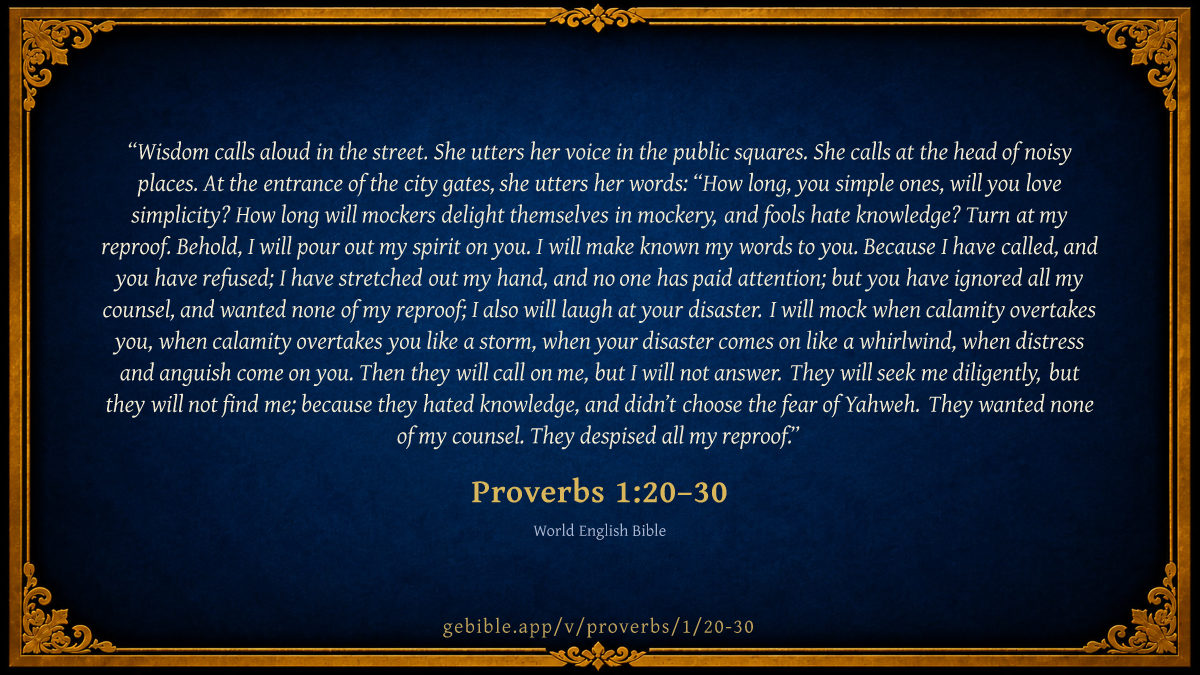
Wisdom calls aloud in the street. She utters her voice in the public squares.
She calls at the head of noisy places. At the entrance of the city gates, she utters her words:
“How long, you simple ones, will you love simplicity? How long will mockers delight themselves in mockery, and fools hate knowledge?
Turn at my reproof. Behold, I will pour out my spirit on you. I will make known my words to you.
Because I have called, and you have refused; I have stretched out my hand, and no one has paid attention;
but you have ignored all my counsel, and wanted none of my reproof;
I also will laugh at your disaster. I will mock when calamity overtakes you,
when calamity overtakes you like a storm, when your disaster comes on like a whirlwind, when distress and anguish come on you.
Then they will call on me, but I will not answer. They will seek me diligently, but they will not find me;
because they hated knowledge, and didn’t choose the fear of Yahweh.
They wanted none of my counsel. They despised all my reproof.
Geneva Bible translators 1599 · Public Domain On vv20, 22, 26, 27, 28, 30 So that none can pretend ignorance.
So that none can pretend ignorance.
This wisdom is the eternal word of God.
Geneva Bible (1599) marginal notes — public domain.
John Trapp 1656 · Public Domain On vv20–30 Pro 1:20 Wisdom crieth without; she uttereth her voice…
Pro 1:20 Wisdom crieth without; she uttereth her voice in the streets:
Ver. 20. Wisdom.] Heb., Wisdoms: that is, the most absolute and sovereign wisdom, the Lord Jesus, "in whom are hid all the treasures of wisdom and knowledge," {Col 2:3} who also "is made unto us of God wisdom, righteousness," &c. {1Co 1:30}
Read full note →
Crieth without.] The Hebrew word signifies often to shout for joy. {Psa 81:2 Lev 9:24} Christ surely cried sweetly, "the roof of his mouth was like the best wine that goeth down sweetly"; {Son 7:9} "with a desire did he desire" our salvation, though he well knew it should cost him so very dear. {Luk 22:15}
She uttereth her voice.] Verbis non solum desertis, red et exertis. "In the last day, that great day of the feast, Jesus stood and cried, saying, If any man thirst, let him come unto me and drink." {Joh 7:37}
John Trapp, A Commentary or Exposition upon All the Books of the Old and New Testament (1647–1656) — public domain. Text from a community e-Sword module.
Matthew Poole 1685 · Public Domain On vv20–30 Having expressed the counsels and invitations of folly and…
Having expressed the counsels and invitations of folly and of wicked men, he now declareth the voice of wisdom. By the name of wisdom or wisdoms he seems to understand the wisdom or counsel of God revealed to the sons of men by his word. Which he calls wisdoms here, as also Pro 9:1, either to note the excellency of this wisdom beyond all other, as the greatest and chief of beasts is called behemoth or beasts, Job 40:15; or because it consisteth of a multitude of wise precepts; or because it hath been delivered to mankind at sundry times, and in divers manners, and by many persons, prophets and apostles, and especially by the Son of God, who is called the wisdom of God, Luk 11:49. And this wisdom is said to cry with a loud voice, to intimate both God’s earnestness in inviting sinners to repentance, and their inexcusableness if they do not hear such loud cries. Without, or abroad, or in the streets or open places, as many others render it, and as it is in the next clause. Not in corners and privily, as seducers persuade men to error or wickedness, being afraid of the light, but openly and publicly before all the world.
Matthew Poole's English Annotations on the Holy Bible (1683–1685) — public domain. Text from a community e-Sword/MySword module.
Matthew Henry 1710 · Public Domain On v20 Solomon, having shown how dangerous it is to hearken…
Solomon, having shown how dangerous it is to hearken to the temptations of Satan, here shows how dangerous it is not to hearken to the calls of God, which we shall for ever rue the neglect of. Observe,
I. By whom God calls to us - by wisdom. It is wisdom that crieth without. The word is plural - wisdoms, for, as there is infinite wisdom in God, so there is the manifold wisdom of God, Eph 3:10. God speaks to the children of men by all the kinds of wisdom, and, as in every will, so in every word, of God there is a counsel. 1. Human understanding is wisdom, the light and law of nature, the powers and faculties of reason, and the office of conscience, Job 38:36. By these God speaks to the children of men, and reasons with them. The spirit of a man is the candle of the Lord; and, wherever men go, they may hear a voice behind them, saying, This is the way; and the voice of conscience is the voice of God, and not always a still small voice, but sometimes it cries. 2. Civil government is wisdom; it is God's ordinance; magistrates are his viceregents [viceregents?]. God by David had said to the fools, Deal not foolishly, Psa 75:4. In the opening of the gates, and in the places of concourse, where courts were kept, the judges, the wisdom of the nation, called to wicked people, in God's name, to repent and reform. 3. Divine revelation is wisdom; all its dictates, all its laws, are wise as wisdom itself. God does, by the written word, by the law of Moses, which sets before us the blessing and the curse, by the priests' lips which keep knowledge, by his servants the prophets, and all the ministers of this word, declare his mind to sinners, and give them warning as plainly as that which is proclaimed in the streets or courts of judicature by the criers. God, in his word, not only opens the case, but argues it with the children of men. Come, now, and let us reason together, Isa 1:18. 4. Christ himself is Wisdom, is Wisdoms, for in him are hidden all the treasures of wisdom and knowledge, and he is the centre of all divine revelation, not only the essential Wisdom, but the eternal Word, by whom God speaks to us and to whom he has committed all judgment; he it is therefore who here both pleads with sinners and passes sentence on them. He calls himself Wisdom, Luk 7:35.
Read full note →
II. How he calls to us, and in what manner. 1. Very publicly, that whosoever hath ears to hear may hear, since all are welcome to take the benefit of what is said and all are concerned to heed it. The rules of wisdom are published without in the streets, not in the schools only, or in the palaces of princes, but in the chief places of concourse, among the common people that pass and repass in the opening of the gates and in the city. It is comfortable casting the net of the gospel where there is a multitude of fish, in hopes that then some will be enclosed. This was fulfilled in our Lord Jesus, who taught openly in the temple, in crowds of people, and in secret said nothing (Joh 18:20), and charged his ministers to proclaim his gospel on the housetop, Mat 10:27. God says (Isa 45:19), I have not spoken in secret. There is no speech or language where Wisdom's voice is not heard. Truth seeks not corners, nor is virtue ashamed of itself. 2. Very pathetically; she cries, and again she cries, as one in earnest. Jesus stood and cried. She utters her voice, she utters her words with all possible clearness and affection. God is desirous to be heard and heeded.
III. What the call of God and Christ is.
1. He reproves sinners for their folly and their obstinately persisting in it, Pro 1:22. Observe, (1.) Who they are that Wisdom here reproves and expostulates with. In general, they are such as are simple, and therefore might justly be despised, such as love simplicity, and therefore might justly be despaired of; but we must use the means even with those that we have but little hopes of, because we know not what divine grace may do. Three sorts of persons are here called to: - [1.] Simple ones that love simplicity. Sin is simplicity, and sinners are simple ones; they do foolishly, very foolishly; and the condition of those is very bad who love simplicity, are fond of their simple notions of good and evil, their simple prejudices against the ways of God, and are in their element when they are doing a simple thing, sporting themselves in their own deceivings and flattering themselves in their wickedness. [2.] Scorners that delight in scorning - proud people that take a pleasure in hectoring all about them, jovial people that banter all mankind, and make a jest of every thing that comes in their way. But scoffers at religion are especially meant, the worst of sinners, that scorn to submit to the truths and laws of Christ, and to the reproofs and admonitions of his word, and take a pride in running down every thing that is sacred and serious. [3.] Fools that hate knowledge. None but fools hate knowledge. Those only are enemies to religion that do not understand it aright. And those are the worst of fools that hate to be instructed and reformed, and have a rooted antipathy to serious godliness. (2.) How the reproof is expressed: "How long will you do so?" This implies that the God of heaven desires the conversion and reformation of sinners and not their ruin, that he is much displeased with their obstinacy and dilatoriness, that he waits to be gracious, and is willing to reason the case with them.
2. He invites them to repent and become wise, Pro 1:23. And here, (1.) The precept is plain: Turn you at my reproof. We do not make a right use of the reproofs that are given us for that which is evil if we do not turn from it to that which is good; for for this end the reproof was given. Turn, that is, return to your right mind, turn to God, turn to your duty, turn and live. (2.) The promises are very encouraging. Those that love simplicity find themselves under a moral impotency to change their own mind and way; they cannot turn by any power of their own. To this God answers, "Behold, I will pour out my Spirit unto you; set yourselves to do what you can, and the grace of God shall set in with you, and work in you both to will and to do that good which, without that grace, you could not do." Help thyself, and God will help thee; stretch forth thy withered hand, and Christ will strengthen and heal it. [1.] The author of this grace is the Spirit, and that is promised: I will pour out my Spirit unto you, as oil, as water; you shall have the Spirit in abundance, rivers of living water, Joh 7:38. Our heavenly Father will give the Holy Spirit to those that ask him. [2.] The means of this grace is the word, which, if we take it aright, will turn us; it is therefore promised, "I will make known my words unto you, not only speak them to you, but make them known, give you to understand them." Note, Special grace is necessary to a sincere conversion. But that grace shall never be denied to any that honestly seek it and submit to it.
3. He reads the doom of those that continue obstinate against all these means and methods of grace. It is large and very terrible, Pro 1:24-32. Wisdom, having called sinners to return, pauses awhile, to see what effect the call has, hearkens and hears; but they speak not aright (Jer 8:6), and therefore she goes on to tell them what will be in the end hereof.
(1.) The crime is recited and it is highly provoking. See what it is for which judgment will be given against impenitent sinners in the great day, and you will say they deserve it, and the Lord is righteous in it. It is, in short, rejecting Christ and the offers of his grace, and refusing to submit to the terms of his gospel, which would have saved them both from the curse of the law of God and from the dominion of the law of sin. [1.] Christ called to them, to warn them of their danger; he stretched out his hand to offer them mercy, nay, to help them out of their miserable condition, stretched out his hand for them to take hold of, but they refused and no man regarded; some were careless and never heeded it, nor took notice of what was said to them; others were wilful, and, though they could not avoid hearing the will of Christ, yet they gave him a flat denial, they refused, Pro 1:24. They were in love with their folly, and would not be made wise. They were obstinate to all the methods that were taken to reclaim them. God stretched out his hand in mercies bestowed upon them, and, when those would not work upon them, in corrections, but all were in vain; they regarded the operations of his hand no more than the declarations of his mouth. [2.] Christ reproved and counselled them, not only reproved them for what they did amiss, but counselled them to do better (those are reproofs of instruction and evidences of love and good-will), but they set at nought all his counsel as not worth heeding, and would none of his reproof, as if it were below them to be reproved by him and as if they had never done any thing that deserved reproof, Pro 1:25. This is repeated (Pro 1:30): "They would none of my counsel, but rejected it with disdain; they called reproofs reproaches, and took them as an insult (Jer 6:10); nay, they despised all my reproof, as if it were all a jest, and not worth taking notice of." Note, Those are marked for ruin that are deaf to reproof and good counsel. [3.] They were exhorted to submit to the government of right reason and religion, but they rebelled against both. First, Reason should not rule them, for they hated knowledge (Pro 1:29), hated the light of divine truth because it discovered to them the evil of their deeds, Joh 3:20. They hated to be told that which they could not bear to know. Secondly, Religion could not rule them, for they did not choose the fear of the Lord, but chose to walk in the way of their heart and in the sight of their eyes. They were pressed to set God always before them, but they chose rather to cast him and his fear behind their backs. Note, Those who do not choose the fear of the Lord show that they have no knowledge.
(2.) The sentence is pronounced, and it is certainly ruining. Those that will not submit to God's government will certainly perish under his wrath and curse, and the gospel itself will not relieve them. They would not take the benefit of God's mercy when it was offered them, and therefore justly fall as victims to his justice, Pro 29:1. The threatenings here will have their full accomplishment in the judgment of the great day and the eternal misery of the impenitent, of which yet there are some earnests in present judgments. [1.] Now sinners are in prosperity and secure; they live at ease, and set sorrow at defiance. But, First, Their calamity will come (Pro 1:26); sickness will come, and those diseases which they shall apprehend to be the very arrests and harbingers of death; other troubles will come, in mind, in estate, which will convince them of their folly in setting God at a distance. Secondly, Their calamity will put them into a great fright. Fear seizes them, and they apprehend that bad will be worse. When public judgments are abroad the sinners in Zion are afraid, fearfulness surprises the hypocrites. Death is the king of terrors to them (Job 15:21, etc.; Job 18:11, etc.); this fear will be their continual torment. Thirdly, According to their fright will it be to them. Their fear shall come (the thing they were afraid of shall befal them); it shall come as desolation, as a mighty deluge bearing down all before it; it shall be their destruction, their total and final destruction; and it shall come as a whirlwind, which suddenly and forcibly drives away all the chaff. Note, Those that will not admit the fear of God lay themselves open to all other fears, and their fears will not prove causeless. Fourthly, Their fright will then be turned into despair: Distress and anguish shall come upon them, for, having fallen into the pit they were afraid of, they shall see no way to escape, Pro 1:27. Saul cries out (Sa2 1:9), Anguish has come upon me; and in hell there is weeping, and wailing, and gnashing of teeth for anguish, tribulation and anguish to the soul of the sinner, the fruit of the indignation and wrath of the righteous God, Rom 2:8, Rom 2:9. [2.] Now God pities their folly, but he will then laugh at their calamity (Pro 1:26): "I also will laugh at your distress, even as you laughed at my counsel." Those that ridicule religion will thereby but make themselves ridiculous before all the world. The righteous will laugh at them (Psa 52:6), for God himself will. It intimates that they shall be for ever shut out of God's compassions; they have so long sinned against mercy that they have now quite sinned it away. His eye shall not spare, neither will he have pity. Nay, his justice being glorified in their ruin, he will be pleased with it, though now he would rather they should turn and live. Ah! I will ease me of my adversaries. [3.] Now God is ready to hear their prayers and to meet them with mercy, if they would but seek to him for it; but then the door will be shut, and they shall cry in vain (Pro 1:28): "Then shall they call upon me when it is too late, Lord, Lord, open to us. They would then gladly be beholden to that mercy which now they reject and make light of; but I will not answer, because, when I called, they would not answer;" all the answer then will be, Depart from me, I know you not. This has been the case of some even in this life, as of Saul, whom God answered not by Urim or prophets; but, ordinarily, while there is life there is room for prayer and hope of speeding, and therefore this must refer to the inexorable justice of the last judgment. Then those that slighted God will seek him early (that is, earnestly), but in vain; they shall not find him, because they sought him not when he might be found, Isa 55:6. The rich man in hell begged, but was denied. [4.] Now they are eager upon their own way, and fond of their own devices; but then they will have enough of them (Pro 1:31), according to the proverb, Let men drink as they brew; they shall eat the fruit of their own way; their wages shall be according to their work, and, as was their choice, so shall their doom be, Gal 6:7, Gal 6:8. Note, First, There is a natural tendency in sin to destruction, Jam 1:15. Sinners are certainly miserable if they do but eat the fruit of their own way. Secondly, Those that perish must thank themselves, and can lay no blame upon any other. It is their own device; let them make their boast of it. God chooses their delusions, Isa 66:4. [5.] Now they value themselves upon their worldly prosperity; but then that shall help to aggravate their ruin, Pro 1:32. First, They are now proud that they can turn away from God and get clear of the restraints of religion; but that very thing shall slay them, the remembrance of it shall cut them to the heart. Secondly, They are now proud of their own security and sensuality; but the ease of the simple (so the margin reads it) shall slay them; the more secure they are the more certain and the more dreadful will their destruction be, and the prosperity of fools shall help to destroy them, by puffing them up with pride, gluing their hearts to the world, furnishing them with fuel for their lusts, and hardening their hearts in their evil ways.
4. He concludes with an assurance of safety and happiness to all those that submit to the instructions of wisdom (Pro 1:33): "Whoso hearkeneth unto me, and will be ruled by me, he shall," (1.) "Be safe; he shall dwell under the special protection of Heaven, so that nothing shall do him any real hurt." (2.) "He shall be easy, and have no disquieting apprehensions of danger; he shall not only be safe from evil, but quiet from the fear of it." Though the earth be removed, yet shall not they fear. Would we be safe from evil, and quiet from the fear of it? Let religion always rule us and the word of God be our counsellor. That is the way to dwell safely in this world, and to be quiet from the fear of evil in the other world.
Matthew Henry's Commentary on the Whole Bible (1708–1710) — public domain (CC PDM 1.0). Text via the HelloAO Bible API.
John Gill 1763 · Public Domain On vv20–30 Wisdom crieth without,.... Here the person instructing throughout this…
Wisdom crieth without,.... Here the person instructing throughout this whole book is represented under the name of "Wisdom"; by which we are to understand not the attribute of divine wisdom displayed in the works of creation; nor the light of nature in man; nor the law of Moses given to the Israelites; nor the revelation of the divine will in general, as it is delivered out in the sacred Scriptures; nor the Gospel, and the ministry of it, in particular; but our Lord Jesus Christ; for the things spoken of Wisdom, and ascribed to it in this book, especially in the eighth and ninth chapters, show that a divine Person is intended, and most properly belong to Christ; who may be called "Wisdoms" (b), in the plural number, as in the Hebrew text, because of the consummate and perfect wisdom that is in him; as he is a divine Person, he is "the Logos", the Word and Wisdom of God; as Mediator, "all the treasures of wisdom and knowledge are hid" in him, Col 2:3; and, as man, "the Spirit of Wisdom" rests upon him without measure, Isa 11:2. This, with what follows to the end of the chapter, is a prophecy of the ministry of Christ in the days of his flesh, and of the success of it; and of the calamities that should come upon the Jews for the rejection of him: and Wisdom is here said to "cry", as Christ did, Joh 7:28; the word signifies to cry both in a sorrowful way, as Jesus did when he cried to Jerusalem, weeping over it, Mat 23:37; and in a joyful one, which well suits with the Gospel, as preached by him; a joyful sound expressed by piping, in opposition to John's ministry, which was a mournful one, Mat 11:17; for crying here means no other than the preaching of the word; which is such a cry as that of heralds, when they publicly proclaim peace or war; so Wisdom or Christ, is said to "proclaim liberty to the captives", and "the acceptable year of the Lord", Isa 61:1. This cry was made "without" the city of Jerusalem, and without that part of the country which was properly called Jewry; Christ first preached in the land of Galilee; or this may mean the Gentile world, where Christ preached, though not in person, yet by his apostles, whom he sent into all the world to preach the Gospel to every creature;
she uttereth her voice in the streets: of the city of Jerusalem, and other places; nor is this contrary to Mat 12:19; which is to be understood of crying in a bawling and litigious way, of lifting up the voice in self-commendation, neither of which Christ did; and yet might cry and utter his voice in the streets, that is, publicly preach his Gospel there, as he did; and he also sent his servants into the streets and lanes of the city to call in sinners by the ministry of the word, Luk 14:21; which perhaps may be meant of places in the Gentile world; nor is this sense to be excluded here; it may be figuratively understood of the public ministration of the word and ordinances in the church called the streets and broad ways of it, Sol 3:2.
Read full note →
(b) "sapientiae", Montanus, Vatablus, Mercerus, Cocceius, Michaelis.
John Gill's Exposition of the Whole Bible (1746–1763) — public domain (CC PDM 1.0). Text via the HelloAO Bible API.
John Wesley 1765 · Public Domain On vv20, 21, 22, 23, 24, 26, 28, 29 Wisdom - Having expressed the counsels of wicked men,…
Wisdom - Having expressed the counsels of wicked men, he now declares the voice of wisdom. By wisdom he understands the wisdom of God revealed to men in his word. And this is said to cry with a loud voice, to intimate God's earnestness in inviting sinners to repentance. Abroad - Or, in the streets or open places. Not in corners, but openly before all the world.
John Wesley, Explanatory Notes Upon the Whole Bible (1754–1765) — public domain. Text via the GEBible commentary corpus.
Adam Clarke 1810 · Public Domain On vv20, 22, 23, 24, 27, 29 Verse 20. Wisdom crieth] Here wisdom is again personified,…
Verse 20. Wisdom crieth] Here wisdom is again personified, as it is frequently, throughout this book; where nothing is meant but the teachings given to man, either by Divine revelation or the voice of the Holy Spirit in the heart. And this voice of wisdom is opposed to the seducing language of the wicked mentioned above. This voice is everywhere heard, in public, in private, in the streets, and in the house. Common sense, universal experience, and the law of justice written on the heart, as well as the law of God, testify against rapine and wrong of every kind.
Adam Clarke's Commentary on the Bible (1810–1826) — public domain. Text from a community e-Sword/MySword module.
Joseph Benson 1811 · Public Domain On vv20, 21, 22, 24, 29 Pro 1:20. Wisdom crieth, &c. — Having shown the…
Pro 1:20. Wisdom crieth, &c. — Having shown the counsels and invitations of folly and of wicked men, he now declares the voice of wisdom. The Hebrew word חכמות, rendered wisdom here, is in the plural number, and is literally wisdoms. It was probably intended to include various kinds, or, rather, all the kinds of Wisdom 1 st, The works of creation, (see on Psa 19:1-6,) the light and law of nature, the dispensations of divine providence, the human understanding, are wisdom, Job 38:36. By these God speaks to the children of men, and reasons with them; the spirit of man is the candle of the Lord, and wherever men go they may hear a voice behind them saying, This is the way; and the voice of conscience is the voice of God, and not always a small, still voice; but sometimes it cries aloud. 2d, Human laws, and the institutions of civil governments, when they do not contradict, but accord with, the divine law, and especially when they enjoin and encourage obedience to it, and punish the disobedient, are the voice of wisdom crying without; even in the opening of the gates, and in the places of concourse, where courts were kept, where the judges sat, and where the wisdom of the nation called the wicked to repent and reform. In a still higher degree, 3d, Divine revelation is wisdom. All its doctrines, its precepts, its promises, its threatenings, are the dictates of infinite wisdom; and where this is published and made known to any people in their own language, and more especially when it is declared, explained, and enforced by God’s ministers, whether in churches, chapels, private houses, or in the open air, there wisdom cries without, and utters her voice in the streets. 4th, Above all, Christ is wisdom, even the wisdom and word of God incarnate, for in him are hid all the treasures of wisdom and knowledge, and he was, and is, the centre and source of all divine revelation; the person in whom all its doctrines, precepts, and promises are yea and amen. And he, in the days of his flesh, continually cried without, and uttered his voice in the streets. Of him, therefore, Solomon’s words may with great propriety be interpreted, whether he directly intended to prophesy of him and his personal ministry or not, especially considering that the original words are expressed in the future time, thus: Wisdom shall cry without: she shall utter her voice in the streets — Or, in open and broad ways or places, as רחבות, signifies. Wisdom, understood in any or all these senses, is said to cry, or speak with a loud voice, to intimate both God’s earnestness in inviting sinners to repentance, and their inexcusableness if they do not hear such loud cries: and she is said to cry without, or abroad, in opposition to the seducing discourses and efforts of sinners, who lay snares for persons in secret, who conceal themselves and their intentions, and address men in corners and privily, being afraid of and shunning the light, that they may the better deceive and seduce men to error and wickedness. On the contrary, wisdom lifteth up her voice in the streets; for she does not invite to murders, to violence, to injustice, to crimes, commonly fatal to those who commit them; but to God, and to the highest good. She discovers the ways which lead to extreme misery, in order that men may avoid them; she recalls men from their errors and sins, and threatens them with ruin if they despise her. Again, by saying that wisdom lifts up her voice in public places, Solomon prevents the poor excuse made by those who ask, Where shall we find this wisdom? He answers, She is everywhere: all that surrounds you preaches to you this wisdom. You need only open your eyes and ears, and you see and hear her. Do you behold evil, scandal, disorder? Avoid doing it. Do you hear good discourses; do you see good examples? Hear, imitate, and profit by them; “the wise learn much more from fools,” says a heathen, “than fools learn from the wise.” See Schultens and Calmet.
Joseph Benson's Commentary on the Old and New Testaments (1811–1818) — public domain. Text from a community e-Sword module.
Albert Barnes 1834 · Public Domain On vv20, 22, 23, 24, 26, 27, 29 Wisdom is personified. In the Hebrew the noun is…
Wisdom is personified. In the Hebrew the noun is a feminine plural, as though this Wisdom were the queen of all wisdoms, uniting in herself all their excellences. She lifts up her voice, not in solitude, but in the haunts of men “without,” i. e., outside the walls, in the streets, at the highest point of all places of concourse, in the open space of the gates where the elders meet and the king sits in judgment, in the heart of the city itself Pro 1:21; through sages, lawgivers, teachers, and yet more through life and its experiences, she preaches to mankind. Socrates said that the fields and the trees taught him nothing, but that he found the wisdom he was seeking in his converse with the men whom he met as he walked in the streets and agora of Athens.
Albert Barnes' Notes on the Bible (1834–1885) — public domain. Text from a community e-Sword/MySword module.
Charles Bridges 1846 · Public Domain On vv20, 24 A Father’s instruction has warned us against the enticement…
A Father’s instruction has warned us against the enticement of Satan. Wisdom — the Son of God himself, now invites us, — in all the plenitude of his Divine authority and grace.†1 Full of yearning love to sinners, he crieth, not only in the temple, but without in the streets, in the chief place of concourse, in the openings of the gates (Compare Pro 8:1-5 . Mat 13:2-3 . Joh 7:37-39 ; Joh 18:20-21 . Psa 40:9-10 ) — How long? Simplicity is another term for folly. It is the temper of mind of those that fear not God. They weigh not what they say or do. They live as if there were neither God nor eternity. Their understandings are blinded by the love of sin. In other cases man delights, not in his ignorance, but in its removal. But these simple ones, ignorant of the value and danger of their souls, love simplicity. They consider all endeavours to enlighten them, as breaking in upon an indulgent repose, and exciting a groundless alarm. For while they live riotously, slothfully, or licentiously, "they consider not in their hearts, that God remembereth all their wickedness," and "that for all these things he will bring them into judgment." (Hos 7:2 . Ecc 11:9 .) They are encouraged by a few more furious than themselves — scorners — who have neither fear nor shame, remorse of heart, nor decency of manner; who take an active delight in their scorning: shooting their poisoned arrows against godliness. (See Psa 64:3-4 .) All earnestness in religion is with them a weakness unworthy of sensible men. The very Scripture terms are revolting. A saint in Scripture means one sanctified by the Spirit of God. With them it means a foolish person or a hypocrite. Their souls are too high to stoop to the vulgar thoughts and habits of the gospel of Christ. Thus do they prove themselves (both the indolent mass of the simple ones, and their scornful leaders) to be fools, that hate knowledge. (Pro 1:7, Pro 1:29-30 . Job 21:14 ; Job 24:13 .) Aiming to keep out alarm, with it they shut out all that would make them wise and happy. If they hate the knowledge of their lost condition, they exclude all that follows upon it, to make them "wise unto salvation." Of other knowledge they have often too much: mischievous, as keeping out better things; giving them an evil eye, filling the soul with darkness; making them "hate the light, so that they will not come to the light, lest their deeds should be reproved." (Joh 3:19-20 .)
Our Lord deals with this case on the perfect freeness of the gospel. He would melt down the hardness by pleading remonstrance — How long? (Compare Mat 23:37 . Luk 19:41-42 .) He sweeps away all the suggestions of unbelief, all the heartless excuses of indolence, by inviting promises — Turn at my reproof. ’I cannot turn myself.’ But I will pour out my Spirit as a living fountain unto you. And — as the consequence of this blessing — I will make known my words unto you. The Bible, before a dark and sealed book, shall be made clear to you. ’I offer to you both my word outwardly to your ears, and a plentiful measure of my Spirit inwardly to your heart, to make that word effectual to you.’†2
Read full note →
But we are often told, that all the illumination to be expected in our day is the written word, interpreted, like every other book, by our own reason; and that the Spirit’s teaching is an enthusiastic delusion. Now this may pass with the simple and the scorner — who know nothing of the blindness of their hearts, and of the power of natural prejudice, which Divine grace alone can conquer. But the man that knows his own darkness, and that nothing less than the power of God can teach him — he will — he must "cry for knowledge, and lift up his voice for understanding" (Pro 2:3 ); not because the word is dark (for it is light itself), but because he is dark, and therefore utterly unable to receive its instructions. (1Co 2:9-14 .) We do not want a new revelation, we only want a Divine Teacher, we want the pouring out of the Spirit to make known the word. The word is the same Divine word as before. But it was not understood, discerned, not therefore practically effectual. Now there is joy, a power and sweetness, of which before we had no conception. It humbled us in the sense of our ignorance, and makes us pant for more of its heavenly light and influence.
But the proud caviller complains of God, as if he reckoned with him for a blindness and inability, which he cannot help, — innate without his consent. "Nay, but O man, who are thou that repliest against God?" (Rom 9:20 .) He at once answers this Satanic plea, by offering to you present, suitable, and sufficient relief. He meets you on your way to condemnation with the promise of free and full forgiveness. (Isa 1:18 ; Isa 43:23, Isa 43:26 .) Your plea will be of force, when you have gone to him, and found him wanting. The power indeed is of him. But he hath said — "Ask, and it shall be given you." (Mat 7:7 .) If your helplessness is a real grievance, bring it to him with an honest desire to be rid of it. If you have never prayed, now is the time for prayer. If you cannot pray, at least make the effort. Stretch out the withered hand in the obedience of faith. (Mar 3:5 .) If your heart be hard, your convictions faint, your resolutions unsteady; all is provided in the promise — I will pour out my Spirit upon you. Move then, and act in dependence upon the Almighty Mover and Agent. (Compare Php 2:12-13 .) Christian experience explains a mystery unfathomable to human reason. It harmonizes man’s energy and God’s grace. There is no straitening, no exclusion, with God. His promises with one mouth assure a welcome to the willing heart. If it cannot move, his Spirit can compel, point, draw it to the Savior. Yea, in the desire to turn, has not the Savior already touched it, and drawn it to himself?
But remember — the call — How long? is to an instant conversion; not to the consideration or resolution of the morrow, but to the decision of today. Delay is mockery of God. "Quench not the Spirit" now striving, but which "will not always strive with man." (1Th 5:19 . Gen 6:3 .) Add not thus to the mass of guilt ready to sink you into perdition.
Footnotes
†1 The cry, the chief place of concourse, the outpouring fountain of the Spirit, are identified, Joh 7:37-39 . This very remonstrance, accompanied, as here, with a stirring invitation, is also given in prophecy from the Savior’s own mouth. Isa 55:1-3 . The terms of the promise forbid any other than a personal application. We can easily conceive a spirit to have wisdom. But that an attribute of wisdom may dispense his Spirit or influence to others, is beyond conception. Moreover, the Messiah assumed this personal title (Mat 23:34, with Luk 11:49 ); and his apostle expressly gives it to him (1Co 1:24 ). The plural noun joined with the singular verb (mar. Compare Pro 9:1 ) seems to point him out as the author and whole substance of all wisdom; ’the very wisdom of the most wise God, "in whom are hid all the treasures of wisdom and knowledge," and by whom rivers of wisdom are poured into man by the word.’ (Glass Lib 3. Tract. i Can. 24.) The future tense in the original may possibly give a prophetic character to the proclamation. Altogether, ’this interpretation gives to the exhortation of Wisdom a peculair majesty and emphasis; setting forth the eternal uncreated Wisdom of the Father, using all means to draw men to God; both by his works and by his word, inviting all men to know the truth.’ — Scott. Bishop Hall. Compare notes on Pro 1:24 . Pro 8:1 .
†2 Bishop Hall.
Charles Bridges, An Exposition of the Book of Proverbs (1846) — public domain. Text from a community e-Sword module.
Haydock's Catholic Bible Commentary 1859 · Public Domain On vv20, 22, 26, 28, 30 Streets. In every place we may learn wisdom. "The…
Streets. In every place we may learn wisdom. "The wise learn more from fools, than fools do from the wise," as Cato well observed. (Calmet)
George Leo Haydock (1774–1849), Haydock's Catholic Family Bible and Commentary, 1859 edition — public domain. Excludes Psalms (Douay-Rheims chapter numbering differs from Protestant) and Deuterocanonical books (Catholic canon only).
Robert Jamieson, A. R. Fausset & David Brown 1871 · Public Domain On vv20–29 Some interpreters regard this address as the language of…
Some interpreters regard this address as the language of the Son of God under the name of Wisdom (compare Luk 11:49). Others think that wisdom, as the divine attribute specially employed in acts of counsel and admonition, is here personified, and represents God. In either case the address is a most solemn and divine admonition, whose matter and spirit are eminently evangelical and impressive (see on Pro 8:1).
Wisdom--literally, "Wisdoms," the plural used either because of the unusual sense, or as indicative of the great excellency of wisdom (compare Pro 9:1).
Read full note →
streets--or most public places, not secretly.
Jamieson, Fausset & Brown — Commentary Critical and Explanatory on the Whole Bible (1871) — public domain (CC PDM 1.0). Text via the HelloAO Bible API.
Daniel D. Whedon 1874 · Public Domain On vv20, 22, 23, 24, 25, 26, 27, 28, 29, 30 THE EXHORTATION, INVITATION, AND WARNINGS OF WISDOM, Pro_1:20-33.
THE EXHORTATION, INVITATION, AND WARNINGS OF WISDOM, Pro_1:20-33.
20, 21. Having thus admonished his pupil of the dangers of yielding to the seducing invitations of rapacious and violent men, and shown him the wickedness, folly, and fearful results of such a course of life, he now exhorts him, on the other hand, to listen to the voice of WISDOM, which he personifies and represents as crying earnestly and persistently in his ears, pressing upon him her counsels, and urging her admonitions.
Read full note →
Wisdom crieth without — חכמות, (hhokmoth,) a plural, but with a verb singular, a poetic form, perhaps, but one by which the Hebrews sometimes expressed the greatness or excellence of a thing, or gave intensity to the subject: (so with the name Elohim, (God,) which is commonly thus used; as much as to say:) The voices of Wisdom are heard all abroad, but especially in the crowded marts of men, in the streets, in the public squares, or in the openings, or spaces about the gates, which were great places of concourse and of business; the courts were also held there.
In the city — In every part of it.
She uttereth her words — Among all classes of men. You need not ask, Where shall I find Wisdom? Open your eyes and see her, your ears and hear her. She is preaching aloud all the time, from every text. the wisdom of the wise, the folly of fools, the righteousness of the righteous, and the wickedness of the wicked; from the character and conduct of all sorts of men, and from the consequence of their actions. Hear, see, and profit by all you meet with amid the busy, bustling throngs. Be taught even by the follies of mankind, for wise men learn more from fools than fools learn from the wise.
Daniel D. Whedon (gen. ed.), Commentary on the Old and New Testaments (1874–1909) — public domain. Text from a community e-Sword module.
The Cambridge Bible for Schools and Colleges 1878 · Public Domain On vv20, 21, 22, 23, 24, 26, 27, 28 Second Address. Warning against Neglecting the Appeal of Wisdom.…
Second Address. Warning against Neglecting the Appeal of Wisdom. Chap. 1. Pro_1:20-33
20. crieth] Rather, crieth aloud, R.V.
Read full note →
without] Rather, in the street, R.V. The expression is sometimes used adverbially, without or abroad; but the parallelism here, in the broad places, points to the literal rendering.
There is perhaps a designed contrast between the secret enticing of sinners (Pro_1:10) and the open call of Wisdom.
the streets] Rather, the broad places, R.V.
The Cambridge Bible for Schools and Colleges (gen. ed. J. J. S. Perowne; Cambridge University Press, 1878–1918) — public domain. Text from a community e-Sword module.
Ellicott's Commentary for English Readers 1878 · Public Domain On vv20, 21, 22, 23, 24, 26, 28 (b) Second Discourse:—Wisdom Addresses her Despisers (Pro_1:20-33).
(b) Second Discourse:—Wisdom Addresses her Despisers (Pro_1:20-33).
(20) Wisdom.—The form of the Hebrew term (chokhmôth) has been taken for an abstract singular noun, but probably it is the plural of chokhmah (Pro_1:2), signifying the multiform excellences of wisdom. It is possible that Solomon may have originally meant in this passage only to describe, in highly poetic language, the influence and work in their generation of those in whom “the fear of the Lord” dwells. So, too, many of the Psalms (Psalms 45, for example), in the first instance it would seem, are intended to describe the excellence of some earthly saint or king, yet they are completely fulfilled only in the Son of man, the ideal of all that is noblest and best in man. And thus the description of Wisdom in her manifold activity, as represented in Proverbs 1, 8, 9, so closely corresponds to the work of our Lord, as depicted in the New Testament, that from the earliest times of Christianity these passages have been held to be a prophecy of Him; and there is good reason for such a view. For a comparison of Luk_11:49 (“Therefore also said the wisdom of God, Behold, I send,” &c.) with Mat_23:34 (where He says, “Behold, I send”) would seem to show that He applied the title to Himself. St. Paul in like manner speaks of Him as the “Wisdom of God” (1Co_1:24); says He has been “made unto us wisdom” (1Co_1:30); and that in Him “are hid all the treasures of wisdom” (Col_2:3). For passages from the Fathers embodying this view, see references in Bishop Wordsworth on this chapter.
A Bible Commentary for English Readers, edited by Charles John Ellicott (1878–1897) — public domain. Text from a community e-Sword module.
The Pulpit Commentary 1880 · Public Domain On vv20–29 Vers. 20-33. 2. Second admonitory discourse. Address of Wisdom…
Vers. 20-33. 2. Second admonitory discourse. Address of Wisdom personified, exhibing the folly of those who wilfully reject, and the security of those who hearken to, her counsels. The sacred writer, in this section, as also in Pr 8, uses the rhetorical figure of prosopopceia, or impersonation. Wisdom is represented as speaking and as addressing the simple, scorners, and fools. The address itself is one of the noblest specimens of sacred eloquence, expressing in rapid succession the strongest phases of feeling pathetic solicitude with abundant promise, indignant scorn at the rejection of her appeal, the judicial severity of offended majesty upon offenders, and lastly the judicial complacency which delights in mercy towards the obedient. The imagery in part is taken from the forces of nature in their irresistible and overwhelming violence and destructive potency.
Wisdom crieth without. Wisdom. The Hebrew word (khochmoth) here used to designate Wisdom seems to be an abstract derivation from the ordinary khochmah. The form is peculiar to the Proverbs and Psalms, in the former occurring four times, (Pro_1:22 Pro_9:1 Pro_14:1 Pro_24:7) and in the latter twice only. (viz. Psa_49:4 Psa_78:15) As in Pro_9:1 and Pro_24:7, it is a pluralis excellentiae of the feminine gender, a variety of the pluralis extensivus, as Bottcher prefers to denominate it. The feminine form may he determined by the general law which associates purity and serenity with womanhood (Plumptre). The idea of plurality, however, is not that of extension, but of comprehension, i.e. it is not so much all kinds of wisdom which is presented to us, as all the varieties under which wisdom par excellence may be regarded and is comprehended. The plural form of the word denotes the highest character or excellence in which wisdom can be conceived; or, as the marginal reading expresses it, wisdoms, i.e. excellent wisdom. Other instances of the pluralis excellentiae are met with in Holy Writ, e.g. Elohim, God, i.e. "God of Gods," either from the polytheistic view, or from the monotheistic view as expressive of God"s might in manifestation, passim; k"doshim, "the Holy (God)," Pro_9:10 Pro_30:3; adonim, for adon "lord" (Gesenius, "Gram.," 2 b). In the conception of Wisdom here presented to us in the text we have the germ of an idea which, on the principles of expansion, developed subsequently in the consciousness of the Christian Church into a definite identification of Wisdom with the Second Person of the blessed Trinity. There is a striking parallel to this passage in Luk_11:49, where Christ speaks of himself as h Sofia tou Yeou , "the Wisdom of God," that shall send prophets and apostles into the world, and thereby identifies himself with Wisdom (cf. this with vers. 20, 21 Pr 7). Again, a striking similarity is observable between the teaching of Divine Wisdom and that of the Incarnate Word, as much in their promises as in their threats and warnings. But it is difficult to determine with accuracy to what extent the Messianic import of the personification was present to the consciousness of the sacred writers, and whether Wisdom as here presented to us is simply a poetic and abstract personification or a distinct by-postatizing of the Word. Dorner ("Pers. of Christ," Introd., p. 16), with reference to Pro_8:22, etc., says that though Wisdom is introduced speaking as a personality distinct from God, still the passage does not lead clearly to a hypostatizing of the Khochmah. Dollinger ("Heidenthum und Judenthum," bk. 10. pt. 3. sec. 2 a, and Pro_8:22, etc.) maintains that Wisdom is "the personified idea of the mind of God in creation," rather than the presence of "a distinct hypostasis." Lucke (see references in Liddon, "Bampton Lects.") holds that in Proverbs Wisdom is merely a personification It is clear that whatever is predicated of Wisdom in Pr 8 must be also predicated of her in the passage before us, in reference either to the hypostatic or opposite view. On the other hand, a large number of expositors, dating from the earliest periods of the Christian Church down to the present time, see in Wisdom a distinct hypostasis, or person the Lord Jesus Christ. A fuller investigation of this subject will be seen in our remarks on ch. 8. For the present we observe that Wisdom is essentially Divine. Her authority, her utterances, whether of promise, threat, scorn, or vengeance, are the authority, the utterances, of God. Crieth; rather, crieth loudly, or aloud. The Hebrew verb ranan (nr) is "to vibrate the voice," and conveys the idea of the clear loud ringing tones with which proclamations were made; cf. the Vulgate praedicare, and the Arabic clamitate, "to cry with a loud voice." Fleischer remarks that the Arabic rannan, which is allied to the Hebrew verb, is used of a speaker who has a clear piercing voice. In such a way does Wisdom cry without when making her address. She elevates her voice that all may hear. The verb in the original is tazonnah, the feminine singular of ranan, and predicate to "Wisdom," according to the rule that verbs in the singular are construed with plural nouns having a singular signification, especially the pluralis excellentiae (see Gesenius, "Gram.," 2). Without. xWhB (bakhuts) is here used adverbially, as in Gen_9:22, and signifies "in the open places," i.e. abroad, without, as opposed to the space within the walls. The writer here begins his enumeration of the five places wherein Wisdom preaches, viz.
Read full note →
(1) without,
(2) in the streets,
(3) in chief places of concourse,
(4) in the opening of the gates,
(5) in the city, all of which are public, and thus indicate the publicity of her announcements. (with those comp. Pro_8:1 Pro_9:3)
She uttereth her voice; or, causeth her voice to be beard; represented in the Vulgate by dat vocem suam. and in the LXX by parrhsian agei (equivalent to "she observes free-spokenness"). The instrumentality which Wisdom uses in her public preaching are the prophets and teachers (Ecc 24:33; Zockler, Vatablus, Mercerus). In the streets; literally, in the wide spares; the Hebrew, twObjor (rkhovoth), being, as in Gen_26:22, "wide spaces," and corresponding to the plateia of the LXX; plateae, Vulgate. The same places are indicated in Luk_14:21, where, in the parable of the marriage supper, the servants are bidden to go out into the streets (plateiai ) and lanes of the city. The word is connected with the adjective rakhav (bjr), "broad," "wide;" and in 2Ch_32:6 is used to designate the ample space at the gates of Oriental cities (Gesenius), though here it seems to refer rather to "squares," large open spaces, not uncommon in Oriental cities I saw one such at Aden or it may refer to the broad crowded thoroughfares. The Syriac reading, in compitis, gives a different sense, as compitum, equivalent to "crossroads.
Vers. 20-23. The gospel call.
This cry of Wisdom is a sort of evangel of the Old Testament religion. It is an anticipation of the gracious invitation subsequently put forth by the Christian truth. That, too, is a cry of Wisdom; for is not Christ the "Wisdom of God", (1Co_1:24) and "made unto us Wisdom"? (1Co_1:30) We of the latter times, therefore, may hear in the preaching of Solomon the call of the glorious gospel of the blessed God.
I THE CHARACTER OF THE CALL. It is a cry, a loud utterance, arresting attention, arousing the thoughtless. Elsewhere we read that wisdom must be sought for like hid treasures, (Pro_2:4) and her most precious gifts are always reserved for diligent inquirers. But before she is found, she calls. Though the choicest blessings of Christ may be pearls to be had only after long search, his call to us is antecedent to our desire to obtain them. God does not wait for us to return to him before he shows a willingness to welcome us. He calls at once in his revelation of truth. It is the duty of Christians to take up and repeat this call, to be heralds of a public truth, not jealous guardians of an esoteric doctrine.
II THE SCENE OF THE CALL.
1. Without. Before the truth can be enjoyed in the heart it must be heard from without. It is not reserved for the initiated. It is declared in the open.
2. In the streets. The gospel meets men in their busy lives. The streets and lanes must be scoured to furnish guests for the King"s feast, The call is too gracious to contain itself in the conventicle of the elect. Free as the air, it aims to reach all. The faithful preacher of the gospel must seek men in their haunts, not wait till they come to his snug retreat.
3. In the chief place of concourse. The gospel courts inquiry, it declares itself in the full light of day, it challenges comparison with all earthly voices. Let us not think that it can only live in conventual seclusion. It boldly claims a place in the busiest life of the world. If it cannot hold its own there, it is worthless. If Christians had more faith in it, they would be less afraid to bring this truth into all possible relations with science, politics, business, recreation. But alas! our ears are dull, and often when the voice of Wisdom is lifted up clear and kindly, it is drowned in the coarse din of worldly commotion.
III THE PERSONS CALLED. Simple ones, scorners, fools. Divine wisdom is healing wisdom. It is not so much a reward to the wise as instruction for the foolish. Earthly wisdom comes most readily to those who are most advanced. The gospel of Christ seeks the ignorant, the wayward, the fallen.
IV THE WAY TO RECEIVE THE CALL. "Turn you," It is not enough to hear, we must answer; and to answer is to obey, for the call is an invitation; and to obey is to turn and repent, for the gospel of the holy Christ must be a reproof to sinners. This gospel can be of no avail to us until we come to ourselves, turn our backs on our old life, and arise and go to our Father.
V THE BLESSING PROMISED the outpouring of the Divine Spirit. All Divine wisdom is an inspiration. Christ the Wisdom of God can only be received as we are baptized with the Holy Spirit. Thus we receive light, love, purity, peace, strength, and eternal life.
Vers. 20-33. Warning cry of Wisdom.
In dramatic style, Wisdom is presentiated, personified, endued with visible and audible attributes. As contempt for religion has been animadverted upon, so now contempt for Wisdom calls for rebuke. The motto (ver. 7) is still in the preacher"s mind.
I THE CRY OF WISDOM IS PUBLIC AND CLEAR. In the street, "where merchants most do congregate," and in all places of general resort, the cry is heard. Hers is no esoteric doctrine; it is popularly exoteric, it is for all. She has no concealments. She is not ashamed of her message. She seeks the weal of each and of all. Like her Divine embodiment, she is the Friend of the simple and the meek, yea, of the fools and the sinners. (Mat_10:27 Luk_14:21) It is a voice to be heard above the mingled sounds of these thronged centres. The state of the markets and of the weather, passing events, the gossip of the hour, news of success and of failure, all have a moral meaning, run up into moral calculations, may be reduced to expressions of moral law.
II HER TONE.
1. It is commanding and superior. She appeals to different classes of the frivolous, the free-thinking, the scoffers of the time. The times of Solomon, as pointed out by Delitzsch, were times of widespread worldliness and religious indifference. The lezim, or "scorners," must have been a numerous class. They scoffed at sacred things, laid claim to superior sense, (Pro_14:6) were contentious and full of debate. (Pro_22:10) They avoided the chakanim, or "wise men," and hence received the name of scoffers or mockers. They were like our modern free-thinkers, and have left their clear traces on the biblical page. The "wise men" were a kind of practical philosophers, not a professional class, but belonging to different callings. Religion and worship have never been exempt from criticism, have in every age been exposed to that "ridicule which is the test of truth." In these conflicts the tone of truth is ever commanding, conscious of authority, calm; that of the scoffer irritable and wanting in weight. Wisdom is commanding, because she holds the conscience. She bandies no arguments with the scoffer, who will only find in them fuel for his contentious spirit; she aims directly at the conscience, accuses and judges the perverted heart. "Turn at my denunciation" from your evil ways] "I will cause my Spirit to stream forth upon you.
2. Her tone is hortatory and promising. The Spirit of wisdom is compared to a mighty, forth-bubbling, never-exhausted fountain. So Christ cried in the last great day of the feast in Jerusalem, "If any man thirst, let him come unto me, and drink.
(1) There is a rich fulness in having wisdom, in contrast to which are the dry negations which are all the scoffer has to offer.
(2) It is a refreshing and a strengthening supply. It is not pedantry, the wisdom of words, nor abstract science of logic and metaphysics, but vital truth, the knowledge of facts and laws of the inner and outer world, which we need for everyday consumption, for the life of the mind.
(3) Its impartation is conditioned by the will of the recipient. There must be the turning and the seeking, that there may be the finding and the enjoying of it; the opening of the mouth before it can be filled.
3. Her tone is threatening and prophetic of retribution. The day of grace is now conceived as past, the hour gone that will not return. She has called, has stretched out the hand, in token of pleading for attention, has lavished both counsel and rebuke; but has been responded to by sullen refusal, averted looks, scornful depreciation, obstinate resistance. This relation of forbearance and good will has been strained to the last degree; in the law of things it must be succeeded by a reaction. The places will be reversed. The scoffer will be the scoffed; the mocker will afford material for mirth. And here the pictures accumulate their dread impression on the imagination; the tempest and the tempest whirlwind answer in nature to the calamity and the horror, the anguish and constraint, of the faithless soul. All moral teaching carries in it a twofold prophetic element; a prophecy of penal retribution and a prophecy of blessed recompense. Retribution is the logical consequence of certain acts; and it involves a correspondence. The relation which has been wrongly denied comes in the end to be affirmed; and that which was affirmed, to be in the end denied. The manner of the sin foretells the manner of the penalty. Those who turned from pleading Wisdom, plead in the end with her in vain; seeking her now with zeal ("early"), their search is vain, The attitude which the soul refused to assume in its pride, it is forced into by its distress. The wheel comes full circle; the sinner is smitten in the very place of his sin; and outraged conscience is avenged.
4. Above all, the tone of Wisdom is reasonable. These are no arbitrary, cruel, capricious dealings with the sinner. They rest upon the law of things (vers. 29-31). Because they hated reasonable doctrine, and coveted not the fear of Jehovah, fared not on the way of my counsel, and despised all my rebuke; therefore they shall eat of the fruit of their way, and be satiated with their counsels!" It is the law of causality applied to moral things. "The curse causeless shall not come!" The most obvious example of the law of cause and effect in nature the connection of seed and crop, sowing and reaping best illustrates the process in the human spirit. We cannot deceive God, cannot evade law; whatsoever we sow, we must reap, and that according to quantity, to kind or quality. Again, the figure of a surfeit is forcible as applied to this experience of the consequences of guilt. We find it also in Isa_3:10 Psa_88:4 Psa_123:4. It brings out the principle that all spurious pleasures, i.e. those which are rooted only in egotism, cloy, and so turn the man against himself. Self-loathling, self-contempt, is the deep revelation of an inner judgment. If any one asks with the anger of the atheistic poet, "Who made self-contempt?" let him turn to this passage for an answer.
5. Wisdom is declarative of moral laws. The turning away, the resistance and recalcitrancy of the simple, murders them, (Jer_8:5 Hos_11:5) and the security (idle, easy, fleshly carelessness, Jer_22:21) destroys them. "More the treacherous calm I dread Than tempests sailing overhead. (See South"s powerful sermon, with his usual splendid illustrations, on "Prosperity ever dangerous to Virtue," vol. 2, ser. 6.)
6. She is prophetic of good to the obedient. In bright contrast to the spurious peace of the dulled conscience is the true peace of the wise and God-fearing, "He who listens to me shall dwell securely, and have rest. without terror of calamity." It is like that of ordered nature peace abiding at the heart of endless agitation." In this profound union with God, the parables of life are but superficial and transient as the waves of ocean, while the depths are calm as eternity. The method of personified Wisdom is that of Christ, with which it may be compared at every point.
(1) Sin is clearly exposed, in its effects and its cause.
(2) Judgment is clearly announced.
(3) Promises of eternal good are no less emphatically given.
(4) Refuge from evil, and the way of salvation both temporal and eternal, are pointed out. J.
Vers. 20-23. The voice of Wisdom.
Wisdom is here personified; it is the language of poetic inspiration. Later on, "in the dispensation of the fulness of times," Wisdom was manifested in human form, and spake in the hearing of men. But its voice has never been silent altogether, from the beginning until now. We are reminded of it
I THAT THERE ARE MANY CHANNELS THROUGH WHICH WISDOM UTTERS ITS VOICE. The plural form of the word ("wisdoms") suggests the manifoldness of the utterance. God teaches us his truth, makes known his mind to us, through
(1) the objects and laws of the physical world around us;
(2) the constitution of our own frame;
(3) the teachings of our own spiritual nature, the judgments of our conscience and the conclusions of our reason;
(4) his providential orderings;
(5) the admonitions of his Spirit;
(6) the words of Jesus Christ: he is the "Wisdom of God". (1Co_1:24)
II THAT THE VOICE OF WISDOM IS AUDIBLE TO ALL WHO WILL LISTEN. "Wisdom crieth without; she utters her voice in the streets: she crieth in the chief place of concourse," etc. (vers. 20, 21). Wisdom, Divine truth, does not merely whisper its doctrine in secret places where there are few to hear; she does not reserve her teaching to the closed classroom to which only some favoured ones find admittance; she speaks "in the open," where the "ways meet," in "the chief places of concourse." "Upon whom doth not God"s light arise?". (Job_25:3) The friendly voices speak in the ear of childhood; they address the mind of youth; they have a message for manhood; they find their way to the sanctuary of age. Wisdom waits upon the pure and holy, walks by the side of spiritual indifference to win its ear, and confronts sin in its most secret haunts, Nothing or nothing but the most hardened iniquity which calls evil good and good evil shut its doors so fast that the monitory voice cannot enter the chambers of the soul.
III THAT WISDOM SPEAKS WITH A HOLY AND LOVING ENERGY. Wisdom "crieth," "utters her voice in the streets." There is an energy and an urgency in her tones and in her language (vers. 29, 23). The utterance of Wisdom is none other than the voice of God. It is our Father who pleads with us; it is our Saviour who calls to us; it is our Divine Friend who implores us. It is no hard voice as of a court doomster that assaults us; it is the pleading, plaintive, pathetic voice of One who loves us with fatherly affection, and yearns over us with more than motherly solicitude, that arrests us in our course and touches the tender and sacred feelings of our heart.
IV THAT WISDOM SPARES NOT TO TELL US EXACTLY WHAT WE ARE. She does not mince her words; she does not cut away the knots of the cord with which we are to be stirred to newness of life. She calls men simpletons, scorners, fools, and upbraids them for their stupidity and their folly (ver. 22). When we listen to the voices which are from above we must expect plain speaking. We must not start back with offence if we find ourselves condemned in strong terms. "Thou art the man!" follows the narrative which transfixes the cruel and heartless robber of his neighbour"s all "Ye fools and blind!" said the Wisdom of God, as he rebuked the hypocrisy of his day, We are not to be repelled from, but attracted to, the man who, speaking for the only wise God, puts sacred truth into the strongest and even the sternest language.
V THAT WISDOM SEEKS TO IMPART ITS OWN SPIRIT TO ITS DISCIPLES. "Behold, I will pour out my Spirit unto you" (ver. 23). Its aim is spiritual and beneficent. God wounds only that he may heal. He sends "poverty of spirit" that he may thereby make rich forevermore. He humbles that he may exalt. His one desire is to make us like himself; to put his own Spirit within us, that we may be "the children of our Father who is in heaven. C.
The Pulpit Commentary (1880–1919), ed. H.D.M. Spence-Jones & Joseph S. Exell — public domain. Text from a community e-Sword module.
The Biblical Illustrator 1887 · Public Domain On vv20, 24, 28 Wisdom crieth without
Pro_1:20-23
Wisdom crieth without
Read full note →
The voice of true Wisdom
The Lord Jesus Christ is the true Wisdom which speaks to the sons of men.
The ancients were accustomed to speak of their religion as wisdom or philosophy, and therefore the Greeks represented Minerva as the goddess of wisdom, saying that she had proceeded from the brain of Jupiter.
I. The attitude which wisdom takes when she addresses the sons of men.
1. Her appeal is an open and public one.
2. Her proposals are of a varied description. She comes into the streets, where are all manner of enticing frivolities. In the chief places of concourse, where the multitudes assemble. In the opening of the gates, where commerce is carried on.
3. Her appeals are pathetic. She crieth.
II. The characters which wisdom addresses herself to. Simple ones; scorners; fools.
III. The promises which she makes. I will infuse My Spirit into you. (W. Barker.)
The fatal policy of drift
I. The message.
1. Eastern method of publication. She, beautiful personification of Wisdom, stands at the head of the noisy streets (R.V. margin). Our methods--the voice--the press, its powerful agency.
2. But the substance of wisdom is always the same, because human nature, life, and needs are the same. We still require higher guidance in our hurried life of to-day. Wisdom sees into the heart of things; seeks their essence; is not drawn aside by accidentals; and puts them in true proportions.
3. The Spirit of Wisdom. I will pour out My Spirit, etc. More a spirit than a science: not to be learnt by rules, but reveals itself to love. Ruskin says that no great painting can be produced unless the artist loves his subject. There must be a leaning that way. A boy who leans to science will make a better naturalist than one to whom slugs and insects are repulsive. So the spirit of wisdom is poured out as love upon the lover. It purifies thought, steadies life, and enriches the nature.
II. How treated. I have called, etc. She stands and cries: but the stream passes by engrossed and heedless, or turns to break a jest upon her. Simple ones, those who are as weather-vanes, light of head, and turned by every wind; shallow of heart, they live the easy life of hand to mouth. Scorners, the superior people, who know, dont you know, to whom earnestness is fanaticism, and devotion cant. Fools, to whom knowledge is a reproach, who stupidly go on their way, and resent interference, even for their good. But the excuses! Let my schemes come to completion, and then! When I have a bit more time! If a youth neglects learning a trade or profession, his life will be bound in shallows and miseries. To drift is fatal. But too often this counsel is set at nought.
III. The punishment of neglect. All through the day she has cried, and has been neglected or despised. The light begins to fade, the night comes, not of sleep, balmy sleep, but of wrath. Wisdom sadly leaves. The whirlwind begins to gather: the air trembles: the earth shudders. Most fearful of all is Gods laughter through the darkened heavens. (J. Feather.)
The cry of Wisdom
Evil-doers are not left without a warning. The warning is loud, public, authoritative. The wisdom of God is a manifold wisdom. While it centres bodily in Christ, and thence issues as from its source, it is reflected and re-echoed from every object and every event. Every law of nature, and every event in history, has a tongue by which Wisdom proclaims Gods holiness and rebukes mans sin. Wisdom speaks through mans conscience. It is not conscience proclaiming Gods anger against the mans evil that has power to make the man good. It is the conscience sprinkled with the blood of Christ that at once speaks peace and works purity.
I. Reproof of the simple who love simplicity. By the simple is meant that class of sinners whose leading characteristic is the absence of good rather than positive activity in evil. The root of bitterness has not shot forth in any form of outrageous vice, but it remains destitute of righteousness. The simple for time are always a numerous class; but the simple for eternity are a more numerous class still.
II. Reproof for the scorners who love scorning. This class meet the threatening realities of eternity, not by an easy indifference, but by a hardy resistance. Scorners may be found on both the edges of society. Poverty and riches become by turns a temptation to the same sin. Scorners love scorning. The habit grows by indulgence. It becomes a second nature. It becomes the element in which they live. Their scoffs are generally parrying strokes to keep convictions away. These smart sayings are the fence to turn aside certain arrows which might otherwise fix their tormenting barbs in the conscience. The scorner is not so bold a man as he appears to be.
III. Reproof for the fools who hate knowledge. Fools are those who have reached the very highest degrees of evil. They hate knowledge, and knowledge has its beginning in the fear of God. The emphatic no God of the fourteenth Psalm indicates, not the despair of a seeker who is unable to find truth, but the anger of an enemy who does not like to retain it. It is not a judgment formed in the fools understanding, but a passion rankling in his heart. (William Arnot, D. D.)
Wisdoms voice
I. A divine call.
1. The subject of the call.
2. The places in which it is given.
3. The manner in which it is addressed.
4. The persons to whom it is applied.
(1) The simple are those who are easily seduced, the thoughtless masses, who become the ready victims of evil-designing men.
(2) The scorners are those who ridicule sacred things.
(3) The fools who hate knowledge include both of the above classes.
II. An important exhortation--Turn you at My reproof.
1. The subject to which this exhortation refers. The great design of the gospel is to turn men from the error of their way.
(1) We are to turn in the exercise of true repentance.
(2) We are to turn with full purpose of heart.
(3) We are to turn without delay.
2. The inducement given in order to lead us to comply with this exhortation. The sinners inability to turn to God is not of the same nature as our inability to fly, which is a physical inability. To meet the moral inability, and to encourage those who are oppressed with a sense of it, the promise is given, I will pour oat My Spirit unto you. He is bestowed in order to change our hearts, to aid our infirmities, and to strengthen us with strength in our souls. It is also said, I will make known My words unto you.
(1) They will be made known to enlighten.
(2) To direct.
(3) To quicken.
(4) To console.
III. A solemn denunciation. Of the doom here denounced we have--
1. Its procuring cause. The disregard shown for, and the contempt cast upon, the Divine message. The act stretching out the hand is done--
(1) To command attention.
(2) To afford assistance.
(3) To confer a blessing.
(4) To make up a quarrel.
2. Its terrible nature. He who is shown as graciously promising and helping is now described as laughing at calamity and mocking at fears. And the woe will be aggravated by the consideration that mercy will be sought when seeking it will be unavailing. (Author of Footsteps of Jesus.)
Wisdoms warning
The Book of Proverbs is a jewel-case well filled with gems. This passage is a delightfully Oriental presentation of the truth of the call of God to the soul of man.
I. The call of wisdom.
1. By wisdom is meant the beneficent Divine energy.
2. This Divine energy comes into connection with man, and produces a reflection of itself in him.
3. The complete presentation of this Divine wisdom going forth for the enlightenment of men is found in Jesus Christ.
(1) This call is open.
(2) The offer made in the call is free.
(3) All classes of men are touched by this call.
(4) The call is urgent.
II. The results of the call of wisdom.
1. Refusal of Gods offer is possible, and consequences necessarily follow.
(1) The acceptance of sin puts man in the attitude of the rejection of God.
(2) When sinful man wants Gods wisdom as a refuge it is no longer available.
(3) Calamity comes upon those who reject the voice of the wisdom of God.
(4) The retribution that comes is largely internal.
2. It is possible for men to hear and obey Wisdoms voice. The result to the obedient is given thus.
(1) Part of it is safety.
(2) Out of this comes quietude.
This lesson has its full application in relation to Wisdom incarnate, even the Lord Jesus Christ. There are diverse consequences for those who answer this voice diversely. (D. J. Burrell, D. D.)
Heavenly wisdom
The Hebrew has wisdoms plural, as including all kinds of true wisdom.
I. Heavenly wisdom is worth the looking after. As things publicly cried and proclaimed are worth taking notice of.
II. This heavenly wisdom is to be found only in Jesus Christ. As the Son of God He knew the Fathers will from all eternity. God spake to Him before His incarnation. God gave Him the Spirit beyond measure. All wisdom that others have in heavenly things comes from Him.
III. God is very desirous that men should get heavenly wisdom. Therefore He cries loudly, earnestly, affectionately. As He gives natural light in creatures and arts, so He gives supernatural in revelations.
IV. This heavenly knowledge is offered to the meanest. It is preached in villages. To show that God is no respecter of persons. To bind men the more to God.
V. The way to this heavenly knowledge is plain and easy. It is cried about the streets; it is taught in all languages; it is taught by earthly similitudes as in parables abundantly. (Francis Taylor.)
She uttereth her voice in the streets.
The voices of the street
We are all ready to listen to the voices of nature--of the mountain, the sea, the storm, the star. How few learn anything from the voices of the noisy and dusty street. Learn--
I. That this life is a scene of toil and struggle. Can it be that passing up and down these streets on your way to work you do not learn anything of the worlds toil, and anxiety, and struggle?
II. That all classes and conditions of society must commingle. We sometimes culture a wicked exclusiveness. All classes of people are compelled to meet on the street. The democratic principle of the gospel recognises the fact that we stand before God on one and the same platform.
III. That it is a very hard thing for a man to keep his heart right and to get to heaven. Infinite temptations spring upon us from these places of public concourse.
IV. That life is full of pretension and sham. What subterfuge, what double-dealing, what two-facedness!
V. That the street is a great field for Christian charity. There are hunger, and suffering, and want, and wretchedness in the country; but these evils chiefly congregate in our great cities. On every street crime prowls, and drunkenness staggers, and shame winks, and pauperism thrusts out its hand, asking for alms. (T. De Witt Talmage.)
How long, ye simple ones, will ye love simplicity?--
The simplicity of unregenerate men
I. I am to show in what respects every unregenerate sinner may be said to be a simple one. They may be very far from this character, in point of natural sagacity, acquired learning, and speculative knowledge of religious things. But, after all, they are really simple.
1. The unregenerate are simple, in that they are satisfied with slight, superficial apprehensions of God.
2. The unregenerate are simple, in their being satisfied with slight thoughts of sin.
3. They are simple, in that they are easily induced to mistake good and evil, to put the one for the other.
4. They are simple, as to believing the strength of sin in their own hearts. They do not think their hearts so corrupt and prone to iniquity as described in Jer_17:9.
5. In consequence of these things, they are easily seduced into sin, and led to entire apostasy from their former seeming faith and holiness.
6. They are simple, as to the ground on which they imagine their spiritual state to be good. They are surprised at the niceness and scrupulousness of the saints in this matter.
7. And as to the approaches of death and eternity: these steal upon them at unawares. The saints see death in its causes--the holiness of God, and the sinfulness of man.
II. This simplicity is loved by sinners. It is not a harmless weakness, but attended with deadly obstinacy.
1. They have a kind of happiness, notwithstanding of it, which suits their carnal taste.
2. This happiness depends on the continuance of their simplicity. For a little Divine wisdom would annihilate that dream, and make their present joys tasteless.
3. They have an aversion to that happiness which is truly Divine and holy.
4. Therefore, to part with this simplicity seems to them to be just the same thing as running into despair.
5. Therefore, either in the way of deceit or of violence, they resist the means of illumination.
III. What is implied in Gods observing the time that a sinner continues in this character?
1. It is founded in His omniscience.
2. And in His character as the Judge of all.
3. Because every act of sin in the heart hath its own malignity.
4. Every period of impenitence is an aggravation of all past sins.
5. God is unwearied in this observation (Isa_40:28).
6. This observation is recorded that the sinner himself may be brought to such an accurate remembrance of his sins as is necessary for his taking in a sense of Divine wrath (Psa_50:21). (J. Love, D.D.)
Scorners delight in their scorning.--
Delight in scorning
I shall arrange the matter of this scorning in different classes, so as to begin with the ultimate and fundamental objects of scorning, and gradually to come down to the more immediate, and those which are obvious to common observation.
I. Such things as relate to the Divine nature and character in general.
1. The infinite holiness of God.
2. The infinite justice of God.
3. All the natural excellences of the Divine nature. When these natural excellences of strength, wisdom, eternity, etc., are considered as clothed with the moral lustre of infinite holiness, justice, etc., their beauty is converted into gloom and horror to the sinner. He hates, and therefore derides them.
4. The mercy of God.
II. Such things as relate to the manifestation of the nature and character of God, in His way of saving sinners: because the glory of God, as above described, shines forth in this way.
1. The sovereign counsels, purposes, and compacts of the Three Persons in the Godhead concerning the salvation of sinners.
2. The solemn, holy, and glorious operations of the Godhead, in the actual procurement of salvation, in the incarnation and humiliation of the Second Person in the glorious Trinity. While the Redeemer was on earth, there was a multitude of sinners who poured out their hostile scorn upon Him, especially when He was upon the Cross (Psa_22:7, etc.).
3. The holy operations of the Spirit of God, in the Person of Christ, and in His people.
III. The manifestations of God, in the character and lives of His children. Here, the excellences of God are brought near to the eyes of natural men; and there are two reasons why the natural enmity is more exercised against the saints than directly against God.
1. They have more lively views of the holiness of the saints than they have of the holiness of God Himself.
2. Because there is greater appearance of impunity.
This enmity at the saints shows itself in derision.
1. At their sins. The wicked will give no quarter to the least sin in a child of God.
2. At their sinless infirmities.
3. At the success of their efforts to draw them into sin (Isa_29:21).
4. Nicknaming their graces, and then taking liberty to ridicule them.
5. The sorrows and joys of the saints.
6. The hopes and fears of the saints; for the same reasons as above.
7. The counsels and reproofs of the saints.
IV. Such things as relate to the pure and spiritual worship of God.
1. This is a combination of all the things already mentioned.
2. The spiritual substance of Divine worship is itself hateful to the sinner; and that considered both as an exercise of sanctified self-love and as springing from disinterested, voluntary love to God--particularly in this last view.
3. But the sinner frequently dares not to avow this; not from any want of enmity, but from a sneaking, cowardly dread of God. And therefore he fixes his ridicule upon the outside of the service of God. Here he nibbles, and plays off his sordid artillery.
V. The providence of God.
1. The external operations of the power and wisdom of God in the visible world, when considered by themselves, detachedly from His moral administration, are indeed the lowest of His works. There is least of what is peculiarly Divine apparent in them.
2. But if the external manifestations of God, in the creation, are considered as intimately connected with His moral character, then even the goodness of God therein appears under a gloom, if it be considered as leading on the sinner to repentance, under certification of double vengeance if he repent not, and as giving a low picture of his superior and sublime goodness as to moral things (Rom_2:4-5).
3. And, much more, external judgments. There seems nothing so material in sin as to justify external calamities. (J. Love, D. D.)
Nothing to replace the Christian religion
Lord Chesterfield being at supper with Voltaire and Madame C---- , the conversation turned on the affairs of England. I think, my lord, said the lady, that the Parliament of England consists of five or six hundred of the best informed and most sensible men in the kingdom. True, madam, they are generally supposed to be so. What, then, can be the reason they should tolerate so great an absurdity as the Christian religion? I suppose, madam, it is because they have not been able to substitute anything better in its stead; when they can, I doubt not but in their wisdom they will readily accept it.
Turn you at My reproof--
Turning from evil
1. What voices does Wisdom find in each generation? Parent-voice; teacher-voice; experience-voice; revelation-voice; Christs voice.
2. Where does Wisdom raise her voice? For them that have ears to hear, anywhere, everywhere.
3. What is the message which the voice delivers?
I. An assertion. You need to be turned. This is not the message we expect Wisdom to bring. She should say, Study. Seek good teachers. Think. Read. She does say, Turn; and so she reveals the one deep and universal need. Simple ones, turn from folly. Scorners, turn from the deceit of scorning. Fools, turn from your wilful, wicked ways. The first thing Wisdom would have us do is change. The first call of Christ, the true Wisdom, is, Repent.
II. A truth. You must turn yourselves. The call is based on our possession of will, and on the fact that we have hitherto made such misguided, such ruinous, choices with our wills. Wisdom calls for a new and different exercise of our will. There is a sense in which we cannot save ourselves; there is a sense in which nobody can save us but ourselves. We can shift it on nobodys shoulders. Therefore the Divine persuasions are, Choose; turn.
III. A duty. You ought to turn at once. Under the constraint of such gracious promises and persuasions. For Wisdom wins as well as calls. She promises to give her spirit, the love of knowledge, the joy of knowing, to all who will turn from selfish pleasures giddy ways. And Christ persuades and promises that He may win. He promises the life that now is, and the life that is to come.
1. Pardon.
2. Cleansing.
3. Healing.
4. Conscious sonship.
5. Love.
6. Joy unspeakable.
7. Heaven.
From dead-works--turn. From worldly pleasures--turn. From self-seekings--turn. From sin--turn. Let the call of Wisdom and of Christ ring in our ears wherever we go, in busy street, in quiet home, in bustling business, in lonely room. (Weekly Pulpit.)
Sinners admonished
Various are the means which the Lord employs to convince the wicked of the error of their ways, and bring them to a knowledge of Divine truth.
I. The reproofs He administers.
1. By the Scriptures, which contain the most pointed and salutary admonitions, sending us for instruction and reproof to--
(1) The works of creation;
(2) examples of impiety;
(3) the awful solemnities of death and the grave.
2. By ministers. They persuade men by the terrors of the Lord, and encourage them by the promises of the gospel.
3. By conscience. The internal and universal monitor; the witness to all our proceedings. It speaks with sovereign authority.
4. By providence. By--
(1) Pious parents;
(2) family connections;
(3) godly neighbours;
(4) by afflictions, and difficulties;
(5) by the death of our fellow-mortals.
II. The submission He requires. He invites return--
1. With penitent hearts. Genuine repentance includes--
(1) Conviction of sin;
(2) humiliation of soul;
(3) compunction of spirit;
(4) holy indignation and shame;
(5) humble confession to God.
2. With believing minds. By faith we--
(1) Credit the gospel;
(2) embrace the Saviour; and
(3) realise salvation.
3. With fervent devotion. We should call upon Him--
(1) Sincerely;
(2) humbly;
(3) confidently;
(4) fervently;
(5) diligently.
4. With prompt obedience. Religion requires an universal renunciation of the principles and habits of vice, and an entire devotedness to God, both of heart and life.
III. The encouragement He imparts. Pour out My Spirit. The participation of the Holy Ghost is an inestimable privilege, which includes every holy principle that He implants, and every gracious disposition which He requires. The Spirit of God is--
1. A convincing Spirit. He opens the eyes of our understanding; and He imparts a spiritual discernment (Joh_16:8-11).
2. A quickening Spirit. He removes the death of sin, and infuses the life of grace.
3. A comforting Spirit.
4. A sanctifying Spirit. He is called the Spirit of holiness. He sanctifies His people wholly, and preserves them blameless unto the coming of our Lord Jesus Christ (1Th_5:23). (Sketches of Four Hundred Sermons.)
Hindrances to spiritual progress
I. God requires nothing more than man can do. The text requires men to do something; and it promises assistance only on the condition that they make use of some strength which it supposes them to possess. But it does not require of them that they should change their hearts or renew their natures. They are to turn at Gods reproof, and it is assumed that they might turn if they would. We enjoin on men that they set vigorously about the reforming what they know to be wrong, and the cultivating what they know to be right. The command of the text does not overrate the powers of those to whom it is addressed.
II. God makes a gracious promise. We assume that the help of Gods Spirit is indispensable to our taking the first step, as well as the last, in the path of salvation. But our turning is the condition of our obtaining the Spirit. No men are altogether without the inward strivings of the Spirit. Because the Spirit is not acting apparently in a mans renewal, we may not assume that He is not acting. He may be engaged in preparatory work. Turn at Gods reproof, and you will receive the Spirit in its renovating power, and have the wisdom which is strength, and peace, and life, and immortality. (H. Melvill, B. D.)
I will pour out My Spirit unto you.--
The gift of the Spirit
Some take it for illumination only, and gifts of knowledge. So it agrees well with the words that follow, I will make known My words unto you. If ye hearken to My reproof I will tell you more of My mind. Ye shall know more of heavenly truths. Others take it for sanctifying gifts of the Spirit.
I. They that will turn to God shall not want the plentiful help of Gods spirit to direct them. They will pray for Gods Spirit. Encourage men to turn to God, for then they shall have His Spirit for their instructor, sanctifier, and comforter.
II. The spirit and the word must go together to guide. Both are joined in this verse. A lying spirit it must needs be that contradicts Gods plain Word. (Francis Taylor.)
The Biblical Illustrator, edited by Joseph S. Exell (c. 1880s–1900s) — public domain. Text from a community e-Sword module.
The Preacher's Complete Homiletical Commentary 1892 · Public Domain On v20 Pro_1:20. The word wisdom is in the plural form…
CRITICAL NOTES.—
Pro_1:20. The word wisdom is in the plural form in the Hebrew.
Read full note →
Pro_1:27. Desolation, or “tempest.”
Pro_1:28. To seek early denotes “earnestly.” See ch. Pro_8:17, Hos_5:15. The person now changes from the second to the third, “as though wisdom were increasing alienated” (Miller).
Pro_1:32. The turning away of the simple, i.e., their rejection of wisdom. Prosperity, “Security,” “idle, easy rest.”
MAIN HOMILETICS OF THE PARAGRAPH—Pro_1:20-23
THE CRY OF WISDOM
I. The wisdom of God is the voice of God.
1. The wisdom of God in nature, in the heavens which declare His glory and in the firmament which sheweth His handiwork” is Divine speech which speaks loudly of eternal power and Godhead.
2. There is a voice of wisdom in the laws and economy of the old dispensation, although that voice gave sometimes but an indistinct sound concerning Divine mercy and judgment.
3. The wisdom of God as displayed in the plan of salvation by Christ is the loudest, the most persuasive and unmistakable voice of God.
II. God’s voice of Wisdom is an earnest voice. Wisdom crieth. The voice of the mother who thinks that her children are in danger rings upon the ear with no uncertain, theatrical sound. When the voice of Paul rang through the Philippian prison and fell upon the man who was about to destroy himself, it was a loud voice, because he was in earnest. God has to deal with his human children who are in danger, and therefore He speaks with earnestness when He says, “Do thyself no harm.” The voice of God in the human conscience sometimes speaks as loudly as the trump of Sinai. He said by His prophets in the days of old, “Turn ye, turn ye from your evil ways, for why will ye die, O house of Israel?” (Eze_33:11). The voice of Christ was an earnest voice. His death enforced the earnestness of the appeals which He uttered in His life. It proved the reality of His own and His Father’s desire that “all should come to repentance.” The voice of the Gospel ministry is an earnest voice. Those who have been baptised by the Spirit of God, beseech men to be reconciled to God (2Co_5:20).
III. God’s voice of wisdom has been uttered where men could hear it. Wisdom uttereth her voice “in the streets,” “in the chief places of concourse,” “in the gates.” The merchant brings his silks and diamonds to the crowded cities, because in them he is most likely to find purchasers. The vendors of goods seek the broad thoroughfares, because there they find streams of human beings to whom they offer their wares. God has observed this method in offering His Divine wisdom to the sons of men. The highest wisdom of God—the Gospel—was first proclaimed in the city of Jerusalem, at a time when there were gathered there men “out of every nation under heaven” (Act_2:5). The apostles of Christ preached in the chief cities of the civilised world, in Corinth, Athens, Antioch, Ephesus, and Rome. And now the voice of wisdom cries in the principal centres of the population of the world. The fishermen spread their nets where most fish congregate, and the fishers of men are attracted to the places where most human souls are gathered.
IV. God’s voice of wisdom addresses all classes of sinners.
1. The simple ones. The unwary and those easily misled. Some men sin through ignorance or through the influence of others. As the unwalled garden is open to the foot of every dog that passes by, so the man who has no principle of his own to defend him is liable to have his soul entered and taken possession of by the first tempter who passes by.
2. The scorner. He is a sinner of a deeper dye. The child who is indifferent to his good father’s love and the attractions of his happy home is a sinner, but the son who mocks his parents and holds up their words to ridicule is certainly a greater sinner. The simple man denotes a sinner who is passive in the hands of evil, but the scorner is active against good. He is placed before us in Holy Scripture as one who has reached the climax of human iniquity (Psa_1:1).
3. Fools are addressed. The man who would rather use means to increase his disease than seek to cure it, may very properly be called a fool. The blind man who chooses to remain blind when he might be healed is certainly a fool. And certainly this is an appropriate name for those who love moral darkness rather than light. He who hates the knowledge which would save him and prefers death to life is the most unwise man upon the face of God’s earth.
V. Although sinners may differ in degree, the same reproof and invitation are addressed to all. A rich man may be able to satisfy the wants of a hungry multitude, although all may not be equally hungry. If a physician possesses remedies which can heal men whose disease is deeply rooted, he will be able to cure those upon whom it has as yet a lighter hold. The voice of God to men offers but one way of satisfaction and soul-healing, viz., repentance. “Turn ye at my reproof.” And the gift of his spirit which accompanies repentance (Act_2:38) is powerful to change the greatest sinner into a saint.
VI. The rejection of Wisdom’s voice of invitation changes it to one of threatening. The refusal of the invitation to the Gospel feast shut out to retribution those who rejected it (Luk_14:16). The space given for repentance will not last for ever. A time is here foretold when God will not hear them who have refused to hear him. Their cry for help will be treated as they once treated the earnest cry of wisdom. “I will mock when your fear cometh.”
VII. The blessed condition of those who accept Wisdom’s invitation. The promises given under the Old Testament dispensation referred in a large degree to the present life. Dwelling safely here doubtless has its immediate reference to a home in Canaan, as in Isa_1:19. “If ye be willing and obedient, ye shall eat the good of the land.” Yet the underlying principle is that God will take charge of the real interests of those who yield themselves to Him—who fall in with His plans for their real eternal good.
OUTLINES AND SUGGESTIVE COMMENTS
Pro_1:20. What was in the views of godly men, in Solomon’s days, an abstraction, became concrete when Christ was manifested on earth. The manifold character of this Divine wisdom (Isa_11:2-3), and the multiplicity of the messengers of this wisdom of God in all ages of the Church accord with the plural form. (See “Critical Notes.”)—Fausset.
The orientals used the plural form to denote the highest excellence. But wisdoms may be plural to denote wisdom in all forms, or all “wisdoms” in one; specially two forms of wisdom—wisdom in a worldly sense, and wisdom in the spiritual sense which the natural man does not discern. Wisdom in both these senses unites in piety. The pious man has spiritual wisdom of which the sinner knows nothing; and fleshly or natural wisdom to avoid hell and to secure heaven, to provide for death and get ready for an eternal world, to a degree altogether superior to a fleshly nature.—Miller.
After that Solomon hath brought in a godly father warning and instructing his sons, now he raiseth up, as it were, a matron or queen-mother provoking her children unto virtue.—Muffet.
The words of men may be wise; but when God speaks, Wisdom itself addresses us.—Lawson.
Perhaps some wide law of association connecting the purity and serenity of wisdom with the idea of womanhood, determines the character of the personification. Not in solitude, but in the haunts of men, through sages, lawgivers, and teachers, and yet more through life and its experiences, she preaches to mankind. Something of the same kind was present, we may believe, to Socrates when he said that the fields and the trees taught him nothing, but that he found the wisdom he was seeking in his converse with the men whom he met as he walked in the streets and agora of Athens. (Plato, “Phædrus,” p. 230.)—Plumptre.
“In the last day, that great day of the feast, Jesus stood and cried, saying, “Come unto me and drink.” (Joh_7:37.)—Trapp.
In the Scriptures, Wisdom cried unto men. “They testify of me,” said Jesus. The prophets all spake of His coming. The sacrifice offered year by year, continually proclaimed aloud to each generation the guilt of men, and the way of mercy. The history of Israel, all the days of old, was itself Wisdom’s perennial articulate cry of warning to the rebellious. The plains of Egypt and the Red Sea, Sinai and the Jordan, each had a voice, and all proclaimed in concert the righteousness and mercy that kissed each other in the counsels of God. And the things were not done in a corner.… But the wisdom of God is a manifold wisdom. While it centres bodily in Christ, it is reflected and re-echoed from every object and every event. There is a challenge in the prophets, “Oh earth, earth, earth, hear the word of the Lord!” The receptive earth has taken in that word, and obediently repeats it from age to age.… He hath made all things for Himself. He serves Himself of criminals and their crimes. From many a ruined fortune, Wisdom cries, “Remember the Sabbath-day, to keep it holy.” From many an outcast in his agonies, as when the eagles of the valley are picking out his eyes, Wisdom cries, “Honour thy father and mother, that thy days may be long.” From many a gloomy scaffold Wisdom cries, “Thou shalt not kill.”—Arnot.
Pro_1:21. Wisdom’s walk through the streets. The Lord and His Spirit follow us everywhere with monition and reminder.—Lange’s Commentary.
In Pro_1:10 sin was represented as trying to get in. Here wisdom is represented as trying to reach out. Sin is harmless unless it can get into the conscience. Wisdom is utterly helpless unless it begins with the flesh. One strives to get in, the others yearns to reach out. “The natural man discerneth not the things of the spirit.” She must begin, therefore, without. The impenitent can only hear natural reasons. “The law is a schoolmaster.” The terrors of death are applied by the Almighty to draw us nearer, within, and finally into the region that is spiritual. It is “out of doors,” therefore, that Wisdom must lift up her voice.—Miller.
The voice of wisdom is heard everywhere. It sounds from the pulpit. From every creature it is heard (Job_12:7-8). The word is in our very hearts, and conscience echoes the voice in our souls. Let us go where we will we must hear it, unless we wilfully shut our ears.—Lawson.
In the Temple she crieth for holiness and reverence, in the gates she crieth for justice and equity, in the city she crieth for honesty and charity. Or else by accommodation we may thus take the words, the head is the chief place of concourse in man, where all the faculties do meet and all affairs are handled: the openings of the gate are the outward fences, the city is the heart, to all which wisdom strongly applieth her instructions. In the head she crieth for a right understanding, in the outward fences for watchfulness, in the heart for upright sincerity.—Jermin.
Pro_1:22. Men are always going to be wise, and, therefore, Wisdom plunges upon this very difficulty. You are going to repent; but when? And, as a still more imperative question, “How long first? You are, perhaps, a grey old man, and your resolutions have been for fifty years.—Miller.
Lovers of simplicity and haters of knowledge are joined together; for where there is a love of simplicity, there is a hatred of knowledge, where there is a love of vice there is a hatred of virtue.—Jermin.
Scorners love scorning. The habit grows by indulgence. It becomes a second nature.—Arnot.
These simplicians are much better than scorners, and far beyond those fools that hate knowledge. All sins are not alike sinful, and wicked men grow worse and worse.—Trapp.
Pro_1:23. The two things mentioned here are to be taken in connection with each other. The latter is the result of the former—the former in order to the latter. There can be no plea, therefore, for continued ignorance. The Word of God is in possession, and the Spirit of God is in promise.—Wardlaw.
When it is said: “Turn,” &c., could any essay to turn be without some influence of the Spirit? But that, complied with, tends to pouring forth a copious effusion not to be withstood.—J. Howe.
When we turn at His reproof, He will pour out His Spirit; when He pours out His Spirit, we will turn at His reproof: blessed circle for the saints to reason in.—Arnot.
Little as we might have expected it, the teaching of the Book of Proverbs anticipates the prophecy of Joel (Joe_2:28) and the promise of our Lord (Joh_14:26; Joh_15:26.) Not the Spirit alone, with no articulate expression of truths received and felt: nor words alone, spoken or written, without the Spirit to give them life.—Plumptre.
He that reproves and then directs not how to do better, is he that snuffs a lamp, but pours not in oil to maintain it.—Trapp.
There are no words that can make known Wisdom’s words but her own, and there is no one that can make known Wisdom’s words but herself. She can, and here she saith: “I will.” And it is as she will, not as she can, and yet freely and fully too, whereof she saith: “I will pour out.”—Jermin.
I. The reproof God administers. God reproves
(1) by the Scriptures;
(2) by ministers;
(3) by conscience;
(4) by Providence.
II. The submission He requires. Turn
(1) with penitent hearts;
(2) with believing minds;
(3) with prompt obedience.
III. The encouragements He imparts. The Spirit is
(1) convincing;
(2) quickening;
(3) comforting;
(4) sanctifying.—Sketches of Sermons.
Pro_1:24. It is an honour to be invited to the feast of an earthly prince; how much more to be bidden unto the banquet of the King of kings! And as the desiring of any to dinner or supper is a sign of love and goodwill in him that offereth this courtesy, so it is a point of great ungentleness and sullenness for a man, without just cause, to refuse so kind a proffer; for, in so doing, he sheweth that he maketh none account at all of him, who not only hath borne toward him a loving affection, but made declaration thereof in some sort, and gone about to seal it by certain pledges of friendship; yea, that which is yet more, he causeth him to lose the cost which he hath bestowed about provisions and entertainment, and his messengers to lose their pains and their travail. Then, when those who are bidden to the kingdom of God (Luk_14:18) desire to be excused, how can this be but a great sin? but, when God shall not only call with His voice, but all day long stretch out His hand to a rebellious people, continuing His Word preached with all means pertaining thereunto; as the grace offered in this respect is doubled, so the sin of not profiting thereby is mightily increased.—Muffet.
God called for a famine on the land, and was not refused; God called for a drought upon the land, and was not refused; and, no doubt, should God call any other of His creatures, they would not refuse to come unto Him, seeing those things which are not, when they are called, do come to God. Only man refuseth. Surely hence it is that the prophets of God do so often speak unto insensible things, as: “Hear, O heavens: give ear, O earth.” For it is not seldom that God calleth to men and is refused.—Jermin.
Pro_1:26. There is not in the Lord any such affection or disposition of mocking as in man; but when in the course of His providence He so worketh that He leaves the wicked to his misery, or maketh him a mocking stock to the world, He is said in the Scripture to scorn, or have them in derision (Psalms 2), because He dealeth as a man which scorneth.—Muffet.
If God laugh, thou hast good cause to cry.—Trapp.
There is, as has been said, a Divine irony in the Nemesis of history. It is, however, significant that in the fuller revelation of the mind and will of the Father in the person of the Son, no such language meets us. Sadness, sternness, severity there may be, but from first to last no word of mere derision.—Plumptre.
Even I, not, “I also,” I, who have warned you so often, so tenderly, so earnestly.—Stuart.
Pro_1:27. Cataline was wont to be afraid at any sudden noise, as being haunted with the furies of his own evil conscience. So was our Richard the Third after the murder of his two innocent nephews, and Charles the Ninth of France after the Parisian massacre. These tyrants became more terrible to themselves than ever they had been to others.—Trapp.
You cannot paint an angel upon light: so mercy could not be represented—mercy could not be, unless there were judgment without mercy, a ground of deep darkness lying beneath, to sustain and reveal it.—Arnot.
Here also the parallelism which we have traced before holds good. The “coming of the Son of Man” shall be as “the lightning” in its instantaneous flashing. And at that coming He will have to utter the same doom. “Many shall seek to enter in, and shall not be able.”—Plumptre.
Pro_1:28. Does the sinner ever cry, and not get answered? Does he ever seek diligently, and God laugh at him? The passage is the profoundest Gospel. A man has two ways of seeking, before he becomes a Christian, and after he becomes a Christian. Before he becomes a Christian he seeks from natural motives, otherwise he would be already spiritual. We cannot say that natural seeking has no promise. We think it has. A man can only start outside the camp to get in. The man who out of a deep sense of terror flies toward the wicket gate under that schoolmaster the law, will reach it if he keep on, and that by promise. If he begs God to make him spiritual and to give him the true motives of the kingdom with even a proper common spirit though it be under the terrors of escape, he draws nearer all the time to being spiritual. The light will at last break. If he keeps on in that way he will emerge some day into the light of the blessed. The action of common grace will merge into that which is saving. But if his motives are too carnal; if his state is mere terror; if his moral part has been so abused that it has passed the boundary which our text suggests; if there be the mere terror of the lost, and the mere selfishness, such as wakes up at the judgment day, we could easily understand that oceans of such tears would drift a man only farther off. They are only a more insidious carnality. The sum of the doctrine is, that natural motives may become instruments of conversion if we seek God early, but if we sin away the day of grace, no terror, however selfishly and therefore passionately expressed, can become a saving prayer to bring us any nearer to the Redeemer.—Miller.
This was Saul’s misery: “The Philistines are upon me, and God will not answer me.” This was Moab’s curse (Isa_16:12). This was the case of David’s enemies (Psa_18:41). Even if God answer him at all, it is according to the idols of his heart (Eze_14:3-4) with bitter answers, as in Jdg_10:13-14. Or, if better, it is but as He answered the Israelites for quails and afterwards for a king; better have been without. Giftless gifts God gives sometimes.—Trapp.
Pro_1:29. Those who do not choose the fear of the Lord are condemned no less than those who hate it. Not to choose is virtually to dislike, and ends in positive hatred. (Mat_12:30.) Men are free in choosing destruction, so that the blame rests wholly on themselves. “Ye judge yourselves unworthy of everlasting life.” (Act_13:46.)—Fausset.
God will give them a reason of their punishment. No marvel if they who hate knowledge do not choose the fear of the Lord. For knowledge is the guide of election, and if the guide be bad the choice cannot be good. And to show the badness of the choice, there being many fears proposed to man’s choice to which man’s life is subject; to choose the fear of the Lord, freeth from all the rest; not to choose that, is to be a slave to all the rest.—Jermin.
Pro_1:30. There is not a word here of disability, it is all unwillingness. Point me to one passage in the Bible where sinners are represented as being condemned for not doing what they could not do. The blessed God is no such tantaliser. When, at any time, inability is spoken of, it is inability all of a moral nature, and resolves itself into unwillingness.—Wardlaw.
Can it be that none of God’s counsel should be followed? Can it be that all his reproof should be despised? Yes; not to have a care of following all God’s counsel is to follow none: not to have a mind that regardeth all His reproof, is to despise all.… As the wings of the living creature which Ezekiel saw, were joined together, so is the joining together of God’s commandments, our desire of yielding a general obedience unto them, that must carry us up to heaven.—Jermin.
Pro_1:31. Their miserable end is the fruit—not of God’s way, but of their own. His plan, His device for them, was a plan of salvation.—Wardlaw.
If a man plants and dresses a poisonous tree in his garden, it is just that he should be obliged to eat the fruit. If our vine is the vine of Sodom, and our clusters the clusters of bitterness, we must leave our complaint on ourselves, if we drink till we are drunken, and fall, and rise no more.—Lawson.
The sinner’s sin is its own punishment (Isa_3:9-11. Hell is not an arbitrary punishment, like human penalties, which have no necessary connection with the crimes, but a natural development of the seed and the bud (Isa_59:4; Gal_6:8). “Filled with their own devices”—i.e. filled even to loathing, which is the final result of the pleasures of sin. “They did eat, and were well filled; for He gave them their own desire; … but while the meat was yet in their mouths, the wrath of God came upon them” (Psa_78:29). Men’s own desires fulfilled are made their sorest plagues (Psa_106:11).—Fausset.
Bad will it be for them that shall eat of it; and yet due will it be to them to eat of it, because it is their own.… It is not said they shall gather the fruit of their ways, which were some expression of their misery, but they shall eat it, it shall enter into them, and be made, as it were, their very substance. This it is that filleth up the misery, and that the filling is of their own devices, that it is, that maketh it be pressed down.—Jermin.
Pro_1:32. When Jeshurun waxed fat, he kicked (Deu_32:15). Thus the objection is met, that sinners often prosper now. Yes, replies wisdom; but that very prosperity proves their curse, and accelerates the judgment of God. It is they who are “settled on their lees” that say in their heart, The Lord will not do good, neither will he do evil (Zep_1:12)—Fausset.
Prosperity ever dangerous.
1. Because every foolish or vicious person is either ignorant or regardless of the proper ends and rules for which God designs the prosperity of those to whom He sends it.
2. Because prosperity, as the nature of man now stands, has a peculiar force and fitness to abate men’s virtues and heighten their corruptions.
3. Because it directly indisposes them to the proper means of amendment and recovery.—South.
Because they are fools, they turn God’s mercies to their own destruction; and because they prosper, they are confirmed in their folly.—Baxter.
When sinners are moved a little by wisdom, and turn away, it is deadly; it is worse than if they had never listened. Prosperity or tranquillity (see “Critical Notes”). The mere doing nothing of impenitent men is carrying them downward.—Miller.
Bernard calls prosperity a mercy that he had no mind to. What good is there in having a fine suit with the plague in it. A man may miscarry upon the soft sands as soon as upon the hard rocks.—Trapp.
Not outward prosperity, but the temper which it too often produces; the easy going indifference to higher truths is that which destroys.—Plumptre.
Pro_1:33. He shall enjoy genuine security. His mind will enjoy unmoved tranquillity amidst all the turmoils and all the vicissitudes of this life (Php_4:6-7). And he shall be quiet from the fear of ultimate evil. The season of the impenitent sinner’s last alarm shall be to him the season of peace, and hope, and joy.—Wardlaw.
Be it so, that some fits of fear, like grudgings of an ague, in the midst of fiery temptations, begin sometimes to cause the faithful to quake a little, yet the grace of God’s Spirit will drive them out in time, and put them all to flight in such manner at the end, that instead of timorousness, stoutness; of unquietness, peace; of bashfulness, boldness; of shrinking, triumph will arise. O, the valiant courage and unterrified heart of the Christian knight and spiritual champion, who is furnished with the whole armour of God (Ephesians 6), and fighteth under the banner of Divine wisdom, his renowned lady and mistress!—Muffet.
1. Temporally.
2. Mentally.
3. Spiritually.
4. Eternally. (Isa_26:3; Isa_33:15-16; Jer_23:6; Deu_33:12; Deu_33:28.—Fausset.
His ark is pitched within and without; tossed, it may be, but not drowned: shaken, but not shivered.—Trapp.
Eternal life, secure in the world to come, casts a bright beam of hope across, sufficient to quiet the anxieties of a faint and fluttering heart in all the dangers of the journey through.—Arnot.
There is no dwelling but in heaven; hell is a prison; earth is a pilgrimage. In Heaven there be many mansions, wherein every room is the lodging of quietness, the walls whereof are safety, the gates security, and all fear of evil shut out for ever.—Jermin.
CRITICAL NOTES.—
Pro_1:2. Incline. To sharpen or prick the ear, like an animal.
Pro_1:5. God. Elohim. One of five instances in the book in which God is thus designated, the appellation Jehovah occurring nearly ninety times. In explaining the all but universal use of Jehovah as the name of God in the Proverbs, while it never occurs in Ecclesiastes, Wordsworth says: “When Solomon wrote the book of Proverbs he was in a state of favour and grace with Jehovah, the Lord God of Israel; he was obedient to the law of Jehovah; and the special design of that book is to enforce obedience to that law.”
The Preacher's Complete Homiletical Commentary (gen. ed. Joseph S. Exell; Funk & Wagnalls, c. 1892) — public domain (pre-1929). A full-Bible homiletical/sermon-outline anthology covering 65 of 66 books (2 John is absent from the source module). Text from a community e-Sword module.
Alexander MacLaren 1905 · Public Domain On v20 Pro 1:20 - Pro 1:33.
Proverbs
WISDOM’S CALL
Read full note →
Pro 1:20 - Pro 1:33.
Our passage begins with a striking picture. A fair and queenly woman stands in the crowded resorts of men, and lifts up a voice of sweet entreaty-authoritative as well as sweet. Her name is Wisdom. The word is in the plural in the Hebrew, as if to teach that in this serene and lovely form all manifold wisdoms are gathered and made one. Who then is she? It is easy to say ‘a poetical personification,’ but that does not add much to our understanding. It is clear that this book means much more by Wisdom than a human quality merely; for august and divine attributes are given to her, and she is the co-eternal associate of God Himself. Dwelling in His bosom, she thence comes forth to inspire all human good deeds, to plead evermore with men, to enrich those who listen to her with choicest gifts. Intellectual clearness, moral goodness, religious devotion, are all combined in the idea of Wisdom as belonging to men.
The divine source of all, and the correspondence between the human and the divine nature, are taught in the residence of this personified Wisdom with God before she dwelt with men. The whole of the manifold revelations, by which God makes known any part of His will to men, are her voice. Especially the call contained in the Old Testament revelation is the summons of Wisdom. But whether the writer of this book had any inkling of deeper truth still, or not, we cannot but connect the incomplete personification of divine Wisdom here with its complete incarnation in a Person who is ‘the power of God and the wisdom of God,’ and who embodies the lineaments of the grand picture of a Wisdom crying in the streets, even while it is true of Him that ‘He does not strive nor cry, nor cause His voice to be heard in the streets’; for the crying, which is denied to be His, is ostentatious and noisy, and the crying which is asserted to be hers is the plain, clear, universal appeal of divine love as well as wisdom. The light of Christ ‘lighteth every man that cometh into the world.’
The call of Wisdom in this passage begins with remonstrance and plain speech, giving their right names to men who neglect her voice. The first step in delivering men from evil-that is, from foolish-courses is to put very clearly before them the true character of their acts, and still more of their inclinations. Gracious offers and rich promises come after; but the initial message of Wisdom to such men as we are must be the accusation of folly. ‘When she is come, she will convict the world of sin.’
The three designations of men in Pro 1:22 are probably arranged so as to make a climax. First come ‘the simple,’ or, as the word means, ‘open.’ There is a sancta simplicitas, a holy ignorance of evil, which is sister to the highest wisdom. It is well to be ignorant as well as ‘innocent of much transgression’; and there is no more mistaken and usually insincere excuse for going into foul places than the plea that it is best to know the evil and so choose the good. That knowledge comes surely and soon enough without our seeking it. But there is a fatal simplicity, open-eared, like Eve, to the Tempter’s whisper, which believes the false promises of sin, and as Bunyan has taught us, is companion of sloth and presumption.
Next come ‘scorners,’ who mock at good. A man must have gone a long way down hill before he begins to gibe at virtue and godliness. But the descent is steep, though the distance is long; and the ‘simple’ who begins to do what is wrong will come to sneer at what is right.
Then last comes the ‘fool,’ the name which, in Proverbs, is shorthand for mental stupidity, moral obstinacy, and dogged godlessness,-a foul compound, but one which is realised oftener than we think. A great many very superior intellects, cultivated ladies and gentlemen, university graduates, and the like, would be unceremoniously set down by divine wisdom as fools; and surely if account is taken of the whole compass and duration of our being, and of all our relations to things and persons seen and unseen, nothing can be more stupid than godlessness, however cultured. The word literally means coarse or thick, and may suggest the idea of stolid insensibility as the last stage in the downward progress.
But note that the charge is directed, not against deeds, but dispositions. Perverted love and perverted hatred underlie acts. The simple love simplicity, preferring to be unwarned against evil; the scorner finds delight in letting his rank tongue blossom into speech; and the false direction given to love gives a fatal twist to its corresponding hate, so that the fool detests ‘knowledge’ as a thief the policeman’s lantern. You cannot love what you should loathe, without loathing what you should love. Inner longings and revulsions settle character and acts.
Pro 1:23 passes into entreaty; for it is vain to rouse conscience by plain speech, unless something is offered to make better life possible. The divine Wisdom comes with a rod, but also with gifts; but if the rod is kissed, the rewards are possessed. The relation of clauses in Pro 1:23 is that the first is the condition of the fulfilment of the second and third. If we turn at her reproof, two great gifts will be bestowed. Her spirit within will make us quick to hear and receive her words sounding without. Whatever other good follows on yielding to the call of divine Wisdom {and the remaining early chapters of Proverbs magnificently detail the many rich gifts that do follow}, chief of all are spirits swift to hear and docile to obey her voice, and then actual communications to purged ears. Outward revelation without prepared hearts is water spilt upon rock. Prepared hearts without a message to them would be but multiplication of vain longings; and God never stultifies Himself, or gives mouths without sending meat to fill them. To the submissive spirit, there will not lack either disposition to hear or clear utterance of His will.
But now comes a pause. Wisdom has made her offers in the crowded streets, and amid all the noise and bustle her voice has rung out. What is the result? Nothing. Not a head has been turned, nor an eye lifted. The bustle goes on as before. ‘They bought, they sold,’ as if no voice had spoken. So, after the disappointed waiting of Wisdom, her voice peals out again, but this time with severity in its tones. Note how, in Pro 1:24 - Pro 1:25, the sin of sins against the pleading Wisdom of God is represented as being simple indifference. ‘Ye refused,’ ‘no man regarded,’ ‘set at nought,’ ‘would none of’-these are the things which bring down the heavy judgments. It does not need violent opposition or black crime to wreck a soul. Simply doing nothing when God speaks is enough to effect destruction. There is no need to lift up angry arms in hostility. If we keep them hanging listless by our sides, it is sufficient. The gift escapes us, if we simply keep our hands shut or held behind our backs. Alas, for ears which have not heard, for seeing eyes which have not seen because they loved evil simplicity and hated knowledge!
Then note the terrible retribution. That is an awful picture of the mocking laughter of Wisdom, accompanying the rush of the whirlwind and the groans of anguish and shrieks of terror. It is even more solemn and dreadful than the parallel representations in Psa 2:1 - Psa 2:12, for there the laughter indicates God’s knowledge that the schemes of opponents are vain, but here it figures pleasure in calamities. Of course it is to be remembered that the Wisdom thus represented is not to be identified with God; but still the imagery is startling, and needs to be taken along with declarations that God has ‘no pleasure in the death of the sinner,’ and to be interpreted as indicating, with daring anthropomorphism, the inevitable character of the ‘destruction,’ and the uselessness of appeals to the Wisdom once despised. But we joyfully remember that the Incarnate Wisdom, fairer than the ancient personification, wept over the city which He knew must perish.
Pro 1:28 - Pro 1:31 carry on the picture of too late repentance and inevitable retribution. They who let Wisdom cry, and paid no heed, shall cry to her in their turn, and be unnoticed. They whom she vainly sought shall vainly seek for her. Actions have their consequences, which are not annihilated because the doers do not like them. Thoughts have theirs; for the foolish not only eat of the fruit of their ways or doings, but are filled with their own devices or counsels. ‘Whatsoever a man soweth, that shall he also reap.’ That inexorable law works, deaf to all cries, in the field of earthly life, both as regards condition and character; and that field of its operation is all that the writer of this book has in view. He is not denying the possibility of forgiveness, nor the efficacy of repentance, nor is he asserting that a penitent soul ever seeks God in vain; but he is declaring that it is too late to cry out for deliverance from consequences of folly when the consequences have us in their grip, and that wishes for deliverance are vain, though sighs of repentance are not. We cannot reap where we have not sowed. We must reap what we have. If we are such sluggards that we will ‘not plough in winter by reason of the cold,’ we shall ‘beg in harvest and have nothing.’
But though the writer had probably only this life in view, Jesus Christ has extended the teaching to the next, when He has told of those who will seek to enter in and not be able. The experience of the fruits of their godlessness will make godless men wish to escape eating the fruits-and that wish shall be vain. It is not for us to enlarge on such words, but it is for us all to lay them to heart, and to take heed that we listen now to the beseeching call of the heavenly Wisdom in its tenderest and noblest form, as it appeared in Christ, the Incarnate Word.
Pro 1:32 - Pro 1:33 generalise the preceding promises and warnings in a great antithesis. ‘The backsliding [or, turning away] of the simple slays them.’ There is allusion to Wisdom’s call in Pro 1:23. The simple had turned, but in the wrong direction-away from and not towards her. To turn away from heavenly Wisdom is to set one’s face toward destruction. It cannot be too earnestly reiterated that we must make our choice of one of two directions for ourselves-either towards God, to seek whom is life, to find whom is heaven; or away from Him, to turn our backs on whom is to embrace unrest, and to be separate from whom is death. ‘The security of fools,’ by which is meant, not their safety, but their fancy that they are safe, ‘destroys them.’ No man is in such danger as the careless man of the world who thinks that he is all right. A traveller along the edge of a precipice in the night, who goes on as if he walked a broad road and takes no heed to his footing, will soon repent his rashness at the bottom, mangled and bruised. A man who in this changing world fancies that he sits as a king, and sees no sorrow, will have a rude wakening. A moment’s heed saves hours of pain.
The alternative to this suicidal folly is in listening to Wisdom’s call. Whoever does that will ‘dwell safely,’ not in fancied but real security; and in his quiet heart there need be no unrest from feared evils, for he will have hold of a charm which turns evils into good, and with such a guide he cannot go astray, nor with such a defender be wounded to death, nor with such a companion ever be solitary. If Christ be our Light, we shall not walk in darkness. If He be our Wisdom, we shall not err. If He be our Life, we shall never see death. If He is our Good, we shall fear no evil.
Alexander MacLaren, Expositions of Holy Scripture (1904–1910) — public domain. Text from a community e-Sword module.
C. I. Scofield 1917 · Public Domain On v29 Also; Pro 1:7. (See Scofield "Psa 19:9").
fear
Also; Pro 1:7. (See Scofield "Psa 19:9").
The Scofield Reference Bible (1917 edition), notes by C. I. Scofield — public domain. Text from a community e-Sword module.
Paul E. Kretzmann 1924 · Public Domain On v20 The Invitation of Wisdom
The Invitation of Wisdom
v. 20. Wisdom, the essence of divine knowledge and true understanding, as set forth throughout the Book of Proverbs, crieth without, on the street, in public places, not ashamed of her teaching, but openly seeking the welfare of all; she uttereth her voice in the streets, on the principal thoroughfares;
Read full note →
v. 21. she crieth in the chief place of concourse, where there are crowds of people in noisy surging, in the openings of the gates, where market was held in Oriental cities, which served as their public square; in the city, on the inner side of the gates, she uttereth her words, saying,
v. 22. How long, ye simple ones, inexperienced and ingenuous people, easily influenced by temptation, will ye love simplicity and the scorners delight in their scorning, their open denial and rejection of the truth, and fools, who consider themselves above instruction, hate knowledge?
v. 23. Turn you at my reproof, from the evil and perverse way which they were then following. Behold, I will pour out my Spirit unto you, in abundant fullness and refreshing power; I will make known my words unto you, for the Spirit of the Lord is given in and through His Word. There is a pause here, as though wisdom were waiting for the simple, the scorners, and the fools to accept her invitation. But no answer being forthcoming, a stern rebuke is added.
v. 24. Because I have called, and ye refused, paying no attention to the kind invitation; I have stretched out My hand, in a gesture of eager beseeching, and no man regarded;
v. 25. but ye have set at naught all My counsel, refusing to make use of it and to follow it, and would none of My reproof, absolutely declining to consider it,
v. 26. I also will laugh at your calamity, in holy mockery at their distress; I will mock when your fear cometh, when terror would overwhelm. them;
v. 27. when your fear cometh as desolation, like a tempest sweeping every thing before it, and your destruction cometh as a whirlwind; when distress and anguish cometh upon you, their oppressing and cramping effect being the result of men’s refusing to accept the precepts of true wisdom.
v. 28. Then shall they call upon Me, praying for wisdom to meet the emergency in which they would find themselves, but I will not answer; they shall seek Me early, with the rising of the dawn, with great diligence, but they shall not find Me, Cf Amo 8:11-13.
v. 29. For that they hated knowledge, when it was offered to them, and did not choose the fear of the Lord, the basis and source of all true wisdom;
v. 0. they would none of My counsel, did not yield to its kind insistence; they despised all My reproof,
v. 31. therefore shall they eat of the fruit of their own way, experiencing the evil consequences of their foolish and wicked action, and be filled with their own devices, get their fill of their evil planning even to the point where it sickens them.
v. 32. For the turning away of the simple, when they turned away from discipline and forsook wisdom, shall slay them, and the prosperity of fools, their carnal security, their idle, easy rest, which renders them too proud to seek understanding, shall destroy them; for a man’s rejection on the part of God is the consequence either of his rejection of the Word or his indifference to its teaching.
v. 33. But whoso hearkeneth unto Me, yielding a glad obedience, shall dwell safely, and shall be quiet from fear of evil, at ease and without fear in the midst of dangers threatening on all sides. Such is the quiet security of the believers, since it is grounded, not in their own wisdom and understanding, but in the eternal wisdom of God, the everlasting Word.
Paul E. Kretzmann, Popular Commentary of the Bible (1921–1924) — public domain. Text from a community e-Sword module.
unfoldingWord translationNotes 2017 · CC BY-SA 4.0 On vv20, 23, 26, 28 General Information:
General Information:
In Pro 1:20-1:33 Wisdom is spoken of as if it were a woman speaking to the people. (See: Personification)
Read full note →
Wisdom cries aloud
If your language does not allow you to treat wisdom as a woman shouting to the people in the city, you might try something like "Grandmother Wisdom cries aloud" or "Honored Miss Wisdom cries aloud" or "Wisdom is like a woman who cries aloud" (See: Personification)
raises her voice
This is an idiom. AT: "speaks with a loud voice" (See: Idiom)
in the open places
This means places where there would be a lot of people. AT: "in the markets" or "in the town squares" (See: Assumed Knowledge and Implicit Information)
at the head of the noisy streets
Possible meanings are 1) "head" refers to the place where busy streets intersect or 2) "head" refers to the top of a wall where people on noisy streets could see and hear wisdom speaking.
How long, you naive people, will you love being naive?
Wisdom uses this question to rebuke those who are not wise. AT: "You who are naive must stop loving being naive." (See: Rhetorical Question)
naive
inexperienced or immature
How long, you mockers, will you delight in mockery, and how long, you fools, will you hate knowledge?
Wisdom uses this question to rebuke the mockers and the fools. AT: "You who mock must stop delighting in mockery, and you fools must stop hating knowledge." (See: Rhetorical Question)
translationWords
wise
voice
gate
love
mock
fool
know
unfoldingWord translationNotes — © Distant Shores Media and the Door43 World Missions Community, licensed CC BY-SA 4.0. Source: git.door43.org/Door43/en_tn.
Tyndale Open Study Notes 2022 · CC BY-SA 4.0 On vv20, 22, 23, 24, 28, 29 1:20-33 The author personifies wisdom as a woman (the…
1:20-33 The author personifies wisdom as a woman (the Hebrew noun translated wisdom, khokmah, is grammatically feminine) and encourages his son to embrace her (see 3:18; 8:1–9:6).
Tyndale Open Study Notes — © Tyndale Open Resources, licensed CC BY-SA 4.0. Text via the HelloAO Bible API.