Psalms 2:4(v26)He who sits in the heavens will laugh. The Lord will have them in derision.
Psalms 37:13(v26)The Lord will laugh at him, for he sees that his day is coming.
Proverbs 10:24(v26)What the wicked fear, will overtake them, but the desire of the righteous will be granted.
Proverbs 6:15(v26)Therefore his calamity will come suddenly. He will be broken suddenly, and that without remedy.
Luke 14:24(v26)For I tell you that none of those men who were invited will taste of my supper.’ ”
Show all 24 cross-references
Psalms 81:11(v25)But my people didn’t listen to my voice. Israel desired none of me.
Luke 7:30(v25)But the Pharisees and the lawyers rejected the counsel of God, not being baptized by him themselves.
Psalms 107:11(v25)because they rebelled against the words of God, and condemned the counsel of the Most High.
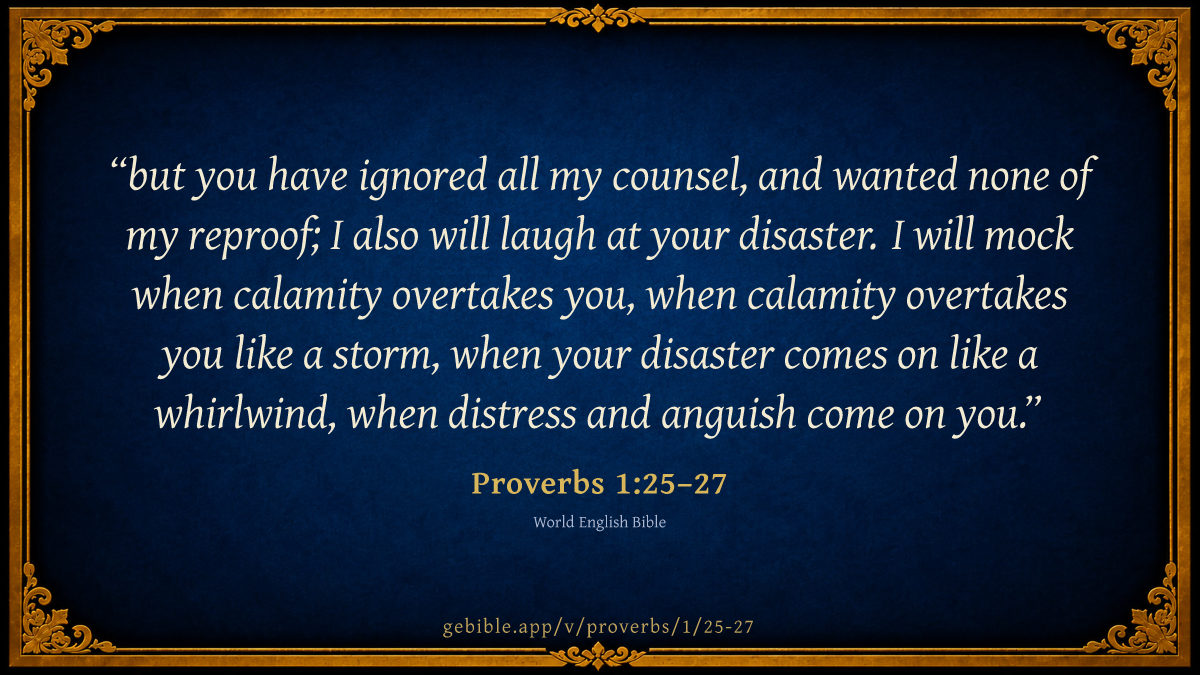
Proverbs 1:30(v25)They wanted none of my counsel. They despised all my reproof.
Proverbs 3:25-26(v27)Don’t be afraid of sudden fear, neither of the desolation of the wicked, when it comes; for Yahweh will be your confidence, and will keep…
Proverbs 12:1(v25)Whoever loves correction loves knowledge, but he who hates reproof is stupid.
2 Chronicles 36:16(v25)but they mocked the messengers of God, and despised his words, and scoffed at his prophets, until Yahweh’s wrath arose against his people,…
Proverbs 5:12(v25)and say, “How I have hated instruction, and my heart despised reproof;
Psalms 58:9(v27)Before your pots can feel the heat of the thorns, he will sweep away the green and the burning alike.
Psalms 69:22-28(v27)Let their table before them become a snare. May it become a retribution and a trap. Let their eyes be darkened, so that they can’t see. Let…
Proverbs 10:24-25(v27)What the wicked fear, will overtake them, but the desire of the righteous will be granted. When the whirlwind passes, the wicked is no…
Isaiah 17:13(v27)The nations will rush like the rushing of many waters: but he will rebuke them, and they will flee far off, and will be chased like the…
Nahum 1:3(v27)Yahweh is slow to anger, and great in power, and will by no means leave the guilty unpunished. Yahweh has his way in the whirlwind and in…
Luke 21:23-26(v27)Woe to those who are pregnant and to those who nurse infants in those days! For there will be great distress in the land, and wrath to this…
Luke 21:34-35(v27)“So be careful, or your hearts will be loaded down with carousing, drunkenness, and cares of this life, and that day will come on you…
Romans 2:9(v27)oppression, and anguish on every soul of man who does evil, to the Jew first, and also to the Greek.
1 Thessalonians 5:3(v27)For when they are saying, “Peace and safety,” then sudden destruction will come on them, like birth pains on a pregnant woman. Then they…
Judges 10:14(v26)Go and cry to the gods which you have chosen. Let them save you in the time of your distress!”
Revelation 6:15-17(v27)The kings of the earth, the princes, the commanding officers, the rich, the strong, and every slave and free person, hid themselves in the…
Cross-references from openbible.info (CC BY 4.0)
Explain this passage (14 sources)
Historical commentary, presented as a primary source — not an endorsement.
Geneva Bible translators1599 · Public DomainOn vv26–27This is spoken according to our capacity, signifying that…
This is spoken according to our capacity, signifying that the wicked, which mock and jest at God’s word, shall have the just reward of their mocking.
Geneva Bible (1599) marginal notes — public domain.
John Trapp1656 · Public DomainOn vv25–27Pro 1:25 But ye have set at nought all…
Pro 1:25 But ye have set at nought all my counsel, and would none of my reproof:
Ver. 25. But ye have set at naught.] As those recusant {a} guests in the Gospel that pretended they therefore came not, because they had bought farms and oxen; but indeed it was because their farms and oxen had bought them. They had either so much to do, or so little to do, that they could not make use of so fair an offer, so sweet advice and advantage.
Read full note →
And would none of my reproof.] Ruinam praecedunt stillicidia. It is a sure presage and desert of ruin, when men will not be ruled. {Pro 29:1} The cypress, the more it is watered, the more it is withered. The tree that is not for fruit, is for the fire. The earth that beareth thorns and briars only is rejected. {Heb 6:8}
{a} One who refuses to submit to some authority, comply with some regulation or request, etc.
John Trapp, A Commentary or Exposition upon All the Books of the Old and New Testament (1647–1656) — public domain. Text from a community e-Sword module.
Matthew Poole1685 · Public DomainOn vv25–27Set at nought, or despised, or made void; resisted…
Set at nought, or despised, or made void; resisted its power and authority.
My counsel: either,
Read full note →
1. My design of doing sinners good, which you have made of none effect to yourselves. Or,
2. My commands and counsels, which suits better with the next clause.
Matthew Poole's English Annotations on the Holy Bible (1683–1685) — public domain. Text from a community e-Sword/MySword module.
John Gill1763 · Public DomainOn vv25–27But ye have set at nought all my counsel,....…
But ye have set at nought all my counsel,.... The same with "the counsel of God", Act 20:27. The whole Gospel, and all the truths of it; the entire scheme of salvation by Jesus Christ, which is the produce of divine wisdom, and is according to the counsel of the divine will, and his eternal purpose in Christ Jesus; this the Jews set at nought, made no account of, but despised and rejected, as they did Christ, the author of it, Act 4:11; as also his ordinances, which go by the same name, because of the wisdom and will of God in them; particularly baptism, rejected by the Scribes and Pharisees, Luk 7:30;
and would none of my reproof; would not hearken to it, nor take it, nor receive any instruction from it nor caution by it; did not like it, but contemned it, and trampled upon it; see Mat 23:37.
John Gill's Exposition of the Whole Bible (1746–1763) — public domain (CC PDM 1.0). Text via the HelloAO Bible API.
John Wesley1765 · Public DomainOn v26Your fear - The misery you do or should…
Your fear - The misery you do or should fear.
John Wesley, Explanatory Notes Upon the Whole Bible (1754–1765) — public domain. Text via the GEBible commentary corpus.
Adam Clarke1810 · Public DomainOn v27Verse 27. Your destruction cometh as a whirlwind] כסופה…
Verse 27. Your destruction cometh as a whirlwind] כסופה kesuphah, as the all-prostrating blast. Sense and sound are here well expressed. Suphah here is the gust of wind.
Adam Clarke's Commentary on the Bible (1810–1826) — public domain. Text from a community e-Sword/MySword module.
Albert Barnes1834 · Public DomainOn vv26–27Compare the marginal reference. The scorn and derision with…
Compare the marginal reference. The scorn and derision with which men look on pride and malice, baffled and put to shame, has something that answers to it in the Divine Judgment. It is, however, significant that in the fuller revelation of the mind and will of the Father in the person of the Son no such language meets us. Sadness, sternness, severity, there may be, but, from first to last, no word of mere derision.
Albert Barnes' Notes on the Bible (1834–1885) — public domain. Text from a community e-Sword/MySword module.
Haydock's Catholic Bible Commentary1859 · Public DomainOn v26Mock. God is too much above us to act…
Mock. God is too much above us to act thus; but he will treat us as an enraged enemy. (Calmet) --- In hell, the damned will cry in vain, ver. 28. They had sufficient graces offered while they were alive. (Worthington)
George Leo Haydock (1774–1849), Haydock's Catholic Family Bible and Commentary, 1859 edition — public domain. Excludes Psalms (Douay-Rheims chapter numbering differs from Protestant) and Deuterocanonical books (Catholic canon only).
Robert Jamieson, A. R. Fausset & David Brown1871 · Public DomainOn vv25–27set at naught--rejected as of no value.
set at naught--rejected as of no value.
would none of--literally, "were not willing or inclined to it."
Jamieson, Fausset & Brown — Commentary Critical and Explanatory on the Whole Bible (1871) — public domain (CC PDM 1.0). Text via the HelloAO Bible API.
Daniel D. Whedon1874 · Public DomainOn vv25–2725. Set at naught — Or, let go, did…
25. Set at naught — Or, let go, did not value it.
Would none of my reproof — That is, did not desire it, would not receive it.
Daniel D. Whedon (gen. ed.), Commentary on the Old and New Testaments (1874–1909) — public domain. Text from a community e-Sword module.
The Cambridge Bible for Schools and Colleges1878 · Public DomainOn vv26–2726. at] Rather, in, i.e. in the time of.…
26. at] Rather, in, i.e. in the time of. Comp. on this verse Psa_2:4; Psa_37:13; Psa_59:8.
The Cambridge Bible for Schools and Colleges (gen. ed. J. J. S. Perowne; Cambridge University Press, 1878–1918) — public domain. Text from a community e-Sword module.
Ellicott's Commentary for English Readers1878 · Public DomainOn v26(26) I also will laugh . . . I…
(26) I also will laugh . . . I will mock.—For expressions like this, comp. Psa_2:4; Psa_37:13; Psa_59:8, where the same actions are attributed to God. They are not to be taken literally, of course, for the sight of human folly can give no pleasure to Him. They signify that He will act as if He mocked when He refuses to hear their cry. Similar expressions, imputing human actions to the Almighty, are Gen_11:5; Gen_11:7; 2Ch_16:9; Psa_18:9; human feelings, Gen_6:6.
A Bible Commentary for English Readers, edited by Charles John Ellicott (1878–1897) — public domain. Text from a community e-Sword module.
The Pulpit Commentary1880 · Public DomainOn vv25–27Ye have set at nought; rather, rejected (Umbreit, Ewald,…
Ye have set at nought; rather, rejected (Umbreit, Ewald, et alii). The Authorized Version rendering here is equivocal, inasmuch as it is capable of meaning "despised," whereas rp (para) signifies "to let loose," "to let go" (cf. the German fahren lassen), and hence "to overlook, or reject." Its force is fairly represented in the LXX, Akurouv epoieite emav , "Ye rendered my counsel of no effect." Counsel (hxe, etsah); i.e. advice, in the sense of recommendations for doing good, as opposed to reproofs for the avoidance of evil (see vers. 23 and 30). Would none. The same verb, hba (avah), occurs in vers. 10 and 30, hence used with the negative al (lo) in the sense of apeiyein (LXX), "to refuse compliance with," as in Aeschylus, "Agam.," 1049.
The Pulpit Commentary (1880–1919), ed. H.D.M. Spence-Jones & Joseph S. Exell — public domain. Text from a community e-Sword module.
unfoldingWord translationNotes2017 · CC BY-SA 4.0On v26General Information:
General Information:
Wisdom continues to speak, describing what happens to those who ignore her.
Read full note →
I will laugh
This can be stated with the word "therefore" to show that the woman wisdom laughs at them because they ignored her. AT: "Therefore I will laugh" (See: Connecting Words)
at your calamity
"when bad things happen to you"
when the terror comes
The abstract noun "terror" can be stated as an adjective. AT: "when you are terrified" (See: Abstract Nouns)
when your fearful dread comes like a storm ... like a whirlwind ... come upon you
Terrible things happening to the people is compared to a storm hitting them and causing fear and suffering. (See: Simile)

Geneva Bible translators 1599 · Public Domain On vv26–27 This is spoken according to our capacity, signifying that…
This is spoken according to our capacity, signifying that the wicked, which mock and jest at God’s word, shall have the just reward of their mocking.
Geneva Bible (1599) marginal notes — public domain.
John Trapp 1656 · Public Domain On vv25–27 Pro 1:25 But ye have set at nought all…
Pro 1:25 But ye have set at nought all my counsel, and would none of my reproof:
Ver. 25. But ye have set at naught.] As those recusant {a} guests in the Gospel that pretended they therefore came not, because they had bought farms and oxen; but indeed it was because their farms and oxen had bought them. They had either so much to do, or so little to do, that they could not make use of so fair an offer, so sweet advice and advantage.
Read full note →
And would none of my reproof.] Ruinam praecedunt stillicidia. It is a sure presage and desert of ruin, when men will not be ruled. {Pro 29:1} The cypress, the more it is watered, the more it is withered. The tree that is not for fruit, is for the fire. The earth that beareth thorns and briars only is rejected. {Heb 6:8}
{a} One who refuses to submit to some authority, comply with some regulation or request, etc.
John Trapp, A Commentary or Exposition upon All the Books of the Old and New Testament (1647–1656) — public domain. Text from a community e-Sword module.
Matthew Poole 1685 · Public Domain On vv25–27 Set at nought, or despised, or made void; resisted…
Set at nought, or despised, or made void; resisted its power and authority.
My counsel: either,
Read full note →
1. My design of doing sinners good, which you have made of none effect to yourselves. Or,
2. My commands and counsels, which suits better with the next clause.
Matthew Poole's English Annotations on the Holy Bible (1683–1685) — public domain. Text from a community e-Sword/MySword module.
John Gill 1763 · Public Domain On vv25–27 But ye have set at nought all my counsel,....…
But ye have set at nought all my counsel,.... The same with "the counsel of God", Act 20:27. The whole Gospel, and all the truths of it; the entire scheme of salvation by Jesus Christ, which is the produce of divine wisdom, and is according to the counsel of the divine will, and his eternal purpose in Christ Jesus; this the Jews set at nought, made no account of, but despised and rejected, as they did Christ, the author of it, Act 4:11; as also his ordinances, which go by the same name, because of the wisdom and will of God in them; particularly baptism, rejected by the Scribes and Pharisees, Luk 7:30;
and would none of my reproof; would not hearken to it, nor take it, nor receive any instruction from it nor caution by it; did not like it, but contemned it, and trampled upon it; see Mat 23:37.
John Gill's Exposition of the Whole Bible (1746–1763) — public domain (CC PDM 1.0). Text via the HelloAO Bible API.
John Wesley 1765 · Public Domain On v26 Your fear - The misery you do or should…
Your fear - The misery you do or should fear.
John Wesley, Explanatory Notes Upon the Whole Bible (1754–1765) — public domain. Text via the GEBible commentary corpus.
Adam Clarke 1810 · Public Domain On v27 Verse 27. Your destruction cometh as a whirlwind] כסופה…
Verse 27. Your destruction cometh as a whirlwind] כסופה kesuphah, as the all-prostrating blast. Sense and sound are here well expressed. Suphah here is the gust of wind.
Adam Clarke's Commentary on the Bible (1810–1826) — public domain. Text from a community e-Sword/MySword module.
Albert Barnes 1834 · Public Domain On vv26–27 Compare the marginal reference. The scorn and derision with…
Compare the marginal reference. The scorn and derision with which men look on pride and malice, baffled and put to shame, has something that answers to it in the Divine Judgment. It is, however, significant that in the fuller revelation of the mind and will of the Father in the person of the Son no such language meets us. Sadness, sternness, severity, there may be, but, from first to last, no word of mere derision.
Albert Barnes' Notes on the Bible (1834–1885) — public domain. Text from a community e-Sword/MySword module.
Haydock's Catholic Bible Commentary 1859 · Public Domain On v26 Mock. God is too much above us to act…
Mock. God is too much above us to act thus; but he will treat us as an enraged enemy. (Calmet) --- In hell, the damned will cry in vain, ver. 28. They had sufficient graces offered while they were alive. (Worthington)
George Leo Haydock (1774–1849), Haydock's Catholic Family Bible and Commentary, 1859 edition — public domain. Excludes Psalms (Douay-Rheims chapter numbering differs from Protestant) and Deuterocanonical books (Catholic canon only).
Robert Jamieson, A. R. Fausset & David Brown 1871 · Public Domain On vv25–27 set at naught--rejected as of no value.
set at naught--rejected as of no value.
would none of--literally, "were not willing or inclined to it."
Jamieson, Fausset & Brown — Commentary Critical and Explanatory on the Whole Bible (1871) — public domain (CC PDM 1.0). Text via the HelloAO Bible API.
Daniel D. Whedon 1874 · Public Domain On vv25–27 25. Set at naught — Or, let go, did…
25. Set at naught — Or, let go, did not value it.
Would none of my reproof — That is, did not desire it, would not receive it.
Daniel D. Whedon (gen. ed.), Commentary on the Old and New Testaments (1874–1909) — public domain. Text from a community e-Sword module.
The Cambridge Bible for Schools and Colleges 1878 · Public Domain On vv26–27 26. at] Rather, in, i.e. in the time of.…
26. at] Rather, in, i.e. in the time of. Comp. on this verse Psa_2:4; Psa_37:13; Psa_59:8.
The Cambridge Bible for Schools and Colleges (gen. ed. J. J. S. Perowne; Cambridge University Press, 1878–1918) — public domain. Text from a community e-Sword module.
Ellicott's Commentary for English Readers 1878 · Public Domain On v26 (26) I also will laugh . . . I…
(26) I also will laugh . . . I will mock.—For expressions like this, comp. Psa_2:4; Psa_37:13; Psa_59:8, where the same actions are attributed to God. They are not to be taken literally, of course, for the sight of human folly can give no pleasure to Him. They signify that He will act as if He mocked when He refuses to hear their cry. Similar expressions, imputing human actions to the Almighty, are Gen_11:5; Gen_11:7; 2Ch_16:9; Psa_18:9; human feelings, Gen_6:6.
A Bible Commentary for English Readers, edited by Charles John Ellicott (1878–1897) — public domain. Text from a community e-Sword module.
The Pulpit Commentary 1880 · Public Domain On vv25–27 Ye have set at nought; rather, rejected (Umbreit, Ewald,…
Ye have set at nought; rather, rejected (Umbreit, Ewald, et alii). The Authorized Version rendering here is equivocal, inasmuch as it is capable of meaning "despised," whereas rp (para) signifies "to let loose," "to let go" (cf. the German fahren lassen), and hence "to overlook, or reject." Its force is fairly represented in the LXX, Akurouv epoieite emav , "Ye rendered my counsel of no effect." Counsel (hxe, etsah); i.e. advice, in the sense of recommendations for doing good, as opposed to reproofs for the avoidance of evil (see vers. 23 and 30). Would none. The same verb, hba (avah), occurs in vers. 10 and 30, hence used with the negative al (lo) in the sense of apeiyein (LXX), "to refuse compliance with," as in Aeschylus, "Agam.," 1049.
The Pulpit Commentary (1880–1919), ed. H.D.M. Spence-Jones & Joseph S. Exell — public domain. Text from a community e-Sword module.
unfoldingWord translationNotes 2017 · CC BY-SA 4.0 On v26 General Information:
General Information:
Wisdom continues to speak, describing what happens to those who ignore her.
Read full note →
I will laugh
This can be stated with the word "therefore" to show that the woman wisdom laughs at them because they ignored her. AT: "Therefore I will laugh" (See: Connecting Words)
at your calamity
"when bad things happen to you"
when the terror comes
The abstract noun "terror" can be stated as an adjective. AT: "when you are terrified" (See: Abstract Nouns)
when your fearful dread comes like a storm ... like a whirlwind ... come upon you
Terrible things happening to the people is compared to a storm hitting them and causing fear and suffering. (See: Simile)
whirlwind
a very strong wind storm that causes damage
translationWords
mock
terror
unfoldingWord translationNotes — © Distant Shores Media and the Door43 World Missions Community, licensed CC BY-SA 4.0. Source: git.door43.org/Door43/en_tn.