
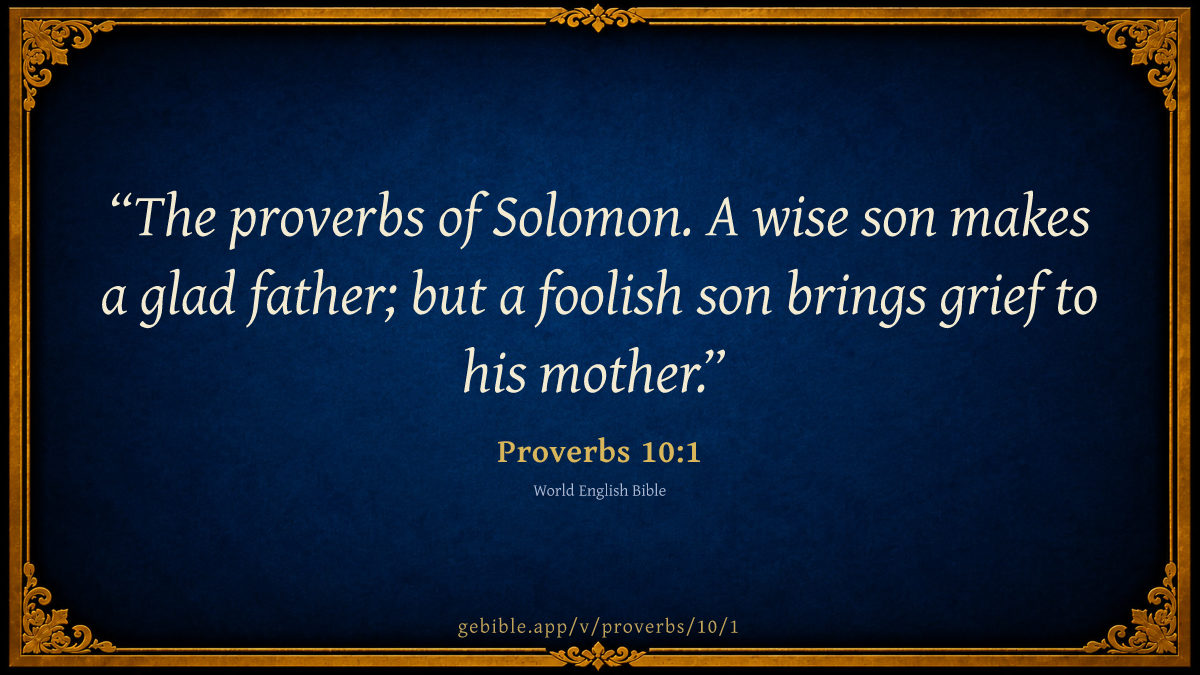
The proverbs of Solomon. A wise son makes a glad father; but a foolish son brings grief to his mother.
Parallel Translations
-
The proverbs of Solomon. A wise son makes a glad father; but a foolish son brings grief to his mother.
-
The proverbs of Solomon. A wise son maketh a glad father: but a foolish son is the heaviness of his mother.
-
The proverbs of Solomon. A wise son maketh a glad father; but a foolish son is the grief of his mother.
Cross-references (13)
Passages linked to Proverbs 10:1 in the Treasury of Scripture Knowledge, ordered by reader-vote popularity; verse text shown in World English Bible.
- Proverbs 1:1 The proverbs of Solomon, the son of David, king of Israel:
- Proverbs 17:25 A foolish son brings grief to his father, and bitterness to her who bore him.
- Proverbs 29:15 The rod of correction gives wisdom, but a child left to himself causes shame to his mother.
- Proverbs 23:15-16 My son, if your heart is wise, then my heart will be glad, even mine. Yes, my heart will rejoice when your lips speak what is right.
- Proverbs 29:3 Whoever loves wisdom brings joy to his father; but a companion of prostitutes squanders his wealth.
- Proverbs 23:24-25 The father of the righteous has great joy. Whoever fathers a wise child delights in him. Let your father and your mother be glad! Let her who bore you rejoice!
- Proverbs 15:20 A wise son makes a father glad, but a foolish man despises his mother.
- Proverbs 17:21 He who becomes the father of a fool grieves. The father of a fool has no joy.
- Ecclesiastes 12:9 Further, because the Preacher was wise, he still taught the people knowledge. Yes, he pondered, sought out, and set in order many proverbs.
- Proverbs 19:13 A foolish son is the calamity of his father. A wife’s quarrels are a continual dripping.
- Proverbs 25:1 These also are proverbs of Solomon, which the men of Hezekiah king of Judah copied out.
- Ecclesiastes 2:19 Who knows whether he will be a wise man or a fool? Yet he will have rule over all of my labor in which I have labored, and in which I have shown myself wise under the sun. This also is vanity.
- 1 Kings 4:32 He spoke three thousand proverbs; and his songs numbered one thousand five.
Cross-references from openbible.info (CC BY 4.0)
Explain this verse (23 sources)
Historical commentary, presented as a primary source — not an endorsement.
Private notes
Saved on this device only — never synced or sent anywhere.
John Trapp 1656 · Public Domain Pro 10:1 The proverbs of Solomon. A wise son…
Pro 10:1 The proverbs of Solomon. A wise son maketh a glad father: but a foolish son [is] the heaviness of his mother.
Ver. 1. The Proverbs.] Properly so called. See Pro 1:1. For the nine former chapters are a kind of common places, or continued discourses premised as a preface to these ensuing wise and grave sentences, tending much to the information of the mind and reformation of the manners, and containing things profitable for all sorts of people. They are not unfitly compared by a divine to a bag full of sweet and fragrant spices, which shuffled or shaken together, or taken single, yield a sweet odour; or to stars in the firmament, each in itself glorious and independent of another, yet all receive their light from the sun.
Read full note →
A wise son maketh a glad father.] Children are certain cares, but uncertain comforts. {a} Every son should be an Abner, that is, his father’s light; and every daughter an Abigail, her father’s joy. Eve promised herself much in her Cain, and David did the like in his Absalom. Sed, fallitur augurio spes bona saepe suo, - they were both deceived. Samuel succeeds Eli in his cross, as well as his place, though not in his sin; and had cause enough to call his untoward children, as Augustus did, tres vomicas, tria carcinomata, - so many ulcerous sores, mattery imposthumes. {b} Virtue is not as lands, inheritable. All that is traduced with the seed is either evil, or not good. Let parents labour to mend by education what they have marred by propagation; and when they have done all, pray "God persuade Japhet," lest else they be put to wish one day, as Augustus did, Oh that I had never married, or never had children! {c} And let children cheer up their parents, as Joseph, Samuel, and Solomon did; and as Epaminondas, who was wont to say, Se longe maximum suarum laudum fructum capere quod earum spectatores haberet parentes, {d} - that he joyed in nothing more than that his parents were yet alive, to take comfort in his brave achievements; for otherwise God will take them in hand, as he did Abimelech, to whom he "rendered the wickedness done to his father"; {Jdg 9:5} and as he did Absalom, whom he trussed up in the height of his rebellious practices with his own immediate hand; or else he will punish them in and by their posterity, which shall either be none (Pro 20:20, compared with 2Sa 14:7), or worse than none; as he who, when his aggrieved father complained that never man had so undutiful a child as he had, Yes, said his son (with less grace than truth), my grandfather had. {e}
The heaviness of his mother.] The mother is mentioned (though the father haply as heavy) first, as most faulted if her children miscarry; {Pro 24:15} next, as most slighted by them; {Pro 15:20} and lastly, as most impatient of such an affliction. Rebekah was weary of her life by reason of the daughters of Heth brought in to her by Esau. {Gen 27:46} If they lie idle at home, mothers have the misery of it; if they do worse abroad, the worst is made of it to the mother at home by fame, that loud liar.
{a} φροντιδες μεγδλαι, ελπιδες αδηλοι. - Plut.
{b} A purulent swelling or cyst in any part of the body; an abscess.
{c} Sueton, cap. 6.
{d} Corn. Nepos.
{e} Mr Fuller’s Holy State.
John Trapp, A Commentary or Exposition upon All the Books of the Old and New Testament (1647–1656) — public domain. Text from a community e-Sword module.
Matthew Poole 1685 · Public Domain A wise son, i.e. prudent, and especially virtuous and…
A wise son, i.e. prudent, and especially virtuous and godly, as this word is commonly meant in this book, and in many other scriptures.
A glad father; and a glad mother too; for both parents are to be understood in both branches, as is evident from the nature of the thing, which affects both of them, and from parallel places, as Pro 17:25; 30:17, although one only be expressed in each branch, for the greater elegancy.
Read full note →
The heaviness of his mother; the occasion of her great sorrow, which is decently ascribed to the mothers rather than to the fathers, because their passions are most vehement, and make deepest impression in them.
Matthew Poole's English Annotations on the Holy Bible (1683–1685) — public domain. Text from a community e-Sword/MySword module.
Matthew Henry 1710 · Public Domain Solomon, speaking to us as unto children, observes here…
Solomon, speaking to us as unto children, observes here how much the comfort of parents, natural, political, and ecclesiastical, depends upon the good behaviour of those under their charge, as a reason, 1. Why parents should be careful to give their children a good education, and to train them up in the ways of religion, which, if it obtain the desired effect, they themselves will have the comfort of it, or, if not, they will have for their support under their heaviness that they have done their duty, have done their endeavour. 2. Why children should conduct themselves wisely and well, and live up to their good education, that they may gladden the hearts of their parents, and not sadden them. Observe, (1.) It adds to the comfort of young people that are pious and discreet that thereby they do something towards recompensing their parents for all the care and pains they have taken with them, and occasion pleasure to them in the evil days of old age, when they most need it; and it is the duty of parents to rejoice in their children's wisdom and well-doing, yea, though it arrive at such an eminency as to eclipse them. (2.) It adds to the guilt of those that conduct themselves ill that thereby they grieve those whom they ought to be a joy to, and are a heaviness particularly to their poor mothers who bore them with sorrow, but with greater sorrow see them wicked and vile.
Matthew Henry's Commentary on the Whole Bible (1708–1710) — public domain (CC PDM 1.0). Text via the HelloAO Bible API.
John Gill 1763 · Public Domain The proverbs of Solomon,.... This title is repeated from…
The proverbs of Solomon,.... This title is repeated from Pro 1:1; and very properly stands here; since here begin those pithy sentences of Solomon, which bear the name of proverbs; the preceding chapters being a sort of preface or introduction to them; in which Solomon recommends the study of wisdom, shows the profit and advantage of it, gives directions about it, and prepares for the reception of those wise sayings that follow; which are for the most part independent of each other, and consist generally of clauses set in a contrast to one another, and often expressed by similes and metaphors;
a wise son maketh a glad father; as Solomon made glad his father David: for no doubt there were appearances of his wisdom before he came to the throne, though greater afterwards; which made David rejoice that he was placed on the throne before his death, to whom he had committed the charge of building the house of the Lord;
Read full note →
but a foolish son is the heaviness of his mother; brings grief and trouble to her, as perhaps Rehoboam did to his mother: though all this is to be understood conjunctly of both parents, and not separately of each; not as if a wise son only was matter of joy to his father, who may be thought to be a better judge of his wisdom, and more abroad to hear the fame of it, and to observe the effects of it; or as if a foolish son only caused grief to his mother, because more at home, and more privy to his foolish behaviour; but as being equally joyous or afflicting to both parents. Nor is this to be understood of such who are wise and foolish as to their natural capacities only; but who are so in a moral sense, either virtuous or vicious, good or wicked. Wherefore parents should be concerned for the education of their children, whose behaviour much depends upon it; and children for their conduct towards their parents and in the world, since their joy and grief are influenced by it. Some interpret the words mystically, the "father", of God; the "mother", of the church; and, the "sons", of the children of them both: and so may fitly describe the different followers of Christ and antichrist; the one being wise, the other foolish; the one acceptable to God, the other not.
John Gill's Exposition of the Whole Bible (1746–1763) — public domain (CC PDM 1.0). Text via the HelloAO Bible API.
John Wesley 1765 · Public Domain Here the Proverbs, properly so called, begin. They are…
Here the Proverbs, properly so called, begin. They are short, but weighty sentences, most of which are two sentences in one verse, illustrating each other. But it is seldom there is any coherence between the verses, much less any thread of discourse.
John Wesley, Explanatory Notes Upon the Whole Bible (1754–1765) — public domain. Text via the GEBible commentary corpus.
Adam Clarke 1810 · Public Domain It is impossible to give summaries of such chapters…
CHAPTER X
It is impossible to give summaries of such chapters as these,
Read full note →
where almost every verse contains a separate subject. Our
common version not being able to exhibit the contents as usual,
simply says, "From this chapter to the five and twentieth are
sundry observations upon moral virtues, and their opposite
vices." In general the wise man states in this chapter the
difference between the wise and the foolish, the righteous and
the wicked, the diligent and the idle. He speaks also of love
and hatred, of the good and the evil tongue, or of the
slanderer and the peace-maker.
NOTES ON CHAP. X.
Verse 1. The proverbs of Solomon] Some ancient MSS. of the Vulgate have Proverbiorum liber secundus, "The second book of the Proverbs." The preceding nine chapters can only be considered as an introduction, if indeed they may be said to make even a part, of the proverbs of Solomon, which appear to commence only at the tenth chapter.
A wise son maketh a glad father] The parallels in this and several of the succeeding chapters are those which Bishop Lowth calls the antithetic; when two lines correspond with each other by an opposition of terms and sentiments; when the second is contrasted with the first; sometimes in expression, sometimes in sense only. Accordingly the degrees of antithesis are various; from an exact contraposition of word to word, through a whole sentence, down to a general disparity, with something of a contrariety in the two propositions, as: -
A wise son rejoiceth in his father.
But a foolish son is the grief of his mother.
Where every word has its opposite; for the terms father and mother are, as the logicians say, relatively opposite.
Adam Clarke's Commentary on the Bible (1810–1826) — public domain. Text from a community e-Sword/MySword module.
Joseph Benson 1811 · Public Domain Pro 10:1. The Proverbs of Solomon — Properly so…
Pro 10:1. The Proverbs of Solomon — Properly so called; for the foregoing chapters, although they had this title in the beginning of them, yet, in truth, were only a preparation to them, intended to stir up men’s minds to the greater attention to all the precepts of wisdom, whereof some here follow; see the argument prefixed to this chapter. A wise son — That is, prudent, and especially virtuous and godly, as this word commonly signifies in this book, and in many other parts of Scripture; maketh a glad father — And a glad mother too; for both parents are to be understood in both branches of the sentence, as is evident from the nature of the thing, which affects both of them, and from parallel places, as Pro 17:25; Pro 30:17, although only one be expressed in each branch for the greater elegance. A foolish son is the heaviness of his mother — The occasion of her great sorrow, which is decently ascribed to the mothers rather than to the fathers, because their passions in general are more vehement, and they are more susceptible of grief and trouble. Although I cannot affirm, says Bishop Patrick, “that there is an order observed in all these proverbs, yet this first sentence seems not to have been casually, but designedly, set in the front of the rest; because nothing contributes so much, every way, to the happiness of mankind, as a religious care about the education of children, which parents are here admonished to attend to if they desire their children should not prove a grief and shame to them: and children are put in mind of the obedience they owe to their instructions, that they may be a joy to them.”
Joseph Benson's Commentary on the Old and New Testaments (1811–1818) — public domain. Text from a community e-Sword module.
Albert Barnes 1834 · Public Domain See the Introduction.
See the Introduction.
Albert Barnes' Notes on the Bible (1834–1885) — public domain. Text from a community e-Sword/MySword module.
Charles Bridges 1846 · Public Domain THE former chapters have beautifully set forth in continuous…
THE former chapters have beautifully set forth in continuous discourse the nature and value of heavenly wisdom, contrasted with the fascinations of sinful folly. We now come to what are more properly (not excluding the foregoing) (Pro 1:2 ) the Proverbs of Solomon. They are for the most part unconnected sentences, remarkable for profound thought, and acute observation, expressed in an antithetical or illustrative form; the whole comprising a Divine system of morals of universal application; a treasury of wisdom in all its diversified details, personal, domestic, social, civil. The previous chapters form a striking introduction to the book. The glorious description of the Great Counsellor (Proverbs 1. 8.) commends to us his gracious instruction as the principles of true happiness and practical godliness.
Perhaps this first sentence may have been placed in the front, to point to the value of a godly education in its personal, social, national influence, connected both with time and eternity. We naturally look for rest in our children, as the choicest gift of God. (Gen 5:28-29 ; Gen 33:5 . Psa 127:3 .) Faith, indeed, may be tried, perhaps severely tried. (Ecc 11:1 ) But the child, watched, prayed over, instructed, and disciplined, shall, in the Lord’s best time, choose wisdom’s paths (Pro 22:6 ), and be the gladness of his father’s heart. (Pro 15:20 ; Pro 23:15-16, Pro 23:24-25 ; Pro 27:11 ; Pro 29:3 . Gen 45:28 ; Gen 46:30 .)
Read full note →
Many a mother, alas! is chastened with the heaviness of a foolish son. (Gen 26:34, Gen 26:35 ; Gen 27:46 .) In such cases, has not indulgence, instead of wholesome restraint; pleasure, instead of godliness; the world, instead of the Bible — educated the child? Want of early discipline; passing over trifles; yielding when we ought to command — how little do we think to what they may grow! (1Sa 2:24 ; 1Sa 3:13 . 1Ki 1:5-6 ; 1Ki 2:25 .) God has laid down plain rules, plain duties, and plain consequences flowing from their observance (Pro 22:6 ; Pro 23:13-14 ) or neglect. (Pro 29:15 .) To forget a daily reference to them; to choose our own wisdom before God’s (1Sa 2:29 ); — can we wonder that the result should be heaviness?†1
Footnotes:
†1 Bishop Lowth supposes an antithesis between the relative terms (Prelim. Dissert. Isaiah), which Bishop Jebb illustrates by the distinctive character of the father’s gladness, whose affections are more disciplined, and the mother’s grief, whose tenderness might blind her to the faults of her children, or lead her weakly to excuse them. — Sacred Literature, Sect. ii. But, probably, this refinement of criticism is beside the meaning of the inspired Writer, who interchangeably ascribes these exercises of feeling to both parents. Pro 17:2, Pro 17:25 ; Pro 19:13 ; Pro 23:24-25 . Compare Gen 26:35 . 2Sa 13:37-39 . Compare Glass. Phil. Sacr. Lib. iv. Tract ii. Obs. 13. Schultens in loco.
Charles Bridges, An Exposition of the Book of Proverbs (1846) — public domain. Text from a community e-Sword module.
Haydock's Catholic Bible Commentary 1859 · Public Domain Mother. A virtuous child cannot be indifferent to the…
Mother. A virtuous child cannot be indifferent to the joy of his parents.
George Leo Haydock (1774–1849), Haydock's Catholic Family Bible and Commentary, 1859 edition — public domain. Excludes Psalms (Douay-Rheims chapter numbering differs from Protestant) and Deuterocanonical books (Catholic canon only).
Lange's Commentary on the Holy Scriptures 1864 · Public Domain Ethical maxims, precepts and admonitions with respect to the…
II. ORIGINAL NUCLEUS OF THE COLLECTION—GENUINE PROVERBS OF SOLOMON
Ethical maxims, precepts and admonitions with respect to the most diverse relations of human life
Read full note →
(Proverbs mainly in the form of antithetic distichs)
Pro_10:1 to Pro_22:16
1. Exhibition of the difference between the pious and the ungodly, and their respective lots in life
Proverbs 10-15
a) Comparison between the pious and the ungodly with respect to their life and conduct, in general. Proverbs 10
1 Proverbs of Solomon.
A wise son maketh glad his father,
but a foolish son is the grief of his mother.
2 Treasures of wickedness do not profit,
but righteousness delivereth from death.
3 Jehovah will not suffer the righteous to famish [E. V.: the soul of the righteous],
but the craving of the wicked He disappointeth.
4 He becometh poor that worketh with an idle hand,
but the hand of the diligent maketh rich.
5 He that gathereth in summer is a wise son,
but he that sleepeth in harvest is a bad son.
6 Blessings are upon the head of the just,
but the mouth of the wicked hideth violence.
7 The memory of the just is blessed,
but the name of the wicked shall rot.
8 Whoso is wise in heart will receive precepts,
but he who is of foolish lips shall fall.
9 He that walketh uprightly walketh securely,
but he that perverteth his way shall be made known.
10 He that winketh with the eye causeth trouble,
and he that is of foolish lips is overthrown.
11 A fountain of life is the mouth of the righteous,
but the mouth of the wicked hideth violence.
12 Hate stirreth up strife,
but love covereth all transgressions.
13 On the lips of the man of understanding wisdom is found,
but a rod (is) for the back of the fool.
14 Wise men store up knowledge,
but the mouth of the fool is a near (speedy) destruction.
15 The rich man’s wealth is his strong city,
the destruction of the poor is their poverty.
16 The labour of the righteous (tendeth) to life,
the gain of the wicked to sin.
17 A way to life is he who heedeth correction,
he who resisteth reproof leadeth astray.
18 He that hideth hatred (hath) lying lips,
and he who spreadeth slander is a fool.
19 In much talking transgression is not wanting,
but he that governeth his lips doeth wisely.
20 Choice silver is the tongue of the righteous,
the heart of the wicked is of little worth.
21 The lips of the righteous feed many,
but fools die for want of knowledge.
22 Jehovah’s blessing,—it maketh rich,
and labour addeth nothing thereto.
23 It is as sport to a fool to do mischief,
but to the man of understanding wisdom.
24 What the wicked feareth cometh upon him,
but the desire of the righteous is granted them.
25 When a storm sweepeth by the wicked is no more,
but the righteous is an everlasting foundation.
26 As vinegar to the teeth and smoke to the eyes,
so is the sluggard to them that send him.
27 The fear of Jehovah multiplieth days,
but the years of the wicked are shortened.
28 The expectation of the righteous is gladness,
but the hope of the wicked shall perish.
29 Jehovah’s way is a bulwark to the righteous,
but destruction to evil doers.
30 The righteous shall never be moved,
but the wicked shall not abide in the land.
31 The mouth of the righteous bringeth forth wisdom,
but the perverse tongue shall be rooted out.
32 The lips of the righteous know what is acceptable,
but the mouth of the wicked perverseness.
GRAMMATICAL AND CRITICAL
Pro_10:1.—[יְשַׂמַּח; cited by Bött (§§ 943, c, e; 950 e) as an illustration of the employment of the Imperf. to express what must be from the very nature of the case,—Fiens debitum,—“must gladden.”—A.]
Pro_10:2.—[יוֹעִילוּ: as above, with the meaning “cannot profit;” §950, c, β.—A.]
Pro_10:3.—יַרְעִיב; an example of the Fiens solitum, what is wont to be; § 950, b.]—The LXX, arbitrarily assimilating the language of the first and second clauses, read in the second חַיַּת רְשָׁעִים, for they translate “the life of the ungodly,” ζωὴν δὲ ἀσεβῶν ἀνατρέψει. [הַוָּה has been quite variously rendered. The E. V. translates “substance,” the object of the desire of the wicked. Luther, following the insidias of the Vulg., renders by “Schindcrei=exactions or oppression. Holden translates “iniquity.” N., St., and M. agree with our author in retaining the simple meaning “craving, or greedy desire.” So Gesen., Fuerst, etc.—A.]
Ver.5—[מֵבישׁ is taken by Gesen., Fuerst, Stuart as intransitive, in the sense of “acting basely.” N., M., II. agree with the E. V. in deriving it from a different radical idea in the verb, and making it a causative Hiphil. The difference in the final import is not very great, yet the former conception of the word appears to have the best warrant.—A.]
Pro_10:8—[יִקַּח, Fiens licitum, “is disposed to receive,” etc. Bött, § 950, c.—A.]
Pro_10:21.—חֲסַר is here stat. constr. not of the adj. חָסֵר, as e.g. above in Pro_10:13, but of the noun חֶסֶר, as the old translators correctly judged. Bertheau is therefore wrong in rendering “through one void of understanding.” Fuerst takes our author’s view; so Bött. (§794), who would interpret Pro_10:10 in the same way, “the back of folly.”—A.]
EXEGETICAL
1. General preliminary remark. The main division of the collection of proverbs that begins with chap. 10, by the scattered isolation and the mosaic-like grouping of its individual elements contrasts quite strongly with the longer and well compacted proverbial discourses of the first nine chapters. And yet one would go too far in assuming an entirely planless and unregulated accumulation of the proverbs contained in chaps. 10–22, and failing to recognize at least an attempt of the collector to secure a methodical grouping of the rich store of maxims that he has to communicate. Hitzig’s assumption, it is true, seems altogether artificial, and tenable only as the result of violent critical dealing,—viz., that chaps. 10–21 may be resolved into four sections of equal length, of about 90 verses each; 1) chaps. 10–12 (Pro_13:1 making a commencement parallel to Pro_10:1); chap. 13–15:32 (in which division Pro_13:23 is to be stricken out to make 91 verses, as in the preceding section); Pro_15:33 to Pro_19:3 (where by omitting Pro_16:25 and inserting two verses from the LXX after Pro_16:17 the number of 89 verses must be reached that shall correspond with the section following); and Pro_19:4 to Pro_21:31. He also assumes that within these four principal subdivisions groups of verses symmetrically constructed of six, seven and eight verses respectively, succeed one another. But although such a construction according to definite relations of numbers is not demonstrable, or at least is demonstrable only in single instances (e.g., Pro_15:33 to Pro_16:15; see remarks on this passage), still the existence of larger or smaller groups of proverbs of similar import cannot be denied; and many of these groups relating to one and the same subject are very probably attached one to another according to a definite plan or construction of ideas. And yet these in most cases stand in a loose co-ordination, and withal quite frequently appear accompanied or interspersed by single verses that are altogether isolated. In the chapter before us groups of this sort, governed by a certain unity of idea, may be found in Pro_10:2-25; Pro_10:27-30. Pro_10:1; Pro_10:26; Pro_10:31-32 stand isolated. Hitzig’s attempt to construct from Pro_10:1 to Pro_11:3 exactly five groups of seven proverbs each appears untenable after an unprejudiced examination of the real relations of the matter.—With reference to the contents of the six groups of verses, together with the individual verses accompanying them, and also with respect to central thoughts that may possibly be drawn from these elements, see the “Doctrinal and Ethical” notes.
2. Pro_10:1. A wise son maketh glad his father, etc.—This thought, which is quite general, is plainly designed to serve as an introduction to the entire collection of proverbs that succeeds; comp. Pro_1:8. As in that instance, and as in Pro_15:20; Pro_17:25; Pro_23:24 there is found here an attempt, by means of an antithetic parallelism, at Metalepsis or the distribution of the propositions between father and mother in detail. [Ingenious expositions of the diverse effects of different kinds of conduct upon the father and the mother, like that of Lord Bacon in the “Advancement of Learning,” and more elaborately in the “De Augmentis Scientiarum,” overlook the nature of the Hebrew parallelism—A.] “Grief, anxiety,” derived from יָגָה (moestus esse, dolere), LXX: λύπη; comp. Pro_14:13; Pro_17:21; Psa_119:28.
3. Pro_10:2-7. Six verses or three pairs of verses relating to the earthly lot of the just and the unjust, the diligent and the sluggish.—Treasures of wickedness profit not.—Because they cannot avert the sudden and unhappy death that awaits the wicked; comp. Pro_10:25-27. With the second clause compare Pro_11:4-19.
Pro_10:3. Jehovah will not suffer the righteous to famish.—Literally, “the spirit of the righteous;” for this is the sense which in agreement with most interpreters we must find here, and not “the desire, the craving of the righteous,” as Elster thinks, appealing for confirmation to Pro_6:30; Pro_23:2. For this strong expression is inappropriate before we come to the antithesis in the second member, and here the idea is plainly enough expressed by the word הַוָּה, “longing” (comp. אַוָּה, Deu_12:15; 1Sa 23:30). Compare Pro_11:6.
Pro_10:4. He becometh poor that worketh with an idle hand.—כַּף־רְמִיָה, not a “deceitful, crafty hand,” but an “idle, sluggish hand,” manus remissa (Vulg.); comp. Pro_12:24; Pro_12:27; Pro_19:15; Jer_48:10.—רָאשׁ, for which the LXX and Vulg. must have read רֵאשׁ the substantive (πενία, egestas), is the third Sing. Perf. Kal [or the participle] with the scriptio plena (like קָאם in Hos_10:14), and with the signification “he is impoverished,” inops fit; comp. Psa_34:10. With the phrase עָשָׂה יַד, to stir the hand, to work with the hand, comp. Jer_48:10.—But the hand of the diligent—literally, “of the sharpened,” comp. Pro_12:24.
Pro_10:5. He that gathereth in summer is a wise man—lit., “is a son that doeth wisely,” and so in the second member, “a son that doeth badly.” These same predicates stand contrasted also in Pro_14:35, in that case to define more closely the term “servant,” but here as attributes of the “son,” which designation is chosen in this instance rather than “man,” probably because “the heavy labors of the field which are here spoken of devolve especially upon the younger men, and also because idleness is particularly ruinous to youth” (Elster).—For the general sentiment comp. also Pro_6:8-9.
Pro_10:6. Benedictions (come) upon the head of the just, but the mouth of the wicked hideth violence.—In this strictly literal rendering of the verse there is no sharp antithesis between the first and second clauses, for which reason many, following the LXX and Vulg., reverse the relation of subject and object in the second clause, and either translate with Döderlein, Dathe, etc., “wickedness closeth the mouth of the vicious,” or, inasmuch as the noun חָמָם cannot possibly be used in this sense of “wickedness, evil disposition,” explain with Umbreit among others, “the mouth of the profligate crime covereth.” [E. V.: “violence covereth the mouth of the wicked.”] (This is substantially the explanation of Hitzig also, except that he points יִכָּסֶה instead of יְכַסֶּה, and takes the noun חָמָם contrary to usage in the sense of “pain, ruin;” “the mouth of the wicked is covered with sorrow.”) [Words. gives a doubtful support to this view.] But why in just this passage and the second hemistich of Pro_10:11 which corresponds literally with it, it should be particularly the mouth and not the face of the wicked that is named as the object to be covered with crime, is not readily seen; and to read “face” (פְּנֵי) instead of “mouth” (פִי) in accordance with Psa_44:16; Jer_51:51, would evidently not answer on account of the double occurrence of the expression. Therefore, with Bertheau, Elster, etc. [N., ST., and M. in a qualified way], we should hold fast the above explanation as the simplest and most obvious, and accordingly reckon our verse among the exceptions, which, moreover, are not very rare, to that antithetic mode of constructing propositions which altogether predominates in the division of the book now before us. [Rueetschi, in the Stud, und Krit., 1868, I., 135, not only agrees with our author in his construction of the verse, but endeavors more fully to justify the parallelism by the following explanation. “While the righteous, who is himself for others a fountain of life and blessing (Pro_10:11), nothing but love and fidelity, is himself also to expect blessing (Pro_10:7), the wicked has in himself only destruction; he hides it, covers it, it is true (comp. כִּסָּה, Pro_10:18), with his mouth, yet has it in him (Psa_5:9); and this very fact, that he covers in himself ruin for others, turns the blessing away from him.”]
Pro_10:7.The name of the wicked rotteth, strictly “will not or moulder,” i.e., the memory of the wicked not only disappears quickly and surely, but also so as to excite sensations of abhorrence and disgust in other men (like ill smelling mould).
4. Pro_10:8-10. Three proverbs bearing upon the contrast between wise men and fools.—He who is of foolish lips is overthrown.—With the wisely disposed (in the first clause) there is significantly contrasted the foolish speaker, the froward talker, and that, too, with the designation suggested by the organ of his foolish discourse, “the fool in lips.” The verb (יִלָּבֵט), for the most part misunderstood by the older translators, can express only the meaning of being brought to a downfall, being overthrown, præcipitari, and accordingly sets forth the consequence of that refusal to receive commandments which characterizes the fool in contrast with the wise man. To secure a stronger antithesis to the verb of the first clause Hitzig reads יִלְבֹט or יְלַבֵּט, “casts them away,” i.e. the commandments. But it is precisely the correspondence with the 2d clause of Pro_10:10, where Hitzig must admit the passive meaning of the verb, that makes it certain that this is here also the intended meaning; for such verbal repetitions of whole or of half verses are among the fancies of the author of this division of our book; see above, remarks on Pro_10:6. [The wise “speaks little, but hears much: receives commands; therefore it goes well with him” (Pro_10:9; Pro_10:1 st clause; Pro_3:1 sq.); but he “who is of foolish lips,” who by his words shows himself a fool, is ever talking and not receiving instruction, is ruined; literally, is overthrown. It is in general a peculiar charm of many proverbs that the parallelism is not perfectly close, but it remains the function of the reader to seek out the intermediate thoughts, and to make the deductions.” Rueetschi, as cited above].
Pro_10:9. Is made manifest, lit., “is made known,” i.e. as a sinner deserving punishment; an allusion to the judicial strictness of God, the All-seeing, [so Wordsw.], (the verb, therefore, not used as in Pro_12:16). Hitzig strangely renders “made wiser,” as though the Niphal were here passive of the Hiphil. [Rueetschi again (as cited above, p. 136) agrees with Zöckler, and thus develops the antithesis: “he adopts crooked ways in order, as he thinks, to be able to practice iniquity more secure and unobserved; but he is ever known and exposed, ho must himself always fear recognition, and this gives to his walk ‘insecurity’ ”].
Pro_10:10. He that winketh with the eye. Comp. Pro_6:13, where as here the “winking with the eye” immediately follows the mention of crooked and perverse action. Instead of the 2d clause, which is identical with the 2d clause of Pro_10:8, and which here yields no antithetic parallelism to the 1st clause, Kennicott, Dathe, Bertheau, Elster prefer the very different reading of the LXX: ὸ δὲ ἐλέγχων μετὰ παῤῥησίας εἰρηνοποιεῖ (but he that rebuketh boldly maketh peace). This however appears rather to be an attempted emendation, the result of well-meaning reflection than the restoration of an original Hebrew text. We must here again assume a momentary departure of the poet from his ordinary strictly antithetical construction of his sentences. In connection with this, however, we are not to give to the verb יִלָּבֵט conjecturally the meaning of “stumbling” or of “groping blindly” (Hitzig), but that which is found also in Pro_10:8, “having a fall,” “self-destruction” (Umbreit). [Here again Rueetschi comes to the defence of the poet’s antithesis, with the explanation “he that winketh, the false, causes sorrow, produces vexation to himself, and he who in his folly openly utters evil falls.” The results differ according to the nature of his wickedness; “vexation when he has done wrong secretly, overthrow, destruction, when he has done it openly” (as above cited, p. 136)].
5. Pro_10:11-14. Two pairs of sentences concerning the contrast between good and evil, wisdom and folly, associated by the mention which is common to the first and last proverb, of the mouth of those in whom the contrast appears (as the preceding group was characterized by the mention of the lips in Pro_10:8; Pro_10:10).—A fountain of life is the mouth of the righteous, on account of the hearty, edifying, loving character of its utterances. For this figure compare Pro_8:14; Pro_18:4. For the 2d clause see remarks above on Pro_10:6.
Pro_10:12. Hate stirreth up strife, lit., “disputes,” “litigations;” comp. Pro_6:14.—All transgressions love covereth over, by ignoring them, by palliating words, by considerate and conciliatory demeanor; comp. Pro_17:9; Jam_5:20; 1Pe_4:8; 1Co_13:4.—[Trapp: Love hath a large mantle].
Pro_10:13. A rod for the fool’s back, i.e. merited punishment overtakes him, the man void of understanding whose lips lack wisdom (comp. Pro_26:3; Pro_19:29). The imperfect and suggestive form of the antithesis is like that in vers, 6 and 8.
Pro_10:14. Wise men reserve knowledge, lit., “conceal knowledge,” i.e. husband the knowledge and understanding which they possess for the right time and place, do not squander it in unseasonable talk and babbling (comp. Pro_10:8). [So W., N., St., and M.]. In the parallel passage Pro_13:23 the synonymous verb to “cover” (כָּסָה) corresponds with the one here used. Comp. also Mal_2:7.—Is a near destruction, i.e. is ever inclined to break forth with its foolish suggestions, and thereby to bring upon itself and upon others alarm and even destruction. Comp. the sentiment of Pro_13:8, which although indeed somewhat differently constructed is still in general similar. [“Near” is an adjective, and the rendering should be more distinct than the ambiguous and misleading translation of the E. V. The mouth of the wicked is not simply passively near to being destroyed; it is a quickly destroying agency.—A.]
6. Pro_10:15-21. Seven proverbs mostly relating to earthly good, its worth, and the means of its attainment,—connected with the two preceding groups (although only loosely and externally) by the “destruction” of Pro_10:15, and the allusion to the lips in Pro_10:18-19. With the 1st clause of Pro_10:15 comp. Pro_18:11; Sir_40:26; and Ecc_7:12.—The destruction of the poor is their poverty, i.e., on account of their destitution there is every instant threatening them an utter destruction or the sundering of all their relations; they therefore come to nothing, they are continually exposed to the danger of a complete ruin in all their circumstances, while to the rich man his means secure a sure basis and a strong protection in all the vicissitudes of life. Naturally the author is here thinking of wealth well earned by practical wisdom; and this is at the same time a means in the further efforts of wisdom; and again, of a deserved poverty which while the consequence of foolish conduct, always causes one to sink deeper in folly and moral need. Comp. the ver. following. Hitzig here following Jer_48:39 takes this destruction (מְחִתָּה) subjectively, as equivalent to “consternation, terror,” [Noyes], which view, however, is opposed by the use of the expression in the preceding verse and in Pro_10:29.
Pro_10:16. The labor of the righteous, his acquisitions, his earnings, comp. 2Jn_1:8.—Tendeth to life, comp. Pro_11:19 and also Pro_16:8. The contrast to this, “tendeth to sin,” includes the idea not fully expressed, “and accordingly to all misfortune and ruin as the result of sin.” Hitzig, “to expiation,” i.e. to making good the losses which his sins bring upon him as just penalties (with a reference to Zec_14:19; Jer_17:3); Schultens, Arnoldi, Umbreit, etc., “to downfall, to misfortune.” Both expositions fail to conform to the usual signification of חַטָּאת.
Pro_10:17. Away to life is he who heedeth correction. “A way to life,” (a well-known expression like “a way, or path of life” in Pro_5:6, and therefore not to be changed by a new punctuation into אֹרֵחַ לְחַיִּים, “a traveller to life,” as Ziegler and Ewald propose); so the wise observer of good instruction is here named because he also guides others to life, in contrast with the מַתְעֶה, him who misleads, the despiser of wholesome discipline and correction, who not only fails of the right way himself, but shows himself an evil guide to others also (Mat_15:14). [The rendering of the E. V., “is in the way,” although followed by H., N., M., W., is not full and exhaustive enough. Such a man is not merely “in the way to life;” he is a guide, by a bolder figure he is a way to other men.—A.] The intransitive conception of this participle (LXX, Vulg., Luther, and also Umbreit, Ewald, etc.), may if necessary be reached by modifying the punctuation מִתָּעֶה (Hithp., Hitzig); but the “going astray” even then does not correspond remarkably with the “way to life,” so far as this expression is correctly understood. [“This sentence is an example how sometimes that which is simplest and most obvious can be persistently missed: these words so simple and true have been refined upon because the real idea was not taken. The meaning is simply this: example is efficacious;” etc. Rueetschi, as above, p. 137].
Pro_10:18. He that hideth hatred (hath) lying lips, strictly, “is lips of falsehood,” i.e. is a man of deceitful lips. [Here again the E. V. sacrifices much of the original. “Lying lips” is not here instrumental; it is the predicate. So H., N., S., M., W.—A.] Comp. for this immediate personification of the sinning organ, Pro_12:19; Pro_12:22, where in the first instance the “lying tongue” and then the “lying lips” appear personified. For the sentiment comp. Pro_26:24.. Peculiarly hard and arbitrary is Hitzig’s exposition; that instead of שֵׁקֶר (falsehood) we should read קֶשֶׁר (union), and that the expression thus resulting, “close, compressed lips” (?) is to be taken as the description of the deceitfully and maliciously compressed mouth of the man who is full of hate! Ewald is also arbitrary (although following the LXX); that instead of שֶׁקֶר we should read צֶדֶק (righteousness); “the lips of the righteous hide hatred,” i.e. cover their enmity with love (?).—He who spreadeth slander is a fool. The meaning of this 2d clause does not stand in the relation of an antithesis to the preceding, but that of a climax, adding a worse case to one not so bad. If one conceals his hatred within himself he becomes a malignant flatterer; but if he gives expression to it in slander, abuse and base detraction, then as a genuine fool he brings upon himself the greatest injury. [Rueetschi objects to this, 1) that the analogy of Pro_12:19; Pro_12:22 does not justify our taking the expression “lying lips” in the 1st clause as the predicate, and 2) that the emphatic pronoun “he” (הוּא) in the 2d clause is still less intelligible on this view of the structure of the verse; he regards this rather as one of the instances, of no very rare occurrence, in which the two clauses make but one proposition, and renders, “whoso conceals hatred with lying lips and at the same time utters slander—he is a fool,” adding the explanation “one of the most odious of vices is where one conceals hatred under fine speech, and yet slanders behind the back; such a man is in sight of God and men despised and spurned”].
Pro_10:19. Transgression is not wanting. In this way is the verb to be rendered, with Umbreit, Hitzig and most others: and not with Bertheau, transgression “does not vanish” (as though we had here something to do with a removal or obliteration of actual guilt); only with the former rendering does the antithesis in the 2d member correspond, where it is plain that taciturnity and discretion in speech are recommended; comp. Pro_13:3; Pro_17:27-28. [Noyes’s translation, “offence,” has the fault, rare with him, of obscurity or ambiguity]. With the expression “to govern the lips” compare the Latin compescere linguam and the parallels from Arabic and Persian poets which Umbreit adduces in illustration of our passage.
Pro_10:20. Choice silver, as in Pro_8:19 (comp. 10) is here used to indicate a very great value.—Is of no worth, literally, “is as nothing, is as a trifle,”—a popular and proverbial circumlocution for the idea of utter nothingness or worthlessness.
Pro_10:21. Feed many, i.e. nourish and refresh many with the wholesome doctrines of godliness (comp. Ecc_12:11; Eze_34:2 sq; Act_20:28).—But fools die for want of knowledge, i.e. persistent fools (אֱוִילִים) are not only incompetent to become to others teachers of truth and guides to life; they are in themselves children of death for their lack of understanding.
7. Pro_10:22-25. Four proverbs relating to the conduct of the righteous and the ungodly and their respective lots. The lot of the righteous, which consists in God’s blessing which makes rich without any effort, forms the starting point of the description in Pro_10:22.—And labor addeth nothing beside it, i.e. as supplementary and exterior to it, that divine blessing which is all in all, which enriches the friends of God even in sleep (comp. Psa_127:2 [and in connection with this Hupfeld’s comments: “Naturally this is not to be taken literally, as though perchance labor in itself were cast aside, and the Oriental indolence commanded; nor again is the privilege given to the pious of being released from ordinary human toils, and of folding their hands in reliance on their powerful Friend; the aim is only, after the emphatic and one-sided manner of the proverb to make prominent the other side of the case, overlooked by restless toilers, what God does in the matter, so as to warn against the delusion that man can conquer by his toil alone,” etc.]). This view is correctly taken by Jarchi, Levi Ben Gerson, Ewald, Hitzig, etc., while others (LXX, Vulg., Umbreit, Bertheau, Elster, [the E. V., H., N., ST., M.]) translate “and addeth no sorrow thereto.” But then instead of עִמָּהּ we should rather have had עַלֶיהָ (comp. Jer_45:3).
Pro_10:23. As sport to a fool is the practice of iniquity, literally, “like a laugh is it to the fool to execute evil counsel.” This “like sport” is then to be supplied also before the 2d member; “but to the man of understanding wisdom is as an enjoyment.” [M. agrees with our author whose view is both more forcible and more accordant with the Hebrew idiom than that expressed in the E. V. and retained by N. and S.: “a man of understanding has wisdom.” More than this is meant: wisdom is his delight.—A.] The verb to practice (עֲשׂות) is probably not to be supplied here before “wisdom” (חָכְמָה); it is self-evident (in opposition to Hitzig’s view) that wisdom is considered here as something practiced and not merely possessed. With the phrase “man of understanding,” the discerning man, comp. Pro_11:12.
Pro_10:24. What the wicked feareth, lit., “the dread of the wicked,” comp. Isa_66:4; Job_3:25; Pro_11:27.—The desire of the righteous is granted them.—The verb (יִתֵּן) can be regarded either as impersonal [like the German “es gibt,” there is: comp. Pro_13:10 and Job_37:10], or directly changed to the passive (יֻתַּן) as the Vulg., the Targums, and among recent interpreters Ewald and Hitzig, e.g., do. To supply as the subject “Jehovah” (Aben Ezra, Umbreit, Elster, Stuart, etc.) has its parallels indeed in Pro_13:21-22, but is here less natural than there.
Pro_10:25. When a. storm sweepeth by the wricked is no more. Thus correctly Ewald, Bertheau, Hitzig, [Holden, Stuart, Muenscher]. Against the conception of the first phrase (כַּעֲבוֹר) as a comparison, “as a storm sweepeth by, so,” etc. (Umbreit, Elster, [E. V., Noyes], etc.) we may urge the conjunction וְ before אֵין, as well as the idea of an “everlasting foundation” in the 2d member. With the latter expression comp. Pro_10:30, and also Psa_125:1, With the first clause comp. Job_1:19; Isa_28:18-19; Pro_1:27.
8. Pro_10:26. An isolated proverb relating to the uselessness and repulsiveness of the sluggish. Comp. Pro_22:13, and also Pro_6:6 sq.; Pro_12:27; Pro_19:24.—As vinegar to the teeth. So the majority correctly render, while the LXX, Pesch., Arab., etc., falsely translate the noun (חֹמֶץ, comp. Num_6:3; Psa_69:22) by “sour grapes” (ὄμφαξ).—To them that send him. Perhaps this phrase as referring to the idea which must be supplied, the authority, the master (אֲדוֹנִים), comp. Pro_25:13, might be translated by “his sender, his employer.” Comp. Hitzig on this passage.
9. Pro_10:27-30. Four proverbs bearing upon the prosperity of the pious and the ruin of the ungodly. With Pro_10:27 comp. Pro_3:1; Pro_9:11; Pro_14:27.
Pro_10:28. The expectation of the righteous is gladness, i.e. as its object comes into possession of him who indulges it. With the 2d clause comp. Pro_6:7; Job_8:13; Psa_112:10.
Pro_10:29. Jehovah’s way is a bulwark to the innocent. The meaning doubtless is, Jehovah’s way in the administration of the world, His providence, His righteous and gracious rule, proves itself to the pious a strong protection and defence (comp. the “strong city” of Pro_10:15, also Psa_31:21; Psa_37:39; Psa_43:2, etc.) [Wordsw.: wherever he goes he is in a castle]. Only with this objective conception of “Jehovah’s way” does the antithesis in the 2d clause agree (comp. Pro_10:14-15), and not with the subjective, which makes it religion, a devout life. Many, however, (Arnoldi, Ziegler, Umbreit, Elster, [Noyes], etc.) unite תֹּם in one conception with דֶּרֶךְ and translate “A fortress is Jehovah to the innocent” (upright in his way); comp. Pro_8:6; Job_4:6. One must make his choice between the two interpretations, as both are grammatically admissible and yield essentially the same meaning.
Pro_10:30. With the first clause comp. Pro_12:3 : with the second, Pro_2:21; Psa_37:29.
10. Pro_10:31-32. Two proverbs standing isolated, treating of the mouth of the righteous and that of the ungodly and their respective utterances or fruits. The mouth of the righteous putteth forth wisdom, as the sap of a fruitful tree develops beautiful flowers and fruits; comp. the “fruit of the lips,” Isa_57:19 and the corresponding expression καρπὸς χειλέων in Heb_13:16—In the 2d clause this figure is abandoned, so far as respects the expression “the perverse tongue;” but the “is destroyed” reminds distinctly enough of the hewing down and dying out of unfruitful trees; comp. Mat_3:10; Mat_7:19.
Pro_10:32. Know what is acceptable, i.e., are familiar with it, know how to say much of it. The noun רָצוֹן is here objective in its meaning, used of that which produces delight (with God and men) the lovely, the charming (comp. Luk_4:22).—Hitzig on account of the ἀποστάζει of the LXX. (they distil, they send forth) reads יַבִּעוּן instead of יֵדְעוּן, from which we do certainly gain a better parallelism of meaning with the 1st clause of the preceding verse. And yet it seems at least suspicious to go so far in this endeavor to secure a parallelism in the contents of the two verses, as actually to transpose, as Hitzig does, the order of their second clauses, and so combine them in the following order: 31, 1st—32, 2d—32, 1st—31, 2d. [Rueetschi, in his criticism upon this tampering with forms and arrangement, says: “It is all needless—nay, it destroys a beautiful, life-like thought, and substitutes for it a dry commonplace.” Pro_10:31 says: “The mouth of the righteous shooteth forth wisdom, but the perverse tongue is rooted out;” if the mouth of the righteous may be compared to a good tree or field, that must yield good fruit, the deceitful tongue is a bad tree, that can bear only rotten fruit, and for that very reason is cut down, rooted out, destroyed. Pro_10:32 adds “The lips of the righteous know,” etc. “The righteous finds always, as if instinctively, what is acceptable—is, as it were, inspired with it, so that his lips, as it were, naturally find it, while, on the other hand, the wicked knows and understands only what is distorted or perverse, and his mouth, therefore speaks only this” (as cited above, p. 138)].
DOCTRINAL AND ETHICAL
The contrast between the righteous and the wicked, or between the wise and foolish, forms evidently the main theme of our chapter. This contrast, after being suggested in a general and prefatory way in Pro_10:1, is developed with special reference, 1) to the attainment or non-attainment on both parts of earthly possessions, especially riches and a good name (Pro_10:2-7); 2) to their differing dispositions as expressed by mouth and lips, the organs of speech, with diverse influence on their prosperity in life (Pro_10:8-14); 3) to the effect, tending on the one side to blessing, on the other to destruction, which the labor of the two classes (whether with the hands or with the lips) has upon themselves and upon others (Pro_10:15-24 and Pro_10:26); 4) the different issues of the lives of both (Pro_10:25; Pro_10:27-32). With the individual groups of proverbs, as we had occasion to combine them above in the exegetical notes, these main divisions in the treatment of the subject correspond only in part; for the formation of the groups was determined as we saw in manifold ways, and by quite external circumstances and relations.
A peculiarly rich return, in an ethical view, is yielded by those maxims which refer to the earthly revenues and possessions of the pious and the foolish (2–7, 15, 16, 22, 27 sq.). They all serve to illustrate the great truth, “On God’s blessing every thing depends,” while they no less interpret that other saying (2Th_3:10; comp. Pro_10:4-5 of our chapter), “If any man will not work, neither shall he eat.” Eminently important and comparatively original (i.e., never before brought to an emphatic utterance) are also the proverbs relating to the worth of a circumspect reserve in speech (Pro_10:8; Pro_10:10; Pro_10:13-14; Pro_10:18-19, comp. Jam_3:3-12); those relating to the ease with which the evil man brings forth his evil and the good his good—plainly because an evil heart underlies the works of the one, a loving spirit the other’s whole mode of action (Pro_10:23; comp. Pro_10:11-12; Pro_10:18; Pro_10:20, and passages of the New Testament like Mat_12:33-35; 1Jn_3:7 sq.; Pro_5:3); and lastly those relating to the spiritual blessings for others also that spring forth from the mouth of the pious as the wholesome fruit of his wisdom (Pro_10:11; Pro_10:21; Pro_10:31; comp. Mat_7:16 sq.; Joh_15:4 sq.; Gal_5:22; Php_1:11; Jam_3:18).
HOMILETIC AND PRACTICAL
Homily on the entire chapter. The pious and the ungodly compared in respect, 1) to their earthly good; 2) to their worth in the eyes of men; 3) to their outward demeanor in intercourse with others; 4) to their disposition of heart as this appears in their mien, their words, their Acts 5) to their diverse fruit, that which they produce in their moral influence on others; 6) to their different fates, as awarded to them at last in the retribution of eternity.—Comp. Stöcker: True righteousness: 1) its basis (Pro_10:1); 2) its manifestation and maintenance in life (Pro_10:2-5); 3) its utility (Pro_10:6-7); 4) the manner of its preservation and increase (Pro_10:8 sq.).1
Starke:—The great difference between the pious and the ungodly: 1) in respect to temporal blessings (Pro_10:1-7); 2) in respect to conduct (Pro_10:8-26); 3) in respect to their prosperity and the issue of their deeds (Pro_10:27-32).—Calwer Handbuch: Of righteousness through wisdom and of unrighteousness through folly and mockery. 1) Warning against the vices which quench delight in righteousness (1–14); 2) admonition to the careful government of the tongue as that on which above all things else the life and the true fruits of righteousness depend (15–21); 3) allusion to riches, long life, the joyful attainment of one’s hopes, confidence in God, security, good counsel, etc., as impelling to righteousness, as well as to the opposite of all these as the evil result of sin (22–32).
Pro_10:1-7 (Text adapted to a sermon on Education). Egard: Wilt thou have joy and not sorrow in thy children, then train them in the nurture and admonition of the Lord (Eph_6:4).—Stöcker: Are there to be people that walk justly, i.e., honorably and sincerely before God, then must they be trained to it from childhood. The education of children is the foundation that must be laid for righteousness.
Pro_10:3 sq. Starke: Although all depends chiefly on God’s blessing, yet not for that reason is man discharged from labor. Labor is the ordinance in which God will reveal His blessing (Psa_128:2).—Von Geriach: The Lord maketh rich, but by the industry which the righteous by His grace exercise.—[Bp. Butler: Riches were first bestowed upon the world as they are still continued in it, by the blessing of God upon the industry of men, in the use of their understanding and strength.]
Pro_10:6-7. Osiander (in Starke): A good name among men is also reasonably to be reckoned among the excellent gifts of God, Psa_112:6; Ecc_7:1.—Geier: To the righteous not only does God grant good in this life and the future; all good men also wish them all good and intercede for it day by day, without their knowing or suspecting it, that it may descend on them from God. Many righteous men unknown, or even hated during their life, are first truly known after their death and distinguished by honors of every kind, as the Apostles, Prophets, Martyrs, etc. The offensiveness of the ungodly, on the contrary, where even so much as the mention of their name is involved, is perpetual.—Funeral discourse on Pro_10:7. Ziegler (in Zimmermann’s Sonntagsfeier, 1858, pp. 760 sq.): The memory of the just is blessed 1) because of his winning friendship; 2) because of his unfeigned piety; 3) because of his steadfast patience; 4) because of his noble, public-spirited activity.—[Pro_10:7. J. Foster: The just show in the most evident and pleasing manner the gracious connexion which God has constantly maintained with a sinful world; they are verifying examples of the excellence of genuine religion; they diminish to our view the repulsiveness and horror of death; their memory is combined with the whole progress of the cause of God on earth,—with its living agency through every stage.—Trapp: Be good and do good, so shall thy name be heir to thy life.]
Pro_10:8-14. Geier (on Pro_10:8): Long as one lives he has to learn and to grow in knowledge, but above all also in the art of governing the tongue. A fool is in nothing sooner and better recognized than in his conversation.—[Pro_10:9. Barrow: Upright simplicity is the deepest wisdom, and perverse craft the merest shallowness; he who is most true and just to others is most faithful and friendly to himself, and whoever doth abuse his neighbor is his own greatest cheat and foe.—Bridges: “Show me an easier path” is nature’s cry. “Show me,” cries the child of God, “a sure path.” Such is the upright walk, under the shield of the Lord’s protection and providence; under the shadow of His promises, in the assurance of His present favor, and in its peaceful end.]—J. Lange (on Pro_10:10): In his very bearing and gestures the Christian must so carry himself that there can be read in them true love, due reverence and sincerity.—He who has too many compliments for every body is seldom sincere; trust not such a one, etc.—[Pro_10:11. Arnot: The Lord looks down and men look up expecting to see a fringe of living green around the lip of a Christian’s life course.]—Zeltner (on Pro_10:12): Love is the noblest spice in all things, the first fruit of faith, the most useful thing in all conditions, yea, a truly Divine virtue, for God Himself is love.—Take love out of the world, and thou wilt find nothing but contention. Of the utility of true love one can never preach enough. [T. Adams: “Love covereth all sins,” saith Solomon; covers them partly from the eyes of God, in praying for the offenders; partly from the eyes of the world in throwing a cloak over our brother’s nakedness; especially from its own eyes, by winking at many wrongs offered it.]—Cramer (on Pro_10:13-14): It is no shame to know nothing, but it is indeed to wish to know nothing. Learn in thy youth, and thou hast benefit therefrom thy life long.—Hasius (on Pro_10:13): He who makes his tongue a rod to scourge others with, must often in turn give his back to correction.—Von Gerlach: The fool must like the beast be corrected with the stick, since he is capable of no rational teaching.—[Bradford: He that trembleth not in hearing shall be broken to pieces in feeling.]
Pro_10:15-26. Geier (on Pro_10:15-16): Riches are a means that may be employed for good, but as, alas, generally happens, may be misused in the service of vanity and evil. Poverty is in itself a sad thing (Pro_30:8), and brings besides serious dangers to the soul; for an humble heart, however, that, child-like, submits to God’s correction and guidance, it may also become a security against many kinds of sins.—[Pro_10:15-16. Trapp: Surely this should humble us, that riches—that should be our rises to raise us up to God, or glasses to see the love of God in—our corrupt nature uses them as clouds, as clogs, etc., yea, sets them up in God’s place.—Lord Bacon: This is excellently expressed, that riches are as a stronghold in imagination, and not always in fact; for certainly great riches have sold more men than they have bought out.—Bridges: Our labor is God’s work—wrought in dependence on Him—not for life, but to life.
Pro_10:18. Barrow: Since our faculty of speech was given us as in the first place to praise and glorify our Maker, so in the next to benefit and help our neighbor, it is an unnatural, perverting and irrational abuse thereof to employ it to the damage, disgrace, vexation or wrong in any kind of our brother.—Arnot: Strangle the evil thoughts as they are coming to the birth, that the spirits which troubled you within may not go forth embodied to trouble also the world.—They who abide in Christ will experience a sweet necessity of doing good to men; they who really try to do good to men will be compelled to abide in Christ.]—Starke (on Pro_10:18). Open hatred and secret slander are both alike works of Satan against which a true Christian should be on his guard.—(On Pro_10:19-21): The more one gives free course to his tongue, the more does he defile his conscience, comes too near God and his neighbor. But how usefully can a consecrated tongue be employed in the instruction, consolation and counsel of one’s neighbor! Therefore let the Holy Spirit of God rule thy heart and thy tongue, Eph. 3:29. (On Pro_10:23): It is devilish to sin and then boast of sin. The wanton laughter of the wicked is followed at last, and often soon enough, by weeping and wailing, Luk_7:25.—(On Pro_10:24): With all the good cheer of sinners there is yet sometimes found in them a strange unrest. Their own conscience chastises them and causes dismay.—(On Pro_10:26): Indolence is injurious to every one, whether in a spiritual or a secular calling. Not by case, but by diligence and fidelity does one honorably fulfil his office; 1Co_4:2.—[Bunyan: All the hopes of the wicked shall not bring him to heaven; all the fears of the righteous shall not bring him to hell.—Arnot:—Fear and hope were common to the righteous and the wicked in time: at the border of eternity the one will be relieved from all his fear, the other will be deprived of all his hope.—(On Pro_10:26): The minor morals are not neglected in the Scriptures. He who is a Christian in little things is not a little Christian. He is the greatest Christian and the most useful. The baptism of these little outlying things shows that he is full of grace, for these are grace’s overflowings.]—Berleb. Bible (on Pro_10:19-21): As silence is in many ways needful, as Christ Himself hath taught us by His own example so on the other hand we should offend God and rob Him of His honor if we would keep silence when He will have us speak. The lips of the righteous often serve God as an instrument by which He speaketh and instructeth him that needeth.
Pro_10:27-32. Zeltner: There is no grosser self-deception than when one in persistent impenitence and impiety yet imagines that he is at last to live in heaven.—Geier: If thy hope of eternal blessedness is not to fail thee, it must, be based on the righteousness of Christ appropriated by faith, for this alone avails with God.—(On Pro_10:30): Let us love and long for that which is really eternal and unchangeable; for only then can we say “I shall not be moved,” Psa_10:6; Psa_30:6.—Starke (on Pro_10:31-32): When God’s honor and the edification and improvement of one’s neighbor is not the chief end of our speaking; it is a sign that eternal wisdom has not yet wholly sanctified our hearts, comp. Pro_10:13-14—Wohlfarth (on Pro_10:23-32): The sinner’s fear and the hope of the righteous (comp. 1Jn_4:18; 1Jn_3:3).
Footnotes:
[1] Stöcker brings the contents of chaps. 10–24 in general under five titles, corresponding to the five chief virtues: Justice, Modesty, Wisdom, Temperance, Patience. To Justice he assigns the contents of chapters 10 and 11; to Moderation chaps. 12 and 13; to Wisdom chaps. 14–16; to Temperance chaps. 17–23; to Patience chap. 24 He himself admits the arbitrariness of this division, and yet thinks there is no undue violence done thereby to the proverbs in question; for there is “in these proverbs of Solomon (in chaps. 10–24) in general a certain quality such as we may have seen in a beautiful green meadow, on which all manner of beautiful, lovely, glorious flowers of many sorts and colors are to be fallen in with or found, which stand wonderfully mixed and confused, and are only afterwards to be brought and placed in a certain order by some maiden who gathers them for a wreath.” (Sermons, etc., p. 166.)
Lange's Commentary on the Holy Scriptures (Critical, Doctrinal, and Homiletical), ed. John Peter Lange, English translation edited by Philip Schaff (1864–1880) — public domain. Text from a community e-Sword module.
The Cambridge Bible for Schools and Colleges 1878 · Public Domain 1. heaviness] or sorrow, as the same somewhat uncommon…
1. heaviness] or sorrow, as the same somewhat uncommon word is rendered in Pro_17:21.
It is perhaps significant that the first proverb deals with so fundamental a relation of human society.
The Cambridge Bible for Schools and Colleges (gen. ed. J. J. S. Perowne; Cambridge University Press, 1878–1918) — public domain. Text from a community e-Sword module.
Ellicott's Commentary for English Readers 1878 · Public Domain 3. A COLLECTION OF 375 SEPARATE VERSES ON VARIOUS…
X.
3. A COLLECTION OF 375 SEPARATE VERSES ON VARIOUS SUBJECTS, MARKED BY A NEW HEADING (Pro_10:1 to Pro_22:16).
Read full note →
(1) The proverbs of Solomon.—The new title and different style of composition mark a new collection of proverbs. (See above, in the Introduction.) Each verse is distinct and complete in itself; but the collector appears to have endeavoured to throw together such as touched on the same subject. For instance, Pro_10:4-5, show why one man fails and another succeeds; Pro_10:6-7, how blessings and curses follow different persons. But the connection is sometimes so slight as to be difficult to catch.
A Bible Commentary for English Readers, edited by Charles John Ellicott (1878–1897) — public domain. Text from a community e-Sword module.
The Pulpit Commentary 1880 · Public Domain Ver. 1-ch. Pro_26:3) The word for heaviness occurs in…
Ver. 1-ch. Pro_26:3) The word for heaviness occurs in Pro_14:13 and Pro_17:21.
Treasures of wickedness; treasures acquired by wrong doing. (Mic_6:10) Profit nothing "in the day of calamity". (comp. Ecc_5:8 Pro_11:4) The LXX renders, "Treasures will not profit the wicked;" so Aquila. "For what shall a man be profited, if he shall gain the whole world, and forfeit his soul?". (Mat_16:26) Righteousness; (Pro_14:34) not simply justice and moral goodness, but more especially liberality, benevolence. So in Mat_6:1 the Revised Version (in accordance with the best manuscripts) reads, "Take heed that ye do not your righteousness before men, to be seen of them," Christ proceeding to specify three outward acts as coming under this term, viz. almsgiving, prayer, and fasting. In some analogous passages the LXX renders the word by elehmosunt , e.g. Psa_111:9 Dan_4:27 RAPC Tob 12:9. (comp. 2Co_9:10) Delivereth from death, shows that a man"s heart is right towards God. and calls down special grace. Such a man lays up in store for himself a good foundation, that he may attain eternal life. (1Ti_6:19; see on Pro_16:6)
Read full note →
The influence of a son over his parents" happiness.
It is impossible to estimate the tremendous influence which children have on the happiness of their parents. The unfortunate thing about it is that the children are the last to realize it. It may be that a misplaced modesty inclines them to imagine that their course in life cannot be of much consequence to any one. In many cases, unhappily, gross selfishness engenders sheer indifference to the feelings of those who have most claim upon them, so that they never give a thought to the pain they are inflicting. But behind these special points there is the universal fact that no one can understand the depth and overpowering intensity of a parent"s love until he becomes a parent himself. Then, in the yearning anxiety he experiences for his own children, a man may have a revelation of the love which he had received all the days of his life without ever dreaming of its wonderful power. But surely, up to their capacity for understanding it, children should realize the great trust that is given to them. They are entrusted with the happiness of their parents. After receiving from them life, food, shelter, innumerable good things and a watchful, tender love throughout, they have it in their power to make bright the evening of their father"s and mother"s life, or to cloud it with a deep, dark gloom of hopeless misery.
I THE SECRET OF THIS INFLUENCE IS IN THE MORTAL CONDUCT OF THE SON OR DAUGHTER. "The wise son fear of the Lord is the beginning of wisdom;" "the foolish son the fool in the Bible is more morally than intellectually defective. In the infancy of their children fond parents often dream of the earthly prosperity they would wish for them a brilliant career, success in business, wealth, renown, happiness. But as life opens out more fully they come to see that these are of secondary importance. The mother whose brooding fancy prophesied a young Milton in her wonderful boy is perhaps just a little disappointed as by slow degrees she undergoes disillusion, and sees him develop into an ordinary city clerk; but she will not confess her disappointment to herself, and it is soon swallowed up in just pride and delight if he is upright and kind and good. But if she is not mistaken about the genius of her child, but only under an error as to the moral direction that genius will take; if her Milton becomes a Byron, then, though the world rings with his lame, she supposing her to be a true, wise mother will be broken-hearted with grief. It is not the dulness, nor the failures, nor the troubles, nor the early death of children that bring a father"s "grey hairs with sorrow to the grave." It is their sins. If these sins show direct unkindness, the grief reaches its saddest height. Then the father may well say, with poor Lear"How sharper than a serpent"s tooth it is To have a thankless child!
It is heart rending for the mother to part with her infant if he dies an early death. But the grief she feels when she looks at the little grave, and thinks of her child quietly sleeping, safe with the God who called the children to himself this grief is calm and endurable compared with the awful, crushing agony she would have experienced if the child had lived and had fallen into sin and brought shame upon his head. Parents are foolish as well as unsubmissive when they pray too positively for their children"s lives. Our one great Father knows what is best. Perhaps it is safest for all that the child should be taken from the evil to come. But, of course, if he can be spared to live a life of usefulness and honour, this is most to be desired, and the parents" prayers should chiefly go out for the safe preservation of their children"s better life.
II THE POSSESSION OF THIS INFLUENCE SHOULD BE A STRONG INDUCEMENT TO WORTHY LIVING. It furnishes a new element in the obligations of right. The son has it in his power to make his parents happy or miserable. So great a trust involves a serious responsibility. "No man liveth unto himself." Besides his higher obligations, the son has a life in regard to his father and mother. He is not at liberty to run riot as he chooses, because he thinks his own future only is at stake. By all the terrible pain he inflicts, by the deep gladness he might have conferred, the guilt of his sin is aggravated. Should not such considerations urge strongly against yielding to temptation? If the mad young man cares little for abstract righteousness, if he has lost the fear of God, still is it nothing that every new folly is a stab in the heart of those who have done most for him and who would even now give their hoes to save him? It is not unmanly to say to one"s self, "For my mother"s sake I will not do this vile thing." It is devilish not to be capable of such a thought. Similar considerations may help us in our highest relations. God is our Father. We may "grieve" his Spirit by sin. When the prodigal returns God rejoices in the presence of his angels. Shall we not hate the sins that made Christ mourn, and seek to do better for the sake of the love of God?
HOMILIES BY E. JOHNSON Ver. 1. We enter upon a mosaic-work of proverbs, which perhaps hardly admit of any one principle of arrangement except that of moral comparison and contrast. This governs the whole. Life is viewed as containing endless oppositions, to which light and darkness correspond in the world of sensuous perception. Early appearance of moral contrast.
I THE FAMILY LIFE ELICITS CHARACTER. It is a little world, and from the first provides a sphere of probation and of judgment which is the miniature of the great world.
II THE TRAINING OF THE PARENTS IS REFLECTED IN THE CHILDREN"S CONDUCT. And the conduct of the children is reflected in the parents" joy or grief. Hence the duty of wise training on the one side, loving obedience on the other; that the happy effects may be secured, the unhappy averted, in each case.
III TO LIVE TO MAKE ONE"S PARENTS (AND OTHERS) HAPPY IS ONE OF THE BEST OF MOTIVES. To see our actions mirrored in their mirth and others" joy, what pleasure can be purer, what ambition nobler? J.
HOMILIES BY W. CLARKSON Ver. 1. Our joy in our children: a sermon to parents.
We may take it for granted, as commonly understood
I THAT THE FOUNDATION DUTY AND INTEREST, with us all, is to be in a right relation, personally, with God. Until we are right with God we must be wrong altogether. Then we must contend
II THAT THE QUESTION OF NEXT VITAL CONSIDERATION is the character of our children, it is conceivable that God might have placed the human world on an entirely different basis than that of the family. But he has rested it on the human home. This is that decision of our Creator which makes the greatest difference to us and to our life. How much it is to those who are parents that they are such! How would their life have been another and a smaller thing without that pure and sacred bond! What deep chasms of experience has it opened! what fountains of feeling has it unsealed! what secrets of life has it unlocked! What heights of joy, what depths of sorrow, has it made possible to the heart!
III THAT THERE IS A SONSHIP WHICH GLADDENS, as there is one that grieves, the parental heart. Who is the wise son (of the text)? Not necessarily the learned, or the clever, or the prosperous son. A child may be any or all of these, and yet may be a grief and not a joy, a shame and not an honour, to his parents. It is he who has learnt wisdom of God, who has sat diligently and effectually at the feet of that great Teacher who came to be the Wisdom of God. It is he
(1) who has found his home and his heritage in a Divine Father;
(2) Who has secured an unfailing Friend in a Divine Redeemer;
(3) who has stored his mind with eternal truth and filled his soul with everlasting principles;
(4) who is building up his Character by the teaching, and regulating his life by the will, of Jesus Christ, This is the son of whom the father will never be ashamed, who will not use the language which it would pain him to hear, nor choose the friends he would be unwilling to acknowledge, nor be guilty of the conduct it would wound him to witness. This is the son on whose character and on whose life, in all its phases and developments, he looks with profoundest gratitude and unspeakable delight.
IV THAT THE CHARACTER OF OUR CHILDREN depends mainly on ourselves. They will:
1. Believe what we teach them.
2. Follow the example we set them.
3. Catch the spirit we manifest in their presence. C.
The Pulpit Commentary (1880–1919), ed. H.D.M. Spence-Jones & Joseph S. Exell — public domain. Text from a community e-Sword module.
The Biblical Illustrator 1887 · Public Domain A wise son maketh a glad father.
Pro_10:1
A wise son maketh a glad father.
Read full note →
A sons wisdom a fathers joy
The first proverb is a characteristic specimen of its kind. It is in your power to make your father glad, and God expects you to do it. Here is one of the sweetest fruits of wisdom--a sons wisdom is his fathers joy. A son who breaks his mothers heart--can this earth have any more irksome load to bear? Foolish son! it is not your mother only with whom you have to deal. God put it into her heart to love you, to watch over you night and day, to bear with all your waywardness, to labour for you to the wasting of her own life. All this is Gods law in her being. Her Maker and yours knew that by putting these instincts into her nature for your good He was laying on her a heavy burden. But He is just. He intended that she should be repaid. His system provides compensation for outlay. There are two frailties--a frailty of infancy and a frailty of age. God has undertaken, in the constitution of His creatures, to provide for both. Where are His laws of compensation written? One on the fleshy table of the heart, the other on the table of the ten commandments. He who knows what is in man would not confide to instinct the care of an aged parent. For that He gave distinct command. There is the mothers title to her turn of cherishing. You dare not dispute her right, and you cannot withstand her Avenger. (W. Arnot, D.D.)
Parental solicitude
This arises--
I. From the imperfection of parents on their own parts. We all want our children to avoid our faults. Children are very apt to be echoes of the parental life.
II. From our conscious inefficiency and unwisdom of discipline. Out of twenty parents there may be one who understands how thoroughly and skilfully to discipline. We, nearly all of us, are on one side or on the other. The discipline is an entire failure in many houses because the father pulls one way and the mother pulls the other way. To strike the medium between severity and too great leniency is the anxiety of every intelligent parent.
III. From the early development of childish sinfulness.
IV. Because our young people are surrounded by so many temptations. (T. De Witt Talmage.)
The influence of the childs character upon the parents heart
I. The holy character of a child gladdens the heart of a parent.
1. He sees in it the best results of his training.
2. The best guarantee for his sons happiness.
II. The unholy character of a child saddens the heart of a parent. Especially a mother. All her toils, anxieties, have been fruitless. A heavy cloud lies on her soul. (Homilist.)
A foolish son is the heaviness of his mother.
The mothers sorrow
The word heaviness means, in this connection, sadness, sorrow, dejection of mind, a wounded spirit, a broken heart. Foolishness denotes, not merely an intellectual weakness, nor merely a religious want, but in general, any grand moral deficiency in the whole complex economy of character.
I. The young man neglectful of his intellectual culture. In all the infinite range of being, after you leave the irrational, until you reach the Divine, there is none whose education is finished. Every young man ought to be giving diligent heed to his intellectual development and discipline. The word foolishness here is the antithesis, not of learning, but of wisdom--two very different things. Learning, in its profoundness, is not possible to all young men. Education, i.e., eduction--a drawing forth, a development. Not a mind infused with erudition, but a mind led forth to think. As thinking is hard work, and most men are lazy, few willingly think. They prefer to buy thought. A true mothers first thought is her childs education. This, however, often errs sadly, in undue forcing, or in undue attention to merely light literature.
II. The indolent young man.
1. The man who has no regular business. The young man of inherited wealth, or the poor young man who has neither energy nor ambition to rise.
2. The man who, having a business, does not attend to it.
(1) In some cases this results from sheer indolence. The man has no bone or sinew in him, no instinct of effort, no adaptation for work. Among men of strong hands he is simply a mistake.
(2) In other cases this results from a wrong choice of business. The man got into a sphere for which he had no adaptation either mental or physical. Men are everywhere out of place, maladjusted, and so they fail. And by this first failure some men are hopelessly discouraged.
(3) In other cases this results from false theories of success. The man is a believer in good luck and grand chances. He trusts to fortune and waits for opportunity.
(4) In other cases the failure results from divided application and energy. The man attempts too much. Ignoring the principle of a division of labour as the grand law of civilisation, he affects the practical barbarism of attempting to do everything. Every efficient thing God ever made does its own work always, and its own work only. Life is too short for the accomplishment of great tasks with divided energies. Be the reason of the failure what it may, the world is full of men who, with a business to do, never succeed in it. Life swarms with indolent and inefficient men. And all such sons are a heaviness to their mother. Mothers want their sons to be something and to do something.
III. The young man who selects a wrong business or pursues it with a wrong spirit. The grand aim to-day is to get rich speedily. The practical theory is that all business is honourable in proportion to its revenues; but never was a theory more false. All honest business is equally honourable. The young man should engage in no work requiring the slightest violation of dictate of conscience. Evil work may have large revenues, but such success is simply infamous. The man who wins it thus is a disgrace to his generation. Womans nature is alive with lofty and chivalrous sentiments. A sons spotless honour is his mothers glory.
IV. The young man who makes choice of unprincipled, immoral, irreligious companions. Choose your companions as you would if they were to go in daily to your mothers fireside. Beware of the young man of fashion. Beware of the sceptical young man. There are those who think freely and speak freely of human nature and of religion--Freethinkers. Beware of the young man of practical immorality. He is a sharper in business, untruthful, a Sabbath-breaker, a profane swearer, a quarreller; his associations are with fast men; he has no reputation for purity.
V. The young man who has become evil himself. It seems impossible that, coming from a happy Christian home, any young man should ever go so widely astray. But alas! the strange thing happens. We see it every day. What a fearful heaviness this brings to a mothers heart. Parental love becomes agony when a child turns to evil courses. To save you from this dire moral pestilence a parent would gladly lay down life.
VI. The young man who lives in neglect of personal religion. To Solomon wisdom in its last analysis is personal piety, and foolishness is practical irreligion. You may sneer at religion and think it noble and wise to call yourself infidel. Your mother does not. To her religion is a life and power. Surely an impenitent son is a heaviness to his mother. (C. Wadsworth.)
The young mans
progress:--In these verses you may make out a sort of successive parallel history of two human beings from the cradle to the grave.
I. These two young men at home. Children at home. Character begins to be developed very soon. Very little boys may sometimes indicate those tempers and dispositions which, upon the one side shall make the fathers heart glad, or on the other, fill the mother with heaviness.
II. These two young men going out (Pro_10:5). The great lesson from this verse is, the importance of taking time by the forelock, using advantages when we have them. It does not do to neglect advantages; seize upon them, use them, do everything in its season. Two things young men should not do: they should neither anticipate nor procrastinate.
III. These two young men getting on. They are now men in business for themselves, having their own responsibilities. Here is an infallible rule: He becometh poor that dealeth with a slack hand; but the hand of the diligent maketh rich. Two kinds of slackness of hand: he may do the thing half-asleep, carelessly; he may not keep tight hold on the profits. The man who works with vigour and with thought, whose whole soul and mind and heart work, as well as his hand--he understands the price at which his profits are obtained.
IV. These two young men in relation to success. Treasures of wickedness profit nothing, but righteousness delivereth from death. Two men may get rich--the one by wickedness, trickery, wrong; the other by industry, probity, diligence. Righteousness here probably signifies benevolence, beneficence. The property of the man who is selfish and covetous will do him no good. Riches may be the means of grace as well as anything else. The beneficent man looks at his wealth as a thing which is to be used for God.
V. These two young men in relation to change. In the alteration of circumstance, in misfortune, what a difference there is between the fall of a man who has a thorough character and that of a man who has not.
VI. These two young men in relation to the end. Blessings are upon the head of the just, but violence covereth the mouth of the wicked. The wicked here means the flagrantly wicked. When the just man grows old he is crowned with respect and love; but the wicked old man receives violence. The same people, exasperated, unable to bear him any longer, cover his mouth and put him out of the way. There is no spectacle on earth so painful as that of a wicked old man.
VII. Now for the epitaph. The memory of the just is blessed, but the name of the wicked shall rot. The memory of just parents is better than a fortune to the children. The very name of the wicked shall become putrid and offensive. The two great principles which rightly tone the fortunes of the young man are, willingness to learn and uprightness of walking. Everything must be done uprightly. (T. Binney.)
Foolish sons
I never can forget my interview with a widowed mother who sent for me to counsel with her over her only son, who for the first time had been brought home by a policeman and laid helpless in the hall. It was the adders first sting in a mothers heart. I said, This is the turning-point of your boys life: harshness now will ruin him; love him now more than ever. Said she, He is penitent this morning, and says it shall be the last time. It was not. Such first times are seldom last times. The burden grew heavier, till at last the mothers prayer moved the Hand to move the heart, and he was plucked as a brand from the burning and brought into the fold of Christ. And it is not only the drunken or debauched son that lies heavy on the mothers heart. Sin leads to other follies and breeds other griefs. When I see a young man who has superior advantages for culture wandering into low companionship, pitching his household tent over against Sodom, I say, There is a foolish son who will be the heaviness of his mother. When I see beardless self-conceit talking about the scientific scepticism of the day, and pretending to Rationalism and doubts about Gods Book and the Cross of Christ, and scoffing at what the Isaac Newtons and the Luthers and Wesleys and Chalmers bowed down before with overawed spirit--sneering at the faith once delivered to the saints--I predict a career that will be a heaviness to the mother. (T. L. Cuyler, D.D.)
The Biblical Illustrator, edited by Joseph S. Exell (c. 1880s–1900s) — public domain. Text from a community e-Sword module.
The Preacher's Complete Homiletical Commentary 1892 · Public Domain We here enter upon the second main division of…
We here enter upon the second main division of the Book of Proverbs, which is composed of a number of distinct propositions or maxims, having but little connection with each other and answering to the modern signification of the word proverb. Wordsworth here remarks that “the Proverbs of the present chapter are exemplifications in detail of the principles, practices, and results of the two ways of life displayed in the foregoing chapters which constitute the prologue.”
CRITICAL NOTES.—
Read full note →
Pro_10:1. Heaviness, “grief.”
MAIN HOMILETICS OF Pro_10:1
PARENTAL GRIEF AND GLADNESS
The generalisation of the first nine chapters here descends into particular applications. The chemist dilates upon the power and excellence of certain elements, and then illustrates what he has affirmed by showing their action in particular cases. Solomon has dwelt long upon the general blessings which will flow from listening to the counsels of Divine Wisdom, and he now shows some particular instances of it. He begins with its effect in the family. Consider—
I. How the author here speaks from personal experience.
1. In his relation to his father. Men in positions of far less importance than that which David held are solicitous that their sons should possess such a character and such mental qualifications as will enable them to fulfil the duties which they will bequeath to them at their own departure from the world. The owner of a large estate, if he has a right sense of his own responsibilities, desires that his heir should be one who will exercise his stewardship wisely and generously. The head of a mercantile firm hopes that the son who is to succeed to his position will be prudent and far-seeing, and possess an aptitude for business. If a monarch is what he ought to be, and feels how very great is his power for good or evil, it will be a matter of the deepest anxiety to him that the son who is one day to sit upon the throne should be one who will discharge his weighty duties wisely and well. David was such a monarch, and we can well imagine how great was his solicitude that his well-beloved son Solomon should possess such gifts and graces as would enable him worthily to fulfil the high position he would one day be called to occupy. And, from what we know of Solomon’s youth and early manhood, we have every reason to believe that he was such a son as gladdened his father’s heart. In the wonderful seventy-second Psalm—which, although it has its entire fulfilment only in the “greater than Solomon,” refers, doubtless, in the first instance, to the great king—we have a glimpse of David’s desires and hopes concerning him. He begins with a prayer for him: “Give the king Thy judgments, O God, and Thy righteousness unto the king’s son” (Pro_10:1). And then he gives utterance to the hopes which he cherished concerning his prosperous and beneficent reign—hopes which, alas! would have been sadly dimmed could he have foreseen the cloud that overshadowed Solomon’s later days, but which were founded in the evidences which he gave of youthful piety and devotion. Solomon knew that he had been the gladness of his father’s heart, because he had been a “wise son,” and therefore he spoke from experience when he uttered the first clause of this proverb. But he spoke no less from experience when he gave utterance to the opposite truth. Solomon was a father as well as a son, and he speaks
(2) in his relation to his son. Rehoboam’s youth and manhood—for he was a man long before his father’s death—were not, we may fairly conclude, of such a character as to give his father much joy, but was such as to awaken the gravest fears concerning his conduct when he should become absolute master of the kingdom. We well know how these fears were justified by his conduct on his accession to the throne. The great crime of David’s life had been committed before Solomon’s birth, and had, therefore, had no bad influence upon him, but the sins of his own old age were a sad example to set before his son, and could not have been without their evil influence. From what we read of Rehoboam, we can but conclude that he had been a “foolish” son, and that Solomon’s heart was heavy with sadness concerning him when he penned these words. These thoughts suggest a lesson which parents should deeply ponder, viz., that whether parents shall have gladness or grief in their children depends not so much upon the execellence of their words as upon the godliness of their lives. Solomon uttered thousands of moral precepts, but had he uttered as many more, they would not have had much effect upon Rehoboam. What his son needed more than wise sayings was the power of a godly life. This must ever accompany moral teaching: nay, it must go before it, for a child can receive impressions from a holy example before it is old enough to appreciate abstract teaching. A parent’s wise sayings will never do a child any good unless there are correspondent doings. A good example is the best education. Consider—
II. How very much our joy and sorrow in this world depend upon our relationships. In proportion as the wise are related to the foolish or to the wise, will be their grief or their gladness. Distant relationships are not very effective in this way, but near relationships are powerful in proportion to their nearness. And the relation of parent to child is in some respects nearer than any other—nearer, perhaps, even than that of husband and wife. Our children are a part of ourselves, and what they are makes or mars our lives. How much does that little pronoun “my” carry with it! To hear that any young man has disgraced his manhood and thrown away his opportunities is an occasion of sadness to us. This is increased if he is the son of anyone we have known and loved. But if good parents have to reflect that “my” son has become a reprobate, how bitter is their sorrow. But when the folly is not so great as this there may still be much “heaviness” in a parent’s heart. “Wise” and “foolish” are relative terms. A good father’s joy is proportionate to his son’s goodness, for we understand wisdom and folly here to stand for the wisdom of godliness and the folly of sin, and a very little amount of wickedness will make a good mother’s heart heavy. Let children then learn from this text to reflect how much power to give joy or sorrow rests with them, and to act accordingly; and let parents, considering how entirely their future happiness or misery will depend upon the character of their children, begin to train them, both by example and precept, from their tenderest years. (On this subject see also Homiletics on chap. Pro_4:1-4.)
OUTLINES AND SUGGESTIVE COMMENTS
The future may be imperative. We prefer this view. “Let a wise son make a glad father.” If a man has a good son, let it be his one all-sufficient gratification.… Men toil for their children, and give themselves pain in their behalf to an extent absolutely heroic, considering how they abnegate self, but to an extent altogether disproportioned, as between their temporal and eternal warfare. This is one way we destroy our children. If their temporal inheritance is threatened, we are all on thorns; but if they are doing well or ill in piety, we give it but little notice. The verb, therefore, as an imperative, means most. “Let a foolish son be the grief of his mother,” that is, an unconverted son. He may be all smiles and amiableness, and the father’s business may be doing well, but if he is a fool, spiritually, it should be his mother’s grief. And then follow the reasons—(For) “treasures of wickedness profit nothing,” etc.—Miller.
Perhaps this first sentence may have been placed in the front to point to the value of a godly education in its personal, social, national influence, connected both with time and eternity.—Bridges.
The father is specially said to be gladdened by a wise son as he is of a more severe nature, and not so likely to form a partial estimate, and therefore not so easily gladdened as the mother; so that it is the stronger praise of the wise son to say that not only the mother, but also the father, is gladdened by him. On the other hand, the mother is apt, through fondness, to ignore the errors of her son, and even to encourage them by indulgent connivance. The wise man admonishes her that she is laying up “heaviness” in store for herself.—Fausset.
After the previous general description of Wisdom, Solomon begins with what is uppermost in his own mind, What would be the character of his successor? What would become of his throne, his wealth, his people, after himself? See his melancholy forebodings in Pro_17:2-21; Pro_17:25; Pro_19:13; Ecc_2:18, etc. Solomon has one son, and he is Rehoboam. This thought lies underneath many of the sayings in the Proverbs.—Wordsworth.
Every son should be an Abner, that is, his father’s light, and every daughter an Abigail, her father’s joy. Eve promised herself much in her Cain, and David did the like in his Absalom. But they were both deceived. Samuel succeeds Eli in his cross, though not in his sin. Virtue is not, as lands, inheritable. Let parents labour to mend by education what they have marred by propagation.—Trapp.
Do you hear this, young man? It is in your power to make your father glad, and God expects you to do it. Here is an object for your ambition, here is an investment that will ensure an immediate return. Come now, make your choice. Whether you will try to please these fools who banter you here, or to gladden your father’s heart that is yearning for you there?… These companions that come between you and him—what have they done for you, and what would they do for you to-morrow, if you were in distress? They have never lost a night’s rest by watching at your sick bed, and never will. But your father what has he done, and yet will do? The command of God is that you gladden your father and not grieve him. Your conscience countersigns that command now. Obey.—Arnot.
The Preacher's Complete Homiletical Commentary (gen. ed. Joseph S. Exell; Funk & Wagnalls, c. 1892) — public domain (pre-1929). A full-Bible homiletical/sermon-outline anthology covering 65 of 66 books (2 John is absent from the source module). Text from a community e-Sword module.
The Sermon Bible 1900 · Public Domain Summer is the right season for gathering in the…
Pro 10:5
Summer is the right season for gathering in the harvest. To say, then, that it is wise to gather in summer is only saying, in other words, that a wise man will make the most of his opportunities, and will gather whatever he has to gather at the best and fittest season.
Read full note →
I. Is not this a practical lesson for children, as soon as they begin to learn? Their summer is the time they spend at school. That time is just as much the season for them to learn in, as the month of August is the season for their fathers to reap in.
II. Is not this a practical lesson for those who are in the prime and strength of life? These are in the summer of their days, so far as practice is concerned. The seeds of the good principles which were sown in them during their childhood should now be springing up in them, and ripening and bearing fruit. Do not sleep in this your spiritual harvest of duty to God and man. If you are far gone in manhood, and have slept hitherto, call to mind St. Paul’s words, that now it is high time for you to awake out of that sleep. If you are just entering into manhood, beware of falling asleep. If it would be madness to put off the harvest of the bread that perishes, how much worse than madness must it he to put off the harvest of holiness and obedience!
A. W. Hare, The Alton Sermons, p. 269.
Reference: Pro 10:6-12.—R. Wardlaw, Lectures on Proverbs, vol. i., p. 230.
Pro 10:7
I. Who are meant by the "just" to whom blessedness is here attributed? By the just alluded to here are meant those who, having felt the power of God in that call which God makes to men to be His servants, have obeyed that call, and have given themselves to the service of the Most High. God calls everyone to do some work for Him, and He expects everyone to do that work "justly." (1) The justice of the just will consist, first, of that which lies at the very basis of all true religion, namely, prayer. It is utterly impossible for the inner life of the true Christian to be supported without prayer. You do not expect a man to battle against a mighty current without stretching forth his hands to swim; even so, a man cannot live in the tossing sea of doubt and difficulty without stretching forth his hands, in the spirit of grace and of supplication, to implore assistance through the name and on account of the merits of Jesus Christ alone. (2) Again, the justice of the just consists in a constant endeavour to cultivate such a spirit of faith as shall promote an abiding sense of God’s presence and of Christ’s love. There can be no godliness where God is not in all the thoughts. There can be no true Christianity save where the heart is so dependent upon Christ that all hope is based on His Atonement, all joy looked for through His Cross. (3) Again, the justice alluded to in the text may be said to imply a constant endeavour to further the true interests of the Church of God. Everyone who has become a member of Christ’s body must take heed to, and respect, that body of which he is a member.
II. What does the text say of the just man? It says that his memory is blessed. His memory is sweet and precious. His name is ever spoken of with honour and commendation. "Men to whom he has been useful, either in things spiritual or in things temporal, bless him whilst he is alive, and after death they pronounce him to be blessed." "The righteous shall be had in everlasting remembrance."
E. Cheese, Oxford and Cambridge Undergraduates’ Journal, May 12th, 1881.
I. "The memory of the just is blessed"—self-evidently so, for the mind blesses it, reverts to it with complacency, mingled with solemnity, returns to it with delight from the sight of the living evil in the world, sometimes even prefers this silent society to the living good.
II. Their memory is blessed when we consider them as practical illustrations, verifying examples of the excellence of genuine religion, and that it is a noble thing in human nature, and makes, and alone makes, that nature noble.
III. Their memory is blessed while we regard them as diminishing to our view the repulsiveness and horror of death. Our Lord’s dying was the fact that threw out the mightiest agency to this effect. But, in their measure, His faithful disciples have done the same.
IV. Their memory is blessed as combined with the whole progress of the cause of God on earth, with its living agency through every stage. Think what they have been employed and empowered to do in the propagation of truth, in the incessant warfare against all manner of evil, in the exemplification of all the virtues by which he could be honoured.
V. Is it not a reasonable object of Christian desire to leave a memory that shall be "blessed"? Not a passion for vainglory, not that so-extolled aspiring to endless fame. But a desire that the remembrance which will remain in the minds of those who are to survive or follow should not be one causing pain, disappointment, or shame. A wish to be, in remembrance, numbered with the faithful and zealous servants of God and Christ.
J. Foster, Lectures, 2nd series, p. 220.
References: Pro 10:7.—W. Arnot, Laws from Heaven, 1st series, p. 236; D. Burns, Christian World Pulpit, vol. vi., p. 328. Pro 10:8.—W. Arnot, Laws from Heaven, 1st series, p. 238. Pro 10:9.—Ibid., p. 240; Preacher’s Monthly, vol. v., p. 16. Pro 10:11.—W. Arnot, Laws from Heaven, 1st series, p. 242. Pro 10:12.—W. R. Nicoll, Calls to Christ, p. 41. Pro 10:13-18.—R. Wardlaw, Lectures on Proverbs, vol. i., p. 241. Pro 10:14.—Ibid., p. 245. Pro 10:15.—Ibid., p. 247. Pro 10:18-21.—Ibid., p. 255. Pro 10:19-32.—Ibid., p. 254.
Pro 10:22
Look at two facts in connection with the Divine blessing exhibited here:—
I. It enriches. (1) Sometimes the blessing of the Lord is material and temporal wealth, as in the case of Abram. (2) More frequently it is not wealth, but food convenient for us.
(3) Godly contentment in poverty is another form of the blessing of the Lord. (4) This blessing turns every possession into wealth. (5) There are some things wrapped up in the blessing of the Lord which are of priceless value. He who has the blessing of salvation is rich indeed.
II. It has no drawbacks. (1) There is no remorse as to the means of acquisition, when the good things you possess you have received as a blessing from the Lord. (2) To acquire good things is to prevent all misgiving as to the right of possession. (3) In this state there is no misgiving as to the power of keeping what we have; and further, there is no alloy in the use of enjoyment.
S. Martin, Westminster Chapel Pulpit, 2nd series, No. 1.
The truth here is twofold. It means that God’s blessing gives material wealth; and also, that they are rich who have that blessing, although they get nothing more.
I. The silver and the gold are His, and He gives them to whomsoever He will. He who rules in the highest, reaches down to the minutest concerns of this world, and controls them all.
II. His blessing makes rich. "Godliness with contentment is great gain." Here is a mixture prescribed by the All-wise, for satisfying a soul, and attaining success in life. "He addeth no sorrow with it." The word seems to imply that there are two ways of acquiring wealth. Some people grow rich without God’s blessing, and some people grow rich by it. It would appear that the god of the world gives riches to his subjects sometimes, when neither giver nor getter owns the supremacy of the Almighty, and that God Himself gives riches to some who are His children. Wherein lies the difference, since both the godless and the godly have gotten wealth? It lies here: He addeth no sorrow with it, but that other lord does.
W. Arnot, Laws from Heaven, 1st series, p. 259.
References: Pro 10:22.—Preacher’s Monthly, vol. i., p. 62. Pro 10:23 (with Pro 14:9).—W. Arnot, Laws from Heaven, 1st series, p. 264. Pro 10:24.—Ibid., p. 268. Pro 10:25.—Ibid., p. 273. Pro 10:26.—Ibid., p. 274.
Pro 10:29
The words "shall be" in the last clause are a supplement. They are quite unnecessary, and in fact they rather hinder the sense. They destroy the completeness of the antithesis between the two halves of the verse. If you leave them out, and suppose that the "way of the Lord" is what is spoken of in both clauses, you get a far deeper and fuller meaning. It is the same way which is strength to one man and ruin to another, and the moral nature of the man determines which it shall be to him.
I. The "way of the Lord" means here, not the road in which God prescribes that we should walk, but the road in which He Himself walks; or in other words, the sum of the Divine action, the solemn footsteps of God through creation, providence, and history. The same way, the same set of facts, the same continuous stream of tendency, which is all with and for every form of good, is all against every form of evil. God’s way has a bright side and a dark. You may take which you like. The way of the Lord must touch your way. You cannot alter that necessity. Your path must either run parallel in the same direction with His, and then all His power will be an impulse to bear you onward; or it must run in the opposite direction, and then all His power will be for your ruin, and the collision with it will crush you as a ship is crushed like an eggshell when it strikes an iceberg. You can choose which of these shall befall you.
II. Look at the application or illustration of the principles that are here. (1) The order of the universe, is such that righteousness is life and sin is death. (2) In our physical life, as a rule, virtue makes strength, sin brings punishment. (3) In higher regions, on the whole, goodness makes blessedness, and evil brings ruin. All the powers of God’s universe and all the tenderness of God’s heart, are on the side of the man that does right. (4) This same fact of the twofold aspect and operation of the one way of the Lord will be made yet more evident in the future. I can conceive it possible that the one manifestation of God in a future life may be in substance the same, and yet that it may produce opposite effects upon oppositely disposed souls. (5) The self-revelation of God has this double aspect: every truth concerning Him may be either a joy or a terror to men. As the very crown of the ways of God, the work of Christ and the record of it in the Gospel have most eminently this double aspect. That which is meant to be the savour of life unto life must either be that or the savour of death unto death.
A. Maclaren, A Year’s Ministry, 2nd series, p. 279.
The Sermon Bible, ed. William Robertson Nicoll (1888–1900) — public domain. Text from a community e-Sword module.
J. R. Dummelow 1909 · Public Domain Here we reach the first collection of what were…
Here we reach the first collection of what were supposed to be Solomon's proverbs. Most of them consist of two lines parallel to each other. The parallelism is one of contrast, or agreement, or explanation, or of different persons and objects. It is impossible to trace any principle underlying the order in which the proverbs stand. Several of them are more or less exactly repeated in Proverbs 25-29.
The main subject, not treated continuously, but recurred to again and again, is the blessing which attends goodness and diligence, the penalty which follows sin and sloth.
Read full note →
2. Treasures of wickedness] acquired by wrong-doing (Amo_3:10). In many synagogues this v. is inscribed over the alms-box. To the later Jews 'righteousness' meant almsgiving (Dan_4:27; Tob_4:1; Tob_12:9; Mat_6:1).
4. To deal with a slack hand is to be lacking in energy.
5. 'Make hay while the sun shines.'
7. 'Only the ashes of the just
Smell sweet and blossom from the dust.'
10. Winketh with the eye] i.e. to stir up by malicious hints. In the LXX the second half of the v. runs: 'but he that openly rebuketh maketh peace.'
12. Love hides them from sight.
14. Near destruction] destruction nigh at hand.
16. The wealth earned by a good man will be rightly employed and therefore will bring him lasting gain, but revenue spent in self-indulgence and sin brings nothing but loss in the end.
19. Simeon, son of Gamaliel, said: 'All my days I have grown up among the wise, and I have found nought of better service than silence... Whoso is profuse of words causes sin.'
21. Feed] instruct.
24. The fear of the wicked] that which he fears.
25. The storm carries him completely away (Psa_1:4).
J. R. Dummelow, A Commentary on the Holy Bible (Macmillan, 1909) — public domain. Text from a community e-Sword module.
C. I. Scofield 1917 · Public Domain foolish son
foolish son
A "fool" in Scripture is never a mentally deficient person, but rather one arrogant and self-sufficient; one who orders his life as if there were no God. See, for illustration, Luk 12:16-20. The rich man was not mentally deficient, but he was a "fool" because he supposed that his soul could live on the things in the barn, giving no thought to his eternal wellbeing.
The Scofield Reference Bible (1917 edition), notes by C. I. Scofield — public domain. Text from a community e-Sword module.
Arno C. Gaebelein 1922 · Public Domain Beginning with the tenth chapter we have the collection…
II. THE PROVERBS OF SOLOMON: CHAPTERS 10--19:19
Beginning with the tenth chapter we have the collection of proverbs given by inspiration through Solomon. In this section the personal address, “My son,” and the personal exhortations are missing. It will be noticed that each verse in this section contains a proverb, consisting each of two lines, mostly of an antithetic character, except Pro 19:7, which has three lines instead of two (a tristich).
Read full note →
It is impossible to give a detailed analysis of these chapters, nor can we take up each proverb separately for meditation. This must be left to each reader. By comparing Scripture with Scripture, and a prayerful study of these terse sayings, the heavenly wisdom given in these chapters can readily be found. There is no end to practical application. Yet even in these chapters a certain order is maintained. The contrast in each chapter is between the righteous and the wicked, between right and wrong.
CHAPTER 10 The Godly and the Ungodly in Life and Conduct
The opening proverbs are concerning treasures, earthly substance. What an important sentence, “Treasures of wickedness profit nothing!” Throughout these proverbs there are the warnings concerning getting riches, or as it is expressed in a modern phrase “getting rich quick” (Pro 28:20), and the dangers connected with it.
These grave warnings of Wisdom are especially needed at the present time in England and America, when the undisguised and the unrestrained pursuit of riches has become more and more recognized as the legitimate end of life, so that few people feel any shame in admitting that this is their aim; and the clear unimpassioned statements of the result, which always follows on the unhallowed passion receive daily confirmation from the occasional revelations of our domestic, our commercial and our criminal life. He that is greedy of gain, we are told, troubleth his own house. An inheritance may be gotten hastily at the beginning, but the end thereof shall not be blessed. A faithful man shall abound with blessings, but he that maketh haste to be rich (and consequently cannot by any possibility be faithful) shall not be unpunished. He that hath an evil eye hasteth after riches, and knoweth not that want shall come upon him. “Weary not thyself,” therefore, it is said, “to be rich;” which, though it may be the dictate of thine own wisdom, is really unmixed folly, burdened with a load of calamity for the unfortunate seeker, for his house, and for all those who are in any way dependent upon him (Expositor’s Bible).
There are also warnings against being slack, which maketh poor, while the hand of the diligent, he that is up and doing, maketh rich. We find promises and assurance for the godly like these: “Righteousness delivereth from death ... the Lord will not suffer the righteous, the soul of the righteous to famish ... blessings are upon the head of the just ... the memory of the just is blessed.”
The walk and conduct of the two classes are contrasted, especially in relation to the mouth and lips. The walk of the righteous is the sure walk (Pro 10:9); the mouth of the righteous is a well of life, it is a fountain for good Pro 10:11. In this proverb we are reminded of Joh 4:10; Joh 7:38, the believer indwelt by the Holy Spirit welling forth waters of life. While violence covers the mouth of the wicked and hatred does nothing but stir up strife, love, the true love in the heart of the just covereth all transgressions. (See 1Pe 4:8 and Jas 5:20.) Whoever has understanding his lips speak wisdom. In all these proverbs there is something to be learned in a practical way and many blessed lessons are written here for all who desire to walk righteously, godly and soberly in this evil age. Here is a test, for instance, “He is in the way of life that heedeth correction” Pro 10:17, corrected translation). But as soon as one forsaketh reproof he errs. How well it would be if children of God would daily consider Pro 10:19. “In the multitude of words there wanteth not sin, but he that refraineth his lips is wise.” The fear of the wicked, the fear of the Lord, the hope of the righteous and the expectations of the wicked are furthermore contrasted in this chapter.
Arno C. Gaebelein, The Annotated Bible (1913–1922) — public domain. Text from a community e-Sword module.
Paul E. Kretzmann 1924 · Public Domain From chapter 10 to chapter 25 of the Book…
From chapter 10 to chapter 25 of the Book of Proverbs there are no connected discourses, but only individual maxims of Solomon, loosely strung together, the sense of each being complete in one or two verses. Any division in this entire section is more or less arbitrary, although it may be said that the parallelism of members in chapters 10 to 15 is generally antithetic and in chapters 16 to 22 synthetic, and there are certain other characteristics and relations of thought which show the transition from one idea to another.
v. 1. The proverbs, maxims of instruction, of Solomon. —A wise son maketh a glad father, one who follows the precepts of wisdom makes his father glad or happy; but a foolish son, one who rejects the instruction of true wisdom, is the heaviness of his mother, causing her grief and distress.
Paul E. Kretzmann, Popular Commentary of the Bible (1921–1924) — public domain. Text from a community e-Sword module.
unfoldingWord translationNotes 2017 · CC BY-SA 4.0 General Information:
General Information:
Many verses in Chapter 10 are contrasting parallelisms (See: Parallelism)
Read full note →
The proverbs of Solomon
After the introduction of Chapters 1-9, Chapter 10 begins the collection of the proverbs; short sayings that teach wisdom.
accumulated
acquired over time
Yahweh does not let the soul of the righteous person go hungry
Here "soul" refers to the person. This can be stated in positive form. AT: "Yahweh makes sure those who do what is right have food to eat" (See: Synecdoche and Litotes)
translationWords
proverb
Solomon
wise
joy
fool
evil
die
Yahweh
unfoldingWord translationNotes — © Distant Shores Media and the Door43 World Missions Community, licensed CC BY-SA 4.0. Source: git.door43.org/Door43/en_tn.
Tyndale Open Study Notes 2022 · CC BY-SA 4.0 10:1–22:16 This long section is called The proverbs of…
10:1–22:16 This long section is called The proverbs of Solomon. It consists mostly of brief bits of advice and observation. These sayings make heavy use of antithetical parallelism to contrast wisdom and righteousness with folly and wickedness. The arrangement of these proverbs appears to be essentially random, as in Egyptian and Mesopotamian wisdom literature. Some proverbs are repeated (see 6:10-11 and 24:33-34; 14:12 and 16:25; 18:8 and 26:22; 19:24 and 26:15; 20:16 and 27:13; 21:9 and 25:24; 22:3 and 27:12). Sometimes a group of proverbs shares a similar theme (e.g., 16:1-11).
10:1 The joy or grief of godly parents reflects the degree of their child’s obedience to principles of wisdom.
Tyndale Open Study Notes — © Tyndale Open Resources, licensed CC BY-SA 4.0. Text via the HelloAO Bible API.