
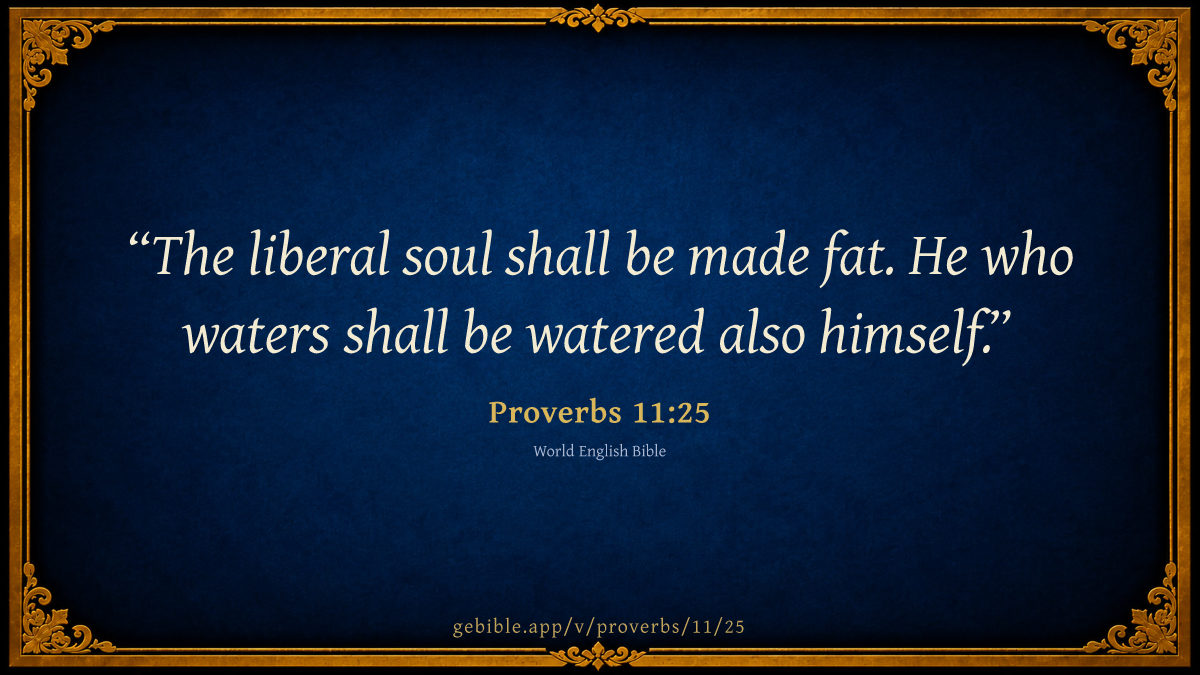
The liberal soul shall be made fat. He who waters shall be watered also himself.
Parallel Translations
-
The liberal soul shall be made fat. He who waters shall be watered also himself.
-
The liberal soul shall be made fat: and he that watereth shall be watered also himself.
-
The beneficent soul shall be made rich, and he that satisfieth abundantly shall be satisfied also himself.
Cross-references (8)
Passages linked to Proverbs 11:25 in the Treasury of Scripture Knowledge, ordered by reader-vote popularity; verse text shown in World English Bible.
- Matthew 5:7 Blessed are the merciful, for they shall obtain mercy.
- 2 Corinthians 9:6-9 Remember this: he who sows sparingly will also reap sparingly. He who sows bountifully will also reap bountifully. Let each man give according as he has determined in his heart, not grudgingly or under compulsion, for God loves a cheerful giver. And God is able to make all grace abound to you, that you, always having all sufficiency in everything, may abound to every good work. As it is written, “He has scattered abroad. He has given to the poor. His righteousness remains forever.”
- Isaiah 58:7-11 Isn’t it to distribute your bread to the hungry, and that you bring the poor who are cast out to your house? When you see the naked, that you cover him; and that you not hide yourself from your own flesh? Then your light will break out as the morning, and your healing will appear quickly; then your righteousness shall go before you, and Yahweh’s glory will be your rear guard. Then you will call, and Yahweh will answer. You will cry for help, and he will say, ‘Here I am.’ “If you take away from among you the yoke, finger pointing, and speaking wickedly; and if you pour out your soul to the hungry, and satisfy the afflicted soul, then your light will rise in darkness, and your obscurity will be as the noonday; and Yahweh will guide you continually, satisfy your soul in dry places, and make your bones strong. You will be like a watered garden, and like a spring of water whose waters don’t fail.
- Matthew 25:34-35 Then the King will tell those on his right hand, ‘Come, blessed of my Father, inherit the Kingdom prepared for you from the foundation of the world; for I was hungry, and you gave me food to eat. I was thirsty, and you gave me drink. I was a stranger, and you took me in.
- Isaiah 32:8 But the noble devises noble things; and he will continue in noble things.
- Proverbs 28:27 One who gives to the poor has no lack; but one who closes his eyes will have many curses.
- Job 29:13-18 the blessing of him who was ready to perish came on me, and I caused the widow’s heart to sing for joy. I put on righteousness, and it clothed me. My justice was as a robe and a diadem. I was eyes to the blind, and feet to the lame. I was a father to the needy. I researched the cause of him who I didn’t know. I broke the jaws of the unrighteous and plucked the prey out of his teeth. Then I said, ‘I will die in my own house, I will count my days as the sand.
- Job 31:16-20 “If I have withheld the poor from their desire, or have caused the eyes of the widow to fail, or have eaten my morsel alone, and the fatherless has not eaten of it (no, from my youth he grew up with me as with a father, I have guided her from my mother’s womb); if I have seen any perish for want of clothing, or that the needy had no covering; if his heart hasn’t blessed me, if he hasn’t been warmed with my sheep’s fleece;
Cross-references from openbible.info (CC BY 4.0)
Explain this verse (17 sources)
Historical commentary, presented as a primary source — not an endorsement.
Private notes
Saved on this device only — never synced or sent anywhere.
Geneva Bible translators 1599 · Public Domain Or, generous.
Or, generous.
Geneva Bible (1599) marginal notes — public domain.
John Trapp 1656 · Public Domain Pro 11:25 The liberal soul shall be made fat:…
Pro 11:25 The liberal soul shall be made fat: and he that watereth shall be watered also himself.
Ver. 25. The liberal soul shall be made fat.] {See Trapp on "Mat 5:7"} and my "Common Place of Alms."
John Trapp, A Commentary or Exposition upon All the Books of the Old and New Testament (1647–1656) — public domain. Text from a community e-Sword module.
Matthew Poole 1685 · Public Domain The liberal soul, Heb. the soul of blessing; that…
The liberal soul, Heb. the soul of blessing; that man who is a blessing to others, who blesseth them, i.e. doeth good to them, as blessing is oft used for a gift, as Gen 33:11; 1Sa 25:27; 2Co 9:5.
Shall be made fat; shall be greatly enriched, both with temporal and spiritual blessings.
Read full note →
He that watereth shall be watered also himself possibly it is a metaphor from a fountain, which when it poureth forth its waters is instantly filled again, whereas if it be stopped it groweth empty, and the water seeketh another course. Others render it, he shall be a rain, i.e. he shall receive such liberal supplies from God, that he shall be able to pour forth showers of good things upon others.
Matthew Poole's English Annotations on the Holy Bible (1683–1685) — public domain. Text from a community e-Sword/MySword module.
Matthew Henry 1710 · Public Domain So backward we are to works of charity, and…
So backward we are to works of charity, and so ready to think that giving undoes us, that we need to have it very much pressed upon us how much it is for our own advantage to do good to others, as before, Pro 11:17. 1. We shall have the comfort of it in our own bosoms: The liberal soul, the soul of blessing, that prays for the afflicted and provides for them, that scatters blessings with gracious lips and generous hands, that soul shall be made fat with true pleasure and enriched with more grace. 2. We shall have the recompence of it both from God and man: He that waters others with the streams of his bounty shall be also watered himself; God will certainly return it in the dews, in the plentiful showers, of his blessing, which he will pour out, till there be not room enough to receive it, Mal 3:10. Men that have any sense of gratitude will return it if there be occasion; the merciful shall find mercy and the kind be kindly dealt with. 3. We shall be enabled still to do yet more good: He that waters, even he shall be as rain (so some read it); he shall be recruited as the clouds are which return after the rain, and shall be further useful and acceptable, as the rain to the new-mown grass. he that teaches shall learn (so the Chaldee reads it); he that uses his knowledge in teaching others shall himself be taught of God; to him that has, and uses what he has, more shall be given.
Matthew Henry's Commentary on the Whole Bible (1708–1710) — public domain (CC PDM 1.0). Text via the HelloAO Bible API.
John Gill 1763 · Public Domain The liberal soul shall be made fat,.... Or, "the…
The liberal soul shall be made fat,.... Or, "the soul of blessing" (c): that is, as the Vulgate Latin version renders it, "the soul which blesseth"; not that merely prays for a blessing upon others, and wishes them well, and gives them good words; but bestows blessings on them, gives good things unto them liberally, cheerfully, and plentifully; and so is a blessing to the poor, and receives a blessing from them again; as such also do from the Lord, by whom they are "made fat"; or are blessed with temporal and spiritual blessings; and are in thriving and flourishing circumstances, both in soul and body. So he that comes full fraught with the blessing of the Gospel of Christ to others is enriched with it himself, and becomes more and more flourishing in gifts and grace;
and he that watereth shall be watered also himself; he that largely shares with others, like a flowing fountain of water, shall have an abundance communicated to him again from God, the inexhaustible fountain of mercies. Watering the plants in Christ's vineyard is one part of the work of a Gospel minister; "I have planted, Apollos watered", &c. Co1 3:6; and such who do their work well are watered, rewarded, refreshed, and comforted of God, being largely taught and richly furnished for such service by him; so the Targum,
Read full note →
"and he that teacheth, also he himself shall learn.''
(c) "anima benedictionis", Montanus, Baynus, Cocceius, Michaelis; "anima benedictioni dedita", Schultens.
John Gill's Exposition of the Whole Bible (1746–1763) — public domain (CC PDM 1.0). Text via the HelloAO Bible API.
John Wesley 1765 · Public Domain Fat - Shall be enriched both with temporal and…
Fat - Shall be enriched both with temporal and spiritual blessings.
John Wesley, Explanatory Notes Upon the Whole Bible (1754–1765) — public domain. Text via the GEBible commentary corpus.
Adam Clarke 1810 · Public Domain Verse 25. The liberal soul shall be made fat]…
Verse 25. The liberal soul shall be made fat] He who gives to the distressed, in the true spirit of charity, shall get a hundred fold from God's mercy. How wonderful is the Lord! He gives the property, gives the heart to use it aright, and recompenses the man for the deed, though all the fruit was found from himself!
He that watereth] A man who distributes in the right spirit gets more good himself than the poor man does who receives the bounty. Thus it is more blessed to give than to receive.
Adam Clarke's Commentary on the Bible (1810–1826) — public domain. Text from a community e-Sword/MySword module.
Albert Barnes 1834 · Public Domain Liberal soul - literally, “the soul that blesses,” i.…
Liberal soul - literally, “the soul that blesses,” i. e., gives freely and fully. The similitudes are both of them essentially Eastern. Fatness, the sleek, well filled look of health, becomes the figure of prosperity, as leanness of misfortune Pro 13:4; Pro 28:25; Psa 22:29; Isa 10:16. Kindly acts come as the refreshing dew and soft rain from heaven upon a thirsty land.
Albert Barnes' Notes on the Bible (1834–1885) — public domain. Text from a community e-Sword/MySword module.
Haydock's Catholic Bible Commentary 1859 · Public Domain Himself. He shall receive abundantly, 2 Corinthians ix. 6.…
Himself. He shall receive abundantly, 2 Corinthians ix. 6. The beneficent shall be amply rewarded both in this world and in the next.
George Leo Haydock (1774–1849), Haydock's Catholic Family Bible and Commentary, 1859 edition — public domain. Excludes Psalms (Douay-Rheims chapter numbering differs from Protestant) and Deuterocanonical books (Catholic canon only).
Robert Jamieson, A. R. Fausset & David Brown 1871 · Public Domain liberal soul--(Compare Margin).
liberal soul--(Compare Margin).
made fat--prospers (Pro 28:25; Deu 32:15; Luk 6:38).
Read full note →
watereth . . . watered--a common figure for blessing.
Jamieson, Fausset & Brown — Commentary Critical and Explanatory on the Whole Bible (1871) — public domain (CC PDM 1.0). Text via the HelloAO Bible API.
Daniel D. Whedon 1874 · Public Domain 25. The liberal soul — Hebrews, the soul of…
25. The liberal soul — Hebrews, the soul of blessing; that is, the man who imparts blessings.
Shall be made fat — Richly nourished. Compare the use of “blessings” in 2Ki_5:15, and of eulogia, blessing, rendered “bounty,” in 2Co_9:5. The similitudes (in this verse) are both essentially Eastern. Fatness, the sleek, well-filled look of health, becomes the figure of prosperity, as leanness is of misfortune. Chap. Pro_13:4; Pro_28:25; Psa_22:29; Isa_10:16. Kindly acts bring to the person performing them an influence as refreshing as are the dew and soft rain to a thirsty land. (Speaker’s Com.) Comp. also Mat_5:7; Mat_7:2; Luk_6:38; Ecc_11:1.
Daniel D. Whedon (gen. ed.), Commentary on the Old and New Testaments (1874–1909) — public domain. Text from a community e-Sword module.
The Cambridge Bible for Schools and Colleges 1878 · Public Domain 25. The liberal soul] Lit. the soul of blessing…
25. The liberal soul] Lit. the soul of blessing (ψυχὴ εὐλογουμένη, LXX.); the soul that is ready to benefit and bless in will and deed. Comp. “a blessing” = “a gift,” 2Ki_5:15, and ὁ σπείρων ἐπʼ εὐλογίαις, 2Co_9:6.
The Cambridge Bible for Schools and Colleges (gen. ed. J. J. S. Perowne; Cambridge University Press, 1878–1918) — public domain. Text from a community e-Sword module.
The Pulpit Commentary 1880 · Public Domain The sentiment of the preceding verse is here carried…
The sentiment of the preceding verse is here carried on and confirmed. The liberal soul; literally, the soul of blessings, the man that blesses others by giving liberally. Shall be made fat. (Pro_13:4 Pro_28:25) The term is used of the rich and prosperous. (Psa_22:29) Septuagint, "Every simple soul is blessed." He that watereth benefits and refreshes othersshall be watered also himself; shall receive the blessing which he imparts. The Vulgate introduces another idea, Qui inebriat, ipse quoque inebriabitur, where the verb implies rather abundance than excess, as in Pro_5:19, etc. The Septuagint departs widely from the present text: "A passionate man is not graceful" (euschmwn ), i.e. is ugly in appearance and manner a sentiment which may be very true, but it is not clear how it found its way into the passage. St. Chrysostom comments upon it in "Hom." 17, on St. John. There are some Eastern proverbs on the stewardship of the rich. When a good man gets riches, it is like fruit falling into the midst of the village. The riches of the good are like water turned into a rice field. The good, like clouds, receive only to give away. The rivers themselves drink not their water; nor do the trees eat their own sweet fruit, and the clouds eat not the crops. The garment in which you clothe another will last longer than that in which you clothe yourself. Who gives alms sows one and reaps a thousand.
The Pulpit Commentary (1880–1919), ed. H.D.M. Spence-Jones & Joseph S. Exell — public domain. Text from a community e-Sword module.
The Biblical Illustrator 1887 · Public Domain The liberal soul shall be made fat: and he…
Pro_11:25
The liberal soul shall be made fat: and he that watereth shall be watered also himself.
Read full note →
The waterer watered
The general principle is, that in living for the good of others, we shall be profited also ourselves. This teaching is sustained by the analogy of nature, for in nature there is a law that no one thing can be independent of the rest of creation, but there is a mutual action and reaction of all upon all. God has so constituted this universe, that selfishness is the greatest possible offence against His law, and living for others, and ministering to others, is the strictest obedience to His will. Our surest road to our own happiness is to seek the good of our fellows. We store up in Gods own bank what we generously expend on the behalf of our race. To get we must give; to accumulate we must scatter; to make ourselves happy, to get good and become spiritually vigorous, we must do good, and seek the spiritual good of others.
I. Apply this principle, in its narrow sense, as belonging to ourselves personally. There are some works in which we cannot all engage. Peculiar men have special work; but watering is work for persons of all grades and all sorts.
1. All Gods plants, more or less, want watering.
2. The Lords people usually get this watering through instrumentality. The Holy Spirit waters us by the admonitions of parents, by the kind suggestions of friends, by the teaching of His ministers, by the example of all His saints.
3. Some plants need special watering, and should be the objects of unusual care--partly because of temperament or of ignorance, and partly because of circumstances, maybe of trial, maybe of soul-withering.
4. All believers have some power to water others. In so watering others we shall be watered ourselves. This is the main point.
(1) You will waken up your own powers.
(2) You will yourself gain instruction.
(3) You will get comfort in your work.
(4) Watering others will make you humble.
(5) You will win many prayers.
(6) You will even get honour to yourselves, that will stimulate you to new exertions.
(7) While watering others you will be manifesting and showing your love to Christ, and that will make you more like Him.
II. The principle, in a wider sense, as it may refer to us as a Church. We, as a Church, have enjoyed singular prosperity; but we have endeavoured to water others. We have undertaken a good many enterprises for Christ, and we hope to undertake a great many more. We must keep our watering work up.
III. The principle, in the widest sense, as it may be referred to the entire Body of Christ. Our missionary operations are an infinite blessing to the Churches at home. Relinquishing them, giving them up, staying them, would bring such a curse that we had need to go down on our knees and pray, God send the missionary work back again. (C. H. Spurgeon}
Scriptural liberality illustrated and enforced
All the appearances of virtue and piety do not partake of their real nature. See the case of the Pharisees. None of our good works can be viewed with approbation by God unless they spring from a right principle, are guided by a right rule, and are directed to a right end. God looks at the motive in which they originate.
I. The character of true religious or Christian liberality.
1. Its principle. The spirit which is in man must be the seat of this virtue, or the liberal hand, so far as it respects God, is of no worth. There is much beneficence apart from religion. But it is the grateful heart God requires.
2. Its objects. First our kindred according to the flesh. Then the poor and distressed in society.
3. The modes in which this liberality should express itself. It should be honest in its administration. It should be proportionate in degree. It should be affectionate in its communication. It should be expansive in its embrace. It should be habitual in its exercise.
II. The recompense to encourage us to its exercise and display.
1. As respects the life that now is. Inward pleasure, pleasure in looking at the good effected; enlarged powers of usefulness.
2. As respects the life to come. Apply to those who give nothing to the cause of the poor. To those who give little. To those who are in the habit of giving much. (John Clayton, jun.)
The blessedness of blessing
It must be admitted that the natural tendency of things in this present fallen world is by no means such as to secure a prosperous result to rectitude of conduct, and failure to that of a contrary character. We often witness the inversion of this order. It is necessary to consider the character of the dispensation under which the book was written. The Jews were ostensibly, as well as really, under the immediate government of God; a government sanctioned by temporal rewards and punishments. This gave to the government of God over them what we may term a visible character. There was an ostensible Moral Governor. The Jew, apart from all consideration of a future state, was entitled to look, even in this life, for a providential sanction to his conduct, when his ways were such as pleased the Lord. In Gods dealings with that people He affords an emblem, a visible emblem, of His dealings with others. The great distinction between the Jewish and the Christian dispensations is, that the one was addressed to sense, the other to faith; the one deals with visible things, the other with spiritual. It is but consistent with this distinction, that while Gods providential government over His people is not less real under the Christian dispensation, it should be less manifest. Those things which would be perplexing to us if we attempt to judge the ways of God by sense, become reconcilable with His character and with His promises when regarded in the judgment of faith. Objection might be raised on the ground that the assertion of the text is contradicted by absolute matter of fact. The words, translated out of their figurative language, obviously assert, that he who liberally dispenses to others of those bounties, whether in grace or in providence, which God has conferred upon him, shall be himself more abundantly enriched. To the eye of sense this assertion is far from being universally verified among us as a matter of fact. In a worldly point of view it is not always the most virtuous who are the most prosperous, nor the most liberal who are the most successful. But faith will see every promise to us fulfilled in a higher and better sense. The highest exemplification of this passage is found in the person of our Lord Jesus Christ. He spent His life in blessing; therefore it was He was so greatly blessed. The recompense of the reward is a motive sanctioned by the highest example, that of Christ Himself. Some think it savours too much of legality, to hold out a future recompense as a stimulus to the active employment of all our talents in the service of God. Yet surely this is to confound things that are perfectly distinct in themselves. It is not inconsistent with the doctrines of grace to propose a proportionable increase of future joy as a motive to present sacrifice, and to hold it up before Christians as a matter of certainty, that every sacrifice which they make for the Lords sake shall be repaid from the hand of the Lord. The liberal distribution of our worldly substance is attended with a blessing from the Lord, at least to the man himself. But the text is the exposition of an established law in the universal government of Gods providence. Our progress depends on our readiness to communicate of the stores already conferred upon us. The Christians rule of spiritual advancement is not so much in proportion to the acquisitions which he makes of knowledge, as to the use that he makes of it. As we feed others our own souls are fed by God. It is in the nature of things, or rather, I should say, it is in the appointment of God, that it should be so. (W. Dodsworth, M.A.)
He that watereth shalt be watered
If we give so much we shall exhaust our resources, is a common remark. Dont be afraid of that, my friend. See that little fountain yonder--away yonder in the distant mountain, shining like a thread of silver through the thick copse, and sparkling like a diamond in its healthful activity. It is hurrying on with tinkling feet to bear its tribute to the river. See, it passes a stagnant pool, and the pool hails it. Whither away, master streamlet? I am going to the river to bear this cup of water God has given me. Ah! you are very foolish for that; youll need it before the summer is over. It has been a backward spring, and we shall have a hot summer to pay for it--you will dry up then. Well, says the streamlet, if I am to die so soon, I had better work while the day lasts. If I am likely to lose this treasure from the heat, I had better do good with it while I have it. So on it went, blessing and rejoicing in its course. The pool smiled complacently at its own superior foresight, and husbanded all its resources, letting not a drop steal away. Soon the midsummer heat came down, and it fell upon the little stream. But the trees crowded to its brink, and threw out their sheltering branches over it in the day of adversity, for it brought refreshment and life to them; and the sun peeped through the branches, and smiled complacently upon its dimpled face, and seemed to say, It is not in my heart to harm you; and the birds sipped its silver tide, and sang its praises; the flowers breathed their perfume upon its bosom; the beasts of the field loved to linger by its banks; the husbandmans eye sparkled with joy as he looked upon the line of verdant beauty that marked its course through his fields and meadows--and so on it went, blessing and blessed of all. God saw that the little stream never exhausted itself. It emptied its full cup into the river, and the river bore it on to the sea, and the sea welcomed it, and the sun smiled upon the sea, and the sea sent up its incense to greet the sun, and the clouds caught, in their capacious bosoms, the incense from the sea, and the winds, like waiting steeds, caught the chariots of the clouds and bore them away--away to the very mountain that gave the little fountain birth; and there they tipped the brimming cup, and poured the grateful baptism down. And so God saw to it, that the little fountain, though it gave so fully and so freely, never ran dry. And where was the prudent pool? Alas! in its inglorious inactivity it grew sickly and pestilential. The beasts of the field put their lips to it, but turned away without drinking. The breeze stooped and kissed it by mistake, but caught the malaria in the contact, and carried the ague through the region. (R. F. Horton.)
Soul fatness
If I desire to flourish in soul, I must not hoard up my stores, but must distribute to the poor. To be close and niggardly is the worlds way to prosperity, but not Gods (see Pro_11:24). Faiths way of gaining is giving. I must try this again and again; and I may expect that as much of prosperity as will be good for me will come to me as a gracious reward for a liberal course of action. Of course, I may not be sure of growing rich. I shall be fat, but not too fat. Too great riches might make me as unwieldy as corpulent persons usually are, and cause me the dyspepsia of worldliness, and perhaps bring on a fatty degeneration of the heart. No, if I am fat enough to be healthy, I may well be satisfied; and if the Lord grants me a competence, I may be thoroughly content. But there is a mental and spiritual fatness which I would greatly covet; and these come as the result of generous thoughts towards my God, His Church, and my fellow-men. Let me not stint, lest I starve my heart. Let me be bountiful and liberal; for so shall I be like my Lord. He gave Himself for me: shall I grudge Him anything? (C. H. Spurgeon.)
Gods law of recompense
If I carefully consider others, God will consider me; and in some way or other He will recompense me. Let me consider the poor, and the Lord will consider me. Let me look after little children, and the Lord will treat me as His child. Let me feed His flock, and He will feed me. Let me water His garden, and He will make a watered garden of my soul. This is the Lords own promise; be it mine to fulfil the condition, and then to expect its fulfilment. I may care about myself till I grow morbid; I may watch over my own feelings till I feel nothing; and I may lament my own weakness till I grow almost too weak to lament. It will be far more profitable for me to become unselfish, and out of love to my Lord Jesus begin to care for the souls of those around me. My tank is getting very low; no fresh rain comes to fill it; what shall I do? I will pull up the plug, and let its contents run out to water the withering plants around me. What do I see? My cistern seems to fill as it flows. A secret spring is at work. While all was stagnant, the fresh spring was sealed; but as my stock flows out to water others, the Lord thinketh upon me. Hallelujah! (C. H. Spurgeon.)
The Biblical Illustrator, edited by Joseph S. Exell (c. 1880s–1900s) — public domain. Text from a community e-Sword module.
C. I. Scofield 1917 · Public Domain liberal soul
liberal soul
See; 2Co 9:6-10.
The Scofield Reference Bible (1917 edition), notes by C. I. Scofield — public domain. Text from a community e-Sword module.
Paul E. Kretzmann 1924 · Public Domain v. 25. The liberal soul shall be made fat,…
v. 25. The liberal soul shall be made fat, being rewarded with blessings from the Lord; and he that watereth shall be watered also himself, that is, God will reward with a corresponding refreshing him who refreshes and restores others by deeds of kindness.
Paul E. Kretzmann, Popular Commentary of the Bible (1921–1924) — public domain. Text from a community e-Sword module.
unfoldingWord translationNotes 2017 · CC BY-SA 4.0 will prosper
will prosper
"will gain more"
Read full note →
the one who
"the generous person who" or "anyone who"
the man who refuses to sell
This describes the person who hoards his wealth instead of helping those in need.
good gifts crown the head of him who sells it
"Crown" represents the reward or award for the person who is willing to sell grain. AT: "good gifts are given as a crown of honor to him who sells it" or "the person who sells it is honored with many blessings" (See: Metaphor)
translationWords
curse
grain
gift
crown
unfoldingWord translationNotes — © Distant Shores Media and the Door43 World Missions Community, licensed CC BY-SA 4.0. Source: git.door43.org/Door43/en_tn.