
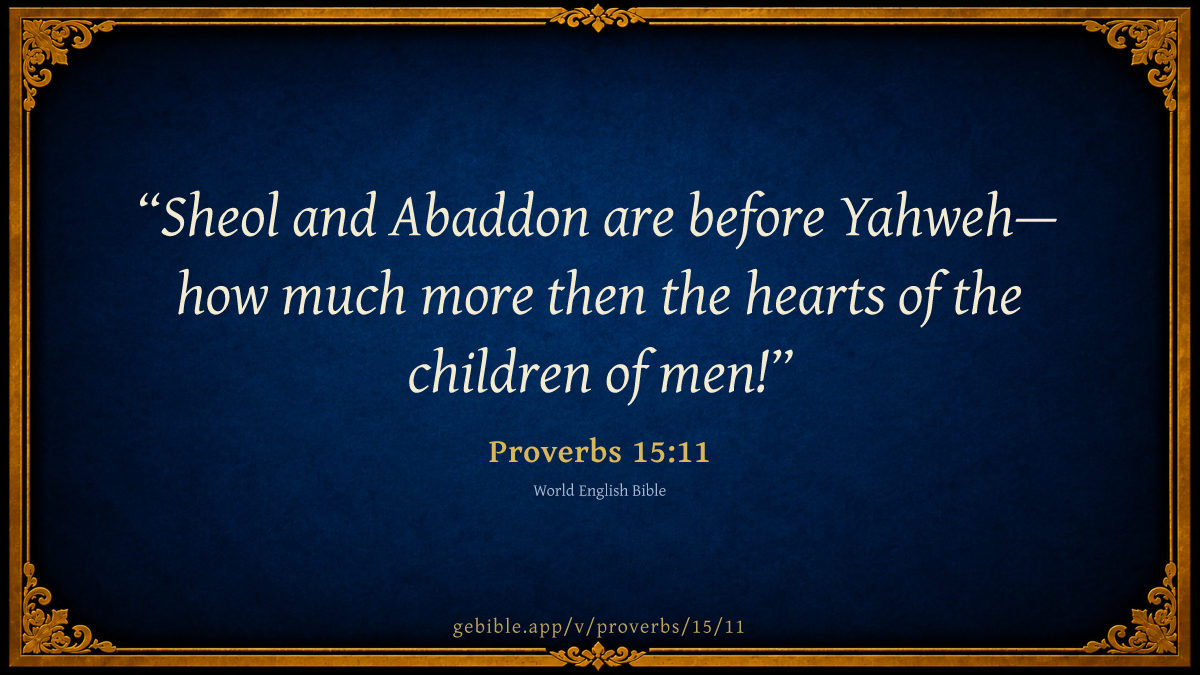
Sheol and Abaddon are before Yahweh— how much more then the hearts of the children of men!
Parallel Translations
-
Sheol and Abaddon are before Yahweh— how much more then the hearts of the children of men!
-
Hell and destruction are before the LORD: how much more then the hearts of the children of men?
-
The nether-world and Destruction are before the LORD; how much more then the hearts of the children of men!
Cross-references (13)
Passages linked to Proverbs 15:11 in the Treasury of Scripture Knowledge, ordered by reader-vote popularity; verse text shown in World English Bible.
- Psalms 44:21 won’t God search this out? For he knows the secrets of the heart.
- Psalms 139:8 If I ascend up into heaven, you are there. If I make my bed in Sheol, behold, you are there!
- Hebrews 4:13 There is no creature that is hidden from his sight, but all things are naked and laid open before the eyes of him to whom we must give an account.
- 2 Chronicles 6:30 then hear from heaven your dwelling place and forgive, and render to every man according to all his ways, whose heart you know (for you, even you only, know the hearts of the children of men)
- Job 26:6 Sheol is naked before God, and Abaddon has no covering.
- Revelation 2:23 I will kill her children with Death, and all the assemblies will know that I am he who searches the minds and hearts. I will give to each one of you according to your deeds.
- 1 Samuel 16:7 But Yahweh said to Samuel, “Don’t look on his face, or on the height of his stature, because I have rejected him; for I don’t see as man sees. For man looks at the outward appearance, but Yahweh looks at the heart.”
- Proverbs 27:20 Sheol and Abaddon are never satisfied; and a man’s eyes are never satisfied.
- Jeremiah 17:10 “I, Yahweh, search the mind. I try the heart, even to give every man according to his ways, according to the fruit of his doings.”
- Revelation 1:18 and the Living one. I was dead, and behold, I am alive forever and ever. Amen. I have the keys of Death and of Hades.
- Psalms 7:9 Oh let the wickedness of the wicked come to an end, but establish the righteous; their minds and hearts are searched by the righteous God.
- John 21:17 He said to him the third time, “Simon, son of Jonah, do you have affection for me?” Peter was grieved because he asked him the third time, “Do you have affection for me?” He said to him, “Lord, you know everything. You know that I have affection for you.” Jesus said to him, “Feed my sheep.
- John 2:24-25 But Jesus didn’t entrust himself to them, because he knew everyone, and because he didn’t need for anyone to testify concerning man; for he himself knew what was in man.
Cross-references from openbible.info (CC BY 4.0)
Explain this verse (19 sources)
Historical commentary, presented as a primary source — not an endorsement.
Private notes
Saved on this device only — never synced or sent anywhere.
Geneva Bible translators 1599 · Public Domain There is nothing so deep or secret that can…
There is nothing so deep or secret that can be hid from the eyes of God, much less man’s thoughts.
Geneva Bible (1599) marginal notes — public domain.
John Trapp 1656 · Public Domain Pro 15:11 Hell and destruction [are] before the LORD:…
Pro 15:11 Hell and destruction [are] before the LORD: how much more then the hearts of the children of men?
Ver. 11. Hell and destruction are before the Lord.] "Tophet is prepared of old"; and wherever it is, as it skills not curiously to inquire, - below us it seems to be, {Rev 14:11} et ubi sit sentient qui curiosius quaerunt {a} - so it is most certain that "hell is naked before God, and destruction uncovered in his sight." {Job 26:6} We, silly fishes, see one another jerked out of the pond of life by the hand of death; but we see not the frying pan and the fire that they are cast into, that "die in their sins," and refuse to be reformed. Cast they are into utter darkness. {Mat 8:12} In tenebras ex tenebris infeliciter exclusi, infelicius excludendi. {b} Howbeit this thickest "darkness hideth not from God, but the light shineth as the day"; {Psa 139:12} he perfectly knows the state of the dead and the damned. Oh that men knew more of it, and did believe in any measure that eternity of extremity that is there to be endured! Oh that they would be forewarned to flee from this wrath to come! Oh that they were wise, that they understood this, that they would consider their latter end, those quatuor novissima! {Deu 32:29} Utinam ubique de Gehenna dissereretur, saith Chrysostom. He that doth but hear of hell, is without any further labour or study taken off from sinful pleasures, saith Nyssen. But if a man had but one glimpse of it, it were enough, saith Bellarmine, to make him not only turn Christian and sober, but anchorite and monk; to live after the strictest rule that can be. But, alas! we cannot get men to think of it till they be plunged headlong into it.
Read full note →
“Esse aliquos manes, &c.
Vel pueri credunt nisi qui nondum aere levantur.”
- Juvenal.
No, though one should come from the dead to testify unto them, they would not be persuaded. {Luk 16:31}
How much more then the hearts of the children of men.] Though deep and deceitful, full of turnings and windings, Multae sunt in animo latebrae, multi recessus , saith Cicero, yet God can fathom and find them out. {Jer 17:9-10} He searcheth the hearts and reins, which yet are the most remote and abstruse of all the entrails, covered from the eye of the anatomist with fat and flesh, &c. By "hearts and reins" understand thoughts and affections; the reins being the seat of the strongest affection, that which is for generation. Lo, these are pervious and patent to the eyes of God, yea, dissected, quartered, cleft in the backbone - as the apostle’s word, τετραχηλισμενα {Heb 4:13} signifies - how much more then their evil actions! These cannot possibly be hidden from God’s all-seeing eye, though they dig deep to secure themselves, as those gunpowder traitors; though they throw thereupon wood, stones, and rubbish, all these to God would be but as spectacles to make their sins appear the greater, or as perspectives to multiply them. {c}
{a} Pareus, in loc.
{b} Augustin., Hom. 16.
{c} Lux altissima coeli occultum nihil esse sinit, latebrasque per omnes intrat. - Claudian.
John Trapp, A Commentary or Exposition upon All the Books of the Old and New Testament (1647–1656) — public domain. Text from a community e-Sword module.
Matthew Poole 1685 · Public Domain Destruction; put for the place of destruction, by a…
Destruction; put for the place of destruction, by a usual metonymy; the place and state of the damned, of which men know nothing but by Divine revelation.
The hearts; whose thoughts and affections, though they lie deep, discover themselves by outward signs and actions.
Matthew Poole's English Annotations on the Holy Bible (1683–1685) — public domain. Text from a community e-Sword/MySword module.
Matthew Henry 1710 · Public Domain This confirms what was said (Pro 15:3) concerning God's…
This confirms what was said (Pro 15:3) concerning God's omnipresence, in order to his judging of evil and good. 1. God knows all things, even those things that are hidden from the eyes of all living: Hell and destruction are before the Lord, not only the centre of the earth, and its subterraneous caverns, but the grave, and all the dead bodies which are there buried out of our sight; they are all before the Lord, all under his eye, so that none of them can be lost or be to seek when they are to be raised again. He knows where every man lies buried, even Moses, even those that are buried in the greatest obscurity; nor needs he any monument with a Hic jacet - Here he lies, to direct him. The place of the damned in particular, and all their torments, which are inexpressible, the state of separate souls in general, and all their circumstances, are under God's eye. The word here used for destruction is Abaddon, which is one of the devil's names, Rev 9:11. That destroyer, though he deceives us, cannot evade or elude the divine cognizance. God examines him whence he comes (Job 1:7), and sees through all his disguises though he is sly, and subtle, and swift, Job 26:6. 2. He knows particularly the hearts of the children of men. If he sees through the depths and wiles of Satan himself, much more can he search men's hearts, though they be deceitful, since they learned all their fraudulent arts of Satan. God is greater than our hearts, and knows them better than we know them ourselves, and therefore is an infallible Judge of every man's character, Heb 4:13.
Matthew Henry's Commentary on the Whole Bible (1708–1710) — public domain (CC PDM 1.0). Text via the HelloAO Bible API.
John Gill 1763 · Public Domain Hell and destruction are before the Lord,.... Or "the…
Hell and destruction are before the Lord,.... Or "the grave" (a), which is the pit of destruction; where bodies being put, putrefy, and are destroyed by worms: this is known by the Lord, even the grave of everyone from the beginning; the graves of Adam, Abel, Abraham; he knows where their dust lies, and will raise it up again at the last day. Hades, or the invisible state of the departed, as the Septuagint has it, is manifest before him; he knows where departed spirits are; what their condition and employment be; and so the place and state of the damned, known by the name of "hell"; and may be called "destruction", where soul and body are destroyed by the Lord with an everlasting destruction; and is the destruction which the broad way of sin leads unto. Now though we know not where this place is, who are there, and what the torments endured in it; yet all is before the Lord, and known to him: "tophet" is ordained of old; everlasting fire is prepared by the Lord for devils and wicked men; see Job 26:6;
how much more then the hearts of the children of men? which, though desperately wicked, are known by him; who is the searcher of the hearts and the trier of the reins of the children of men: he to whom hell is naked, and can look into that outer darkness, the blackness of darkness, can look into a man's heart, a second hell, in which all manner of wickedness is, and observe it all; he needs no testimony of man; he knows what is in man, all his secret thoughts, wicked purposes, designs, and devices; see Jer 17:9.
Read full note →
(a) "sepulchrum", Munster, Piscator, Mercerus, so Ben Melech.
John Gill's Exposition of the Whole Bible (1746–1763) — public domain (CC PDM 1.0). Text via the HelloAO Bible API.
John Wesley 1765 · Public Domain Destruction - The place of destruction, of which men…
Destruction - The place of destruction, of which men know nothing but by Divine Revelation.
John Wesley, Explanatory Notes Upon the Whole Bible (1754–1765) — public domain. Text via the GEBible commentary corpus.
Adam Clarke 1810 · Public Domain Verse 11. Hell and destruction] שאול ואבדון sheol vaabaddon.…
Verse 11. Hell and destruction] שאול ואבדון sheol vaabaddon. Hades, the invisible world, the place of separate spirits till the resurrection: and Abaddon, the place of torment; are ever under the eye and control of the Lord.
Adam Clarke's Commentary on the Bible (1810–1826) — public domain. Text from a community e-Sword/MySword module.
Charles Bridges 1846 · Public Domain Once more (Pro 15:3 ) behold we an Omniscient…
Once more (Pro 15:3 ) behold we an Omniscient — Omnipresent God. Hell and destruction; every recess of the vast Hades; the state of the dead, and the place of the damned — are before the LORD,†1 before his eye; open to his cognizance. How much more, then, the hearts of the children of men (1Jn 3:20 ), unsearchable though they be! (Jer 17:9-10 .) No depth is there within, that he cannot fathom; no manner of deceit so complicated, that he cannot track them. Words are not necessary with him to lay open the heart. Aaron’s rebellious feelings were as cognizant to his eye as Moses’ angry words. (Num 20:12, Num 20:24 .) The inward hypocrisy of his people was as open before him, as if it had been stamped upon their foreheads. (Deu 5:28-29 . Zep 1:12 .)
Yet what a mass of practical unbelief is there in this plain demonstrative truth! For would men dare to indulge their vain thoughts, their light notions, their trifles, their impurities, did they really believe that the LORD searched their hearts? Would they attempt a forced concealment from his eye (Isa 29:15 ); as if outward service, lip-worship, would avail, while the heart was cherishing its unrepented sin? Would they not be afraid to think before him what they would shrink from doing before men? Oh! is it not an awful moment in privacy to stand the test of this searching eye? Awful indeed is the thought to the idolatrous sinner, to the lover of pleasure, distinction, or low ambition. Thine heart is open before thy God. Never will he stoop to occupy the second place there. Thy covering of deceit is swept away. The refuges of lies are pierced and laid bare.
Read full note →
The conscious sinner shrinks from this appalling view. The believer walks undismayed in the sight of this "consuming fire." His godly fear is the exercise of filial confidence. (Heb 12:28-29 .) The sins, that are opened to his Father’s knowledge, are covered from his justice. (Heb 4:13 . Psa 32:1 .) When he "finds the law, that when he would do good, evil is present with him;" he can look up — "All my desire is before thee." (Rom 7:21 . Psa 38:9 .) Thus does the Gospel clothe the Divine attributes with light and love.
And see we not here a testimony to the Divine Glory of Immanuel? For are not hell and destruction before him (Rev 1:18 ) as his vast empire? And did not he often prove his prerogative of searching the hearts of the children of men; charging sin in the inner world, beyond the ken of any, but the One all-seeing eye? And this indeed is the confidence of his people. Each of them appeals to this Omniscient eye, in despite of all accusing from the enemy — "Lord! thou knowest all things; thou knowest that I love thee!" (Joh 21:17 . Rev 2:23 .)
Footnotes:
†1 Job 26:6. Psa 139:7-8 . Destruction, Heb. Abaddon. Compare Rev 9:11 .
Charles Bridges, An Exposition of the Book of Proverbs (1846) — public domain. Text from a community e-Sword module.
Haydock's Catholic Bible Commentary 1859 · Public Domain Before. Naked. The state of the damned is known…
Before. Naked. The state of the damned is known to God, chap. ix. 18. (Calmet)
George Leo Haydock (1774–1849), Haydock's Catholic Family Bible and Commentary, 1859 edition — public domain. Excludes Psalms (Douay-Rheims chapter numbering differs from Protestant) and Deuterocanonical books (Catholic canon only).
Robert Jamieson, A. R. Fausset & David Brown 1871 · Public Domain Hell-- (Psa 16:10).
Hell-- (Psa 16:10).
destruction--or, "Abaddon," the place of the destroyer. All the unseen world is open to God, much more men's hearts.
Jamieson, Fausset & Brown — Commentary Critical and Explanatory on the Whole Bible (1871) — public domain (CC PDM 1.0). Text via the HelloAO Bible API.
Daniel D. Whedon 1874 · Public Domain 11. Hell and destruction — Sheol and abaddon, the…
11. Hell and destruction — Sheol and abaddon, the under world, the infernal regions. The Hebrew sheol corresponded somewhat to the Greek hades, which word is generally used for it is the Septuagint. It here denotes the receptacle of departed spirits, conceived of, probably, as a vast subterranean region, dark and invisible to mortal eyes, and invested with more or less of horrible imagery — “the dreary regions of the dead.” It was, perhaps, not thought of at first as the abode of the wicked exclusively; nevertheless, it is plain that it came eventually to be associated more particularly with the state of wicked men after death; while to the righteous was assigned a happier sphere, at first probably thought of as a favoured portion of the under world, but in time transferred to the regions above — the heavens. Among the Jews, in later times, this was called paradise, Abraham’s bosom, etc. This was regarded as the place where there were “fulness of joy” and “pleasures for evermore.” The point in the proverb is this: As the invisible under world is open and conspicuous to the eyes of Jehovah, how much more, or certainly, the hearts of the children of men. Compare Job_26:6; Job_28:22; Psa_18:12; Psa_55:23; Psa_139:8; Pro_27:20. On the latter clause, see Jer_17:10; Heb_4:3; Rev_9:11.
Daniel D. Whedon (gen. ed.), Commentary on the Old and New Testaments (1874–1909) — public domain. Text from a community e-Sword module.
The Cambridge Bible for Schools and Colleges 1878 · Public Domain 11. Hell and destruction] Sheol and Abaddon with “The…
11. Hell and destruction] Sheol and Abaddon with “The grave,” and “Destruction” in the marg. R.V. In their preface the Revisers explain that “with a view to obviate inevitable misunderstanding,” they “have left in the historical narratives the rendering (of A.V.) ‘the grave,’ or ‘the pit,’ with a marginal note, ‘Heb. Sheol,’ to indicate that it does not signify the place of burial; while in the poetical writings they have put most commonly ‘Sheol’ in the text, and ‘the grave’ in the margin.”
In like manner, “Abaddon, which has hitherto been known to the English reader of the Bible only from the New Testament (Rev_9:11), has been introduced in three passages (Job_26:6; Pro_15:11; Pro_27:20), where a proper name appeared to be required for giving vividness and point.” Comp. for the thought, Job_26:6; Psa_139:1-16.
The Cambridge Bible for Schools and Colleges (gen. ed. J. J. S. Perowne; Cambridge University Press, 1878–1918) — public domain. Text from a community e-Sword module.
Ellicott's Commentary for English Readers 1878 · Public Domain (11) Hell and destruction.—“Hell” is here the general name…
(11) Hell and destruction.—“Hell” is here the general name for the unseen world (Hades) beyond the grave, so called, according to one derivation, from its always “asking” for more victims, and never being satisfied. (Comp. Pro_27:20.) “Destruction” (Abaddon) is the lowest hell, corresponding to the “abyss” of Luk_8:31; Rev_9:1; Rev_9:11; the abode of evil spirits and the lost. (For the thought, comp. Job_26:6, and Psa_139:8.)
A Bible Commentary for English Readers, edited by Charles John Ellicott (1878–1897) — public domain. Text from a community e-Sword module.
The Pulpit Commentary 1880 · Public Domain Hell and destruction are before the Lord. The two…
Hell and destruction are before the Lord. The two words rendered "hell" and "destruction" are respectively Sheol and Abaddon, Infernus and Perditio, Aidhv and apwleia . (comp. Pro_27:20) The former is used generally as the place to which the souls of the dead are consigned the receptacle of all departed spirits, whether good or bad. Abaddon is the lowest depth of hell, the "abyss" of Luk_8:31 Rev_9:2, etc.; Rev_20:1, etc. The clause means that God"s eye penetrates even the most secret corners of the unseen world. As Job (Job_26:6) says, "Sheol is naked before him, and Abaddon hath no covering". (comp. Psa_139:7, etc.) How much more then the hearts of the children of men? (For the form of the expression, comp. Pro_11:31 and Pro_19:7; and for the import, Pro_16:2 Pro_21:2 Jer_17:10) If God knows the secrets of the world beyond the grave, much more does he know the secret thoughts of men on earth. The heart is the source of action. (see Mat_15:19, etc.)
The heart open to God.
Read full note →
I THE HEART A PROFOUND MYSTERY. We speculate about the mysteries of the world without us, as if these were the great secrets, forgetful what an abyss of wonder is within.
II THIS MYSTERY MAY BE COMPARED TO THAT OF HADES AND THE KINGDOM OF THE DEVIL.
1. It is equally profound.
2. It is equally fascinating.
3. It is equally hidden from our knowledge.
Peruse our greatest masters of the human heart a Shakespeare, Bacon, Montaigne we have still not touched the bottom.
III THE MYSTERY OF ALL WORLDS IS KNOWN TO GOD, THE INTERNAL NO LESS THAN THE EXTERNAL.
1. This is a thought of awe.
2. Still more it should be of comfort.
My God, thou knowest all, all that fain would hide itself from others, even from myself and yet "hast stooped to ask of me the love of this poor heart"! J.
The certainty of God"s notice.
First we have
I THE DIFFICULTY SUGGESTED. It is not unnatural to ask Does God in very deed take notice of such beings as we are? does he condescend to watch the workings of our mind? are the flitting thoughts that cross our brain, the fugitive feelings that pass through our weak human hearts, within the range of his observation? Is that worth his while? Are they not beyond the pale of his Divine regard?
II THE ARGUMENT FROM SECRECY. If "Sheol" is before the Lord, if that region of darkness were "the light (itself) is as darkness," if the place of mystery and shadow is within his Divine regard, how much more are those who are living in the light of day, on whom the sunshine falls, who live their life openly beneath the heavens! The writer evidently felt that there was nothing so particularly hidden or secret about the mind of man. And we may well argue that there is nothing inscrutably hidden within our hearts; for do we not read, continually and correctly, the minds of our children? We know what they think and feel. And if their minds are open to us, how much more must our minds the minds of the children of men be "naked and open" to our heavenly Father! If our superior intelligence supplies us with the key to their secrets, what does not Omniscience know of us, even of those thoughts and motives we are most anxious to conceal?
III THE ARGUMENT FROM UNATTRACTIVENESS. "Abaddon destruction is before the Lord." That which has no manner of interest in itself, that from which Benevolence would willingly turn its eyes, that which is repelling to the sight of love and life, that even is before God; he never ceases to regard a scene so utterly uninviting. How much more, then, will he regard the hearts of his own offspring! There is nothing beneath the skies so interesting to him. What has the most charm to us in our home? Surely not any furniture or any treasures, however rare, or costly, or beautiful these may be. It is our children; it is their hearts of love for which we care. It is to them that we come home in joyful expectation. It is on them our eye rests with benignity and delight. So with our Divine Father. He does look on all the furniture of this wonderful home in which we dwell; (Psa_104:31) he ever has before him the sphere and scene of destruction; but that which draws his eye of tender interest and kindly pity and holy love is the heart of his sons and daughters. We are poor and needy, but we are all his offspring, and "the Lord thinketh upon us.
1. With what parental grief does he look upon
a. our separation from himself in sympathy;
b. our unlikeness to himself in spirit and in character;
c. our disobedience to his will!
2. With what parental satisfaction does he view
a. our return to his side and his service;
b. our increasing likeness to our Leader and Exemplar;
c. our filial obedience and submission to his will! C.
The Pulpit Commentary (1880–1919), ed. H.D.M. Spence-Jones & Joseph S. Exell — public domain. Text from a community e-Sword module.
The Preacher's Complete Homiletical Commentary 1892 · Public Domain Pro_15:11. Hell and destruction, “Sheôl,” and “Abaddôn,” two different…
CRITICAL NOTES.—
Pro_15:11. Hell and destruction, “Sheôl,” and “Abaddôn,” two different names for the world of the departed. “Sheôl” is the unseen world in general, “Abaddôn” the place of destruction, i.e., the place where their bodies are destroyed (so Stuart, Zöckler, etc.). How much more. Miller translates these particles by “because also” (see his Comment).
Read full note →
MAIN HOMILETICS OF Pro_15:11
TWO WORLDS
I. Two worlds out of the reach of the human senses—the world of departed men and the human soul. Both these mysterious worlds are shut out or shut in from the eye of man by the bolts and bars of his bodily senses. How exceedingly small a portion of the vast universe of God is revealed to the eye of sense! The small globe upon which man finds himself is nearly all that he can possibly know with his bodily vision. Reason may tell him that there is much more, faith may afford him clearer evidence of things not seen (Heb_11:1), but over all there is a veil drawn. The vast world, where dwells the great majority of the human race—that unseen home, peopled with the spirits of just men made perfect, and the dwelling-place of the spirits of the unjust—are regions entirely beyond the reach of human sight. And there is another world equally out of the reach of his vision. He has never seen the soul of any one of the thousands of his fellow-men with whom he has come in contact. He has never read the heart of his most intimate friend. His own “living soul,” even that which is himself, has never been apprehended by his bodily senses. He has never touched or looked upon that.
II. But both these invisible worlds are entirely open to the eye of God. The world of spirits and the individual soul of each man are seen by Him as plainly as we see the material world around us, or as we see the bodies of our fellow-creatures. And they are far more fully comprehended by Him than the visible things upon which our eyes rest every day are comprehended by us. For what do we really know of the essential properties of that by which we are surrounded? Is not our very bodily organism a mystery to us? But each soul of each individual man in the body, and each “unclothed” (2Co_5:4) spirit in the worlds of the departed is “naked and open” in the eyes of Him with whom each one “has to do” (Heb_4:13) as really and as intimately as if in all the universe there was only one creature of whom the omniscient Creator had to take cognizance.
OUTLINES AND SUGGESTIVE COMMENTS
It is the gross persuasion of some, as if hell and destruction were only things that God did set before us, and that they were not before Him; as if they were things wherewith God did only terrify us, and which should never be. But the wise man telleth us, that they are before the Lord, and that though we know not where hell is and what is done there, yet it is before God’s eyes. And, therefore, though the heart of the children of men be made as deep as hell by hellish devices, yet much more is that manifest to God. The heart of man is more manifest to Him than it is to himself. Wherefore St. Augustine, speaking unto God, saith, “Thou wert within, and I was without.” For, indeed, God is often within and knoweth what our hearts are, when we ourselves are without and do not know them.—Jermin.
This terrible truth these hearts secretly know, and their desperate writhings to shake it off show how much they dislike it. The Romish confessional is one of the most pregnant facts in the history of man. It is a monument and measure of the guilty creature’s enmity against God.… We have wondered at the blindness and stupidity of our common nature in permitting a man, not more holy than his neighbours, to stand in the place of God to a brother’s soul. There is cause for grief, but not ground for surprise. The phenomenon proceeds in the way of natural law. It is the common, well understood process of compounding for the security of the whole, by the voluntary surrender of a part. The confessional is a kind of insurance office where periodical exposure of the heart to a man is the premium paid for fancied impunity in hiding that heart altogether from the deeper scrutiny of the all-seeing God.… It is God’s love from the face of Jesus Christ shining into my dark heart that makes my heart open and delight to be His dwelling-place. The eye of the just Avenger I cannot endure to be in this place of sin; but the eye of the compassionate Physician I shall gladly admit into this place of disease.—Arnot.
“Because also the hearts of the children of men.” (See Miller’s rendering in Critical Notes.) The intimation is God knows hell because He knows men. He knows that “hating reproof,” we die (Pro_15:10), and just how fast we die or sink by each act of hating. In other words, he knows how fast sin grows under an administration of justice; and, therefore, how far a given sinner will have gone down, at any date, through his eternal age.—Miller.
The verse may denote that the deepest machinations of the prince of hell, and of all his legions of fallen angels, are open to the Lord’s inspection, and must end in their disappointment and deeper torment; how, then, can man, who is so inferior in sagacity and subtilty, expect to hide his counsels from God, or to prosper in rebellion against Him?” There is nothing so deep or secret that can be hid from the eyes of God, much less man’s thoughts.”—Scott.
The Preacher's Complete Homiletical Commentary (gen. ed. Joseph S. Exell; Funk & Wagnalls, c. 1892) — public domain (pre-1929). A full-Bible homiletical/sermon-outline anthology covering 65 of 66 books (2 John is absent from the source module). Text from a community e-Sword module.
C. I. Scofield 1917 · Public Domain Heb. "Sheol," (See Scofield "Hab 2:5"), Job 26:6; Psa…
hell
Heb. "Sheol," (See Scofield "Hab 2:5"), Job 26:6; Psa 139:8.
The Scofield Reference Bible (1917 edition), notes by C. I. Scofield — public domain. Text from a community e-Sword module.
Paul E. Kretzmann 1924 · Public Domain v. 11. Hell and destruction are before the Lord,…
v. 11. Hell and destruction are before the Lord, the realm of the dead, the place of eternal perdition, is uncovered before Him; He knows them, though they be hidden from the eyes of men; how much more, then, the hearts of the children of men? Jehovah knows the hearts of all men, they are all uncovered before His eyes, Jer 17:10; Heb 4:13.
Paul E. Kretzmann, Popular Commentary of the Bible (1921–1924) — public domain. Text from a community e-Sword module.
unfoldingWord translationNotes 2017 · CC BY-SA 4.0 Sheol and destruction are open before Yahweh
Sheol and destruction are open before Yahweh
The words "Sheol and destruction" both refer to the place of the dead. Yahweh knowing everything about the place of the dead is spoken of as if it were open before Yahweh. AT: "Yahweh knows everything about the place where dead people are" (See: Doublet and Metaphor)
Read full note →
how much more the hearts of the sons of mankind?
This rhetorical question emphasizes that since Yahweh knows everything about the place of the dead, it is more obvious that he knows everything about the hearts of men. AT: "so he certainly knows the hearts of the sons of mankind!" (See: Rhetorical Question)
the hearts of the sons of mankind
Here the word "hearts" represents the thoughts and motivations. The phrase "the sons of mankind" is an idiom for humanity. AT: "the thoughts of humans" (See: Metonymy and Idiom)
The mocker resents correction
The word "correction" can be translated with a verbal form. AT: "The mocker hates when others correct him" (See: Abstract Nouns)
he will not go to the wise
It is implied that he will not go to the wise to seek their counsel or advice. AT: "he will not go to the wise to seek their counsel" (See: Assumed Knowledge and Implicit Information)
translationWords
Hades
Yahweh
heart
mock
wise
unfoldingWord translationNotes — © Distant Shores Media and the Door43 World Missions Community, licensed CC BY-SA 4.0. Source: git.door43.org/Door43/en_tn.
Tyndale Open Study Notes 2022 · CC BY-SA 4.0 15:11 Death and Destruction (Hebrew Sheol and Abaddon) personify…
15:11 Death and Destruction (Hebrew Sheol and Abaddon) personify the destiny of the dead. Sheol is the abode of the dead; Abaddon is a synonym for Sheol that has an added implication of punishment. • God knows all secrets (see Ps 139:1-12).
Tyndale Open Study Notes — © Tyndale Open Resources, licensed CC BY-SA 4.0. Text via the HelloAO Bible API.