
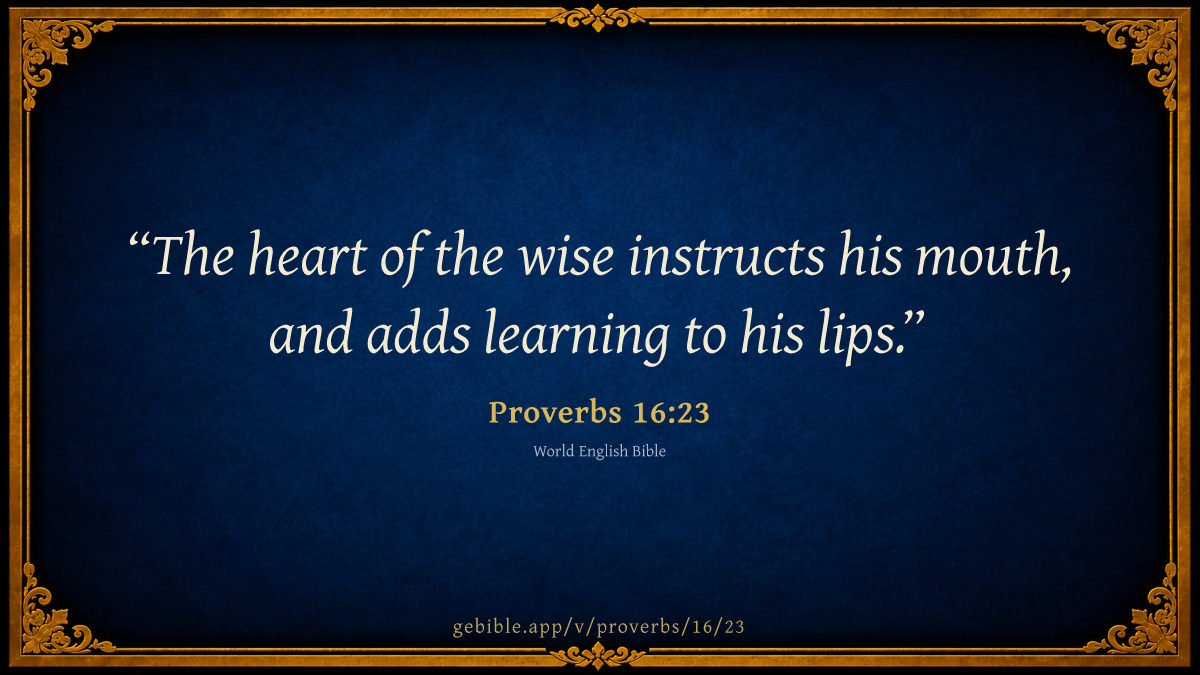
The heart of the wise instructs his mouth, and adds learning to his lips.
Parallel Translations
-
The heart of the wise instructs his mouth, and adds learning to his lips.
-
The heart of the wise teacheth his mouth, and addeth learning to his lips.
-
The heart of the wise teacheth his mouth, and addeth learning to his lips.
Cross-references (6)
Passages linked to Proverbs 16:23 in the Treasury of Scripture Knowledge, ordered by reader-vote popularity; verse text shown in World English Bible.
- Proverbs 15:28 The heart of the righteous weighs answers, but the mouth of the wicked gushes out evil.
- Matthew 12:34-35 You offspring of vipers, how can you, being evil, speak good things? For out of the abundance of the heart, the mouth speaks. The good man out of his good treasure brings out good things, and the evil man out of his evil treasure brings out evil things.
- Proverbs 22:17-18 Turn your ear, and listen to the words of the wise. Apply your heart to my teaching. For it is a pleasant thing if you keep them within you, if all of them are ready on your lips.
- Colossians 3:16 Let the word of Christ dwell in you richly; in all wisdom teaching and admonishing one another with psalms, hymns, and spiritual songs, singing with grace in your heart to the Lord.
- Psalms 37:30-31 The mouth of the righteous talks of wisdom. His tongue speaks justice. The law of his God is in his heart. None of his steps shall slide.
- Psalms 45:1 My heart overflows with a noble theme. I recite my verses for the king. My tongue is like the pen of a skillful writer.
Cross-references from openbible.info (CC BY 4.0)
Explain this verse (15 sources)
Historical commentary, presented as a primary source — not an endorsement.
Private notes
Saved on this device only — never synced or sent anywhere.
John Trapp 1656 · Public Domain Pro 16:23 The heart of the wise teacheth his…
Pro 16:23 The heart of the wise teacheth his mouth, and addeth learning to his lips.
Ver. 23. The heart of the wise teacheth his mouth.] Frameth his speech for him, and seasoneth it with salt of grace, ere it sets it as a dish before the hearers. Nescit poeuitenda loqui qui proferenda prius suo tradidit examini, saith Cassiodore. {a} He cannot lightly speak amiss that weighs his words before he utters them. The voice which is made in the mouth is nothing so melodious as that which comes from the depth of the breast Heart sprung speech hath weight and worth in it.
Read full note →
And addeth learning to his lips.] By restraining talkativeness, and making him as willing to hear as to speak, to learn as to teach, to be an auditor as an orator.
{a} Lib. x. Eph 4:1-32.
John Trapp, A Commentary or Exposition upon All the Books of the Old and New Testament (1647–1656) — public domain. Text from a community e-Sword module.
Matthew Poole 1685 · Public Domain Teacheth his mouth; directeth him what, and when, and…
Teacheth his mouth; directeth him what, and when, and how to speak, and keepeth him from speaking rashly and foolishly.
Addeth learning to his lips, i.e. enableth him to speak learnedly and wisely. Or, increaseth learning (in himself and others) by (as this Hebrew particle oft signifies, and is by some rendered here) his lips, i.e. by his wise speeches; that this may agree with the latter clause of Pro 16:21, where this same phrase is used.
Matthew Poole's English Annotations on the Holy Bible (1683–1685) — public domain. Text from a community e-Sword/MySword module.
Matthew Henry 1710 · Public Domain Solomon had commended eloquence, or the sweetness of the…
Solomon had commended eloquence, or the sweetness of the lips (Pro 16:21), and seemed to prefer it before wisdom; but here he corrects himself, as it were, and shows that unless there be a good treasure within to support the eloquence it is worth little. Wisdom in the heart is the main matter. 1. It is this that directs us in speaking, that teaches the mouth what to speak, and when, and how, so that what is spoken may be proper, and pertinent, and seasonable; otherwise, though the language be ever so fine, it had better be unsaid. 2. It is this that gives weight to what we speak and adds learning to it, strength of reason and force of argument, without which, let a thing be ever so well worded, it will be rejected, when it comes to be considered, as trifling. Quaint expressions please the ear, and humour the fancy, but it is learning in the lips that must convince the judgment, and sway that, to which wisdom in the heart is necessary.
Matthew Henry's Commentary on the Whole Bible (1708–1710) — public domain (CC PDM 1.0). Text via the HelloAO Bible API.
John Gill 1763 · Public Domain The heart of the wise teacheth his mouth,.... That…
The heart of the wise teacheth his mouth,.... That is, a man that is wise in heart, as in Pro 16:21; his heart will teach his mouth what to say, when to say it, and before whom; it will prompt him to matter, that he shall not be at a loss what to say, nor how to say; it will furnish him with words and things; out of the abundance of the heart the mouth speaketh, Mat 12:34;
and addeth learning to his lips: so that he does not deliver out mere words, but solid learning along with them, instructive to himself and others. The Targum is,
Read full note →
"and by his lips he addeth doctrine;''
or increases knowledge.
John Gill's Exposition of the Whole Bible (1746–1763) — public domain (CC PDM 1.0). Text via the HelloAO Bible API.
John Wesley 1765 · Public Domain Teacheth - Directs him what to speak, and keeps…
Teacheth - Directs him what to speak, and keeps him from speaking foolishly. Addeth - Enables him to speak learnedly and wisely.
John Wesley, Explanatory Notes Upon the Whole Bible (1754–1765) — public domain. Text via the GEBible commentary corpus.
Adam Clarke 1810 · Public Domain Verse 23. The heart of the wise teacheth his…
Verse 23. The heart of the wise teacheth his mouth] He has a wise heart; he speaks as it dictates; and therefore his speeches are all speeches of wisdom.
Adam Clarke's Commentary on the Bible (1810–1826) — public domain. Text from a community e-Sword/MySword module.
Charles Bridges 1846 · Public Domain The well-spring of life, however silently it may flow,…
The well-spring of life, however silently it may flow, cannot be concealed. The weighty instruction, pouring out from a Divinely-instructed heart, shews the heavenly source, from whence the well-spring is supplied. While the "talk of the lips impoverishes" (Pro 14:23 ), the teaching of the heart addeth learning. Who does not know the difference between one, who speaks of what he has read or heard, and one, who speaks of what he has felt and tasted? The one has the knowledge of the gospel — dry and spiritless. The other has "the savor of this knowledge" (2Co 2:14 ) — fragrant and invigorating. The theorist may exceed in the quantum (for Satan — as an angel of light — is a fearful proof, how much knowledge may be consistent with ungodliness;) but the real difference applies, not to the extent, but to the character, of knowledge; not to the matter known, but to the mode of knowing it. ’Unbelievers’ — as Dr. Owen admirably observes — ’may know more of God, than many believers; but they know nothing as they ought; nothing in a right manner; nothing with an holy and heavenly light. The excellency of a believer is, not that he hath a large apprehension of things; but that what he doth apprehend (which perhaps may be very little) he sees it in the light of the Spirit of God, in a saving, soul-transforming light. And this is that, which gives us communion with God.’†1 It is not therefore the intellectual knowledge of Divine truth that makes the Divine. The only true Divine is he, who knows holy things in a holy manner; because he only is gifted with a spiritual taste and relish for them. His apprehensions therefore are manifestly of God. His object has a real existence. Without any theological aid, he comes to the enjoyment of "all the riches of the full assurance of understanding" (Col 2:2 ); to a clearer certainty of the truth, than by the most demonstrable theorism. (1Jn 2:27 ; 1Jn 5:20 .) And this experimental theology gives a rich unction to his communications. Divinity is not said by rote. The heart teacheth the mouth.
Take as an illustration the doctrine of the Trinity — that mystery, of which every letter is mysterious. The disputant of the schools, in attempting to expound it, only "darkens counsel by words without knowledge." (Job 38:2 .) The heart of the wise — heaven-taught — realizes the indwelling of the three sacred persons in undivided essence; and every act of prayer is through God — by God — to God. (Eph 2:18 .) Conscious weakness needs Divine breath. Conscious guilt trusts in Divine advocacy. The heart, thus taught in the school of experience, expounds the doctrine in simplicity, and addeth learning to the lips. How much better is faith understood in the practical exercise, than in the accurate definition! He who lives most simply "a life of faith on the Son of God" (Gal 2:20 . 1Jn 5:10 ) will explain most clearly its office and influence. Contrast also proud reasoning man replying to the Sovereignty of God, with the heart humbled, and teaching the mouth the adoration of wonder and praise. (Rom 9:19-20 ; Rom 11:33 .)
Read full note →
This heart-teaching gives the Minister "the tongue of the learned" for the refreshment of the weary soul, when he "declares," not only "what he has seen and heard" (Isa 50:4, with 2Co 1:4 ), but "what his hands have handled of the Word of life." (1Jn 1:1-3 .) He then speaks, not only the message of God, but from the mouth of God; and his "gospel comes not in word only, but in power, and in the Holy Ghost, and in much assurance." (1Th 1:5 .)
In fine — man’s religion begins with the head; God’s with the heart. "Out of the heart are the issues of life." (Pro 4:23 .) Let me be careful, in what atmosphere, under what teaching I live. The vivid theory brings me into the icy zone; cold, and clear and cold.†2 The experimental application realizes the glow of evangelical light and warmth. Let me look mainly, not to intellectual or theological attainments, but to heavenly teaching. Let me seek that my heart be first taught. Then let it teach my mouth, and add learning to my lips for the praise of my God, and the edifying of his Church.
Footnotes:
†1 On the Mortification of Sin in Believers, Proverbs xii
†2 ’Going over the theory of virtue in one’s thoughts, talking well, and drawing fine pictures about it, this is so far from necessarily or certainly conducing to form the habit of it in him, who thus employs himself, that it may harden the mind in a contrary course, and form an habit of insensibility to all moral considerations.’ Such is the weighty and solemn warning of Bishop Butler, Analogy, part i. Proverbs v.
Charles Bridges, An Exposition of the Book of Proverbs (1846) — public domain. Text from a community e-Sword module.
Haydock's Catholic Bible Commentary 1859 · Public Domain Heart. Or knowledge. (Haydock) --- Wisdom gives beauty to…
Heart. Or knowledge. (Haydock) --- Wisdom gives beauty to eloquence.
George Leo Haydock (1774–1849), Haydock's Catholic Family Bible and Commentary, 1859 edition — public domain. Excludes Psalms (Douay-Rheims chapter numbering differs from Protestant) and Deuterocanonical books (Catholic canon only).
Robert Jamieson, A. R. Fausset & David Brown 1871 · Public Domain The heart is the source of wisdom flowing from…
The heart is the source of wisdom flowing from the mouth.
Jamieson, Fausset & Brown — Commentary Critical and Explanatory on the Whole Bible (1871) — public domain (CC PDM 1.0). Text via the HelloAO Bible API.
Daniel D. Whedon 1874 · Public Domain 23. Teacheth his mouth — Makes it prudent, skilful,…
23. Teacheth his mouth — Makes it prudent, skilful, wise.
Addeth learning, etc. — Increases the instruction upon his lips; that is, makes his discourse more edifying.
Daniel D. Whedon (gen. ed.), Commentary on the Old and New Testaments (1874–1909) — public domain. Text from a community e-Sword module.
Ellicott's Commentary for English Readers 1878 · Public Domain (23)Addeth learning to his lips.—His wisdom and learning do…
(23)Addeth learning to his lips.—His wisdom and learning do not remain hidden in his heart, but continually rise to his lips, like the waters of an everflowing fountain, for the instruction of others.
A Bible Commentary for English Readers, edited by Charles John Ellicott (1878–1897) — public domain. Text from a community e-Sword module.
The Pulpit Commentary 1880 · Public Domain The heart of the wise teacheth his mouth. Out…
The heart of the wise teacheth his mouth. Out of the abundance of his heart the wise man speaks; the spirit within him finds fit utterance. Pectus est quod disertos facit. The thought and mind control the outward expression and make it eloquent and persuasive. (comp. Pro_15:2) And addeth learning to his lips; Vulgate, "addeth grace." But lekach, which means properly "reception," "taking in," is best rendered "learning," as in ver. 21; Pro_1:5, etc. The intellect and knowledge of the wise display themselves in their discourse. Delitzsch, "Learning mounteth up to his lips." Ecc 21:26, "The heart of fools is in their mouth; but the mouth of the wise is in their heart." Septuagint, "The heart of the wise will consider what proceedeth from his mouth; and on his lips he will carry prudence (epignwmosunhn )."
The Pulpit Commentary (1880–1919), ed. H.D.M. Spence-Jones & Joseph S. Exell — public domain. Text from a community e-Sword module.
The Biblical Illustrator 1887 · Public Domain The heart of the wise teacheth his mouth, and…
Pro_16:23-24
The heart of the wise teacheth his mouth, and addeth learning to his lips.
Read full note →
Ideal eloquence
These two verses lead us to infer several things concerning true eloquence.
I. It is the utterance of the true heart. The heart of the wise teacheth his mouth.
1. It is when the genuinely patriotic heart teacheth the mouth of the statesman that his speeches are really eloquent, and that his voice bends the senate to his will.
2. It is when the genuinely justice-loving heart teacheth the mouth of the counsel that his address is really eloquent, and that he carries the jury with him, and makes the cause of his client triumphant.
3. It is when the genuinely Christ-loving heart teaches the mouth of the preacher that his sermons become eloquent, and mighty through God.
II. It is the means of useful instruction. It addeth learning to his lips. True eloquence does more than awaken mere emotion in the hearer. It instructs. Its spirit is in such vital alliance with eternal reality that its very sounds echo such truths as start the highest trains of thought. Who is the best religious teacher? Not the mere theologian, however vast his learning, Scriptural his theory, or perfect his language; but the Christ-loving man, however untutored his intellect and ungrammatical his speech. He dispenses the best learning, learning which teaches men rightly to live and triumphantly to die.
III. It is a source of soul-refreshment. Honey was prized by those of old times, not only as a luxury to the palate, but also on account of its medicinal and salutary properties. To this there is an allusion here. The words express the twofold idea of pleasantness and of benefit. Many things have the one quality which have not the other. Many a poison is like honey, sweet to the taste, but instead of being health to the bones, is laden with death. Words of true eloquence, indeed, fall as drops of honey on the soul, not only delicious to the taste but a tonic to the heart. (Homilist.)
The Biblical Illustrator, edited by Joseph S. Exell (c. 1880s–1900s) — public domain. Text from a community e-Sword module.
Paul E. Kretzmann 1924 · Public Domain v. 23. The heart of the wise teacheth his…
v. 23. The heart of the wise teacheth his mouth, for wisdom of heart and mind is shown in sensible speech, and addeth learning to his lips, giving greater emphasis and weight to his teaching.
Paul E. Kretzmann, Popular Commentary of the Bible (1921–1924) — public domain. Text from a community e-Sword module.
unfoldingWord translationNotes 2017 · CC BY-SA 4.0 The heart of a wise person gives
The heart of a wise person gives
Here the word "heart" represents the mind and thoughts. AT: "The thoughts of a wise person gives" (See: Metonymy)
Read full note →
gives insight to his mouth
Here the word "mouth" is a metonym for speech. AT: "makes his speech wise" (See: Metonymy)
to his lips
Here the word "lips" is a metonym for speech. AT: "to what he says" (See: Metonymy)
Pleasant words are a honeycomb
The writer speaks of pleasant words being able to bring delight to the hearers as if the words were a honeycomb dripping with fresh honey. AT: "Pleasant words are like a honeycomb" (See: Metaphor)
sweet to the soul
Possible meanings for the word "soul" are 1) it represents a person's inward desires and pleasures. AT: "sweet enough to make a person happy" or 2) it can mean "throat" and is a metonym for a person's tongue and ability to taste. AT: "sweet to a person's taste" (See: Metonymy)
healing to the bones
Here the word "bones" represent a person's body. AT: "healing to the body" (See: Synecdoche)
translationWords
heart
wise
word
honey
soul
cure
unfoldingWord translationNotes — © Distant Shores Media and the Door43 World Missions Community, licensed CC BY-SA 4.0. Source: git.door43.org/Door43/en_tn.