
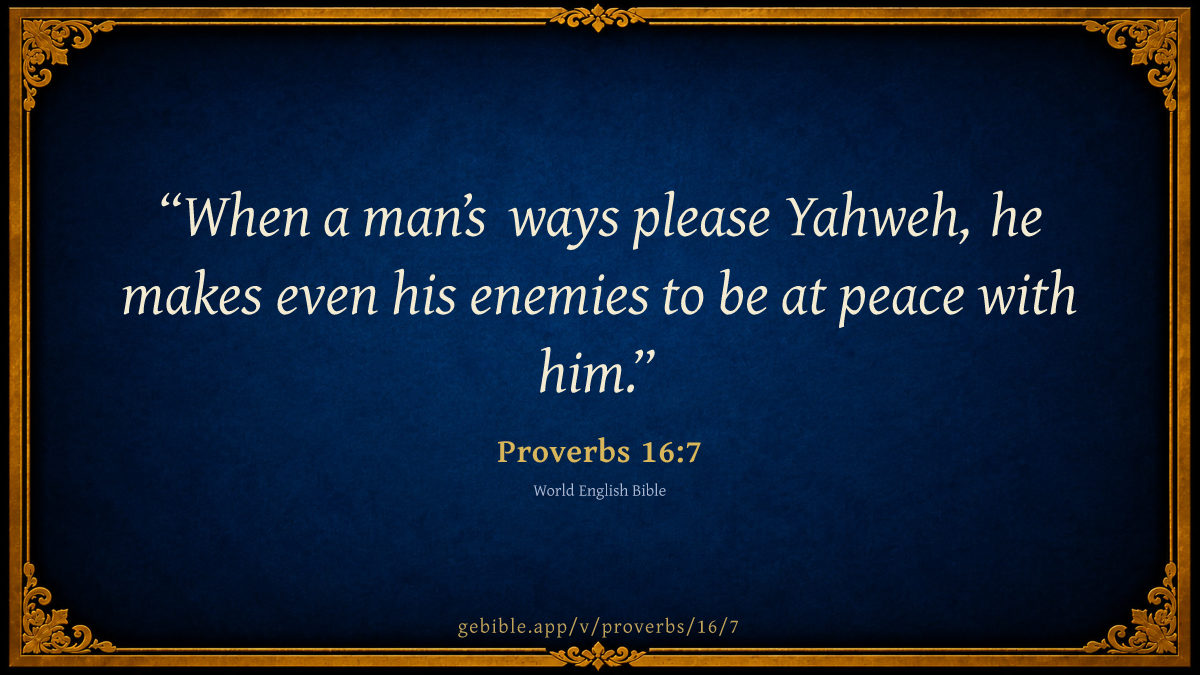
When a man’s ways please Yahweh, he makes even his enemies to be at peace with him.
Parallel Translations
-
When a man’s ways please Yahweh, he makes even his enemies to be at peace with him.
-
When a man’s ways please the LORD, he maketh even his enemies to be at peace with him.
-
When a man's ways please the LORD, He maketh even his enemies to be at peace with him.
Examined in Scripture Analysis
Contradictions (1)
Questions where the Bible appears to say two different things, with the passages on each side set together.
Cross-references (15)
Passages linked to Proverbs 16:7 in the Treasury of Scripture Knowledge, ordered by reader-vote popularity; verse text shown in World English Bible.
- Romans 8:31 What then shall we say about these things? If God is for us, who can be against us?
- 1 John 3:22 so whatever we ask, we receive from him, because we keep his commandments and do the things that are pleasing in his sight.
- 2 Chronicles 17:10 The fear of Yahweh fell on all the kingdoms of the lands that were around Judah, so that they made no war against Jehoshaphat.
- Colossians 1:10 that you may walk worthily of the Lord, to please him in all respects, bearing fruit in every good work and increasing in the knowledge of God,
- Jeremiah 15:11 Yahweh said, “Most certainly I will strengthen you for good. Most certainly I will cause the enemy to make supplication to you in the time of evil and in the time of affliction.
- Hebrews 13:21 make you complete in every good work to do his will, working in you that which is well pleasing in his sight, through Jesus Christ, to whom be the glory forever and ever. Amen.
- Genesis 33:4 Esau ran to meet him, embraced him, fell on his neck, kissed him, and they wept.
- Genesis 32:28 He said, “Your name will no longer be called Jacob, but Israel; for you have fought with God and with men, and have prevailed.”
- Colossians 3:20 Children, obey your parents in all things, for this pleases the Lord.
- Acts 9:19-20 He took food and was strengthened. Saul stayed several days with the disciples who were at Damascus. Immediately in the synagogues he proclaimed the Christ, that he is the Son of God.
- Psalms 69:31 It will please Yahweh better than an ox, or a bull that has horns and hoofs.
- Philippians 4:18 But I have all things and abound. I am filled, having received from Epaphroditus the things that came from you, a sweet-smelling fragrance, an acceptable and well-pleasing sacrifice to God.
- Genesis 32:6-7 The messengers returned to Jacob, saying, “We came to your brother Esau. He is coming to meet you, and four hundred men are with him.” Then Jacob was greatly afraid and was distressed. He divided the people who were with him, and the flocks, and the herds, and the camels, into two companies;
- Genesis 27:41 Esau hated Jacob because of the blessing with which his father blessed him. Esau said in his heart, “The days of mourning for my father are at hand. Then I will kill my brother Jacob.”
- Acts 9:1-2 But Saul, still breathing threats and slaughter against the disciples of the Lord, went to the high priest and asked for letters from him to the synagogues of Damascus, that if he found any who were of the Way, whether men or women, he might bring them bound to Jerusalem.
Cross-references from openbible.info (CC BY 4.0)
Explain this verse (17 sources)
Historical commentary, presented as a primary source — not an endorsement.
Private notes
Saved on this device only — never synced or sent anywhere.
John Trapp 1656 · Public Domain Pro 16:7 When a man’s ways please the LORD,…
Pro 16:7 When a man’s ways please the LORD, he maketh even his enemies to be at peace with him.
Ver. 7. When a man’s ways please the Lord.] Sin is the only make-bait that sets God and man at difference. Now, when God is displeased, all his creatures are up in arms to fetch in his rebels, and to do execution. "Who then would set the briars and thorns against him in battle? Would he not go through them? Would he not burn them together? Let him then take hold of my strength, saith God, that he may make peace with me, and he shall make peace with me." {Isa 27:4-5} And not with God only, but with the creature too, that gladly takes his part, and is at his beck and check. Laban followed Jacob with one troop, Esau met him with another, both with hostile intentions. But God so wrought for Jacob, whom he had chosen, that Laban leaves him with a kiss, Esau meets him with a kiss. Of the one he hath an oath, tears of the other - peace with both. Who shall need to fear men that is in league with God?
John Trapp, A Commentary or Exposition upon All the Books of the Old and New Testament (1647–1656) — public domain. Text from a community e-Sword module.
Matthew Poole 1685 · Public Domain By disposing their hearts to kindness towards him.
By disposing their hearts to kindness towards him.
Matthew Poole's English Annotations on the Holy Bible (1683–1685) — public domain. Text from a community e-Sword/MySword module.
Matthew Henry 1710 · Public Domain Note, 1. God can turn foes into friends when…
Note, 1. God can turn foes into friends when he pleases. He that has all hearts in his hand has access to men's spirits and power over them, working insensibly, but irresistibly upon them, can make a man's enemies to be at peace with him, can change their minds, or force them into a feigned submission. He can slay all enemies, and bring those together that were at the greatest distance from each other. 2. He will do it for us when we please him. If we make it our care to be reconciled to God, and to keep ourselves in his love, he will incline those that have been envious towards us, and vexatious to us, to entertain a good opinion of us and to become our friends. God made Esau to be at peace with Jacob, Abimelech with Isaac, and David's enemies to court his favour and desire a league with Israel. The image of God appearing upon the righteous, and his particular lovingkindness to them, are enough to recommend them to the respect of all, even of those that have been most prejudiced against them.
Matthew Henry's Commentary on the Whole Bible (1708–1710) — public domain (CC PDM 1.0). Text via the HelloAO Bible API.
John Gill 1763 · Public Domain When a man's ways please the Lord,.... As they…
When a man's ways please the Lord,.... As they do when a man walks according to the rule of his word; when he walks as he has Christ for an example; when he walks after the Spirit, and not after the flesh; when he walks by faith, and does all he does in faith; without which it is impossible to please God, Heb 11:6; and when all his ways and actions are directed to the glory of God;
he maketh even his enemies to be at peace with him; as Abimelech with Isaac, Esau with Jacob; and the enemies of the church and people of God with then, in the latter day, Rev 3:9.
John Gill's Exposition of the Whole Bible (1746–1763) — public domain (CC PDM 1.0). Text via the HelloAO Bible API.
Adam Clarke 1810 · Public Domain Verse 7. When a man's ways please the Lord]…
Verse 7. When a man's ways please the Lord] God is the guardian and defence of all that fear and love him; and it is truly astonishing to see how wondrously God works in their behalf, raising them up friends, and turning their enemies into friends.
Adam Clarke's Commentary on the Bible (1810–1826) — public domain. Text from a community e-Sword/MySword module.
Joseph Benson 1811 · Public Domain Pro 16:7. When a man’s ways please the Lord…
Pro 16:7. When a man’s ways please the Lord — The best way to have our enemies reconciled unto us, is for us first to be reconciled unto God; for such is the love which the Lord hath to pious and virtuous persons, that when all their designs and actions are such as he approves, he often inclines even those that were their foes to become their friends, disposing their hearts to kindness toward them.
Joseph Benson's Commentary on the Old and New Testaments (1811–1818) — public domain. Text from a community e-Sword module.
Albert Barnes 1834 · Public Domain Goodness has power to charm and win even enemies…
Goodness has power to charm and win even enemies to itself.
Albert Barnes' Notes on the Bible (1834–1885) — public domain. Text from a community e-Sword/MySword module.
Charles Bridges 1846 · Public Domain Often is the favor of God and man combined…
Often is the favor of God and man combined to the man of God. (Pro 3:3-4 . Rom 14:18 .) Yet he will always have his enemies, if from no other source, from "his own household." (Mat 10:36 .) To seek peace with them by compromise of principle, would be to forfeit his character at a dreadful cost. Let him hold fast his principles in the face of his enemies. ’Though they mean him no good, they shall do him no harm.’†1
How then do we explain the persecution of the saints (2Ti 3:12 ), of Him especially, whose ways always pleased the LORD? (Joh 8:29, Joh 8:37 .) Each statement limits the other. The one shews the native enmity of the heart: the other its Divine restraint. It shall be let loose, so far as is for the glory of God. Beyond this, it shall be restrained. (Psa 76:10 .) His Church had her season of rest. (Act 9:31 .) He hath all tongues, all hands, all hearts, under his power. Who then needs to fear man, that walks in the fear of God? (Rom 8:31 .)
Read full note →
’The best way for our enemies to be reconciled to us, is for us to be reconciled to God.’†2 All our danger lies in his wrath, not in their anger. No creature can touch us without his permission.†3 Laban followed Jacob as an enemy, but was constrained to be at peace with him.†4 Esau when about to execute his long-brooded threat, was melted down into brotherly endearment.†5 Israel’s lands were preserved from invasion, while they were engaged in the service of God.†6 The enemies of the godly kings were manacled, and bowed before them.†7 Often has the majesty of the godly brow commanded the reverence, and even bound up the hands of the wicked.†8 And such will be the ultimate victory of the Church over all opposition.†9
But even if the enemies be let loose; yet if their harm be overruled to larger good, is not the promise substantially fulfilled? ’No wise man will tax him with breach of promise, who, having promised a pound of silver, giveth a talent of gold. Or who can truly say, that that man is not so good as his word, that is apparently much better than his word?’†10 God will take care of his people. Peace or war shall turn to their everlasting good. (Rom 8:28 . Php 1:12-19 .)
Footnotes:
†1 Bishop Sanderson’s Sermon on Text.
†2 Bishop Patrick.
†3 See Job 1:9-12 . Psa 105:13-15 .
†4 Gen 31:24.
†5 Gen 27:41; Gen 33:1-4 .
†6 Exo 34:23-24.
†7 1Ki 4:21-25 . 1Ki 10:23-29 . 2Ch 17:10 .
†8 David, 1Sa 24:17 . Daniel and his fellow-captives, Dan 1:6-21 ; Dan 3:26-30 ; Dan 6:24-28 . John the Baptist, Mar 6:20 . Paul, Act 27:43 .
†9 Rev 3:9.
†10 Bishop Sanderson ut supra.
Charles Bridges, An Exposition of the Book of Proverbs (1846) — public domain. Text from a community e-Sword module.
Haydock's Catholic Bible Commentary 1859 · Public Domain Peace. Thus Jacob, Joseph, Daniel, &c., were admired by…
Peace. Thus Jacob, Joseph, Daniel, &c., were admired by their former enemies.
George Leo Haydock (1774–1849), Haydock's Catholic Family Bible and Commentary, 1859 edition — public domain. Excludes Psalms (Douay-Rheims chapter numbering differs from Protestant) and Deuterocanonical books (Catholic canon only).
Robert Jamieson, A. R. Fausset & David Brown 1871 · Public Domain Persecutions, of course, excepted.
Persecutions, of course, excepted.
Jamieson, Fausset & Brown — Commentary Critical and Explanatory on the Whole Bible (1871) — public domain (CC PDM 1.0). Text via the HelloAO Bible API.
Daniel D. Whedon 1874 · Public Domain 7. A man’s ways, etc. — A general truth,…
7. A man’s ways, etc. — A general truth, not to be rigidly interpreted. Good men are sometimes persecuted, and otherwise suffer; but even this shall work for their good, according to the promise contained in Rom_8:28.
Daniel D. Whedon (gen. ed.), Commentary on the Old and New Testaments (1874–1909) — public domain. Text from a community e-Sword module.
Ellicott's Commentary for English Readers 1878 · Public Domain (7) When a man’s ways please the Lord .…
(7) When a man’s ways please the Lord . . .—Comp. Gen_26:28; 2Ch_17:10-11.
A Bible Commentary for English Readers, edited by Charles John Ellicott (1878–1897) — public domain. Text from a community e-Sword module.
The Pulpit Commentary 1880 · Public Domain When a man"s ways please the Lord, which they…
When a man"s ways please the Lord, which they can do only when they are religious, just, and charitable. He maketh even his enemies to be at peace with him; to submit themselves. Experience proves that nothing succeeds like success. Where a man is prosperous and things go well with him, even ill-wishers are content to east away or to dissemble their dislike, and to live at peace with him. Thus Abimelech King of Gerar fawned upon Isaac because he saw that the Lord was with him. (Gen_26:27, etc.) This is the worldly side of the maxim. It has a higher aspect, and intimates the far reaching influence of goodness how it disarms opposition, arouses reverence and love, gives no occasion for disputes, and spreads around an atmosphere of peace. To the Jews the maxim was taught by external circumstances. While they were doing the will of the Lord, their land was to be preserved from hostile attack. (Exo_34:24 2Ch_17:10) And Christians learn that it is only when they obey and fear God that they can overcome the assaults of the enemies of their soul the devil, the world, and the flesh Talmud, "He who is agreeable to God is equally agreeable to men."
The Pulpit Commentary (1880–1919), ed. H.D.M. Spence-Jones & Joseph S. Exell — public domain. Text from a community e-Sword module.
The Biblical Illustrator 1887 · Public Domain When a mans ways please the Lord, He maketh…
Pro_16:7
When a mans ways please the Lord, He maketh even his enemies to be at peace with him.
Read full note →
Our ways
These words contain two blessed fruits of a gracious conversation. The one more immediate and direct, acceptance with God; the other more remote, and by consequence from the former, peace with men.
I. The subject. A mans ways. His whole carriage in the course of his life, with all his thoughts, speeches, and actions, good or bad. When a man walketh in the beaten track of the world, without ever turning his feet unto Gods testimonies, neither that man nor his ways can please the Lord. When a man walketh conscionably and constantly in the good ways of God both the man and his ways are well pleasing unto God. When a man in the more constant course of his life walketh uprightly, and in a right way, but yet in a few particulars treadeth awry, the man may be accepted, though his ways are not altogether pleasing.
II. The act. Pleasing. This hath reference to acceptation: wherein the endeavour is one thing, and the event another. A man may have a full intention, and make due endeavour, and yet fail of his end. This is apparent when we have to deal with men. To please signifieth rather the event in finding acceptance than the endeavour in seeking it. In a moral sense, however, not so much the event as the endeavour and intention. But there may be a good assurance of the event where the desire of pleasing is unfeigned and the endeavour faithful.
III. The object. All men strive to please; but some to please themselves; some to please other men; and some to please the Lord. We should endeavour so to walk as to please God. For He is our Master, Captain, Father, and King. There is one great benefit attached to pleasing the Lord in the text,--He will make our enemies to be at peace with us. We may add, He will preserve us from sinful temptations. He will answer our prayers. He will translate us into His heavenly kingdom. The wicked man, who displeases God, strengthens the hands of his enemies; exposes himself as a prey to temptations; blocks up the passage against his own prayer; debars himself from entering the kingdom. How can pleasing the Lord be done? By likeness and obedience. The godly love what God loveth. They desire and endeavour to be holy as He is holy; perfect as He is perfect, merciful as the heavenly Father is merciful. Obedience is the proof of our willing and cheerful subjection to His most righteous commands. It is vain to think of pleasing God by the mere outward performances of fasting, prayer, almsdeeds, hearing Gods Word, or receiving the Sacrament. How comes it about that such poor things as our best endeavours are should please God? Our good works are pleasing to God upon two grounds.
1. Because He worketh them in us; and--
2. Because He looketh upon us and them in Christ. In the consequent of pleasing God there are three things observable. The persons--a mans enemies. The effect--peace. The author--the Lord. The scope of the whole words is to instruct us that the fairest and likeliest way for us to procure peace with man is to order our ways so as to please the Lord. The favour of God and the favour of men is joined together in Holy Scripture, as if the one were a consequent of the other. (Bp. Sanderson.)
The true way of pleasing God and being at peace with
men:--
I. The substance. When a mans ways please the Lord. All the Lords ways are concentred ways, and they concentre in Christ Jesus. Then, in order to please the Lord, we must be found in these ways, and as those ways are in Christ, we must also be in union with Christ.
1. In what way has the Lord fixed the love of His heart upon man?
2. The Lord brings His people to desire eternal life in the same way that He has designed it.
3. In what way has the Lord made us holy?
4. In what way does the Lord regenerate His people?
II. The negative; or what the text does not mean. The latter part of the text appears to be negatived by the conduct of the enemies of the Lords people in all ages.
III. The positive; or what the text does mean. Refer to a Scripture passage, The wrath of man shall praise Thee; the remainder of wrath shalt Thou restrain. Illustrate by circumstances in the stories of Abraham, Jacob, Joseph, David, Nehemiah, Jews when building the second temple.
IV. The implication.
1. That the Lord has some specific purpose and end in view.
2. That He is sure to accomplish that purpose. (James Wells.)
The charm of goodness
Not that the enemies are simply kept quiet through their knowledge that the good man is under Gods protection, but that goodness has power to charm and win them to itself. (Dean Plumptre.)
Gods control over His peoples enemies
I must see that my ways please the Lord. Even then I shall have enemies; and, perhaps, all the more certainly because I endeavour to do that which is right, But what a promise this is! The Lord will abate the wrath of man to praise Him, and abate it so that it shall not distress me. He can constrain an enemy to desist from harming me, even though he has a mind to do so. This He did with Laban, who pursued Jacob, but did not dare to touch him. Or He can subdue the wrath of Esau, who met Jacob in a brotherly manner, though Jacob had dreaded that he would smite him and his family with the sword. The Lord can also convert a furious adversary into a brother in Christ, and a fellow-worker, as He did with Saul of Tarsus. Oh, that He would do this in every case where a persecuting spirit appears! Happy is the man whose enemies are made to be to him what the lions were to Daniel in the den--quiet and companionable! When I meet death, who is called the last enemy, I pray that I may be at peace. Only let my great care be to please the Lord in all things. (C. H. Spurgeon.)
The Biblical Illustrator, edited by Joseph S. Exell (c. 1880s–1900s) — public domain. Text from a community e-Sword module.
The Preacher's Complete Homiletical Commentary 1892 · Public Domain MAIN HOMILETICS OF Pro_16:7
MAIN HOMILETICS OF Pro_16:7
PLEASING GOD
Read full note →
I. There are times when men’s ways do not please the Lord. The ways of the ungodly do not at any time please the Lord. Because they have no sympathy with His laws, and are at variance with His character. “God is not in all their thoughts” (Psa_10:4), and it is impossible for God to be pleased with the ways of them who do not think Him worth thinking about. A man must forsake his own ways and come into God’s ways before his ways can please the Lord. The ways of good men do not at all times please the Lord. They sometimes stray from the royal road—the highway of righteousness—and get into bye-paths, and thus bring down upon themselves the displeasure of their God. David, though in the main a “man after God’s own heart,” more than once walked in paths that were displeasing to the Lord, and several incidents in his life teach us plainly that some ways of a godly man may be very contrary to the Divine mind.
II. But God can be pleased by a man’s ways. Those who strive to conform to our desires—who are in sympathy with our minds—naturally yield us pleasure. And a good man’s main desire is to conform his ways to the will of God—he is in sympathy with the mind of God, and his life is the outcome of that sympathy. Therefore he can yield pleasure to the Eternal. If the Creator, in looking upon the inanimate works of His hands, pronounces them “good” (Gen_1:31) when He sees them fulfilling the design of their creation, how much more good in His sight is it when a moral and responsible creature who has power to turn out of the path ordained for him seeks patiently to continue in well-doing notwithstanding all the temptations he has to encounter.
III. The consequence upon men’s minds of thus giving pleasure to the Divine mind. The way of pleasing the Lord promotes “favour and a good understanding in the sight of God and man” (chap. Pro_3:4). He whose aim is to please God will desire and strive to live at peace with men. And in cases where his godliness provokes the enmity of the ungodly, God, by His overruling Providence, often directly interferes on his behalf. He did so in the case of Jacob and Laban, in that of Joseph and his brethren, etc.
OUTLINES AND SUGGESTIVE COMMENTS
The doctrine of this verse stands in apparent contradiction to 2Ti_3:12. The truth seems to be that neither of the passages is to be taken universally. The peace possessed by those who please God does not extend so far as to exempt them from having enemies, and though all godly men must be persecuted, yet none are persecuted at all times. The passage from Timothy may, therefore, refer to the native enmity which true godliness is certain to excite, and the proverb to the Divine control over it.—A. Fuller.
There would be more sunlight in the believer’s life if he could leave the dull negative fear of judgment far behind as a motive of action, and bound forward into the glad positive, a hopeful effort to please God.… This is one of two principles that stand together in the word, and act together in the Divine administration. Its counterpart and complement is, “If any man would live godly in Christ Jesus, he must suffer persecution.” … Both are best; neither could be wanted. If the principle that goodness exposes to persecution prevailed everywhere and always, the spirit would fail before Him and the souls that He has made. Again, if the principle that goodness conciliates the favour of the world prevailed everywhere and always, no discipline would be done, and the service of God would degenerate into mercenary self-interest.… A beautiful balance of opposites is employed to produce one grand result.… A Christian in the world is like a human body in the sea—there is a tendency to sink and a tendency to swim. A very small force in either direction will turn the scale. Our Father in heaven holds the elements of nature and the passions of men at His own disposal. His children need not fear, for He keeps the balance in His own hands.—Arnot.
If it is manifest that God makes Himself known, bestowing blessings on a man, there lies in this a power of conviction which disarms his most bitter opponents, excepting only those who have in selfishness hardened themselves.—Delitzsch.
Whatsoever a man’s ways are, it is part of every man’s intention to please howsoever; it is the object that maketh the difference. All men strive to please, but some to please themselves, some to please other men, and some few to please the Lord.… The last is—
1. A duty whereunto we stand bound by many obligations. He is our Master, our Captain, our Father, our King. He is no honest servant that will not strive to please his master. And he is no generous soldier who will not strive to please his general. And that son hath neither grace nor good nature in him that will not strive to please his father, and he is no loyal subject that will not strive to please his lawful sovereign. And yet there may be a time when all those obligations may cease, for if it be their pleasure that we should do something that lawfully we may not, we must disobey, though we displease. But we can have no colour of plea for refusing to do the pleasure of our heavenly Lord and Master, in anything whatsoever; inasmuch as we are sure nothing will please Him but what is just and right. With what a forehead, then, can any of us challenge from Him either wages as servants, or stipends as soldiers, or provision as sons, or protection as subjects, if we be not careful in every respect to frame ourselves so as to please Him?
2. It is our wisdom, too: in respect of the great benefits we shall reap thereby. There is one great benefit expressed in the text, and the scope of those words is to instruct us, that the fairest and likeliest way to procure peace with men is to order our ways so as to please the Lord.… The favour of God and the favour of men are often joined together in the Scriptures as if the one were consequent of the other. See Luk_2:52; Pro_3:3-4; Rom_14:18, etc.… But it may be objected that sundry times when a man’s ways are right, and therefore pleasing to God, his enemies are nothing less, if not perhaps much more, enraged against him than formerly.… Sundry considerations may be of use to us in the difficulty, as, first, if God have not yet made our enemies to be at peace with us, yet it may be He will do it hereafter. Neither is it unlikely that we do not walk with an even foot, and by a straight line, but tread awry in something or other which displeaseth God, and for which He suffereth their enmity to continue.… Or if He do not presently make our enemies to be at peace with us, yet if He teach us to profit by their enmity, in exercising our faith and patience, in quickening us unto prayer, etc., is it not in every way, and incomparably better? Will any wise man tax Him with a breach of promise, who, having promised a pound of silver, giveth a talent of gold? Or who can truly say that that man is not as good as his word who is apparently much better than his word?—Bp. Sanderson.
It is our peace with God that maketh Him to make our enemies to be at peace with us, and it is our enmity against God’s enemies that maketh God to be at peace with us. Now, the enemies of God are the sins of men, and if we be in a continual war with those, then do our ways please God. Then it is that He is ready to please us, when our ways please Him. Neither is He hard to please—a willingness, a desire to please, is accepted by Him. He looks not—He requireth not—that we should do exactly all that is contained in His commandments, but if we go about to please Him—if we put ourselves carefully in the way—then do our ways please Him. And then will He give us that glorious victory over our enemies which is above all others. For to subdue our enemies is but to make ourselves happy in their misery; but to make our enemies at peace with us is a victory for God’s hand, and giveth man a double triumph, as well over the hatred as the power of our enemies.—Jermin.
The subject of Pro_16:8 is substantially the same as that of chap Pro_15:6; Pro_15:17. See Homiletics on page 405, etc.
OUTLINES AND SUGGESTIVE COMMENTS
“Better,” for the tranquillity of conscience, for the present enjoyment of this life, and for the life to come. In chap. Pro_15:16, we are warned against gain without religion, in chap. Pro_15:17, against gain without love to our neighbour: here, against gain without right.—Fausset.
Abraham would not take to himself of the spoils of Sodom so much as the value of a shoe-latchet, that it might never be said in after times that the king of Sodom had made Abraham rich; so neither will any godly man that hath learned the art of contentation, suffer a penny of the gain of ungodliness to mingle with the rest of his estate, that the devil may not be able to upbraid him with it afterwards to his shame, as if he had contributed something towards the increasing thereof.—Bishop Sanderson.
A little that is a man’s own is better than a great deal that is another body’s. Now that which a man hath with righteousness is his own, for there can be no better title than that which righteousness maketh. But that which thou hast without right cannot be thine, howsoever thou mayest account it, or others may call it. Possession may be a great point in human laws, but it is nothing in God’s law: the want of right overthroweth whatsoever else may be said. Tis true, thou mayest have quiet possession on earth, but there be adversaries that do implead the unrighteous at God’s judgment bar, where they are sure last to be cast, and where themselves will give the verdict which the wise man here doth.—Jermin.
The Preacher's Complete Homiletical Commentary (gen. ed. Joseph S. Exell; Funk & Wagnalls, c. 1892) — public domain (pre-1929). A full-Bible homiletical/sermon-outline anthology covering 65 of 66 books (2 John is absent from the source module). Text from a community e-Sword module.
Paul E. Kretzmann 1924 · Public Domain v. 7. When a man’s ways please the Lord,…
v. 7. When a man’s ways please the Lord, when Jehovah finds that a person’s conduct, the objects which he has in mind, and the means which he uses to accomplish them, are in accordance with His will, He maketh even his enemies to be at peace with him, causing them to abandon their hostile attitude and even to take his part.
Paul E. Kretzmann, Popular Commentary of the Bible (1921–1924) — public domain. Text from a community e-Sword module.
unfoldingWord translationNotes 2017 · CC BY-SA 4.0 he makes
he makes
"Yahweh makes"
Read full note →
a large income
"earning a lot of money"
with injustice
"with wrongdoing"
translationWords
Yahweh
adversary
peace
unfoldingWord translationNotes — © Distant Shores Media and the Door43 World Missions Community, licensed CC BY-SA 4.0. Source: git.door43.org/Door43/en_tn.