
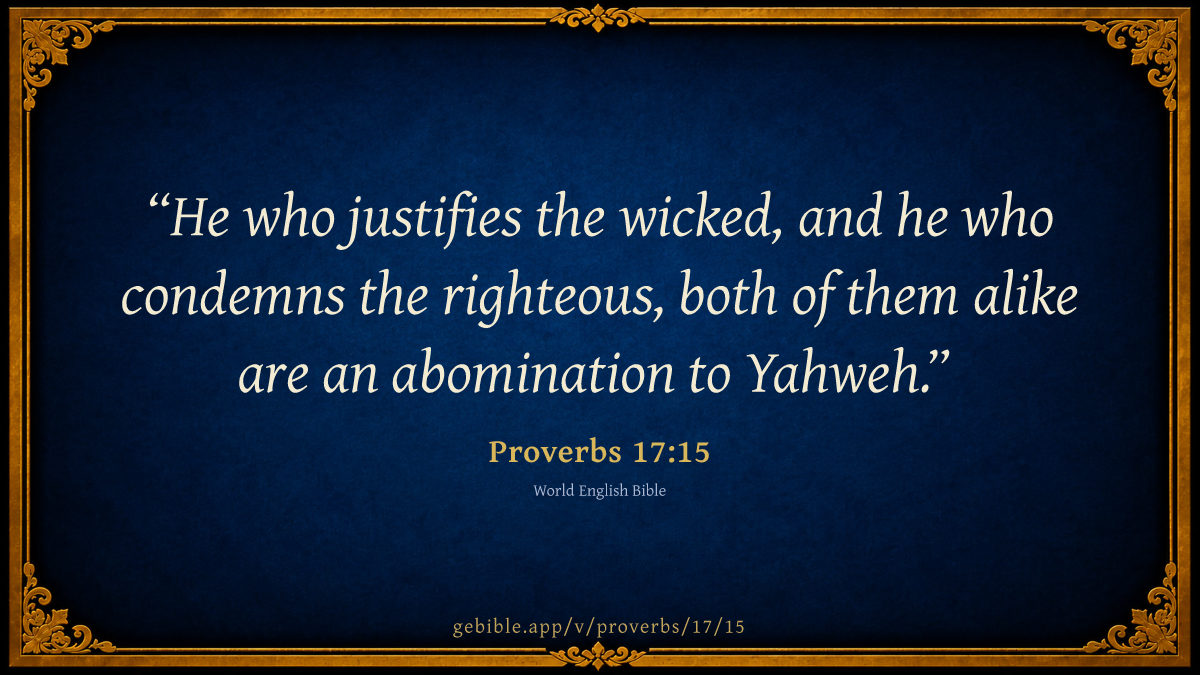
He who justifies the wicked, and he who condemns the righteous, both of them alike are an abomination to Yahweh.
Parallel Translations
-
He who justifies the wicked, and he who condemns the righteous, both of them alike are an abomination to Yahweh.
-
He that justifieth the wicked, and he that condemneth the just, even they both are abomination to the LORD.
-
He that justifieth the wicked, and he that condemneth the righteous, even they both are an abomination to the LORD.
Examined in Scripture Analysis
Contradictions (1)
Questions where the Bible appears to say two different things, with the passages on each side set together.
Cross-references (16)
Passages linked to Proverbs 17:15 in the Treasury of Scripture Knowledge, ordered by reader-vote popularity; verse text shown in World English Bible.
- Exodus 23:7 “Keep far from a false charge, and don’t kill the innocent and righteous; for I will not justify the wicked.
- Proverbs 18:5 To be partial to the faces of the wicked is not good, nor to deprive the innocent of justice.
- Isaiah 5:23 who acquit the guilty for a bribe, but deny justice for the innocent!
- Proverbs 24:23-24 These also are sayings of the wise. To show partiality in judgment is not good. He who says to the wicked, “You are righteous,” peoples will curse him, and nations will abhor him—
- Amos 6:12 Do horses run on the rocky crags? Does one plow there with oxen? But you have turned justice into poison, and the fruit of righteousness into bitterness;
- Proverbs 15:8 The sacrifice made by the wicked is an abomination to Yahweh, but the prayer of the upright is his delight.
- Isaiah 55:8-9 “For my thoughts are not your thoughts, and your ways are not my ways,” says Yahweh. “For as the heavens are higher than the earth, so are my ways higher than your ways, and my thoughts than your thoughts.
- Amos 5:7 You who turn justice to wormwood, and cast down righteousness to the earth:
- Amos 5:12 For I know how many your offenses, and how great are your sins— you who afflict the just, who take a bribe, and who turn away the needy in the courts.
- 1 Kings 21:13 The two men, the wicked fellows, came in and sat before him. The wicked fellows testified against him, even against Naboth, in the presence of the people, saying, “Naboth cursed God and the king!” Then they carried him out of the city and stoned him to death with stones.
- Proverbs 6:16 There are six things which Yahweh hates; yes, seven which are an abomination to him:
- James 5:6 You have condemned and you have murdered the righteous one. He doesn’t resist you.
- Ezekiel 22:27-29 Her princes within it are like wolves ravening the prey, to shed blood, and to destroy souls, that they may get dishonest gain. Her prophets have plastered for them with whitewash, seeing false visions, and divining lies to them, saying, ‘The Lord Yahweh says,’ when Yahweh has not spoken. The people of the land have used oppression and exercised robbery. Yes, they have troubled the poor and needy, and have oppressed the foreigner wrongfully.
- Luke 23:18-25 But they all cried out together, saying, “Away with this man! Release to us Barabbas!”— one who was thrown into prison for a certain revolt in the city, and for murder. Then Pilate spoke to them again, wanting to release Jesus, but they shouted, saying, “Crucify! Crucify him!” He said to them the third time, “Why? What evil has this man done? I have found no capital crime in him. I will therefore chastise him and release him.” But they were urgent with loud voices, asking that he might be crucified. Their voices and the voices of the chief priests prevailed. Pilate decreed that what they asked for should be done. He released him who had been thrown into prison for insurrection and murder, for whom they asked, but he delivered Jesus up to their will.
- Romans 4:5 But to him who doesn’t work, but believes in him who justifies the ungodly, his faith is accounted for righteousness.
- Proverbs 11:1 A false balance is an abomination to Yahweh, but accurate weights are his delight.
Cross-references from openbible.info (CC BY 4.0)
Explain this verse (17 sources)
Historical commentary, presented as a primary source — not an endorsement.
Private notes
Saved on this device only — never synced or sent anywhere.
John Trapp 1656 · Public Domain Pro 17:15 He that justifieth the wicked, and he…
Pro 17:15 He that justifieth the wicked, and he that condemneth the just, even they both [are] abomination to the LORD.
Ver. 15. He that justifieth the wicked, and he that condemneth the just, &c.] To wrong a righteous man in word only is a grievous sin; how much more to murder him under pretence of justice, as they did innocent Naboth; as the bloody Papists do Christ’s faithful witnesses; and as the Jews did Christ himself, crying out, "We have a law, and by our law he ought to die." This is to play the thief or manslayer cum privilegio; this is to "frame mischief by a law." {Psa 94:20} The like may be said of that other branch of injustice, the justifying of the wicked. Bonis nocet, qui malis parcit: He wrongs the good that spares the bad; better turn so many wild boars, bears, wolves, leopards loose among them, than these monstrous men of condition, that will either corrupt them, or otherwise mischieve them. For "thou knowest this people is set upon mischief" {Exo 32:22} They cannot sleep, unless they have hurt some one. Neither pertains this proverb to magistrates only, but to private persons too, who must take heed how they precipitate a censure. Herein David was to blame in pronouncing the wicked happy, and condemning the generation of God’s children, {Psa 73:3-16} for the which oversight he afterwards shames and shents himself, yea, befools and be-beasts himself, as well he deserved. {Psa 73:22}
John Trapp, A Commentary or Exposition upon All the Books of the Old and New Testament (1647–1656) — public domain. Text from a community e-Sword module.
Matthew Poole 1685 · Public Domain That justifieth; that acquitteth him as innocent by a…
That justifieth; that acquitteth him as innocent by a judicial sentence, or otherwise approveth or commendeth his evil practices; by which we may easily understand what it is to condemn the just.
Matthew Poole's English Annotations on the Holy Bible (1683–1685) — public domain. Text from a community e-Sword/MySword module.
Matthew Henry 1710 · Public Domain This shows what an offence it is to God,…
This shows what an offence it is to God, 1. When those that are entrusted with the administration of public justice, judges, juries, witnesses, prosecutors, counsel, do either acquit the guilty or condemn those that are not guilty, or in the least contribute to either; this defeats the end of government, which is to protect the good and punish the bad, Rom 13:3, Rom 13:4. It is equally provoking to God to justify the wicked, though it be in pity and in favorem vitae - to safe life, as to condemn the just. 2. When any private persons plead for sin and sinners, palliate and excuse wickedness, or argue against virtue and piety, and so pervert the right ways of the Lord and confound the eternal distinctions between good and evil.
Matthew Henry's Commentary on the Whole Bible (1708–1710) — public domain (CC PDM 1.0). Text via the HelloAO Bible API.
John Gill 1763 · Public Domain He that justifieth the wicked, and he that condemneth…
He that justifieth the wicked, and he that condemneth the just,.... That absolves and clears the guilty, and pronounces him righteous in open court, where he stands arraigned, accused, and the fact proved; and that adjudges an innocent man to condemnation; or passes the sentence of it upon him, when it is a clear case he is not guilty;
even they both are abomination to the Lord: being contrary to law and justice, to the declared will of God, and the orders and instructions given by him to judges, Deu 25:1; such an abominable action were the Jews guilty of in desiring Barabbas, a wicked man, to be released, and Christ, the just One, to be condemned; and Pilate in complying with them. From this passage we learn, that the word "justify" is used in a forensic sense, for pronouncing persons just in a court of judicature; and in which sense it is used in the article of a sinner's justification before God: by which act, though it is an ungodly person that is justified, yet it is through the perfect righteousness of Christ imputed to him, and is quite agreeable to law and the justice of God; and not at all inconsistent with this passage, which represents the justification of a wicked man as an abomination: it is so where there is no righteousness, but not where there is; agreeably to which is the saying of an Heathen (r) poet,
Read full note →
"it is not righteous, neither rashly to condemn bad men good, nor good men bad.''
(r) Sophoclis Oedipus Tyrann. v. 622, 623.
John Gill's Exposition of the Whole Bible (1746–1763) — public domain (CC PDM 1.0). Text via the HelloAO Bible API.
Joseph Benson 1811 · Public Domain Pro 17:15. He that justifieth the wicked — That…
Pro 17:15. He that justifieth the wicked — That acquitteth him as innocent by a judicial sentence, or otherwise approveth or commendeth his evil practices; and he that condemneth the just — Or, contributes to his condemnation, defeats the end of government, which is to protect the good, and punish the bad; and therefore they both are abomination to the Lord — Who would have justice exactly administered, and so cannot but be highly displeased at those who endeavour to confound the nature of good and evil among men.
Joseph Benson's Commentary on the Old and New Testaments (1811–1818) — public domain. Text from a community e-Sword module.
Albert Barnes 1834 · Public Domain People need to be warned against an unjust acquittal,…
People need to be warned against an unjust acquittal, no less than against unjust condemnation. The word “justifieth” has its forensic sense, “to declare righteous,” to acquit.
Albert Barnes' Notes on the Bible (1834–1885) — public domain. Text from a community e-Sword/MySword module.
Charles Bridges 1846 · Public Domain Judicial iniquity is an awful abuse of God’s authority.…
Judicial iniquity is an awful abuse of God’s authority. (Exo 23:7 .) The judge or magistrate "is a minister of God for good." (Rom 13:4 .) The appeal is to him for justice, as the Representative of God. (Deu 25:1 .) If the great Judge "loveth righteousness and hateth iniquity,"†1 this unrighteousness justifying the wicked must be abomination to him.†2 This guilt of Samuel’s sons, so contrary to his own integrity, was the immediate cause of the abolition of the Theocracy.†3 The judges in David’s time seem to have been guilty of both these branches of injustice.†4 Ahab’s house was ruined by his condemnation of the just.†5 "Not this man, but Barabbas"†6 — combined the double sin. It was the perfection of injustice, the most aggravated abomination.
Not however to confine the application to official iniquity — Do we not all need great watchfulness, that we may "judge righteous judgment" (Joh 7:24 ); that no corrupt bias may prejudice the exercise of our private judgment, either in favor of the wicked, or in the condemnation of the just?
Read full note →
But let us place ourselves before the "Judge of all" accused by Satan, our own conscience, and the righteous law of God; convicted of every charge; yet justified. Does God then in thus "justifying the ungodly" (Rom 4:5 ) contravene this rule? Far from it. If he justifies the wicked, it is on account of righteousness. (Rom 3:25-26 .) If he condemn the just, it is on the imputation of unrighteousness. Nowhere throughout the universe do the moral perfections of the Governor of the world shine so gloriously as at the cross of Calvary.†7 The satisfaction of the holy law, and the manifestation of righteous mercy, harmonize with the justification of the condemned sinner.†8 And this combined glory tunes the song of everlasting praise.†9
Footnotes:
†1 Psa 45:7. Deu 32:4 .
†2 Isa 5:23. Compare Sophoclis Œdip. Tyr., verses 622, 623, also Pro 24:23-24 .
†3 1Sa 8:3-5, with 1Sa 12:3 .
†4 Psa 82:2; Psa 94:20-21 .
†5 1Ki 21:13-19 .
†6 Joh 18:40.
†7 Isa 53:5-10. 2Co 5:21 .
†8 Psa 85:10. Isa 42:21 ; Isa 45:21 .
†9 Bishop Davenant justly quotes this text, as an example of the forensic use of the term justification — ’not the infusion of a quality, but the pronouncing a sentence.’ (Discourse on Inherent Righteousness, Proverbs 22. Allport’s Translation.) In this true sense it is used in reference to our justification before God — pronounced just in God’s own court of judgment.
Charles Bridges, An Exposition of the Book of Proverbs (1846) — public domain. Text from a community e-Sword module.
Haydock's Catholic Bible Commentary 1859 · Public Domain God. We ought to suspend our judgment, or incline…
God. We ought to suspend our judgment, or incline to the more favourable side, Matthew vii. 1., and Romans ii. 1.
George Leo Haydock (1774–1849), Haydock's Catholic Family Bible and Commentary, 1859 edition — public domain. Excludes Psalms (Douay-Rheims chapter numbering differs from Protestant) and Deuterocanonical books (Catholic canon only).
Robert Jamieson, A. R. Fausset & David Brown 1871 · Public Domain abomination . . . Lord--as reversing His method of…
abomination . . . Lord--as reversing His method of acting (Pro 3:32; Pro 12:2).
Jamieson, Fausset & Brown — Commentary Critical and Explanatory on the Whole Bible (1871) — public domain (CC PDM 1.0). Text via the HelloAO Bible API.
Daniel D. Whedon 1874 · Public Domain 15. Justifieth the wicked… condemneth the just — This…
15. Justifieth the wicked… condemneth the just — This proverb refers especially to judicial justification and condemnation, but may have its applications also in other cases, as when one in conversation defends bad men or condemns good ones. The Judge of all the earth strongly condemns such confounding of good and evil, or making light the distinction between vice and virtue.
Abomination to the Lord — Exceedingly hateful to him. Compare Exo_23:9; Pro_24:24; Isa_5:23.
Daniel D. Whedon (gen. ed.), Commentary on the Old and New Testaments (1874–1909) — public domain. Text from a community e-Sword module.
The Cambridge Bible for Schools and Colleges 1878 · Public Domain 15. Comp. Isa_5:23.
15. Comp. Isa_5:23.
The Cambridge Bible for Schools and Colleges (gen. ed. J. J. S. Perowne; Cambridge University Press, 1878–1918) — public domain. Text from a community e-Sword module.
Ellicott's Commentary for English Readers 1878 · Public Domain (15) He that justifieth the wicked—i.e., acquits. The perversion…
(15) He that justifieth the wicked—i.e., acquits. The perversion of justice was a fruitful source of evil in Israel, and a constant topic of reproach in the mouth of the prophets (1Sa_8:3; Psa_82:2; Isa_5:7).
A Bible Commentary for English Readers, edited by Charles John Ellicott (1878–1897) — public domain. Text from a community e-Sword module.
The Pulpit Commentary 1880 · Public Domain He that justifieth in a forensic sense, declares righteous,…
He that justifieth in a forensic sense, declares righteous, acquitsthe wicked, etc. Two forms of the perversion of justice are censured, viz. the acquittal of a guilty person and the condemnation of an innocent one. (comp. Pro_24:24 Isa_5:23)
The Pulpit Commentary (1880–1919), ed. H.D.M. Spence-Jones & Joseph S. Exell — public domain. Text from a community e-Sword module.
The Biblical Illustrator 1887 · Public Domain He that justifieth the wicked, and he that condemneth…
Pro_17:15
He that justifieth the wicked, and he that condemneth the just, even they both are abomination to the Lord.
Read full note →
Our estimate of other men
We may regard such an estimate from three points of view: in its effect on those thus estimated, on society in general, and on ourselves. Did we ever question with ourselves, On what is my estimate of others usually founded? If we did we should surely be dissatisfied with our present practice. It would be unnatural and absurd to pretend that no influence should be exerted over our estimate of men by the organs of public opinion; equally unreasonable to decry them as perfectly unreliable in the matter. But there may be very much untruthfulness, short of what is utter and absolute; very much which is utter and absolute, and yet escapes detection. What is the duty of Christians with regard to the blame and praise of others? Insist first on the general duty of conscientiousness in forming all our estimates of other men. It should be our aim as Christians, not obsequiously to follow public opinion, but to act for ourselves and for God. There is a timidity, even amounting to cowardice, among us in forming and expressing our opinion of other men. The body of Christian men among us seems to have abjured the duty of conscientiousness; and this abjuration is one of the most fearful symptoms of our times. The duty of estimating others as in the sight of God is not by any means a light one, but a most solemn one. Unholy and unprincipled life, wherever found, ought to be protested against by the servants of God. There is a sad tendency among us to overlook those faults which fall in with the practice of the day, which consist in the neglect of unwelcome duties, or the committal of lightly-esteemed sins. The second person who is said to be an abomination to the Lord is he that condemneth the just. We are always more prone to condemn than to justify. It is an abuse of our instinct of self-preservation to be ever ready with our hostility to other men. The general propensity to depress others renders it very easy, in any case, to condemn. Point out a few ways by which we may guard ourselves against this tendency to condemn the just. The first caution is this--look ever at the life which is palpable rather than at the motive or the creed, which are usually mere matters of surmise. A second caution is, avoid and refuse to use, and protest against the use of, all party names. Another caution is this--form your opinions of others, not at the prompting of the world, but as under the eye of God. For all our most secret judgments of men and things we are accountable to Him. (H. Alford, B. D.)
Just estimates
It was a saying of Solon, the Athenian lawgiver, that a republic walks upon two feet; one being just punishment for the unworthy, the other due reward for the worthy. If it fail in either of these, it necessarily goes lame. How if it fail in both?
The Biblical Illustrator, edited by Joseph S. Exell (c. 1880s–1900s) — public domain. Text from a community e-Sword module.
The Preacher's Complete Homiletical Commentary 1892 · Public Domain MAIN HOMILETICS OF Pro_17:15
MAIN HOMILETICS OF Pro_17:15
I. A present inversion of moral order. There is an established law, by which things spiritual are governed as well as things material According to this law, punishment ought to come to the unrighteous and the righteous should be justified; that is, they should be declared to be righteous and treated accordingly. This law must and will prevail in the upshot and issue of things, because the Great Lawgiver of the universe is perfectly just and holy; but it does not always govern the dealings of men with men. Injustice may be meted out to a man by his fellow-man from ignorance. A human judge may pass an unjust sentence upon a prisoner, or society may condemn a man undeservedly simply because they are ignorant of all the facts of the case. We are so little capable of weighing all the motives of our fellow-creatures, that we may unwittingly sometimes justify the wicked and condemn the just. But the proverb is evidently directed against those who do it because they are themselves unrighteous—against those who are prompted by motives of self-interest or malice or by a simple hatred of good wherever it is found.
Read full note →
II. A future restitution of moral order. If a man has an ear for music, all discordant tones are displeasing to him; but when the law of harmony is entirely subverted, all his musical sensibilities are outraged. So when a righteous man becomes cognizant of some gross injustice his whole soul rises up in protest against it. What therefore must be the light in which the perfectly pure and just God regards such subversion of moral order? He can but regard it with repugnance. But the certainty of this fact makes another fact no less certain—viz., that there will come a period in the history of the universe when this inversion shall cease, when moral order shall be restored, and it shall be no longer possible for the wicked to be justified, or for the righteous to be condemned. Thus saith the Lord, “Woe unto them that call evil good, and good evil; that put darkness for light, and light for darkness.… which justify the wicked for reward and take away the righteousness of the righteous from him. Therefore as the fire devoureth the stubble, and the flame consumeth the chaff, so their root shall be as rottenness, and their blossom shall go up as dust; because they have cast away the law of the Lord of hosts, and despised the word of the Holy One of Israel” (Isa_5:20; Isa_5:23-24). When this sentence is completely carried out moral order and harmony will be restored to the universe.
OUTLINES AND SUGGESTIVE COMMENTS
This verse shows that the term justify (Hebrew, matzeddik) is forensic, to pronounce just one, even though not just in himself: a keyword in the doctrinal Epistle to the Romans: the opposite of “condemn” or pronounce impious (mareshiang).—Fausset.
That “both” should be, the expression “even” seems to point to as wonderful. They are both very plain propositions; and yet neither of them, in the mind of the sinner, is free from half-conscious surprise. That God “will by no means clear the guilty” (Exo_34:7) and, therefore, that “without the shedding of blood is no remission” (Heb_9:22), when learned, is half the gospel. To learn it easily, would imply that “then hath the offence of the Cross ceased” (Gal_5:11). God will not condemn Himself in His “righteous” action, and He cannot “justify the wicked” without a mediator; and Solomon, without being able to clear all the difficulties, sets in this sentence as one of the great timbers of thought, which he looks to to defend the gospel.—Miller.
He spareth the wolf and so hurteth the lambs; He toucheth the members of Christ and the very apples of the Lord’s eye.—Muffet.
But let us place ourselves before the “Judge of all” accused by Satan, our own conscience, and the righteous law of God; convicted of every charge; yet justified. Does God then in thus “justifying the ungodly” (Rom_4:5) contravene this rule? Far from it. If He justifies the wicked, it is on account of righteousness (Ib. Pro_3:25-26). If He condemns the just, it is on the imputation of unrighteousness. Nowhere throughout the universe do the moral perfections of the Governor of the world shine so gloriously as at the cross of Calvary. The satisfaction of the holy law, and the manifestation of righteous mercy, harmonise with the justification of the condemned sinner. And this combined glory tunes the song of everlasting praise.—Bridges.
That condemning the just is a grievous crime, there is no doubt. But some will be startled at the wise man’s assertion, that justifying the wicked is a crime of the like nature and malignity. But we rebel against God by turning to the right hand, as well as by turning to the left, from that way in which we are commanded to walk. Justifying the wicked has an appearance of mercy in it, but there is cruelty to millions in unreasonable acts of mercy to individuals. It was not altogether without ground observed by a senator to the Emperor Cocceius Nerva, when his detestation of his predecessor’s cruelty seduced him into extremes of clemency,—That it was bad to live in a state where every thing was forbidden, but worse to live in a state where every thing was allowed. Historians tell us, that the provinces of the empire suffered more oppression under the administration of this mild prince, than in the bloody reign of Domitian.—Lawson.
As in the administration of justice, in the world or in the Church, so in the official declaration of doctrine and of duty, faithfulness is the first and most essential qualification. No “gift,” no bribe, no love of gain,—or, in the apostle’s words, “greed of filthy lucre,”—must ever be allowed to corrupt “the man of God,” and tempt him either to pervert or to keep back the truth—to “shun to declare” any part of “the counsel of God,” or to utter a single sentiment but what he believes to be a lesson of God’s word, a divinely authorised message. For a minister of Christ either to say what is false or to withhold what is true, from a wish to please those on whom he may feel himself dependent, is as unworthy of him as for a judge on the civil bench to pervert justice, and may be to others unspeakably more mischievous. The decisions of the latter can affect only what is temporary; the effects of the former’s unfaithful temporising may extend to eternity. The guilt of the former, therefore, may be greater than that of the latter, in the proportion of the value of the soul to the body, of eternity to time. There must be no bribery or corruption here. O to be able to say with Paul, “I am clear from the blood of all men.”—Wardlaw.
When Jacob, blessing the sons of Joseph, put his hands across, and laid his right hand on the head of Ephraim the younger, and his left hand on the head of Manasseh the elder, the thing displeased Joseph. But Jacob refused to have his hands removed. Now that which Jacob did in the blessing of his grandchildren, the same is the cursed doing of many who in the world are seated in the place of justice. For those whom God setteth on His right hand, they set on the left, those whom God setteth on His left hand they set on the right … And though God Himself call to them, Not so, yet they refuse to alter their sentence … And though their hands in justifying go across, yet being joined together in wickedness they are both an abomination to the Lord.—Jermin.
He that saith to the wicked, thou art righteous
(1) condemneth the law of God, for that condemneth the wicked;
(2) doth as much as he may to bring sin into credit, that others also should practise it without fear or reproach;
(3) hardeneth the heart and hurteth the soul of the offender, debarring him from corrections, which are God’s medicines for the curing of evils. He dealeth as a murderer under the name of a physician that encourageth his patient to eat the poison freely.—Dod.
The Preacher's Complete Homiletical Commentary (gen. ed. Joseph S. Exell; Funk & Wagnalls, c. 1892) — public domain (pre-1929). A full-Bible homiletical/sermon-outline anthology covering 65 of 66 books (2 John is absent from the source module). Text from a community e-Sword module.
Paul E. Kretzmann 1924 · Public Domain v. 15. He that justifieth the wicked, and he…
v. 15. He that justifieth the wicked, and he that condemneth the just, with an utter disregard of the demands of justice, even they both are abomination to the Lord, God regards either case with equal loathing.
Paul E. Kretzmann, Popular Commentary of the Bible (1921–1924) — public domain. Text from a community e-Sword module.
unfoldingWord translationNotes 2017 · CC BY-SA 4.0 The person who acquits the wicked person and the…
The person who acquits the wicked person and the person who condemns the righteous person
"The one who acquits wicked people and the one who condemns the righteous"
Read full note →
acquits
justifies, declares someone not guilty
Why should a fool pay money to learn about wisdom, when he has no ability to learn it?
This rhetorical question emphasizes that the fool should not do this. This question may be written as a statement. AT: "A fool should not pay money to learn about wisdom because he does not have the ability to learn it." (See: Rhetorical Question)
translationWords
evil
condemn
abomination
Yahweh
fool
wise
unfoldingWord translationNotes — © Distant Shores Media and the Door43 World Missions Community, licensed CC BY-SA 4.0. Source: git.door43.org/Door43/en_tn.