Proverbs 21:17(v21)He who loves pleasure will be a poor man. He who loves wine and oil won’t be rich.
Proverbs 19:15(v21)Slothfulness casts into a deep sleep. The idle soul shall suffer hunger.
Luke 21:34(v20)“So be careful, or your hearts will be loaded down with carousing, drunkenness, and cares of this life, and that day will come on you…
Ephesians 5:18(v20)Don’t be drunken with wine, in which is dissipation, but be filled with the Spirit,
Philippians 3:19(v21)whose end is destruction, whose god is the belly, and whose glory is in their shame, who think about earthly things.
Show all 25 cross-references
Deuteronomy 21:20(v21)They shall tell the elders of his city, “This our son is stubborn and rebellious. He will not obey our voice. He is a glutton and a…
Proverbs 6:9-11(v21)How long will you sleep, sluggard? When will you arise out of your sleep? A little sleep, a little slumber, a little folding of the hands…
Isaiah 5:22(v20)Woe to those who are mighty to drink wine, and champions at mixing strong drink;
Romans 13:13(v20)Let’s walk properly, as in the day; not in reveling and drunkenness, not in sexual promiscuity and lustful acts, and not in strife and…
1 Corinthians 5:11(v21)But as it is, I wrote to you not to associate with anyone who is called a brother who is a sexual sinner, or covetous, or an idolater, or a…
Galatians 5:21(v21)envy, murders, drunkenness, orgies, and things like these; of which I forewarn you, even as I also forewarned you, that those who practice…
Proverbs 24:30-34(v21)I went by the field of the sluggard, by the vineyard of the man void of understanding: Behold, it was all grown over with thorns. Its…
Proverbs 28:7(v20)Whoever keeps the law is a wise son; but he who is a companion of gluttons shames his father.
Isaiah 5:11(v20)Woe to those who rise up early in the morning, that they may follow strong drink, who stay late into the night, until wine inflames them!
Isaiah 22:13(v20)and behold, joy and gladness, killing cattle and killing sheep, eating meat and drinking wine: “Let’s eat and drink, for tomorrow we will…
Joel 1:5(v21)Wake up, you drunkards, and weep! Wail, all you drinkers of wine, because of the sweet wine; for it is cut off from your mouth.
Matthew 24:49(v20)and begins to beat his fellow servants, and eat and drink with the drunkards,
Luke 15:13(v20)Not many days after, the younger son gathered all of this together and traveled into a far country. There he wasted his property with…
1 Corinthians 6:10(v21)nor thieves, nor covetous, nor drunkards, nor slanderers, nor extortionists, will inherit God’s Kingdom.
1 Peter 4:3-4(v20)For we have spent enough of our past time doing the desire of the Gentiles, and having walked in lewdness, lusts, drunken binges, orgies,…
Proverbs 20:1(v20)Wine is a mocker and beer is a brawler. Whoever is led astray by them is not wise.
Proverbs 23:29-35(v20)Who has woe? Who has sorrow? Who has strife? Who has complaints? Who has needless bruises? Who has bloodshot eyes? Those who stay long at…
Proverbs 31:6-7(v20)Give strong drink to him who is ready to perish, and wine to the bitter in soul. Let him drink, and forget his poverty, and remember his…
Isaiah 28:1-3(v21)Woe to the crown of pride of the drunkards of Ephraim, and to the fading flower of his glorious beauty, which is on the head of the fertile…
Luke 16:19(v20)“Now there was a certain rich man, and he was clothed in purple and fine linen, living in luxury every day.
Cross-references from openbible.info (CC BY 4.0)
Explain this passage (12 sources)
Historical commentary, presented as a primary source — not an endorsement.
Geneva Bible translators1599 · Public DomainOn v20Hebrew, devourers of flesh.
Hebrew, devourers of flesh.
Hebrew, wine-bibbers.
Geneva Bible (1599) marginal notes — public domain.
John Trapp1656 · Public DomainOn vv20–21Pro 23:20 Be not among winebibbers; among riotous eaters…
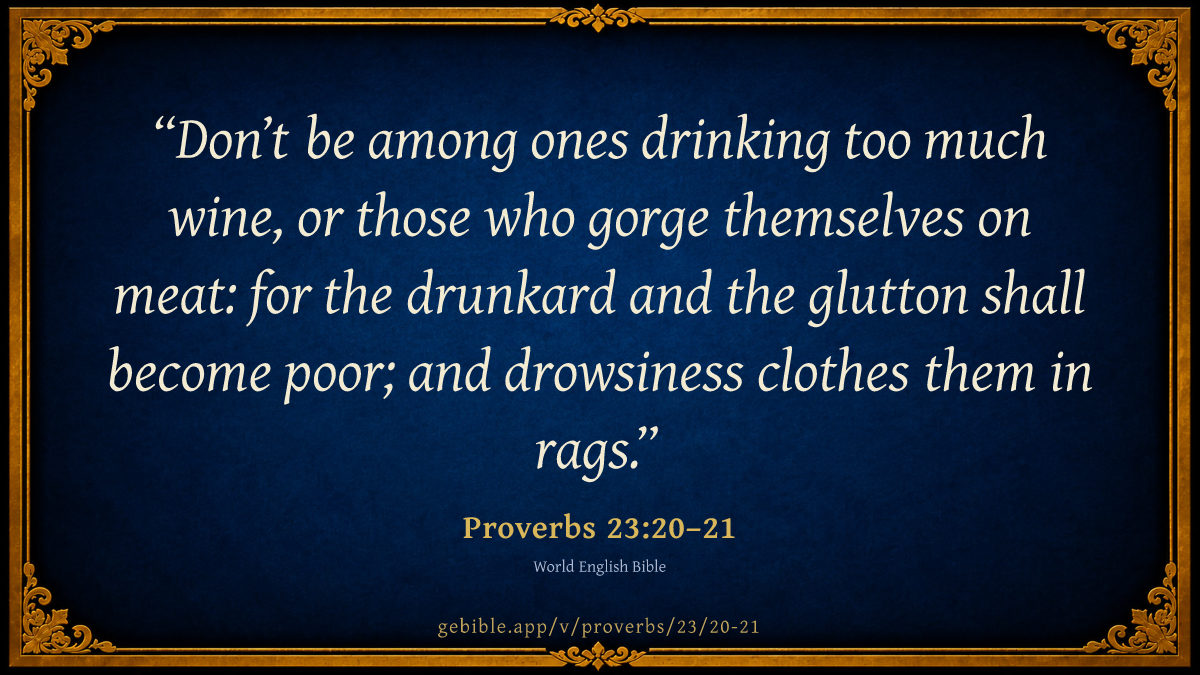
Pro 23:20 Be not among winebibbers; among riotous eaters of flesh:
Ver. 20. Be not among wine-bibbers.] Follow not the custom nor company of such; thou knowest not what thou mayest be drawn to do, though of thyself averse to such evil courses. Noah got no good by the luxurious old world {Mat 24:38} with whom he lived; nor Lot by the intemperate Sodomites. {Eze 16:49} Uriah, a good man, was at length persuaded to drink to excess. {2Sa 11:13} "Let him that standeth take heed lest he fall." That evil servant that presumes to "eat and drink with the drunken," shall be cut off in the middle {a} {Mat 24:49}
Read full note →
Among riotous eaters of flesh.] Among fleshmongers, qui crapulae indulgent, that pamper their paunches, In cute curanda plus aequo operati. See my Common Place of Abstinence. These are all for themselves, as Nabal was. Helluantur sibi carnem - so the Hebrew runs; They ravin up flesh for themselves.
{a} διχοτομησει.
John Trapp, A Commentary or Exposition upon All the Books of the Old and New Testament (1647–1656) — public domain. Text from a community e-Sword module.
Matthew Poole1685 · Public DomainOn vv20–21Avoid their conversation and company, lest thou be either…
Avoid their conversation and company, lest thou be either infected or injured by them.
Matthew Poole's English Annotations on the Holy Bible (1683–1685) — public domain. Text from a community e-Sword/MySword module.
John Gill1763 · Public DomainOn vv20–21Be not amongst winebibbers,.... Who drink to excess, otherwise…
Be not amongst winebibbers,.... Who drink to excess, otherwise wine may be drank, provided moderation is used; but it is not good to be in company with, excessive drinkers of it, lost a habit of excessive drinking should be acquired;
among riotous eaters of flesh; flesh may be lawfully eaten, but not in a riotous manner, so as to indulge to gluttony and surfeiting; nor should such persons be kept company with that do so, lest their ways should be learned and imitated.
John Gill's Exposition of the Whole Bible (1746–1763) — public domain (CC PDM 1.0). Text via the HelloAO Bible API.
Adam Clarke1810 · Public DomainOn v20Verse 20. Be not among winebibbers] There is much…
Verse 20. Be not among winebibbers] There is much of this chapter spent in giving directions concerning eating, drinking, and entertainments in general.
First, the pupil is directed relative to the manner in which he is to conduct himself in his visits to the tables of the rich and great.
Read full note →
2. Relative to the covetous, and his intercourse with them. And
3. To public entertainments, where there were generally riot and debauch. The reasons, says Calmet, which induced the wise man to give these directions were,
1. The useless expense.
2. The loss of time.
3. The danger from bad company. And
4. The danger of contracting irregular habits, and of being induced to lead a voluptuous and effeminate life.
Adam Clarke's Commentary on the Bible (1810–1826) — public domain. Text from a community e-Sword/MySword module.
Haydock's Catholic Bible Commentary1859 · Public DomainOn vv20–21Eat. Such feasts tend to corrupt the morals, and…
Eat. Such feasts tend to corrupt the morals, and to misspend time.
George Leo Haydock (1774–1849), Haydock's Catholic Family Bible and Commentary, 1859 edition — public domain. Excludes Psalms (Douay-Rheims chapter numbering differs from Protestant) and Deuterocanonical books (Catholic canon only).
Robert Jamieson, A. R. Fausset & David Brown1871 · Public DomainOn vv20–21riotous . . . flesh--prodigal, or eating more than…
riotous . . . flesh--prodigal, or eating more than necessary. Instead of "their flesh" (compare Margin), better, "flesh to them," that is, used for pleasure.
Jamieson, Fausset & Brown — Commentary Critical and Explanatory on the Whole Bible (1871) — public domain (CC PDM 1.0). Text via the HelloAO Bible API.
Daniel D. Whedon1874 · Public DomainOn v2020, 21. Winebibbers — That is, persons who drink…
20, 21. Winebibbers — That is, persons who drink excessively.
Riotous eaters of flesh — Muenscher says”Prodigal of flesh for themselves.” “Prodigal of flesh for their gratification.” — Stuart. Some render: Prodigal of their own flesh or bodies — wasting their bodies in debauch. Pro_23:21, where drunkard and glutton correspond to the terms “winebibbers” and “eaters of flesh” of Pro_23:20, seems to fix the sense. Compare Pro_5:9; Pro_5:11; Pro_31:3. “The full force of the expression ‘prodigal of flesh’ cannot be felt except in a country like Palestine, where animal food does not enter into the ordinary diet of the people, and where it is esteemed a real luxury, and, as such, occasionally indulged in to great excess.” — Muenscher. Comp. Deu_21:19-20; Pro_7:14; Pro_9:11; Pro_15:17; Rom_13:13; Eph_5:18.
Daniel D. Whedon (gen. ed.), Commentary on the Old and New Testaments (1874–1909) — public domain. Text from a community e-Sword module.
The Cambridge Bible for Schools and Colleges1878 · Public DomainOn vv20–2120. riotous] Rather, gluttonous, as the same word is…
20. riotous] Rather, gluttonous, as the same word is rendered in Pro_23:21 and Deu_21:20, A.V.
The Cambridge Bible for Schools and Colleges (gen. ed. J. J. S. Perowne; Cambridge University Press, 1878–1918) — public domain. Text from a community e-Sword module.
Ellicott's Commentary for English Readers1878 · Public DomainOn v21(21) Drowsiness, that follows after such debauches.
(21) Drowsiness, that follows after such debauches.
A Bible Commentary for English Readers, edited by Charles John Ellicott (1878–1897) — public domain. Text from a community e-Sword module.
The Pulpit Commentary1880 · Public DomainOn vv20–21Wine bibbers; persons who meet together for the express…
Wine bibbers; persons who meet together for the express purpose of drinking intoxicating liquors. Among riotous eaters of flesh. The Hebrew is "of flesh for themselves," whence some take the meaning to be "of their own flesh," i.e. who by their gluttony and luxury ruin their own bodies. But tile parallelism with the wine drinker shows plainly that the flesh which they eat is meant, and the idea is that they eat for the gratification of their own appetites, caring nothing for anything else. The combination of glutton and wine bibber was used as a reproach against our blessed Lord. (Mat_11:19) The versions of Jerome and the LXX point to the contributed entertainments, where each guest brought some article to the meal, like our picnics. Thus Vulgate, "Be not among parties of drinkers, nor at the banquets of those who contribute flesh to eat;" Septuagint. "Be not a wine bibber, and strain not after contributed feasts (sumbolaiv ) and purchases of meats.
Vers. 20, 21. See below. C.
The Pulpit Commentary (1880–1919), ed. H.D.M. Spence-Jones & Joseph S. Exell — public domain. Text from a community e-Sword module.
Paul E. Kretzmann1924 · Public DomainOn vv20–21v. 20. Be not among winebibbers, those given to…
v. 20. Be not among winebibbers, those given to intemperance in drinking, among riotous eaters of flesh, for these two forms of intemperance are usually found together;
Paul E. Kretzmann, Popular Commentary of the Bible (1921–1924) — public domain. Text from a community e-Sword module.
 GEBible — Godless Engineer's Bible App
Geneva Bible translators 1599 · Public Domain On v20 Hebrew, devourers of flesh.
Hebrew, devourers of flesh.
Hebrew, wine-bibbers.
Geneva Bible (1599) marginal notes — public domain.
John Trapp 1656 · Public Domain On vv20–21 Pro 23:20 Be not among winebibbers; among riotous eaters…
Pro 23:20 Be not among winebibbers; among riotous eaters of flesh:
Ver. 20. Be not among wine-bibbers.] Follow not the custom nor company of such; thou knowest not what thou mayest be drawn to do, though of thyself averse to such evil courses. Noah got no good by the luxurious old world {Mat 24:38} with whom he lived; nor Lot by the intemperate Sodomites. {Eze 16:49} Uriah, a good man, was at length persuaded to drink to excess. {2Sa 11:13} "Let him that standeth take heed lest he fall." That evil servant that presumes to "eat and drink with the drunken," shall be cut off in the middle {a} {Mat 24:49}
Read full note →
Among riotous eaters of flesh.] Among fleshmongers, qui crapulae indulgent, that pamper their paunches, In cute curanda plus aequo operati. See my Common Place of Abstinence. These are all for themselves, as Nabal was. Helluantur sibi carnem - so the Hebrew runs; They ravin up flesh for themselves.
{a} διχοτομησει.
John Trapp, A Commentary or Exposition upon All the Books of the Old and New Testament (1647–1656) — public domain. Text from a community e-Sword module.
Matthew Poole 1685 · Public Domain On vv20–21 Avoid their conversation and company, lest thou be either…
Avoid their conversation and company, lest thou be either infected or injured by them.
Matthew Poole's English Annotations on the Holy Bible (1683–1685) — public domain. Text from a community e-Sword/MySword module.
John Gill 1763 · Public Domain On vv20–21 Be not amongst winebibbers,.... Who drink to excess, otherwise…
Be not amongst winebibbers,.... Who drink to excess, otherwise wine may be drank, provided moderation is used; but it is not good to be in company with, excessive drinkers of it, lost a habit of excessive drinking should be acquired;
among riotous eaters of flesh; flesh may be lawfully eaten, but not in a riotous manner, so as to indulge to gluttony and surfeiting; nor should such persons be kept company with that do so, lest their ways should be learned and imitated.
John Gill's Exposition of the Whole Bible (1746–1763) — public domain (CC PDM 1.0). Text via the HelloAO Bible API.
Adam Clarke 1810 · Public Domain On v20 Verse 20. Be not among winebibbers] There is much…
Verse 20. Be not among winebibbers] There is much of this chapter spent in giving directions concerning eating, drinking, and entertainments in general.
First, the pupil is directed relative to the manner in which he is to conduct himself in his visits to the tables of the rich and great.
Read full note →
2. Relative to the covetous, and his intercourse with them. And
3. To public entertainments, where there were generally riot and debauch. The reasons, says Calmet, which induced the wise man to give these directions were,
1. The useless expense.
2. The loss of time.
3. The danger from bad company. And
4. The danger of contracting irregular habits, and of being induced to lead a voluptuous and effeminate life.
Adam Clarke's Commentary on the Bible (1810–1826) — public domain. Text from a community e-Sword/MySword module.
Haydock's Catholic Bible Commentary 1859 · Public Domain On vv20–21 Eat. Such feasts tend to corrupt the morals, and…
Eat. Such feasts tend to corrupt the morals, and to misspend time.
George Leo Haydock (1774–1849), Haydock's Catholic Family Bible and Commentary, 1859 edition — public domain. Excludes Psalms (Douay-Rheims chapter numbering differs from Protestant) and Deuterocanonical books (Catholic canon only).
Robert Jamieson, A. R. Fausset & David Brown 1871 · Public Domain On vv20–21 riotous . . . flesh--prodigal, or eating more than…
riotous . . . flesh--prodigal, or eating more than necessary. Instead of "their flesh" (compare Margin), better, "flesh to them," that is, used for pleasure.
Jamieson, Fausset & Brown — Commentary Critical and Explanatory on the Whole Bible (1871) — public domain (CC PDM 1.0). Text via the HelloAO Bible API.
Daniel D. Whedon 1874 · Public Domain On v20 20, 21. Winebibbers — That is, persons who drink…
20, 21. Winebibbers — That is, persons who drink excessively.
Riotous eaters of flesh — Muenscher says”Prodigal of flesh for themselves.” “Prodigal of flesh for their gratification.” — Stuart. Some render: Prodigal of their own flesh or bodies — wasting their bodies in debauch. Pro_23:21, where drunkard and glutton correspond to the terms “winebibbers” and “eaters of flesh” of Pro_23:20, seems to fix the sense. Compare Pro_5:9; Pro_5:11; Pro_31:3. “The full force of the expression ‘prodigal of flesh’ cannot be felt except in a country like Palestine, where animal food does not enter into the ordinary diet of the people, and where it is esteemed a real luxury, and, as such, occasionally indulged in to great excess.” — Muenscher. Comp. Deu_21:19-20; Pro_7:14; Pro_9:11; Pro_15:17; Rom_13:13; Eph_5:18.
Daniel D. Whedon (gen. ed.), Commentary on the Old and New Testaments (1874–1909) — public domain. Text from a community e-Sword module.
The Cambridge Bible for Schools and Colleges 1878 · Public Domain On vv20–21 20. riotous] Rather, gluttonous, as the same word is…
20. riotous] Rather, gluttonous, as the same word is rendered in Pro_23:21 and Deu_21:20, A.V.
The Cambridge Bible for Schools and Colleges (gen. ed. J. J. S. Perowne; Cambridge University Press, 1878–1918) — public domain. Text from a community e-Sword module.
Ellicott's Commentary for English Readers 1878 · Public Domain On v21 (21) Drowsiness, that follows after such debauches.
(21) Drowsiness, that follows after such debauches.
A Bible Commentary for English Readers, edited by Charles John Ellicott (1878–1897) — public domain. Text from a community e-Sword module.
The Pulpit Commentary 1880 · Public Domain On vv20–21 Wine bibbers; persons who meet together for the express…
Wine bibbers; persons who meet together for the express purpose of drinking intoxicating liquors. Among riotous eaters of flesh. The Hebrew is "of flesh for themselves," whence some take the meaning to be "of their own flesh," i.e. who by their gluttony and luxury ruin their own bodies. But tile parallelism with the wine drinker shows plainly that the flesh which they eat is meant, and the idea is that they eat for the gratification of their own appetites, caring nothing for anything else. The combination of glutton and wine bibber was used as a reproach against our blessed Lord. (Mat_11:19) The versions of Jerome and the LXX point to the contributed entertainments, where each guest brought some article to the meal, like our picnics. Thus Vulgate, "Be not among parties of drinkers, nor at the banquets of those who contribute flesh to eat;" Septuagint. "Be not a wine bibber, and strain not after contributed feasts (sumbolaiv ) and purchases of meats.
Vers. 20, 21. See below. C.
The Pulpit Commentary (1880–1919), ed. H.D.M. Spence-Jones & Joseph S. Exell — public domain. Text from a community e-Sword module.
Paul E. Kretzmann 1924 · Public Domain On vv20–21 v. 20. Be not among winebibbers, those given to…
v. 20. Be not among winebibbers, those given to intemperance in drinking, among riotous eaters of flesh, for these two forms of intemperance are usually found together;
Paul E. Kretzmann, Popular Commentary of the Bible (1921–1924) — public domain. Text from a community e-Sword module.