Questions where the Bible appears to say two different things, with the passages on each side set together.
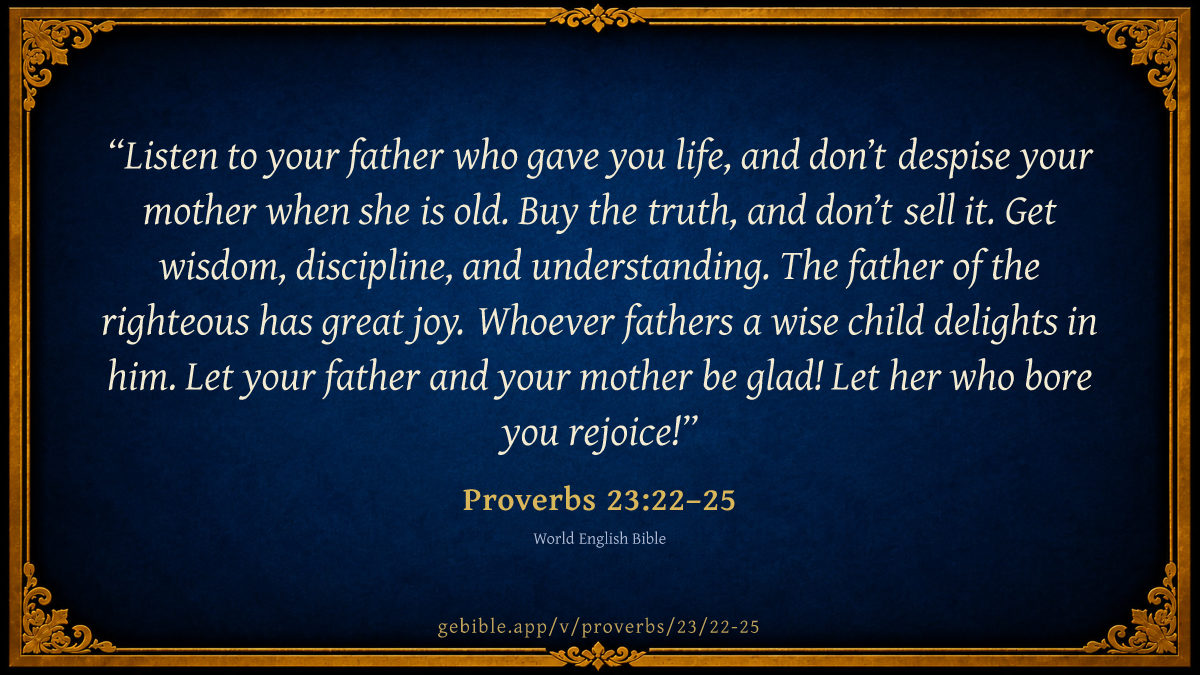
How should parents be treated?The Torah and the wisdom literature hand down an unambiguous rule: honor your father and mother.
Is wisdom a good thing?Proverbs, Ecclesiastes, and James repeatedly extol wisdom as supremely valuable, something to be pursued and preferred over gold.
Has there ever been a righteous person?Job 15:14, Isaiah 64:6, and Romans 3:10 deny anyone is righteous — all our righteousness is as filthy rags, there is none righteous, no, not one.
Proverbs 18:15(v23)The heart of the discerning gets knowledge. The ear of the wise seeks knowledge.
Matthew 13:44(v23)“Again, the Kingdom of Heaven is like treasure hidden in the field, which a man found, and hid. In his joy, he goes and sells all that he…
Psalms 119:72(v23)The law of your mouth is better to me than thousands of pieces of gold and silver.
Proverbs 16:16(v23)How much better it is to get wisdom than gold! Yes, to get understanding is to be chosen rather than silver.
Isaiah 55:1(v23)“Hey! Come, everyone who thirsts, to the waters! Come, he who has no money, buy, and eat! Yes, come, buy wine and milk without money and…
Show all 44 cross-references
Philippians 3:7-8(v23)However, I consider those things that were gain to me as a loss for Christ. Yes most certainly, and I count all things to be a loss for the…
Hebrews 11:26(v23)considering the reproach of Christ greater riches than the treasures of Egypt; for he looked to the reward.
Proverbs 10:1(vv23–24)The proverbs of Solomon. A wise son makes a glad father; but a foolish son brings grief to his mother.
Psalms 119:127(v23)Therefore I love your commandments more than gold, yes, more than pure gold.
Matthew 16:26(v23)For what will it profit a man, if he gains the whole world, and forfeits his life? Or what will a man give in exchange for his life?
Matthew 13:46(v23)who having found one pearl of great price, he went and sold all that he had, and bought it.
Revelation 3:18(v23)I counsel you to buy from me gold refined by fire, that you may become rich; and white garments, that you may clothe yourself, and that the…
Proverbs 4:5-7(v23)Get wisdom. Get understanding. Don’t forget, and don’t deviate from the words of my mouth. Don’t forsake her, and she will preserve you.…
Job 28:12-19(v23)“But where will wisdom be found? Where is the place of understanding? Man doesn’t know its price; Neither is it found in the land of the…
Revelation 12:11(v23)They overcame him because of the Lamb’s blood, and because of the word of their testimony. They didn’t love their life, even to death.
Proverbs 2:2-4(v23)so as to turn your ear to wisdom, and apply your heart to understanding; yes, if you call out for discernment, and lift up your voice for…
Proverbs 15:20(v24)A wise son makes a father glad, but a foolish man despises his mother.
Proverbs 17:16(v23)Why is there money in the hand of a fool to buy wisdom, since he has no understanding?
Proverbs 30:17(v22)“The eye that mocks at his father, and scorns obedience to his mother: the ravens of the valley shall pick it out, the young eagles shall…
Proverbs 1:8(v22)My son, listen to your father’s instruction, and don’t forsake your mother’s teaching:
Proverbs 23:15-16(v24)My son, if your heart is wise, then my heart will be glad, even mine. Yes, my heart will rejoice when your lips speak what is right.
Proverbs 29:3(v24)Whoever loves wisdom brings joy to his father; but a companion of prostitutes squanders his wealth.
John 19:26-27(v22)Therefore when Jesus saw his mother, and the disciple whom he loved standing there, he said to his mother, “Woman, behold, your son!” Then…
Acts 20:23(v23)except that the Holy Spirit testifies in every city, saying that bonds and afflictions wait for me.
Proverbs 6:20(v22)My son, keep your father’s commandment, and don’t forsake your mother’s teaching.
Proverbs 17:25(v25)A foolish son brings grief to his father, and bitterness to her who bore him.
Ephesians 6:1-2(v22)Children, obey your parents in the Lord, for this is right. “Honor your father and mother,” which is the first commandment with a promise:
Philemon 1:20(v24)Yes, brother, let me have joy from you in the Lord. Refresh my heart in the Lord.
Philemon 1:9(v24)yet for love’s sake I rather beg, being such a one as Paul, the aged, but also a prisoner of Jesus Christ.
1 Kings 2:1-3(v24)Now the days of David came near that he should die; and he commanded Solomon his son, saying, “I am going the way of all the earth. You be…
1 Kings 2:9(v24)Now therefore don’t hold him guiltless, for you are a wise man; and you will know what you ought to do to him, and you shall bring his gray…
Ecclesiastes 2:19(v24)Who knows whether he will be a wise man or a fool? Yet he will have rule over all of my labor in which I have labored, and in which I have…
Luke 1:58(v25)Her neighbors and her relatives heard that the Lord had magnified his mercy toward her, and they rejoiced with her.
Luke 11:27-28(v25)It came to pass, as he said these things, a certain woman out of the multitude lifted up her voice, and said to him, “Blessed is the womb…
Deuteronomy 27:16(v22)‘Cursed is he who dishonors his father or his mother.’ All the people shall say, ‘Amen.’
1 Chronicles 4:9-10(v25)Jabez was more honorable than his brothers. His mother named him Jabez, saying, “Because I bore him with sorrow.” Jabez called on the God…
Luke 1:40-47(v25)and entered into the house of Zacharias and greeted Elizabeth. When Elizabeth heard Mary’s greeting, the baby leaped in her womb; and…
Leviticus 19:3(v22)“ ‘Each one of you shall respect his mother and his father. You shall keep my Sabbaths. I am Yahweh your God.
Deuteronomy 21:18-21(v22)If a man has a stubborn and rebellious son who will not obey the voice of his father or the voice of his mother, and though they chasten…
1 Kings 1:48(v24)Also thus said the king, ‘Blessed be Yahweh, the God of Israel, who has given one to sit on my throne today, my eyes even seeing it.’ ”
Proverbs 30:11(v22)There is a generation that curses their father, and doesn’t bless their mother.
Matthew 15:4-6(v22)For God commanded, ‘Honor your father and your mother,’ and, ‘He who speaks evil of father or mother, let him be put to death.’ But you…
Mark 7:10(v22)For Moses said, ‘Honor your father and your mother;’ and, ‘He who speaks evil of father or mother, let him be put to death.’
Luke 1:31-33(v25)Behold, you will conceive in your womb and give birth to a son, and shall name him ‘Jesus.’ He will be great and will be called the Son of…
44 distinct cross-references across this passage (45 total citations).
Cross-references from openbible.info (CC BY 4.0)
Explain this passage (18 sources)
Historical commentary, presented as a primary source — not an endorsement.
Geneva Bible translators1599 · Public DomainOn v23Spare no cost for truth’s sake, neither depart from…
Spare no cost for truth’s sake, neither depart from it for any gain.
Geneva Bible (1599) marginal notes — public domain.
John Trapp1656 · Public DomainOn vv22–24Pro 23:22 Hearken unto thy father that begat thee,…
Pro 23:22 Hearken unto thy father that begat thee, and despise not thy mother when she is old.
Ver. 22. Hearken to thy father, &c.] {See Trapp on "Pro 1:8"}
Read full note →
And despise not thy mother when she is old,] Dr Taylor, martyr, said to his son, among other things, when he was to suffer: When thy mother is waxed old, forsake her not, but provide for her to thy power, and see that she lack nothing; for so will God bless thee, and give thee long life upon earth, and prosperity. {a}
{a} Acts and Mon.
John Trapp, A Commentary or Exposition upon All the Books of the Old and New Testament (1647–1656) — public domain. Text from a community e-Sword module.
Matthew Poole1685 · Public DomainOn vv22, 23, 25That begat thee; and therefore desires and seeks thy…
That begat thee; and therefore desires and seeks thy good in all his counsels.
When she is old; when the infirmity of age is added to that of her sex, which is apt to breed contempt.
Matthew Poole's English Annotations on the Holy Bible (1683–1685) — public domain. Text from a community e-Sword/MySword module.
John Gill1763 · Public DomainOn vv22–25Hearken unto thy father that begat thee,.... And who…
Hearken unto thy father that begat thee,.... And who has a true and hearty affection for thee, and whatever he says is for thy good and welfare, which he studies and has at heart; and who therefore also has an authority over thee, and what he enjoins ought to be strictly regarded; and, having lived longer in the world, must be thought to have a larger experience and knowledge of things, and therefore should be hearkened unto;
and despise not thy mother when she is old; despise not her counsels, instructions, and advice, though she is old; and because she is so, do not reject them as old wives' fables, or as the silly talk of an old woman, as young men are too apt to do.
John Gill's Exposition of the Whole Bible (1746–1763) — public domain (CC PDM 1.0). Text via the HelloAO Bible API.
John Wesley1765 · Public DomainOn v23Buy - Purchase it upon any terms, spare no…
Buy - Purchase it upon any terms, spare no pains or cost. Truth - The true and saving knowledge of God's will. Sell it not - Do not forsake it for any worldly advantage.
John Wesley, Explanatory Notes Upon the Whole Bible (1754–1765) — public domain. Text via the GEBible commentary corpus.
Adam Clarke1810 · Public DomainOn vv22–23Verse 22. Despise not thy mother when she is…
Verse 22. Despise not thy mother when she is old.] A very necessary caution, as very old women are generally helpless, useless, and burdensome: yet these circumstances do not at all lessen the child's duty. And this duty is strengthened by the Divine command here given.
Adam Clarke's Commentary on the Bible (1810–1826) — public domain. Text from a community e-Sword/MySword module.
Joseph Benson1811 · Public DomainOn v22Pro 23:22-25. Hearken unto thy father that begat thee…
Pro 23:22-25. Hearken unto thy father that begat thee — And who, therefore, desires and seeks thy good in all his counsels; and despise not thy mother when she is old — When the infirmity of age is added to that of her sex, which is apt to produce contempt. Buy the truth — Purchase a true and saving knowledge of God, and his will concerning thy salvation, upon any terms; spare no pains nor cost to obtain it; and sell it not — Do not forget it, nor forsake it for any worldly advantages, as unthinking backsliders frequently do; also wisdom and understanding — Whereby thou mayest be enabled to love and practice the truths known and received. The father of the righteous shall greatly rejoice — “For there is no greater joy a parent can have than to see his son take virtuous ways; which, as it is the only wisdom, so it gives both parents and children the highest pleasure and satisfaction.” Thy father and thy mother shall be glad — “Let not thy father and mother then want this singular pleasure; but, by thy well-doing, fill the heart of her that bare thee with joy and triumph; who, for all the pains and care she hath had in thy birth, and about thy education, desires no other requital but only this.” — Bishop Patrick. Thus Solomon twice urges the same consideration, as a powerful argument to prevail with all children, that are not void of natural affection, to labour to be wise and good, that so they may rejoice the hearts of their parents, to whom they are under such high and indelible obligations.
Joseph Benson's Commentary on the Old and New Testaments (1811–1818) — public domain. Text from a community e-Sword module.
Charles Bridges1846 · Public DomainOn vv22–23"We have had fathers of our flesh, and we…
"We have had fathers of our flesh, and we gave them reverence." (Heb 12:9 .) Such is the rule of nature. Such is the law of God.†1 The wise man here enforces its special application to an aged parent — thy mother when she is old. Then surely love and reverence are doubly due. ’A thing comely and pleasant to see’ — says Bishop Hall — ’and worthy of honor from the beholder, is a child understanding the eye of his parent.’†2 More lovely still is this filial exercise, when the age of the child has naturally loosened the restraints of authority. Respect is then the effect of principle and gratitude. The child no more feels at liberty to despise his parent’s wishes, than if he were subject to their early discipline. The Scripture examples are beautiful patterns for our imitation. Isaac with Abraham;†3 Jacob with both his parents;†4 Joseph’s deference to his aged father, and desiring his blessing on his own children;†5 Moses with his father-in-law;†6 Ruth with her mother-in-law;†7 Solomon in the grandeur of royalty paying respect to his mother;†8 the Rechabites hearkening to their deceased father’s command;†9 and — above all the rest — the Savior’s tender care for his mother in his own dying agonies.†10
The contrary conduct is marked with the most awful reprobation.†11 It forms a part of the dark mass of heathen depravity,†12 and one of the signs of the "perilous times in the last days." (2Ti 3:1-2 .) The spectacle will ever bring a blot upon the child’s name and character. (Pro 19:26 .)
Read full note →
But is not this trial of neglect the Lord’s chastening of foolish fondness of our children when young, of our unwise treatment, or inconsistent conduct? Sinful indulgence will always in the end make us despised in their eyes, and lay our authority in the dust for them to trample under foot. Christian dignity and consistency, on the other hand, command respect, even where they fail of producing the full practical results. (Pro 31:28 .) Oh! what need have we of Divine grace and wisdom, honorably to maintain parental responsibility!
Footnotes:
†1 Exo 20:12. Lev 19:3 . Eph 6:1-2 . Compare Pro 1:8 ; Pro 6:20 .
†2 Holy Observations, v.
†3 Gen 22:9.
†4 Gen 28:1-5.
†5 Gen 48:9-14.
†6 Exo 18:13-24.
†7 Rth 2:22-23.
†8 1Ki 2:19 .
†9 Jer 35:6.
†10 Joh 19:26-27. Dr. Taylor’s ’godly exhortations to his son,’ as Foxe writes in his exquisite Biography, ’is worthy of all youth to be marked’ - ’When thy mother is waxed old, forsake her not; but provide for her to thy power, and see that she lack nothing; for so will God bless thee, give thee long life upon earth, and prosperity, which I pray God to grant thee.’ Vol. vi. 692. Compare Sir 3:8-14 .
†11 Pro 20:20; Pro 30:17 . Deu 21:18-21 ; Deu 27:16 . Isa 3:5 .
†12 Rom 1:30.
Charles Bridges, An Exposition of the Book of Proverbs (1846) — public domain. Text from a community e-Sword module.
Haydock's Catholic Bible Commentary1859 · Public DomainOn v23Sell. Acquire as much wisdom as possible, and keep…
Sell. Acquire as much wisdom as possible, and keep it with care. (Calmet) --- Septuagint, "do not drive wisdom from thee."
George Leo Haydock (1774–1849), Haydock's Catholic Family Bible and Commentary, 1859 edition — public domain. Excludes Psalms (Douay-Rheims chapter numbering differs from Protestant) and Deuterocanonical books (Catholic canon only).
Robert Jamieson, A. R. Fausset & David Brown1871 · Public DomainOn vv22–24Hearken--that is, obey (Pro 1:8; Eph 6:1).
Hearken--that is, obey (Pro 1:8; Eph 6:1).
despise . . . old--Adults revere the parents whom, as children, they once obeyed.
Jamieson, Fausset & Brown — Commentary Critical and Explanatory on the Whole Bible (1871) — public domain (CC PDM 1.0). Text via the HelloAO Bible API.
Daniel D. Whedon1874 · Public DomainOn vv22, 23, 2522. Despise not thy mother — A negative for…
22. Despise not thy mother — A negative for a positive precept — pay to thine aged mother all due deference and respect.
When… old — Some read, because she is old. Let not the infirmities of age lessen thy esteem for her.
Daniel D. Whedon (gen. ed.), Commentary on the Old and New Testaments (1874–1909) — public domain. Text from a community e-Sword module.
The Cambridge Bible for Schools and Colleges1878 · Public DomainOn vv23, 2523. buy … sell it not] Procure it at…
23. buy … sell it not] Procure it at any cost: part with it on no consideration. Comp. Mat_13:44-45.
also] Rather, even, or, yea. The things mentioned are not additions to, but elements of “the truth.” Comp. Mal_4:4, R.V.
The Cambridge Bible for Schools and Colleges (gen. ed. J. J. S. Perowne; Cambridge University Press, 1878–1918) — public domain. Text from a community e-Sword module.
Ellicott's Commentary for English Readers1878 · Public DomainOn v23(23) Buy the truth, and sell it not.—The “truth”…
(23) Buy the truth, and sell it not.—The “truth” is here described under the three heads of wisdom, self-discipline, and understanding. (See above, on Pro_1:2.) All these are to be obtained from God (Jas_1:5), who gives to every man “liberally,” “without money and without price” (Isa_55:1). (Comp. Rev_3:18, and the “treasure” and “pearl of great price” of Mat_13:44-46.)
A Bible Commentary for English Readers, edited by Charles John Ellicott (1878–1897) — public domain. Text from a community e-Sword module.
The Pulpit Commentary1880 · Public DomainOn vv22–25Vers. 22-25. An octastich, containing an earnest exhortation to…
Vers. 22-25. An octastich, containing an earnest exhortation to the disciple.
That begat thee. This is a claim on the attention and obedience of the son. When she is old. When old age with its consequent infirmities comes upon thy mother, despise her not, but rather thank God for giving her long life, and profit by her love and long experience (comp. Ecc_3:1, etc., where the exhortation to honour parents is very full and touching).
Read full note →
The mighty Redeemer.
I THE HELPLESS NEED A MIGHTY REDEEMER. In simple, rough times some provision had to be made to protect the weak from the overbearing insolence and tyranny of the strong. When the arm of the law was not capable of maintaining justice, private friends were required and authorized to take up the cause of the wronged. The goel, or avenger, was then needed to stand up for his helpless kinsfolk. But there were extreme cases in which no such assistance could bring deliverance, either because no relative was living who could undertake the task, or because the distress was so desperate that no human hand could relieve it. This might happen with heartbroken widows robbed of husband, children, and land, and left penniless and friendless. But even such cases of the utmost distress are not so desperate as that of the soul in its sin and wretchedness, utterly and hopelessly undone unless some mighty hand of redemption is stretched out to save it.
II GOD IS A MIGHTY REDEEMER. Two essential conditions were required in the redeemer. He must have a right to interfere, and he must have power to succeed. God has both.
1. The right. The right of the old Hebrew redeemer was blood relationship. The nearest kinsman was called to act as goel. God is nearly related to man. He is the Father of all. The friendless poor have One left who regards them as of his family. Christ came as a brother man to be the Redeemer of the human race.
2. The power.
(1) God has power as the Almighty. He can overthrow the greatest. If the poor man has God on his side, he need not fear the most imperious tyranny; it is as child"s play before the majesty of heaven.
(2) Christ has power as the crucified Saviour. The great redemption from man"s worst enemy, sin, is won by the cross of Christ. Now he is able to save unto the uttermost.
III GOD"S MIGHTY REDEMPTION IS AVAILABLE. He is not only a mighty Redeemer; he is willing to help, and he does afford succour.
1. He acts in justice. "Shall not the Judge of all the earth do right?". (Gen_18:25) At present we witness cruel injustice. The poor are oppressed by the strong. Hard toiling men, women, and children in manufacturing centres are ground into penury by the fierce mill of competition, while ruthless "middle men" fatten on their ill-paid labour. The few in prosperity revel in luxury that they wring out of the many in penury. God will not permit such cruel wrongs to last forever. The Redeemer is an Avenger. The blood of the victims of those who make haste to be rich at the expense of their starving brethren cries out to heaven for vengeance. It will not always cry in vain.
(1) Meanwhile, seeing that the Redeemer of the poor is mighty, it would be well for the reckless oppressors to repent before the sword of judgment is unsheathed.
(2) They who are working at the apparently hopeless task of helping the poor and oppressed have a great encouragement. God, the mighty Avenger, is on their side.
2. He acts in mercy. He pities the suffering poor. They are his children, and he will not forget their needs. Love is the inspiration of Divine redemption.
This is the secret of Christ"s great redemption of sinners. Justice is ultimately satisfied here; but the first motive is mercy, for the helpless are also the ill-deserving. Yet even their Redeemer is mighty.
The Pulpit Commentary (1880–1919), ed. H.D.M. Spence-Jones & Joseph S. Exell — public domain. Text from a community e-Sword module.
The Biblical Illustrator1887 · Public DomainOn vv23, 25Buy the truth, and sell it not.
Pro_23:23
Buy the truth, and sell it not.
Read full note →
A domestic homily on buying the truth
When the wise man counselled his pupil to buy the truth, he had the whole range of truth before his mind: truth in history, in science, in social economics, in morals, and in religion. It is a slander that revelation, or the religion which accepts revelation as its guide, seeks the shade of ignorance and demands to lead its devotees blindfolded through the universe. Revelation demands light, and ever more light. The words of the text are a warrant for all investigation that has truth for its object. But it more especially refers to moral and religious truth.
I. The truth is an eminently desirable possession. Truth is capable of becoming much more intimately and inseparably the possession of a man than any of those things which men usually call their possessions. The truth bought secures to men the great end of all possessions--blessedness. The truth restores conscience to an active and undisputed sovereignty, harmonises the will and the reason, and casts out the foreign elements which have disturbed the movements of the inner life.
II. It is our duty to secure the truth as our possession. Buy. Do not stand chaffering about it; promptly make it your own.
1. We must go in quest of it. A man must be assiduous, painstaking, persevering in his search. And he must be cautious.
2. We must approach Truth, and live with her, trustfully. The intellect may assent, while the soul remains sceptical, and stands aloof.
3. The truth must be obeyed. She enters the soul as a queen. She demands to dictate every action, to shape every plan, to control every feeling. There is, perhaps, no utterly conclusive evidence of what is strictly moral or religious truth, but that of the inward witness, which speaks in the soul of the man who is living in the truth; that is, cordially and spontaneously obeying it.
4. We must be ready to make sacrifice for the truth. Prejudices must be sacrificed. Tastes, appetites, and passions, which the truth cannot sanction, must be sacrificed. If we are to get and hold the truth we must search, trust, obey, and make sacrifice. (Alex. Hannay, D.D.)
Buying the truth
To be said of all truths, but especially of the highest.
I. How is truth bought? In one sense it is free as air, but in seeking and keeping it we make surrenders. Labour and search may need to be paid. Prejudice, pride of heart, illusions broken. Sins of heart and life forsaken. Esteem of friends and of the world may need to be parted with.
II. How truth may be sold. Not when it is communicated; thereby we buy more. But when it is not communicated, when it is betrayed from fear or allurement, when it is held in unrighteousness, selfishness, treachery, inconsistency, we sell the truth.
III. Why, when bought, it should never be sold. It has a value beyond all you can get for it. Its value grows the longer you keep it. It buys all other good things at last. When sold, it is hard to be bought back. (John Ker, D.D.)
Buy the truth, sell it not
I. Inquire what truth is. Of truths there are many kinds.
1. Those proper to the studies of great scholars.
2. Those concerning the preservation of our bodies.
3. Those concerning the making and executing of laws.
4. Those relating to husbandry, tillage, and business. The truth here is the excellency of the knowledge of Christ Jesus.
II. The nature and quality of this merchandise. It containeth all those precepts and conclusions that concern the knowledge and service of God, and that conduce to virtue and integrity and uprightness of life. This truth is fit and proportionable to the soul of man, which is made capable of it. As it is fitted to all, so it is lovely and amiable in the eyes of all, even of those who will not buy it.
III. The truth must be bought. It will not be ours unless we lay out something and purchase it. We do not stumble on this truth by chance. If mens faith cost them more, they would make more use of it than they do.
IV. What is it to buy the truth? The price is yourselves. Ye must lay down yourselves at the altar of truth, and be offered up as sacrifice for it. You must offer up your understandings, your wills, and your affections. Give up your prejudices. Cast away all malice to the truth, all distasting of it, all averseness to it. What helps does the God of truth afford us for the obtaining of the truth?
1. Meditation, or fixing of our thoughts upon the truth.
2. Prayer, which draweth down grace.
3. Exercise and practice of those truths we learn. (A. Farindon, B.D.)
Buying the truth
Truth is but one, and it is in God, and of God; nay, it is God Himself. This truth is from Him conveyed into divers things, which are therefore termed true. The Word is the truth, because God is the author of it; because inspired men wrote it; because Christ confirmed it; and because the Spirit of Truth interprets it. Buying includes a desire of the commodity; a repairing to the place where it is set to sale; a skill to discern and know the goodness of it; giving a price proportionable to the value of it; and a storing of it up for necessary uses. (S. Hieron.)
The birthright of truth
I. Truth is a matter of purchase. Truth is, in itself, one, perfect, and eternal. To us it is a growing and increasing treasure. The truth we consider is that which has been delivered down to us through the Scriptures. We get truth by having the eye ever open to observe it; by reading, meditation, and conversation.
II. Truth must not be sold. Amongst other shrines at which we shall be tempted to sell the truth is--
1. The commercial spirit of the day. We are tempted by the mode in which the arrangements of the kingdom of Christ are compelled to make way for the arrangements of this world. This absorption of mind by the spirit of earthly gain gives little time for religious exercises, and breeds an inclination to extol certain business virtues.
2. Men sacrifice the truth on the altar of narrow-minded exclusiveness in the application of the privileges and blessings of truth. Truth is lost in sectarianism.
3. There is peril for truth in the spirit of rationalism that is abroad. (E. Monro.)
The price of truth
I. What it costs to know truth. By truth we mean, an agreement between an object and our idea of it. We want to know, What is moral truth? What is universal truth? To attain it, take seven precepts. Be attentive. Do not be discouraged at labour. Suspend your judgment. Let prejudice yield to reason. Be teachable. Restrain your avidity of knowing. In order to edify your mind, subdue your heart.
II. The worth and advantages of truth.
1. It will open to you an infinite source of pleasure.
2. It will fit you for the various employments to which you may be called in society.
3. It will free you from many disagreeable doubts about religion.
4. It will render you intrepid at the approach of death. (E. Monro)
The sale of truth
Sell not the truth means--
1. Do not lose the disposition of mind, the aptness to universal truth, when ye have acquired it.
2. It reproves those mercenary souls who trade with their wisdom and sell it, as it were, by the penny.
3. By selling may be understood, betraying truth. To betray truth is, through any sordid motive, to suppress, or to disguise, things of consequence to the glory of religion, the interest of a neighbour, or the good of society.
There are six orders of persons who may sell truth--
1. The courtier.
2. The indiscreet zealot.
3. The apostate.
4. The judge.
5. The politician.
6. The pastor. (E. Monro.)
Buy the truth
The meaning of the exhortation seems to be, that we should endeavour to acquire that happy disposition of soul which will make us give to every question the time and attention it deserves; to every proof its due force; to every difficulty its full weight; and to every advantage its true value. But this disposition cannot be had for nought; it must be acquired by attention and toil: it must be bought by the sacrifice of dissipation and of indolence. We can easily observe in what narrow bounds the mind of man is confined; how defective its powers are, and how limited their operations. If, therefore, when it is necessary to consider some combined proposition, we do not bestow upon it proportionable attention, we shall infallibly overlook some of its properties, and, consequently, our conclusion will be partial and absurd. This reasoning is confirmed by invariable experience: for every man may remember some things which have appeared false or true, certain or doubtful, according to the hurry or the attention with which he examined them. To acquire this habitual attention is commonly a toilsome work, and therefore demands the sacrifice of our indolence. The labour of the mind is evidently more wearisome than that of the body: for we may see the greatest part of mankind submitting without repugnance to the heaviest bodily toil, rather than suffer that which is mental. This labour, however, is surmountable; and, like all others, by custom, may be rendered easy. Exercise is therefore necessary to acquire the faculty of continued attention, which, when once acquired, will enable us to compare the most sublime ideas, and to investigate the most abstruse parts of knowledge. Then shall we reckon as nothing the sacrifices we have made; and the truth, when we have obtained it, will never be deemed too dear. It will open to us a fruitful source of pleasures; it will form us to fill with propriety our different employments; it will rid us of all troublesome scruples; and render us intrepid at the approach of death. The placid and serene pleasures of the intellect are beyond comparison sweeter than those which are excited merely by the gross organs of sense, or by the more turbulent passions of the soul. And if the pleasure of advancing in human knowledge be very great, as it is universally allowed to be, what charms must accompany the attainment of that knowledge which concerns the things of immortality! It is in retirement that our attention can exert its full force, and consider religion in all its views. Truth will enable us, besides, to fill with propriety the different employments to which we are called in society. A man who has cultivated his mind will distinguish himself in every station; and a man whose way of thinking is erroneous or futile, will in every station be pitied or despised. Truth will, moreover, free us from every importunate and troublesome scruple. To be tossed about with every wind of doctrine is a most violent situation; and yet it is a situation which none can avoid, except those who are seriously engaged in the study of truth, or those who are utterly insensible. Finally, the value of truth appears in the serenity which it procures at the approach of death. The famous story of Cato Uticensis is well known. Having resolved to quit this world, he wished much to be assured that there was another. For this purpose he read over attentively Platos book concerning the immortality of the soul; and the reasonings of that philosopher satisfied him so fully, that he died with the greatest tranquillity. He saw beyond the grave another Rome, where tyranny could have no dominion, where Pompey could be no more oppressed, and Caesar could triumph no more. So long as the soul fluctuates between light and darkness, between persuasion and doubt; so long as it has only presumptions and probabilities in favour of religion; it is nearly impossible to behold death without dread; but the Christian who is enlightened, confirmed, and strengthened, being raised above its power, is secure from all its terrors. If Cato the heathen could brave this terrible king, what would not Cato the Christian have done? (A. Macdonald.)
Buy the truth
I. The value and importance of truth. Were it a matter of equal and unavailing indifference whether we embraced truth or error, what advantages could be derived from the culture of education, from the progress of learning, or the discoveries of knowledge? Were this maxim once admissible, the untutored heathen, and the enlightened Christian would be completely on a level. Were truth of no importance to the security, the welfare, and the happiness of mankind, what occasion is there for the deep researches of philosophers, for the ardent zeal of theologians, and for the wearisome labours of the real student? But in the awful concerns of religion, where the salvation of the soul is at stake, the value and importance of truth rises in an infinite proportion!
II. In what manner we must buy it. Solomon does not intimate in my text at what rate we must buy the truth, because we cannot buy it too dear. We may be said, then, to buy the truth when we devote our earthly riches to the attainment and diffusion of Christian knowledge. For it has been well remarked, Riches should be employed for the getting knowledge rather than knowledge for the getting riches. We also buy the truth when we pay attention to the means of obtaining it. Thus, when we diligently search the Holy Scriptures, and make them our chief study, when we pray to God in secret, and when we strictly regard the ordinances of the gospel, we then bestow some pains to know the truth.
III. The danger and guilt of selling it. (John Grose, M.A.)
The practical value of opinions
There is hardly anything so plain in respect to human duty, that a wrong state of moral feeling may not cause it to be doubted, or even to be denied. It is an every-day occurrence to hear the value of truth disputed. The usual form is this--It is no matter what a man believes if his life is only right. The assertion sounds familiar and trite, yet on examination it will appear to be one of the most glaring and self-evident of falsehoods. To act right without knowledge is hardly less a practicable thing than to see without the proper organs. Consider what is necessary to be done in order to prove the position true that it is no matter what a man believes on religious subjects if his life be right. It must be shown either--
1. That there are no certain truths pertaining to religion; or else--
2. That these truths have no necessary connection with the conduct of men; or--
3. That the consequences of their conduct, whether right or wrong, will be the same. Our conclusion is, that it is not to be expected that the conduct, the lives of men, will be materially better than their opinions; by opinions understanding the actual living convictions of their minds. It is therefore an imperative duty to set a high value upon truth in our religious thinking. Religious opinions should not only be firmly fixed; they should also be right opinions. (R. Palmer, D.D.)
Buy the truth, and sell it not
In every subject there is a truth somewhere. The original of truth--the mould in which it is all first cast--must be the mind of God. But, how do these great archetypes of the mind of God reach and impress themselves upon the mind of man? First, God has given us revelation to be their reflector. But because the most important truth of all truths to us is how a sinner can be saved--how a just God can forgive a rebel--therefore, as Christians, we generally call the gospel the truth. And well it deserves the name! But the teaching of one who had a right to speak, from the largest experience, perhaps, that any man had, is, that truth is hard to get and difficult to retain. Buy the truth, and sell it not. And what is the cost of truth? You must get out of the littlenesses and narrownesses of party feeling. You must go high enough to have large views of things. Next, you must feel and act as an infant in intellect, being conscious of weakness and ignorance--even in your strongest point; willing to be taught. Whatever your talent may be, you can never purchase truth but by fag. There must be a real expenditure of hard work. And you must build up carefully, accurately, systematically; taking nothing for granted. And your prayers must not be easy, common-place things. But now, I would suppose that the contract is complete, and that, with the necessary expenditure--much effort and much prayer--you have bought the truth,--some truth--little it may be, but real and genuine. Let me give you a caution. Truth is a precious treasure. But where there is, a treasure there the robbers will come! And they will come very deceptively. Not by force, but by artifice. And they will pretend to buy. But the bargain is ruinous! For it is one thing to buy, and it is another thing to sell; and men often will give us very little for that for which we have given a great deal! It will be a bad bargain if you sell truth at any price. But many things will lure you. It may be a little love of making an excitement, which will tempt you to exaggerate the truth; and if you exaggerate it, you have well-nigh lost it. Or it may be a love of popularity, which makes you wish to please every one with whom you are, and therefore to accommodate your views to everybody; and you pare off a little on the one side, and you add a little on the other side, till the whole shape and character is changed, and the truth comes out no truth at all. Or it may happen that truth, which you feel to be truth, stands in the way of your worldly interest, and you are tempted to sacrifice it on the altar of fame or mammon. Or the prejudices of your social position, or your professional ideas, lead you to view and present truth under such a medium as shall altogether misrepresent and well-nigh pervert it. Or mere indolence may creep over you, and you may give away to carelessness what you once obtained by so great an outlay! And it often takes as much to keep truth as it does to get it. A little worldliness, a little frittering of pleasures, will enervate the very fibre of truth. And still more and more solemnly, one vice can emasculate all truth. If a man continue in sin, the truth must go. (J. Vaughan, M.A.)
Bartering for eternity
Some of the characteristics of a wise spiritual merchant.
1. He will not neglect to take an account of stock.
2. He will be on his guard against burglars.
3. He will watch the state of the markets.
4. He will be careful to get a profit out of everything that passes through his hands.
5. He will not take any unnecessary risks. (T. De Witt Talmage, D.D.)
The preciousness of the truth
This statement is not to be understood in a literal or commercial sense. Following the figure that is here used, see--
I. That the truth ought to be carefully examined. No wise man buys an article without looking very closely into it. There is no good thing but has its counterfeits and imitations. The article we are here advised to purchase is admitted to be the most valuable of all things, and it is therefore the last thing that should be taken on trust. That it is liable to be perverted and debased we all know. The great Teacher did not require His hearers to take His declarations upon trust. He courted and even demanded inquiry. The principle of private judgment may be abused.
II. The truth has to be appraised. A careful estimate of its value has to be formed. It is offered only on one condition--the sacrifice, or at least the free surrender of all we have.
III. To complete the transaction we must close with the terms on which article is offered. The truth is a system of doctrine and discipline, which needs to be carefully studied, thoroughly grasped, and diligently improved.
IV. The truth can never be sold, except at a serious loss. It may be sold or sacrificed--
1. From a spirit of mere cowardice.
2. From a feeling of false charity and selfish complaisance.
3. By being accommodated to what is called the spirit of the age. (Walter M. Giloray, D.D.)
The important purchase and prohibited sale
I. The commodity recommended. The truth.
1. There is doctrinal truth.
2. There is experimental truth.
3. There is practical truth.
II. The counsel given. Buy the truth. To obtain the truth we must--
1. Come to the mart of truth.
2. Sacrifice the hindrances to truth.
3. Employ the means truth recommends.
III. Let this purchase be urged by several considerations.
1. From your absolute need of it.
2. From the free and easy mode of its acquisition.
3. From its essential worth. When possessed it must be retained.
IV. By whom is the truth sold.
1. By the mercenary minister.
2. By the temporising professor.
3. By the false speaker.
4. By the flatterer.
5. By the backslider.
V. Reasons why we should not sell the truth. (J. Burns, D.D.)
The cost of religion
The Bible contains the truth which we have to buy. He that has a religion that has cost him nothing has a religion that is worth nothing. You cannot be religious without some sacrifice. It costs less in early than in later life. (E. Birch, M.A.)
The nature and importance of truth
I. What truth is. By truth, I mean a right apprehension of all those things which tend to promote the happiness of mankind. This includes the idea of all virtuous and religious obligations. Truth, in its utmost latitude, relates to a variety of things which are matters of mere speculation only; and these may afford some pleasure to men of deep thought and learning. But that truth which is the object of all mens concern has a more immediate respect to happiness. And this consists in a right knowledge of religion and virtue. This shines in practice more than in speculation. Other truths may please the ear, and soothe the fancy; but this improves the judgment, and mends the heart.
II. We should use all proper means to obtain the knowledge of truth. It is absolutely requisite that a man should first know, before he can rightly do, what is good; and therefore if the soul of man be ignorant of truth, it must at the same time be destitute of virtue; and if it be destitute of virtue, it is utterly incapable of happiness. Nor is the search after truth less pleasant than profitable. For, in the course of our inquiry, we must contemplate God, nature, and ourselves. In contemplating the Divine Being, what a spacious field of pleasure lies open to the mind! What noble transports must the soul feel from a view of Him, who is the fountain of perfection; in whom dwells beauty, knowledge, truth, wisdom, virtue, and all moral excellence! In the contemplation of nature, we see as it were in perspective an infinite variety of beautiful appearances, and relations of things to each other; all which serve to fill the mind with the most pleasing ideas of beauty, order, and harmony. And in the survey of ourselves we may observe a curious machine consisting of various springs and movements, each of which contributes some pleasure or advantage either to ourselves or others. Again, truth is the most beautiful, as well as pleasant. For all beauty is truth. Thus, in architecture true proportions make the beauty of a building. In music, true measures make the beauty of harmony; and in poetry, which deals so much in fable, truth still is the foundation: for all fiction is no longer pleasing than while it bears a resemblance with truth. And so, in like manner, the beauty of actions, affections, and characters arises from honesty and moral truth. For what can be more beautiful than just sentiments, graceful actions, regular passions, and agreeable behaviour? Thus nature itself leads to virtue, and truth has a kind of moral magic in it which charms irresistibly. Who, then, would refuse at any rate to purchase the knowledge of truth, which is so pleasant, so beautiful, so advantageous? But in this honest way of merchandising truth, and in all our researches after it, great care must be taken that we are not imposed upon either by ignorant or designing men. Falsehood often courts us under the appearance of truth, as some sort of glittering stones will counterfeit true diamonds. Thus, among some professors of Christianity, superstition counterfeits the name of religion, and many idle ceremonies pass current instead of pure substantial virtue. To prevent this, we should study human nature, and the nature of God, so far as He is discovered to us by the light of reason and revelation.
III. When by our faithful endeavours we have gained the truth the text suggests to us, we should upon no consideration part with it. Buy the truth, and sell it not. If truth be of so great importance as to have virtue, religion, and even happiness depend upon it, what wise man would ever part with it? For can any equivalent be given for the loss of it? And why should we exchange a greater for a lesser good? In our journey through this world we meet with many rugged ways and difficulties. But truth will lead us safely through all into the wished-for haven. All worldly goods are imperfect and of short duration; but truth is eternal in its original, and will never fail to give complete satisfaction to all who persevere in it. But you will ask, When may we be said to part with the truth? We part with it whenever we let any interest, prejudice, or passion prevail over us, contrary to the dictates of right reason. As, therefore, we value our greatest interest, let us honestly endeavour to know the truth; and let us apply ourselves to all proper means for this purpose, such as reading, conversation, and prayer to God. The same honest diligence which is used in learning other arts and sciences will bring us to the knowledge of all that truth which is necessary for any to know. And God requires no more of us than what our respective capacities and opportunities will allow. (N. Ball.)
The merchandise of truth
I. The valuable commodity requisite for human life. Truth is that commodity which feeds the moral life.
1. It is of universal comprehension.
2. It is of common necessity and fitness.
3. It is a thing of common end in life.
4. It is the crown and complement of life.
II. The commerce of truth.
1. One compartment in the market of truth is acquaintance and fair dealing with ourselves.
2. Communion with the Father of our spirit.
3. Study of the works and words of God.
4. Acquaintance with humanity.
5. Christian means and provision.
Truth is cheap at any cost. One condition in the pursuit of truth is a high and holy motive. Another is right use of our powers and opportunities. A third is seeking and following the best. A fourth is submission to the Divine will. Another is perseverance; and another faith.
III. The conservative Duty. It is easy in the sale, but difficult to buy. Nothing can compensate for its absence. The sale of truth always means an unjust bargain. (T. Hughes.)
Truth should be purchased, but never sold
I. The truth is a precious thing. Buy the truth. What is truth? It is reality. In contradistinction to all that is fictitious and false.
1. Reality in relation to the chief good. What a number of false theories there are concerning human dignity and human happiness. Truth is the reality of these.
2. Reality in relation to personal conduct. There are hollow men, sham men. Truth makes men real. Brings their conceptions into perfect accord with eternal facts, and their personal conduct into perfect accord with their conceptions. Christ is embodied truth. The preciousness of this truth may be estimated by the influence it has exerted on the race. Intellectual truth is precious, moral truth is more precious, redemptive truth is more precious than all.
II. Truth to be obtained must be purchased. It can only be purchased by--
1. Study.
2. Devotion.
3. Labour.
4. Self-surrender.
III. Truth once purchased should never be sold. Sell it not. Truth can be sold. Judas sold it. It can be sold for power, for fame, for worldly pleasure, etc. Sell it not. If you sell it, you sell your moral usefulness. You sell your self-respect. You sell your power of conscience. You sell your dignity. Hold it as Daniel, Stephen, and Paul held it. (Homilist.)
The highest commerce
I. The importance of acquiring the truth.
1. We should make diligent search for it.
2. We should be willing to sacrifice and surrender all for it.
3. Again, truth must be obeyed in order to be made our own.
II. The importance of retaining the truth. Sell it not. We should not part with it.
1. Because of its intrinsic value.
2. Because it does not rise and fall in value like other things. The markets of this world are for ever fluctuating, etc. Truth is ever the same.
3. Because it can be appropriated or made our own as nothing else can. A mans life (well-being) consisteth not in the abundance of the things which he possesseth. Worldly goods are of no value to a man when the last hour comes. But true religion will go with him into adversity, into affliction, and will comfort him even in death. (D. Morgan.)
Truth cannot be disposed of without injury
Truth is not like a watch-seal, which a man can dispose of without any injury to his character. It is a vital element of character, and thus of happiness; and he who barters it for anything, will soon realise that he has not only sacrificed the greater for the less, but given up the chief thing in human nobility and joy. (T. Carlyle.)
The Biblical Illustrator, edited by Joseph S. Exell (c. 1880s–1900s) — public domain. Text from a community e-Sword module.
Paul E. Kretzmann1924 · Public DomainOn vv22–25v. 22. Hearken unto thy father that begat thee,…
v. 22. Hearken unto thy father that begat thee, in ready obedience to all his commands, and despise not thy mother when she is old, it being the tendency of young people to be ashamed of their aged parents and no longer to heed their counsel.
Paul E. Kretzmann, Popular Commentary of the Bible (1921–1924) — public domain. Text from a community e-Sword module.
unfoldingWord translationNotes2017 · CC BY-SA 4.0On vv22, 24General Information:
General Information:
These verses continue the "thirty sayings" (Proverbs 22:20).
Read full note →
do not despise
This can be stated positively. AT: "show respect for" (See: Litotes)
Buy the truth, but do not sell it; buy wisdom, instruction, and understanding
Another possible meaning is "Buy the truth, and do not sell wisdom, instruction, or understanding." The words "truth," "wisdom," "instruction," and "understanding" are abstract nouns that are spoken of as if they were physical items that a person can buy and sell in a market. They can be translated as verbs. AT: "Do what you need to do so you can know what is true, so you can be wise, so you can learn how to act, and so you can tell good from bad; never think of anything else as more important than these things" (See: Abstract Nouns and Metaphor)
Tyndale Open Study Notes2022 · CC BY-SA 4.0On v2223:22-25 Saying 16: This saying is an exhortation to…
23:22-25 Saying 16: This saying is an exhortation to pursue the wisdom that a godly father and mother provide. Unlike other ancient Near East wisdom texts, Proverbs attributes wisdom to both father and mother (1:8; 6:20).

Geneva Bible translators 1599 · Public Domain On v23 Spare no cost for truth’s sake, neither depart from…
Spare no cost for truth’s sake, neither depart from it for any gain.
Geneva Bible (1599) marginal notes — public domain.
John Trapp 1656 · Public Domain On vv22–24 Pro 23:22 Hearken unto thy father that begat thee,…
Pro 23:22 Hearken unto thy father that begat thee, and despise not thy mother when she is old.
Ver. 22. Hearken to thy father, &c.] {See Trapp on "Pro 1:8"}
Read full note →
And despise not thy mother when she is old,] Dr Taylor, martyr, said to his son, among other things, when he was to suffer: When thy mother is waxed old, forsake her not, but provide for her to thy power, and see that she lack nothing; for so will God bless thee, and give thee long life upon earth, and prosperity. {a}
{a} Acts and Mon.
John Trapp, A Commentary or Exposition upon All the Books of the Old and New Testament (1647–1656) — public domain. Text from a community e-Sword module.
Matthew Poole 1685 · Public Domain On vv22, 23, 25 That begat thee; and therefore desires and seeks thy…
That begat thee; and therefore desires and seeks thy good in all his counsels.
When she is old; when the infirmity of age is added to that of her sex, which is apt to breed contempt.
Matthew Poole's English Annotations on the Holy Bible (1683–1685) — public domain. Text from a community e-Sword/MySword module.
John Gill 1763 · Public Domain On vv22–25 Hearken unto thy father that begat thee,.... And who…
Hearken unto thy father that begat thee,.... And who has a true and hearty affection for thee, and whatever he says is for thy good and welfare, which he studies and has at heart; and who therefore also has an authority over thee, and what he enjoins ought to be strictly regarded; and, having lived longer in the world, must be thought to have a larger experience and knowledge of things, and therefore should be hearkened unto;
and despise not thy mother when she is old; despise not her counsels, instructions, and advice, though she is old; and because she is so, do not reject them as old wives' fables, or as the silly talk of an old woman, as young men are too apt to do.
John Gill's Exposition of the Whole Bible (1746–1763) — public domain (CC PDM 1.0). Text via the HelloAO Bible API.
John Wesley 1765 · Public Domain On v23 Buy - Purchase it upon any terms, spare no…
Buy - Purchase it upon any terms, spare no pains or cost. Truth - The true and saving knowledge of God's will. Sell it not - Do not forsake it for any worldly advantage.
John Wesley, Explanatory Notes Upon the Whole Bible (1754–1765) — public domain. Text via the GEBible commentary corpus.
Adam Clarke 1810 · Public Domain On vv22–23 Verse 22. Despise not thy mother when she is…
Verse 22. Despise not thy mother when she is old.] A very necessary caution, as very old women are generally helpless, useless, and burdensome: yet these circumstances do not at all lessen the child's duty. And this duty is strengthened by the Divine command here given.
Adam Clarke's Commentary on the Bible (1810–1826) — public domain. Text from a community e-Sword/MySword module.
Joseph Benson 1811 · Public Domain On v22 Pro 23:22-25. Hearken unto thy father that begat thee…
Pro 23:22-25. Hearken unto thy father that begat thee — And who, therefore, desires and seeks thy good in all his counsels; and despise not thy mother when she is old — When the infirmity of age is added to that of her sex, which is apt to produce contempt. Buy the truth — Purchase a true and saving knowledge of God, and his will concerning thy salvation, upon any terms; spare no pains nor cost to obtain it; and sell it not — Do not forget it, nor forsake it for any worldly advantages, as unthinking backsliders frequently do; also wisdom and understanding — Whereby thou mayest be enabled to love and practice the truths known and received. The father of the righteous shall greatly rejoice — “For there is no greater joy a parent can have than to see his son take virtuous ways; which, as it is the only wisdom, so it gives both parents and children the highest pleasure and satisfaction.” Thy father and thy mother shall be glad — “Let not thy father and mother then want this singular pleasure; but, by thy well-doing, fill the heart of her that bare thee with joy and triumph; who, for all the pains and care she hath had in thy birth, and about thy education, desires no other requital but only this.” — Bishop Patrick. Thus Solomon twice urges the same consideration, as a powerful argument to prevail with all children, that are not void of natural affection, to labour to be wise and good, that so they may rejoice the hearts of their parents, to whom they are under such high and indelible obligations.
Joseph Benson's Commentary on the Old and New Testaments (1811–1818) — public domain. Text from a community e-Sword module.
Charles Bridges 1846 · Public Domain On vv22–23 "We have had fathers of our flesh, and we…
"We have had fathers of our flesh, and we gave them reverence." (Heb 12:9 .) Such is the rule of nature. Such is the law of God.†1 The wise man here enforces its special application to an aged parent — thy mother when she is old. Then surely love and reverence are doubly due. ’A thing comely and pleasant to see’ — says Bishop Hall — ’and worthy of honor from the beholder, is a child understanding the eye of his parent.’†2 More lovely still is this filial exercise, when the age of the child has naturally loosened the restraints of authority. Respect is then the effect of principle and gratitude. The child no more feels at liberty to despise his parent’s wishes, than if he were subject to their early discipline. The Scripture examples are beautiful patterns for our imitation. Isaac with Abraham;†3 Jacob with both his parents;†4 Joseph’s deference to his aged father, and desiring his blessing on his own children;†5 Moses with his father-in-law;†6 Ruth with her mother-in-law;†7 Solomon in the grandeur of royalty paying respect to his mother;†8 the Rechabites hearkening to their deceased father’s command;†9 and — above all the rest — the Savior’s tender care for his mother in his own dying agonies.†10
The contrary conduct is marked with the most awful reprobation.†11 It forms a part of the dark mass of heathen depravity,†12 and one of the signs of the "perilous times in the last days." (2Ti 3:1-2 .) The spectacle will ever bring a blot upon the child’s name and character. (Pro 19:26 .)
Read full note →
But is not this trial of neglect the Lord’s chastening of foolish fondness of our children when young, of our unwise treatment, or inconsistent conduct? Sinful indulgence will always in the end make us despised in their eyes, and lay our authority in the dust for them to trample under foot. Christian dignity and consistency, on the other hand, command respect, even where they fail of producing the full practical results. (Pro 31:28 .) Oh! what need have we of Divine grace and wisdom, honorably to maintain parental responsibility!
Footnotes:
†1 Exo 20:12. Lev 19:3 . Eph 6:1-2 . Compare Pro 1:8 ; Pro 6:20 .
†2 Holy Observations, v.
†3 Gen 22:9.
†4 Gen 28:1-5.
†5 Gen 48:9-14.
†6 Exo 18:13-24.
†7 Rth 2:22-23.
†8 1Ki 2:19 .
†9 Jer 35:6.
†10 Joh 19:26-27. Dr. Taylor’s ’godly exhortations to his son,’ as Foxe writes in his exquisite Biography, ’is worthy of all youth to be marked’ - ’When thy mother is waxed old, forsake her not; but provide for her to thy power, and see that she lack nothing; for so will God bless thee, give thee long life upon earth, and prosperity, which I pray God to grant thee.’ Vol. vi. 692. Compare Sir 3:8-14 .
†11 Pro 20:20; Pro 30:17 . Deu 21:18-21 ; Deu 27:16 . Isa 3:5 .
†12 Rom 1:30.
Charles Bridges, An Exposition of the Book of Proverbs (1846) — public domain. Text from a community e-Sword module.
Haydock's Catholic Bible Commentary 1859 · Public Domain On v23 Sell. Acquire as much wisdom as possible, and keep…
Sell. Acquire as much wisdom as possible, and keep it with care. (Calmet) --- Septuagint, "do not drive wisdom from thee."
George Leo Haydock (1774–1849), Haydock's Catholic Family Bible and Commentary, 1859 edition — public domain. Excludes Psalms (Douay-Rheims chapter numbering differs from Protestant) and Deuterocanonical books (Catholic canon only).
Robert Jamieson, A. R. Fausset & David Brown 1871 · Public Domain On vv22–24 Hearken--that is, obey (Pro 1:8; Eph 6:1).
Hearken--that is, obey (Pro 1:8; Eph 6:1).
despise . . . old--Adults revere the parents whom, as children, they once obeyed.
Jamieson, Fausset & Brown — Commentary Critical and Explanatory on the Whole Bible (1871) — public domain (CC PDM 1.0). Text via the HelloAO Bible API.
Daniel D. Whedon 1874 · Public Domain On vv22, 23, 25 22. Despise not thy mother — A negative for…
22. Despise not thy mother — A negative for a positive precept — pay to thine aged mother all due deference and respect.
When… old — Some read, because she is old. Let not the infirmities of age lessen thy esteem for her.
Daniel D. Whedon (gen. ed.), Commentary on the Old and New Testaments (1874–1909) — public domain. Text from a community e-Sword module.
The Cambridge Bible for Schools and Colleges 1878 · Public Domain On vv23, 25 23. buy … sell it not] Procure it at…
23. buy … sell it not] Procure it at any cost: part with it on no consideration. Comp. Mat_13:44-45.
also] Rather, even, or, yea. The things mentioned are not additions to, but elements of “the truth.” Comp. Mal_4:4, R.V.
The Cambridge Bible for Schools and Colleges (gen. ed. J. J. S. Perowne; Cambridge University Press, 1878–1918) — public domain. Text from a community e-Sword module.
Ellicott's Commentary for English Readers 1878 · Public Domain On v23 (23) Buy the truth, and sell it not.—The “truth”…
(23) Buy the truth, and sell it not.—The “truth” is here described under the three heads of wisdom, self-discipline, and understanding. (See above, on Pro_1:2.) All these are to be obtained from God (Jas_1:5), who gives to every man “liberally,” “without money and without price” (Isa_55:1). (Comp. Rev_3:18, and the “treasure” and “pearl of great price” of Mat_13:44-46.)
A Bible Commentary for English Readers, edited by Charles John Ellicott (1878–1897) — public domain. Text from a community e-Sword module.
The Pulpit Commentary 1880 · Public Domain On vv22–25 Vers. 22-25. An octastich, containing an earnest exhortation to…
Vers. 22-25. An octastich, containing an earnest exhortation to the disciple.
That begat thee. This is a claim on the attention and obedience of the son. When she is old. When old age with its consequent infirmities comes upon thy mother, despise her not, but rather thank God for giving her long life, and profit by her love and long experience (comp. Ecc_3:1, etc., where the exhortation to honour parents is very full and touching).
Read full note →
The mighty Redeemer.
I THE HELPLESS NEED A MIGHTY REDEEMER. In simple, rough times some provision had to be made to protect the weak from the overbearing insolence and tyranny of the strong. When the arm of the law was not capable of maintaining justice, private friends were required and authorized to take up the cause of the wronged. The goel, or avenger, was then needed to stand up for his helpless kinsfolk. But there were extreme cases in which no such assistance could bring deliverance, either because no relative was living who could undertake the task, or because the distress was so desperate that no human hand could relieve it. This might happen with heartbroken widows robbed of husband, children, and land, and left penniless and friendless. But even such cases of the utmost distress are not so desperate as that of the soul in its sin and wretchedness, utterly and hopelessly undone unless some mighty hand of redemption is stretched out to save it.
II GOD IS A MIGHTY REDEEMER. Two essential conditions were required in the redeemer. He must have a right to interfere, and he must have power to succeed. God has both.
1. The right. The right of the old Hebrew redeemer was blood relationship. The nearest kinsman was called to act as goel. God is nearly related to man. He is the Father of all. The friendless poor have One left who regards them as of his family. Christ came as a brother man to be the Redeemer of the human race.
2. The power.
(1) God has power as the Almighty. He can overthrow the greatest. If the poor man has God on his side, he need not fear the most imperious tyranny; it is as child"s play before the majesty of heaven.
(2) Christ has power as the crucified Saviour. The great redemption from man"s worst enemy, sin, is won by the cross of Christ. Now he is able to save unto the uttermost.
III GOD"S MIGHTY REDEMPTION IS AVAILABLE. He is not only a mighty Redeemer; he is willing to help, and he does afford succour.
1. He acts in justice. "Shall not the Judge of all the earth do right?". (Gen_18:25) At present we witness cruel injustice. The poor are oppressed by the strong. Hard toiling men, women, and children in manufacturing centres are ground into penury by the fierce mill of competition, while ruthless "middle men" fatten on their ill-paid labour. The few in prosperity revel in luxury that they wring out of the many in penury. God will not permit such cruel wrongs to last forever. The Redeemer is an Avenger. The blood of the victims of those who make haste to be rich at the expense of their starving brethren cries out to heaven for vengeance. It will not always cry in vain.
(1) Meanwhile, seeing that the Redeemer of the poor is mighty, it would be well for the reckless oppressors to repent before the sword of judgment is unsheathed.
(2) They who are working at the apparently hopeless task of helping the poor and oppressed have a great encouragement. God, the mighty Avenger, is on their side.
2. He acts in mercy. He pities the suffering poor. They are his children, and he will not forget their needs. Love is the inspiration of Divine redemption.
This is the secret of Christ"s great redemption of sinners. Justice is ultimately satisfied here; but the first motive is mercy, for the helpless are also the ill-deserving. Yet even their Redeemer is mighty.
The Pulpit Commentary (1880–1919), ed. H.D.M. Spence-Jones & Joseph S. Exell — public domain. Text from a community e-Sword module.
The Biblical Illustrator 1887 · Public Domain On vv23, 25 Buy the truth, and sell it not.
Pro_23:23
Buy the truth, and sell it not.
Read full note →
A domestic homily on buying the truth
When the wise man counselled his pupil to buy the truth, he had the whole range of truth before his mind: truth in history, in science, in social economics, in morals, and in religion. It is a slander that revelation, or the religion which accepts revelation as its guide, seeks the shade of ignorance and demands to lead its devotees blindfolded through the universe. Revelation demands light, and ever more light. The words of the text are a warrant for all investigation that has truth for its object. But it more especially refers to moral and religious truth.
I. The truth is an eminently desirable possession. Truth is capable of becoming much more intimately and inseparably the possession of a man than any of those things which men usually call their possessions. The truth bought secures to men the great end of all possessions--blessedness. The truth restores conscience to an active and undisputed sovereignty, harmonises the will and the reason, and casts out the foreign elements which have disturbed the movements of the inner life.
II. It is our duty to secure the truth as our possession. Buy. Do not stand chaffering about it; promptly make it your own.
1. We must go in quest of it. A man must be assiduous, painstaking, persevering in his search. And he must be cautious.
2. We must approach Truth, and live with her, trustfully. The intellect may assent, while the soul remains sceptical, and stands aloof.
3. The truth must be obeyed. She enters the soul as a queen. She demands to dictate every action, to shape every plan, to control every feeling. There is, perhaps, no utterly conclusive evidence of what is strictly moral or religious truth, but that of the inward witness, which speaks in the soul of the man who is living in the truth; that is, cordially and spontaneously obeying it.
4. We must be ready to make sacrifice for the truth. Prejudices must be sacrificed. Tastes, appetites, and passions, which the truth cannot sanction, must be sacrificed. If we are to get and hold the truth we must search, trust, obey, and make sacrifice. (Alex. Hannay, D.D.)
Buying the truth
To be said of all truths, but especially of the highest.
I. How is truth bought? In one sense it is free as air, but in seeking and keeping it we make surrenders. Labour and search may need to be paid. Prejudice, pride of heart, illusions broken. Sins of heart and life forsaken. Esteem of friends and of the world may need to be parted with.
II. How truth may be sold. Not when it is communicated; thereby we buy more. But when it is not communicated, when it is betrayed from fear or allurement, when it is held in unrighteousness, selfishness, treachery, inconsistency, we sell the truth.
III. Why, when bought, it should never be sold. It has a value beyond all you can get for it. Its value grows the longer you keep it. It buys all other good things at last. When sold, it is hard to be bought back. (John Ker, D.D.)
Buy the truth, sell it not
I. Inquire what truth is. Of truths there are many kinds.
1. Those proper to the studies of great scholars.
2. Those concerning the preservation of our bodies.
3. Those concerning the making and executing of laws.
4. Those relating to husbandry, tillage, and business. The truth here is the excellency of the knowledge of Christ Jesus.
II. The nature and quality of this merchandise. It containeth all those precepts and conclusions that concern the knowledge and service of God, and that conduce to virtue and integrity and uprightness of life. This truth is fit and proportionable to the soul of man, which is made capable of it. As it is fitted to all, so it is lovely and amiable in the eyes of all, even of those who will not buy it.
III. The truth must be bought. It will not be ours unless we lay out something and purchase it. We do not stumble on this truth by chance. If mens faith cost them more, they would make more use of it than they do.
IV. What is it to buy the truth? The price is yourselves. Ye must lay down yourselves at the altar of truth, and be offered up as sacrifice for it. You must offer up your understandings, your wills, and your affections. Give up your prejudices. Cast away all malice to the truth, all distasting of it, all averseness to it. What helps does the God of truth afford us for the obtaining of the truth?
1. Meditation, or fixing of our thoughts upon the truth.
2. Prayer, which draweth down grace.
3. Exercise and practice of those truths we learn. (A. Farindon, B.D.)
Buying the truth
Truth is but one, and it is in God, and of God; nay, it is God Himself. This truth is from Him conveyed into divers things, which are therefore termed true. The Word is the truth, because God is the author of it; because inspired men wrote it; because Christ confirmed it; and because the Spirit of Truth interprets it. Buying includes a desire of the commodity; a repairing to the place where it is set to sale; a skill to discern and know the goodness of it; giving a price proportionable to the value of it; and a storing of it up for necessary uses. (S. Hieron.)
The birthright of truth
I. Truth is a matter of purchase. Truth is, in itself, one, perfect, and eternal. To us it is a growing and increasing treasure. The truth we consider is that which has been delivered down to us through the Scriptures. We get truth by having the eye ever open to observe it; by reading, meditation, and conversation.
II. Truth must not be sold. Amongst other shrines at which we shall be tempted to sell the truth is--
1. The commercial spirit of the day. We are tempted by the mode in which the arrangements of the kingdom of Christ are compelled to make way for the arrangements of this world. This absorption of mind by the spirit of earthly gain gives little time for religious exercises, and breeds an inclination to extol certain business virtues.
2. Men sacrifice the truth on the altar of narrow-minded exclusiveness in the application of the privileges and blessings of truth. Truth is lost in sectarianism.
3. There is peril for truth in the spirit of rationalism that is abroad. (E. Monro.)
The price of truth
I. What it costs to know truth. By truth we mean, an agreement between an object and our idea of it. We want to know, What is moral truth? What is universal truth? To attain it, take seven precepts. Be attentive. Do not be discouraged at labour. Suspend your judgment. Let prejudice yield to reason. Be teachable. Restrain your avidity of knowing. In order to edify your mind, subdue your heart.
II. The worth and advantages of truth.
1. It will open to you an infinite source of pleasure.
2. It will fit you for the various employments to which you may be called in society.
3. It will free you from many disagreeable doubts about religion.
4. It will render you intrepid at the approach of death. (E. Monro)
The sale of truth
Sell not the truth means--
1. Do not lose the disposition of mind, the aptness to universal truth, when ye have acquired it.
2. It reproves those mercenary souls who trade with their wisdom and sell it, as it were, by the penny.
3. By selling may be understood, betraying truth. To betray truth is, through any sordid motive, to suppress, or to disguise, things of consequence to the glory of religion, the interest of a neighbour, or the good of society.
There are six orders of persons who may sell truth--
1. The courtier.
2. The indiscreet zealot.
3. The apostate.
4. The judge.
5. The politician.
6. The pastor. (E. Monro.)
Buy the truth
The meaning of the exhortation seems to be, that we should endeavour to acquire that happy disposition of soul which will make us give to every question the time and attention it deserves; to every proof its due force; to every difficulty its full weight; and to every advantage its true value. But this disposition cannot be had for nought; it must be acquired by attention and toil: it must be bought by the sacrifice of dissipation and of indolence. We can easily observe in what narrow bounds the mind of man is confined; how defective its powers are, and how limited their operations. If, therefore, when it is necessary to consider some combined proposition, we do not bestow upon it proportionable attention, we shall infallibly overlook some of its properties, and, consequently, our conclusion will be partial and absurd. This reasoning is confirmed by invariable experience: for every man may remember some things which have appeared false or true, certain or doubtful, according to the hurry or the attention with which he examined them. To acquire this habitual attention is commonly a toilsome work, and therefore demands the sacrifice of our indolence. The labour of the mind is evidently more wearisome than that of the body: for we may see the greatest part of mankind submitting without repugnance to the heaviest bodily toil, rather than suffer that which is mental. This labour, however, is surmountable; and, like all others, by custom, may be rendered easy. Exercise is therefore necessary to acquire the faculty of continued attention, which, when once acquired, will enable us to compare the most sublime ideas, and to investigate the most abstruse parts of knowledge. Then shall we reckon as nothing the sacrifices we have made; and the truth, when we have obtained it, will never be deemed too dear. It will open to us a fruitful source of pleasures; it will form us to fill with propriety our different employments; it will rid us of all troublesome scruples; and render us intrepid at the approach of death. The placid and serene pleasures of the intellect are beyond comparison sweeter than those which are excited merely by the gross organs of sense, or by the more turbulent passions of the soul. And if the pleasure of advancing in human knowledge be very great, as it is universally allowed to be, what charms must accompany the attainment of that knowledge which concerns the things of immortality! It is in retirement that our attention can exert its full force, and consider religion in all its views. Truth will enable us, besides, to fill with propriety the different employments to which we are called in society. A man who has cultivated his mind will distinguish himself in every station; and a man whose way of thinking is erroneous or futile, will in every station be pitied or despised. Truth will, moreover, free us from every importunate and troublesome scruple. To be tossed about with every wind of doctrine is a most violent situation; and yet it is a situation which none can avoid, except those who are seriously engaged in the study of truth, or those who are utterly insensible. Finally, the value of truth appears in the serenity which it procures at the approach of death. The famous story of Cato Uticensis is well known. Having resolved to quit this world, he wished much to be assured that there was another. For this purpose he read over attentively Platos book concerning the immortality of the soul; and the reasonings of that philosopher satisfied him so fully, that he died with the greatest tranquillity. He saw beyond the grave another Rome, where tyranny could have no dominion, where Pompey could be no more oppressed, and Caesar could triumph no more. So long as the soul fluctuates between light and darkness, between persuasion and doubt; so long as it has only presumptions and probabilities in favour of religion; it is nearly impossible to behold death without dread; but the Christian who is enlightened, confirmed, and strengthened, being raised above its power, is secure from all its terrors. If Cato the heathen could brave this terrible king, what would not Cato the Christian have done? (A. Macdonald.)
Buy the truth
I. The value and importance of truth. Were it a matter of equal and unavailing indifference whether we embraced truth or error, what advantages could be derived from the culture of education, from the progress of learning, or the discoveries of knowledge? Were this maxim once admissible, the untutored heathen, and the enlightened Christian would be completely on a level. Were truth of no importance to the security, the welfare, and the happiness of mankind, what occasion is there for the deep researches of philosophers, for the ardent zeal of theologians, and for the wearisome labours of the real student? But in the awful concerns of religion, where the salvation of the soul is at stake, the value and importance of truth rises in an infinite proportion!
II. In what manner we must buy it. Solomon does not intimate in my text at what rate we must buy the truth, because we cannot buy it too dear. We may be said, then, to buy the truth when we devote our earthly riches to the attainment and diffusion of Christian knowledge. For it has been well remarked, Riches should be employed for the getting knowledge rather than knowledge for the getting riches. We also buy the truth when we pay attention to the means of obtaining it. Thus, when we diligently search the Holy Scriptures, and make them our chief study, when we pray to God in secret, and when we strictly regard the ordinances of the gospel, we then bestow some pains to know the truth.
III. The danger and guilt of selling it. (John Grose, M.A.)
The practical value of opinions
There is hardly anything so plain in respect to human duty, that a wrong state of moral feeling may not cause it to be doubted, or even to be denied. It is an every-day occurrence to hear the value of truth disputed. The usual form is this--It is no matter what a man believes if his life is only right. The assertion sounds familiar and trite, yet on examination it will appear to be one of the most glaring and self-evident of falsehoods. To act right without knowledge is hardly less a practicable thing than to see without the proper organs. Consider what is necessary to be done in order to prove the position true that it is no matter what a man believes on religious subjects if his life be right. It must be shown either--
1. That there are no certain truths pertaining to religion; or else--
2. That these truths have no necessary connection with the conduct of men; or--
3. That the consequences of their conduct, whether right or wrong, will be the same. Our conclusion is, that it is not to be expected that the conduct, the lives of men, will be materially better than their opinions; by opinions understanding the actual living convictions of their minds. It is therefore an imperative duty to set a high value upon truth in our religious thinking. Religious opinions should not only be firmly fixed; they should also be right opinions. (R. Palmer, D.D.)
Buy the truth, and sell it not
In every subject there is a truth somewhere. The original of truth--the mould in which it is all first cast--must be the mind of God. But, how do these great archetypes of the mind of God reach and impress themselves upon the mind of man? First, God has given us revelation to be their reflector. But because the most important truth of all truths to us is how a sinner can be saved--how a just God can forgive a rebel--therefore, as Christians, we generally call the gospel the truth. And well it deserves the name! But the teaching of one who had a right to speak, from the largest experience, perhaps, that any man had, is, that truth is hard to get and difficult to retain. Buy the truth, and sell it not. And what is the cost of truth? You must get out of the littlenesses and narrownesses of party feeling. You must go high enough to have large views of things. Next, you must feel and act as an infant in intellect, being conscious of weakness and ignorance--even in your strongest point; willing to be taught. Whatever your talent may be, you can never purchase truth but by fag. There must be a real expenditure of hard work. And you must build up carefully, accurately, systematically; taking nothing for granted. And your prayers must not be easy, common-place things. But now, I would suppose that the contract is complete, and that, with the necessary expenditure--much effort and much prayer--you have bought the truth,--some truth--little it may be, but real and genuine. Let me give you a caution. Truth is a precious treasure. But where there is, a treasure there the robbers will come! And they will come very deceptively. Not by force, but by artifice. And they will pretend to buy. But the bargain is ruinous! For it is one thing to buy, and it is another thing to sell; and men often will give us very little for that for which we have given a great deal! It will be a bad bargain if you sell truth at any price. But many things will lure you. It may be a little love of making an excitement, which will tempt you to exaggerate the truth; and if you exaggerate it, you have well-nigh lost it. Or it may be a love of popularity, which makes you wish to please every one with whom you are, and therefore to accommodate your views to everybody; and you pare off a little on the one side, and you add a little on the other side, till the whole shape and character is changed, and the truth comes out no truth at all. Or it may happen that truth, which you feel to be truth, stands in the way of your worldly interest, and you are tempted to sacrifice it on the altar of fame or mammon. Or the prejudices of your social position, or your professional ideas, lead you to view and present truth under such a medium as shall altogether misrepresent and well-nigh pervert it. Or mere indolence may creep over you, and you may give away to carelessness what you once obtained by so great an outlay! And it often takes as much to keep truth as it does to get it. A little worldliness, a little frittering of pleasures, will enervate the very fibre of truth. And still more and more solemnly, one vice can emasculate all truth. If a man continue in sin, the truth must go. (J. Vaughan, M.A.)
Bartering for eternity
Some of the characteristics of a wise spiritual merchant.
1. He will not neglect to take an account of stock.
2. He will be on his guard against burglars.
3. He will watch the state of the markets.
4. He will be careful to get a profit out of everything that passes through his hands.
5. He will not take any unnecessary risks. (T. De Witt Talmage, D.D.)
The preciousness of the truth
This statement is not to be understood in a literal or commercial sense. Following the figure that is here used, see--
I. That the truth ought to be carefully examined. No wise man buys an article without looking very closely into it. There is no good thing but has its counterfeits and imitations. The article we are here advised to purchase is admitted to be the most valuable of all things, and it is therefore the last thing that should be taken on trust. That it is liable to be perverted and debased we all know. The great Teacher did not require His hearers to take His declarations upon trust. He courted and even demanded inquiry. The principle of private judgment may be abused.
II. The truth has to be appraised. A careful estimate of its value has to be formed. It is offered only on one condition--the sacrifice, or at least the free surrender of all we have.
III. To complete the transaction we must close with the terms on which article is offered. The truth is a system of doctrine and discipline, which needs to be carefully studied, thoroughly grasped, and diligently improved.
IV. The truth can never be sold, except at a serious loss. It may be sold or sacrificed--
1. From a spirit of mere cowardice.
2. From a feeling of false charity and selfish complaisance.
3. By being accommodated to what is called the spirit of the age. (Walter M. Giloray, D.D.)
The important purchase and prohibited sale
I. The commodity recommended. The truth.
1. There is doctrinal truth.
2. There is experimental truth.
3. There is practical truth.
II. The counsel given. Buy the truth. To obtain the truth we must--
1. Come to the mart of truth.
2. Sacrifice the hindrances to truth.
3. Employ the means truth recommends.
III. Let this purchase be urged by several considerations.
1. From your absolute need of it.
2. From the free and easy mode of its acquisition.
3. From its essential worth. When possessed it must be retained.
IV. By whom is the truth sold.
1. By the mercenary minister.
2. By the temporising professor.
3. By the false speaker.
4. By the flatterer.
5. By the backslider.
V. Reasons why we should not sell the truth. (J. Burns, D.D.)
The cost of religion
The Bible contains the truth which we have to buy. He that has a religion that has cost him nothing has a religion that is worth nothing. You cannot be religious without some sacrifice. It costs less in early than in later life. (E. Birch, M.A.)
The nature and importance of truth
I. What truth is. By truth, I mean a right apprehension of all those things which tend to promote the happiness of mankind. This includes the idea of all virtuous and religious obligations. Truth, in its utmost latitude, relates to a variety of things which are matters of mere speculation only; and these may afford some pleasure to men of deep thought and learning. But that truth which is the object of all mens concern has a more immediate respect to happiness. And this consists in a right knowledge of religion and virtue. This shines in practice more than in speculation. Other truths may please the ear, and soothe the fancy; but this improves the judgment, and mends the heart.
II. We should use all proper means to obtain the knowledge of truth. It is absolutely requisite that a man should first know, before he can rightly do, what is good; and therefore if the soul of man be ignorant of truth, it must at the same time be destitute of virtue; and if it be destitute of virtue, it is utterly incapable of happiness. Nor is the search after truth less pleasant than profitable. For, in the course of our inquiry, we must contemplate God, nature, and ourselves. In contemplating the Divine Being, what a spacious field of pleasure lies open to the mind! What noble transports must the soul feel from a view of Him, who is the fountain of perfection; in whom dwells beauty, knowledge, truth, wisdom, virtue, and all moral excellence! In the contemplation of nature, we see as it were in perspective an infinite variety of beautiful appearances, and relations of things to each other; all which serve to fill the mind with the most pleasing ideas of beauty, order, and harmony. And in the survey of ourselves we may observe a curious machine consisting of various springs and movements, each of which contributes some pleasure or advantage either to ourselves or others. Again, truth is the most beautiful, as well as pleasant. For all beauty is truth. Thus, in architecture true proportions make the beauty of a building. In music, true measures make the beauty of harmony; and in poetry, which deals so much in fable, truth still is the foundation: for all fiction is no longer pleasing than while it bears a resemblance with truth. And so, in like manner, the beauty of actions, affections, and characters arises from honesty and moral truth. For what can be more beautiful than just sentiments, graceful actions, regular passions, and agreeable behaviour? Thus nature itself leads to virtue, and truth has a kind of moral magic in it which charms irresistibly. Who, then, would refuse at any rate to purchase the knowledge of truth, which is so pleasant, so beautiful, so advantageous? But in this honest way of merchandising truth, and in all our researches after it, great care must be taken that we are not imposed upon either by ignorant or designing men. Falsehood often courts us under the appearance of truth, as some sort of glittering stones will counterfeit true diamonds. Thus, among some professors of Christianity, superstition counterfeits the name of religion, and many idle ceremonies pass current instead of pure substantial virtue. To prevent this, we should study human nature, and the nature of God, so far as He is discovered to us by the light of reason and revelation.
III. When by our faithful endeavours we have gained the truth the text suggests to us, we should upon no consideration part with it. Buy the truth, and sell it not. If truth be of so great importance as to have virtue, religion, and even happiness depend upon it, what wise man would ever part with it? For can any equivalent be given for the loss of it? And why should we exchange a greater for a lesser good? In our journey through this world we meet with many rugged ways and difficulties. But truth will lead us safely through all into the wished-for haven. All worldly goods are imperfect and of short duration; but truth is eternal in its original, and will never fail to give complete satisfaction to all who persevere in it. But you will ask, When may we be said to part with the truth? We part with it whenever we let any interest, prejudice, or passion prevail over us, contrary to the dictates of right reason. As, therefore, we value our greatest interest, let us honestly endeavour to know the truth; and let us apply ourselves to all proper means for this purpose, such as reading, conversation, and prayer to God. The same honest diligence which is used in learning other arts and sciences will bring us to the knowledge of all that truth which is necessary for any to know. And God requires no more of us than what our respective capacities and opportunities will allow. (N. Ball.)
The merchandise of truth
I. The valuable commodity requisite for human life. Truth is that commodity which feeds the moral life.
1. It is of universal comprehension.
2. It is of common necessity and fitness.
3. It is a thing of common end in life.
4. It is the crown and complement of life.
II. The commerce of truth.
1. One compartment in the market of truth is acquaintance and fair dealing with ourselves.
2. Communion with the Father of our spirit.
3. Study of the works and words of God.
4. Acquaintance with humanity.
5. Christian means and provision.
Truth is cheap at any cost. One condition in the pursuit of truth is a high and holy motive. Another is right use of our powers and opportunities. A third is seeking and following the best. A fourth is submission to the Divine will. Another is perseverance; and another faith.
III. The conservative Duty. It is easy in the sale, but difficult to buy. Nothing can compensate for its absence. The sale of truth always means an unjust bargain. (T. Hughes.)
Truth should be purchased, but never sold
I. The truth is a precious thing. Buy the truth. What is truth? It is reality. In contradistinction to all that is fictitious and false.
1. Reality in relation to the chief good. What a number of false theories there are concerning human dignity and human happiness. Truth is the reality of these.
2. Reality in relation to personal conduct. There are hollow men, sham men. Truth makes men real. Brings their conceptions into perfect accord with eternal facts, and their personal conduct into perfect accord with their conceptions. Christ is embodied truth. The preciousness of this truth may be estimated by the influence it has exerted on the race. Intellectual truth is precious, moral truth is more precious, redemptive truth is more precious than all.
II. Truth to be obtained must be purchased. It can only be purchased by--
1. Study.
2. Devotion.
3. Labour.
4. Self-surrender.
III. Truth once purchased should never be sold. Sell it not. Truth can be sold. Judas sold it. It can be sold for power, for fame, for worldly pleasure, etc. Sell it not. If you sell it, you sell your moral usefulness. You sell your self-respect. You sell your power of conscience. You sell your dignity. Hold it as Daniel, Stephen, and Paul held it. (Homilist.)
The highest commerce
I. The importance of acquiring the truth.
1. We should make diligent search for it.
2. We should be willing to sacrifice and surrender all for it.
3. Again, truth must be obeyed in order to be made our own.
II. The importance of retaining the truth. Sell it not. We should not part with it.
1. Because of its intrinsic value.
2. Because it does not rise and fall in value like other things. The markets of this world are for ever fluctuating, etc. Truth is ever the same.
3. Because it can be appropriated or made our own as nothing else can. A mans life (well-being) consisteth not in the abundance of the things which he possesseth. Worldly goods are of no value to a man when the last hour comes. But true religion will go with him into adversity, into affliction, and will comfort him even in death. (D. Morgan.)
Truth cannot be disposed of without injury
Truth is not like a watch-seal, which a man can dispose of without any injury to his character. It is a vital element of character, and thus of happiness; and he who barters it for anything, will soon realise that he has not only sacrificed the greater for the less, but given up the chief thing in human nobility and joy. (T. Carlyle.)
The Biblical Illustrator, edited by Joseph S. Exell (c. 1880s–1900s) — public domain. Text from a community e-Sword module.
Paul E. Kretzmann 1924 · Public Domain On vv22–25 v. 22. Hearken unto thy father that begat thee,…
v. 22. Hearken unto thy father that begat thee, in ready obedience to all his commands, and despise not thy mother when she is old, it being the tendency of young people to be ashamed of their aged parents and no longer to heed their counsel.
Paul E. Kretzmann, Popular Commentary of the Bible (1921–1924) — public domain. Text from a community e-Sword module.
unfoldingWord translationNotes 2017 · CC BY-SA 4.0 On vv22, 24 General Information:
General Information:
These verses continue the "thirty sayings" (Proverbs 22:20).
Read full note →
do not despise
This can be stated positively. AT: "show respect for" (See: Litotes)
Buy the truth, but do not sell it; buy wisdom, instruction, and understanding
Another possible meaning is "Buy the truth, and do not sell wisdom, instruction, or understanding." The words "truth," "wisdom," "instruction," and "understanding" are abstract nouns that are spoken of as if they were physical items that a person can buy and sell in a market. They can be translated as verbs. AT: "Do what you need to do so you can know what is true, so you can be wise, so you can learn how to act, and so you can tell good from bad; never think of anything else as more important than these things" (See: Abstract Nouns and Metaphor)
translationWords
true
wise
unfoldingWord translationNotes — © Distant Shores Media and the Door43 World Missions Community, licensed CC BY-SA 4.0. Source: git.door43.org/Door43/en_tn.
Tyndale Open Study Notes 2022 · CC BY-SA 4.0 On v22 23:22-25 Saying 16: This saying is an exhortation to…
23:22-25 Saying 16: This saying is an exhortation to pursue the wisdom that a godly father and mother provide. Unlike other ancient Near East wisdom texts, Proverbs attributes wisdom to both father and mother (1:8; 6:20).
Tyndale Open Study Notes — © Tyndale Open Resources, licensed CC BY-SA 4.0. Text via the HelloAO Bible API.