
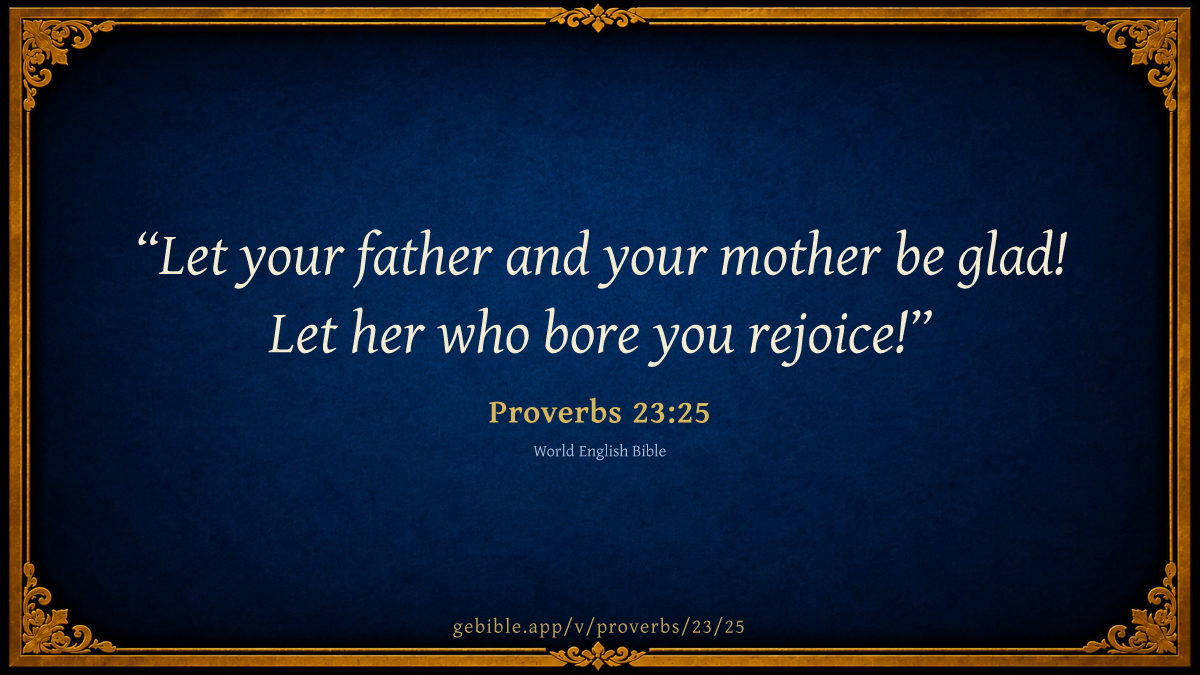
Let your father and your mother be glad! Let her who bore you rejoice!
Parallel Translations
-
Let your father and your mother be glad! Let her who bore you rejoice!
-
Thy father and thy mother shall be glad, and she that bare thee shall rejoice.
-
Let thy father and thy mother be glad, and let her that bore thee rejoice.
Cross-references (6)
Passages linked to Proverbs 23:25 in the Treasury of Scripture Knowledge, ordered by reader-vote popularity; verse text shown in World English Bible.
- Proverbs 17:25 A foolish son brings grief to his father, and bitterness to her who bore him.
- Luke 1:58 Her neighbors and her relatives heard that the Lord had magnified his mercy toward her, and they rejoiced with her.
- Luke 11:27-28 It came to pass, as he said these things, a certain woman out of the multitude lifted up her voice, and said to him, “Blessed is the womb that bore you, and the breasts which nursed you!” But he said, “On the contrary, blessed are those who hear the word of God, and keep it.”
- 1 Chronicles 4:9-10 Jabez was more honorable than his brothers. His mother named him Jabez, saying, “Because I bore him with sorrow.” Jabez called on the God of Israel, saying, “Oh that you would bless me indeed, and enlarge my border! May your hand be with me, and may you keep me from evil, that I may not cause pain!” God granted him that which he requested.
- Luke 1:40-47 and entered into the house of Zacharias and greeted Elizabeth. When Elizabeth heard Mary’s greeting, the baby leaped in her womb; and Elizabeth was filled with the Holy Spirit. She called out with a loud voice and said, “Blessed are you among women, and blessed is the fruit of your womb! Why am I so favored, that the mother of my Lord should come to me? For behold, when the voice of your greeting came into my ears, the baby leaped in my womb for joy! Blessed is she who believed, for there will be a fulfillment of the things which have been spoken to her from the Lord!” Mary said, “My soul magnifies the Lord. My spirit has rejoiced in God my Savior,
- Luke 1:31-33 Behold, you will conceive in your womb and give birth to a son, and shall name him ‘Jesus.’ He will be great and will be called the Son of the Most High. The Lord God will give him the throne of his father David, and he will reign over the house of Jacob forever. There will be no end to his Kingdom.”
Cross-references from openbible.info (CC BY 4.0)
Explain this verse (7 sources)
Historical commentary, presented as a primary source — not an endorsement.
Private notes
Saved on this device only — never synced or sent anywhere.
Matthew Poole 1685 · Public Domain Thy father and thy mother shall be glad; he…
Thy father and thy mother shall be glad; he repeateth this again, as a powerful argument to prevail with all children that are not void of natural affection, to labour to be wise and good, that so they may glad the hearts of their parents, to whom they have such high and indelible obligations.
She that bare thee with so great pain and hazard, and brought thee up with such tender care, whom thou canst not better requite.
Matthew Poole's English Annotations on the Holy Bible (1683–1685) — public domain. Text from a community e-Sword/MySword module.
John Gill 1763 · Public Domain Thy father and thy mother shall be glad,.... That,…
Thy father and thy mother shall be glad,.... That, is when thou art righteous and wise; see Pro 10:1; or "let thy father and thy mother be glad" (e); do everything that may make their hearts glad, and their lives easy and comfortable in their old age; by ministering to their necessities, if in any; by treading in their steps, and following their examples; by living soberly and righteously, and behaving wisely; by not only honouring them, but by seeking the honour and glory of God; showing a regard to religion, and supporting it to the utmost of their power; these are things which make the hearts of pious parents glad;
and she that bare thee shall rejoice; thy mother particularly, who bore and brought thee forth with so much pain, and brought thee up with so much care and trouble, will think it an to much recompence for all, if thou art truly wise and religious. Some accommodate this to God our heavenly Father, and to the church, the Jerusalem above, the mother of us all.
Read full note →
(e) "guadeat", V. L. "laetetur", Tigurine version, Junius & Tremellius, Piscator; "fac ut laetetur", Mercerus, Gejerus; "exhilaretur", Schultens.
John Gill's Exposition of the Whole Bible (1746–1763) — public domain (CC PDM 1.0). Text via the HelloAO Bible API.
Daniel D. Whedon 1874 · Public Domain 25. Father… rejoice… mother — Muenscher and Zockler forcibly…
25. Father… rejoice… mother — Muenscher and Zockler forcibly render this thus: “Let thy father and thy mother be glad, and let her that bare thee rejoice;” that is, by thy attaining to righteousness and wisdom, according to the preceding verse. Compare Pro_10:1; Pro_15:20; Pro_27:11.
Daniel D. Whedon (gen. ed.), Commentary on the Old and New Testaments (1874–1909) — public domain. Text from a community e-Sword module.
The Cambridge Bible for Schools and Colleges 1878 · Public Domain 25. shall … shall] Rather, Let thy father ……
25. shall … shall] Rather, Let thy father … and let her &c. It is an exhortation to the son to verify by his own conduct the statement of the preceding verse. “Quod cum ita sit, da operam ut parentibus lætitiam crees,” Maurer; εὐφραινέσθω, χαιρέτω, LXX.; gaudeat, exsultet, Vulg.
The Cambridge Bible for Schools and Colleges (gen. ed. J. J. S. Perowne; Cambridge University Press, 1878–1918) — public domain. Text from a community e-Sword module.
The Pulpit Commentary 1880 · Public Domain Shall be glad; or, let them be glad; gaudeat,…
Shall be glad; or, let them be glad; gaudeat, Vulgate; eufrainesyw , Septuagint. She that bare thee. As in ver. 24 the father"s joy was expressly mentioned, so here prominence is given to that of the mother. In the former case it is "he that begetteth;" here, "she that beareth."
The Pulpit Commentary (1880–1919), ed. H.D.M. Spence-Jones & Joseph S. Exell — public domain. Text from a community e-Sword module.
The Biblical Illustrator 1887 · Public Domain Thy father and thy mother shall be glad, and…
Pro_23:25
Thy father and thy mother shall be glad, and she that bare thee shall rejoice.
Read full note →
Filial piety
Respect and love for parents are not, indeed, the motives which operate with the greatest force upon minds renewed by the Spirit of grace and truth. With such the most powerful incentives to action are those which derive their origin from the relation we sustain to God, the author of life and salvation. It is sometimes the case that an ingenuous youth is more influenced by the recollection of the counsels of a departed father or mother than he would have been by the same counsels had that father or mother not been taken from him; and never, in any circumstances, does filial piety appear more lovely and attractive.
I. Cultivate a reverence for parental counsels and authority. At no period of their lives are young persons so tempted to disregard parental authority as when they are passing from boyhood to manhood. They are desirous to be thought independent, and capable of directing themselves. They become impatient of restraint, and the advice even of parents whom they both reverence and love is often irksome. Better show your claim to be considered youths of a truly noble and independent spirit by always daring to do what is right, and by always yielding due obedience to parental commands. Despise not a mothers fears, however unfounded they may be. Be it your aim to remove them, not by maintaining that there is no ground for them, but by reverently receiving her admonitions, and conforming yourself to them.
II. Seek with all earnestness after truth. To how many a father and mother it would be as life from the dead could they be assured that you were all earnestly seeking the pearl of great price, ready and desirous to purchase it at any cost--at any sacrifice! But do not be indifferent to other truth, truths of physical, ethical, or political science. And always keep to truth as opposed to falsehood, dissimulation, and hypocrisy. The commands of God, the social interests of men, the very existence of civil society, call for an unwavering adherence to truth. Attend also to truth in the sense of fidelity, sincerity, and punctuality in keeping promises.
III. Seek after wisdom, instruction, and understanding. These different terms were employed not so much for the purpose of exact discrimination, as to indicate the earnestness with which they should be sought. Be it your aim to make all possible advances in both human and Divine knowledge, but especially in the latter.
IV. Seek the company of the wise and good, selecting for associates only those who are distinguished for sobriety of conduct. Your associations, of whatever kind they be, cannot fail to exert an influence over you. If your companions be the wise and good, you cannot but receive advantage from the connection.
V. Be careful in your choice of books. Such is the constitution of our minds that everything we read makes an impression upon them. As is your reading so are you.
VI. Cherish virtuous sentiments and virtuous habits. That your sentiments may be virtuous, you must give yourselves to the study of virtue. (John Maclean, D.D.)
The Biblical Illustrator, edited by Joseph S. Exell (c. 1880s–1900s) — public domain. Text from a community e-Sword module.
Paul E. Kretzmann 1924 · Public Domain v. 25. Thy father and thy mother shall be…
v. 25. Thy father and thy mother shall be glad, and she that bare thee shall rejoice, this fact being urged in order to stimulate the children in true pious conduct. cf Pro 10:1; Pro 15:20; Pro 27:11.
Paul E. Kretzmann, Popular Commentary of the Bible (1921–1924) — public domain. Text from a community e-Sword module.