
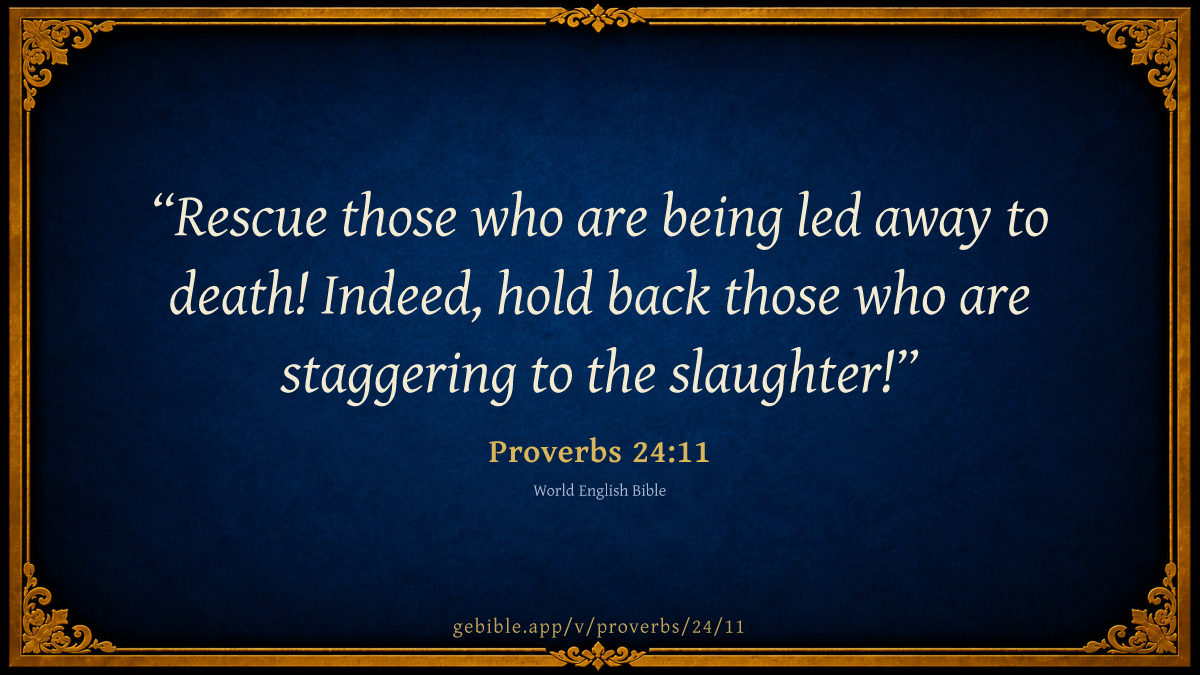
Rescue those who are being led away to death! Indeed, hold back those who are staggering to the slaughter!
Parallel Translations
-
Rescue those who are being led away to death! Indeed, hold back those who are staggering to the slaughter!
-
If thou forbear to deliver them that are drawn unto death, and those that are ready to be slain;
-
Deliver them that are drawn unto death; and those that are ready to be slain wilt thou forbear to rescue?
Cross-references (11)
Passages linked to Proverbs 24:11 in the Treasury of Scripture Knowledge, ordered by reader-vote popularity; verse text shown in World English Bible.
- Psalms 82:4 Rescue the weak and needy. Deliver them out of the hand of the wicked.”
- Isaiah 58:6-7 “Isn’t this the fast that I have chosen: to release the bonds of wickedness, to undo the straps of the yoke, to let the oppressed go free, and that you break every yoke? Isn’t it to distribute your bread to the hungry, and that you bring the poor who are cast out to your house? When you see the naked, that you cover him; and that you not hide yourself from your own flesh?
- 1 John 3:16-17 By this we know love, because he laid down his life for us. And we ought to lay down our lives for the brothers. But whoever has the world’s goods and sees his brother in need, then closes his heart of compassion against him, how does God’s love remain in him?
- Job 29:17 I broke the jaws of the unrighteous and plucked the prey out of his teeth.
- 1 Samuel 26:8-9 Then Abishai said to David, “God has delivered up your enemy into your hand today. Now therefore please let me strike him with the spear to the earth at one stroke, and I will not strike him the second time.” David said to Abishai, “Don’t destroy him; for who can stretch out his hand against Yahweh’s anointed, and be guiltless?”
- Luke 10:31-32 By chance a certain priest was going down that way. When he saw him, he passed by on the other side. In the same way a Levite also, when he came to the place, and saw him, passed by on the other side.
- Luke 23:23-25 But they were urgent with loud voices, asking that he might be crucified. Their voices and the voices of the chief priests prevailed. Pilate decreed that what they asked for should be done. He released him who had been thrown into prison for insurrection and murder, for whom they asked, but he delivered Jesus up to their will.
- Acts 21:31-32 As they were trying to kill him, news came up to the commanding officer of the regiment that all Jerusalem was in an uproar. Immediately he took soldiers and centurions and ran down to them. They, when they saw the chief captain and the soldiers, stopped beating Paul.
- Acts 18:17 Then all the Greeks seized Sosthenes, the ruler of the synagogue, and beat him before the judgment seat. Gallio didn’t care about any of these things.
- Acts 23:10 When a great argument arose, the commanding officer, fearing that Paul would be torn in pieces by them, commanded the soldiers to go down and take him by force from among them, and bring him into the barracks.
- Acts 23:23-35 He called to himself two of the centurions, and said, “Prepare two hundred soldiers to go as far as Caesarea, with seventy horsemen, and two hundred men armed with spears, at the third hour of the night.” He asked them to provide animals, that they might set Paul on one, and bring him safely to Felix the governor. He wrote a letter like this: “Claudius Lysias to the most excellent governor Felix: Greetings. “This man was seized by the Jews, and was about to be killed by them, when I came with the soldiers and rescued him, having learned that he was a Roman. Desiring to know the cause why they accused him, I brought him down to their council. I found him to be accused about questions of their law, but not to be charged with anything worthy of death or of imprisonment. When I was told that the Jews lay in wait for the man, I sent him to you immediately, charging his accusers also to bring their accusations against him before you. Farewell.” So the soldiers, carrying out their orders, took Paul and brought him by night to Antipatris. But on the next day they left the horsemen to go with him, and returned to the barracks. When they came to Caesarea and delivered the letter to the governor, they also presented Paul to him. When the governor had read it, he asked what province he was from. When he understood that he was from Cilicia, he said, “I will hear you fully when your accusers also arrive.” He commanded that he be kept in Herod’s palace.
Cross-references from openbible.info (CC BY 4.0)
Explain this verse (22 sources)
Historical commentary, presented as a primary source — not an endorsement.
Private notes
Saved on this device only — never synced or sent anywhere.
Geneva Bible translators 1599 · Public Domain None can be excused, if he help not the…
None can be excused, if he help not the innocent when he is in danger.
Geneva Bible (1599) marginal notes — public domain.
John Trapp 1656 · Public Domain Pro 24:11 If thou forbear to deliver [them that…
Pro 24:11 If thou forbear to deliver [them that are] drawn unto death, and [those that are] ready to be slain;
Ver. 11. If thou forbear to deliver them, &c.] That is, That are wrongfully butchered. Here, not to save a man, if it be in our power, is to destroy him. {Mar 3:4} Job "brake the jaws of the wicked, and plucked the prey out of his teeth." {Job 29:17} The people rescued Jonathan, and Ebedmelech Jeremiah. Henry VIII delivered his Queen Katherine, and King Philip with his Spaniards kept the Lady Elizabeth from the cruel mercies of Stephen Gardiner, who had designed them destruction. Sir George Blage (one of King Henry VIII’s privy chamber), being condemned for a heretic, was yet pardoned by the king. He coming afterwards to the king’s presence, - "Ah, my pig," saith the king, for so he was wont to call him. "Yea," said he, "if your Majesty had not been better to me than your bishops were, your pig had been roasted ere this time." But what a bloody mind bore Harpsfield, archdeacon of Canterbury, who, being at London when Queen Mary lay dying, made all post haste home to despatch those whom he had then in cruel custody. {a}
Read full note →
{a} Acts and Mon., fol. 1899, 1135, 1862.
John Trapp, A Commentary or Exposition upon All the Books of the Old and New Testament (1647–1656) — public domain. Text from a community e-Sword module.
Matthew Poole 1685 · Public Domain To deliver them, when it is in thy power…
To deliver them, when it is in thy power to do it lawfully.
Drawn unto death, to wit, unjustly, or by the violence of lawless men.
Read full note →
That are ready to be slain; that are in present danger of death or destruction.
Matthew Poole's English Annotations on the Holy Bible (1683–1685) — public domain. Text from a community e-Sword/MySword module.
Matthew Henry 1710 · Public Domain Here is, 1. A great duty required of us,…
Here is, 1. A great duty required of us, and that is to appear for the relief of oppressed innocency. If we see the lives or livelihoods of any in danger of being taken away unjustly, we ought to bestir ourselves all we can to save them, by disproving the false accusations on which they are condemned and seeking out proofs of their innocency. Though the persons be not such as we are under any particular obligation to, we must help them, out of a general zeal for justice. If any be set upon by force and violence, and it be in our power to rescue them, we ought to do it. Nay, if we see any through ignorance exposing themselves to danger, or fallen in distress, as travellers upon the road, ships at sea, or any the like, it is our duty, though it be with peril to ourselves, to hasten with help to them and not forbear to deliver them, not to be slack, or remiss, or indifferent, in such a case. 2. An answer to the excuse that is commonly make for the omission of this duty. Thou wilt say, "Behold, we knew it not; we were not aware of the imminency of the danger the person was in; we could not be sure that he was innocent, nor did we know how to prove his innocence, nor which way to do any thing in favour of him, else we would have helped him." Now, (1.) It is easy to make such an excuse as this, sufficient to avoid the censures of men, for perhaps they cannot disprove us when we say, We knew it not, or, We forgot; and the temptation to tell a lie for the excusing of a fault is very strong when we know that it is impossible to be disproved, the truth lying wholly in our own breast, as when we say, We thought so and so, and really designed it, which no one is conscious of but ourselves. (2.) It is not so easy with such excuses to evade the judgment of God; and to the discovery of that we lie open and by the determination of that we must abide. Now, [1.] God ponders the heart and keeps the soul; he keeps an eye upon it, observes all the motions of it; its most secret thoughts and intents are all naked and open before him. It is his prerogative to do so, and that in which he glories. Jer 17:10, I the Lord search the heart. He keeps the soul, holds it in life. This is a good reason why we should be tender of the lives of others, and do all we can to preserve them, because our lives have been precious in the sight of God and he has graciously kept them. [2.] He knows and considers whether the excuse we make be true or no, whether it was because we did not know it or whether the true reason was not because we did not love our neighbour as we ought, but were selfish, and regardless both of God and man. Let this serve to silence all our frivolous pleas, by which we think to stop the mouth of conscience when it charges us with the omission of plain duty: Does not he that ponders the heart consider it? [3.] He will judge us accordingly. As his knowledge cannot be imposed upon, so his justice cannot be biassed, but he will render to every man according to his works, not only the commission of evil works, but the omission of good works.
Matthew Henry's Commentary on the Whole Bible (1708–1710) — public domain (CC PDM 1.0). Text via the HelloAO Bible API.
John Gill 1763 · Public Domain If thou sayest, Behold, we knew it not,.... The…
If thou sayest, Behold, we knew it not,.... The danger the person was in; or the innocency of his cause; or what method to take to deliver him; or that it was in our power to do anything for him; so the Vulgate Latin version, "if thou sayest, strength is not sufficient": or "we knew him not" (k), who he was or what he was; had no knowledge of him, or acquaintance with him, and so did not think ourselves under any obligation to regard his case; such excuses will not do;
doth not he that pondereth the heart consider it? he that searches the heart and tries it, and weighs every thought of it, and excuse it makes, considers and understands whether it is a mere excuse or not; though such excuses may appear plausible to men, yet to God that knows the heart they are of no avail; for he knows it to be a mere shift, and that it was unwillingness to help the distressed, and a neglect of their case; and that all that is said on their own behalf is a vain pretence;
Read full note →
and he that keepeth thy soul, doth not he know it? he that upholds it in life, and whose visitation preserves it, and therefore should be careful of the life of another; and if not, may justly fear the Lord will withdraw his care and preservation of them; he knows perfectly well what regard a man has to the welfare of another, or to the preservation of another man's life when in danger; and whether what he says on his own behalf is well founded: or "he that observeth thy soul" (l); all the inward motions of it, the thoughts, affections, purposes, and inclinations; he knows whether what is said is true or not;
and shall not he render to every man according to his works? and behave towards him according to the law of retaliation; the same measure he measures to others, he will measure to him again; and who having shown no mercy in saving the lives of others, when he could have done it, shall have judgment executed on him without mercy, when he is in distress.
(k) , , Sept. "non noverimus istum", Gejerus; "non novimus hunc", Pagninus, Montanus, Michaelis. (l) "et qui observat animam tuam", Michaelis, Schultens; "observator animae tuae", Tigurine version, Gejerus.
John Gill's Exposition of the Whole Bible (1746–1763) — public domain (CC PDM 1.0). Text via the HelloAO Bible API.
John Wesley 1765 · Public Domain Deliver - When it is in thy power. Drawn…
Deliver - When it is in thy power. Drawn - By the violence of lawless men.
John Wesley, Explanatory Notes Upon the Whole Bible (1754–1765) — public domain. Text via the GEBible commentary corpus.
Adam Clarke 1810 · Public Domain Verse 11. If thou forbear to deliver] If thou…
Verse 11. If thou forbear to deliver] If thou seest the innocent taken by the hand of lawless power or superstitious zeal, and they are about to be put to death, thou shouldst rise up in their behalf, boldly plead for them, testify to their innocence when thou knowest it; and thus thou wilt not be guilty of blood; which thou wouldst be, if, through any pretense, thou shouldst neglect to save the life of a man unjustly condemned.
Adam Clarke's Commentary on the Bible (1810–1826) — public domain. Text from a community e-Sword/MySword module.
Joseph Benson 1811 · Public Domain Pro 24:11-12. If thou forbear to deliver — When…
Pro 24:11-12. If thou forbear to deliver — When it is in thy power to do it lawfully; them that are drawn unto death — Namely, unjustly, or by the violence of lawless men; and those that are ready to be slain — That are in present danger of death or destruction. He enforces, in these verses, the necessity of giving our assistance toward the rescue of innocent persons, when their lives are in danger, either by counselling them, or petitioning others in their behalf, or by doing any thing in our power for their deliverance. If thou sayest, We knew it not — I was ignorant, either of his innocence, or of his extreme danger, or of my power to relieve him; doth not he consider it — That this is only a frivolous excuse, and that the true reason of thy neglect was, thy want of true love to thy brother, whose life thou wast, by the law of God and of nature, obliged to preserve, and a carnal fear of some mischief, or trouble, which might befall thee in the discharge of thy duty. And he that keepeth thy soul — Who is the preserver of men, Job 7:20, who daily does, and who only can, keep thee both in and from the greatest dangers; and this favour of God may be here mentioned, partly as an encouragement to the performance of the duty here spoken of, from the consideration of God’s special care and watchfulness over those that do their duty; and partly to intimate to them, that by the neglect of this duty they would forfeit God’s protection over themselves, and expose themselves to manifold dangers and calamities. The Hebrew word נצר, however, may be rendered, he that observeth thy soul, that sees all the secret thoughts and inward motions of thy heart; which interpretation is favoured both by the preceding and following words. And shall not he render, &c. — God will certainly deal with thee as thou hast dealt with him, either rewarding thy performance of this duty, or punishing thy neglect of it.
Joseph Benson's Commentary on the Old and New Testaments (1811–1818) — public domain. Text from a community e-Sword module.
Albert Barnes 1834 · Public Domain “Deliver those that are drawn unto death,
Literally:
“Deliver those that are drawn unto death,
Read full note →
And those who totter to the slaughter - if
Thou withdraw ...”
i. e., “O withdraw them,” save them from their doom; in contrast to Pro 24:10. The structure and meaning are both somewhat obscure; but the sentence is complete in itself, and is not a mere hypothesis concluded in the following verses.
Albert Barnes' Notes on the Bible (1834–1885) — public domain. Text from a community e-Sword/MySword module.
Charles Bridges 1846 · Public Domain 11 If thou forbear to deliver them that are…
11 If thou forbear to deliver them that are drawn unto death, and those that are ready to be slain;†a 12 If thou sayest, Behold, we knew it not; doth not he that pondereth the heart consider it? and he that keepeth thy soul, doth not he know it? and shall not he render to every man according to his works?
(Pro 24:12 is quoted in the NT: Rom 2:6 [Note, this sentence is found serveral times in the Old Testament so it is not certain if Rom 2:6 is quoting Pro 24:12 specifically])
Read full note →
Suppose a fellow-creature in imminent danger — as it were drawn unto death, and ready to be slain unjustly,†1 or from wickedness. (Luk 10:30 .) The magistrate standing in the place, and invested with the power of God†2 — If he forbear to deliver, on the false pretense that he knew it not, the Lord will require it. This obligation, with all the responsibility of its neglect, is the universal law of the Gospel. (Luk 10:29-36 .) Whoever knows his brother’s danger, and forbears to deliver — doth not he that pondereth the heart consider it? Will he not render? The Hebrew midwives,†3 and Esther in after-ages,†4 thus delivered their own people drawn unto death. Reuben delivered Joseph from the pit. Job was the deliverer of the poor in the extremety,†5 Jonathan saved his friend at imminent risk to himself.†6 Obadiah hid the LORD’s prophets.†7 Ahikam and Ebed-melech saved Jeremiah.†8 Johanan attempted to deliver the unsuspecting Gedaliah.†9 Daniel preserved the wise men of Babylon.†10 The Samaritan rescued his neighbor from death. Paul’s nephew delivered the great Apostle, by informing him of the murderous plot.†11 The rule includes all oppression, which has more or less of the character of murder.†12
Excuses are always at hand for slightly passing over their sad condition — We knew it not — we knew not your state, how you came into it, or how to help you out of it. But the true reason is, as Bishop Sanderson has stated it — ’We want charity, but abound in self-love. Our defect in that appeareth by our backwardness to perform our duties to our brethren; and our excess in this by our readiness to frame excuses for ourselves.’†13 But doth not God, who hath a balance for every thought, know thy brother’s wants, the sorrow of his heart, and the grief that presses down his soul? Doth not he consider the excuse of ignorance to be the mere cover for selfishness? Vain is it to plead ignorance before the All-seeing God. He that pondereth the heart will thoroughly sift; his Omniscience will perfectly know; his retributive justice will render. Disinterested kindness will be considered.†14 But to forbear deliverance — whether from cruelty,†15 selfishness,†16 or fear of personal consequences†17 — involves an awful account.
But how much more guilty to forbear the deliverance of immortal souls! — in ignorance, ungodliness, or unbelief, drawn unto death, and ready to be slain! Ought they not to be the objects of our most yearning anxiety? What shall we then say to that frozen apathy, which forbears to deliver? ’We have no right to judge — we knew it not — "Am I my brother’s keeper?" (Gen 4:9 .) It is no concern of mine.’ But might not many a soul have started back from ruin, had but the discovery of his danger been made, ere it was too late? Yet the one word, that might have saved, was forborne. Is there no brother, child, or neighbor, who may pierce the conscience to eternity with the rebuke — ’Hadst thou dealt faithfully with my soul, I had not been in this place of torment.’ (Jas 5:19-20 .) If others may charge us with the bodies of our fellow-creatures, God commits their souls to our care. The Lord preserve us from an indictment in the court of heaven for the murder of our brother’s soul, by forbearing to deliver!
And does not this ring a solemn peal of warning to those, whose special office it is to deliver them that are drawn unto death? ’We knew it not.’ But ought we not to have been "watching for souls, as those that must give account"? (Heb 13:17 .) And what will be the tremendous reckoning for those, who perish by the neglect of their pledged and divinely-appointed guardians! "While thy servant was busy here and there" — upon his own pleasure — the soul "was gone!" "But his blood will be required at the watchman’s hand."†18
Footnotes:
†a ’To deliver them that are ready to be slain. If thou forbear. First — he layeth down the duty. Then he adds the warning, armed with a thunderbolt of retributive judgment upon the forbearance.’ — Schultens.
†1 1Sa 24:11 ; 1Sa 26:18-20 . 1Ki 21:8-13 .
†2 Psa 82:3-6. Compare Baruch, Bar 6:35-38 — where the idols are proved to be no gods, because they cannot do the work of God here delegated to the magistrates as his representative.
†3 Exo 1:13-17.
†4 Est 3:6-13; Est 4:13-14 ; Est 8:4-6 .
†5 Job 29:12-13, Job 29:16-17 .
†6 1Sa 19:4 ; 1Sa 20:26-33 .
†7 1Ki 18:4 .
†8 Jer 26:24; Jer 38:11-13 .
†9 Jer 40:13-16.
†10 Dan 2:12-15.
†11 Act 23:16-22.
†12 Compare Sir 34:21-22 .
†13 Bishop Sanderson’s Assize Sermon on this text.
†14 Jer 38:7-13; Jer 39:16-18 .
†15 1Sa 22:9-18 .
†16 1Sa 25:10-11 . Luk 10:30-32 .
†17 Joh 19:4-13.
†18 1Ki 20:39-40 . Eze 33:8 . See Doddridge’s striking Sermon on this text given from his works in Williams’s Christian Preacher.
Charles Bridges, An Exposition of the Book of Proverbs (1846) — public domain. Text from a community e-Sword module.
Haydock's Catholic Bible Commentary 1859 · Public Domain Deliver. The Jews often put people to death without…
Deliver. The Jews often put people to death without any formal trial, pretending zeal, as they did St. Stephen, &c. Our Saviour rescued the adulteress from such a situation, as Daniel had done Susanna. Yet this text may regard poor debtors, Psalm lxxi. 4. (Calmet) --- Christian bishops used all their influence to preserve the lives of those who did not deserve death. (St. Ambrose in Psalm cxviii. Ser. viii. Off. i. 36., and ep. xxv., and xxvi.)
George Leo Haydock (1774–1849), Haydock's Catholic Family Bible and Commentary, 1859 edition — public domain. Excludes Psalms (Douay-Rheims chapter numbering differs from Protestant) and Deuterocanonical books (Catholic canon only).
Robert Jamieson, A. R. Fausset & David Brown 1871 · Public Domain Neglect of known duty is sin (Jam 4:17).
Neglect of known duty is sin (Jam 4:17).
ready--literally, "bowing down"
Read full note →
to be slain--that is, unjustly. God's retributive justice cannot be avoided by professed ignorance.
Jamieson, Fausset & Brown — Commentary Critical and Explanatory on the Whole Bible (1871) — public domain (CC PDM 1.0). Text via the HelloAO Bible API.
Daniel D. Whedon 1874 · Public Domain 11, 12. If thou forbear to deliver… his works…
11, 12. If thou forbear to deliver… his works — Muenscher’s translation and note are: “Dost thou forbear to deliver [those who are] led away to death, and those who are tottering to the slaughter? Dost thou say, Behold, we know not these [men?] Will not He that weigheth the hearts observe [it]? Yea, he that keepeth thy soul knoweth [it]; and he will render to every man according to his work.” When a criminal was led to execution, a crier went before, who proclaimed the crime of which he had been convicted, and called on all who could say any thing in his behalf to come forward; in case any did he was led back to the tribunal and the cause was reheard. The proverb contains an implied exhortation to assist the unfortunate, to succour the distressed, and vindicate the innocent, for God knows and will judge. See Lowth on Isaiah 53. Compare Psa_49:16; Psa_62:12; Isaiah 53:37, 38; Job_34:11; Jer_32:19; Rom_2:6; Rev_22:12.
Daniel D. Whedon (gen. ed.), Commentary on the Old and New Testaments (1874–1909) — public domain. Text from a community e-Sword module.
The Cambridge Bible for Schools and Colleges 1878 · Public Domain 11. drawn unto death … ready to be slain]…
11. drawn unto death … ready to be slain] whether by unjust judgement, or by violence. In the first case you may deliver a soul by giving true witness (Pro_14:25), in the second, by not passing by like the priest and the Levite on the other side, but by rendering help with the good Samaritan.
It is better to take this verse as complete in itself, with LXX. (ῥῦσαι ἀγομένους εἰς θάνατον, καὶ ἐκπρίου κτεινομένους, μὴ φείσῃ); Vulg., Erue eos qui ducuntur ad mortem; et qui trahuntur ad interitum liberare necesses; and with R.V.
Read full note →
Deliver them that are carried away unto death,
And those that are ready to be slain see that thou hold back.
ready to be slain] Lit. tottering to the slaughter.
The Cambridge Bible for Schools and Colleges (gen. ed. J. J. S. Perowne; Cambridge University Press, 1878–1918) — public domain. Text from a community e-Sword module.
Ellicott's Commentary for English Readers 1878 · Public Domain (11) If thou forbear . . .—Rather, Deliver those…
(11) If thou forbear . . .—Rather, Deliver those that are taken to death, and those that are tottering to the slaughter, stop them!
A Bible Commentary for English Readers, edited by Charles John Ellicott (1878–1897) — public domain. Text from a community e-Sword module.
The Pulpit Commentary 1880 · Public Domain Vers. 11, 12. A hexastich, inculcating humanity on the…
Vers. 11, 12. A hexastich, inculcating humanity on the ground of God"s omniscience.
If thou forbear to deliver them that are drawn unto death. The sentence is not conditional, in the second line being equivalent to Wl, utinam, "oh that!" "would that!" So the first hemistich should be rendered, "Deliver them that are haled to death," and the second, "And those that are tottering to slaughter, oh, hold them back!" The sentence is somewhat obscure, but Cheyne well explains it thus: "Some victims of a miscarriage of justice are about to be dragged away to execution, and the disciple of wisdom is exhorted to use his endeavours to deliver them" ("Job and Solomon"). In the case supposed a moral obligation lies on the pious and well-informed to save a human life unjustly imperilled. At the same time, there is nothing in the passage which absolutely, shows that the punishment of the guiltless is here deprecated; it looks rather as if Wisdom had no pleasure in the death of men, innocent or not, and that the victims of an extreme sentence claimed pity at her hands, whatever might be the circumstances of the verdict. Septuagint, "Deliver those that are being led away to death, and redeem (ekpriou ) those that are appointed to be slain; spare not (to help them)". (comp. Psa_82:3, Psa_82:4)
Read full note →
Vers. 11, 12. Culpable negligence.
Following the Revised Version and the now generally accepted rendering of these verses, we will read the first as an exhortation to deliver men from death, and the second as a warning against neglecting this duty.
I THE EXHORTATION. "Deliver them that are carried away unto death, and those that are ready to be slain see that thou hold back." Note first the grounds, and then the application, of this exhortation.
1. The grounds of it.
(1) It springs from human need. Men are in danger in war, famine, poverty, disease, sin. The world cannot go on without mutual assistance. The selfish policy of sauve qui peut would be fatal to society.
(2) It is based on human brotherhood. God has made all men of one blood. (Act_17:26) Our fellow creatures of the animal world have claims upon us; for, like us, they are sensitive, and God made both us and them. Much more are our fellow men in our care.
(3) It is urged by Divine commands. The Bible teaches duty to man as well as to God, on Divine authority. The mainly negative requirements of the ten commandments do not cover all our duty. We are called upon to love our neighbours as ourselves.
(4) It is confirmed by the example of God. He has given us our lives, spared them when forfeited by sin, and saved them from many dangers. He has given his Son in death to save us from ruin. Such redeeming mercy makes churlish negligence on our part doubly culpable.
2. The application of it.
(1) There should be mercy in war. It is heathenish to refuse quarter. The Christian soldier will dress the wounds of his enemy.
(2) We should render assistance in cases of accident and danger. It is horrible to read in the newspapers of men who would watch a child drown because they were not officers of the Royal Humane Society, because it was not their business to save life, and even because they had good clothes which they did not wish to soil. Selfish people will see a man half murdered in a street quarrel without interfering.
(3) We should help the poor. This applies to our own poor first, then to those of our neighbourhood, but the obligation extends as far as a China famine.
(4) Hospitals deserve support, for ministrations to the sick directly tend to preserve life.
(5) Social reforms demand Christian assistance.
(6) It is our supreme duty to spread the gospel throughout the world. This is a "Word of life". (Php_2:16) To let men perish for lack of the bread of life is culpable negligence. The lepers of Samaria rebuke such conduct. (2Ki_7:9)
I THE WARNING.
1. Ignorance is no excuse. "Behold, we knew it" (or "him") "not." Of course, this does not apply to unavoidable ignorance. But the rich should know the condition of the poor. It is the duty of the West End to investigate the condition of the East End. While this duty is neglected the comfortable complacency of ignorance is unpardonable. Further, if the attempted excuse be that the sufferer is personally unknown to us, this must not be admitted. He is still our brother. The parable of the good Samaritan shows that the perfect stranger has claims upon us.
2. God observes this negligence. He "pondereth the heart." He reads our secret thoughts and weighs our motives. Thus he knows whether we are kept back by unavoidable ignorance or inability to help, or whether the negligence is wilful. With this awful fact before us, that there is One who "pondereth the heart," all flimsy excuses must shrivel up and leave the negligence of the needy in its naked guilt.
3. God will treat us according to our treatment of our fellow men. "With what measure ye mete it shall be measured to you again". (Mat_7:2) Moreover, in regard to the duty now before us, it is to be observed that God takes note of omissions as well as of transgressions. The "eternal fire" is not spoken of by our Lord for thieves, murderers, etc., but for those who failed to help the hungry, the thirsty, the needy. (Mat_25:41-46)
Vers. 11, 12. Compassion for the wronged.
I THE HEART AND HAND SHOULD EVER BE READY AT THE CALL OF DISTRESS. (Ver. 11) The picture seems to be placed before us of one arriving at the place of judgment, seeing an innocent sufferer yet, like the priest and the Levite in the parable, passing by "on the other side." "To see and sights moves more than hear them told; For then the eye interprets to the ear The heavy motion that it doth behold.
To respond to these mute appeals from any of God"s creatures is to obey a law immediately known within our breast; to resist them is to sin against him and against our own souls.
II NEGLECT OF DUTY CANNOT ESCAPE PUNISHMENT. (Ver. 12)
1. Human nature is fertile in excuses. For the burden of blame and of conscious guilt is the heaviest we can bear. But searching is the truth of the proverb, "Whoso excuses, accuses himself," Ignorance of duty needs no excuses; but excuses for neglect can never be valid.
2. Excuses may avail with man, but not with God. With fallible men they may and often do pass for truth. At all events, they must often be accepted by those who need in turn to make them. But God knows the truth of every heart, and in every case; and to him excuses are either needless or worse.
3. Judgment will be executed in spite of our excuses. For God is the Vindicator of the wronged, and the Recompenser of all according to their deeds. Scripture is very impressive on the sin of neglect of kindly duties to others, in regard to which the conscience is so often dull. (Luk_14:18, etc.) Men content themselves with the reflection that they have not done others positive harm a negative position. But the other negative position, that we have not done the good we had a call to do, on this the teaching of Christ fixes a deeper guilt. Noble as it is to save a life from bodily death, still more glorious in its consequences is it to save a soul from death and hide a multitude of sins. J.
Vers. 11, 12. Inexcusable indifference.
The principles contained in this passage are these
I THAT ALL HUMAN NEED IS A CLAIM FOR HELP. God has so "fashioned our hearts alike," and has so bound together our lives and our interests, that we are under serious obligation to one another. No man is at liberty to live an isolated life; he owes too much to those that have gone before him, and is too closely related to those who are around him, to allow of such a course. To wish it is unnatural, to attempt it is immoral "We are members one of another;" we are brethren and sisters one of another. And whenever any one about us whoever or whatever he or she may be is in any kind of difficulty or distress, is in need of sympathy and succour, there is an imperative demand, as clear as if it came from an angel"s trumpet or straight out of the heavens above us, that we should stop, should inquire, should help as best we can. (see 1Jn_3:17, 1Jn_3:18)
II THAT THE EXTREMITY OF HUMAN NEED IS A MOST POWERFUL PLEA. If any sufferer on life"s highway is a man to be pitied and relieved, how much more are they who are "drawn unto death," who are "ready to be slain"! To see our brother or our sister made like ourselves, and capable as we are of intense suffering, holding life as precious as we ourselves regard it in circumstances of keen distress or of utmost danger, and to withhold our pity and our aid, this is condemned of God. Whether we "pass by on the other side", (Luk_10:31) so as to hide our cruel indifference as well as we can from our own sight; or whether we pass close by, clearly recognizing our duty, but cynically and heartlessly declining to do it; or whether we stand awhile and pity, but conclude that help will be too costly, and so pass on without helping; we are guilty, we are unbrotherly, inhuman, altogether unlike our Lord.
III THAT EXCUSES WILL NOT AVAIL US. If we want to escape from our plain duty we seldom refuse it point blank. We do not say to our Lord or to ourselves, "We will not;" we say, "We would if ," or "We will when ." When our brother is in difficulty or in sorrow, and urgently needs the extricating hand, the sympathizing word, we may plead, to ourselves or to our neighbours, our ignorance of the sufferer, our imperfect acquaintance with the circumstances, our want of time, our incapacity for assisting in that kind of trouble, our multitudinous and pressing duties and claims, etc. These may succeed with men, but they will not avail with God. God knows the hollowness of these poor pleas; to his eye they are only thin veils that do not hide our cruel selfishness; he judges that nothing justifies us in abandoning the perishing to their fate, and he condemns us.
IV THAT GOD IS GRIEVED WITH US FOR OUR OWN SAKE. He "that keepeth our soul" knows it. And because God does "keep our soul," he is grieved to see us take up an attitude towards our brother which
(1) proves us to be unbrotherly, and
(2) helps to fix us in our cold-heartedness. For every act and instance of selfishness hardens our heart and makes it more capable of cruel indifference than before.
V THAT CRUELTY AND KINDNESS MOVE TO THEIR REWARD. "Shall he not render," etc.? Cruelty and kindness must be cursed or blessed by the immediate effects they leave in the soul of the agent. But they also move toward a day of award, Then will a selfish indifference hear its strong, Divine condemnation (Mat_25:41-45) Then, also, will a generous kindness listen to its warm, Divine commendation. C. (Mat_25:34-40)
The Pulpit Commentary (1880–1919), ed. H.D.M. Spence-Jones & Joseph S. Exell — public domain. Text from a community e-Sword module.
The Biblical Illustrator 1887 · Public Domain If thou forbear to deliver them that are drawn…
Pro_24:11-12
If thou forbear to deliver them that are drawn unto death.
Read full note →
The claim of our brothers need
1. It is supposed that there is an allusion here to what is understood to have been a custom among the Jews. When a man was being led to execution a sort of crier or herald went with the procession, publicly proclaiming that if any man hath anything to offer even yet to show the innocence of the accused, or any circumstances of extenuation to present, or testimony to give to his character, let him now declare it; the judges are sitting; the procession to the place of execution shall be arrested; anything new in the form of evidence or testimony shall be heard, and thus execution shall be stayed. It is supposed here that a man is in danger of death. It is supposed that he is innocent. It is supposed that there is a man who can help him, even now, to prove his innocence. If that man withholds his testimony, he is guilty of murder, and comes into the judgment of God.
2. Illustrations of the principle embodied in the text. Individuals may be exposed to great suffering by no fault of their own. Many have to suffer in consequence of the operation of general laws over which they have no control. Where there is suffering, peril, or destitution on one side, there is somewhere on the other the power to help; somebody has the ability to interpose. Those that have the power may neglect it, and endeavour to find miserable apologies and excuses for their neglect. There may be perfectly honest and sufficient reasons in any case why an individual may not help or take part in affording relief, but in every case a man must be perfectly honest with himself, and not make his personal indulgence take shape as pecuniary inability to help others. (T. Binney.)
Help for the heathen world
As descriptive, the words of the text draw our attention to the heathen, and give us a very affecting representation of their state. As imperative, they turn our attention to ourselves, and point out the work which God has given us to do--to use every possible effort to rescue our perishing neighbours from the state of peril and danger in which they are placed.
I. The state of the heathen world. As described in the text, drawn unto death, and ready to be slain.
1. As respects this world. In Hindustan there are four modes whereby men and women are drawn unto death--women by being burnt alive on the funeral pile of their husbands, and by being buried alive in the same grave; men by being crushed beneath the wheels of the ponderous car of Juggernaut, and by being drowned in the river Ganges.
2. As respects the next world. Look at their never-dying souls; think of the everlasting importance of the world to come. They are drawn to the pains of eternal death by their numerous and enormous iniquities; by the god of this world; and by the almighty arm of a holy and righteous God.
II. The imperative fixture of the text. We must look at ourselves.
1. Our duty is clearly pointed out. We are to preach the everlasting gospel. Who will go? To whom can we look with so much propriety as to those who are already ordained to preach the gospel? But some may plead, I am already useful and acceptable at home; or If I go to preach abroad, I shall inflict an injury on my own country; or I am not competent; I do not possess the requisite qualifications: and if. I were to make the attempt I should fail; or We cannot see it to be our duty to embark in this work at once, and for life; or I am already comfortable at home, and I do not like to give up my delights.
2. We are to present fervent supplication to the throne of grace. We must pray as well as preach.
3. Another means to be employed is, liberal contributions to defray the expenses of so great an undertaking. God will not hold him guiltless who neglects this duty. (Henry Townley.)
Drawn unto death, and ready to be slain
I. A statement of a certain condition. The natural world is in this state. It is so with reference to its original and to its actual guilt. A man, as a sin agent, is evermore superadding sin to sin.
II. The moral causes which contribute to it.
1. Education conducted on false estimates and erroneous principles.
2. Example. Actions affix a deeper stamp and stronger impressions than words.
3. Habit, which is said to be a second nature. It exercises a sort of moral omnipotency over us.
4. Self-complacency of a nominal religion.
5. Pride, when it makes a man virtually deny the value of a revelation by Christ.
6. Sloth which lulls a man into a pleasing dream, from which he would not be awakened.
7. The fear of the world, which has its branding-irons.
8. Love of sin. Its indulgence makes up the pleasure of their life.
III. The solemn duty to be performed. The deliverance is not in the power of man. A sinner must see himself as he really is, in the blackness of his guilt before God. For this he must seek the animation of the Holy Spirit. He must repent; and by faith look up to the Lord Jesus. These things must be told men plainly, and pressed upon them earnestly. (T. J. Judkin, M.A.)
Vain excuses
It is the universal characteristic of fallen man that he endeavours to extenuate what may be wrong in his conduct, and invent excuses. Are the pleas by which you might think to justify yourselves in regard to your known duties such as would bear being submitted to God? Men will often admit an excuse without close examination; not so God. We may examine into an excuse, and nevertheless not detect its worthlessness; not so God. Men, even when satisfied that blame attaches to the individual who offers the excuse, are often forced to let him pass without punishment; not so God. Groundless excuses can be of no avail as made to God, because, in the first place, He is a being who considers everything. In the second place, He knows everything. And in the third, He rewards everything. (H. Melvill, D.D.)
To magistrates
This text impresses this upon us--it is the duty of every one of us to use our best strength to deliver the oppressed, but our sin is we faint and forbear to do so.
1. Reasons for this duty in respect of God. We have His command and His example.
2. In respect of ourselves. What power we have and what need we may have. Our natural powers and faculties all have their several uses and opportunities. We have power to relieve the necessities of the poor. The world is full of changes and chances, and those who now have power presently come to have need. The rule of equity is, Do as thou wouldst be done to.
3. Reasons on consideration of the poor and oppressed. Consider the greatness of their distress, the scarcity of their friends, and the righteousness of their cause. That which you are to do for the poor is this, seek first to be well assured that their cause is just. Then you must not forsake or despise him because he is poor.
4. Reasons from the effects of the duty itself. It will gain us honour and estimation, purchase for us the blessings of the poor, and bring down on us the blessings of God. We want charity, but abound with self-love. Our defect in that appeareth by our backwardness to perform our duties to our brethren; and our excess in this, by our readiness to frame excuses for ourselves. Consider these excuses, such as--
(1) We never heard of their matters.
(2) We had no clear evidence that their cause was right and good.
(3) We did not see how we could relieve them. Gods response to such excuses is assured.
Doth not He consider? Doth not He know? Will not He render? (Bp. Sanderson.)
The Biblical Illustrator, edited by Joseph S. Exell (c. 1880s–1900s) — public domain. Text from a community e-Sword module.
The Preacher's Complete Homiletical Commentary 1892 · Public Domain Pro_24:11. Literally, “Deliver them who are dragged forth unto…
CRITICAL NOTES.—
Pro_24:11. Literally, “Deliver them who are dragged forth unto death, and them that totter to the slaughter, oh, rescue them.”
Read full note →
Pro_24:12. He that pondereth, literally, the Weigher of hearts. He that keepeth, rather “watcheth.”
MAIN HOMILETICS OF Pro_24:11-12
POSITIVE PUNISHMENT FOR A NEGATIVE CRIME
I. The negative crime. The question “Am I my brother’s keeper?” is here answered with an emphatic affirmative, for whatever may be the special reference of the words it is plain that they condemn as criminal the non-interposition of the strong on behalf of the weak and distressed. This crime may be committed from various causes. Those who are guilty of it may be entirely indifferent to the sufferings of others. There are many men and women who, if they are at ease themselves, never concern themselves about the sufferings of others—it matters not to them who is hungry so as they are well fed, and what privations others may be enduring while their needs are supplied. But the crime is oftener chargeable to moral cowardice and unwillingness to practice self-denial. A man may be sufficiently concerned for the danger of a drowning brother to throw him a rope, but he may shrink from throwing himself into the water and risking a watery grave on his behalf. So he may pity the ignorant and the erring and feel sad when he thinks of their sorrows and their sins, and yet be unwilling to sacrifice his money or his leisure or his social position in endeavours to save them. But the proverb seems to deal especially with what seems at first sight to be a less blameworthy class of persons than either of these—with those who have never considered the claims which others have upon them—who are really ignorant how many hearts are breaking around them and how many are perishing for the want of a helping hand. But this ignorance is here regarded as criminal. “Evil is wrought for want of thought, as well as want of heart,” but it is as much evil in the one case as in the other, and the want of thought is a sin in itself. And so is the want of knowledge here. God will not admit the plea “I knew it not,” but holds him who utters it guilty for his ignorance as well as for his neglect.
II. The positive punishment. No truth is taught more plainly in the Bible, than that men will not escape retribution of some kind because they have simply abstained from doing ill. The possessor of the one talent did not put it to a bad use, or throw it away. He kept it carefully wrapped in a napkin. But the sentence passed upon him was not merely that he should be deprived of his privilege, or that reward should be withheld, but:—“Cast ye the unprofitable servant into outer darkness.” (Mat_25:30). “The tree that was only barren was burned,” says an old writer. The justice of this will be seen the more we consider how much actual wrong-doing on the part of some is chargeable to the not-doing of others. How much sin might be prevented if those who have it in their power sought to deliver others from bodily, or social, or moral death.
OUTLINES AND SUGGESTIVE COMMENTS
“He that keepeth thy soul, doth not He know it.” This favour of God may be here mentioned partly as a strong obligation upon Him to preserve him who was made after God’s image, and whom God hath commanded him to love and preserve; partly to an encouragement to the performance of his duty herein from the consideration of God’s special care and watchfulness over those who do their duty; and partly to intimate to them the danger of neglect of this duty whereby they will forfeit God’s protection over themselves.—Poole.
The condition of sinners may be regarded as here very aptly set forth. They are “drawn unto death”—seized, or apprehended for death, and “ready to be slain:”—and the death to which they are doomed,—O how unutterably fearful! But you may naturally meet me with an objection here. In their condition there is no injustice; no unrighteous and cruel oppression. The sentence of death under which they lie is a divine sentence—in perfect accordance with all the principles of equity:—the sword with which they are “ready to be slain” is the sword of divine justice itself. They deserve to die the death. To attempt to prevent it would be to arrest the hand of God. Ought not divine, and therefore unimpeachable, justice to have its course? The objection—otherwise irresistible—God has Himself removed. Justice, infinite justice, had all its claims acknowledged and fulfilled on Calvary. On the ground of the sacrifice there offered, the atonement there made, the God of justice and mercy has called on sinners to accept pardon, in the name and for the sake of His Son. His call comes with authority. It is a command. It is in virtue of the satisfaction of justice in the atonement of Christ, that we ourselves enjoy our own deliverance from the death and destruction to which, in common with all, we were devoted. And the very same authority that commanded us to believe and be saved, enjoins on us to be agents in attempting the rescue of others. O! what should we not be ready to do, to sacrifice, to suffer, for such an end!—to effect such a rescue!—Wardlaw.
When Samuel Romilly’s Bill to abolish the punishment of death for a theft amounting to the sum of five shillings passed the English House of Commons, it was thrown out by a majority in the House of Lords. Among those who voted against the Bill were one archbishop and five bishops. Our poet here in the Proverbs is of a different mind. Even the law of Sinai appoints the punishment of death only for man-stealing.… In expressions like the above a true Christian spirit rules the spirit which condemns all bloodthirstiness of justice, and calls forth to a crusade, not only against the inquisition, but against all unmerciful and cruel executions.—Delitzsch.
The Hebrew midwives, and Esther in after ages, thus delivered their own people drawn unto death. Reuben delivered Joseph from the pit. Job was the deliverer of the poor in the extremity. Jonathan saved his friend at imminent risk to himself. Obadiah hid the Lord’s prophets. Ahikam and Ebed-melech saved Jeremiah. Johanan attempted to deliver the unsuspecting Gedaliah. Daniel preserved the wise men of Babylon. The Samaritan rescued his neighbour from death. Paul’s nephew delivered the great Apostle by informing him of the murderous plot. The rule includes all oppression, which has more or less of the character of murder.—Bridges.
“Who is lord over us?” is the watchword of the life-long battle between an evil conscience and a righteous Judge. Here the commandment is exceeding broad. Like Divine omniscience, it compasses the transgressor before and behind. It checks his advance, and cuts off his retreat. Although a man should actually maintain in relation to every brother the neutrality he professes, it would avail him nothing.… What ails our brother, that he needs the compassion of a tender heart and the help of a strong hand? He is “drawn unto death,” and “ready to be slain.” This is the very crisis which at once needs help and admits it. If the danger were more distant, he might not be sensible of his need; if it were nearer, he might be beyond the hope of recovery. He is so low that help is necessary; yet not so low as would render help vain. He is “drawn unto death,” and therefore is an object of pity; but his life is yet in him, and therefore he is a subject of hope.—Arnot.
The Preacher's Complete Homiletical Commentary (gen. ed. Joseph S. Exell; Funk & Wagnalls, c. 1892) — public domain (pre-1929). A full-Bible homiletical/sermon-outline anthology covering 65 of 66 books (2 John is absent from the source module). Text from a community e-Sword module.
Alexander MacLaren 1905 · Public Domain Pro 24:11 - Pro 24:12.
Proverbs
THE CRIME OF NEGLIGENCE
Read full note →
Pro 24:11 - Pro 24:12.
What is called the missionary spirit is nothing else than the Christian church working in a particular direction. If a man has a conviction, the health of his own soul, his reverence for the truth he has learnt to love, his necessary connection with other men, make it a duty, a necessity, and a joy to tell what he has heard, and to speak what he believes. On these common grounds rests the whole obligation of Christ’s followers to speak the Gospel which they have received; only the obligation presses on them with greater force because of the higher worth of the word and the deeper misery of men without it. The text contains nothing specially bearing on Christian missions, but it deals with the fault which besets us all in our relations and in life: and the wholesome truths which it utters apply to our duties in regard to Christian missions because they apply to our duties in regard to every misery within our reach. They speak of the murderous cruelty and black sin of negligence to save any whom we can help from any sort of misery which threatens them. They appear to me to suggest four thoughts which I would now deal with:-
I. The crime of negligence.
Not to use any power is a sin; to omit to do anything that we can do is a crime: to withhold a help that we can render is to participate in the authorship of all the misery that we have failed to relieve. He who neglects to save a life, kills. There are more murderers than those who lift violent hands with malice aforethought against a hated life. Rulers or communities who leave people uncared for to die, who suffer swarming millions to live where the air is poison and the light is murky, and first the soul and then the body, are dwarfed and die; the incompetent men in high places, and the indolent ones in low, whose selfishness brings, and whose blundering blindness allows to continue, the conditions that are fatal to life-on these the guilt of blood lies. Violence slays its thousands, but supine negligence slays its tens of thousands.
And when we pass from these merely physical conditions to think of the world and of the Church in the world, where shall we find words weighty and burning enough to tell what fatal cruelty lies in the unthinking negligence so characteristic of large portions of Christ’s professed followers? There is nothing which the ordinary type of Christian, so called, more needs than to be aroused to a living sense of personal responsibility for all the unalleviated misery of the world. For every one who has laid the sorrows of humanity on his heart, and has felt them in any measure as his own, there are a hundred to whom these make no appeal and give no pang. Within ear-shot of our churches and chapels there are squalid aggregations of stunted and festering manhood, of whom it is only too true that they are ‘drawn unto death’ and ‘ready to be slain,’ and yet it would be an exaggeration to say that the bulk of our congregations cast even a languid eye of compassion upon those, to say nothing of stretching out a hand to help. It needs to be dinned, far more than it is at present, into every professing Christian that each of us has an obligation which cannot be ignored or shuffled off, to acquaint ourselves with the glaring facts that force themselves upon all thoughtful men, and that the measure of our power is the measure of our obligation. The question, Has the church done its best to deliver these? needs to be sharpened to the point of ‘Have I done my best?’ And the vision of multitudes perishing in the slums of a great city needs to be expanded into the vision of dim millions perishing in the wide world.
II. The excuse of negligence.
The shuffling plea, ‘Behold we knew it not,’ is a cowardly lie. It admits the responsibility to knowledge and pretends an ignorance which it knows to be partly a false excuse, and in so far as it is true, to be our own fault. We are bound to know, and the most ignorant of us does know, and cannot help knowing, enough to condemn our negligence. How many of us have ever tried to find out how the pariahs of civilisation live who live beside us? Our ignorance so far as it is real is the result of a sinful indolence. And there is a sadder form of it in an ignorance which is the result of familiarity. We all know how custom dulls our impressions. It is well that it should be so, for a surgeon would be fit for little if he trembled and was shaken at the sight of the tumour he had to work to remove, as we should be; but his familiarity with misery does not harden him, because he seeks to remove the suffering with which he has become familiar. But that same familiarity does harden and injure the whole nature of the onlooker who does nothing to alleviate it. Then there is an ignorance of other suffering which is the result of selfish absorption in one’s own concerns. The man who is caring for himself only, and whose thoughts and feelings all flow in the direction of his own success, may see spread before him the most poignant sorrows without feeling one throb of brotherly compassion and without even being aware of what his eyes see. So, in so far as the excuse ‘we knew it not’ is true, it is no excuse, but an indictment. It lays bare the true reason of the criminal negligence as being a yet more criminal callousness as to the woe and loss in which such crowds of men whom we ought to recognise as brethren are sunken.
III. The condemnation of negligence.
The great example of God is put forward in the text as the contrast to all this selfish negligence. Note the twofold description of Him given here, ‘He that pondereth the heart,’ and ‘He that keepeth thy soul.’ The former of these presents to us God’s sedulous watching of the hearts of men, in contrast to our indolent and superficial looks; and in this divine attitude we find the awful condemnation of our disregard of our fellows. God ‘takes pain,’ so to speak, to see after His children. Are they not bound to look lovingly on each other? God seeks to know them. Are they not bound to know one another? Lofty disregard of human suffering is not God’s way. Is it ours? He ‘looks down from the height of His sanctuary to hear the crying of the prisoner.’ Should not we stoop from our mole-hill to see it? God has not too many concerns on His hands to mark the obscurest sorrow and be ready to help it. And shall we plead that we are too busy with petty personal concerns to take interest in helping the sorrows and fighting against the sins of the world?
No less eloquently does the other name which is here applied to God rebuke our negligence. ‘He preserveth thy soul.’ By His divine care and communication of life, we live; and surely the soul thus preserved is thereby bound to be a minister of preservation to all that are ‘ready to be slain.’ The strongest motive for seeking to save others is that God has saved us. Thus this name for God touches closely upon the great Christian thought, ‘Christ has given Himself for me.’ And in that thought we find the true condemnation of a Christianity which has not caught from Him the enthusiasm for self-surrender, and the passion for saving the outcast and forlorn. If to be a Christian is to imitate Christ, then the name has little application to those who see ‘them that are drawn to death,’ and turn from them unconcerned and unconscious of responsibility.
IV. The judgment of negligence.
‘Doth not He render to every man according to his works?’ There is such a judgment both in the present and in the future for Christian men as for others. And not only what they do, but what they inconsistently fail to do, comes into the category of their works, and influences their position. It does so in the present, for no man can cherish such a maimed Christian life as makes such negligence possible without robbing himself of much that would tend to his own growth in grace and likeness to Jesus Christ. The unfaithful servant is poorer by the pound hidden in the napkin which might all the while have been laid out at interest with the money-changers, which would have increased the income whilst the lord was absent. We rob ourselves of blessed sympathies and of the still more blessed joy of service, and of the yet more blessed joy of successful effort, by our indolence and our negligence. Let us not forget that our works do follow us in this life as in the life to come, and that it is here as well as hereafter, that he that goeth forth with a full basket and scatters the precious seed with weeping, and yet with joy, shall doubtless come again bringing his sheaves with him. And if we stretch our view to take in the life beyond, what gladness can match that of the man who shall enter there with some who will be his joy and crown of rejoicing in that day, and of whom he shall be able to say, ‘Behold I and the children whom Thou hast given me!’
I venture earnestly to appeal to all my hearers for more faithful discharge of this duty. I pray you to open your ears to hear, and your eyes to see, and your hearts to feel, and last of all, your hands to help, the miseries of the world. Solemn duties wait upon great privileges. It is an awful trust to have Christ and His gospel committed to our care. We get it because from One who lived no life of luxurious ease, but felt all the woes of humanity which He redeemed, and forbore not to deliver us from death, though at the cost of His own. We get it for no life of silken indolence or selfish disregard of the sorrows of our brethren. If there is one tear we could have dried and didn’t, or one wound we could have healed and didn’t, that is a sin; if we could have lightened the great heap of sorrow by one grain and didn’t, that is a sin; and if there be one soul that perishes which we might have saved and didn’t, the negligence is not merely the omission of a duty, but the doing of a deed which will be ‘rendered to us according to our works.’
Alexander MacLaren, Expositions of Holy Scripture (1904–1910) — public domain. Text from a community e-Sword module.
Paul E. Kretzmann 1924 · Public Domain v. 11. If thou forbear to deliver them that…
v. 11. If thou forbear to deliver them that are drawn unto death, rather, "Deliver those who are taken to death," and those that are ready to be slain, the appeal being directed particularly to such as witnessed the deeds of religious fanatics, who then, as now, often made it a point to interfere with the business of the government and to demand the severest punishments for such as had incurred their displeasure;
Paul E. Kretzmann, Popular Commentary of the Bible (1921–1924) — public domain. Text from a community e-Sword module.
unfoldingWord translationNotes 2017 · CC BY-SA 4.0 General Information:
General Information:
These verses continue the "thirty sayings" (Proverbs 22:20).
Read full note →
those who are being taken away
These words can be translated in active form by using the term "they" which could be anyone, but are probably government officials. AT: "those whom they are taking away" (See: Active or Passive)
taken away
Another possible meaning is "dragged away."
staggering
walking unsteadily and almost falling. This word would also describe the way a person walks when he is being dragged away.
the slaughter
The abstract noun "slaughter" can be translated as a verb. The writer speaks as if those who take them away think of them as no better than animals. If your language has a word for killing animals that would fit here, you might want to use it. AT: "where people will kill them as they would kill animals" (See: Abstract Nouns and Metaphor)
If you say, "Behold, ... this," does
The writer is answering something that the reader may wrongly be thinking. AT: "You may say, 'Behold, ... this,' but does"
Behold, we
"Listen to us! We" or "But we" or "We have done nothing wrong, because we"
does not the one who weighs the heart understand what you are saying?
The writer assumes the readers know the answer and asks this for emphasis. AT: "the one who weighs the heart understands what you are saying." (See: Rhetorical Question)
the one who
The writer expects the reader to know that "the one" is Yahweh. AT: "Yahweh, who" (See: Euphemism)
weighs the heart
The word "heart" is a metonym for what a person thinks and desires. The writer speaks as if what a person thinks and desires were a physical object that a person could weigh, and weighing an object is a metaphor for looking closely at something to see how good it is. AT: "knows how good what people really think and desire is" (See: Metonymy and Metaphor)
The one who guards your life, does he not know it?
The writer assumes the readers know the answer and asks this for emphasis. AT: "The one who guards your life knows it." (See: Rhetorical Question)
Will God not give to each one what he deserves?
The writer assumes the readers know the answer and asks this for emphasis. AT: "God will give to each one what he deserves." (See: Rhetorical Question)
translationWords
die
heart
life
God
unfoldingWord translationNotes — © Distant Shores Media and the Door43 World Missions Community, licensed CC BY-SA 4.0. Source: git.door43.org/Door43/en_tn.
Tyndale Open Study Notes 2022 · CC BY-SA 4.0 24:11-12 Saying 25: The wise do what they can…
24:11-12 Saying 25: The wise do what they can to prevent injustice and suffering (e.g., Job 29:12-17).
Tyndale Open Study Notes — © Tyndale Open Resources, licensed CC BY-SA 4.0. Text via the HelloAO Bible API.