Questions where the Bible appears to say two different things, with the passages on each side set together.
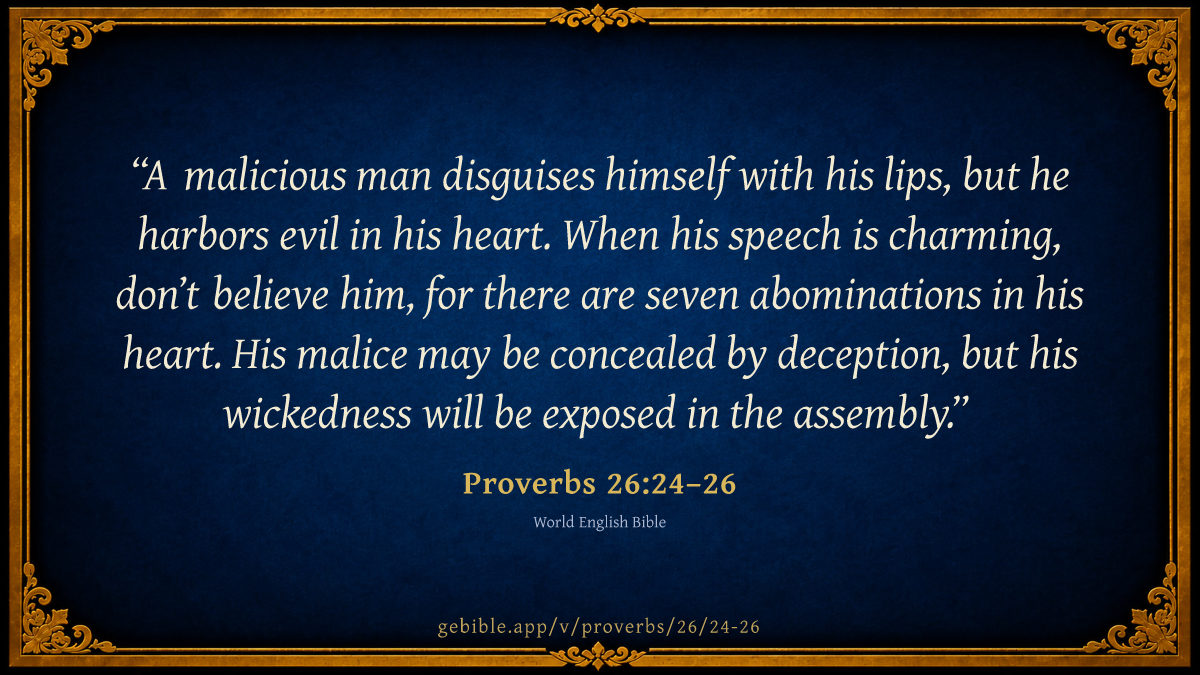
Should we believe everything?Paul's hymn to love in 1 Corinthians 13:7 says love 'believes all things,' but Proverbs 14:15, Proverbs 26:25, 1 Thessalonians 5:21, and 1 John 4:1 issue blank…
Proverbs 6:16-19(v25)There are six things which Yahweh hates; yes, seven which are an abomination to him: arrogant eyes, a lying tongue, hands that shed…
Psalms 28:3(v25)Don’t draw me away with the wicked, with the workers of iniquity who speak peace with their neighbors, but mischief is in their hearts.
Jeremiah 12:6(v25)For even your brothers, and the house of your father, even they have dealt treacherously with you! Even they have cried aloud after you!…
Proverbs 12:20(v24)Deceit is in the heart of those who plot evil, but joy comes to the promoters of peace.
Jeremiah 9:2-8(v25)Oh that I had in the wilderness a lodging place of wayfaring men; that I might leave my people, and go from them! For they are all…
Show all 20 cross-references
Matthew 24:23(v25)“Then if any man tells you, ‘Behold, here is the Christ,’ or, ‘There,’ don’t believe it.
Psalms 12:2(v25)Everyone lies to his neighbor. They speak with flattering lips, and with a double heart.
Psalms 41:6(v24)If he comes to see me, he speaks falsehood. His heart gathers iniquity to itself. When he goes abroad, he tells it.
Proverbs 10:18(v24)He who hides hatred has lying lips. He who utters a slander is a fool.
Psalms 55:21-23(v26)His mouth was smooth as butter, but his heart was war. His words were softer than oil, yet they were drawn swords. Cast your burden on…
1 Samuel 18:17(v26)Saul said to David, “Behold, my elder daughter Merab, I will give her to you as wife. Only be valiant for me, and fight Yahweh’s battles.”…
Proverbs 12:5(v24)The thoughts of the righteous are just, but the advice of the wicked is deceitful.
Proverbs 12:17(v24)He who is truthful testifies honestly, but a false witness lies.
Proverbs 14:8(v24)The wisdom of the prudent is to think about his way, but the folly of fools is deceit.
Micah 7:5(v25)Don’t trust in a neighbor. Don’t put confidence in a friend. With the woman lying in your embrace, be careful of the words of your mouth!
Genesis 4:8(v26)Cain said to Abel, his brother, “Let’s go into the field.” While they were in the field, Cain rose up against Abel, his brother, and killed…
1 Samuel 18:21(v26)Saul said, I will give her to him, that she may be a snare to him, and that the hand of the Philistines may be against him. Therefore Saul…
2 Samuel 3:27-30(v26)When Abner was returned to Hebron, Joab took him aside into the middle of the gate to speak with him quietly, and struck him there in the…
2 Samuel 13:22-28(v26)Absalom spoke to Amnon neither good nor bad; for Absalom hated Amnon, because he had forced his sister Tamar. After two full years, Absalom…
Proverbs 11:1(v24)A false balance is an abomination to Yahweh, but accurate weights are his delight.
Cross-references from openbible.info (CC BY 4.0)
Explain this passage (16 sources)
Historical commentary, presented as a primary source — not an endorsement.
Geneva Bible translators1599 · Public DomainOn vv25–26Meaning, many: he useth the number certain, for the…
Meaning, many: he useth the number certain, for the uncertain.
Geneva Bible (1599) marginal notes — public domain.
John Trapp1656 · Public DomainOn vv24–26Pro 26:24 He that hateth dissembleth with his lips,…
Pro 26:24 He that hateth dissembleth with his lips, and layeth up deceit within him;
Ver. 24. He that hateth dissembleth with his lips.] And so heaps sin upon sin, till he be transformed into a breathing devil. This is meant not so much of the passion of hatred as of the habit of it; when it hath wholly leavened the heart, and lies watching its opportunity of doing mischief. The devil is at inn with such, as Mr Bradford {a} phraseth it, and was as great a master, long before the Florentine secretary was born, as since.
Read full note →
{a} Serm. of Repent.
John Trapp, A Commentary or Exposition upon All the Books of the Old and New Testament (1647–1656) — public domain. Text from a community e-Sword module.
Matthew Poole1685 · Public DomainOn vv24, 26Dissembleth, or, carrieth himself like another man; pretends love…
Dissembleth, or, carrieth himself like another man; pretends love and kindness; which sense seems to agree best both with the next clause of this verse, and with the two following verses,
Matthew Poole's English Annotations on the Holy Bible (1683–1685) — public domain. Text from a community e-Sword/MySword module.
Matthew Henry1710 · Public DomainOn v24There is cause to complain, not only of the…
There is cause to complain, not only of the want of sincerity in men's profession of friendship, and that they do not love so well as they pretend nor will serve their friends so much as they promise, but, which is much worse, of wicked designs in the profession of friendship, and the making of it subservient to the most malicious intentions. This is here spoken of as a common thing (Pro 26:24): He that hates his neighbour, and is contriving to do him a mischief, yet dissembles with his lips, professes to have a respect for him and to be ready to serve him, talks kindly with him, as Cain with Abel, asks, Art thou in health, my brother? as Joab to Amasa, that his malice may not be suspected and guarded against, and so he may have the fairer opportunity to execute the purposes of it, this man lays up deceit within him, that is, he keeps in his mind the mischief he intends to do his neighbour till he catches him at an advantage. This is malice which has no less of the subtlety than it has of the venom of the old serpent in it. Now, as to this matter, we are here cautioned, 1. Not to be so foolish as to suffer ourselves to be imposed upon by the pretensions of friendship. Remember to distrust when a man speaks fair; be not too forward to believe him unless you know him well, for it is possible there may be seven abominations in his heart, a great many projects of mischief against you, which he is labouring so industriously to conceal with his fair speech. Satan is an enemy that hates us, and yet in his temptations speaks fair, as he did to Eve, but it is madness to give credit to him, for there are seven abominations in his heart; seven other spirits does one unclean spirit bring more wicked than himself. 2. Not to be so wicked as to impose upon any with a profession of friendship; for, though the fraud may be carried on plausibly awhile, it will be brought to light, Pro 26:26. He whose hatred is covered by deceit will one time or other be discovered, and his wickedness shown, to his shame and confusion, before the whole congregation; and nothing will do more to make a man odious to all companies. Love (says one) is the best armour, but the worst cloak, and will serve dissemblers as the disguise which Ahab put on and perished in.
Matthew Henry's Commentary on the Whole Bible (1708–1710) — public domain (CC PDM 1.0). Text via the HelloAO Bible API.
John Gill1763 · Public DomainOn vv24–26When he speaketh fair, believe him not,.... Gives good…
When he speaketh fair, believe him not,.... Gives good words, flatters with his lips, pretends great kindness and favour, expresses himself in a very gracious and amiable manner, in order to gain attention and respect; or when he delivers himself in a submissive and suppliant way, with great humility and deference; or in a mournful and pitiful strain, as if he had the most tender affection and concern; be not too credulous; do not suffer yourselves to be imposed upon by him; be upon your guard, distrust him, suspect a snake in the grass;
for there are seven abominations in his heart; a multitude of wicked purposes, schemes, and designs, which he has formed there against you, and which he only waits a proper time to put in execution; things abominable to God and men. Aben Ezra thinks reference is had to the seven abominations in Pro 6:16.
John Gill's Exposition of the Whole Bible (1746–1763) — public domain (CC PDM 1.0). Text via the HelloAO Bible API.
Adam Clarke1810 · Public DomainOn v25Verse 25. When he speaketh fair] For there are…
Verse 25. When he speaketh fair] For there are such hypocrites and false friends in the world.
Believe him not] Let all his professions go for nothing.
Read full note →
For there are seven abominations in his heart.] That is, he is full of abominations.
Adam Clarke's Commentary on the Bible (1810–1826) — public domain. Text from a community e-Sword/MySword module.
Joseph Benson1811 · Public DomainOn v24Pro 26:24-26. He that hateth dissembleth with his lips…
Pro 26:24-26. He that hateth dissembleth with his lips — Hebrew, ינכר, carries himself like another man, that is, pretends love and kindness; and layeth up deceit within him — Means, by counterfeiting kindness, only the more easily and securely to deceive thee. When he speaketh fair —
Hebrew, יחנן קולו, uses gracious or supplicating language, gives thee the kindest words, and assures thee he is sincere; believe him not — Give no credit to his flatteries and professions of esteem and regard; for there are seven abominations in his heart — That is, a great variety of base and wicked designs. Whose hatred is covered by deceit — With false professions of love; his wickedness shall be showed before the whole congregation — Instead of that secrecy and impunity which, by this art, he designs and promises to himself, he shall be brought to public shame and punishment.
Joseph Benson's Commentary on the Old and New Testaments (1811–1818) — public domain. Text from a community e-Sword module.
Albert Barnes1834 · Public DomainOn vv25–26Seven abominations - Compare Pro 26:16 note. Here “seven”…
Seven abominations - Compare Pro 26:16 note. Here “seven” retains, perhaps, its significance as the symbol of completeness. Evil has, as it were, gone through all its work, and holds its accursed Sabbath in the heart in which all things are “very evil.”
Albert Barnes' Notes on the Bible (1834–1885) — public domain. Text from a community e-Sword/MySword module.
Haydock's Catholic Bible Commentary1859 · Public DomainOn vv24, 26Lips. He will speak of what he hates much.
Lips. He will speak of what he hates much.
George Leo Haydock (1774–1849), Haydock's Catholic Family Bible and Commentary, 1859 edition — public domain. Excludes Psalms (Douay-Rheims chapter numbering differs from Protestant) and Deuterocanonical books (Catholic canon only).
Robert Jamieson, A. R. Fausset & David Brown1871 · Public DomainOn vv24–26dissembleth--though an unusual sense of the word (compare Margin),…
dissembleth--though an unusual sense of the word (compare Margin), is allowable, and better suits the context, which sets forth hypocrisy.
Jamieson, Fausset & Brown — Commentary Critical and Explanatory on the Whole Bible (1871) — public domain (CC PDM 1.0). Text via the HelloAO Bible API.
Daniel D. Whedon1874 · Public DomainOn vv24–2624. He that… dissembleth — This seems to be…
24. He that… dissembleth — This seems to be the counterpart of the preceding, and is rendered: “By his lips shall the hater be known, that he putteth deceit within him;” that is, that he cherishes it. — Gesenius. The hater, however smooth spoken, can hardly so dissemble as to escape detection. Most interpreters, however, follow the Authorized Version.
Daniel D. Whedon (gen. ed.), Commentary on the Old and New Testaments (1874–1909) — public domain. Text from a community e-Sword module.
The Cambridge Bible for Schools and Colleges1878 · Public DomainOn vv24, 2624. and] But he layeth up &c. (R.V.) gives…
24. and] But he layeth up &c. (R.V.) gives the sense more forcibly. Comp. 2Sa_3:27.
The Cambridge Bible for Schools and Colleges (gen. ed. J. J. S. Perowne; Cambridge University Press, 1878–1918) — public domain. Text from a community e-Sword module.
Ellicott's Commentary for English Readers1878 · Public DomainOn vv25–26(25) Seven abominations.—See above on Pro_26:16, and comp. “seven…
(25) Seven abominations.—See above on Pro_26:16, and comp. “seven spirits” (Mat_12:45) and “seven devils” (Mar_16:9).
A Bible Commentary for English Readers, edited by Charles John Ellicott (1878–1897) — public domain. Text from a community e-Sword module.
The Pulpit Commentary1880 · Public DomainOn vv24–26He that hateth dissembleth with his lips. This and…
He that hateth dissembleth with his lips. This and the next verse form a tetrastich. St. Jerome, Labiis suis intelligitur inimicus. But the verb here used, rkn, bears the meaning "to make one"s self unknown," as well as "to make one"s self known," and hence "to make one"s self unrecognizable" by dress or change of countenance. (1Ki_14:5) This is much more appropriate in the present connection than the other explanation. The man cloaks his hatred with honeyed words. And layeth up deceit within him; meditating all the time treachery in his heart. (Jer_9:8) Septuagint, "An enemy weeping promises all things with his lips, but in his heart he contriveth deceits." The tears in this case are hypocritical signs of sorrow, intended to deceive the dupe.
The Pulpit Commentary (1880–1919), ed. H.D.M. Spence-Jones & Joseph S. Exell — public domain. Text from a community e-Sword module.
The Biblical Illustrator1887 · Public DomainOn v24He that hateth dissembleth with his lips.
Pro_26:24-27
He that hateth dissembleth with his lips.
Read full note →
Clandestine hatred
I. It is often greatly disguised. Burning lips and a wicked heart are like a potsherd covered with silver dross.
II. It is excessively corrupt. When he speaketh fair, believe him not: for there are seven abominations in his heart. The word number seven, in Scripture, denotes fulness or completeness. The idea here is, that such a mans heart is full of abominations.
III. It is liable to exposure. Whose hatred is covered by deceit, his wickedness shall be shewed before the whole congregation. Dissembling never answers in the end. The Providence of God brings dark deeds to light. All sin will one day be stripped of its mask, and laid bare in all its putrescent hideousness to the open eye of the universe.
IV. It is self-ruinous. Whoso diggeth a pit shall fall therein. Evil is a hard worker. It digs pits and rolls stones. And what is worse, all its hard work is self-ruinous. Into the pit which they have dug they shall tumble. Those who plot mischief for others will be overwhelmed with it themselves. Moab, in attempting to curse Israel, fell himself under the curse of God. Hamans gallows for Mordecai was his own promotion of shame. The enemies of Daniel were devoured in the ruin which they plotted against him. Thus does God take the wise in his craftiness, the wicked in his wickedness. The malice that meditates the evil is often the cause of its own overthrow.
V. It is socially pernicious. A lying tongue hateth those that are afflicted by it; and a flattering mouth worketh ruin.
1. It injures by its slanders. A lying tongue hateth those that are afflicted by it.
2. It injures by its flatteries. Flattery is a social curse. (D. Thomas, D. D.)
By injuring others we are ourselves often the greatest sufferers
The wasps sting is provided with a barb, and when he feels particularly vicious, and drives the sting into the flesh, it becomes so firmly imbedded that the only way for him to escape is to leave the sting behind. This, however, is sure to cause his death. He receives himself such a wound that he cannot recover. We sometimes forget that when we hurt others by stinging words and treacherous acts, we ourselves, in the long run, are generally the greatest sufferers. (W. Judson.)
The Biblical Illustrator, edited by Joseph S. Exell (c. 1880s–1900s) — public domain. Text from a community e-Sword module.
unfoldingWord translationNotes2017 · CC BY-SA 4.0On v24disguises his feelings with his lips
disguises his feelings with his lips
Disguising his feelings represents keeping people from knowing what his feelings are. The phrase "his lips" is a metonym for what he says. AT: "hides his feelings with what he says" or "speaks in such a way that people cannot know his true feelings" (See: Metaphor and Metonymy)
Read full note →
he lays up deceit within himself
Being deceitful is spoken of as if he were storing deceit within himself. Possible meanings are that "deceit" refers to lies. AT: "he likes his many lies" or 2) deceit refers secret plans to harm people. AT: "he secretly plans to harm people" (See: Metaphor)
but do not believe him
"but do not believe what he says"
for there are seven abominations in his heart
The number seven represents completeness. Possible meanings are 1) "abominations" refers to attitudes that God hates. AT: "for his heart is completely filled with hateful things" or 2) "abominations" refers to his hatred for people. AT: "for his heart is completely filled with hatred" (See: Metaphor)
Though his hatred is covered with deception
This can be stated actively. AT: "Though deception covers his hatred" or "Though he covers his hatred with deception" (See: Active or Passive)
Though his hatred is covered with deception
Keeping people from knowing that he hates them is spoken of as covering his hatred. AT: "Though he lies to keep people from knowing that he hates them" or "Though he lies so that people will not know that he hates them" (See: Metaphor)
his wickedness will be exposed in the assembly
Being exposed represents being discovered or becoming known. AT: "his wickedness will become known in the assembly" or "the assembly will discover his wickedness" (See: Metaphor and Active or Passive)

Geneva Bible translators 1599 · Public Domain On vv25–26 Meaning, many: he useth the number certain, for the…
Meaning, many: he useth the number certain, for the uncertain.
Geneva Bible (1599) marginal notes — public domain.
John Trapp 1656 · Public Domain On vv24–26 Pro 26:24 He that hateth dissembleth with his lips,…
Pro 26:24 He that hateth dissembleth with his lips, and layeth up deceit within him;
Ver. 24. He that hateth dissembleth with his lips.] And so heaps sin upon sin, till he be transformed into a breathing devil. This is meant not so much of the passion of hatred as of the habit of it; when it hath wholly leavened the heart, and lies watching its opportunity of doing mischief. The devil is at inn with such, as Mr Bradford {a} phraseth it, and was as great a master, long before the Florentine secretary was born, as since.
Read full note →
{a} Serm. of Repent.
John Trapp, A Commentary or Exposition upon All the Books of the Old and New Testament (1647–1656) — public domain. Text from a community e-Sword module.
Matthew Poole 1685 · Public Domain On vv24, 26 Dissembleth, or, carrieth himself like another man; pretends love…
Dissembleth, or, carrieth himself like another man; pretends love and kindness; which sense seems to agree best both with the next clause of this verse, and with the two following verses,
Matthew Poole's English Annotations on the Holy Bible (1683–1685) — public domain. Text from a community e-Sword/MySword module.
Matthew Henry 1710 · Public Domain On v24 There is cause to complain, not only of the…
There is cause to complain, not only of the want of sincerity in men's profession of friendship, and that they do not love so well as they pretend nor will serve their friends so much as they promise, but, which is much worse, of wicked designs in the profession of friendship, and the making of it subservient to the most malicious intentions. This is here spoken of as a common thing (Pro 26:24): He that hates his neighbour, and is contriving to do him a mischief, yet dissembles with his lips, professes to have a respect for him and to be ready to serve him, talks kindly with him, as Cain with Abel, asks, Art thou in health, my brother? as Joab to Amasa, that his malice may not be suspected and guarded against, and so he may have the fairer opportunity to execute the purposes of it, this man lays up deceit within him, that is, he keeps in his mind the mischief he intends to do his neighbour till he catches him at an advantage. This is malice which has no less of the subtlety than it has of the venom of the old serpent in it. Now, as to this matter, we are here cautioned, 1. Not to be so foolish as to suffer ourselves to be imposed upon by the pretensions of friendship. Remember to distrust when a man speaks fair; be not too forward to believe him unless you know him well, for it is possible there may be seven abominations in his heart, a great many projects of mischief against you, which he is labouring so industriously to conceal with his fair speech. Satan is an enemy that hates us, and yet in his temptations speaks fair, as he did to Eve, but it is madness to give credit to him, for there are seven abominations in his heart; seven other spirits does one unclean spirit bring more wicked than himself. 2. Not to be so wicked as to impose upon any with a profession of friendship; for, though the fraud may be carried on plausibly awhile, it will be brought to light, Pro 26:26. He whose hatred is covered by deceit will one time or other be discovered, and his wickedness shown, to his shame and confusion, before the whole congregation; and nothing will do more to make a man odious to all companies. Love (says one) is the best armour, but the worst cloak, and will serve dissemblers as the disguise which Ahab put on and perished in.
Matthew Henry's Commentary on the Whole Bible (1708–1710) — public domain (CC PDM 1.0). Text via the HelloAO Bible API.
John Gill 1763 · Public Domain On vv24–26 When he speaketh fair, believe him not,.... Gives good…
When he speaketh fair, believe him not,.... Gives good words, flatters with his lips, pretends great kindness and favour, expresses himself in a very gracious and amiable manner, in order to gain attention and respect; or when he delivers himself in a submissive and suppliant way, with great humility and deference; or in a mournful and pitiful strain, as if he had the most tender affection and concern; be not too credulous; do not suffer yourselves to be imposed upon by him; be upon your guard, distrust him, suspect a snake in the grass;
for there are seven abominations in his heart; a multitude of wicked purposes, schemes, and designs, which he has formed there against you, and which he only waits a proper time to put in execution; things abominable to God and men. Aben Ezra thinks reference is had to the seven abominations in Pro 6:16.
John Gill's Exposition of the Whole Bible (1746–1763) — public domain (CC PDM 1.0). Text via the HelloAO Bible API.
Adam Clarke 1810 · Public Domain On v25 Verse 25. When he speaketh fair] For there are…
Verse 25. When he speaketh fair] For there are such hypocrites and false friends in the world.
Believe him not] Let all his professions go for nothing.
Read full note →
For there are seven abominations in his heart.] That is, he is full of abominations.
Adam Clarke's Commentary on the Bible (1810–1826) — public domain. Text from a community e-Sword/MySword module.
Joseph Benson 1811 · Public Domain On v24 Pro 26:24-26. He that hateth dissembleth with his lips…
Pro 26:24-26. He that hateth dissembleth with his lips — Hebrew, ינכר, carries himself like another man, that is, pretends love and kindness; and layeth up deceit within him — Means, by counterfeiting kindness, only the more easily and securely to deceive thee. When he speaketh fair —
Hebrew, יחנן קולו, uses gracious or supplicating language, gives thee the kindest words, and assures thee he is sincere; believe him not — Give no credit to his flatteries and professions of esteem and regard; for there are seven abominations in his heart — That is, a great variety of base and wicked designs. Whose hatred is covered by deceit — With false professions of love; his wickedness shall be showed before the whole congregation — Instead of that secrecy and impunity which, by this art, he designs and promises to himself, he shall be brought to public shame and punishment.
Joseph Benson's Commentary on the Old and New Testaments (1811–1818) — public domain. Text from a community e-Sword module.
Albert Barnes 1834 · Public Domain On vv25–26 Seven abominations - Compare Pro 26:16 note. Here “seven”…
Seven abominations - Compare Pro 26:16 note. Here “seven” retains, perhaps, its significance as the symbol of completeness. Evil has, as it were, gone through all its work, and holds its accursed Sabbath in the heart in which all things are “very evil.”
Albert Barnes' Notes on the Bible (1834–1885) — public domain. Text from a community e-Sword/MySword module.
Haydock's Catholic Bible Commentary 1859 · Public Domain On vv24, 26 Lips. He will speak of what he hates much.
Lips. He will speak of what he hates much.
George Leo Haydock (1774–1849), Haydock's Catholic Family Bible and Commentary, 1859 edition — public domain. Excludes Psalms (Douay-Rheims chapter numbering differs from Protestant) and Deuterocanonical books (Catholic canon only).
Robert Jamieson, A. R. Fausset & David Brown 1871 · Public Domain On vv24–26 dissembleth--though an unusual sense of the word (compare Margin),…
dissembleth--though an unusual sense of the word (compare Margin), is allowable, and better suits the context, which sets forth hypocrisy.
Jamieson, Fausset & Brown — Commentary Critical and Explanatory on the Whole Bible (1871) — public domain (CC PDM 1.0). Text via the HelloAO Bible API.
Daniel D. Whedon 1874 · Public Domain On vv24–26 24. He that… dissembleth — This seems to be…
24. He that… dissembleth — This seems to be the counterpart of the preceding, and is rendered: “By his lips shall the hater be known, that he putteth deceit within him;” that is, that he cherishes it. — Gesenius. The hater, however smooth spoken, can hardly so dissemble as to escape detection. Most interpreters, however, follow the Authorized Version.
Daniel D. Whedon (gen. ed.), Commentary on the Old and New Testaments (1874–1909) — public domain. Text from a community e-Sword module.
The Cambridge Bible for Schools and Colleges 1878 · Public Domain On vv24, 26 24. and] But he layeth up &c. (R.V.) gives…
24. and] But he layeth up &c. (R.V.) gives the sense more forcibly. Comp. 2Sa_3:27.
The Cambridge Bible for Schools and Colleges (gen. ed. J. J. S. Perowne; Cambridge University Press, 1878–1918) — public domain. Text from a community e-Sword module.
Ellicott's Commentary for English Readers 1878 · Public Domain On vv25–26 (25) Seven abominations.—See above on Pro_26:16, and comp. “seven…
(25) Seven abominations.—See above on Pro_26:16, and comp. “seven spirits” (Mat_12:45) and “seven devils” (Mar_16:9).
A Bible Commentary for English Readers, edited by Charles John Ellicott (1878–1897) — public domain. Text from a community e-Sword module.
The Pulpit Commentary 1880 · Public Domain On vv24–26 He that hateth dissembleth with his lips. This and…
He that hateth dissembleth with his lips. This and the next verse form a tetrastich. St. Jerome, Labiis suis intelligitur inimicus. But the verb here used, rkn, bears the meaning "to make one"s self unknown," as well as "to make one"s self known," and hence "to make one"s self unrecognizable" by dress or change of countenance. (1Ki_14:5) This is much more appropriate in the present connection than the other explanation. The man cloaks his hatred with honeyed words. And layeth up deceit within him; meditating all the time treachery in his heart. (Jer_9:8) Septuagint, "An enemy weeping promises all things with his lips, but in his heart he contriveth deceits." The tears in this case are hypocritical signs of sorrow, intended to deceive the dupe.
The Pulpit Commentary (1880–1919), ed. H.D.M. Spence-Jones & Joseph S. Exell — public domain. Text from a community e-Sword module.
The Biblical Illustrator 1887 · Public Domain On v24 He that hateth dissembleth with his lips.
Pro_26:24-27
He that hateth dissembleth with his lips.
Read full note →
Clandestine hatred
I. It is often greatly disguised. Burning lips and a wicked heart are like a potsherd covered with silver dross.
II. It is excessively corrupt. When he speaketh fair, believe him not: for there are seven abominations in his heart. The word number seven, in Scripture, denotes fulness or completeness. The idea here is, that such a mans heart is full of abominations.
III. It is liable to exposure. Whose hatred is covered by deceit, his wickedness shall be shewed before the whole congregation. Dissembling never answers in the end. The Providence of God brings dark deeds to light. All sin will one day be stripped of its mask, and laid bare in all its putrescent hideousness to the open eye of the universe.
IV. It is self-ruinous. Whoso diggeth a pit shall fall therein. Evil is a hard worker. It digs pits and rolls stones. And what is worse, all its hard work is self-ruinous. Into the pit which they have dug they shall tumble. Those who plot mischief for others will be overwhelmed with it themselves. Moab, in attempting to curse Israel, fell himself under the curse of God. Hamans gallows for Mordecai was his own promotion of shame. The enemies of Daniel were devoured in the ruin which they plotted against him. Thus does God take the wise in his craftiness, the wicked in his wickedness. The malice that meditates the evil is often the cause of its own overthrow.
V. It is socially pernicious. A lying tongue hateth those that are afflicted by it; and a flattering mouth worketh ruin.
1. It injures by its slanders. A lying tongue hateth those that are afflicted by it.
2. It injures by its flatteries. Flattery is a social curse. (D. Thomas, D. D.)
By injuring others we are ourselves often the greatest sufferers
The wasps sting is provided with a barb, and when he feels particularly vicious, and drives the sting into the flesh, it becomes so firmly imbedded that the only way for him to escape is to leave the sting behind. This, however, is sure to cause his death. He receives himself such a wound that he cannot recover. We sometimes forget that when we hurt others by stinging words and treacherous acts, we ourselves, in the long run, are generally the greatest sufferers. (W. Judson.)
The Biblical Illustrator, edited by Joseph S. Exell (c. 1880s–1900s) — public domain. Text from a community e-Sword module.
unfoldingWord translationNotes 2017 · CC BY-SA 4.0 On v24 disguises his feelings with his lips
disguises his feelings with his lips
Disguising his feelings represents keeping people from knowing what his feelings are. The phrase "his lips" is a metonym for what he says. AT: "hides his feelings with what he says" or "speaks in such a way that people cannot know his true feelings" (See: Metaphor and Metonymy)
Read full note →
he lays up deceit within himself
Being deceitful is spoken of as if he were storing deceit within himself. Possible meanings are that "deceit" refers to lies. AT: "he likes his many lies" or 2) deceit refers secret plans to harm people. AT: "he secretly plans to harm people" (See: Metaphor)
but do not believe him
"but do not believe what he says"
for there are seven abominations in his heart
The number seven represents completeness. Possible meanings are 1) "abominations" refers to attitudes that God hates. AT: "for his heart is completely filled with hateful things" or 2) "abominations" refers to his hatred for people. AT: "for his heart is completely filled with hatred" (See: Metaphor)
Though his hatred is covered with deception
This can be stated actively. AT: "Though deception covers his hatred" or "Though he covers his hatred with deception" (See: Active or Passive)
Though his hatred is covered with deception
Keeping people from knowing that he hates them is spoken of as covering his hatred. AT: "Though he lies to keep people from knowing that he hates them" or "Though he lies so that people will not know that he hates them" (See: Metaphor)
his wickedness will be exposed in the assembly
Being exposed represents being discovered or becoming known. AT: "his wickedness will become known in the assembly" or "the assembly will discover his wickedness" (See: Metaphor and Active or Passive)
the assembly
"the community of Israel"
translationWords
deceive
grace
believe
abomination
heart
evil
assembly
unfoldingWord translationNotes — © Distant Shores Media and the Door43 World Missions Community, licensed CC BY-SA 4.0. Source: git.door43.org/Door43/en_tn.