
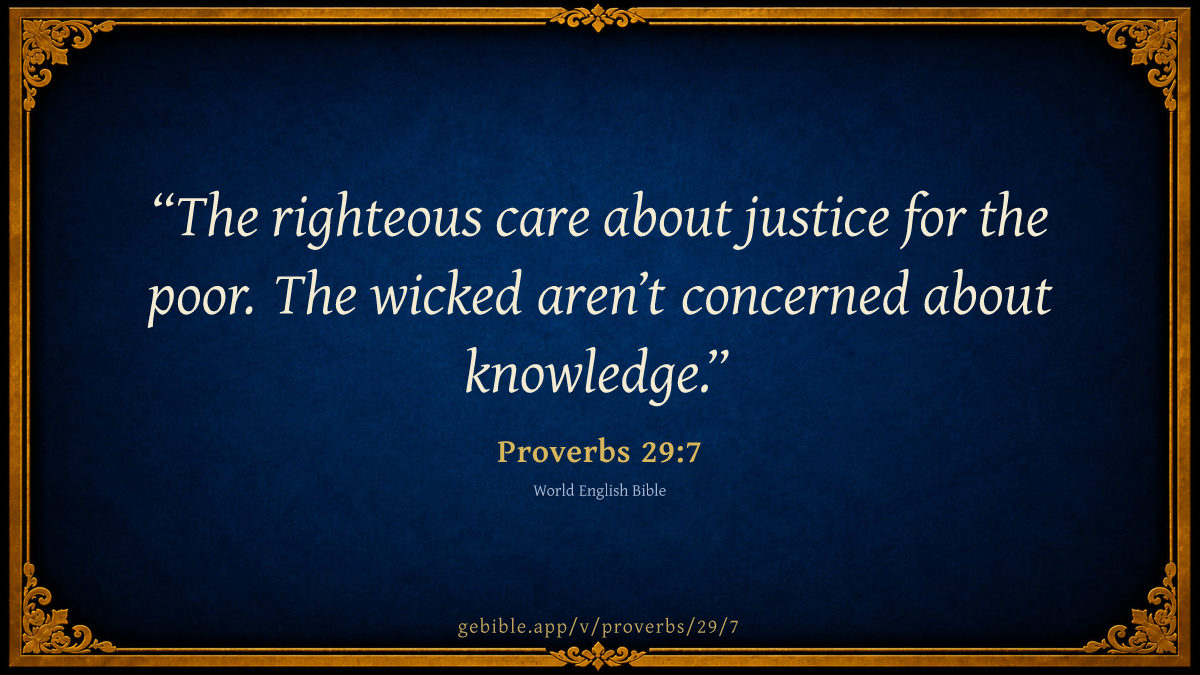
The righteous care about justice for the poor. The wicked aren’t concerned about knowledge.
Parallel Translations
-
The righteous care about justice for the poor. The wicked aren’t concerned about knowledge.
-
The righteous considereth the cause of the poor: but the wicked regardeth not to know it.
-
The righteous taketh knowledge of the cause of the poor; the wicked understandeth not knowledge.
Examined in Scripture Analysis
Contradictions (1)
Questions where the Bible appears to say two different things, with the passages on each side set together.
Cross-references (14)
Passages linked to Proverbs 29:7 in the Treasury of Scripture Knowledge, ordered by reader-vote popularity; verse text shown in World English Bible.
- Job 29:16 I was a father to the needy. I researched the cause of him who I didn’t know.
- Psalms 41:1 Blessed is he who considers the poor. Yahweh will deliver him in the day of evil.
- Proverbs 21:13 Whoever stops his ears at the cry of the poor, he will also cry out, but shall not be heard.
- Proverbs 31:8-9 Open your mouth for the mute, in the cause of all who are left desolate. Open your mouth, judge righteously, and serve justice to the poor and needy.”
- Galatians 6:1 Brothers, even if a man is caught in some fault, you who are spiritual must restore such a one in a spirit of gentleness; looking to yourself so that you also aren’t tempted.
- 1 Samuel 25:9-11 When David’s young men came, they spoke to Nabal all those words in the name of David, and waited. Nabal answered David’s servants, and said, “Who is David? Who is the son of Jesse? There are many servants who break away from their masters these days. Shall I then take my bread, my water, and my meat that I have killed for my shearers, and give it to men who I don’t know where they come from?”
- Job 31:13 “If I have despised the cause of my male servant or of my female servant, when they contended with me,
- Job 31:21 if I have lifted up my hand against the fatherless, because I saw my help in the gate,
- Jeremiah 5:28 They have grown fat. They shine; yes, they excel in deeds of wickedness. They don’t plead the cause, the cause of the fatherless, that they may prosper; and they don’t defend the rights of the needy.
- Jeremiah 22:15-17 “Should you reign, because you strive to excel in cedar? Didn’t your father eat and drink, and do justice and righteousness? Then it was well with him. He judged the cause of the poor and needy; so it was well, then. Wasn’t this to know me?” says Yahweh. But your eyes and your heart are only for your covetousness, for shedding innocent blood, for oppression, and for doing violence.”
- Ezekiel 22:29-31 The people of the land have used oppression and exercised robbery. Yes, they have troubled the poor and needy, and have oppressed the foreigner wrongfully. “I sought for a man among them who would build up the wall and stand in the gap before me for the land, that I would not destroy it; but I found no one. Therefore I have poured out my indignation on them. I have consumed them with the fire of my wrath. I have brought their own way on their heads,” says the Lord Yahweh.
- Psalms 31:7 I will be glad and rejoice in your loving kindness, for you have seen my affliction. You have known my soul in adversities.
- Ezekiel 22:7 In you have they treated father and mother with contempt. Among you they have oppressed the foreigner. In you they have wronged the fatherless and the widow.
- Micah 3:1-4 I said, “Please listen, you heads of Jacob, and rulers of the house of Israel: Isn’t it for you to know justice? You who hate the good, and love the evil; who tear off their skin, and their flesh from off their bones; who also eat the flesh of my people, and peel their skin from off them, and break their bones, and chop them in pieces, as for the pot, and as meat within the cauldron. Then they will cry to Yahweh, but he will not answer them. Yes, he will hide his face from them at that time, because they made their deeds evil.”
Cross-references from openbible.info (CC BY 4.0)
Explain this verse (12 sources)
Historical commentary, presented as a primary source — not an endorsement.
Private notes
Saved on this device only — never synced or sent anywhere.
John Trapp 1656 · Public Domain Pro 29:7 The righteous considereth the cause of the…
Pro 29:7 The righteous considereth the cause of the poor: [but] the wicked regardeth not to know [it].
Ver. 7. The righteous considereth the cause of the poor.] The cause, not the person of the poor, for that is forbidden in the law. {Lev 19:15} The great must not be favoured for their might, nor the mean for their misery, but justice, justice must be done to all, as Moses hath it; that is, even law and execution of right - as the oath runs that is given to our judges - without respect of persons. The cause of the poor and needy must come into equal balance with the rich and mighty, lest he be trampled on by those fat bulls of Bashan, to his utter undoing. For a poor man in his house is like a snail in his shell - crush that, and ye kill him.
Read full note →
But the wicked regardeth not to know it.] Unless there were more to be got by it. Felix had soon enough of Paul’s defence, because he expected some bribe from him; but nothing came. How ill-willing was that unjust judge, {Luk 18:1-8} either to take knowledge of, or to take course for, the relief of the poor widow! Aperi bursam, apperiam buccam, saith the greedy lawyer. They that cannot lavish money out of the bag are little welcome to these Crumenimulgae, as one calls them - these purse suckers, that will weigh your gold, but not your cause; and if a man put not into their mouths, they even prepare war against him. {Mic 3:5}
John Trapp, A Commentary or Exposition upon All the Books of the Old and New Testament (1647–1656) — public domain. Text from a community e-Sword module.
Matthew Poole 1685 · Public Domain The righteous, whether magistrate, or any private person concerned…
The righteous, whether magistrate, or any private person concerned to know it, and capable of helping him in it,
considereth the cause of the poor; his poverty neither hinders him from taking pains to examine it, nor from a righteous determination of it.
Read full note →
Regardeth not to know it; will not put himself to the trouble of searching it out, either because it yields him no profit, or because he resolves to give away his right.
Matthew Poole's English Annotations on the Holy Bible (1683–1685) — public domain. Text from a community e-Sword/MySword module.
Matthew Henry 1710 · Public Domain It is a pity but that every one who…
It is a pity but that every one who sues sub form pauperis - as a pauper, should have an honest cause (they are of all others inexcusable if they have not), because the scripture has so well provided that it should have a fair hearing, and that the judge himself should be of counsel, as for the prisoner, so for the pauper. 1. It is here made the character of a righteous judge that he considers the cause of the poor. It is every man's duty to consider the poor (Psa 41:1), but the judgment of the poor is to be considered by those that sit in judgment; they must take as much pains to find out the right in a poor man's cause as in a rich man's. Sense of justice must make both judge and advocate as solicitous and industrious in the poor man's cause as if they hoped for the greatest advantage. 2. It is made the character of a wicked man that because it is a poor man's cause, which there is nothing to be got by, he regards not to know it, in the true state of it, for he cares not which way it goes, right or wrong. See Job 29:16.
Matthew Henry's Commentary on the Whole Bible (1708–1710) — public domain (CC PDM 1.0). Text via the HelloAO Bible API.
John Gill 1763 · Public Domain The righteous considereth the cause of the poor,.... Not…
The righteous considereth the cause of the poor,.... Not his poverty and distress, so as to relieve him, which yet he does, Psa 41:1; nor the person of the poor in judgment, and which he ought not to do; for as he should not regard a rich man's person, and favour him, because he is rich; so neither a poor man, because he is poor, through an affectation of mercy, Lev 19:15; but the cause of the poor, and the justice of that, and do him justice, though a poor man. This is to be understood chiefly of a civil magistrate, a judge righteous; who will take notice of and regard a poor man's cause, and take a good deal of pains and care that he is not injured. Or, "knoweth the judgment of the poor" (m) he acquaints himself with his case, makes himself thoroughly master of it, searches out his cause as Job did, Pro 29:16;
but the wicked regardeth not to know it; or, "does not understand knowledge" (n) of the poor man's cause and case; and there being no money to be had, he does not care to consider it, and look into it, and get knowledge of it, and do him justice; he will not take his cause in hand, or plead it.
Read full note →
(m) "novit justus causan pauperum", V. L. "cognoscit", Pagninus, Tigurine version, Junius & Tremellius, Piscator, &c. "novit et curat justus judicum pauperum", Michaelis; "cognoscit justus litem tenuiem", Schultens. (n) "non intellilget scientiam", Paguinus, Montanus; "intelligit", Mercerus, Piscator, Gejerus, Michaelis, Schultens.
John Gill's Exposition of the Whole Bible (1746–1763) — public domain (CC PDM 1.0). Text via the HelloAO Bible API.
Joseph Benson 1811 · Public Domain Pro 29:7. The righteous — Whether magistrate, or any…
Pro 29:7. The righteous — Whether magistrate, or any private person, concerned to know it, and capable of helping him in it; considereth the cause of the poor — His poverty neither hinders him from taking pains to examine it, nor from a righteous determination of it; but the wicked regardeth not to know — Will not put himself to the trouble of searching it out, either because it yields him no profit, or because he resolves to give away the poor man’s right.
Joseph Benson's Commentary on the Old and New Testaments (1811–1818) — public domain. Text from a community e-Sword module.
Charles Bridges 1846 · Public Domain The original gives to the Proverb a judicial aspect.†1…
The original gives to the Proverb a judicial aspect.†1 To "respect the person of the poor" is no less unjust, than to "honor the person of the mighty."†2 But the righteous judge or advocate will consider his cause, judge it as for God, investigate it thoroughly, and take care that it be not lost from his own inability to defend it. (Psa 82:3-4 .) This was the considerate administration of the great King of righteousness.†3 The man of God will walk after this divine Exemplar.†4 ’Let him have the conscience first’ — says Bishop Sanderson — ’and then the patience too (and yet if he have the conscience, certainly he will have the patience), to make search into the truth of things, and not be dainty of his pains herein, though matters be intricate, and the labor like to be long and irksome.’†5
Selfishness however, not truth, justice, or mercy, is the standard of the wicked. He considers, first the poor man’s person, then his cause. "The unjust judge" would not have "avenged the widow of her adversary," but to save trouble to himself. (Luk 18:2-5 .) Felix regarded not to know the Apostle’s cause, only that he might indulge his own covetousness. (Act 24:26-27 .) But fearful is it to sit in the place of God†6 as his representative, only to pervert his judgment for selfish aggrandizement.†7 For ’He that rejecteth the complaint of the poor, and beateth them off with big words, and terror in his looks, either out of the hardness of his heart or the love of ease, when he might have leisure to give them audience (if he were so minded) and to take notice of their grievances, cannot justly excuse himself by pleading — "Behold, we know it not."’†8
Read full note →
The maxim however obviously applies more generally to the considerate regard of the righteous, and the cruel disregard of the wicked, towards the poor. The ordinance, that "the poor shall never cease out of the land;" and the inequality of rank, prevailing throughout the œconomy of Providence, were doubtless intended as an incitement to Christian sympathy and enlargement.†9 Consideration of the poor is the true spirit of Christian sympathy; putting ourselves as far as may be in their place.†10 Oh! how different is this from the impatient, ungracious temper, in which the suit of the poor client is sometimes dispatched, as if we grudged our time and pains. Our beloved Lord not only "went about doing good" (Act 10:38 ), but he did it so tenderly, so considerately. Always was he ready to yield his own convenience and even necessary comfort to the call of need. (Mar 6:31-34 .) The same considerate regard for the poor marked the Apostolic administration.†11 Sympathy with the poor is the practical acknowledgment of our own undeserved mercies: specially remembering the Lord’s poor, as the representatives of Him,†12 who is First and Last, and All to us; and who, "though he was rich, yet for our sakes became poor, that we through his poverty might be made rich." (2Co 8:9 .)
Well do those, who regard not to know, deserve their name — the wicked. Like Cain, they acknowledge no interest in their brother. (Gen 4:9 .) Like Nabal — "It is no concern of mine."†13 ’If the poor must be fed rather than starve’ — it is casting food to a dog, rather than holding out an helping hand to a fellow-sinner.†14 This total absence of the image of a God of love†15 — this utter casting off his royal law†16 — surely he will require it.†17
Footnotes:
†1 Holden. Geier. Bp. Patrick.
†2 Lev 19:15. Exo 23:3 .
†3 Psa 72:2-4, Psa 72:12-14 .
†4 Job 29:11-16; Job 31:13, Job 31:20 . Jer 22:16 .
†5 Sermon on Exo 23:1-3 .
†6 Psa 82:6. Rom 13:1-2 .
†7 Pro 24:11-12. Jer 5:28-29 . Eze 22:7, Eze 22:29-31 . Mic 3:1-4 .
†8 Bp. Sanderson’s Sermon on Pro 24:10-12 .
†9 Deu 15:7-11. 2Co 8:14-15 . Compare Sir 4:8 .
†10 Psa 41:1. Most striking was the consideration of the poor in Bp. Ridley, imploring in his last moments at the stake the queen in behalf of certain poor men’s leases in his bishopric likely to become void by his death. Foxe, vii. 545, 546. In the same noble spirit was the remembrance of the dying Scott to his son, of the arrival of the season, when he had been used to plant a root for the supply of the poor.
†11 Act 4:34-35; Act 6:1-6 . 1Co 16:2 . 2Co 9:12-13 . Gal 2:10 .
†12 Mat 10:42; Mat 25:40 .
†13 1Sa 25:10-11 .
†14 Luk 16:21.
†15 1Jn 3:17 .
†16 Jas 2:8. Lev 19:18, with Luk 10:31-32 .
†17 Pro 24:12.
Charles Bridges, An Exposition of the Book of Proverbs (1846) — public domain. Text from a community e-Sword module.
Robert Jamieson, A. R. Fausset & David Brown 1871 · Public Domain considereth--literally, "knows," as Psa 1:6.
considereth--literally, "knows," as Psa 1:6.
the cause--that is, in courts of justice (compare Pro 29:14). The voluntary neglect of it by the wicked (Pro 28:27) occasions oppression.
Jamieson, Fausset & Brown — Commentary Critical and Explanatory on the Whole Bible (1871) — public domain (CC PDM 1.0). Text via the HelloAO Bible API.
Daniel D. Whedon 1874 · Public Domain 7. Considereth the cause — Pleadeth it. The expression…
7. Considereth the cause — Pleadeth it. The expression is used in a forensic sense.
Wicked regardeth not to know — Will not take pains to obtain a knowledge of the cause, much less “consider” or plead it. This proverb should be heeded especially by judges and others in official positions. Compare Pro_28:5; Job_29:16.
Daniel D. Whedon (gen. ed.), Commentary on the Old and New Testaments (1874–1909) — public domain. Text from a community e-Sword module.
The Cambridge Bible for Schools and Colleges 1878 · Public Domain 7. the cause] the judicial cause in a court…
7. the cause] the judicial cause in a court of law. Comp. Deu_17:8, where the same Heb. word is rendered plea.
regardeth not] Or, hath not understanding, R.V. Either does not take the trouble, as the righteous does, to look into the case; or, has not the moral perception to grasp its bearings.
The Cambridge Bible for Schools and Colleges (gen. ed. J. J. S. Perowne; Cambridge University Press, 1878–1918) — public domain. Text from a community e-Sword module.
Ellicott's Commentary for English Readers 1878 · Public Domain (7) The wicked regardeth not to know it.—Literally, understandeth…
(7) The wicked regardeth not to know it.—Literally, understandeth not knowledge; he does not know nor care to know anything about his poorer neighbour’s affairs, so as to be able to help him. He cares as little about him as did Dives about Lazarus, though he saw him each time he went out of his own door.
A Bible Commentary for English Readers, edited by Charles John Ellicott (1878–1897) — public domain. Text from a community e-Sword module.
The Pulpit Commentary 1880 · Public Domain Considereth the cause; recognizes the claims, and, as the…
Considereth the cause; recognizes the claims, and, as the word din implies, supports them at the seat of judgment. (comp. Job_29:12, 16 Psa_82:3, etc.) Septuagint, "A righteous man knows how to judge for the poor." The wicked regardeth not to know it. This is a clumsy translation; it means, pays no attention so as to become fully acquainted with its details and bearings. But the words signify rather, as in the Revised Version margin, "understandeth not knowledge", (Pro_19:25 Pro_28:5) has no knowledge which would lead him to enter into the poor man"s case, and to sympathize with him in his distress; the claims of the feeble to recognition and relief at his hands are utterly unknown and disregarded. He can daily look on Lazarus at his gate, and find no call for his pity and charity; he can see the wounded traveller in the road, and pass by on the other side. The LXX offers two translations of the latter clause, reading the second time vd instead of vr, and thereby not improving the sense: "But the ungodly understand. eth not knowledge, and the poor man hath not an understanding mind.
See homily on Pro_19:17. C.
The Pulpit Commentary (1880–1919), ed. H.D.M. Spence-Jones & Joseph S. Exell — public domain. Text from a community e-Sword module.
unfoldingWord translationNotes 2017 · CC BY-SA 4.0 set a city on fire
set a city on fire
Here the word "city" represents the people who live in the city. Mockers causing the people to experience turmoil and possibly to become violent is spoken of as if they set the city on fire. AT: "create turmoil for the people of a city" (See: Metonymy and Metaphor)
Read full note →
turn away wrath
This idiom means to cause angry people no longer to be angry. AT: "calm the wrath of angry people" (See: Idiom)
translationWords
plea
evil
know
mock
wise
turn
wrath
unfoldingWord translationNotes — © Distant Shores Media and the Door43 World Missions Community, licensed CC BY-SA 4.0. Source: git.door43.org/Door43/en_tn.