Psalms 91:3(v26)For he will deliver you from the snare of the fowler, and from the deadly pestilence.
1 Samuel 2:9(v26)He will keep the feet of his holy ones, but the wicked will be put to silence in darkness; for no man will prevail by strength.
Proverbs 14:26(v26)In the fear of Yahweh is a secure fortress, and he will be a refuge for his children.
Psalms 91:9-10(v26)Because you have made Yahweh your refuge, and the Most High your dwelling place, no evil shall happen to you, neither shall any plague come…
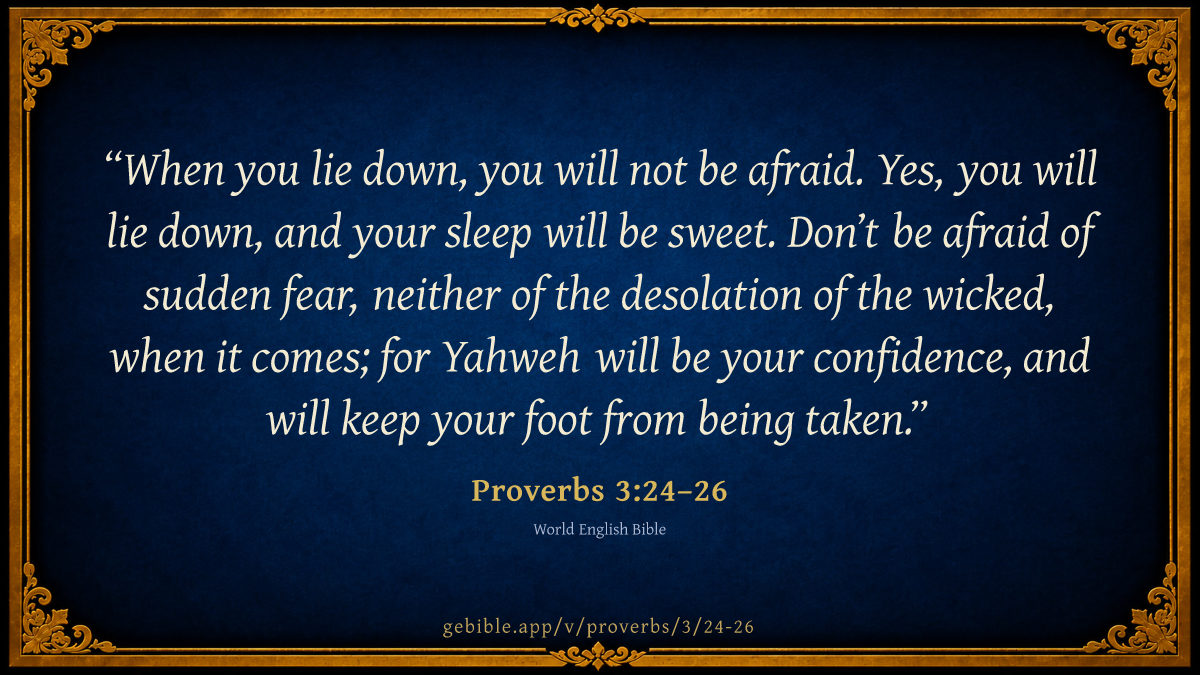
Psalms 3:5(v24)I laid myself down and slept. I awakened; for Yahweh sustains me.
Show all 33 cross-references
Psalms 4:8(v24)In peace I will both lay myself down and sleep, for you, Yahweh alone, make me live in safety.
Proverbs 6:22(v24)When you walk, it will lead you. When you sleep, it will watch over you. When you awake, it will talk with you.
Habakkuk 3:17-18(v26)For though the fig tree doesn’t flourish, nor fruit be in the vines; the labor of the olive fails, the fields yield no food; the flocks are…
Isaiah 41:10-14(v25)Don’t you be afraid, for I am with you. Don’t be dismayed, for I am your God. I will strengthen you. Yes, I will help you. Yes, I will…
Job 11:19(v24)Also you will lie down, and no one will make you afraid. Yes, many will court your favor.
Psalms 121:4-7(v24)Behold, he who keeps Israel will neither slumber nor sleep. Yahweh is your keeper. Yahweh is your shade on your right hand. The sun will…
Psalms 112:7(v25)He will not be afraid of evil news. His heart is steadfast, trusting in Yahweh.
Jeremiah 31:26(v24)On this I awakened, and saw; and my sleep was sweet to me.
Psalms 91:5(v25)You shall not be afraid of the terror by night, nor of the arrow that flies by day,
1 Peter 3:14(v25)But even if you should suffer for righteousness’ sake, you are blessed. “Don’t fear what they fear, neither be troubled.”
Leviticus 26:6(v24)“ ‘I will give peace in the land, and you shall lie down, and no one will make you afraid. I will remove evil animals out of the land,…
Psalms 127:2(v24)It is vain for you to rise up early, to stay up late, eating the bread of toil, for he gives sleep to his loved ones.
Isaiah 8:12-13(v25)“Don’t say, ‘A conspiracy!’ concerning all about which this people say, ‘A conspiracy!’ neither fear their threats, nor be terrorized.…
Job 11:13-15(v25)“If you set your heart aright, stretch out your hands toward him. If iniquity is in your hand, put it far away. Don’t let unrighteousness…
Psalms 46:1-3(v25)God is our refuge and strength, a very present help in trouble. Therefore we won’t be afraid, though the earth changes, though the…
Ezekiel 34:15(v24)I myself will be the shepherd of my sheep, and I will cause them to lie down,” says the Lord Yahweh.
Matthew 8:24-26(v25)Behold, a violent storm came up on the sea, so much that the boat was covered with the waves, but he was asleep. They came to him, and woke…
Matthew 24:6(v25)You will hear of wars and rumors of wars. See that you aren’t troubled, for all this must happen, but the end is not yet.
Luke 21:18-28(v25)And not a hair of your head will perish. “By your endurance you will win your lives. “But when you see Jerusalem surrounded by armies, then…
Psalms 27:1-2(v25)Yahweh is my light and my salvation. Whom shall I fear? Yahweh is the strength of my life. Of whom shall I be afraid? When evildoers came…
Psalms 73:19(v25)How they are suddenly destroyed! They are completely swept away with terrors.
Daniel 3:17-18(v25)If it happens, our God whom we serve is able to deliver us from the burning fiery furnace; and he will deliver us out of your hand, O king.…
Mark 4:40(v25)He said to them, “Why are you so afraid? How is it that you have no faith?”
John 14:1(v25)“Don’t let your heart be troubled. Believe in God. Believe also in me.
Job 5:21-22(v25)You will be hidden from the scourge of the tongue, neither will you be afraid of destruction when it comes. You will laugh at destruction…
Proverbs 1:27(v25)when calamity overtakes you like a storm, when your disaster comes on like a whirlwind, when distress and anguish come on you.
Matthew 24:15(v25)“When, therefore, you see the abomination of desolation, which was spoken of through Daniel the prophet, standing in the holy place (let…
Luke 21:9(v25)When you hear of wars and disturbances, don’t be terrified, for these things must happen first, but the end won’t come immediately.”
Cross-references from openbible.info (CC BY 4.0)
Explain this passage (15 sources)
Historical commentary, presented as a primary source — not an endorsement.
Geneva Bible translators1599 · Public DomainOn v25For when God destroyeth the wicked, he will save…
For when God destroyeth the wicked, he will save his as he did Lot in Sodom.
Geneva Bible (1599) marginal notes — public domain.
John Trapp1656 · Public DomainOn vv24–26Pro 3:24 When thou liest down, thou shalt not…
Pro 3:24 When thou liest down, thou shalt not be afraid: yea, thou shalt lie down, and thy sleep shall be sweet.
Ver. 24. Thou shalt not be afraid.] See this exemplified in David; {Psa 3:5-6} Peter; {Act 12:6} and Mr Rogers, our late protomartyr, who when he was warned suddenly to prepare for the fire, he then being sound asleep in the prison, scarce with much shaking could be awaked. {a}
Read full note →
Thy sleep shall be sweet.] As knowing that God - thy keeper {Psa 121:4-5} - doth wake and watch for thee. {Psa 121:1} Wicked men’s sleep is often troublesome, through the workings of their evil consciences; as our Richard III, after the murder of his own two innocent nephews, had fearful dreams, insomuch that he did often leap out of his bed in the dark, and catching his sword, which always lay naked stuck by his side, he would go distractedly about the chamber, everywhere seeking to find out the cause of his own occasioned disquiet. {b} So Charles IX of France, after the bloody massacre of Paris, was so inwardly terrified, that he was every night laid to sleep, and wakened again with a set of musicians. {c}
{a} Acts and Mon., fol. 1356.
{b} Daniel’s Hist. of Eng.
{c} Thuan, lib. lvii.
John Trapp, A Commentary or Exposition upon All the Books of the Old and New Testament (1647–1656) — public domain. Text from a community e-Sword module.
Matthew Poole1685 · Public DomainOn vv24–26Free from distracting cares and terrors, which ofttimes haunt…
Free from distracting cares and terrors, which ofttimes haunt sinners even in their sleep, because thy mind shall be composed and serene through the sense of God’s favour and providence, and the conscience of thine own integrity.
Matthew Poole's English Annotations on the Holy Bible (1683–1685) — public domain. Text from a community e-Sword/MySword module.
John Gill1763 · Public DomainOn vv24–26When thou liest down thou shalt not be afraid,....…
When thou liest down thou shalt not be afraid,.... That is, when thou liest down on thy bed at night in order to take sleep, having committed thyself into the hands of a faithful Creator and covenant God and Father, and of Christ the Redeemer and Wisdom of God; thou shalt not be afraid of thieves breaking in to hurt thy person or rob thee of thy property, or of fire to consume thy dwelling and substance, and of nocturnal apparitions and diabolical spectres deceiving thy sight and disturbing thy mind: or when thou art "asleep" (e), for so the word also signifies; thou shall not be surprised out of it with any of the above things, or terrified in it with uneasy imaginations, anxious cares, and distressing dreams;
yea, thou shalt lie down, and thy sleep shall be sweet; free of all uneasy thoughts and cares, sound and refreshing, pleasant and comfortable, like that of the labouring man, Ecc 5:12; see Psa 4:8. This epithet of "sweet" is often given to "sleep" in poetic writings (f).
Read full note →
(e) "dormieris", V. L. "eum dormies", Vatablus. (f) , Homer. Odyss. 7. v. 289. & 19. v. 511. Theocrit. Idyll. 11. v. 22, 23.
John Gill's Exposition of the Whole Bible (1746–1763) — public domain (CC PDM 1.0). Text via the HelloAO Bible API.
John Wesley1765 · Public DomainOn vv25–26Be not - Thou shalt not be afraid. Sudden…
Be not - Thou shalt not be afraid. Sudden - For sudden and unexpected evils are most frightful. And fear is here put for the evils feared. Desolation - Which cometh upon the wicked.
John Wesley, Explanatory Notes Upon the Whole Bible (1754–1765) — public domain. Text via the GEBible commentary corpus.
Adam Clarke1810 · Public DomainOn v24Verse 24. When thou liest down] In these verses…
Verse 24. When thou liest down] In these verses (Pr 3:23-26) the wise man describes the confidence, security, and safety, which proceed from a consciousness of innocence. Most people are afraid of sleep, lest they should never awake, because they feel they are not prepared to appear before God. They are neither innocent nor pardoned. True believers know that God is their keeper night and day; they have strong confidence in him that he will be their director and not suffer them to take any false step in life, Pr 3:23. They go to rest in perfect confidence that God will watch over them; hence their sleep, being undisturbed with foreboding and evil dreams, is sweet and refreshing, Pr 3:24. They are not apprehensive of any sudden destruction, because they know that all things are under the control of God; and they are satisfied that if sudden destruction should fall upon their wicked neighbour, yet God knows well how to preserve them, Pr 3:25. And all this naturally flows from the Lord being their confidence, Pr 3:26.
Adam Clarke's Commentary on the Bible (1810–1826) — public domain. Text from a community e-Sword/MySword module.
Joseph Benson1811 · Public DomainOn v24Pro 3:24-26. When thou liest down thou shalt not…
Pro 3:24-26. When thou liest down thou shalt not be afraid — Of fire, or thieves, or any of the terrors of the darkness, knowing that when thou and all thy friends are asleep, yet He that keepeth Israel, and every true-born Israelite, neither slumbers nor sleeps, and that to him thou hast committed thyself, and taken shelter under the shadow of his wings. Yea, thou shalt lie down — And shalt not need to sit up to keep guard; and, being laid down, thou shalt sleep, and not have thine eyes held waking by care or fear; and thy sleep shall be sweet — Refreshing to thee, not being disturbed by any alarms from without, or apprehensions from within. The way to have a good night is to sleep with a good conscience; and the sleep, as of the labouring man, so of the wise and godly man, is sweet. Be not afraid — That is, thou shalt not be afraid. For that it is a promise seems most probable from the context; only, for greater emphasis, it is delivered in the form of a precept; as if he had said, I require thee not to be afraid; it is both thy duty and privilege; of sudden fear — For sudden and unexpected evils are most frightful and grievous; and fear is here put for the evils feared. Neither of the desolation of the wicked — Which befalls them, when the Lord cometh out of his place to punish the inhabitants of the earth for their iniquity; and thou mayest be ready to fear, lest thou shouldst be involved in the common calamity; but fear not, for God will then hide thee in his chambers, Isa 26:20-21. For the Lord shall be thy confidence — A sufficient and sure ground of confidence; and shall keep thy foot from being taken — In the snares either of sin or of mischief.
Joseph Benson's Commentary on the Old and New Testaments (1811–1818) — public domain. Text from a community e-Sword module.
Albert Barnes1834 · Public DomainOn v25Under the form of this strong prohibition there is…
Under the form of this strong prohibition there is an equally strong promise. So safe will all thy ways be that to fear will be a sin.
Albert Barnes' Notes on the Bible (1834–1885) — public domain. Text from a community e-Sword/MySword module.
Robert Jamieson, A. R. Fausset & David Brown1871 · Public DomainOn vv25–26Be not--or, "You shall not be."
Be not--or, "You shall not be."
sudden fear--what causes it (Pro 1:27), any unlooked-for evil (Psa 46:3; Psa 91:12; Pe1 3:14).
Read full note →
desolation-- (Pro 1:27).
Jamieson, Fausset & Brown — Commentary Critical and Explanatory on the Whole Bible (1871) — public domain (CC PDM 1.0). Text via the HelloAO Bible API.
Daniel D. Whedon1874 · Public DomainOn vv24–2624. Sleep… sweet — The preceding verse describes the…
24. Sleep… sweet — The preceding verse describes the safety and prosperity of more active life; this one, the security and pleasantness of repose. The truly wise man — the virtuously wise — knows that the Lord is his guardian, that he that keepeth him shall neither slumber nor sleep. Comp. Psa_127:1-2; Jer_31:26.
Daniel D. Whedon (gen. ed.), Commentary on the Old and New Testaments (1874–1909) — public domain. Text from a community e-Sword module.
The Cambridge Bible for Schools and Colleges1878 · Public DomainOn v2525. Be not afraid] Dean Plumptre (Speaker’s Comm.) points…
25. Be not afraid] Dean Plumptre (Speaker’s Comm.) points out that, “under the form of this strong prohibition there is of course an equally strong promise,” so that these two verses add yet another to the advantages to be gained from Wisdom: it confers both strength and beauty (Pro_3:22); it preserves alike in action and in repose (Pro_3:23-24); it is equal to every emergency of life (Pro_3:25-26).
desolation] or, storm, R.V. marg.
Read full note →
of the wicked] This may mean, brought upon thee by the wicked. So Maurer, who compares, “rescue my soul from their destructions.” Psa_35:17; and Vulg. irruentes tibi potentias impiorum. But it is perhaps better to understand it of the desolation or storm which comes upon the wicked. Comp. Psa_91:8.
Pro_3:27-35. There is a marked change of style in these verses, and they are regarded by Maurer (who describes them as singularia aliqua prœcepta) and others as a separate section. The continuous address is exchanged for the concise sentences or “proverbs,” which form the bulk of the Book.
The Cambridge Bible for Schools and Colleges (gen. ed. J. J. S. Perowne; Cambridge University Press, 1878–1918) — public domain. Text from a community e-Sword module.
Ellicott's Commentary for English Readers1878 · Public DomainOn v25(25) Desolation of the wicked.—That is, the storm which…
(25) Desolation of the wicked.—That is, the storm which overwhelms them.
A Bible Commentary for English Readers, edited by Charles John Ellicott (1878–1897) — public domain. Text from a community e-Sword module.
The Pulpit Commentary1880 · Public DomainOn vv24–26When thou liest down thou shalt not be afraid.…
When thou liest down thou shalt not be afraid. This is beautifully illustrated by what David says in Psa_4:8, "I will both lay me down in peace and sleep: for thou, Lord, only makest me dwell in safety." No fear is to be apprehended where Jehovah is Protector. (see Psa_3:5, 6 46:1-3 91:1-5 121:5-8) When, (im) is rendered "if" by the Vulgate, LXX, Targum Jonathan. Thou liest down; tish"kav, "thou shalt lie down," kal future, like shakavta, kal perfect, in the corresponding hemistich, is from shakav, "to lie down," specially to lay one"s self down to sleep, as in Gen_19:4 Psa_3:6. Vulgate, si dormieris; cf. Pro_6:22, "when thou sleepest" b"shok"b"ka). The LXX rendering, "if thou sittest" (kayh ), arises from reading bveTe (teshev) for bkvTi (tish"kav) Yea, thou shalt lie down; b"shok"b"ta, as before, with prefixed, equivalent to the future, as in the Authorized Version; LXX, kayeudhv . Shall be sweet; arvah, from arav, "to be sweet," or "pleasant," perhaps "well mixed," as arev, equivalent to "to mix." Thy sleep shall be full of pleasing impressions, not restless, as in Deu_28:66 and Job_7:4, but sweet, because of the sense of safety, and from confidence in God, as well as from a good conscience. (cf. Job_11:18, "Thou shalt take thy rest in safety," from which the idea is probably taken)
The Pulpit Commentary (1880–1919), ed. H.D.M. Spence-Jones & Joseph S. Exell — public domain. Text from a community e-Sword module.
The Biblical Illustrator1887 · Public DomainOn vv24–25Yea, thou shalt lie down, and thy sleep shall…
Pro_3:24
Yea, thou shalt lie down, and thy sleep shall be sweet.
Read full note →
The peaceful slumbers of the righteous
Slumber is the common privilege of thousands undistinguished by any great virtue. But slumber may be the ordinary effect of nature. While there is no physical ailment or deep sorrow to hinder it; it is the natural result of weariness and daily toil. The slumbers of the text are those which come through freedom from fear.
I. The security of a good mans rest. The body demands rest. To withhold this rest, or to give it reasonable limits, is moral suicide. When the good man lies down he is not to be afraid. Afraid of what? Of bodily danger and accidents and calamities. It is an instinct to have more fear in the darkness than in the light. It is in the night that we dread the outbreak of the smouldering spark; it is the night which favours the robbers murderous purpose; it is the night which adds terrors to the lightning flash and to the storm. The promise of the text supplies a rational warrant for calm security. You may sleep and take your rest, for He that keepeth Israel will neither slumber nor sleep. The powers of evil shall not destroy further than may be consistent with the Divine designs of mercy, or with an overruling purpose for good. It is a promise that in lying down we need not be afraid of death. When we close our eyes in slumber we know not in which of two worlds we may wake again. We can only overcome the fear of death by knowing that we have a part in Him who is the destroyer of death. How may we lay down and not be afraid? Only by endeavouring that, whether we wake in one world or another, we may have Christ with us at our rising.
II. Thy sleep shall be sweet. This is a second privilege of the good.
1. Sleep is sweetened by the thought of duties attempted, if not duties done. We are all unprofitable servants, but that is no reason why we should be slothful servants.
2. Sleep is sweet through an enjoyed sense of the Divine forgiveness. It cannot be a healthy sleep which men enjoy while the pillow is pressed by a weight of unpardoned, unrepented sin.
3. Sleep may be sweetened by kind and charitable thoughts towards all mankind. Cultivate those dispositions which minister to a holy and gentle charity. Conclusion. You must share in the good mans labour if either in this life or in that which is to come you would share in the good mans rest. Sleep to the labouring man is sweet, so also is the sleep of the labouring Christian. His struggles with sin, his contest with the world, the labour of keeping the heart right, and the hands pure, and the eye single, and the ways direct--these are things which make rest needful for him, which give refreshment to his slumbers and repose to his rest. And this warfare of the Christian every day, followed by a night of rest, is but a type of the whole warfare of time followed by the Sabbath rest of eternity. (Daniel Moore, M.A.)
The Biblical Illustrator, edited by Joseph S. Exell (c. 1880s–1900s) — public domain. Text from a community e-Sword module.
unfoldingWord translationNotes2017 · CC BY-SA 4.0On v25devastation caused by the wicked, when it comes
devastation caused by the wicked, when it comes
This can be stated in active form. AT: "when the wicked cause devastation" (See: Active or Passive)
Read full note →
Yahweh will be on your side
"Yahweh will be by your side." A person standing by another person's side is an idiom that means that the one person will help and support the other. AT: "Yahweh will support and defend you" (See: Idiom)
will keep your foot from being caught in a trap
The writer speaks of a person experiencing harm from "terror" and "devastation" as if the person were caught in a trap. The word "foot" represents the whole person. AT: "will protect you from those who want to harm you" (See: Metaphor and Synecdoche)

Geneva Bible translators 1599 · Public Domain On v25 For when God destroyeth the wicked, he will save…
For when God destroyeth the wicked, he will save his as he did Lot in Sodom.
Geneva Bible (1599) marginal notes — public domain.
John Trapp 1656 · Public Domain On vv24–26 Pro 3:24 When thou liest down, thou shalt not…
Pro 3:24 When thou liest down, thou shalt not be afraid: yea, thou shalt lie down, and thy sleep shall be sweet.
Ver. 24. Thou shalt not be afraid.] See this exemplified in David; {Psa 3:5-6} Peter; {Act 12:6} and Mr Rogers, our late protomartyr, who when he was warned suddenly to prepare for the fire, he then being sound asleep in the prison, scarce with much shaking could be awaked. {a}
Read full note →
Thy sleep shall be sweet.] As knowing that God - thy keeper {Psa 121:4-5} - doth wake and watch for thee. {Psa 121:1} Wicked men’s sleep is often troublesome, through the workings of their evil consciences; as our Richard III, after the murder of his own two innocent nephews, had fearful dreams, insomuch that he did often leap out of his bed in the dark, and catching his sword, which always lay naked stuck by his side, he would go distractedly about the chamber, everywhere seeking to find out the cause of his own occasioned disquiet. {b} So Charles IX of France, after the bloody massacre of Paris, was so inwardly terrified, that he was every night laid to sleep, and wakened again with a set of musicians. {c}
{a} Acts and Mon., fol. 1356.
{b} Daniel’s Hist. of Eng.
{c} Thuan, lib. lvii.
John Trapp, A Commentary or Exposition upon All the Books of the Old and New Testament (1647–1656) — public domain. Text from a community e-Sword module.
Matthew Poole 1685 · Public Domain On vv24–26 Free from distracting cares and terrors, which ofttimes haunt…
Free from distracting cares and terrors, which ofttimes haunt sinners even in their sleep, because thy mind shall be composed and serene through the sense of God’s favour and providence, and the conscience of thine own integrity.
Matthew Poole's English Annotations on the Holy Bible (1683–1685) — public domain. Text from a community e-Sword/MySword module.
John Gill 1763 · Public Domain On vv24–26 When thou liest down thou shalt not be afraid,....…
When thou liest down thou shalt not be afraid,.... That is, when thou liest down on thy bed at night in order to take sleep, having committed thyself into the hands of a faithful Creator and covenant God and Father, and of Christ the Redeemer and Wisdom of God; thou shalt not be afraid of thieves breaking in to hurt thy person or rob thee of thy property, or of fire to consume thy dwelling and substance, and of nocturnal apparitions and diabolical spectres deceiving thy sight and disturbing thy mind: or when thou art "asleep" (e), for so the word also signifies; thou shall not be surprised out of it with any of the above things, or terrified in it with uneasy imaginations, anxious cares, and distressing dreams;
yea, thou shalt lie down, and thy sleep shall be sweet; free of all uneasy thoughts and cares, sound and refreshing, pleasant and comfortable, like that of the labouring man, Ecc 5:12; see Psa 4:8. This epithet of "sweet" is often given to "sleep" in poetic writings (f).
Read full note →
(e) "dormieris", V. L. "eum dormies", Vatablus. (f) , Homer. Odyss. 7. v. 289. & 19. v. 511. Theocrit. Idyll. 11. v. 22, 23.
John Gill's Exposition of the Whole Bible (1746–1763) — public domain (CC PDM 1.0). Text via the HelloAO Bible API.
John Wesley 1765 · Public Domain On vv25–26 Be not - Thou shalt not be afraid. Sudden…
Be not - Thou shalt not be afraid. Sudden - For sudden and unexpected evils are most frightful. And fear is here put for the evils feared. Desolation - Which cometh upon the wicked.
John Wesley, Explanatory Notes Upon the Whole Bible (1754–1765) — public domain. Text via the GEBible commentary corpus.
Adam Clarke 1810 · Public Domain On v24 Verse 24. When thou liest down] In these verses…
Verse 24. When thou liest down] In these verses (Pr 3:23-26) the wise man describes the confidence, security, and safety, which proceed from a consciousness of innocence. Most people are afraid of sleep, lest they should never awake, because they feel they are not prepared to appear before God. They are neither innocent nor pardoned. True believers know that God is their keeper night and day; they have strong confidence in him that he will be their director and not suffer them to take any false step in life, Pr 3:23. They go to rest in perfect confidence that God will watch over them; hence their sleep, being undisturbed with foreboding and evil dreams, is sweet and refreshing, Pr 3:24. They are not apprehensive of any sudden destruction, because they know that all things are under the control of God; and they are satisfied that if sudden destruction should fall upon their wicked neighbour, yet God knows well how to preserve them, Pr 3:25. And all this naturally flows from the Lord being their confidence, Pr 3:26.
Adam Clarke's Commentary on the Bible (1810–1826) — public domain. Text from a community e-Sword/MySword module.
Joseph Benson 1811 · Public Domain On v24 Pro 3:24-26. When thou liest down thou shalt not…
Pro 3:24-26. When thou liest down thou shalt not be afraid — Of fire, or thieves, or any of the terrors of the darkness, knowing that when thou and all thy friends are asleep, yet He that keepeth Israel, and every true-born Israelite, neither slumbers nor sleeps, and that to him thou hast committed thyself, and taken shelter under the shadow of his wings. Yea, thou shalt lie down — And shalt not need to sit up to keep guard; and, being laid down, thou shalt sleep, and not have thine eyes held waking by care or fear; and thy sleep shall be sweet — Refreshing to thee, not being disturbed by any alarms from without, or apprehensions from within. The way to have a good night is to sleep with a good conscience; and the sleep, as of the labouring man, so of the wise and godly man, is sweet. Be not afraid — That is, thou shalt not be afraid. For that it is a promise seems most probable from the context; only, for greater emphasis, it is delivered in the form of a precept; as if he had said, I require thee not to be afraid; it is both thy duty and privilege; of sudden fear — For sudden and unexpected evils are most frightful and grievous; and fear is here put for the evils feared. Neither of the desolation of the wicked — Which befalls them, when the Lord cometh out of his place to punish the inhabitants of the earth for their iniquity; and thou mayest be ready to fear, lest thou shouldst be involved in the common calamity; but fear not, for God will then hide thee in his chambers, Isa 26:20-21. For the Lord shall be thy confidence — A sufficient and sure ground of confidence; and shall keep thy foot from being taken — In the snares either of sin or of mischief.
Joseph Benson's Commentary on the Old and New Testaments (1811–1818) — public domain. Text from a community e-Sword module.
Albert Barnes 1834 · Public Domain On v25 Under the form of this strong prohibition there is…
Under the form of this strong prohibition there is an equally strong promise. So safe will all thy ways be that to fear will be a sin.
Albert Barnes' Notes on the Bible (1834–1885) — public domain. Text from a community e-Sword/MySword module.
Robert Jamieson, A. R. Fausset & David Brown 1871 · Public Domain On vv25–26 Be not--or, "You shall not be."
Be not--or, "You shall not be."
sudden fear--what causes it (Pro 1:27), any unlooked-for evil (Psa 46:3; Psa 91:12; Pe1 3:14).
Read full note →
desolation-- (Pro 1:27).
Jamieson, Fausset & Brown — Commentary Critical and Explanatory on the Whole Bible (1871) — public domain (CC PDM 1.0). Text via the HelloAO Bible API.
Daniel D. Whedon 1874 · Public Domain On vv24–26 24. Sleep… sweet — The preceding verse describes the…
24. Sleep… sweet — The preceding verse describes the safety and prosperity of more active life; this one, the security and pleasantness of repose. The truly wise man — the virtuously wise — knows that the Lord is his guardian, that he that keepeth him shall neither slumber nor sleep. Comp. Psa_127:1-2; Jer_31:26.
Daniel D. Whedon (gen. ed.), Commentary on the Old and New Testaments (1874–1909) — public domain. Text from a community e-Sword module.
The Cambridge Bible for Schools and Colleges 1878 · Public Domain On v25 25. Be not afraid] Dean Plumptre (Speaker’s Comm.) points…
25. Be not afraid] Dean Plumptre (Speaker’s Comm.) points out that, “under the form of this strong prohibition there is of course an equally strong promise,” so that these two verses add yet another to the advantages to be gained from Wisdom: it confers both strength and beauty (Pro_3:22); it preserves alike in action and in repose (Pro_3:23-24); it is equal to every emergency of life (Pro_3:25-26).
desolation] or, storm, R.V. marg.
Read full note →
of the wicked] This may mean, brought upon thee by the wicked. So Maurer, who compares, “rescue my soul from their destructions.” Psa_35:17; and Vulg. irruentes tibi potentias impiorum. But it is perhaps better to understand it of the desolation or storm which comes upon the wicked. Comp. Psa_91:8.
Pro_3:27-35. There is a marked change of style in these verses, and they are regarded by Maurer (who describes them as singularia aliqua prœcepta) and others as a separate section. The continuous address is exchanged for the concise sentences or “proverbs,” which form the bulk of the Book.
The Cambridge Bible for Schools and Colleges (gen. ed. J. J. S. Perowne; Cambridge University Press, 1878–1918) — public domain. Text from a community e-Sword module.
Ellicott's Commentary for English Readers 1878 · Public Domain On v25 (25) Desolation of the wicked.—That is, the storm which…
(25) Desolation of the wicked.—That is, the storm which overwhelms them.
A Bible Commentary for English Readers, edited by Charles John Ellicott (1878–1897) — public domain. Text from a community e-Sword module.
The Pulpit Commentary 1880 · Public Domain On vv24–26 When thou liest down thou shalt not be afraid.…
When thou liest down thou shalt not be afraid. This is beautifully illustrated by what David says in Psa_4:8, "I will both lay me down in peace and sleep: for thou, Lord, only makest me dwell in safety." No fear is to be apprehended where Jehovah is Protector. (see Psa_3:5, 6 46:1-3 91:1-5 121:5-8) When, (im) is rendered "if" by the Vulgate, LXX, Targum Jonathan. Thou liest down; tish"kav, "thou shalt lie down," kal future, like shakavta, kal perfect, in the corresponding hemistich, is from shakav, "to lie down," specially to lay one"s self down to sleep, as in Gen_19:4 Psa_3:6. Vulgate, si dormieris; cf. Pro_6:22, "when thou sleepest" b"shok"b"ka). The LXX rendering, "if thou sittest" (kayh ), arises from reading bveTe (teshev) for bkvTi (tish"kav) Yea, thou shalt lie down; b"shok"b"ta, as before, with prefixed, equivalent to the future, as in the Authorized Version; LXX, kayeudhv . Shall be sweet; arvah, from arav, "to be sweet," or "pleasant," perhaps "well mixed," as arev, equivalent to "to mix." Thy sleep shall be full of pleasing impressions, not restless, as in Deu_28:66 and Job_7:4, but sweet, because of the sense of safety, and from confidence in God, as well as from a good conscience. (cf. Job_11:18, "Thou shalt take thy rest in safety," from which the idea is probably taken)
The Pulpit Commentary (1880–1919), ed. H.D.M. Spence-Jones & Joseph S. Exell — public domain. Text from a community e-Sword module.
The Biblical Illustrator 1887 · Public Domain On vv24–25 Yea, thou shalt lie down, and thy sleep shall…
Pro_3:24
Yea, thou shalt lie down, and thy sleep shall be sweet.
Read full note →
The peaceful slumbers of the righteous
Slumber is the common privilege of thousands undistinguished by any great virtue. But slumber may be the ordinary effect of nature. While there is no physical ailment or deep sorrow to hinder it; it is the natural result of weariness and daily toil. The slumbers of the text are those which come through freedom from fear.
I. The security of a good mans rest. The body demands rest. To withhold this rest, or to give it reasonable limits, is moral suicide. When the good man lies down he is not to be afraid. Afraid of what? Of bodily danger and accidents and calamities. It is an instinct to have more fear in the darkness than in the light. It is in the night that we dread the outbreak of the smouldering spark; it is the night which favours the robbers murderous purpose; it is the night which adds terrors to the lightning flash and to the storm. The promise of the text supplies a rational warrant for calm security. You may sleep and take your rest, for He that keepeth Israel will neither slumber nor sleep. The powers of evil shall not destroy further than may be consistent with the Divine designs of mercy, or with an overruling purpose for good. It is a promise that in lying down we need not be afraid of death. When we close our eyes in slumber we know not in which of two worlds we may wake again. We can only overcome the fear of death by knowing that we have a part in Him who is the destroyer of death. How may we lay down and not be afraid? Only by endeavouring that, whether we wake in one world or another, we may have Christ with us at our rising.
II. Thy sleep shall be sweet. This is a second privilege of the good.
1. Sleep is sweetened by the thought of duties attempted, if not duties done. We are all unprofitable servants, but that is no reason why we should be slothful servants.
2. Sleep is sweet through an enjoyed sense of the Divine forgiveness. It cannot be a healthy sleep which men enjoy while the pillow is pressed by a weight of unpardoned, unrepented sin.
3. Sleep may be sweetened by kind and charitable thoughts towards all mankind. Cultivate those dispositions which minister to a holy and gentle charity. Conclusion. You must share in the good mans labour if either in this life or in that which is to come you would share in the good mans rest. Sleep to the labouring man is sweet, so also is the sleep of the labouring Christian. His struggles with sin, his contest with the world, the labour of keeping the heart right, and the hands pure, and the eye single, and the ways direct--these are things which make rest needful for him, which give refreshment to his slumbers and repose to his rest. And this warfare of the Christian every day, followed by a night of rest, is but a type of the whole warfare of time followed by the Sabbath rest of eternity. (Daniel Moore, M.A.)
The Biblical Illustrator, edited by Joseph S. Exell (c. 1880s–1900s) — public domain. Text from a community e-Sword module.
unfoldingWord translationNotes 2017 · CC BY-SA 4.0 On v25 devastation caused by the wicked, when it comes
devastation caused by the wicked, when it comes
This can be stated in active form. AT: "when the wicked cause devastation" (See: Active or Passive)
Read full note →
Yahweh will be on your side
"Yahweh will be by your side." A person standing by another person's side is an idiom that means that the one person will help and support the other. AT: "Yahweh will support and defend you" (See: Idiom)
will keep your foot from being caught in a trap
The writer speaks of a person experiencing harm from "terror" and "devastation" as if the person were caught in a trap. The word "foot" represents the whole person. AT: "will protect you from those who want to harm you" (See: Metaphor and Synecdoche)
translationWords
fear
terror
devastate
evil
Yahweh
unfoldingWord translationNotes — © Distant Shores Media and the Door43 World Missions Community, licensed CC BY-SA 4.0. Source: git.door43.org/Door43/en_tn.