Proverbs 19:10(v22)Delicate living is not appropriate for a fool, much less for a servant to have rule over princes.
Proverbs 21:19(v23)It is better to dwell in a desert land, than with a contentious and fretful woman.
Proverbs 27:15(v23)A continual dropping on a rainy day and a contentious wife are alike:
Proverbs 21:9(v23)It is better to dwell in the corner of the housetop than to share a house with a contentious woman.
Proverbs 29:21(v23)He who pampers his servant from youth will have him become a son in the end.
Show all 14 cross-references
Proverbs 19:13(v23)A foolish son is the calamity of his father. A wife’s quarrels are a continual dripping.
Ecclesiastes 10:7(v22)I have seen servants on horses, and princes walking like servants on the earth.
1 Samuel 25:3(v22)Now the name of the man was Nabal; and the name of his wife Abigail. This woman was intelligent and had a beautiful face; but the man was…
1 Samuel 25:10-11(v22)Nabal answered David’s servants, and said, “Who is David? Who is the son of Jesse? There are many servants who break away from their…
1 Samuel 25:25(v22)Please don’t let my lord pay attention to this worthless fellow, Nabal; for as his name is, so is he. Nabal is his name, and folly is with…
1 Samuel 25:36-38(v22)Abigail came to Nabal; and behold, he held a feast in his house, like the feast of a king. Nabal’s heart was merry within him, for he was…
1 Samuel 30:16(v22)When he had brought him down, behold, they were spread around over all the ground, eating, drinking, and dancing, because of all the great…
Isaiah 3:4-5(v22)I will give boys to be their princes, and children shall rule over them. The people will be oppressed, everyone by another, and everyone by…
Proverbs 28:3(v22)A needy man who oppresses the poor is like a driving rain which leaves no crops.
Cross-references from openbible.info (CC BY 4.0)
Explain this passage (18 sources)
Historical commentary, presented as a primary source — not an endorsement.
Geneva Bible translators1599 · Public DomainOn vv22–23These commonly abuse the state whereunto they are called.
These commonly abuse the state whereunto they are called.
Geneva Bible (1599) marginal notes — public domain.
John Trapp1656 · Public DomainOn vv21–23Pro 30:21 For three [things] the earth is disquieted,…
Pro 30:21 For three [things] the earth is disquieted, and for four [which] it cannot bear:
Ver. 21. For three things the earth is disquieted.] Such trouble towns are odious creatures; the places where they live, long for a vomit to spew them out. As they live wickedly, so they die wishedly; there is a good world’s riddance of them, as there was of Nabal, and of those in Job 27:23; Job 27:15, who were buried before half dead, being hissed and kicked off the stage of the world, as Phocas was by Heraclius.
Read full note →
And for four which it cannot bear.] The very axle of the world is even ready to crack under them, the earth to open and swallow them up.
John Trapp, A Commentary or Exposition upon All the Books of the Old and New Testament (1647–1656) — public domain. Text from a community e-Sword module.
Matthew Poole1685 · Public DomainOn vv21–23The earth is disquieted; either,
The earth is disquieted; either,
1. The earth itself trembleth and is moved; so it is an hyperbole. Or rather,
Read full note →
2. The inhabitants of the earth. They do by their insolence and impudence cause great and dreadful disturbances in the places where they live.
Which it cannot bear; which are intolerable in human societies.
Matthew Poole's English Annotations on the Holy Bible (1683–1685) — public domain. Text from a community e-Sword/MySword module.
John Gill1763 · Public DomainOn vv21–23For three things the earth is disquieted,.... The inhabitants…
For three things the earth is disquieted,.... The inhabitants of it are made very uneasy;
and for four which it cannot bear; they are a load and burden upon it, and are intolerable to those that dwell on it, and make them very uncomfortable.
John Gill's Exposition of the Whole Bible (1746–1763) — public domain (CC PDM 1.0). Text via the HelloAO Bible API.
John Wesley1765 · Public DomainOn vv21–23Four - Which are intolerable in human societies.
Four - Which are intolerable in human societies.
John Wesley, Explanatory Notes Upon the Whole Bible (1754–1765) — public domain. Text via the GEBible commentary corpus.
Adam Clarke1810 · Public DomainOn v21Verse 21. For three things the earth is disquieted,…
Verse 21. For three things the earth is disquieted, and for four which it cannot bear] This is another enigma. Four things insupportable to men. 1. A slave, when he becomes ruler. 2. An overfed fool. 3. An ill-tempered woman, when mistress of a family. And, 4. A servant maid, when the rule of the house is committed to her.
1. A slave, when he comes to bear rule, is an unprincipled tyrant. It has been often observed both in America and in the West Indies, when it was judged necessary to arm some of the most confidential slaves, that no regiments were used so cruelly in the drill, c., as those black regiments that had black officers.
Read full note →
2. The overfed fool. The intellectually weak man, who has every thing at his command, has generally manners which none can bear and, if a favourite with his master, he is insupportable to all others.
3. An ill-tempered woman, when she gets embarrassed with domestic cares, is beyond bearing.
4. A servant maid, when, either through the death of the mistress, or the sin of the husband, she is in fact exalted to be head over the family, is so insolent and impudent, as to be hateful to every one, and execrated by all.
Adam Clarke's Commentary on the Bible (1810–1826) — public domain. Text from a community e-Sword/MySword module.
Joseph Benson1811 · Public DomainOn v21Pro 30:21-23. For three things the earth — That…
Pro 30:21-23. For three things the earth — That is, the inhabitants of the earth; is disquieted — By their insolence and impudence they cause great disturbances in the places where they live; for four it cannot rest — They are intolerable in human societies. For a servant when he reigneth — When he is advanced to great power and dignity; for such a one is ignorant and unfit for his place, and therefore commits many errors; he is poor, and therefore insatiable; he is proud and imperious, and usually injurious and cruel; and a fool — A conceited fool, or an obstinately wicked man; when he is filled with meat — When he is over fed, his meat and drink heating his blood, and stirring him up to many insolences: or, when he abounds in wealth, which, in that case, is like a sword in a madman’s hand, being an instrument and occasion of many acts of wickedness and mischief. For an odious woman — Proud and perverse, and full of other offensive qualities; when she is married — For then she displays all those ill humours which before she concealed. And a handmaid that is heir — Which great and sudden change transports her beside herself, and makes her insufferably proud and scornful.
Joseph Benson's Commentary on the Old and New Testaments (1811–1818) — public domain. Text from a community e-Sword module.
Albert Barnes1834 · Public DomainOn vv21, 23For four which it cannot bear - Better: four…
For four which it cannot bear - Better: four it cannot bear. Here the common element is that of being intolerable, and the four examples are divided equally between the two sexes. Each has its examples of power and prosperity misused because they fall to the lot of those who have no training for them, and are therefore in the wrong place.
Albert Barnes' Notes on the Bible (1834–1885) — public domain. Text from a community e-Sword/MySword module.
Charles Bridges1846 · Public DomainOn v21Next to things which were unsearchable, Agur now mentions…
Next to things which were unsearchable, Agur now mentions some things that were intolerable — things, for which the earth is disquieted, bringing confusion wherever they are found. Who does not naturally condemn things out of place, as unsuitable and unseemly? Order is the law of the works of God in the world, no less than in the Church;†1 and any breach of order is to be deprecated. Four such evils are here mentioned — two connected with men, two with women; the one class in the community, the other in the family.
The first evil mentioned is — a servant, when he reigneth. This is a serious evil in the family, whether it arises from the mismanagement of the master,†2 or from his own intrigue. (Pro 30:23 .) He is obviously out of place; and ruling, where he ought to serve, he must bring disorder. (Gen 16:4 .) The evil is far greater in a kingdom. Men of low birth may indeed rise honorably by their own merit to a high station. God may call them, as he did Joseph (Gen 41:41 ), to reign. The evil is the advancement to power of ignorant, unprincipled minions.†3 Men of mean spirit cannot bear to be raised. Intoxicated by sudden elevation, these upstarts shew themselves not only fools, but tyrants;†4 swelling with all the insolence of their unseemly honor. Such was the enmity of Tobiah the Ammonite†5 and the misrule of Haman.†6 What national evil resulted from the elevation of Jeroboam!†7 What anarchy from the successful usurpation of Zimri!†8 Well therefore might the reign of servants be deplored, as a component part of the calamity of disconsolate Zion! (Lam 5:8 .) In the ordinary course it can only be viewed as a chastening dispensation. (Isa 3:4-5 .) Let us acknowledge with thankfulness our deliverance from it.
Read full note →
Then look at the fool (not an idiot, but a willful sinner) when he is filled with meat. Can we wonder that he should be a trouble and a curse; giving the reins to his appetite, and becoming yet more devoid of understanding than before? The history of Nabal, sunk into brutishness by his own sensual lust (1Sa 25:36 ); Elah murdered by his servant, whilst "drinking himself drunk in his steward’s house;"†9 Belshazzar giving himself over to the lust of ungodliness†10 — all these were evils, for which the earth was disquieted, and which it could not bear. Filled with meat — "with surfeiting and drunkenness" they dig as it were their own graves with their teeth, and are set forth as an example in the just punishment of their wicked folly.
Look again into the inner room of the family. What is the origin of discord and palpable misery? An odious woman is in rule. She quarrels with all around her. Her ungoverned tongue and temper are an unceasing source of agitation. Had she known herself, much better for her never to have entered into the marriage bond, than to become the inseparable tormentor of her husband and family.†11 Woman is to man either his greatest curse or blessing. If love be not the earnest of the sacred union, truly will it be a bond of misery, from which only the special mercy of God can deliver. Let the worldly portion of the wife be the last consideration. Take heed, lest worldly glitter open a door for remediless misery.
The odious woman, when she is married, if she be in authority, becomes a national evil. Jezebel was a scourge to Israel, the spring of all Ahab’s wickedness, that brought the heavy judgment of God upon the land.†12 The earth was disquieted for her, and at the last cast her out. (2Ki 9:30-37 .) Herodias brought upon her husband and his nation the guilt of the blood of the murdered prophet "crying from the ground." (Mat 14:8 .) If marriage be the ordinance of lust, not of godliness, what wonder if an odious woman should be the result, a canker to every domestic comfort?
The last evil noticed is a frequent source of family trouble — an handmaid, that is heir to her mistress. Want of discipline, simplicity, or integrity, leads to waywardness and self-indulgence; and the house, instead of being under wholesome rule, becomes a prey to envy and strife. The ill-regulated connection between Abraham and Hagar, when the servant became heir to her mistress — occupying her mistress’s place with her husband — became the source of most baneful contention. (Gen 16:4 .) Our own history presents sad illustration of this intolerable evil. Anne Boleyn and Jane Seymour were handmaids, and unhappily heirs, to their respective mistresses while living, in the affections of the sovereign. The royal example of selfishness and lust was a national grievance, in which the handmaids were not wholly guiltless.
And thus in modern society, an handmaid, treated with that familiarity, which breaks down the Divine barriers between the several ranks, has sometimes become heir to her mistress; either succeeding to her property — perhaps to the exclusion of more rightful claimants (Pro 29:21 ); or rising into her place by an ill-assorted union, like those above-mentioned, usually productive of much family dissension. Or again, in the higher ranks, she is the heir to her mistress’s dresses. This encourages in her the love of dress and vanity, habits unsuitable to her situation in life; and too often hurtful to her solid respectability and eternal interests.
How needful is it to preserve consistency in every part of our profession! Oh! let us look carefully to it, that no want of wisdom, godly contentment, or self-denial, brings reproach upon that worthy name by which we are called; that there be no spots, to mar that adorning beauty, which might attract those around us to the ways of God.
Footnotes:
†1 Ecc 3:11. 1Co 14:40 .
†2 Pro 29:21.
†3 Pro 19:10. Ecc 10:5-7 .
†4 Proverbs XX? iii. 3. This danger is accurately drawn by one of the Classic moralists: -
Asperius nihil est humili; cum surgit in altum,
Cuncta ferit, dum cuncta timet; desævit in omnes,
Ut se posse putet; nec bellua tetrior ulla est,
Quam servi rabies, in libera terga furentis.
Claudian. Lib. i. in Eutrop.
†5 Neh 2:10.
†6 Est 3:1.
†7 1Ki 11:26-28 ; 1Ki 12:30 .
†8 1Ki 16:9-20 . Compare 2Ki 8:12 .
†9 1Ki 16:9-10 . Hos 7:5 .
†10 Dan 5:1-4, Dan 5:30 . 1Sa 30:16 . 1Ki 20:16 .
†11 Pro 21:9, Pro 21:19 ; Pro 27:15 .
†12 1Ki 16:31 ; 1Ki 21:25 .
Charles Bridges, An Exposition of the Book of Proverbs (1846) — public domain. Text from a community e-Sword module.
Haydock's Catholic Bible Commentary1859 · Public DomainOn v23Mistress, and is married to her master. She will…
Mistress, and is married to her master. She will generally prove insolent; like slaves on the throne, Regnabit sanguine multo ad regnum quisquis venit ab exilio. (Suetonius, Tib. 59.) (Calmet)
George Leo Haydock (1774–1849), Haydock's Catholic Family Bible and Commentary, 1859 edition — public domain. Excludes Psalms (Douay-Rheims chapter numbering differs from Protestant) and Deuterocanonical books (Catholic canon only).
Robert Jamieson, A. R. Fausset & David Brown1871 · Public DomainOn vv21, 23Pride and cruelty, the undue exaltation of those unfit…
Pride and cruelty, the undue exaltation of those unfit to hold power, produce those vices which disquiet society (compare Pro 19:10; Pro 28:3).
Jamieson, Fausset & Brown — Commentary Critical and Explanatory on the Whole Bible (1871) — public domain (CC PDM 1.0). Text via the HelloAO Bible API.
Daniel D. Whedon1874 · Public DomainOn v2121-23. Three… four — Hence follows another enigma, the…
21-23. Three… four — Hence follows another enigma, the four intolerable things.
The earth is disquieted — The land is disturbed, thrown into commotion.
Read full note →
A servant when he reigneth — When he becomes a ruler. Under Eastern governments slaves are sometimes promoted to office and become rulers. They are frequently the most imperious of tyrants. The same thing was, in the days of slavery, observed in this country when slaves were made overseers of their fellows, and in the West Indies, as Dr. Clarke remarks, where they were made drill masters of black regiments. This grows out of their previous condition and education, or, rather, their lack of education. (Comp. Pro_29:19.)
A fool — נבל, (nabhal,) an ungodly dolt; the word implies wickedness and stupidity. (Compare Pro_19:10.)
An odious woman — A hateful and hated woman.
When she is married — Literally, when she is lorded, or husbanded; that is, when she gets married. (Comp. Pro_29:17-18; Pro_31:1.)
Heir to her mistress — Literally, inherits her mistress; that is, inherits her place — disinherits her in the affections and honour of her husband. Comp. Pro_16:21.
Daniel D. Whedon (gen. ed.), Commentary on the Old and New Testaments (1874–1909) — public domain. Text from a community e-Sword module.
The Cambridge Bible for Schools and Colleges1878 · Public DomainOn vv21–2321. For] “or Under,” R.V. marg.
21. For] “or Under,” R.V. marg.
21–23. Four things that are intolerable.
Read full note →
Two of them are drawn from each sex, and in each case they are unbearable because they are out of place, in a false position.
The Cambridge Bible for Schools and Colleges (gen. ed. J. J. S. Perowne; Cambridge University Press, 1878–1918) — public domain. Text from a community e-Sword module.
Ellicott's Commentary for English Readers1878 · Public DomainOn vv22–23(22) For a servant when he reigneth.—The mischief done…
(22) For a servant when he reigneth.—The mischief done by Oriental favourites at court, who often began life as slaves, was proverbial.
A fool (nâbhâl).—See above, on Pro_17:7. It is only when he has to work hard for his living that he will behave himself decently; if he gets a little money, it will soon be wasted in idleness and self-indulgence.
A Bible Commentary for English Readers, edited by Charles John Ellicott (1878–1897) — public domain. Text from a community e-Sword module.
The Pulpit Commentary1880 · Public DomainOn vv21–23Vers. 21-23. Then follows a proverb concerning four things…
Vers. 21-23. Then follows a proverb concerning four things which are intolerable, examples of incongruous associations or positions two in the case of men, two in the case of women.
For three things the earth is disquieted; better, under three things the earth doth tremble, as if oppressed by an overwhelming borden. The form of expression does not allow us to think of an earthquake. "The earth" is equivalent to "the inhabitants thereof." And for four which it cannot bear; or, under four it cannot stand. (comp. Amo_7:10) These four evils destroy the comfort of social life, uproot the bonds of society, and endanger the safety of a nation.
Read full note →
Vers. 21-23. Intolerable things.
I THE EXAMPLES.
1. The slave in authority. (Ver. 22) The inversion of objects is intolerable to the trained eye; things standing upside down, etc. So in social relations and in political Government belongs to the wise and the strong; the feeble in mind and the narrow in heart are emphatically the wrong men in the wrong place, in seats of power.
2. The self-satisfied fool. His fatuous smile is a satire upon himself and upon the condition of things which permits him to bask in so fantastic a paradise. Those are sights to make the "angels weep.
3. The ill-tempered wife. (Ver. 23) She, again, is emphatically "out of place." For home, in any sweet sense, is the place which woman"s presence makes a delight.
4. The ambitious maidservant. The effort to supplant, to grasp a place beyond one"s rights and deserts, hurts our intuitive perceptions of what is right. An Oriental proverb says, "Sit in your place, and none shall make you rise," on which we have a pointed commentary from Christ in Luk_14:11, "He that humbleth himself shall be exalted.
II THE GENERAL LESSONS. Order and rank are Divine institutions. To overturn this is no work of the true reformer or friend of the social weal. Rule rests ultimately upon ability to rule; government, upon power; authority, upon wisdom. When these relations are actually reversed, society is disturbed, matters are unhappy. When they only seem to be reversed, there will be distress and discomfort in right minds, until the just order and the nominal state of things shall be restored. J.
The Pulpit Commentary (1880–1919), ed. H.D.M. Spence-Jones & Joseph S. Exell — public domain. Text from a community e-Sword module.
The Preacher's Complete Homiletical Commentary1892 · Public DomainOn v21Pro_30:23. Odious, or unloved.
CRITICAL NOTES.—
Pro_30:23. Odious, or unloved.
Read full note →
MAIN HOMILETICS OF THE PARAGRAPH.—Pro_30:21-23
BURDENS GRIEVOUS TO BE BORNE
I. It is sometimes dangerous to the peace of a community to raise a person from a low to a high position. To place a man who has never before crossed a horse, upon a high-spirited charger, is to create a source of danger both to himself and others. There is a strong probability that the unskilful rider will be thrown from his unaccustomed elevation, and so injure himself. And it is also probable that he will be the means of mischief to other travellers upon the road, whom he will overthrow in his unskilful efforts to keep his seat. It is generally as dangerous an experiment to lift a man at once from the position of a servant to that of a ruler. Although faithfulness “over a few things” is, according to the highest authority, the best qualification for rulership “over many things” (Mat_25:21), it is not always hands used only to service are fit to hold the reins of government, either in a small or a large society. On this subject see also on chap. Pro_19:10, page 569.
II. Some human creatures cannot safely be trusted with even a sufficiency of this world’s goods. They are not only unfit to rule others, but so unfit to rule themselves that they cannot be “filled with meat” without becoming a centre of disturbance. Even enough of the necessaries of life suffices to make them injurious to themselves and insolent to their betters. This is especially true of men who are slaves to their bodily appetites. There are men in the world who, although peaceable and even useful citizens when they are kept in a state of comparative want and hardship, indulge in excess and immorality as soon as the restraint is removed. They will sometimes know this to be true, and yet they are so wanting in moral courage and strength as not to struggle after a higher condition of being. Such men are fools indeed.
III. The change of disposition which change of circumstance sometimes seems to work may be the result of deliberate purpose. When a servant becomes a ruler he may be the occasion of trouble simply from intellectual inability, and the fool who cannot safely be filled with meat may be only morally weak; but the woman here represented as developing into a curse after marriage suggests a person who has deliberately hidden her real character for a time in order to gain a position in which she can have more opportunities of indulging her evil propensities. This is a step farther in wickedness, and this domestic burden is often the most grievous of all burdens. On this subject see on chap. Pro_21:9; Pro_21:19, page 613.
OUTLINES AND SUGGESTIVE COMMENTS
Judge, then, how horrible it is that men should set the devil, or his two angels the world and the flesh, in the throne, whiles they place God in the footstool; or that in this commonwealth of man, reason, which is the queen or princess over the better powers and graces of the soul, should stoop to so base a slave as sensual lust.—T. Adams.
And now, just notice the comprehensiveness, in regard to the happiness of human life, of the four things thus enumerated. They begin, observe, at the throne, and come down to the domestic servant. They embrace four great sources of the social unhappiness of mankind. These are—incompetent rule, prosperous and, besotted folly, conjugal alienation and strife with its domestic miseries, and the unnatural inversion of social order.—Wardlaw.
The Preacher's Complete Homiletical Commentary (gen. ed. Joseph S. Exell; Funk & Wagnalls, c. 1892) — public domain (pre-1929). A full-Bible homiletical/sermon-outline anthology covering 65 of 66 books (2 John is absent from the source module). Text from a community e-Sword module.
unfoldingWord translationNotes2017 · CC BY-SA 4.0On v21Under three things the earth trembles, and under four…
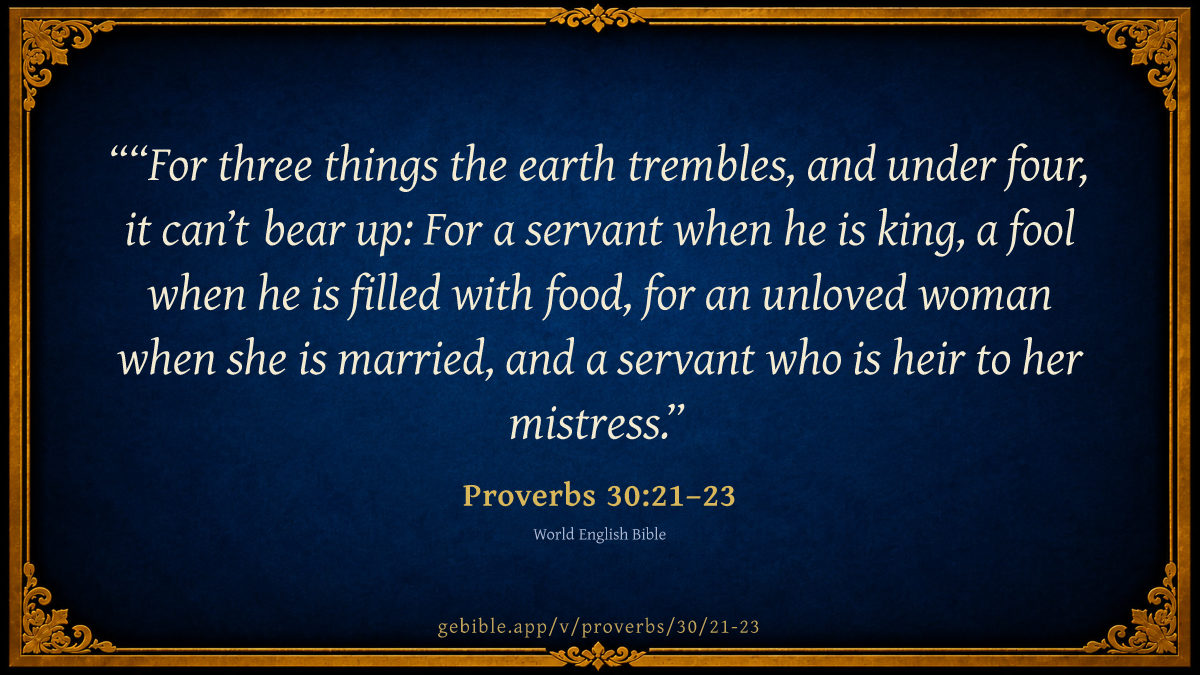
Under three things the earth trembles, and under four it cannot bear up
The use of the numbers "three" and "four" here is likely a poetic device. "There are some things that make the earth tremble, that it cannot endure. Four of these are:"
Read full note →
a fool when he is filled with food
This can be translated in active form. AT: "a fool who has had enough to eat" (See: Active or Passive)
a hated woman when she marries
That is, people rightly hated her before she married; once she marries, she will be worse than she was before she married. This can be translated in active form. AT: "a woman whom good people have hated when she marries" or "an outcast woman when she marries" (See: Active or Passive)
Tyndale Open Study Notes2022 · CC BY-SA 4.0On v2130:21-23 This proverb lists four things that make the…
30:21-23 This proverb lists four things that make the earth tremble because they overturn the order of things. • who prospers (literally who is full of bread): In the ancient Near East as in much of the non-industrialized world today, having adequate food (bread) was a sign of prosperity.
 GEBible — Godless Engineer's Bible App
Geneva Bible translators 1599 · Public Domain On vv22–23 These commonly abuse the state whereunto they are called.
These commonly abuse the state whereunto they are called.
Geneva Bible (1599) marginal notes — public domain.
John Trapp 1656 · Public Domain On vv21–23 Pro 30:21 For three [things] the earth is disquieted,…
Pro 30:21 For three [things] the earth is disquieted, and for four [which] it cannot bear:
Ver. 21. For three things the earth is disquieted.] Such trouble towns are odious creatures; the places where they live, long for a vomit to spew them out. As they live wickedly, so they die wishedly; there is a good world’s riddance of them, as there was of Nabal, and of those in Job 27:23; Job 27:15, who were buried before half dead, being hissed and kicked off the stage of the world, as Phocas was by Heraclius.
Read full note →
And for four which it cannot bear.] The very axle of the world is even ready to crack under them, the earth to open and swallow them up.
John Trapp, A Commentary or Exposition upon All the Books of the Old and New Testament (1647–1656) — public domain. Text from a community e-Sword module.
Matthew Poole 1685 · Public Domain On vv21–23 The earth is disquieted; either,
The earth is disquieted; either,
1. The earth itself trembleth and is moved; so it is an hyperbole. Or rather,
Read full note →
2. The inhabitants of the earth. They do by their insolence and impudence cause great and dreadful disturbances in the places where they live.
Which it cannot bear; which are intolerable in human societies.
Matthew Poole's English Annotations on the Holy Bible (1683–1685) — public domain. Text from a community e-Sword/MySword module.
John Gill 1763 · Public Domain On vv21–23 For three things the earth is disquieted,.... The inhabitants…
For three things the earth is disquieted,.... The inhabitants of it are made very uneasy;
and for four which it cannot bear; they are a load and burden upon it, and are intolerable to those that dwell on it, and make them very uncomfortable.
John Gill's Exposition of the Whole Bible (1746–1763) — public domain (CC PDM 1.0). Text via the HelloAO Bible API.
John Wesley 1765 · Public Domain On vv21–23 Four - Which are intolerable in human societies.
Four - Which are intolerable in human societies.
John Wesley, Explanatory Notes Upon the Whole Bible (1754–1765) — public domain. Text via the GEBible commentary corpus.
Adam Clarke 1810 · Public Domain On v21 Verse 21. For three things the earth is disquieted,…
Verse 21. For three things the earth is disquieted, and for four which it cannot bear] This is another enigma. Four things insupportable to men. 1. A slave, when he becomes ruler. 2. An overfed fool. 3. An ill-tempered woman, when mistress of a family. And, 4. A servant maid, when the rule of the house is committed to her.
1. A slave, when he comes to bear rule, is an unprincipled tyrant. It has been often observed both in America and in the West Indies, when it was judged necessary to arm some of the most confidential slaves, that no regiments were used so cruelly in the drill, c., as those black regiments that had black officers.
Read full note →
2. The overfed fool. The intellectually weak man, who has every thing at his command, has generally manners which none can bear and, if a favourite with his master, he is insupportable to all others.
3. An ill-tempered woman, when she gets embarrassed with domestic cares, is beyond bearing.
4. A servant maid, when, either through the death of the mistress, or the sin of the husband, she is in fact exalted to be head over the family, is so insolent and impudent, as to be hateful to every one, and execrated by all.
Adam Clarke's Commentary on the Bible (1810–1826) — public domain. Text from a community e-Sword/MySword module.
Joseph Benson 1811 · Public Domain On v21 Pro 30:21-23. For three things the earth — That…
Pro 30:21-23. For three things the earth — That is, the inhabitants of the earth; is disquieted — By their insolence and impudence they cause great disturbances in the places where they live; for four it cannot rest — They are intolerable in human societies. For a servant when he reigneth — When he is advanced to great power and dignity; for such a one is ignorant and unfit for his place, and therefore commits many errors; he is poor, and therefore insatiable; he is proud and imperious, and usually injurious and cruel; and a fool — A conceited fool, or an obstinately wicked man; when he is filled with meat — When he is over fed, his meat and drink heating his blood, and stirring him up to many insolences: or, when he abounds in wealth, which, in that case, is like a sword in a madman’s hand, being an instrument and occasion of many acts of wickedness and mischief. For an odious woman — Proud and perverse, and full of other offensive qualities; when she is married — For then she displays all those ill humours which before she concealed. And a handmaid that is heir — Which great and sudden change transports her beside herself, and makes her insufferably proud and scornful.
Joseph Benson's Commentary on the Old and New Testaments (1811–1818) — public domain. Text from a community e-Sword module.
Albert Barnes 1834 · Public Domain On vv21, 23 For four which it cannot bear - Better: four…
For four which it cannot bear - Better: four it cannot bear. Here the common element is that of being intolerable, and the four examples are divided equally between the two sexes. Each has its examples of power and prosperity misused because they fall to the lot of those who have no training for them, and are therefore in the wrong place.
Albert Barnes' Notes on the Bible (1834–1885) — public domain. Text from a community e-Sword/MySword module.
Charles Bridges 1846 · Public Domain On v21 Next to things which were unsearchable, Agur now mentions…
Next to things which were unsearchable, Agur now mentions some things that were intolerable — things, for which the earth is disquieted, bringing confusion wherever they are found. Who does not naturally condemn things out of place, as unsuitable and unseemly? Order is the law of the works of God in the world, no less than in the Church;†1 and any breach of order is to be deprecated. Four such evils are here mentioned — two connected with men, two with women; the one class in the community, the other in the family.
The first evil mentioned is — a servant, when he reigneth. This is a serious evil in the family, whether it arises from the mismanagement of the master,†2 or from his own intrigue. (Pro 30:23 .) He is obviously out of place; and ruling, where he ought to serve, he must bring disorder. (Gen 16:4 .) The evil is far greater in a kingdom. Men of low birth may indeed rise honorably by their own merit to a high station. God may call them, as he did Joseph (Gen 41:41 ), to reign. The evil is the advancement to power of ignorant, unprincipled minions.†3 Men of mean spirit cannot bear to be raised. Intoxicated by sudden elevation, these upstarts shew themselves not only fools, but tyrants;†4 swelling with all the insolence of their unseemly honor. Such was the enmity of Tobiah the Ammonite†5 and the misrule of Haman.†6 What national evil resulted from the elevation of Jeroboam!†7 What anarchy from the successful usurpation of Zimri!†8 Well therefore might the reign of servants be deplored, as a component part of the calamity of disconsolate Zion! (Lam 5:8 .) In the ordinary course it can only be viewed as a chastening dispensation. (Isa 3:4-5 .) Let us acknowledge with thankfulness our deliverance from it.
Read full note →
Then look at the fool (not an idiot, but a willful sinner) when he is filled with meat. Can we wonder that he should be a trouble and a curse; giving the reins to his appetite, and becoming yet more devoid of understanding than before? The history of Nabal, sunk into brutishness by his own sensual lust (1Sa 25:36 ); Elah murdered by his servant, whilst "drinking himself drunk in his steward’s house;"†9 Belshazzar giving himself over to the lust of ungodliness†10 — all these were evils, for which the earth was disquieted, and which it could not bear. Filled with meat — "with surfeiting and drunkenness" they dig as it were their own graves with their teeth, and are set forth as an example in the just punishment of their wicked folly.
Look again into the inner room of the family. What is the origin of discord and palpable misery? An odious woman is in rule. She quarrels with all around her. Her ungoverned tongue and temper are an unceasing source of agitation. Had she known herself, much better for her never to have entered into the marriage bond, than to become the inseparable tormentor of her husband and family.†11 Woman is to man either his greatest curse or blessing. If love be not the earnest of the sacred union, truly will it be a bond of misery, from which only the special mercy of God can deliver. Let the worldly portion of the wife be the last consideration. Take heed, lest worldly glitter open a door for remediless misery.
The odious woman, when she is married, if she be in authority, becomes a national evil. Jezebel was a scourge to Israel, the spring of all Ahab’s wickedness, that brought the heavy judgment of God upon the land.†12 The earth was disquieted for her, and at the last cast her out. (2Ki 9:30-37 .) Herodias brought upon her husband and his nation the guilt of the blood of the murdered prophet "crying from the ground." (Mat 14:8 .) If marriage be the ordinance of lust, not of godliness, what wonder if an odious woman should be the result, a canker to every domestic comfort?
The last evil noticed is a frequent source of family trouble — an handmaid, that is heir to her mistress. Want of discipline, simplicity, or integrity, leads to waywardness and self-indulgence; and the house, instead of being under wholesome rule, becomes a prey to envy and strife. The ill-regulated connection between Abraham and Hagar, when the servant became heir to her mistress — occupying her mistress’s place with her husband — became the source of most baneful contention. (Gen 16:4 .) Our own history presents sad illustration of this intolerable evil. Anne Boleyn and Jane Seymour were handmaids, and unhappily heirs, to their respective mistresses while living, in the affections of the sovereign. The royal example of selfishness and lust was a national grievance, in which the handmaids were not wholly guiltless.
And thus in modern society, an handmaid, treated with that familiarity, which breaks down the Divine barriers between the several ranks, has sometimes become heir to her mistress; either succeeding to her property — perhaps to the exclusion of more rightful claimants (Pro 29:21 ); or rising into her place by an ill-assorted union, like those above-mentioned, usually productive of much family dissension. Or again, in the higher ranks, she is the heir to her mistress’s dresses. This encourages in her the love of dress and vanity, habits unsuitable to her situation in life; and too often hurtful to her solid respectability and eternal interests.
How needful is it to preserve consistency in every part of our profession! Oh! let us look carefully to it, that no want of wisdom, godly contentment, or self-denial, brings reproach upon that worthy name by which we are called; that there be no spots, to mar that adorning beauty, which might attract those around us to the ways of God.
Footnotes:
†1 Ecc 3:11. 1Co 14:40 .
†2 Pro 29:21.
†3 Pro 19:10. Ecc 10:5-7 .
†4 Proverbs XX? iii. 3. This danger is accurately drawn by one of the Classic moralists: -
Asperius nihil est humili; cum surgit in altum,
Cuncta ferit, dum cuncta timet; desævit in omnes,
Ut se posse putet; nec bellua tetrior ulla est,
Quam servi rabies, in libera terga furentis.
Claudian. Lib. i. in Eutrop.
†5 Neh 2:10.
†6 Est 3:1.
†7 1Ki 11:26-28 ; 1Ki 12:30 .
†8 1Ki 16:9-20 . Compare 2Ki 8:12 .
†9 1Ki 16:9-10 . Hos 7:5 .
†10 Dan 5:1-4, Dan 5:30 . 1Sa 30:16 . 1Ki 20:16 .
†11 Pro 21:9, Pro 21:19 ; Pro 27:15 .
†12 1Ki 16:31 ; 1Ki 21:25 .
Charles Bridges, An Exposition of the Book of Proverbs (1846) — public domain. Text from a community e-Sword module.
Haydock's Catholic Bible Commentary 1859 · Public Domain On v23 Mistress, and is married to her master. She will…
Mistress, and is married to her master. She will generally prove insolent; like slaves on the throne, Regnabit sanguine multo ad regnum quisquis venit ab exilio. (Suetonius, Tib. 59.) (Calmet)
George Leo Haydock (1774–1849), Haydock's Catholic Family Bible and Commentary, 1859 edition — public domain. Excludes Psalms (Douay-Rheims chapter numbering differs from Protestant) and Deuterocanonical books (Catholic canon only).
Robert Jamieson, A. R. Fausset & David Brown 1871 · Public Domain On vv21, 23 Pride and cruelty, the undue exaltation of those unfit…
Pride and cruelty, the undue exaltation of those unfit to hold power, produce those vices which disquiet society (compare Pro 19:10; Pro 28:3).
Jamieson, Fausset & Brown — Commentary Critical and Explanatory on the Whole Bible (1871) — public domain (CC PDM 1.0). Text via the HelloAO Bible API.
Daniel D. Whedon 1874 · Public Domain On v21 21-23. Three… four — Hence follows another enigma, the…
21-23. Three… four — Hence follows another enigma, the four intolerable things.
The earth is disquieted — The land is disturbed, thrown into commotion.
Read full note →
A servant when he reigneth — When he becomes a ruler. Under Eastern governments slaves are sometimes promoted to office and become rulers. They are frequently the most imperious of tyrants. The same thing was, in the days of slavery, observed in this country when slaves were made overseers of their fellows, and in the West Indies, as Dr. Clarke remarks, where they were made drill masters of black regiments. This grows out of their previous condition and education, or, rather, their lack of education. (Comp. Pro_29:19.)
A fool — נבל, (nabhal,) an ungodly dolt; the word implies wickedness and stupidity. (Compare Pro_19:10.)
An odious woman — A hateful and hated woman.
When she is married — Literally, when she is lorded, or husbanded; that is, when she gets married. (Comp. Pro_29:17-18; Pro_31:1.)
Heir to her mistress — Literally, inherits her mistress; that is, inherits her place — disinherits her in the affections and honour of her husband. Comp. Pro_16:21.
Daniel D. Whedon (gen. ed.), Commentary on the Old and New Testaments (1874–1909) — public domain. Text from a community e-Sword module.
The Cambridge Bible for Schools and Colleges 1878 · Public Domain On vv21–23 21. For] “or Under,” R.V. marg.
21. For] “or Under,” R.V. marg.
21–23. Four things that are intolerable.
Read full note →
Two of them are drawn from each sex, and in each case they are unbearable because they are out of place, in a false position.
The Cambridge Bible for Schools and Colleges (gen. ed. J. J. S. Perowne; Cambridge University Press, 1878–1918) — public domain. Text from a community e-Sword module.
Ellicott's Commentary for English Readers 1878 · Public Domain On vv22–23 (22) For a servant when he reigneth.—The mischief done…
(22) For a servant when he reigneth.—The mischief done by Oriental favourites at court, who often began life as slaves, was proverbial.
A fool (nâbhâl).—See above, on Pro_17:7. It is only when he has to work hard for his living that he will behave himself decently; if he gets a little money, it will soon be wasted in idleness and self-indulgence.
A Bible Commentary for English Readers, edited by Charles John Ellicott (1878–1897) — public domain. Text from a community e-Sword module.
The Pulpit Commentary 1880 · Public Domain On vv21–23 Vers. 21-23. Then follows a proverb concerning four things…
Vers. 21-23. Then follows a proverb concerning four things which are intolerable, examples of incongruous associations or positions two in the case of men, two in the case of women.
For three things the earth is disquieted; better, under three things the earth doth tremble, as if oppressed by an overwhelming borden. The form of expression does not allow us to think of an earthquake. "The earth" is equivalent to "the inhabitants thereof." And for four which it cannot bear; or, under four it cannot stand. (comp. Amo_7:10) These four evils destroy the comfort of social life, uproot the bonds of society, and endanger the safety of a nation.
Read full note →
Vers. 21-23. Intolerable things.
I THE EXAMPLES.
1. The slave in authority. (Ver. 22) The inversion of objects is intolerable to the trained eye; things standing upside down, etc. So in social relations and in political Government belongs to the wise and the strong; the feeble in mind and the narrow in heart are emphatically the wrong men in the wrong place, in seats of power.
2. The self-satisfied fool. His fatuous smile is a satire upon himself and upon the condition of things which permits him to bask in so fantastic a paradise. Those are sights to make the "angels weep.
3. The ill-tempered wife. (Ver. 23) She, again, is emphatically "out of place." For home, in any sweet sense, is the place which woman"s presence makes a delight.
4. The ambitious maidservant. The effort to supplant, to grasp a place beyond one"s rights and deserts, hurts our intuitive perceptions of what is right. An Oriental proverb says, "Sit in your place, and none shall make you rise," on which we have a pointed commentary from Christ in Luk_14:11, "He that humbleth himself shall be exalted.
II THE GENERAL LESSONS. Order and rank are Divine institutions. To overturn this is no work of the true reformer or friend of the social weal. Rule rests ultimately upon ability to rule; government, upon power; authority, upon wisdom. When these relations are actually reversed, society is disturbed, matters are unhappy. When they only seem to be reversed, there will be distress and discomfort in right minds, until the just order and the nominal state of things shall be restored. J.
The Pulpit Commentary (1880–1919), ed. H.D.M. Spence-Jones & Joseph S. Exell — public domain. Text from a community e-Sword module.
The Preacher's Complete Homiletical Commentary 1892 · Public Domain On v21 Pro_30:23. Odious, or unloved.
CRITICAL NOTES.—
Pro_30:23. Odious, or unloved.
Read full note →
MAIN HOMILETICS OF THE PARAGRAPH.—Pro_30:21-23
BURDENS GRIEVOUS TO BE BORNE
I. It is sometimes dangerous to the peace of a community to raise a person from a low to a high position. To place a man who has never before crossed a horse, upon a high-spirited charger, is to create a source of danger both to himself and others. There is a strong probability that the unskilful rider will be thrown from his unaccustomed elevation, and so injure himself. And it is also probable that he will be the means of mischief to other travellers upon the road, whom he will overthrow in his unskilful efforts to keep his seat. It is generally as dangerous an experiment to lift a man at once from the position of a servant to that of a ruler. Although faithfulness “over a few things” is, according to the highest authority, the best qualification for rulership “over many things” (Mat_25:21), it is not always hands used only to service are fit to hold the reins of government, either in a small or a large society. On this subject see also on chap. Pro_19:10, page 569.
II. Some human creatures cannot safely be trusted with even a sufficiency of this world’s goods. They are not only unfit to rule others, but so unfit to rule themselves that they cannot be “filled with meat” without becoming a centre of disturbance. Even enough of the necessaries of life suffices to make them injurious to themselves and insolent to their betters. This is especially true of men who are slaves to their bodily appetites. There are men in the world who, although peaceable and even useful citizens when they are kept in a state of comparative want and hardship, indulge in excess and immorality as soon as the restraint is removed. They will sometimes know this to be true, and yet they are so wanting in moral courage and strength as not to struggle after a higher condition of being. Such men are fools indeed.
III. The change of disposition which change of circumstance sometimes seems to work may be the result of deliberate purpose. When a servant becomes a ruler he may be the occasion of trouble simply from intellectual inability, and the fool who cannot safely be filled with meat may be only morally weak; but the woman here represented as developing into a curse after marriage suggests a person who has deliberately hidden her real character for a time in order to gain a position in which she can have more opportunities of indulging her evil propensities. This is a step farther in wickedness, and this domestic burden is often the most grievous of all burdens. On this subject see on chap. Pro_21:9; Pro_21:19, page 613.
OUTLINES AND SUGGESTIVE COMMENTS
Judge, then, how horrible it is that men should set the devil, or his two angels the world and the flesh, in the throne, whiles they place God in the footstool; or that in this commonwealth of man, reason, which is the queen or princess over the better powers and graces of the soul, should stoop to so base a slave as sensual lust.—T. Adams.
And now, just notice the comprehensiveness, in regard to the happiness of human life, of the four things thus enumerated. They begin, observe, at the throne, and come down to the domestic servant. They embrace four great sources of the social unhappiness of mankind. These are—incompetent rule, prosperous and, besotted folly, conjugal alienation and strife with its domestic miseries, and the unnatural inversion of social order.—Wardlaw.
The Preacher's Complete Homiletical Commentary (gen. ed. Joseph S. Exell; Funk & Wagnalls, c. 1892) — public domain (pre-1929). A full-Bible homiletical/sermon-outline anthology covering 65 of 66 books (2 John is absent from the source module). Text from a community e-Sword module.
unfoldingWord translationNotes 2017 · CC BY-SA 4.0 On v21 Under three things the earth trembles, and under four…
Under three things the earth trembles, and under four it cannot bear up
The use of the numbers "three" and "four" here is likely a poetic device. "There are some things that make the earth tremble, that it cannot endure. Four of these are:"
Read full note →
a fool when he is filled with food
This can be translated in active form. AT: "a fool who has had enough to eat" (See: Active or Passive)
a hated woman when she marries
That is, people rightly hated her before she married; once she marries, she will be worse than she was before she married. This can be translated in active form. AT: "a woman whom good people have hated when she marries" or "an outcast woman when she marries" (See: Active or Passive)
takes the place of her mistress
rules the household
translationWords
earth
servant
king
fool
unfoldingWord translationNotes — © Distant Shores Media and the Door43 World Missions Community, licensed CC BY-SA 4.0. Source: git.door43.org/Door43/en_tn.
Tyndale Open Study Notes 2022 · CC BY-SA 4.0 On v21 30:21-23 This proverb lists four things that make the…
30:21-23 This proverb lists four things that make the earth tremble because they overturn the order of things. • who prospers (literally who is full of bread): In the ancient Near East as in much of the non-industrialized world today, having adequate food (bread) was a sign of prosperity.
Tyndale Open Study Notes — © Tyndale Open Resources, licensed CC BY-SA 4.0. Text via the HelloAO Bible API.