
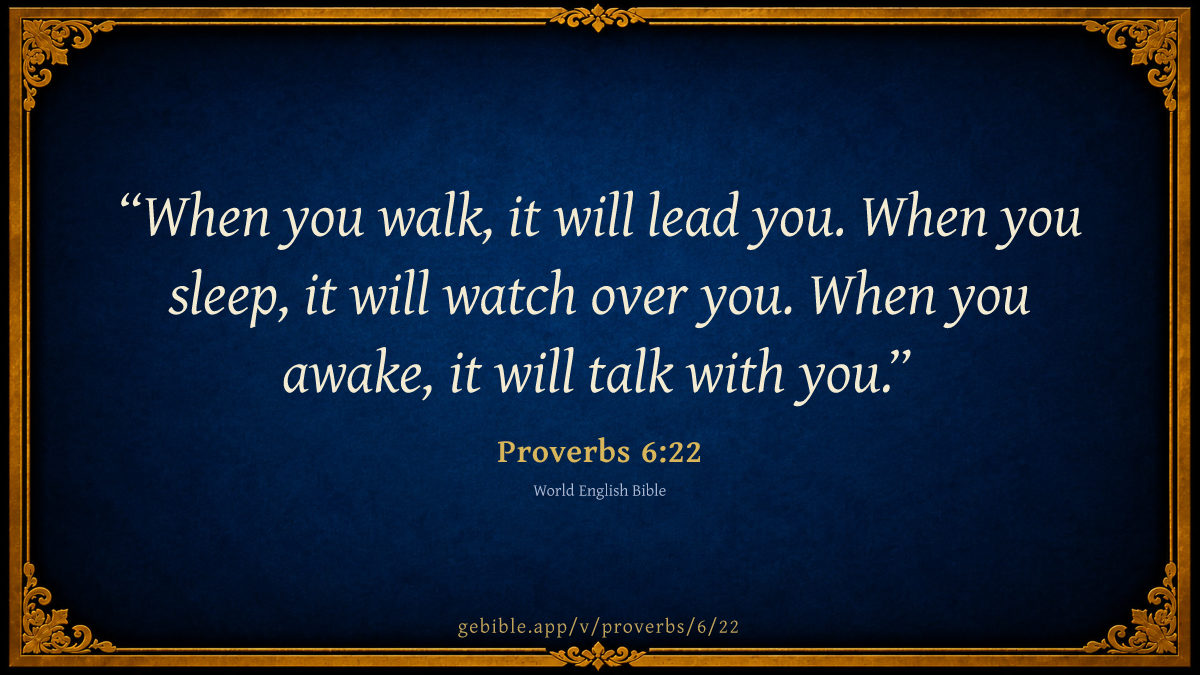
When you walk, it will lead you. When you sleep, it will watch over you. When you awake, it will talk with you.
Parallel Translations
-
When you walk, it will lead you. When you sleep, it will watch over you. When you awake, it will talk with you.
-
When thou goest, it shall lead thee; when thou sleepest, it shall keep thee; and when thou awakest, it shall talk with thee.
-
When thou walkest, it shall lead thee, when thou liest down, it shall watch over thee; and when thou awakest, it shall talk with thee.
Cross-references (11)
Passages linked to Proverbs 6:22 in the Treasury of Scripture Knowledge, ordered by reader-vote popularity; verse text shown in World English Bible.
- Psalms 119:11 I have hidden your word in my heart, that I might not sin against you.
- Proverbs 3:23-24 Then you shall walk in your way securely. Your foot won’t stumble. When you lie down, you will not be afraid. Yes, you will lie down, and your sleep will be sweet.
- Psalms 119:24 Indeed your statutes are my delight, and my counselors.
- Proverbs 2:11 Discretion will watch over you. Understanding will keep you,
- Psalms 43:3 Oh, send out your light and your truth. Let them lead me. Let them bring me to your holy hill, to your tents.
- Psalms 119:97 How I love your law! It is my meditation all day.
- Psalms 17:4 As for the deeds of men, by the word of your lips, I have kept myself from the ways of the violent.
- Psalms 119:9 How can a young man keep his way pure? By living according to your word.
- Psalms 119:54 Your statutes have been my songs in the house where I live.
- Psalms 119:148 My eyes stay open through the night watches, that I might meditate on your word.
- Daniel 11:18-21 After this he will turn his face to the islands, and will take many; but a prince will cause the reproach offered by him to cease. Yes, moreover, he will cause his reproach to turn on him. Then he will turn his face toward the fortresses of his own land; but he will stumble and fall, and won’t be found. “Then one who will cause a tax collector to pass through the kingdom to maintain its glory will stand up in his place; but within few days he shall be destroyed, not in anger, and not in battle. “In his place a contemptible person will stand up, to whom they had not given the honor of the kingdom; but he will come in time of security, and will obtain the kingdom by flatteries.
Cross-references from openbible.info (CC BY 4.0)
Explain this verse (12 sources)
Historical commentary, presented as a primary source — not an endorsement.
Private notes
Saved on this device only — never synced or sent anywhere.
John Trapp 1656 · Public Domain Pro 6:22 When thou goest, it shall lead thee;…
Pro 6:22 When thou goest, it shall lead thee; when thou sleepest, it shall keep thee; and [when] thou awakest, it shall talk with thee.
Ver. 22. When thou goest, it shall lead {a} thee.] No such guide to God as the word, which while a man holds to, he may safely say, Lord, if I be deceived, thou hast deceived me; if I be out of the way, thy word hath misled me.
Read full note →
When thou sleepest, it shall keep thee.] If thou sleep with some good meditation in thy mind, it shall keep thee from foolish and sinful dreams and fancies, and set thy heart in a holy frame when thou awakest, he that raketh up his fire at night shall find fire in the morning. "How precious are thy thoughts" (that is, thoughts of thee) "unto me, O God." {Psa 139:17} What follows "When I awake, I am still with thee." {Psa 139:18}
{a} Ducet et perducet.
John Trapp, A Commentary or Exposition upon All the Books of the Old and New Testament (1647–1656) — public domain. Text from a community e-Sword module.
Matthew Poole 1685 · Public Domain It, the law of God, which thy parents have…
It, the law of God, which thy parents have taught thee, and pressed upon thee,
shall lead thee; direct thee how to order all thy steps and actions.
Read full note →
It shall talk with thee; it shall give thee counsel and comfort.
Matthew Poole's English Annotations on the Holy Bible (1683–1685) — public domain. Text from a community e-Sword/MySword module.
John Gill 1763 · Public Domain For the commandment is a lamp,.... The law of…
For the commandment is a lamp,.... The law of God is a lamp or candle to see to work by and to walk by; it enlightens the eyes and directs the feet, and makes working more pleasant, and walking more comfortable; and indeed wit, bout it a man knows not rightly what to do or where he should walk, or where he is walking; see Psa 119:105;
and the law is light; it makes things clear and manifest, what is right and what is wrong; it enlightens the eyes of the understanding, whereby persons come to see both their sin and their duty; and it directs them to avoid the one and do the other; see Psa 19:8;
Read full note →
and reproofs of instruction are the way life; kind reproofs given by parents agreeable to the word of God, which instruct what should be shunned and what should be performed, when attended to, put men in the way of an honourable and useful life; and are the means of preserving them from a scandalous and useless one.
John Gill's Exposition of the Whole Bible (1746–1763) — public domain (CC PDM 1.0). Text via the HelloAO Bible API.
John Wesley 1765 · Public Domain It - The law of God which thy parents…
It - The law of God which thy parents have taught thee. Talk - It shall give thee counsel and comfort.
John Wesley, Explanatory Notes Upon the Whole Bible (1754–1765) — public domain. Text via the GEBible commentary corpus.
Adam Clarke 1810 · Public Domain Verse 22. When thou goest, it shall lead thee]…
Verse 22. When thou goest, it shall lead thee] Here the law is personified; and is represented as a nurse, teacher, and guardian, by night and day. An upright man never goes but as directed by God's word and led by God's Spirit.
When thou sleepest] He commends his body and soul to the protection of his Maker when he lies down and sleeps in peace. And when he awakes in the morning, the promises and mercies of God are the first things that present themselves to his recollection.
Adam Clarke's Commentary on the Bible (1810–1826) — public domain. Text from a community e-Sword/MySword module.
Haydock's Catholic Bible Commentary 1859 · Public Domain
CHAPTER VI.
George Leo Haydock (1774–1849), Haydock's Catholic Family Bible and Commentary, 1859 edition — public domain. Excludes Psalms (Douay-Rheims chapter numbering differs from Protestant) and Deuterocanonical books (Catholic canon only).
Robert Jamieson, A. R. Fausset & David Brown 1871 · Public Domain it--(compare Pro 6:23); denotes the instruction of parents (Pro…
it--(compare Pro 6:23); denotes the instruction of parents (Pro 6:20), to which all the qualities of a safe guide and guard and ready teacher are ascribed. It prevents the ingress of evil by supplying good thoughts, even in dreams (Pro 3:21-23; Psa 19:9; Pe2 1:19).
Jamieson, Fausset & Brown — Commentary Critical and Explanatory on the Whole Bible (1871) — public domain (CC PDM 1.0). Text via the HelloAO Bible API.
Daniel D. Whedon 1874 · Public Domain 22. It — Literally, she. Some suppose it spoken…
22. It — Literally, she. Some suppose it spoken of wisdom personified. Blessed is the youth that respects his parents and their wholesome precepts.
Daniel D. Whedon (gen. ed.), Commentary on the Old and New Testaments (1874–1909) — public domain. Text from a community e-Sword module.
The Cambridge Bible for Schools and Colleges 1878 · Public Domain 22. it] The change from the plural, “bind them,”…
22. it] The change from the plural, “bind them,” “tie them,” of Pro_6:21, and the return to “it,” “the commandment,” “the law,” in Pro_6:23 (comp. Pro_6:20) indicate not only the substantial identity of the teaching of the father and the mother, but the source of that identity in the one law of God, of which they are both the authorised exponents (Deu_6:7).
The Cambridge Bible for Schools and Colleges (gen. ed. J. J. S. Perowne; Cambridge University Press, 1878–1918) — public domain. Text from a community e-Sword module.
The Pulpit Commentary 1880 · Public Domain The going, sleeping, and awaking occur in the same…
The going, sleeping, and awaking occur in the same order in the Pentateuch, from which the ideas of this and the preceding verse are evidently derived. (see Deu_6:7 and Deu_11:19) Though only specifying three conditions, they refer to the whole conduct of life, and hence the verse promises direction, guardianship, and converse of wisdom, which will undoubtedly attend life where the precepts of parents are lovingly treasured and obediently observed. The Authorized Version conveys the impression that it is "the keeping" of the parents" precepts, etc., which is to bear such results; but it is better to understand "it" as signifying the whole teaching or doctrine of wisdom, as Delitzsch. Wisdom becomes personified in the representation, and identified with her teaching. It shall lead thee. The Hebrew verb nakhah, "to lead," in the sense of "to direct," like the Latin dirigere (Delitzsch), and as it is used in Exodus and Numbers, passim. In the Psalms (Psa_5:9 Psa_27:11 Psa_31:4, etc.) it is employed of God as governing men. Hence, in the affairs of life, Wisdom will so guide and control us that we shall act uprightly. There is the further notion imported into the word of preservation from evil. (cf. Pro_3:23, "Thou shalt walk in thy way safely, and thy foot shall not stumble When thou sleepest; or, when thou liest down, as in Pro_3:25, where the same verb occurs. It shall keep thee; i.e. watch over, keep safe, or preserve; as in the Vulgate, custodire, and the LXX fulattein . We have had the same verb, shamar, before in Pro_2:11. Wisdom will be as it were a guardian angel in our hours of repose. When thou awakest; Hebrew, hakitsotha, the hiph. perfect of kutz. This word only occurs here. The hiph. form, hekitz, is intransitive, "to be aroused" (cf. the LXX, egeiromenw ). It shall talk with thee; rather, she. Bertheau renders, "She will make thee thoughtful;" and Dathe, "Let them be thy meditation;" but the accusative suffix designates the person who is the object of the action of the verb, as in Psa_5:5 Psa_42:4 Zec_7:5 (Zockler) and as Delitzseh remarks, the personification requires something more than a mere meditation with one"s self on the precepts of Wisdom. Wisdom herself shall hold converse with thee (cf. the LXX, sullalh soi ), she shall suggest thoughts how thou art to behave thyself. The meaning of the verb, "to meditate," "to think deeply," however, need not be lost sight of.
God"s Word guide, guardian, companion.
Read full note →
Man is insufficient of himself; he needs help from on high. Often in the course of his life he has goings forth, and then he wants direction; often he finds himself helpless, and then he needs a guardian to preserve him; often he is alone, and then he craves a friend who will commune with him. All this he has in the Word of the living God. It is
I IN ACTION, OUR GUIDE. "When thou goest, it shall lead thee." We go "front home," "into business," "to sea," "abroad," etc. In all these goings forth we want that which will lead us in the fight and the wise way the way of truth, purity, righteousness, happiness. The Word of the heavenly Father will supply this.
II IN DANGER, OUR DEFENCE. "When thou sleepest, it shall keep thee." Not. only when we are "asleep" on our couch are we in danger from those who might wish to injure us, but when we are unconscious of the spiritual dangers by which we are surrounded; when in a state of "innocence," of being uninitiated into the secrets of sin; when we are not alive to duty and opportunity as we should be; then the Word of God will be a fence, a security. Following it, coming to it to learn God"s will, we shall know which way to take, what courses to avoid, how to revive and to be reanimated with holy energy and zeal.
III IN LONELINESS, OUR COMPANION. "When we awake," when we find ourselves with our faculties all in force, and no one to hold fellowship with us, then the Word of God will "talk with us." It will speak to us of God our Father, of the supreme value of our spiritual nature, of the path of life, of the kingdom of Christ and the salvation in him, of the heavenly home. "Lamp of our feet, whereby we trace," etc. (ver. 23). C.
The Pulpit Commentary (1880–1919), ed. H.D.M. Spence-Jones & Joseph S. Exell — public domain. Text from a community e-Sword module.
The Biblical Illustrator 1887 · Public Domain When thou goest, it shall lead thee.
Pro_6:22
When thou goest, it shall lead thee.
Read full note →
The comfort of the thought of Gods guidance in after-life of those brought up in His fear and love
Who is there who has never felt in his heart a wish for some one to advise, direct, and help him? There is an Adviser, a Helper, promised to us, able, powerful to guide and help us with unerring wisdom through any difficulties or troubles--the gracious Father, the redeeming Son, the Spirit that maketh holy. All of us need, daily need, such a Companion, such a Comforter. Those who will meet together and receive Gods blessing from the hand of the bishop in confirmation, where will they all be in a few years, nay, perhaps when another year has passed over their heads? Wherever they may be, this one thing awaits them, temptation--temptation as different as their own circumstances and dispositions, but still temptation. The old fables and monkish legends represent Satan coming in different shapes to one another according to their particular weakness--to one as a gold-finder showing his hidden treasure, to another as a handsome winning man, offering life of pleasure, to another as a beautiful woman enticing to ways of sin. But all these mean the same thing--that the world, the flesh, and the devil shape their temptations so as best to catch each unprotected soul. There is no saying what that temptation will be like; for to each it may be different according to where he is, and what he is. Some may be tempted by getting on in the world, some by not getting on, some by idle follies, some by busy follies. Let their life be what it may, we can comfort ourselves with the thought that they are prepared, that they have had the best kind of preparation, that which cometh from God only, the knowledge of His mercies and promises, the help of His Holy Spirit. Shall we try to look a little more closely down the long avenue of time, and see them as they will be; some we can fancy taking root here, spreading out their branches safely under the shelter of Christs Church; some may be found settling far away, some not settling at all, but drifting hither and thither on the changeful tides of life; but what of their souls, which will be bettering or worsening from day to day? We have trained them to know, to fear, and to love the Lord their Saviour, their Comforter, their God; and that God has promised His all-powerful Spirit shall garrison their souls, and strengthen them to fight the life-long fight of faith, if they will not slacken or desert His service. So we will cheer ourselves with the thought that as, like Joseph, they have been bred up in the fear and nurture of the Lord, so they will be able to render as good an account of themselves. (Archdeacon Mildmay.)
When thou awakest, it shall talk with thee.
Mans counsellor
I. The subject of this statement--what it is that will do this. The commandment and law of religious and well-instructed persons come to be equivalent to the law of God. It really stands for Gods book. Talk is expressive of that familiarity and friendship which may come to be established between the mind and heart of a young man and the wisdom of God personified and embodied in the book. There is a sacred familiarity, an affectionate friendship, an intercourse of tenderness. Two or three things characterise this sacred converse and intercourse.
1. It will talk with you on the most important subjects.
2. It will talk with you in all sorts of ways.
3. It will talk with authority.
There is nothing harsh, nothing grating in its tone of authority if the heart be right. But it will talk with honest plainness. This friend will speak to you with openness and honesty, and with the plainness of reproof. Two or three things you must carry with you in order that this converse may be fully beneficial.
1. You must be on terms of sincerity with the Bible. You must not come reluctantly, nor with doubt, nor to ridicule; you must not come in an improper spirit of questioning. This book treats a man just as one man treats another. To the froward it will show itself froward.
2. There must be serious and earnest prayer for Gods enlightening and guiding Spirit.
3. There must be frequent and sometimes prolonged and deep meditation on the words spoken.
There are three ways in which may be illustrated the time that is here indicated--When thou awakest.
1. Take the expression literally. When you come back in the morning to consciousness.
2. Take the expression figuratively. At particular times, through the force of inward thoughts or of outward circumstances, young man may suddenly wake up to his peril, foolishness, sin--to duty, the greatness of life, the past, the future.
3. Youth figuratively is emphatically a time of awakening to the realities of life. The young man wakes up to his personal individuality, to a sense of his obligations, feeling that there are now many things which depend on his own judgment--upon himself.
II. The object of discourse in the chapter. To warn the young man against things which may injure and ruin in a worldly point of view. And there is a far greater connection between the ruin of a man in a worldly respect and the ruin of the soul than people are apt to imagine. Three causes of ruin--
1. Want of caution. Illustrated in giving your name in a bond or guarantee for another. Speculations, hazardous schemes, efforts to get profit without giving sweat. It is Gods law that we shall purchase everything with the sweat of our brow; and all hazardous speculations, all gambling transactions, are, in fact, efforts to evade this law.
2. Indolence. There are some people who seem to be asleep all day long.
3. Profligacy. There is not only the seduction of man by the harlot, but the injury of man by his fellow-man. This last is a more complicated crime than the first. The man who gives way to any impure form of vice is said to lack understanding, to destroy his own soul.
III. The characteristics of a man who is on the road to ruin. Along with the evil imaginations of the heart, a false tongue, and the love of sowing discord, there is a loss of manliness, of transparency, of sincerity, and the like. Conclusion:
1. Give a spiritual turn to the teaching of the chapter, and see what spiritual thoughts may be educed from it.
2. Invite young men who accept the Christian faith to devote themselves to Gods service in the beginning of life.
3. Being so devoted, see that ye be not led away and seduced from your steadfastness by the world, the flesh, and the devil. Look ahead; always consider consequences. You are living under great moral laws, and you can no more alter those laws, you can no more avoid their working out their results, than you can turn the sun from its course. Beware of doing any one thing, of giving way to any one temptation, from which grievous results may arise. (Thomas Binney.)
The talking book
It is a very happy circumstance when the commandment of our father and the law of our mother are also the commandment of God and the law of the Lord. Happy are they who have a double force to draw them to the right--the bonds of nature and the cords of grace. Gods law should be a guide to us--When thou goest, it shall lead thee; a guardian to us--when thou sleepest--when thou art defenceless and off thy guard--it shall keep thee; and a dear companion to us--when thou awakest, it shall talk with thee.
I. We perceive that the world is living. How else could it be said--It shall talk with thee?
1. It is living, because it is pure truth. Error is death, truth is life. The tooth of time devours all lies. Truth never dies.
2. It is the utterance of an immutable, self-existing
God. So the Word is sure, steadfast, and full of power. It is never out of date.
3. It enshrines the living heart of Christ. The living Christ is in the book; you behold His face on almost every page.
4. The Holy Spirit has a peculiar connection with the Word of God. The work of the Spirit in mens hearts is done by the texts which ministers quote rather than by their explanations of them. Take care, then, how you trifle with a book which is so instinct with life.
II. We perceive that the word is personal. It shall talk with thee.
1. Gods Word talks about men, and about modern men; about the paradise of unfallen manhood, the fall, the degeneracy of the race, and the means of its redemption.
2. Gods Word speaks to men in all states and conditions before God--to sinners and to the children of God.
3. Gods Word is personal to all our states of mind. It goes into all details of our case, let our state be what it may.
4. Gods Word is always faithful. You never find the Word of God keeping back that which is profitable for you. This suggests a little healthful self-examination. How does the Word of God speak to my soul?
III. We perceive that Holy Scripture is very familiar. Talk with thee. To talk signifies fellowship, communion, familiarity. Scripture speaks the language of men; it comes down to our simplicity; it is familiar as to all that concerns us; it answers inquiries.
IV. We perceive that the Word of God is responsive. With thee, not to thee. Talk with a man is not all on one side. To talk with a man means answering talk from him. Scripture is a marvellously conversational book; it talks and it makes men talk.
V. We perceive that Scripture is influential. When the Word of God talks with us, it influences us. All talk influences more or less. This book soothes our sorrows, and encourages us. It has a wonderfully elevating power. It warns and restrains. It sanctifies and moulds the mind into the image of Christ. It confirms and settles us. (C. H. Spurgeon.)
The Biblical Illustrator, edited by Joseph S. Exell (c. 1880s–1900s) — public domain. Text from a community e-Sword module.
unfoldingWord translationNotes 2017 · CC BY-SA 4.0 When you walk ... when you sleep ... when…
When you walk ... when you sleep ... when you wake up
These three phrases are used together to emphasize that the lessons are valuable all the time. (See: Parallelism)
Read full note →
they will guide you ... they will watch over you ... they will teach you
The repetition of these phrases is to show that the lessons are valuable for all sorts of things. It also speaks of those lessons as if they were people. (See: Parallelism and Personification)
the commands ... the teaching ... the corrections that come by instruction
These three phrases mean basically the same thing, and together they show the various types of lessons a father and a mother teach. (See: Parallelism)
a lamp ... a light ... the way of life
All three of these mean basically the same thing and are repeated to emphasize the fact that the lessons make life better and easier. AT: "as useful as a lamp ... as helpful as light in the darkness ... as necessary to follow as the way of life" (See: Metaphor and Parallelism)
the way of life
"the way that leads to life" or "the way of living that God approves of"
translationWords
command
lamp
light
life
unfoldingWord translationNotes — © Distant Shores Media and the Door43 World Missions Community, licensed CC BY-SA 4.0. Source: git.door43.org/Door43/en_tn.