Numbers 5:14(v34)and the spirit of jealousy comes on him, and he is jealous of his wife and she is defiled; or if the spirit of jealousy comes on him, and…
Proverbs 27:4(v34)Wrath is cruel, and anger is overwhelming; but who is able to stand before jealousy?
Song of Solomon 8:6(v34)Set me as a seal on your heart, as a seal on your arm; for love is strong as death. Jealousy is as cruel as Sheol. Its flashes are flashes…
2 Kings 5:1(v35)Now Naaman, captain of the army of the king of Syria, was a great man with his master, and honorable, because by him Yahweh had given…
Proverbs 4:3(v35)For I was a son to my father, tender and an only child in the sight of my mother.
Show all 12 cross-references
Proverbs 7:13(v35)So she caught him, and kissed him. With an impudent face she said to him:
Proverbs 8:25(v35)Before the mountains were settled in place, before the hills, I was born;
Isaiah 2:9(v35)Man is brought low, and mankind is humbled; therefore don’t forgive them.
Malachi 2:9(v35)“Therefore I have also made you contemptible and wicked before all the people, according to the way you have not kept my ways, but have had…
1 Corinthians 10:22(v34)Or do we provoke the Lord to jealousy? Are we stronger than he?
Numbers 25:11(v34)“Phinehas, the son of Eleazar, the son of Aaron the priest, has turned my wrath away from the children of Israel, in that he was jealous…
Judges 19:29-30(v34)When he had come into his house, he took a knife and cut up his concubine, and divided her, limb by limb, into twelve pieces, and sent her…
Cross-references from openbible.info (CC BY 4.0)
Explain this passage (13 sources)
Historical commentary, presented as a primary source — not an endorsement.
Geneva Bible translators1599 · Public DomainOn v34He showeth that man by nature seeketh his death,…
He showeth that man by nature seeketh his death, that hath abused his wife, and so concludeth, that neither God’s Law nor the law of nature admitteth any ransom for the adultery.
Geneva Bible (1599) marginal notes — public domain.
John Trapp1656 · Public DomainOn v34Pro 6:34 For jealousy [is] the rage of a…
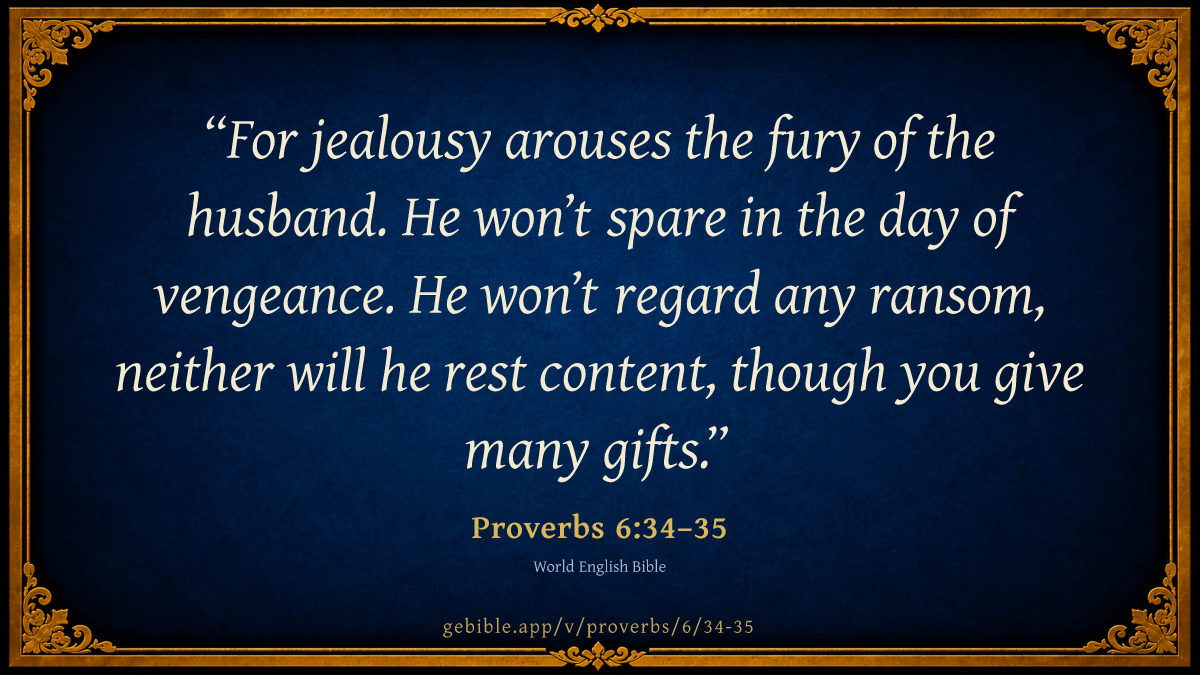
Pro 6:34 For jealousy [is] the rage of a man: therefore he will not spare in the day of vengeance.
Ver. 34. For jealousy is the rage.] Howbeit he may not kill the adulterer, though taken in the act, but prosecute the law against him, and appeal to the magistrate, who is the lord keeper of both tables - custos utriusque tabulae. But if no law will relieve a man, yet let him know that he shall do himself no disservice by making God his chancellor.
John Trapp, A Commentary or Exposition upon All the Books of the Old and New Testament (1647–1656) — public domain. Text from a community e-Sword module.
Matthew Poole1685 · Public DomainOn vv34–35Is the rage of a man; it inflames a…
Is the rage of a man; it inflames a man with rage and fury against the adulterer.
In the day of vengeance; when he hath an opportunity to avenge himself upon the delinquent.
Matthew Poole's English Annotations on the Holy Bible (1683–1685) — public domain. Text from a community e-Sword/MySword module.
John Gill1763 · Public DomainOn v34He will not regard any ransom,.... So that his…
He will not regard any ransom,.... So that his case is much worse than, a thief's; if he is taken, he makes restitution according to law, and he is freed, and no more is said and done to him; and, at most, it is but parting with all the goods in his house; but in this case it will not do. In the Hebrew text it is, "he will not accept the face of any ransom" (z); that is, as the Targum paraphrases it,
"he will not accept the face of anyone that gives a gift:''
Read full note →
he will have no respect unto him for the sake of the gift; whatever gift is offered, be it what it will, for the ransom of his life from death, it will be disregarded;
neither will he rest content, though thou givest many gifts; increase them, and keep continually giving; nothing but the life of the adulterer will satisfy him, which he will either take away himself, or obtain it in a way of legal prosecution. How foolish therefore is the man that will expose his name and credit, his health and substance, his life in this world, and his soul in another, to utter ruin, for the sake of gratifying a sordid lust! This may be interpreted of God, who is a jealous God in matters of worship, and will not suffer idolatry to go unpunished, which is spiritual adultery.
John Gill's Exposition of the Whole Bible (1746–1763) — public domain (CC PDM 1.0). Text via the HelloAO Bible API.
John Wesley1765 · Public DomainOn v34Rage - It enflames a man with rage. In…
Rage - It enflames a man with rage. In the day - When he hath an opportunity to avenge himself.
John Wesley, Explanatory Notes Upon the Whole Bible (1754–1765) — public domain. Text via the GEBible commentary corpus.
Adam Clarke1810 · Public DomainOn vv34–35Verse 34. Jealousy is the rage of a man:…
Verse 34. Jealousy is the rage of a man: therefore he will not spare] He will not, when he has detected the adulterer in the fact, wait for the slow progress of the law: it is then to him the day of vengeance; and in general, he avenges himself on the spot, as we see above.
Adam Clarke's Commentary on the Bible (1810–1826) — public domain. Text from a community e-Sword/MySword module.
Haydock's Catholic Bible Commentary1859 · Public DomainOn v35Gifts. "A husband would rather hear that his wife…
Gifts. "A husband would rather hear that his wife had been slain, than that she had been defiled." (St. Jerome in Amos vi.)
George Leo Haydock (1774–1849), Haydock's Catholic Family Bible and Commentary, 1859 edition — public domain. Excludes Psalms (Douay-Rheims chapter numbering differs from Protestant) and Deuterocanonical books (Catholic canon only).
Robert Jamieson, A. R. Fausset & David Brown1871 · Public DomainOn v34nor any terms of reconciliation be admitted.
nor any terms of reconciliation be admitted.
regard--or, "accept" any ransom.
Read full note →
Next: Proverbs Chapter 7
Jamieson, Fausset & Brown — Commentary Critical and Explanatory on the Whole Bible (1871) — public domain (CC PDM 1.0). Text via the HelloAO Bible API.
Daniel D. Whedon1874 · Public DomainOn vv34–3534. Jealousy… rage of a man — Or husband.…
34. Jealousy… rage of a man — Or husband. He will have no pity or mercy. This and what follows are assigned as justifying the assertion in Pro_6:31.
Daniel D. Whedon (gen. ed.), Commentary on the Old and New Testaments (1874–1909) — public domain. Text from a community e-Sword module.
The Cambridge Bible for Schools and Colleges1878 · Public DomainOn v3434. therefore] Rather, and. Here is no question of…
34. therefore] Rather, and. Here is no question of compensation (Pro_6:35); the burning fire of jealousy will pursue thee unto death (Lev_20:10).
The Cambridge Bible for Schools and Colleges (gen. ed. J. J. S. Perowne; Cambridge University Press, 1878–1918) — public domain. Text from a community e-Sword module.
Ellicott's Commentary for English Readers1878 · Public DomainOn v34(34) For jealousy is the rage of a man.—That…
(34) For jealousy is the rage of a man.—That is jealousy is furious, and cannot be appeased by bribes.
A Bible Commentary for English Readers, edited by Charles John Ellicott (1878–1897) — public domain. Text from a community e-Sword module.
The Pulpit Commentary1880 · Public DomainOn vv34–35For jealousy is the rage of a man: therefore…
For jealousy is the rage of a man: therefore he will not spare in the day of vengeance. The first hemistich is adduced as a reason for what has preceded, while the concluding hemistich and the following and last verses are a deduction strengthening what has been stated before, and also showing that the punishment will be inevitable. The general consensus of commentators and texts is to connect the two hemistiches of this verse. Thus the LXX, Mestolou yumora krisewv , "For the wrath of her husband filled with jealousy shall not spare in the day of judgment;" the Vulgate, Quia zelus et furor viri non parcet in die vindictae, "For the jealousy and rage of a man shall not spare in the day of vengeance;" the Syriac, Nam quia furor mariti plenus est zelotypia non parcet in die retributionis, "For because rage of a husband is full of jealousy he shall not spare in the day of retribution." So the Arabic, and the Tigarina Versio, and among the commentators Durandus. Dathe, Doderlein, Holden. But the Hebrew simply makes the statement, ki-kimah khamath-gaver, quia zelus excandescentia viri, i.e. , as in the Authorized Version, "for jealousy is the rage of a man," ki, equivalent to the Greek gar , "for" and kinah is the subject of the sentence. The Hebrew kinah is "jealousy" as in Pro_27:4, "Who is able to stand before envy?" or, as margin, "jealousy." The ordinary copulative verb "is" is best understood as connecting the subject and the predicate; "the rage of a man," Hebrew kamath-gaver, as above, i.e. "the glow of a man"s anger" (Delitzsch), or "a man"s fierce anger" (Zockler). Jealousy awakens and inflames the wrath and anger of a man or husband to its highest pitch. It evokes the strongest feelings for revenge. Man; Hebrew, gaver, equivalent to ish, "a man," in opposition to "a wife husband," as here. The word is chiefly found in poetry. Its derivation, from gavar, "to be strong," serves to bring out the idea also of the intensity or force of the jealousy it burns or rages with all the might of the man. The latter part of the verse in the Hebrew is simply, "and he will not spare (v"lo-yakh"mol) in the day of vengeance." The Authorized Version "therefore" serves to bring out the deduction, though it does net occur in the original. He will not spare; i.e. the injured husband will not show any clemency or mercy to the adulterer, the man who has wronged him so deeply. In the day of vengeance; Hebrew, b"yom nakam. The expression may refer to the time when the adulterer is brought before the judges, but more probably to every occasion on which the husband can exercise his vengeance. So Gejerus. For the expression, of. Isa_34:8, "The day of the Lord"s vengeance;" Job_20:28, "The day of his wrath;" and Pro_11:4, "The day of wrath." Jealousy is implacable. (see Son_8:6, "Jealousy is cruel as the grave
The Pulpit Commentary (1880–1919), ed. H.D.M. Spence-Jones & Joseph S. Exell — public domain. Text from a community e-Sword module.
unfoldingWord translationNotes2017 · CC BY-SA 4.0On v34very angry
furious
very angry
Read full note →
he will show no mercy
The "he" is the neighbor whose wife has committed adultery with another man. AT: "he will not limit the pain he will cause you" or "he will hurt you as much as he can" (See: Litotes)
when he takes his revenge
"in the moment of his revenge" or "when the moment arrives when he can take his revenge"
takes his revenge
If a person takes revenge, it is to cause hurt to the person who hurt him first.
compensation
payment by one who does wrong to the person to whom he has done wrong
he cannot be bought off
This can be stated in active form. AT: "you cannot pay him enough money to change his mind" (See: Active or Passive)
 GEBible — Godless Engineer's Bible App
Geneva Bible translators 1599 · Public Domain On v34 He showeth that man by nature seeketh his death,…
He showeth that man by nature seeketh his death, that hath abused his wife, and so concludeth, that neither God’s Law nor the law of nature admitteth any ransom for the adultery.
Geneva Bible (1599) marginal notes — public domain.
John Trapp 1656 · Public Domain On v34 Pro 6:34 For jealousy [is] the rage of a…
Pro 6:34 For jealousy [is] the rage of a man: therefore he will not spare in the day of vengeance.
Ver. 34. For jealousy is the rage.] Howbeit he may not kill the adulterer, though taken in the act, but prosecute the law against him, and appeal to the magistrate, who is the lord keeper of both tables - custos utriusque tabulae. But if no law will relieve a man, yet let him know that he shall do himself no disservice by making God his chancellor.
John Trapp, A Commentary or Exposition upon All the Books of the Old and New Testament (1647–1656) — public domain. Text from a community e-Sword module.
Matthew Poole 1685 · Public Domain On vv34–35 Is the rage of a man; it inflames a…
Is the rage of a man; it inflames a man with rage and fury against the adulterer.
In the day of vengeance; when he hath an opportunity to avenge himself upon the delinquent.
Matthew Poole's English Annotations on the Holy Bible (1683–1685) — public domain. Text from a community e-Sword/MySword module.
John Gill 1763 · Public Domain On v34 He will not regard any ransom,.... So that his…
He will not regard any ransom,.... So that his case is much worse than, a thief's; if he is taken, he makes restitution according to law, and he is freed, and no more is said and done to him; and, at most, it is but parting with all the goods in his house; but in this case it will not do. In the Hebrew text it is, "he will not accept the face of any ransom" (z); that is, as the Targum paraphrases it,
"he will not accept the face of anyone that gives a gift:''
Read full note →
he will have no respect unto him for the sake of the gift; whatever gift is offered, be it what it will, for the ransom of his life from death, it will be disregarded;
neither will he rest content, though thou givest many gifts; increase them, and keep continually giving; nothing but the life of the adulterer will satisfy him, which he will either take away himself, or obtain it in a way of legal prosecution. How foolish therefore is the man that will expose his name and credit, his health and substance, his life in this world, and his soul in another, to utter ruin, for the sake of gratifying a sordid lust! This may be interpreted of God, who is a jealous God in matters of worship, and will not suffer idolatry to go unpunished, which is spiritual adultery.
(z) "non accipiet facies", Montanus; "non acceptabit faciem ullius redemptionis", Mercerus, Gejerus; "ullius lytri", Cocceius, Michaelis, Schultens.
Next: Proverbs Chapter 7
John Gill's Exposition of the Whole Bible (1746–1763) — public domain (CC PDM 1.0). Text via the HelloAO Bible API.
John Wesley 1765 · Public Domain On v34 Rage - It enflames a man with rage. In…
Rage - It enflames a man with rage. In the day - When he hath an opportunity to avenge himself.
John Wesley, Explanatory Notes Upon the Whole Bible (1754–1765) — public domain. Text via the GEBible commentary corpus.
Adam Clarke 1810 · Public Domain On vv34–35 Verse 34. Jealousy is the rage of a man:…
Verse 34. Jealousy is the rage of a man: therefore he will not spare] He will not, when he has detected the adulterer in the fact, wait for the slow progress of the law: it is then to him the day of vengeance; and in general, he avenges himself on the spot, as we see above.
Adam Clarke's Commentary on the Bible (1810–1826) — public domain. Text from a community e-Sword/MySword module.
Haydock's Catholic Bible Commentary 1859 · Public Domain On v35 Gifts. "A husband would rather hear that his wife…
Gifts. "A husband would rather hear that his wife had been slain, than that she had been defiled." (St. Jerome in Amos vi.)
George Leo Haydock (1774–1849), Haydock's Catholic Family Bible and Commentary, 1859 edition — public domain. Excludes Psalms (Douay-Rheims chapter numbering differs from Protestant) and Deuterocanonical books (Catholic canon only).
Robert Jamieson, A. R. Fausset & David Brown 1871 · Public Domain On v34 nor any terms of reconciliation be admitted.
nor any terms of reconciliation be admitted.
regard--or, "accept" any ransom.
Read full note →
Next: Proverbs Chapter 7
Jamieson, Fausset & Brown — Commentary Critical and Explanatory on the Whole Bible (1871) — public domain (CC PDM 1.0). Text via the HelloAO Bible API.
Daniel D. Whedon 1874 · Public Domain On vv34–35 34. Jealousy… rage of a man — Or husband.…
34. Jealousy… rage of a man — Or husband. He will have no pity or mercy. This and what follows are assigned as justifying the assertion in Pro_6:31.
Daniel D. Whedon (gen. ed.), Commentary on the Old and New Testaments (1874–1909) — public domain. Text from a community e-Sword module.
The Cambridge Bible for Schools and Colleges 1878 · Public Domain On v34 34. therefore] Rather, and. Here is no question of…
34. therefore] Rather, and. Here is no question of compensation (Pro_6:35); the burning fire of jealousy will pursue thee unto death (Lev_20:10).
The Cambridge Bible for Schools and Colleges (gen. ed. J. J. S. Perowne; Cambridge University Press, 1878–1918) — public domain. Text from a community e-Sword module.
Ellicott's Commentary for English Readers 1878 · Public Domain On v34 (34) For jealousy is the rage of a man.—That…
(34) For jealousy is the rage of a man.—That is jealousy is furious, and cannot be appeased by bribes.
A Bible Commentary for English Readers, edited by Charles John Ellicott (1878–1897) — public domain. Text from a community e-Sword module.
The Pulpit Commentary 1880 · Public Domain On vv34–35 For jealousy is the rage of a man: therefore…
For jealousy is the rage of a man: therefore he will not spare in the day of vengeance. The first hemistich is adduced as a reason for what has preceded, while the concluding hemistich and the following and last verses are a deduction strengthening what has been stated before, and also showing that the punishment will be inevitable. The general consensus of commentators and texts is to connect the two hemistiches of this verse. Thus the LXX, Mestolou yumora krisewv , "For the wrath of her husband filled with jealousy shall not spare in the day of judgment;" the Vulgate, Quia zelus et furor viri non parcet in die vindictae, "For the jealousy and rage of a man shall not spare in the day of vengeance;" the Syriac, Nam quia furor mariti plenus est zelotypia non parcet in die retributionis, "For because rage of a husband is full of jealousy he shall not spare in the day of retribution." So the Arabic, and the Tigarina Versio, and among the commentators Durandus. Dathe, Doderlein, Holden. But the Hebrew simply makes the statement, ki-kimah khamath-gaver, quia zelus excandescentia viri, i.e. , as in the Authorized Version, "for jealousy is the rage of a man," ki, equivalent to the Greek gar , "for" and kinah is the subject of the sentence. The Hebrew kinah is "jealousy" as in Pro_27:4, "Who is able to stand before envy?" or, as margin, "jealousy." The ordinary copulative verb "is" is best understood as connecting the subject and the predicate; "the rage of a man," Hebrew kamath-gaver, as above, i.e. "the glow of a man"s anger" (Delitzsch), or "a man"s fierce anger" (Zockler). Jealousy awakens and inflames the wrath and anger of a man or husband to its highest pitch. It evokes the strongest feelings for revenge. Man; Hebrew, gaver, equivalent to ish, "a man," in opposition to "a wife husband," as here. The word is chiefly found in poetry. Its derivation, from gavar, "to be strong," serves to bring out the idea also of the intensity or force of the jealousy it burns or rages with all the might of the man. The latter part of the verse in the Hebrew is simply, "and he will not spare (v"lo-yakh"mol) in the day of vengeance." The Authorized Version "therefore" serves to bring out the deduction, though it does net occur in the original. He will not spare; i.e. the injured husband will not show any clemency or mercy to the adulterer, the man who has wronged him so deeply. In the day of vengeance; Hebrew, b"yom nakam. The expression may refer to the time when the adulterer is brought before the judges, but more probably to every occasion on which the husband can exercise his vengeance. So Gejerus. For the expression, of. Isa_34:8, "The day of the Lord"s vengeance;" Job_20:28, "The day of his wrath;" and Pro_11:4, "The day of wrath." Jealousy is implacable. (see Son_8:6, "Jealousy is cruel as the grave
The Pulpit Commentary (1880–1919), ed. H.D.M. Spence-Jones & Joseph S. Exell — public domain. Text from a community e-Sword module.
unfoldingWord translationNotes 2017 · CC BY-SA 4.0 On v34 very angry
furious
very angry
Read full note →
he will show no mercy
The "he" is the neighbor whose wife has committed adultery with another man. AT: "he will not limit the pain he will cause you" or "he will hurt you as much as he can" (See: Litotes)
when he takes his revenge
"in the moment of his revenge" or "when the moment arrives when he can take his revenge"
takes his revenge
If a person takes revenge, it is to cause hurt to the person who hurt him first.
compensation
payment by one who does wrong to the person to whom he has done wrong
he cannot be bought off
This can be stated in active form. AT: "you cannot pay him enough money to change his mind" (See: Active or Passive)
off, though
"off. This will be true even if"
translationWords
jealous
mercy
gift
unfoldingWord translationNotes — © Distant Shores Media and the Door43 World Missions Community, licensed CC BY-SA 4.0. Source: git.door43.org/Door43/en_tn.