Proverbs 5:8(v25)Remove your way far from her. Don’t come near the door of her house,
Proverbs 5:5(v27)Her feet go down to death. Her steps lead straight to Sheol.
Proverbs 9:18(v27)But he doesn’t know that the departed spirits are there, that her guests are in the depths of Sheol.
Proverbs 2:18-19(v27)for her house leads down to death, her paths to the departed spirits. None who go to her return again, neither do they attain to the paths…
Proverbs 6:25(v25)Don’t lust after her beauty in your heart, neither let her captivate you with her eyelids.
Show all 23 cross-references
Isaiah 53:6(v25)All we like sheep have gone astray. Everyone has turned to his own way; and Yahweh has laid on him the iniquity of us all.
Revelation 22:15(v27)Outside are the dogs, the sorcerers, the sexually immoral, the murderers, the idolaters, and everyone who loves and practices falsehood.
Nehemiah 13:26(v26)Didn’t Solomon king of Israel sin by these things? Yet among many nations there was no king like him, and he was loved by his God, and God…
Ecclesiastes 7:26(v27)I find more bitter than death the woman whose heart is snares and traps, whose hands are chains. Whoever pleases God shall escape from her;…
Matthew 5:28(v25)but I tell you that everyone who gazes at a woman to lust after her has committed adultery with her already in his heart.
1 Peter 2:11(v26)Beloved, I beg you as foreigners and pilgrims, to abstain from fleshly lusts, which war against the soul;
1 Kings 11:1-2(v26)Now king Solomon loved many foreign women, together with the daughter of Pharaoh, women of the Moabites, Ammonites, Edomites, Sidonians,…
Psalms 119:176(v25)I have gone astray like a lost sheep. Seek your servant, for I don’t forget your commandments.
Proverbs 4:14-15(v25)Don’t enter into the path of the wicked. Don’t walk in the way of evil men. Avoid it, and don’t pass by it. Turn from it, and pass on.
Proverbs 5:23(v25)He will die for lack of instruction. In the greatness of his folly, he will go astray.
Proverbs 6:33(v26)He will get wounds and dishonor. His reproach will not be wiped away.
Proverbs 23:31-33(v25)Don’t look at the wine when it is red, when it sparkles in the cup, when it goes down smoothly. In the end, it bites like a snake, and…
1 Corinthians 10:8(v26)Let’s not commit sexual immorality, as some of them committed, and in one day twenty-three thousand fell.
Judges 16:21(v26)The Philistines laid hold on him and put out his eyes; and they brought him down to Gaza and bound him with fetters of bronze; and he…
2 Samuel 3:6-8(v26)While there was war between Saul’s house and David’s house, Abner made himself strong in Saul’s house. Now Saul had a concubine, whose name…
2 Samuel 3:27(v26)When Abner was returned to Hebron, Joab took him aside into the middle of the gate to speak with him quietly, and struck him there in the…
2 Samuel 12:9-11(v26)Why have you despised Yahweh’s word, to do that which is evil in his sight? You have struck Uriah the Hittite with the sword, and have…
2 Corinthians 12:21(v26)that again when I come my God would humble me before you, and I would mourn for many of those who have sinned before now, and not repented…
Cross-references from openbible.info (CC BY 4.0)
Explain this passage (14 sources)
Historical commentary, presented as a primary source — not an endorsement.
Geneva Bible translators1599 · Public DomainOn v26Neither wit nor strength can deliver them that fall…
Neither wit nor strength can deliver them that fall into the hands of the harlot.
Geneva Bible (1599) marginal notes — public domain.
John Trapp1656 · Public DomainOn vv25–27Pro 7:25 Let not thine heart decline to her…
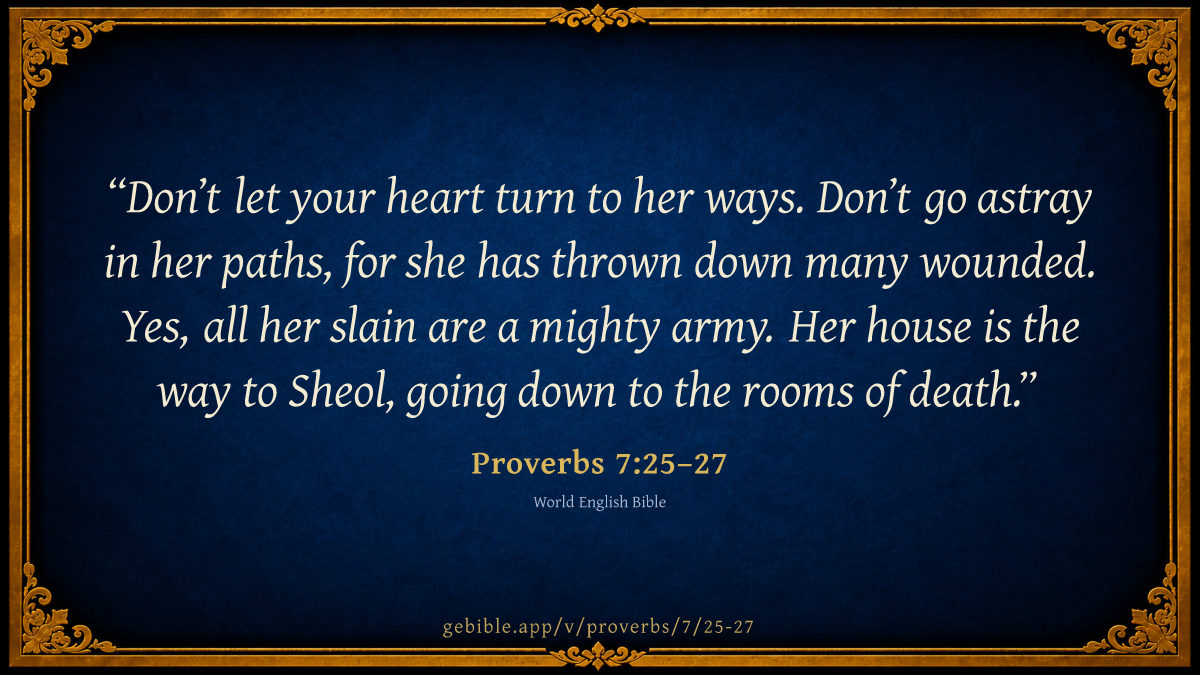
Pro 7:25 Let not thine heart decline to her ways, go not astray in her paths.
Ver. 25. Let not thine heart.] Think not of her, lust not after her. Thoughts and affections are sibi mutuo causae. "While I mused the fire burned," {Psa 39:3} so that thoughts kindle affections, and these cause thoughts to boil. See Job 31:1. See therefore that evil thoughts, though they rush into the heart, yet they rest not in it.
John Trapp, A Commentary or Exposition upon All the Books of the Old and New Testament (1647–1656) — public domain. Text from a community e-Sword module.
Matthew Poole1685 · Public DomainOn vv25–27Decline to her ways; either to the paths which…
Decline to her ways; either to the paths which lead to her house, or to her manner of living.
Matthew Poole's English Annotations on the Holy Bible (1683–1685) — public domain. Text from a community e-Sword/MySword module.
John Gill1763 · Public DomainOn vv25–26For she hath cast down many wounded,.... Wounded in…
For she hath cast down many wounded,.... Wounded in their name, character, and reputation; in their bodies by diseases; and in their souls by guilt, shame, and horror, through a compliance with her sinful lusts: these she "cast down" from the honours they were possessed of, from the health they enjoyed, and from the peace and tranquillity of mind they formerly felt within them. And not a single person, as the young man instanced in, or a few only, but "many"; great multitudes, hundreds and thousands, and those not weak, and foolish, and inconstant, as he might be thought to be; but such as were "great" (m) and mighty, as the word also signifies; men of great riches, and wisdom, and courage; as soldiers (n), mighty men of war, such as wound and kill others; which seems the true sense of the word here used: and therefore none ought to trust in themselves, nor trust themselves in her company, nor in the least decline to her ways; and especially such as are weak and unskilful, and ignorant of her devices, as the "children" here addressed;
yea, many strong men have been slain by her; men famous for martial exploits, as Samson and others, have been overcome by her: some of great fortitude of mind have not been able to withstand her, she has prevailed over them; and others of robust constitutions have been weakened by diseases, contracted through incontinency with her; and some have suffered death by her means, either from her husband, or her gallants, or the civil magistrate: and of these there have been "innumerable" instances; so the word (o) for "strong men" sometimes signifies; and so it is here rendered in the Septuagint and Arabic versions, "and innumerable are they whom she has slain". All the world have wondered after the whore of Rome; kings of the earth and mighty men have committed fornication with her; high and low, rich and poor, have been ruined by her; thousands have gone to hell by her means; and some of the sycophants of Rome have even said, that if the pope of Rome should send thousands to hell, of which they seem themselves to be conscious, no one should say to him, What dost thou?
Read full note →
(m) "multos magnosque", Gejerus. (n) See Dr. Kennicott's Dissert. 1. p. 110. (o) Sept. so Arab. "numerosi", Junius & Tremellius, Piscator, Amama, Cocceius, Michaelis, Schultens; so Bootius, Animadv. l. 4. c. 11. s. 2.
John Gill's Exposition of the Whole Bible (1746–1763) — public domain (CC PDM 1.0). Text via the HelloAO Bible API.
Adam Clarke1810 · Public DomainOn vv26–27Verse 26. For she hath cast down many wounded:…
Verse 26. For she hath cast down many wounded: yea, many strong men have been slain by her.] That is, such like women have been the ruin of many. חללים chalalim, which we render wounded, also signifies soldiers or men of war; and עצמים atsumim, which we render strong men, may be translated heroes. Many of those who have distinguished themselves in the field and in the cabinet have been overcome and destroyed by their mistresses. History is full of such examples.
Adam Clarke's Commentary on the Bible (1810–1826) — public domain. Text from a community e-Sword/MySword module.
Albert Barnes1834 · Public DomainOn v26The house of the harlot is now likened to…
The house of the harlot is now likened to a field of battle strewn with the corpses of the many slain.
Albert Barnes' Notes on the Bible (1834–1885) — public domain. Text from a community e-Sword/MySword module.
Haydock's Catholic Bible Commentary1859 · Public DomainOn vv26–27Her. Solomon gave a melancholy proof of this, as…
Her. Solomon gave a melancholy proof of this, as well as David, and Amnon. (Calmet)
George Leo Haydock (1774–1849), Haydock's Catholic Family Bible and Commentary, 1859 edition — public domain. Excludes Psalms (Douay-Rheims chapter numbering differs from Protestant) and Deuterocanonical books (Catholic canon only).
Robert Jamieson, A. R. Fausset & David Brown1871 · Public DomainOn v26Even the mightiest fail to resist her deathly allurements.
Even the mightiest fail to resist her deathly allurements.
Next: Proverbs Chapter 8
Jamieson, Fausset & Brown — Commentary Critical and Explanatory on the Whole Bible (1871) — public domain (CC PDM 1.0). Text via the HelloAO Bible API.
Daniel D. Whedon1874 · Public DomainOn vv26–2726. For she — That is, such women. She…
26. For she — That is, such women. She is taken representatively. The sentiment is: Innumerable mighty men, or mighty hosts, have thus been brought to ruin. If the strong are slain, how can you escape, if enticed into the snare? Miller, “For mighty men, when polluted, she has hurled down,” etc. “The most valiant heroes, the most puissant soldiers, that never yielded, but stood undaunted against all other assaults, have generally been vanquished, and frequently destroyed, by the allurements of women.” — Hammond. The fall of Hannibal’s army in Italy is an example in point. Compare Num_22:5, etc.; Pro_25:1, etc.
Daniel D. Whedon (gen. ed.), Commentary on the Old and New Testaments (1874–1909) — public domain. Text from a community e-Sword module.
The Cambridge Bible for Schools and Colleges1878 · Public DomainOn vv26–2726. many strong] This is the rendering of a…
26. many strong] This is the rendering of a single Heb. word, which may mean mighty, as it usually does, or (comp. the use of the verb in Psa_40:5; Psa_40:12 [Hebrews 6, 13]) many. Lit. mighty ones, or numerous ones, are all her slain, i.e. the whole number of those slain by her amount to a mighty host, as it is happily rendered in R.V. The thought is not so much of the individual strength of her victims as of their great number, as the parallelism indicates: ἀναρίθμητοί εἰσιν οὒς πεφόνευκε, “numberless are they whom she has slain,” LXX.
The Cambridge Bible for Schools and Colleges (gen. ed. J. J. S. Perowne; Cambridge University Press, 1878–1918) — public domain. Text from a community e-Sword module.
The Pulpit Commentary1880 · Public DomainOn vv25–27Let not thine heart decline to her ways. The…
Let not thine heart decline to her ways. The verb satah is used in Pro_4:15 (where see note) of turning aside from evil; but here, as Delitzsch notes, it is especially appropriate to the case of a faithless wife whose transgression, or declension from virtue, is described by this term. (Num_5:12) Go not astray in her paths. The LXX (in most manuscripts) has only one rendering for the two clauses: "Let not thine heart incline unto her ways."
The Pulpit Commentary (1880–1919), ed. H.D.M. Spence-Jones & Joseph S. Exell — public domain. Text from a community e-Sword module.
The Biblical Illustrator1887 · Public DomainOn v27Her house is the way to hell.
Pro_7:27
Her house is the way to hell.
Read full note →
The way to hell
An energetic expression. It is not the place itself, but the way to it. In this ease what is the difference between the way and the destination? The one is as the other, so much so that he who has entered the way may reckon upon it as a fatal certainty that he will accomplish the journey and be plunged into the chamber of death. No man means to go the whole length. A mans will is not destroyed in an instant; it is taken from him, as it were, little by little, and almost imperceptibly; he imagines that he is as strong as ever, and says that he will go out and shake himself as at other times, not knowing that the spirit of might has gone from him. Is there any object on earth more pathetic than that of a man who has lost his power of resistance to evil, and is dragged on, an unresisting victim, whithersoever the spirit of perdition may desire to take him? It is true that the young man can plead the power of fascination; all that music, and colour, and blandishment, and flattery can do has been done: the cloven foot has been most successfully concealed; the speech has been all garden, and paradise, and sweetness, and joy; the word hell, or perdition, has not been so much as mentioned. This is what is meant by seduction: leading a man out of himself, and from himself, onward and onward, by carefully graded processes, until fascination has accomplished its work, and bound the consenting soul in eternal bondage. (J. Parker, D. D.)
.
The Biblical Illustrator, edited by Joseph S. Exell (c. 1880s–1900s) — public domain. Text from a community e-Sword module.
C. I. Scofield1917 · Public DomainOn v27Heb. "Sheol," (See Scofield "Hab 2:5")
hell
Heb. "Sheol," (See Scofield "Hab 2:5")
The Scofield Reference Bible (1917 edition), notes by C. I. Scofield — public domain. Text from a community e-Sword module.
unfoldingWord translationNotes2017 · CC BY-SA 4.0On v26She has caused many people to fall down pierced
She has caused many people to fall down pierced
Being pierced by spears or arrows represents being killed. AT: "She has caused many people to fall dead" (See: Metonymy)
Read full note →
Her house is on the paths to Sheol ... they go down
Here "paths" represents the kinds of behavior that foolish people participate in. Sheol was the name for the world of the dead.
on the paths to Sheol ... down to the dark bedrooms of death
These two phrases basically mean the same thing and are repeated to emphasize that the woman's victims will be destroyed. (See: Parallelism)
the dark bedrooms of death
This expression pictures the dead as sleeping in many different rooms in Sheol. (See: Metaphor)
 GEBible — Godless Engineer's Bible App
Geneva Bible translators 1599 · Public Domain On v26 Neither wit nor strength can deliver them that fall…
Neither wit nor strength can deliver them that fall into the hands of the harlot.
Geneva Bible (1599) marginal notes — public domain.
John Trapp 1656 · Public Domain On vv25–27 Pro 7:25 Let not thine heart decline to her…
Pro 7:25 Let not thine heart decline to her ways, go not astray in her paths.
Ver. 25. Let not thine heart.] Think not of her, lust not after her. Thoughts and affections are sibi mutuo causae. "While I mused the fire burned," {Psa 39:3} so that thoughts kindle affections, and these cause thoughts to boil. See Job 31:1. See therefore that evil thoughts, though they rush into the heart, yet they rest not in it.
John Trapp, A Commentary or Exposition upon All the Books of the Old and New Testament (1647–1656) — public domain. Text from a community e-Sword module.
Matthew Poole 1685 · Public Domain On vv25–27 Decline to her ways; either to the paths which…
Decline to her ways; either to the paths which lead to her house, or to her manner of living.
Matthew Poole's English Annotations on the Holy Bible (1683–1685) — public domain. Text from a community e-Sword/MySword module.
John Gill 1763 · Public Domain On vv25–26 For she hath cast down many wounded,.... Wounded in…
For she hath cast down many wounded,.... Wounded in their name, character, and reputation; in their bodies by diseases; and in their souls by guilt, shame, and horror, through a compliance with her sinful lusts: these she "cast down" from the honours they were possessed of, from the health they enjoyed, and from the peace and tranquillity of mind they formerly felt within them. And not a single person, as the young man instanced in, or a few only, but "many"; great multitudes, hundreds and thousands, and those not weak, and foolish, and inconstant, as he might be thought to be; but such as were "great" (m) and mighty, as the word also signifies; men of great riches, and wisdom, and courage; as soldiers (n), mighty men of war, such as wound and kill others; which seems the true sense of the word here used: and therefore none ought to trust in themselves, nor trust themselves in her company, nor in the least decline to her ways; and especially such as are weak and unskilful, and ignorant of her devices, as the "children" here addressed;
yea, many strong men have been slain by her; men famous for martial exploits, as Samson and others, have been overcome by her: some of great fortitude of mind have not been able to withstand her, she has prevailed over them; and others of robust constitutions have been weakened by diseases, contracted through incontinency with her; and some have suffered death by her means, either from her husband, or her gallants, or the civil magistrate: and of these there have been "innumerable" instances; so the word (o) for "strong men" sometimes signifies; and so it is here rendered in the Septuagint and Arabic versions, "and innumerable are they whom she has slain". All the world have wondered after the whore of Rome; kings of the earth and mighty men have committed fornication with her; high and low, rich and poor, have been ruined by her; thousands have gone to hell by her means; and some of the sycophants of Rome have even said, that if the pope of Rome should send thousands to hell, of which they seem themselves to be conscious, no one should say to him, What dost thou?
Read full note →
(m) "multos magnosque", Gejerus. (n) See Dr. Kennicott's Dissert. 1. p. 110. (o) Sept. so Arab. "numerosi", Junius & Tremellius, Piscator, Amama, Cocceius, Michaelis, Schultens; so Bootius, Animadv. l. 4. c. 11. s. 2.
John Gill's Exposition of the Whole Bible (1746–1763) — public domain (CC PDM 1.0). Text via the HelloAO Bible API.
Adam Clarke 1810 · Public Domain On vv26–27 Verse 26. For she hath cast down many wounded:…
Verse 26. For she hath cast down many wounded: yea, many strong men have been slain by her.] That is, such like women have been the ruin of many. חללים chalalim, which we render wounded, also signifies soldiers or men of war; and עצמים atsumim, which we render strong men, may be translated heroes. Many of those who have distinguished themselves in the field and in the cabinet have been overcome and destroyed by their mistresses. History is full of such examples.
Adam Clarke's Commentary on the Bible (1810–1826) — public domain. Text from a community e-Sword/MySword module.
Albert Barnes 1834 · Public Domain On v26 The house of the harlot is now likened to…
The house of the harlot is now likened to a field of battle strewn with the corpses of the many slain.
Albert Barnes' Notes on the Bible (1834–1885) — public domain. Text from a community e-Sword/MySword module.
Haydock's Catholic Bible Commentary 1859 · Public Domain On vv26–27 Her. Solomon gave a melancholy proof of this, as…
Her. Solomon gave a melancholy proof of this, as well as David, and Amnon. (Calmet)
George Leo Haydock (1774–1849), Haydock's Catholic Family Bible and Commentary, 1859 edition — public domain. Excludes Psalms (Douay-Rheims chapter numbering differs from Protestant) and Deuterocanonical books (Catholic canon only).
Robert Jamieson, A. R. Fausset & David Brown 1871 · Public Domain On v26 Even the mightiest fail to resist her deathly allurements.
Even the mightiest fail to resist her deathly allurements.
Next: Proverbs Chapter 8
Jamieson, Fausset & Brown — Commentary Critical and Explanatory on the Whole Bible (1871) — public domain (CC PDM 1.0). Text via the HelloAO Bible API.
Daniel D. Whedon 1874 · Public Domain On vv26–27 26. For she — That is, such women. She…
26. For she — That is, such women. She is taken representatively. The sentiment is: Innumerable mighty men, or mighty hosts, have thus been brought to ruin. If the strong are slain, how can you escape, if enticed into the snare? Miller, “For mighty men, when polluted, she has hurled down,” etc. “The most valiant heroes, the most puissant soldiers, that never yielded, but stood undaunted against all other assaults, have generally been vanquished, and frequently destroyed, by the allurements of women.” — Hammond. The fall of Hannibal’s army in Italy is an example in point. Compare Num_22:5, etc.; Pro_25:1, etc.
Daniel D. Whedon (gen. ed.), Commentary on the Old and New Testaments (1874–1909) — public domain. Text from a community e-Sword module.
The Cambridge Bible for Schools and Colleges 1878 · Public Domain On vv26–27 26. many strong] This is the rendering of a…
26. many strong] This is the rendering of a single Heb. word, which may mean mighty, as it usually does, or (comp. the use of the verb in Psa_40:5; Psa_40:12 [Hebrews 6, 13]) many. Lit. mighty ones, or numerous ones, are all her slain, i.e. the whole number of those slain by her amount to a mighty host, as it is happily rendered in R.V. The thought is not so much of the individual strength of her victims as of their great number, as the parallelism indicates: ἀναρίθμητοί εἰσιν οὒς πεφόνευκε, “numberless are they whom she has slain,” LXX.
The Cambridge Bible for Schools and Colleges (gen. ed. J. J. S. Perowne; Cambridge University Press, 1878–1918) — public domain. Text from a community e-Sword module.
The Pulpit Commentary 1880 · Public Domain On vv25–27 Let not thine heart decline to her ways. The…
Let not thine heart decline to her ways. The verb satah is used in Pro_4:15 (where see note) of turning aside from evil; but here, as Delitzsch notes, it is especially appropriate to the case of a faithless wife whose transgression, or declension from virtue, is described by this term. (Num_5:12) Go not astray in her paths. The LXX (in most manuscripts) has only one rendering for the two clauses: "Let not thine heart incline unto her ways."
The Pulpit Commentary (1880–1919), ed. H.D.M. Spence-Jones & Joseph S. Exell — public domain. Text from a community e-Sword module.
The Biblical Illustrator 1887 · Public Domain On v27 Her house is the way to hell.
Pro_7:27
Her house is the way to hell.
Read full note →
The way to hell
An energetic expression. It is not the place itself, but the way to it. In this ease what is the difference between the way and the destination? The one is as the other, so much so that he who has entered the way may reckon upon it as a fatal certainty that he will accomplish the journey and be plunged into the chamber of death. No man means to go the whole length. A mans will is not destroyed in an instant; it is taken from him, as it were, little by little, and almost imperceptibly; he imagines that he is as strong as ever, and says that he will go out and shake himself as at other times, not knowing that the spirit of might has gone from him. Is there any object on earth more pathetic than that of a man who has lost his power of resistance to evil, and is dragged on, an unresisting victim, whithersoever the spirit of perdition may desire to take him? It is true that the young man can plead the power of fascination; all that music, and colour, and blandishment, and flattery can do has been done: the cloven foot has been most successfully concealed; the speech has been all garden, and paradise, and sweetness, and joy; the word hell, or perdition, has not been so much as mentioned. This is what is meant by seduction: leading a man out of himself, and from himself, onward and onward, by carefully graded processes, until fascination has accomplished its work, and bound the consenting soul in eternal bondage. (J. Parker, D. D.)
.
The Biblical Illustrator, edited by Joseph S. Exell (c. 1880s–1900s) — public domain. Text from a community e-Sword module.
C. I. Scofield 1917 · Public Domain On v27 Heb. "Sheol," (See Scofield "Hab 2:5")
hell
Heb. "Sheol," (See Scofield "Hab 2:5")
The Scofield Reference Bible (1917 edition), notes by C. I. Scofield — public domain. Text from a community e-Sword module.
unfoldingWord translationNotes 2017 · CC BY-SA 4.0 On v26 She has caused many people to fall down pierced
She has caused many people to fall down pierced
Being pierced by spears or arrows represents being killed. AT: "She has caused many people to fall dead" (See: Metonymy)
Read full note →
Her house is on the paths to Sheol ... they go down
Here "paths" represents the kinds of behavior that foolish people participate in. Sheol was the name for the world of the dead.
on the paths to Sheol ... down to the dark bedrooms of death
These two phrases basically mean the same thing and are repeated to emphasize that the woman's victims will be destroyed. (See: Parallelism)
the dark bedrooms of death
This expression pictures the dead as sleeping in many different rooms in Sheol. (See: Metaphor)
translationWords
Hades
die
unfoldingWord translationNotes — © Distant Shores Media and the Door43 World Missions Community, licensed CC BY-SA 4.0. Source: git.door43.org/Door43/en_tn.